Prediction of improvement in Students
academic performance with
implementation of experiential learning
using Classification Models
xbxbb
ABSTRACT
The National Education Policy (NEP) is a comprehensive framework designed to
bring about significant improvements to a nation's educational system. One of
the main goals of the NEP 2020 is to encourage students to engage in
"experiential learning and critical thinking."Experiential learning is vital because
it engages learners actively in the learning process, fostering deeper
understanding and retention of knowledge. Through hands-on experiences,
individuals can apply theoretical concepts to real-world situations, enhancing
their problem-solving skills and critical thinking abilities. Additionally,
experiential learning promotes personal growth, encourages creativity, and
cultivates a sense of self-efficacy and confidence in learners. The main goal of
this paper is to predict how this experiental learning can bring improvement in
students academic performance using classification models
INTRODUCTION
 An extensive framework for the advancement of education in India is
provided by the National Education Policy (NEP) 2020. On July 29, 2020, the
Union Cabinet of India gave it approval. Its goal is to modernize the
educational system to suit the demands of the twenty-first century. The
National Policy on Education, 1986 was superseded by the NEP 2020, which
was developed following considerable stakeholder input and consultations
from a range of industries. In India, experiential learning is a fundamental
part of the National Education Policy (NEP) 2020. The policy places a strong
emphasis on the value of practical, hands-on learning experiences that help
students apply their theoretical knowledge to actual situations. Students'
overall growth is aided by experiential learning, which encourages active
learning, skill development, creativity, and community involvement. The
objective of this paper is to predict how implementation of Experiential
Learning will impact students academic performance through application of
Decision tree and Random Forest classifier.
CLASSIFICATION
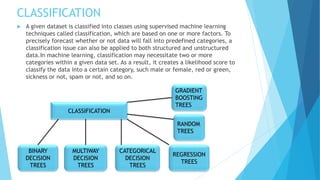
 A given dataset is classified into classes using supervised machine learning
techniques called classification, which are based on one or more factors. To
precisely forecast whether or not data will fall into predefined categories, a
classification issue can also be applied to both structured and unstructured
data.In machine learning, classification may necessitate two or more
categories within a given data set. As a result, it creates a likelihood score to
classify the data into a certain category, such male or female, red or green,
sickness or not, spam or not, and so on.
CLASSIFICATION
BINARY
DECISION
TREES
MULTIWAY
DECISION
TREES
CATEGORICAL
DECISION
TREES
REGRESSION
TREES
RANDOM
TREES
GRADIENT
BOOSTING
TREES
BINARY DECISION TREES
 Decision trees in binary form are the most basic type, with each internal
node having exactly two branches that lead to two child nodes. Each internal
node divides the data into two groups by making a decision based on the
value of a feature.
MULTIWAY DECISION TREES
 These decision trees permit more than two branches at each internal node,
in contrast to binary decision trees. This implies that nodes can have many
branches corresponding to distinct feature values in place of binary splits.
CATEGORICAL DECISION TREES
 Decision trees that are specifically made for datasets that contain
categorical (nominal) attributes are known as categorical decision trees.
Because these trees naturally handle categorical data, splits based on
discrete categories as opposed to continuous values are possible.
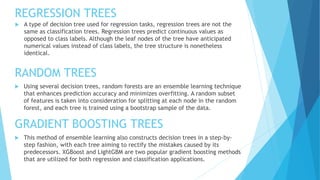
REGRESSION TREES
 A type of decision tree used for regression tasks, regression trees are not the
same as classification trees. Regression trees predict continuous values as
opposed to class labels. Although the leaf nodes of the tree have anticipated
numerical values instead of class labels, the tree structure is nonetheless
identical.
RANDOM TREES
 Using several decision trees, random forests are an ensemble learning technique
that enhances prediction accuracy and minimizes overfitting. A random subset
of features is taken into consideration for splitting at each node in the random
forest, and each tree is trained using a bootstrap sample of the data.
GRADIENT BOOSTING TREES
 This method of ensemble learning also constructs decision trees in a step-by-
step fashion, with each tree aiming to rectify the mistakes caused by its
predecessors. XGBoost and LightGBM are two popular gradient boosting methods
that are utilized for both regression and classification applications.
METHODOLOGY
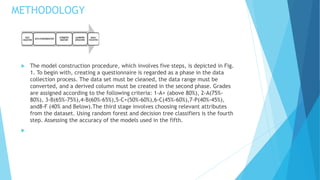
 The model construction procedure, which involves five steps, is depicted in Fig.
1. To begin with, creating a questionnaire is regarded as a phase in the data
collection process. The data set must be cleaned, the data range must be
converted, and a derived column must be created in the second phase. Grades
are assigned according to the following criteria: 1-A+ (above 80%), 2-A(75%-
80%), 3-B(65%-75%),4-B(60%-65%),5-C+(50%-60%),6-C(45%-60%),7-P(40%-45%),
and8-F (40% and Below).The third stage involves choosing relevant attributes
from the dataset. Using random forest and decision tree classifiers is the fourth
step. Assessing the accuracy of the models used in the fifth.

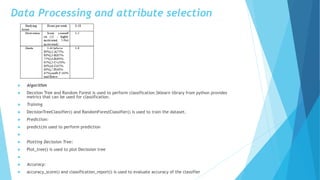
Data Processing and attribute selection
 Algorithm
 Decsiion Tree and Random Forest is used to perform classification.Sklearn library from python provides
metrics that can be used for classification.
 Training
 DecisionTreeClassifier() and RandomForestClassifier() is used to train the dataset.
 Prediction:
 predict()is used to perform prediction

 Plotting Decission Tree:
 Plot_tree() is used to plot Decission tree

 Accuracy:
 accuracy_score() and classification_report() is used to evaluate accuracy of the classifier
Experiental learning.pptx with expert learning

Experiental learning.pptx with expert learning

  • 1.
    Prediction of improvementin Students academic performance with implementation of experiential learning using Classification Models xbxbb
  • 2.
    ABSTRACT The National EducationPolicy (NEP) is a comprehensive framework designed to bring about significant improvements to a nation's educational system. One of the main goals of the NEP 2020 is to encourage students to engage in "experiential learning and critical thinking."Experiential learning is vital because it engages learners actively in the learning process, fostering deeper understanding and retention of knowledge. Through hands-on experiences, individuals can apply theoretical concepts to real-world situations, enhancing their problem-solving skills and critical thinking abilities. Additionally, experiential learning promotes personal growth, encourages creativity, and cultivates a sense of self-efficacy and confidence in learners. The main goal of this paper is to predict how this experiental learning can bring improvement in students academic performance using classification models
  • 3.
    INTRODUCTION  An extensiveframework for the advancement of education in India is provided by the National Education Policy (NEP) 2020. On July 29, 2020, the Union Cabinet of India gave it approval. Its goal is to modernize the educational system to suit the demands of the twenty-first century. The National Policy on Education, 1986 was superseded by the NEP 2020, which was developed following considerable stakeholder input and consultations from a range of industries. In India, experiential learning is a fundamental part of the National Education Policy (NEP) 2020. The policy places a strong emphasis on the value of practical, hands-on learning experiences that help students apply their theoretical knowledge to actual situations. Students' overall growth is aided by experiential learning, which encourages active learning, skill development, creativity, and community involvement. The objective of this paper is to predict how implementation of Experiential Learning will impact students academic performance through application of Decision tree and Random Forest classifier.
  • 4.
    CLASSIFICATION  A givendataset is classified into classes using supervised machine learning techniques called classification, which are based on one or more factors. To precisely forecast whether or not data will fall into predefined categories, a classification issue can also be applied to both structured and unstructured data.In machine learning, classification may necessitate two or more categories within a given data set. As a result, it creates a likelihood score to classify the data into a certain category, such male or female, red or green, sickness or not, spam or not, and so on. CLASSIFICATION BINARY DECISION TREES MULTIWAY DECISION TREES CATEGORICAL DECISION TREES REGRESSION TREES RANDOM TREES GRADIENT BOOSTING TREES
  • 5.
    BINARY DECISION TREES Decision trees in binary form are the most basic type, with each internal node having exactly two branches that lead to two child nodes. Each internal node divides the data into two groups by making a decision based on the value of a feature. MULTIWAY DECISION TREES  These decision trees permit more than two branches at each internal node, in contrast to binary decision trees. This implies that nodes can have many branches corresponding to distinct feature values in place of binary splits. CATEGORICAL DECISION TREES  Decision trees that are specifically made for datasets that contain categorical (nominal) attributes are known as categorical decision trees. Because these trees naturally handle categorical data, splits based on discrete categories as opposed to continuous values are possible.
  • 6.
    REGRESSION TREES  Atype of decision tree used for regression tasks, regression trees are not the same as classification trees. Regression trees predict continuous values as opposed to class labels. Although the leaf nodes of the tree have anticipated numerical values instead of class labels, the tree structure is nonetheless identical. RANDOM TREES  Using several decision trees, random forests are an ensemble learning technique that enhances prediction accuracy and minimizes overfitting. A random subset of features is taken into consideration for splitting at each node in the random forest, and each tree is trained using a bootstrap sample of the data. GRADIENT BOOSTING TREES  This method of ensemble learning also constructs decision trees in a step-by- step fashion, with each tree aiming to rectify the mistakes caused by its predecessors. XGBoost and LightGBM are two popular gradient boosting methods that are utilized for both regression and classification applications.
  • 7.
    METHODOLOGY  The modelconstruction procedure, which involves five steps, is depicted in Fig. 1. To begin with, creating a questionnaire is regarded as a phase in the data collection process. The data set must be cleaned, the data range must be converted, and a derived column must be created in the second phase. Grades are assigned according to the following criteria: 1-A+ (above 80%), 2-A(75%- 80%), 3-B(65%-75%),4-B(60%-65%),5-C+(50%-60%),6-C(45%-60%),7-P(40%-45%), and8-F (40% and Below).The third stage involves choosing relevant attributes from the dataset. Using random forest and decision tree classifiers is the fourth step. Assessing the accuracy of the models used in the fifth. 
  • 8.
    Data Processing andattribute selection  Algorithm  Decsiion Tree and Random Forest is used to perform classification.Sklearn library from python provides metrics that can be used for classification.  Training  DecisionTreeClassifier() and RandomForestClassifier() is used to train the dataset.  Prediction:  predict()is used to perform prediction   Plotting Decission Tree:  Plot_tree() is used to plot Decission tree   Accuracy:  accuracy_score() and classification_report() is used to evaluate accuracy of the classifier