Active Learning (ML)
Akhilesh Ravi
Indian Institute of Technology Gandhinagar
What is active learning?
● Let us say that you have some data.
● You want to apply a machine learning technique to classify
the data.
● No labelled samples or a very small number of labelled
samples, and a large amount of data.
● Labelling each sample is expensive.
● What will you do?
What is active learning?
Image Source: https://www.datacamp.com/community/tutorials/active-learning
What is active learning?
“The key idea behind active learning is that a machine learning algorithm
can perform better with less training if it is allowed to choose the data from
which it learns.”[1]
● It gives the samples to be labelled in such a way that with less labelled
samples, the machine learning model performs well - it chooses the
optimal set of samples to be labelled for good performance
● We could say that the model actively learns and sees what to learn next
so that it can perform better.
References:
1. Settles, Burr. Active learning literature survey. University of Wisconsin-Madison Department of Computer Sciences, 2009.
2. "Active Learning (Machine Learning)". En.Wikipedia.Org, 2020,
https://en.wikipedia.org/wiki/Active_learning_(machine_learning)#cite_note-settles-1. Accessed 31 Oct 2020.
Steps in Active Learning
● Train the model on the labelled data.
● Evaluate the model on all the unlabelled samples.
● Based on the evaluation, choose the sample/list of samples
to be labelled.
● Label these samples and add them to the labelled data.
● Repeat the above steps till a certain condition (stopping
criterion)
An Important Component
Oracle - person or a model that knows the correct
answer/classification/prediction to all questions/queries.[1][2]
Practically, an expert in the corresponding field would be
considered as an oracle.
1. Hosein, Stefan. "A Beginner's Guide To Active Learning". DatacampCommunity, 2020, https://www.datacamp.com/community/tutorials/active-learning. Accessed 31 Oct 2020.
2. "Active Learning (Machine Learning)". En.Wikipedia.Org, 2020, https://en.wikipedia.org/wiki/Active_learning_(machine_learning)#cite_note-settles-1. Accessed 31 Oct 2020.
Active learning - Scenarios
Active Learning - Scenarios
● Membership Query Synthesis
● Pool-based Sampling
● Stream-based Selective Sampling
Membership Query Synthesis
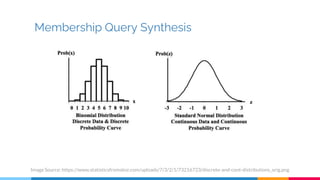
● The learner has a distribution made from the original data.
● The learner generates a sample from this distribution.
● The oracle gives the prediction for the sample
● This is added to the dataset that the learner uses for learning
References
1. Hosein, Stefan. "A Beginner's Guide To Active Learning". DatacampCommunity, 2020, https://www.datacamp.com/community/tutorials/active-learning. Accessed 31 Oct 2020.
2. "Active Learning (Machine Learning)". En.Wikipedia.Org, 2020, https://en.wikipedia.org/wiki/Active_learning_(machine_learning)#cite_note-settles-1. Accessed 31 Oct 2020.
Membership Query Synthesis
Image Source: https://www.statisticsfromatoz.com/uploads/7/3/2/1/73216723/discrete-and-cont-distributions_orig.png
Pool-based Sampling
● A data pool of unlabelled samples
● Informativeness score - assigned to all the samples in the pool
or a subset of pool if the pool is very large.
● The most informative sample(s) is(are) selected.
● Depending on the configuration ,one sample can be chosen
each time or a few samples can be chosen each time.
● These are labelled and added to the dataset that the learner
uses for learning.
References
1. Hosein, Stefan. "A Beginner's Guide To Active Learning". DatacampCommunity, 2020, https://www.datacamp.com/community/tutorials/active-learning. Accessed 31 Oct 2020.
2. "Active Learning (Machine Learning)". En.Wikipedia.Org, 2020, https://en.wikipedia.org/wiki/Active_learning_(machine_learning)#cite_note-settles-1. Accessed 31 Oct 2020.
Pool-based Sampling
Image Source: https://www.datacamp.com/community/tutorials/active-learning
Stream-based Selective Sampling
● Assumption: Getting an unlabelled sample is free
● The samples are taken one by one and examined
● Based on an informativeness score for each sample, decide
whether an instance has to be labelled in this iteration or not.
● Many iterations
References
1. Hosein, Stefan. "A Beginner's Guide To Active Learning". DatacampCommunity, 2020, https://www.datacamp.com/community/tutorials/active-learning. Accessed 31 Oct 2020.
2. "Active Learning (Machine Learning)". En.Wikipedia.Org, 2020, https://en.wikipedia.org/wiki/Active_learning_(machine_learning)#cite_note-settles-1. Accessed 31 Oct 2020.
Query Strategies
Query Strategies
There are many query strategies.[1][2] Here are three common
strategies:
● Least Confidence
● Margin Sampling
● Entropy Sampling
1. Hosein, Stefan. "A Beginner's Guide To Active Learning". DatacampCommunity, 2020, https://www.datacamp.com/community/tutorials/active-learning. Accessed 31 Oct 2020.
2. "Active Learning (Machine Learning)". En.Wikipedia.Org, 2020, https://en.wikipedia.org/wiki/Active_learning_(machine_learning)#cite_note-settles-1. Accessed 31 Oct 2020.
Query Strategies - Least Confidence
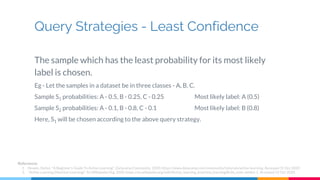
The sample which has the least probability for its most likely
label is chosen.
Eg - Let the samples in a dataset be in three classes - A, B, C.
Sample S1 probabilities: A - 0.5, B - 0.25, C - 0.25 Most likely label: A (0.5)
Sample S2 probabilities: A - 0.1, B - 0.8, C - 0.1 Most likely label: B (0.8)
Here, S1 will be chosen according to the above query strategy.
References
1. Hosein, Stefan. "A Beginner's Guide To Active Learning". DatacampCommunity, 2020, https://www.datacamp.com/community/tutorials/active-learning. Accessed 31 Oct 2020.
2. "Active Learning (Machine Learning)". En.Wikipedia.Org, 2020, https://en.wikipedia.org/wiki/Active_learning_(machine_learning)#cite_note-settles-1. Accessed 31 Oct 2020.
Query Strategies - Margin Sampling
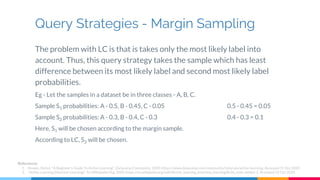
The problem with LC is that is takes only the most likely label into
account. Thus, this query strategy takes the sample which has least
difference between its most likely label and second most likely label
probabilities.
Eg - Let the samples in a dataset be in three classes - A, B, C.
Sample S1 probabilities: A - 0.5, B - 0.45, C - 0.05 0.5 - 0.45 = 0.05
Sample S2 probabilities: A - 0.3, B - 0.4, C - 0.3 0.4 - 0.3 = 0.1
Here, S1 will be chosen according to the margin sample.
According to LC, S2 will be chosen.
References
1. Hosein, Stefan. "A Beginner's Guide To Active Learning". DatacampCommunity, 2020, https://www.datacamp.com/community/tutorials/active-learning. Accessed 31 Oct 2020.
2. "Active Learning (Machine Learning)". En.Wikipedia.Org, 2020, https://en.wikipedia.org/wiki/Active_learning_(machine_learning)#cite_note-settles-1. Accessed 31 Oct 2020.
LC takes only most likely label into account and margin sampling
sampling takes the top two likely labels into account. Entropy sampling
uses the probability of all possible labels. This is done using the metric
called entropy. The sample with the largest entropy is selected.
Query Strategies - Entropy Sampling
References
1. Hosein, Stefan. "A Beginner's Guide To Active Learning". DatacampCommunity, 2020, https://www.datacamp.com/community/tutorials/active-learning. Accessed 31 Oct 2020.
2. "Active Learning (Machine Learning)". En.Wikipedia.Org, 2020, https://en.wikipedia.org/wiki/Active_learning_(machine_learning)#cite_note-settles-1. Accessed 31 Oct 2020.
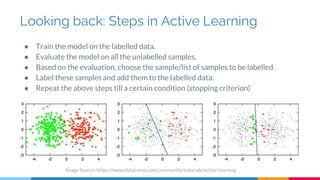
Looking back: Steps in Active Learning
● Train the model on the labelled data.
● Evaluate the model on all the unlabelled samples.
● Based on the evaluation, choose the sample/list of samples to be labelled.
● Label these samples and add them to the labelled data.
● Repeat the above steps till a certain condition (stopping criterion)
Image Source: https://www.datacamp.com/community/tutorials/active-learning
Advantages of Active Learning
● Eases the problem of lack of labelled data; only a
fraction of the data has to be labelled
● Can be applied for online learning scenarios - many
practical scenarios in industries involve online learning
Application Areas of Active Learning
● Natural Language Processing[1]
○ Lots of data to label
● Reinforcement Learning
● Online Learning
○ Lot of data coming in continuously
○ Spam filters, ranking of search results, job listings, etc.[2]
References
1. Hosein, Stefan. "A Beginner's Guide To Active Learning". DatacampCommunity, 2020, https://www.datacamp.com/community/tutorials/active-learning. Accessed 31 Oct 2020.
2. https://www.oreilly.com/content/real-world-active-learning/
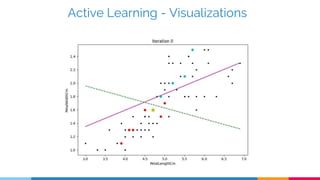
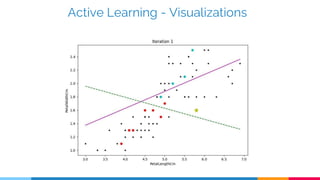
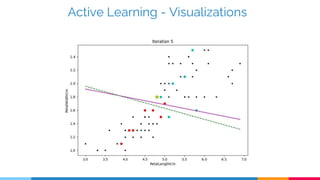
Active learning - Visualizations
Active Learning - Visualizations
Iris Dataset
Versicolor - red
Virginica -
cyan/light blue
Source: https://www.kaggle.com/uciml/iris
Active Learning - Visualizations
Tutorial on Active Learning
Active Learning Tutorial - bit.ly/medium-active-learning
Images
1. Towards Data Science Logo - https://miro.medium.com/max/1200/1*F0LADxTtsKOgmPa-_7iUEQ.jpeg
2. Medium.com Logo - https://miro.medium.com/max/8978/1*s986xIGqhfsN8U--09_AdA.png
References
Datacamp.org -
https://www.datacamp.com/community/tutorials/active-learning
Wikipedia.org -
https://en.wikipedia.org/wiki/Active_learning_(machine_learning)
Thank you

Active learning

  • 1.
    Active Learning (ML) AkhileshRavi Indian Institute of Technology Gandhinagar
  • 2.
    What is activelearning? ● Let us say that you have some data. ● You want to apply a machine learning technique to classify the data. ● No labelled samples or a very small number of labelled samples, and a large amount of data. ● Labelling each sample is expensive. ● What will you do?
  • 3.
    What is activelearning? Image Source: https://www.datacamp.com/community/tutorials/active-learning
  • 4.
    What is activelearning?
  • 5.
    What is activelearning? “The key idea behind active learning is that a machine learning algorithm can perform better with less training if it is allowed to choose the data from which it learns.”[1] ● It gives the samples to be labelled in such a way that with less labelled samples, the machine learning model performs well - it chooses the optimal set of samples to be labelled for good performance ● We could say that the model actively learns and sees what to learn next so that it can perform better. References: 1. Settles, Burr. Active learning literature survey. University of Wisconsin-Madison Department of Computer Sciences, 2009. 2. "Active Learning (Machine Learning)". En.Wikipedia.Org, 2020, https://en.wikipedia.org/wiki/Active_learning_(machine_learning)#cite_note-settles-1. Accessed 31 Oct 2020.
  • 6.
    Steps in ActiveLearning ● Train the model on the labelled data. ● Evaluate the model on all the unlabelled samples. ● Based on the evaluation, choose the sample/list of samples to be labelled. ● Label these samples and add them to the labelled data. ● Repeat the above steps till a certain condition (stopping criterion)
  • 7.
    An Important Component Oracle- person or a model that knows the correct answer/classification/prediction to all questions/queries.[1][2] Practically, an expert in the corresponding field would be considered as an oracle. 1. Hosein, Stefan. "A Beginner's Guide To Active Learning". DatacampCommunity, 2020, https://www.datacamp.com/community/tutorials/active-learning. Accessed 31 Oct 2020. 2. "Active Learning (Machine Learning)". En.Wikipedia.Org, 2020, https://en.wikipedia.org/wiki/Active_learning_(machine_learning)#cite_note-settles-1. Accessed 31 Oct 2020.
  • 8.
  • 9.
    Active Learning -Scenarios ● Membership Query Synthesis ● Pool-based Sampling ● Stream-based Selective Sampling
  • 10.
    Membership Query Synthesis ●The learner has a distribution made from the original data. ● The learner generates a sample from this distribution. ● The oracle gives the prediction for the sample ● This is added to the dataset that the learner uses for learning References 1. Hosein, Stefan. "A Beginner's Guide To Active Learning". DatacampCommunity, 2020, https://www.datacamp.com/community/tutorials/active-learning. Accessed 31 Oct 2020. 2. "Active Learning (Machine Learning)". En.Wikipedia.Org, 2020, https://en.wikipedia.org/wiki/Active_learning_(machine_learning)#cite_note-settles-1. Accessed 31 Oct 2020.
  • 11.
    Membership Query Synthesis ImageSource: https://www.statisticsfromatoz.com/uploads/7/3/2/1/73216723/discrete-and-cont-distributions_orig.png
  • 12.
    Pool-based Sampling ● Adata pool of unlabelled samples ● Informativeness score - assigned to all the samples in the pool or a subset of pool if the pool is very large. ● The most informative sample(s) is(are) selected. ● Depending on the configuration ,one sample can be chosen each time or a few samples can be chosen each time. ● These are labelled and added to the dataset that the learner uses for learning. References 1. Hosein, Stefan. "A Beginner's Guide To Active Learning". DatacampCommunity, 2020, https://www.datacamp.com/community/tutorials/active-learning. Accessed 31 Oct 2020. 2. "Active Learning (Machine Learning)". En.Wikipedia.Org, 2020, https://en.wikipedia.org/wiki/Active_learning_(machine_learning)#cite_note-settles-1. Accessed 31 Oct 2020.
  • 13.
    Pool-based Sampling Image Source:https://www.datacamp.com/community/tutorials/active-learning
  • 14.
    Stream-based Selective Sampling Stream-basedSelective Sampling ● Assumption: Getting an unlabelled sample is free ● The samples are taken one by one and examined ● Based on an informativeness score for each sample, decide whether an instance has to be labelled in this iteration or not. ● Many iterations References 1. Hosein, Stefan. "A Beginner's Guide To Active Learning". DatacampCommunity, 2020, https://www.datacamp.com/community/tutorials/active-learning. Accessed 31 Oct 2020. 2. "Active Learning (Machine Learning)". En.Wikipedia.Org, 2020, https://en.wikipedia.org/wiki/Active_learning_(machine_learning)#cite_note-settles-1. Accessed 31 Oct 2020.
  • 15.
  • 16.
    Query Strategies There aremany query strategies.[1][2] Here are three common strategies: ● Least Confidence ● Margin Sampling ● Entropy Sampling 1. Hosein, Stefan. "A Beginner's Guide To Active Learning". DatacampCommunity, 2020, https://www.datacamp.com/community/tutorials/active-learning. Accessed 31 Oct 2020. 2. "Active Learning (Machine Learning)". En.Wikipedia.Org, 2020, https://en.wikipedia.org/wiki/Active_learning_(machine_learning)#cite_note-settles-1. Accessed 31 Oct 2020.
  • 17.
    Query Strategies -Least Confidence The sample which has the least probability for its most likely label is chosen. Eg - Let the samples in a dataset be in three classes - A, B, C. Sample S1 probabilities: A - 0.5, B - 0.25, C - 0.25 Most likely label: A (0.5) Sample S2 probabilities: A - 0.1, B - 0.8, C - 0.1 Most likely label: B (0.8) Here, S1 will be chosen according to the above query strategy. References 1. Hosein, Stefan. "A Beginner's Guide To Active Learning". DatacampCommunity, 2020, https://www.datacamp.com/community/tutorials/active-learning. Accessed 31 Oct 2020. 2. "Active Learning (Machine Learning)". En.Wikipedia.Org, 2020, https://en.wikipedia.org/wiki/Active_learning_(machine_learning)#cite_note-settles-1. Accessed 31 Oct 2020.
  • 18.
    Query Strategies -Margin Sampling The problem with LC is that is takes only the most likely label into account. Thus, this query strategy takes the sample which has least difference between its most likely label and second most likely label probabilities. Eg - Let the samples in a dataset be in three classes - A, B, C. Sample S1 probabilities: A - 0.5, B - 0.45, C - 0.05 0.5 - 0.45 = 0.05 Sample S2 probabilities: A - 0.3, B - 0.4, C - 0.3 0.4 - 0.3 = 0.1 Here, S1 will be chosen according to the margin sample. According to LC, S2 will be chosen. References 1. Hosein, Stefan. "A Beginner's Guide To Active Learning". DatacampCommunity, 2020, https://www.datacamp.com/community/tutorials/active-learning. Accessed 31 Oct 2020. 2. "Active Learning (Machine Learning)". En.Wikipedia.Org, 2020, https://en.wikipedia.org/wiki/Active_learning_(machine_learning)#cite_note-settles-1. Accessed 31 Oct 2020.
  • 19.
    LC takes onlymost likely label into account and margin sampling sampling takes the top two likely labels into account. Entropy sampling uses the probability of all possible labels. This is done using the metric called entropy. The sample with the largest entropy is selected. Query Strategies - Entropy Sampling References 1. Hosein, Stefan. "A Beginner's Guide To Active Learning". DatacampCommunity, 2020, https://www.datacamp.com/community/tutorials/active-learning. Accessed 31 Oct 2020. 2. "Active Learning (Machine Learning)". En.Wikipedia.Org, 2020, https://en.wikipedia.org/wiki/Active_learning_(machine_learning)#cite_note-settles-1. Accessed 31 Oct 2020.
  • 20.
    Looking back: Stepsin Active Learning ● Train the model on the labelled data. ● Evaluate the model on all the unlabelled samples. ● Based on the evaluation, choose the sample/list of samples to be labelled. ● Label these samples and add them to the labelled data. ● Repeat the above steps till a certain condition (stopping criterion) Image Source: https://www.datacamp.com/community/tutorials/active-learning
  • 21.
    Advantages of ActiveLearning ● Eases the problem of lack of labelled data; only a fraction of the data has to be labelled ● Can be applied for online learning scenarios - many practical scenarios in industries involve online learning
  • 22.
    Application Areas ofActive Learning ● Natural Language Processing[1] ○ Lots of data to label ● Reinforcement Learning ● Online Learning ○ Lot of data coming in continuously ○ Spam filters, ranking of search results, job listings, etc.[2] References 1. Hosein, Stefan. "A Beginner's Guide To Active Learning". DatacampCommunity, 2020, https://www.datacamp.com/community/tutorials/active-learning. Accessed 31 Oct 2020. 2. https://www.oreilly.com/content/real-world-active-learning/
  • 23.
    Active learning -Visualizations
  • 24.
    Active Learning -Visualizations Iris Dataset Versicolor - red Virginica - cyan/light blue Source: https://www.kaggle.com/uciml/iris
  • 25.
    Active Learning -Visualizations
  • 26.
    Active Learning -Visualizations
  • 27.
    Active Learning -Visualizations
  • 28.
    Active Learning -Visualizations
  • 29.
    Active Learning -Visualizations
  • 30.
    Active Learning -Visualizations
  • 31.
    Active Learning -Visualizations
  • 32.
    Active Learning -Visualizations
  • 33.
    Tutorial on ActiveLearning Active Learning Tutorial - bit.ly/medium-active-learning Images 1. Towards Data Science Logo - https://miro.medium.com/max/1200/1*F0LADxTtsKOgmPa-_7iUEQ.jpeg 2. Medium.com Logo - https://miro.medium.com/max/8978/1*s986xIGqhfsN8U--09_AdA.png
  • 34.
  • 35.