

ENGINEERING PHYSICS
UNIT 3- THERMAL PHYSICS
WHAT IS THERMAL
CONDUCTION?
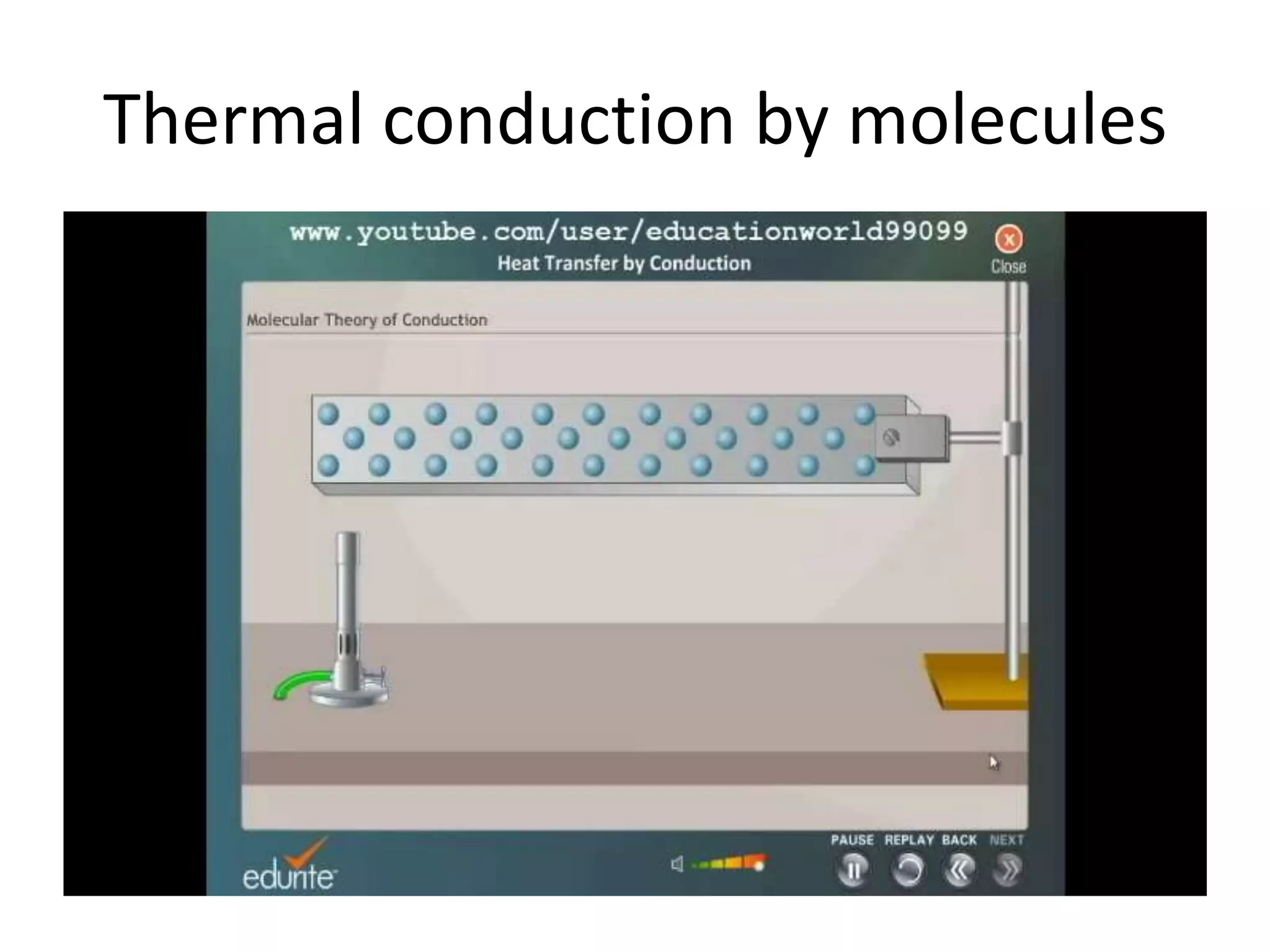
• Conduction is the process by which heat is
transmitted along a body from one molecule
to the neighbouring molecule, without the
actual movement of the molecules from one
place to another.
Thermal conduction by molecules
STATE THE REASON ???
THERMAL EXPANSION
• Thermal expansion is the tendency of matter
to change in volume in response to a change
in temperature.
• When a substance is heated, its particles
begin moving more and thus usually maintain
a greater average separation. Materials which
contract with increasing temperature are
unusual; this effect is limited in size, and only
occurs within limited temperature ranges.
Thermal expansion of solid, liquid and
gas.
WHAT IS THERMODYNAMICS?
• Thermodynamics is a branch of natural
science concerned with heat and its relation
to energy and work.
LAWS OF THERMODYNAMICS
Zeroth law:
• If body A is in thermal equilibrium with B and
B is in thermal equilibrium with C, then C is
also in thermal equilibrium with A.
First law:
• Although energy may be converted from one
form to another, it cannot be created or
destroyed.
• Second law:
– Heat cannot by itself pass from a cold to a hot body.
– All spontaneous processes are, to some extent, irreversible and
are accompanied by a degradation of energy.
– Every system, when left to itself, will on the average, change
toward a system of maximum probability.
– Kelvin planck statement. It is impossible to construct an engine
that, operating continuously will produce no effect other than
the transfer of heat from a single thermal reservoir at a uniform
temperature and the performance of an equal amount of work.
– Clausius statement. It is impossible to construct a heat pump
that, operating continuously, will produce no effect other than
the transfer of heat from a lower temperature body to a higher
temperature one.
BIMETALLIC STRIPS
• A bimetallic strip is used to convert a
temperature change into mechanical
displacement.
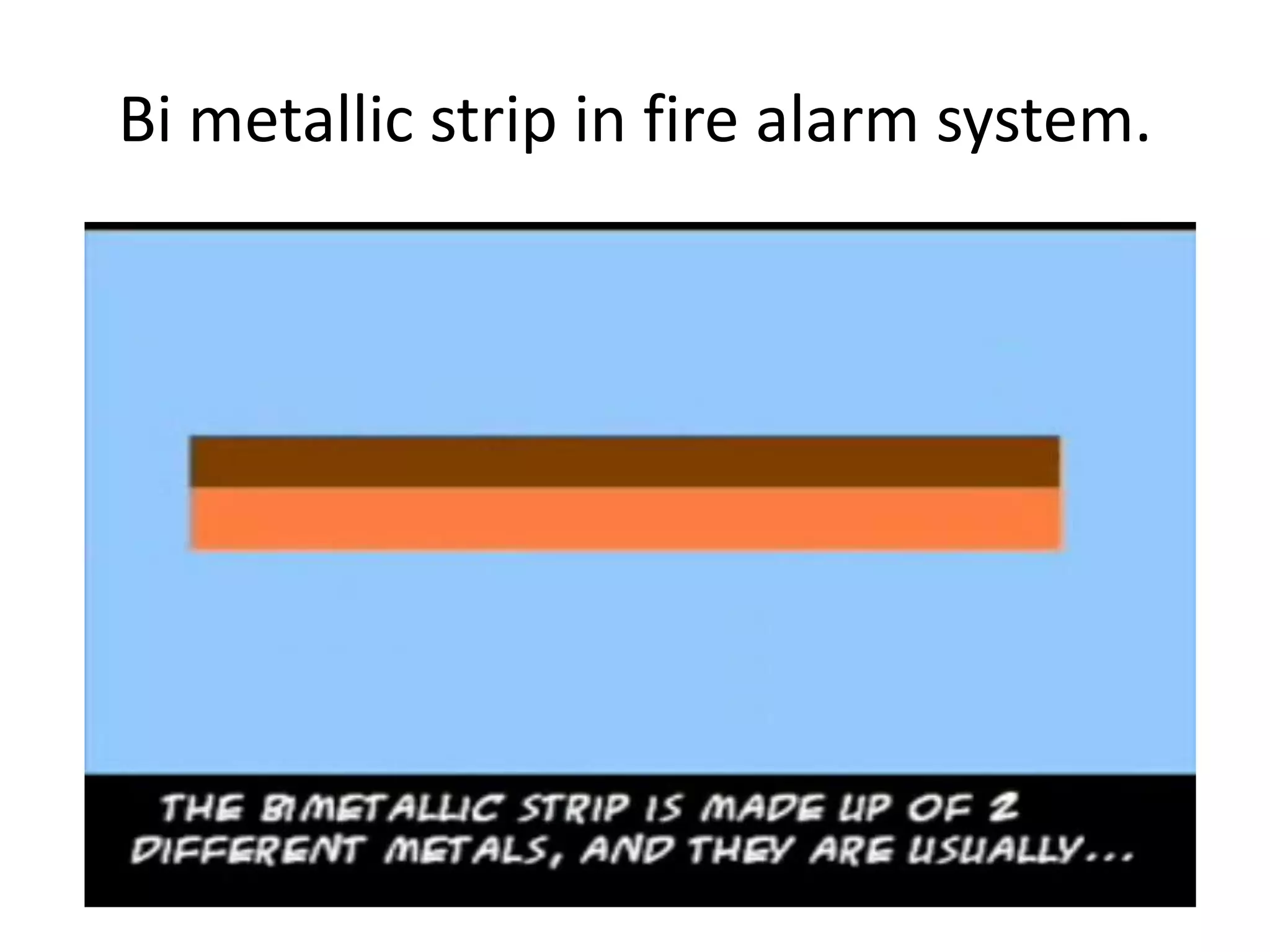
• The strip consists of two strips of different
metals which expand at different rates as they
are heated, usually steel and copper, or in
some cases steel and brass.
Bi metallic strip in fire alarm system.
OTTO AND DIESEL CYCLES
• The otto cycle and the diesel cycle are the two
important air- standard cycles used for the analysis of
internal combustion engines.
• In an ideal otto cycle, the heat is supplied during a
constant volume process. It requires that the
combustion of the fuel is instantaneous and occur so
rapidly that the change in volume is negligible.
• In the air standard “diesel cycle”, the heat is supplied
during a constant pressure process. It necessitates the
combustion process to occur very slowly.
CARNOT’S CYCLE.
• Principle
– No heat engine operating in a cycle between two
constant temperature reservoirs.
– All reversible engines working between two
constant temperature reservoirs have the same
efficiency irrespective of the working substance,
and this efficiency is dependent only on the
temperature levels.
FORBES AND LEES DISC METHOD
• Forbes method- to determine the thermal
conduction in good conductors.
• Lees disc method- to determine the thermal
conduction in bad conductors.
THANK YOU.

Thermal physics

  • 1.
  • 2.
  • 3.
    • Conduction isthe process by which heat is transmitted along a body from one molecule to the neighbouring molecule, without the actual movement of the molecules from one place to another.
  • 4.
  • 5.
  • 6.
    THERMAL EXPANSION • Thermalexpansion is the tendency of matter to change in volume in response to a change in temperature. • When a substance is heated, its particles begin moving more and thus usually maintain a greater average separation. Materials which contract with increasing temperature are unusual; this effect is limited in size, and only occurs within limited temperature ranges.
  • 7.
    Thermal expansion ofsolid, liquid and gas.
  • 8.
  • 9.
    • Thermodynamics isa branch of natural science concerned with heat and its relation to energy and work.
  • 10.
  • 11.
    Zeroth law: • Ifbody A is in thermal equilibrium with B and B is in thermal equilibrium with C, then C is also in thermal equilibrium with A. First law: • Although energy may be converted from one form to another, it cannot be created or destroyed.
  • 12.
    • Second law: –Heat cannot by itself pass from a cold to a hot body. – All spontaneous processes are, to some extent, irreversible and are accompanied by a degradation of energy. – Every system, when left to itself, will on the average, change toward a system of maximum probability. – Kelvin planck statement. It is impossible to construct an engine that, operating continuously will produce no effect other than the transfer of heat from a single thermal reservoir at a uniform temperature and the performance of an equal amount of work. – Clausius statement. It is impossible to construct a heat pump that, operating continuously, will produce no effect other than the transfer of heat from a lower temperature body to a higher temperature one.
  • 13.
    BIMETALLIC STRIPS • Abimetallic strip is used to convert a temperature change into mechanical displacement. • The strip consists of two strips of different metals which expand at different rates as they are heated, usually steel and copper, or in some cases steel and brass.
  • 14.
    Bi metallic stripin fire alarm system.
  • 15.
    OTTO AND DIESELCYCLES • The otto cycle and the diesel cycle are the two important air- standard cycles used for the analysis of internal combustion engines. • In an ideal otto cycle, the heat is supplied during a constant volume process. It requires that the combustion of the fuel is instantaneous and occur so rapidly that the change in volume is negligible. • In the air standard “diesel cycle”, the heat is supplied during a constant pressure process. It necessitates the combustion process to occur very slowly.
  • 16.
    CARNOT’S CYCLE. • Principle –No heat engine operating in a cycle between two constant temperature reservoirs. – All reversible engines working between two constant temperature reservoirs have the same efficiency irrespective of the working substance, and this efficiency is dependent only on the temperature levels.
  • 17.
    FORBES AND LEESDISC METHOD • Forbes method- to determine the thermal conduction in good conductors. • Lees disc method- to determine the thermal conduction in bad conductors.
  • 19.