
1:49:38 AM


PERSONALITY


     DEVELOPMENT
                           1
   Personality is defined as the enduring personal
    characteristics of individuals.
   The term “personality” is derived from the Latin
    word persona, meaning the mask which the actors
    wore on the Greek and Roman stage to distinguish
    their roles and amplify their voices.
   Personality Development is the developing a
    personality cult so as to create a strong positive
    impression about self with the targeted group, or in
    general; and more pertinent aspect of such
    personality is to maintain and prove in a long run.


1:49:38 AM                                                 2
FACTORS TO BE
CONSIDERED
                 Leadership
                 Interpersonal relations
                 Communication in organization
                 Stress management
                 Group dynamics and team building
                 Conflict management
                 Performance appraisal
                 Time management
                 Motivation


 1:49:38 AM                                          3
LEADERSHIP

             “ Phenomenon of one person influencing
                the thinking or action or both of
                another person or groups of persons”
                One should identify where his/her
                 predominant leadership skill lie and
                 as far as possible try to seek tasks
                 which are in tune with them.


1:49:38 AM                                              4
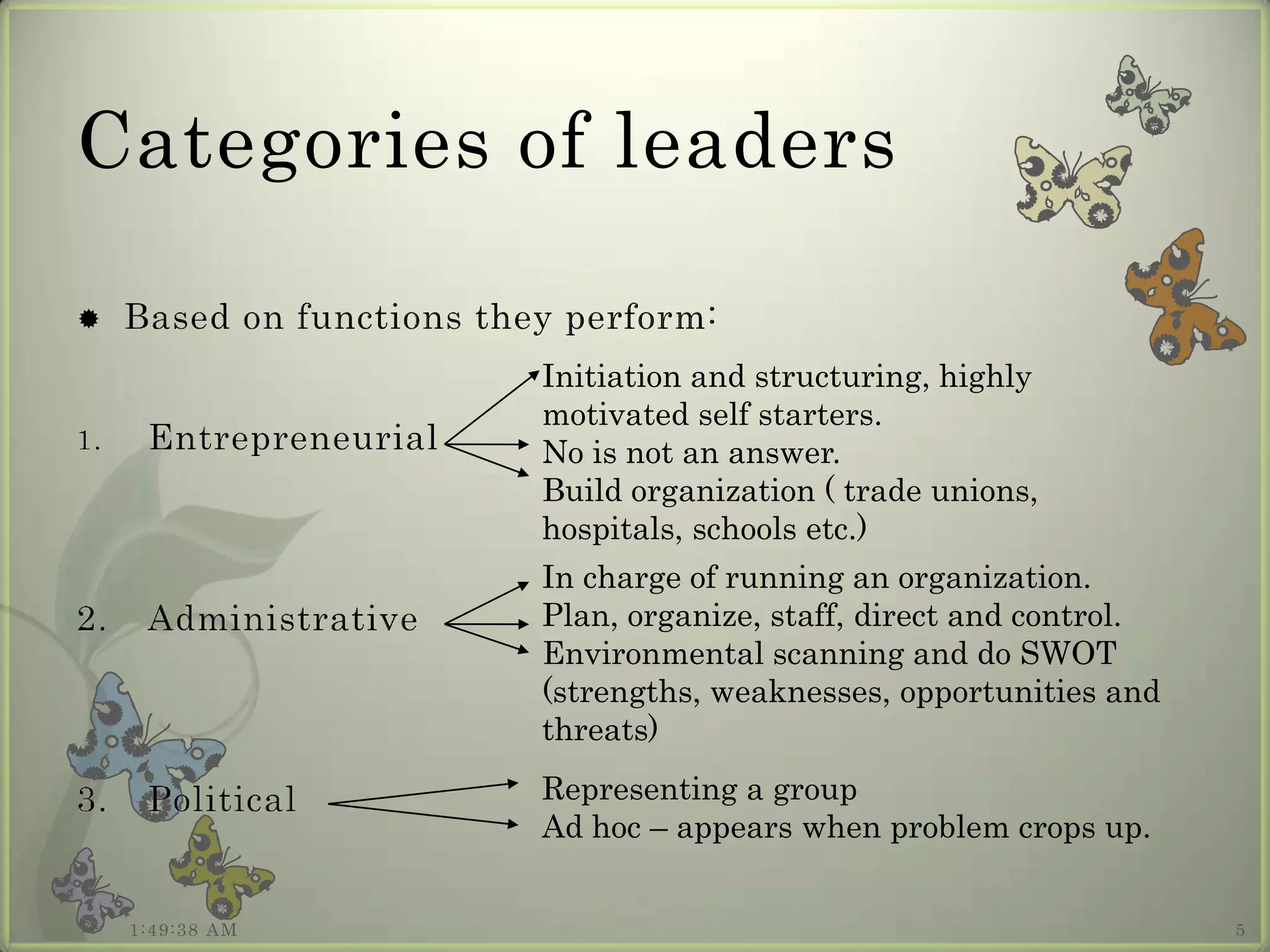
Categories of leaders

    Based on functions they perform:
                           Initiation and structuring, highly
                           motivated self starters.
1.    Entrepreneurial      No is not an answer.
                           Build organization ( trade unions,
                           hospitals, schools etc.)
                           In charge of running an organization.
2.    Administrative       Plan, organize, staff, direct and control.
                           Environmental scanning and do SWOT
                           (strengths, weaknesses, opportunities and
                           threats)

3.    Political            Representing a group
                           Ad hoc – appears when problem crops up.


     1:49:38 AM                                                         5
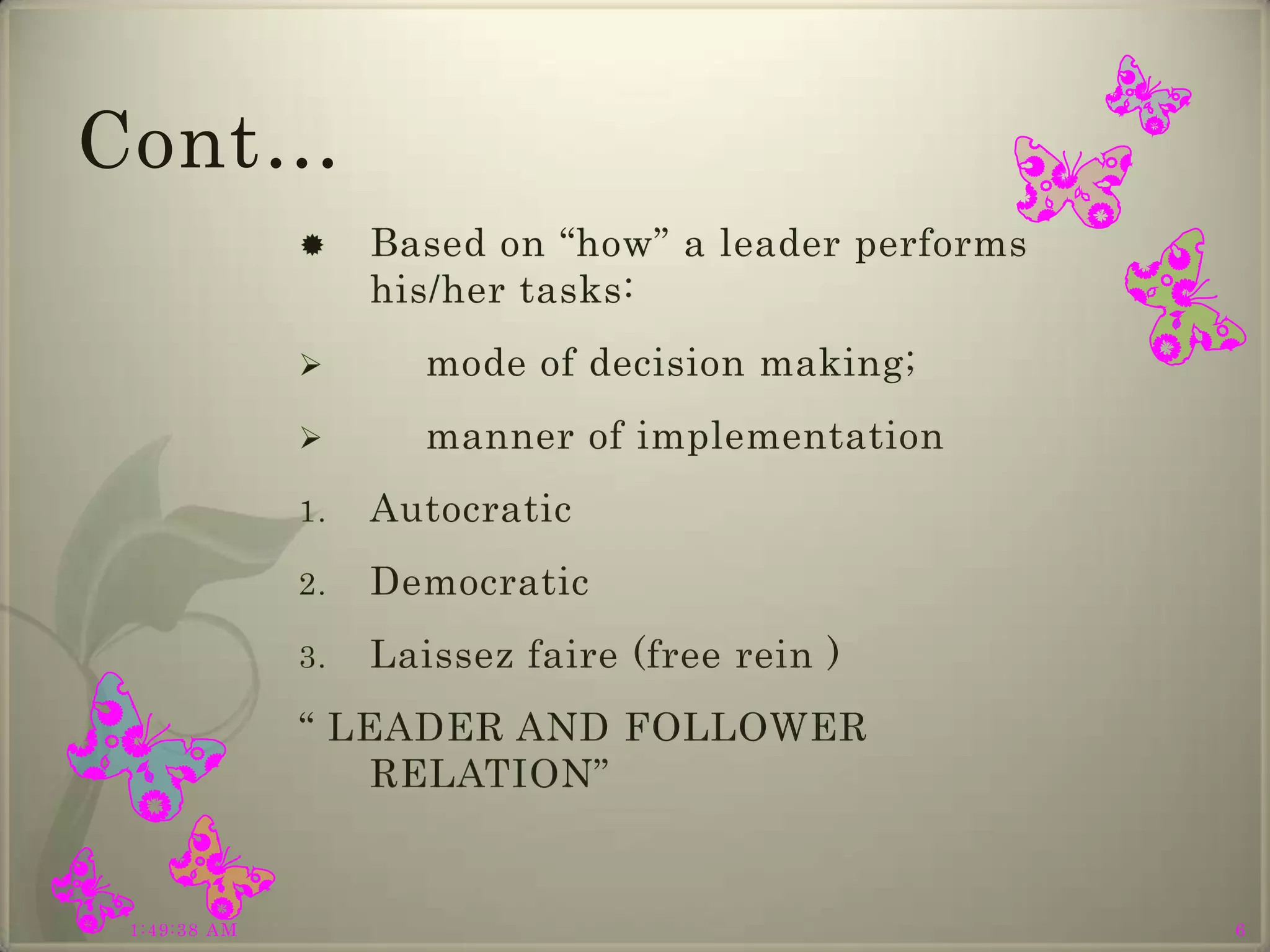
Cont…
                  Based on “how” a leader performs
                   his/her tasks:
                     mode of decision making;
                     manner of implementation
              1.   Autocratic
              2.   Democratic
              3.   Laissez faire (free rein )
              “ LEADER AND FOLLOWER
                  RELATION”


 1:49:38 AM                                           6
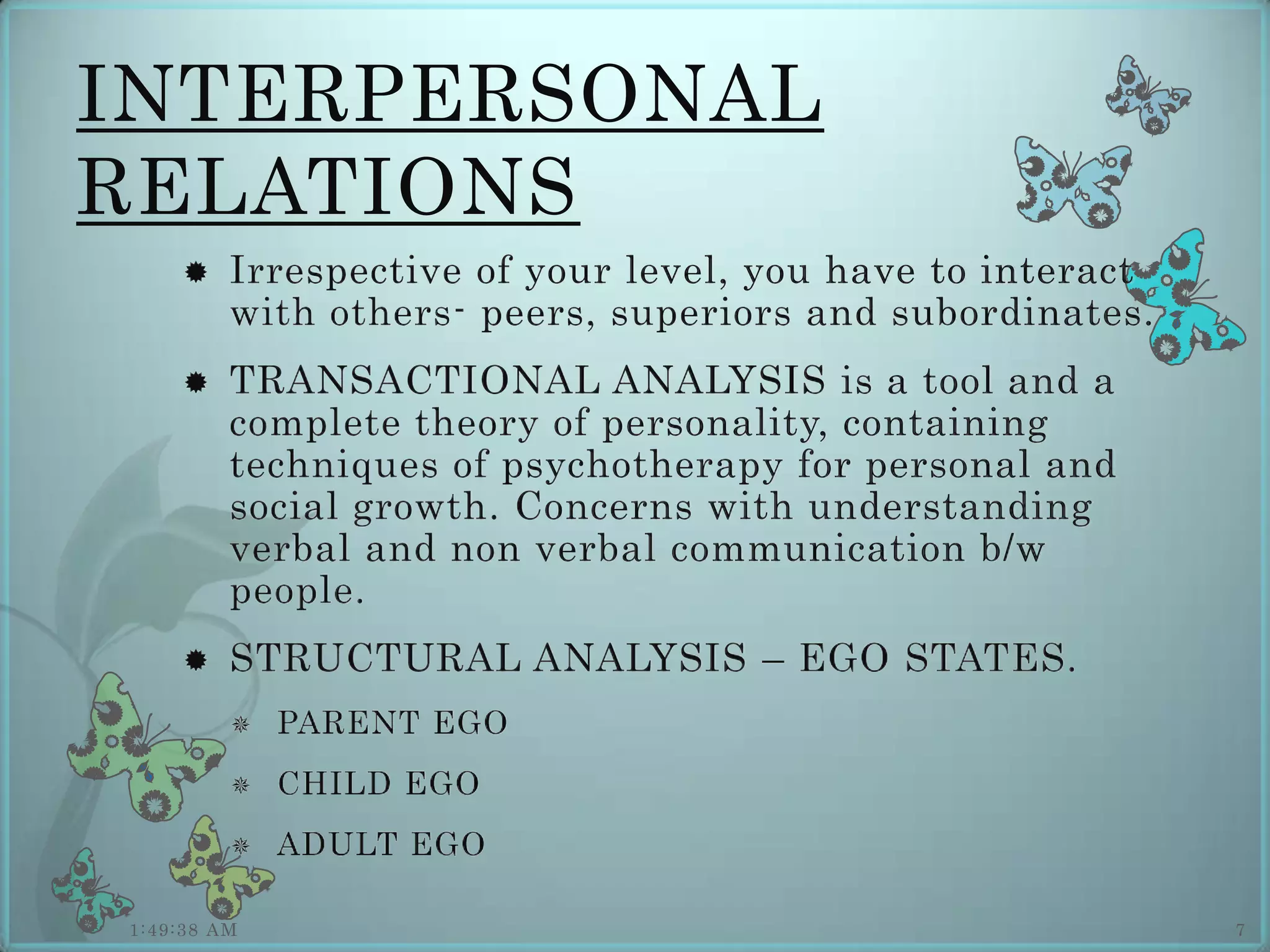
INTERPERSONAL
RELATIONS
        Irrespective of your level, you have to interact
         with others- peers, superiors and subordinates.
        TRANSACTIONAL ANALYSIS is a tool and a
         complete theory of personality, containing
         techniques of psychotherapy for personal and
         social growth. Concerns with understanding
         verbal and non verbal communication b/w
         people.
        STRUCTURAL ANALYSIS – EGO STATES.
            PARENT EGO
            CHILD EGO
            ADULT EGO

1:49:38 AM                                                  7
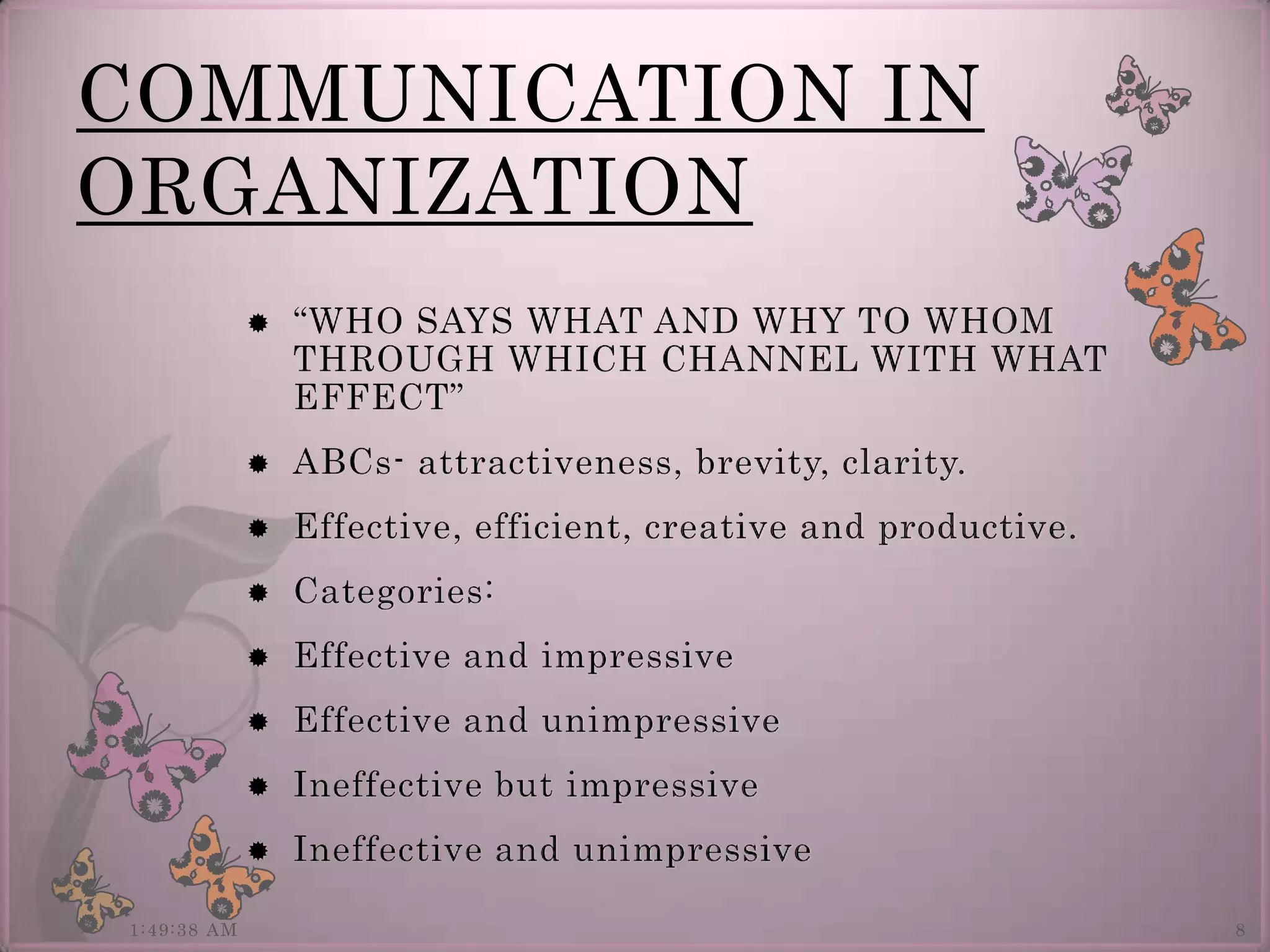
COMMUNICATION IN
ORGANIZATION
                “WHO SAYS WHAT AND WHY TO WHOM
                 THROUGH WHICH CHANNEL WITH WHAT
                 EFFECT”
                ABCs- attractiveness, brevity, clarity.
                Effective, efficient, creative and productive.
                Categories:
                Effective and impressive
                Effective and unimpressive
                Ineffective but impressive
                Ineffective and unimpressive

1:49:38 AM                                                        8
“ READING MAKE A FULL
MAN, WRITING AN EXACT
MAN AND CONFERENCE A
READY MAN ”
             Communication skills can be improved by:
             •Listening
             •speaking


1:49:38 AM                                              9
STRESS
MANAGEMENT
                A person’s adaptive response to a
                 stimulus that places excessive
                 psychological or physical demands on
                 that person.
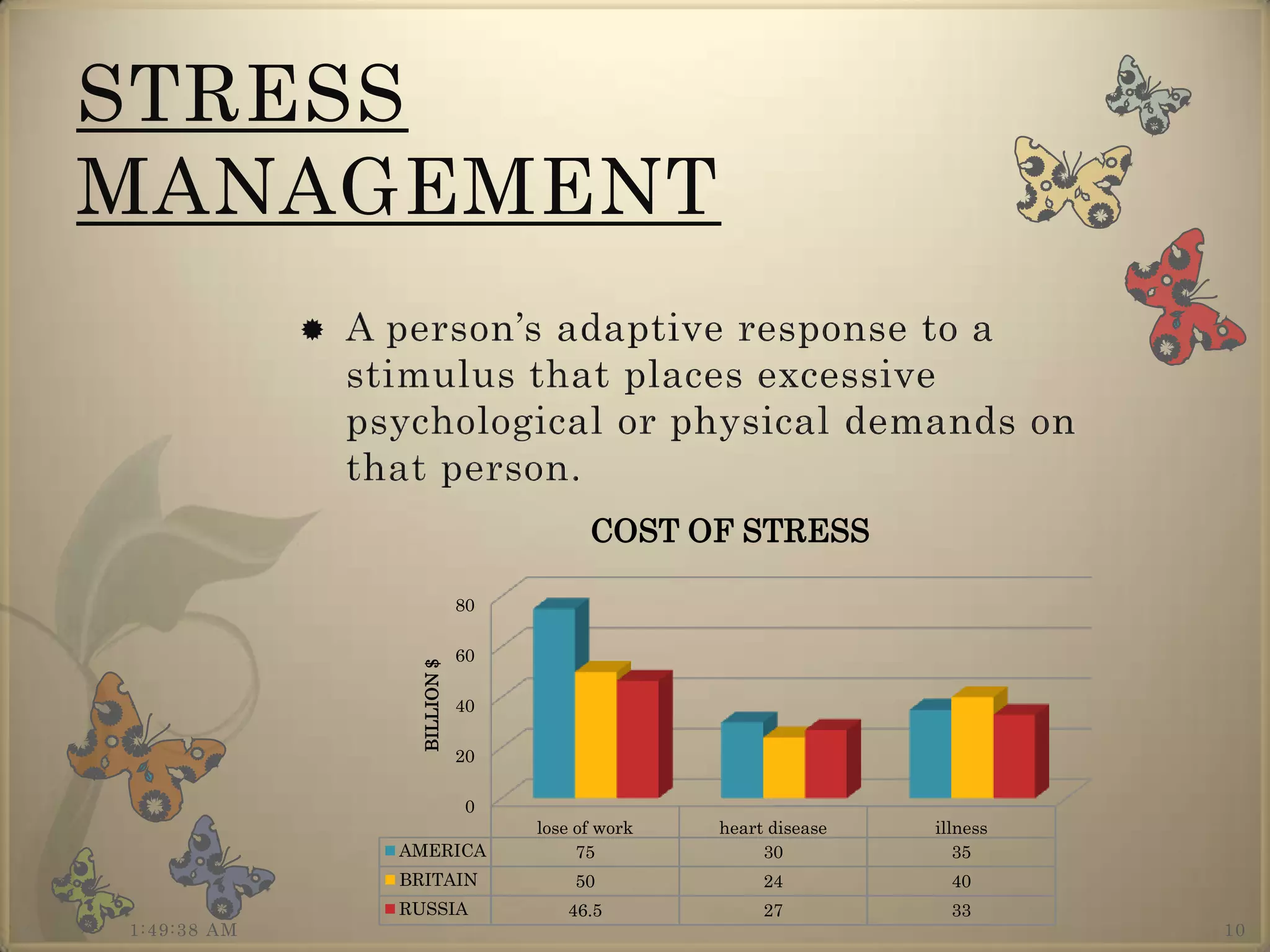
                                           COST OF STRESS

                                80

                                60
                    BILLION $


                                40

                                20

                                 0
                                     lose of work   heart disease   illness
                   AMERICA                75             30            35
                   BRITAIN               50              24           40
                   RUSSIA               46.5             27           33
1:49:38 AM                                                                    10
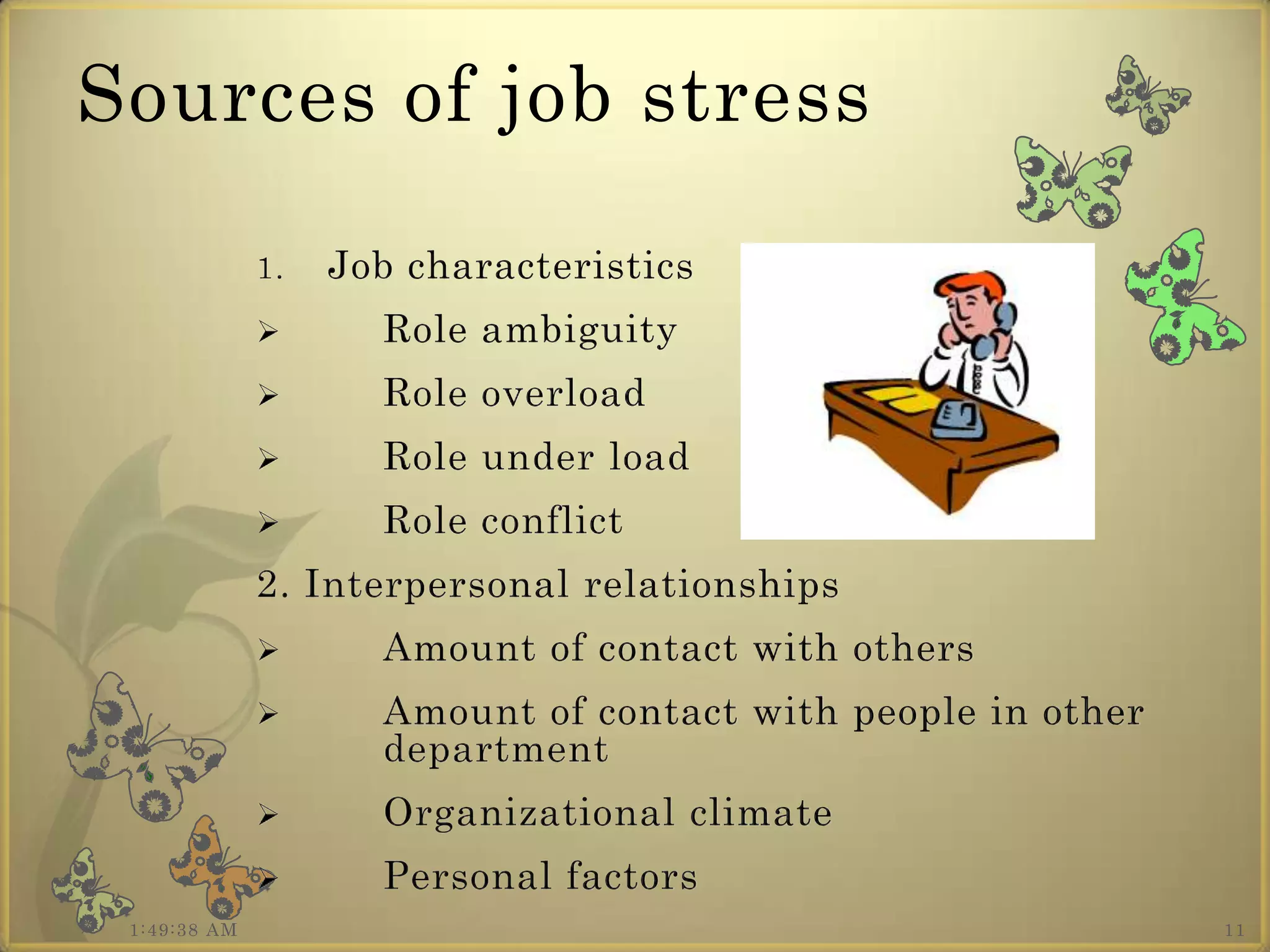
Sources of job stress

              1.   Job characteristics
                    Role ambiguity
                    Role overload
                    Role under load
                    Role conflict
              2. Interpersonal relationships
                    Amount of contact with others
                    Amount of contact with people in other
                     department
                    Organizational climate
                    Personal factors
 1:49:38 AM                                                   11
Consequences of
 job stress

1.   Physical health
2.   Psychological
3.   Performance            Coping with
4.   Decision               job stress
     making
                       1.    Work focused
                       2.    Emotion focused


     1:49:38 AM                                12
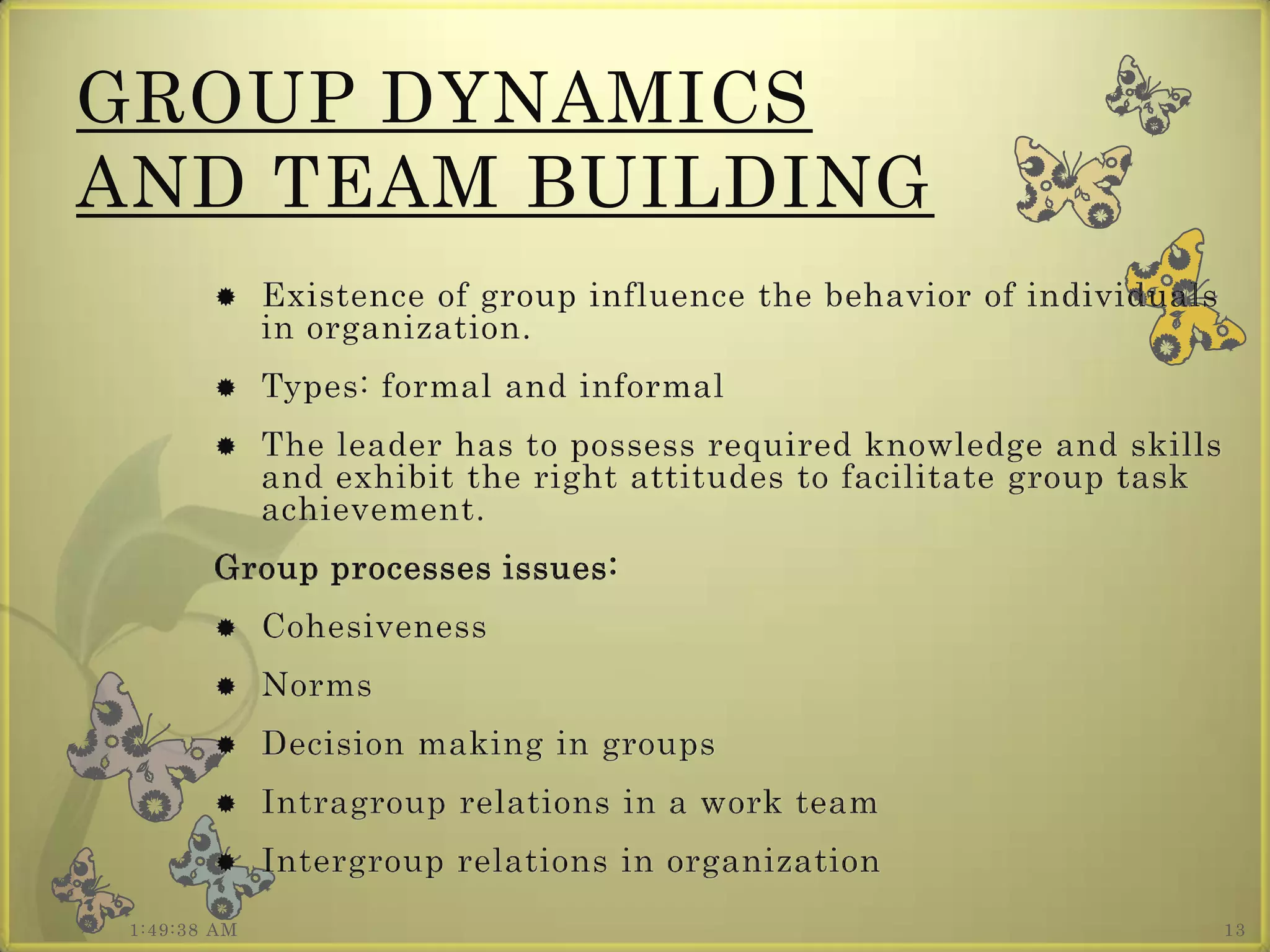
GROUP DYNAMICS
AND TEAM BUILDING
             Existence of group influence the behavior of individuals
              in organization.
             Types: formal and informal
             The leader has to possess required knowledge and skills
              and exhibit the right attitudes to facilitate group task
              achievement.
        Group processes issues:
             Cohesiveness
             Norms
             Decision making in groups
             Intragroup relations in a work team
             Intergroup relations in organization
 1:49:38 AM                                                              13
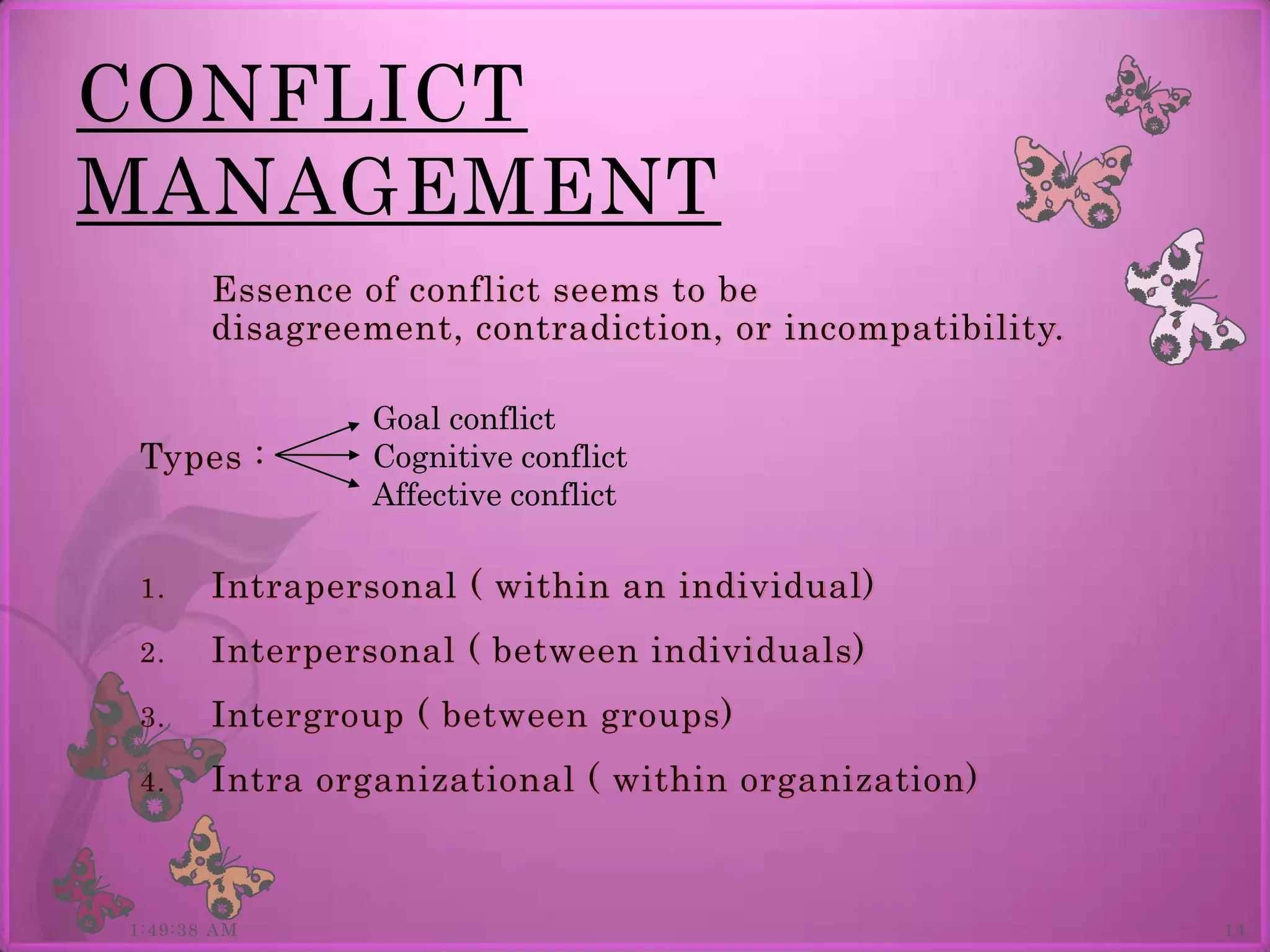
CONFLICT
MANAGEMENT
       Essence of conflict seems to be
       disagreement, contradiction, or incompatibility.

                Goal conflict
Types :         Cognitive conflict
                Affective conflict

1.     Intrapersonal ( within an individual)
2.     Interpersonal ( between individuals)
3.     Intergroup ( between groups)
4.     Intra organizational ( within organization)


1:49:38 AM                                                14
PERFORMANCE
APPRAISAL
                 Formal process determined by the
                 performance.
                Absolute standards
                Relative standards
                Objectives


1:49:38 AM                                          15
TIME MANAGEMENT

             Controlling the use of your most
             valuable resource and refuse excessive
             workloads.
            Effective
            Efficient
            Effortless
            Absence- last minute rushes to meet
             deadlines.


1:49:38 AM                                            16
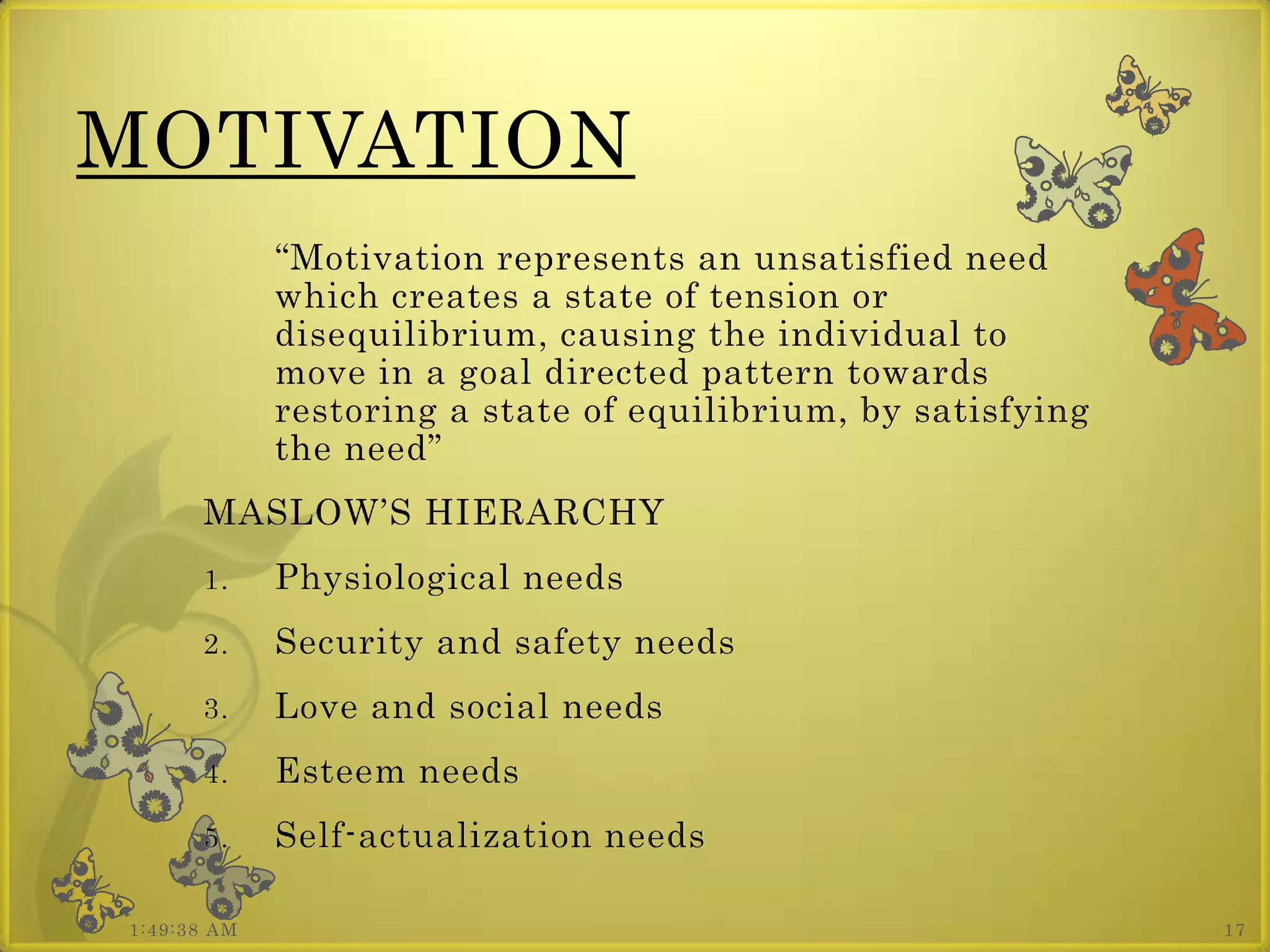
MOTIVATION
             “Motivation represents an unsatisfied need
             which creates a state of tension or
             disequilibrium, causing the individual to
             move in a goal directed pattern towards
             restoring a state of equilibrium, by satisfying
             the need”
      MASLOW’S HIERARCHY
      1.     Physiological needs
      2.     Security and safety needs
      3.     Love and social needs
      4.     Esteem needs
      5.     Self-actualization needs

1:49:38 AM                                                     17
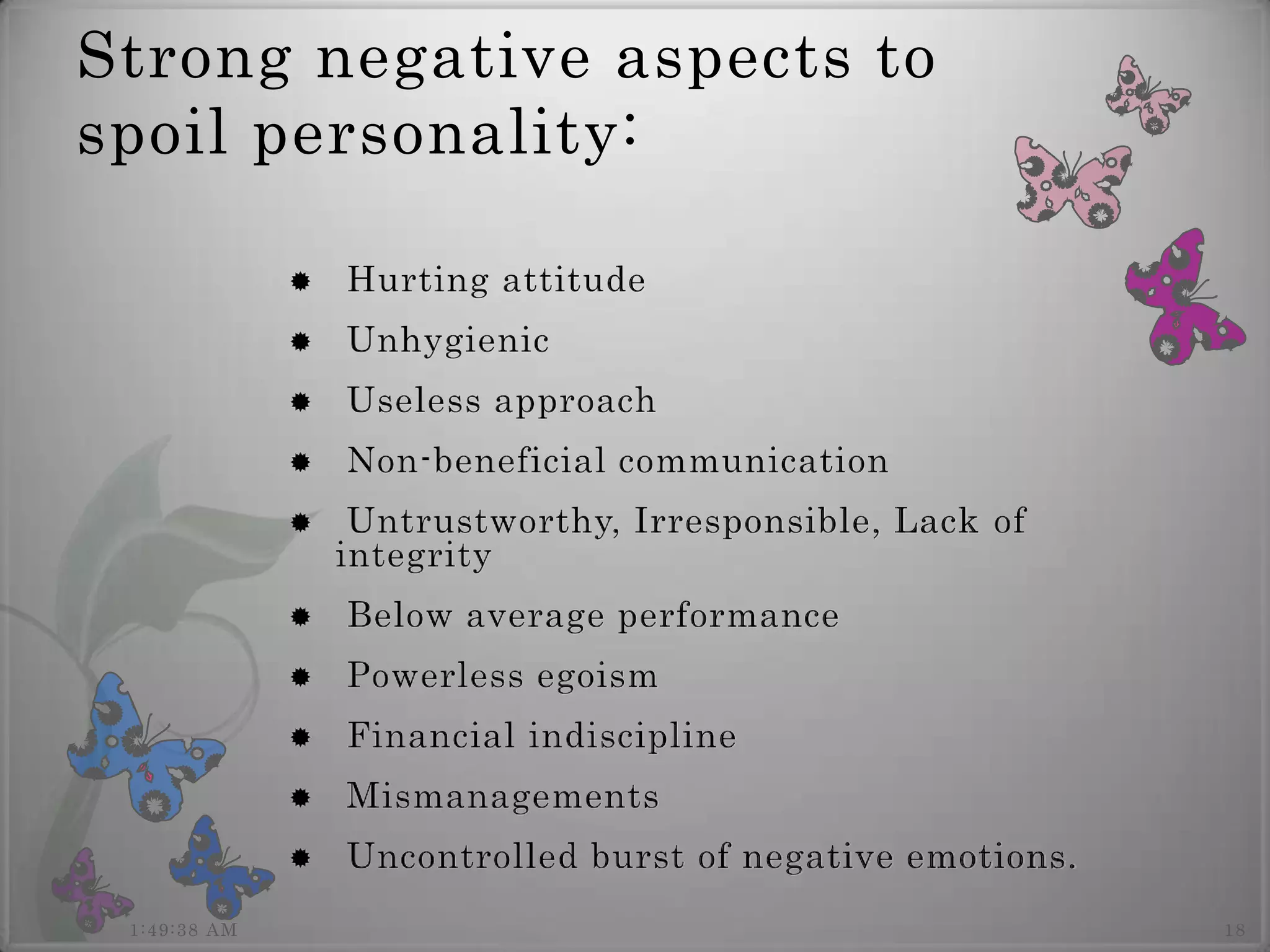
Strong negative aspects to
spoil personality:

                 Hurting attitude
                 Unhygienic
                 Useless approach
                 Non-beneficial communication
                  Untrustworthy, Irresponsible, Lack of
                  integrity
                 Below average performance
                 Powerless egoism
                 Financial indiscipline
                 Mismanagements
                 Uncontrolled burst of negative emotions.
 1:49:38 AM                                                  18
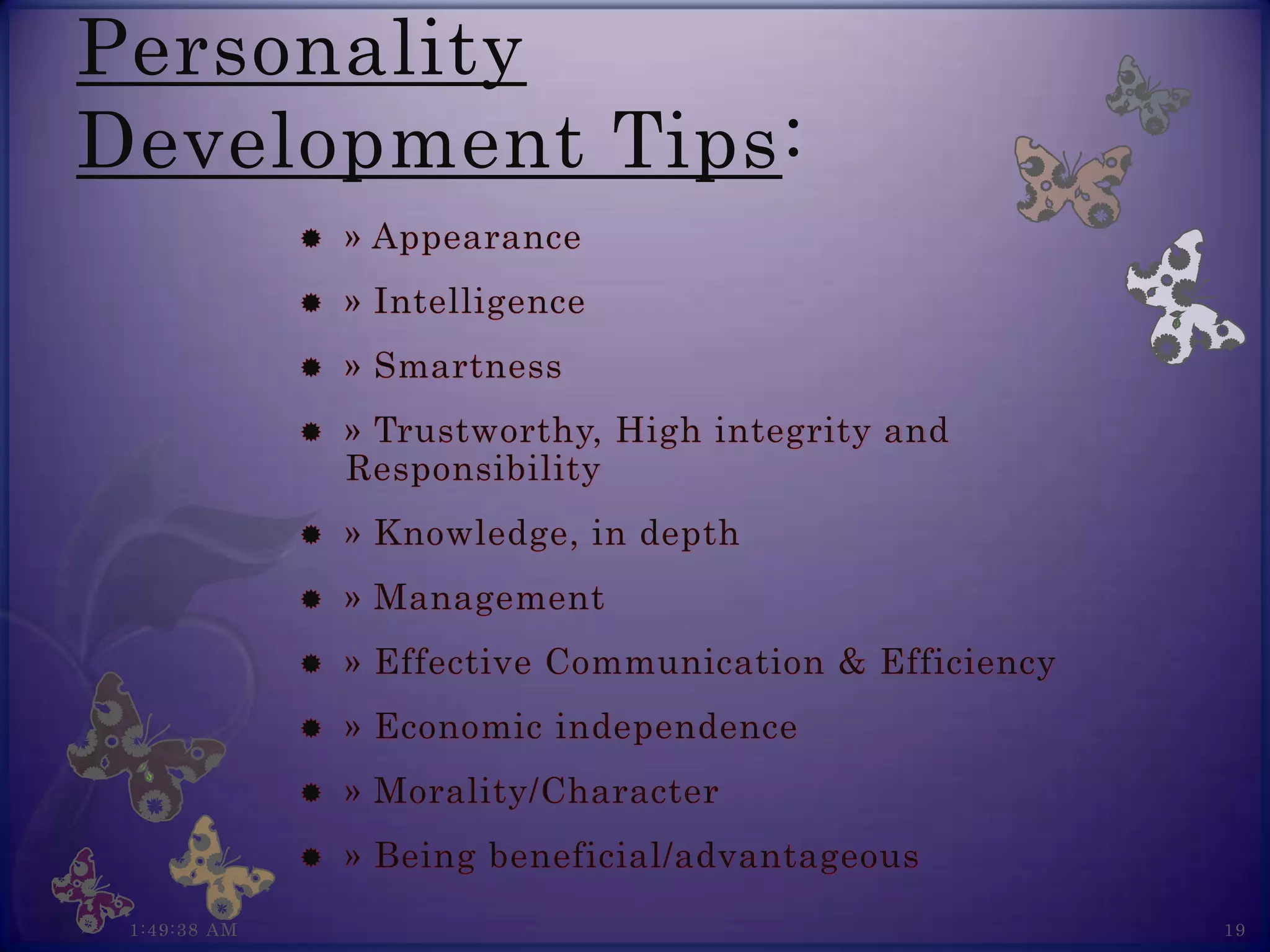
Personality
Development Tips:
                 » Appearance
                 » Intelligence
                 » Smartness
                 » Trustworthy, High integrity and
                  Responsibility
                 » Knowledge, in depth
                 » Management
                 » Effective Communication & Efficiency
                 » Economic independence
                 » Morality/Character
                 » Being beneficial/advantageous
 1:49:38 AM                                                19
THANK YOU…


         Re f e re nce : Chandan, J.S., O rg anizatio nal Be hav io r. Vikas Publishing Ho use PVT LTD
         1994

         Statt, D .A. Using Psy cho lo g y in Manag e me nt Training , Tay lo r and Francis

         Inc.2000

         Arno ld , JHC Fe ldman, D .C. O rg anizatio nal Be hav io ur IRWIN/M cG RA W - H I LL 1986

         Luthans F, O rg anisatio nal Be hav io ur, IRWIN/ M cG R A W - H IL L 1998.


   1:49:38 AM
                                                                                                      20

Personality development

  • 1.
  • 2.
    Personality is defined as the enduring personal characteristics of individuals.  The term “personality” is derived from the Latin word persona, meaning the mask which the actors wore on the Greek and Roman stage to distinguish their roles and amplify their voices.  Personality Development is the developing a personality cult so as to create a strong positive impression about self with the targeted group, or in general; and more pertinent aspect of such personality is to maintain and prove in a long run. 1:49:38 AM 2
  • 3.
    FACTORS TO BE CONSIDERED  Leadership  Interpersonal relations  Communication in organization  Stress management  Group dynamics and team building  Conflict management  Performance appraisal  Time management  Motivation 1:49:38 AM 3
  • 4.
    LEADERSHIP “ Phenomenon of one person influencing the thinking or action or both of another person or groups of persons”  One should identify where his/her predominant leadership skill lie and as far as possible try to seek tasks which are in tune with them. 1:49:38 AM 4
  • 5.
    Categories of leaders  Based on functions they perform: Initiation and structuring, highly motivated self starters. 1. Entrepreneurial No is not an answer. Build organization ( trade unions, hospitals, schools etc.) In charge of running an organization. 2. Administrative Plan, organize, staff, direct and control. Environmental scanning and do SWOT (strengths, weaknesses, opportunities and threats) 3. Political Representing a group Ad hoc – appears when problem crops up. 1:49:38 AM 5
  • 6.
    Cont…  Based on “how” a leader performs his/her tasks:  mode of decision making;  manner of implementation 1. Autocratic 2. Democratic 3. Laissez faire (free rein ) “ LEADER AND FOLLOWER RELATION” 1:49:38 AM 6
  • 7.
    INTERPERSONAL RELATIONS  Irrespective of your level, you have to interact with others- peers, superiors and subordinates.  TRANSACTIONAL ANALYSIS is a tool and a complete theory of personality, containing techniques of psychotherapy for personal and social growth. Concerns with understanding verbal and non verbal communication b/w people.  STRUCTURAL ANALYSIS – EGO STATES.  PARENT EGO  CHILD EGO  ADULT EGO 1:49:38 AM 7
  • 8.
    COMMUNICATION IN ORGANIZATION  “WHO SAYS WHAT AND WHY TO WHOM THROUGH WHICH CHANNEL WITH WHAT EFFECT”  ABCs- attractiveness, brevity, clarity.  Effective, efficient, creative and productive.  Categories:  Effective and impressive  Effective and unimpressive  Ineffective but impressive  Ineffective and unimpressive 1:49:38 AM 8
  • 9.
    “ READING MAKEA FULL MAN, WRITING AN EXACT MAN AND CONFERENCE A READY MAN ” Communication skills can be improved by: •Listening •speaking 1:49:38 AM 9
  • 10.
    STRESS MANAGEMENT  A person’s adaptive response to a stimulus that places excessive psychological or physical demands on that person. COST OF STRESS 80 60 BILLION $ 40 20 0 lose of work heart disease illness AMERICA 75 30 35 BRITAIN 50 24 40 RUSSIA 46.5 27 33 1:49:38 AM 10
  • 11.
    Sources of jobstress 1. Job characteristics  Role ambiguity  Role overload  Role under load  Role conflict 2. Interpersonal relationships  Amount of contact with others  Amount of contact with people in other department  Organizational climate  Personal factors 1:49:38 AM 11
  • 12.
    Consequences of jobstress 1. Physical health 2. Psychological 3. Performance Coping with 4. Decision job stress making 1. Work focused 2. Emotion focused 1:49:38 AM 12
  • 13.
    GROUP DYNAMICS AND TEAMBUILDING  Existence of group influence the behavior of individuals in organization.  Types: formal and informal  The leader has to possess required knowledge and skills and exhibit the right attitudes to facilitate group task achievement. Group processes issues:  Cohesiveness  Norms  Decision making in groups  Intragroup relations in a work team  Intergroup relations in organization 1:49:38 AM 13
  • 14.
    CONFLICT MANAGEMENT Essence of conflict seems to be disagreement, contradiction, or incompatibility. Goal conflict Types : Cognitive conflict Affective conflict 1. Intrapersonal ( within an individual) 2. Interpersonal ( between individuals) 3. Intergroup ( between groups) 4. Intra organizational ( within organization) 1:49:38 AM 14
  • 15.
    PERFORMANCE APPRAISAL Formal process determined by the performance.  Absolute standards  Relative standards  Objectives 1:49:38 AM 15
  • 16.
    TIME MANAGEMENT Controlling the use of your most valuable resource and refuse excessive workloads.  Effective  Efficient  Effortless  Absence- last minute rushes to meet deadlines. 1:49:38 AM 16
  • 17.
    MOTIVATION “Motivation represents an unsatisfied need which creates a state of tension or disequilibrium, causing the individual to move in a goal directed pattern towards restoring a state of equilibrium, by satisfying the need” MASLOW’S HIERARCHY 1. Physiological needs 2. Security and safety needs 3. Love and social needs 4. Esteem needs 5. Self-actualization needs 1:49:38 AM 17
  • 18.
    Strong negative aspectsto spoil personality:  Hurting attitude  Unhygienic  Useless approach  Non-beneficial communication  Untrustworthy, Irresponsible, Lack of integrity  Below average performance  Powerless egoism  Financial indiscipline  Mismanagements  Uncontrolled burst of negative emotions. 1:49:38 AM 18
  • 19.
    Personality Development Tips:  » Appearance  » Intelligence  » Smartness  » Trustworthy, High integrity and Responsibility  » Knowledge, in depth  » Management  » Effective Communication & Efficiency  » Economic independence  » Morality/Character  » Being beneficial/advantageous 1:49:38 AM 19
  • 20.
    THANK YOU… Re f e re nce : Chandan, J.S., O rg anizatio nal Be hav io r. Vikas Publishing Ho use PVT LTD 1994 Statt, D .A. Using Psy cho lo g y in Manag e me nt Training , Tay lo r and Francis Inc.2000 Arno ld , JHC Fe ldman, D .C. O rg anizatio nal Be hav io ur IRWIN/M cG RA W - H I LL 1986 Luthans F, O rg anisatio nal Be hav io ur, IRWIN/ M cG R A W - H IL L 1998. 1:49:38 AM 20