MR. JAYESH V. PATIDAR
INTRODUCTION

 Team work is significant in any setting more so in a
  mental health setting.
 The milieu needed to care for patient depends up on the
  qualification, experience, skillful handling of the situation
  by all members of the team with similar approach.
 For promotion of a therapeutic environment members of
  the various discipline coordinate their activity.
 Four health care professionals constitute the core mental
  health disciplines : psychiatric nursing, psychiatry, clinical
  psychology, and psychiatric social work.
MEANING
 Teamwork is paramount for the success of any group.
 Teamwork means the combined, co-coordinated &
  dedicated effort of each & every member of the team
  toward achievement of the vested interest, target or goal of
  the team as an entity.
 Teamwork becomes more significant in a mental health
  setting where the contribution of all the members is
  extremely vital for the assessment, diagnosis, treatment, in-
  patient rehabilitation as well as community based
  rehabilitation of the mentally ill patient.
 Team work is one of the steps leading to exemplary care of
  the individual, his family & the community at large thus
  making the millennium concept of “Holistic Patient Care” a
  reality.
CONCEPT OF MULTI-DISCIPLINARY TEAM
 This multi-disciplinary team can also function as an Inter-
  disciplinary team in that the total care of the patient requires
  not only the total input of each members of this team but also
  the inter-disciplinary coordinated effort .
 One can compare this concept to an orchestra led by the
  music director.
 Each members of the orchestra has to give his input &
  simultaneously there should be coordination with other
  members as directed by the music director, so that the final
  effect is splendid.
 Similarly, multi-disciplinary input & inter-disciplinary
  coordination's as directed by the patient & his illness will
  lead to the splendid outcome of recovery of the patient to his
  maximum capability & capacity in the community.
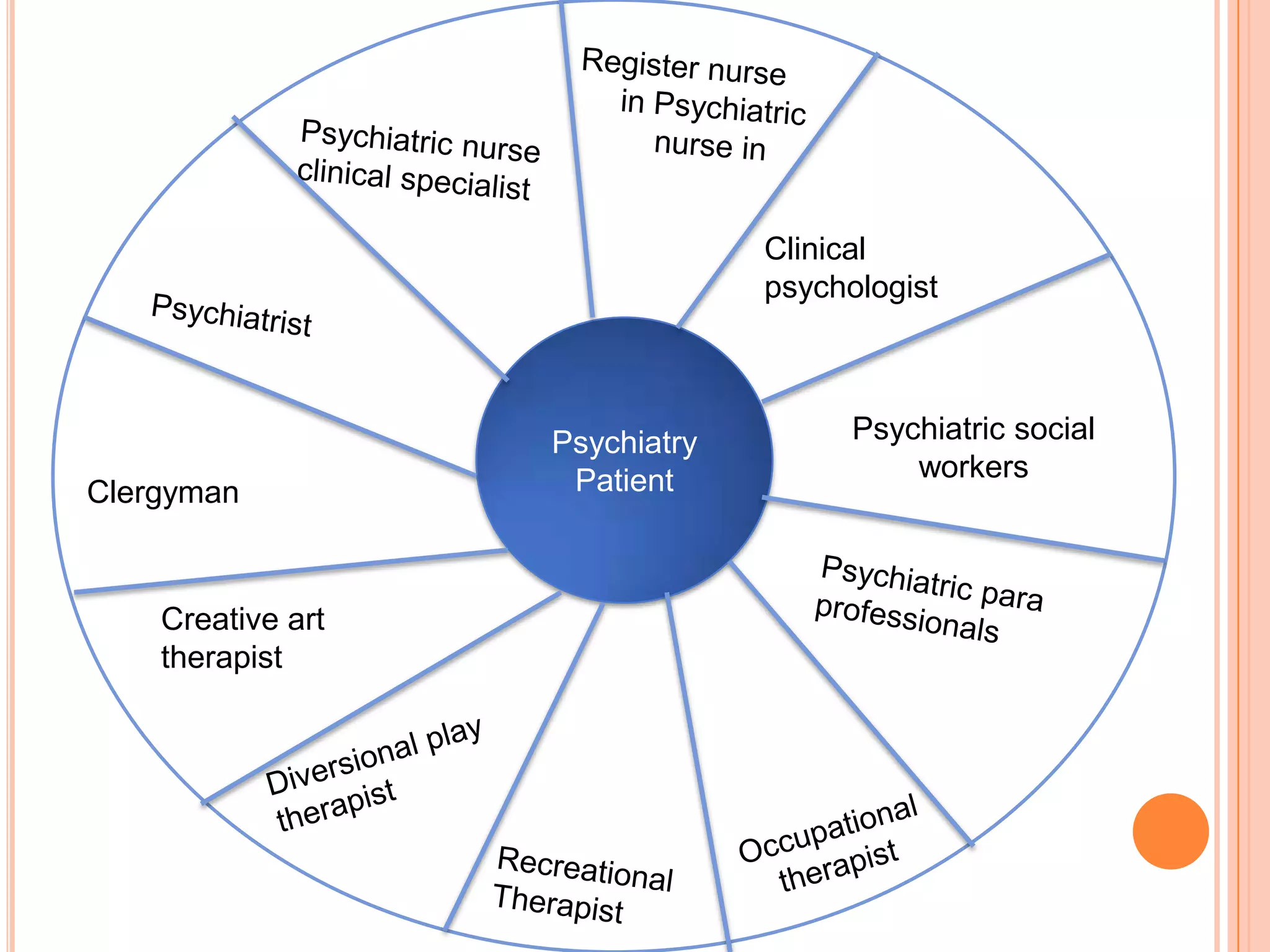
Clinical
                                psychologist


                   Psychiatry         Psychiatric social
                    Patient               workers
Clergyman


    Creative art
    therapist
1. PSYCHIATRIST

   The psychiatrist is a doctor with post-graduation in

    psychiatry with 2-3 years of residence training.

   The psychiatrist is responsible for diagnosis, treatment

    & prevention of mental disorders, prescribe medicines &

    somatic therapy & function as a leader of the mental

    health team.
2. PSYCHIATRIC NURSE CLINICAL SPECIALIST
 The psychiatric nurse clinical specialist should have a
  master degree in nursing, preferably with post –graduate
  research work.
 She participates actively in primary, secondary & tertiary
  prevention of mental disorder & provides individual, group
  & family psychotherapy in a hospital & community setting.
 She also takes up the responsibility of teaching,
  administration & research, bedsides publishing work in a
  mental health setting.
 She takes up the role of a leader & can practice
  independently.
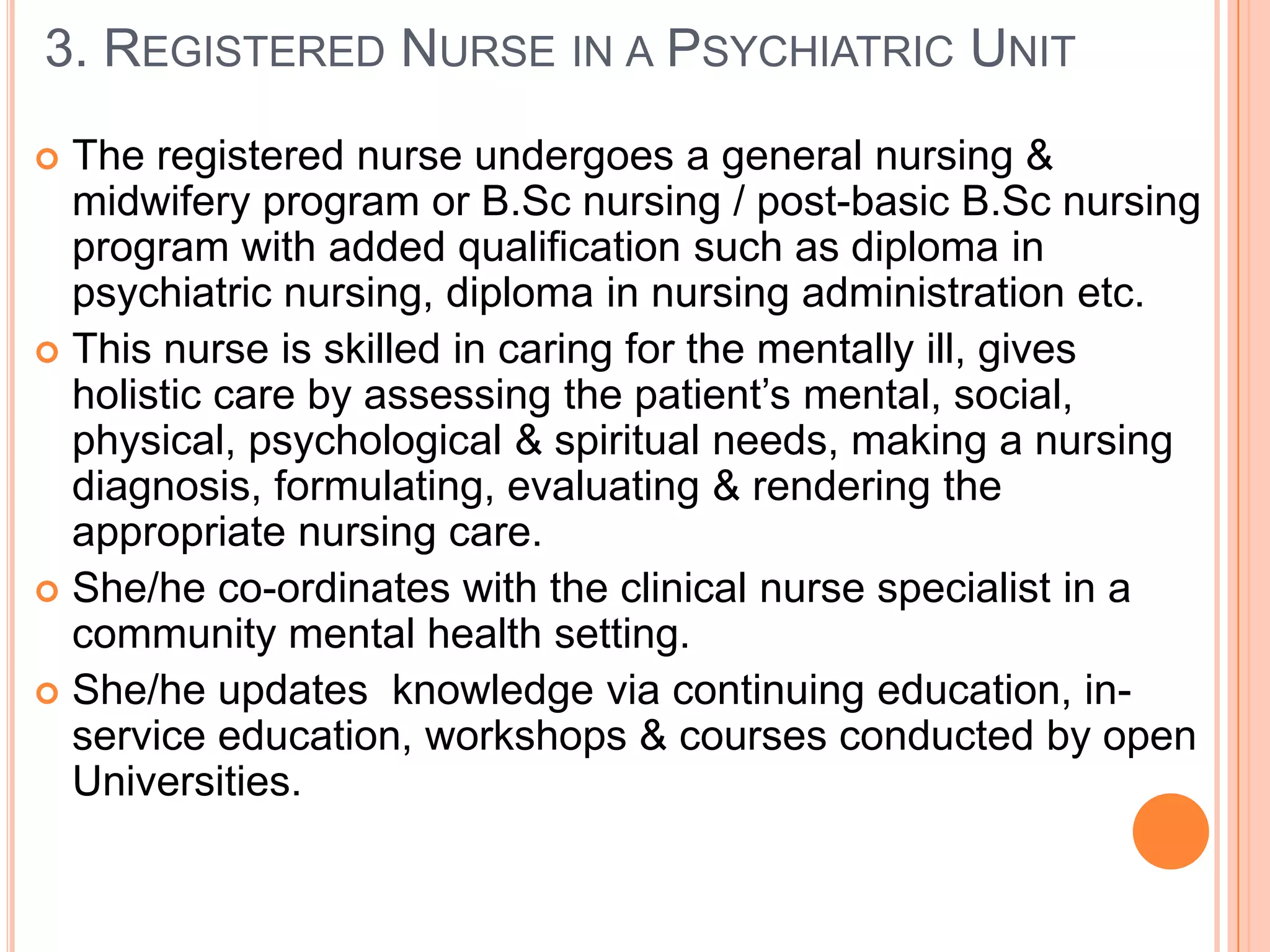
3. REGISTERED NURSE IN A PSYCHIATRIC UNIT
 The registered nurse undergoes a general nursing &
  midwifery program or B.Sc nursing / post-basic B.Sc nursing
  program with added qualification such as diploma in
  psychiatric nursing, diploma in nursing administration etc.
 This nurse is skilled in caring for the mentally ill, gives
  holistic care by assessing the patient’s mental, social,
  physical, psychological & spiritual needs, making a nursing
  diagnosis, formulating, evaluating & rendering the
  appropriate nursing care.
 She/he co-ordinates with the clinical nurse specialist in a
  community mental health setting.
 She/he updates knowledge via continuing education, in-
  service education, workshops & courses conducted by open
  Universities.
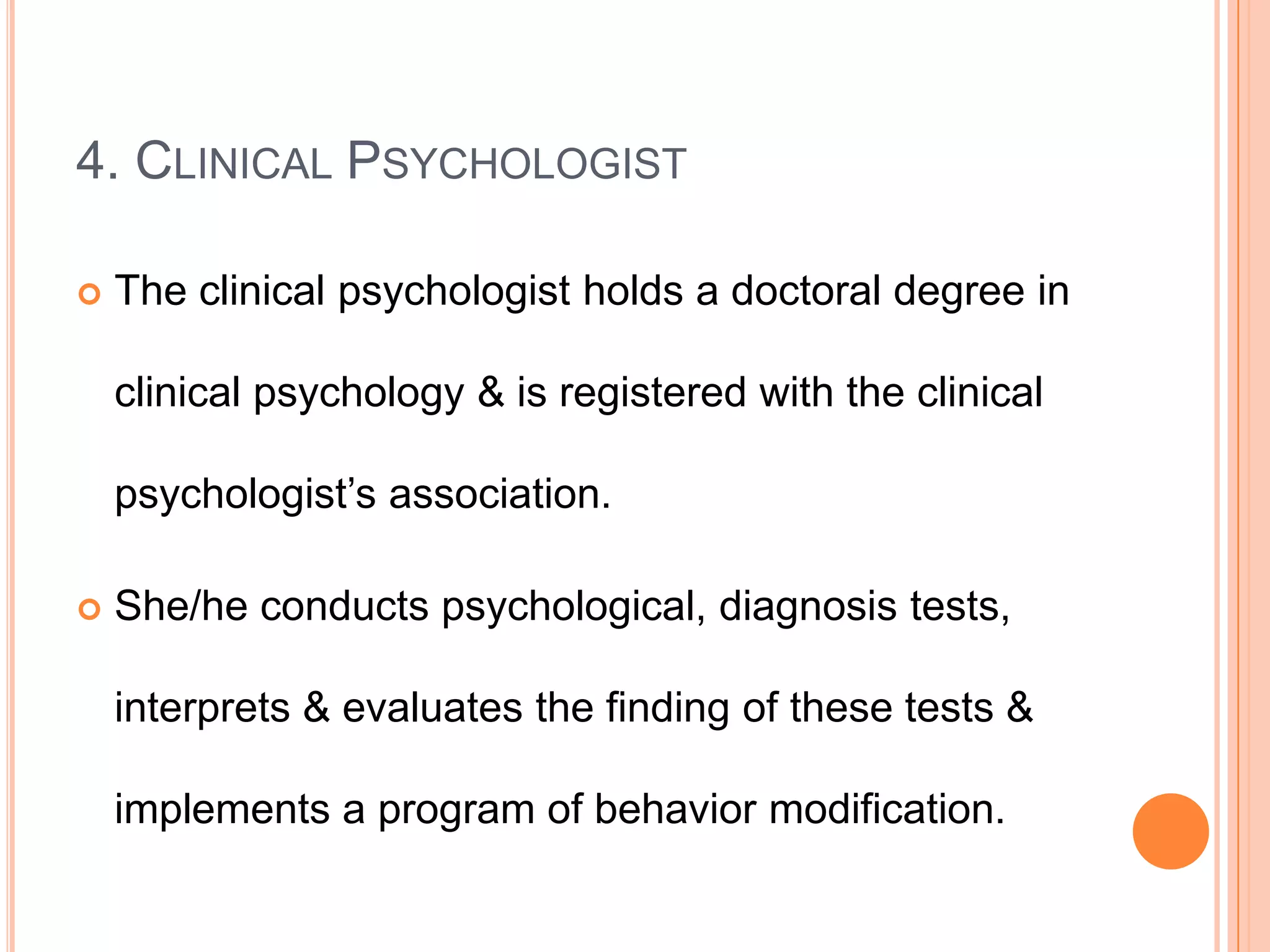
4. CLINICAL PSYCHOLOGIST

   The clinical psychologist holds a doctoral degree in

    clinical psychology & is registered with the clinical

    psychologist’s association.

   She/he conducts psychological, diagnosis tests,

    interprets & evaluates the finding of these tests &

    implements a program of behavior modification.
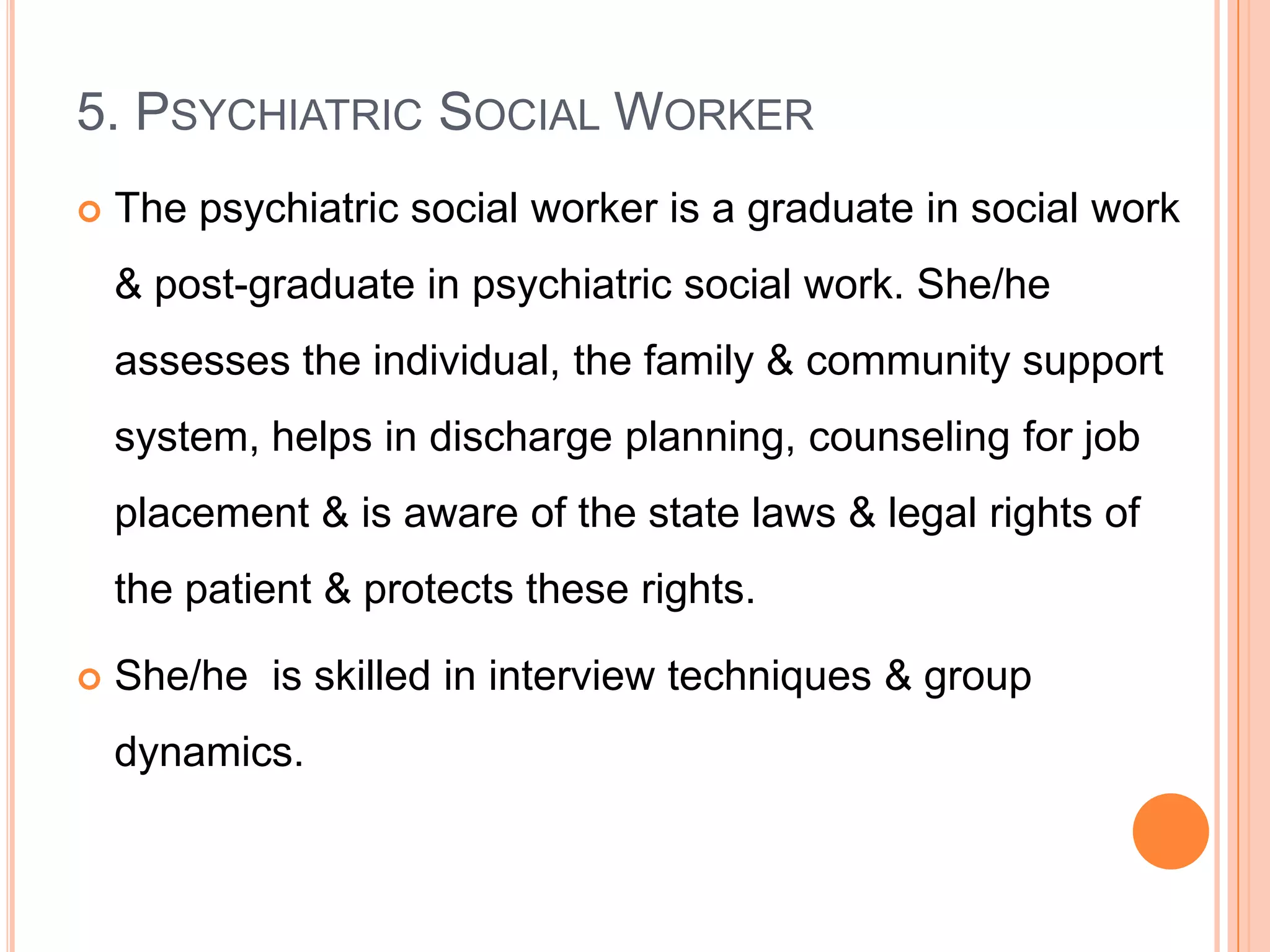
5. PSYCHIATRIC SOCIAL WORKER
   The psychiatric social worker is a graduate in social work
    & post-graduate in psychiatric social work. She/he
    assesses the individual, the family & community support
    system, helps in discharge planning, counseling for job
    placement & is aware of the state laws & legal rights of
    the patient & protects these rights.

   She/he is skilled in interview techniques & group
    dynamics.
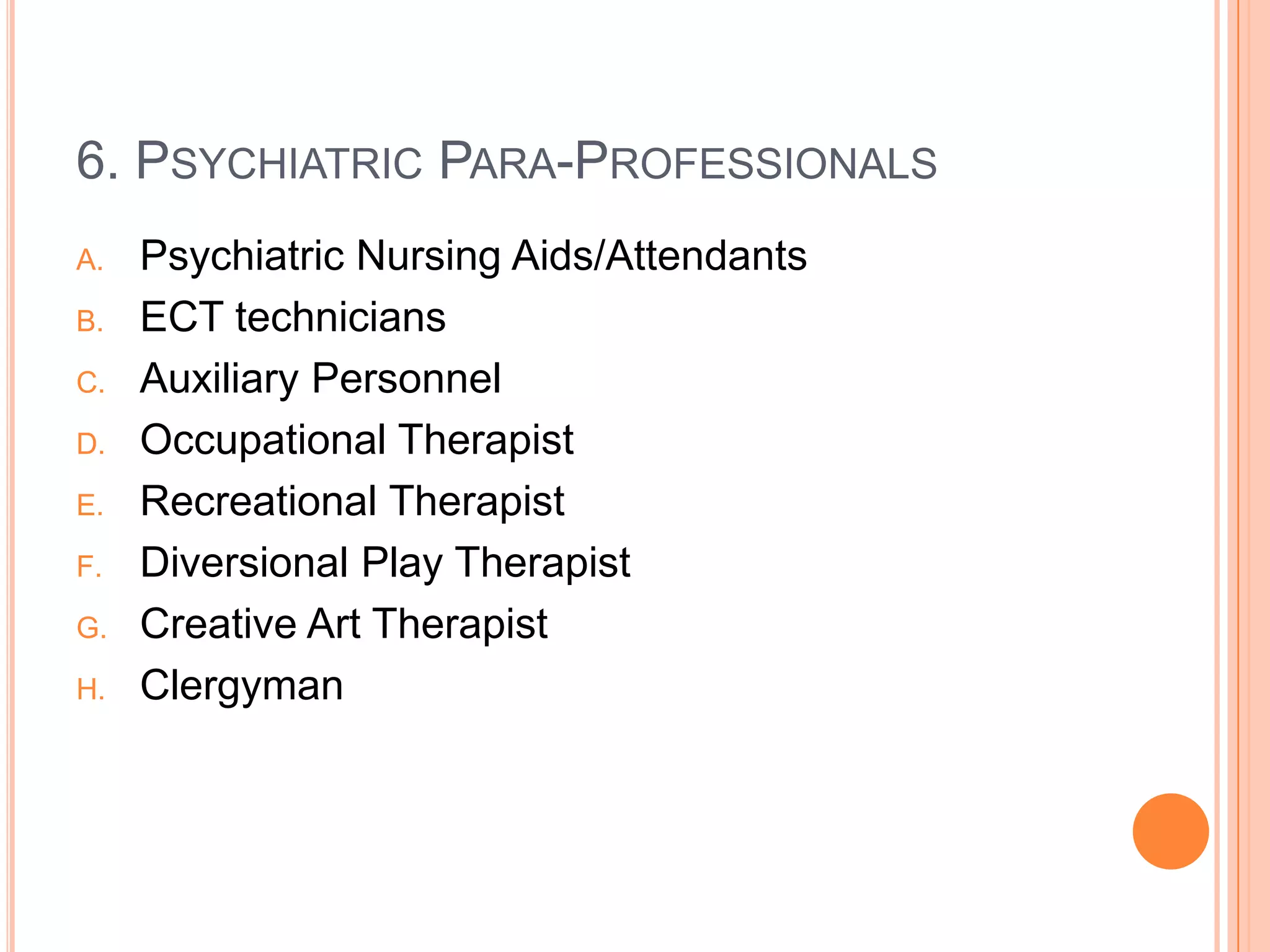
6. PSYCHIATRIC PARA-PROFESSIONALS
A.   Psychiatric Nursing Aids/Attendants
B.   ECT technicians
C.   Auxiliary Personnel
D.   Occupational Therapist
E.   Recreational Therapist
F.   Diversional Play Therapist
G.   Creative Art Therapist
H.   Clergyman
A. Psychiatric Nursing Aids/Attendants:


   They have high school training & are trained on the

    job.

   They aid maintaining the therapeutic environment &

    provide care under supervision.
B. ECT technicians:


   They undergo training for 6-9 months.

   Their function is to keep ready the ECT under the

    supervision of a psychiatrist or anesthetist.
C. Auxiliary Personnel:


   They are volunteer housekeeper or clerical staff &

    require in-service education to interact with the

    patient therapeutically.
D. Occupational Therapist:

   Occupational therapist goes through specialized
    training.

   He /she has a pivotal role to play by using manual &
    creative techniques to assess the interpersonal
    responses of the patient.

   Patients are helped to develop skill in the area of their
    choice & become economically independent.

   They are helped to work in sheltered workshop.
E. Recreational Therapist:


   The recreational therapist plans activities to

    stimulate the patient’s muscle co-ordination,

    interpersonal relationship & socialization.

   These approaches are need-based.
F. Diversional Play Therapist:


   Makes observation of a child / patient during his play.

   The behavior of the child while playing, the type of toys &

    his reaction toward the doll, beating, calling or throwing

    are the focus of attention.

   The therapist explores the behavior of the child & relates

    to conditions like phobia, child abuse, separation or any

    other condition.
G. Creative Art Therapist:


   He/she is an art graduate & encourages the patient
    to express his work freely with colors & analysis the
    use of various colours, drawing of various scenes
    etc.

   This therapy helps in diagnosis & also in bringing
    the repressed feelings of the patient to the
    conscious level.
H. Clergyman:


   These are religious persons who may be asked to

    come to the hospital unit once a week (depending

    on the patient’s religious faith) & have a spiritual

    talk with the patient.
THANK YOU

Multidisciplinary mental health team

  • 1.
  • 2.
    INTRODUCTION  Team workis significant in any setting more so in a mental health setting.  The milieu needed to care for patient depends up on the qualification, experience, skillful handling of the situation by all members of the team with similar approach.  For promotion of a therapeutic environment members of the various discipline coordinate their activity.  Four health care professionals constitute the core mental health disciplines : psychiatric nursing, psychiatry, clinical psychology, and psychiatric social work.
  • 3.
    MEANING  Teamwork isparamount for the success of any group.  Teamwork means the combined, co-coordinated & dedicated effort of each & every member of the team toward achievement of the vested interest, target or goal of the team as an entity.  Teamwork becomes more significant in a mental health setting where the contribution of all the members is extremely vital for the assessment, diagnosis, treatment, in- patient rehabilitation as well as community based rehabilitation of the mentally ill patient.  Team work is one of the steps leading to exemplary care of the individual, his family & the community at large thus making the millennium concept of “Holistic Patient Care” a reality.
  • 4.
    CONCEPT OF MULTI-DISCIPLINARYTEAM  This multi-disciplinary team can also function as an Inter- disciplinary team in that the total care of the patient requires not only the total input of each members of this team but also the inter-disciplinary coordinated effort .  One can compare this concept to an orchestra led by the music director.  Each members of the orchestra has to give his input & simultaneously there should be coordination with other members as directed by the music director, so that the final effect is splendid.  Similarly, multi-disciplinary input & inter-disciplinary coordination's as directed by the patient & his illness will lead to the splendid outcome of recovery of the patient to his maximum capability & capacity in the community.
  • 6.
    Clinical psychologist Psychiatry Psychiatric social Patient workers Clergyman Creative art therapist
  • 7.
    1. PSYCHIATRIST  The psychiatrist is a doctor with post-graduation in psychiatry with 2-3 years of residence training.  The psychiatrist is responsible for diagnosis, treatment & prevention of mental disorders, prescribe medicines & somatic therapy & function as a leader of the mental health team.
  • 8.
    2. PSYCHIATRIC NURSECLINICAL SPECIALIST  The psychiatric nurse clinical specialist should have a master degree in nursing, preferably with post –graduate research work.  She participates actively in primary, secondary & tertiary prevention of mental disorder & provides individual, group & family psychotherapy in a hospital & community setting.  She also takes up the responsibility of teaching, administration & research, bedsides publishing work in a mental health setting.  She takes up the role of a leader & can practice independently.
  • 9.
    3. REGISTERED NURSEIN A PSYCHIATRIC UNIT  The registered nurse undergoes a general nursing & midwifery program or B.Sc nursing / post-basic B.Sc nursing program with added qualification such as diploma in psychiatric nursing, diploma in nursing administration etc.  This nurse is skilled in caring for the mentally ill, gives holistic care by assessing the patient’s mental, social, physical, psychological & spiritual needs, making a nursing diagnosis, formulating, evaluating & rendering the appropriate nursing care.  She/he co-ordinates with the clinical nurse specialist in a community mental health setting.  She/he updates knowledge via continuing education, in- service education, workshops & courses conducted by open Universities.
  • 10.
    4. CLINICAL PSYCHOLOGIST  The clinical psychologist holds a doctoral degree in clinical psychology & is registered with the clinical psychologist’s association.  She/he conducts psychological, diagnosis tests, interprets & evaluates the finding of these tests & implements a program of behavior modification.
  • 11.
    5. PSYCHIATRIC SOCIALWORKER  The psychiatric social worker is a graduate in social work & post-graduate in psychiatric social work. She/he assesses the individual, the family & community support system, helps in discharge planning, counseling for job placement & is aware of the state laws & legal rights of the patient & protects these rights.  She/he is skilled in interview techniques & group dynamics.
  • 12.
    6. PSYCHIATRIC PARA-PROFESSIONALS A. Psychiatric Nursing Aids/Attendants B. ECT technicians C. Auxiliary Personnel D. Occupational Therapist E. Recreational Therapist F. Diversional Play Therapist G. Creative Art Therapist H. Clergyman
  • 13.
    A. Psychiatric NursingAids/Attendants:  They have high school training & are trained on the job.  They aid maintaining the therapeutic environment & provide care under supervision.
  • 14.
    B. ECT technicians:  They undergo training for 6-9 months.  Their function is to keep ready the ECT under the supervision of a psychiatrist or anesthetist.
  • 15.
    C. Auxiliary Personnel:  They are volunteer housekeeper or clerical staff & require in-service education to interact with the patient therapeutically.
  • 16.
    D. Occupational Therapist:  Occupational therapist goes through specialized training.  He /she has a pivotal role to play by using manual & creative techniques to assess the interpersonal responses of the patient.  Patients are helped to develop skill in the area of their choice & become economically independent.  They are helped to work in sheltered workshop.
  • 17.
    E. Recreational Therapist:  The recreational therapist plans activities to stimulate the patient’s muscle co-ordination, interpersonal relationship & socialization.  These approaches are need-based.
  • 18.
    F. Diversional PlayTherapist:  Makes observation of a child / patient during his play.  The behavior of the child while playing, the type of toys & his reaction toward the doll, beating, calling or throwing are the focus of attention.  The therapist explores the behavior of the child & relates to conditions like phobia, child abuse, separation or any other condition.
  • 19.
    G. Creative ArtTherapist:  He/she is an art graduate & encourages the patient to express his work freely with colors & analysis the use of various colours, drawing of various scenes etc.  This therapy helps in diagnosis & also in bringing the repressed feelings of the patient to the conscious level.
  • 20.
    H. Clergyman:  These are religious persons who may be asked to come to the hospital unit once a week (depending on the patient’s religious faith) & have a spiritual talk with the patient.
  • 21.