Educational Technology
EXT-705
Dr. Rupasi Tiwari
Joint Director, EE
ICAR- Indian Veterinary Research Institute
Izatnagar, Bareilly, UP-243122
Email: rtiwarirupasi@gmail.com, Mo: 09411917058
Meaning of Technology
• The word ‘Technology’ is derived from the two Greek words namely Technic
and Logia.
• ‘Technic’ -means ‘art or skill
• ’‘Logia’– means ‘Science or Study’
• So simplest meaning of ‘Technology’ is “Science of study of an art or skill.”
Definitions of Technology
• “Technology is Knowledge organized for Production” –
Sachs, I.
• “Technology is the application of scientific knowledge to a
practical purpose” – Page, T.
• “Technology is the set of instruments and skills which are
used to satisfy the needs of the community” Hierra, A.
Meaning of Education
• The word ‘Education’ is derived from the Latin
word ‘Educatum’, which means ‘To bring out’. “bring out
the better qualities of the individual”
• Acc. to Ross, the word ‘Education’ is derived from the Latin
word ‘Educare’ which means ‘to bring up’ or ‘to raise’. It
means that education is that process which brings up or
rears the individual in the right way.
Meaning of Educational Technology
• Three views regarding the meaning of educational
technology.
• Educational Technology 1 (ET 1)
• Educational Technology 2 (ET 2)
• Educational Technology 3 (ET 3)
Educational Technology 1 (ET 1)
• Refers to the application of physical sciences and
engineering technology to provide mechanical
instruments or “hardware” which can be used for
instructional purposes.
• This is the view of James O. Finn and others (1960).
• E.g. Tape-recorders (including language laboratory),
television, teaching machines and computer- based
teaching.
Educational Technology 2 (ET 2)
• Refers to the application of scientific principles or
‘software approach’ to instruction.
• This is the view of Skinner, Gagne and others.
Educational Technology 3 (ET 3)
• This incorporates both ET 1 and ET 2 through the
application of a ‘system approach’ to education and
training.
• Described by Davis and Hartley (1972)
Definitions of Educational Technology
• “Educational technology is the application of scientific process
to man’s learning conditions”
– Robert A. Cox.
• “Educational technology is an application of scientific
knowledge about learning to practical learning situation”
– Bloomer.
• Educational technology (commonly abbreviated as edutech,
or edtech) is the combined use of computer hardware,
software, and educational theory and practice to
facilitate learning.
-Wikipedia
Meaning of educational technology
• It is a system of 5 M’s. Educational
Technology is a System in education in
which
• Machines
• Materials
• Media
• Men
• Methods
• Are interrelated and work together fo
r fulfillment of specific educational obj
ectives.
Nature of Educational Technology
• The basis of educational technology is science.
• Educational technology studies the effect of
science and technology upon education.
• Educational technology is a continuous, dynamic,
progressive and effect-producing method.
• ET has contributed in developing various methods e.g.
Micro teaching method, Interaction analysis, Audio
Visual Aids and Programmed learning method.
• Educational technology accepts school as a
system. In this system, the school-building, furniture
and teachers act as input while various methods,
techniques, strategies and examination with the help
of audio-visual aids function as process. Lastly, the
output is in the form of ability of the pupils
Nature of Educational Technology
• Engineering technology is not the educational
technology. Though engineering technology has produced
radio, tape-recorder, video-tape and T.V. which are used in
teaching as audio-visual aids, it is different from educational
technology. In education, it is accepted as hardware approach
only.
• Audio-visual aids cannot be called as educational
technology because AV aids deals with process aspect of
educational technology and not with Input and Output
aspects.
• Programmed Instruction is only a part of educational
technology because it does not allow interaction between
pupil and teacher.
• Educational technology cannot solve each and every
problem of education. It can only be used successfully in
teaching-learning process.
• Educational technology can never replace the teacher
because of input, process, output aspects of
educational technology.
Revolution and Development of Educational Technology
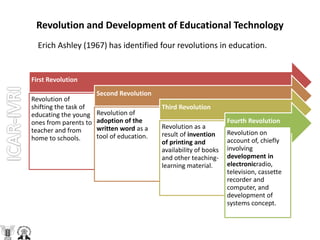
Erich Ashley (1967) has identified four revolutions in education.
First Revolution
Revolution of
shifting the task of
educating the young
ones from parents to
teacher and from
home to schools.
Second Revolution
Revolution of
adoption of the
written word as a
tool of education.
Third Revolution
Revolution as a
result of invention
of printing and
availability of books
and other teaching-
learning material.
Fourth Revolution
Revolution on
account of, chiefly
involving
development in
electronicradio,
television, cassette
recorder and
computer, and
development of
systems concept.
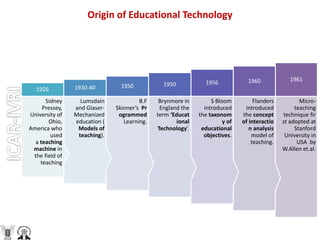
Origin of Educational Technology
Micro-
teaching
technique fir
st adopted at
Stanford
University in
USA by
W.Allen et.al.
1961
Flanders
introduced
the concept
of interactio
n analysis
model of
teaching.
1960
S Bloom
introduced
the taxonom
y of
educational
objectives.
1956
Brynmore in
England the
term ‘Educat
ional
Technology’.
1950
B.F
Skinner’s Pr
ogrammed
Learning.
1950
Lumsdain
and Glaser-
Mechanized
education (
Models of
teaching).
1930-40
Sidney
Pressey,
University of
Ohio,
America who
used
a teaching
machine in
the field of
teaching
1926
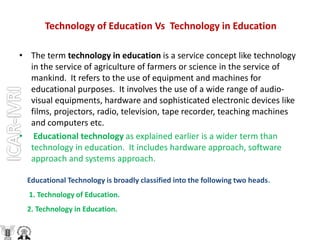
Technology of Education Vs Technology in Education
• The term technology in education is a service concept like technology
in the service of agriculture of farmers or science in the service of
mankind. It refers to the use of equipment and machines for
educational purposes. It involves the use of a wide range of audio-
visual equipments, hardware and sophisticated electronic devices like
films, projectors, radio, television, tape recorder, teaching machines
and computers etc.
• Educational technology as explained earlier is a wider term than
technology in education. It includes hardware approach, software
approach and systems approach.
Educational Technology is broadly classified into the following two heads.
1. Technology of Education.
2. Technology in Education.
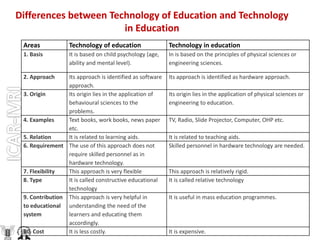
Differences between Technology of Education and Technology
in Education
Areas Technology of education Technology in education
1. Basis It is based on child psychology (age,
ability and mental level).
In is based on the principles of physical sciences or
engineering sciences.
2. Approach Its approach is identified as software
approach.
Its approach is identified as hardware approach.
3. Origin Its origin lies in the application of
behavioural sciences to the
problems.
Its origin lies in the application of physical sciences or
engineering to education.
4. Examples Text books, work books, news paper
etc.
TV, Radio, Slide Projector, Computer, OHP etc.
5. Relation It is related to learning aids. It is related to teaching aids.
6. Requirement The use of this approach does not
require skilled personnel as in
hardware technology.
Skilled personnel in hardware technology are needed.
7. Flexibility This approach is very flexible This approach is relatively rigid.
8. Type It is called constructive educational
technology
It is called relative technology
9. Contribution
to educational
system
This approach is very helpful in
understanding the need of the
learners and educating them
accordingly.
It is useful in mass education programmes.
10. Cost It is less costly. It is expensive.
Need and Importance of Educational Technology
1. Population Explosion
• Populations of Asian countries are increasing at a very fast speed and we
cannot educate all these people just by using teachers in the class.
• Modern media of communication like TV, Internet and CDs etc. can
impart education to millions of people together in one setting.
2. Fast Generation of New knowledge
• New knowledge is expanding at a very fast speed.
• It is almost doubling in just 3 years.
• A teacher is not supposed to impart this huge amount of knowledge by
tutorial or classroom teaching.
• ET can perform this function very easily.
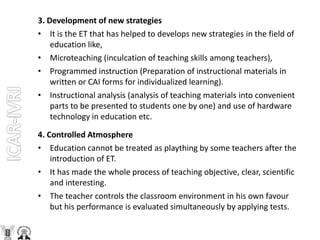
3. Development of new strategies
• It is the ET that has helped to develops new strategies in the field of
education like,
• Microteaching (inculcation of teaching skills among teachers),
• Programmed instruction (Preparation of instructional materials in
written or CAI forms for individualized learning).
• Instructional analysis (analysis of teaching materials into convenient
parts to be presented to students one by one) and use of hardware
technology in education etc.
4. Controlled Atmosphere
• Education cannot be treated as plaything by some teachers after the
introduction of ET.
• It has made the whole process of teaching objective, clear, scientific
and interesting.
• The teacher controls the classroom environment in his own favour
but his performance is evaluated simultaneously by applying tests.
5. Importance of Teacher’s role
• It emphasizes theories & Principles of teaching more than those of
learning.
• Thus, it has removed many of the defects and has raised the
significance & relevance of a teacher in the class.
6. Mass extension of Model teaching
• The facilities of radio television and internet are now available in a
large scale.
• By demonstrating the effective teaching of renowned teachers on
these media we can benefit millions of students together.
• Even the less effective and less skilled teachers can take the benefit of
these demonstrations & improve their teaching.
7. Advantages to private students
• Many universities have given permission to students for private
examinations, even in higher education.
• These students do not attend classes
• In order to maintain standard of education in higher education, the
use of ET becomes a necessity.
8. Preservation of knowledge
• By using hardware technology, we can preserve knowledge in audio
and video cassettes, CDs & floppy disks (Pen drive), web
9. Development of teaching models
• When a definite combination of inputs and strategies gives good
result repeatedly in a number of class room situations.
• It can be translated into teaching models to be used universally.
• It can be also lead to the development of teaching theories.
10. Creation of Interesting learning situations
• ET can transform the teaching-learning process from burden to enjoy
which, psychologically very sound for students.
• (e.g.) use of material aids in teaching increases the interest of
students.
Utility / Use of educational technology for teachers
• It has provided scientific and systematic approach to teachers to
conduct action research in the classroom situations to overcome the
classroom problems related to classroom environment, content,
curriculum etc.
• It helps the teacher to modernize and mechanize the teaching-
learning process. It also helps the learners to study at their own
speed/rate with the help of programmed instruction on video or
computers.
• ET supplements the teacher, with AV-aids to make the teaching-
learning process more effective.
• Add to their teaching competence, modify their teaching behaviour
and style, inculcate a scientific outlook, approach & attitude and help
them transfer these to their learners.
• ET supplements teacher in their instructional programmes through
the structured lessons for remedial, enrichment or drill purposes.
• The learners get the training of self instruction and teachers are
relieved of the burden of routine repetition for exercise & revision
purposes.
• It helps in teacher’s professional growth.
FORMS OF EDUCATIONAL TECHNOLOGY
The various forms of ET are as follows,
I. Teaching Technology
II. Instructional Technology
III. Behavioural Technology
I. TEACHING TECHNOLOGY
1. Introduction
2. Content of Teaching Technology
3. Assumptions of Teaching Technology
4. Characteristics of Teaching Technology
1. Introduction
• Teaching is the social and professional activity.
• Teaching is purposeful activity. The ultimate goal of teaching is
to bring all round development of a child.
• Teaching is an art as well as science because teaching can be
studied objectively and scientifically.
• The Chief proponents of Teaching Technology: I.K. Davies, N.L.
Gagne, Herbert, Hunt, Burner and Robert Glaser.
• Teaching is such a classroom activity which is completed by the
interaction between teachers and students.
• This activity leads to complete development of students.
• Today teaching is considered ‘Student-Centered’ and not
‘Teacher-Centered’.
• In other words, instead of teaching by the teacher, the learning
by the student is emphasized.
• K. Davies and Robert Glaser (1962) have developed the
content of teaching technology and classified into 4
elements.
a. Planning of Teaching
b. Organization of teaching
c. Leading of teaching
d. Controlling of teaching
2.Content of Teaching Technology
a. Planning of Teaching
• A teacher makes proper plan to what he is to teach in
the class. In planning he does 3 things/activities.
• Task analysis (He analyses the content and arranges
such sub contents into systematic manner).
• Identification of Objectives (i.e. what changes he has to
bring in the behaviour of his students).
• Writing learning Objectives (they can be evaluated at
the end of the task).
b. Organization of Teaching
• This is the second stage of teaching.
• This stage is particularly related to the presentation of the
subject-matter.
• In organizing, a teacher does the following things,
• He selects suitable teaching strategies and techniques.
• He selects or prepares suitable material aids for making
the presentation of the subject –matter effective.
• He matches the strategies and material aids with the
nature of the sub content to give such an experience to his
students which is conducive to the realization of teaching
objectives.
c. Leading of teaching
• This stage is related to communication strategies and
reinforcement devices.
• The techniques of motivation are employed for leading the
behaviours of the students.
• The knowledge regarding reports between teacher and
students is considered under this step.
d. Controlling of Teaching
• The last step concerns with evaluation of teaching.
• The main focus of this step is to assess the learning
objectives in terms of student’s performance.
• The learner’s performance provides the basis for the
feedback to teacher and learners.
The content of teaching technology is based on the following
assumptions.
• Teaching is a scientific process and it has two major components:
Content and Communication
• Teaching skills can be developed with the help of feedback devices.
• Teaching and learning are mutually inter-related (i.e.) they are
affected with each other. In otherwise means that better teaching
leads to better learning and better learning environment leads to
better teaching.
• Modification and improvement can be made in teaching activities
according to the situations (i.e.) there is no general formula applicable
to all circumstances.
• Appropriate conditions can be created by teaching for effective
learning.
3. Assumptions of Teaching Technology
4.Characteristics of Teaching Technology
The following are the main features of Teaching Technology.
• All the 3 domains/ objectives: cognitive, affective and psychomotor
can be achieved by this technology.
• It can make the teaching more effective.
• Teaching technology is based on philosophical, sociological and
scientific knowledge of education.
• Teaching can be organized at 3 levels namely: memory,
understanding and reflective level of teaching.
• As a system it consists of the inputs, process and outputs with the
focus on teachers.
• The teaching-learning process can be made effective with the help
of teaching technology.
II. Instructional technology
1. Introduction
• Instruction means communication of information by means other than
a teacher.
• For example various types of audio-visual aids can guide the students.
The Correspondence Course and Open University students accomplish
the task of instructions through press and television.
• Actually instructional technology is based upon Hardware approach.
• The instruction stands for development of knowledge and beliefs.
• Instructional technology means a network of techniques or devices
employed to accomplish a set of learning objectives.
• The origin of IT is from psychological laboratory experiments.
• The most important example of IT is ‘Programmed Instruction’.
• The Chief proponents of IT: B.F Skinner, Bruner, Glaser, Gilbert and
Mager.
2. Content of Instructional Technology
• The instructional technology involves the strategies and tactics
which can be used outside and inside the class room teaching.
• Teaching is an instruction but the instruction is not the
teaching.
• The instructional technology consists of the following content:
• Programmed instruction, Linear programming and its
Principles, Structure of Branching programming and its
Principles, Development of Programmed instruction material,
Learner Controlled instruction and CAI
3. Assumptions of Instructional Technology
The instructional technology involves the following assumptions:
• A pupil can learn according to his needs and capacities. (It means
that an instruction cannot benefit the entire student equally,
howsoever it is good).
• A pupil can learn even in the absence of the teacher.
• Reinforcement can be provided continuously by the use of
instruction.
• The subject matter can be divided into its various elements and
each element can be taught / presented independently through
this technology.
• Students can be given feed back by instructional activities also,
(i.e.) effective communication can provide feedback to learners.
4. Characteristics of Instructional Technology
The following are the main features of instructional technology
• Objectives of Cognitive domain can be achieved by the use of this
technology.
• Right responses of students can be reinforced regularly which will
lead to further right responses to occur.
• By the use of this technology, students can learn according to
their need and speed (rate).
• It provides the deep insight into the content structure and
sequence of its elements.
• The instructional theory may be developed by using this
technology in learning process.
• It helps in development of ‘Learner-Centered’ education.
III. BEHAVIOURAL TECHNOLOGY
1. Introduction
• This technology is closely related to psychology.
• Psychology is the Science of behaviour and learning is the
modification of behaviour through activities and
experiences.
• It is an application of scientific knowledge or modifying
teacher’s behaviour.
• It is also called as ‘Training Technology’
• The chief proponents of B.T: Flanders, B.F. Skinner,
Anderson, and Amidon.
2. Content of Behavioural Technology
• Teacher behaviour, Methods of observing teacher’s
behaviour and its rating (speed).
• Evaluation of teacher behaviour.
• Assumptions & theory of teacher behaviour.
• Models of classroom interaction.
• Various techniques of developing teacher
behaviour such as,
• Micro teaching
• Team teaching
• Interaction analysis techniques
• Programmed instruction
3. Assumptions of Behavioural Technology
This technology is based on the following assumptions:
• The behaviour of the teacher is social as well as psychological. It
means that psychological and social conditions directly affect
teachers’ behaviour.
• Teachers’ behaviour can be observable and measurable.
• Teachers’ behaviour is relative. It means that some teachers are
good and some are not good.
• Teachers’ behaviour can be modified by training and by using
reinforcement devices.
4. Characteristics of Behavioural Technology
The following are the main features of Behavioural Technology:
• It has the focus to achieve the psychomotor objectives.
• The specific teaching skills can be developed in teacher with the
help of this technology.
• The basic foundation is psychology.
• It is based upon software approach.
Aspect Teaching
Technology
Instructional
Technology
Behavioural
Technology
1. Proponents D. K Davies, N.LGagne Herbert,
Hunt, Bruner and
Robert Glaser.
B. F Skinner, Glaser,Gilbert, Mager Flanders, B.F Skinner,Andersonand
Amidon
2. Objectives Developmentofcognitive,
affective and psychomotor
domains.
Development of Cognitivedomain. Development of psychomotor
(skills).
3. Components /
approach
Content and
communication
Physical (Hardware)
approach
Behavioural
(Software) approach
4. Basis /
Foundation of
teaching
Philosophical, sociological
psychologicaland
scientific
Psychological andscientific basis Psychological and cybernetics.
5. content - Planningofteaching
- Organization ofteaching
- Leading ofteaching
- Controlling of teaching
- Task analysis
- Formulating objectives in
behavioralterms
- Reinforcement strategies
- Teacher behavior theories
- Teaching models
- Observation
techniques
- Analysis and
modificationsof Teacher
behaviour.
6. Level / Types of
teaching and learning
- memory
- understanding
- Reflective
- Programmed learning (self)
- CAI
- Learner Controlled Instruction
- Interaction analysis
- Micro Teaching
- Team Teaching
7. Principles - Art of teaching
and science of learning
Input,Process,Output Principles of learning
feedback and
reinforcement
8. Role of
teacher
As Manager As helper As an observer or
supervisor
9. Application Improving classroom teaching and
makingit effective
and purposive
Self – instruction, Correspondence
education & remedial teaching
Teacher education and teacher
training
Comparison among Different Forms of Educational Technology
1. Area of curriculum construction
In the present technological and psychological age, the application of
scientific and technological knowledge is much essential for the
curriculum construction. the curriculum construction has become a very
tedious job in the field of education. the task of the curriculum
construction can be simplified with the help of educational technology.
2. Selection of teaching-learning strategies
The selection of teaching-learning strategies turns easy with the help of
educational technology.
3. Selection of audio-visual material
Another important working area of educational technology is that the
teacher can select easily the audio-visual aids with its assistance.
Scope of Educational Technology
4. Determination of educational objectives
The software aspect of educational technology contributes in the formulation of
teaching objectives.
5. Areas of Teachers training
The new innovations of educational technology can be used successfully in
teachers training and it is actually being done, such as micro-teaching, simulated
teaching, system approach, classroom interaction and teaching models etc.
6. Areas of Feedback
In the field of education, educational technology has emphasized on feedback for
evaluation. Many experiments have been carried out in this area.
7. Areas of Hardwares
One form of educational technology also occurs as hardware devices such as
teaching machines, tape-recorder, television, computer and satellite etc. the
learning in the classroom can be made effective with their use.
Scope of Educational Technology

Educational Technology.pptx

  • 1.
    Educational Technology EXT-705 Dr. RupasiTiwari Joint Director, EE ICAR- Indian Veterinary Research Institute Izatnagar, Bareilly, UP-243122 Email: rtiwarirupasi@gmail.com, Mo: 09411917058
  • 2.
    Meaning of Technology •The word ‘Technology’ is derived from the two Greek words namely Technic and Logia. • ‘Technic’ -means ‘art or skill • ’‘Logia’– means ‘Science or Study’ • So simplest meaning of ‘Technology’ is “Science of study of an art or skill.”
  • 3.
    Definitions of Technology •“Technology is Knowledge organized for Production” – Sachs, I. • “Technology is the application of scientific knowledge to a practical purpose” – Page, T. • “Technology is the set of instruments and skills which are used to satisfy the needs of the community” Hierra, A.
  • 4.
    Meaning of Education •The word ‘Education’ is derived from the Latin word ‘Educatum’, which means ‘To bring out’. “bring out the better qualities of the individual” • Acc. to Ross, the word ‘Education’ is derived from the Latin word ‘Educare’ which means ‘to bring up’ or ‘to raise’. It means that education is that process which brings up or rears the individual in the right way.
  • 5.
    Meaning of EducationalTechnology • Three views regarding the meaning of educational technology. • Educational Technology 1 (ET 1) • Educational Technology 2 (ET 2) • Educational Technology 3 (ET 3)
  • 6.
    Educational Technology 1(ET 1) • Refers to the application of physical sciences and engineering technology to provide mechanical instruments or “hardware” which can be used for instructional purposes. • This is the view of James O. Finn and others (1960). • E.g. Tape-recorders (including language laboratory), television, teaching machines and computer- based teaching.
  • 7.
    Educational Technology 2(ET 2) • Refers to the application of scientific principles or ‘software approach’ to instruction. • This is the view of Skinner, Gagne and others.
  • 8.
    Educational Technology 3(ET 3) • This incorporates both ET 1 and ET 2 through the application of a ‘system approach’ to education and training. • Described by Davis and Hartley (1972)
  • 9.
    Definitions of EducationalTechnology • “Educational technology is the application of scientific process to man’s learning conditions” – Robert A. Cox. • “Educational technology is an application of scientific knowledge about learning to practical learning situation” – Bloomer. • Educational technology (commonly abbreviated as edutech, or edtech) is the combined use of computer hardware, software, and educational theory and practice to facilitate learning. -Wikipedia
  • 10.
    Meaning of educationaltechnology • It is a system of 5 M’s. Educational Technology is a System in education in which • Machines • Materials • Media • Men • Methods • Are interrelated and work together fo r fulfillment of specific educational obj ectives.
  • 11.
    Nature of EducationalTechnology • The basis of educational technology is science. • Educational technology studies the effect of science and technology upon education. • Educational technology is a continuous, dynamic, progressive and effect-producing method. • ET has contributed in developing various methods e.g. Micro teaching method, Interaction analysis, Audio Visual Aids and Programmed learning method. • Educational technology accepts school as a system. In this system, the school-building, furniture and teachers act as input while various methods, techniques, strategies and examination with the help of audio-visual aids function as process. Lastly, the output is in the form of ability of the pupils
  • 12.
    Nature of EducationalTechnology • Engineering technology is not the educational technology. Though engineering technology has produced radio, tape-recorder, video-tape and T.V. which are used in teaching as audio-visual aids, it is different from educational technology. In education, it is accepted as hardware approach only. • Audio-visual aids cannot be called as educational technology because AV aids deals with process aspect of educational technology and not with Input and Output aspects. • Programmed Instruction is only a part of educational technology because it does not allow interaction between pupil and teacher. • Educational technology cannot solve each and every problem of education. It can only be used successfully in teaching-learning process. • Educational technology can never replace the teacher because of input, process, output aspects of educational technology.
  • 13.
    Revolution and Developmentof Educational Technology Erich Ashley (1967) has identified four revolutions in education. First Revolution Revolution of shifting the task of educating the young ones from parents to teacher and from home to schools. Second Revolution Revolution of adoption of the written word as a tool of education. Third Revolution Revolution as a result of invention of printing and availability of books and other teaching- learning material. Fourth Revolution Revolution on account of, chiefly involving development in electronicradio, television, cassette recorder and computer, and development of systems concept.
  • 14.
    Origin of EducationalTechnology Micro- teaching technique fir st adopted at Stanford University in USA by W.Allen et.al. 1961 Flanders introduced the concept of interactio n analysis model of teaching. 1960 S Bloom introduced the taxonom y of educational objectives. 1956 Brynmore in England the term ‘Educat ional Technology’. 1950 B.F Skinner’s Pr ogrammed Learning. 1950 Lumsdain and Glaser- Mechanized education ( Models of teaching). 1930-40 Sidney Pressey, University of Ohio, America who used a teaching machine in the field of teaching 1926
  • 15.
    Technology of EducationVs Technology in Education • The term technology in education is a service concept like technology in the service of agriculture of farmers or science in the service of mankind. It refers to the use of equipment and machines for educational purposes. It involves the use of a wide range of audio- visual equipments, hardware and sophisticated electronic devices like films, projectors, radio, television, tape recorder, teaching machines and computers etc. • Educational technology as explained earlier is a wider term than technology in education. It includes hardware approach, software approach and systems approach. Educational Technology is broadly classified into the following two heads. 1. Technology of Education. 2. Technology in Education.
  • 16.
    Differences between Technologyof Education and Technology in Education Areas Technology of education Technology in education 1. Basis It is based on child psychology (age, ability and mental level). In is based on the principles of physical sciences or engineering sciences. 2. Approach Its approach is identified as software approach. Its approach is identified as hardware approach. 3. Origin Its origin lies in the application of behavioural sciences to the problems. Its origin lies in the application of physical sciences or engineering to education. 4. Examples Text books, work books, news paper etc. TV, Radio, Slide Projector, Computer, OHP etc. 5. Relation It is related to learning aids. It is related to teaching aids. 6. Requirement The use of this approach does not require skilled personnel as in hardware technology. Skilled personnel in hardware technology are needed. 7. Flexibility This approach is very flexible This approach is relatively rigid. 8. Type It is called constructive educational technology It is called relative technology 9. Contribution to educational system This approach is very helpful in understanding the need of the learners and educating them accordingly. It is useful in mass education programmes. 10. Cost It is less costly. It is expensive.
  • 17.
    Need and Importanceof Educational Technology 1. Population Explosion • Populations of Asian countries are increasing at a very fast speed and we cannot educate all these people just by using teachers in the class. • Modern media of communication like TV, Internet and CDs etc. can impart education to millions of people together in one setting. 2. Fast Generation of New knowledge • New knowledge is expanding at a very fast speed. • It is almost doubling in just 3 years. • A teacher is not supposed to impart this huge amount of knowledge by tutorial or classroom teaching. • ET can perform this function very easily.
  • 18.
    3. Development ofnew strategies • It is the ET that has helped to develops new strategies in the field of education like, • Microteaching (inculcation of teaching skills among teachers), • Programmed instruction (Preparation of instructional materials in written or CAI forms for individualized learning). • Instructional analysis (analysis of teaching materials into convenient parts to be presented to students one by one) and use of hardware technology in education etc. 4. Controlled Atmosphere • Education cannot be treated as plaything by some teachers after the introduction of ET. • It has made the whole process of teaching objective, clear, scientific and interesting. • The teacher controls the classroom environment in his own favour but his performance is evaluated simultaneously by applying tests.
  • 19.
    5. Importance ofTeacher’s role • It emphasizes theories & Principles of teaching more than those of learning. • Thus, it has removed many of the defects and has raised the significance & relevance of a teacher in the class. 6. Mass extension of Model teaching • The facilities of radio television and internet are now available in a large scale. • By demonstrating the effective teaching of renowned teachers on these media we can benefit millions of students together. • Even the less effective and less skilled teachers can take the benefit of these demonstrations & improve their teaching. 7. Advantages to private students • Many universities have given permission to students for private examinations, even in higher education. • These students do not attend classes • In order to maintain standard of education in higher education, the use of ET becomes a necessity.
  • 20.
    8. Preservation ofknowledge • By using hardware technology, we can preserve knowledge in audio and video cassettes, CDs & floppy disks (Pen drive), web 9. Development of teaching models • When a definite combination of inputs and strategies gives good result repeatedly in a number of class room situations. • It can be translated into teaching models to be used universally. • It can be also lead to the development of teaching theories. 10. Creation of Interesting learning situations • ET can transform the teaching-learning process from burden to enjoy which, psychologically very sound for students. • (e.g.) use of material aids in teaching increases the interest of students.
  • 21.
    Utility / Useof educational technology for teachers • It has provided scientific and systematic approach to teachers to conduct action research in the classroom situations to overcome the classroom problems related to classroom environment, content, curriculum etc. • It helps the teacher to modernize and mechanize the teaching- learning process. It also helps the learners to study at their own speed/rate with the help of programmed instruction on video or computers. • ET supplements the teacher, with AV-aids to make the teaching- learning process more effective. • Add to their teaching competence, modify their teaching behaviour and style, inculcate a scientific outlook, approach & attitude and help them transfer these to their learners. • ET supplements teacher in their instructional programmes through the structured lessons for remedial, enrichment or drill purposes. • The learners get the training of self instruction and teachers are relieved of the burden of routine repetition for exercise & revision purposes. • It helps in teacher’s professional growth.
  • 22.
    FORMS OF EDUCATIONALTECHNOLOGY The various forms of ET are as follows, I. Teaching Technology II. Instructional Technology III. Behavioural Technology
  • 23.
    I. TEACHING TECHNOLOGY 1.Introduction 2. Content of Teaching Technology 3. Assumptions of Teaching Technology 4. Characteristics of Teaching Technology
  • 24.
    1. Introduction • Teachingis the social and professional activity. • Teaching is purposeful activity. The ultimate goal of teaching is to bring all round development of a child. • Teaching is an art as well as science because teaching can be studied objectively and scientifically. • The Chief proponents of Teaching Technology: I.K. Davies, N.L. Gagne, Herbert, Hunt, Burner and Robert Glaser. • Teaching is such a classroom activity which is completed by the interaction between teachers and students. • This activity leads to complete development of students. • Today teaching is considered ‘Student-Centered’ and not ‘Teacher-Centered’. • In other words, instead of teaching by the teacher, the learning by the student is emphasized.
  • 25.
    • K. Daviesand Robert Glaser (1962) have developed the content of teaching technology and classified into 4 elements. a. Planning of Teaching b. Organization of teaching c. Leading of teaching d. Controlling of teaching 2.Content of Teaching Technology
  • 26.
    a. Planning ofTeaching • A teacher makes proper plan to what he is to teach in the class. In planning he does 3 things/activities. • Task analysis (He analyses the content and arranges such sub contents into systematic manner). • Identification of Objectives (i.e. what changes he has to bring in the behaviour of his students). • Writing learning Objectives (they can be evaluated at the end of the task).
  • 27.
    b. Organization ofTeaching • This is the second stage of teaching. • This stage is particularly related to the presentation of the subject-matter. • In organizing, a teacher does the following things, • He selects suitable teaching strategies and techniques. • He selects or prepares suitable material aids for making the presentation of the subject –matter effective. • He matches the strategies and material aids with the nature of the sub content to give such an experience to his students which is conducive to the realization of teaching objectives.
  • 28.
    c. Leading ofteaching • This stage is related to communication strategies and reinforcement devices. • The techniques of motivation are employed for leading the behaviours of the students. • The knowledge regarding reports between teacher and students is considered under this step. d. Controlling of Teaching • The last step concerns with evaluation of teaching. • The main focus of this step is to assess the learning objectives in terms of student’s performance. • The learner’s performance provides the basis for the feedback to teacher and learners.
  • 29.
    The content ofteaching technology is based on the following assumptions. • Teaching is a scientific process and it has two major components: Content and Communication • Teaching skills can be developed with the help of feedback devices. • Teaching and learning are mutually inter-related (i.e.) they are affected with each other. In otherwise means that better teaching leads to better learning and better learning environment leads to better teaching. • Modification and improvement can be made in teaching activities according to the situations (i.e.) there is no general formula applicable to all circumstances. • Appropriate conditions can be created by teaching for effective learning. 3. Assumptions of Teaching Technology
  • 30.
    4.Characteristics of TeachingTechnology The following are the main features of Teaching Technology. • All the 3 domains/ objectives: cognitive, affective and psychomotor can be achieved by this technology. • It can make the teaching more effective. • Teaching technology is based on philosophical, sociological and scientific knowledge of education. • Teaching can be organized at 3 levels namely: memory, understanding and reflective level of teaching. • As a system it consists of the inputs, process and outputs with the focus on teachers. • The teaching-learning process can be made effective with the help of teaching technology.
  • 31.
    II. Instructional technology 1.Introduction • Instruction means communication of information by means other than a teacher. • For example various types of audio-visual aids can guide the students. The Correspondence Course and Open University students accomplish the task of instructions through press and television. • Actually instructional technology is based upon Hardware approach. • The instruction stands for development of knowledge and beliefs. • Instructional technology means a network of techniques or devices employed to accomplish a set of learning objectives. • The origin of IT is from psychological laboratory experiments. • The most important example of IT is ‘Programmed Instruction’. • The Chief proponents of IT: B.F Skinner, Bruner, Glaser, Gilbert and Mager.
  • 32.
    2. Content ofInstructional Technology • The instructional technology involves the strategies and tactics which can be used outside and inside the class room teaching. • Teaching is an instruction but the instruction is not the teaching. • The instructional technology consists of the following content: • Programmed instruction, Linear programming and its Principles, Structure of Branching programming and its Principles, Development of Programmed instruction material, Learner Controlled instruction and CAI
  • 33.
    3. Assumptions ofInstructional Technology The instructional technology involves the following assumptions: • A pupil can learn according to his needs and capacities. (It means that an instruction cannot benefit the entire student equally, howsoever it is good). • A pupil can learn even in the absence of the teacher. • Reinforcement can be provided continuously by the use of instruction. • The subject matter can be divided into its various elements and each element can be taught / presented independently through this technology. • Students can be given feed back by instructional activities also, (i.e.) effective communication can provide feedback to learners.
  • 34.
    4. Characteristics ofInstructional Technology The following are the main features of instructional technology • Objectives of Cognitive domain can be achieved by the use of this technology. • Right responses of students can be reinforced regularly which will lead to further right responses to occur. • By the use of this technology, students can learn according to their need and speed (rate). • It provides the deep insight into the content structure and sequence of its elements. • The instructional theory may be developed by using this technology in learning process. • It helps in development of ‘Learner-Centered’ education.
  • 35.
    III. BEHAVIOURAL TECHNOLOGY 1.Introduction • This technology is closely related to psychology. • Psychology is the Science of behaviour and learning is the modification of behaviour through activities and experiences. • It is an application of scientific knowledge or modifying teacher’s behaviour. • It is also called as ‘Training Technology’ • The chief proponents of B.T: Flanders, B.F. Skinner, Anderson, and Amidon.
  • 36.
    2. Content ofBehavioural Technology • Teacher behaviour, Methods of observing teacher’s behaviour and its rating (speed). • Evaluation of teacher behaviour. • Assumptions & theory of teacher behaviour. • Models of classroom interaction. • Various techniques of developing teacher behaviour such as, • Micro teaching • Team teaching • Interaction analysis techniques • Programmed instruction
  • 37.
    3. Assumptions ofBehavioural Technology This technology is based on the following assumptions: • The behaviour of the teacher is social as well as psychological. It means that psychological and social conditions directly affect teachers’ behaviour. • Teachers’ behaviour can be observable and measurable. • Teachers’ behaviour is relative. It means that some teachers are good and some are not good. • Teachers’ behaviour can be modified by training and by using reinforcement devices. 4. Characteristics of Behavioural Technology The following are the main features of Behavioural Technology: • It has the focus to achieve the psychomotor objectives. • The specific teaching skills can be developed in teacher with the help of this technology. • The basic foundation is psychology. • It is based upon software approach.
  • 38.
    Aspect Teaching Technology Instructional Technology Behavioural Technology 1. ProponentsD. K Davies, N.LGagne Herbert, Hunt, Bruner and Robert Glaser. B. F Skinner, Glaser,Gilbert, Mager Flanders, B.F Skinner,Andersonand Amidon 2. Objectives Developmentofcognitive, affective and psychomotor domains. Development of Cognitivedomain. Development of psychomotor (skills). 3. Components / approach Content and communication Physical (Hardware) approach Behavioural (Software) approach 4. Basis / Foundation of teaching Philosophical, sociological psychologicaland scientific Psychological andscientific basis Psychological and cybernetics. 5. content - Planningofteaching - Organization ofteaching - Leading ofteaching - Controlling of teaching - Task analysis - Formulating objectives in behavioralterms - Reinforcement strategies - Teacher behavior theories - Teaching models - Observation techniques - Analysis and modificationsof Teacher behaviour. 6. Level / Types of teaching and learning - memory - understanding - Reflective - Programmed learning (self) - CAI - Learner Controlled Instruction - Interaction analysis - Micro Teaching - Team Teaching 7. Principles - Art of teaching and science of learning Input,Process,Output Principles of learning feedback and reinforcement 8. Role of teacher As Manager As helper As an observer or supervisor 9. Application Improving classroom teaching and makingit effective and purposive Self – instruction, Correspondence education & remedial teaching Teacher education and teacher training Comparison among Different Forms of Educational Technology
  • 39.
    1. Area ofcurriculum construction In the present technological and psychological age, the application of scientific and technological knowledge is much essential for the curriculum construction. the curriculum construction has become a very tedious job in the field of education. the task of the curriculum construction can be simplified with the help of educational technology. 2. Selection of teaching-learning strategies The selection of teaching-learning strategies turns easy with the help of educational technology. 3. Selection of audio-visual material Another important working area of educational technology is that the teacher can select easily the audio-visual aids with its assistance. Scope of Educational Technology
  • 40.
    4. Determination ofeducational objectives The software aspect of educational technology contributes in the formulation of teaching objectives. 5. Areas of Teachers training The new innovations of educational technology can be used successfully in teachers training and it is actually being done, such as micro-teaching, simulated teaching, system approach, classroom interaction and teaching models etc. 6. Areas of Feedback In the field of education, educational technology has emphasized on feedback for evaluation. Many experiments have been carried out in this area. 7. Areas of Hardwares One form of educational technology also occurs as hardware devices such as teaching machines, tape-recorder, television, computer and satellite etc. the learning in the classroom can be made effective with their use. Scope of Educational Technology