MidTerm Exam 1
Subject: Differential Equation
Note: This exam contains 10 questions, please resolve the
differential
Equations carefully!
Please answer this Exam in separate file contains your names
and ID.
PROFESSOR ROBERTO N. PADUA
THEORY CONSTRUCTION AND DEVELOPMENT
COURSE OUTLINE
I. Theory,Philosophical Bases and Logic
II. Deductive Methods of Theory Development
III. Inductive Methods of Theory Development
IV. Theory Development Versus Theory Verification
Course Requirements: Workshop Outputs
LECTURE I: Theory and Philosophical Bases
1. SCIENTIFIC RESEARCH: is systematic, controlled,
empirical, and critical investigation of hypothetical propositions
about the presumed relationships among phenomena.
2. THEORY: is a set of interrelated constructs (concepts),
definitions, and propositions that presents a systematic view of
phenomena by specifying relations among variables, with the
purpose of explaining, predicting, and controlling the
phenomena.
DEFINITIONS
A Theory is a statement that explains why things happen as they
do. There are three forms of a theory:
1. The "set-of-laws" form defines theory as a set of well-
supported empirical generalizations, or "laws." Here, theory is
thought of as "things we feel very certain about." This is the
inductive form.
2. The "axiomatic" form defines theory as a set of interrelated
propositions and definitions derived from axioms (i.e., things
we feel certain about). This is the deductive form of a theory.
3. The "causal" form defines theory as a set of descriptions of
causal processes. Here, theory "tells us how things work."
FUNCTIONS OF THEORY
a. EXPLANATION: provides an answer to the question "why is
the fact what it is?" that is intellectually satisfying. Formal
explanation: subsuming a proposition under a broader
proposition which needs no explanation. It consists of a
universal generalization that is assumed to be true, a particular
set of circumstances, and a conclusion which asserts that an
event had to occur because it was deducible from the logic of
the propositions of the theory. Such explanations are
deterministic/causal/nomic. Law: (x) <If Px then Qx>;
Antecedent Condition: Px; Conclusion: Qx.
FUNCTIONS OF THEORY:
b. PREDICTION: proposing the occurrence of a future event
given some awareness of a past or present relationship which
may or may not be understood (e.g., astronomy). One can
predict without explanation, but the reverse is not true. Thus
explanation, rather than prediction, is the end of science.
FUNCTIONS OF THEORY
c. CONTROL: ability to intervene in a particular case or to alter
the case of a particular relationship. In the pure case it implies
complete understanding of elements and their relationships as
well as a closed system. Less purely, it implies knowledge of
the principles along which the phenomena vary.
CHARACTERISTICS OF A THEORY
ABSTRACTNESS
Abstract concepts are independent of a specific time and place.
Because scientific statements must predict future events, they
cannot be specific to past events. Scientists prefer theories that
are as general as possible to time and place.
Abstract concepts are independent of specific circumstances or
conditions. This independence permits efficiency in
understanding and predicting future events. Thus, the statement,
"the greater the human capital investment, the greater the life
chances," contains two abstract concepts: human capital
investment and life chances.
This statement can be used to derive and test a large number of
related hypotheses, such as:
H1: The greater the formal education, the greater the income.
H2: The greater the job experience, the greater the likelihood of
promotion.
H3: The greater the communication skills, the greater the job
performance.
... and so on.
The process of science is one of moving continuously from one
level of abstraction to another. Scientists "borrow" abstract
statements from theories to derive hypotheses suitable to their
specific study. They test these hypotheses through observation.
They "return" the results of their studies to the theory by
reporting to the community of scholars the efficacy of the
theory in explaining their observations. Supported hypotheses
provide further support for and confidence in the theory.
Rejected hypotheses prompt consideration of revising the theory
or noting that it is less broadly applicable than originally
believed. A scientific body of knowledge is accumulated by this
ongoing process of borrowing, testing, revising, and building
new theories.
RELEVANCE
Empirical relevance refers to meeting two conditions of
observation:
Scientific theories must be falsifiable. The distinguishing
feature of science, in contrast with other epistemologies, is that
its statements can, in principle, be rejected through observation.
2. Scientific theories must be supported by observations. When
theories receive strong empirical support, then we gain
confidence in them, which allows us to build safe bridges, send
satellites into orbit, design effective crime prevention programs,
etc.
THE IDEA OF A THEORY
Theories are stories, stories about how reality works. They
differ from other stories in the ways described above: they are
abstract, causal, and falsifiable. Nevertheless, they are stories
about reality and they come from somewhere. Much has been
written in the philosophy of science about induction and
deduction, the twin processes by which new theories are crafted,
where induction refers to designing theories by combining and
raising to an abstract level empirical generalizations and
deduction refers to the "great thought" about how something
works.
We will rely upon Reynolds' text to describe each feature of a
theory in more detail.
Theory: A set of abstract statements about reality. These
statements about a phenomenon are interrelated constructs
building greater understanding of the phenomenon.e.g. What
would improve a nation’s quallity of life?
Proposition: One abstract statement within a theory.
Example: "The greater the human capital investment, the greater
the life chances.“
Hypothesis: A specific case of the proposition.
Example: "The greater the formal education, the greater the
income.’
Operational Definition: The description of how each concept
will be measured.
The greater the years of formal schooling, the greater the total
household income before taxes in 2007." StatementIndependent
VariableDependent VariableProposition (Abstract)Human
capital investmentLife chancesHypothesis (Concrete)Formal
educationIncomeOperational DefinitionYears of formal
schoolingTotal household income before taxes in 2007
The results of the statistical test of the research hypothesis
(presuming it is measured quantitatively) might lead the
researcher to reject the null form of the hypothesis (i.e., "There
is no relationship between formal education and income."). If
so, then the results of observation lend support for the
hypothesis, the proposition, the theory, and the paradigm. If the
null hypothesis is not rejected, then the community of scholars
will explore reasons why it was not supported, including the
notion that the theory (and perhaps the paradigm) might not be a
correct depiction of reality.
Concepts
Concepts, the building blocks of theories, are symbols designed
to convey a specific meaning to the community of scholars.
They must be defined, operationalized, and reviewed by the
community of scholars for meaning and accuracy. The concept
self-esteem, for example, is defined as, "an individual's sense of
his or her value or worth," and most often is measured using
Rosenberg's Self Esteem Scale, which is widely accepted by the
community of scholars.
1. Concepts are defined with either primitive or derived terms.
Primitive terms cannot be defined with other symbols or
language (e.g., colors, sounds, attitudes, some relationships
between individuals), but can only be further described through
the use of examples. A derived term is a set of primitive words
and symbols that further describes a concept.
2. An abstract concept refers to two or more events (e.g.,
temperature, human capital investment). A concrete concept
refers to a specific event (e.g., temperature of the sun, years of
formal education).
3. Concepts can be measured either quantitatively or
qualitatively. There is no epistemological reason to suspect that
either type of measurement is more or less scientific, objective,
or valid.
4. Concepts can be measured at the nominal level, indicating no
inherent ranking (e.g., male, female; Christian, Hindu, Muslim,
Jewish), the ordinal level, indicating ranking without a
continuous ordering (e.g., large, medium, small), the interval
level, indicating ranking with a continuous ordering, with no
known zero-state (e.g, attitudes about same-sex marriage
expressed on a 1-7 response scale), or the ratio level, indicating
continuous ordered ranking with a known zero point (e.g., age
in years).
1. Associational statements state a relationship without
implying cause. For example, we might state that, "locus-of-
control and self-esteem (two concepts with similar meanings)
are related," meaning they will vary together but not necessarily
cause one another.
2. Causal statements imply that x causes y (e.g., the greater the
formal education, the greater the income).
3. Theoretical propositions state relationships in an abstract
form (e.g., the greater the human capital investment, the greater
the life chances).
4. Hypotheses state relationships in a concrete form (e.g, the
greater the formal education, the greater the income).
Forms of Theory
Theories can be expressed as a set of laws, in axiomatic form,
or as a set of causal statements.
1. The set-of-laws format expresses relationships as a set of
highly supported laws (i.e., typically in causal form). Consider,
for example, the Theory of Reasoned Action, proposed by
Martin Fishbein and Izak Ajzen. Within this theory we might
state as one law, "the greater the attitude about the behavior, the
greater the intention to engage in the behavior." All the other
paths implied by the diagram would be listed as laws within the
set of laws that define the theory of reasoned action.
2. The axiomatic format expresses relationships as a set of
axioms. For example, within the theory of reasoned action, we
might state as one axiom, "If attitude toward the behavior, then
intention toward the behavior." All the other paths implied by
the diagram would be listed as axioms within this format.
3. The diagram shown for the theory of reasoned action
represents the causal statement form. Each diagrammed path
represents a theoretical proposition. For example, we might
infer from the diagram of the Theory of Reasoned Action that,
"the greater the attitude about the behavior, the greater the
intention to engage in the behavior."
Note Regarding the Format of Theory
The typical format used in sociology to express a theory is the
set of causal statements, often shown in a concise manner by the
use of a diagram. In the 1980's, as part of an effort to make
sociology "more scientific," sociologists began to present their
theories in axiomatic format (see volumes of The American
Sociological Review for examples of this effort). Sociologists
learned quickly that the formatting of a theory provided few
advantages toward accumulating a scientific body of
knowledge; what mattered was the quality of the theory, not its
formatting. Note, however, that some sociologists will argue
that "theory" should be expressed either as a set of laws or in
axiomatic format (see: Formal Theory in Sociology:
Opportunity or Pitfall?, edited by Jerald Hage).
PHILOSOPHICAL BASES
a. EPISTEMOLOGY: How do we know what we claim to know?
1) To what extent can knowledge exist before experience?
2) To what extent is knowledge universal?
3) By what process does knowledge arise?
a) Rationalism: knowledge arises out of the sheer power of the
human mind. (PLATO, ERDOS)
b) Empiricism: knowledge arises in perception (JOHN STUART
MILL).
c) Constructivism: people create knowledge to function in life(
LAKATOS, IMRE,).
4) Is knowledge best conceived in parts or wholes? (GESTALT)
5) To what extent is knowledge explicit?
b. ONTOLOGY: What is the nature of the phenomena we seek
to know?
1) To what extent do humans make real choices?
a) Determinists (motion theory): humans are basically reactive
and passive; behavior is determined by and responsive to past
pressures.
b) Teleologists (action theory): people plan their behavior to
meet goals; individuals create meanings, they have intentions,
they make real choices.
2) To what extent are humans best understood in terms of states
versus traits?
3) To what extent is human experience basically individual
versus social
c. AXIOLOGY: What is the role of values in inquiry (value-
conscious versus value-neutral scholarship).
1) Can theory be value-free?
2) To what extent does inquiry influence what is studied?
3) To what extent should scholarship attempt to achieve social
change?
DURHEIM-QUINE PRINCIPLEThere are infinitely many
theories that could explain the same set of data or observations.
Example: We all observe that the sun rises in the East and sets
in the West. But:A. Some theorized that the earth is flat while
others theorized otherwise;B. Some theorized that the earth is
the center of the universe, while others believed that the sun is
the center of the universe.
WORKSHOP 1:
The following exercises aim to gauge how much of the basic
concepts in this lecture you have absorbed and learned. There
are three(3) activities in this workshop.
1. State a theory in a field of study that you are interested in or
has knowledge of.
1.1 State at least two(2) propositions based on this theory.
1.2 State at least one(1) hypothesis for every proposition that
you have stated.
WORKSHOP 1 (continued)
2.. Analyze the following situation and then come up with a
theory (set of at least three propositions), propositions, and
hypotheses.
“ So much had been said about the deteriorating quality of
Philippine higher education. In the 1960’s, the Philippines was
considered Asia’s best destination for higher education and
advanced studies. Thus, Philippine universities and colleges
trained the technocrats of Thailand, Japan, Indonesia, Malaysia,
Australia and other countries. In a recent survey of the state of
education, however, the country was ranked 42nd out of 45
countries in a test for science and mathematics. Policy makers
blamed the situation to many factors: short-basic education
cycle, economic problems of the Philippines, non-specialized
curricula in colleges and universities, brain- drain, inequitable
distribution of resources etc. In the 1990’s the country re-
designed its educational system to address various systemic
issues leading to the poor quality of education observed.
Paradoxically, the situation has not changed very much since
1994 when CHED was established.”
3. Gather the results of the other groups and copy their theories.
3.1 What are the similarities and differences in the way
that the other groups derived their theories?
3.2 Did you come up with essentially the same or different
theories?
3.3 How would you philosophically explain the similarities
or differences in the theories that you have derived?
OUTPUT PRESENTATION :1:00-2:00 P.M. OF DAY 1
1. Make a powerpoint presentation of your results.
2. Elect a group reporter to present the output.
3. Any member of the group may respond to any questions
raised by the members of the class. However, in case there are
no questions, the group must also prepare a set of guide
questions to steer the discussions.
4. Each group is given 15 minutes to present and respond to
questions.
5. You will be graded in terms of your presentation abilities and
in terms of the thoroughness with which you respond to
questions.
LECTURE 2: BRIEF DIGRESSION INTO LOGICSince one of
the methods for theory construction that we will study is the
Deductive Method, we need to strengthen our LOGIC.One
handy definition for Day One of an introductory course like this
is that logic is the study of argument. For the purposes of logic,
an argument is not a quarrel or dispute, but an example of
reasoning in which one or more statements are offered as
support, justification, grounds, reasons, or evidence for another
statement. The statement being supported is the conclusion of
the argument, and the statements that support it are the premises
of the argument.
Arguments establish the truth of conclusions relative to some
premises and rules of inference. Logicians do not care whether
arguments succeed psychologically in changing people's minds
or convincing them. The kinks and twists of actual human
reasoning are studied by psychology; the effectiveness of
reasoning and its variations in persuading others are studied by
rhetoric; but the correctness of reasoning (the validity of the
inference) is studied by logic.
To assess the worth of an argument, only two aspects or
properties of the argument need be considered: the truth of the
premises and the validity of the reasoning from them to the
conclusion. Of these, logicians study only the reasoning; they
leave the question of the truth of the premises to empirical
scientists and private detectives. An argument is valid if the
truth of its premises guarantees the truth of its conclusion.Note
that only arguments can be valid or invalid, not statements.
Similarly, only statements can be true or false, not arguments.
Truth of Statements, Validity of Reasoning
Peter Suber, Philosophy Department, Earlham College
True Premises, False Conclusion
0.
Valid
Impossible: no valid argument can have true premises and a
false conclusion.
1.
Invalid
Cats are mammals.
Dogs are mammals.
Therefore, dogs are cats.
True Premises, True Conclusion
2.
Valid
Cats are mammals.
Tigers are cats.
Therefore, tigers are mammals.
3.
Invalid
Cats are mammals.
Tigers are mammals.
Therefore, tigers are cats.
False Premises, False Conclusion
4.
Valid
Dogs are cats.
Cats are birds.
Therefore, dogs are birds.
5.
Invalid
Cats are birds.
Dogs are birds.
Therefore, dogs are cats.
False Premises, True Conclusion
6.
Valid
Cats are birds.
Birds are mammals.
Therefore, cats are mammals.
7.
Invalid
Cats are birds.
Tigers are birds.
Therefore, tigers are cats.
The distinction between truth and validity is the fundamental
distinction of formal logic. You cannot understand how
logicians see things until this distinction is clear and familiar.
PROPOSITIONAL LOGICA simple statement is one that does
not contain any other statement as a part. We will use the lower-
case letters, p, q, r, ..., as symbols for simple statements. A
compound statement is one with two or more simple statements
as parts or what we will call components. A component of a
compound is any whole statement that is part of a larger
statement; components may themselves be compounds. An
operator (or connective) joins simple statements into
compounds, and joins compounds into larger compounds. We
will use the symbols, , · , , and to designate the sentential
connectives. They are called sentential connectives because
they join sentences (or what we are calling statements). The
symbol, ~, is the only operator that is not a connective; it
affects single statements only, and does not join statements into
compounds.
Simple statements
p
"p is true"
assertion
~p
"p is false"
negation
Compounds and connectives
p q
"either p is true, or q is true, or both"
disjunction
p · q
"both p and q are true"
conjunction
p q
"if p is true, then q is true"
implication
p q
"p and q are either both true or both false"
equivalence
Implication statements (p q) are sometimes called conditionals,
and equivalence statements (p q) are sometimes called
biconditionals.
The truth value of a statement is its truth or falsity. All
meaningful statements have truth values, whether they are
simple or compound, asserted or negated. That is, p is either
true or false, ~p is either true or false, p q is either true or false,
and so on.
A truth table is a complete list of the possible truth values of a
statement. We use "T" to mean "true", and "F" to mean "false"
(though it may be clearer and quicker to use "1" and "0"
respectively).
For example, p is either true or false. So its truth table has just
2 rows:
p
T
F
But the compound, p q, has 2 components, each of which can be
true or false. So there are 4 possible combinations of truth
values. The disjunction of p with q will be true as a compound
whenever p is true, or q is true, or both:
p
q
p q
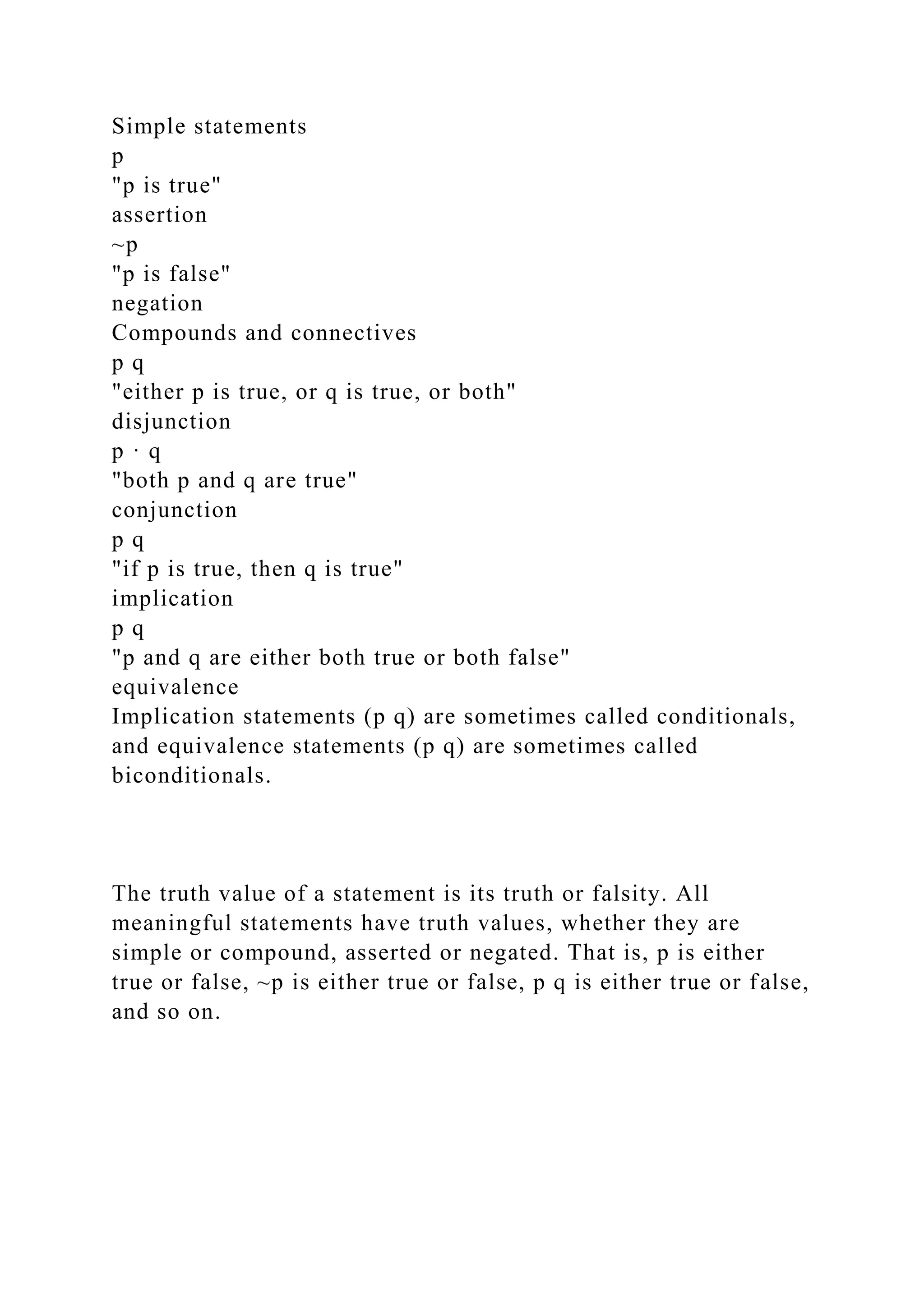
T
T
T
T
F
T
F
T
T
F
F
F
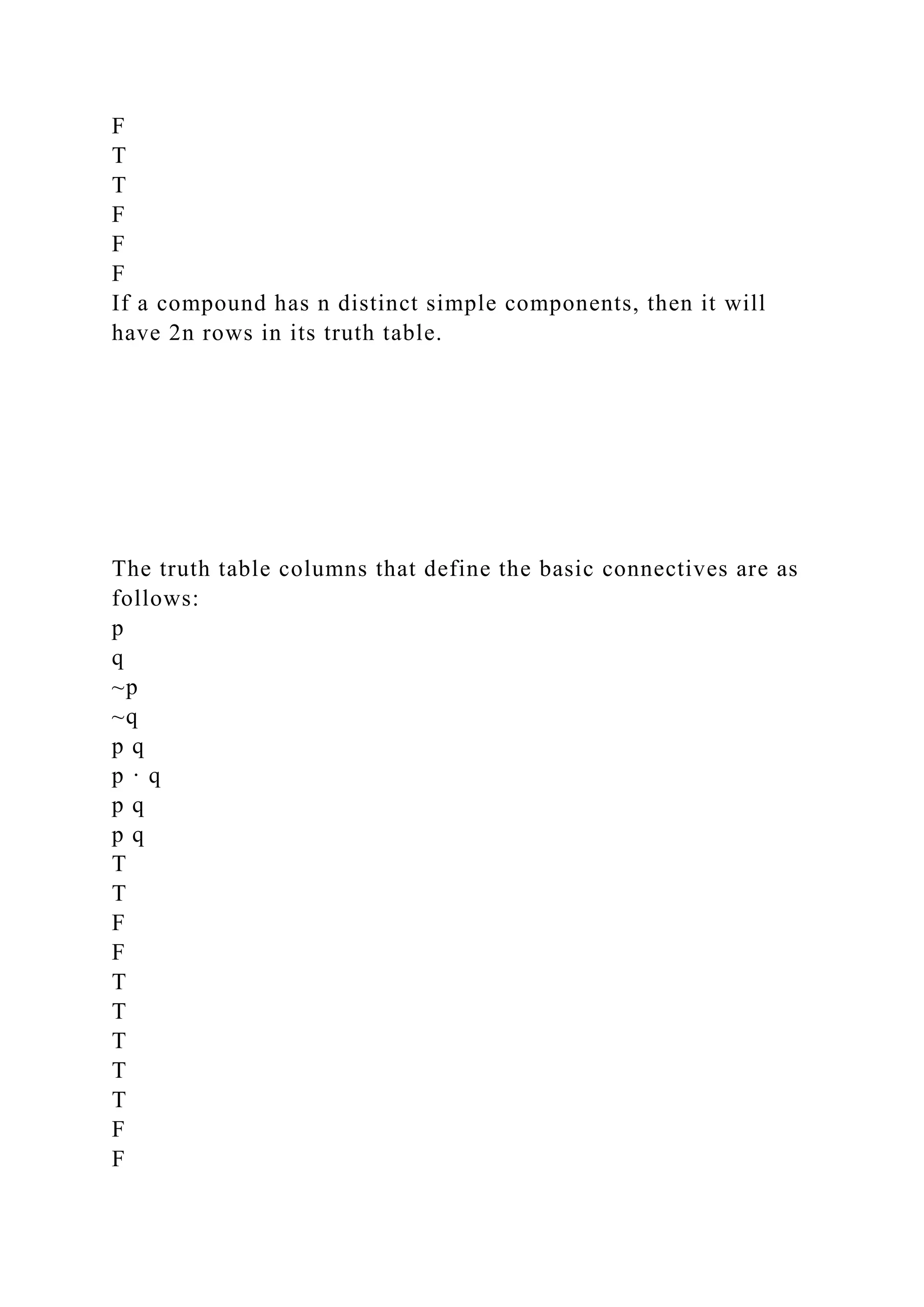
If a compound has n distinct simple components, then it will
have 2n rows in its truth table.
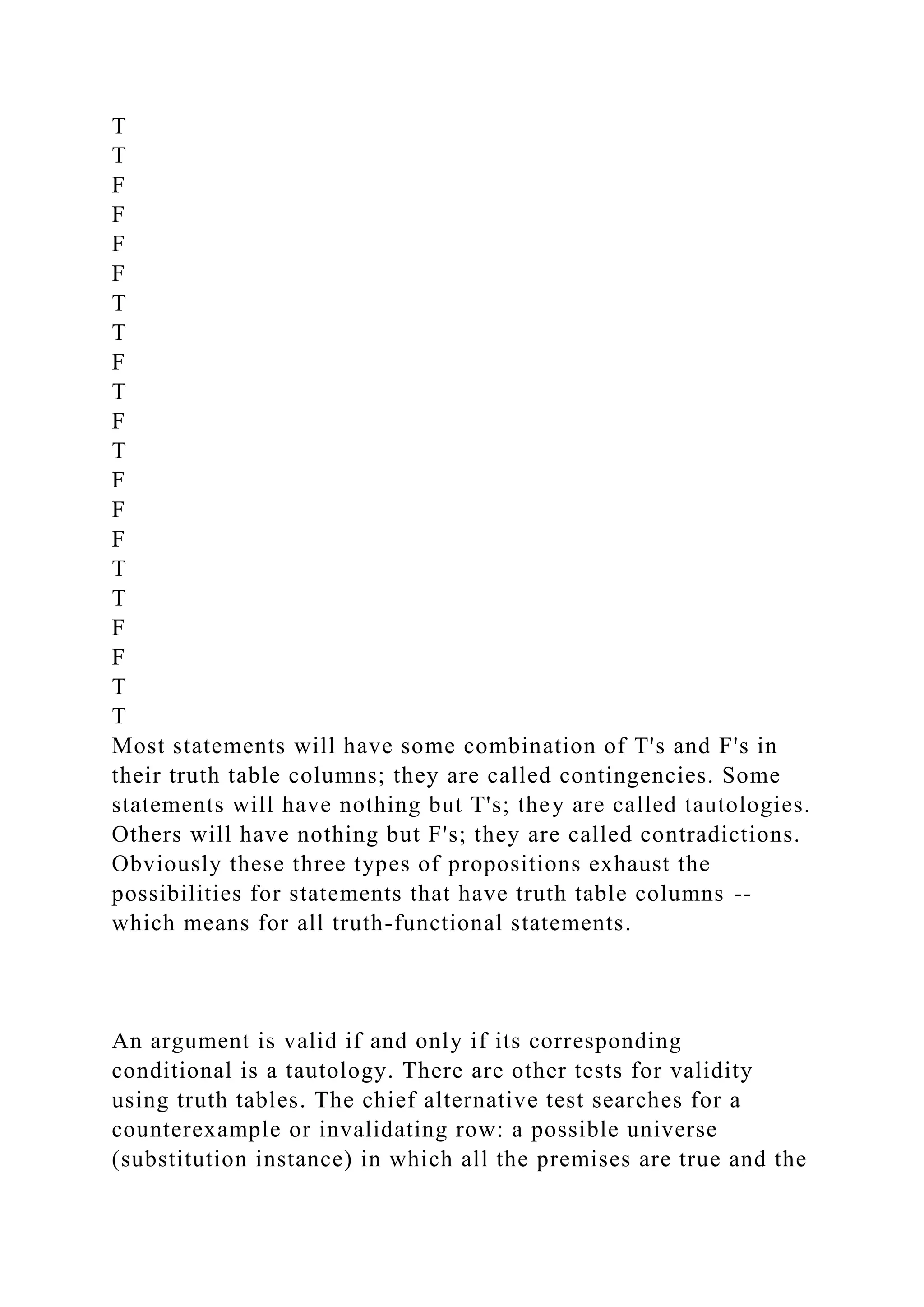
The truth table columns that define the basic connectives are as
follows:
p
q
~p
~q
p q
p · q
p q
p q
T
T
F
F
T
T
T
T
T
F
F
T
T
F
F
F
F
T
T
F
T
F
T
F
F
F
T
T
F
F
T
T
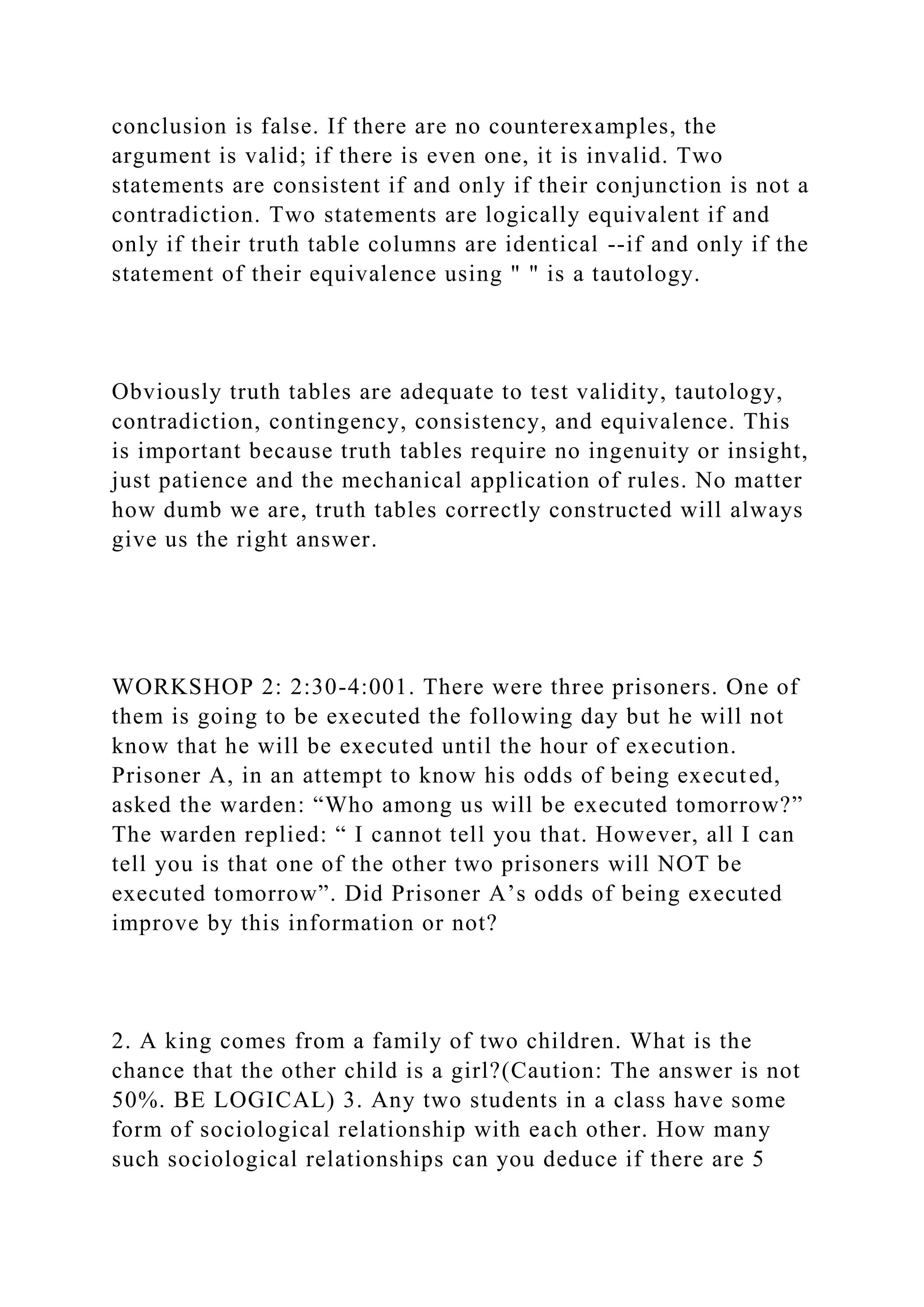
Most statements will have some combination of T's and F's in
their truth table columns; they are called contingencies. Some
statements will have nothing but T's; they are called tautologies.
Others will have nothing but F's; they are called contradictions.
Obviously these three types of propositions exhaust the
possibilities for statements that have truth table columns --
which means for all truth-functional statements.
An argument is valid if and only if its corresponding
conditional is a tautology. There are other tests for validity
using truth tables. The chief alternative test searches for a
counterexample or invalidating row: a possible universe
(substitution instance) in which all the premises are true and the
conclusion is false. If there are no counterexamples, the
argument is valid; if there is even one, it is invalid. Two
statements are consistent if and only if their conjunction is not a
contradiction. Two statements are logically equivalent if and
only if their truth table columns are identical --if and only if the
statement of their equivalence using " " is a tautology.
Obviously truth tables are adequate to test validity, tautology,
contradiction, contingency, consistency, and equivalence. This
is important because truth tables require no ingenuity or insight,
just patience and the mechanical application of rules. No matter
how dumb we are, truth tables correctly constructed will always
give us the right answer.
WORKSHOP 2: 2:30-4:001. There were three prisoners. One of
them is going to be executed the following day but he will not
know that he will be executed until the hour of execution.
Prisoner A, in an attempt to know his odds of being executed,
asked the warden: “Who among us will be executed tomorrow?”
The warden replied: “ I cannot tell you that. However, all I can
tell you is that one of the other two prisoners will NOT be
executed tomorrow”. Did Prisoner A’s odds of being executed
improve by this information or not?
2. A king comes from a family of two children. What is the
chance that the other child is a girl?(Caution: The answer is not
50%. BE LOGICAL) 3. Any two students in a class have some
form of sociological relationship with each other. How many
such sociological relationships can you deduce if there are 5
students in the class?4. Five (5) friends A,B,C,D and E are
stranded in an island. Friend E was murdered on a Tuesday in
their camp with a blunt object which crushed his skull instantly
killing him. Friend A is scheduled to look for food every
Thursday, Friday and Saturday. Friend B is scheduled to look
for food every Tuesday, Friday and Saturday. Friend C’s
schedule for food is Monday, Wednesday and Saturday. Friend
D searches for food every Tuesday, Wednesday, Friday and
Saturday. A and B are male while C and D are female. Who are
your most likely suspects as murderers?
5. Show by using a truth table that “p or not p” is a tautology
but “p and not p” is a contradiction.6. Show that the following
are equivalent statements by using a truth table:6.1 “not (p or
q)” is equivalent to “not p and not q”6.2 “not (p and q” is
equivalent to “not p or not q”6.3 “If p implies q” is logically
equivalent to “If not q implies not p”7. Show how the
proposition:”If population grows geometrically, then there will
be hunger in the future” is deducible by logical inference from
the Malthusian principle.That is, put the Malthusian principle in
symbolic logic form and do some logical operations to arrive at
the statement.WORKSHOP PRESENTATION: 4-5 P.M.
LECTURE 3: DEDUCTIVE SYSTEMS
DEDUCTIVE SYSTEMS
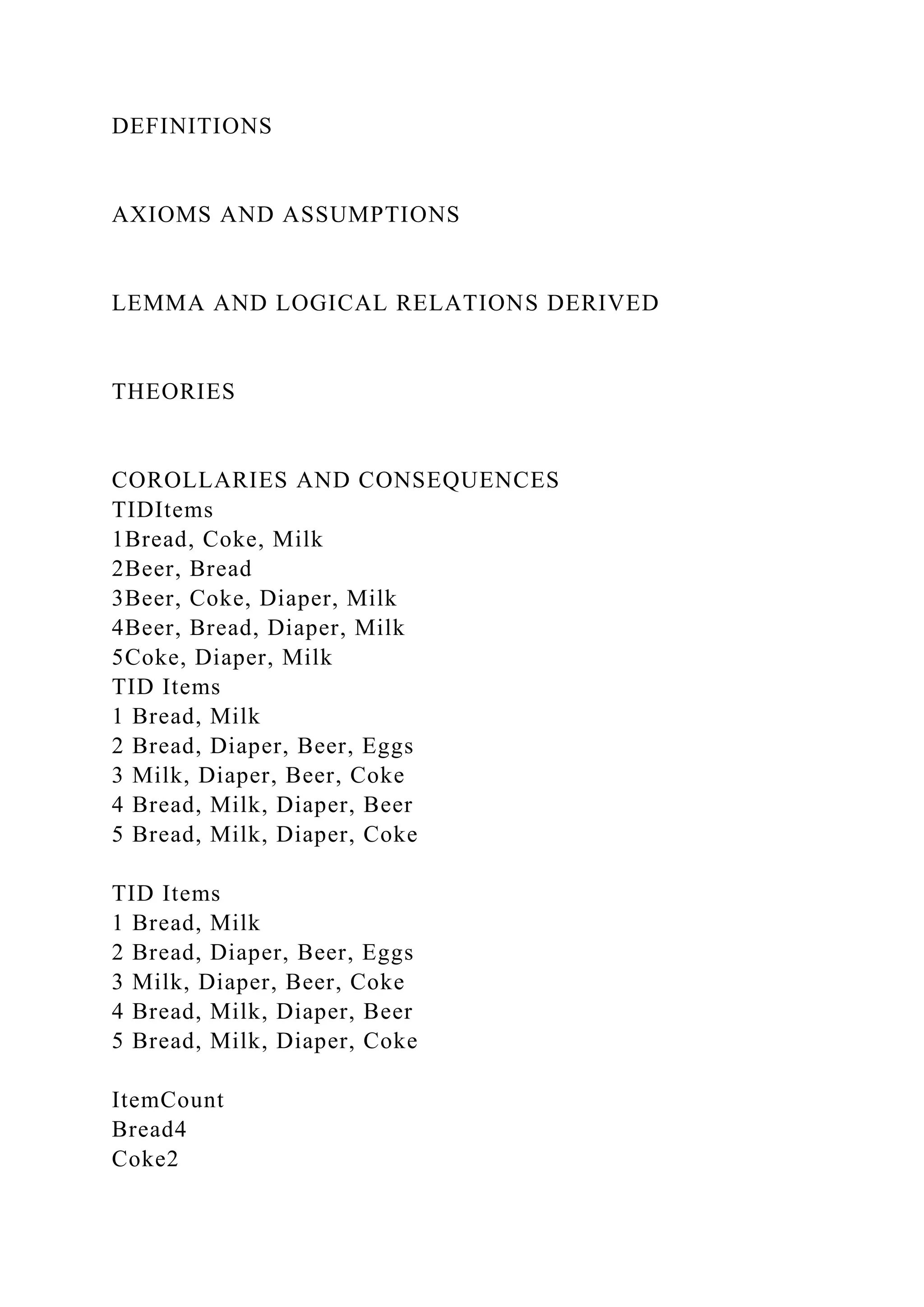
DEFINITIONS
AXIOMS AND ASSUMPTIONS
LEMMA AND LOGICAL RELATIONS DERIVED
THEORIES
COROLLARIES AND CONSEQUENCES
LECTURE 3: DEDUCTIVE METHODSThe process of theory
construction:1. Specify the topic2. Specify the
assumptions and axioms3. Specify the range of
phenomena4. Specify the major concepts and variables5.
Specify the propositions, hypotheses, and relationships6.
Specify the theory
SPECIFY THE TOPIC
The first step in theory verification and/or construction is to
specify the research topic of interest. Existing theories and
literature related to the topic should be identified and used as
guidance for determining the nature and scope of the inquiry.
Since knowledge is cumulative, the inherited body of
information and understanding is the takeoff point for the
development of more knowledge. The practice of reviewing the
literature in research papers serves this purpose of identifying
relevant theories and findings or the lack of both.
EXAMPLES:1. Spread of communicable diseases.
2. Quality higher education.
3. Digital divide in developing countries.
4. Quality of life of a nation
5. Care of the elderly in developing and underdeveloped nations
SPECIFY THE ASSUMPTIONS/AXIOMSThe second step in
theory verification and/or construction is to specify the
assumptions related to the research focus. Assumptions are
suppositions that are not yet tested but are considered true. In
general, assumptions should make sense to most people. When
in doubt, researchers should test their assumptions rather than
consider them true. For example, when the telephone interview
is used as a data collection method, the assumption is that it can
reach a representative sample of the population of interest. If
this assumption is not necessarily true, as in studies of
Medicaid recipients or indigent patients, then researchers need
to conduct a pretest to verity whether the telephone is a proper
channel to reach the study population prior to full-scale data
collection.
EXAMPLESTOPIC: STATE CARE OF THE ELDERLY IN
DEVELOPING AND UNDERDEVELOPED
NATIONSDEFINITIONS:1. Developing nations are nations
whose economy are in the initial stages of industrialization;
Underdeveloped nations are nations whose economy are
agricuture-based.AXIOMS/ASSUMPTIONS1. Developing and
underdeveloped nations have fair to poor social services
system.2. Developing nations prioritizes economic concerns in
their national budget. Moreover, economic strategies adopted by
these governments aim for productive employment.3.
Developing and underdeveloped nations are characterized as
religious and attach strong significance to the family.4.
Population growth rates of developing and underdeveloped
nations are often high: between 2.5% to 3.0% per annum.
Average life expectancies range from 60 to 70 years with an sd
of about 6 years.
SPECIFY THE RANGE OF PHENOMENAThe third step in
theory verification and/or construction is to specify the range of
phenomena the current research and existing theories address.
For example, will the research and theories apply to people of
the world or only to Filipinos or only to young Filipinos?
Research or theories are more useful the greater the range of
phenomena they cover, although broader theories are more
difficult to construct. For one thing, data have to be collected
from a wider spectrum of the population.
SPECIFY MAJOR VARIABLES AND CONCEPTSThe fourth
step in theory verification and/or construction is to specify the
major concepts and variables. Concepts are mental images or
perceptions (Bailey, 1994). They may be difficult to observe
directly, such as equity or ethics, or they may have referents
that are easily observable, such as a hospital or a clinic. A
concept that has only a single, never-changing value is called a
constant. A concept that has more than one measurable value is
called a variable.
Variables may be classified as independent and/or dependent.
Generally, a variable capable of effecting change in other
variables is called an independent variable. A variable whose
value is dependent upon one or more other variables, but which
cannot itself affect the other variables, is called a dependent
variable. The dependent variable is the variable we wish to
explain, and the independent variable is the hypothesized
explanation. In a causal relationship, the cause is an
independent variable and the effect a dependent variable. For
example, since smoking causes lung cancer, smoking is an
independent variable and lung cancer a dependent variable.
Often we can recognize a variable as independent simply
because it occurs before the other variable. For example, we
may find a relationship between race and level of education.
Race clearly comes before schooling and, therefore, must be an
independent variable. Education level can in no way influence
race, since race has already been determined at birth. When one
variable does not clearly precede the other, it may be difficult
to designate it as dependent or independent. An example is the
relationship between health status and income.
WORKSHOP 2: 10 A.M. TO 2 P.M.There are two exercises in
this workshop.1. THEORIES FROM CHAOS1.1 Read Robert
May’s paper on Chaos in Biology.1.2 Extract the most relevant
concepts from this paper in your own field of study.1.3 State
some of the major assumptions and axioms that you may have in
relation to applying the chaos concepts in your own field.
WORKSHOP 3: 10 A.M.- 2 P.M.DAY 22.INTERNET WORK1.
Work with your group to determine a topic which you are all
interested to work on.2. Search the NET for some literature
reviews on the topic. You are required to have at least three(3)
downloads.3. Do a thematic review analysis. Specify your major
definitions, axioms and assumptions.4. Specify the dependent
and independent variables.WORKSHOP PRESENTATION: 2 –
3P.M
LECTURE 4: DEDUCTIVE THEORY CONSTRUCTION
CONTINUEDThe fifth step in theory verification and/or
construction is to specify the propositions, hypotheses, and
relationships among the variables. A proposition is a statement
about one or more concepts or variables (Bailey, 1994). Just as
concepts are the building blocks of propositions, propositions
are the building blocks of theories. Depending upon their use in
theory building, propositions have been given different names
including hypotheses, empirical generalizations, constructs,
axioms, postulates, and theorems.
A proposition that discusses a single variable is called a
univariate proposition. An example is: “Forty million of the
citizens in the United States do not have any type of health
insurance.” It is a univariate proposition because only one
variable, “have any type of health insurance,” is contained in
the statement.A bivariate proposition is one that relates two
variables. An example is: “The lower the population density in a
county. the lower the physician-to-population ratio in that
county.” It is a bivariate proposition because two variables,
“population density” and “physician-to-population ratio,” are
contained in the statement.
A proposition relating more than two variables is called a
multivariate proposition. An example is: “The lower the
population density in a county, the lower the physician-to-
population ratio and hospital-to-population ratio in that
county.” It is a multivariate proposition because three variables,
“population density,” “physician-to-population ratio,” and
“hospital-to-population ratio,” are contained in the statement. A
multivariate proposition can be written as two or more bivariate
propositions
For example, (1) “the lower the population density in a county,
the lower the physician-to-population ratio in that county” and
(2) “the lower the population density in a county, the lower the
hospital-to-population ratio in that county.” This would allow
for one portion of the original proposition to be rejected without
rejecting the other portion, based on later statistical tests.
When a proposition is stated in a testable form (that we can in
principle prove right or wrong through research) and predicts a
particular relationship between two or more variables, it is
called a hypothesis. Normative statements, or those that are
opinions and value judgments, are not hypotheses. For example,
the statement that every person should have access to health
care is a normative statement. It is a value judgment that cannot
be proved right or wrong.
SPECIFY THE THEORYThe final step in theory verification
and/or construction is to specify the theory as applied to a
particular phenomenon under investigation. The theory may be a
corroborated or revised existing theory or a newly constructed
theory. Theory is the result of relating the various assumptions
and axioms derived.The axioms and assumptions contain
variables. The formal description of a theory consists of the
definitions of related concepts, the assumptions used, and a set
of interrelated propositions logically formed to explain the
specific topic under investigation (McCain and Sega!, 1977).
WORKSHOP 5: 3-5 P.M.A. BACK TO INTERNET1. Go back to
the INTERNET exercises in Workshop 4.2. Relate your various
assumptions and axioms to form various theories.3. Make a
report of these derived theories in class.B. BACK TO STATE
CARE FOR THE ELDERLY1. Weave the various assumptions
and axioms into a reasonable theory.2. Generate some testable
propositions and hypotheses.WORKSHOP PRESENTATION: 8-
9 A.M. DAY 3.
LECTURE 5: DEDUCIBILITY OF STATEMENTSOur goal in
this lecture is to show that theories developed deductively can
be proved or disproved given the finite set of axioms or
assumptions made. The method which we will use follows the
axiomatic proof system .Example: Prove or disprove the
following :1. “In developing and underdeveloped countries,
state care for the elderly will be given least priority and will
instead be implicitly borne by the families concerned”.2. “In
developing and underdeveloped countries, state care for the
elderly will, in the long run, become an insignificant problem
considering that at that point in time, the population will be
mainly young.”
PROOF OF STATEMENT 1:We restate our axioms for
reference:AXIOMS/ASSUMPTIONS1. Developing and
underdeveloped nations have fair to poor social services
system.2. Developing nations prioritizes economic concerns in
their national budget. Moreover, economic strategies adopted by
these governments aim for productive employment.3.
Developing and underdeveloped nations are characterized as
religious and attach strong significance to the family.4.
Population growth rates of developing and underdeveloped
nations are often high: between 2.5% to 3.0% per annum.
Average life expectancies range from 60 to 70 years with an sd
of about 6 years.
FORMAL PROOF:By axiom 1, developing and underdeveloped
nations have poor social services including that of providing
state-supported care for the elderly.By axiom 2, improvement of
the social services systems of these countries, in particular,
improvement of state-supported care for the elderly will not be
a top priority of these governments.By axiom 4, among the
social services that will be on the top agenda of these
governments will be the education of the ever-increasing young,
school-age population and then subsequently finding jobs for
them by Axiom 2.Thus, state-supported care for the elderly will
be a least prioritized concern of the state.By axiom 3,
considering the close family ties and family attachment of the
citizens of these states, care for the elderly (who are members
of the family) will become the concern of the nuclear families.
Q.E.D
PROOF OF STATEMENT 2The proof of statement 2 will
require knowledge of statistics.If, by axiom 4, the maximum life
expectancy is 70, then the median or average age of a citizen in
these countries is 35.If the standard deviation is 6 years, then,
at any given time, 95% of the population is between 23 years
old to 47 years old.From these, we conclude that the elderly
(aged 65 above) in these countries constitute a mere 0.10% of
the population or less than 1% of the population. (For
population of 86M, then the elderly will be roughly only 86,000
people.)This percentage of people falling under the category of
“elderly” is small and therefore, insignificant. Furthermore, a
3% increase in the younger set of people reduces the percentage
of elderly by approximately 95% in the long run. QED.
COROLLARY STATEMENTSFrom the two theories, we deduce
the following corollary statement:Corollary 1: Putting up a
private Geriatric Center is not a profitable venture in
developing and underdeveloped nations.Proof:The statement
follows from Theory 2.
WORKSHOP 5: 10:00 – 12:00 1. Consider the theories that you
have developed as a group. Prove each of the statements that
you made using only the finite set of assumptions and axioms
that you have.
2. Is your set of axioms the least number of axioms needed to
prove your theories? If not, can you find the least number of
axioms needed? This is called a Minimal Set of Sufficient
Deductive System.OUTPUT PRESENTATION: 1 – 2 PM.
LECTURE 6: DISSERTATION FORMAT AND
PITFALLSTheories derived by deductive methods are only as
strong as their foundations or bases. If the bases are certain,
then the theories derived will be as certain and and as
immutable.The strength of the theories derived by deductive
methods rests on the researcher’s ability to scan through the
“known” facts about the topic. The more facts are available, the

deeper becomes your theory.Previous proven theories on the
topic also become part of your arsenal of axioms.
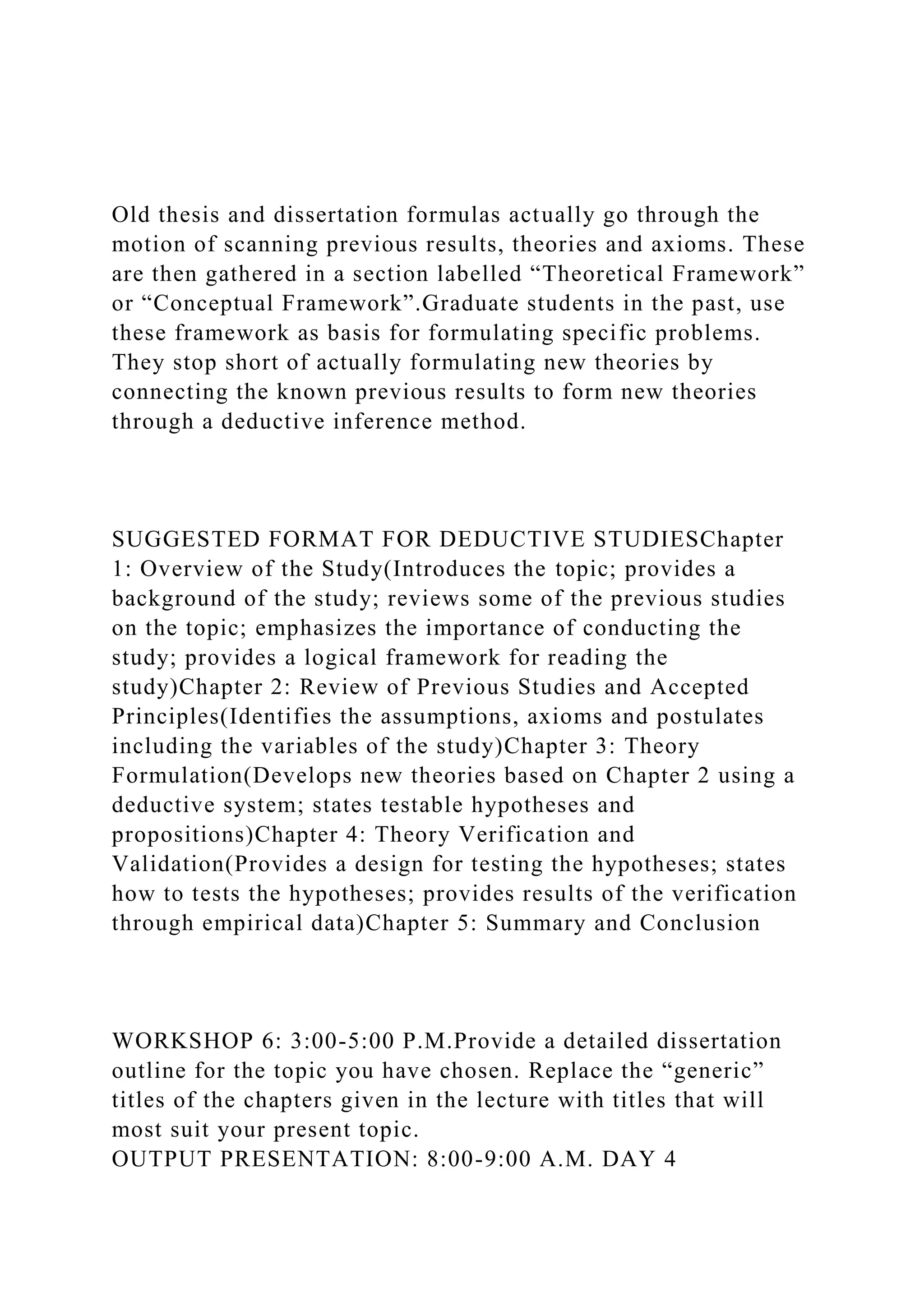
Old thesis and dissertation formulas actually go through the
motion of scanning previous results, theories and axioms. These
are then gathered in a section labelled “Theoretical Framework”
or “Conceptual Framework”.Graduate students in the past, use
these framework as basis for formulating specific problems.
They stop short of actually formulating new theories by
connecting the known previous results to form new theories
through a deductive inference method.
SUGGESTED FORMAT FOR DEDUCTIVE STUDIESChapter
1: Overview of the Study(Introduces the topic; provides a
background of the study; reviews some of the previous studies
on the topic; emphasizes the importance of conducting the
study; provides a logical framework for reading the
study)Chapter 2: Review of Previous Studies and Accepted
Principles(Identifies the assumptions, axioms and postulates
including the variables of the study)Chapter 3: Theory
Formulation(Develops new theories based on Chapter 2 using a
deductive system; states testable hypotheses and
propositions)Chapter 4: Theory Verification and
Validation(Provides a design for testing the hypotheses; states
how to tests the hypotheses; provides results of the verification
through empirical data)Chapter 5: Summary and Conclusion
WORKSHOP 6: 3:00-5:00 P.M.Provide a detailed dissertation
outline for the topic you have chosen. Replace the “generic”
titles of the chapters given in the lecture with titles that will
most suit your present topic.

OUTPUT PRESENTATION: 8:00-9:00 A.M. DAY 4
LECTURE 7: INDUCTIVE METHODS FOR THEORY
DEVELOPMENTSometimes theories are created based on
observations rather than on deduction from existing theories.
These theories are referred to as Grounded Theories. Glaser
(1992) and Strauss (1990) summarized the process of
developing grounded theory as: (1) entering the field or
proceeding with research without a hypothesis, (2) describing
what one observes in the field, and (3) explaining why it
happens on the basis of observation. These explanations become
the theory, which is generated directly from observation
It is often very difficult to establish causality in social science
research. One reason is due to the limitations of existing
theories, which may not be sufficient to identify the proper
causes. Another reason is that the identified causes cannot be
properly controlled. Further, since much of the data in social
sciences are gathered via the survey and interview method, we
often cannot tell the temporal sequence of the factors of
interest. Hence, we cannot be certain of the cause(s) and
effect(s) and may have to treat the relationship as symmetrical
without implying causality.
INDUCTIVE METHOD for theory development has the
following key steps:1. Select a topic of interest in your field.2.
Identify key factors and variables that may be discovered in
reading through various studies on the topic.3. Gather data
(either through the NET or survey) without any hypotheses in
mind.4. Use one of the analytical data mining techniques to
come up with a theory or theories.5. Formulate testable
hypotheses.
Association Rule Discovery: Definition
Given a set of records each of which contain some number of
items from a given collection;
Produce dependency rules which will predict occurrence of an
item based on occurrences of other items
Rules Discovered:
{Milk} --> {Coke}
{Diaper, Milk} --> {Beer}
TIDItems
1
Bread, Coke, Milk
2
Beer, Bread
3
Beer, Coke, Diaper, Milk
4
Beer, Bread, Diaper, Milk
5
Coke, Diaper, Milk
Given a set of transactions, find rules that will predict the
occurrence of an item based on the occurrences of other items in
the transaction
TIDItems
1
Bread, Milk
2
Bread, Diaper, Beer, Eggs
3
Milk, Diaper, Beer, Coke
4
Bread, Milk, Diaper, Beer
5
Bread, Milk, Diaper, Coke
TIDItems
1
Bread, Milk
2
Bread, Diaper, Beer, Eggs
3
Milk, Diaper, Beer, Coke
4
Bread, Milk, Diaper, Beer
5
Bread, Milk, Diaper, Coke
Association Rule Mining Task
ItemCount
Bread
4
Coke
2
Milk
4
Beer
3
Diaper
4
Eggs
1
ItemsetCount
{Bread,Milk}
3
{Bread,Beer}
2
{Bread,Diaper}
3
{Milk,Beer}
2
{Milk,Diaper}
3
{Beer,Diaper}
3
ItemsetCount
{Bread,Milk,Diaper}
3
EXAMPLE: W e look at variables related to climate change and
health concerns:
X1: average typhoons entering Philippine area of responsibility
X2: average annual temperature
X3: incidence of dengue cases per thousand population
X4: incidence of diabetes per thousand population
X5: incidence of tuberculosis per thousand population
Over the last twenty years. The data are shown below:
typhoon avtemp dengue diabetes TB
26 33 15 13 12
25 34 14 12 13
15 29 6 11 5
13 30 14 14 12
8 34 12 10 11
11 32 14 12 13
25 26 17 14 12
9 35 8 11 7
18 31 14 11 5
15 32 10 13 8
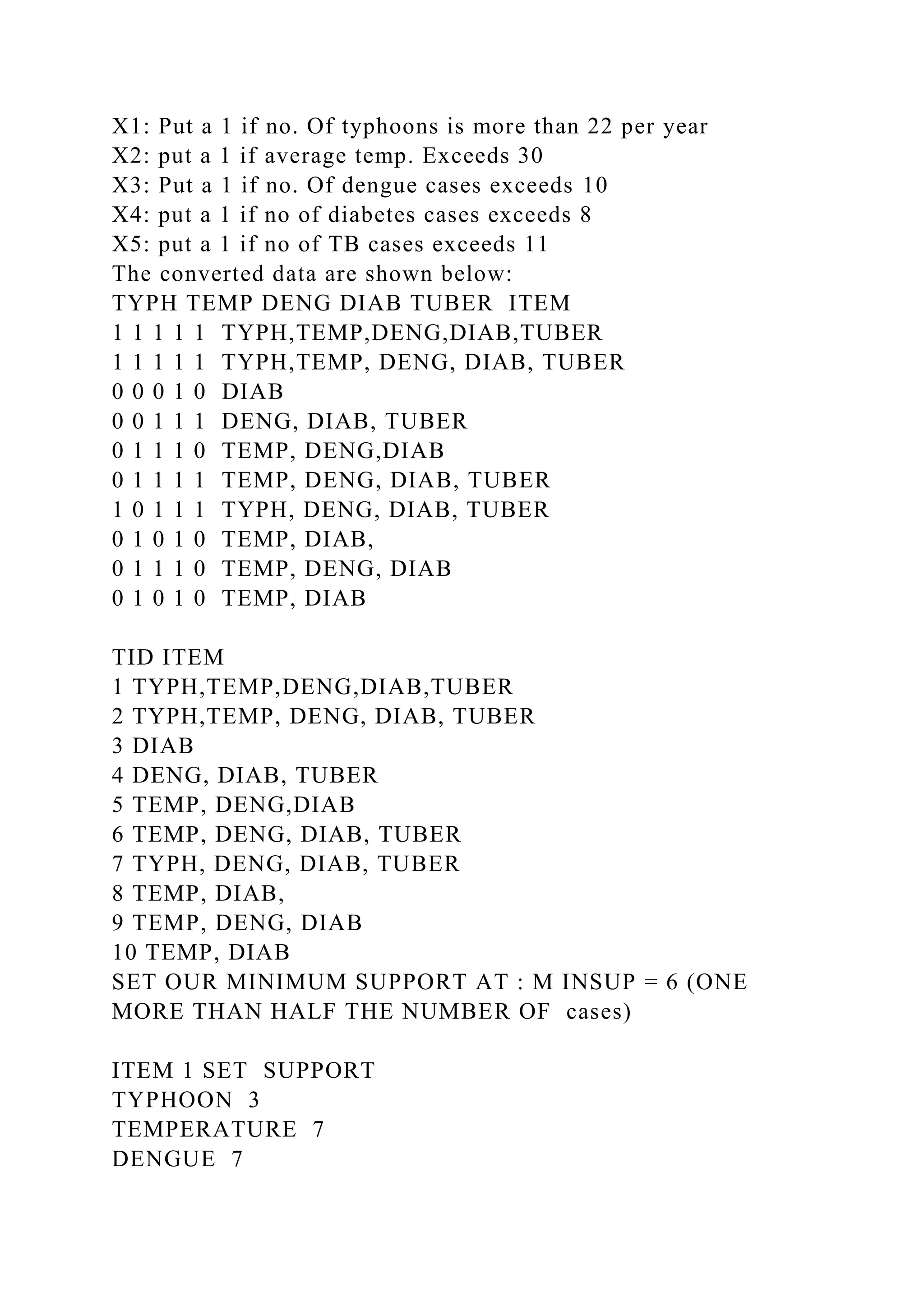
Let us discover some association rules here. We use MINITAB
to convert and simplify our data as follows:
X1: Put a 1 if no. Of typhoons is more than 22 per year
X2: put a 1 if average temp. Exceeds 30
X3: Put a 1 if no. Of dengue cases exceeds 10
X4: put a 1 if no of diabetes cases exceeds 8
X5: put a 1 if no of TB cases exceeds 11
The converted data are shown below:
TYPH TEMP DENG DIAB TUBER ITEM
1 1 1 1 1
TYPH,TEMP,DENG,DIAB,TUBER
1 1 1 1 1 TYPH,TEMP, DENG, DIAB,
TUBER
0 0 0 1 0 DIAB
0 0 1 1 1 DENG, DIAB, TUBER
0 1 1 1 0 TEMP, DENG,DIAB
0 1 1 1 1 TEMP, DENG, DIAB, TUBER
1 0 1 1 1 TYPH, DENG, DIAB, TUBER
0 1 0 1 0 TEMP, DIAB,
0 1 1 1 0 TEMP, DENG, DIAB
0 1 0 1 0 TEMP, DIAB
TID ITEM
1 TYPH,TEMP,DENG,DIAB,TUBER
2 TYPH,TEMP, DENG, DIAB, TUBER
3 DIAB
4 DENG, DIAB, TUBER
5 TEMP, DENG,DIAB
6 TEMP, DENG, DIAB, TUBER
7 TYPH, DENG, DIAB, TUBER
8 TEMP, DIAB,
9 TEMP, DENG, DIAB
10 TEMP, DIAB
SET OUR MINIMUM SUPPORT AT : MINSUP = 6 (ONE
MORE THAN HALF THE NUMBER OF cases)
ITEM 1 SET SUPPORT
TYPHOON 3
TEMPERATURE 7
DENGUE 7
DIABETES 10
TB 5 (eliminate TYPHOON AND TB)
ITEM 2 SET SUPPORT
TEMP, DENG 6
TEMP, DIAB 7
DENG, DIAB 7 (ALL TWO ITEM SET ARE
ACCEPTED)
ITEM 3 SET SUPPORT
TEMP,DENG, DIAB 5 (ELIMINATE THREE
ITEM SET)
THEORIES:
1. DENGUE CASES INCREASE WITH OBSERVED RISE IN
AVERAGE TEMPERATURE.
2. DIABETES CASES INCREASE WITH OBSERVED RISE IN
AVERAGE TEMPERATURE
3. DIABETES AND DENGUE INCIDENCES ARE CO-
EXISTENT HEALTH PROBLEMS.
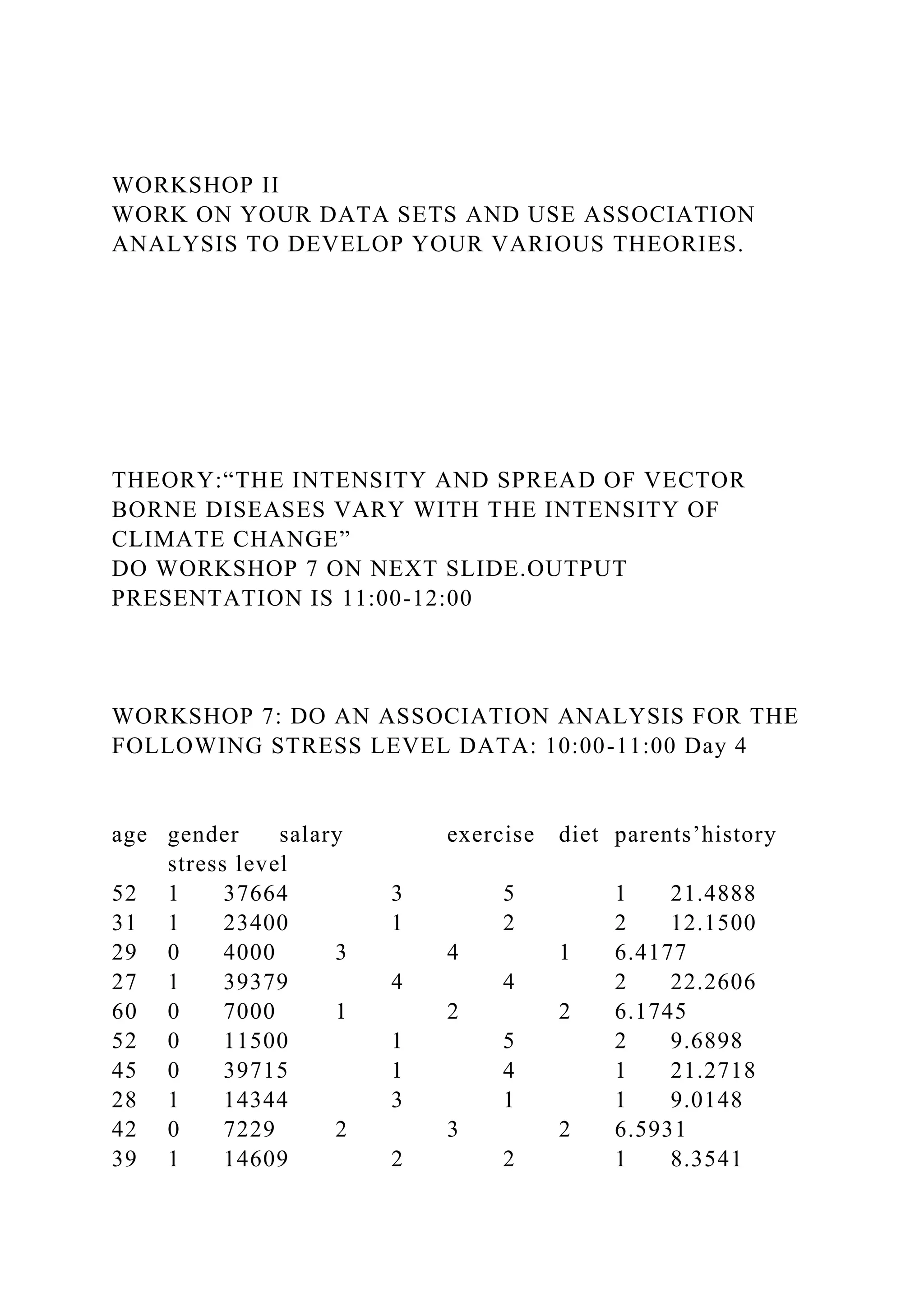
WORKSHOP II
WORK ON YOUR DATA SETS AND USE ASSOCIATION
ANALYSIS TO DEVELOP YOUR VARIOUS THEORIES.
THEORY:“THE INTENSITY AND SPREAD OF VECTOR
BORNE DISEASES VARY WITH THE INTENSITY OF
CLIMATE CHANGE”
DO WORKSHOP 7 ON NEXT SLIDE.OUTPUT
PRESENTATION IS 11:00-12:00
WORKSHOP 7: DO AN ASSOCIATION ANALYSIS FOR THE
FOLLOWING STRESS LEVEL DATA: 10:00-11:00 Day 4
age gender salary exercise diet parents’history
stress level
52 1 37664 3 5 1 21.4888
31 1 23400 1 2 2 12.1500
29 0 4000 3 4 1 6.4177
27 1 39379 4 4 2 22.2606
60 0 7000 1 2 2 6.1745
52 0 11500 1 5 2 9.6898
45 0 39715 1 4 1 21.2718
28 1 14344 3 1 1 9.0148
42 0 7229 2 3 2 6.5931
39 1 14609 2 2 1 8.3541
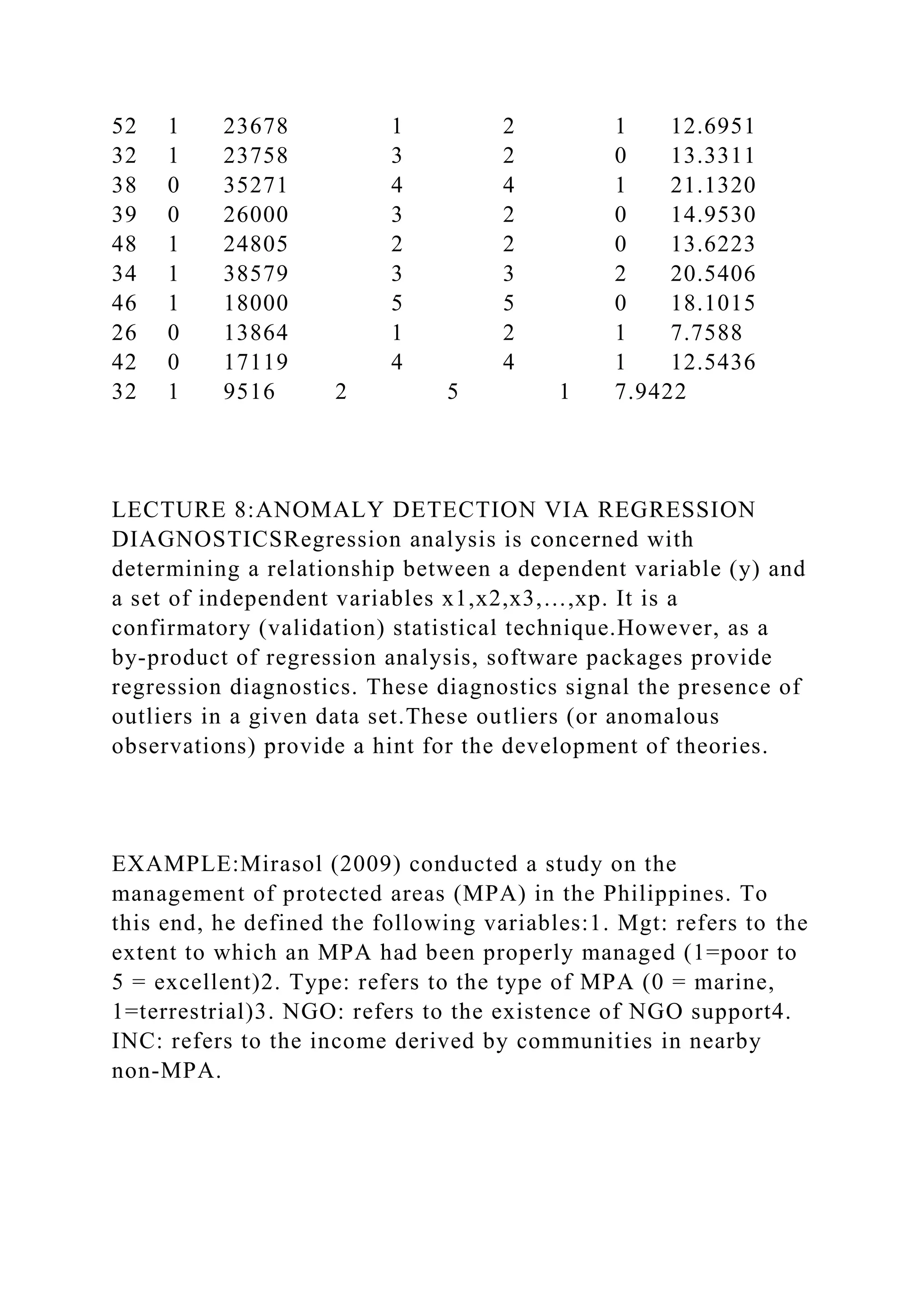
52 1 23678 1 2 1 12.6951
32 1 23758 3 2 0 13.3311
38 0 35271 4 4 1 21.1320
39 0 26000 3 2 0 14.9530
48 1 24805 2 2 0 13.6223
34 1 38579 3 3 2 20.5406
46 1 18000 5 5 0 18.1015
26 0 13864 1 2 1 7.7588
42 0 17119 4 4 1 12.5436
32 1 9516 2 5 1 7.9422
LECTURE 8:ANOMALY DETECTION VIA REGRESSION
DIAGNOSTICSRegression analysis is concerned with
determining a relationship between a dependent variable (y) and
a set of independent variables x1,x2,x3,…,xp. It is a
confirmatory (validation) statistical technique.However, as a
by-product of regression analysis, software packages provide
regression diagnostics. These diagnostics signal the presence of
outliers in a given data set.These outliers (or anomalous
observations) provide a hint for the development of theories.
EXAMPLE:Mirasol (2009) conducted a study on the
management of protected areas (MPA) in the Philippines. To
this end, he defined the following variables:1. Mgt: refers to the
extent to which an MPA had been properly managed (1=poor to
5 = excellent)2. Type: refers to the type of MPA (0 = marine,
1=terrestrial)3. NGO: refers to the existence of NGO support4.
INC: refers to the income derived by communities in nearby
non-MPA.
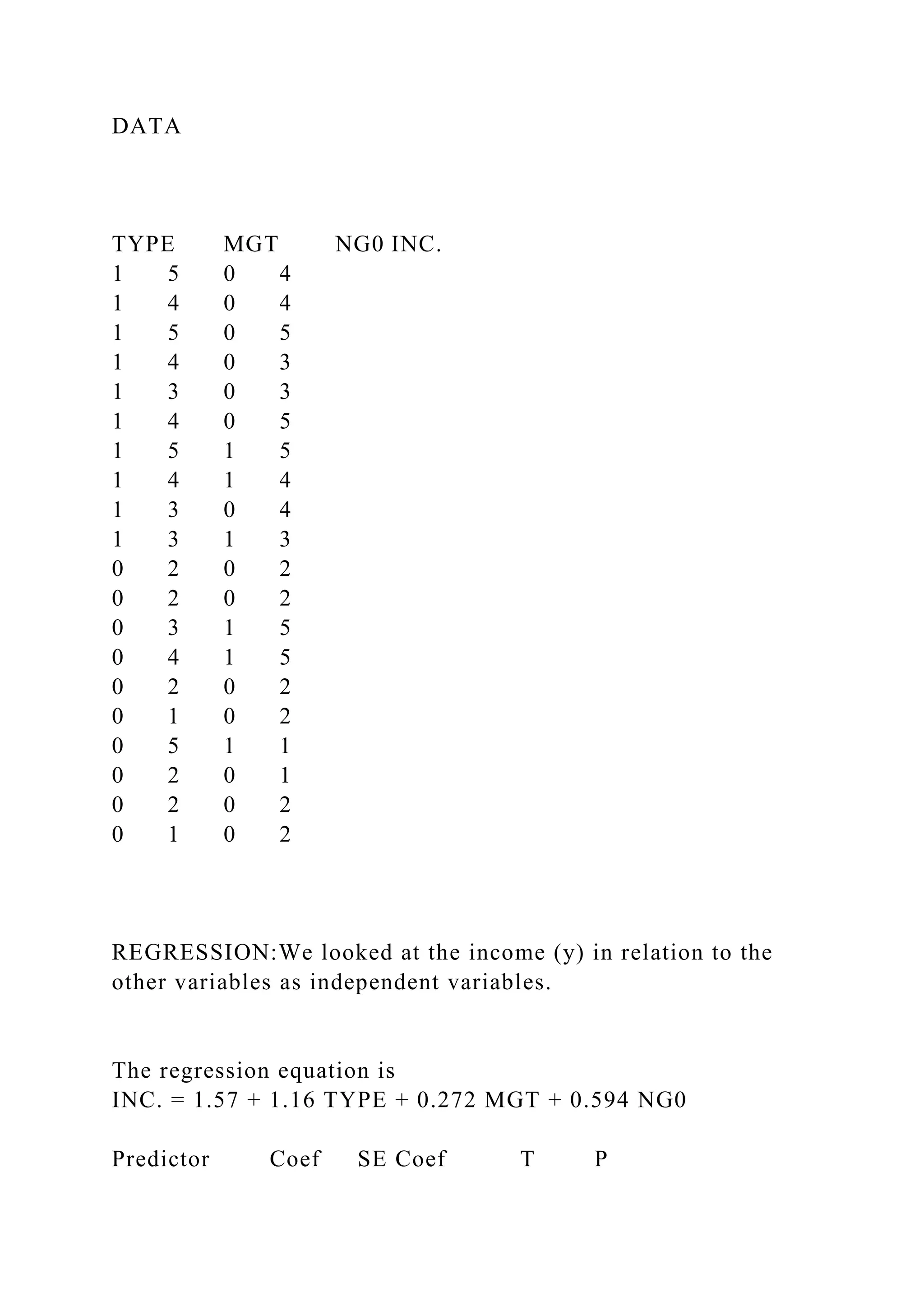
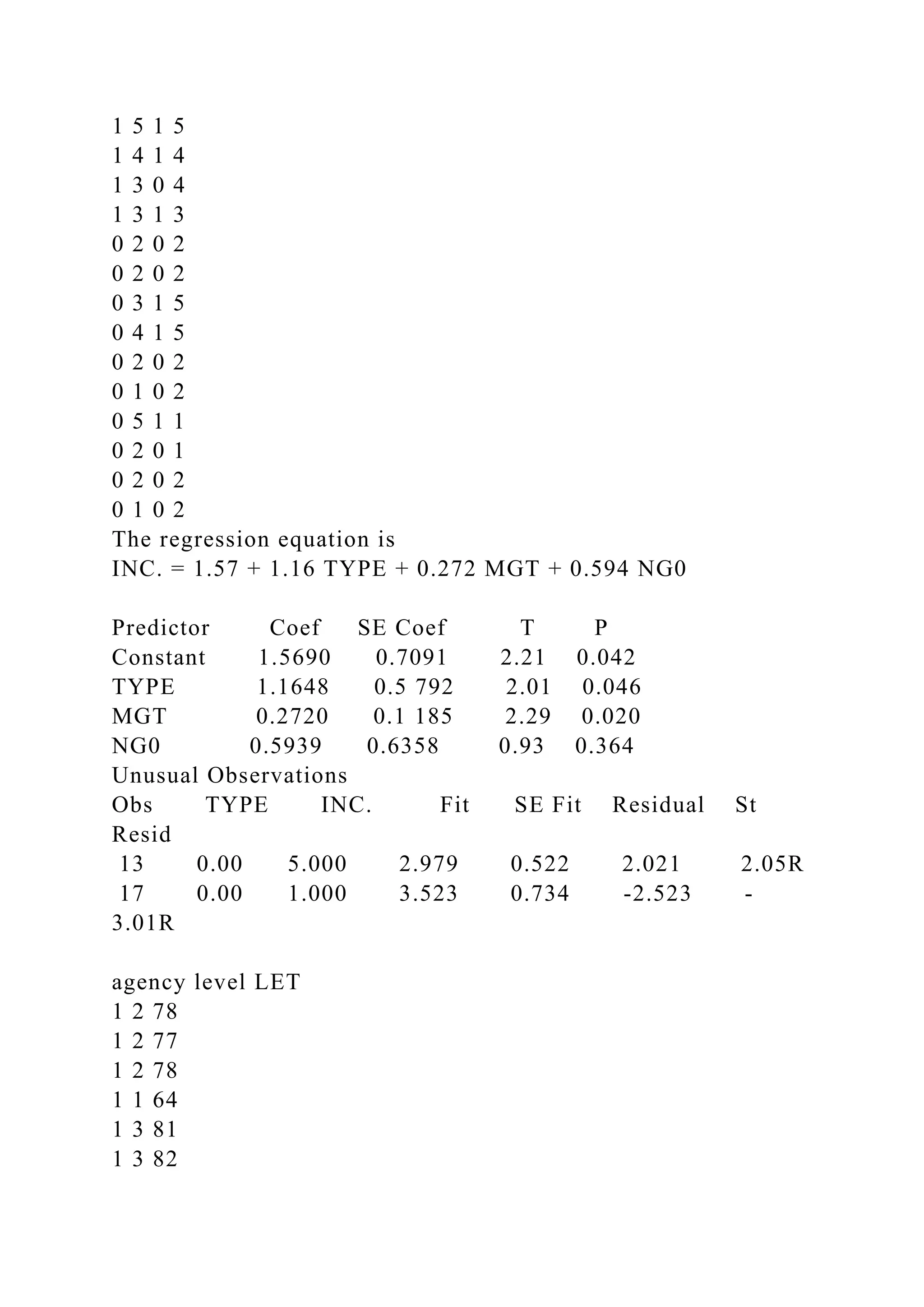
DATA
TYPE MGT NG0 INC.
1 5 0 4
1 4 0 4
1 5 0 5
1 4 0 3
1 3 0 3
1 4 0 5
1 5 1 5
1 4 1 4
1 3 0 4
1 3 1 3
0 2 0 2
0 2 0 2
0 3 1 5
0 4 1 5
0 2 0 2
0 1 0 2
0 5 1 1
0 2 0 1
0 2 0 2
0 1 0 2
REGRESSION:We looked at the income (y) in relation to the
other variables as independent variables.
The regression equation is
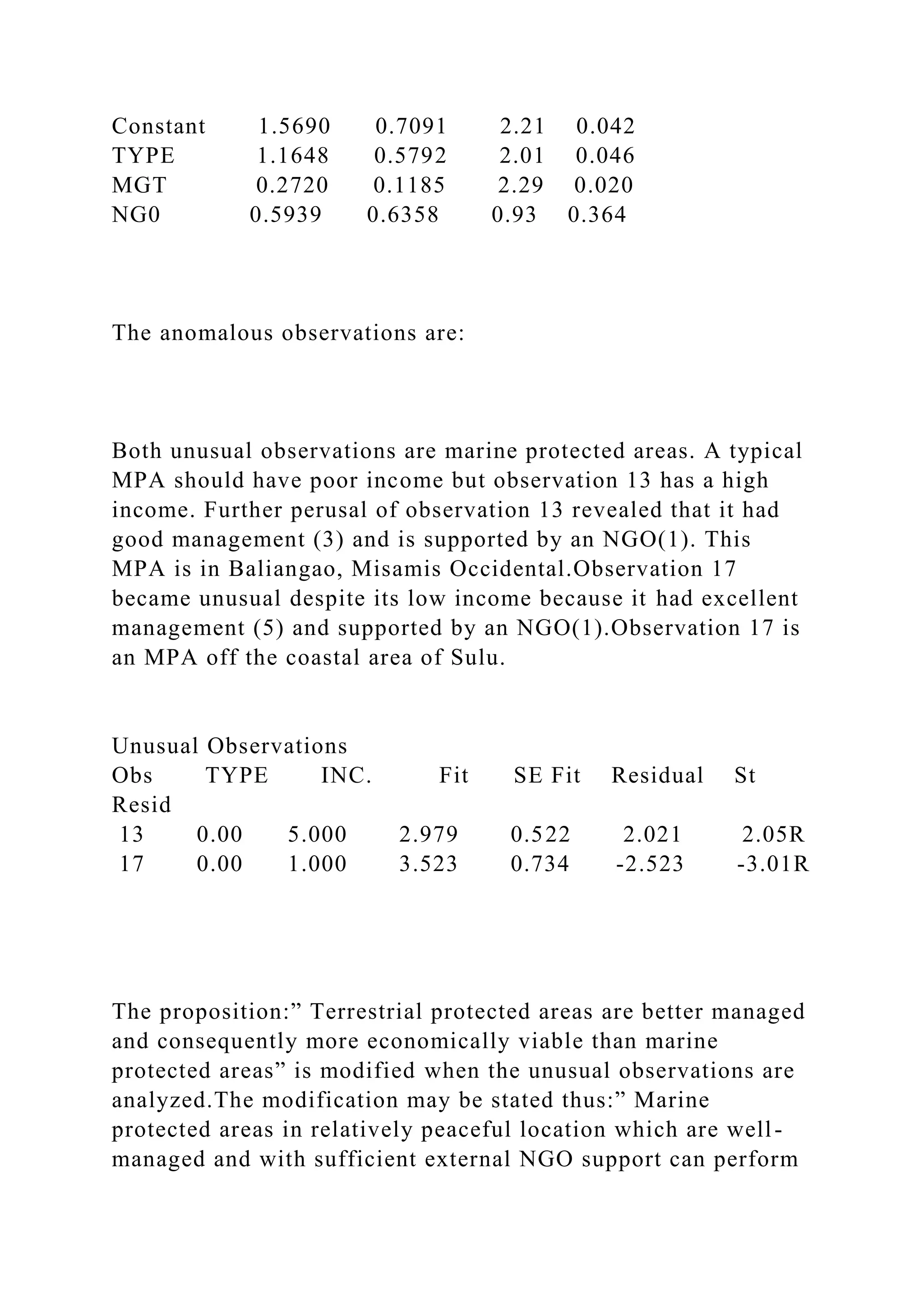
INC. = 1.57 + 1.16 TYPE + 0.272 MGT + 0.594 NG0
Predictor Coef SE Coef T P
Constant 1.5690 0.7091 2.21 0.042
TYPE 1.1648 0.5792 2.01 0.046
MGT 0.2720 0.1185 2.29 0.020
NG0 0.5939 0.6358 0.93 0.364
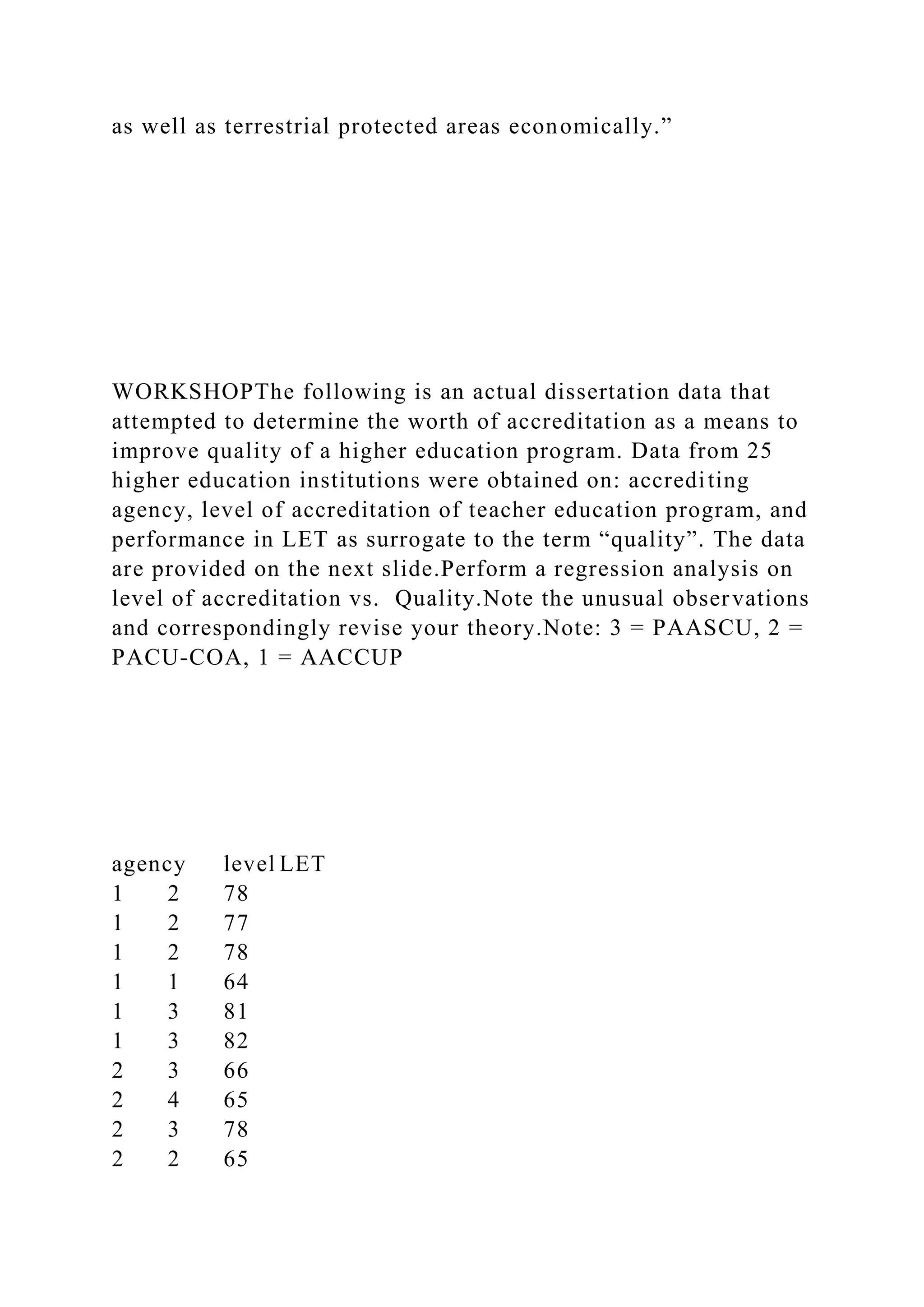
The anomalous observations are:
Both unusual observations are marine protected areas. A typical
MPA should have poor income but observation 13 has a high
income. Further perusal of observation 13 revealed that it had
good management (3) and is supported by an NGO(1). This
MPA is in Baliangao, Misamis Occidental.Observation 17
became unusual despite its low income because it had excellent
management (5) and supported by an NGO(1).Observation 17 is
an MPA off the coastal area of Sulu.
Unusual Observations
Obs TYPE INC. Fit SE Fit Residual St
Resid
13 0.00 5.000 2.979 0.522 2.021 2.05R
17 0.00 1.000 3.523 0.734 -2.523 -3.01R
The proposition:” Terrestrial protected areas are better managed
and consequently more economically viable than marine
protected areas” is modified when the unusual observations are
analyzed.The modification may be stated thus:” Marine
protected areas in relatively peaceful location which are well-
managed and with sufficient external NGO support can perform
as well as terrestrial protected areas economically.”
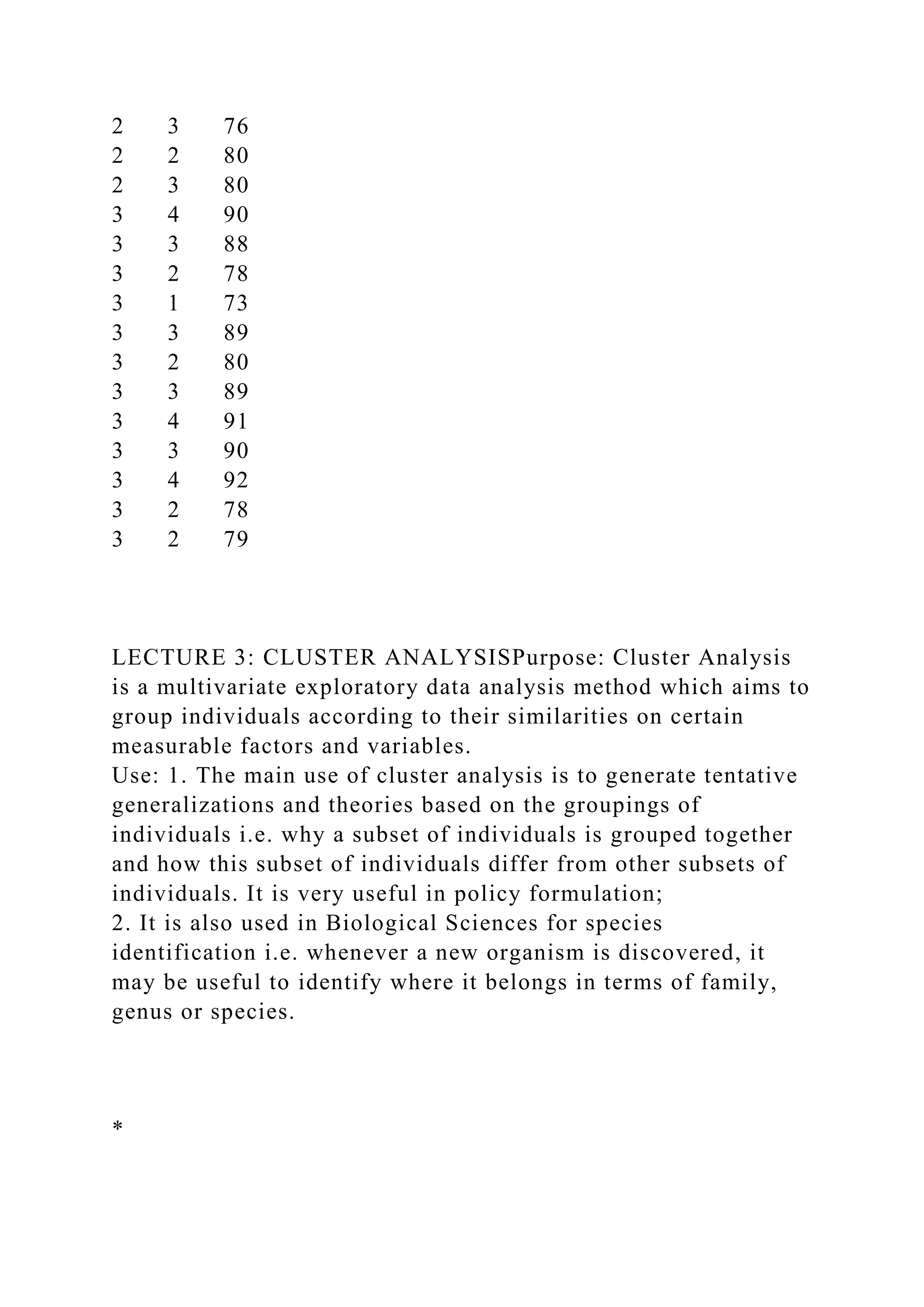
WORKSHOPThe following is an actual dissertation data that
attempted to determine the worth of accreditation as a means to
improve quality of a higher education program. Data from 25
higher education institutions were obtained on: accrediting
agency, level of accreditation of teacher education program, and
performance in LET as surrogate to the term “quality”. The data
are provided on the next slide.Perform a regression analysis on
level of accreditation vs. Quality.Note the unusual observations
and correspondingly revise your theory.Note: 3 = PAASCU, 2 =
PACU-COA, 1 = AACCUP
agency level LET
1 2 78
1 2 77
1 2 78
1 1 64
1 3 81
1 3 82
2 3 66
2 4 65
2 3 78
2 2 65
2 3 76
2 2 80
2 3 80
3 4 90
3 3 88
3 2 78
3 1 73
3 3 89
3 2 80
3 3 89
3 4 91
3 3 90
3 4 92
3 2 78
3 2 79
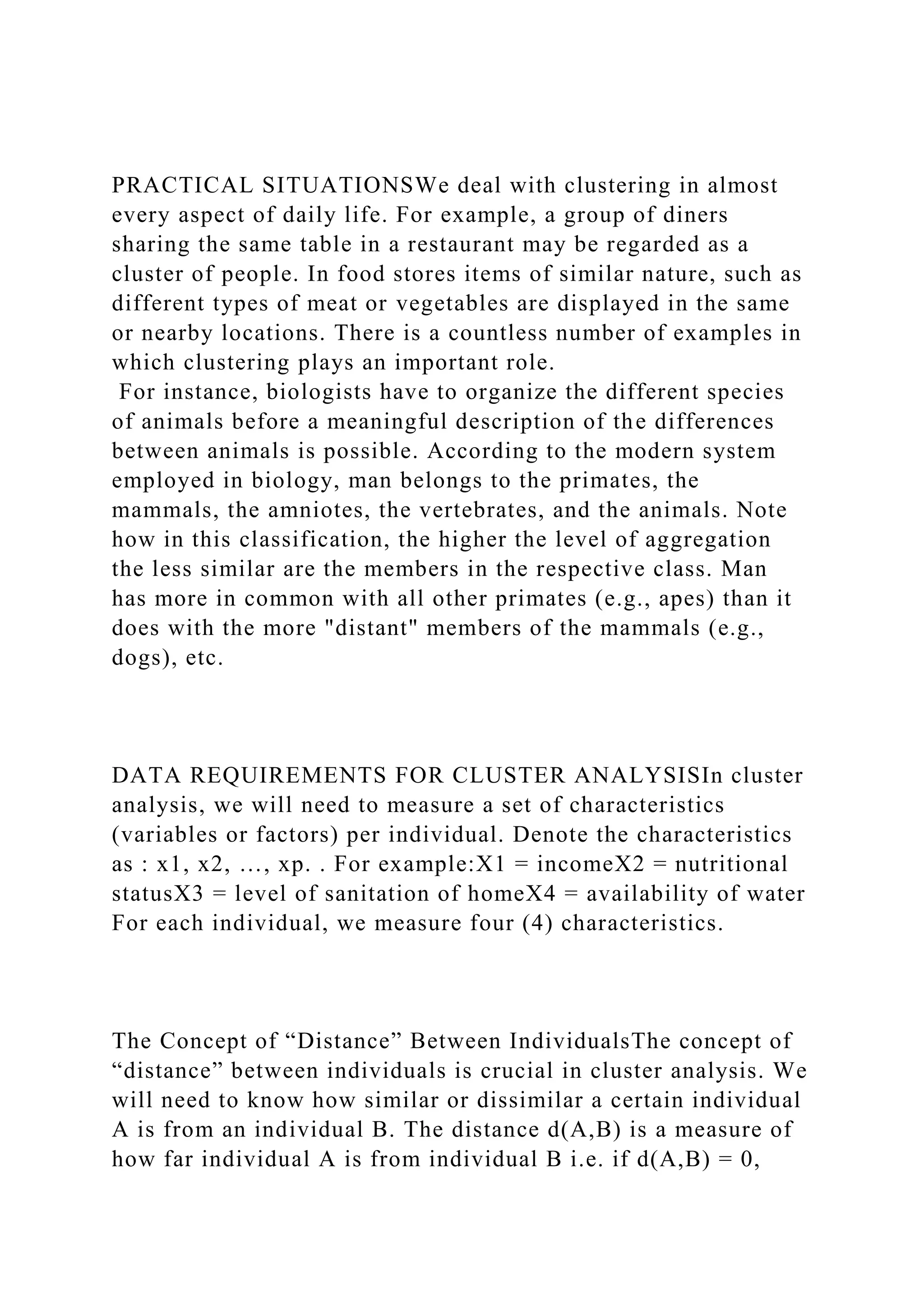
LECTURE 3: CLUSTER ANALYSISPurpose: Cluster Analysis
is a multivariate exploratory data analysis method which aims to
group individuals according to their similarities on certain
measurable factors and variables.
Use: 1. The main use of cluster analysis is to generate tentative
generalizations and theories based on the groupings of
individuals i.e. why a subset of individuals is grouped together
and how this subset of individuals differ from other subsets of
individuals. It is very useful in policy formulation;
2. It is also used in Biological Sciences for species
identification i.e. whenever a new organism is discovered, it
may be useful to identify where it belongs in terms of family,
genus or species.
*
PRACTICAL SITUATIONSWe deal with clustering in almost
every aspect of daily life. For example, a group of diners
sharing the same table in a restaurant may be regarded as a
cluster of people. In food stores items of similar nature, such as
different types of meat or vegetables are displayed in the same
or nearby locations. There is a countless number of examples in
which clustering plays an important role.
For instance, biologists have to organize the different species
of animals before a meaningful description of the differences
between animals is possible. According to the modern system
employed in biology, man belongs to the primates, the
mammals, the amniotes, the vertebrates, and the animals. Note
how in this classification, the higher the level of aggregation
the less similar are the members in the respective class. Man
has more in common with all other primates (e.g., apes) than it
does with the more "distant" members of the mammals (e.g.,
dogs), etc.
DATA REQUIREMENTS FOR CLUSTER ANALYSISIn cluster
analysis, we will need to measure a set of characteristics
(variables or factors) per individual. Denote the characteristics
as : x1, x2, …, xp. . For example:X1 = incomeX2 = nutritional
statusX3 = level of sanitation of homeX4 = availability of water
For each individual, we measure four (4) characteristics.
The Concept of “Distance” Between IndividualsThe concept of
“distance” between individuals is crucial in cluster analysis. We
will need to know how similar or dissimilar a certain individual
A is from an individual B. The distance d(A,B) is a measure of
how far individual A is from individual B i.e. if d(A,B) = 0,
then A and B are essentially the same individual with respect to
the measured characteristics.
A BLAST FROM THE PAST!!!! The Geometry Nightmare
RevisitedLet us say that for two individuals A and B the
characteristic measured is: x1 = body odor with 0 = no odor,
and 5 = very odorous. For individual A , x 1 = 0 while for
individual B, x 1 = 5, Then it is natural to estimate the “odorous
distance” between A and B by:d(A,B) = /0 – 5/ = /-5/ = 5,i.e.
the two individuals are very “far” from each other with respect
to body odor!!!
Two CharacteristicsNow, let us measure two characteristics per
individual: x 1 = body odor, and X2 = color of skin, where color
of skin is 1 = light color, to 5 = very dark color. Thus,A = (0, 5)
and B = (5, 1) means that A has no body odor (x1 =0) and has a
very dark skin color (x 2 = 5) while B has very strong body
odor (x 1 = 5) and has a very light skin color (x2 = 1). Then,
from geometry:
d(A,B) = [(0-5)2 + (5-1)2]1/2 = (41)1/2 = 6.41.
Individuals C = (2,2) and D = (2, 3) would have:
d(C,D) = [(2-2)2 + (2-3)2]1/2 = (0 +1)1/2 = 1.
So, C and D are more similar to each other than are A and B.
CLUSTERING ALGORITHMk-Means Clustering General logic
Suppose that you already have hypotheses concerning the
number of clusters in your cases or variables. You may want to
"tell" the computer to form exactly 3 clusters that are to be as
distinct as possible. This is the type of research question that
can be addressed by the k- means clustering algorithm. In
general, the k-means method will produce exactly k different
clusters of greatest possible distinction. It should be mentioned
that the best number of clusters k leading to the greatest
separation (distance) is not known as a priori and must be
computed from the data. (Good research for the theoretical
mathematician)
A WORKED EXAMPLEWe are looking at “QUALITY OF
EDUCATION” and we are getting data from 15 universities in
the Philippines. We decided to look into:X1 = performance in
licensure examsX2 = average tuition rate per unitX3 =
enrollment sizeX4 = Percentage of Ph.D.’s in facultyX5 =
acceptance/rejection rate per hundredThe data are shown on the
next page.
THE DATA SETExam Tuition Enrolment Ph.D.
rejection87 700 6000 60 0.8085
620 5500 50 0.7583 600 5000 45
0.7782 600 5400 48 0.7483 610
6250 50 0.8078 450 8000 36 0.6577
400 7600 32 0.5476 410 7700 37
0.4578 460 8900 32 0.5080 500
9000 30 0.4872 200 8000 8 0.2075
250 9000 10 0.1070 300 9000 7
0.1567 260 11000 10 0.1568
200 10000 5 0.05
STEPS
GO TO “STAT”
GO TO “MULTIVARIATE”
GO TO “CLUSTER OBSERVATIONS”
CLICK ALL THE VARIABLES
CLICK “SHOW DENDROGRAM”
Input “number of clusters = 3”
Click “OK”
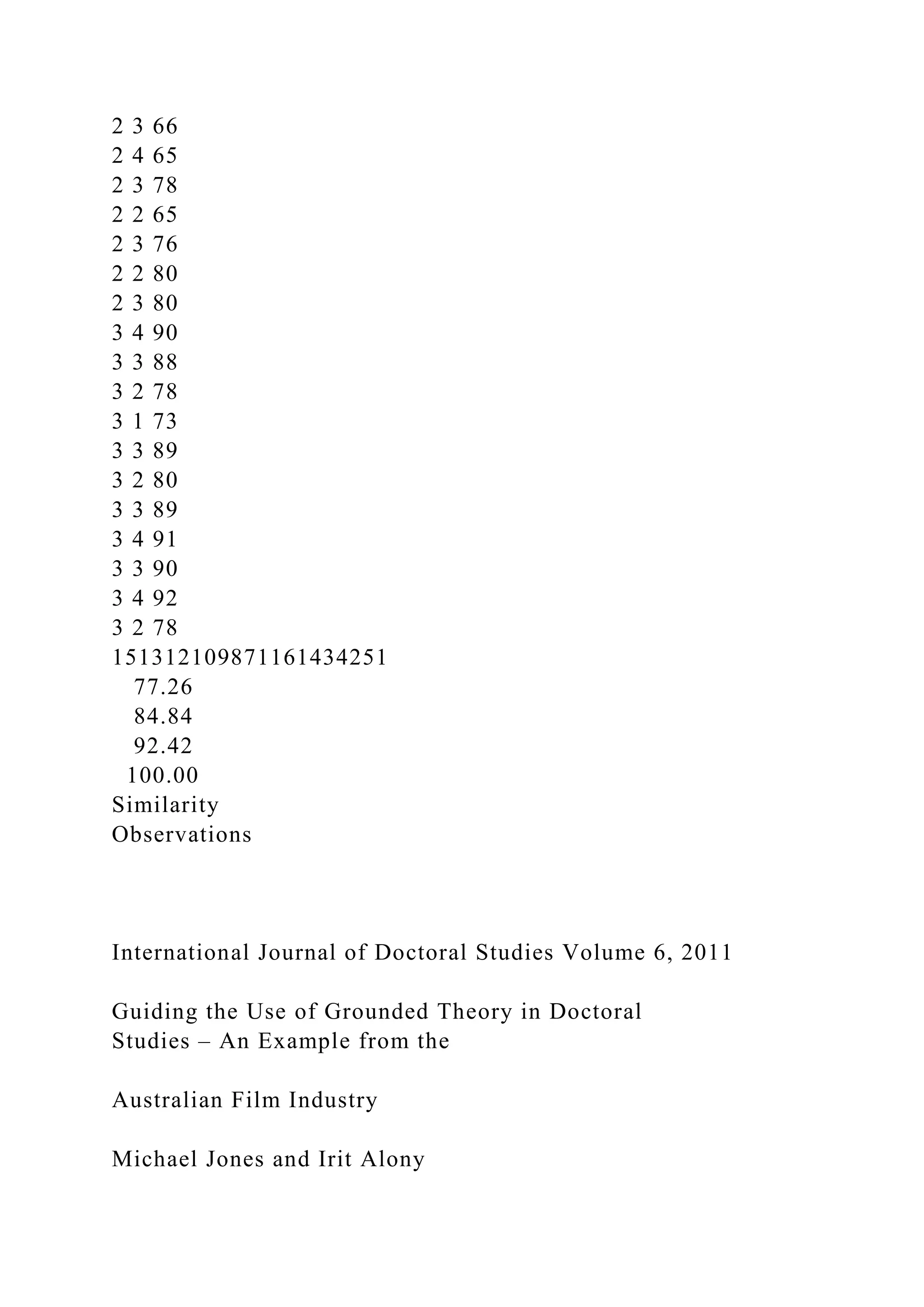
THE DENDROGRAM
27.txt
��������Cluo 'Exam'-
'rejection';�����������������������������
�����������������������������������
�����������������������������������
������������������/������}.��Cluo 'Exam'-
'rejection';�����������������������������
�����������������������������������
�����������������������������������
�����;; HMF V1.24 TEXT
;; (Microsoft Win32 Intel 386) HOOPS 5.00-17 I.M. 3.00-17
(Selectability "windows=off,geometry=on")
(Visibility "on")
(Color_By_Index "Geometry,Face Contrast" 1)
(Color_By_Index "Window" 0)
(Window_Frame "off")
(Window -1 1 -1 1)
(Camera (0 0 -5) (0 0 0) (0 1 0) 2 2 "Stretched")
;; (Driver_Options "no backing storeno borderno control areano
debug,disable in
;; put,no double-bufferingno double bufferingno fixed colors,no
force black-and
;; -whiteno force black and whiteno gamma correctionlight
scaling=0,no locater
;; transform,no pen speed,no physical size,no subscreen
creatingno subscreen mo
;; vingno subscreen resizingsubscreen stretchingno output
format,no use colorma
;; p id")
(Edge_Pattern "---")
(Edge_Weight 1)
(Face_Pattern "solid")
(Heuristics "no related selection limit")
(Line_Pattern "---")
(Line_Weight 1)
(Marker_Size 0.421875)
(Marker_Symbol ".")
(Text_Font "name=arial-gdi-vector,no
transforms,rotation=follow path")
(User_Options "mtb aspect
ratio=0.675953,graphicsversion=6,worksheettitle="Wor
ksheet
1",optiplot=0,builtin=0,statguideid=0,toplayer=0,angle=0,arro
wdir=0,arr
owstyle=0,polygon=0,isdata=0,textfollowpath=1,ldfill=0,solidfi
ll=0,3d=0,usebitm
ap=0,canbrush=0,brushrows=0,light
scaling=0.00000,sessionline=58")
(Segment "include" ())
(Front ((Segment "figure1" (
(Window_Pattern "clear")
(Window -1 1 -1 1)
(User_Options "viewinfigurecoord=0")
(Front ((Segment "region" (
(Front ((Segment "figure box" (
(Visibility "polygons=off,lines=off")
(Color_By_Index "Face" 0)
(Color_By_Index "Face Contrast,Line,Edge" 1)
(Edge_Pattern "---")
(Edge_Weight 1)
(Face_Pattern "solid")
(Line_Pattern "---")
(Line_Weight 1)
(User_Options "solidfill=1")
(Segment "" (
(Polygon ((-0.99995 -0.99995 0) (0.99995 -0.99995 0)
(0.99995
0.99995 0) (-0.99995 0.99995 0) (-0.99995 -0.99995
0)))))))
(Segment "data box" (
(Visibility "faces=off")
(Color_By_Index "Face" 0)
(Color_By_Index "Face Contrast,Line,Edge" 1)
(Edge_Pattern "---")
(Edge_Weight 1)
(Face_Pattern "solid")
(Line_Pattern "---")
(Line_Weight 1)
(User_Options "solidfill=1")
(Segment "" (
(Polygon ((-0.749962 -0.59997 0) (0.899955 -0.59997
0) (0.899955
0.59997 0) (-0.749962 0.59997 0) (-0.749962 -
0.59997 0)))))))
(Segment "legend box" ())
(Segment "legend" (
(Window_Pattern "clear")
(Window -1 1 -1 1)
(User_Options "viewinfigurecoord=1")))))))
(Segment "object" (
(Front ((Segment "frame" (
(Window_Pattern "clear")
(Window -1 1 -1 1)
(Front ((Segment "tick" (
(Front ((Segment "set1" (
(Color_By_Index "Face Contrast,Line,Text,Edge"
1)
(Edge_Pattern "---")
(Edge_Weight 1)
(Line_Pattern "---")
(Line_Weight 1)
(Text_Alignment "^*")
(Text_Font "name=arial-gdi-vector,size=0.03385
sru")
(Segment "" (
(Text 0.734963 -0.669966 0 "15")))
(Segment "" (
(Text 0.624969 -0.669966 0 "13")))
(Segment "" (
(Text 0.514974 -0.669966 0 "12")))
(Segment "" (
(Text 0.40498 -0.669966 0 "10")))
(Segment "" (
(Text 0.294985 -0.669966 0 "9")))
(Segment "" (
(Text 0.184991 -0.669966 0 "8")))
(Segment "" (
(Text 0.0749962 -0.669966 0 "7")))
(Segment "" (
(Text -0.0349982 -0.669966 0 "11")))
(Segment "" (
(Text -0.144993 -0.669966 0 "6")))
(Segment "major" (
(Segment "" (
(Polyline ((0.734963 -0.59997 0) (0.734963 -
0.639968 0)
))))
(Segment "" (
(Polyline ((0.624969 -0.59997 0) (0.624969 -
0.639968 0)
))))
(Segment "" (
(Polyline ((0.514974 -0.59997 0) (0.514974 -
0.639968 0)
))))
(Segment "" (
(Polyline ((0.40498 -0.59997 0) (0.40498 -
0.639968 0)))
))
(Segment "" (
(Polyline ((0.294985 -0.59997 0) (0.294985 -
0.639968 0)
))))
(Segment "" (
(Polyline ((0.184991 -0.59997 0) (0.184991 -
0.639968 0)
))))
(Segment "" (
(Polyline ((0.0749962 -0.59997 0) (0.0749962 -
0.639968
0)))))
(Segment "" (
(Polyline ((-0.0349982 -0.59997 0) (-0.0349982
-0.639968 0)))))
(Segment "" (
(Polyline ((-0.144993 -0.59997 0) (-0.144993 -
0.639968
0)))))))))
(Segment "set2" (
(Color_By_Index "Face Contrast,Line,Text,Edge"
1)
(Edge_Pattern "---")
(Edge_Weight 1)
(Line_Pattern "---")
(Line_Weight 1)
(Text_Alignment "^*")
(Text_Font "name=arial-gdi-vector,size=0.03385
sru")
(Segment "" (
(Text 0.844958 -0.669966 0 "14")))
(Segment "major" (
(Segment "" (
(Polyline ((0.844958 -0.59997 0) (0.844958 -
0.639968 0)
))))))))
(Segment "set3" (
(Color_By_Index "Face Contrast,Line,Text,Edge"
1)
(Edge_Pattern "---")
(Edge_Weight 1)
(Line_Pattern "---")
(Line_Weight 1)
(Text_Alignment "^*")
(Text_Font "name=arial-gdi-vector,size=0.03385
sru")
(Segment "" (
(Text -0.254987 -0.669966 0 "3")))
(Segment "" (
(Text -0.364982 -0.669966 0 "4")))
(Segment "" (
(Text -0.474976 -0.669966 0 "2")))
(Segment "" (
(Text -0.584971 -0.669966 0 "5")))
(Segment "" (
(Text -0.694965 -0.669966 0 "1")))
(Segment "major" (
(Segment "" (
(Polyline ((-0.254987 -0.59997 0) (-0.254987 -
0.639968
0)))))
(Segment "" (
(Polyline ((-0.364982 -0.59997 0) (-0.364982 -
0.639968
0)))))
(Segment "" (
(Polyline ((-0.474976 -0.59997 0) (-0.474976 -
0.639968
0)))))
(Segment "" (
(Polyline ((-0.584971 -0.59997 0) (-0.584971 -
0.639968
0)))))
(Segment "" (
(Polyline ((-0.694965 -0.59997 0) (-0.694965 -
0.639968
0)))))))))
(Segment "set4" (
(Color_By_Index "Face Contrast,Line,Text,Edge"
1)
(Edge_Pattern "---")
(Edge_Weight 1)
(Line_Pattern "---")
(Line_Weight 1)
(Text_Alignment "*>")
(Text_Font "name=arial-gdi-vector,size=0.03385
sru")
(Segment "" (
(Text -0.819959 0.54283 0 " 77.26")))
(Segment "" (
(Text -0.819959 0.165706 0 " 84.84")))
(Segment "" (
(Text -0.819959 -0.222846 0 " 92.42")))
(Segment "" (
(Text -0.819959 -0.59997 0 " 100.00")))
(Segment "major" (
(Segment "" (
(Polyline ((-0.749962 0.54283 0) (-0.78996
0.54283 0)))
))
(Segment "" (
(Polyline ((-0.749962 0.165706 0) (-0.78996
0.165706 0)
))))
(Segment "" (
(Polyline ((-0.749962 -0.222846 0) (-0.78996 -
0.222846
0)))))
(Segment "" (
(Polyline ((-0.749962 -0.59997 0) (-0.78996 -
0.59997 0)
))))))))))))
(Segment "grid" ())
(Segment "reference" ())
(Segment "axis" (
(Front ((Segment "dend1" (
(Color_By_Index "Text" 1)
(Text_Alignment "*<")
(Text_Font "name=arial-gdi-vector,size=0.04232
sru")
(Segment "" (
(Text -0.979951 0.699965 0 "Similarity")))
(Segment "" (
(Text -0.0905559 -0.79996 0
"Observations")))))))))))))
(Segment "data" (
(Window_Pattern "clear")
(Window -1 1 -1 1)
(User_Options "isdata=1,viewinfigurecoord=1")
(Front ((Segment "dend1" (
(Color_By_Index "Face Contrast,Line,Edge" 1)
(Edge_Pattern "---")
(Edge_Weight 1)
(Line_Pattern "---")
(Line_Weight 1)
(Segment "" (
(Polyline ((0.734963 0.237484 0) (0.734963 -
0.59997 0)))))
(Segment "" (
(Polyline ((0.239988 0.237484 0) (0.239988
0.152824 0)))))
(Segment "" (
(Polyline ((0.239988 0.237484 0) (0.734963
0.237484 0)))))
(Segment "" (
(Polyline ((0.459977 0.152824 0) (0.459977 -
0.440642 0)))))
(Segment "" (
(Polyline ((0.019999 0.152824 0) (0.019999 -
0.346829 0)))))
(Segment "" (
(Polyline ((0.019999 0.152824 0) (0.459977
0.152824 0)))))
(Segment "" (
(Polyline ((0.129994 -0.346829 0) (0.129994 -
0.515807 0)))))
(Segment "" (
(Polyline ((-0.0899955 -0.346829 0) (-0.0899955 -
0.389508 0))
)))
(Segment "" (
(Polyline ((-0.0899955 -0.346829 0) (0.129994 -
0.346829 0))))
)
(Segment "" (
(Polyline ((-0.0349982 -0.389508 0) (-0.0349982 -
0.59997 0)))
))
(Segment "" (
(Polyline ((-0.144993 -0.389508 0) (-0.144993 -
0.59997 0)))))
(Segment "" (
(Polyline ((-0.144993 -0.389508 0) (-0.0349982 -
0.389508 0)))
))
(Segment "" (
(Polyline ((0.569971 -0.440642 0) (0.569971 -
0.557868 0)))))
(Segment "" (
(Polyline ((0.349982 -0.440642 0) (0.349982 -
0.509858 0)))))
(Segment "" (
(Polyline ((0.349982 -0.440642 0) (0.569971 -
0.440642 0)))))
(Segment "" (
(Polyline ((0.40498 -0.509858 0) (0.40498 -0.59997
0)))))
(Segment "" (
(Polyline ((0.294985 -0.509858 0) (0.294985 -
0.59997 0)))))
(Segment "" (
(Polyline ((0.294985 -0.509858 0) (0.40498 -
0.509858 0)))))
(Segment "" (
(Polyline ((0.184991 -0.515807 0) (0.184991 -
0.59997 0)))))
(Segment "" (
(Polyline ((0.0749962 -0.515807 0) (0.0749962 -
0.59997 0)))))
(Segment "" (
(Polyline ((0.0749962 -0.515807 0) (0.184991 -
0.515807 0)))))
(Segment "" (
(Polyline ((0.624969 -0.557868 0) (0.624969 -
0.59997 0)))))
(Segment "" (
(Polyline ((0.514974 -0.557868 0) (0.514974 -
0.59997 0)))))
(Segment "" (
(Polyline ((0.514974 -0.557868 0) (0.624969 -
0.557868 0))))))
)
(Segment "dend2" (
(Color_By_Index "Face Contrast,Line,Edge" 1)
(Edge_Pattern "---")
(Edge_Weight 1)
(Line_Pattern "---")
(Line_Weight 1)
(Segment "" (
(Polyline ((0.844958 0.237923 0) (0.844958 -
0.59997 0)))))
(Segment "" (
(Polyline ((0.844958 0.237923 0) (0.844958 -
0.59997 0)))))
(Segment "" (
(Polyline ((0.844958 0.237923 0) (0.844958
0.237923 0)))))))
(Segment "dend3" (
(Color_By_Index "Face Contrast,Line,Edge" 1)
(Edge_Pattern "---")
(Edge_Weight 1)
(Line_Pattern "---")
(Line_Weight 1)
(Segment "" (
(Polyline ((-0.337483 -0.176376 0) (-0.337483 -
0.265408 0))))
)
(Segment "" (
(Polyline ((-0.639968 -0.176376 0) (-0.639968 -
0.377556 0))))
)
(Segment "" (
(Polyline ((-0.639968 -0.176376 0) (-0.337483 -
0.176376 0))))
)
(Segment "" (
(Polyline ((-0.254987 -0.265408 0) (-0.254987 -
0.59997 0)))))
(Segment "" (
(Polyline ((-0.419979 -0.265408 0) (-0.419979 -
0.514622 0))))
)
(Segment "" (
(Polyline ((-0.419979 -0.265408 0) (-0.254987 -
0.265408 0))))
)
(Segment "" (
(Polyline ((-0.584971 -0.377556 0) (-0.584971 -
0.59997 0)))))
(Segment "" (
(Polyline ((-0.694965 -0.377556 0) (-0.694965 -
0.59997 0)))))
(Segment "" (
(Polyline ((-0.694965 -0.377556 0) (-0.584971 -
0.377556 0))))
)
(Segment "" (
(Polyline ((-0.364982 -0.514622 0) (-0.364982 -
0.59997 0)))))
(Segment "" (
(Polyline ((-0.474976 -0.514622 0) (-0.474976 -
0.59997 0)))))
(Segment "" (
(Polyline ((-0.474976 -0.514622 0) (-0.364982 -
0.514622 0))))
)))
(Segment "dend4" (
(Color_By_Index "Face Contrast,Line,Edge" 1)
(Edge_Pattern "---")
(Edge_Weight 1)
(Line_Pattern "---")
(Line_Weight 1)
(Segment "" (
(Polyline ((0.666217 0.54283 0) (0.666217 0.237923
0)))))
(Segment "" (
(Polyline ((-0.488726 0.54283 0) (-0.488726 -
0.176376 0)))))
(Segment "" (
(Polyline ((-0.488726 0.54283 0) (0.666217 0.54283
0)))))
(Segment "" (
(Polyline ((0.487476 0.237923 0) (0.487476
0.237484 0)))))
(Segment "" (
(Polyline ((0.487476 0.237923 0) (0.844958
0.237923 0))))))))
)))))))
(Segment "labels" (
(Window_Pattern "clear")
(Window -1 1 -1 1)))
(Segment "annotation" (
(Window_Pattern "clear")
(Window -1 1 -1 1)))))))
(Segment "annotation" (
(Window_Pattern "clear")
(Window -1 1 -1 1)
(User_Options "toplayer=1")))))
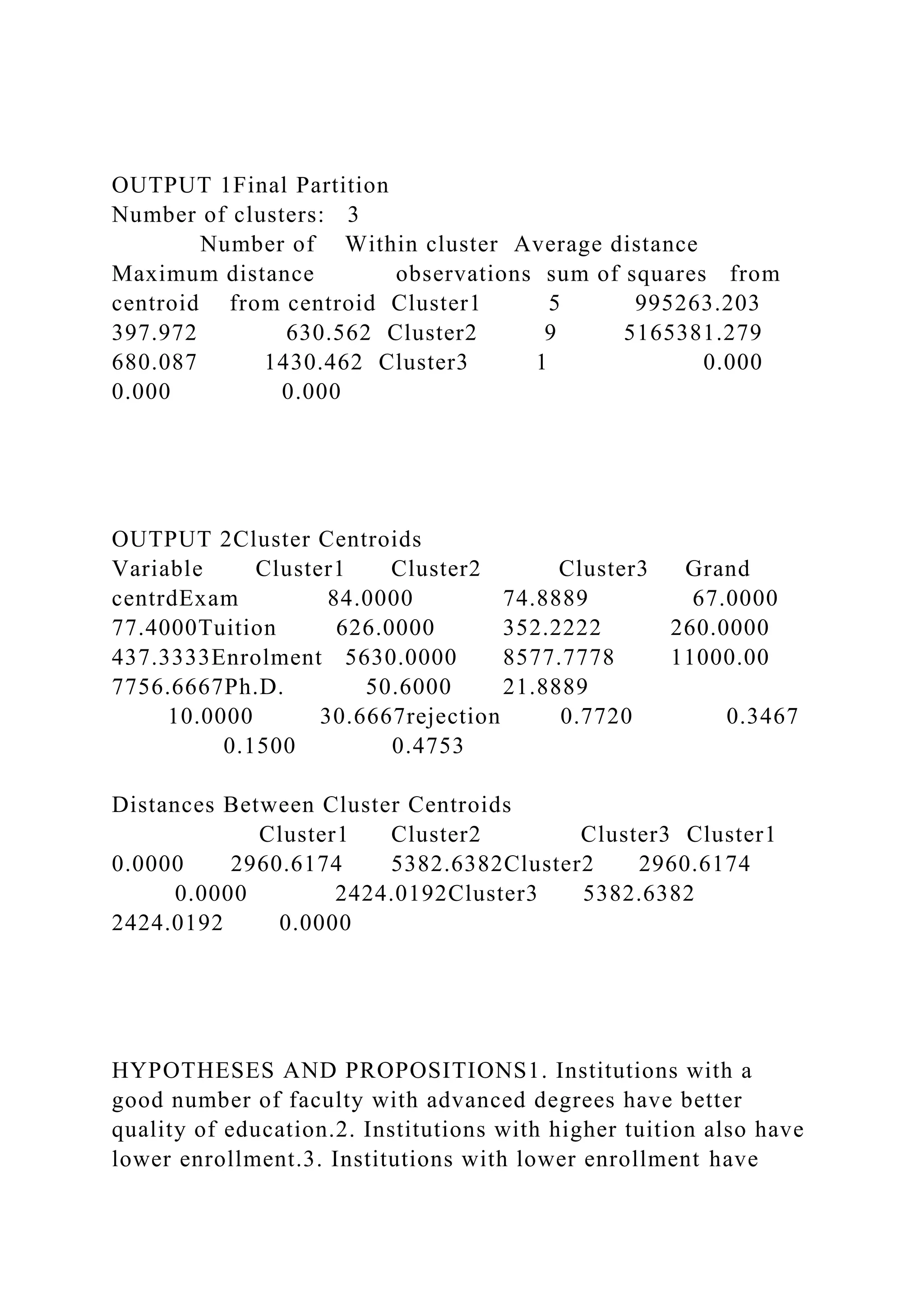
OUTPUT 1Final Partition
Number of clusters: 3
Number of Within cluster Average distance
Maximum distance observations sum of squares from
centroid from centroid Cluster1 5 995263.203
397.972 630.562 Cluster2 9 5165381.279
680.087 1430.462 Cluster3 1 0.000
0.000 0.000
OUTPUT 2Cluster Centroids
Variable Cluster1 Cluster2 Cluster3 Grand
centrdExam 84.0000 74.8889 67.0000
77.4000Tuition 626.0000 352.2222 260.0000
437.3333Enrolment 5630.0000 8577.7778 11000.00
7756.6667Ph.D. 50.6000 21.8889
10.0000 30.6667rejection 0.7720 0.3467
0.1500 0.4753
Distances Between Cluster Centroids
Cluster1 Cluster2 Cluster3 Cluster1
0.0000 2960.6174 5382.6382Cluster2 2960.6174
0.0000 2424.0192Cluster3 5382.6382
2424.0192 0.0000
HYPOTHESES AND PROPOSITIONS1. Institutions with a
good number of faculty with advanced degrees have better
quality of education.2. Institutions with higher tuition also have
lower enrollment.3. Institutions with lower enrollment have
lower student to faculty ratio and turn out to have better quality
also.
workshopPART A1. Add one more proposition or hypothesis in
the last slide of this lecture. Produce a working theory for the
entire exercise.2. Perform a regression analysis for all the
hypothesized relationships between quality and the other factors
or variables, singly and in combination.3. If there are any
anomalous observations, reformulate the theory that you have
made in Problem 1.
WorkshopPART B. Human Development Index (HDI) is a
composite index measuring average achievement in three basic
dimensions of human development: a long and healthy life,
knowledge, and decent standard of living. In 2003, a survey was
conducted to determine the HDI of several countries (Fukuda-
Parr, 2003). In this survey, the Philippines was ranked 85th out
of 175 countries in the world. Data for fifteen (15) selected
countries are shown on the next page. Perform a cluster analysis
on this data set and formulate tentative theories about Human
Development Indices of countries worldwide.
HUMAN DEVELOPMENT INDEX DATA (Fukuda-Parr,2003,
Milenium Development Goals)Country
HDIMALNUTRITIONLITERACYPOVERTYPOLITICAL1.
Norway 0.9940.010.990.020.992. Japan
0.9330.010.940.040.943. Germany
0.9210.030.960.050.924. Singapore
0.8840.040.870.030.955. Brunei
0.8720.070.890.020.996. Malaysia 0.790.080.830.060.927.
Thailand 0.7680.080.880.050.888. Philippines
0.7510.000.90.10.849. Vietnam 0.6880.080.830.110.8810.
Indonesia 0.6820.090.800.110.8511. Cambodia
0.5560.120.640.150.8412. Myanmar
0.5490.200.720.220.813. Sierra Leone
0.2750.250.410.250.7714. USA
0.940.010.970.040.9815. Ethiopia 0.330.210.450.210.80
C. Read the paper on the Normal Distribution. Provide an in-
depth critique of the arguments used in the paper. Take careful
note of the following:1. Is the present use of the normal
distribution in education justified on the basis of the historical
background provided by the paper?2. What is the main “thesis”
of the paper? Is the author’s argument convincing and free of
contradictions?3. If you were to rewrite the paper, how would
you modify the author’s work?
Concepts
Concepts, the building blocks of theories, are symbols designed
to convey a specific
meaning to the community of scholars. They must be defined,
operationalized, and
reviewed by the community of scholars for meaning and
accuracy. The concept self-esteem,
for example, is defined as, "an individual's sense of his or her
value or worth," and most
often is measured using Rosenberg's Self Esteem Scale , which
is widely accepted by the
community of scholars.
1. Concepts are defined with either primitive or derived terms.
Primitive terms cannot be
defined with other symbols or language (e.g., colors, sounds,
attitudes, some
relationships between individuals ), but can only be further
described through the use of
examples. A derived term is a set of primitive words and
symbols that further describes
a concept.
2. An abstract concept refers to two or more events (e.g.,
temperature, human capital
investment). A concrete concept refers to a specific event (e.g.,
temperature of the
sun, years of formal education).
3. Concepts can be measured either quantitatively or
qualitatively. There is no
epistemological reason to suspect that either type of
measurement is more or less
scientific, objective, or valid.
4. Concepts can be measured at the nominal level, indicating no
inherent ranking (e.g.,
male, female; Christian, Hindu, Muslim, Jewish), the ordinal
level, indicating ranking
without a continuous ordering (e.g., large, m edium, small), the
interval level,
indicating ranking with a continuous ordering, with no known
zero -state (e.g,
attitudes about same-sex marriage expressed on a 1 -7 response
scale), or the ratio
level, indicating continuous ordered ranking with a known ze ro
point (e.g., age in
years).
1. Associational statements state a relationship without
implying cause. For example,
we might state that, "locus -of-control and self-esteem (two
concepts with similar
meanings) are related," meaning they will vary together but not
necessarily cause
one another.
2. Causal statements imply that x causes y (e.g., the greater the
formal education, the
greater the income).
3. Theoretical propositions state relationships in an abstract
form (e.g., the greater the
human capital investment, the greater the life chances).
4. Hypotheses state relationships in a concrete form (e.g, the
greater the formal
education, the greater the income).
Forms of Theory
Theories can be expressed as a set of laws, in axiomatic form,
or as a set of causal
statements.
1. The set-of-laws format expresses relationships as a set of
highly supported laws (i.e.,
typically in causal form). Consider, for example, the Theory of
Reasoned Action ,
proposed by Martin Fishbein and Izak Ajzen. Within this theory
we might state as one
law, "the greater the attitude about the behavior, the greater the
intention to engage in
the behavior." All the other paths implied by the diagram would
be listed as laws within
the set of laws that define the theory of reasoned action.
2. The axiomatic format expresses relationships as a set of
axioms. For example, within
the theory of reasoned ac tion, we might state as one axiom, "If
attitude toward the
behavior, then intention toward the behavior." All the other
paths implied by the
diagram would be listed as axioms within this format.
3. The diagram shown for the theory of reasoned action represen
ts the causal
statement form. Each diagrammed path represents a theoretical
proposition. For
example, we might infer from the diagram of the Theory of
Reasoned Action that,
"the greater the attitude about the behavior, the greater the
intention to engage in
the behavior."
Note Regarding the Format of Theory
The typical format used in sociology to express a theory is the
set of causal statements,
often shown in a concise manner by the use of a diagram. In the
1980's, as part of an
effort to make sociology "more scientific," sociologists began to
present their theories in
axiomatic format (see volumes of The American Sociological
Review for examples of this
effort). Sociologists learned quickly that th e formatting of a
theory provided few
advantages toward accumulating a scientific body of
knowledge; what mattered was the
quality of the theory, not its formatting. Note, however, that
some sociologists will argue
that "theory" should be expressed either as a set of laws or in
axiomatic format (see:
Formal Theory in Sociology: Opportunity or Pitfall? , edited by
Jerald Hage).
Truth of Statements, Validity of Reasoning
Peter Suber, Philosophy Department, Earlham College
True Premises, False Conclusion
0. Valid Impossible: no valid argument can have true premises
and a false conclusion.
1. Invalid
Cats are mammals.
Dogs are mammals.
Therefore, dogs are cats.
True Premises, True Conclusion
2. Valid
Cats are mammals.
Tigers are cats.
Therefore, tigers are mammals.
3. Invalid
Cats are mammals.
Tigers are mammals.
Therefore, tigers are cats.
False Premises, False Conclusion
4. Valid
Dogs are cats.
Cats are birds.
Therefore, dogs are birds.
5. Invalid
Cats are birds.
Dogs are birds.
Therefore, dogs are cats.
False Premises, True Conclusion
6. Valid
Cats are birds.
Birds are mammals.
Therefore, cats are mammals.
7. Invalid
Cats are birds.
Tigers are birds.
Therefore, tigers are cats.
The distinction between truth and validity is the fundamental
distinction of formal logic. You
cannot understand how logicians see things until this distinction
is clear and familiar.
Simple statements
p "p is true" assertion
~p "p is false" negation
Compounds and connectives
p q "either p is true, or q is true, or both" disjunction
p · q "both p and q are true" conjunction
p q "if p is true, then q is true" implication
p q "p and q are either both true or both fal se" equivalence
Implication statements (p q) are sometimes called conditionals,
and equivalence statements (p
q) are sometimes called biconditionals.
A truth table is a complete list of the possible truth values of a
statement. We use "T" to mean
"true", and "F" to mean "false" (though it may be clearer and
quicker to use "1" and "0"
respectively).
For example, p is either true or false . So its truth table has just
2 rows:
p
T
F
But the compound, p q, has 2 components, each of which can be
true or false. So there are 4
possible combinations of truth values. The disjunction of p with
q will be true as a compound
whenever p is true, or q is true, or both:
p q p q
T T T
T F T
F T T
F F F
If a compound has n distinct simple components, then it will
have 2
n
rows in its truth table.
The truth table columns that define the basic connectives are as
follows:
p q ~p ~q p q p · q p q p q
T T F F T T T T
T F F T T F F F
F T T F T F T F
F F T T F F T T
Most statements will have some combination of T's and F's in
their truth table columns; they are
called contingencies. Some statements will have nothing but
T's; they are call ed tautologies.
Others will have nothing but F's; they are called contradictions.
Obviously these three types of
propositions exhaust the possibilities for statements that have
truth table columns --which means
for all truth-functional statements.
DEDUCTIVE SYSTEMS
DEFINITIONS
AXIOMS AND ASSUMPTIONS
LEMMA AND LOGICAL RELATIONS DERIVED
THEORIES
COROLLARIES AND CONSEQUENCES
TIDItems
1Bread, Coke, Milk
2Beer, Bread
3Beer, Coke, Diaper, Milk
4Beer, Bread, Diaper, Milk
5Coke, Diaper, Milk
TID Items
1 Bread, Milk
2 Bread, Diaper, Beer, Eggs
3 Milk, Diaper, Beer, Coke
4 Bread, Milk, Diaper, Beer
5 Bread, Milk, Diaper, Coke
TID Items
1 Bread, Milk
2 Bread, Diaper, Beer, Eggs
3 Milk, Diaper, Beer, Coke
4 Bread, Milk, Diaper, Beer
5 Bread, Milk, Diaper, Coke
ItemCount
Bread4
Coke2
Milk4
Beer3
Diaper4
Eggs1
Itemset Count
{Bread,Milk} 3
{Bread,Beer} 2
{Bread,Diaper} 3
{Milk,Beer} 2
{Milk,Diaper} 3
{Beer,Diaper} 3
Itemset Count
{Bread,Milk,Diaper} 3
EXAMPLE: W e look at variables related to climate change and
health concerns:
X1: average typhoons entering Philippine area of responsibility
X2: average annual temperature
X3: incidence of dengue cases per thousand population
X4: incidence of diabetes per thousand population
X5: incidence of tuberculosis per thousand populatio n
Over the last twenty years. The data are shown below:
typhoon avtemp dengue diabetes TB
26 33 15 13 12
25 34 14 12 13
15 29 6 11 5
13 30 14 14 12
8 34 12 10 11
11 32 14 12 13
25 26 17 14 12
9 35 8 11 7
18 31 14 11 5
15 32 10 13 8
Let us discover some association rules here. We use MINITAB
to convert and simplify our data as
follows:
X1: Put a 1 if no. Of typhoons is more than 22 per year
X2: put a 1 if average temp. Exceeds 30
X3: Put a 1 if no. Of dengue cases exceeds 10
X4: put a 1 if no of diabetes cases exceeds 8
X5: put a 1 if no of TB cases exceeds 11
The converted data are shown below:
TYPH TEMP DENG DIAB TUBER ITEM
1 1 1 1 1 TYPH,TEMP,DENG,DIAB,TUBER
1 1 1 1 1 TYPH,TEMP, DENG, DIAB, TUBER
0 0 0 1 0 DIAB
0 0 1 1 1 DENG, DIAB, TUBER
0 1 1 1 0 TEMP, DENG,DIAB
0 1 1 1 1 TEMP, DENG, DIAB, TUBER
1 0 1 1 1 TYPH, DENG, DIAB, TUBER
0 1 0 1 0 TEMP, DIAB,
0 1 1 1 0 TEMP, DENG, DIAB
0 1 0 1 0 TEMP, DIAB
TID ITEM
1 TYPH,TEMP,DENG,DIAB,TUBER
2 TYPH,TEMP, DENG, DIAB, TUBER
3 DIAB
4 DENG, DIAB, TUBER
5 TEMP, DENG,DIAB
6 TEMP, DENG, DIAB, TUBER
7 TYPH, DENG, DIAB, TUBER
8 TEMP, DIAB,
9 TEMP, DENG, DIAB
10 TEMP, DIAB
SET OUR MINIMUM SUPPORT AT : M INSUP = 6 (ONE
MORE THAN HALF THE NUMBER OF cases)
ITEM 1 SET SUPPORT
TYPHOON 3
TEMPERATURE 7
DENGUE 7
DIABETES 10
TB 5 (eliminate TYPHOON AND TB)
ITEM 2 SET SUPPORT
TEMP, DENG 6
TEMP, DIAB 7
DENG, DIAB 7 (ALL TWO ITEM SET ARE ACCEPTED)
ITEM 3 SET SUPPORT
TEMP,DENG, DIAB 5 (ELIMINATE THREE ITEM SET)
age gender salary exercise diet parents’history stress level
52 1 37664 3 5 1 21.4888
31 1 23400 1 2 2 12.1500
29 0 4000 3 4 1 6.4177
27 1 39379 4 4 2 22.2606
60 0 7000 1 2 2 6.1745
52 0 11500 1 5 2 9.6898
45 0 39715 1 4 1 21.2718
28 1 14344 3 1 1 9.0148
42 0 7229 2 3 2 6.5931
39 1 14609 2 2 1 8.3541
52 1 23678 1 2 1 12.6951
32 1 23758 3 2 0 13.3311
38 0 35271 4 4 1 21.1320
39 0 26000 3 2 0 14.9530
48 1 24805 2 2 0 13.6223
34 1 38579 3 3 2 20.5406
46 1 18000 5 5 0 18.1015
26 0 13864 1 2 1 7.7588
42 0 17119 4 4 1 12.5436
32 1 9516 2 5 1 7.9422
TYPE MGT NG0 INC.
1 5 0 4
1 4 0 4
1 5 0 5
1 4 0 3
1 3 0 3
1 4 0 5
1 5 1 5
1 4 1 4
1 3 0 4
1 3 1 3
0 2 0 2
0 2 0 2
0 3 1 5
0 4 1 5
0 2 0 2
0 1 0 2
0 5 1 1
0 2 0 1
0 2 0 2
0 1 0 2
The regression equation is
INC. = 1.57 + 1.16 TYPE + 0.272 MGT + 0.594 NG0
Predictor Coef SE Coef T P
Constant 1.5690 0.7091 2.21 0.042
TYPE 1.1648 0.5 792 2.01 0.046
MGT 0.2720 0.1 185 2.29 0.020
NG0 0.5939 0.6358 0.93 0.364
Unusual Observations
Obs TYPE INC. Fit SE Fit Residual St
Resid
13 0.00 5.000 2.979 0.522 2.021 2.05R
17 0.00 1.000 3.523 0.734 -2.523 -
3.01R
agency level LET
1 2 78
1 2 77
1 2 78
1 1 64
1 3 81
1 3 82
2 3 66
2 4 65
2 3 78
2 2 65
2 3 76
2 2 80
2 3 80
3 4 90
3 3 88
3 2 78
3 1 73
3 3 89
3 2 80
3 3 89
3 4 91
3 3 90
3 4 92
3 2 78
151312109871161434251
77.26
84.84
92.42
100.00
Similarity
Observations
International Journal of Doctoral Studies Volume 6, 2011
Guiding the Use of Grounded Theory in Doctoral
Studies – An Example from the
Australian Film Industry
Michael Jones and Irit Alony
Faculty of Commerce, University of Wollongong,
Wollongong, Australia
[email protected][email protected]
Abstract
Selecting the most appropriate research method is one of the
most difficult problems facing a
doctoral researcher. Grounded Theory is presented here as a
method of choice as it is detailed,
rigorous, and systematic, yet it also permits flexibility and
freedom.
Grounded Theory offers many benefits to research in
Information Systems as it is suitable for the
investigation of complex multifaceted phenomena. It is also
well equipped to explore socially
related issues. Despite existing criticism, it is a rigorous and
methodical research approach capa-
ble of broadening the perceptions of those in the research
community. This paper provides de-
tailed and practical guidelines that illustrate the techniques,
utility, and ease of use of grounded
theory, especially as these apply to information systems based
research.
This paper tracks a Grounded Theory research project
undertaken to study the phenomena of col-
laboration and knowledge sharing in the Australian Film
Industry. It uses this to illustrate and
emphasize salient points to assist potential users in applying the
method. The very practical ap-
proach shared in this paper provides a focused critique
rendering it a valuable contribution to the
discussion of methods of analysis in the IS sphere, particularly
grounded theory.
Keywords: Research methodology, Grounded Theory,
Knowledge Management, Qualitative Me-
thods.
Introduction
Selecting an appropriate research method is one of the most
critical challenges presented to a doc-
toral researcher. Phillips (1976) likened this element to the
Magna Carta of research. The re-
search method must be designed into the research project such
that the product of the research is
reliable and credible and, importantly for early career
researchers, a method that can be applied
easily without decades of refinement
and practice.
Among interpretive and qualitative re-
search methods, Grounded Theory of-
fers unique benefits to the doctoral re-
searcher. Grounded Theory “is an in-
ductive, theory discovery methodology
that allows the researcher to develop a
theoretical account of the general fea-
tures of a topic while simultaneously
grounding the account in empirical ob-
Material published as part of this publication, either on-line or
in print, is copyrighted by the Informing Science Institute.
Permission to make digital or paper copy of part or all of these
works for personal or classroom use is granted without fee
provided that the copies are not made or distributed for profit
or commercial advantage AND that copies 1) bear this notice
in full and 2) give the full citation on the first page. It is per-
missible to abstract these works so long as credit is given. To
copy in all other cases or to republish or to post on a server or
to redistribute to lists requires specific permission and payment
of a fee. Contact [email protected] to request
redistribution permission.
Editor: Yair Levy
mailto:[email protected]
Guiding the Use of Grounded Theory
servations or data” (Martin & Turner, 1986, p. 141). Grounded
Theory provides a detailed, rigor-
ous, and systematic method of analysis, which has the
advantage of reserving the need for the
researcher to conceive preliminary hypotheses. It therefore
provides the researcher with greater
freedom to explore the research area and allow issues to emerge
(Bryant, 2002; Glaser, 1978,
1992, 1998, 2001). As a consequence, Grounded Theory is
useful in providing rigorous insight
into areas that are relatively unknown by the researcher.
Despite all these benefits, however, Grounded Theory poses
several risks to the doctoral re-
searcher. Foremost among these is the risk that after
commencing data collection and analysis,
the researcher may not actually uncover substantial or
significant theory (also known as a basic
social process (Glaser, 1978)). Another risk is the chance that
the unorthodox nature of Grounded
Theory will alienate the potential recipients from the research
findings.
This paper seeks to guide doctoral students who consider using
Grounded Theory for their stud-
ies. It provides a focused critique of Grounded Theory, which
can guide their decision to employ
it as a research method. More importantly, this paper details
and explains the steps doctoral re-
searchers must undertake in order to reap the benefits Grounded
Theory has to offer, by applying
it rigorously to the problem examined. To ensure a complete
understanding of how to use
Grounded Theory, the paper tracks a Grounded Theory research
project undertaken to study the
phenomena of collaboration and knowledge sharing in the
Australian Film Industry.
The Information Systems (IS) phenomenon examined here is
knowledge sharing within a project
environment. Although knowledge sharing has been recently
studied in various contexts, the
context of project-based knowledge sharing has been largely
overlooked (Ajmal & Koskinen,
2008). Studies examining inter-firm knowledge sharing (Ko,
Kirsch, & King, 2005), inter-
personal knowledge sharing (Gee-Woo, Zmud, & Sanjeev, 2005;
McLure-Wasko & Faraj, 2005),
as well as person-to-repository knowledge sharing (Kankanhalli,
Tan, & Wei, 2005) revealed a
myriad of factors that impact knowledge sharing attitudes,
intentions, and behavior. However,
only a small amount of empirical work has examined the
applicability of these factors to the tem-
porary and ad-hoc nature of a project environment (e.g., Boh,
2007).
To explore the underlying issues surrounding knowledge
sharing in a project environment, this
study selected The Australian Film Industry (AFI). This
industry shares many of the characteris-
tics of project teams on one hand (Bechky, 2000; Boh, 2007)
and, on the other hand, presents fas-
cinating successful project completions under strict limitations
of resources (Alony, Whymark, &
Jones, 2007; Jones, Kriflik, & Zanko, 2005). Understanding the
enablers facilitating effective
knowledge sharing in the AFI offers important lessons to other
project environments that also rely
on effective knowledge sharing for project success (Ajmal &
Koskinen, 2008; Davies & Brady,
2000). As it appears that no significant attention has been given
to studying IS in this environ-
ment before, Grounded Theory offers a sensitive and rigorous
method for investigation.
As a research method that is liberated from many of the
impositions shared by other methods,
Grounded Theory can potentially provide a unique insight into
the successful process of knowl-
edge sharing in the AFI. This approach was undertaken in order
to explore the sharing process
and its enablers and supporting factors. The actual study which
looks at knowledge sharing in the
Australian Film Industry, and its results, will be used here in a
capacity limited to practical illus-
tration. For a full discussion of the findings of this research
please see Alony et al. (2007).
This paper proceeds as follows. First, the value and benefits
Grounded Theory has to offer to IS
research is articulated. Then, the criticism Grounded Theory
received in this field is discussed.
The paper then tracks the steps taken in a study of collaboration
and tacit knowledge sharing in
the Australian Film Industry (AFI), using Grounded Theory,
with the aim of providing the reader
an illustrated step-by-step guide for using Grounded Theory in
IS. The theoretical underpinning
for the practical research steps is provided as well.
96
Jones & Alony
The Value of using Grounded Theory in IS Research
The benefits offered by Grounded Theory for IS research
include the method’s capacity to inter-
pret complex phenomena (Charmaz, 2003), its accommodation
of social issues (Glaser & Strauss,
1967), its appropriateness for socially constructed experiences
(Charmaz, 2003; Goulding, 1998),
it is imperative for emergence (Glaser, 1978; Glaser & Strauss,
1967), its absence from the con-
straints of a priori knowledge (Glaser, 1978; Glaser & Strauss,
1967), and the method’s ability to
fit with different types of researchers (Martin & Turner, 1986).
The IS environment is complex and multifaceted (Geri & Geri,
2011; Skyrius & Bujauskas,
2010). A full conceptual understanding of it requires the
grappling of many interweaved and
overlapping issues and themes (Bryant, 2002; Fernández &
Lehmann, 2005; Walsham, 1995).
Interpretive research provides to the researcher thick
description, which helps to disentangle con-
ceptual relevance (Geertz, 1973). This provides value to those
who will benefit from its product
by providing meaningful emergent concepts (Charmaz, 2006,
2008; Fernández, 2004). A
Grounded Theory study which closely follows the guidelines
presented by Glaser and Strauss
(1967) will transcend thick description to provide substantive
theory (Fernández, Martin, Gregor,
Stern, & Vitale, 2006; Goulding, 2001). This quality of
Grounded Theory is further supported by
Ellis and Levy (2009) who stated that GT can furnish additional
value when literature fails to
support the theoretical evolution of phenomena.
Grounded Theory is an important method for studying topics of
a social nature. The issues which
occupy practitioners within the IS environment are of a socio-
technical nature. Fernández and
Lehnmanm (2005) argued that for research to maintain most
relevance in emerging areas of the
socio-technical domain, researchers must adopt a new
methodology: “we propose a [new] meth-
odological alternative: grounded theory building research,
where the emerging theory helps ex-
plain, in conceptual terms, what is going on in the substantive
field of research” (p. 2). Other me-
thods may have the effect of forcing preconception through the
transfer of inaccurate theoretical
assumptions upon the emerging phenomena. Grounded Theory
can overcome these problems by
providing a lens that does not bias emergence with a priori
assumptions and does not thrust for-
ward a selection of preconceived theories from which the
researcher must explain the socio-
technical phenomena
Another implication of the social aspect of IS is the
constructivist nature of the phenomena. As
Walsham (1995, 2006) discussed, socially constructed
knowledge in IS requires an interpretive
approach to inquiry; this renders its interpretation as subjective
and value-laden (Galal, 2001).
Therefore, data are acquired as composite social constructions
of the researcher along with the
socially constructed views of those who are being studied
(Walsham, 1995). Van Maanen
(1979b) divided this composite into first and second order
concepts. First order components are
the artefacts presented by the subject of the research – these are
taken as facts. Second order
components are the constructions of the researcher – these lead
to the theories the researcher de-
velops to explain the phenomena under study. To put this
simply: first order concepts are inter-
pretations, second order concepts are “interpretations of
interpretations” (van Maanen, 1979a, p.
541). Grounded Theory provides a means of assembling and
sorting first order concepts by look-
ing for patterns and saturation. Grounded Theory also provides
a means of drawing out second
order concepts through processes of abstraction (Fernández &
Lehmann, 2005). (The methods
implicit in these assertions will be discussed in detail in a later
section of this paper.)
Walsham (2006) made a salient point in recognizing the
importance of fit between the selected
method and the researcher. Walsham (2006) explained that by
choosing a method the researcher
likes, enjoys, and engages with, convincing others of the
justification of the method becomes an
easier task. It is this convention which drove the selection of
Grounded Theory as a method in
this study. In the case of this research, Grounded Theory is the
method of choice because it en-
97
Guiding the Use of Grounded Theory
ables an understanding of an area which requires no preformed
concepts of knowledge or reality.
The ontology and epistemology adopted in this research accepts
that knowledge is not static, but
is always emerging and transforming, and is interpreted by both
observer and participant. Mean-
ing is conveyed through dialogue and action. Within dialogue
and action are embedded under-
standing, experience, and emotion. Only through interaction and
discourse can meaning be
unlocked and conveyed to the observer. From this perspective,
Grounded Theory provides a me-
thod which enables a researcher to adduce true meaning and
understanding.
As a research method, Grounded Theory has not gone without
criticism. The following section
explains, discusses and addresses the most widespread of these
criticisms.
Criticisms of Grounded Theory
As with most research methods, Grounded Theory does not exist
without its critics. The most
common criticism in the field of IS rests with a claim that while
the method uses interpretivist
and constructionist tools, it stems from positivism/objectivism.
It therefore suffers from internal
misalignment (Bryant, 2002). The following section addresses
this criticism in detail. Other
points of criticism include naive inductionism (Bryant, 2002;
Goulding, 2001), limitations on a
priori knowledge (Bryant, 2002; Charmaz, 2006; Goulding,
2001), phenomenalism (Goulding,
2001), the paradox of ‘theory’ (Bryant, 2002; Charmaz, 2006),
and limited theoretical generalisa-
tion (Burawoy, 1991; Nasirin, Birks, & Jones, 2003; Charmaz,
2006). Addressing these criti-
cisms is outside the scope of this paper.
Various researchers have differing ideas on the philosophical
location of Grounded Theory. Some
view it as a positivist/objectivist method, due to the language
used by Glaser and Strauss (1967)
in their book titled ‘The Discovery of Grounded Theory’. Terms
like ‘emergence’ and ‘discovery’
suggest an objective realist perspective, accepting only one
‘true’ reality (Locke, 2001). The main
reason for this assumption probably lies in the fact that Glaser
and Strauss established a strong
argument for a structured method of qualitative analysis
(Charmaz, 1990, p. 253):
Glaser and Strauss’s (1967) work was revolutionary because it
challenged (a) arbitrary
divisions between theory and research, (b) views of qualitative
research as primarily a
precursor to more "rigorous" quantitative methods, (c) claims
that the quest for rigor
made qualitative research illegitimate, (d) beliefs that
qualitative methods are impression-
istic and unsystematic, (e) separation of data collection and
analysis, and (f) assumptions
that qualitative research could produce only descriptive case
studies rather than theory
development.
Denzin and Lincoln (2000) introduced Grounded Theory as an
institutional icon in the modernist
paradigm. This finding may have been heavily influenced by the
date of publication of the origi-
nal monograph in 1967. That year lay well within Denzin and
Lincoln’s (2000) espoused second
movement. It may also have been informed by Glaser’s strong
positivist background, a view sup-
ported by Charmaz (2003).
In contrast to this view, Glaser and Strauss (1967) argued for a
movement away from a positivis-
tic association (Hutchinson, 1988; Suddaby, 2006). They
proffered their work as a solution to
some of the concerns they saw at the time: “[Grounded Theory]
came forward … in response to
the extreme violations brought to data by quantitative,
preconceived, positivistic research using
forcing conjectured theory” (Glaser, 2001, p. 6). Grounded
Theory was developed to avoid highly
abstract sociology. It was a big part in the change of qualitative
analysis during the 1960s and
1970s (Goulding, 1998, p. 6). Through developing theory by
‘grounding’ it in data, Glaser and
Strauss were able to bridge the void between theoretically
‘uninformed’ empirical research and
empirically ‘uninformed’ theory (Charmaz, 1983).
98
Jones & Alony
Goulding (1998) and Locke (2001) suggested that Grounded
Theory lies closer to an interpretive
paradigm, citing its association with American pragmatism and
the symbolic interactionist school
of sociology. Glaser supports this view citing the influence of
Strauss with his strong background
in symbolic interactionism gained at the Chicago School of
Symbolic Interactionism and claim-
ing: “through Anselm [Strauss], I started learning the social
construction of realities by symbolic
interaction making meanings through self-indications to self and
others. I learned that man was a
meaning making animal” (Glaser, 1998, p. 32).
Glaser (2005) tended to be ambivalent about the position of
Grounded Theory and stated that
Grounded Theory is intended as an alternative to all paradigms:
“[Grounded Theory] is not an
either/or method. It is simply an alternative to positivistic,
social constructionist and interpretive
qualitative data methods” (Glaser, 2001, p. 6). Glaser (2001)
emphasizes that a method’s selec-
tion is to be guided by the needs of the research, rather than by
any one paradigmic bias: “My
bias is clear, but this does not mean I rubber stamp ‘ok’ or
indite any method. The difference in
perspectives will just help any one researcher decide what
method to use that suits his/her needs
within the research context and its goals for research” (Glaser,
2001, p. 2).
Two Grounded Theory Schools
Grounded Theory was initially developed by two researchers –
Barney Glaser and Anselm
Strauss (1967). However, early in its development the two
researchers separated and a bifurcation
of the theory enveloped (Glaser, 1992; Strauss & Corbin, 1990).
We now have two fundamental
schools for Grounded Theory: the Glaserian School and the
Straussian School (Stern, 1994). The
differences between these are many, and in cases somewhat
minor. The major differences, how-
ever, can have an important impact in the direction and
execution of the primary research. For
instance, Glaser takes the stance that researchers should have an
empty mind, while Strauss per-
mits a general idea of the area under study. Glaser leads with
the principle that theory should
emerge, while Strauss uses structured questions to lead a more
forced emergence of theory. These
differences and others are detailed in Table 1. This discussion
has been borrowed from Onions
(2006).
Table 1: Comparisons of the two schools of Grounded Theory
‘GLASERIAN’ ‘STRAUSSIAN’
Beginning with general wonderment (an empty
mind)
Having a general idea of where to begin
Emerging theory, with neutral questions Forcing the theory,
with structured questions
Development of a conceptual theory
Conceptual description (description of situa-
tions)
Theoretical sensitivity (the ability to perceive
variables and relationships) comes from im-
mersion in the data
Theoretical sensitivity comes from methods
and Tools
The theory is grounded in the data The theory is interpreted by
an observer
The credibility of the theory, or verification, is
derived from its grounding in the data
The credibility of the theory comes from the
rigour of the method
A basic social process should be identified Basic social
processes need not be identified
The researcher is passive, exhibiting disci-
plined restraint
The researcher is active
Data reveals the theory Data is structured to reveal the theory
99
Guiding the Use of Grounded Theory
‘GLASERIAN’ ‘STRAUSSIAN’
Coding is less rigorous, a constant comparison
of incident to incident, with neutral questions
and categories and properties evolving. Take
care not to ‘over-conceptualise’, identify key
points
Coding is more rigorous and defined by tech-
nique. The nature of making comparisons var-
ies with the coding technique. Labels are care-
fully crafted at the time. Codes are derived
from ‘micro-analysis which consists of analysis
data word-by-word’
Two coding phases or types, simple (fracture
the data then conceptually group it) and sub-
stantive (open or selective, to produce catego-
ries and properties)
Three types of coding, open (identifying, nam-
ing, categorising and describing phenomena),
axial (the process of relating codes to each oth-
er) and selective (choosing a core category and
relating other categories to that)
Regarded by some as the only ‘true’ GTM
Regarded by some as a form of qualitative data
analysis (QDA)
The research described in this paper adopts the former
methodology, that of Glaser. This method
has been selected in favor of the Straussian School primarily as
a result of the Glaserian method
maintaining a focus on its more pure origins and due to its more
emergent nature over the more
prescriptive edicts of the Straussian style (Stern, 1994).
Overview of the Research Project – Knowledge Sharing in the
Australian Film Industry
The study was part of a larger investigation of the Australian
Film Industry (AFI), focusing on
collaboration, knowledge transfer, and knowledge sharing in a
project environment. Being com-
plex, multi faceted, and socially driven, this activity of
knowledge exchange is an appropriate
subject to study using Grounded Theory (Orlikowski, 2002).
The research focuses on the infor-
mation flow between participants, looking for events of
knowledge sharing and factors enabling
it. The findings elucidated three issues:
1. The nature of knowledge sharing in the AFI: tacit or explicit
knowledge
2. The difference between information flow and knowledge
sharing
3. The different factors which enable and inhibit this sharing of
knowledge
Knowledge sharing was selected as a research topic as it has
been found to improve organisa-
tional performance (Haas & Hansen, 2007; Lesser & Storck,
2001), to promote competitive ad-
vantage (Argote & Ingram, 2000), to enhance organisational
learning (Argote, 1999), to increase
innovation (Powell, Koput, & Smith-Doerr, 1996), and to
support organisational survival and sus-
tainability (Baum & Ingram, 1998). However, not all
organizations can easily facilitate knowl-
edge sharing. Project-based organizations find this facilitation
challenging (Cooper, Lyneis, &
Bryant, 2002) due to the temporary, transient, and customized
nature of projects (Boh, 2007).
Project-based organizations rely on temporary and ad-hoc
structures for completion of tasks.
From a task perspective, each customized project tends to differ
from others in several critical
aspects. This makes it difficult to transfer lessons learned
across projects (Meyerson, Weick, &
Kramer, 1996). From a relationship perspective, team members
tend to vary from one project to
another. This renders the conduits of knowledge transfer (i.e.,
relationships) transient and poten-
tially less effective (Hobday, 2000). Despite these limitations,
project-based organizations are
particularly useful for tasks that require creativity, innovation,
and diverse perspectives (Boh,
2007; Davies & Brady, 2000; Hobday, 2000).
100
Jones & Alony
The ultimate project-based environment is the film industry,
where project teams form around
each movie based on specific requirements of expertise
(Bechky, 2000; Daskalaki & Blair, 2002;
Mintzberg & McHugh, 1985). These members may or may not
have worked together in the past,
therefore suggesting various degrees of relationship strengths.
Film production teams draw to-
gether individuals with different types of expertise, and thus
knowledge specific to individuals,
which is not held by others, is common (Cattani & Ferriani,
2008). Similar to most industry pro-
jects, Australian film production teams are under pressure of
time and resources, as project deliv-
erables must meet deadlines within budget constraints (Jones &
Alony, 2007). The success of
film projects is heavily reliant on collaborative processes,
which include knowledge transfer (Cat-
tani & Ferriani, 2008). The AFI work environment is
challenging and stressful. This demands
swift and accurate results, without tolerance for ambiguity,
inaccuracy, or failure (DeFillippi &
Arthur, 1998; Jones & Alony, 2007). The fact that many film
projects are completed successfully
in the AFI suggests that knowledge transfer is effective in this
industry. Factors that support
knowledge sharing and enable its success in such harsh
conditions can therefore serve as power-
ful lessons for other project environments.
To understand what enables and supports knowledge sharing in
project teams, and due to a lack
of prior research into this context, Grounded Theory was
employed. Since knowledge has been
described as an “ongoing social accomplishment, constituted
and reconstituted as actors engage
the world in practice” (Orlikowski, 2002, p. 249), investigating
the process of its sharing with the
holistic view provided by Grounded Theory enables the
capturing of the influence of many situ-
ational variables involved. This approach for studying
knowledge work has been argued for by
others as well (Bechky, 2006). Knowledge sharing and
collaboration within the AFI has not been
previously studied; it therefore justified an exploratory
approach.
The results of this study found five groups of factors impacting
on the success of the process of
knowledge sharing during collaboration: individual,
relationship, network, organization, and
knowledge. In addition, the results showed that individual
motivation has the potential to override
the influence of all other factors and to support a successful
knowledge sharing process. The full
results of this project can be found in Alony et al. (2007). The
aim of this paper is to provide the
reader with an understanding of how to use Grounded Theory
for such research. The following
section details the methodological process undertaken in this
study.
Using the Grounded Theory Method
This section integrates our Grounded Theory design by
interlacing theoretical guidelines with
practical insights from the study described above. For ease of
communication this discussion ne-
cessitates a mix of first and third person, where first person
represents the practical side of the
example (also underlined for clarity) and third person will
represent theoretical doctrine. An ad-
vantage of the first person here is that it provides a more
subjective view of the research process,
and since subjectivity is an inherent component of qualitative
research, this strategy is perhaps
appropriate.
The process of Grounded Theory encompasses an
acknowledgment of the researchers’ bias, the
selection of a data collection site, the data collection process,
the process of coding and analysis,
and the compilation of results. Coding and analysis includes
three stages: open coding, selective
coding, and theoretical coding. Open coding employs constant
comparison and memoing and re-
sults in themes, sub-categories, and core categories. These
results guide the subsequent sampling
of participants through theoretical sampling. The next stage of
coding – selective coding – also
employs constant comparison and memoing. This stage results
in dense, saturated core categories.
The core categories are then sorted, written, theorized, and
cross-referenced with literature, dur-
ing theoretical coding. The results of this last stage of coding
are a basic social process and a
theoretical model. This is the final product of Grounded Theory
research. This research process is
101
Guiding the Use of Grounded Theory
summarized in Figure 1. This section explains each part of the
process, and illustrates how it was
undertaken in the study of the AFI.
Figure 1. The Process of Grounded Theory
Acknowledge Biases
An initial step in qualitative research, in particular Grounded
Theory, is for the researcher to dis-
close influences which may bias the study. By acknowledging
researcher biases, the work gains a
degree of scientific hardiness. In addition, Glaser and Strauss
(1967) recommended researchers
enter the field without preconceived or a priori ideas of the
subject area, of what may be discov-
ered, or where it may lead. However, as many writers have
testified (Charmaz, 2003; Hettinga,
1998), it is very difficult, if not impossible, to totally divorce
one’s self from the accumulations of
knowledge and experience which temper understanding,
observation, and interpretation. Re-
searchers must therefore disclose information which may affect
understanding. Disclosure will do
two things. Firstly, it will inform the reader of areas where
objectivity may be at risk of not being
102
Jones & Alony
absolute. More importantly though, it will communicate that we,
as researchers, are aware of
these potential biases and have endeavored to account for them.
Not unlike other interpretive methods, researchers must be
aware of two potential biases: double
hermeneutic and the Hawthorne effect. This caveat is not
limited to the use of Grounded Theory.
Interpretive researchers must acknowledge this role and its
potential for affecting the results
(Walsham, 1995). The first bias, double hermeneutic, as termed
by Giddens (1984), suggests the
subject of the research is influenced by the research and by the
researcher. Given time, the subject
will eventually learn from the research and modify his or her
behaviour. The other bias is known
as ‘the Hawthorne effect’ (Landsberger, 1958). Landsberger
studied the famous Hawthorne ex-
periments to try to understand the extraordinary outcomes of the
research. In doing so, he found
that people have a tendency to do things to please the
researcher, and this can result in artificial
results. Researchers must bear these influences in mind when
preparing research, collecting data,
and writing up and reporting results.
We entered the study with little prior knowledge of the AFI,
knowing nothing about film produc-
tion. In order to gain some initial knowledge of the film
industry, of the jargon used, and to gain
some of the requisites for the development of theoretical
sensitivity (Glaser, 1978) we undertook
an initial pilot study. Following this we interviewed several
film producers at a film conference.
These activities served to provide some basic general
knowledge. Glaser and Strauss (1967)
stressed that developing theoretical sensitivity is essential for
the proper emergence of Grounded
Theory.
Following the prescribed methods of Glaserian Grounded
Theory (Glaser 1978, 1992, 1998,
2001, 2005; Glaser & Kaplan, 1996; Glaser & Strauss, 1967),
empirical data were collected from
film workers. Initial inquiries were directed toward management
practices in general. However,
as the basic social process began to emerge, the research
became more and more focused toward
the actual social problem as related by the participants. As
Glaser and Holton (2004) stated:
GT provides an honest approach to the data that lets the natural
organization of substan-
tive life emerge. The GT researcher listens to participants
venting issues rather than en-
couraging them to talk about a subject of little interest. The
mandate is to remain open to
what is actually happening and not to start filtering data through
pre-conceived hypothe-
ses and biases to listen and observe and thereby discover the
main concern of the partici-
pants in the field and how they resolve this concern. (p. 11)
Begin Data Collection
A Grounded Theory study begins with a general opening of a
subject area. As stated by Dey
(1999, p. 3), the researcher will usually start with a “general
subject or problem conceived only in
terms of a general disciplinary perspective.” From this initial
opening, the study becomes con-
tinually focussed towards an area of social concern. Once a data
site has been selected, collection
of data begins, this is usually in the form of open-ended
interviewing and transcription, but can
include other forms of data acquisition such as documents and
literature. Glaser comments that
“all is data” meaning just that: “exactly what is going on in the
research scene is the data, what-
ever the source, whether interview, observations, documents. It
is not just what is being, how it is
being and the conditions of it being told, but all the data
surrounding what is being told” (Glaser,
2001, p. 145).
The selection of our initial participants was based on
introductions from our University. Introduc-
tions were necessary as these people were generally high profile
and were also accustomed to
working unusual hours. It was both courteous and convenient to
secure an introduction before
contacting each of the participants. Following the guidelines of
Theoretical Sampling (Glaser,
1978), each participant was asked to recommend a number of
people who would potentially sat-
103
Guiding the Use of Grounded Theory
isfy our expected needs for theoretical sampling and
densification. After analysis we determined
which of these potential participants would be most suited to
the research by examining their bi-
ographies and filmographies. Through this examination of their
history and experience we could
determine whether they would be suitable according to what we
thought they could add to the
study in relation to the data we were obtaining. When we
determined which of the potential con-
tacts were most useful we would ask the person we had
interviewed if they could contact this per-
son and introduce us. This did not work in all cases – due to
various reasons, usually because the
person was busy working; in these cases we would ask for an
introduction to our next preferred
participant.
The first two interviews were held on the same day with two
film producers in two separate loca-
tions. These initial interviews went from 90 to 120 minutes
each, both yielding rich information.
The data were of such high quality that nearly all of it was used
in the study. After these first two
interviews, subsequent interviews became progressively shorter
as the study progressed, with the
final interviews running just short of one hour each. Glaser and
Strauss (1967) explain that it is
customary for interviews to run this way.
The first two producers were each asked the same set of
questions. These questions were open-
ended, allowing for significant prompting and focusing. During
the interviews a digital voice re-
cording was made, along with notes, which enabled us to recall
certain expressions and body lan-
guage that would convey information pertinent to the
participants’ intended meaning. For exam-
ple, in response to a question on the importance of
communication, Sara responded by saying:
I think communication is a really, really important skill. I’m
not going to claim that most
producers don’t have that, but I think being able to talk to
people on a human level is vi-
tal and to listen to what people say. That’s one of the main
skills of producers. Listening
to what everybody has to say. (Interview with Sara, a Line-
Producer)
During this part of our conversation she became very animated
and raised her voice a little. We
interpreted this to mean that this aspect of her job was very
important to her. Similar notations
and allowances were made through all of the interviews to
enable further interpretation of the in-
formation that was conveyed during the meeting. This is similar
to what Glaser terms as listening
“with a big ear”, meaning to use all avenues of interpretation
(Glaser, 2001, p. 175).
Coding
After the empirical data have been collected the researcher
begins the process of coding – catego-
rizing the data to reflect the various issues represented. The
Glaserian Grounded Theory method
uses three levels of coding – open coding, selective coding, and
theoretical coding. The coding
stages are consecutive and sequential and not iterative. The
product of each stage guides the fol-
lowing stage.
Open coding
Initially, open coding is employed. At this stage, the raw data
(for example, transcripts) are ini-
tially examined and are coded through a process which fractures
the interview into discrete
threads of datum. These data are collated and accrue to form
categories of similar phenomena.
The process of open coding examines the data without
limitations in its scope and without the
application of any filters, thus all data are accepted and none
are excluded. This allows the re-
searcher to look for patterns that may lead to social processes
which may be of eventual interest.
As the categories begin to fill, those that are most dense become
known as core categories (Glas-
er, 2001). Through this process of densification, core categories
build to become the core focus of
theoretical articulation through to the development of a basic
social process (Glaser, 1978, p. 93).
104
Jones & Alony
Almost immediately upon completion, the two interviews were
transcribed and coding began. It
is important to begin this parallel task of collection and coding
in a timely and synchronous man-
ner to ensure a structured discovery of data which more easily
illuminates emerging themes and
potential areas of enquiry (Backman & Kyngäs, 1999). Data
were coded following the prescribed
process of open coding. This involved systematically reading
and considering every comment
made by each participant in an effort to find similarities
between concepts. Then, these concepts
were coded according to their meaning and relevance to the
study. As this was our first set of in-
terviews, we were interested in all the respondents had to say,
and as a consequence we coded the
entire transcript (Glaser, 1978). At this stage we were unable to
identify the data which were not
relevant to the emerging concepts.
Constant comparison
Open coding utilizes a process of constant comparison (Glaser
& Strauss, 1967). Constant com-
parison is a simultaneous and concurrent process of coding and
analysis (Partington, 2000). As
categories start to accumulate and gain depth, constant
comparison compels the researcher to be-
gin to reflect on the data and to commence conceptualization,
usually using ‘memos’ to record the
researchers’ reflections and annotations of the data. This
eventually leads to hypothesis and the-
ory: “The purpose of the constant comparative method of joint
coding and analysis is to generate
theory more systematically … by using explicit coding and
analytic procedures” (Glaser &
Strauss, 1967, p. 102). “The constant comparative method is
designed to aid the analyst … in ge-
nerating a theory that is integrated, consistent, plausible, close
to the data” (Glaser & Strauss,
1967, p. 103). Figure 2 illustrates the process of constant
comparison. The process does not, how-
ever, yield tested theory. It produces a substantive theory which
derives from a set of plausibly
induced (but not scientifically tested) categories, properties,
and hypotheses which regard real
social problems (Glaser & Strauss, 1967, p. 104). Validity
arises through data saturation – when
no new concepts emerge.
Data Set i Data Set j
CONSTANT
COMPARISON
Data
Collection
Note-
taking
memoing
Coding
Data
Collection
Note-
taking
memoing
Coding
Figure 2. Constant Comparison
(derived from Glaser, 1978; 1992; 1998; 2001; Glaser &
Strauss, 1967)
This process of constant comparison was employed throughout
our analysis from initial open
coding until literature was integrated at the stage of theoretical
development. In the case of our
first two interviews, we compared data during the process of
coding within interviews and be-
tween interviews. The goal was firstly to compare selections of
data to each other to gauge their
similarity or dissimilarity, and then to compare them to existing
categories to look for fit and
whether the data were confirming or disconfirming the existing
data.
105
Guiding the Use of Grounded Theory
Memoing
Glaser refers to memoing as “the core stage in the process of
generating theory, the bedrock of
theory generation” (Glaser, 1978, p. 83). Memos have four basic
goals: they should develop ideas
and codes, these ideas should develop freely, should be stored
centrally, and should be sortable
(Glaser, 1978, p. 83).
When recording memos, researchers should reflect on the data
but should not limit their reflection
to just the data. Everything is an important reflection. The rule
is to write down everything – no
matter how bizarre or nonsensical – and to interrogate one’s
feelings and thoughts constantly.
Martin and Turner describe this style of writing as a free-
flowing style which is free from any
self-editing (1986, p.151).
As data began to accumulate into categories, we needed to
reflect on what was emerging. This
process of reflection was greatly enhanced through the use of
memos. As our categories filled
through constant comparison and constant reflection, our memos
started to become rich and re-
flective. Memos are an important part of the Grounded Theory
process. In our case they enabled
us to become reflective very early in the research, while there
was still time to fine tune data col-
lection.
In our case, we questioned what the participants were telling us.
We commented on inconsisten-
cies and discrepancies and noted when they were more, or less,
passionate in their narratives. For
example, the first producer we spoke to was talking about his
most recent production (quite a well
known and controversial film), and when he spoke about the
difficulties he became very passion-
ate about ‘how’ and ‘what’ the crew did to overcome these
difficulties and how he was in awe of
their energy, creativity, and drive. This higher level of passion
in his narration was noted and in-
cluded in all associated codes and categories. This later became
a very important notation which
was observed in other producers when they regarded similar
situations.
Constant comparison continues until core categories emerge
from the data, and no significant new
phenomena are reported.
Theoretical sampling
As data are being coded, compared, and accumulated to form
categories and core categories, an
on-going process of sampling takes place, known as theoretical
sampling. Theoretical sampling
regards the process of data collection, where new targets for
data collection are directed by the
results collected from the preceding sample. The aim is to
systematically select new participants
or data which will guide the researcher to select data samples
which are most salient for the re-
search being undertaken. Theoretical sampling works by
selecting subsequent participants based
on the information which emerges from the data already coded
(Sarantakos, 2005, p.166). This
process provides a means of ensuring that new data contribute
to theory development and that
they work with the concepts already compiled through a
measure of fit and relevance (Glaser,
1978). New data are confirmed and disconfirmed to ensure the
emerging theory develops rigor
and parsimony.
There are two main steps involved with theoretical sampling. In
the first step, the researcher tar-
gets participants who share minimal differences with regard to
the subject under examination.
After data from this step have passed the scrutiny of constant
comparison, the sampling moves to
the second step. In this step, an enlargement of the sample
commences until differences between
participants are maximized. By initially minimizing differences,
the researcher is able to quickly
develop categories and determine their properties. By
maximizing differences the researcher can
ensure categories have been fully developed and that data
saturation is actually occurring (Glaser,
1978).
106
Jones & Alony
Saturation was an indication for us to begin to widen the sample
to other areas of data collection,
for example, a move from producers to production managers
(Glaser & Strauss, 1967, p. 61).
New sample groups were desirable at this stage as large
differences in groups would “maximize
the varieties of data bearing on a category, and thereby develop
as many diverse properties of the
category as possible” (Glaser & Strauss, 1967, p.62). The
analysis therefore suggested that we
should start to explore other areas for the next level of data
collection. The interviews we were to
undertake in the next round were with film workers who were
lower down in the film manage-
ment hierarchy.
Selective coding
The second stage, selective coding, is reached when core
categories become apparent. A core
category is a category that has developed through densification
and that explains most of the vari-
ation which represents the participants’ major concern. The core
category should be an issue upon
which the basic social process is centered. It should relate
meaningfully and easily to other cate-
gories. It should have clear and grabbing qualities (Glaser,
1978; Glaser & Holton, 2004).
Selective coding allows the researcher to filter and code data
which are deemed to be more rele-
vant to the emerging concepts. Therefore, only the most
pertinent passages of a transcript are
used and coded. To facilitate this, interview questions are
continuously reformulated to encom-
pass the new and more focused direction of the research.
In our case, the core category had been abstracted from various
sub-categories to form one core.
All of the participants who had been interviewed to this point
had expressed concerns which re-
lated to this core concept and the concepts which were grouped
into this category. It is this de-
gree of saturation – in both breadth and depth – which led to its
selection. An issue which was
repeatedly mentioned, emphasized, and related to by the
participants was that of collaboration.
Collaboration was portrayed as being crucial for the success of
a project, in this case, film pro-
duction. Emerging sub-categories included the different factors,
situations, and conditions im-
pacting on the success and failure of collaboration.
Through coding we were able to accumulate data into categories
which were most relevant to the
study. Where data accumulated most densely we started to focus
in on a core category. Interview
questions became more focused and the resulting interviews
shorter, containing richer data. These
interviews were also transcribed and coded. However this time,
as the direction of investigation
was known, we used selective coding.
Our use of selective coding meant that during coding we only
picked out relevant data from the
transcripts and only added these to the core category where they
added value. As a result, many
of the categories building the core category became saturated
(the additional data collected
yielded no new insights or phenomena). It was now safe for us
to assume that the core category
was empirically mature (Glaser & Strauss, 1967). To ensure that
this was the case and to ensure
that the categories were wide enough to encompass all relevant
phenomena, we acquired second
source data from film literature and coded these data into the
emerging process to look for con-
cepts that would fill gaps in the model.
Theoretical coding
The final stage of coding is known as theoretical coding.
Theoretical coding occurs when core
categories have become saturated. Saturation is both a
peculiarity and strength of Grounded The-
ory. Unlike other methods of qualitative analysis which acquire
rigor through multiple levels of
confirmation or triangulation (Mertens, 1998), Grounded Theory
builds an analytical case by con-
stantly seeking new categories of evidence. Eventually, after a
period of data collection, a point is
reached where no new data result from additional data
collection. This is the point of saturation:
107
Guiding the Use of Grounded Theory
“One keeps on collecting data until one receives only already
known statements” (Seldén, 2005,
p. 124).
Theoretical coding examines these saturated categories and
provides the researcher with analyti-
cal criteria for the development of conceptual relationships
between categories and their rele-
vance to the literature (Glaser, 1992; 2005; Glaser & Kaplan
1996). As the coding procedure be-
fore this phase worked to fracture the data and cluster them
according to abstract similarity, theo-
retical coding, along with sorting, knits the fractured pieces
back together again to conceptualize
causal relationships between the hypotheses derived through
open and selective coding: “Theo-
retical codes give integrative scope, broad pictures and a new
perspective. They help the analyst
maintain the conceptual level in writing about concepts and
their interrelations” (Glaser & Hol-
ton, 2004, p.9). A meaningful schema of interpretation of the
causal relationships is produced,
linking the conceptual outcomes of the analysis. Glaser (1978,
1998, 2005) identifies 50 families
of theoretical codes to identify what he calls “latent patterns”
(Glaser, 2005, p.5).
To assist with this process of conceptual development we used
theoretical coding to fully explore
and analyze all new and existing data (Glaser, 1978, 2005).
These theoretical codes assisted in the
recognition of patterns and in the process of theorizing what
was actually happening during the
process of collaboration and knowledge exchange. The various
factors impacting on knowledge
exchange were consolidated into five groups, as shown in
Figure 3: individual, relationship, net-
work, organization, and knowledge. The influence of each
factor on the success of knowledge
exchange process was identified. Our use of theoretical coding
worked to ensure consistency and
objectivity in our process of analysis (Glaser, 1978). Glaser
states that the use of theoretical codes
is not necessary, but “a GT is best when they are used … a GT
will appear more plausible, more
relevant and more enhanced when integrated and modeled by an
emergent TC” (Glaser, 2005,
p.14).
Figure 3. The five factors of knowledge exchange (Alony et al.,
2007)
108
Jones & Alony
At the same time, all of the memos which we had written
through processes of abstraction and
reflection, along with the major categories that had emerged,
were printed out. We then cut them
up and scattered them on the floor. These were compared and
assessed to ensure that our theoreti-
cal development was in tune with the data and that there were
no areas where our interpretation of
categories could not easily be traced back to the data. This
exercise of physically printing the
memos and categories and arranging them on the floor was very
helpful in ensuring that catego-
ries linked together meaningfully.
Basic social process and theoretical model
The final result of research using Grounded Theory as a method
of qualitative analysis is a model
depicting the basic social process. A basic social process is a
core category that has been devel-
oped through densification and is found to substantially
represent a major social process of the
phenomenon under study. It is through the articulation and
explanation of this basic social proc-
ess that the explanatory theory emerges. To qualify as a basic
social process the category must
have “two or more clear emergent stages” (Glaser, 1978, p. 97).
Basic social processes also share
other important characteristics. They should be pervasive, in
that they reflect and summarize the
patterns of behavior which are fundamental to the phenomena,
taking into account the moderating
variables which work to alter the process. By being separate
from a unit based structure basic so-
cial processes should be fully variable and therefore maintain
validity in other settings and struc-
tures independent of social unit. Basic social processes are not
only durable and stable over time;
they are also flexible enough to accommodate for temporal
change – or change over time – main-
taining an interchangeable consistency in meaning, fit, and
workability through the addition of
new conditions and stages which account for the changing
environment (Glaser, 1978). A basic
social process focuses only on those variables that are related to
the core category and those
which are necessary in “relation to resolving the problematic
nature of the pattern of behavior to
be accounted for” (Glaser, 1978, p. 93).
It is possible that more than one core category will emerge from
the research. If this is the case
the researcher selects one of the core categories to develop into
a basic social process and subse-
quent theory. Selection, in this case, is usually based on the
core category which represents the
main concern of the participants. The remaining core categories
are not developed further, but can
be reinstated in future studies.
Thus, the basic social process is the discovery of a human
process that transcends the typical re-
search boundary of ‘social unit’ by examining the social process
occurring within that unit. Sub-
sequently, studies revealing basic social processes are not
grounded by their research context but
gain a degree of universality (Glaser, 1978).
The basic social process identified in our study is the process of
successful collaboration and
knowledge exchange. We found individual motivation to be the
main enabler of this success, do-
minating the influence of all other factors identified.
Another outcome is a collection of clearly articulated and
conceptualized categories which, once
sorted and integrated with relevant literature, become
substantial components in the writing up of
the research.
Conclusion
This paper demonstrates the contribution Grounded Theory has
to offer to IS research and aims to
provide annotated guidelines for using Grounded Theory in IS
research. The paper explains the
potential value Grounded Theory has to offer, the major
criticism it has received in the field of IS,
and an address of this criticism. The major focus of discussion
is its provision of a detailed ac-
109
Guiding the Use of Grounded Theory
count of the steps taken during IS research, the theoretical
underpinning for these steps, and a
demonstration of the findings resulting from each step.
In order to use Grounded Theory effectively, the researcher
must adopt a non-traditional state of
mind. Fernández and Lehmann (2005, p. 9) provided a list of
seven principles – drawn from
Glaser – to assist researchers in their adoption of Grounded
Theory:
1. tolerate confusion—there is no need to know a priori and no
need to force the data;
2. tolerate regression—the researcher might get briefly ‘lost’
before finding his or her way;
3. trust emerging data without worrying about justification—the
data will provide the justi-
fication if the researcher adheres to the rigor of the method;
4. have someone to talk to—Grounded Theory demands
moments of isolation to get deep in
data analysis and moments of consultation and discussion;
5. be open to emerging evidence that may change the way the
researcher thought about the
subject matter, and to act on the new evidence;
6. be able conceptualize to derive theory from the data; and,
7. be creative—devising new ways of obtaining and handling
data, combining the approach
of others, or using a tested approach in a different way.
Grounded Theory appeals to researchers who can comply with
these principles, in contrast to
those who prefer a more structured, definitive, and, arguably, a
more restricted approach. The
inclusion of Grounded Theory research into the field of IS
offers a broadening of the available
points of view in the discipline, providing richer, and hopefully
more authentic, accounts of real-
ity.
A Personal Reflection on Grounded Theory
The selection of Grounded Theory in this study provided some
advantages: Firstly, Grounded
Theory allowed us to enter the field to discover the phenomena
of greatest importance to the par-
ticipants. We had been floundering around for some time,
unable to conceive appropriate research
questions which would allow the execution of more
conventional research. Grounded Theory
provided the opportunity to get on with the study. Secondly,
Grounded Theory also made more
sense. The progression of research is logical and practical. The
researcher begins with only an
idea of the area he or she intends to research, but as the
research gains direction, focus and mo-
mentum, the researcher commences a gradual sensitization with
extant literature (Suddaby, 2006,
p.634). However, the literature does not inform the research, it
is more a reality check for com-
parative purposes.
Thirdly, we liked the guiding structure that is provided by
Grounded Theory. There was certain
comfort in the analytical journey using its methods of coding
and constant comparison because of
its systematic and thorough construction. We also found the
principle of theoretical sampling
practical and useful. Other methods provide much less structure
in this area. Finally, we felt that
Grounded Theory offered the research a much more substantial
end product. Most methods are
designed to test theory, only a few actually build theory (Glaser
& Strauss, 1967). We wanted to
build theory.
References
Ajmal, M. M., & Koskinen, K. U. (2008). Knowledge transfer in
project-based organizations: An organiza-
tional culture perspective. Project Management Journal, 39(1),
7-15.
Alony, I., Whymark, G., & Jones, M. (2007). Sharing tacit
knowledge: A case study in the Australian film
industry. Informing Science: the International Journal of an
Emerging Transdiscipline, 10, 41-59. Re-
trieved from http://www.inform.nu/Articles/Vol10/ISJv10p041-
059Alony360.pdf
110
http://www.inform.nu/Articles/Vol10/ISJv10p041-
059Alony360.pdf
Jones & Alony
Argote, L. (1999). Organizational learning: Creating, retaining,
and transferring knowledge. Boston,
Kluwer Academic.
Argote, L., & Ingram, P. (2000). Knowledge transfer: A basis
for competitive advantage in firms. Organ-
izational Behavior and Human Decision Processes, 82(1), 150-
169.
Backman, K., & Kyngäs, H. A. (1999). Challenges of the
grounded theory approach to a novice researcher.
Nursing & Health Sciences, 1(3), 147-153.
Baum, J., & Ingram, P. (1998). Survival-enhancing learning in
the Manhattan hotel industry, 1898-1980.
Management Science, 44(7), 996-1016.
Bechky, B. A. (2000). Gaffers, gofers, and grips: Role-based
coordination in temporary organizations. Or-
ganization Science, 17(1), 3-21.
Bechky, B. A. (2006). Talking about machines, thick
description, and knowledge work. Organization Stud-
ies, 27(12), 1757.
Boh, W. F. (2007). Mechanisms for sharing knowledge in
project-based organizations. Information and
Organization, 17(1), 27-58.
Bryant, A. (2002). Re-grounding grounded theory. JITTA:
Journal of Information Technology Theory and
Application, 4(1), 25.
Burawoy, M. (1991). Reconstructing social theories. In M.
Burawoy (Ed). Ethnography unbound. Power
and resistance in the modern metropolis (pp. 8-27). Berkeley:
University of California Press.
Cattani, G., & Ferriani, S. (2008). A core/periphery perspective
on individual creative performance: Social
networks and cinematic achievements in the Hollywood film
industry. Organization Science, 19(6),
824-844.
Charmaz, K. (1983). The grounded theory method: An
explication and interpretation. In R. Emerson (Ed.),
Contemporary field research: A collection of readings (pp. 109-
126). Boston, MA: Little Brown Com-
pany.
Charmaz, K. (1990). ‘Discovering’ chronic illness: Using
grounded theory. Social Science and Medicine,
30(11), 1161-1172.
Charmaz, K. (2003). Grounded theory - Objectivist and
constructivist methods. In N. K. Denzin & Y. S.
Lincoln (Eds.), Strategies of qualitative inquiry (pp. 249-291).
London: Sage.
Charmaz, K. (2006). Constructing grounded theory: A practical
guide through qualitative analysis. Lon-
don: Sage Publications Ltd.
Charmaz, K. (2008). Grounded theory. In J. A. Smith (Ed.),
Qualitative psychology: A practical guide to
research methods (pp. 81-110). Los Angeles: SAGE.
Cooper, K. G., Lyneis, J. M., & Bryant, B. J. (2002). Learning
to learn, from past to future. International
Journal of Project Management, 20(3), 213-219.
Daskalaki, M., & Blair, H. (2002). Knowing as an activity:
Implications for the film industry and semi-
permanent work groups. Proceedings of the Organisational
Knowledge, Learning and Capabilities
Conference. Athens 2002.
Davies, A., & Brady, T. (2000). Organisational capabilities and
learning in complex product systems: To-
wards repeatable solutions. Research Policy, 29(7-8), 931-953.
DeFillippi, R. J., & Arthur, M. B. (1998). Paradox in project-
based enterprise. California Management Re-
view, 40(2), 125-139.
Denzin, N. K., & Lincoln, Y. S. (2000). Introduction. In N. K.
Denzin & Y. S. Lincoln, The discipline and
practice of qualitative research. Handbook of qualitative
research (pp. 1-29). London: Sage.
Dey, I. (1999). Grounding grounded theory: Guidelines for
qualitative inquiry. San Diego: Academic
Press.
111
Guiding the Use of Grounded Theory
Ellis, T. J., & Levy, Y. (2009). Towards a guide for novice
researchers on research methodology: Review
and proposed methods. Issues in Informing Science and
Information Technology, 6, 323-337. Re-
trieved from http://iisit.org/Vol6/IISITv6p323-337Ellis663.pdf
Fernández, W. D. (2004). The Glaserian approach and emerging
business practices in information systems
management: Achieving relevance through conceptualisation.
3rd European Conference on Research
Methodology for Business and Management Studies. A. Brown
and D. Remenyi. Reading UK, Univer-
sity of Reading.
Fernández, W. D., & Lehmann, H. (2005). Achieving rigour and
relevance in information systems studies:
Using grounded theory to investigate organizational cases. The
Grounded Theory Review, 5(1), 79-
107.
Fernández, W. D., Martin, M. A., Gregor, S. D., Stern, S. E., &
Vitale, M. R. (2006). A multi-paradigm
approach to grounded theory. Information Systems Foundations
Workshop: Constructing and Criticis-
ing, School of Accounting and Business Information Systems,
College of Business and Economics, The
Australian National University, Canberra, Australia, 2006.
Galal, G. H. (2001). From contexts to constructs: The use of
grounded theory in operationalising contingent
process models. European Journal of Information Systems,
10(1), 2.
Gee-Woo, B., Zmud, R. W., & Sanjeev, S. (2005). Behavioral
intention formation in knowledge sharing:
Examining the roles of extrinsic motivators, social-
psychological forces, and organizational climate.
MIS Quarterly, 29(1), 87-111.
Geri, N., & Geri, Y. (2011). The information age measurement
paradox: Collecting too much data, Inform-
ing Science: the International Journal of an Emerging
Transdiscipline, 14, 47-59. Retrieved from
http://www.inform.nu/Articles/Vol14/ISJv14p047-
059Geri587.pdf
Geertz, C. (1973). The interpretation of cultures: Selected
essays. New York: Basic Books.
Giddens, A. (1984). The constitution of society: Outline of the
theory of structuration. Berkely, CA: Uni-
versity of California Press.
Glaser, B. G. (1978). Theoretical sensitivity: Advances in the
methodology of grounded theory. Mill Valley,
CA: Sociology Press.
Glaser, B. G. (1992). Basics of grounded theory analysis. Mill
Valley, CA: Sociology Press.
Glaser, B. G. (1998). Doing grounded theory. Issues and
discussions. Mill Valley, CA: Sociology Press.
Glaser, B. G. (2001). The grounded theory perspective:
Conceptualization contrasted with description. Mill
Valley, CA: Sociology Press.
Glaser, B. G. (2005). The grounded theory perspective III:
Theoretical coding. Mill Valley, CA: Sociology
Press.
Glaser, B. G., & Holton, J. (2004). Remodeling grounded
theory: Article 4. Forum: Qualitative Social Re-
search, 5(2), 1-17.
Glaser, B. G., & Kaplan, W. D. (1996). Gerund grounded
theory: The basic social process dissertation.
Mill Valley, CA: Sociology Press.
Glaser, B. G., & Strauss, A. (1967). The discovery of grounded
theory: Strategies for qualitative research.
New York: Aldine.
Goulding, C. (1998). Grounded theory: The missing
methodology on the interpretivist agenda. Qualitative
Market Research: An International Journal, 1(1), 50-57.
Goulding, C. (2001). Grounded theory: A magical formula or a
potential nightmare. The Marketing Review,
2(1), 21-33.
Haas, M. R., & Hansen, M. T. (2007). Different knowledge,
different benefits: Toward a productivity per-
spective on knowledge sharing in organizations. Strategic
Management Journal, 28(11), 1133-1153.
112
http://iisit.org/Vol6/IISITv6p323-337Ellis663.pdf
http://www.inform.nu/Articles/Vol14/ISJv14p047-
059Geri587.pdf
Jones & Alony
Hettinga, M. (1998). Towards a theoretical foundation of
EVOLVE: Report of an inventory of theories
relevant for a conceptual model of evolving use of groupware.
Telematica Instituut, 1-43.
Hobday, M. (2000). The project-based organisation: An ideal
form for managing complex products and
systems? Research Policy, 29(7-8), 871-893.
Hutchinson, S. A. (1988). Education and grounded theory. In R.
R. Sherman & R. B. Webb (Eds.), Qualita-
tive research in education: Focus and methods. Lewes, UK: The
Falmer Press.
Jones, M., & Alony, I. (2007). Tacit knowledge, explicability
and creativity - A case study of the Austra-
lian film industry. Working Papers in Design, 3, 1-17.
Jones, M. L., Kriflik, G., & Zanko, M. (2005). Understanding
worker motivation in the Australian film
industry. Faculty of Commerce-Papers, 48.
Kankanhalli, A., Tan, C. Y., & Wei, K. K. (2005). Contributing
knowledge to electronic knowledge reposi-
tories: An empirical investigation. MIS Quarterly, 29(1), 113-
143.
Ko, D. G., Kirsch, L. J., & King, W. R. (2005). Antecedents of
knowledge transfer from consultants to cli-
ents in enterprise system implementations. MIS Quarterly,
29(1), 59-85.
Landsberger, H. A. (1958). Hawthorne revisited: Management
and the worker, its critics, and develop-
ments in human relations in industry. Ithaca, NY: Cornell
University.
Lesser, E., &Storck, J. (2001). Communities of practice and
organizational performance. IBM Systems
Journal, 40(4), 831-841.
Locke, K. (2001). Grounded theory in management research.
London: Sage.
Martin, P. Y., & Turner, B. A. (1986). Grounded theory and
organizational research. The Journal of Ap-
plied Behavioral Science, 22(2), 141-157.
McLure-Wasko, M., & Faraj, S. (2005). Why should I share?
Examining social capital and knowledge con-
tribution in electronic networks of practice. MIS Quarterly,
29(1), 35-57.
Mertens, D. M. (1998). Research methods in education and
psychology. Thousand Oaks, CA: Sage.
Meyerson, D., Weick, K. E., & Kramer, R. M. (1996). Swift
trust and temporary groups. Trust in Organiza-
tions: Frontiers of Theory And Research, 166, 195.
Mintzberg, H., & McHugh, A. (1985). Strategy formation in an
adhocracy. Administrative Science Quar-
terly, 30(2), 160-197.
Nasirin, S., Birks, D. F., & Jones, B. (2003). Re-examining
fundamental GIS implementation constructs
through the grounded theory approach. Telematics and
Informatics, 20(4), 331-347.
Onions, P.E.W. (2006). Grounded theory application in
reviewing knowledge management literature. Re-
trieved from
http://www.lmu.ac.uk/research/postgradconf/papers/Patrick_Oni
ons_paper.pdf
Orlikowski, W. J. (2002). Knowing in practice: Enacting a
collective capability in distributed organizing."
Organization Science, 13(3), 249-273.
Partington, D. (2000). Building grounded theories of
management action. British Journal of Management,
11(2), 91.
Phillips, B. S. (1976). Social research: Strategy and tactics.
New York: Macmillan.
Powell, W., Koput, K., & Smith-Doerr, L. (1996).
Interorganizational collaboration and the locus of inno-
vation: Networks of learning in biotechnology. Administrative
Science Quarterly, 41(1), 116-145.
Sarantakos, S. (2005). Social Research. Hampshire: Palgrave
Macmillan.
Seldén, L. (2005). On Grounded Theory - with some malice.
Journal of Documentation, 61(1), 114.
Skyrius, R., & Bujauskas, V. (2010). A study on complex
information needs in business activities. Inform-
ing Science: the International Journal of an Emerging
Transdiscipline, 13, 1-13. Retrieved from
http://www.inform.nu/Articles/Vol13/ISJv13p001-
013Skyrius550.pdf
113
http://www.lmu.ac.uk/research/postgradconf/papers/Patrick_Oni
ons_paper.pdf
http://www.inform.nu/Articles/Vol13/ISJv13p001-
013Skyrius550.pdf
Guiding the Use of Grounded Theory
114
Stern, P. N. (1994). Eroding grounded theory. In J. M. Morse
(Ed.), Critical issues in qualitative research
methods (pp. 212 -223). London: Sage.
Strauss, A., & Corbin, J. (1990). Basics of qualitative research,
grounded theory procedures and tech-
niques. New York: Sage Publications.
Suddaby, R. (2006). From the editors: What grounded theory is
not. Academy of Management Journal,
49(4), 633-642.
van Maanen, J. (1979a). The fact of fiction in organizational
ethnography. Administrative Science Quar-
terly, 24(4), 539-550.
van Maanen, J. (1979b). Reclaiming qualitative methods for
organizational research: A preface. Adminis-
trative Science Quarterly, 24(4), 520-526.
Walsham, G. (1995). Interpretive case studies in IS research:
Nature and method. European Journal of In-
formation Systems, 4(2), 74-81.
Walsham, G. (2006). Doing interpretive research. European
Journal of Information Systems, 15(3), 320-
330.
Biographies
Michael Jones is a lecturer in Organizational Behavior in
Australia’s
University of Wollongong. His recent writings focus on
eCollabora-
tion, especially with regard to small to medium enterprises, and
on
elements of Organizational Psychology. This work has led to a
number
of competitive grants for research. Early writings dealt with two
prin-
ciple areas; studies of qualitative methods, particularly in the
field of
grounded theory and computerized techniques for qualitative
data
analysis; and, organizational behavior, concentrating in areas of
moti-
vation and commitment. Michael received his Ph.D. in
organizational
behavior from the University of Wollongong.
Irit Alony has been an academic teaching and researching in
areas of
information systems, management, and organisational behavior
since
2006. Irit has developed research interests in the following
areas: or-
ganisational culture, human decision making, affect and
emotions in
the workplace, and organisational psychology. Irit is also
developing
research strengths in areas of qualitative methods. Irit has
recently
started her Ph.D. on organisational turnover prediction in the
Univer-
sity of Wollongong in Australia.
Guiding the Use of Grounded Theory in Doctoral Studies – An
Example from the Australian Film IndustryMichael Jones and
Irit AlonyFaculty of Commerce, University of Wollongong,
Wollongong,
Australia[email protected][email protected]AbstractIntroduction
The Value of using Grounded Theory in IS ResearchTwo
Grounded Theory SchoolsOverview of the Research Project –
Knowledge Sharing in the Australian Film Industry Using the
Grounded Theory MethodAcknowledge BiasesBegin Data
CollectionCodingOpen codingConstant
comparisonMemoingTheoretical samplingSelective
codingTheoretical codingBasic social process and theoretical
modelConclusionA Personal Reflection on Grounded Theory
ReferencesBiographies
Grounded theory
methodology
Chapter 7
Learning objectives
After reading this chapter, you will have an understanding of:
the aims and objectives of grounded theory methodology
the basic principles that underpin grounded theory methodology
the methodological procedures associated with grounded
theory, including techniques for gathering
and analysing data and ways of presenting the fi ndings
the different versions of grounded theory that are available and
the debates that have given rise to
their emergence
grounded theory’s limitations
In addition, you will be able to:
locate grounded theory epistemologically and understand (1)
what kind of knowledge it aims to
produce, (2) what kinds of assumptions it makes about the
world, and (3) how it conceptualizes the
role of the researcher in the research process
Grounded theory was originally developed by two sociologists,
Barney Glaser and Anselm Strauss. They
were unhappy about the way in which existing theories
dominated sociological research. They argued
that researchers needed a method that would allow them to
move from data to theory, so that new theories
could emerge. Such theories would be specific to the context in
which they had been developed. They
would be ‘grounded’ in the data from which they had emerged
rather than rely on analytical constructs,
categories or variables from pre-existing theories. Grounded
theory, therefore, was designed to open up a
space for the development of new, contextualized theories.
MGH083_ch07.indd 69 4/25/13 1:48 PM
CHAPTER 7 GROUNDED THEORY
METHODOLOGYCHAPTER 7 GROUNDED THEORY
METHODOLOGY70
Since the publication of The Discovery of Grounded Theory by
Glaser and Strauss in 1967, the grounded
theory method has undergone a number of revisions. Most
signifi cantly, Glaser and Strauss themselves
parted company and proposed different ways in which grounded
theory ought to be practised (see
Snapshot Box 7.1 at the end of this chapter). In this chapter, I
introduce the basic principles of grounded
theory. This is followed by an illustration of the application of
the method to the study of nurse–patient
interaction. Having thus outlined the basic process of grounded
theory, I identify some of the differences
between the various versions of the grounded theory method. I
then go on to draw attention to the limitations
of grounded theory as a qualitative method for psychological
research. The chapter concludes by examining
what grounded theory may have to say in response to the three
epistemological questions identifi ed at the
end of Chapter 1.
Basic principles of grounded theory
Grounded theory involves the progressive identification and
integration of categories of meaning from
data. It is both the process of category identification and
integration (as method) and its product (as theory).
Grounded theory as method provides us with guidelines on how
to identify categories, how to make links
between categories and how to establish relationships between
them. Grounded theory as theory is the
end-product of this process; it provides us with an explanatory
framework with which to understand the
phenomenon under investigation. To identify, refine and
integrate categories, and ultimately to develop
theory, grounded theory researchers use a number of key
strategies, including constant comparative analysis,
theoretical sampling and theoretical coding. Let us take a closer
look at the major analytical constructs, or
building blocks, of the grounded theory method.
Categories
These designate the grouping together of instances (events,
processes, occurrences) that share central
features or characteristics with one another. Categories can be
at a low level of abstraction, in which case
they function as descriptive labels (or concepts; see Strauss and
Corbin 1990: 61). For example, references to
‘anxiety’, ‘anger’ and ‘pity’ can be grouped together under the
category heading of ‘emotions’. As grounded
theory analysis progresses, the researcher is able to identify
categories at a higher level of abstraction.
These categories are analytic rather than descriptive. They
interpret, rather than simply label, instances of
phenomena. For example, references to diverse activities such
as getting drunk, jogging and writing poetry
could be categorized as ‘escape’ if they appear to share the
objective of distracting the individual from
thinking about a problem. Both descriptive and analytic
categories are based upon the identification of
‘relations of similarity and difference’ (see Dey 1999: 63);
however, they function at different levels of
abstraction. Category identification in grounded theory is very
different from content analysis, with
which it should never be confused. Content analysis makes use
of categories that are defined before data
analysis commences and which are designed to be mutually
exclusive. This is to say, the same data cannot
be allocated to more than one category. By contrast, categories
in grounded theory emerge from the data,
they are not mutually exclusive and they evolve throughout the
research process.
Coding
This is the process by which categories are identified. In the
early stages of analysis, coding is largely
descriptive. Here, descriptive labels are attached to discrete
instances of phenomena. New, low-level cat-
egories emerge frequently as a result. As coding progresses, the
researcher is able to identify higher-level
categories that systematically integrate low-level categories into
meaningful units. In other words, analytical
categories are introduced. Because grounded theory aims to
develop new, context-specific theories, category
labels should not be derived from existing theoretical
formulations but should be grounded in the data
instead. Ideally, category labels should be in vivo – that is, they
should utilize words or phrases used by the
participants in the study. This helps the researcher to avoid
importing existing theory into the analysis.
Theoretical coding involves the application of a coding
paradigm to the data. A coding paradigm sensitizes
the researcher to particular ways in which categories may be
linked with one another. Different versions
of grounded theory subscribe to different coding paradigms.
These will be discussed in more detail below
(see also Snapshot Box 7.1).
MGH083_ch07.indd 70 4/25/13 1:48 PM
BASIC PRINCIPLES OF GROUNDED THEORYBASIC
PRINCIPLES OF GROUNDED THEORY 71
Constant comparative analysis
This ensures that the coding process maintains its momentum by
moving back and forth between the
identification of similarities among and differences between
emerging categories. Having identified a
common feature that unites instances of a phenomenon, the
researcher needs to refocus on differences
within a category in order to be able to identify any emerging
subcategories. The earlier example of ‘emotion’
as a category may be expanded to illustrate this process. I
suggested that references to ‘anxiety’, ‘anger’ and
‘pity’ could give rise to the category ‘emotion’. Further
instances of this category could be ‘joy’, ‘jealousy’
and ‘hate’. Comparing the various instances of emotion allows
us to construct subcategories of emotion,
such as emotions that require an object (e.g. hate and jealousy)
and those that do not (e.g. joy and anxiety).
Constant comparative analysis ensures that the researcher does
not merely build up categories but also
breaks them down again into smaller units of meaning. In this
way, the full complexity and diversity of
the data can be recognized, and any homogenizing impulse can
be counteracted. The ultimate objective
of constant comparative analysis is to link and integrate
categories in such a way that all instances of
variation are captured by the emerging theory.
Negative case analysis
This ensures that the researcher continues to develop the
emerging theory in the light of the evidence.
Having identified a category, or a linkage between categories,
grounded theory researchers need to look
for ‘negative cases’ – that is, instances that do not fit. The
identification of such instances allows the
researcher to qualify and elaborate the emerging theory, adding
depth and density to it, so that it is able
to capture the full complexity of the data on which it is based.
Theoretical sensitivity
This is what moves the researcher from a descriptive to an
analytic level. In grounded theory, the researcher
interacts with the data. That is, (s)he asks questions of the data,
which are in turn modified by the emerging
answers. Each emerging category, idea, concept or linkage
informs a new look at the data to elaborate or
modify the original construct. The researcher engages with the
data by asking questions, making com-
parisons and looking for opposites. This may involve going
back to source to collect further data. Data
collection and coding are both part of the process of grounded
theory analysis.
Theoretical sampling
This involves collecting further data in the light of categories
that have emerged from earlier stages of data
analysis. Theoretical sampling means checking emerging theory
against reality by sampling incidents
that may challenge or elaborate its developing claims. While the
earlier stages of grounded theory require
maximum openness and flexibility to identify a wide range of
predominantly descriptive categories,
theoretical sampling is concerned with the refinement and,
ultimately, saturation (see below) of existing,
and increasingly analytic, categories.
Theoretical saturation
Ideally, the process of data collection and data analysis in
grounded theory continues until theoretical saturation
has been achieved. In other words, the researcher continues to
sample and code data until no new categories
can be identified, and until new instances of variation for
existing categories have ceased to emerge. At
this point, a set of categories and subcategories captures the
bulk of the available data. However, theoretical
saturation functions as a goal rather than a reality. This is
because even though we may (and ought to) strive
for saturation of our categories, modification of categories or
changes in perspective are always possible.
Glaser and Strauss (1967: 40) draw attention to the way in
which grounded theory is always provisional:
When generation of theory is the aim, however, one is
constantly alert to emergent perspectives, what will
change and help develop the theory. These perspectives can
easily occur on the fi nal day of study or when
the manuscript is reviewed in page proof: so the published word
is not the fi nal one, but only a pause in
the never-ending process of generating theory.
(cited in Dey 1999: 117)
MGH083_ch07.indd 71 4/25/13 1:48 PM
CHAPTER 7 GROUNDED THEORY
METHODOLOGYCHAPTER 7 GROUNDED THEORY
METHODOLOGY72
Memo-writing
This is an important part of the grounded theory method.
Throughout the process of data collection and analysis,
the researcher maintains a written record of theory
development. This means writing definitions of categories
and justifying labels chosen for them, tracing their emergent
relationships with one another, and keeping a
record of the progressive integration of higher- and lower-level
categories. Memos will also show up changes
of direction in the analytic process and emerging perspectives,
as well as provide reflections on the adequacy
of the research question (see below). As a result, memos
provide information about the research process itself
as well as about the substantive findings of the study. Memos
can be long or short, abstract or concrete,
integrative (of earlier memos or ideas) or original, use words or
diagrams (e.g. flowcharts). All memos,
however, should be dated, contain a heading and state which
sections of the data they were inspired by.
Research process
Grounded theory is unlike most other research methods in that it
merges the processes of data collection
and analysis. The researcher moves back and forth between the
two in an attempt to ‘ground’ the analysis
in the data. The aim of this movement is theoretical saturation
(see above). As a result, grounded theory
does not provide the researcher with a series of steps, which, if
followed correctly, will take him or her
from the formulation of the research question through data
collection to analysis and, finally, to the
production of a research report. Instead, grounded theory
encourages the researcher to continuously
review earlier stages of the research and, if necessary, to change
direction. Even the research question is no
permanent fixture in grounded theory. Simply serving to
identify the phenomenon we wish to study at the
outset, the research question becomes progressively focused
throughout the research process. Alternatively,
it can change altogether in the light of emerging categories (see
Morse’s study of nurse–patient interaction
below). Having drawn attention to the integrated and cyclical
nature of the grounded theory method, I
shall nevertheless attempt to provide an outline of what is
involved in a typical grounded theory study.
This outline is not meant to serve as a blueprint; however,
without any such guidelines, it may be difficult
to get started on grounded theory research.
The research question
Grounded theory researchers need an initial research question to
focus their attention upon the particular
phenomenon they wish to investigate (see Strauss and Corbin
1990: 37–40). The initial research question
should serve to identify, but not make assumptions about, the
phenomenon of interest. This is difficult,
if not impossible, to achieve. The process of labelling itself
imports assumptions about a phenomenon (see
Chapters 10 and 11 for an in-depth discussion of this process);
for example, if we ask ‘How do women
manage a pregnancy complicated by chronic illness?’ (see
Strauss and Corbin 1990: 38), we assume that
women ‘manage’ their pregnancies (as opposed to being
‘subjected’ to them, for example) and that chronic
illness constitutes a ‘complication’ in relation to pregnancy. We
cannot ask questions without making
assumptions. However, we can attempt to remain at a
descriptive level and use our question simply to
identify the phenomenon (e.g. ‘How do women with chronic
illness experience pregnancy?’) rather than to
offer an explanatory account that requires testing against reality
(e.g. ‘To what extent does social support
improve the ability of women with chronic illness to cope with
a pregnancy?’).
The initial research question in grounded theory should be
open-ended and should not be compatible with
simple ‘yes/no’ answers. It should identify the phenomenon of
interest without making (too many) assump-
tions about it. It should never employ constructs derived from
existing theories. It is also recommended
that the question orientates the researcher towards action and
process (e.g. ‘How do people do x?’) rather
than states and conditions (e.g. ‘What do people want?’ or ‘Why
do people do x?’) (see Strauss and Corbin
1990: 38). As the research progresses, the researcher is able to
focus the research question more narrowly.
This process is facilitated by theoretical sampling and
theoretical sensitivity (see above). By the time theoretical
saturation has been achieved, the initial research question can
have changed almost beyond recognition.
Data collection
Grounded theory is compatible with a wide range of data
collection techniques. Semi-structured inter-
viewing, participant observation, focus groups, even diaries can
generate data for grounded theory. In
MGH083_ch07.indd 72 4/25/13 1:48 PM
RESEARCH PROCESSRESEARCH PROCESS 73
addition, existing texts and documents can also be subjected to
grounded theory analysis. However, it is
important to differentiate between the full implementation of
the method, which requires the researcher
to move back and forth between data collection and analysis,
and an abbreviated version that involves the
coding of data only.
In the full version, the researcher collects some data, explores
the data through initial open coding,
establishes tentative linkages between categories, and then
returns to the fi eld to collect further data. Data
collection is progressively focused and informed by the
emerging theory (see Theoretical sampling above).
In this version, the researcher is able to triangulate; that is,
(s)he can draw on different data sources and use
different methods of data collection. For example, in a study of
eating habits, initial coding of a transcript
of a group discussion among offi ce workers may lead to the
identifi cation of the category ‘context’ with
the subcategories ‘work’ and ‘leisure’. This may lead the
researcher to carry out a semi-structured interview
with a professional cook to further explore the relevance of
context to the experience of eating. The full
version of grounded theory allows the researcher to push
outwards, to seek out manifestations of categories,
negative cases and opposites, until category development is
dense, detailed and differentiated. This gives
the researcher confi dence that theoretical saturation is being
approached.
The abbreviated version of grounded theory, by contrast, works
with the original data only. Here, inter-
view transcripts or other documents are analysed following the
principles of grounded theory (i.e. the
processes of coding and constant comparative analysis);
however, theoretical sensitivity, theoretical saturation
and negative case analysis can only be implemented within the
texts that are being analysed. The researcher
does not have the opportunity to leave the confi nes of the
original data set to broaden and refi ne the
analysis. Consequently, the abbreviated version of grounded
theory should never be our fi rst choice; it
should only be used where time or resource constraints prevent
the implementation of the full version of
grounded theory (see also Henwood and Pidgeon 1995; Pidgeon
and Henwood 2004 for a discussion of
smaller-scale grounded theory studies).
Data analysis
Coding constitutes the most basic as well as the most
fundamental process in grounded theory. Coding can be
carried out line-by-line, sentence-by-sentence, paragraph-by-
paragraph, page-by-page, section-by-section,
and so on. The smaller the unit of analysis (e.g. one line of
text), the more numerous the descriptive
categories that emerge initially. Later stages of analysis will
integrate a lot of these into higher-level analytic
categories. Line-by-line analysis ensures that our analysis is
truly grounded and that higher-level categories
and, later on, theoretical formulations, actually emerge from the
data, rather than being imposed upon it.
If we code larger chunks of text, such as a whole page, our
attention may be captured by one particularly
striking occurrence. As a result, less obvious but perhaps
equally important instances of categories, whose
true significance has yet to emerge, can be missed. If there is
sufficient time available, line-by-line coding
should always be carried out. This is particularly important
when the abbreviated version of grounded
theory is used; here, the depth of analysis generated by line-by-
line coding is needed to compensate for
the loss of breadth that accompanies the researcher’s
dependence on the original data set.
There are differences in the ways in which grounded theory
researchers approach the coding process.
For most grounded theorists, initial open coding involves the
generation of largely descriptive labels for
occurrences or phenomena. Such labels give rise to low-level
categories. To establish linkages between
such categories and to integrate them into higher-order analytic
categories, we can use a coding paradigm.
A coding paradigm sensitizes the researcher to particular ways
in which categories may be linked with one
another. It helps us to arrange our categories in a meaningful
and hierarchical way, with some categories
constituting the ‘core’ and others the ‘periphery’. It is here that
grounded theory researchers disagree with
one another. Some (e.g. Strauss 1987; Strauss and Corbin 1990)
propose the use of a coding paradigm that
explicitly focuses upon, and thus alerts the researcher to,
manifestations of ‘process’ and ‘change’ in the
data. This is done by asking certain questions of the data. These
include questions about the context
within which a category is embedded, the interactional
strategies used by participants to manage the
category, and the consequences of such interactional strategies.
Strauss and Corbin (1990) refer to this
process as ‘axial coding’. Others (e.g. Glaser 1978, 1992)
caution against the use of a coding paradigm that
presupposes the relevance of particular constructs (such as
‘process’ or ‘change’) to the data. Instead, they
argue that any kind of coding paradigm should only be used
when it is indicated by the data. Glaser
(1978) identifi es a wide range of theoretical codes that could
potentially come into play when low-level
categories are integrated. However, according to this view, the
data themselves are the best source of
relevant theoretical codes.
MGH083_ch07.indd 73 4/25/13 1:48 PM
CHAPTER 7 GROUNDED THEORY
METHODOLOGYCHAPTER 7 GROUNDED THEORY
METHODOLOGY74
The research report
Qualitative research can be written up in a variety of ways;
qualitative researchers are much less con-
strained by convention than quantitative researchers when it
comes to the presentation of their work.
A qualitative research report should contain information about
the rationale of the study (including
references to relevant literature), about how it was carried out
(including both data collection and analysis),
what was found and what these findings may mean (including
their implications for theory and practice).
As long as the report contains this information, it does not
matter precisely how, and in what format, it is
presented. The author of a qualitative research report should
strive for clarity first and foremost. For those
who are new to qualitative research, however, it may feel safer
to stick to the conventional research report
format. In the remainder of this section, I present some
guidelines for writing up grounded theory research
using the standard subheadings of ‘Introduction’, ‘Method’,
‘Results’, ‘Discussion’ and ‘References and
appendices’.
Introduction
The introductory chapter (or section) of the report should
present a rationale for the study to be reported.
Such a rationale can be informed by theoretical or practical
concerns. For example, the author may argue
that a particular phenomenon has not been explained
convincingly in the literature, and that his or her
study was designed to fill this gap. Alternatively, the author
may identify a recent social phenomenon that
has not been investigated. Or there may be a large research
literature about the phenomenon but none of
the studies reported asked the type of question that the author
wants to ask about it. This is often the case
when most of the studies reported have used quantitative
methods, which meant that certain questions (e.g.
about the quality of experience, about the negotiation of
meanings) could not be addressed satisfactorily
by the research. Since grounded theory research aims to develop
new, contextualized theories, a review of
existing research has to be undertaken with caution. It is
important that the researcher maintains a certain
distance from such literature; the grounded theory study
reported must not be seen as an extension of, or
a test or, an existing theory. Some grounded theorists even
recommend that the researcher does not review
relevant literature until after the research has been completed.
However, it could be argued that this is
impossible, since most researchers are already working within a
discipline (e.g. psychology, nursing studies,
social work) and are already familiar with the major theories in
the field. A systematic review of the literature
is unlikely to ‘contaminate’ their grounded theory study within
such a context. It may, however, help
them to formulate a useful research question that has not been
asked before in quite the same way.
Method
In this section, the researcher describes exactly what they did
and why. This means including information
about data collection techniques, choice of contexts and
participants, and about how data were coded and
how categories were integrated. If the researcher chose the full
version of the grounded theory method,
(s)he needs to provide an account of how the cyclical process of
data collection and analysis progressed
throughout the research. If the abbreviated version was used,
the researcher needs to explain why this was
done. The method section should also contain ethical
considerations and, where appropriate, a discussion
of reflexivity.
Results
This is likely to be the longest section of the report. Within the
context of a thesis, the results of the study
can be presented in a number of consecutive chapters. The
presentation of the findings of a grounded
theory study are best organized around the key categories
identified. If there is a core category at the centre
of the phenomenon under investigation and with which all other
categories have some kind of relationship,
this should be discussed first. If there is no one core category,
the major categories should be discussed in
sequence. It is also a good idea to include a visual
representation of the major categories and their relation-
ships with one another. This can take the form of a flowchart or
a table (for helpful illustrations of how
categories can be presented diagrammatically, see Morse
1992a).
The results section of the report can be divided by subheadings
that refer to the major categories identifi ed.
Under each heading, the relevant category and its subcategories
are introduced and defi ned. This is where
MGH083_ch07.indd 74 4/25/13 1:48 PM
AN EXAMPLE OF GROUNDED THEORYAN EXAMPLE OF
GROUNDED THEORY 75
data can be used to support analytical points made. For
example, quotations from participants can illustrate
the use of a particular category in a particular context. It is
important, however, to use data only to illustrate, but
never to substitute for, analysis. Following the introduction and
discussion of each category, a further
section (or chapter) can be devoted to a detailed examination of
the relationships between categories. This is
also where emerging theoretical formulations are spelled out
and explored. Alternatively, the introduction
of categories and a discussion of their relationships with one
another can be merged; however, this is a
more challenging way to write up grounded theory clearly and
systematically.
Discussion
Here, the author addresses the theoretical and practical
implications of the study. What has the study
contributed to our understanding of the phenomenon under
investigation? What may be the practical
applications of our findings? We may also want to reflect upon
the focus of our study. Was our initial
research question the right question to ask? Why may we have
got it wrong? What does this tell us about
our assumptions about the phenomenon? At this point, we can
raise further issues in relation to both
personal and epistemological reflexivity (see Chapter 1). This
section is also the place where we discuss our
findings in relation to the existing literature. To what extent
does our research challenge or support existing
theories? What can our work contribute to theoretical
developments in the field? What kind of research
ought to be done in the future to build upon our study? And how
may our participants benefit from the
research to which they have contributed?
References and appendices
All research reports should include a list of references,
including all authors referred to in the report. There
may also be appendices containing additional data supporting
the analysis presented in the report.
These should be clearly labelled and identified at relevant
points in the report itself. However, there
should be nothing in the appendices that is essential to the
reader’s comprehension of the report. Authors
cannot assume that appendices will necessarily be read.
In Constructing Grounded Theory: A Practical Guide Through
Qualitative Analysis, Charmaz (2006) offers
detailed guidance to help researchers navigate the grounded
theory research process. The book provides
helpful examples of different types of coding and memo-
writing, and demonstrates how the key com-
ponents of the grounded theory process (gathering data, coding,
memo-writing, theoretical sampling,
saturation, sorting) contribute to the construction of theory.
However, as Morse (2009) points out,
grounded theory is not something that is ‘performed’ by
different researchers in exactly the same way;
every researcher will need to tailor the approach to suit their
particular research purpose. This means that every
researcher will generate their own version of grounded theory
methodology in the process of conducting
the research. And this, of course, is entirely in keeping with the
spirit of grounded theory!
An example of grounded theory
This section focuses on ‘Negotiating commitment and
involvement in the nurse–patient relationship’, by
Janice Morse (1992b). Morse’s initial research question was:
‘What is the role of gift-giving in the patient–
nurse relationship?’ Morse had noticed that patients frequently
offered nurses gifts in response to the care
they had received. She was interested in exploring the role gift-
giving played in the development of the
relationship between patient and nurse. Morse and her research
assistants conducted semi-structured inter-
views with nurses. During the initial stages of data analysis, it
became clear that gift-giving was a way of
negotiating a certain type of relationship. It played a symbolic
role that could potentially be played by
other actions. This led Morse to broaden the focus of the study
and to ask: ‘How does the nurse–patient/
patient–nurse relationship develop?’ Theoretical sampling
allowed Morse and her research assistants to
obtain data that shed light on the development of nurse–patient
relationships in more general terms. They
conducted further interviews, this time with nurses who had
themselves been patients. All interviews were
transcribed and coded.
Morse used a version of Strauss and Corbin’s coding paradigm,
which meant that she explored the cat-
egories she had identifi ed in terms of ‘process’ (i.e.
experiences of nurses and patients over the course of
MGH083_ch07.indd 75 4/25/13 1:48 PM
CHAPTER 7 GROUNDED THEORY
METHODOLOGYCHAPTER 7 GROUNDED THEORY
METHODOLOGY76
the relationship) and ‘change’ (i.e. factors and circumstances
that impact upon the nurse–patient interaction).
‘Negotiating the relationship’ emerged as the core category.
Other categories included ‘types of relationship’,
which were subdivided into ‘mutual’ and ‘unilateral’. ‘Mutual
relationships’ were characterized by mutual
interest and investment in the relationship between nurse and
patient, whereas ‘unilateral relationships’
involved a degree of mismatch between the participants’
willingness to develop the relationship. ‘Mutual
relationships’ in turn contained four subcategories: ‘clinical’,
‘therapeutic’, ‘connected’ and ‘over-involved’.
Morse identifi ed six dimensions according to which the four
types of ‘mutual relationships’ could be dif-
ferentiated. These included time spent together (e.g. long-term
vs transitory), the purpose of the interaction
(e.g. perfunctory vs supportive), the patient’s needs (e.g. minor
vs extensive), the patient’s trust (e.g. basic vs
complete), the patient’s role (e.g. patient vs person) and nursing
commitment (e.g. professional vs personal).
Morse presents the types of relationship and their six
dimensions in table format.
Morse’s study develops an ‘explanatory model for describing
the various types of relationship that
occur’ between nurses and their patients (Morse 1992b: 334).
Gift-giving, which had originally been the
focus (and the inspiration) of the study, ended up being just one
among a number of strategies used by
patients for increasing involvement in the nurse–patient
relationship. It was part of the process of nego-
tiating a mutual relationship that had moved beyond its clinical
remit and into a realm of connectedness
between nurse and patient. Grounded theory as a method was
able to accommodate a shift in the focus of
the study. It allowed Morse to identify different types of nurse–
patient relationship, their characteristics,
and the strategies participants use to negotiate these
relationships.
Versions of grounded theory
When The Discovery of Grounded Theory was published in
1967 (Glaser and Strauss), it introduced qualitative
researchers in the social sciences to a new methodology. Once
researchers adopted it for their own purposes
and grounded theory studies began to be published, it became
clear that the new methodology could be
interpreted and applied in a number of different ways. As time
went by, even the creators of grounded
theory, Barney Glaser and Anselm Strauss, began to disagree
about the nature of the method and how it
ought to be practised (see Snapshot Box 7.1). As a result, a
number of versions of the grounded theory
method have emerged. Currently, three main versions dominate
the field (McCallin 2004). These include
the ‘classical’ (Glaserian) version, Strauss and Corbin’s more
structured approach, and Charmaz’s (2006)
constructivist version. Although all of these are still referred to
as ‘grounded theory’, some (e.g. Glaser
1992) have suggested that this label should be reserved for the
original formulation by Glaser and Strauss
(1967) and that more recent versions and developments ought to
find new, and more appropriate, names
for themselves. However, others (e.g. Dey 1999: 44) argue that
‘later difficulties and disagreements over
grounded theory can be traced to ambiguities in the original
presentation’. This suggests that there is, in
fact, no one original and unambiguous version of the
methodology that alone is entitled to the label
‘grounded theory’.
There are three major issues around which debates have evolved
in grounded theory research, and
around which the different approaches to grounded theory
methodology have evolved. They concern
the role of induction in grounded theory, discovery versus
construction, and a focus on social processes versus
individual experience.
In the remainder of this section, I aim to identify the major
debates in grounded theory research and to
differentiate between the various versions of the grounded
theory method that have emerged around them.
The role of induction in grounded theory
The grounded theory method was developed to allow new,
contextualized theories to emerge directly
from data. It was a reaction against the pervasiveness of
hypothesis-testing and the application of existing
theories to new data. Grounded theory was designed to
minimize the imposition of the researcher’s own
categories of meaning upon the data during the research
process. However, with the production of
detailed, step-by-step guides to the method (e.g. Strauss and
Corbin 1990, 1998), grounded theory was
becoming more prescriptive. The inclusion of a specific coding
paradigm, for instance, ensures that the
researcher will be looking for the manifestation of particular
patterns in the data. This adds a deductive
element to grounded theory; instead of taking the data
themselves as our starting point to determine
which categories may emerge, a coding paradigm identifies a set
of dimensions of interest and explores
MGH083_ch07.indd 76 4/25/13 1:48 PM
VERSIONS OF GROUNDED THEORYVERSIONS OF
GROUNDED THEORY 77
the data in the light of these. Here, through the use of the
coding paradigm, the researcher is sensitized to
those aspects of the data that are considered to be essential to
our understanding of social phenomena.
For example, Strauss and Corbin’s (1990) axial coding
paradigm is designed to sensitize the researcher to
the role of ‘process’: ‘unless the analyst is made keenly aware
of the need to identify process, to build it
into the analysis, it is often omitted or done in a very narrow or
limited fashion’ (p. 143). Similarly, Strauss
and Corbin recommend the use of a ‘conditional matrix’ to
introduce higher-level constructs such as
class, gender, race and power into the analysis.
Those who subscribe to the earlier, less prescriptive version of
grounded theory are concerned that
such a deductive element undermines the original purpose of
grounded theory (i.e. the emergence of theory
from data) by imposing researcher-defi ned categories, or ‘pet
codes’ (Glaser 1992). As Melia (1996: 376)
puts it: ‘I always have a nagging doubt that the procedures are
getting in the way; the technical tail is
beginning to wag the theoretical dog.’ These researchers argue
that, to maintain its creative potential,
grounded theory must retain the openness of its original
formulation. According to this view, the grounded
theory method needs to be fl exible enough to respond to the
data. Highly prescriptive procedures and
coding frames encourage analytic rigidity and are not
compatible with such fl exibility.
Discovery versus construction
In 1967, Glaser and Strauss described grounded theory as
involving ‘the discovery of theory from data’ (p. 1).
The use of the term ‘discovery’ suggests that the researcher
uncovers something that is already there.
Similarly, the concept of ‘emergence’ (of categories, of theory)
also plays down the creative role of the
researcher in the research process. Here, the researcher is like a
midwife, who delivers the fully formed
baby. It has been argued, however, that such a view of the
research process in grounded theory is heavily
influenced by a positivist epistemology and not compatible with
‘big Q’ qualitative methodology (see
Chapter 1). This is because the suggestion that categories and
theories can simply ‘emerge’ from data, and
that it is possible for a researcher to avoid the imposition of
categories of meaning onto the data, reflects
the belief that phenomena create their own representations that
are directly perceived by observers.
Charmaz (1990, 2000, 2002, 2006) introduced a social
constructionist version of grounded theory that
argues that categories and theories do not emerge from the data,
but are constructed by the researcher
through an interaction with the data. According to this version,
‘The researcher creates an explication,
organisation and presentation of the data rather than discovering
order within the data. The discovery
process consists of discovering the ideas the researcher has
about the data after interacting with it’ (Charmaz
1990: 1169, original emphasis).
Here, it is acknowledged that the researcher’s decisions, the
questions that (s)he is asking of the data, the
way (s)he is using the method, as well as his or her (personal,
philosophical, theoretical, methodological)
background shape the research process and, ultimately, the fi
ndings. As a result, the theory produced
constitutes one particular reading of the data rather than the
only truth about the data. Pidgeon and
Henwood (1997) substitute the term theory generation for
discovery to capture the constructive element in
the process of theory development. See also Clarke (2003, 2005,
2006) for more on constructionism in
grounded theory.
A focus on social processes versus individual experience
Originally, grounded theory was developed to allow researchers
in the social sciences to study, and theor-
ize, localized social processes, such as chronic illness
management, the socialization of nurses or the
dying trajectory, within particular settings (e.g. the hospital, the
family). The aim of the emerging theories
was to clarify and explain such social processes and their
consequences. These processes could be social
psychological or social structural in nature. In order to identify
and explicate relevant processes and their
consequences, researchers engaged in the full cyclical
interpretative inquiry (i.e. the full version). More
recently, researchers have used grounded theory as a method of
data analysis only (i.e. the abbreviated ver-
sion). Here, interview transcripts have been subjected to
grounded theory-inspired coding in order to
produce a systematic representation of the participant’s
experience and understanding of the phenome-
non under investigation (e.g. chronic pain, relationship break-
ups, undergoing gender reassignment)
through the identification of categories of meaning and
experience.
This use of grounded theory shares some features with
phenomenological research (see Chapter 8).
Thus, while a focus on social processes takes a more
contextualized and dynamic approach, whereby the
MGH083_ch07.indd 77 4/25/13 1:48 PM
CHAPTER 7 GROUNDED THEORY
METHODOLOGYCHAPTER 7 GROUNDED THEORY
METHODOLOGY78
researcher attempts to identify and map social processes and
relationships and their consequences for
participants, a focus on participants’ individual experiences is
more psychological in that the researcher is
concerned with the structure of the internal world of the
participant (e.g. their thoughts, feelings, beliefs,
memories) rather than its social context, causes or
consequences. The former approach takes a view ‘from
the outside in’, whereas the latter proceeds ‘from the inside out’
(see Charmaz 1995: 30–1). The kind of
theory generated on the basis of the abbreviated, ‘from the
inside out’ approach to grounded theory might
look a little like a cognitive behavioural formulation whereby
an individual’s beliefs and assumptions are
shown to generate certain emotions which then inform that
individual’s behavourial choices. It is, of
course, possible to combine the two perspectives (‘inside out’
and ‘outside in’) by attempting to capture
the lived experience of participants and to explain its quality in
terms of wider social processes and their
consequences. It could be argued that this would indeed be
required in order to gain a full understanding
of social psychological phenomena.
Limitations of grounded theory as a method for psychological
research
As is the case with all research methods, grounded theory does
have a number of limitations. The most
widely raised criticism of the grounded theory method concerns
its epistemological roots. It has been
argued that grounded theory subscribes to a positivist
epistemology and that it sidesteps questions of
reflexivity. For researchers in psychology, another shortcoming
of grounded theory is its preoccupation
with uncovering social processes, which limits its applicability
to more phenomenological research questions.
These two limitations will be discussed in turn.
The problem of induction, or ‘What grounds grounded theory?’
The original purpose of grounded theory was to allow new
theories to emerge from data. In other words,
grounded theory works with induction, whereby observations
give rise to new ideas. This was meant to
liberate the researcher from the straitjacket of hypothetico-
deductive research. However, one of the problems
associated with induction is that it pays insufficient attention to
the role of the researcher. It is assumed
that the data speaks for itself. However, as critics of positivism
have argued convincingly, all observations
are made from a particular perspective, that is, they are
standpoint-specific. Whatever emerges from a field
through observation depends on the observer’s position within
it. In the same way, whatever emerges
from the analysis of a set of data is theoretically informed
because all analysis is necessarily guided by the
questions asked by the researcher. As Dey (1999: 104) puts it:
Even if we accept the (doubtful) proposition that categories are
discovered, what we discover will depend
in some degree on what we are looking for – just as Columbus
could hardly have ‘discovered’ America if
he had not been looking for the ‘Indies’ in the fi rst place.
Thus, grounded theory has been criticized for not addressing
questions of reflexivity satisfactorily.
Stanley and Wise (1983: 152) have argued that as long as it
does not address the question of ‘What
grounds grounded theory?’, the grounded theory method
remains a form of inductivist positivism. Social
constructionist versions of grounded theory (e.g. Charmaz 1990,
2006) address these concerns and attempt
to develop refl exive grounded theory. Here, it is recognized
that categories can never ‘capture the essence’
of a concept in its entirety (see Dey 1999: 66) and that
categories do not simply emerge from the data
because they do not exist before the process of categorization;
rather, they are constructed by the researcher
during the research process.
Pidgeon and Henwood (1997) recommend that grounded theory
researchers document, carefully and
in detail, each phase of the research process. Such
documentation increases refl exivity throughout the
research process and demonstrates the ways in which the
researcher’s assumptions, values, sampling decisions,
analytic technique, interpretations of context, and so on, have
shaped the research. However, social con-
structionist versions of grounded theory are a recent
development. While they acknowledge the epistemo-
logical limitations of a purely inductivist version, it is not yet
clear whether a social constructionist
approach to grounded theory requires more than a recognition of
the active role of the researcher in the
research process. It could be argued that social constructionist
versions of grounded theory research can
adopt one of two possible positions. The fi rst one is a moderate
social constructionist position which does
not abandon grounded theory’s aspiration to better understand
what is going on (in the world, between
MGH083_ch07.indd 78 4/25/13 1:48 PM
THREE EPISTEMOLOGICAL QUESTIONSTHREE
EPISTEMOLOGICAL QUESTIONS 79
people, and/or inside people’s minds) but which acknowledges
that a ‘bird’s-eye’ view of social reality does
not exist and that, therefore, the researcher’s own assumptions
and expectations will inevitably shape
the theory that they develop on the basis of their research. This
position is similar to the epistemological
position adopted by hermeneutic approaches to
phenomenological research (see Chapter 8). The
second position constitutes a more radical perspective whereby
the researcher forsakes the search for even
an approximation to the ‘truth’ of what is ‘really going on’ and
instead focuses on the social constructions
mobilized by both the research participants and the researcher
in their accounts of social processes and
experiences. It could be argued that such a social
constructionist perspective would have to theorize the
role of language in the construction of categories, which in turn
would mean engaging with the notion of
‘discourse’ (see Chapters 10 and 11). Such an engagement,
however, may transform the method to such
an extent that it ceases to be (a version of ) grounded theory.
Suitability for psychological research
Originally, grounded theory was designed to study social
processes ‘from the bottom up’. That is, the
method allowed researchers to trace how actions had
consequences and how patterns of social interaction
combined to give rise to particular, identifiable social
processes. The theories generated by grounded theory
research helped to explicate basic social processes (see Dey
1999: 63). It is clear that grounded theory was
designed with sociological research questions in mind. Indeed,
Glaser and Strauss were themselves socio-
logists, and much of their own grounded theory research was
concerned with medical sociology.
In recent years, grounded theory has been adopted as a
qualitative research method for psychological
research and it now features as a key method in psychology
methods textbooks (e.g. Smith et al. 1995;
Hayes 1997; Murray and Chamberlain 1999; Howitt 2010; Frost
2011). However, its suitability as a qualita-
tive research method for psychological research may be
questioned. It could be argued that, when applied
to questions about the nature of experience, as opposed to the
unfolding of social processes, the grounded
theory method is reduced to a technique for systematic
categorization. That is, studies concerned with
capturing the meanings that a particular experience holds for an
individual tend to use one-off interviews
with participants, transcribe them and code the transcript using
the principles of the grounded theory
method. The result is a systematic map of concepts and
categories used by the respondents to make sense
of their experience. While such a map may provide us with a
better understanding of the structure of our
participants’ experiences, it does not, in fact, constitute a
theory. In other words, such mapping of experiences
is a descriptive rather than an explanatory exercise and, as such,
is not geared towards the development of theory.
It could be argued that research questions about the nature of
experience are more suitably addressed
using phenomenological research methods (see Chapter 8).
Grounded theory techniques (preferably the
full version) could then be reserved for the study of social
psychological processes. (See also Charmaz and
Henwood 2008: 251–4 for a critical discussion of descriptive
versions of grounded theory methodology.)
Three epistemological questions
To conclude this chapter on grounded theory, let us take a look
at what kind of knowledge this methodology
aims to produce, the assumptions it makes about the world it
studies, and the way in which it conceptualizes
the role of the researcher in the process of knowledge
production.
What kind of knowledge does grounded theory aim to produce?
Grounded theory was designed to identify and explicate
contextualized social processes. Its techniques for
data-gathering and analysis are designed to allow concepts and
categories to emerge from the data. The
researcher is encouraged to approach the data without
preconceptions or pet theories. Imposition of
meanings onto the data is to be avoided at all costs. The aim of
grounded theory analysis is to produce
theories that are truly grounded in the data; that is, theories that
do not depend on external concepts that
are brought to the data by the researcher. As Glaser (1999: 840)
puts it, ‘[G]rounded theory is what is, not
what should, could or ought to be’ (original emphasis).
Grounded theory, therefore, has a realist orientation.
The kind of knowledge grounded theory aims to produce is
knowledge of processes that reside in the data
and which can emerge from the data (with a little help from the
researcher). Categorization and theorizing
are simply ways in which these processes are systematically
presented to a readership by the researcher.
MGH083_ch07.indd 79 4/25/13 1:48 PM
CHAPTER 7 GROUNDED THEORY
METHODOLOGYCHAPTER 7 GROUNDED THEORY
METHODOLOGY80
The processes identified by the researcher, however, are
assumed to take place irrespective of whether or
not they are documented by the researcher. In other words,
potential knowledge is ‘out there’ and can be
captured by the researcher. In this sense, grounded theory takes
a positivist approach to knowledge pro-
duction. However, as we have seen, grounded theory’s positivist
tendencies have been challenged by
those who are attempting to develop a social constructionist
version of the method.
What kinds of assumptions does grounded theory make about
the world?
Grounded theorists are interested in the ways in which human
actors negotiate and manage social situations,
and how their actions contribute to the unfolding of social
processes. Grounded theory assumes that
social events and processes have an objective reality in the
sense that they take place irrespective of the
researcher and that they can be observed and documented by the
researcher. This suggests a realist ontology.
However, grounded theory also assumes that social realities are
negotiated by human actors and that
participants’ interpretations of events shape their consequences.
Here, grounded theory subscribes to a
symbolic interactionist perspective. This means that ‘the world’
that is studied by grounded theorists is
very much a product of human participation and negotiation. It
is a changing world, which means that
the methods used for studying it must be sensitive to its
dynamic properties. This is what grounded theory
attempts to do by focusing on ‘process’ and ‘change’.
How does grounded theory conceptualize the role of the
researcher in the research process?
In grounded theory, the researcher acts as a witness. (S)he
observes carefully what is going on, takes
detailed notes of proceedings, and questions participants in
order to better understand what they are
doing and why. The researcher takes care not to import his or
her own assumptions and expectations into
the analysis; the aim is to develop theories that do not move
beyond the data. The researcher’s role is to
use his or her skills to represent, in a systematic and accessible
fashion, a clear picture of what is going on
in the slice of social reality they have chosen to study. Here, it
is the researcher’s skills, his or her ability to
collect and analyse the data, which is seen to determine the
outcome of the research. The researcher’s
identity and standpoint must remain secondary. Social
constructionist versions of grounded theory take
a different view of the role of the researcher in the research
process. Here, the researcher is more than a
witness; (s)he actively constructs a particular understanding of
the phenomenon under investigation.
From a social constructionist perspective, grounded theory does
not capture social reality; instead, it is
itself a social construction of reality (see Charmaz 1990: 1165).
Conclusion
This chapter has introduced the basic principles of the grounded
theory method. Charmaz and
Henwood (2008: 241) sum up the defining features of the
process of grounded theory as follows:
We gather data, compare them, remain open to all possible
theoretical understandings of the data, and
develop tentative interpretations about these data through our
codes and nascent categories. Then we go
back to the field and gather more data to check and refine our
categories.
Despite (or perhaps because of ) the apparent simplicity of the
logic underpinning grounded theory, over
the years a number of different versions have emerged.
Depending on our research question, our time
constraints and resources, we can choose between the full and
the abbreviated versions of grounded
theory. We can use grounded theory to theorize contextualized
social processes or to map individuals’ cat-
egories of experience. Finally, we can take a realist or a social
constructionist approach to grounded theory
research. Whichever version we choose to use, it is important
that we communicate clearly to our reader-
ship the approach we have adopted and why. Grounded theory
continues to evolve and it is likely that
further varieties of the grounded theory method will emerge.
Some of these may be more suitable for
psychological research than others. I want to close this chapter
by letting Pidgeon and Henwood
(1997: 255) remind us that grounded theory, in whatever guise,
provides us with a set of procedures, which
‘are ways of putting into practice the requirement to actively
engage in close and detailed analysis of
your research materials, so that they can both stimulate and
discipline the theoretical imagination’.
MGH083_ch07.indd 80 4/25/13 1:48 PM
81FURTHER READING
Interactive exercises
1 Work with a newspaper article about an event or situation
(e.g. a report of a public disturbance
or a criminal act). To begin with, read the article and write a
brief summary of what you believe the
article has told you. Then f ollow the guidelines provided in this
chapter to code the article, line-by-
line. Integrate low-level (descriptive) categories into higher-
level (analytical) categories. Having
completed the exercise, compare your initial summary of the
article with the results of your coding
exercise. What does the coding tell us that a simple reading of
the article does not? What is its
‘added value’?
2 Formulate a research question suitable for grounded theory
using the guidelines provided in this
chapter. Make sure that the question can be addressed by
conducting research within your own
environment and that it is not ethically sensitive (e.g. ‘How do
psychology students choose topics
for fi nal year research projects?’). Construct a brief interview
agenda that will help you to begin
investigating your research question and conduct a semi-
structured interview with a friend or
colleague. Transcribe and code the interview. On the basis of
your initial fi ndings, where would you
have to go next in order to pursue your research question?
Identify potential data sources and
directions of inquiry.
Further reading
Bryant, A. and Charmaz, K. (eds) (2007) The SAGE Handbook
of Grounded Theory. London: Sage.
Charmaz, C. (2006) Constructing Grounded Theory: A Practical
Guide Through Qualitative Analysis. London: Sage.
Dey, I. (1999) Grounding Grounded Theory: Guidelines for
Qualitative Inquiry. London: Academic Press.
Dey, I. (2004) Grounded theory, in C. Seale, G. Gobo, J.F.
Gubrium and D. Silverman (eds) Qualitative Research Practice.
London: Sage.
Henwood, K.L. and Pidgeon, N.F. (2006) Grounded theory, in
G. Breakwell, S. Hammond, C. Fife-Shaw and J. Smith
(eds) Research Methods in Psychology, 3rd edn. London: Sage.
Pidgeon, N. and Henwood, K. (1997) Using grounded theory in
psychological research, in N. Hayes (ed.) Doing
Qualitative Analysis in Psychology. Hove: Psychology Press.
Strauss, A.L. and Corbin, J. (1998) Basics of Qualitative
Research: Grounded Theory Procedures and Techniques, 2nd
edn.
London: Sage.
Grounded theory or full conceptual description? The debate
between Glaser and Strauss
Having co-authored The Discovery of Grounded Theory (1967),
Barney Glaser and Anselm Strauss went on
to disagree about the nature of grounded theory. In 1992, Glaser
published Emergence vs Forcing: Basics
of Grounded Theory Analysis. This book was written in
response to Strauss and Corbin’s (1990) Basics of
Qualitative Research: Grounded Theory Procedures and
Techniques. Glaser felt that Strauss and Corbin’s
book presented a version of grounded theory that was too
prescriptive. He argued that the method
outlined in Strauss and Corbin’s book was not, in fact, grounded
theory at all. Instead, he proposed
that what Strauss and Corbin had described was a different
method altogether, a method that did not
facilitate the emergence of theory from data but rather a method
that produced ‘full scale conceptual
forced description’ (Glaser 1992: 61–2). Glaser’s unhappiness
with Strauss and Corbin’s revision of grounded
theory is evident. He described Strauss and Corbin’s techniques
as ‘fractured, detailed, cumbersome
and over-self-conscious’ (Glaser 1992: 60), and he argued that
they interfere with, rather than facilitate, the
process of discovery. Glaser disagreed with Strauss and
Corbin’s (1990: 38) definition of the research
Snapshot Box 7.1
MGH083_ch07.indd 81 4/25/13 1:48 PM
CHAPTER 7 GROUNDED THEORY
METHODOLOGYCHAPTER 7 GROUNDED THEORY
METHODOLOGY82
question as ‘a statement which identifies the phenomenon to be
studied’. Instead, he proposed that
the focus of the research emerges in the early stages of the
research itself. Glaser also disagreed with
Strauss and Corbin’s coding paradigm, particularly axial
coding. Glaser argued that Strauss and
Corbin’s approach to coding introduces preconceptions into the
analysis that are incompatible with
the spirit of grounded theory. As Glaser (1992: 123) put it, ‘If
you torture the data enough it will give
up! The data is not allowed to speak for itself, as in grounded
theory, and to be heard from infrequently
it has to scream. Forcing by preconception constantly derails it
from relevance.’
Furthermore, while Glaser proposed that verifi cation (of
relationships between categories, of
emerging theories) is not part of the grounded theory method,
Strauss and Corbin maintain that
verifi cational work is built into the research process itself.
Related to this disagreement is Glaser’s purely
inductive approach to grounded theory, which contrasts with
Strauss and Corbin’s incorporation of
some deductive analysis and their acknowledgement of the role
of existing theories in sensitizing
grounded theory researchers. It is clear that there are major
differences between the two versions
of grounded theory advocated by Glaser and by Strauss and
Corbin, respectively. But do they constitute
entirely different method(ologie)s, which ought to be referred to
by different names, as Glaser would
have it, or is Strauss and Corbin’s version merely a
manifestation of the natural evolution of grounded
theory, as Strauss and Corbin suggest? Is grounded theory a
research method with clearly defi ned and
agreed upon procedures, or is it rather a set of methods based on
an ‘approach to inquiry with several
key strategies for conducting inquiry’ (see Charmaz 2006)? To
make up your mind, you may wish to
follow up the debate in the following publications:
Charmaz, C. (2006) Constructing Grounded Theory: A Practical
Guide Through Qualitative Analysis. London: Sage.
Dey, I. (1999) Grounding Grounded Theory: Guidelines for
Qualitative Inquiry. London: Academic Press.
Glaser, B.G. (1992) Emergence vs Forcing: Basics of Grounded
Theory Analysis. Mill Valley, CA: The Sociology Press.
Melia, K.M. (1996) Rediscovering Glaser, Qualitative Health
Research (Special Issue: Advances in Grounded Theory),
6(3): 368–78.
Strauss, A.L. and Corbin, J. (1998) Basics of Qualitative
Research: Grounded Theory Procedures and Techniques, 2nd
edn.
London: Sage.
When you have read this chapter, log on to the Online Learning
Centre website at
www.openup.co.uk/willig<http://www.openup.co.uk/willig> to
explore study resources
including chapter-by-chapter multiple choice questions, essay
questions and chapter glossaries.
Online
Learning Centre
MGH083_ch07.indd 82 4/25/13 1:48 PM
Date
Topics/Activities/Outputs
June 24,2017
· LECTURE I: Theory and Philosophical Bases
· SCIENTIFIC RESEARCH and THEORY
· Definition of Theory
· Functions of the Theory
· We are given assignment to find one article in every functions
of the theory
For proper guidance, see the PowerPoint entitled “Theory
Development”
July 1,2017
· CHARACTERISTICS OF A THEORY
· Relevance
· Idea of a Theory
· Forms of Theory
· Philosophical Bases
· Workshop No. 1
· For proper guidance, see the PowerPoint entitled “Theory
Development”
July 8, 2017
· Guiding the Use of Grounded Theory in Doctoral Studies – An
Example from the Australian Film Industry
· See the pdf attachment
July 15, 2017
· Grounded Theory Methodology
· See the pdf attachment
July 22, 2017
· Review the previous topics
· Within the session, we are ask to submit proposed titles for
our respective study for individual approval
· We are ask to make our Assumption Hypothesis, Abstract,
Keywords, etc.

MidTerm Exam 1Subject Differential EquationNote This e.docx

  • 1.
    MidTerm Exam 1 Subject:Differential Equation Note: This exam contains 10 questions, please resolve the differential Equations carefully! Please answer this Exam in separate file contains your names and ID. PROFESSOR ROBERTO N. PADUA THEORY CONSTRUCTION AND DEVELOPMENT COURSE OUTLINE I. Theory,Philosophical Bases and Logic II. Deductive Methods of Theory Development III. Inductive Methods of Theory Development IV. Theory Development Versus Theory Verification Course Requirements: Workshop Outputs LECTURE I: Theory and Philosophical Bases
  • 2.
    1. SCIENTIFIC RESEARCH:is systematic, controlled, empirical, and critical investigation of hypothetical propositions about the presumed relationships among phenomena. 2. THEORY: is a set of interrelated constructs (concepts), definitions, and propositions that presents a systematic view of phenomena by specifying relations among variables, with the purpose of explaining, predicting, and controlling the phenomena. DEFINITIONS A Theory is a statement that explains why things happen as they do. There are three forms of a theory: 1. The "set-of-laws" form defines theory as a set of well- supported empirical generalizations, or "laws." Here, theory is thought of as "things we feel very certain about." This is the inductive form. 2. The "axiomatic" form defines theory as a set of interrelated propositions and definitions derived from axioms (i.e., things we feel certain about). This is the deductive form of a theory. 3. The "causal" form defines theory as a set of descriptions of causal processes. Here, theory "tells us how things work." FUNCTIONS OF THEORY a. EXPLANATION: provides an answer to the question "why is the fact what it is?" that is intellectually satisfying. Formal
  • 3.
    explanation: subsuming aproposition under a broader proposition which needs no explanation. It consists of a universal generalization that is assumed to be true, a particular set of circumstances, and a conclusion which asserts that an event had to occur because it was deducible from the logic of the propositions of the theory. Such explanations are deterministic/causal/nomic. Law: (x) <If Px then Qx>; Antecedent Condition: Px; Conclusion: Qx. FUNCTIONS OF THEORY: b. PREDICTION: proposing the occurrence of a future event given some awareness of a past or present relationship which may or may not be understood (e.g., astronomy). One can predict without explanation, but the reverse is not true. Thus explanation, rather than prediction, is the end of science. FUNCTIONS OF THEORY c. CONTROL: ability to intervene in a particular case or to alter the case of a particular relationship. In the pure case it implies complete understanding of elements and their relationships as well as a closed system. Less purely, it implies knowledge of the principles along which the phenomena vary. CHARACTERISTICS OF A THEORY ABSTRACTNESS Abstract concepts are independent of a specific time and place. Because scientific statements must predict future events, they cannot be specific to past events. Scientists prefer theories that
  • 4.
    are as generalas possible to time and place. Abstract concepts are independent of specific circumstances or conditions. This independence permits efficiency in understanding and predicting future events. Thus, the statement, "the greater the human capital investment, the greater the life chances," contains two abstract concepts: human capital investment and life chances. This statement can be used to derive and test a large number of related hypotheses, such as: H1: The greater the formal education, the greater the income. H2: The greater the job experience, the greater the likelihood of promotion. H3: The greater the communication skills, the greater the job performance. ... and so on. The process of science is one of moving continuously from one level of abstraction to another. Scientists "borrow" abstract statements from theories to derive hypotheses suitable to their specific study. They test these hypotheses through observation. They "return" the results of their studies to the theory by reporting to the community of scholars the efficacy of the theory in explaining their observations. Supported hypotheses provide further support for and confidence in the theory. Rejected hypotheses prompt consideration of revising the theory or noting that it is less broadly applicable than originally believed. A scientific body of knowledge is accumulated by this ongoing process of borrowing, testing, revising, and building
  • 5.
    new theories. RELEVANCE Empirical relevancerefers to meeting two conditions of observation: Scientific theories must be falsifiable. The distinguishing feature of science, in contrast with other epistemologies, is that its statements can, in principle, be rejected through observation. 2. Scientific theories must be supported by observations. When theories receive strong empirical support, then we gain confidence in them, which allows us to build safe bridges, send satellites into orbit, design effective crime prevention programs, etc. THE IDEA OF A THEORY Theories are stories, stories about how reality works. They differ from other stories in the ways described above: they are abstract, causal, and falsifiable. Nevertheless, they are stories about reality and they come from somewhere. Much has been written in the philosophy of science about induction and deduction, the twin processes by which new theories are crafted, where induction refers to designing theories by combining and raising to an abstract level empirical generalizations and deduction refers to the "great thought" about how something works. We will rely upon Reynolds' text to describe each feature of a theory in more detail.
  • 6.
    Theory: A setof abstract statements about reality. These statements about a phenomenon are interrelated constructs building greater understanding of the phenomenon.e.g. What would improve a nation’s quallity of life? Proposition: One abstract statement within a theory. Example: "The greater the human capital investment, the greater the life chances.“ Hypothesis: A specific case of the proposition. Example: "The greater the formal education, the greater the income.’ Operational Definition: The description of how each concept will be measured. The greater the years of formal schooling, the greater the total household income before taxes in 2007." StatementIndependent VariableDependent VariableProposition (Abstract)Human capital investmentLife chancesHypothesis (Concrete)Formal educationIncomeOperational DefinitionYears of formal schoolingTotal household income before taxes in 2007 The results of the statistical test of the research hypothesis
  • 7.
    (presuming it ismeasured quantitatively) might lead the researcher to reject the null form of the hypothesis (i.e., "There is no relationship between formal education and income."). If so, then the results of observation lend support for the hypothesis, the proposition, the theory, and the paradigm. If the null hypothesis is not rejected, then the community of scholars will explore reasons why it was not supported, including the notion that the theory (and perhaps the paradigm) might not be a correct depiction of reality. Concepts Concepts, the building blocks of theories, are symbols designed to convey a specific meaning to the community of scholars. They must be defined, operationalized, and reviewed by the community of scholars for meaning and accuracy. The concept self-esteem, for example, is defined as, "an individual's sense of his or her value or worth," and most often is measured using Rosenberg's Self Esteem Scale, which is widely accepted by the community of scholars. 1. Concepts are defined with either primitive or derived terms. Primitive terms cannot be defined with other symbols or language (e.g., colors, sounds, attitudes, some relationships between individuals), but can only be further described through the use of examples. A derived term is a set of primitive words and symbols that further describes a concept. 2. An abstract concept refers to two or more events (e.g., temperature, human capital investment). A concrete concept refers to a specific event (e.g., temperature of the sun, years of formal education). 3. Concepts can be measured either quantitatively or
  • 8.
    qualitatively. There isno epistemological reason to suspect that either type of measurement is more or less scientific, objective, or valid. 4. Concepts can be measured at the nominal level, indicating no inherent ranking (e.g., male, female; Christian, Hindu, Muslim, Jewish), the ordinal level, indicating ranking without a continuous ordering (e.g., large, medium, small), the interval level, indicating ranking with a continuous ordering, with no known zero-state (e.g, attitudes about same-sex marriage expressed on a 1-7 response scale), or the ratio level, indicating continuous ordered ranking with a known zero point (e.g., age in years). 1. Associational statements state a relationship without implying cause. For example, we might state that, "locus-of- control and self-esteem (two concepts with similar meanings) are related," meaning they will vary together but not necessarily cause one another. 2. Causal statements imply that x causes y (e.g., the greater the formal education, the greater the income). 3. Theoretical propositions state relationships in an abstract form (e.g., the greater the human capital investment, the greater the life chances). 4. Hypotheses state relationships in a concrete form (e.g, the greater the formal education, the greater the income).
  • 9.
    Forms of Theory Theoriescan be expressed as a set of laws, in axiomatic form, or as a set of causal statements. 1. The set-of-laws format expresses relationships as a set of highly supported laws (i.e., typically in causal form). Consider, for example, the Theory of Reasoned Action, proposed by Martin Fishbein and Izak Ajzen. Within this theory we might state as one law, "the greater the attitude about the behavior, the greater the intention to engage in the behavior." All the other paths implied by the diagram would be listed as laws within the set of laws that define the theory of reasoned action. 2. The axiomatic format expresses relationships as a set of axioms. For example, within the theory of reasoned action, we might state as one axiom, "If attitude toward the behavior, then intention toward the behavior." All the other paths implied by the diagram would be listed as axioms within this format. 3. The diagram shown for the theory of reasoned action represents the causal statement form. Each diagrammed path represents a theoretical proposition. For example, we might infer from the diagram of the Theory of Reasoned Action that, "the greater the attitude about the behavior, the greater the intention to engage in the behavior." Note Regarding the Format of Theory The typical format used in sociology to express a theory is the set of causal statements, often shown in a concise manner by the use of a diagram. In the 1980's, as part of an effort to make sociology "more scientific," sociologists began to present their theories in axiomatic format (see volumes of The American
  • 10.
    Sociological Review forexamples of this effort). Sociologists learned quickly that the formatting of a theory provided few advantages toward accumulating a scientific body of knowledge; what mattered was the quality of the theory, not its formatting. Note, however, that some sociologists will argue that "theory" should be expressed either as a set of laws or in axiomatic format (see: Formal Theory in Sociology: Opportunity or Pitfall?, edited by Jerald Hage). PHILOSOPHICAL BASES a. EPISTEMOLOGY: How do we know what we claim to know? 1) To what extent can knowledge exist before experience? 2) To what extent is knowledge universal? 3) By what process does knowledge arise? a) Rationalism: knowledge arises out of the sheer power of the human mind. (PLATO, ERDOS) b) Empiricism: knowledge arises in perception (JOHN STUART MILL). c) Constructivism: people create knowledge to function in life( LAKATOS, IMRE,). 4) Is knowledge best conceived in parts or wholes? (GESTALT) 5) To what extent is knowledge explicit?
  • 11.
    b. ONTOLOGY: Whatis the nature of the phenomena we seek to know? 1) To what extent do humans make real choices? a) Determinists (motion theory): humans are basically reactive and passive; behavior is determined by and responsive to past pressures. b) Teleologists (action theory): people plan their behavior to meet goals; individuals create meanings, they have intentions, they make real choices. 2) To what extent are humans best understood in terms of states versus traits? 3) To what extent is human experience basically individual versus social c. AXIOLOGY: What is the role of values in inquiry (value- conscious versus value-neutral scholarship). 1) Can theory be value-free? 2) To what extent does inquiry influence what is studied? 3) To what extent should scholarship attempt to achieve social change? DURHEIM-QUINE PRINCIPLEThere are infinitely many theories that could explain the same set of data or observations. Example: We all observe that the sun rises in the East and sets
  • 12.
    in the West.But:A. Some theorized that the earth is flat while others theorized otherwise;B. Some theorized that the earth is the center of the universe, while others believed that the sun is the center of the universe. WORKSHOP 1: The following exercises aim to gauge how much of the basic concepts in this lecture you have absorbed and learned. There are three(3) activities in this workshop. 1. State a theory in a field of study that you are interested in or has knowledge of. 1.1 State at least two(2) propositions based on this theory. 1.2 State at least one(1) hypothesis for every proposition that you have stated. WORKSHOP 1 (continued) 2.. Analyze the following situation and then come up with a theory (set of at least three propositions), propositions, and hypotheses. “ So much had been said about the deteriorating quality of Philippine higher education. In the 1960’s, the Philippines was considered Asia’s best destination for higher education and advanced studies. Thus, Philippine universities and colleges trained the technocrats of Thailand, Japan, Indonesia, Malaysia, Australia and other countries. In a recent survey of the state of education, however, the country was ranked 42nd out of 45 countries in a test for science and mathematics. Policy makers blamed the situation to many factors: short-basic education cycle, economic problems of the Philippines, non-specialized curricula in colleges and universities, brain- drain, inequitable distribution of resources etc. In the 1990’s the country re- designed its educational system to address various systemic
  • 13.
    issues leading tothe poor quality of education observed. Paradoxically, the situation has not changed very much since 1994 when CHED was established.” 3. Gather the results of the other groups and copy their theories. 3.1 What are the similarities and differences in the way that the other groups derived their theories? 3.2 Did you come up with essentially the same or different theories? 3.3 How would you philosophically explain the similarities or differences in the theories that you have derived? OUTPUT PRESENTATION :1:00-2:00 P.M. OF DAY 1 1. Make a powerpoint presentation of your results. 2. Elect a group reporter to present the output. 3. Any member of the group may respond to any questions raised by the members of the class. However, in case there are no questions, the group must also prepare a set of guide questions to steer the discussions. 4. Each group is given 15 minutes to present and respond to questions. 5. You will be graded in terms of your presentation abilities and in terms of the thoroughness with which you respond to questions. LECTURE 2: BRIEF DIGRESSION INTO LOGICSince one of the methods for theory construction that we will study is the Deductive Method, we need to strengthen our LOGIC.One handy definition for Day One of an introductory course like this is that logic is the study of argument. For the purposes of logic,
  • 14.
    an argument isnot a quarrel or dispute, but an example of reasoning in which one or more statements are offered as support, justification, grounds, reasons, or evidence for another statement. The statement being supported is the conclusion of the argument, and the statements that support it are the premises of the argument. Arguments establish the truth of conclusions relative to some premises and rules of inference. Logicians do not care whether arguments succeed psychologically in changing people's minds or convincing them. The kinks and twists of actual human reasoning are studied by psychology; the effectiveness of reasoning and its variations in persuading others are studied by rhetoric; but the correctness of reasoning (the validity of the inference) is studied by logic. To assess the worth of an argument, only two aspects or properties of the argument need be considered: the truth of the premises and the validity of the reasoning from them to the conclusion. Of these, logicians study only the reasoning; they leave the question of the truth of the premises to empirical scientists and private detectives. An argument is valid if the truth of its premises guarantees the truth of its conclusion.Note that only arguments can be valid or invalid, not statements. Similarly, only statements can be true or false, not arguments. Truth of Statements, Validity of Reasoning Peter Suber, Philosophy Department, Earlham College True Premises, False Conclusion
  • 15.
    0. Valid Impossible: no validargument can have true premises and a false conclusion. 1. Invalid Cats are mammals. Dogs are mammals. Therefore, dogs are cats. True Premises, True Conclusion 2. Valid Cats are mammals. Tigers are cats. Therefore, tigers are mammals. 3. Invalid Cats are mammals. Tigers are mammals. Therefore, tigers are cats. False Premises, False Conclusion 4. Valid Dogs are cats. Cats are birds. Therefore, dogs are birds. 5. Invalid Cats are birds. Dogs are birds. Therefore, dogs are cats. False Premises, True Conclusion 6. Valid Cats are birds. Birds are mammals.
  • 16.
    Therefore, cats aremammals. 7. Invalid Cats are birds. Tigers are birds. Therefore, tigers are cats. The distinction between truth and validity is the fundamental distinction of formal logic. You cannot understand how logicians see things until this distinction is clear and familiar. PROPOSITIONAL LOGICA simple statement is one that does not contain any other statement as a part. We will use the lower- case letters, p, q, r, ..., as symbols for simple statements. A compound statement is one with two or more simple statements as parts or what we will call components. A component of a compound is any whole statement that is part of a larger statement; components may themselves be compounds. An operator (or connective) joins simple statements into compounds, and joins compounds into larger compounds. We will use the symbols, , · , , and to designate the sentential connectives. They are called sentential connectives because they join sentences (or what we are calling statements). The symbol, ~, is the only operator that is not a connective; it affects single statements only, and does not join statements into compounds.
  • 17.
    Simple statements p "p istrue" assertion ~p "p is false" negation Compounds and connectives p q "either p is true, or q is true, or both" disjunction p · q "both p and q are true" conjunction p q "if p is true, then q is true" implication p q "p and q are either both true or both false" equivalence Implication statements (p q) are sometimes called conditionals, and equivalence statements (p q) are sometimes called biconditionals. The truth value of a statement is its truth or falsity. All meaningful statements have truth values, whether they are simple or compound, asserted or negated. That is, p is either true or false, ~p is either true or false, p q is either true or false, and so on.
  • 18.
    A truth tableis a complete list of the possible truth values of a statement. We use "T" to mean "true", and "F" to mean "false" (though it may be clearer and quicker to use "1" and "0" respectively). For example, p is either true or false. So its truth table has just 2 rows: p T F But the compound, p q, has 2 components, each of which can be true or false. So there are 4 possible combinations of truth values. The disjunction of p with q will be true as a compound whenever p is true, or q is true, or both: p q p q T T T T F T
  • 19.
    F T T F F F If a compoundhas n distinct simple components, then it will have 2n rows in its truth table. The truth table columns that define the basic connectives are as follows: p q ~p ~q p q p · q p q p q T T F F T T T T T F F
  • 20.
    T T F F F F T T F T F T F F F T T F F T T Most statements willhave some combination of T's and F's in their truth table columns; they are called contingencies. Some statements will have nothing but T's; they are called tautologies. Others will have nothing but F's; they are called contradictions. Obviously these three types of propositions exhaust the possibilities for statements that have truth table columns -- which means for all truth-functional statements. An argument is valid if and only if its corresponding conditional is a tautology. There are other tests for validity using truth tables. The chief alternative test searches for a counterexample or invalidating row: a possible universe (substitution instance) in which all the premises are true and the
  • 21.
    conclusion is false.If there are no counterexamples, the argument is valid; if there is even one, it is invalid. Two statements are consistent if and only if their conjunction is not a contradiction. Two statements are logically equivalent if and only if their truth table columns are identical --if and only if the statement of their equivalence using " " is a tautology. Obviously truth tables are adequate to test validity, tautology, contradiction, contingency, consistency, and equivalence. This is important because truth tables require no ingenuity or insight, just patience and the mechanical application of rules. No matter how dumb we are, truth tables correctly constructed will always give us the right answer. WORKSHOP 2: 2:30-4:001. There were three prisoners. One of them is going to be executed the following day but he will not know that he will be executed until the hour of execution. Prisoner A, in an attempt to know his odds of being executed, asked the warden: “Who among us will be executed tomorrow?” The warden replied: “ I cannot tell you that. However, all I can tell you is that one of the other two prisoners will NOT be executed tomorrow”. Did Prisoner A’s odds of being executed improve by this information or not? 2. A king comes from a family of two children. What is the chance that the other child is a girl?(Caution: The answer is not 50%. BE LOGICAL) 3. Any two students in a class have some form of sociological relationship with each other. How many such sociological relationships can you deduce if there are 5
  • 22.
    students in theclass?4. Five (5) friends A,B,C,D and E are stranded in an island. Friend E was murdered on a Tuesday in their camp with a blunt object which crushed his skull instantly killing him. Friend A is scheduled to look for food every Thursday, Friday and Saturday. Friend B is scheduled to look for food every Tuesday, Friday and Saturday. Friend C’s schedule for food is Monday, Wednesday and Saturday. Friend D searches for food every Tuesday, Wednesday, Friday and Saturday. A and B are male while C and D are female. Who are your most likely suspects as murderers? 5. Show by using a truth table that “p or not p” is a tautology but “p and not p” is a contradiction.6. Show that the following are equivalent statements by using a truth table:6.1 “not (p or q)” is equivalent to “not p and not q”6.2 “not (p and q” is equivalent to “not p or not q”6.3 “If p implies q” is logically equivalent to “If not q implies not p”7. Show how the proposition:”If population grows geometrically, then there will be hunger in the future” is deducible by logical inference from the Malthusian principle.That is, put the Malthusian principle in symbolic logic form and do some logical operations to arrive at the statement.WORKSHOP PRESENTATION: 4-5 P.M. LECTURE 3: DEDUCTIVE SYSTEMS DEDUCTIVE SYSTEMS DEFINITIONS
  • 23.
    AXIOMS AND ASSUMPTIONS LEMMAAND LOGICAL RELATIONS DERIVED THEORIES COROLLARIES AND CONSEQUENCES LECTURE 3: DEDUCTIVE METHODSThe process of theory construction:1. Specify the topic2. Specify the assumptions and axioms3. Specify the range of phenomena4. Specify the major concepts and variables5. Specify the propositions, hypotheses, and relationships6. Specify the theory SPECIFY THE TOPIC The first step in theory verification and/or construction is to specify the research topic of interest. Existing theories and literature related to the topic should be identified and used as guidance for determining the nature and scope of the inquiry. Since knowledge is cumulative, the inherited body of information and understanding is the takeoff point for the development of more knowledge. The practice of reviewing the literature in research papers serves this purpose of identifying relevant theories and findings or the lack of both. EXAMPLES:1. Spread of communicable diseases.
  • 24.
    2. Quality highereducation. 3. Digital divide in developing countries. 4. Quality of life of a nation 5. Care of the elderly in developing and underdeveloped nations SPECIFY THE ASSUMPTIONS/AXIOMSThe second step in theory verification and/or construction is to specify the assumptions related to the research focus. Assumptions are suppositions that are not yet tested but are considered true. In general, assumptions should make sense to most people. When in doubt, researchers should test their assumptions rather than consider them true. For example, when the telephone interview is used as a data collection method, the assumption is that it can reach a representative sample of the population of interest. If this assumption is not necessarily true, as in studies of Medicaid recipients or indigent patients, then researchers need to conduct a pretest to verity whether the telephone is a proper channel to reach the study population prior to full-scale data collection. EXAMPLESTOPIC: STATE CARE OF THE ELDERLY IN DEVELOPING AND UNDERDEVELOPED NATIONSDEFINITIONS:1. Developing nations are nations whose economy are in the initial stages of industrialization; Underdeveloped nations are nations whose economy are agricuture-based.AXIOMS/ASSUMPTIONS1. Developing and underdeveloped nations have fair to poor social services system.2. Developing nations prioritizes economic concerns in their national budget. Moreover, economic strategies adopted by these governments aim for productive employment.3. Developing and underdeveloped nations are characterized as religious and attach strong significance to the family.4.
  • 25.
    Population growth ratesof developing and underdeveloped nations are often high: between 2.5% to 3.0% per annum. Average life expectancies range from 60 to 70 years with an sd of about 6 years. SPECIFY THE RANGE OF PHENOMENAThe third step in theory verification and/or construction is to specify the range of phenomena the current research and existing theories address. For example, will the research and theories apply to people of the world or only to Filipinos or only to young Filipinos? Research or theories are more useful the greater the range of phenomena they cover, although broader theories are more difficult to construct. For one thing, data have to be collected from a wider spectrum of the population. SPECIFY MAJOR VARIABLES AND CONCEPTSThe fourth step in theory verification and/or construction is to specify the major concepts and variables. Concepts are mental images or perceptions (Bailey, 1994). They may be difficult to observe directly, such as equity or ethics, or they may have referents that are easily observable, such as a hospital or a clinic. A concept that has only a single, never-changing value is called a constant. A concept that has more than one measurable value is called a variable. Variables may be classified as independent and/or dependent. Generally, a variable capable of effecting change in other variables is called an independent variable. A variable whose value is dependent upon one or more other variables, but which cannot itself affect the other variables, is called a dependent
  • 26.
    variable. The dependentvariable is the variable we wish to explain, and the independent variable is the hypothesized explanation. In a causal relationship, the cause is an independent variable and the effect a dependent variable. For example, since smoking causes lung cancer, smoking is an independent variable and lung cancer a dependent variable. Often we can recognize a variable as independent simply because it occurs before the other variable. For example, we may find a relationship between race and level of education. Race clearly comes before schooling and, therefore, must be an independent variable. Education level can in no way influence race, since race has already been determined at birth. When one variable does not clearly precede the other, it may be difficult to designate it as dependent or independent. An example is the relationship between health status and income. WORKSHOP 2: 10 A.M. TO 2 P.M.There are two exercises in this workshop.1. THEORIES FROM CHAOS1.1 Read Robert May’s paper on Chaos in Biology.1.2 Extract the most relevant concepts from this paper in your own field of study.1.3 State some of the major assumptions and axioms that you may have in relation to applying the chaos concepts in your own field. WORKSHOP 3: 10 A.M.- 2 P.M.DAY 22.INTERNET WORK1. Work with your group to determine a topic which you are all interested to work on.2. Search the NET for some literature reviews on the topic. You are required to have at least three(3) downloads.3. Do a thematic review analysis. Specify your major definitions, axioms and assumptions.4. Specify the dependent

  • 27.
    and independent variables.WORKSHOPPRESENTATION: 2 – 3P.M LECTURE 4: DEDUCTIVE THEORY CONSTRUCTION CONTINUEDThe fifth step in theory verification and/or construction is to specify the propositions, hypotheses, and relationships among the variables. A proposition is a statement about one or more concepts or variables (Bailey, 1994). Just as concepts are the building blocks of propositions, propositions are the building blocks of theories. Depending upon their use in theory building, propositions have been given different names including hypotheses, empirical generalizations, constructs, axioms, postulates, and theorems. A proposition that discusses a single variable is called a univariate proposition. An example is: “Forty million of the citizens in the United States do not have any type of health insurance.” It is a univariate proposition because only one variable, “have any type of health insurance,” is contained in the statement.A bivariate proposition is one that relates two variables. An example is: “The lower the population density in a county. the lower the physician-to-population ratio in that county.” It is a bivariate proposition because two variables, “population density” and “physician-to-population ratio,” are contained in the statement. A proposition relating more than two variables is called a multivariate proposition. An example is: “The lower the population density in a county, the lower the physician-to- population ratio and hospital-to-population ratio in that
  • 28.
    county.” It isa multivariate proposition because three variables, “population density,” “physician-to-population ratio,” and “hospital-to-population ratio,” are contained in the statement. A multivariate proposition can be written as two or more bivariate propositions For example, (1) “the lower the population density in a county, the lower the physician-to-population ratio in that county” and (2) “the lower the population density in a county, the lower the hospital-to-population ratio in that county.” This would allow for one portion of the original proposition to be rejected without rejecting the other portion, based on later statistical tests. When a proposition is stated in a testable form (that we can in principle prove right or wrong through research) and predicts a particular relationship between two or more variables, it is called a hypothesis. Normative statements, or those that are opinions and value judgments, are not hypotheses. For example, the statement that every person should have access to health care is a normative statement. It is a value judgment that cannot be proved right or wrong. SPECIFY THE THEORYThe final step in theory verification and/or construction is to specify the theory as applied to a particular phenomenon under investigation. The theory may be a corroborated or revised existing theory or a newly constructed theory. Theory is the result of relating the various assumptions and axioms derived.The axioms and assumptions contain variables. The formal description of a theory consists of the definitions of related concepts, the assumptions used, and a set
  • 29.
    of interrelated propositionslogically formed to explain the specific topic under investigation (McCain and Sega!, 1977). WORKSHOP 5: 3-5 P.M.A. BACK TO INTERNET1. Go back to the INTERNET exercises in Workshop 4.2. Relate your various assumptions and axioms to form various theories.3. Make a report of these derived theories in class.B. BACK TO STATE CARE FOR THE ELDERLY1. Weave the various assumptions and axioms into a reasonable theory.2. Generate some testable propositions and hypotheses.WORKSHOP PRESENTATION: 8- 9 A.M. DAY 3. LECTURE 5: DEDUCIBILITY OF STATEMENTSOur goal in this lecture is to show that theories developed deductively can be proved or disproved given the finite set of axioms or assumptions made. The method which we will use follows the axiomatic proof system .Example: Prove or disprove the following :1. “In developing and underdeveloped countries, state care for the elderly will be given least priority and will instead be implicitly borne by the families concerned”.2. “In developing and underdeveloped countries, state care for the elderly will, in the long run, become an insignificant problem considering that at that point in time, the population will be mainly young.” PROOF OF STATEMENT 1:We restate our axioms for reference:AXIOMS/ASSUMPTIONS1. Developing and underdeveloped nations have fair to poor social services system.2. Developing nations prioritizes economic concerns in their national budget. Moreover, economic strategies adopted by
  • 30.
    these governments aimfor productive employment.3. Developing and underdeveloped nations are characterized as religious and attach strong significance to the family.4. Population growth rates of developing and underdeveloped nations are often high: between 2.5% to 3.0% per annum. Average life expectancies range from 60 to 70 years with an sd of about 6 years. FORMAL PROOF:By axiom 1, developing and underdeveloped nations have poor social services including that of providing state-supported care for the elderly.By axiom 2, improvement of the social services systems of these countries, in particular, improvement of state-supported care for the elderly will not be a top priority of these governments.By axiom 4, among the social services that will be on the top agenda of these governments will be the education of the ever-increasing young, school-age population and then subsequently finding jobs for them by Axiom 2.Thus, state-supported care for the elderly will be a least prioritized concern of the state.By axiom 3, considering the close family ties and family attachment of the citizens of these states, care for the elderly (who are members of the family) will become the concern of the nuclear families. Q.E.D PROOF OF STATEMENT 2The proof of statement 2 will require knowledge of statistics.If, by axiom 4, the maximum life expectancy is 70, then the median or average age of a citizen in these countries is 35.If the standard deviation is 6 years, then, at any given time, 95% of the population is between 23 years old to 47 years old.From these, we conclude that the elderly (aged 65 above) in these countries constitute a mere 0.10% of the population or less than 1% of the population. (For
  • 31.
    population of 86M,then the elderly will be roughly only 86,000 people.)This percentage of people falling under the category of “elderly” is small and therefore, insignificant. Furthermore, a 3% increase in the younger set of people reduces the percentage of elderly by approximately 95% in the long run. QED. COROLLARY STATEMENTSFrom the two theories, we deduce the following corollary statement:Corollary 1: Putting up a private Geriatric Center is not a profitable venture in developing and underdeveloped nations.Proof:The statement follows from Theory 2. WORKSHOP 5: 10:00 – 12:00 1. Consider the theories that you have developed as a group. Prove each of the statements that you made using only the finite set of assumptions and axioms that you have. 2. Is your set of axioms the least number of axioms needed to prove your theories? If not, can you find the least number of axioms needed? This is called a Minimal Set of Sufficient Deductive System.OUTPUT PRESENTATION: 1 – 2 PM. LECTURE 6: DISSERTATION FORMAT AND PITFALLSTheories derived by deductive methods are only as strong as their foundations or bases. If the bases are certain, then the theories derived will be as certain and and as immutable.The strength of the theories derived by deductive methods rests on the researcher’s ability to scan through the “known” facts about the topic. The more facts are available, the deeper becomes your theory.Previous proven theories on the topic also become part of your arsenal of axioms.
  • 32.
    Old thesis anddissertation formulas actually go through the motion of scanning previous results, theories and axioms. These are then gathered in a section labelled “Theoretical Framework” or “Conceptual Framework”.Graduate students in the past, use these framework as basis for formulating specific problems. They stop short of actually formulating new theories by connecting the known previous results to form new theories through a deductive inference method. SUGGESTED FORMAT FOR DEDUCTIVE STUDIESChapter 1: Overview of the Study(Introduces the topic; provides a background of the study; reviews some of the previous studies on the topic; emphasizes the importance of conducting the study; provides a logical framework for reading the study)Chapter 2: Review of Previous Studies and Accepted Principles(Identifies the assumptions, axioms and postulates including the variables of the study)Chapter 3: Theory Formulation(Develops new theories based on Chapter 2 using a deductive system; states testable hypotheses and propositions)Chapter 4: Theory Verification and Validation(Provides a design for testing the hypotheses; states how to tests the hypotheses; provides results of the verification through empirical data)Chapter 5: Summary and Conclusion WORKSHOP 6: 3:00-5:00 P.M.Provide a detailed dissertation outline for the topic you have chosen. Replace the “generic” titles of the chapters given in the lecture with titles that will most suit your present topic. OUTPUT PRESENTATION: 8:00-9:00 A.M. DAY 4
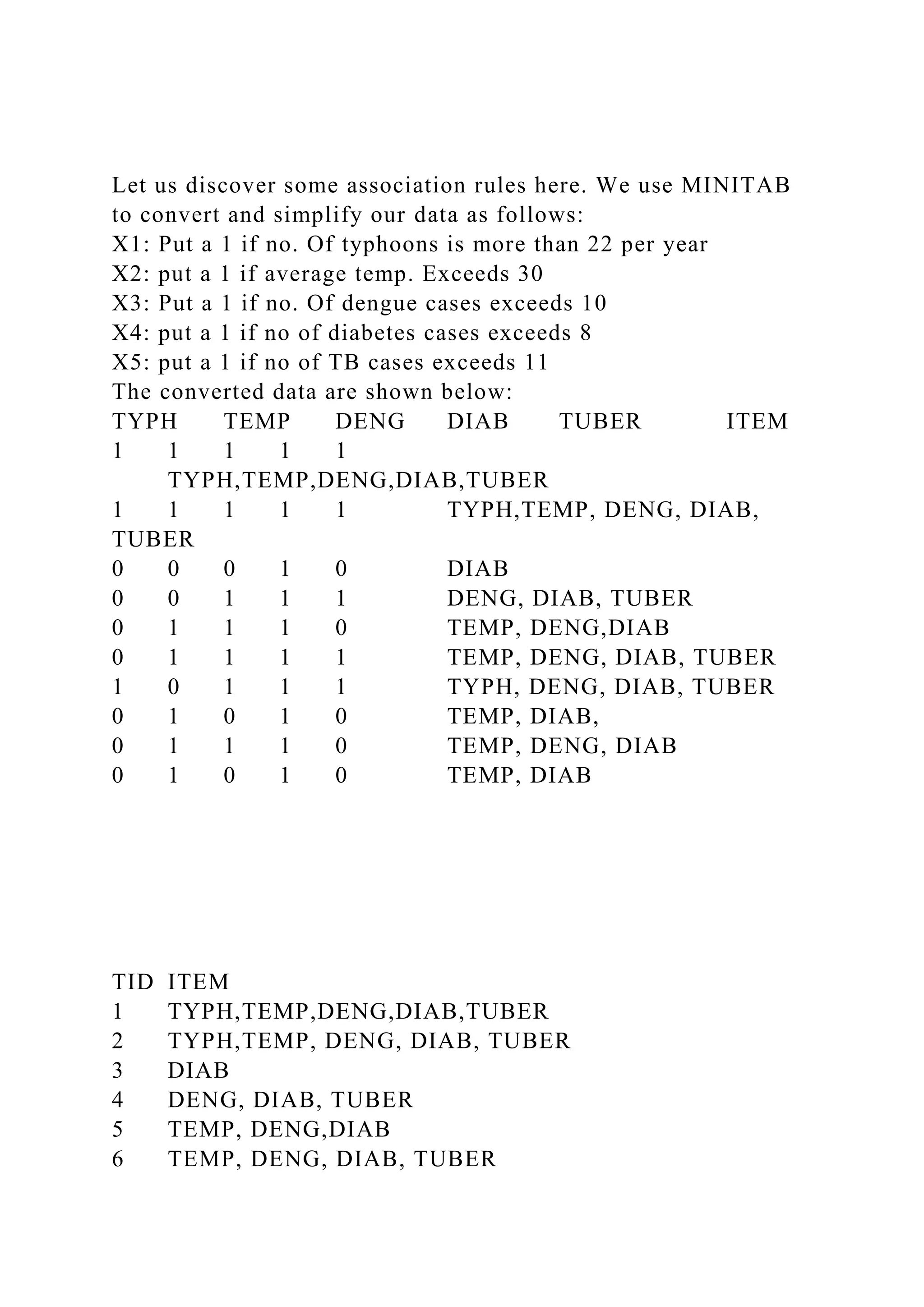

  • 33.
    LECTURE 7: INDUCTIVEMETHODS FOR THEORY DEVELOPMENTSometimes theories are created based on observations rather than on deduction from existing theories. These theories are referred to as Grounded Theories. Glaser (1992) and Strauss (1990) summarized the process of developing grounded theory as: (1) entering the field or proceeding with research without a hypothesis, (2) describing what one observes in the field, and (3) explaining why it happens on the basis of observation. These explanations become the theory, which is generated directly from observation It is often very difficult to establish causality in social science research. One reason is due to the limitations of existing theories, which may not be sufficient to identify the proper causes. Another reason is that the identified causes cannot be properly controlled. Further, since much of the data in social sciences are gathered via the survey and interview method, we often cannot tell the temporal sequence of the factors of interest. Hence, we cannot be certain of the cause(s) and effect(s) and may have to treat the relationship as symmetrical without implying causality. INDUCTIVE METHOD for theory development has the following key steps:1. Select a topic of interest in your field.2. Identify key factors and variables that may be discovered in reading through various studies on the topic.3. Gather data (either through the NET or survey) without any hypotheses in mind.4. Use one of the analytical data mining techniques to come up with a theory or theories.5. Formulate testable
  • 34.
    hypotheses. Association Rule Discovery:Definition Given a set of records each of which contain some number of items from a given collection; Produce dependency rules which will predict occurrence of an item based on occurrences of other items Rules Discovered: {Milk} --> {Coke} {Diaper, Milk} --> {Beer} TIDItems 1 Bread, Coke, Milk 2 Beer, Bread 3 Beer, Coke, Diaper, Milk 4 Beer, Bread, Diaper, Milk 5 Coke, Diaper, Milk Given a set of transactions, find rules that will predict the occurrence of an item based on the occurrences of other items in the transaction
  • 35.
    TIDItems 1 Bread, Milk 2 Bread, Diaper,Beer, Eggs 3 Milk, Diaper, Beer, Coke 4 Bread, Milk, Diaper, Beer 5 Bread, Milk, Diaper, Coke TIDItems 1 Bread, Milk 2 Bread, Diaper, Beer, Eggs 3 Milk, Diaper, Beer, Coke 4 Bread, Milk, Diaper, Beer 5 Bread, Milk, Diaper, Coke Association Rule Mining Task ItemCount
  • 36.
  • 37.
    {Beer,Diaper} 3 ItemsetCount {Bread,Milk,Diaper} 3 EXAMPLE: W elook at variables related to climate change and health concerns: X1: average typhoons entering Philippine area of responsibility X2: average annual temperature X3: incidence of dengue cases per thousand population X4: incidence of diabetes per thousand population X5: incidence of tuberculosis per thousand population Over the last twenty years. The data are shown below: typhoon avtemp dengue diabetes TB 26 33 15 13 12 25 34 14 12 13 15 29 6 11 5 13 30 14 14 12 8 34 12 10 11 11 32 14 12 13 25 26 17 14 12 9 35 8 11 7 18 31 14 11 5 15 32 10 13 8
  • 38.
    Let us discoversome association rules here. We use MINITAB to convert and simplify our data as follows: X1: Put a 1 if no. Of typhoons is more than 22 per year X2: put a 1 if average temp. Exceeds 30 X3: Put a 1 if no. Of dengue cases exceeds 10 X4: put a 1 if no of diabetes cases exceeds 8 X5: put a 1 if no of TB cases exceeds 11 The converted data are shown below: TYPH TEMP DENG DIAB TUBER ITEM 1 1 1 1 1 TYPH,TEMP,DENG,DIAB,TUBER 1 1 1 1 1 TYPH,TEMP, DENG, DIAB, TUBER 0 0 0 1 0 DIAB 0 0 1 1 1 DENG, DIAB, TUBER 0 1 1 1 0 TEMP, DENG,DIAB 0 1 1 1 1 TEMP, DENG, DIAB, TUBER 1 0 1 1 1 TYPH, DENG, DIAB, TUBER 0 1 0 1 0 TEMP, DIAB, 0 1 1 1 0 TEMP, DENG, DIAB 0 1 0 1 0 TEMP, DIAB TID ITEM 1 TYPH,TEMP,DENG,DIAB,TUBER 2 TYPH,TEMP, DENG, DIAB, TUBER 3 DIAB 4 DENG, DIAB, TUBER 5 TEMP, DENG,DIAB 6 TEMP, DENG, DIAB, TUBER
  • 39.
    7 TYPH, DENG,DIAB, TUBER 8 TEMP, DIAB, 9 TEMP, DENG, DIAB 10 TEMP, DIAB SET OUR MINIMUM SUPPORT AT : MINSUP = 6 (ONE MORE THAN HALF THE NUMBER OF cases) ITEM 1 SET SUPPORT TYPHOON 3 TEMPERATURE 7 DENGUE 7 DIABETES 10 TB 5 (eliminate TYPHOON AND TB) ITEM 2 SET SUPPORT TEMP, DENG 6 TEMP, DIAB 7 DENG, DIAB 7 (ALL TWO ITEM SET ARE ACCEPTED) ITEM 3 SET SUPPORT TEMP,DENG, DIAB 5 (ELIMINATE THREE ITEM SET) THEORIES: 1. DENGUE CASES INCREASE WITH OBSERVED RISE IN AVERAGE TEMPERATURE. 2. DIABETES CASES INCREASE WITH OBSERVED RISE IN AVERAGE TEMPERATURE 3. DIABETES AND DENGUE INCIDENCES ARE CO- EXISTENT HEALTH PROBLEMS.
  • 40.
    WORKSHOP II WORK ONYOUR DATA SETS AND USE ASSOCIATION ANALYSIS TO DEVELOP YOUR VARIOUS THEORIES. THEORY:“THE INTENSITY AND SPREAD OF VECTOR BORNE DISEASES VARY WITH THE INTENSITY OF CLIMATE CHANGE” DO WORKSHOP 7 ON NEXT SLIDE.OUTPUT PRESENTATION IS 11:00-12:00 WORKSHOP 7: DO AN ASSOCIATION ANALYSIS FOR THE FOLLOWING STRESS LEVEL DATA: 10:00-11:00 Day 4 age gender salary exercise diet parents’history stress level 52 1 37664 3 5 1 21.4888 31 1 23400 1 2 2 12.1500 29 0 4000 3 4 1 6.4177 27 1 39379 4 4 2 22.2606 60 0 7000 1 2 2 6.1745 52 0 11500 1 5 2 9.6898 45 0 39715 1 4 1 21.2718 28 1 14344 3 1 1 9.0148 42 0 7229 2 3 2 6.5931 39 1 14609 2 2 1 8.3541
  • 41.
    52 1 236781 2 1 12.6951 32 1 23758 3 2 0 13.3311 38 0 35271 4 4 1 21.1320 39 0 26000 3 2 0 14.9530 48 1 24805 2 2 0 13.6223 34 1 38579 3 3 2 20.5406 46 1 18000 5 5 0 18.1015 26 0 13864 1 2 1 7.7588 42 0 17119 4 4 1 12.5436 32 1 9516 2 5 1 7.9422 LECTURE 8:ANOMALY DETECTION VIA REGRESSION DIAGNOSTICSRegression analysis is concerned with determining a relationship between a dependent variable (y) and a set of independent variables x1,x2,x3,…,xp. It is a confirmatory (validation) statistical technique.However, as a by-product of regression analysis, software packages provide regression diagnostics. These diagnostics signal the presence of outliers in a given data set.These outliers (or anomalous observations) provide a hint for the development of theories. EXAMPLE:Mirasol (2009) conducted a study on the management of protected areas (MPA) in the Philippines. To this end, he defined the following variables:1. Mgt: refers to the extent to which an MPA had been properly managed (1=poor to 5 = excellent)2. Type: refers to the type of MPA (0 = marine, 1=terrestrial)3. NGO: refers to the existence of NGO support4. INC: refers to the income derived by communities in nearby non-MPA.
  • 42.
    DATA TYPE MGT NG0INC. 1 5 0 4 1 4 0 4 1 5 0 5 1 4 0 3 1 3 0 3 1 4 0 5 1 5 1 5 1 4 1 4 1 3 0 4 1 3 1 3 0 2 0 2 0 2 0 2 0 3 1 5 0 4 1 5 0 2 0 2 0 1 0 2 0 5 1 1 0 2 0 1 0 2 0 2 0 1 0 2 REGRESSION:We looked at the income (y) in relation to the other variables as independent variables. The regression equation is INC. = 1.57 + 1.16 TYPE + 0.272 MGT + 0.594 NG0 Predictor Coef SE Coef T P
  • 43.
    Constant 1.5690 0.70912.21 0.042 TYPE 1.1648 0.5792 2.01 0.046 MGT 0.2720 0.1185 2.29 0.020 NG0 0.5939 0.6358 0.93 0.364 The anomalous observations are: Both unusual observations are marine protected areas. A typical MPA should have poor income but observation 13 has a high income. Further perusal of observation 13 revealed that it had good management (3) and is supported by an NGO(1). This MPA is in Baliangao, Misamis Occidental.Observation 17 became unusual despite its low income because it had excellent management (5) and supported by an NGO(1).Observation 17 is an MPA off the coastal area of Sulu. Unusual Observations Obs TYPE INC. Fit SE Fit Residual St Resid 13 0.00 5.000 2.979 0.522 2.021 2.05R 17 0.00 1.000 3.523 0.734 -2.523 -3.01R The proposition:” Terrestrial protected areas are better managed and consequently more economically viable than marine protected areas” is modified when the unusual observations are analyzed.The modification may be stated thus:” Marine protected areas in relatively peaceful location which are well- managed and with sufficient external NGO support can perform
  • 44.
    as well asterrestrial protected areas economically.” WORKSHOPThe following is an actual dissertation data that attempted to determine the worth of accreditation as a means to improve quality of a higher education program. Data from 25 higher education institutions were obtained on: accrediting agency, level of accreditation of teacher education program, and performance in LET as surrogate to the term “quality”. The data are provided on the next slide.Perform a regression analysis on level of accreditation vs. Quality.Note the unusual observations and correspondingly revise your theory.Note: 3 = PAASCU, 2 = PACU-COA, 1 = AACCUP agency level LET 1 2 78 1 2 77 1 2 78 1 1 64 1 3 81 1 3 82 2 3 66 2 4 65 2 3 78 2 2 65
  • 45.
    2 3 76 22 80 2 3 80 3 4 90 3 3 88 3 2 78 3 1 73 3 3 89 3 2 80 3 3 89 3 4 91 3 3 90 3 4 92 3 2 78 3 2 79 LECTURE 3: CLUSTER ANALYSISPurpose: Cluster Analysis is a multivariate exploratory data analysis method which aims to group individuals according to their similarities on certain measurable factors and variables. Use: 1. The main use of cluster analysis is to generate tentative generalizations and theories based on the groupings of individuals i.e. why a subset of individuals is grouped together and how this subset of individuals differ from other subsets of individuals. It is very useful in policy formulation; 2. It is also used in Biological Sciences for species identification i.e. whenever a new organism is discovered, it may be useful to identify where it belongs in terms of family, genus or species. *
  • 46.
    PRACTICAL SITUATIONSWe dealwith clustering in almost every aspect of daily life. For example, a group of diners sharing the same table in a restaurant may be regarded as a cluster of people. In food stores items of similar nature, such as different types of meat or vegetables are displayed in the same or nearby locations. There is a countless number of examples in which clustering plays an important role. For instance, biologists have to organize the different species of animals before a meaningful description of the differences between animals is possible. According to the modern system employed in biology, man belongs to the primates, the mammals, the amniotes, the vertebrates, and the animals. Note how in this classification, the higher the level of aggregation the less similar are the members in the respective class. Man has more in common with all other primates (e.g., apes) than it does with the more "distant" members of the mammals (e.g., dogs), etc. DATA REQUIREMENTS FOR CLUSTER ANALYSISIn cluster analysis, we will need to measure a set of characteristics (variables or factors) per individual. Denote the characteristics as : x1, x2, …, xp. . For example:X1 = incomeX2 = nutritional statusX3 = level of sanitation of homeX4 = availability of water For each individual, we measure four (4) characteristics. The Concept of “Distance” Between IndividualsThe concept of “distance” between individuals is crucial in cluster analysis. We will need to know how similar or dissimilar a certain individual A is from an individual B. The distance d(A,B) is a measure of how far individual A is from individual B i.e. if d(A,B) = 0,
  • 47.
    then A andB are essentially the same individual with respect to the measured characteristics. A BLAST FROM THE PAST!!!! The Geometry Nightmare RevisitedLet us say that for two individuals A and B the characteristic measured is: x1 = body odor with 0 = no odor, and 5 = very odorous. For individual A , x 1 = 0 while for individual B, x 1 = 5, Then it is natural to estimate the “odorous distance” between A and B by:d(A,B) = /0 – 5/ = /-5/ = 5,i.e. the two individuals are very “far” from each other with respect to body odor!!! Two CharacteristicsNow, let us measure two characteristics per individual: x 1 = body odor, and X2 = color of skin, where color of skin is 1 = light color, to 5 = very dark color. Thus,A = (0, 5) and B = (5, 1) means that A has no body odor (x1 =0) and has a very dark skin color (x 2 = 5) while B has very strong body odor (x 1 = 5) and has a very light skin color (x2 = 1). Then, from geometry: d(A,B) = [(0-5)2 + (5-1)2]1/2 = (41)1/2 = 6.41. Individuals C = (2,2) and D = (2, 3) would have: d(C,D) = [(2-2)2 + (2-3)2]1/2 = (0 +1)1/2 = 1. So, C and D are more similar to each other than are A and B. CLUSTERING ALGORITHMk-Means Clustering General logic Suppose that you already have hypotheses concerning the number of clusters in your cases or variables. You may want to "tell" the computer to form exactly 3 clusters that are to be as distinct as possible. This is the type of research question that can be addressed by the k- means clustering algorithm. In
  • 48.
    general, the k-meansmethod will produce exactly k different clusters of greatest possible distinction. It should be mentioned that the best number of clusters k leading to the greatest separation (distance) is not known as a priori and must be computed from the data. (Good research for the theoretical mathematician) A WORKED EXAMPLEWe are looking at “QUALITY OF EDUCATION” and we are getting data from 15 universities in the Philippines. We decided to look into:X1 = performance in licensure examsX2 = average tuition rate per unitX3 = enrollment sizeX4 = Percentage of Ph.D.’s in facultyX5 = acceptance/rejection rate per hundredThe data are shown on the next page. THE DATA SETExam Tuition Enrolment Ph.D. rejection87 700 6000 60 0.8085 620 5500 50 0.7583 600 5000 45 0.7782 600 5400 48 0.7483 610 6250 50 0.8078 450 8000 36 0.6577 400 7600 32 0.5476 410 7700 37 0.4578 460 8900 32 0.5080 500 9000 30 0.4872 200 8000 8 0.2075 250 9000 10 0.1070 300 9000 7 0.1567 260 11000 10 0.1568 200 10000 5 0.05 STEPS GO TO “STAT” GO TO “MULTIVARIATE”
  • 49.
    GO TO “CLUSTEROBSERVATIONS” CLICK ALL THE VARIABLES CLICK “SHOW DENDROGRAM” Input “number of clusters = 3” Click “OK” THE DENDROGRAM 27.txt ��������Cluo 'Exam'- 'rejection';����������������������������� ����������������������������������� ����������������������������������� ������������������/������}.��Cluo 'Exam'- 'rejection';����������������������������� ����������������������������������� ����������������������������������� �����;; HMF V1.24 TEXT ;; (Microsoft Win32 Intel 386) HOOPS 5.00-17 I.M. 3.00-17 (Selectability "windows=off,geometry=on") (Visibility "on") (Color_By_Index "Geometry,Face Contrast" 1) (Color_By_Index "Window" 0) (Window_Frame "off") (Window -1 1 -1 1) (Camera (0 0 -5) (0 0 0) (0 1 0) 2 2 "Stretched") ;; (Driver_Options "no backing storeno borderno control areano debug,disable in ;; put,no double-bufferingno double bufferingno fixed colors,no force black-and ;; -whiteno force black and whiteno gamma correctionlight scaling=0,no locater ;; transform,no pen speed,no physical size,no subscreen
  • 50.
    creatingno subscreen mo ;;vingno subscreen resizingsubscreen stretchingno output format,no use colorma ;; p id") (Edge_Pattern "---") (Edge_Weight 1) (Face_Pattern "solid") (Heuristics "no related selection limit") (Line_Pattern "---") (Line_Weight 1) (Marker_Size 0.421875) (Marker_Symbol ".") (Text_Font "name=arial-gdi-vector,no transforms,rotation=follow path") (User_Options "mtb aspect ratio=0.675953,graphicsversion=6,worksheettitle="Wor ksheet 1",optiplot=0,builtin=0,statguideid=0,toplayer=0,angle=0,arro wdir=0,arr owstyle=0,polygon=0,isdata=0,textfollowpath=1,ldfill=0,solidfi ll=0,3d=0,usebitm ap=0,canbrush=0,brushrows=0,light scaling=0.00000,sessionline=58") (Segment "include" ()) (Front ((Segment "figure1" ( (Window_Pattern "clear") (Window -1 1 -1 1) (User_Options "viewinfigurecoord=0") (Front ((Segment "region" ( (Front ((Segment "figure box" ( (Visibility "polygons=off,lines=off") (Color_By_Index "Face" 0) (Color_By_Index "Face Contrast,Line,Edge" 1) (Edge_Pattern "---") (Edge_Weight 1) (Face_Pattern "solid")
  • 51.
    (Line_Pattern "---") (Line_Weight 1) (User_Options"solidfill=1") (Segment "" ( (Polygon ((-0.99995 -0.99995 0) (0.99995 -0.99995 0) (0.99995 0.99995 0) (-0.99995 0.99995 0) (-0.99995 -0.99995 0))))))) (Segment "data box" ( (Visibility "faces=off") (Color_By_Index "Face" 0) (Color_By_Index "Face Contrast,Line,Edge" 1) (Edge_Pattern "---") (Edge_Weight 1) (Face_Pattern "solid") (Line_Pattern "---") (Line_Weight 1) (User_Options "solidfill=1") (Segment "" ( (Polygon ((-0.749962 -0.59997 0) (0.899955 -0.59997 0) (0.899955 0.59997 0) (-0.749962 0.59997 0) (-0.749962 - 0.59997 0))))))) (Segment "legend box" ()) (Segment "legend" ( (Window_Pattern "clear") (Window -1 1 -1 1) (User_Options "viewinfigurecoord=1"))))))) (Segment "object" ( (Front ((Segment "frame" ( (Window_Pattern "clear") (Window -1 1 -1 1) (Front ((Segment "tick" ( (Front ((Segment "set1" ( (Color_By_Index "Face Contrast,Line,Text,Edge" 1)
  • 52.
    (Edge_Pattern "---") (Edge_Weight 1) (Line_Pattern"---") (Line_Weight 1) (Text_Alignment "^*") (Text_Font "name=arial-gdi-vector,size=0.03385 sru") (Segment "" ( (Text 0.734963 -0.669966 0 "15"))) (Segment "" ( (Text 0.624969 -0.669966 0 "13"))) (Segment "" ( (Text 0.514974 -0.669966 0 "12"))) (Segment "" ( (Text 0.40498 -0.669966 0 "10"))) (Segment "" ( (Text 0.294985 -0.669966 0 "9"))) (Segment "" ( (Text 0.184991 -0.669966 0 "8"))) (Segment "" ( (Text 0.0749962 -0.669966 0 "7"))) (Segment "" ( (Text -0.0349982 -0.669966 0 "11"))) (Segment "" ( (Text -0.144993 -0.669966 0 "6"))) (Segment "major" ( (Segment "" ( (Polyline ((0.734963 -0.59997 0) (0.734963 - 0.639968 0) )))) (Segment "" ( (Polyline ((0.624969 -0.59997 0) (0.624969 - 0.639968 0) )))) (Segment "" ( (Polyline ((0.514974 -0.59997 0) (0.514974 -
  • 53.
    0.639968 0) )))) (Segment ""( (Polyline ((0.40498 -0.59997 0) (0.40498 - 0.639968 0))) )) (Segment "" ( (Polyline ((0.294985 -0.59997 0) (0.294985 - 0.639968 0) )))) (Segment "" ( (Polyline ((0.184991 -0.59997 0) (0.184991 - 0.639968 0) )))) (Segment "" ( (Polyline ((0.0749962 -0.59997 0) (0.0749962 - 0.639968 0))))) (Segment "" ( (Polyline ((-0.0349982 -0.59997 0) (-0.0349982 -0.639968 0))))) (Segment "" ( (Polyline ((-0.144993 -0.59997 0) (-0.144993 - 0.639968 0))))))))) (Segment "set2" ( (Color_By_Index "Face Contrast,Line,Text,Edge" 1) (Edge_Pattern "---") (Edge_Weight 1) (Line_Pattern "---") (Line_Weight 1) (Text_Alignment "^*") (Text_Font "name=arial-gdi-vector,size=0.03385 sru") (Segment "" (
  • 54.
    (Text 0.844958 -0.6699660 "14"))) (Segment "major" ( (Segment "" ( (Polyline ((0.844958 -0.59997 0) (0.844958 - 0.639968 0) )))))))) (Segment "set3" ( (Color_By_Index "Face Contrast,Line,Text,Edge" 1) (Edge_Pattern "---") (Edge_Weight 1) (Line_Pattern "---") (Line_Weight 1) (Text_Alignment "^*") (Text_Font "name=arial-gdi-vector,size=0.03385 sru") (Segment "" ( (Text -0.254987 -0.669966 0 "3"))) (Segment "" ( (Text -0.364982 -0.669966 0 "4"))) (Segment "" ( (Text -0.474976 -0.669966 0 "2"))) (Segment "" ( (Text -0.584971 -0.669966 0 "5"))) (Segment "" ( (Text -0.694965 -0.669966 0 "1"))) (Segment "major" ( (Segment "" ( (Polyline ((-0.254987 -0.59997 0) (-0.254987 - 0.639968 0))))) (Segment "" ( (Polyline ((-0.364982 -0.59997 0) (-0.364982 - 0.639968 0))))) (Segment "" (
  • 55.
    (Polyline ((-0.474976 -0.599970) (-0.474976 - 0.639968 0))))) (Segment "" ( (Polyline ((-0.584971 -0.59997 0) (-0.584971 - 0.639968 0))))) (Segment "" ( (Polyline ((-0.694965 -0.59997 0) (-0.694965 - 0.639968 0))))))))) (Segment "set4" ( (Color_By_Index "Face Contrast,Line,Text,Edge" 1) (Edge_Pattern "---") (Edge_Weight 1) (Line_Pattern "---") (Line_Weight 1) (Text_Alignment "*>") (Text_Font "name=arial-gdi-vector,size=0.03385 sru") (Segment "" ( (Text -0.819959 0.54283 0 " 77.26"))) (Segment "" ( (Text -0.819959 0.165706 0 " 84.84"))) (Segment "" ( (Text -0.819959 -0.222846 0 " 92.42"))) (Segment "" ( (Text -0.819959 -0.59997 0 " 100.00"))) (Segment "major" ( (Segment "" ( (Polyline ((-0.749962 0.54283 0) (-0.78996 0.54283 0))) )) (Segment "" ( (Polyline ((-0.749962 0.165706 0) (-0.78996
  • 56.
    0.165706 0) )))) (Segment ""( (Polyline ((-0.749962 -0.222846 0) (-0.78996 - 0.222846 0))))) (Segment "" ( (Polyline ((-0.749962 -0.59997 0) (-0.78996 - 0.59997 0) )))))))))))) (Segment "grid" ()) (Segment "reference" ()) (Segment "axis" ( (Front ((Segment "dend1" ( (Color_By_Index "Text" 1) (Text_Alignment "*<") (Text_Font "name=arial-gdi-vector,size=0.04232 sru") (Segment "" ( (Text -0.979951 0.699965 0 "Similarity"))) (Segment "" ( (Text -0.0905559 -0.79996 0 "Observations"))))))))))))) (Segment "data" ( (Window_Pattern "clear") (Window -1 1 -1 1) (User_Options "isdata=1,viewinfigurecoord=1") (Front ((Segment "dend1" ( (Color_By_Index "Face Contrast,Line,Edge" 1) (Edge_Pattern "---") (Edge_Weight 1) (Line_Pattern "---") (Line_Weight 1) (Segment "" ( (Polyline ((0.734963 0.237484 0) (0.734963 - 0.59997 0)))))
  • 57.
    (Segment "" ( (Polyline((0.239988 0.237484 0) (0.239988 0.152824 0))))) (Segment "" ( (Polyline ((0.239988 0.237484 0) (0.734963 0.237484 0))))) (Segment "" ( (Polyline ((0.459977 0.152824 0) (0.459977 - 0.440642 0))))) (Segment "" ( (Polyline ((0.019999 0.152824 0) (0.019999 - 0.346829 0))))) (Segment "" ( (Polyline ((0.019999 0.152824 0) (0.459977 0.152824 0))))) (Segment "" ( (Polyline ((0.129994 -0.346829 0) (0.129994 - 0.515807 0))))) (Segment "" ( (Polyline ((-0.0899955 -0.346829 0) (-0.0899955 - 0.389508 0)) ))) (Segment "" ( (Polyline ((-0.0899955 -0.346829 0) (0.129994 - 0.346829 0)))) ) (Segment "" ( (Polyline ((-0.0349982 -0.389508 0) (-0.0349982 - 0.59997 0))) )) (Segment "" ( (Polyline ((-0.144993 -0.389508 0) (-0.144993 - 0.59997 0))))) (Segment "" ( (Polyline ((-0.144993 -0.389508 0) (-0.0349982 -
  • 58.
    0.389508 0))) )) (Segment ""( (Polyline ((0.569971 -0.440642 0) (0.569971 - 0.557868 0))))) (Segment "" ( (Polyline ((0.349982 -0.440642 0) (0.349982 - 0.509858 0))))) (Segment "" ( (Polyline ((0.349982 -0.440642 0) (0.569971 - 0.440642 0))))) (Segment "" ( (Polyline ((0.40498 -0.509858 0) (0.40498 -0.59997 0))))) (Segment "" ( (Polyline ((0.294985 -0.509858 0) (0.294985 - 0.59997 0))))) (Segment "" ( (Polyline ((0.294985 -0.509858 0) (0.40498 - 0.509858 0))))) (Segment "" ( (Polyline ((0.184991 -0.515807 0) (0.184991 - 0.59997 0))))) (Segment "" ( (Polyline ((0.0749962 -0.515807 0) (0.0749962 - 0.59997 0))))) (Segment "" ( (Polyline ((0.0749962 -0.515807 0) (0.184991 - 0.515807 0))))) (Segment "" ( (Polyline ((0.624969 -0.557868 0) (0.624969 - 0.59997 0))))) (Segment "" ( (Polyline ((0.514974 -0.557868 0) (0.514974 -
  • 59.
    0.59997 0))))) (Segment ""( (Polyline ((0.514974 -0.557868 0) (0.624969 - 0.557868 0)))))) ) (Segment "dend2" ( (Color_By_Index "Face Contrast,Line,Edge" 1) (Edge_Pattern "---") (Edge_Weight 1) (Line_Pattern "---") (Line_Weight 1) (Segment "" ( (Polyline ((0.844958 0.237923 0) (0.844958 - 0.59997 0))))) (Segment "" ( (Polyline ((0.844958 0.237923 0) (0.844958 - 0.59997 0))))) (Segment "" ( (Polyline ((0.844958 0.237923 0) (0.844958 0.237923 0))))))) (Segment "dend3" ( (Color_By_Index "Face Contrast,Line,Edge" 1) (Edge_Pattern "---") (Edge_Weight 1) (Line_Pattern "---") (Line_Weight 1) (Segment "" ( (Polyline ((-0.337483 -0.176376 0) (-0.337483 - 0.265408 0)))) ) (Segment "" ( (Polyline ((-0.639968 -0.176376 0) (-0.639968 - 0.377556 0)))) ) (Segment "" ( (Polyline ((-0.639968 -0.176376 0) (-0.337483 -
  • 60.
    0.176376 0)))) ) (Segment ""( (Polyline ((-0.254987 -0.265408 0) (-0.254987 - 0.59997 0))))) (Segment "" ( (Polyline ((-0.419979 -0.265408 0) (-0.419979 - 0.514622 0)))) ) (Segment "" ( (Polyline ((-0.419979 -0.265408 0) (-0.254987 - 0.265408 0)))) ) (Segment "" ( (Polyline ((-0.584971 -0.377556 0) (-0.584971 - 0.59997 0))))) (Segment "" ( (Polyline ((-0.694965 -0.377556 0) (-0.694965 - 0.59997 0))))) (Segment "" ( (Polyline ((-0.694965 -0.377556 0) (-0.584971 - 0.377556 0)))) ) (Segment "" ( (Polyline ((-0.364982 -0.514622 0) (-0.364982 - 0.59997 0))))) (Segment "" ( (Polyline ((-0.474976 -0.514622 0) (-0.474976 - 0.59997 0))))) (Segment "" ( (Polyline ((-0.474976 -0.514622 0) (-0.364982 -
  • 61.
    0.514622 0)))) ))) (Segment "dend4"( (Color_By_Index "Face Contrast,Line,Edge" 1) (Edge_Pattern "---") (Edge_Weight 1) (Line_Pattern "---") (Line_Weight 1) (Segment "" ( (Polyline ((0.666217 0.54283 0) (0.666217 0.237923 0))))) (Segment "" ( (Polyline ((-0.488726 0.54283 0) (-0.488726 - 0.176376 0))))) (Segment "" ( (Polyline ((-0.488726 0.54283 0) (0.666217 0.54283 0))))) (Segment "" ( (Polyline ((0.487476 0.237923 0) (0.487476 0.237484 0))))) (Segment "" ( (Polyline ((0.487476 0.237923 0) (0.844958 0.237923 0)))))))) ))))))) (Segment "labels" ( (Window_Pattern "clear") (Window -1 1 -1 1))) (Segment "annotation" ( (Window_Pattern "clear") (Window -1 1 -1 1))))))) (Segment "annotation" ( (Window_Pattern "clear") (Window -1 1 -1 1) (User_Options "toplayer=1")))))
  • 62.
    OUTPUT 1Final Partition Numberof clusters: 3 Number of Within cluster Average distance Maximum distance observations sum of squares from centroid from centroid Cluster1 5 995263.203 397.972 630.562 Cluster2 9 5165381.279 680.087 1430.462 Cluster3 1 0.000 0.000 0.000 OUTPUT 2Cluster Centroids Variable Cluster1 Cluster2 Cluster3 Grand centrdExam 84.0000 74.8889 67.0000 77.4000Tuition 626.0000 352.2222 260.0000 437.3333Enrolment 5630.0000 8577.7778 11000.00 7756.6667Ph.D. 50.6000 21.8889 10.0000 30.6667rejection 0.7720 0.3467 0.1500 0.4753 Distances Between Cluster Centroids Cluster1 Cluster2 Cluster3 Cluster1 0.0000 2960.6174 5382.6382Cluster2 2960.6174 0.0000 2424.0192Cluster3 5382.6382 2424.0192 0.0000 HYPOTHESES AND PROPOSITIONS1. Institutions with a good number of faculty with advanced degrees have better quality of education.2. Institutions with higher tuition also have lower enrollment.3. Institutions with lower enrollment have
  • 63.
    lower student tofaculty ratio and turn out to have better quality also. workshopPART A1. Add one more proposition or hypothesis in the last slide of this lecture. Produce a working theory for the entire exercise.2. Perform a regression analysis for all the hypothesized relationships between quality and the other factors or variables, singly and in combination.3. If there are any anomalous observations, reformulate the theory that you have made in Problem 1. WorkshopPART B. Human Development Index (HDI) is a composite index measuring average achievement in three basic dimensions of human development: a long and healthy life, knowledge, and decent standard of living. In 2003, a survey was conducted to determine the HDI of several countries (Fukuda- Parr, 2003). In this survey, the Philippines was ranked 85th out of 175 countries in the world. Data for fifteen (15) selected countries are shown on the next page. Perform a cluster analysis on this data set and formulate tentative theories about Human Development Indices of countries worldwide. HUMAN DEVELOPMENT INDEX DATA (Fukuda-Parr,2003, Milenium Development Goals)Country HDIMALNUTRITIONLITERACYPOVERTYPOLITICAL1. Norway 0.9940.010.990.020.992. Japan 0.9330.010.940.040.943. Germany 0.9210.030.960.050.924. Singapore 0.8840.040.870.030.955. Brunei 0.8720.070.890.020.996. Malaysia 0.790.080.830.060.927.
  • 64.
    Thailand 0.7680.080.880.050.888. Philippines 0.7510.000.90.10.849.Vietnam 0.6880.080.830.110.8810. Indonesia 0.6820.090.800.110.8511. Cambodia 0.5560.120.640.150.8412. Myanmar 0.5490.200.720.220.813. Sierra Leone 0.2750.250.410.250.7714. USA 0.940.010.970.040.9815. Ethiopia 0.330.210.450.210.80 C. Read the paper on the Normal Distribution. Provide an in- depth critique of the arguments used in the paper. Take careful note of the following:1. Is the present use of the normal
  • 65.
    distribution in educationjustified on the basis of the historical background provided by the paper?2. What is the main “thesis” of the paper? Is the author’s argument convincing and free of contradictions?3. If you were to rewrite the paper, how would you modify the author’s work? Concepts Concepts, the building blocks of theories, are symbols designed to convey a specific meaning to the community of scholars. They must be defined, operationalized, and reviewed by the community of scholars for meaning and accuracy. The concept self-esteem, for example, is defined as, "an individual's sense of his or her value or worth," and most often is measured using Rosenberg's Self Esteem Scale , which is widely accepted by the community of scholars. 1. Concepts are defined with either primitive or derived terms. Primitive terms cannot be defined with other symbols or language (e.g., colors, sounds, attitudes, some relationships between individuals ), but can only be further described through the use of examples. A derived term is a set of primitive words and symbols that further describes a concept. 2. An abstract concept refers to two or more events (e.g., temperature, human capital investment). A concrete concept refers to a specific event (e.g., temperature of the sun, years of formal education). 3. Concepts can be measured either quantitatively or qualitatively. There is no epistemological reason to suspect that either type of measurement is more or less
  • 66.
    scientific, objective, orvalid. 4. Concepts can be measured at the nominal level, indicating no inherent ranking (e.g., male, female; Christian, Hindu, Muslim, Jewish), the ordinal level, indicating ranking without a continuous ordering (e.g., large, m edium, small), the interval level, indicating ranking with a continuous ordering, with no known zero -state (e.g, attitudes about same-sex marriage expressed on a 1 -7 response scale), or the ratio level, indicating continuous ordered ranking with a known ze ro point (e.g., age in years). 1. Associational statements state a relationship without implying cause. For example, we might state that, "locus -of-control and self-esteem (two concepts with similar meanings) are related," meaning they will vary together but not necessarily cause one another. 2. Causal statements imply that x causes y (e.g., the greater the formal education, the greater the income). 3. Theoretical propositions state relationships in an abstract form (e.g., the greater the human capital investment, the greater the life chances). 4. Hypotheses state relationships in a concrete form (e.g, the greater the formal education, the greater the income). Forms of Theory Theories can be expressed as a set of laws, in axiomatic form, or as a set of causal
  • 67.
    statements. 1. The set-of-lawsformat expresses relationships as a set of highly supported laws (i.e., typically in causal form). Consider, for example, the Theory of Reasoned Action , proposed by Martin Fishbein and Izak Ajzen. Within this theory we might state as one law, "the greater the attitude about the behavior, the greater the intention to engage in the behavior." All the other paths implied by the diagram would be listed as laws within the set of laws that define the theory of reasoned action. 2. The axiomatic format expresses relationships as a set of axioms. For example, within the theory of reasoned ac tion, we might state as one axiom, "If attitude toward the behavior, then intention toward the behavior." All the other paths implied by the diagram would be listed as axioms within this format. 3. The diagram shown for the theory of reasoned action represen ts the causal statement form. Each diagrammed path represents a theoretical proposition. For example, we might infer from the diagram of the Theory of Reasoned Action that, "the greater the attitude about the behavior, the greater the intention to engage in the behavior." Note Regarding the Format of Theory The typical format used in sociology to express a theory is the set of causal statements, often shown in a concise manner by the use of a diagram. In the 1980's, as part of an effort to make sociology "more scientific," sociologists began to
  • 68.
    present their theoriesin axiomatic format (see volumes of The American Sociological Review for examples of this effort). Sociologists learned quickly that th e formatting of a theory provided few advantages toward accumulating a scientific body of knowledge; what mattered was the quality of the theory, not its formatting. Note, however, that some sociologists will argue that "theory" should be expressed either as a set of laws or in axiomatic format (see: Formal Theory in Sociology: Opportunity or Pitfall? , edited by Jerald Hage). Truth of Statements, Validity of Reasoning Peter Suber, Philosophy Department, Earlham College True Premises, False Conclusion 0. Valid Impossible: no valid argument can have true premises and a false conclusion. 1. Invalid Cats are mammals. Dogs are mammals. Therefore, dogs are cats. True Premises, True Conclusion 2. Valid Cats are mammals. Tigers are cats. Therefore, tigers are mammals. 3. Invalid Cats are mammals. Tigers are mammals. Therefore, tigers are cats. False Premises, False Conclusion 4. Valid Dogs are cats. Cats are birds.
  • 69.
    Therefore, dogs arebirds. 5. Invalid Cats are birds. Dogs are birds. Therefore, dogs are cats. False Premises, True Conclusion 6. Valid Cats are birds. Birds are mammals. Therefore, cats are mammals. 7. Invalid Cats are birds. Tigers are birds. Therefore, tigers are cats. The distinction between truth and validity is the fundamental distinction of formal logic. You cannot understand how logicians see things until this distinction is clear and familiar. Simple statements p "p is true" assertion ~p "p is false" negation Compounds and connectives p q "either p is true, or q is true, or both" disjunction p · q "both p and q are true" conjunction p q "if p is true, then q is true" implication p q "p and q are either both true or both fal se" equivalence Implication statements (p q) are sometimes called conditionals, and equivalence statements (p q) are sometimes called biconditionals. A truth table is a complete list of the possible truth values of a statement. We use "T" to mean "true", and "F" to mean "false" (though it may be clearer and quicker to use "1" and "0" respectively). For example, p is either true or false . So its truth table has just 2 rows:
  • 70.
    p T F But the compound,p q, has 2 components, each of which can be true or false. So there are 4 possible combinations of truth values. The disjunction of p with q will be true as a compound whenever p is true, or q is true, or both: p q p q T T T T F T F T T F F F If a compound has n distinct simple components, then it will have 2 n rows in its truth table. The truth table columns that define the basic connectives are as follows: p q ~p ~q p q p · q p q p q T T F F T T T T T F F T T F F F F T T F T F T F F F T T F F T T Most statements will have some combination of T's and F's in their truth table columns; they are called contingencies. Some statements will have nothing but T's; they are call ed tautologies. Others will have nothing but F's; they are called contradictions. Obviously these three types of propositions exhaust the possibilities for statements that have truth table columns --which means for all truth-functional statements. DEDUCTIVE SYSTEMS
  • 71.
    DEFINITIONS AXIOMS AND ASSUMPTIONS LEMMAAND LOGICAL RELATIONS DERIVED THEORIES COROLLARIES AND CONSEQUENCES TIDItems 1Bread, Coke, Milk 2Beer, Bread 3Beer, Coke, Diaper, Milk 4Beer, Bread, Diaper, Milk 5Coke, Diaper, Milk TID Items 1 Bread, Milk 2 Bread, Diaper, Beer, Eggs 3 Milk, Diaper, Beer, Coke 4 Bread, Milk, Diaper, Beer 5 Bread, Milk, Diaper, Coke TID Items 1 Bread, Milk 2 Bread, Diaper, Beer, Eggs 3 Milk, Diaper, Beer, Coke 4 Bread, Milk, Diaper, Beer 5 Bread, Milk, Diaper, Coke ItemCount Bread4 Coke2
  • 72.
    Milk4 Beer3 Diaper4 Eggs1 Itemset Count {Bread,Milk} 3 {Bread,Beer}2 {Bread,Diaper} 3 {Milk,Beer} 2 {Milk,Diaper} 3 {Beer,Diaper} 3 Itemset Count {Bread,Milk,Diaper} 3 EXAMPLE: W e look at variables related to climate change and health concerns: X1: average typhoons entering Philippine area of responsibility X2: average annual temperature X3: incidence of dengue cases per thousand population X4: incidence of diabetes per thousand population X5: incidence of tuberculosis per thousand populatio n Over the last twenty years. The data are shown below: typhoon avtemp dengue diabetes TB 26 33 15 13 12 25 34 14 12 13 15 29 6 11 5 13 30 14 14 12 8 34 12 10 11 11 32 14 12 13 25 26 17 14 12 9 35 8 11 7 18 31 14 11 5 15 32 10 13 8 Let us discover some association rules here. We use MINITAB to convert and simplify our data as follows:
  • 73.
    X1: Put a1 if no. Of typhoons is more than 22 per year X2: put a 1 if average temp. Exceeds 30 X3: Put a 1 if no. Of dengue cases exceeds 10 X4: put a 1 if no of diabetes cases exceeds 8 X5: put a 1 if no of TB cases exceeds 11 The converted data are shown below: TYPH TEMP DENG DIAB TUBER ITEM 1 1 1 1 1 TYPH,TEMP,DENG,DIAB,TUBER 1 1 1 1 1 TYPH,TEMP, DENG, DIAB, TUBER 0 0 0 1 0 DIAB 0 0 1 1 1 DENG, DIAB, TUBER 0 1 1 1 0 TEMP, DENG,DIAB 0 1 1 1 1 TEMP, DENG, DIAB, TUBER 1 0 1 1 1 TYPH, DENG, DIAB, TUBER 0 1 0 1 0 TEMP, DIAB, 0 1 1 1 0 TEMP, DENG, DIAB 0 1 0 1 0 TEMP, DIAB TID ITEM 1 TYPH,TEMP,DENG,DIAB,TUBER 2 TYPH,TEMP, DENG, DIAB, TUBER 3 DIAB 4 DENG, DIAB, TUBER 5 TEMP, DENG,DIAB 6 TEMP, DENG, DIAB, TUBER 7 TYPH, DENG, DIAB, TUBER 8 TEMP, DIAB, 9 TEMP, DENG, DIAB 10 TEMP, DIAB SET OUR MINIMUM SUPPORT AT : M INSUP = 6 (ONE MORE THAN HALF THE NUMBER OF cases) ITEM 1 SET SUPPORT TYPHOON 3 TEMPERATURE 7 DENGUE 7
  • 74.
    DIABETES 10 TB 5(eliminate TYPHOON AND TB) ITEM 2 SET SUPPORT TEMP, DENG 6 TEMP, DIAB 7 DENG, DIAB 7 (ALL TWO ITEM SET ARE ACCEPTED) ITEM 3 SET SUPPORT TEMP,DENG, DIAB 5 (ELIMINATE THREE ITEM SET) age gender salary exercise diet parents’history stress level 52 1 37664 3 5 1 21.4888 31 1 23400 1 2 2 12.1500 29 0 4000 3 4 1 6.4177 27 1 39379 4 4 2 22.2606 60 0 7000 1 2 2 6.1745 52 0 11500 1 5 2 9.6898 45 0 39715 1 4 1 21.2718 28 1 14344 3 1 1 9.0148 42 0 7229 2 3 2 6.5931 39 1 14609 2 2 1 8.3541 52 1 23678 1 2 1 12.6951 32 1 23758 3 2 0 13.3311 38 0 35271 4 4 1 21.1320 39 0 26000 3 2 0 14.9530 48 1 24805 2 2 0 13.6223 34 1 38579 3 3 2 20.5406 46 1 18000 5 5 0 18.1015 26 0 13864 1 2 1 7.7588 42 0 17119 4 4 1 12.5436 32 1 9516 2 5 1 7.9422 TYPE MGT NG0 INC. 1 5 0 4 1 4 0 4 1 5 0 5 1 4 0 3 1 3 0 3 1 4 0 5
  • 75.
    1 5 15 1 4 1 4 1 3 0 4 1 3 1 3 0 2 0 2 0 2 0 2 0 3 1 5 0 4 1 5 0 2 0 2 0 1 0 2 0 5 1 1 0 2 0 1 0 2 0 2 0 1 0 2 The regression equation is INC. = 1.57 + 1.16 TYPE + 0.272 MGT + 0.594 NG0 Predictor Coef SE Coef T P Constant 1.5690 0.7091 2.21 0.042 TYPE 1.1648 0.5 792 2.01 0.046 MGT 0.2720 0.1 185 2.29 0.020 NG0 0.5939 0.6358 0.93 0.364 Unusual Observations Obs TYPE INC. Fit SE Fit Residual St Resid 13 0.00 5.000 2.979 0.522 2.021 2.05R 17 0.00 1.000 3.523 0.734 -2.523 - 3.01R agency level LET 1 2 78 1 2 77 1 2 78 1 1 64 1 3 81 1 3 82
  • 76.
    2 3 66 24 65 2 3 78 2 2 65 2 3 76 2 2 80 2 3 80 3 4 90 3 3 88 3 2 78 3 1 73 3 3 89 3 2 80 3 3 89 3 4 91 3 3 90 3 4 92 3 2 78 151312109871161434251 77.26 84.84 92.42 100.00 Similarity Observations International Journal of Doctoral Studies Volume 6, 2011 Guiding the Use of Grounded Theory in Doctoral Studies – An Example from the Australian Film Industry Michael Jones and Irit Alony
  • 77.
    Faculty of Commerce,University of Wollongong, Wollongong, Australia [email protected][email protected] Abstract Selecting the most appropriate research method is one of the most difficult problems facing a doctoral researcher. Grounded Theory is presented here as a method of choice as it is detailed, rigorous, and systematic, yet it also permits flexibility and freedom. Grounded Theory offers many benefits to research in Information Systems as it is suitable for the investigation of complex multifaceted phenomena. It is also well equipped to explore socially related issues. Despite existing criticism, it is a rigorous and methodical research approach capa- ble of broadening the perceptions of those in the research community. This paper provides de- tailed and practical guidelines that illustrate the techniques, utility, and ease of use of grounded theory, especially as these apply to information systems based research. This paper tracks a Grounded Theory research project undertaken to study the phenomena of col- laboration and knowledge sharing in the Australian Film Industry. It uses this to illustrate and emphasize salient points to assist potential users in applying the method. The very practical ap- proach shared in this paper provides a focused critique rendering it a valuable contribution to the discussion of methods of analysis in the IS sphere, particularly grounded theory.
  • 78.
    Keywords: Research methodology,Grounded Theory, Knowledge Management, Qualitative Me- thods. Introduction Selecting an appropriate research method is one of the most critical challenges presented to a doc- toral researcher. Phillips (1976) likened this element to the Magna Carta of research. The re- search method must be designed into the research project such that the product of the research is reliable and credible and, importantly for early career researchers, a method that can be applied easily without decades of refinement and practice. Among interpretive and qualitative re- search methods, Grounded Theory of- fers unique benefits to the doctoral re- searcher. Grounded Theory “is an in- ductive, theory discovery methodology that allows the researcher to develop a theoretical account of the general fea- tures of a topic while simultaneously grounding the account in empirical ob- Material published as part of this publication, either on-line or in print, is copyrighted by the Informing Science Institute. Permission to make digital or paper copy of part or all of these works for personal or classroom use is granted without fee provided that the copies are not made or distributed for profit or commercial advantage AND that copies 1) bear this notice in full and 2) give the full citation on the first page. It is per- missible to abstract these works so long as credit is given. To
  • 79.
    copy in allother cases or to republish or to post on a server or to redistribute to lists requires specific permission and payment of a fee. Contact [email protected] to request redistribution permission. Editor: Yair Levy mailto:[email protected] mailto:[email protected] mailto:[email protected] Guiding the Use of Grounded Theory servations or data” (Martin & Turner, 1986, p. 141). Grounded Theory provides a detailed, rigor- ous, and systematic method of analysis, which has the advantage of reserving the need for the researcher to conceive preliminary hypotheses. It therefore provides the researcher with greater freedom to explore the research area and allow issues to emerge (Bryant, 2002; Glaser, 1978, 1992, 1998, 2001). As a consequence, Grounded Theory is useful in providing rigorous insight into areas that are relatively unknown by the researcher. Despite all these benefits, however, Grounded Theory poses several risks to the doctoral re- searcher. Foremost among these is the risk that after commencing data collection and analysis, the researcher may not actually uncover substantial or significant theory (also known as a basic social process (Glaser, 1978)). Another risk is the chance that the unorthodox nature of Grounded Theory will alienate the potential recipients from the research findings.
  • 80.
    This paper seeksto guide doctoral students who consider using Grounded Theory for their stud- ies. It provides a focused critique of Grounded Theory, which can guide their decision to employ it as a research method. More importantly, this paper details and explains the steps doctoral re- searchers must undertake in order to reap the benefits Grounded Theory has to offer, by applying it rigorously to the problem examined. To ensure a complete understanding of how to use Grounded Theory, the paper tracks a Grounded Theory research project undertaken to study the phenomena of collaboration and knowledge sharing in the Australian Film Industry. The Information Systems (IS) phenomenon examined here is knowledge sharing within a project environment. Although knowledge sharing has been recently studied in various contexts, the context of project-based knowledge sharing has been largely overlooked (Ajmal & Koskinen, 2008). Studies examining inter-firm knowledge sharing (Ko, Kirsch, & King, 2005), inter- personal knowledge sharing (Gee-Woo, Zmud, & Sanjeev, 2005; McLure-Wasko & Faraj, 2005), as well as person-to-repository knowledge sharing (Kankanhalli, Tan, & Wei, 2005) revealed a myriad of factors that impact knowledge sharing attitudes, intentions, and behavior. However, only a small amount of empirical work has examined the applicability of these factors to the tem- porary and ad-hoc nature of a project environment (e.g., Boh, 2007). To explore the underlying issues surrounding knowledge
  • 81.
    sharing in aproject environment, this study selected The Australian Film Industry (AFI). This industry shares many of the characteris- tics of project teams on one hand (Bechky, 2000; Boh, 2007) and, on the other hand, presents fas- cinating successful project completions under strict limitations of resources (Alony, Whymark, & Jones, 2007; Jones, Kriflik, & Zanko, 2005). Understanding the enablers facilitating effective knowledge sharing in the AFI offers important lessons to other project environments that also rely on effective knowledge sharing for project success (Ajmal & Koskinen, 2008; Davies & Brady, 2000). As it appears that no significant attention has been given to studying IS in this environ- ment before, Grounded Theory offers a sensitive and rigorous method for investigation. As a research method that is liberated from many of the impositions shared by other methods, Grounded Theory can potentially provide a unique insight into the successful process of knowl- edge sharing in the AFI. This approach was undertaken in order to explore the sharing process and its enablers and supporting factors. The actual study which looks at knowledge sharing in the Australian Film Industry, and its results, will be used here in a capacity limited to practical illus- tration. For a full discussion of the findings of this research please see Alony et al. (2007). This paper proceeds as follows. First, the value and benefits Grounded Theory has to offer to IS research is articulated. Then, the criticism Grounded Theory received in this field is discussed. The paper then tracks the steps taken in a study of collaboration
  • 82.
    and tacit knowledgesharing in the Australian Film Industry (AFI), using Grounded Theory, with the aim of providing the reader an illustrated step-by-step guide for using Grounded Theory in IS. The theoretical underpinning for the practical research steps is provided as well. 96 Jones & Alony The Value of using Grounded Theory in IS Research The benefits offered by Grounded Theory for IS research include the method’s capacity to inter- pret complex phenomena (Charmaz, 2003), its accommodation of social issues (Glaser & Strauss, 1967), its appropriateness for socially constructed experiences (Charmaz, 2003; Goulding, 1998), it is imperative for emergence (Glaser, 1978; Glaser & Strauss, 1967), its absence from the con- straints of a priori knowledge (Glaser, 1978; Glaser & Strauss, 1967), and the method’s ability to fit with different types of researchers (Martin & Turner, 1986). The IS environment is complex and multifaceted (Geri & Geri, 2011; Skyrius & Bujauskas, 2010). A full conceptual understanding of it requires the grappling of many interweaved and overlapping issues and themes (Bryant, 2002; Fernández & Lehmann, 2005; Walsham, 1995). Interpretive research provides to the researcher thick description, which helps to disentangle con- ceptual relevance (Geertz, 1973). This provides value to those who will benefit from its product
  • 83.
    by providing meaningfulemergent concepts (Charmaz, 2006, 2008; Fernández, 2004). A Grounded Theory study which closely follows the guidelines presented by Glaser and Strauss (1967) will transcend thick description to provide substantive theory (Fernández, Martin, Gregor, Stern, & Vitale, 2006; Goulding, 2001). This quality of Grounded Theory is further supported by Ellis and Levy (2009) who stated that GT can furnish additional value when literature fails to support the theoretical evolution of phenomena. Grounded Theory is an important method for studying topics of a social nature. The issues which occupy practitioners within the IS environment are of a socio- technical nature. Fernández and Lehnmanm (2005) argued that for research to maintain most relevance in emerging areas of the socio-technical domain, researchers must adopt a new methodology: “we propose a [new] meth- odological alternative: grounded theory building research, where the emerging theory helps ex- plain, in conceptual terms, what is going on in the substantive field of research” (p. 2). Other me- thods may have the effect of forcing preconception through the transfer of inaccurate theoretical assumptions upon the emerging phenomena. Grounded Theory can overcome these problems by providing a lens that does not bias emergence with a priori assumptions and does not thrust for- ward a selection of preconceived theories from which the researcher must explain the socio- technical phenomena Another implication of the social aspect of IS is the constructivist nature of the phenomena. As
  • 84.
    Walsham (1995, 2006)discussed, socially constructed knowledge in IS requires an interpretive approach to inquiry; this renders its interpretation as subjective and value-laden (Galal, 2001). Therefore, data are acquired as composite social constructions of the researcher along with the socially constructed views of those who are being studied (Walsham, 1995). Van Maanen (1979b) divided this composite into first and second order concepts. First order components are the artefacts presented by the subject of the research – these are taken as facts. Second order components are the constructions of the researcher – these lead to the theories the researcher de- velops to explain the phenomena under study. To put this simply: first order concepts are inter- pretations, second order concepts are “interpretations of interpretations” (van Maanen, 1979a, p. 541). Grounded Theory provides a means of assembling and sorting first order concepts by look- ing for patterns and saturation. Grounded Theory also provides a means of drawing out second order concepts through processes of abstraction (Fernández & Lehmann, 2005). (The methods implicit in these assertions will be discussed in detail in a later section of this paper.) Walsham (2006) made a salient point in recognizing the importance of fit between the selected method and the researcher. Walsham (2006) explained that by choosing a method the researcher likes, enjoys, and engages with, convincing others of the justification of the method becomes an easier task. It is this convention which drove the selection of Grounded Theory as a method in this study. In the case of this research, Grounded Theory is the
  • 85.
    method of choicebecause it en- 97 Guiding the Use of Grounded Theory ables an understanding of an area which requires no preformed concepts of knowledge or reality. The ontology and epistemology adopted in this research accepts that knowledge is not static, but is always emerging and transforming, and is interpreted by both observer and participant. Mean- ing is conveyed through dialogue and action. Within dialogue and action are embedded under- standing, experience, and emotion. Only through interaction and discourse can meaning be unlocked and conveyed to the observer. From this perspective, Grounded Theory provides a me- thod which enables a researcher to adduce true meaning and understanding. As a research method, Grounded Theory has not gone without criticism. The following section explains, discusses and addresses the most widespread of these criticisms. Criticisms of Grounded Theory As with most research methods, Grounded Theory does not exist without its critics. The most common criticism in the field of IS rests with a claim that while the method uses interpretivist and constructionist tools, it stems from positivism/objectivism. It therefore suffers from internal misalignment (Bryant, 2002). The following section addresses
  • 86.
    this criticism indetail. Other points of criticism include naive inductionism (Bryant, 2002; Goulding, 2001), limitations on a priori knowledge (Bryant, 2002; Charmaz, 2006; Goulding, 2001), phenomenalism (Goulding, 2001), the paradox of ‘theory’ (Bryant, 2002; Charmaz, 2006), and limited theoretical generalisa- tion (Burawoy, 1991; Nasirin, Birks, & Jones, 2003; Charmaz, 2006). Addressing these criti- cisms is outside the scope of this paper. Various researchers have differing ideas on the philosophical location of Grounded Theory. Some view it as a positivist/objectivist method, due to the language used by Glaser and Strauss (1967) in their book titled ‘The Discovery of Grounded Theory’. Terms like ‘emergence’ and ‘discovery’ suggest an objective realist perspective, accepting only one ‘true’ reality (Locke, 2001). The main reason for this assumption probably lies in the fact that Glaser and Strauss established a strong argument for a structured method of qualitative analysis (Charmaz, 1990, p. 253): Glaser and Strauss’s (1967) work was revolutionary because it challenged (a) arbitrary divisions between theory and research, (b) views of qualitative research as primarily a precursor to more "rigorous" quantitative methods, (c) claims that the quest for rigor made qualitative research illegitimate, (d) beliefs that qualitative methods are impression- istic and unsystematic, (e) separation of data collection and analysis, and (f) assumptions that qualitative research could produce only descriptive case studies rather than theory
  • 87.
    development. Denzin and Lincoln(2000) introduced Grounded Theory as an institutional icon in the modernist paradigm. This finding may have been heavily influenced by the date of publication of the origi- nal monograph in 1967. That year lay well within Denzin and Lincoln’s (2000) espoused second movement. It may also have been informed by Glaser’s strong positivist background, a view sup- ported by Charmaz (2003). In contrast to this view, Glaser and Strauss (1967) argued for a movement away from a positivis- tic association (Hutchinson, 1988; Suddaby, 2006). They proffered their work as a solution to some of the concerns they saw at the time: “[Grounded Theory] came forward … in response to the extreme violations brought to data by quantitative, preconceived, positivistic research using forcing conjectured theory” (Glaser, 2001, p. 6). Grounded Theory was developed to avoid highly abstract sociology. It was a big part in the change of qualitative analysis during the 1960s and 1970s (Goulding, 1998, p. 6). Through developing theory by ‘grounding’ it in data, Glaser and Strauss were able to bridge the void between theoretically ‘uninformed’ empirical research and empirically ‘uninformed’ theory (Charmaz, 1983). 98 Jones & Alony
  • 88.
    Goulding (1998) andLocke (2001) suggested that Grounded Theory lies closer to an interpretive paradigm, citing its association with American pragmatism and the symbolic interactionist school of sociology. Glaser supports this view citing the influence of Strauss with his strong background in symbolic interactionism gained at the Chicago School of Symbolic Interactionism and claim- ing: “through Anselm [Strauss], I started learning the social construction of realities by symbolic interaction making meanings through self-indications to self and others. I learned that man was a meaning making animal” (Glaser, 1998, p. 32). Glaser (2005) tended to be ambivalent about the position of Grounded Theory and stated that Grounded Theory is intended as an alternative to all paradigms: “[Grounded Theory] is not an either/or method. It is simply an alternative to positivistic, social constructionist and interpretive qualitative data methods” (Glaser, 2001, p. 6). Glaser (2001) emphasizes that a method’s selec- tion is to be guided by the needs of the research, rather than by any one paradigmic bias: “My bias is clear, but this does not mean I rubber stamp ‘ok’ or indite any method. The difference in perspectives will just help any one researcher decide what method to use that suits his/her needs within the research context and its goals for research” (Glaser, 2001, p. 2). Two Grounded Theory Schools Grounded Theory was initially developed by two researchers – Barney Glaser and Anselm Strauss (1967). However, early in its development the two researchers separated and a bifurcation
  • 89.
    of the theoryenveloped (Glaser, 1992; Strauss & Corbin, 1990). We now have two fundamental schools for Grounded Theory: the Glaserian School and the Straussian School (Stern, 1994). The differences between these are many, and in cases somewhat minor. The major differences, how- ever, can have an important impact in the direction and execution of the primary research. For instance, Glaser takes the stance that researchers should have an empty mind, while Strauss per- mits a general idea of the area under study. Glaser leads with the principle that theory should emerge, while Strauss uses structured questions to lead a more forced emergence of theory. These differences and others are detailed in Table 1. This discussion has been borrowed from Onions (2006). Table 1: Comparisons of the two schools of Grounded Theory ‘GLASERIAN’ ‘STRAUSSIAN’ Beginning with general wonderment (an empty mind) Having a general idea of where to begin Emerging theory, with neutral questions Forcing the theory, with structured questions Development of a conceptual theory Conceptual description (description of situa- tions)
  • 90.
    Theoretical sensitivity (theability to perceive variables and relationships) comes from im- mersion in the data Theoretical sensitivity comes from methods and Tools The theory is grounded in the data The theory is interpreted by an observer The credibility of the theory, or verification, is derived from its grounding in the data The credibility of the theory comes from the rigour of the method A basic social process should be identified Basic social processes need not be identified The researcher is passive, exhibiting disci- plined restraint The researcher is active Data reveals the theory Data is structured to reveal the theory 99 Guiding the Use of Grounded Theory ‘GLASERIAN’ ‘STRAUSSIAN’ Coding is less rigorous, a constant comparison of incident to incident, with neutral questions
  • 91.
    and categories andproperties evolving. Take care not to ‘over-conceptualise’, identify key points Coding is more rigorous and defined by tech- nique. The nature of making comparisons var- ies with the coding technique. Labels are care- fully crafted at the time. Codes are derived from ‘micro-analysis which consists of analysis data word-by-word’ Two coding phases or types, simple (fracture the data then conceptually group it) and sub- stantive (open or selective, to produce catego- ries and properties) Three types of coding, open (identifying, nam- ing, categorising and describing phenomena), axial (the process of relating codes to each oth- er) and selective (choosing a core category and relating other categories to that) Regarded by some as the only ‘true’ GTM Regarded by some as a form of qualitative data analysis (QDA) The research described in this paper adopts the former methodology, that of Glaser. This method has been selected in favor of the Straussian School primarily as a result of the Glaserian method maintaining a focus on its more pure origins and due to its more emergent nature over the more prescriptive edicts of the Straussian style (Stern, 1994).
  • 92.
    Overview of theResearch Project – Knowledge Sharing in the Australian Film Industry The study was part of a larger investigation of the Australian Film Industry (AFI), focusing on collaboration, knowledge transfer, and knowledge sharing in a project environment. Being com- plex, multi faceted, and socially driven, this activity of knowledge exchange is an appropriate subject to study using Grounded Theory (Orlikowski, 2002). The research focuses on the infor- mation flow between participants, looking for events of knowledge sharing and factors enabling it. The findings elucidated three issues: 1. The nature of knowledge sharing in the AFI: tacit or explicit knowledge 2. The difference between information flow and knowledge sharing 3. The different factors which enable and inhibit this sharing of knowledge Knowledge sharing was selected as a research topic as it has been found to improve organisa- tional performance (Haas & Hansen, 2007; Lesser & Storck, 2001), to promote competitive ad- vantage (Argote & Ingram, 2000), to enhance organisational learning (Argote, 1999), to increase innovation (Powell, Koput, & Smith-Doerr, 1996), and to support organisational survival and sus- tainability (Baum & Ingram, 1998). However, not all organizations can easily facilitate knowl- edge sharing. Project-based organizations find this facilitation challenging (Cooper, Lyneis, &
  • 93.
    Bryant, 2002) dueto the temporary, transient, and customized nature of projects (Boh, 2007). Project-based organizations rely on temporary and ad-hoc structures for completion of tasks. From a task perspective, each customized project tends to differ from others in several critical aspects. This makes it difficult to transfer lessons learned across projects (Meyerson, Weick, & Kramer, 1996). From a relationship perspective, team members tend to vary from one project to another. This renders the conduits of knowledge transfer (i.e., relationships) transient and poten- tially less effective (Hobday, 2000). Despite these limitations, project-based organizations are particularly useful for tasks that require creativity, innovation, and diverse perspectives (Boh, 2007; Davies & Brady, 2000; Hobday, 2000). 100 Jones & Alony The ultimate project-based environment is the film industry, where project teams form around each movie based on specific requirements of expertise (Bechky, 2000; Daskalaki & Blair, 2002; Mintzberg & McHugh, 1985). These members may or may not have worked together in the past, therefore suggesting various degrees of relationship strengths. Film production teams draw to- gether individuals with different types of expertise, and thus knowledge specific to individuals, which is not held by others, is common (Cattani & Ferriani,
  • 94.
    2008). Similar tomost industry pro- jects, Australian film production teams are under pressure of time and resources, as project deliv- erables must meet deadlines within budget constraints (Jones & Alony, 2007). The success of film projects is heavily reliant on collaborative processes, which include knowledge transfer (Cat- tani & Ferriani, 2008). The AFI work environment is challenging and stressful. This demands swift and accurate results, without tolerance for ambiguity, inaccuracy, or failure (DeFillippi & Arthur, 1998; Jones & Alony, 2007). The fact that many film projects are completed successfully in the AFI suggests that knowledge transfer is effective in this industry. Factors that support knowledge sharing and enable its success in such harsh conditions can therefore serve as power- ful lessons for other project environments. To understand what enables and supports knowledge sharing in project teams, and due to a lack of prior research into this context, Grounded Theory was employed. Since knowledge has been described as an “ongoing social accomplishment, constituted and reconstituted as actors engage the world in practice” (Orlikowski, 2002, p. 249), investigating the process of its sharing with the holistic view provided by Grounded Theory enables the capturing of the influence of many situ- ational variables involved. This approach for studying knowledge work has been argued for by others as well (Bechky, 2006). Knowledge sharing and collaboration within the AFI has not been previously studied; it therefore justified an exploratory approach.
  • 95.
    The results ofthis study found five groups of factors impacting on the success of the process of knowledge sharing during collaboration: individual, relationship, network, organization, and knowledge. In addition, the results showed that individual motivation has the potential to override the influence of all other factors and to support a successful knowledge sharing process. The full results of this project can be found in Alony et al. (2007). The aim of this paper is to provide the reader with an understanding of how to use Grounded Theory for such research. The following section details the methodological process undertaken in this study. Using the Grounded Theory Method This section integrates our Grounded Theory design by interlacing theoretical guidelines with practical insights from the study described above. For ease of communication this discussion ne- cessitates a mix of first and third person, where first person represents the practical side of the example (also underlined for clarity) and third person will represent theoretical doctrine. An ad- vantage of the first person here is that it provides a more subjective view of the research process, and since subjectivity is an inherent component of qualitative research, this strategy is perhaps appropriate. The process of Grounded Theory encompasses an acknowledgment of the researchers’ bias, the selection of a data collection site, the data collection process, the process of coding and analysis, and the compilation of results. Coding and analysis includes three stages: open coding, selective
  • 96.
    coding, and theoreticalcoding. Open coding employs constant comparison and memoing and re- sults in themes, sub-categories, and core categories. These results guide the subsequent sampling of participants through theoretical sampling. The next stage of coding – selective coding – also employs constant comparison and memoing. This stage results in dense, saturated core categories. The core categories are then sorted, written, theorized, and cross-referenced with literature, dur- ing theoretical coding. The results of this last stage of coding are a basic social process and a theoretical model. This is the final product of Grounded Theory research. This research process is 101 Guiding the Use of Grounded Theory summarized in Figure 1. This section explains each part of the process, and illustrates how it was undertaken in the study of the AFI. Figure 1. The Process of Grounded Theory Acknowledge Biases An initial step in qualitative research, in particular Grounded Theory, is for the researcher to dis- close influences which may bias the study. By acknowledging researcher biases, the work gains a degree of scientific hardiness. In addition, Glaser and Strauss (1967) recommended researchers enter the field without preconceived or a priori ideas of the
  • 97.
    subject area, ofwhat may be discov- ered, or where it may lead. However, as many writers have testified (Charmaz, 2003; Hettinga, 1998), it is very difficult, if not impossible, to totally divorce one’s self from the accumulations of knowledge and experience which temper understanding, observation, and interpretation. Re- searchers must therefore disclose information which may affect understanding. Disclosure will do two things. Firstly, it will inform the reader of areas where objectivity may be at risk of not being 102 Jones & Alony absolute. More importantly though, it will communicate that we, as researchers, are aware of these potential biases and have endeavored to account for them. Not unlike other interpretive methods, researchers must be aware of two potential biases: double hermeneutic and the Hawthorne effect. This caveat is not limited to the use of Grounded Theory. Interpretive researchers must acknowledge this role and its potential for affecting the results (Walsham, 1995). The first bias, double hermeneutic, as termed by Giddens (1984), suggests the subject of the research is influenced by the research and by the researcher. Given time, the subject will eventually learn from the research and modify his or her behaviour. The other bias is known as ‘the Hawthorne effect’ (Landsberger, 1958). Landsberger studied the famous Hawthorne ex-
  • 98.
    periments to tryto understand the extraordinary outcomes of the research. In doing so, he found that people have a tendency to do things to please the researcher, and this can result in artificial results. Researchers must bear these influences in mind when preparing research, collecting data, and writing up and reporting results. We entered the study with little prior knowledge of the AFI, knowing nothing about film produc- tion. In order to gain some initial knowledge of the film industry, of the jargon used, and to gain some of the requisites for the development of theoretical sensitivity (Glaser, 1978) we undertook an initial pilot study. Following this we interviewed several film producers at a film conference. These activities served to provide some basic general knowledge. Glaser and Strauss (1967) stressed that developing theoretical sensitivity is essential for the proper emergence of Grounded Theory. Following the prescribed methods of Glaserian Grounded Theory (Glaser 1978, 1992, 1998, 2001, 2005; Glaser & Kaplan, 1996; Glaser & Strauss, 1967), empirical data were collected from film workers. Initial inquiries were directed toward management practices in general. However, as the basic social process began to emerge, the research became more and more focused toward the actual social problem as related by the participants. As Glaser and Holton (2004) stated: GT provides an honest approach to the data that lets the natural organization of substan- tive life emerge. The GT researcher listens to participants
  • 99.
    venting issues ratherthan en- couraging them to talk about a subject of little interest. The mandate is to remain open to what is actually happening and not to start filtering data through pre-conceived hypothe- ses and biases to listen and observe and thereby discover the main concern of the partici- pants in the field and how they resolve this concern. (p. 11) Begin Data Collection A Grounded Theory study begins with a general opening of a subject area. As stated by Dey (1999, p. 3), the researcher will usually start with a “general subject or problem conceived only in terms of a general disciplinary perspective.” From this initial opening, the study becomes con- tinually focussed towards an area of social concern. Once a data site has been selected, collection of data begins, this is usually in the form of open-ended interviewing and transcription, but can include other forms of data acquisition such as documents and literature. Glaser comments that “all is data” meaning just that: “exactly what is going on in the research scene is the data, what- ever the source, whether interview, observations, documents. It is not just what is being, how it is being and the conditions of it being told, but all the data surrounding what is being told” (Glaser, 2001, p. 145). The selection of our initial participants was based on introductions from our University. Introduc- tions were necessary as these people were generally high profile and were also accustomed to working unusual hours. It was both courteous and convenient to secure an introduction before
  • 100.
    contacting each ofthe participants. Following the guidelines of Theoretical Sampling (Glaser, 1978), each participant was asked to recommend a number of people who would potentially sat- 103 Guiding the Use of Grounded Theory isfy our expected needs for theoretical sampling and densification. After analysis we determined which of these potential participants would be most suited to the research by examining their bi- ographies and filmographies. Through this examination of their history and experience we could determine whether they would be suitable according to what we thought they could add to the study in relation to the data we were obtaining. When we determined which of the potential con- tacts were most useful we would ask the person we had interviewed if they could contact this per- son and introduce us. This did not work in all cases – due to various reasons, usually because the person was busy working; in these cases we would ask for an introduction to our next preferred participant. The first two interviews were held on the same day with two film producers in two separate loca- tions. These initial interviews went from 90 to 120 minutes each, both yielding rich information. The data were of such high quality that nearly all of it was used in the study. After these first two interviews, subsequent interviews became progressively shorter
  • 101.
    as the studyprogressed, with the final interviews running just short of one hour each. Glaser and Strauss (1967) explain that it is customary for interviews to run this way. The first two producers were each asked the same set of questions. These questions were open- ended, allowing for significant prompting and focusing. During the interviews a digital voice re- cording was made, along with notes, which enabled us to recall certain expressions and body lan- guage that would convey information pertinent to the participants’ intended meaning. For exam- ple, in response to a question on the importance of communication, Sara responded by saying: I think communication is a really, really important skill. I’m not going to claim that most producers don’t have that, but I think being able to talk to people on a human level is vi- tal and to listen to what people say. That’s one of the main skills of producers. Listening to what everybody has to say. (Interview with Sara, a Line- Producer) During this part of our conversation she became very animated and raised her voice a little. We interpreted this to mean that this aspect of her job was very important to her. Similar notations and allowances were made through all of the interviews to enable further interpretation of the in- formation that was conveyed during the meeting. This is similar to what Glaser terms as listening “with a big ear”, meaning to use all avenues of interpretation (Glaser, 2001, p. 175).
  • 102.
    Coding After the empiricaldata have been collected the researcher begins the process of coding – catego- rizing the data to reflect the various issues represented. The Glaserian Grounded Theory method uses three levels of coding – open coding, selective coding, and theoretical coding. The coding stages are consecutive and sequential and not iterative. The product of each stage guides the fol- lowing stage. Open coding Initially, open coding is employed. At this stage, the raw data (for example, transcripts) are ini- tially examined and are coded through a process which fractures the interview into discrete threads of datum. These data are collated and accrue to form categories of similar phenomena. The process of open coding examines the data without limitations in its scope and without the application of any filters, thus all data are accepted and none are excluded. This allows the re- searcher to look for patterns that may lead to social processes which may be of eventual interest. As the categories begin to fill, those that are most dense become known as core categories (Glas- er, 2001). Through this process of densification, core categories build to become the core focus of theoretical articulation through to the development of a basic social process (Glaser, 1978, p. 93). 104 Jones & Alony
  • 103.
    Almost immediately uponcompletion, the two interviews were transcribed and coding began. It is important to begin this parallel task of collection and coding in a timely and synchronous man- ner to ensure a structured discovery of data which more easily illuminates emerging themes and potential areas of enquiry (Backman & Kyngäs, 1999). Data were coded following the prescribed process of open coding. This involved systematically reading and considering every comment made by each participant in an effort to find similarities between concepts. Then, these concepts were coded according to their meaning and relevance to the study. As this was our first set of in- terviews, we were interested in all the respondents had to say, and as a consequence we coded the entire transcript (Glaser, 1978). At this stage we were unable to identify the data which were not relevant to the emerging concepts. Constant comparison Open coding utilizes a process of constant comparison (Glaser & Strauss, 1967). Constant com- parison is a simultaneous and concurrent process of coding and analysis (Partington, 2000). As categories start to accumulate and gain depth, constant comparison compels the researcher to be- gin to reflect on the data and to commence conceptualization, usually using ‘memos’ to record the researchers’ reflections and annotations of the data. This eventually leads to hypothesis and the- ory: “The purpose of the constant comparative method of joint coding and analysis is to generate theory more systematically … by using explicit coding and analytic procedures” (Glaser &
  • 104.
    Strauss, 1967, p.102). “The constant comparative method is designed to aid the analyst … in ge- nerating a theory that is integrated, consistent, plausible, close to the data” (Glaser & Strauss, 1967, p. 103). Figure 2 illustrates the process of constant comparison. The process does not, how- ever, yield tested theory. It produces a substantive theory which derives from a set of plausibly induced (but not scientifically tested) categories, properties, and hypotheses which regard real social problems (Glaser & Strauss, 1967, p. 104). Validity arises through data saturation – when no new concepts emerge. Data Set i Data Set j CONSTANT COMPARISON Data Collection Note- taking memoing
  • 105.
    Coding Data Collection Note- taking memoing Coding Figure 2. ConstantComparison (derived from Glaser, 1978; 1992; 1998; 2001; Glaser & Strauss, 1967) This process of constant comparison was employed throughout our analysis from initial open coding until literature was integrated at the stage of theoretical development. In the case of our first two interviews, we compared data during the process of coding within interviews and be- tween interviews. The goal was firstly to compare selections of data to each other to gauge their similarity or dissimilarity, and then to compare them to existing categories to look for fit and whether the data were confirming or disconfirming the existing data. 105 Guiding the Use of Grounded Theory
  • 106.
    Memoing Glaser refers tomemoing as “the core stage in the process of generating theory, the bedrock of theory generation” (Glaser, 1978, p. 83). Memos have four basic goals: they should develop ideas and codes, these ideas should develop freely, should be stored centrally, and should be sortable (Glaser, 1978, p. 83). When recording memos, researchers should reflect on the data but should not limit their reflection to just the data. Everything is an important reflection. The rule is to write down everything – no matter how bizarre or nonsensical – and to interrogate one’s feelings and thoughts constantly. Martin and Turner describe this style of writing as a free- flowing style which is free from any self-editing (1986, p.151). As data began to accumulate into categories, we needed to reflect on what was emerging. This process of reflection was greatly enhanced through the use of memos. As our categories filled through constant comparison and constant reflection, our memos started to become rich and re- flective. Memos are an important part of the Grounded Theory process. In our case they enabled us to become reflective very early in the research, while there was still time to fine tune data col- lection. In our case, we questioned what the participants were telling us. We commented on inconsisten- cies and discrepancies and noted when they were more, or less, passionate in their narratives. For
  • 107.
    example, the firstproducer we spoke to was talking about his most recent production (quite a well known and controversial film), and when he spoke about the difficulties he became very passion- ate about ‘how’ and ‘what’ the crew did to overcome these difficulties and how he was in awe of their energy, creativity, and drive. This higher level of passion in his narration was noted and in- cluded in all associated codes and categories. This later became a very important notation which was observed in other producers when they regarded similar situations. Constant comparison continues until core categories emerge from the data, and no significant new phenomena are reported. Theoretical sampling As data are being coded, compared, and accumulated to form categories and core categories, an on-going process of sampling takes place, known as theoretical sampling. Theoretical sampling regards the process of data collection, where new targets for data collection are directed by the results collected from the preceding sample. The aim is to systematically select new participants or data which will guide the researcher to select data samples which are most salient for the re- search being undertaken. Theoretical sampling works by selecting subsequent participants based on the information which emerges from the data already coded (Sarantakos, 2005, p.166). This process provides a means of ensuring that new data contribute to theory development and that they work with the concepts already compiled through a measure of fit and relevance (Glaser,
  • 108.
    1978). New dataare confirmed and disconfirmed to ensure the emerging theory develops rigor and parsimony. There are two main steps involved with theoretical sampling. In the first step, the researcher tar- gets participants who share minimal differences with regard to the subject under examination. After data from this step have passed the scrutiny of constant comparison, the sampling moves to the second step. In this step, an enlargement of the sample commences until differences between participants are maximized. By initially minimizing differences, the researcher is able to quickly develop categories and determine their properties. By maximizing differences the researcher can ensure categories have been fully developed and that data saturation is actually occurring (Glaser, 1978). 106 Jones & Alony Saturation was an indication for us to begin to widen the sample to other areas of data collection, for example, a move from producers to production managers (Glaser & Strauss, 1967, p. 61). New sample groups were desirable at this stage as large differences in groups would “maximize the varieties of data bearing on a category, and thereby develop as many diverse properties of the category as possible” (Glaser & Strauss, 1967, p.62). The analysis therefore suggested that we
  • 109.
    should start toexplore other areas for the next level of data collection. The interviews we were to undertake in the next round were with film workers who were lower down in the film manage- ment hierarchy. Selective coding The second stage, selective coding, is reached when core categories become apparent. A core category is a category that has developed through densification and that explains most of the vari- ation which represents the participants’ major concern. The core category should be an issue upon which the basic social process is centered. It should relate meaningfully and easily to other cate- gories. It should have clear and grabbing qualities (Glaser, 1978; Glaser & Holton, 2004). Selective coding allows the researcher to filter and code data which are deemed to be more rele- vant to the emerging concepts. Therefore, only the most pertinent passages of a transcript are used and coded. To facilitate this, interview questions are continuously reformulated to encom- pass the new and more focused direction of the research. In our case, the core category had been abstracted from various sub-categories to form one core. All of the participants who had been interviewed to this point had expressed concerns which re- lated to this core concept and the concepts which were grouped into this category. It is this de- gree of saturation – in both breadth and depth – which led to its selection. An issue which was repeatedly mentioned, emphasized, and related to by the participants was that of collaboration.
  • 110.
    Collaboration was portrayedas being crucial for the success of a project, in this case, film pro- duction. Emerging sub-categories included the different factors, situations, and conditions im- pacting on the success and failure of collaboration. Through coding we were able to accumulate data into categories which were most relevant to the study. Where data accumulated most densely we started to focus in on a core category. Interview questions became more focused and the resulting interviews shorter, containing richer data. These interviews were also transcribed and coded. However this time, as the direction of investigation was known, we used selective coding. Our use of selective coding meant that during coding we only picked out relevant data from the transcripts and only added these to the core category where they added value. As a result, many of the categories building the core category became saturated (the additional data collected yielded no new insights or phenomena). It was now safe for us to assume that the core category was empirically mature (Glaser & Strauss, 1967). To ensure that this was the case and to ensure that the categories were wide enough to encompass all relevant phenomena, we acquired second source data from film literature and coded these data into the emerging process to look for con- cepts that would fill gaps in the model. Theoretical coding The final stage of coding is known as theoretical coding. Theoretical coding occurs when core categories have become saturated. Saturation is both a
  • 111.
    peculiarity and strengthof Grounded The- ory. Unlike other methods of qualitative analysis which acquire rigor through multiple levels of confirmation or triangulation (Mertens, 1998), Grounded Theory builds an analytical case by con- stantly seeking new categories of evidence. Eventually, after a period of data collection, a point is reached where no new data result from additional data collection. This is the point of saturation: 107 Guiding the Use of Grounded Theory “One keeps on collecting data until one receives only already known statements” (Seldén, 2005, p. 124). Theoretical coding examines these saturated categories and provides the researcher with analyti- cal criteria for the development of conceptual relationships between categories and their rele- vance to the literature (Glaser, 1992; 2005; Glaser & Kaplan 1996). As the coding procedure be- fore this phase worked to fracture the data and cluster them according to abstract similarity, theo- retical coding, along with sorting, knits the fractured pieces back together again to conceptualize causal relationships between the hypotheses derived through open and selective coding: “Theo- retical codes give integrative scope, broad pictures and a new perspective. They help the analyst maintain the conceptual level in writing about concepts and their interrelations” (Glaser & Hol-
  • 112.
    ton, 2004, p.9).A meaningful schema of interpretation of the causal relationships is produced, linking the conceptual outcomes of the analysis. Glaser (1978, 1998, 2005) identifies 50 families of theoretical codes to identify what he calls “latent patterns” (Glaser, 2005, p.5). To assist with this process of conceptual development we used theoretical coding to fully explore and analyze all new and existing data (Glaser, 1978, 2005). These theoretical codes assisted in the recognition of patterns and in the process of theorizing what was actually happening during the process of collaboration and knowledge exchange. The various factors impacting on knowledge exchange were consolidated into five groups, as shown in Figure 3: individual, relationship, net- work, organization, and knowledge. The influence of each factor on the success of knowledge exchange process was identified. Our use of theoretical coding worked to ensure consistency and objectivity in our process of analysis (Glaser, 1978). Glaser states that the use of theoretical codes is not necessary, but “a GT is best when they are used … a GT will appear more plausible, more relevant and more enhanced when integrated and modeled by an emergent TC” (Glaser, 2005, p.14). Figure 3. The five factors of knowledge exchange (Alony et al., 2007) 108
  • 113.
    Jones & Alony Atthe same time, all of the memos which we had written through processes of abstraction and reflection, along with the major categories that had emerged, were printed out. We then cut them up and scattered them on the floor. These were compared and assessed to ensure that our theoreti- cal development was in tune with the data and that there were no areas where our interpretation of categories could not easily be traced back to the data. This exercise of physically printing the memos and categories and arranging them on the floor was very helpful in ensuring that catego- ries linked together meaningfully. Basic social process and theoretical model The final result of research using Grounded Theory as a method of qualitative analysis is a model depicting the basic social process. A basic social process is a core category that has been devel- oped through densification and is found to substantially represent a major social process of the phenomenon under study. It is through the articulation and explanation of this basic social proc- ess that the explanatory theory emerges. To qualify as a basic social process the category must have “two or more clear emergent stages” (Glaser, 1978, p. 97). Basic social processes also share other important characteristics. They should be pervasive, in that they reflect and summarize the patterns of behavior which are fundamental to the phenomena, taking into account the moderating variables which work to alter the process. By being separate
  • 114.
    from a unitbased structure basic so- cial processes should be fully variable and therefore maintain validity in other settings and struc- tures independent of social unit. Basic social processes are not only durable and stable over time; they are also flexible enough to accommodate for temporal change – or change over time – main- taining an interchangeable consistency in meaning, fit, and workability through the addition of new conditions and stages which account for the changing environment (Glaser, 1978). A basic social process focuses only on those variables that are related to the core category and those which are necessary in “relation to resolving the problematic nature of the pattern of behavior to be accounted for” (Glaser, 1978, p. 93). It is possible that more than one core category will emerge from the research. If this is the case the researcher selects one of the core categories to develop into a basic social process and subse- quent theory. Selection, in this case, is usually based on the core category which represents the main concern of the participants. The remaining core categories are not developed further, but can be reinstated in future studies. Thus, the basic social process is the discovery of a human process that transcends the typical re- search boundary of ‘social unit’ by examining the social process occurring within that unit. Sub- sequently, studies revealing basic social processes are not grounded by their research context but gain a degree of universality (Glaser, 1978). The basic social process identified in our study is the process of
  • 115.
    successful collaboration and knowledgeexchange. We found individual motivation to be the main enabler of this success, do- minating the influence of all other factors identified. Another outcome is a collection of clearly articulated and conceptualized categories which, once sorted and integrated with relevant literature, become substantial components in the writing up of the research. Conclusion This paper demonstrates the contribution Grounded Theory has to offer to IS research and aims to provide annotated guidelines for using Grounded Theory in IS research. The paper explains the potential value Grounded Theory has to offer, the major criticism it has received in the field of IS, and an address of this criticism. The major focus of discussion is its provision of a detailed ac- 109 Guiding the Use of Grounded Theory count of the steps taken during IS research, the theoretical underpinning for these steps, and a demonstration of the findings resulting from each step. In order to use Grounded Theory effectively, the researcher must adopt a non-traditional state of mind. Fernández and Lehmann (2005, p. 9) provided a list of seven principles – drawn from Glaser – to assist researchers in their adoption of Grounded
  • 116.
    Theory: 1. tolerate confusion—thereis no need to know a priori and no need to force the data; 2. tolerate regression—the researcher might get briefly ‘lost’ before finding his or her way; 3. trust emerging data without worrying about justification—the data will provide the justi- fication if the researcher adheres to the rigor of the method; 4. have someone to talk to—Grounded Theory demands moments of isolation to get deep in data analysis and moments of consultation and discussion; 5. be open to emerging evidence that may change the way the researcher thought about the subject matter, and to act on the new evidence; 6. be able conceptualize to derive theory from the data; and, 7. be creative—devising new ways of obtaining and handling data, combining the approach of others, or using a tested approach in a different way. Grounded Theory appeals to researchers who can comply with these principles, in contrast to those who prefer a more structured, definitive, and, arguably, a more restricted approach. The inclusion of Grounded Theory research into the field of IS offers a broadening of the available points of view in the discipline, providing richer, and hopefully more authentic, accounts of real- ity. A Personal Reflection on Grounded Theory The selection of Grounded Theory in this study provided some
  • 117.
    advantages: Firstly, Grounded Theoryallowed us to enter the field to discover the phenomena of greatest importance to the par- ticipants. We had been floundering around for some time, unable to conceive appropriate research questions which would allow the execution of more conventional research. Grounded Theory provided the opportunity to get on with the study. Secondly, Grounded Theory also made more sense. The progression of research is logical and practical. The researcher begins with only an idea of the area he or she intends to research, but as the research gains direction, focus and mo- mentum, the researcher commences a gradual sensitization with extant literature (Suddaby, 2006, p.634). However, the literature does not inform the research, it is more a reality check for com- parative purposes. Thirdly, we liked the guiding structure that is provided by Grounded Theory. There was certain comfort in the analytical journey using its methods of coding and constant comparison because of its systematic and thorough construction. We also found the principle of theoretical sampling practical and useful. Other methods provide much less structure in this area. Finally, we felt that Grounded Theory offered the research a much more substantial end product. Most methods are designed to test theory, only a few actually build theory (Glaser & Strauss, 1967). We wanted to build theory. References Ajmal, M. M., & Koskinen, K. U. (2008). Knowledge transfer in project-based organizations: An organiza-
  • 118.
    tional culture perspective.Project Management Journal, 39(1), 7-15. Alony, I., Whymark, G., & Jones, M. (2007). Sharing tacit knowledge: A case study in the Australian film industry. Informing Science: the International Journal of an Emerging Transdiscipline, 10, 41-59. Re- trieved from http://www.inform.nu/Articles/Vol10/ISJv10p041- 059Alony360.pdf 110 http://www.inform.nu/Articles/Vol10/ISJv10p041- 059Alony360.pdf Jones & Alony Argote, L. (1999). Organizational learning: Creating, retaining, and transferring knowledge. Boston, Kluwer Academic. Argote, L., & Ingram, P. (2000). Knowledge transfer: A basis for competitive advantage in firms. Organ- izational Behavior and Human Decision Processes, 82(1), 150- 169. Backman, K., & Kyngäs, H. A. (1999). Challenges of the grounded theory approach to a novice researcher. Nursing & Health Sciences, 1(3), 147-153. Baum, J., & Ingram, P. (1998). Survival-enhancing learning in the Manhattan hotel industry, 1898-1980. Management Science, 44(7), 996-1016.
  • 119.
    Bechky, B. A.(2000). Gaffers, gofers, and grips: Role-based coordination in temporary organizations. Or- ganization Science, 17(1), 3-21. Bechky, B. A. (2006). Talking about machines, thick description, and knowledge work. Organization Stud- ies, 27(12), 1757. Boh, W. F. (2007). Mechanisms for sharing knowledge in project-based organizations. Information and Organization, 17(1), 27-58. Bryant, A. (2002). Re-grounding grounded theory. JITTA: Journal of Information Technology Theory and Application, 4(1), 25. Burawoy, M. (1991). Reconstructing social theories. In M. Burawoy (Ed). Ethnography unbound. Power and resistance in the modern metropolis (pp. 8-27). Berkeley: University of California Press. Cattani, G., & Ferriani, S. (2008). A core/periphery perspective on individual creative performance: Social networks and cinematic achievements in the Hollywood film industry. Organization Science, 19(6), 824-844. Charmaz, K. (1983). The grounded theory method: An explication and interpretation. In R. Emerson (Ed.), Contemporary field research: A collection of readings (pp. 109- 126). Boston, MA: Little Brown Com- pany. Charmaz, K. (1990). ‘Discovering’ chronic illness: Using grounded theory. Social Science and Medicine, 30(11), 1161-1172.
  • 120.
    Charmaz, K. (2003).Grounded theory - Objectivist and constructivist methods. In N. K. Denzin & Y. S. Lincoln (Eds.), Strategies of qualitative inquiry (pp. 249-291). London: Sage. Charmaz, K. (2006). Constructing grounded theory: A practical guide through qualitative analysis. Lon- don: Sage Publications Ltd. Charmaz, K. (2008). Grounded theory. In J. A. Smith (Ed.), Qualitative psychology: A practical guide to research methods (pp. 81-110). Los Angeles: SAGE. Cooper, K. G., Lyneis, J. M., & Bryant, B. J. (2002). Learning to learn, from past to future. International Journal of Project Management, 20(3), 213-219. Daskalaki, M., & Blair, H. (2002). Knowing as an activity: Implications for the film industry and semi- permanent work groups. Proceedings of the Organisational Knowledge, Learning and Capabilities Conference. Athens 2002. Davies, A., & Brady, T. (2000). Organisational capabilities and learning in complex product systems: To- wards repeatable solutions. Research Policy, 29(7-8), 931-953. DeFillippi, R. J., & Arthur, M. B. (1998). Paradox in project- based enterprise. California Management Re- view, 40(2), 125-139. Denzin, N. K., & Lincoln, Y. S. (2000). Introduction. In N. K. Denzin & Y. S. Lincoln, The discipline and practice of qualitative research. Handbook of qualitative research (pp. 1-29). London: Sage.
  • 121.
    Dey, I. (1999).Grounding grounded theory: Guidelines for qualitative inquiry. San Diego: Academic Press. 111 Guiding the Use of Grounded Theory Ellis, T. J., & Levy, Y. (2009). Towards a guide for novice researchers on research methodology: Review and proposed methods. Issues in Informing Science and Information Technology, 6, 323-337. Re- trieved from http://iisit.org/Vol6/IISITv6p323-337Ellis663.pdf Fernández, W. D. (2004). The Glaserian approach and emerging business practices in information systems management: Achieving relevance through conceptualisation. 3rd European Conference on Research Methodology for Business and Management Studies. A. Brown and D. Remenyi. Reading UK, Univer- sity of Reading. Fernández, W. D., & Lehmann, H. (2005). Achieving rigour and relevance in information systems studies: Using grounded theory to investigate organizational cases. The Grounded Theory Review, 5(1), 79- 107. Fernández, W. D., Martin, M. A., Gregor, S. D., Stern, S. E., & Vitale, M. R. (2006). A multi-paradigm approach to grounded theory. Information Systems Foundations Workshop: Constructing and Criticis- ing, School of Accounting and Business Information Systems,
  • 122.
    College of Businessand Economics, The Australian National University, Canberra, Australia, 2006. Galal, G. H. (2001). From contexts to constructs: The use of grounded theory in operationalising contingent process models. European Journal of Information Systems, 10(1), 2. Gee-Woo, B., Zmud, R. W., & Sanjeev, S. (2005). Behavioral intention formation in knowledge sharing: Examining the roles of extrinsic motivators, social- psychological forces, and organizational climate. MIS Quarterly, 29(1), 87-111. Geri, N., & Geri, Y. (2011). The information age measurement paradox: Collecting too much data, Inform- ing Science: the International Journal of an Emerging Transdiscipline, 14, 47-59. Retrieved from http://www.inform.nu/Articles/Vol14/ISJv14p047- 059Geri587.pdf Geertz, C. (1973). The interpretation of cultures: Selected essays. New York: Basic Books. Giddens, A. (1984). The constitution of society: Outline of the theory of structuration. Berkely, CA: Uni- versity of California Press. Glaser, B. G. (1978). Theoretical sensitivity: Advances in the methodology of grounded theory. Mill Valley, CA: Sociology Press. Glaser, B. G. (1992). Basics of grounded theory analysis. Mill Valley, CA: Sociology Press. Glaser, B. G. (1998). Doing grounded theory. Issues and
  • 123.
    discussions. Mill Valley,CA: Sociology Press. Glaser, B. G. (2001). The grounded theory perspective: Conceptualization contrasted with description. Mill Valley, CA: Sociology Press. Glaser, B. G. (2005). The grounded theory perspective III: Theoretical coding. Mill Valley, CA: Sociology Press. Glaser, B. G., & Holton, J. (2004). Remodeling grounded theory: Article 4. Forum: Qualitative Social Re- search, 5(2), 1-17. Glaser, B. G., & Kaplan, W. D. (1996). Gerund grounded theory: The basic social process dissertation. Mill Valley, CA: Sociology Press. Glaser, B. G., & Strauss, A. (1967). The discovery of grounded theory: Strategies for qualitative research. New York: Aldine. Goulding, C. (1998). Grounded theory: The missing methodology on the interpretivist agenda. Qualitative Market Research: An International Journal, 1(1), 50-57. Goulding, C. (2001). Grounded theory: A magical formula or a potential nightmare. The Marketing Review, 2(1), 21-33. Haas, M. R., & Hansen, M. T. (2007). Different knowledge, different benefits: Toward a productivity per- spective on knowledge sharing in organizations. Strategic Management Journal, 28(11), 1133-1153. 112
  • 124.
    http://iisit.org/Vol6/IISITv6p323-337Ellis663.pdf http://iisit.org/Vol6/IISITv6p323-337Ellis663.pdf http://iisit.org/Vol6/IISITv6p323-337Ellis663.pdf http://www.inform.nu/Articles/Vol14/ISJv14p047- 059Geri587.pdf Jones & Alony Hettinga,M. (1998). Towards a theoretical foundation of EVOLVE: Report of an inventory of theories relevant for a conceptual model of evolving use of groupware. Telematica Instituut, 1-43. Hobday, M. (2000). The project-based organisation: An ideal form for managing complex products and systems? Research Policy, 29(7-8), 871-893. Hutchinson, S. A. (1988). Education and grounded theory. In R. R. Sherman & R. B. Webb (Eds.), Qualita- tive research in education: Focus and methods. Lewes, UK: The Falmer Press. Jones, M., & Alony, I. (2007). Tacit knowledge, explicability and creativity - A case study of the Austra- lian film industry. Working Papers in Design, 3, 1-17. Jones, M. L., Kriflik, G., & Zanko, M. (2005). Understanding worker motivation in the Australian film industry. Faculty of Commerce-Papers, 48. Kankanhalli, A., Tan, C. Y., & Wei, K. K. (2005). Contributing knowledge to electronic knowledge reposi- tories: An empirical investigation. MIS Quarterly, 29(1), 113- 143.
  • 125.
    Ko, D. G.,Kirsch, L. J., & King, W. R. (2005). Antecedents of knowledge transfer from consultants to cli- ents in enterprise system implementations. MIS Quarterly, 29(1), 59-85. Landsberger, H. A. (1958). Hawthorne revisited: Management and the worker, its critics, and develop- ments in human relations in industry. Ithaca, NY: Cornell University. Lesser, E., &Storck, J. (2001). Communities of practice and organizational performance. IBM Systems Journal, 40(4), 831-841. Locke, K. (2001). Grounded theory in management research. London: Sage. Martin, P. Y., & Turner, B. A. (1986). Grounded theory and organizational research. The Journal of Ap- plied Behavioral Science, 22(2), 141-157. McLure-Wasko, M., & Faraj, S. (2005). Why should I share? Examining social capital and knowledge con- tribution in electronic networks of practice. MIS Quarterly, 29(1), 35-57. Mertens, D. M. (1998). Research methods in education and psychology. Thousand Oaks, CA: Sage. Meyerson, D., Weick, K. E., & Kramer, R. M. (1996). Swift trust and temporary groups. Trust in Organiza- tions: Frontiers of Theory And Research, 166, 195. Mintzberg, H., & McHugh, A. (1985). Strategy formation in an adhocracy. Administrative Science Quar-
  • 126.
    terly, 30(2), 160-197. Nasirin,S., Birks, D. F., & Jones, B. (2003). Re-examining fundamental GIS implementation constructs through the grounded theory approach. Telematics and Informatics, 20(4), 331-347. Onions, P.E.W. (2006). Grounded theory application in reviewing knowledge management literature. Re- trieved from http://www.lmu.ac.uk/research/postgradconf/papers/Patrick_Oni ons_paper.pdf Orlikowski, W. J. (2002). Knowing in practice: Enacting a collective capability in distributed organizing." Organization Science, 13(3), 249-273. Partington, D. (2000). Building grounded theories of management action. British Journal of Management, 11(2), 91. Phillips, B. S. (1976). Social research: Strategy and tactics. New York: Macmillan. Powell, W., Koput, K., & Smith-Doerr, L. (1996). Interorganizational collaboration and the locus of inno- vation: Networks of learning in biotechnology. Administrative Science Quarterly, 41(1), 116-145. Sarantakos, S. (2005). Social Research. Hampshire: Palgrave Macmillan. Seldén, L. (2005). On Grounded Theory - with some malice. Journal of Documentation, 61(1), 114. Skyrius, R., & Bujauskas, V. (2010). A study on complex
  • 127.
    information needs inbusiness activities. Inform- ing Science: the International Journal of an Emerging Transdiscipline, 13, 1-13. Retrieved from http://www.inform.nu/Articles/Vol13/ISJv13p001- 013Skyrius550.pdf 113 http://www.lmu.ac.uk/research/postgradconf/papers/Patrick_Oni ons_paper.pdf http://www.inform.nu/Articles/Vol13/ISJv13p001- 013Skyrius550.pdf Guiding the Use of Grounded Theory 114 Stern, P. N. (1994). Eroding grounded theory. In J. M. Morse (Ed.), Critical issues in qualitative research methods (pp. 212 -223). London: Sage. Strauss, A., & Corbin, J. (1990). Basics of qualitative research, grounded theory procedures and tech- niques. New York: Sage Publications. Suddaby, R. (2006). From the editors: What grounded theory is not. Academy of Management Journal, 49(4), 633-642. van Maanen, J. (1979a). The fact of fiction in organizational ethnography. Administrative Science Quar- terly, 24(4), 539-550. van Maanen, J. (1979b). Reclaiming qualitative methods for organizational research: A preface. Adminis-
  • 128.
    trative Science Quarterly,24(4), 520-526. Walsham, G. (1995). Interpretive case studies in IS research: Nature and method. European Journal of In- formation Systems, 4(2), 74-81. Walsham, G. (2006). Doing interpretive research. European Journal of Information Systems, 15(3), 320- 330. Biographies Michael Jones is a lecturer in Organizational Behavior in Australia’s University of Wollongong. His recent writings focus on eCollabora- tion, especially with regard to small to medium enterprises, and on elements of Organizational Psychology. This work has led to a number of competitive grants for research. Early writings dealt with two prin- ciple areas; studies of qualitative methods, particularly in the field of grounded theory and computerized techniques for qualitative data analysis; and, organizational behavior, concentrating in areas of moti- vation and commitment. Michael received his Ph.D. in organizational behavior from the University of Wollongong. Irit Alony has been an academic teaching and researching in areas of information systems, management, and organisational behavior
  • 129.
    since 2006. Irit hasdeveloped research interests in the following areas: or- ganisational culture, human decision making, affect and emotions in the workplace, and organisational psychology. Irit is also developing research strengths in areas of qualitative methods. Irit has recently started her Ph.D. on organisational turnover prediction in the Univer- sity of Wollongong in Australia. Guiding the Use of Grounded Theory in Doctoral Studies – An Example from the Australian Film IndustryMichael Jones and Irit AlonyFaculty of Commerce, University of Wollongong, Wollongong, Australia[email protected][email protected]AbstractIntroduction The Value of using Grounded Theory in IS ResearchTwo Grounded Theory SchoolsOverview of the Research Project – Knowledge Sharing in the Australian Film Industry Using the Grounded Theory MethodAcknowledge BiasesBegin Data CollectionCodingOpen codingConstant comparisonMemoingTheoretical samplingSelective codingTheoretical codingBasic social process and theoretical modelConclusionA Personal Reflection on Grounded Theory ReferencesBiographies Grounded theory methodology Chapter 7
  • 130.
    Learning objectives After readingthis chapter, you will have an understanding of: the aims and objectives of grounded theory methodology the basic principles that underpin grounded theory methodology the methodological procedures associated with grounded theory, including techniques for gathering and analysing data and ways of presenting the fi ndings the different versions of grounded theory that are available and the debates that have given rise to their emergence grounded theory’s limitations In addition, you will be able to: locate grounded theory epistemologically and understand (1) what kind of knowledge it aims to produce, (2) what kinds of assumptions it makes about the world, and (3) how it conceptualizes the role of the researcher in the research process Grounded theory was originally developed by two sociologists, Barney Glaser and Anselm Strauss. They were unhappy about the way in which existing theories dominated sociological research. They argued that researchers needed a method that would allow them to move from data to theory, so that new theories could emerge. Such theories would be specific to the context in which they had been developed. They would be ‘grounded’ in the data from which they had emerged rather than rely on analytical constructs,
  • 131.
    categories or variablesfrom pre-existing theories. Grounded theory, therefore, was designed to open up a space for the development of new, contextualized theories. MGH083_ch07.indd 69 4/25/13 1:48 PM CHAPTER 7 GROUNDED THEORY METHODOLOGYCHAPTER 7 GROUNDED THEORY METHODOLOGY70 Since the publication of The Discovery of Grounded Theory by Glaser and Strauss in 1967, the grounded theory method has undergone a number of revisions. Most signifi cantly, Glaser and Strauss themselves parted company and proposed different ways in which grounded theory ought to be practised (see Snapshot Box 7.1 at the end of this chapter). In this chapter, I introduce the basic principles of grounded theory. This is followed by an illustration of the application of the method to the study of nurse–patient interaction. Having thus outlined the basic process of grounded theory, I identify some of the differences between the various versions of the grounded theory method. I then go on to draw attention to the limitations of grounded theory as a qualitative method for psychological research. The chapter concludes by examining what grounded theory may have to say in response to the three epistemological questions identifi ed at the end of Chapter 1. Basic principles of grounded theory Grounded theory involves the progressive identification and integration of categories of meaning from data. It is both the process of category identification and
  • 132.
    integration (as method)and its product (as theory). Grounded theory as method provides us with guidelines on how to identify categories, how to make links between categories and how to establish relationships between them. Grounded theory as theory is the end-product of this process; it provides us with an explanatory framework with which to understand the phenomenon under investigation. To identify, refine and integrate categories, and ultimately to develop theory, grounded theory researchers use a number of key strategies, including constant comparative analysis, theoretical sampling and theoretical coding. Let us take a closer look at the major analytical constructs, or building blocks, of the grounded theory method. Categories These designate the grouping together of instances (events, processes, occurrences) that share central features or characteristics with one another. Categories can be at a low level of abstraction, in which case they function as descriptive labels (or concepts; see Strauss and Corbin 1990: 61). For example, references to ‘anxiety’, ‘anger’ and ‘pity’ can be grouped together under the category heading of ‘emotions’. As grounded theory analysis progresses, the researcher is able to identify categories at a higher level of abstraction. These categories are analytic rather than descriptive. They interpret, rather than simply label, instances of phenomena. For example, references to diverse activities such as getting drunk, jogging and writing poetry could be categorized as ‘escape’ if they appear to share the objective of distracting the individual from thinking about a problem. Both descriptive and analytic categories are based upon the identification of ‘relations of similarity and difference’ (see Dey 1999: 63); however, they function at different levels of
  • 133.
    abstraction. Category identificationin grounded theory is very different from content analysis, with which it should never be confused. Content analysis makes use of categories that are defined before data analysis commences and which are designed to be mutually exclusive. This is to say, the same data cannot be allocated to more than one category. By contrast, categories in grounded theory emerge from the data, they are not mutually exclusive and they evolve throughout the research process. Coding This is the process by which categories are identified. In the early stages of analysis, coding is largely descriptive. Here, descriptive labels are attached to discrete instances of phenomena. New, low-level cat- egories emerge frequently as a result. As coding progresses, the researcher is able to identify higher-level categories that systematically integrate low-level categories into meaningful units. In other words, analytical categories are introduced. Because grounded theory aims to develop new, context-specific theories, category labels should not be derived from existing theoretical formulations but should be grounded in the data instead. Ideally, category labels should be in vivo – that is, they should utilize words or phrases used by the participants in the study. This helps the researcher to avoid importing existing theory into the analysis. Theoretical coding involves the application of a coding paradigm to the data. A coding paradigm sensitizes the researcher to particular ways in which categories may be linked with one another. Different versions of grounded theory subscribe to different coding paradigms. These will be discussed in more detail below (see also Snapshot Box 7.1).
  • 134.
    MGH083_ch07.indd 70 4/25/131:48 PM BASIC PRINCIPLES OF GROUNDED THEORYBASIC PRINCIPLES OF GROUNDED THEORY 71 Constant comparative analysis This ensures that the coding process maintains its momentum by moving back and forth between the identification of similarities among and differences between emerging categories. Having identified a common feature that unites instances of a phenomenon, the researcher needs to refocus on differences within a category in order to be able to identify any emerging subcategories. The earlier example of ‘emotion’ as a category may be expanded to illustrate this process. I suggested that references to ‘anxiety’, ‘anger’ and ‘pity’ could give rise to the category ‘emotion’. Further instances of this category could be ‘joy’, ‘jealousy’ and ‘hate’. Comparing the various instances of emotion allows us to construct subcategories of emotion, such as emotions that require an object (e.g. hate and jealousy) and those that do not (e.g. joy and anxiety). Constant comparative analysis ensures that the researcher does not merely build up categories but also breaks them down again into smaller units of meaning. In this way, the full complexity and diversity of the data can be recognized, and any homogenizing impulse can be counteracted. The ultimate objective of constant comparative analysis is to link and integrate categories in such a way that all instances of variation are captured by the emerging theory. Negative case analysis This ensures that the researcher continues to develop the
  • 135.
    emerging theory inthe light of the evidence. Having identified a category, or a linkage between categories, grounded theory researchers need to look for ‘negative cases’ – that is, instances that do not fit. The identification of such instances allows the researcher to qualify and elaborate the emerging theory, adding depth and density to it, so that it is able to capture the full complexity of the data on which it is based. Theoretical sensitivity This is what moves the researcher from a descriptive to an analytic level. In grounded theory, the researcher interacts with the data. That is, (s)he asks questions of the data, which are in turn modified by the emerging answers. Each emerging category, idea, concept or linkage informs a new look at the data to elaborate or modify the original construct. The researcher engages with the data by asking questions, making com- parisons and looking for opposites. This may involve going back to source to collect further data. Data collection and coding are both part of the process of grounded theory analysis. Theoretical sampling This involves collecting further data in the light of categories that have emerged from earlier stages of data analysis. Theoretical sampling means checking emerging theory against reality by sampling incidents that may challenge or elaborate its developing claims. While the earlier stages of grounded theory require maximum openness and flexibility to identify a wide range of predominantly descriptive categories, theoretical sampling is concerned with the refinement and, ultimately, saturation (see below) of existing, and increasingly analytic, categories.
  • 136.
    Theoretical saturation Ideally, theprocess of data collection and data analysis in grounded theory continues until theoretical saturation has been achieved. In other words, the researcher continues to sample and code data until no new categories can be identified, and until new instances of variation for existing categories have ceased to emerge. At this point, a set of categories and subcategories captures the bulk of the available data. However, theoretical saturation functions as a goal rather than a reality. This is because even though we may (and ought to) strive for saturation of our categories, modification of categories or changes in perspective are always possible. Glaser and Strauss (1967: 40) draw attention to the way in which grounded theory is always provisional: When generation of theory is the aim, however, one is constantly alert to emergent perspectives, what will change and help develop the theory. These perspectives can easily occur on the fi nal day of study or when the manuscript is reviewed in page proof: so the published word is not the fi nal one, but only a pause in the never-ending process of generating theory. (cited in Dey 1999: 117) MGH083_ch07.indd 71 4/25/13 1:48 PM CHAPTER 7 GROUNDED THEORY METHODOLOGYCHAPTER 7 GROUNDED THEORY METHODOLOGY72 Memo-writing This is an important part of the grounded theory method.
  • 137.
    Throughout the processof data collection and analysis, the researcher maintains a written record of theory development. This means writing definitions of categories and justifying labels chosen for them, tracing their emergent relationships with one another, and keeping a record of the progressive integration of higher- and lower-level categories. Memos will also show up changes of direction in the analytic process and emerging perspectives, as well as provide reflections on the adequacy of the research question (see below). As a result, memos provide information about the research process itself as well as about the substantive findings of the study. Memos can be long or short, abstract or concrete, integrative (of earlier memos or ideas) or original, use words or diagrams (e.g. flowcharts). All memos, however, should be dated, contain a heading and state which sections of the data they were inspired by. Research process Grounded theory is unlike most other research methods in that it merges the processes of data collection and analysis. The researcher moves back and forth between the two in an attempt to ‘ground’ the analysis in the data. The aim of this movement is theoretical saturation (see above). As a result, grounded theory does not provide the researcher with a series of steps, which, if followed correctly, will take him or her from the formulation of the research question through data collection to analysis and, finally, to the production of a research report. Instead, grounded theory encourages the researcher to continuously review earlier stages of the research and, if necessary, to change direction. Even the research question is no permanent fixture in grounded theory. Simply serving to identify the phenomenon we wish to study at the
  • 138.
    outset, the researchquestion becomes progressively focused throughout the research process. Alternatively, it can change altogether in the light of emerging categories (see Morse’s study of nurse–patient interaction below). Having drawn attention to the integrated and cyclical nature of the grounded theory method, I shall nevertheless attempt to provide an outline of what is involved in a typical grounded theory study. This outline is not meant to serve as a blueprint; however, without any such guidelines, it may be difficult to get started on grounded theory research. The research question Grounded theory researchers need an initial research question to focus their attention upon the particular phenomenon they wish to investigate (see Strauss and Corbin 1990: 37–40). The initial research question should serve to identify, but not make assumptions about, the phenomenon of interest. This is difficult, if not impossible, to achieve. The process of labelling itself imports assumptions about a phenomenon (see Chapters 10 and 11 for an in-depth discussion of this process); for example, if we ask ‘How do women manage a pregnancy complicated by chronic illness?’ (see Strauss and Corbin 1990: 38), we assume that women ‘manage’ their pregnancies (as opposed to being ‘subjected’ to them, for example) and that chronic illness constitutes a ‘complication’ in relation to pregnancy. We cannot ask questions without making assumptions. However, we can attempt to remain at a descriptive level and use our question simply to identify the phenomenon (e.g. ‘How do women with chronic illness experience pregnancy?’) rather than to offer an explanatory account that requires testing against reality (e.g. ‘To what extent does social support improve the ability of women with chronic illness to cope with
  • 139.
    a pregnancy?’). The initialresearch question in grounded theory should be open-ended and should not be compatible with simple ‘yes/no’ answers. It should identify the phenomenon of interest without making (too many) assump- tions about it. It should never employ constructs derived from existing theories. It is also recommended that the question orientates the researcher towards action and process (e.g. ‘How do people do x?’) rather than states and conditions (e.g. ‘What do people want?’ or ‘Why do people do x?’) (see Strauss and Corbin 1990: 38). As the research progresses, the researcher is able to focus the research question more narrowly. This process is facilitated by theoretical sampling and theoretical sensitivity (see above). By the time theoretical saturation has been achieved, the initial research question can have changed almost beyond recognition. Data collection Grounded theory is compatible with a wide range of data collection techniques. Semi-structured inter- viewing, participant observation, focus groups, even diaries can generate data for grounded theory. In MGH083_ch07.indd 72 4/25/13 1:48 PM RESEARCH PROCESSRESEARCH PROCESS 73 addition, existing texts and documents can also be subjected to grounded theory analysis. However, it is important to differentiate between the full implementation of the method, which requires the researcher to move back and forth between data collection and analysis,
  • 140.
    and an abbreviatedversion that involves the coding of data only. In the full version, the researcher collects some data, explores the data through initial open coding, establishes tentative linkages between categories, and then returns to the fi eld to collect further data. Data collection is progressively focused and informed by the emerging theory (see Theoretical sampling above). In this version, the researcher is able to triangulate; that is, (s)he can draw on different data sources and use different methods of data collection. For example, in a study of eating habits, initial coding of a transcript of a group discussion among offi ce workers may lead to the identifi cation of the category ‘context’ with the subcategories ‘work’ and ‘leisure’. This may lead the researcher to carry out a semi-structured interview with a professional cook to further explore the relevance of context to the experience of eating. The full version of grounded theory allows the researcher to push outwards, to seek out manifestations of categories, negative cases and opposites, until category development is dense, detailed and differentiated. This gives the researcher confi dence that theoretical saturation is being approached. The abbreviated version of grounded theory, by contrast, works with the original data only. Here, inter- view transcripts or other documents are analysed following the principles of grounded theory (i.e. the processes of coding and constant comparative analysis); however, theoretical sensitivity, theoretical saturation and negative case analysis can only be implemented within the texts that are being analysed. The researcher does not have the opportunity to leave the confi nes of the original data set to broaden and refi ne the
  • 141.
    analysis. Consequently, theabbreviated version of grounded theory should never be our fi rst choice; it should only be used where time or resource constraints prevent the implementation of the full version of grounded theory (see also Henwood and Pidgeon 1995; Pidgeon and Henwood 2004 for a discussion of smaller-scale grounded theory studies). Data analysis Coding constitutes the most basic as well as the most fundamental process in grounded theory. Coding can be carried out line-by-line, sentence-by-sentence, paragraph-by- paragraph, page-by-page, section-by-section, and so on. The smaller the unit of analysis (e.g. one line of text), the more numerous the descriptive categories that emerge initially. Later stages of analysis will integrate a lot of these into higher-level analytic categories. Line-by-line analysis ensures that our analysis is truly grounded and that higher-level categories and, later on, theoretical formulations, actually emerge from the data, rather than being imposed upon it. If we code larger chunks of text, such as a whole page, our attention may be captured by one particularly striking occurrence. As a result, less obvious but perhaps equally important instances of categories, whose true significance has yet to emerge, can be missed. If there is sufficient time available, line-by-line coding should always be carried out. This is particularly important when the abbreviated version of grounded theory is used; here, the depth of analysis generated by line-by- line coding is needed to compensate for the loss of breadth that accompanies the researcher’s dependence on the original data set. There are differences in the ways in which grounded theory researchers approach the coding process.
  • 142.
    For most groundedtheorists, initial open coding involves the generation of largely descriptive labels for occurrences or phenomena. Such labels give rise to low-level categories. To establish linkages between such categories and to integrate them into higher-order analytic categories, we can use a coding paradigm. A coding paradigm sensitizes the researcher to particular ways in which categories may be linked with one another. It helps us to arrange our categories in a meaningful and hierarchical way, with some categories constituting the ‘core’ and others the ‘periphery’. It is here that grounded theory researchers disagree with one another. Some (e.g. Strauss 1987; Strauss and Corbin 1990) propose the use of a coding paradigm that explicitly focuses upon, and thus alerts the researcher to, manifestations of ‘process’ and ‘change’ in the data. This is done by asking certain questions of the data. These include questions about the context within which a category is embedded, the interactional strategies used by participants to manage the category, and the consequences of such interactional strategies. Strauss and Corbin (1990) refer to this process as ‘axial coding’. Others (e.g. Glaser 1978, 1992) caution against the use of a coding paradigm that presupposes the relevance of particular constructs (such as ‘process’ or ‘change’) to the data. Instead, they argue that any kind of coding paradigm should only be used when it is indicated by the data. Glaser (1978) identifi es a wide range of theoretical codes that could potentially come into play when low-level categories are integrated. However, according to this view, the data themselves are the best source of relevant theoretical codes. MGH083_ch07.indd 73 4/25/13 1:48 PM
  • 143.
    CHAPTER 7 GROUNDEDTHEORY METHODOLOGYCHAPTER 7 GROUNDED THEORY METHODOLOGY74 The research report Qualitative research can be written up in a variety of ways; qualitative researchers are much less con- strained by convention than quantitative researchers when it comes to the presentation of their work. A qualitative research report should contain information about the rationale of the study (including references to relevant literature), about how it was carried out (including both data collection and analysis), what was found and what these findings may mean (including their implications for theory and practice). As long as the report contains this information, it does not matter precisely how, and in what format, it is presented. The author of a qualitative research report should strive for clarity first and foremost. For those who are new to qualitative research, however, it may feel safer to stick to the conventional research report format. In the remainder of this section, I present some guidelines for writing up grounded theory research using the standard subheadings of ‘Introduction’, ‘Method’, ‘Results’, ‘Discussion’ and ‘References and appendices’. Introduction The introductory chapter (or section) of the report should present a rationale for the study to be reported. Such a rationale can be informed by theoretical or practical concerns. For example, the author may argue that a particular phenomenon has not been explained convincingly in the literature, and that his or her
  • 144.
    study was designedto fill this gap. Alternatively, the author may identify a recent social phenomenon that has not been investigated. Or there may be a large research literature about the phenomenon but none of the studies reported asked the type of question that the author wants to ask about it. This is often the case when most of the studies reported have used quantitative methods, which meant that certain questions (e.g. about the quality of experience, about the negotiation of meanings) could not be addressed satisfactorily by the research. Since grounded theory research aims to develop new, contextualized theories, a review of existing research has to be undertaken with caution. It is important that the researcher maintains a certain distance from such literature; the grounded theory study reported must not be seen as an extension of, or a test or, an existing theory. Some grounded theorists even recommend that the researcher does not review relevant literature until after the research has been completed. However, it could be argued that this is impossible, since most researchers are already working within a discipline (e.g. psychology, nursing studies, social work) and are already familiar with the major theories in the field. A systematic review of the literature is unlikely to ‘contaminate’ their grounded theory study within such a context. It may, however, help them to formulate a useful research question that has not been asked before in quite the same way. Method In this section, the researcher describes exactly what they did and why. This means including information about data collection techniques, choice of contexts and participants, and about how data were coded and how categories were integrated. If the researcher chose the full version of the grounded theory method,
  • 145.
    (s)he needs toprovide an account of how the cyclical process of data collection and analysis progressed throughout the research. If the abbreviated version was used, the researcher needs to explain why this was done. The method section should also contain ethical considerations and, where appropriate, a discussion of reflexivity. Results This is likely to be the longest section of the report. Within the context of a thesis, the results of the study can be presented in a number of consecutive chapters. The presentation of the findings of a grounded theory study are best organized around the key categories identified. If there is a core category at the centre of the phenomenon under investigation and with which all other categories have some kind of relationship, this should be discussed first. If there is no one core category, the major categories should be discussed in sequence. It is also a good idea to include a visual representation of the major categories and their relation- ships with one another. This can take the form of a flowchart or a table (for helpful illustrations of how categories can be presented diagrammatically, see Morse 1992a). The results section of the report can be divided by subheadings that refer to the major categories identifi ed. Under each heading, the relevant category and its subcategories are introduced and defi ned. This is where MGH083_ch07.indd 74 4/25/13 1:48 PM AN EXAMPLE OF GROUNDED THEORYAN EXAMPLE OF
  • 146.
    GROUNDED THEORY 75 datacan be used to support analytical points made. For example, quotations from participants can illustrate the use of a particular category in a particular context. It is important, however, to use data only to illustrate, but never to substitute for, analysis. Following the introduction and discussion of each category, a further section (or chapter) can be devoted to a detailed examination of the relationships between categories. This is also where emerging theoretical formulations are spelled out and explored. Alternatively, the introduction of categories and a discussion of their relationships with one another can be merged; however, this is a more challenging way to write up grounded theory clearly and systematically. Discussion Here, the author addresses the theoretical and practical implications of the study. What has the study contributed to our understanding of the phenomenon under investigation? What may be the practical applications of our findings? We may also want to reflect upon the focus of our study. Was our initial research question the right question to ask? Why may we have got it wrong? What does this tell us about our assumptions about the phenomenon? At this point, we can raise further issues in relation to both personal and epistemological reflexivity (see Chapter 1). This section is also the place where we discuss our findings in relation to the existing literature. To what extent does our research challenge or support existing theories? What can our work contribute to theoretical developments in the field? What kind of research ought to be done in the future to build upon our study? And how may our participants benefit from the
  • 147.
    research to whichthey have contributed? References and appendices All research reports should include a list of references, including all authors referred to in the report. There may also be appendices containing additional data supporting the analysis presented in the report. These should be clearly labelled and identified at relevant points in the report itself. However, there should be nothing in the appendices that is essential to the reader’s comprehension of the report. Authors cannot assume that appendices will necessarily be read. In Constructing Grounded Theory: A Practical Guide Through Qualitative Analysis, Charmaz (2006) offers detailed guidance to help researchers navigate the grounded theory research process. The book provides helpful examples of different types of coding and memo- writing, and demonstrates how the key com- ponents of the grounded theory process (gathering data, coding, memo-writing, theoretical sampling, saturation, sorting) contribute to the construction of theory. However, as Morse (2009) points out, grounded theory is not something that is ‘performed’ by different researchers in exactly the same way; every researcher will need to tailor the approach to suit their particular research purpose. This means that every researcher will generate their own version of grounded theory methodology in the process of conducting the research. And this, of course, is entirely in keeping with the spirit of grounded theory! An example of grounded theory This section focuses on ‘Negotiating commitment and involvement in the nurse–patient relationship’, by Janice Morse (1992b). Morse’s initial research question was:
  • 148.
    ‘What is therole of gift-giving in the patient– nurse relationship?’ Morse had noticed that patients frequently offered nurses gifts in response to the care they had received. She was interested in exploring the role gift- giving played in the development of the relationship between patient and nurse. Morse and her research assistants conducted semi-structured inter- views with nurses. During the initial stages of data analysis, it became clear that gift-giving was a way of negotiating a certain type of relationship. It played a symbolic role that could potentially be played by other actions. This led Morse to broaden the focus of the study and to ask: ‘How does the nurse–patient/ patient–nurse relationship develop?’ Theoretical sampling allowed Morse and her research assistants to obtain data that shed light on the development of nurse–patient relationships in more general terms. They conducted further interviews, this time with nurses who had themselves been patients. All interviews were transcribed and coded. Morse used a version of Strauss and Corbin’s coding paradigm, which meant that she explored the cat- egories she had identifi ed in terms of ‘process’ (i.e. experiences of nurses and patients over the course of MGH083_ch07.indd 75 4/25/13 1:48 PM CHAPTER 7 GROUNDED THEORY METHODOLOGYCHAPTER 7 GROUNDED THEORY METHODOLOGY76 the relationship) and ‘change’ (i.e. factors and circumstances that impact upon the nurse–patient interaction).
  • 149.
    ‘Negotiating the relationship’emerged as the core category. Other categories included ‘types of relationship’, which were subdivided into ‘mutual’ and ‘unilateral’. ‘Mutual relationships’ were characterized by mutual interest and investment in the relationship between nurse and patient, whereas ‘unilateral relationships’ involved a degree of mismatch between the participants’ willingness to develop the relationship. ‘Mutual relationships’ in turn contained four subcategories: ‘clinical’, ‘therapeutic’, ‘connected’ and ‘over-involved’. Morse identifi ed six dimensions according to which the four types of ‘mutual relationships’ could be dif- ferentiated. These included time spent together (e.g. long-term vs transitory), the purpose of the interaction (e.g. perfunctory vs supportive), the patient’s needs (e.g. minor vs extensive), the patient’s trust (e.g. basic vs complete), the patient’s role (e.g. patient vs person) and nursing commitment (e.g. professional vs personal). Morse presents the types of relationship and their six dimensions in table format. Morse’s study develops an ‘explanatory model for describing the various types of relationship that occur’ between nurses and their patients (Morse 1992b: 334). Gift-giving, which had originally been the focus (and the inspiration) of the study, ended up being just one among a number of strategies used by patients for increasing involvement in the nurse–patient relationship. It was part of the process of nego- tiating a mutual relationship that had moved beyond its clinical remit and into a realm of connectedness between nurse and patient. Grounded theory as a method was able to accommodate a shift in the focus of the study. It allowed Morse to identify different types of nurse– patient relationship, their characteristics, and the strategies participants use to negotiate these
  • 150.
    relationships. Versions of groundedtheory When The Discovery of Grounded Theory was published in 1967 (Glaser and Strauss), it introduced qualitative researchers in the social sciences to a new methodology. Once researchers adopted it for their own purposes and grounded theory studies began to be published, it became clear that the new methodology could be interpreted and applied in a number of different ways. As time went by, even the creators of grounded theory, Barney Glaser and Anselm Strauss, began to disagree about the nature of the method and how it ought to be practised (see Snapshot Box 7.1). As a result, a number of versions of the grounded theory method have emerged. Currently, three main versions dominate the field (McCallin 2004). These include the ‘classical’ (Glaserian) version, Strauss and Corbin’s more structured approach, and Charmaz’s (2006) constructivist version. Although all of these are still referred to as ‘grounded theory’, some (e.g. Glaser 1992) have suggested that this label should be reserved for the original formulation by Glaser and Strauss (1967) and that more recent versions and developments ought to find new, and more appropriate, names for themselves. However, others (e.g. Dey 1999: 44) argue that ‘later difficulties and disagreements over grounded theory can be traced to ambiguities in the original presentation’. This suggests that there is, in fact, no one original and unambiguous version of the methodology that alone is entitled to the label ‘grounded theory’. There are three major issues around which debates have evolved in grounded theory research, and around which the different approaches to grounded theory
  • 151.
    methodology have evolved.They concern the role of induction in grounded theory, discovery versus construction, and a focus on social processes versus individual experience. In the remainder of this section, I aim to identify the major debates in grounded theory research and to differentiate between the various versions of the grounded theory method that have emerged around them. The role of induction in grounded theory The grounded theory method was developed to allow new, contextualized theories to emerge directly from data. It was a reaction against the pervasiveness of hypothesis-testing and the application of existing theories to new data. Grounded theory was designed to minimize the imposition of the researcher’s own categories of meaning upon the data during the research process. However, with the production of detailed, step-by-step guides to the method (e.g. Strauss and Corbin 1990, 1998), grounded theory was becoming more prescriptive. The inclusion of a specific coding paradigm, for instance, ensures that the researcher will be looking for the manifestation of particular patterns in the data. This adds a deductive element to grounded theory; instead of taking the data themselves as our starting point to determine which categories may emerge, a coding paradigm identifies a set of dimensions of interest and explores MGH083_ch07.indd 76 4/25/13 1:48 PM VERSIONS OF GROUNDED THEORYVERSIONS OF GROUNDED THEORY 77
  • 152.
    the data inthe light of these. Here, through the use of the coding paradigm, the researcher is sensitized to those aspects of the data that are considered to be essential to our understanding of social phenomena. For example, Strauss and Corbin’s (1990) axial coding paradigm is designed to sensitize the researcher to the role of ‘process’: ‘unless the analyst is made keenly aware of the need to identify process, to build it into the analysis, it is often omitted or done in a very narrow or limited fashion’ (p. 143). Similarly, Strauss and Corbin recommend the use of a ‘conditional matrix’ to introduce higher-level constructs such as class, gender, race and power into the analysis. Those who subscribe to the earlier, less prescriptive version of grounded theory are concerned that such a deductive element undermines the original purpose of grounded theory (i.e. the emergence of theory from data) by imposing researcher-defi ned categories, or ‘pet codes’ (Glaser 1992). As Melia (1996: 376) puts it: ‘I always have a nagging doubt that the procedures are getting in the way; the technical tail is beginning to wag the theoretical dog.’ These researchers argue that, to maintain its creative potential, grounded theory must retain the openness of its original formulation. According to this view, the grounded theory method needs to be fl exible enough to respond to the data. Highly prescriptive procedures and coding frames encourage analytic rigidity and are not compatible with such fl exibility. Discovery versus construction In 1967, Glaser and Strauss described grounded theory as involving ‘the discovery of theory from data’ (p. 1). The use of the term ‘discovery’ suggests that the researcher
  • 153.
    uncovers something thatis already there. Similarly, the concept of ‘emergence’ (of categories, of theory) also plays down the creative role of the researcher in the research process. Here, the researcher is like a midwife, who delivers the fully formed baby. It has been argued, however, that such a view of the research process in grounded theory is heavily influenced by a positivist epistemology and not compatible with ‘big Q’ qualitative methodology (see Chapter 1). This is because the suggestion that categories and theories can simply ‘emerge’ from data, and that it is possible for a researcher to avoid the imposition of categories of meaning onto the data, reflects the belief that phenomena create their own representations that are directly perceived by observers. Charmaz (1990, 2000, 2002, 2006) introduced a social constructionist version of grounded theory that argues that categories and theories do not emerge from the data, but are constructed by the researcher through an interaction with the data. According to this version, ‘The researcher creates an explication, organisation and presentation of the data rather than discovering order within the data. The discovery process consists of discovering the ideas the researcher has about the data after interacting with it’ (Charmaz 1990: 1169, original emphasis). Here, it is acknowledged that the researcher’s decisions, the questions that (s)he is asking of the data, the way (s)he is using the method, as well as his or her (personal, philosophical, theoretical, methodological) background shape the research process and, ultimately, the fi ndings. As a result, the theory produced constitutes one particular reading of the data rather than the only truth about the data. Pidgeon and Henwood (1997) substitute the term theory generation for
  • 154.
    discovery to capturethe constructive element in the process of theory development. See also Clarke (2003, 2005, 2006) for more on constructionism in grounded theory. A focus on social processes versus individual experience Originally, grounded theory was developed to allow researchers in the social sciences to study, and theor- ize, localized social processes, such as chronic illness management, the socialization of nurses or the dying trajectory, within particular settings (e.g. the hospital, the family). The aim of the emerging theories was to clarify and explain such social processes and their consequences. These processes could be social psychological or social structural in nature. In order to identify and explicate relevant processes and their consequences, researchers engaged in the full cyclical interpretative inquiry (i.e. the full version). More recently, researchers have used grounded theory as a method of data analysis only (i.e. the abbreviated ver- sion). Here, interview transcripts have been subjected to grounded theory-inspired coding in order to produce a systematic representation of the participant’s experience and understanding of the phenome- non under investigation (e.g. chronic pain, relationship break- ups, undergoing gender reassignment) through the identification of categories of meaning and experience. This use of grounded theory shares some features with phenomenological research (see Chapter 8). Thus, while a focus on social processes takes a more contextualized and dynamic approach, whereby the MGH083_ch07.indd 77 4/25/13 1:48 PM
  • 155.
    CHAPTER 7 GROUNDEDTHEORY METHODOLOGYCHAPTER 7 GROUNDED THEORY METHODOLOGY78 researcher attempts to identify and map social processes and relationships and their consequences for participants, a focus on participants’ individual experiences is more psychological in that the researcher is concerned with the structure of the internal world of the participant (e.g. their thoughts, feelings, beliefs, memories) rather than its social context, causes or consequences. The former approach takes a view ‘from the outside in’, whereas the latter proceeds ‘from the inside out’ (see Charmaz 1995: 30–1). The kind of theory generated on the basis of the abbreviated, ‘from the inside out’ approach to grounded theory might look a little like a cognitive behavioural formulation whereby an individual’s beliefs and assumptions are shown to generate certain emotions which then inform that individual’s behavourial choices. It is, of course, possible to combine the two perspectives (‘inside out’ and ‘outside in’) by attempting to capture the lived experience of participants and to explain its quality in terms of wider social processes and their consequences. It could be argued that this would indeed be required in order to gain a full understanding of social psychological phenomena. Limitations of grounded theory as a method for psychological research As is the case with all research methods, grounded theory does have a number of limitations. The most widely raised criticism of the grounded theory method concerns its epistemological roots. It has been
  • 156.
    argued that groundedtheory subscribes to a positivist epistemology and that it sidesteps questions of reflexivity. For researchers in psychology, another shortcoming of grounded theory is its preoccupation with uncovering social processes, which limits its applicability to more phenomenological research questions. These two limitations will be discussed in turn. The problem of induction, or ‘What grounds grounded theory?’ The original purpose of grounded theory was to allow new theories to emerge from data. In other words, grounded theory works with induction, whereby observations give rise to new ideas. This was meant to liberate the researcher from the straitjacket of hypothetico- deductive research. However, one of the problems associated with induction is that it pays insufficient attention to the role of the researcher. It is assumed that the data speaks for itself. However, as critics of positivism have argued convincingly, all observations are made from a particular perspective, that is, they are standpoint-specific. Whatever emerges from a field through observation depends on the observer’s position within it. In the same way, whatever emerges from the analysis of a set of data is theoretically informed because all analysis is necessarily guided by the questions asked by the researcher. As Dey (1999: 104) puts it: Even if we accept the (doubtful) proposition that categories are discovered, what we discover will depend in some degree on what we are looking for – just as Columbus could hardly have ‘discovered’ America if he had not been looking for the ‘Indies’ in the fi rst place. Thus, grounded theory has been criticized for not addressing questions of reflexivity satisfactorily. Stanley and Wise (1983: 152) have argued that as long as it
  • 157.
    does not addressthe question of ‘What grounds grounded theory?’, the grounded theory method remains a form of inductivist positivism. Social constructionist versions of grounded theory (e.g. Charmaz 1990, 2006) address these concerns and attempt to develop refl exive grounded theory. Here, it is recognized that categories can never ‘capture the essence’ of a concept in its entirety (see Dey 1999: 66) and that categories do not simply emerge from the data because they do not exist before the process of categorization; rather, they are constructed by the researcher during the research process. Pidgeon and Henwood (1997) recommend that grounded theory researchers document, carefully and in detail, each phase of the research process. Such documentation increases refl exivity throughout the research process and demonstrates the ways in which the researcher’s assumptions, values, sampling decisions, analytic technique, interpretations of context, and so on, have shaped the research. However, social con- structionist versions of grounded theory are a recent development. While they acknowledge the epistemo- logical limitations of a purely inductivist version, it is not yet clear whether a social constructionist approach to grounded theory requires more than a recognition of the active role of the researcher in the research process. It could be argued that social constructionist versions of grounded theory research can adopt one of two possible positions. The fi rst one is a moderate social constructionist position which does not abandon grounded theory’s aspiration to better understand what is going on (in the world, between MGH083_ch07.indd 78 4/25/13 1:48 PM
  • 158.
    THREE EPISTEMOLOGICAL QUESTIONSTHREE EPISTEMOLOGICALQUESTIONS 79 people, and/or inside people’s minds) but which acknowledges that a ‘bird’s-eye’ view of social reality does not exist and that, therefore, the researcher’s own assumptions and expectations will inevitably shape the theory that they develop on the basis of their research. This position is similar to the epistemological position adopted by hermeneutic approaches to phenomenological research (see Chapter 8). The second position constitutes a more radical perspective whereby the researcher forsakes the search for even an approximation to the ‘truth’ of what is ‘really going on’ and instead focuses on the social constructions mobilized by both the research participants and the researcher in their accounts of social processes and experiences. It could be argued that such a social constructionist perspective would have to theorize the role of language in the construction of categories, which in turn would mean engaging with the notion of ‘discourse’ (see Chapters 10 and 11). Such an engagement, however, may transform the method to such an extent that it ceases to be (a version of ) grounded theory. Suitability for psychological research Originally, grounded theory was designed to study social processes ‘from the bottom up’. That is, the method allowed researchers to trace how actions had consequences and how patterns of social interaction combined to give rise to particular, identifiable social processes. The theories generated by grounded theory research helped to explicate basic social processes (see Dey
  • 159.
    1999: 63). Itis clear that grounded theory was designed with sociological research questions in mind. Indeed, Glaser and Strauss were themselves socio- logists, and much of their own grounded theory research was concerned with medical sociology. In recent years, grounded theory has been adopted as a qualitative research method for psychological research and it now features as a key method in psychology methods textbooks (e.g. Smith et al. 1995; Hayes 1997; Murray and Chamberlain 1999; Howitt 2010; Frost 2011). However, its suitability as a qualita- tive research method for psychological research may be questioned. It could be argued that, when applied to questions about the nature of experience, as opposed to the unfolding of social processes, the grounded theory method is reduced to a technique for systematic categorization. That is, studies concerned with capturing the meanings that a particular experience holds for an individual tend to use one-off interviews with participants, transcribe them and code the transcript using the principles of the grounded theory method. The result is a systematic map of concepts and categories used by the respondents to make sense of their experience. While such a map may provide us with a better understanding of the structure of our participants’ experiences, it does not, in fact, constitute a theory. In other words, such mapping of experiences is a descriptive rather than an explanatory exercise and, as such, is not geared towards the development of theory. It could be argued that research questions about the nature of experience are more suitably addressed using phenomenological research methods (see Chapter 8). Grounded theory techniques (preferably the full version) could then be reserved for the study of social psychological processes. (See also Charmaz and
  • 160.
    Henwood 2008: 251–4for a critical discussion of descriptive versions of grounded theory methodology.) Three epistemological questions To conclude this chapter on grounded theory, let us take a look at what kind of knowledge this methodology aims to produce, the assumptions it makes about the world it studies, and the way in which it conceptualizes the role of the researcher in the process of knowledge production. What kind of knowledge does grounded theory aim to produce? Grounded theory was designed to identify and explicate contextualized social processes. Its techniques for data-gathering and analysis are designed to allow concepts and categories to emerge from the data. The researcher is encouraged to approach the data without preconceptions or pet theories. Imposition of meanings onto the data is to be avoided at all costs. The aim of grounded theory analysis is to produce theories that are truly grounded in the data; that is, theories that do not depend on external concepts that are brought to the data by the researcher. As Glaser (1999: 840) puts it, ‘[G]rounded theory is what is, not what should, could or ought to be’ (original emphasis). Grounded theory, therefore, has a realist orientation. The kind of knowledge grounded theory aims to produce is knowledge of processes that reside in the data and which can emerge from the data (with a little help from the researcher). Categorization and theorizing are simply ways in which these processes are systematically presented to a readership by the researcher. MGH083_ch07.indd 79 4/25/13 1:48 PM
  • 161.
    CHAPTER 7 GROUNDEDTHEORY METHODOLOGYCHAPTER 7 GROUNDED THEORY METHODOLOGY80 The processes identified by the researcher, however, are assumed to take place irrespective of whether or not they are documented by the researcher. In other words, potential knowledge is ‘out there’ and can be captured by the researcher. In this sense, grounded theory takes a positivist approach to knowledge pro- duction. However, as we have seen, grounded theory’s positivist tendencies have been challenged by those who are attempting to develop a social constructionist version of the method. What kinds of assumptions does grounded theory make about the world? Grounded theorists are interested in the ways in which human actors negotiate and manage social situations, and how their actions contribute to the unfolding of social processes. Grounded theory assumes that social events and processes have an objective reality in the sense that they take place irrespective of the researcher and that they can be observed and documented by the researcher. This suggests a realist ontology. However, grounded theory also assumes that social realities are negotiated by human actors and that participants’ interpretations of events shape their consequences. Here, grounded theory subscribes to a symbolic interactionist perspective. This means that ‘the world’ that is studied by grounded theorists is very much a product of human participation and negotiation. It is a changing world, which means that the methods used for studying it must be sensitive to its dynamic properties. This is what grounded theory
  • 162.
    attempts to doby focusing on ‘process’ and ‘change’. How does grounded theory conceptualize the role of the researcher in the research process? In grounded theory, the researcher acts as a witness. (S)he observes carefully what is going on, takes detailed notes of proceedings, and questions participants in order to better understand what they are doing and why. The researcher takes care not to import his or her own assumptions and expectations into the analysis; the aim is to develop theories that do not move beyond the data. The researcher’s role is to use his or her skills to represent, in a systematic and accessible fashion, a clear picture of what is going on in the slice of social reality they have chosen to study. Here, it is the researcher’s skills, his or her ability to collect and analyse the data, which is seen to determine the outcome of the research. The researcher’s identity and standpoint must remain secondary. Social constructionist versions of grounded theory take a different view of the role of the researcher in the research process. Here, the researcher is more than a witness; (s)he actively constructs a particular understanding of the phenomenon under investigation. From a social constructionist perspective, grounded theory does not capture social reality; instead, it is itself a social construction of reality (see Charmaz 1990: 1165). Conclusion This chapter has introduced the basic principles of the grounded theory method. Charmaz and Henwood (2008: 241) sum up the defining features of the process of grounded theory as follows: We gather data, compare them, remain open to all possible theoretical understandings of the data, and
  • 163.
    develop tentative interpretationsabout these data through our codes and nascent categories. Then we go back to the field and gather more data to check and refine our categories. Despite (or perhaps because of ) the apparent simplicity of the logic underpinning grounded theory, over the years a number of different versions have emerged. Depending on our research question, our time constraints and resources, we can choose between the full and the abbreviated versions of grounded theory. We can use grounded theory to theorize contextualized social processes or to map individuals’ cat- egories of experience. Finally, we can take a realist or a social constructionist approach to grounded theory research. Whichever version we choose to use, it is important that we communicate clearly to our reader- ship the approach we have adopted and why. Grounded theory continues to evolve and it is likely that further varieties of the grounded theory method will emerge. Some of these may be more suitable for psychological research than others. I want to close this chapter by letting Pidgeon and Henwood (1997: 255) remind us that grounded theory, in whatever guise, provides us with a set of procedures, which ‘are ways of putting into practice the requirement to actively engage in close and detailed analysis of your research materials, so that they can both stimulate and discipline the theoretical imagination’. MGH083_ch07.indd 80 4/25/13 1:48 PM 81FURTHER READING
  • 164.
    Interactive exercises 1 Workwith a newspaper article about an event or situation (e.g. a report of a public disturbance or a criminal act). To begin with, read the article and write a brief summary of what you believe the article has told you. Then f ollow the guidelines provided in this chapter to code the article, line-by- line. Integrate low-level (descriptive) categories into higher- level (analytical) categories. Having completed the exercise, compare your initial summary of the article with the results of your coding exercise. What does the coding tell us that a simple reading of the article does not? What is its ‘added value’? 2 Formulate a research question suitable for grounded theory using the guidelines provided in this chapter. Make sure that the question can be addressed by conducting research within your own environment and that it is not ethically sensitive (e.g. ‘How do psychology students choose topics for fi nal year research projects?’). Construct a brief interview agenda that will help you to begin investigating your research question and conduct a semi- structured interview with a friend or colleague. Transcribe and code the interview. On the basis of your initial fi ndings, where would you have to go next in order to pursue your research question? Identify potential data sources and directions of inquiry. Further reading Bryant, A. and Charmaz, K. (eds) (2007) The SAGE Handbook of Grounded Theory. London: Sage. Charmaz, C. (2006) Constructing Grounded Theory: A Practical
  • 165.
    Guide Through QualitativeAnalysis. London: Sage. Dey, I. (1999) Grounding Grounded Theory: Guidelines for Qualitative Inquiry. London: Academic Press. Dey, I. (2004) Grounded theory, in C. Seale, G. Gobo, J.F. Gubrium and D. Silverman (eds) Qualitative Research Practice. London: Sage. Henwood, K.L. and Pidgeon, N.F. (2006) Grounded theory, in G. Breakwell, S. Hammond, C. Fife-Shaw and J. Smith (eds) Research Methods in Psychology, 3rd edn. London: Sage. Pidgeon, N. and Henwood, K. (1997) Using grounded theory in psychological research, in N. Hayes (ed.) Doing Qualitative Analysis in Psychology. Hove: Psychology Press. Strauss, A.L. and Corbin, J. (1998) Basics of Qualitative Research: Grounded Theory Procedures and Techniques, 2nd edn. London: Sage. Grounded theory or full conceptual description? The debate between Glaser and Strauss Having co-authored The Discovery of Grounded Theory (1967), Barney Glaser and Anselm Strauss went on to disagree about the nature of grounded theory. In 1992, Glaser published Emergence vs Forcing: Basics of Grounded Theory Analysis. This book was written in response to Strauss and Corbin’s (1990) Basics of Qualitative Research: Grounded Theory Procedures and Techniques. Glaser felt that Strauss and Corbin’s book presented a version of grounded theory that was too prescriptive. He argued that the method outlined in Strauss and Corbin’s book was not, in fact, grounded theory at all. Instead, he proposed that what Strauss and Corbin had described was a different
  • 166.
    method altogether, amethod that did not facilitate the emergence of theory from data but rather a method that produced ‘full scale conceptual forced description’ (Glaser 1992: 61–2). Glaser’s unhappiness with Strauss and Corbin’s revision of grounded theory is evident. He described Strauss and Corbin’s techniques as ‘fractured, detailed, cumbersome and over-self-conscious’ (Glaser 1992: 60), and he argued that they interfere with, rather than facilitate, the process of discovery. Glaser disagreed with Strauss and Corbin’s (1990: 38) definition of the research Snapshot Box 7.1 MGH083_ch07.indd 81 4/25/13 1:48 PM CHAPTER 7 GROUNDED THEORY METHODOLOGYCHAPTER 7 GROUNDED THEORY METHODOLOGY82 question as ‘a statement which identifies the phenomenon to be studied’. Instead, he proposed that the focus of the research emerges in the early stages of the research itself. Glaser also disagreed with Strauss and Corbin’s coding paradigm, particularly axial coding. Glaser argued that Strauss and Corbin’s approach to coding introduces preconceptions into the analysis that are incompatible with the spirit of grounded theory. As Glaser (1992: 123) put it, ‘If you torture the data enough it will give up! The data is not allowed to speak for itself, as in grounded theory, and to be heard from infrequently it has to scream. Forcing by preconception constantly derails it from relevance.’
  • 167.
    Furthermore, while Glaserproposed that verifi cation (of relationships between categories, of emerging theories) is not part of the grounded theory method, Strauss and Corbin maintain that verifi cational work is built into the research process itself. Related to this disagreement is Glaser’s purely inductive approach to grounded theory, which contrasts with Strauss and Corbin’s incorporation of some deductive analysis and their acknowledgement of the role of existing theories in sensitizing grounded theory researchers. It is clear that there are major differences between the two versions of grounded theory advocated by Glaser and by Strauss and Corbin, respectively. But do they constitute entirely different method(ologie)s, which ought to be referred to by different names, as Glaser would have it, or is Strauss and Corbin’s version merely a manifestation of the natural evolution of grounded theory, as Strauss and Corbin suggest? Is grounded theory a research method with clearly defi ned and agreed upon procedures, or is it rather a set of methods based on an ‘approach to inquiry with several key strategies for conducting inquiry’ (see Charmaz 2006)? To make up your mind, you may wish to follow up the debate in the following publications: Charmaz, C. (2006) Constructing Grounded Theory: A Practical Guide Through Qualitative Analysis. London: Sage. Dey, I. (1999) Grounding Grounded Theory: Guidelines for Qualitative Inquiry. London: Academic Press. Glaser, B.G. (1992) Emergence vs Forcing: Basics of Grounded Theory Analysis. Mill Valley, CA: The Sociology Press. Melia, K.M. (1996) Rediscovering Glaser, Qualitative Health Research (Special Issue: Advances in Grounded Theory),
  • 168.
    6(3): 368–78. Strauss, A.L.and Corbin, J. (1998) Basics of Qualitative Research: Grounded Theory Procedures and Techniques, 2nd edn. London: Sage. When you have read this chapter, log on to the Online Learning Centre website at www.openup.co.uk/willig<http://www.openup.co.uk/willig> to explore study resources including chapter-by-chapter multiple choice questions, essay questions and chapter glossaries. Online Learning Centre MGH083_ch07.indd 82 4/25/13 1:48 PM Date Topics/Activities/Outputs June 24,2017 · LECTURE I: Theory and Philosophical Bases · SCIENTIFIC RESEARCH and THEORY · Definition of Theory · Functions of the Theory · We are given assignment to find one article in every functions of the theory For proper guidance, see the PowerPoint entitled “Theory Development” July 1,2017 · CHARACTERISTICS OF A THEORY · Relevance · Idea of a Theory · Forms of Theory
  • 169.
    · Philosophical Bases ·Workshop No. 1 · For proper guidance, see the PowerPoint entitled “Theory Development” July 8, 2017 · Guiding the Use of Grounded Theory in Doctoral Studies – An Example from the Australian Film Industry · See the pdf attachment July 15, 2017 · Grounded Theory Methodology · See the pdf attachment July 22, 2017 · Review the previous topics · Within the session, we are ask to submit proposed titles for our respective study for individual approval · We are ask to make our Assumption Hypothesis, Abstract, Keywords, etc.