10/1/2013 
1 
Theory vs. Law Review 
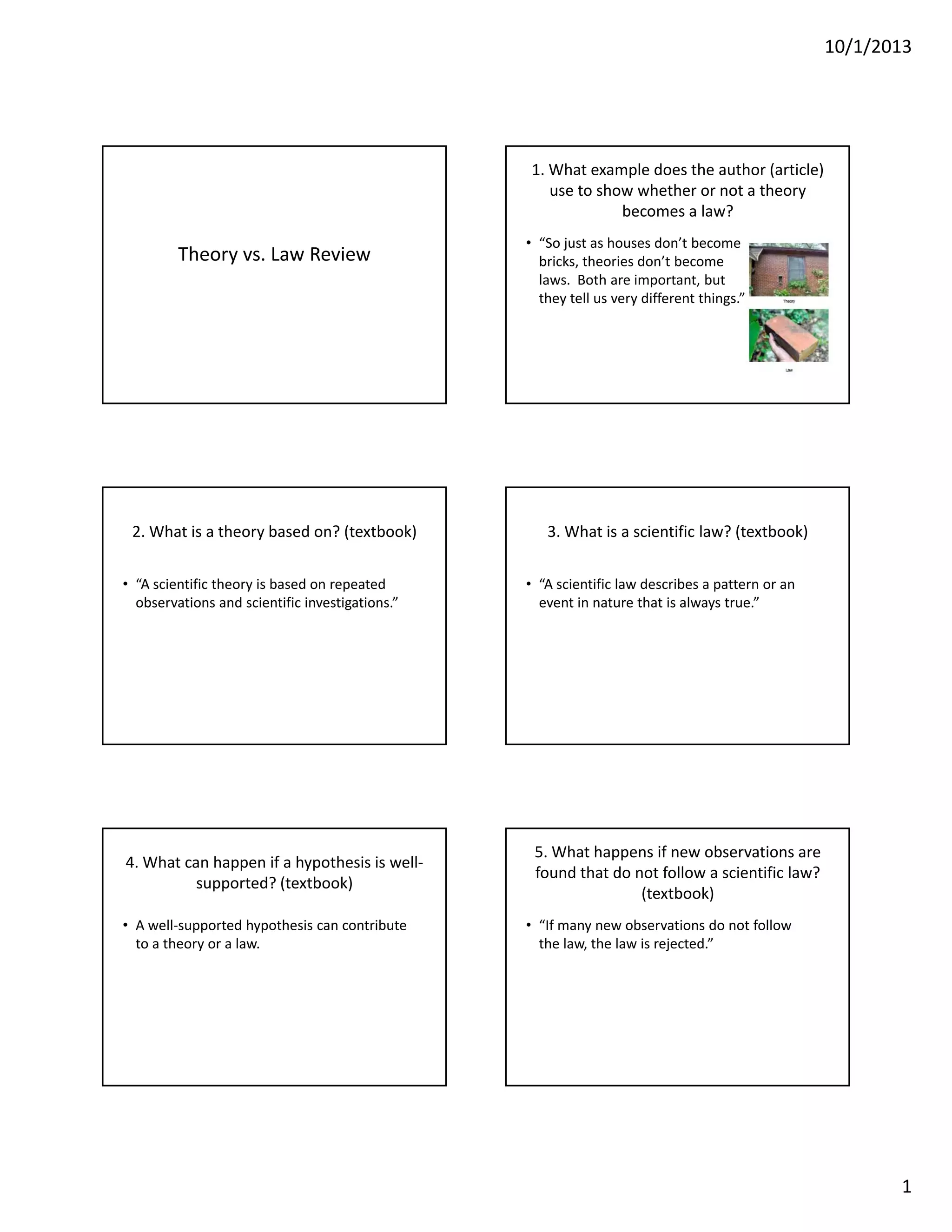
1. What example does the author (article) 
use to show whether or not a theory 
becomes a law? 
• “So just as houses don’t become 
bricks, theories don’t become 
laws. Both are important, but 
they tell us very different things.” 
2. What is a theory based on? (textbook) 
• “A scientific theory is based on repeated 
observations and scientific investigations.” 
3. What is a scientific law? (textbook) 
• “A scientific law describes a pattern or an 
event in nature that is always true.” 
4. What can happen if a hypothesis is well‐supported? 
(textbook) 
• A well‐supported hypothesis can contribute 
to a theory or a law. 
5. What happens if new observations are 
found that do not follow a scientific law? 
(textbook) 
• “If many new observations do not follow 
the law, the law is rejected.”
10/1/2013 
2 
6. What can happen if a theory has a flaw 
or new information is discovered that does 
not support a theory? (article & book) 
• “If new information does not support a 
scientific theory, the theory will be 
modified or rejected.”” (book) 
• “Scientists would examine the new 
evidence, and see if there was a way to 
adjust the theory so that the new evidence 
fit.” (article) 
7. How does Einstein explain the way 
scientists work? (article) 
• “No amount of experimentation can ever 
prove me right; a single experiment can 
prove me wrong.”” – Albert Einstein 
• Until evidence goes against the existing 
laws and theories, they continue to be 
accepted. 
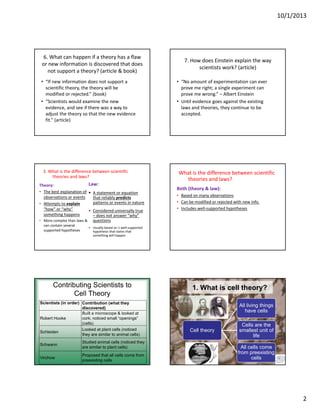
3. What is the difference between scientific 
theories and laws? 
Theory: 
• The best explanation of 
observations or events 
• Attempts to explain 
Law: 
 A statement or equation 
that reliably predicts 
patterns or events in nature 
“how” or “why” 
something happens 
• More complex than laws & 
can contain several 
supported hypotheses 
• Considered universally true 
– does not answer “why” 
questions 
• Usually based on 1 well‐supported 
hypothesis that states that 
something will happen 
What is the difference between scientific 
theories and laws? 
Both (theory & law): 
• Based on many observations 
• Can be modified or rejected with new info. 
I l d ll dh h 
• Includes well‐supported hypotheses 
Contributing Scientists to 
Cell Theory 
Scientists (in order) Contribution (what they 
discovered) 
Robert Hooke 
Built a microscope & looked at 
cork; noticed small “openings” 
(cells) 
Schleiden Looked at plant cells (noticed 
they are similar to animal cells) 
Schwann Studied animal cells (noticed they 
are similar to plant cells) 
Virchow Proposed that all cells come from 
preexisting cells 
1. What is cell theory? 
All living things 
have cells 
Cell theory 
Cells are the 
smallest unit of 
life 
All cells come 
from preexisting 
cells
10/1/2013 
3 
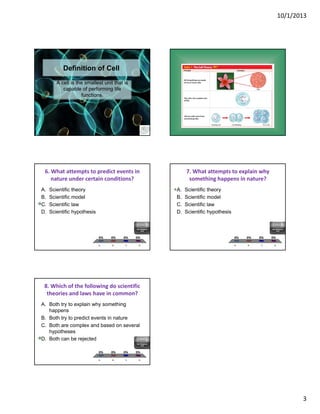
Definition of Cell 
A cell is the smallest unit that is 
capable of performing life 
functions. 
6. What attempts to predict events in 
nature under certain conditions? 
A. Scientific theory 
B. Scientific model 
C. Scientific law 
0% 0% 0% 0% 
A. B. C. D. 
D. Scientific hypothesis 
Non-Response 
Grid 
7. What attempts to explain why 
something happens in nature? 
A. Scientific theory 
B. Scientific model 
C. Scientific law 
0% 0% 0% 0% 
A. B. C. D. 
D. Scientific hypothesis 
Non-Response 
Grid 
8. Which of the following do scientific 
theories and laws have in common? 
A. Both try to explain why something 
happens 
B. Both try to predict events in nature 
C. Both are complex and based on several 
0% 0% 0% 0% 
A. B. C. D. 
hypotheses 
D. Both can be rejected 
Non-Response 
Grid

Theory vs law review (and cell theory)

  • 1.
    10/1/2013 1 Theoryvs. Law Review 1. What example does the author (article) use to show whether or not a theory becomes a law? • “So just as houses don’t become bricks, theories don’t become laws. Both are important, but they tell us very different things.” 2. What is a theory based on? (textbook) • “A scientific theory is based on repeated observations and scientific investigations.” 3. What is a scientific law? (textbook) • “A scientific law describes a pattern or an event in nature that is always true.” 4. What can happen if a hypothesis is well‐supported? (textbook) • A well‐supported hypothesis can contribute to a theory or a law. 5. What happens if new observations are found that do not follow a scientific law? (textbook) • “If many new observations do not follow the law, the law is rejected.”
  • 2.
    10/1/2013 2 6.What can happen if a theory has a flaw or new information is discovered that does not support a theory? (article & book) • “If new information does not support a scientific theory, the theory will be modified or rejected.”” (book) • “Scientists would examine the new evidence, and see if there was a way to adjust the theory so that the new evidence fit.” (article) 7. How does Einstein explain the way scientists work? (article) • “No amount of experimentation can ever prove me right; a single experiment can prove me wrong.”” – Albert Einstein • Until evidence goes against the existing laws and theories, they continue to be accepted. 3. What is the difference between scientific theories and laws? Theory: • The best explanation of observations or events • Attempts to explain Law:  A statement or equation that reliably predicts patterns or events in nature “how” or “why” something happens • More complex than laws & can contain several supported hypotheses • Considered universally true – does not answer “why” questions • Usually based on 1 well‐supported hypothesis that states that something will happen What is the difference between scientific theories and laws? Both (theory & law): • Based on many observations • Can be modified or rejected with new info. I l d ll dh h • Includes well‐supported hypotheses Contributing Scientists to Cell Theory Scientists (in order) Contribution (what they discovered) Robert Hooke Built a microscope & looked at cork; noticed small “openings” (cells) Schleiden Looked at plant cells (noticed they are similar to animal cells) Schwann Studied animal cells (noticed they are similar to plant cells) Virchow Proposed that all cells come from preexisting cells 1. What is cell theory? All living things have cells Cell theory Cells are the smallest unit of life All cells come from preexisting cells
  • 3.
    10/1/2013 3 Definitionof Cell A cell is the smallest unit that is capable of performing life functions. 6. What attempts to predict events in nature under certain conditions? A. Scientific theory B. Scientific model C. Scientific law 0% 0% 0% 0% A. B. C. D. D. Scientific hypothesis Non-Response Grid 7. What attempts to explain why something happens in nature? A. Scientific theory B. Scientific model C. Scientific law 0% 0% 0% 0% A. B. C. D. D. Scientific hypothesis Non-Response Grid 8. Which of the following do scientific theories and laws have in common? A. Both try to explain why something happens B. Both try to predict events in nature C. Both are complex and based on several 0% 0% 0% 0% A. B. C. D. hypotheses D. Both can be rejected Non-Response Grid