The Nature and Role of Theory in Scientific
               Research
                      Lecture by
                Dr. Charles R. Hildreth
 Palmer School of Library and Information
                  Science
            September 7, 2006


    The primary goal of science is to formulate and affirm theories that enhance our
    understanding of the social and natural worlds in which we live.” (CRH)
SCIENCE ?

     RESEARCH ?

SCIENTIFIC RESEARCH ?
   (The Process/Method)

SCIENTIFIC KNOWLEDGE ?
SCIENCE AS DATA
  GATHERING ?

 Observe/Look About

      Measure

Gather Empirical Data

Report Data Findings

(Does this sum it up?)
SCIENTIFIC RESEARCH IS NOT:

1. Not mere information gathering (At the library,
     in the encyclopedia, on the Internet)
2. Not mere observation, however precise
3. Not transporting known facts via a paper
4. Not rummaging through files and archives for
    information
5. Not a propaganda word to support unscientific claims
SCIENCE, A WAY OF KNOWING

                            Preamble

All those involved with science teaching and learning should have
a common, accurate view of the nature of science. Science is
characterized by the systematic gathering of information through
various forms of direct and indirect observations and the testing
of this information by methods including, but not limited to,
experimentation. The principal product of science is knowledge in
the form of naturalistic concepts and the laws and theories related
to those concepts. (www.nsta.org)
“THEORY”
 Popular Usage:

   - a vague and fuzzy sort of fact
   - a mere quess or hunch as to why something happens
   - tentative, uncertain, unproven

Scientific Usage:

  - an explanation of a natural phenomenon built up logically
      from numerous testable observations and well-tested
      hypotheses

  - a well-established, broadly accepted complex of ideas that
      explain a particular phenomenon
WHAT SCIENTIFIC RESEARCH IS:
    (DISTINGUISHING FEATURES)

“Research is the systematic process of collecting and
analyzing information (data) in order to increase our
understanding of the phenomenon about which we are
concerned or interested.” (Leedy & Ormrod, 2001)
Research originates with a question or problem.

Research requires a clear articulation of a goal.

Research follows a specific plan of procedure.

Research divides the problem into sub-problems.

Research is guided by the specific research problem, question, or
hypothesis.

Research accepts certain critical assumptions.

Research requires the collection and interpretation of data in an
attempt to resolve the problem that initiated the research.

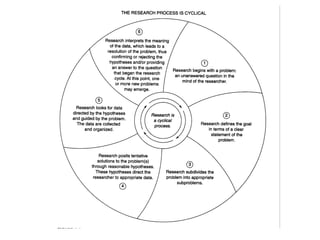
Research is, by its nature, cyclical, or helical.
THE SCIENTIFIC METHOD
                           “Little Science”
                        A Series of Logical Steps?
1.   State the problem
2.   Formulate the hypothesis
3.   Design the survey or experiment
4.   Make observations/collect data
5.   Interpret the data
6.   Draw conclusions
7.   Suggest additional research

“The scientific method is really a series of intellectual steps. It is
not so much the actual techniques whereby the research is
performed as it is the thought process whereby hypotheses are
formed, tested, and verified (or not verified).” (Sirkin, 1995)
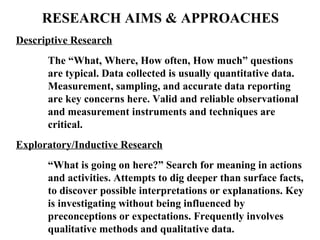
RESEARCH AIMS & APPROACHES

Descriptive Research

Exploratory/Inductive Research

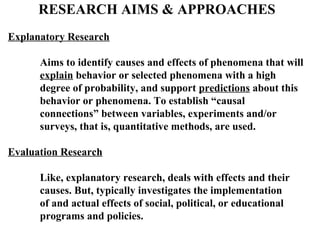
Explanatory Research

Evaluation Research
RESEARCH AIMS & APPROACHES
Descriptive Research
      The “What, Where, How often, How much” questions
      are typical. Data collected is usually quantitative data.
      Measurement, sampling, and accurate data reporting
      are key concerns here. Valid and reliable observational
      and measurement instruments and techniques are
      critical.
Exploratory/Inductive Research
      “What is going on here?” Search for meaning in actions
      and activities. Attempts to dig deeper than surface facts,
      to discover possible interpretations or explanations. Key
      is investigating without being influenced by
      preconceptions or expectations. Frequently involves
      qualitative methods and qualitative data.
RESEARCH AIMS & APPROACHES
Explanatory Research

      Aims to identify causes and effects of phenomena that will
      explain behavior or selected phenomena with a high
      degree of probability, and support predictions about this
      behavior or phenomena. To establish “causal
      connections” between variables, experiments and/or
      surveys, that is, quantitative methods, are used.

Evaluation Research

      Like, explanatory research, deals with effects and their
      causes. But, typically investigates the implementation
      of and actual effects of social, political, or educational
      programs and policies.
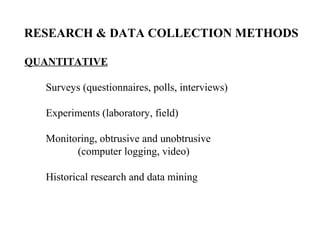
RESEARCH & DATA COLLECTION METHODS

QUANTITATIVE

   Surveys (questionnaires, polls, interviews)

   Experiments (laboratory, field)

   Monitoring, obtrusive and unobtrusive
         (computer logging, video)

   Historical research and data mining
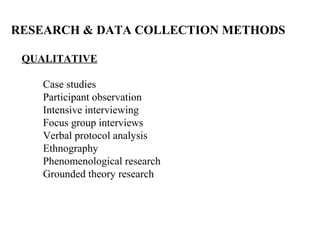
RESEARCH & DATA COLLECTION METHODS

 QUALITATIVE

    Case studies
    Participant observation
    Intensive interviewing
    Focus group interviews
    Verbal protocol analysis
    Ethnography
    Phenomenological research
    Grounded theory research
KINDS OF SCIENTIFIC KNOWLEDGE

        Empirical Data Facts

            Hypotheses

             Theories

              “Laws”
KEY DEFINITIONS-1

                                         Hypothesis:

   “A hypothesis is a logical supposition, a reasonable guess, an educated conjecture. It
    provides a tentative explanation for a phenomenon under investigation.” (Leedy)

    “To scientists, the phrase "the theory of ..." signals a particularly well-tested idea. A
      hypothesis is an idea or suggestion that has been put forward to explain a set of
       observations.” (http://www2.slac.stanford.edu/vvc/theory/modeltheory.html)

“A hypothesis is a tentative theory that has not yet been tested. Typically, a scientist devises
  a hypothesis and then sees if it "holds water" by testing it against available data. If the
           hypothesis does hold water, the scientist declares it to be a theory.”
                        (http://home.xnet.com/~blatura/skep_1.html)

“Hypothesis: This is an educated guess based upon observation. It is a rational explanation
  of a single event or phenomenon based upon what is observed, but which has not been
  proved. Most hypotheses can be supported or refuted by experimentation or continued
                       observation.” (http://wilstar.com/theories.htm)
KEY DEFINITIONS-2
Theory:
 “Over time, as particular hypotheses are supported by a growing body of data, they evolve
into theories. A theory is an organized body of concepts and principles intended to explain a
particular phenomenon.”
 “Today, any set of scientific ideas referred to as "the theory of ..." is a well-tested and well-
established understanding of an underlying mechanism or process. Such a theory can never
be proved to be complete and final -- that is why we no longer call it a "law."
(http://www2.slac.stanford.edu/vvc/theory/modeltheory.html)
 “A theory is a scientific explanation of an observed phenomenon. Unlike laws, theories
actually explain why things are the way they are. Theories are what science is for.”
(http://www.geocities.com/Tokyo/Temple/9917/evolution/theory.html)
 “Well evolution is a theory. It is also a fact. And facts and theories are different things, not
rungs in a hierarchy of increasing certainty. Facts are the world's data. Theories are
structures of ideas that explain and interpret facts.” (Stephen J. Gould)
http://www.talkorigins.org/faqs/evolution-fact.html
Theory (continued):


 “In popular usage, a theory is just a vague and fuzzy sort of fact. But to a scientist a theory
is a conceptual framework that explains existing facts and predicts new ones.”
(http://home.xnet.com/~blatura/skep_1.html)
 “Theory: A theory is more like a scientific law than a hypothesis. A theory is an
explanation of a set of related observations or events based upon proven hypotheses and
verified multiple times by detached groups of researchers. One scientist cannot create a
theory; he can only create a hypothesis.” (http://wilstar.com/theories.htm)


 “An explanation for an observation or series of observations that is substantiated by a
considerable body of evidence” (Krimsley, 1995). “… a law describes what nature does
under certain conditions, and will predict what will happen as long as those conditions are
met. A theory explains how nature works.” (
http://science.kennesaw.edu/~rmatson/Biol%203380/3380theory.html)
Wickipedia on “Theory”
           (http://en.wikipedia.org/wiki/Theory)
In common usage a theory is often viewed as little more
     than a guess or a hypothesis. But in science and
   generally in academic usage, a theory is much more
    than that. A theory is an established paradigm that
    explains all or much of the data we have and offers
valid predictions that can be tested. In science, a theory
  is never considered fact or infallible, because we can
   never assume we know all there is to know. Instead,
   theories remain standing until they are disproven, at
 which point they are thrown out altogether or modified
                   to fit the additional data.
Wickipedia on “Theory” (Cont.)
    Theories start out with empirical observations such as
 “sometimes water turns into ice.” At some point, there is a
   need or curiosity to find out why this is, which leads to a
 theoretical/scientific phase. In scientific theories, this then
  leads to research, in combination with auxiliary and other
     hypotheses (see scientific method), which may then
eventually lead to a theory. Some scientific theories (such as
  the theory of gravity) are so widely accepted that they are
    often seen as laws. This, however, rests on a mistaken
assumption of what theories and laws are. Theories and laws
are not rungs in a ladder of truth, but different sets of data. A
       law is a general statement based on observations.
KEY DEFINITIONS-3
Laws:
 “A scientific law is a description of an observed phenomenon. Kepler's Laws of Planetary
Motion are a good example. Those laws describe the motions of planets. But they do not
explain why they are that way. If all scientists ever did was to formulate scientific laws,
then the universe would be very well-described, but still unexplained and very mysterious.”
   (http://www.geocities.com/Tokyo/Temple/9917/evolution/theory.html)
 “Scientific Law: This is a statement of fact meant to explain, in concise terms, an action or
set of actions. It is generally accepted to be true and universal, and can sometimes be
expressed in terms of a single mathematical equation. Scientific laws are similar to
mathematical postulates. They don’t really need any complex external proofs; they are
accepted at face value based upon the fact that they have always been observed to be true.”
(http://wilstar.com/theories.htm)
 “A set of observed regularities expressed in a concise verbal or mathematical statement.”
(Krimsley, 1995).
 “Regardless of which definitions one uses to distinguish between a law and a theory,
scientists would agree that a theory is NOT a "transitory law, a law in waiting". There is
NO hierarchy being implied by scientists who use these words. That is, a law is neither
"better than" nor "above" a theory. From this view, laws and theories "do" different things
and have different roles to play in science.” (
http://science.kennesaw.edu/~rmatson/Biol%203380/3380theory.html)
EXAMPLES OF SCIENTIFIC THEORIES
Newton's theory of gravity
Newton’s “laws” of motion
The theory of evolution by natural selection
Einstein's theory of gravity
Einstein’s theories of general and specific relativity
Mendel's law of inheritance
A chaos theory
Pythagoras's theorem
Early psychoanalytic theory
Geology: Plate Tectonics
The big bang
The Jungian theory of the unconscious mind
Germ theory of disease
Rational choice theory
Deterrence theory
Genetic theories of intelligence or personality
ROLES OF THEORY IN SCIENCE
                         Explanatory
                         Predictive
                         Generative
                     Stimulate research
                       Guide research
                   Aid data interpretation
 “Theories do not provide the answers to the questions we
 pose as topics for research. Instead, theories suggest the
   areas on which we should focus and the propositions
(hypotheses) we should consider for a test.” (Schutt, 2001)
    Falsifiability: Always tentative, never final, absolute
The product of insight that produces questions more than
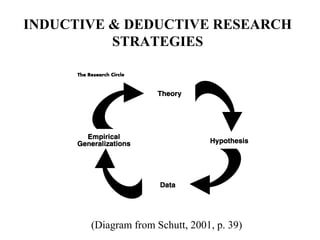
INDUCTIVE & DEDUCTIVE RESEARCH
          STRATEGIES


       (Diagram from Schutt, 2001, p. 39)
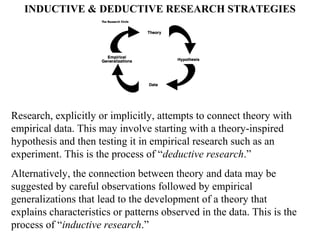
INDUCTIVE & DEDUCTIVE RESEARCH STRATEGIES


Research, explicitly or implicitly, attempts to connect theory with
empirical data. This may involve starting with a theory-inspired
hypothesis and then testing it in empirical research such as an
experiment. This is the process of “deductive research.”
Alternatively, the connection between theory and data may be
suggested by careful observations followed by empirical
generalizations that lead to the development of a theory that
explains characteristics or patterns observed in the data. This is the
process of “inductive research.”
Theory presentation
Theory presentation

Theory presentation

  • 1.
    The Nature andRole of Theory in Scientific Research Lecture by Dr. Charles R. Hildreth Palmer School of Library and Information Science September 7, 2006 The primary goal of science is to formulate and affirm theories that enhance our understanding of the social and natural worlds in which we live.” (CRH)
  • 2.
    SCIENCE ? RESEARCH ? SCIENTIFIC RESEARCH ? (The Process/Method) SCIENTIFIC KNOWLEDGE ?
  • 3.
    SCIENCE AS DATA GATHERING ? Observe/Look About Measure Gather Empirical Data Report Data Findings (Does this sum it up?)
  • 4.
    SCIENTIFIC RESEARCH ISNOT: 1. Not mere information gathering (At the library, in the encyclopedia, on the Internet) 2. Not mere observation, however precise 3. Not transporting known facts via a paper 4. Not rummaging through files and archives for information 5. Not a propaganda word to support unscientific claims
  • 5.
    SCIENCE, A WAYOF KNOWING Preamble All those involved with science teaching and learning should have a common, accurate view of the nature of science. Science is characterized by the systematic gathering of information through various forms of direct and indirect observations and the testing of this information by methods including, but not limited to, experimentation. The principal product of science is knowledge in the form of naturalistic concepts and the laws and theories related to those concepts. (www.nsta.org)
  • 6.
    “THEORY” Popular Usage: - a vague and fuzzy sort of fact - a mere quess or hunch as to why something happens - tentative, uncertain, unproven Scientific Usage: - an explanation of a natural phenomenon built up logically from numerous testable observations and well-tested hypotheses - a well-established, broadly accepted complex of ideas that explain a particular phenomenon
  • 7.
    WHAT SCIENTIFIC RESEARCHIS: (DISTINGUISHING FEATURES) “Research is the systematic process of collecting and analyzing information (data) in order to increase our understanding of the phenomenon about which we are concerned or interested.” (Leedy & Ormrod, 2001)
  • 8.
    Research originates witha question or problem. Research requires a clear articulation of a goal. Research follows a specific plan of procedure. Research divides the problem into sub-problems. Research is guided by the specific research problem, question, or hypothesis. Research accepts certain critical assumptions. Research requires the collection and interpretation of data in an attempt to resolve the problem that initiated the research. Research is, by its nature, cyclical, or helical.
  • 10.
    THE SCIENTIFIC METHOD “Little Science” A Series of Logical Steps? 1. State the problem 2. Formulate the hypothesis 3. Design the survey or experiment 4. Make observations/collect data 5. Interpret the data 6. Draw conclusions 7. Suggest additional research “The scientific method is really a series of intellectual steps. It is not so much the actual techniques whereby the research is performed as it is the thought process whereby hypotheses are formed, tested, and verified (or not verified).” (Sirkin, 1995)
  • 11.
    RESEARCH AIMS &APPROACHES Descriptive Research Exploratory/Inductive Research Explanatory Research Evaluation Research
  • 12.
    RESEARCH AIMS &APPROACHES Descriptive Research The “What, Where, How often, How much” questions are typical. Data collected is usually quantitative data. Measurement, sampling, and accurate data reporting are key concerns here. Valid and reliable observational and measurement instruments and techniques are critical. Exploratory/Inductive Research “What is going on here?” Search for meaning in actions and activities. Attempts to dig deeper than surface facts, to discover possible interpretations or explanations. Key is investigating without being influenced by preconceptions or expectations. Frequently involves qualitative methods and qualitative data.
  • 13.
    RESEARCH AIMS &APPROACHES Explanatory Research Aims to identify causes and effects of phenomena that will explain behavior or selected phenomena with a high degree of probability, and support predictions about this behavior or phenomena. To establish “causal connections” between variables, experiments and/or surveys, that is, quantitative methods, are used. Evaluation Research Like, explanatory research, deals with effects and their causes. But, typically investigates the implementation of and actual effects of social, political, or educational programs and policies.
  • 14.
    RESEARCH & DATACOLLECTION METHODS QUANTITATIVE Surveys (questionnaires, polls, interviews) Experiments (laboratory, field) Monitoring, obtrusive and unobtrusive (computer logging, video) Historical research and data mining
  • 15.
    RESEARCH & DATACOLLECTION METHODS QUALITATIVE Case studies Participant observation Intensive interviewing Focus group interviews Verbal protocol analysis Ethnography Phenomenological research Grounded theory research
  • 16.
    KINDS OF SCIENTIFICKNOWLEDGE Empirical Data Facts Hypotheses Theories “Laws”
  • 17.
    KEY DEFINITIONS-1 Hypothesis: “A hypothesis is a logical supposition, a reasonable guess, an educated conjecture. It provides a tentative explanation for a phenomenon under investigation.” (Leedy) “To scientists, the phrase "the theory of ..." signals a particularly well-tested idea. A hypothesis is an idea or suggestion that has been put forward to explain a set of observations.” (http://www2.slac.stanford.edu/vvc/theory/modeltheory.html) “A hypothesis is a tentative theory that has not yet been tested. Typically, a scientist devises a hypothesis and then sees if it "holds water" by testing it against available data. If the hypothesis does hold water, the scientist declares it to be a theory.” (http://home.xnet.com/~blatura/skep_1.html) “Hypothesis: This is an educated guess based upon observation. It is a rational explanation of a single event or phenomenon based upon what is observed, but which has not been proved. Most hypotheses can be supported or refuted by experimentation or continued observation.” (http://wilstar.com/theories.htm)
  • 18.
    KEY DEFINITIONS-2 Theory: “Overtime, as particular hypotheses are supported by a growing body of data, they evolve into theories. A theory is an organized body of concepts and principles intended to explain a particular phenomenon.” “Today, any set of scientific ideas referred to as "the theory of ..." is a well-tested and well- established understanding of an underlying mechanism or process. Such a theory can never be proved to be complete and final -- that is why we no longer call it a "law." (http://www2.slac.stanford.edu/vvc/theory/modeltheory.html) “A theory is a scientific explanation of an observed phenomenon. Unlike laws, theories actually explain why things are the way they are. Theories are what science is for.” (http://www.geocities.com/Tokyo/Temple/9917/evolution/theory.html) “Well evolution is a theory. It is also a fact. And facts and theories are different things, not rungs in a hierarchy of increasing certainty. Facts are the world's data. Theories are structures of ideas that explain and interpret facts.” (Stephen J. Gould) http://www.talkorigins.org/faqs/evolution-fact.html
  • 19.
    Theory (continued): “Inpopular usage, a theory is just a vague and fuzzy sort of fact. But to a scientist a theory is a conceptual framework that explains existing facts and predicts new ones.” (http://home.xnet.com/~blatura/skep_1.html) “Theory: A theory is more like a scientific law than a hypothesis. A theory is an explanation of a set of related observations or events based upon proven hypotheses and verified multiple times by detached groups of researchers. One scientist cannot create a theory; he can only create a hypothesis.” (http://wilstar.com/theories.htm) “An explanation for an observation or series of observations that is substantiated by a considerable body of evidence” (Krimsley, 1995). “… a law describes what nature does under certain conditions, and will predict what will happen as long as those conditions are met. A theory explains how nature works.” ( http://science.kennesaw.edu/~rmatson/Biol%203380/3380theory.html)
  • 20.
    Wickipedia on “Theory” (http://en.wikipedia.org/wiki/Theory) In common usage a theory is often viewed as little more than a guess or a hypothesis. But in science and generally in academic usage, a theory is much more than that. A theory is an established paradigm that explains all or much of the data we have and offers valid predictions that can be tested. In science, a theory is never considered fact or infallible, because we can never assume we know all there is to know. Instead, theories remain standing until they are disproven, at which point they are thrown out altogether or modified to fit the additional data.
  • 21.
    Wickipedia on “Theory”(Cont.) Theories start out with empirical observations such as “sometimes water turns into ice.” At some point, there is a need or curiosity to find out why this is, which leads to a theoretical/scientific phase. In scientific theories, this then leads to research, in combination with auxiliary and other hypotheses (see scientific method), which may then eventually lead to a theory. Some scientific theories (such as the theory of gravity) are so widely accepted that they are often seen as laws. This, however, rests on a mistaken assumption of what theories and laws are. Theories and laws are not rungs in a ladder of truth, but different sets of data. A law is a general statement based on observations.
  • 22.
    KEY DEFINITIONS-3 Laws: “Ascientific law is a description of an observed phenomenon. Kepler's Laws of Planetary Motion are a good example. Those laws describe the motions of planets. But they do not explain why they are that way. If all scientists ever did was to formulate scientific laws, then the universe would be very well-described, but still unexplained and very mysterious.” (http://www.geocities.com/Tokyo/Temple/9917/evolution/theory.html) “Scientific Law: This is a statement of fact meant to explain, in concise terms, an action or set of actions. It is generally accepted to be true and universal, and can sometimes be expressed in terms of a single mathematical equation. Scientific laws are similar to mathematical postulates. They don’t really need any complex external proofs; they are accepted at face value based upon the fact that they have always been observed to be true.” (http://wilstar.com/theories.htm) “A set of observed regularities expressed in a concise verbal or mathematical statement.” (Krimsley, 1995). “Regardless of which definitions one uses to distinguish between a law and a theory, scientists would agree that a theory is NOT a "transitory law, a law in waiting". There is NO hierarchy being implied by scientists who use these words. That is, a law is neither "better than" nor "above" a theory. From this view, laws and theories "do" different things and have different roles to play in science.” ( http://science.kennesaw.edu/~rmatson/Biol%203380/3380theory.html)
  • 23.
    EXAMPLES OF SCIENTIFICTHEORIES Newton's theory of gravity Newton’s “laws” of motion The theory of evolution by natural selection Einstein's theory of gravity Einstein’s theories of general and specific relativity Mendel's law of inheritance A chaos theory Pythagoras's theorem Early psychoanalytic theory Geology: Plate Tectonics The big bang The Jungian theory of the unconscious mind Germ theory of disease Rational choice theory Deterrence theory Genetic theories of intelligence or personality
  • 24.
    ROLES OF THEORYIN SCIENCE Explanatory Predictive Generative Stimulate research Guide research Aid data interpretation “Theories do not provide the answers to the questions we pose as topics for research. Instead, theories suggest the areas on which we should focus and the propositions (hypotheses) we should consider for a test.” (Schutt, 2001) Falsifiability: Always tentative, never final, absolute The product of insight that produces questions more than
  • 25.
    INDUCTIVE & DEDUCTIVERESEARCH STRATEGIES (Diagram from Schutt, 2001, p. 39)
  • 26.
    INDUCTIVE & DEDUCTIVERESEARCH STRATEGIES Research, explicitly or implicitly, attempts to connect theory with empirical data. This may involve starting with a theory-inspired hypothesis and then testing it in empirical research such as an experiment. This is the process of “deductive research.” Alternatively, the connection between theory and data may be suggested by careful observations followed by empirical generalizations that lead to the development of a theory that explains characteristics or patterns observed in the data. This is the process of “inductive research.”