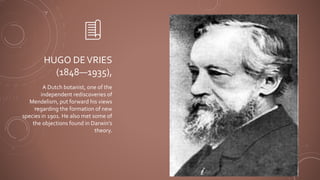
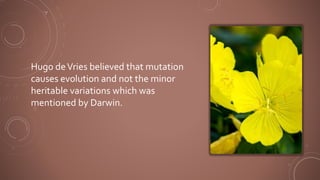
Hugo de Vries proposed the mutation theory of evolution in 1901. He argued that evolution occurs via large, discontinuous mutations rather than the small, gradual variations proposed by Darwin. De Vries observed different plant varieties emerge suddenly in evening primrose experiments. He believed mutations provided new traits that could lead to new species forming in a single step. While the mutation theory highlighted an important source of variation, it was later shown that natural selection of mutations and gradual processes also drive evolutionary change.