Evolution: A Journey
Through Time
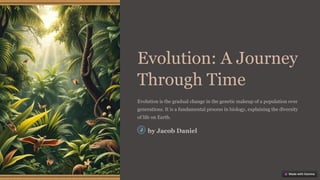
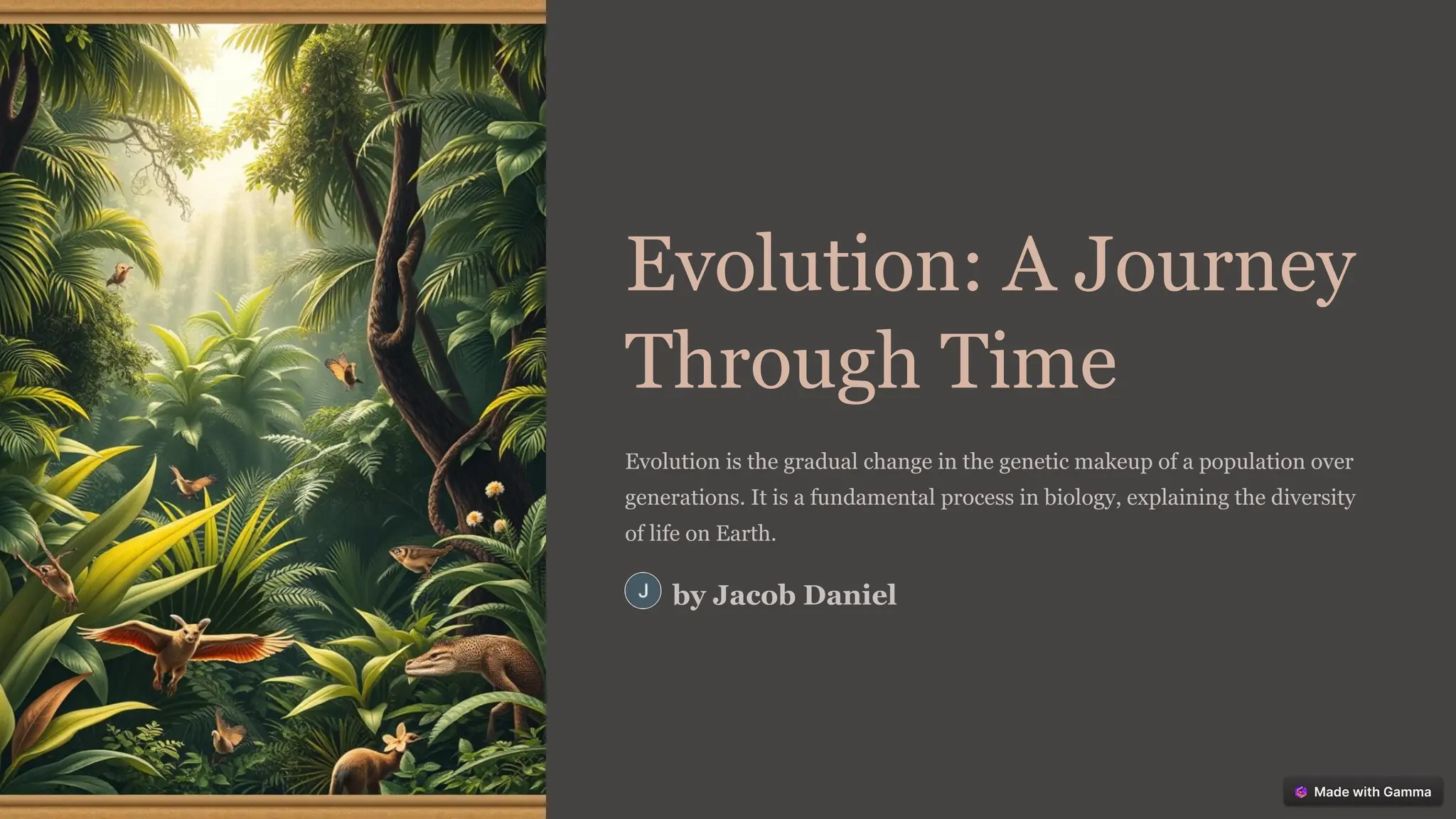
Evolution is the gradual change in the genetic makeup of a population over
generations. It is a fundamental process in biology, explaining the diversity
of life on Earth.
by Jacob Daniel
The Theory of Evolution
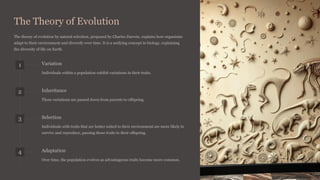
The theory of evolution by natural selection, proposed by Charles Darwin, explains how organisms
adapt to their environment and diversify over time. It is a unifying concept in biology, explaining
the diversity of life on Earth.
1 Variation
Individuals within a population exhibit variations in their traits.
2 Inheritance
These variations are passed down from parents to offspring.
3 Selection
Individuals with traits that are better suited to their environment are more likely to
survive and reproduce, passing those traits to their offspring.
4 Adaptation
Over time, the population evolves as advantageous traits become more common.
Evidence for Evolution
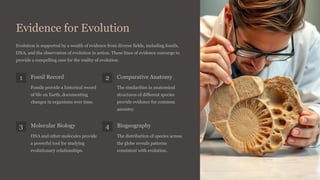
Evolution is supported by a wealth of evidence from diverse fields, including fossils,
DNA, and the observation of evolution in action. These lines of evidence converge to
provide a compelling case for the reality of evolution.
1 Fossil Record
Fossils provide a historical record
of life on Earth, documenting
changes in organisms over time.
2 Comparative Anatomy
The similarities in anatomical
structures of different species
provide evidence for common
ancestry.
3 Molecular Biology
DNA and other molecules provide
a powerful tool for studying
evolutionary relationships.
4 Biogeography
The distribution of species across
the globe reveals patterns
consistent with evolution.
Natural Selection
Natural selection is the driving force behind evolution. It is the process by which
individuals with traits that are better suited to their environment survive and
reproduce more successfully, passing those advantageous traits on to their offspring.
Competition
Organisms compete for resources,
such as food, water, and mates.
Survival
Individuals with traits that give them
an advantage in this competition are
more likely to survive.
Reproduction
Successful survivors are more likely
to reproduce, passing their
advantageous traits to their
offspring.
Adaptation
Over generations, the frequency of
these advantageous traits increases
in the population, leading to
adaptation.
Genetic Variation
Genetic variation is the raw material for evolution. It refers to the differences in genes and traits among individuals in a population.
Without variation, natural selection would have nothing to act on.
Mutations
Random changes in DNA sequences are
the ultimate source of genetic variation.
Sexual Reproduction
The shuffling of genes during sexual
reproduction creates new combinations
of alleles, increasing genetic variation.
Gene Flow
The movement of genes between
populations can introduce new
variations.
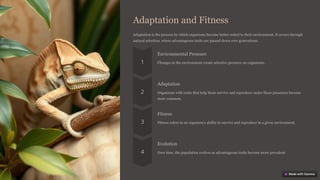
Adaptation and Fitness
Adaptation is the process by which organisms become better suited to their environment. It occurs through
natural selection, where advantageous traits are passed down over generations.
Environmental Pressure
Changes in the environment create selective pressure on organisms.
Adaptation
Organisms with traits that help them survive and reproduce under these pressures become
more common.
Fitness
Fitness refers to an organism's ability to survive and reproduce in a given environment.
Evolution
Over time, the population evolves as advantageous traits become more prevalent.
Speciation and Reproductive Isolation
Speciation is the process by which new species arise from existing ones. It often involves reproductive isolation,
where populations are prevented from interbreeding, leading to genetic divergence and the formation of new
species.
Prezygotic Barriers Prevent the formation of a zygote
Habitat Isolation Species live in different habitats and don't encounter
each other
Temporal Isolation Species breed at different times of day or year
Behavioral Isolation Species have different courtship rituals or mating
signals
Mechanical Isolation Reproductive structures are incompatible
Gametic Isolation Sperm and egg are incompatible
Postzygotic Barriers Prevent hybrid offspring from surviving or
reproducing
Reduced Hybrid Viability Hybrid offspring have lower survival rates
Reduced Hybrid Fertility Hybrid offspring are sterile
Hybrid Breakdown Hybrid offspring are fertile in the first generation
but later generations have reduced fertility
Evolution of Behavior
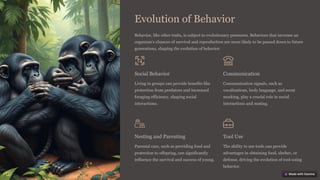
Behavior, like other traits, is subject to evolutionary pressures. Behaviors that increase an
organism's chances of survival and reproduction are more likely to be passed down to future
generations, shaping the evolution of behavior.
Social Behavior
Living in groups can provide benefits like
protection from predators and increased
foraging efficiency, shaping social
interactions.
Communication
Communication signals, such as
vocalizations, body language, and scent
marking, play a crucial role in social
interactions and mating.
Nesting and Parenting
Parental care, such as providing food and
protection to offspring, can significantly
influence the survival and success of young.
Tool Use
The ability to use tools can provide
advantages in obtaining food, shelter, or
defense, driving the evolution of tool-using
behavior.
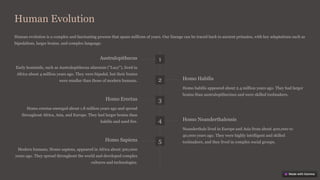
Human Evolution
Human evolution is a complex and fascinating process that spans millions of years. Our lineage can be traced back to ancient primates, with key adaptations such as
bipedalism, larger brains, and complex language.
1
Australopithecus
Early hominids, such as Australopithecus afarensis ("Lucy"), lived in
Africa about 4 million years ago. They were bipedal, but their brains
were smaller than those of modern humans. 2 Homo Habilis
Homo habilis appeared about 2.4 million years ago. They had larger
brains than australopithecines and were skilled toolmakers.
3
Homo Erectus
Homo erectus emerged about 1.8 million years ago and spread
throughout Africa, Asia, and Europe. They had larger brains than
habilis and used fire. 4 Homo Neanderthalensis
Neanderthals lived in Europe and Asia from about 400,000 to
40,000 years ago. They were highly intelligent and skilled
toolmakers, and they lived in complex social groups.
5
Homo Sapiens
Modern humans, Homo sapiens, appeared in Africa about 300,000
years ago. They spread throughout the world and developed complex
cultures and technologies.
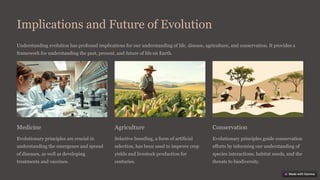
Implications and Future of Evolution
Understanding evolution has profound implications for our understanding of life, disease, agriculture, and conservation. It provides a
framework for understanding the past, present, and future of life on Earth.
Medicine
Evolutionary principles are crucial in
understanding the emergence and spread
of diseases, as well as developing
treatments and vaccines.
Agriculture
Selective breeding, a form of artificial
selection, has been used to improve crop
yields and livestock production for
centuries.
Conservation
Evolutionary principles guide conservation
efforts by informing our understanding of
species interactions, habitat needs, and the
threats to biodiversity.

Evolution-A-Journey-Through-Time.pptx grade 8

  • 1.
    Evolution: A Journey ThroughTime Evolution is the gradual change in the genetic makeup of a population over generations. It is a fundamental process in biology, explaining the diversity of life on Earth. by Jacob Daniel
  • 2.
    The Theory ofEvolution The theory of evolution by natural selection, proposed by Charles Darwin, explains how organisms adapt to their environment and diversify over time. It is a unifying concept in biology, explaining the diversity of life on Earth. 1 Variation Individuals within a population exhibit variations in their traits. 2 Inheritance These variations are passed down from parents to offspring. 3 Selection Individuals with traits that are better suited to their environment are more likely to survive and reproduce, passing those traits to their offspring. 4 Adaptation Over time, the population evolves as advantageous traits become more common.
  • 3.
    Evidence for Evolution Evolutionis supported by a wealth of evidence from diverse fields, including fossils, DNA, and the observation of evolution in action. These lines of evidence converge to provide a compelling case for the reality of evolution. 1 Fossil Record Fossils provide a historical record of life on Earth, documenting changes in organisms over time. 2 Comparative Anatomy The similarities in anatomical structures of different species provide evidence for common ancestry. 3 Molecular Biology DNA and other molecules provide a powerful tool for studying evolutionary relationships. 4 Biogeography The distribution of species across the globe reveals patterns consistent with evolution.
  • 4.
    Natural Selection Natural selectionis the driving force behind evolution. It is the process by which individuals with traits that are better suited to their environment survive and reproduce more successfully, passing those advantageous traits on to their offspring. Competition Organisms compete for resources, such as food, water, and mates. Survival Individuals with traits that give them an advantage in this competition are more likely to survive. Reproduction Successful survivors are more likely to reproduce, passing their advantageous traits to their offspring. Adaptation Over generations, the frequency of these advantageous traits increases in the population, leading to adaptation.
  • 5.
    Genetic Variation Genetic variationis the raw material for evolution. It refers to the differences in genes and traits among individuals in a population. Without variation, natural selection would have nothing to act on. Mutations Random changes in DNA sequences are the ultimate source of genetic variation. Sexual Reproduction The shuffling of genes during sexual reproduction creates new combinations of alleles, increasing genetic variation. Gene Flow The movement of genes between populations can introduce new variations.
  • 6.
    Adaptation and Fitness Adaptationis the process by which organisms become better suited to their environment. It occurs through natural selection, where advantageous traits are passed down over generations. Environmental Pressure Changes in the environment create selective pressure on organisms. Adaptation Organisms with traits that help them survive and reproduce under these pressures become more common. Fitness Fitness refers to an organism's ability to survive and reproduce in a given environment. Evolution Over time, the population evolves as advantageous traits become more prevalent.
  • 7.
    Speciation and ReproductiveIsolation Speciation is the process by which new species arise from existing ones. It often involves reproductive isolation, where populations are prevented from interbreeding, leading to genetic divergence and the formation of new species. Prezygotic Barriers Prevent the formation of a zygote Habitat Isolation Species live in different habitats and don't encounter each other Temporal Isolation Species breed at different times of day or year Behavioral Isolation Species have different courtship rituals or mating signals Mechanical Isolation Reproductive structures are incompatible Gametic Isolation Sperm and egg are incompatible Postzygotic Barriers Prevent hybrid offspring from surviving or reproducing Reduced Hybrid Viability Hybrid offspring have lower survival rates Reduced Hybrid Fertility Hybrid offspring are sterile Hybrid Breakdown Hybrid offspring are fertile in the first generation but later generations have reduced fertility
  • 8.
    Evolution of Behavior Behavior,like other traits, is subject to evolutionary pressures. Behaviors that increase an organism's chances of survival and reproduction are more likely to be passed down to future generations, shaping the evolution of behavior. Social Behavior Living in groups can provide benefits like protection from predators and increased foraging efficiency, shaping social interactions. Communication Communication signals, such as vocalizations, body language, and scent marking, play a crucial role in social interactions and mating. Nesting and Parenting Parental care, such as providing food and protection to offspring, can significantly influence the survival and success of young. Tool Use The ability to use tools can provide advantages in obtaining food, shelter, or defense, driving the evolution of tool-using behavior.
  • 9.
    Human Evolution Human evolutionis a complex and fascinating process that spans millions of years. Our lineage can be traced back to ancient primates, with key adaptations such as bipedalism, larger brains, and complex language. 1 Australopithecus Early hominids, such as Australopithecus afarensis ("Lucy"), lived in Africa about 4 million years ago. They were bipedal, but their brains were smaller than those of modern humans. 2 Homo Habilis Homo habilis appeared about 2.4 million years ago. They had larger brains than australopithecines and were skilled toolmakers. 3 Homo Erectus Homo erectus emerged about 1.8 million years ago and spread throughout Africa, Asia, and Europe. They had larger brains than habilis and used fire. 4 Homo Neanderthalensis Neanderthals lived in Europe and Asia from about 400,000 to 40,000 years ago. They were highly intelligent and skilled toolmakers, and they lived in complex social groups. 5 Homo Sapiens Modern humans, Homo sapiens, appeared in Africa about 300,000 years ago. They spread throughout the world and developed complex cultures and technologies.
  • 10.
    Implications and Futureof Evolution Understanding evolution has profound implications for our understanding of life, disease, agriculture, and conservation. It provides a framework for understanding the past, present, and future of life on Earth. Medicine Evolutionary principles are crucial in understanding the emergence and spread of diseases, as well as developing treatments and vaccines. Agriculture Selective breeding, a form of artificial selection, has been used to improve crop yields and livestock production for centuries. Conservation Evolutionary principles guide conservation efforts by informing our understanding of species interactions, habitat needs, and the threats to biodiversity.