Modernisation Theory
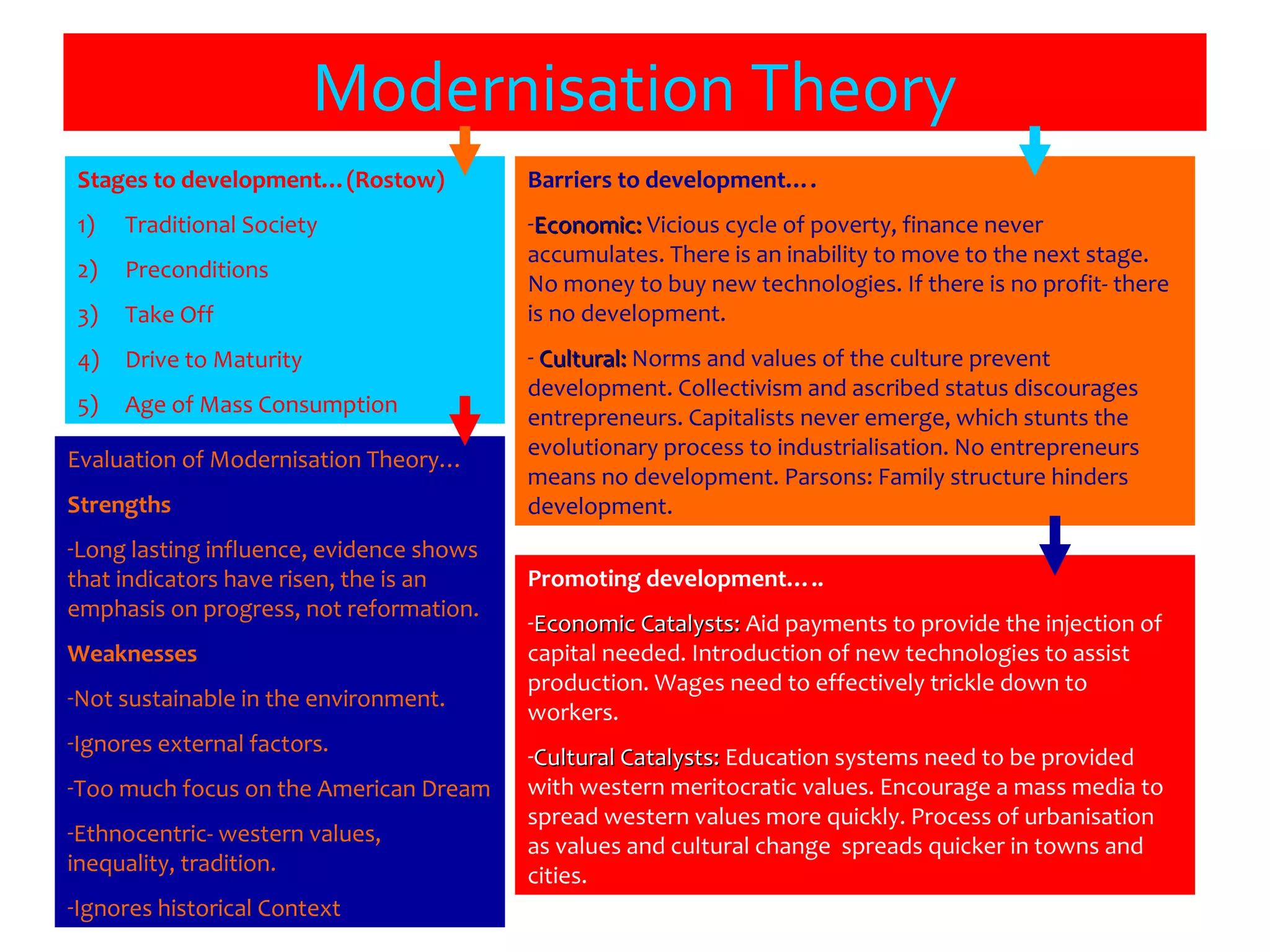
Stages to development…(Rostow)
1) Traditional Society
2) Preconditions
3) Take Off
4) Drive to Maturity
5) Age of Mass Consumption
Barriers to development….
-Economic:Economic: Vicious cycle of poverty, finance never
accumulates. There is an inability to move to the next stage.
No money to buy new technologies. If there is no profit- there
is no development.
- Cultural:Cultural: Norms and values of the culture prevent
development. Collectivism and ascribed status discourages
entrepreneurs. Capitalists never emerge, which stunts the
evolutionary process to industrialisation. No entrepreneurs
means no development. Parsons: Family structure hinders
development.
Promoting development…..
-Economic Catalysts:Economic Catalysts: Aid payments to provide the injection of
capital needed. Introduction of new technologies to assist
production. Wages need to effectively trickle down to
workers.
-Cultural Catalysts:Cultural Catalysts: Education systems need to be provided
with western meritocratic values. Encourage a mass media to
spread western values more quickly. Process of urbanisation
as values and cultural change spreads quicker in towns and
cities.
Evaluation of Modernisation Theory…
Strengths
-Long lasting influence, evidence shows
that indicators have risen, the is an
emphasis on progress, not reformation.
Weaknesses
-Not sustainable in the environment.
-Ignores external factors.
-Too much focus on the American Dream
-Ethnocentric- western values,
inequality, tradition.
-Ignores historical Context
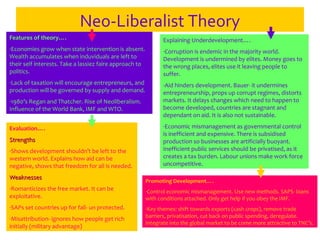
Neo-Liberalist Theory
Features of theory….
-Economies grow when state intervention is absent.
Wealth accumulates when induviduals are left to
their self interests. Take a lassiez faire approach to
politics.
-Lack of taxation will encourage entrepreneurs, and
production will be governed by supply and demand.
-1980’s Regan and Thatcher. Rise of Neoliberalism.
Influence of the World Bank, IMF and WTO.
Evaluation….
StrengthsStrengths
-Shows development shouldn’t be left to the
western world. Explains how aid can be
negative, shows that freedom for all is needed.
WeaknessesWeaknesses
-Romanticizes the free market. It can be
exploitative.
-SAPs set countries up for fall- un protected.
-Misattribution- ignores how people get rich
initially (military advantage)
Promoting Development….
-Control economic mismanagement. Use new methods. SAPS- loans
with conditions attached. Only get help if you obey the IMF.
-Key themes: shift towards exports (cash crops), remove trade
barriers, privatisation, cut back on public spending, deregulate.
Integrate into the global market to be come more attractive to TNC’s.
Explaining Underdevelopment….
-Corruption is endemic in the majority world.
Development is undermined by elites. Money goes to
the wrong places, elites use it leaving people to
suffer.
-Aid hinders development. Bauer- it undermines
entrepreneurship, props up corrupt regimes, distorts
markets. It delays changes which need to happen to
become developed, countries are stagnant and
dependant on aid. It is also not sustainable.
-Economic mismanagement as governmental control
is inefficient and expensive. There is subsidised
production so businesses are artificially buoyant.
Inefficient public services should be privatised, as it
creates a tax burden. Labour unions make work force
uncompetitive.
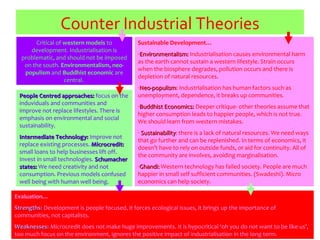
Counter Industrial Theories
Critical of western models to
development. Industrialisation is
problematic, and should not be imposed
on the south. Environmentalism, neo-
populism and Buddhist economic are
central.
Evaluation…
Strengths:Strengths: Development is people focused, it forces ecological issues, it brings up the importance of
communities, not capitalists.
Weaknesses:Weaknesses: Microcredit does not make huge improvements. It is hypocritical ‘oh you do not want to be like us’,
too much focus on the environment, ignores the positive impact of industrialisation in the long term.
People Centred approaches:People Centred approaches: focus on the
induviduals and communities and
improve not replace lifestyles. There is
emphasis on environmental and social
sustainability.
Intermediate Technology:Intermediate Technology: Improve not
replace existing processes. Microcredit:Microcredit:
small loans to help businesses lift off.
Invest in small technologies. SchumacherSchumacher
states:states: We need creativity and not
consumption. Previous models confused
well being with human well being.
Sustainable Development…
-Environmentalism:Environmentalism: Industrialisation causes environmental harm
as the earth cannot sustain a western lifestyle. Strain occurs
when the biosphere degrades, pollution occurs and there is
depletion of natural resources.
-Neo-populismNeo-populism: Industrialisation has human factors such as
unemployment, dependence, it breaks up communities.
-Buddhist Economics:Buddhist Economics: Deeper critique- other theories assume that
higher consumption leads to happier people, which is not true.
We should learn from western mistakes.
- SustainabilitySustainability: there is a lack of natural resources. We need ways
that go further and can be replenished. In terms of economics, it
doesn’t have to rely on outside funds, or aid for continuity. All of
the community are involves, avoiding marginalisation.
-Ghandi:Ghandi: Western technology has failed society. People are much
happier in small self sufficient communities. (Swadeshi). Micro
economics can help society.
Dependency Theory
Evaluation….
Strengths:Strengths: Blames the west, not the poor themselves. Sees nations as interconnected, interrogates the route of
poverty at a deep level.
Weaknesses:Weaknesses: It provides no strategy out of poverty. It doesn’t explain why some have succeeded whilst being a
satellite, and why some have issues without colonial powers. Dependence is not always a bad thing.
Neo-colonialism…Neo-colonialism…
-Colonies break away
but damage still
remains as they are still
dependant, and
exploitation continues
to occur.
-Ex colonies remain a
source of cheap labour
and resources.
-Prices are in a
downward spiral.
-Chain of exploitation:
rich nations
(metropolis) still
exploit poor nations
(satellites) .
Mercantile Capitalism:Mercantile Capitalism: Informal exploitative relationships are established by
explorers. They establish trade routes, but due to military strength, the west
benefited. The explorers found that there were areas with established lifestyles.
The slave triangle begins. Goods from the west are sold at an African port. The
ships are then filled with slaves who are taken to the Caribbean to be sold. Wealth
in the south is exported through exploitation of natural and human resources.
Colonialism:Colonialism: Formalised exploitative relationships. Rich nations took control of the
countries and regions, dividing up existing nations, cultures and tribes (divide and
rule) . E.g. the scramble for Africa. 100,000 areas were amalgamated into 40
European colonies. Social. Economic, Political systems collapse.
-Economic:Economic: Agricultural production changed into what powers wanted. Craftsmen
lost their jobs, and couldn't compete with mass production. Cultural:Cultural: Existing beliefs
are replaced with new technology and civilised cultures. Education and language was
destroyed. Places became reliant on powers for knowledge. PPolitical:olitical: Governing
structure was reshaped as an extension of imperial power. Families were ripped
apart and those who had feuds were forced together. Caused a genocide in Rwanda
1994.
-World remains impoverished, nations are dependant on powers, lack of institutions.
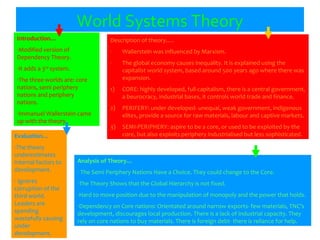
World Systems Theory
Introduction…
-Modified version of
Dependency Theory.
-It adds a 3rd
system.
-The three worlds are: core
nations, semi periphery
nations and periphery
nations.
-Immanuel Wallerstein came
up with the theory.
Evaluation…
-The theory
underestimates
internal factors to
development.
- Ignores
corruption of the
third world.
Leaders are
spending
wastefully causing
under
development.
Analysis of Theory…
- The Semi Periphery Nations Have a Choice. They could change to the Core.
-The Theory Shows that the Global Hierarchy is not fixed.
-Hard to move position due to the manipulation of monopoly and the power that holds.
-Dependency on Core nations: Orientated around narrow exports- few materials, TNC’s
development, discourages local production. There is a lack of industrial capacity. They
rely on core nations to buy materials. There is foreign debt- there is reliance for help.
Description of theory….
- Wallerstein was influenced by Marxism.
- The global economy causes inequality. It is explained using the
capitalist world system, based around 500 years ago where there was
expansion.
1) CORE: highly developed, full capitalism, there is a central government,
a beurocracy, industrial bases, it controls world trade and finance.
2) PERIFERY: under developed- unequal, weak government, indigenous
elites, provide a source for raw materials, labour and captive markets.
3) SEMI-PERIPHERY: aspire to be a core, or used to be exploited by the
core, but also exploits periphery industrialised but less sophisticated.
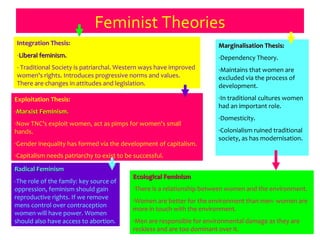
Feminist Theories
Integration Thesis:
-Liberal feminism.Liberal feminism.
- Traditional Society is patriarchal. Western ways have improved
women's rights. Introduces progressive norms and values.
There are changes in attitudes and legislation.
Radical FeminismRadical Feminism
-The role of the family: key source of
oppression, feminism should gain
reproductive rights. If we remove
mens control over contraception
women will have power. Women
should also have access to abortion.
Marginalisation Thesis:Marginalisation Thesis:
-Dependency Theory.
-Maintains that women are
excluded via the process of
development.
-In traditional cultures women
had an important role.
-Domesticity.
-Colonialism ruined traditional
society, as has modernisation.
Exploitation Thesis:
-Marxist Feminism.Marxist Feminism.
-Now TNC’s exploit women, act as pimps for women's small
hands.
-Gender inequality has formed via the development of capitalism.
-Capitalism needs patriarchy to exist to be successful.
Ecological FeminismEcological Feminism
-There is a relationship between women and the environment.
-Women are better for the environment than men- women are
more in touch with the environment.
-Men are responsible for environmental damage as they are
reckless and are too dominant over it.
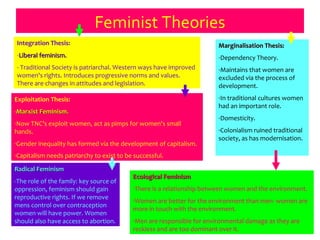
Feminist Theories
Integration Thesis:
-Liberal feminism.Liberal feminism.
- Traditional Society is patriarchal. Western ways have improved
women's rights. Introduces progressive norms and values.
There are changes in attitudes and legislation.
Radical FeminismRadical Feminism
-The role of the family: key source of
oppression, feminism should gain
reproductive rights. If we remove
mens control over contraception
women will have power. Women
should also have access to abortion.
Marginalisation Thesis:Marginalisation Thesis:
-Dependency Theory.
-Maintains that women are
excluded via the process of
development.
-In traditional cultures women
had an important role.
-Domesticity.
-Colonialism ruined traditional
society, as has modernisation.
Exploitation Thesis:
-Marxist Feminism.Marxist Feminism.
-Now TNC’s exploit women, act as pimps for women's small
hands.
-Gender inequality has formed via the development of capitalism.
-Capitalism needs patriarchy to exist to be successful.
Ecological FeminismEcological Feminism
-There is a relationship between women and the environment.
-Women are better for the environment than men- women are
more in touch with the environment.
-Men are responsible for environmental damage as they are
reckless and are too dominant over it.

Theories for World Sociology (Global Development)

  • 1.
    Modernisation Theory Stages todevelopment…(Rostow) 1) Traditional Society 2) Preconditions 3) Take Off 4) Drive to Maturity 5) Age of Mass Consumption Barriers to development…. -Economic:Economic: Vicious cycle of poverty, finance never accumulates. There is an inability to move to the next stage. No money to buy new technologies. If there is no profit- there is no development. - Cultural:Cultural: Norms and values of the culture prevent development. Collectivism and ascribed status discourages entrepreneurs. Capitalists never emerge, which stunts the evolutionary process to industrialisation. No entrepreneurs means no development. Parsons: Family structure hinders development. Promoting development….. -Economic Catalysts:Economic Catalysts: Aid payments to provide the injection of capital needed. Introduction of new technologies to assist production. Wages need to effectively trickle down to workers. -Cultural Catalysts:Cultural Catalysts: Education systems need to be provided with western meritocratic values. Encourage a mass media to spread western values more quickly. Process of urbanisation as values and cultural change spreads quicker in towns and cities. Evaluation of Modernisation Theory… Strengths -Long lasting influence, evidence shows that indicators have risen, the is an emphasis on progress, not reformation. Weaknesses -Not sustainable in the environment. -Ignores external factors. -Too much focus on the American Dream -Ethnocentric- western values, inequality, tradition. -Ignores historical Context
  • 2.
    Neo-Liberalist Theory Features oftheory…. -Economies grow when state intervention is absent. Wealth accumulates when induviduals are left to their self interests. Take a lassiez faire approach to politics. -Lack of taxation will encourage entrepreneurs, and production will be governed by supply and demand. -1980’s Regan and Thatcher. Rise of Neoliberalism. Influence of the World Bank, IMF and WTO. Evaluation…. StrengthsStrengths -Shows development shouldn’t be left to the western world. Explains how aid can be negative, shows that freedom for all is needed. WeaknessesWeaknesses -Romanticizes the free market. It can be exploitative. -SAPs set countries up for fall- un protected. -Misattribution- ignores how people get rich initially (military advantage) Promoting Development…. -Control economic mismanagement. Use new methods. SAPS- loans with conditions attached. Only get help if you obey the IMF. -Key themes: shift towards exports (cash crops), remove trade barriers, privatisation, cut back on public spending, deregulate. Integrate into the global market to be come more attractive to TNC’s. Explaining Underdevelopment…. -Corruption is endemic in the majority world. Development is undermined by elites. Money goes to the wrong places, elites use it leaving people to suffer. -Aid hinders development. Bauer- it undermines entrepreneurship, props up corrupt regimes, distorts markets. It delays changes which need to happen to become developed, countries are stagnant and dependant on aid. It is also not sustainable. -Economic mismanagement as governmental control is inefficient and expensive. There is subsidised production so businesses are artificially buoyant. Inefficient public services should be privatised, as it creates a tax burden. Labour unions make work force uncompetitive.
  • 3.
    Counter Industrial Theories Criticalof western models to development. Industrialisation is problematic, and should not be imposed on the south. Environmentalism, neo- populism and Buddhist economic are central. Evaluation… Strengths:Strengths: Development is people focused, it forces ecological issues, it brings up the importance of communities, not capitalists. Weaknesses:Weaknesses: Microcredit does not make huge improvements. It is hypocritical ‘oh you do not want to be like us’, too much focus on the environment, ignores the positive impact of industrialisation in the long term. People Centred approaches:People Centred approaches: focus on the induviduals and communities and improve not replace lifestyles. There is emphasis on environmental and social sustainability. Intermediate Technology:Intermediate Technology: Improve not replace existing processes. Microcredit:Microcredit: small loans to help businesses lift off. Invest in small technologies. SchumacherSchumacher states:states: We need creativity and not consumption. Previous models confused well being with human well being. Sustainable Development… -Environmentalism:Environmentalism: Industrialisation causes environmental harm as the earth cannot sustain a western lifestyle. Strain occurs when the biosphere degrades, pollution occurs and there is depletion of natural resources. -Neo-populismNeo-populism: Industrialisation has human factors such as unemployment, dependence, it breaks up communities. -Buddhist Economics:Buddhist Economics: Deeper critique- other theories assume that higher consumption leads to happier people, which is not true. We should learn from western mistakes. - SustainabilitySustainability: there is a lack of natural resources. We need ways that go further and can be replenished. In terms of economics, it doesn’t have to rely on outside funds, or aid for continuity. All of the community are involves, avoiding marginalisation. -Ghandi:Ghandi: Western technology has failed society. People are much happier in small self sufficient communities. (Swadeshi). Micro economics can help society.
  • 4.
    Dependency Theory Evaluation…. Strengths:Strengths: Blamesthe west, not the poor themselves. Sees nations as interconnected, interrogates the route of poverty at a deep level. Weaknesses:Weaknesses: It provides no strategy out of poverty. It doesn’t explain why some have succeeded whilst being a satellite, and why some have issues without colonial powers. Dependence is not always a bad thing. Neo-colonialism…Neo-colonialism… -Colonies break away but damage still remains as they are still dependant, and exploitation continues to occur. -Ex colonies remain a source of cheap labour and resources. -Prices are in a downward spiral. -Chain of exploitation: rich nations (metropolis) still exploit poor nations (satellites) . Mercantile Capitalism:Mercantile Capitalism: Informal exploitative relationships are established by explorers. They establish trade routes, but due to military strength, the west benefited. The explorers found that there were areas with established lifestyles. The slave triangle begins. Goods from the west are sold at an African port. The ships are then filled with slaves who are taken to the Caribbean to be sold. Wealth in the south is exported through exploitation of natural and human resources. Colonialism:Colonialism: Formalised exploitative relationships. Rich nations took control of the countries and regions, dividing up existing nations, cultures and tribes (divide and rule) . E.g. the scramble for Africa. 100,000 areas were amalgamated into 40 European colonies. Social. Economic, Political systems collapse. -Economic:Economic: Agricultural production changed into what powers wanted. Craftsmen lost their jobs, and couldn't compete with mass production. Cultural:Cultural: Existing beliefs are replaced with new technology and civilised cultures. Education and language was destroyed. Places became reliant on powers for knowledge. PPolitical:olitical: Governing structure was reshaped as an extension of imperial power. Families were ripped apart and those who had feuds were forced together. Caused a genocide in Rwanda 1994. -World remains impoverished, nations are dependant on powers, lack of institutions.
  • 5.
    World Systems Theory Introduction… -Modifiedversion of Dependency Theory. -It adds a 3rd system. -The three worlds are: core nations, semi periphery nations and periphery nations. -Immanuel Wallerstein came up with the theory. Evaluation… -The theory underestimates internal factors to development. - Ignores corruption of the third world. Leaders are spending wastefully causing under development. Analysis of Theory… - The Semi Periphery Nations Have a Choice. They could change to the Core. -The Theory Shows that the Global Hierarchy is not fixed. -Hard to move position due to the manipulation of monopoly and the power that holds. -Dependency on Core nations: Orientated around narrow exports- few materials, TNC’s development, discourages local production. There is a lack of industrial capacity. They rely on core nations to buy materials. There is foreign debt- there is reliance for help. Description of theory…. - Wallerstein was influenced by Marxism. - The global economy causes inequality. It is explained using the capitalist world system, based around 500 years ago where there was expansion. 1) CORE: highly developed, full capitalism, there is a central government, a beurocracy, industrial bases, it controls world trade and finance. 2) PERIFERY: under developed- unequal, weak government, indigenous elites, provide a source for raw materials, labour and captive markets. 3) SEMI-PERIPHERY: aspire to be a core, or used to be exploited by the core, but also exploits periphery industrialised but less sophisticated.
  • 6.
    Feminist Theories Integration Thesis: -Liberalfeminism.Liberal feminism. - Traditional Society is patriarchal. Western ways have improved women's rights. Introduces progressive norms and values. There are changes in attitudes and legislation. Radical FeminismRadical Feminism -The role of the family: key source of oppression, feminism should gain reproductive rights. If we remove mens control over contraception women will have power. Women should also have access to abortion. Marginalisation Thesis:Marginalisation Thesis: -Dependency Theory. -Maintains that women are excluded via the process of development. -In traditional cultures women had an important role. -Domesticity. -Colonialism ruined traditional society, as has modernisation. Exploitation Thesis: -Marxist Feminism.Marxist Feminism. -Now TNC’s exploit women, act as pimps for women's small hands. -Gender inequality has formed via the development of capitalism. -Capitalism needs patriarchy to exist to be successful. Ecological FeminismEcological Feminism -There is a relationship between women and the environment. -Women are better for the environment than men- women are more in touch with the environment. -Men are responsible for environmental damage as they are reckless and are too dominant over it.
  • 7.
    Feminist Theories Integration Thesis: -Liberalfeminism.Liberal feminism. - Traditional Society is patriarchal. Western ways have improved women's rights. Introduces progressive norms and values. There are changes in attitudes and legislation. Radical FeminismRadical Feminism -The role of the family: key source of oppression, feminism should gain reproductive rights. If we remove mens control over contraception women will have power. Women should also have access to abortion. Marginalisation Thesis:Marginalisation Thesis: -Dependency Theory. -Maintains that women are excluded via the process of development. -In traditional cultures women had an important role. -Domesticity. -Colonialism ruined traditional society, as has modernisation. Exploitation Thesis: -Marxist Feminism.Marxist Feminism. -Now TNC’s exploit women, act as pimps for women's small hands. -Gender inequality has formed via the development of capitalism. -Capitalism needs patriarchy to exist to be successful. Ecological FeminismEcological Feminism -There is a relationship between women and the environment. -Women are better for the environment than men- women are more in touch with the environment. -Men are responsible for environmental damage as they are reckless and are too dominant over it.