Globalisation, Green Crime,
Human Rights and State Crimes
Lesson Objectives
• To understand the ways in which globalisation
  and crime are related.
• To investigate what Sociologists can tell us
  about green crime
• Look at the relationship between state crimes
  and human rights
•   Globalisation- refers to the increasing
    Interconnectedness of societies: what
    happens in one locality is shaped by distant
    events and vice versa
•   Globalisation has many causes including the
    spread of new ICT and the influence of the
    global mass media, cheap air travel and the
    deregulation of financial and other markets
Activity
• Using the globalisation and crime starter sheet
  link up the type of crime to its definition.
The global criminal economy
• Held et al claimed that there had been a
  globalisation of crime. The increasing
  interconnectedness of crime across national
  borders, and the spread of transnational
  organised crime.
• Globalisation creates new opportunities for
  crime, new means of committing crime and
  new offences e.g. Various cyber crimes
• Castells (1998) argues there is a global
  criminal economy worth over £1 trillion per
  annum
• There is both a demand side (West) and a
  supply side (Third World Countries)
• The global criminal economy could not
  function without a supply side that provides
  drugs, sex workers etc

• This takes many forms:
Arms and nuclear material trafficking
Trafficking and smuggling people
Trafficking body parts


An estimated 2,000 organs are taken from criminals in
                       China.
Sex tourism
Cyber crime
Green Crimes
Smuggling of Illegal Goods
International Terrorism
Trafficking cultural artefacts
Trafficking endangered species
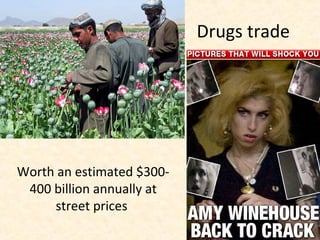
Drugs trade


Worth an estimated $300-
 400 billion annually at
     street prices
Money Laundering
Global Risk Consciousness
• Globalisation creates new insecurities or ‘risk
  consciousness’. Risk is seen as global rather than tied
  to particular places e.g. Economic migrants and asylum
  seekers fleeing persecution have given rise to anxieties
  in western countries about risks of C&D and need to
  protect borders
• Along with media creating moral panics- negative coverage
  of immigrants- leads to hate crimes
• Leading to intensification of social control at the
  national level- UK tightening border controls
• Another result of globalised risk is the increased
  attempts at international cooperation & control in
  various ‘wars’ on terror, drugs & crime
Globalisation, Capitalism and Crime
• From a Marxist perspective, Taylor (1997) argues
  that by giving free reign to market forces
  globalisation has led to greater inequality and
  rising crime
• Transactional corporations (TNCs) can now
  switch manufacturing to low wage countries to
  gain higher profits, producing job insecurity,
  unemployment and poverty
• Deregulation means government have little
  control over their own economies (create jobs & raise taxes)
  and state spending on welfare has declined
• Marketisation has encouraged people to see
  themselves as individual consumers, calculating
  the personal costs and benefits of each action,
  undermining social cohesion
• The increasingly materialistic culture promoted
  by the global media portrays success in terms of
  a lifestyle of consumption
• These factors create insecurity and widening
  inequalities that encourage people to turn to
  crime e.g. lucrative drug trade (Deindustrialisation in LA
  led to growth of drug gangs)
• For the elite globalisation creates large scale
  criminal opportunities e.g. Deregulation of
  financial markets creates opportunities for
  insider trading and tax evasion

• Globalisation also led to new employment
  patterns creating new opportunities for crime
  e.g. Using subcontracting to recruit ‘flexible’
  workers often working illegally or for less than
  minimum wage or working in breach of H&S
  or labour laws
Patterns of Criminal Organisation
• As globalisation creates new criminal
  opportunities, it is also giving rise to new
  forms of criminal organisation:
1.‘Glocal’ organisation- Hobbs & Dunningham
  found that the way crime is organised is linked
  to globalisation. It involves individuals with
  contacts acting as a ‘hub’ around which a
  loose-knit network forms, often linking
  legitimate and illegitimate activities.
• This is different from rigid hierarchical ‘Mafia’
  style criminal organisations of the past
• These new forms of organisation have global
  links (e.g. Drug smuggling) but crime is still
  rooted in its local context (still need local
  contacts and networks to find opportunities
  and to sell their drugs).
• Concluding that crime works as a ‘glocal’
  system- locally based, but with global connections
Organised crime and Globalisation (McMafia)
2. McMafia- refers to the organisations that emerged
   in Russia & Eastern Europe following the fall of
   communism (which was a major factor in the process
   of globalisation).
• The new Russian government deregulated much of
   the economy, leading to huge rises in food prices and
   rents
• However commodity prices (for oil, gas, metals etc)
   were kept at old prices (lower than world market
   price). Therefore well connected citizens with access
   to large funds could buy these up very cheaply and
   sell them on the world market (selling at profit-
   creating Russia’s new capitalist class ‘oligarchs’)
• To protect themselves from increasing
  disorder oligarchs turned to the new ‘mafias’
  (ex-state security/secret servicemen from old
  communist regimes).
• With their assistance the oligarchs were able
  to find protection for their wealth and a
  means of moving it out of the country
• These criminal organisations were vital for the
  entry of the new Russian capitalist class into
  the world economy
ACTIVITY
• Summarise Globalisation and Crime in
  100 words
H/W
• http://www.bbc.co.uk/worldservice/programmes/global_

• Here you will find short articles about different aspects
  of global crime.
• As a group, you should each choose one of these to
  investigate.
• Make sure you understand the details of your chosen
  case and then take it in turns to summarise your case as
  a presentation to the group.
Essay practice
Item B : In today’s society we learn about crime and deviance largely
from the mass media. Unfortunately, however, the image we are given
is often an inaccurate one. While we might expect fictional portrayals of
crime- in films, on TV, in novels and so on- not be an accurate
representation, many sociologists argue that the image presented via
the news media also distorts the reality of crime.
Sociologists are very interested both in the possible causes of these
misrepresentations and also in the effects that they may have on
deviant behaviour

Using material from Item B and elsewhere, assess sociological
explanations of the media representations of crime and their effects (21
marks)
Globalisation                  Transnational crime               Risk consciousness

Definition: The way in         Greater communication and         Increased terrorism has
which we seem to live in an    travel have made the drugs        increased our awareness
increasingly ‘shrinking        industry extend beyond            of the international risks
world’, where societies are    national boundaries. Often        we face and increased
becoming more                  involving many countries the      security at our national
interconnected and             supply comes from south           borders, airports, ports
dependant on each other.       America (Colombia) and its        and train stations.
                               demand from western
                               countries.                        Increased crime
Global crime (1
  trillion)                       Globalisation                  Ian Taylor (1973) Marxist
                                                                 argues that globalisation
 Arms trafficking                and crime
                                                                 has allowed capitalism to
 Smuggling immigrants                                           create more crime by
                              Changing crime
                                                                 exploiting workers abroad
 Trafficking women and
                              Hobbs and Dunningham say           and creating fraud on a
  children                                                       larger scale.
                              crime is now longer local but
 Sex tourism                 ‘Glocal’ meaning it involves       manufacturing products
                              networks of people across the      abroad has led to a lack of
 Cyber-crimes –
                              globe. Gleeny (2008) argues        jobs and opportunities for
  identity theft and child    even the mafia has gone            the working class, which
  porn                        global, it has franchised its      leads them to crime.
 Drugs trade                 businesses to different parts of
                              the globe – McMafia
 Money laundering

Globalisation

  • 1.
    Globalisation, Green Crime, HumanRights and State Crimes
  • 2.
    Lesson Objectives • Tounderstand the ways in which globalisation and crime are related. • To investigate what Sociologists can tell us about green crime • Look at the relationship between state crimes and human rights
  • 3.
    Globalisation- refers to the increasing Interconnectedness of societies: what happens in one locality is shaped by distant events and vice versa • Globalisation has many causes including the spread of new ICT and the influence of the global mass media, cheap air travel and the deregulation of financial and other markets
  • 4.
    Activity • Using theglobalisation and crime starter sheet link up the type of crime to its definition.
  • 5.
    The global criminaleconomy • Held et al claimed that there had been a globalisation of crime. The increasing interconnectedness of crime across national borders, and the spread of transnational organised crime. • Globalisation creates new opportunities for crime, new means of committing crime and new offences e.g. Various cyber crimes
  • 6.
    • Castells (1998)argues there is a global criminal economy worth over £1 trillion per annum • There is both a demand side (West) and a supply side (Third World Countries) • The global criminal economy could not function without a supply side that provides drugs, sex workers etc • This takes many forms:
  • 7.
    Arms and nuclearmaterial trafficking
  • 8.
  • 9.
    Trafficking body parts Anestimated 2,000 organs are taken from criminals in China.
  • 10.
  • 11.
  • 12.
  • 13.
  • 14.
  • 15.
  • 16.
  • 17.
    Drugs trade Worth anestimated $300- 400 billion annually at street prices
  • 18.
  • 19.
    Global Risk Consciousness •Globalisation creates new insecurities or ‘risk consciousness’. Risk is seen as global rather than tied to particular places e.g. Economic migrants and asylum seekers fleeing persecution have given rise to anxieties in western countries about risks of C&D and need to protect borders • Along with media creating moral panics- negative coverage of immigrants- leads to hate crimes • Leading to intensification of social control at the national level- UK tightening border controls • Another result of globalised risk is the increased attempts at international cooperation & control in various ‘wars’ on terror, drugs & crime
  • 20.
    Globalisation, Capitalism andCrime • From a Marxist perspective, Taylor (1997) argues that by giving free reign to market forces globalisation has led to greater inequality and rising crime • Transactional corporations (TNCs) can now switch manufacturing to low wage countries to gain higher profits, producing job insecurity, unemployment and poverty • Deregulation means government have little control over their own economies (create jobs & raise taxes) and state spending on welfare has declined
  • 21.
    • Marketisation hasencouraged people to see themselves as individual consumers, calculating the personal costs and benefits of each action, undermining social cohesion • The increasingly materialistic culture promoted by the global media portrays success in terms of a lifestyle of consumption • These factors create insecurity and widening inequalities that encourage people to turn to crime e.g. lucrative drug trade (Deindustrialisation in LA led to growth of drug gangs)
  • 22.
    • For theelite globalisation creates large scale criminal opportunities e.g. Deregulation of financial markets creates opportunities for insider trading and tax evasion • Globalisation also led to new employment patterns creating new opportunities for crime e.g. Using subcontracting to recruit ‘flexible’ workers often working illegally or for less than minimum wage or working in breach of H&S or labour laws
  • 23.
    Patterns of CriminalOrganisation • As globalisation creates new criminal opportunities, it is also giving rise to new forms of criminal organisation: 1.‘Glocal’ organisation- Hobbs & Dunningham found that the way crime is organised is linked to globalisation. It involves individuals with contacts acting as a ‘hub’ around which a loose-knit network forms, often linking legitimate and illegitimate activities.
  • 24.
    • This isdifferent from rigid hierarchical ‘Mafia’ style criminal organisations of the past • These new forms of organisation have global links (e.g. Drug smuggling) but crime is still rooted in its local context (still need local contacts and networks to find opportunities and to sell their drugs). • Concluding that crime works as a ‘glocal’ system- locally based, but with global connections
  • 25.
    Organised crime andGlobalisation (McMafia)
  • 26.
    2. McMafia- refersto the organisations that emerged in Russia & Eastern Europe following the fall of communism (which was a major factor in the process of globalisation). • The new Russian government deregulated much of the economy, leading to huge rises in food prices and rents • However commodity prices (for oil, gas, metals etc) were kept at old prices (lower than world market price). Therefore well connected citizens with access to large funds could buy these up very cheaply and sell them on the world market (selling at profit- creating Russia’s new capitalist class ‘oligarchs’)
  • 27.
    • To protectthemselves from increasing disorder oligarchs turned to the new ‘mafias’ (ex-state security/secret servicemen from old communist regimes). • With their assistance the oligarchs were able to find protection for their wealth and a means of moving it out of the country • These criminal organisations were vital for the entry of the new Russian capitalist class into the world economy
  • 28.
  • 29.
    H/W • http://www.bbc.co.uk/worldservice/programmes/global_ • Hereyou will find short articles about different aspects of global crime. • As a group, you should each choose one of these to investigate. • Make sure you understand the details of your chosen case and then take it in turns to summarise your case as a presentation to the group.
  • 30.
    Essay practice Item B: In today’s society we learn about crime and deviance largely from the mass media. Unfortunately, however, the image we are given is often an inaccurate one. While we might expect fictional portrayals of crime- in films, on TV, in novels and so on- not be an accurate representation, many sociologists argue that the image presented via the news media also distorts the reality of crime. Sociologists are very interested both in the possible causes of these misrepresentations and also in the effects that they may have on deviant behaviour Using material from Item B and elsewhere, assess sociological explanations of the media representations of crime and their effects (21 marks)
  • 31.
    Globalisation Transnational crime Risk consciousness Definition: The way in Greater communication and Increased terrorism has which we seem to live in an travel have made the drugs increased our awareness increasingly ‘shrinking industry extend beyond of the international risks world’, where societies are national boundaries. Often we face and increased becoming more involving many countries the security at our national interconnected and supply comes from south borders, airports, ports dependant on each other. America (Colombia) and its and train stations. demand from western countries. Increased crime Global crime (1 trillion) Globalisation Ian Taylor (1973) Marxist argues that globalisation  Arms trafficking and crime has allowed capitalism to  Smuggling immigrants create more crime by Changing crime exploiting workers abroad  Trafficking women and Hobbs and Dunningham say and creating fraud on a children larger scale. crime is now longer local but  Sex tourism ‘Glocal’ meaning it involves manufacturing products networks of people across the abroad has led to a lack of  Cyber-crimes – globe. Gleeny (2008) argues jobs and opportunities for identity theft and child even the mafia has gone the working class, which porn global, it has franchised its leads them to crime.  Drugs trade businesses to different parts of the globe – McMafia  Money laundering

Editor's Notes

  • #2 http://news.bbc.co.uk/hi/english/static/in_depth/uk/2001/life_of_crime/crime.stm What is the key factor of globalisation? What is meant by transnational crime? What is transnational organised crime? How do Hobbs and Dunningham show evidence of organised crime in Britain? How do Hobbs and Dunningham point out that organised crime is still local at all points? How has critical criminology showed that changes in a political economy has effected crime? What three changes in the political economy has shaped crime did Taylor identify? Explain how Davis used the political economy and the drugs trade in Los Angeles to show Taylors changes. Using Currie, show how policies of national governments can affect criminal activity within their national boundaries. Extension questions Which do you think has had the biggest affect on crime today, local government policies or globalisation? Is this type of crime being shown as more common than ‘normal’ crime today? Why?
  • #4 It describes the process by which regional economies, societies, and cultures have become integrated through communication, transportation, and trade Globalisation: refers to the idea that the world is shrinking in a social, cultural and economic sense.
  • #5 1 Arms trafficking 2 Smuggling of illegal immigrants 3 Sex tourism 4 Trafficking body parts 5 Cyber-crimes 6 Green crimes 7 International terrorism 8 Smuggling of legal goods 9 Money laundering 10 Trafficking of endangered species 11 The drugs trade 12 Trafficking of cultural artefacts 3 Where westerners travel to Third World countries for sex. 6 Damaging the environment. 11 Smuggled to feed the western drug habit. 7 Much of terrorism is now based on ideological links made via the internet. 4 For organ transplants in rich countries. 9 The profits of organised crimes. 1 Selling weapons to illegal regimes. 12 Includes works of art having been stolen to order. 10 To use for pets and traditional medicines. 8 Such as tobacco and alcohol to evade customs. 5 Such as identity theft and child pornography. 2 Often linked to prostitution and slavery.
  • #8 To illegal regimes, guerrilla groups and terrorists
  • #9 Chinese Triads make an estimated $2.5 billion annually
  • #10 For organ transplants in rich countries
  • #11 Westerners travel to 3 rd world countries for sex, sometimes involving minors
  • #12 Such as identity theft and child pornography
  • #13 That damage the environment e.g. Illegal dumping of toxic waste in 3 rd world countries
  • #14 Alcohol and tobacco, to evade taxes and of stolen goods such as cars to sell in foreign markets
  • #15 Much terrorism is now based on ideological links made via the internet and other ICT, rather than on local territorial links as in the past
  • #17 To produce traditional remedies
  • #19 Of the profits from organised crime, estimated at up to 1.5 trillion per year
  • #21 Deregulation is the removal or simplification of government rules and regulations that constrain the operation of market forces. [1] Deregulation does not mean elimination of laws against fraud or property rights but eliminating or reducing government control of how business is done, thereby moving toward a more laissez-faire, free market.
  • #22 Marketisation- is the process that enables the state-owned enterprises to act like market-oriented firms (privatisation) e.g. NHS, Education etc
  • #23 Health and Safety
  • #26 http://www.sociologyexchange.co.uk/videos/view/20348/
  • #27 Communism is a social, political and economic movement that aims at the establishment of a classless and stateless communist society structured upon common ownership of the means of production a commodity is the generic term for any marketable item produced to satisfy wants or needs