These are small scale studies that focus on what happens within schools and the classroom – (that is research that focuses on these areas) – these are known as known as micro or small scale studies From this perspective pupils aren’t simply passive (structuralist ie Feminist) but active – pupils and teachers’ define what happens in the classroom
Hargreaves (1971), Cicourel & Kitsuse (1971), Becker (1971), Keddie (1971) researched how non-academic factors such as speech, dress, personality, enthusiasm for work, influence a teacher’s evaluation of a pupil.  This stereotype is known as the Halo Effect This process also ‘labels’ students e.g. thick, slow, bright, intelligent etc Rosenthal & Jacobson found this created a self-fulfilling prophecy – you become your label
Ball’s research in Beachside Comprehensive looked at the influence of banding or streaming on the pupil/teacher relationship.  Setting and streaming puts children of the same ability together
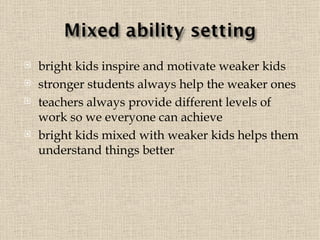
bright kids inspire and motivate weaker kids stronger students always help the weaker ones teachers always provide different levels of work so we everyone can achieve  bright kids mixed with weaker kids helps them understand things better
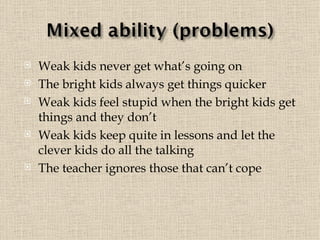
Weak kids never get what’s going on The bright kids always get things quicker Weak kids feel stupid when the bright kids get things and they don’t Weak kids keep quite in lessons and let the clever kids do all the talking The teacher ignores those that can’t cope
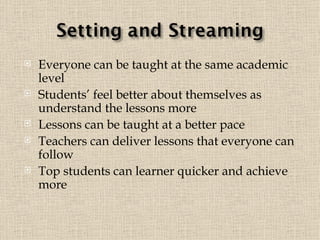
Everyone can be taught at the same academic level   Students’ feel better about themselves as  understand the lessons more Lessons can be taught at a better pace Teachers can deliver lessons that everyone can follow   Top students can learner quicker and achieve more
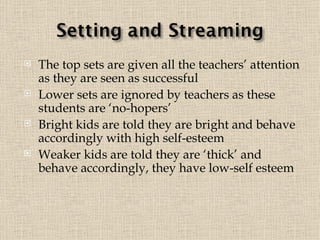
The top sets are given all the teachers’ attention as they are seen as successful Lower sets are ignored by teachers as these students are ‘no-hopers’ Bright kids are told they are bright and behave accordingly with high self-esteem Weaker kids are told they are ‘thick’ and behave accordingly, they have low-self esteem
Rosenthal & Jacobson (1968) looked at the role of self-fulfilling prophecy how people act out the ‘label’ they’ve been given
Willis’ research looked at the anti-school culture or counter school sub-culture created by low achieving boys  In order to achieve a high status by non-academic methods they breaking school rules, mess about etc This relatively small group of boys create their own culture with their own norms & values – a sub-culture

Factors That Affect Attainment In Schools

  • 1.
  • 2.
    These are smallscale studies that focus on what happens within schools and the classroom – (that is research that focuses on these areas) – these are known as known as micro or small scale studies From this perspective pupils aren’t simply passive (structuralist ie Feminist) but active – pupils and teachers’ define what happens in the classroom
  • 3.
    Hargreaves (1971), Cicourel& Kitsuse (1971), Becker (1971), Keddie (1971) researched how non-academic factors such as speech, dress, personality, enthusiasm for work, influence a teacher’s evaluation of a pupil. This stereotype is known as the Halo Effect This process also ‘labels’ students e.g. thick, slow, bright, intelligent etc Rosenthal & Jacobson found this created a self-fulfilling prophecy – you become your label
  • 4.
    Ball’s research inBeachside Comprehensive looked at the influence of banding or streaming on the pupil/teacher relationship. Setting and streaming puts children of the same ability together
  • 5.
    bright kids inspireand motivate weaker kids stronger students always help the weaker ones teachers always provide different levels of work so we everyone can achieve bright kids mixed with weaker kids helps them understand things better
  • 6.
    Weak kids neverget what’s going on The bright kids always get things quicker Weak kids feel stupid when the bright kids get things and they don’t Weak kids keep quite in lessons and let the clever kids do all the talking The teacher ignores those that can’t cope
  • 7.
    Everyone can betaught at the same academic level Students’ feel better about themselves as understand the lessons more Lessons can be taught at a better pace Teachers can deliver lessons that everyone can follow Top students can learner quicker and achieve more
  • 8.
    The top setsare given all the teachers’ attention as they are seen as successful Lower sets are ignored by teachers as these students are ‘no-hopers’ Bright kids are told they are bright and behave accordingly with high self-esteem Weaker kids are told they are ‘thick’ and behave accordingly, they have low-self esteem
  • 9.
    Rosenthal & Jacobson(1968) looked at the role of self-fulfilling prophecy how people act out the ‘label’ they’ve been given
  • 10.
    Willis’ research lookedat the anti-school culture or counter school sub-culture created by low achieving boys In order to achieve a high status by non-academic methods they breaking school rules, mess about etc This relatively small group of boys create their own culture with their own norms & values – a sub-culture