


Hi,
TCP/IP
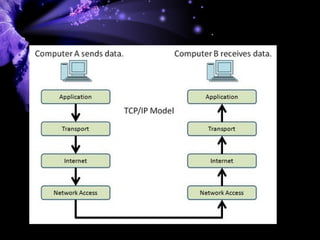
Introduction TCP/IPIntroduction TCP/IP
• The Internet Protocol Suite (commonly known
as TCP/IP) is the set of communications
protocols used for the Internet and other similar
networks.
• It is named from two of the most important protocols
in it:
– the Transmission Control Protocol (TCP) and
– the Internet Protocol (IP), which were the first two
networking protocols defined in this standard.
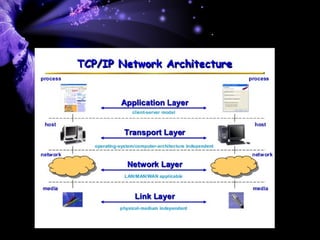
APPLICATION
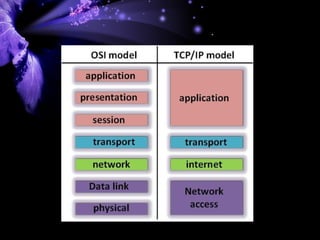
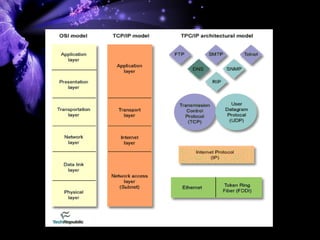
• This layer is comparable to the application,
presentation, and session layers of the OSI model all
combined into one.
• It provides a way for applications to have access to
networked services.
• This layer also contains the high level protocols.
The main issue with this layer is the ability to use
both TCP and UDP protocols.
• For example TFTP uses UDP because usually on a
LAN the physical links are short enough to ensure
quick and reliable packet delivery without many
errors. SMTP instead uses TCP because of the error
checking capabilities.
• Since we consider our email important information
we would like to ensure a safe delivery.
• UDP (User Datagram Protocol) - offering a direct 
way to send and receive datagrams over an IP 
network with very few error recovery services. 
• TFTP (Trivial File Transfer Protocol) - Simplified 
version of the FTP protocol which has no security 
features. 
TRANSPORT
• This layer acts as the delivery service used by the 
application layer.
• Again the two protocols used are TCP and UDP. 
• The choice is made based on the application's 
transmission reliability requirements. 
• The transport layer also handles all error detection 
and recovery.  
• It uses checksums, acknowledgements, and 
timeouts to control transmissions and end to end 
verification. 
•  Unlike the OSI model, TCP/IP treats reliability as an 
end-to-end problem 
INTERNET
• This layer is also known as Internet layer. The main
purpose of this layer is to organize or handle the
movement of data on network.
• By movement of data, we generally mean routing of
data over the network. The main protocol used at
this layer is IP. While ICMP(used by popular ‘ping’
command) and IGMP are also used at this layer.
NETWORK
• This layer is also known as network interface layer
• This layer normally consists of device drivers in the OS
and the network interface card attached to the system.
• Both the device drivers and the network interface card
take care of the communication details with the media
being used to transfer the data over the network.
•
• In most of the cases, this media is in the form of
cables.
• Some of the famous protocols that are used at this
layer include ARP(Address resolution protocol),
PPP(Point to point protocol) etc.
The Internet Protocol Suite (commonly known as TCP/IP)

The Internet Protocol Suite (commonly known as TCP/IP)

  • 1.
  • 2.
  • 3.
    Introduction TCP/IPIntroduction TCP/IP •The Internet Protocol Suite (commonly known as TCP/IP) is the set of communications protocols used for the Internet and other similar networks. • It is named from two of the most important protocols in it: – the Transmission Control Protocol (TCP) and – the Internet Protocol (IP), which were the first two networking protocols defined in this standard.
  • 7.
    APPLICATION • This layeris comparable to the application, presentation, and session layers of the OSI model all combined into one. • It provides a way for applications to have access to networked services. • This layer also contains the high level protocols. The main issue with this layer is the ability to use both TCP and UDP protocols.
  • 8.
    • For exampleTFTP uses UDP because usually on a LAN the physical links are short enough to ensure quick and reliable packet delivery without many errors. SMTP instead uses TCP because of the error checking capabilities. • Since we consider our email important information we would like to ensure a safe delivery.
  • 9.
    • UDP (UserDatagram Protocol) - offering a direct  way to send and receive datagrams over an IP  network with very few error recovery services.  • TFTP (Trivial File Transfer Protocol) - Simplified  version of the FTP protocol which has no security  features. 
  • 11.
    TRANSPORT • This layer acts as the delivery service used by the  application layer. • Again the two protocols used are TCP and UDP.  •The choice is made based on the application's  transmission reliability requirements.  • The transport layer also handles all error detection  and recovery.  
  • 12.
  • 13.
    INTERNET • This layeris also known as Internet layer. The main purpose of this layer is to organize or handle the movement of data on network. • By movement of data, we generally mean routing of data over the network. The main protocol used at this layer is IP. While ICMP(used by popular ‘ping’ command) and IGMP are also used at this layer.
  • 14.
    NETWORK • This layeris also known as network interface layer • This layer normally consists of device drivers in the OS and the network interface card attached to the system. • Both the device drivers and the network interface card take care of the communication details with the media being used to transfer the data over the network. •
  • 15.
    • In mostof the cases, this media is in the form of cables. • Some of the famous protocols that are used at this layer include ARP(Address resolution protocol), PPP(Point to point protocol) etc.