WHY TCP/IP
• TCP/IP, is a suite of protocols used for communication over
the internet.  The TCP/IP model was created after the OSI
7 layer model for two major reasons. 
• First, the foundation of the Internet was built using the
TCP/IP suite and through the spread of the World Wide
Web and Internet, TCP/IP has been preferred. 
• Second, a project researched by the Department of
Defense (DOD) consisted of creating the TCP/IP protocols. 
TCP/IP LAYERS
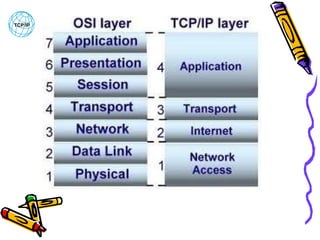
• The TCP/IP model, similar to the OSI
model, is comprised of layers.  It contain
four or five layer.
• Some people use the Application,
Transport, Internet and Network Access
layers. 
• Others split the Network Access layer
into the Physical and Data Link
components.
LAYER 4 - APPLICATION
• This layer is comparable to the application,
presentation, and session layers of the
OSI model. 
• It provides a way for applications to have
access to networked services. 
• This layer also contains the high level
protocols.
• The main issue with this layer is the ability
to use both TCP1 and UDP2 protocols. 
LAYER 3-TRANSPORT
• This layer acts as the delivery service
used by the application layer.   
• The transport layer also handles all error
detection and recovery. 
• It uses checksums, acknowledgements, and
timeouts to control transmissions and end
to end verification. 
• Unlike the OSI model, TCP/IP treats
reliability as an end-to-end problem.
LAYER 2-INTERNET
• The upper layers are responsible for
the reordering of the data. 
• This layer can be compared to the
network layer of the OSI model. 
• IP and ARP6 are the major protocols
used at this layer.
LAYER 1-NETWORK
ACCESS
• This a combination of the Data Link and
Physical layers of the OSI model
• The frame format is dependent on the
system being used, for example Ethernet
LAN, Frame relay9, etc.
• This layer has actually not been specified
in details because it depends on which
technology is being used such as Ethernet. 
• So freedom is given to this layer as far as
implementation is concerned.
TCP/IP
TCP/IP

TCP/IP

  • 3.
    WHY TCP/IP • TCP/IP,is a suite of protocols used for communication over the internet.  The TCP/IP model was created after the OSI 7 layer model for two major reasons.  • First, the foundation of the Internet was built using the TCP/IP suite and through the spread of the World Wide Web and Internet, TCP/IP has been preferred.  • Second, a project researched by the Department of Defense (DOD) consisted of creating the TCP/IP protocols. 
  • 4.
    TCP/IP LAYERS • TheTCP/IP model, similar to the OSI model, is comprised of layers.  It contain four or five layer. • Some people use the Application, Transport, Internet and Network Access layers.  • Others split the Network Access layer into the Physical and Data Link components.
  • 5.
    LAYER 4 -APPLICATION • This layer is comparable to the application, presentation, and session layers of the OSI model.  • It provides a way for applications to have access to networked services.  • This layer also contains the high level protocols. • The main issue with this layer is the ability to use both TCP1 and UDP2 protocols. 
  • 6.
    LAYER 3-TRANSPORT • Thislayer acts as the delivery service used by the application layer.    • The transport layer also handles all error detection and recovery.  • It uses checksums, acknowledgements, and timeouts to control transmissions and end to end verification.  • Unlike the OSI model, TCP/IP treats reliability as an end-to-end problem.
  • 7.
    LAYER 2-INTERNET • Theupper layers are responsible for the reordering of the data.  • This layer can be compared to the network layer of the OSI model.  • IP and ARP6 are the major protocols used at this layer.
  • 8.
    LAYER 1-NETWORK ACCESS • Thisa combination of the Data Link and Physical layers of the OSI model • The frame format is dependent on the system being used, for example Ethernet LAN, Frame relay9, etc. • This layer has actually not been specified in details because it depends on which technology is being used such as Ethernet.  • So freedom is given to this layer as far as implementation is concerned.