Family- Rosaceae
Systematic Position and Vegetative
Characters
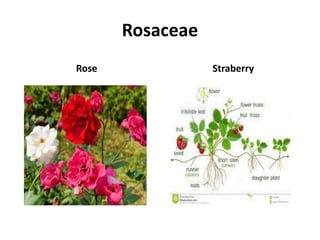
Rosaceae
Rose Straberry
Systematic Position
(Bentham and hooker)
Division- Angiospermae
Class- Dicotyledons
Sub-class- Polyptalae (petals free)
Series- Calyciflorae (calyx gamopetalous)
Order- Rosales
Family- Rosaceae
Distribution
• World wide
• Genera- 115, Species- 3200
• Common in Nepal
Vegetative Characters
• Habit and habitat: may be herb, shrub (Rose) or
trees
• Root: Tap root or adventitious arising from the
underground organs or cuttings
• Stem: herbaceous or woody, erect, cylindrical,
solid, branching, sometimes divided into nodes
and internodes.
• Leaf: Simple or compound, alternate, stipulate,
petiolate, unicostate reticulate venation
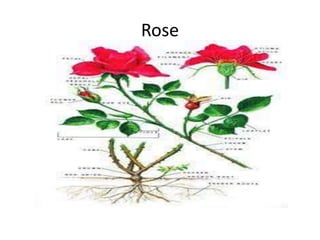
Rose
Some species of Rosaceae
• Rosa rubiginosa (Rose)
• Fragaria ananassa (Strawberry)
• Prunus persica (Peach)
• Prunus dulcis (Almond)
Floral Characters
• Inflorescence: Variable. Solitary, receme,
axillary or cyme, spike like receme
• Flowers: pedicillate, bacteate, bisexual or
unisexual, actinomorphic, hypozygous,
perigynous, epigynous
• Calyx: sepals-5, gamosepalous, imbricate,
valvate astivation
• Corolla: petals- 5, polypetalous,imbricate
astivation, petals are various colours.
• Androecium- Many Stamens, anther are small
and bicell.
• Gynoecium- Consists of many carpels, mostly
apocarpus (free), superior but sometimes
syncarpous and inferior.
• Fruit- variables (berry, pome)
• Floral formula –
Floral diagram
Economic importance of Rosaceae
• It is one of the most economically important
families which comprised the fruit, nut,
ornamental, aroma, herb, and woody plants.
• Edible crops domesticated for human
consumption in Rosaceae include apple,
strawberry, pear, peach, plum, almond, sour
cherry, and sweet cherry.
Reference
• www.tufoe.edu.np
• Pandey, B.P.(2011). A Textbook of Botany
Angiosperm, S. Chand Publishing. New Delhi.
Family- Rosaceae.pptx