Stageoftransition
Phloem
Xylem
The Root-Stem Transition Zone.
Root and stem form a
continuous structure in plants
called the axis.
The vascular tissue in root is
radial (xylem and phloem
arranged separately in different
radii) whereas in the stem is
conjoint (xylem and phloem are
arranged together in same radii
as vascular bundles).
Thus, there should be a region in
the axis where the vascular
structures of the root and the
stem meet and merge together.
This peculiar region is called the
Root-Stem Transition Zone.
• The epidermis, cortex,
endodermis, pericycle and
the secondary vascular tissue
are continuous from root to
stem.
• Only the primary vascular
tissue in the axis undergoes a
change in their position and
orientation.
• The exarch arrangement of
xylem in root changes to
endarch position in the stem.
• In the transition zone, the
vascular tissue undergoes
many changes such as
Forking, Rotation and Fusion.
Stageoftransition
Phloem
Xylem
• The epidermis, cortex,
endodermis, pericycle and
the secondary vascular tissue
are continuous from root to
stem.
• Only the primary vascular
tissue in the axis undergoes a
change in their position and
orientation.
• The exarch arrangement of
xylem in root changes to
endarch position in the stem.
• In the transition zone, the
vascular tissue undergoes
many changes such as
Forking, Rotation and Fusion.
• The vascular tissue also increases
their diameter.
• The exact position of the
transition zone is different in
different plants.
• Usually, the transition zone occurs
at the tip of the radicle or at the
basal or middle or at the top
portion of hypocotyl.
• The length of transition zone also
varies from few millimeters to
several centimeters. The
transition of vascular tissue may
be gradual or abrupt in different
plants.
• The phloem tissue, in most of the
cases, remains more or less same
position.
Stageoftransition
Phloem
Xylem
• The vascular tissue also
increases their diameter.
• The exact position of the
transition zone is different in
different plants.
• Usually, the transition zone
occurs at the tip of the radicle or
at the basal or middle or at the
top portion of hypocotyl.
• The length of transition zone
also varies from few millimeters
to several centimeters.
• The transition of vascular tissue
may be gradual or abrupt in
different plants.
• The phloem tissue, in most of
the cases, remains extra or less
same position.
Different types of Root Stem Transitions are observed in plants
Eames and McDaniel (1947) described FOUR types of root stem
transition in plants.
They are:
(1). Fumaria Type (A – Type)
(2). Cucurbita Type (B – Type)
(3). Lathyrus Type (C – Type)
(4). Anemarrhena Type (D -Type)
FUMARIA TYPE ROOT-STEM TRANSITION
(TYPE A)
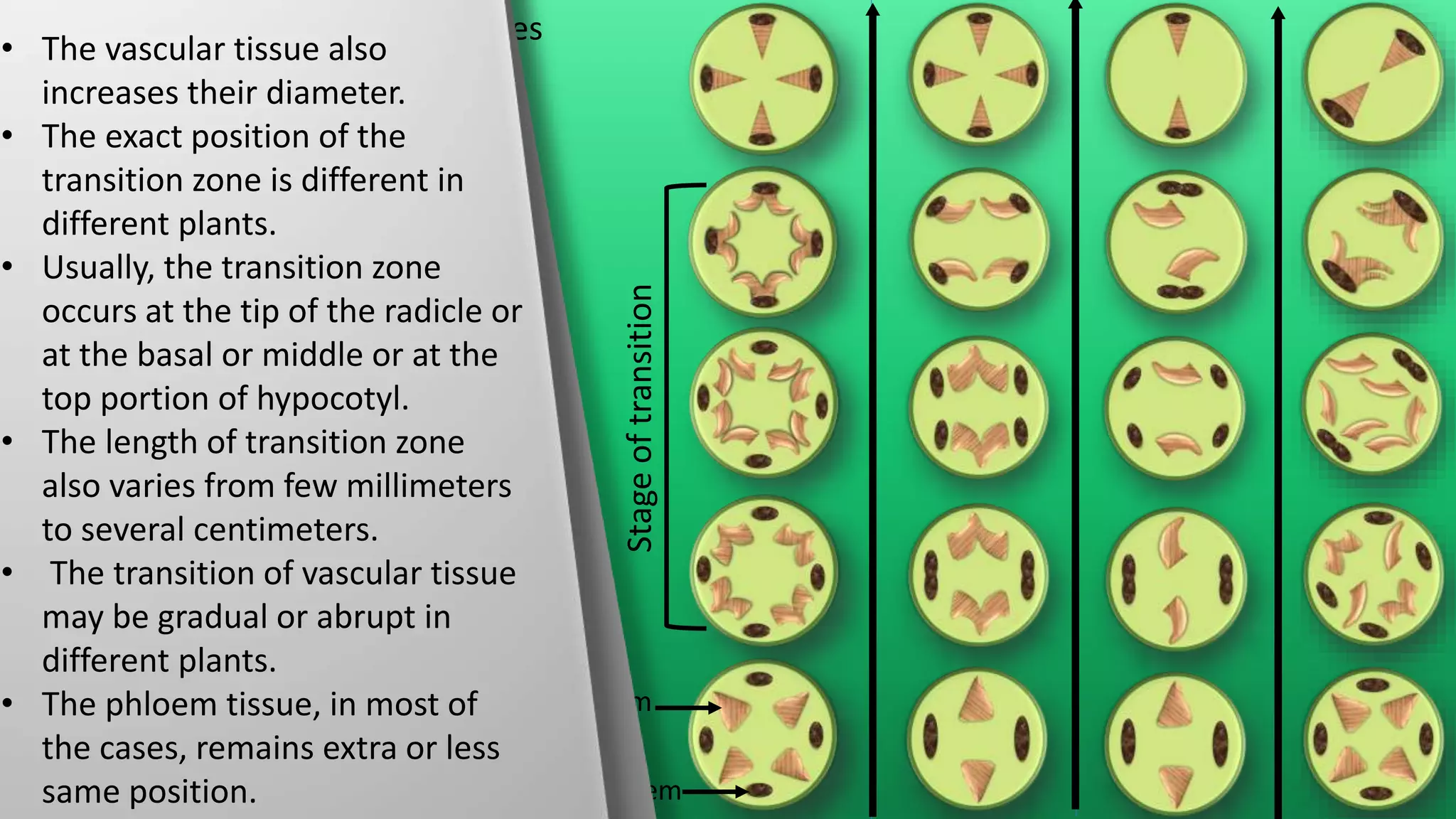
• Occurs in Fumaria, Mirabilis and
Dipsacus.
• Each xylem strands in the root divides
radially into two branches.
• As the branches go upward, they swing
laterally. Among these two branches,
one swing to the right and one swing
to left and join to the phloem strand
inside.
• Phloem strand do not change its
position or orientation and they pass
directly from the root to the stem.
• The number of vascular bundles
formed in the stem will be equal to the
number of phloem strands occurs in
the root.
Stageoftransition
Phloem
Xylem
FUMARIA TYPE ROOT-STEM TRANSITION
(TYPE A)
• Occurs in Fumaria, Mirabilis and
Dipsacus.
• Each xylem strands in the root divides
radially into two branches.
• As the branches go upward, they swing
laterally. Among these two branches,
one swing to the right and one swing
to left and join to the phloem strand
inside.
• Phloem strand do not change its
position or orientation and they pass
directly from the root to the stem.
• The number of vascular bundles
formed in the stem will be equal to the
number of phloem strands occurs in
the root.
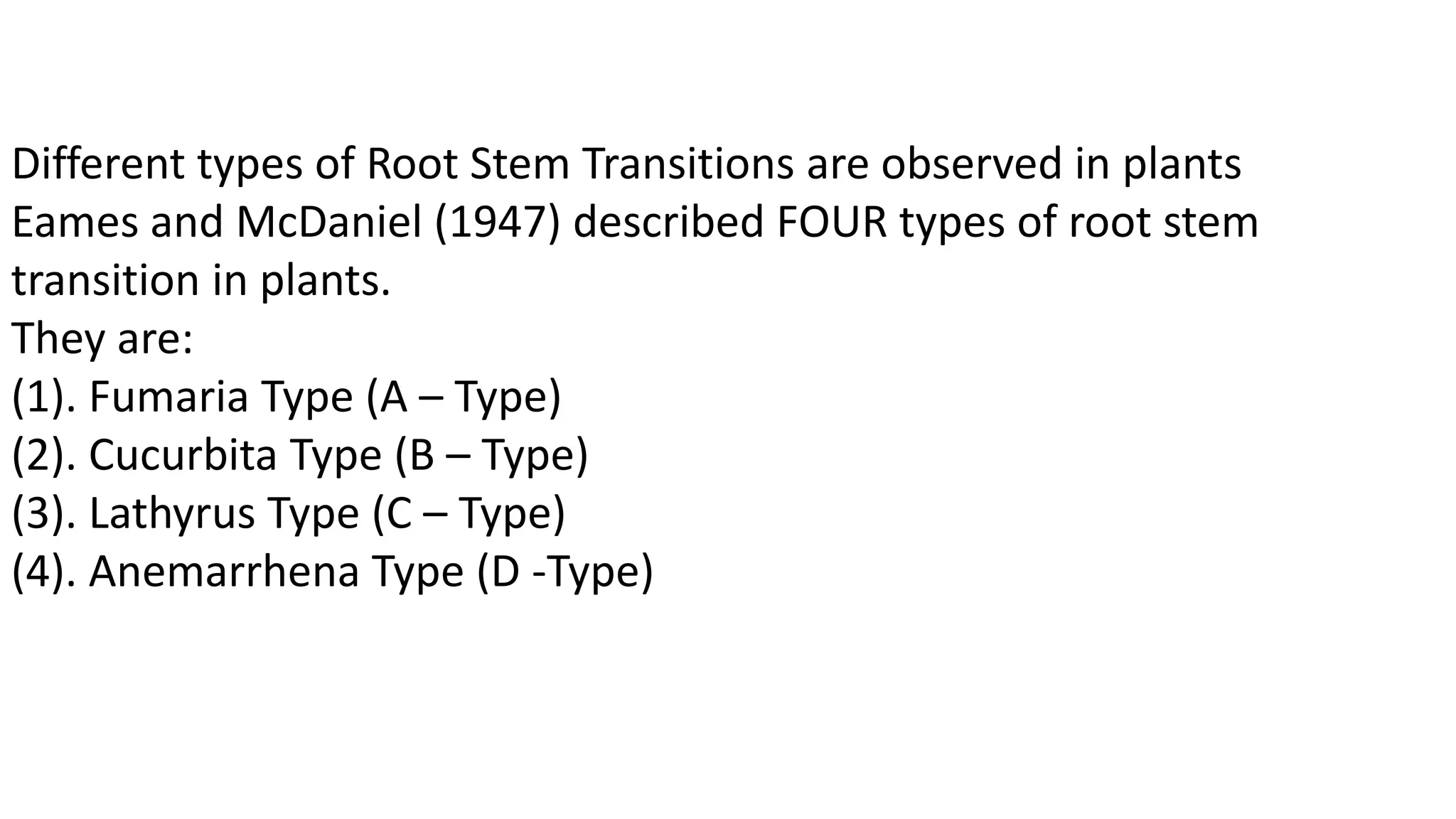
• CUCURBITA TYPE ROOT-STEM
TRANSITION (TYPE B)
• Found in Cucurbita, Acer, Phaseolus
and Tropaeolum.
• In Cucurbita type both the xylem
and phloem strand divide into two
strands.
• Each xylem swing as in Fumaria
type, and join with a strand of
phloem.
• Phloem does not change its
orientation, but the xylem becomes
inverted.
• Number of vascular bundles formed
in the stem will be twice the
number of phloem strands in the
root.
• CUCURBITA TYPE ROOT-STEM
TRANSITION (TYPE B)
• Found in Cucurbita, Acer, Phaseolus
and Tropaeolum.
• In Cucurbita type both the xylem
and phloem strand divide into two
strands.
• Each xylem swing as in Fumaria
type, and join with a strand of
phloem.
• Phloem does not change its
orientation, but the xylem becomes
inverted.
• Number of vascular bundles formed
in the stem will be twice the
number of phloem strands in the
root.
Stageoftransition
Phloem
Xylem
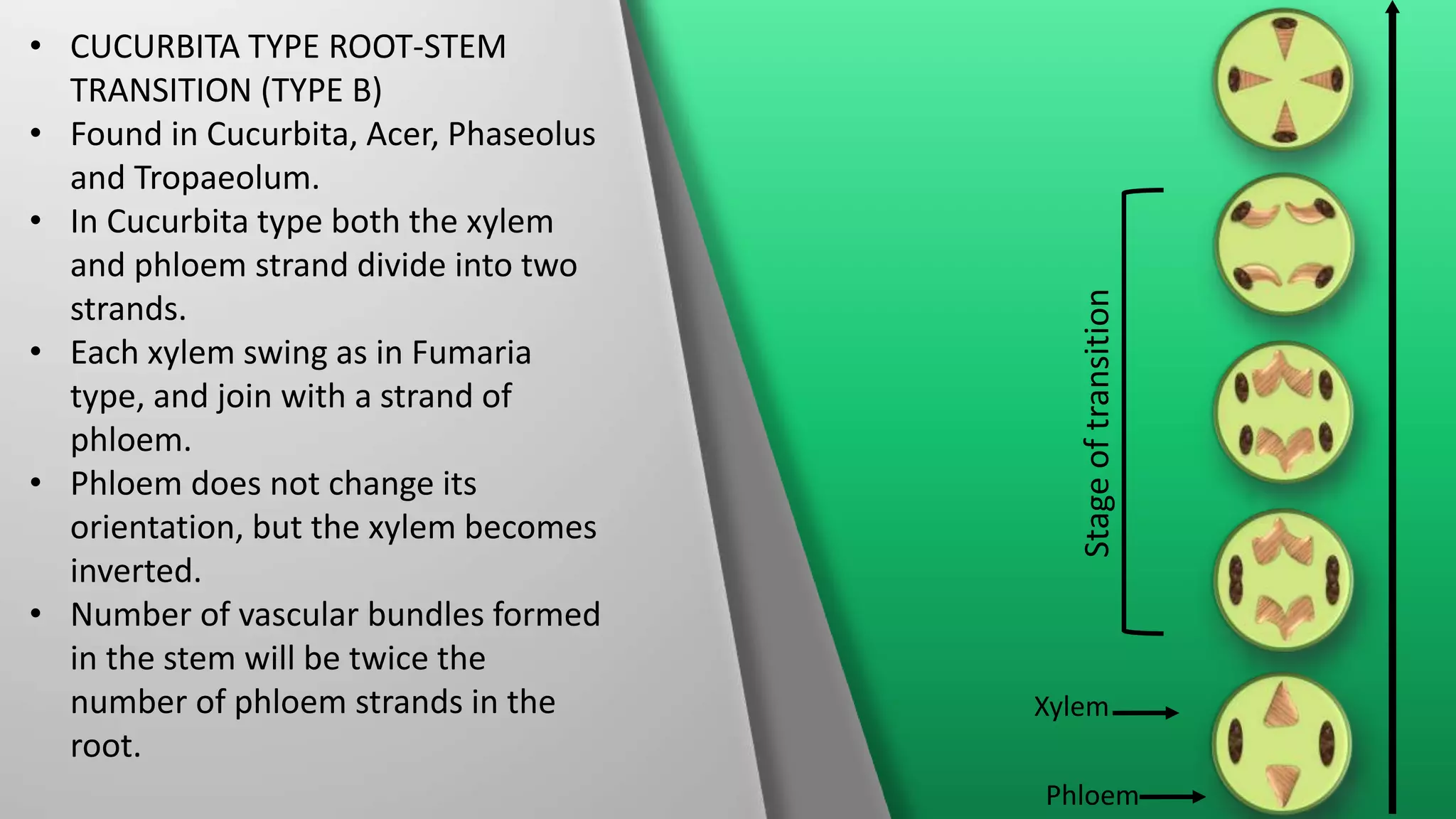
• LATHYRUS TYPE ROOT-STEM
TRANSITION (TYPE C)
• Found in Lathyrus and Medicago.
• Here the xylem strand does not divide
but pass continuously into the stem.
• However the xylem strands twist 180
degrees.
• Meantime the phloem strands divide.
• The phloem strands then move
laterally to the position of the xylem
strand and then they fuse together
and join the xylem strand on the
outside
• In this type the number of vascular
bundle formed in the stem will be
equal to the number of phloem
strands found in the roots.
Stageoftransition
Phloem
Xylem
• LATHYRUS TYPE ROOT-STEM
TRANSITION (TYPE C)
• Found in Lathyrus and Medicago.
• Here the xylem strand does not divide
but pass continuously into the stem.
• However the xylem strands twist 180
degrees.
• Meantime the phloem strands divide.
• The phloem strands then move
laterally to the position of the xylem
strand and then they fuse together
and join the xylem strand on the
outside
• In this type the number of vascular
bundle formed in the stem will be
equal to the number of phloem
strands found in the roots.
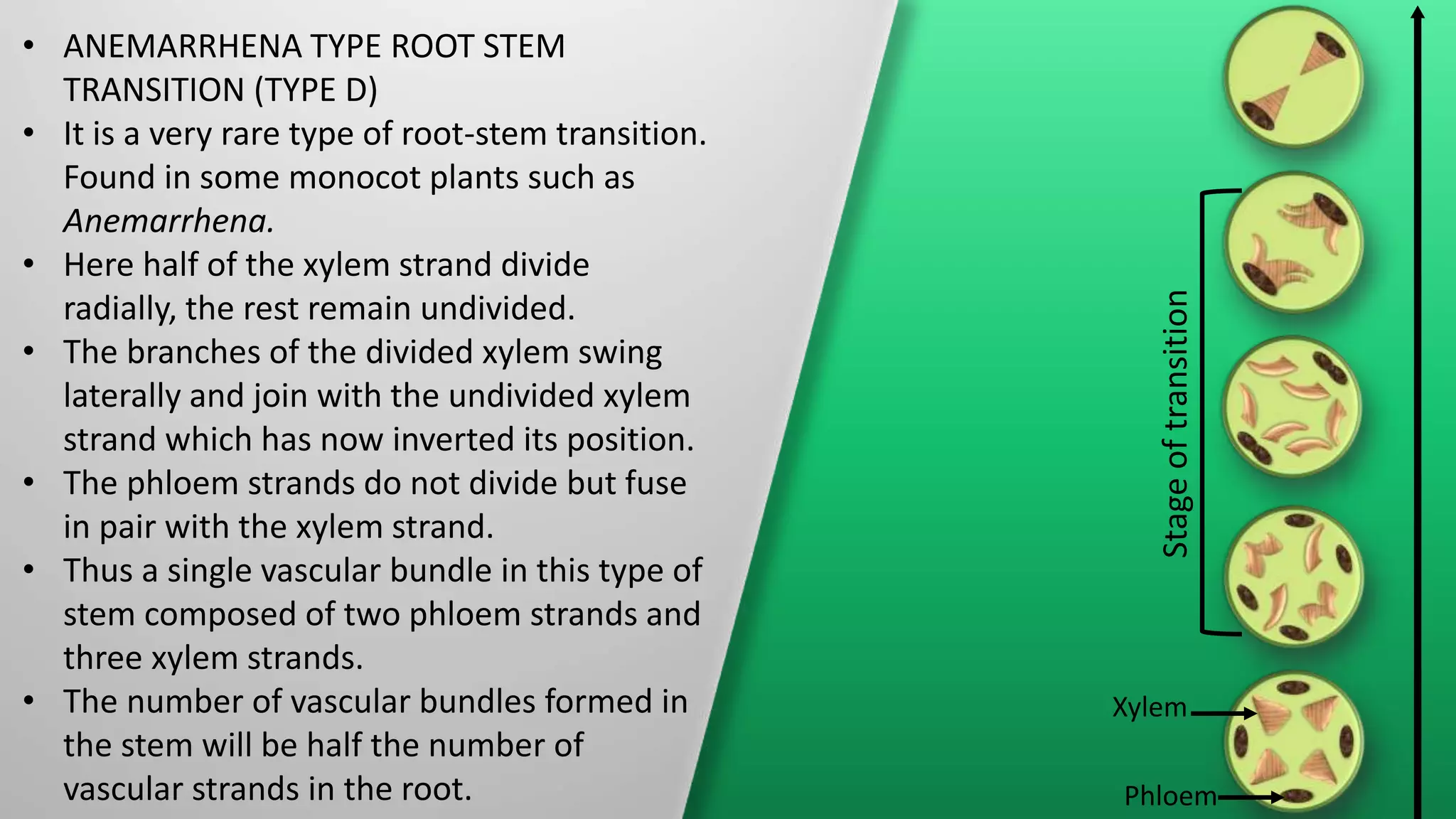
• ANEMARRHENA TYPE ROOT STEM
TRANSITION (TYPE D)
• It is a very rare type of root-stem transition.
Found in some monocot plants such as
Anemarrhena.
• Here half of the xylem strand divide
radially, the rest remain undivided.
• The branches of the divided xylem swing
laterally and join with the undivided xylem
strand which has now inverted its position.
• The phloem strands do not divide but fuse
in pair with the xylem strand.
• Thus a single vascular bundle in this type of
stem composed of two phloem strands and
three xylem strands.
• The number of vascular bundles formed in
the stem will be half the number of
vascular strands in the root.
• ANEMARRHENA TYPE ROOT STEM
TRANSITION (TYPE D)
• It is a very rare type of root-stem transition.
Found in some monocot plants such as
Anemarrhena.
• Here half of the xylem strand divide
radially, the rest remain undivided.
• The branches of the divided xylem swing
laterally and join with the undivided xylem
strand which has now inverted its position.
• The phloem strands do not divide but fuse
in pair with the xylem strand.
• Thus a single vascular bundle in this type of
stem composed of two phloem strands and
three xylem strands.
• The number of vascular bundles formed in
the stem will be half the number of
vascular strands in the root.
Stageoftransition
Phloem
Xylem

Root stem transition

  • 2.
    Stageoftransition Phloem Xylem The Root-Stem TransitionZone. Root and stem form a continuous structure in plants called the axis. The vascular tissue in root is radial (xylem and phloem arranged separately in different radii) whereas in the stem is conjoint (xylem and phloem are arranged together in same radii as vascular bundles). Thus, there should be a region in the axis where the vascular structures of the root and the stem meet and merge together. This peculiar region is called the Root-Stem Transition Zone.
  • 3.
    • The epidermis,cortex, endodermis, pericycle and the secondary vascular tissue are continuous from root to stem. • Only the primary vascular tissue in the axis undergoes a change in their position and orientation. • The exarch arrangement of xylem in root changes to endarch position in the stem. • In the transition zone, the vascular tissue undergoes many changes such as Forking, Rotation and Fusion. Stageoftransition Phloem Xylem • The epidermis, cortex, endodermis, pericycle and the secondary vascular tissue are continuous from root to stem. • Only the primary vascular tissue in the axis undergoes a change in their position and orientation. • The exarch arrangement of xylem in root changes to endarch position in the stem. • In the transition zone, the vascular tissue undergoes many changes such as Forking, Rotation and Fusion.
  • 4.
    • The vasculartissue also increases their diameter. • The exact position of the transition zone is different in different plants. • Usually, the transition zone occurs at the tip of the radicle or at the basal or middle or at the top portion of hypocotyl. • The length of transition zone also varies from few millimeters to several centimeters. The transition of vascular tissue may be gradual or abrupt in different plants. • The phloem tissue, in most of the cases, remains more or less same position. Stageoftransition Phloem Xylem • The vascular tissue also increases their diameter. • The exact position of the transition zone is different in different plants. • Usually, the transition zone occurs at the tip of the radicle or at the basal or middle or at the top portion of hypocotyl. • The length of transition zone also varies from few millimeters to several centimeters. • The transition of vascular tissue may be gradual or abrupt in different plants. • The phloem tissue, in most of the cases, remains extra or less same position.
  • 5.
    Different types ofRoot Stem Transitions are observed in plants Eames and McDaniel (1947) described FOUR types of root stem transition in plants. They are: (1). Fumaria Type (A – Type) (2). Cucurbita Type (B – Type) (3). Lathyrus Type (C – Type) (4). Anemarrhena Type (D -Type)
  • 6.
    FUMARIA TYPE ROOT-STEMTRANSITION (TYPE A) • Occurs in Fumaria, Mirabilis and Dipsacus. • Each xylem strands in the root divides radially into two branches. • As the branches go upward, they swing laterally. Among these two branches, one swing to the right and one swing to left and join to the phloem strand inside. • Phloem strand do not change its position or orientation and they pass directly from the root to the stem. • The number of vascular bundles formed in the stem will be equal to the number of phloem strands occurs in the root. Stageoftransition Phloem Xylem FUMARIA TYPE ROOT-STEM TRANSITION (TYPE A) • Occurs in Fumaria, Mirabilis and Dipsacus. • Each xylem strands in the root divides radially into two branches. • As the branches go upward, they swing laterally. Among these two branches, one swing to the right and one swing to left and join to the phloem strand inside. • Phloem strand do not change its position or orientation and they pass directly from the root to the stem. • The number of vascular bundles formed in the stem will be equal to the number of phloem strands occurs in the root.
  • 7.
    • CUCURBITA TYPEROOT-STEM TRANSITION (TYPE B) • Found in Cucurbita, Acer, Phaseolus and Tropaeolum. • In Cucurbita type both the xylem and phloem strand divide into two strands. • Each xylem swing as in Fumaria type, and join with a strand of phloem. • Phloem does not change its orientation, but the xylem becomes inverted. • Number of vascular bundles formed in the stem will be twice the number of phloem strands in the root. • CUCURBITA TYPE ROOT-STEM TRANSITION (TYPE B) • Found in Cucurbita, Acer, Phaseolus and Tropaeolum. • In Cucurbita type both the xylem and phloem strand divide into two strands. • Each xylem swing as in Fumaria type, and join with a strand of phloem. • Phloem does not change its orientation, but the xylem becomes inverted. • Number of vascular bundles formed in the stem will be twice the number of phloem strands in the root. Stageoftransition Phloem Xylem
  • 8.
    • LATHYRUS TYPEROOT-STEM TRANSITION (TYPE C) • Found in Lathyrus and Medicago. • Here the xylem strand does not divide but pass continuously into the stem. • However the xylem strands twist 180 degrees. • Meantime the phloem strands divide. • The phloem strands then move laterally to the position of the xylem strand and then they fuse together and join the xylem strand on the outside • In this type the number of vascular bundle formed in the stem will be equal to the number of phloem strands found in the roots. Stageoftransition Phloem Xylem • LATHYRUS TYPE ROOT-STEM TRANSITION (TYPE C) • Found in Lathyrus and Medicago. • Here the xylem strand does not divide but pass continuously into the stem. • However the xylem strands twist 180 degrees. • Meantime the phloem strands divide. • The phloem strands then move laterally to the position of the xylem strand and then they fuse together and join the xylem strand on the outside • In this type the number of vascular bundle formed in the stem will be equal to the number of phloem strands found in the roots.
  • 9.
    • ANEMARRHENA TYPEROOT STEM TRANSITION (TYPE D) • It is a very rare type of root-stem transition. Found in some monocot plants such as Anemarrhena. • Here half of the xylem strand divide radially, the rest remain undivided. • The branches of the divided xylem swing laterally and join with the undivided xylem strand which has now inverted its position. • The phloem strands do not divide but fuse in pair with the xylem strand. • Thus a single vascular bundle in this type of stem composed of two phloem strands and three xylem strands. • The number of vascular bundles formed in the stem will be half the number of vascular strands in the root. • ANEMARRHENA TYPE ROOT STEM TRANSITION (TYPE D) • It is a very rare type of root-stem transition. Found in some monocot plants such as Anemarrhena. • Here half of the xylem strand divide radially, the rest remain undivided. • The branches of the divided xylem swing laterally and join with the undivided xylem strand which has now inverted its position. • The phloem strands do not divide but fuse in pair with the xylem strand. • Thus a single vascular bundle in this type of stem composed of two phloem strands and three xylem strands. • The number of vascular bundles formed in the stem will be half the number of vascular strands in the root. Stageoftransition Phloem Xylem