By: Maximilian Lim
Muhammad Naim
The Traditional Japanese House
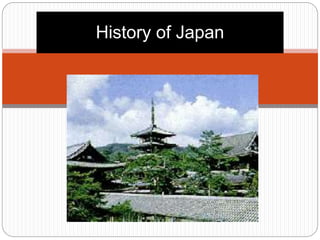
History of Japan
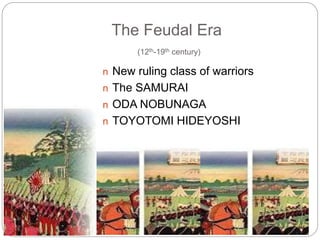
The Feudal Era
(12th-19th century)
n New ruling class of warriors
n The SAMURAI
n ODA NOBUNAGA
n TOYOTOMI HIDEYOSHI
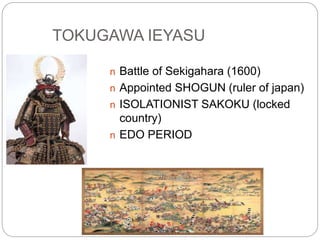
TOKUGAWA IEYASU
n Battle of Sekigahara (1600)
n Appointed SHOGUN (ruler of japan)
n ISOLATIONIST SAKOKU (locked
country)
n EDO PERIOD
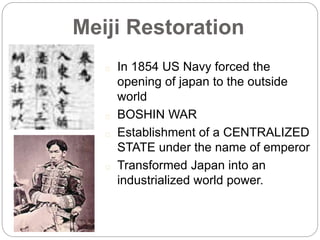
Meiji Restoration
In 1854 US Navy forced the
opening of japan to the outside
world
BOSHIN WAR
Establishment of a CENTRALIZED
STATE under the name of emperor
Transformed Japan into an
industrialized world power.
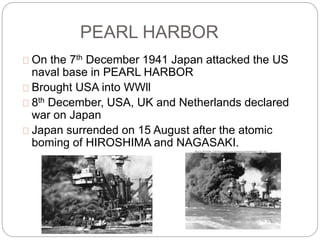
PEARL HARBOR
On the 7th December 1941 Japan attacked the US
naval base in PEARL HARBOR
Brought USA into WWll
8th December, USA, UK and Netherlands declared
war on Japan
Japan surrended on 15 August after the atomic
boming of HIROSHIMA and NAGASAKI.
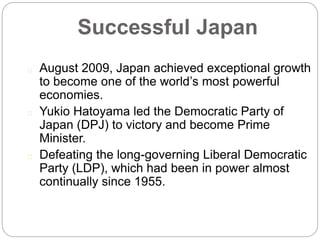
Successful Japan
August 2009, Japan achieved exceptional growth
to become one of the world’s most powerful
economies.
Yukio Hatoyama led the Democratic Party of
Japan (DPJ) to victory and become Prime
Minister.
Defeating the long-governing Liberal Democratic
Party (LDP), which had been in power almost
continually since 1955.
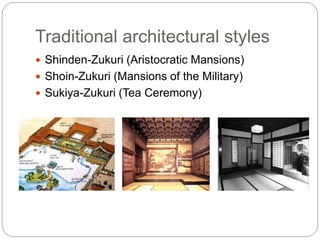
Traditional architectural styles
 Shinden-Zukuri (Aristocratic Mansions)
 Shoin-Zukuri (Mansions of the Military)
 Sukiya-Zukuri (Tea Ceremony)
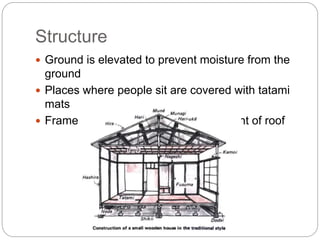
Structure
 Ground is elevated to prevent moisture from the
ground
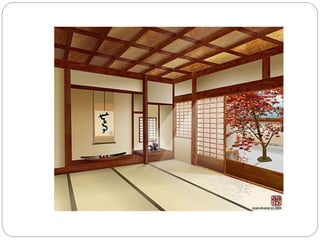
 Places where people sit are covered with tatami
mats
 Frame of the house supports the weight of roof
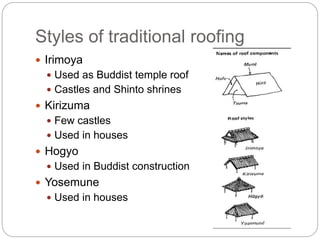
Styles of traditional roofing
 Irimoya
 Used as Buddist temple roof
 Castles and Shinto shrines
 Kirizuma
 Few castles
 Used in houses
 Hogyo
 Used in Buddist construction
 Yosemune
 Used in houses
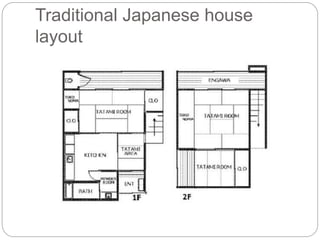
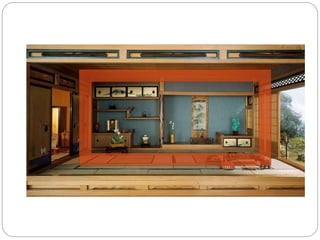
Traditional Japanese house
layout
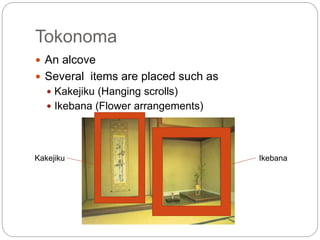
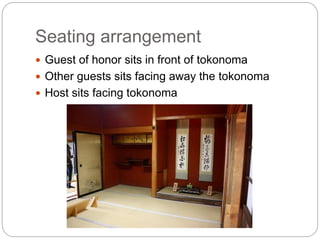
Tokonoma
 An alcove
 Several items are placed such as
 Kakejiku (Hanging scrolls)
 Ikebana (Flower arrangements)
Kakejiku Ikebana
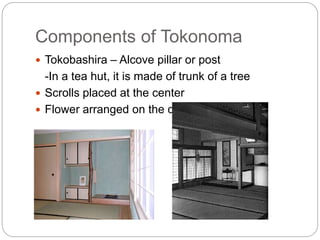
Components of Tokonoma
 Tokobashira – Alcove pillar or post
-In a tea hut, it is made of trunk of a tree
 Scrolls placed at the center
 Flower arranged on the dais
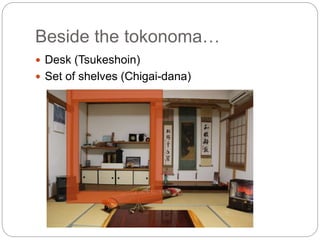
Beside the tokonoma…
 Desk (Tsukeshoin)
 Set of shelves (Chigai-dana)
Seating arrangement
 Guest of honor sits in front of tokonoma
 Other guests sits facing away the tokonoma
 Host sits facing tokonoma
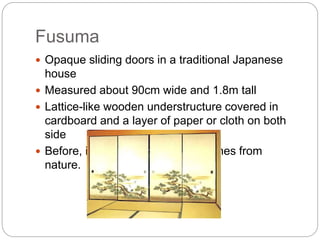
Fusuma
 Opaque sliding doors in a traditional Japanese
house
 Measured about 90cm wide and 1.8m tall
 Lattice-like wooden understructure covered in
cardboard and a layer of paper or cloth on both
side
 Before, it was painted on with scenes from
nature.
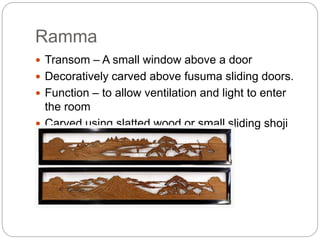
Ramma
 Transom – A small window above a door
 Decoratively carved above fusuma sliding doors.
 Function – to allow ventilation and light to enter
the room
 Carved using slatted wood or small sliding shoji
panels
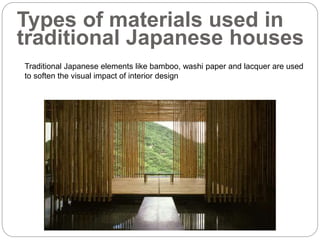
Traditional Japanese elements like bamboo, washi paper and lacquer are used
to soften the visual impact of interior design
Types of materials used in
traditional Japanese houses
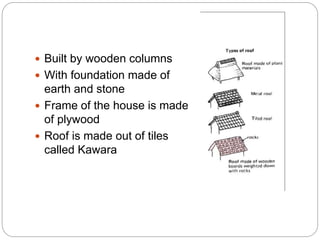
 Built by wooden columns
 With foundation made of
earth and stone
 Frame of the house is made
of plywood
 Roof is made out of tiles
called Kawara
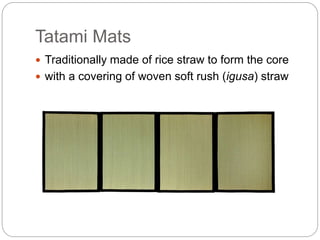
Tatami Mats
 Traditionally made of rice straw to form the core
 with a covering of woven soft rush (igusa) straw
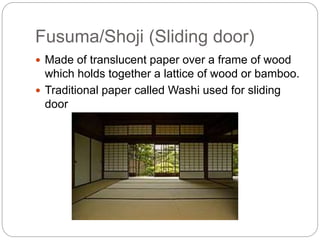
Fusuma/Shoji (Sliding door)
 Made of translucent paper over a frame of wood
which holds together a lattice of wood or bamboo.
 Traditional paper called Washi used for sliding
door
References
 Elements of a Traditional Japanese Interior (n.p.).
Retrieved January 26, 2015, from
http://yoshino.truecompassdesigns.net/newsletter-
traditional-interiors/
 Traditional culture and festivals (n.p.). Retrieved January
26, 2015, from
http://www.jnto.go.jp/eng/indepth/cultural/experience/a.html
 Tokonoma and the art of the focal point (n.p.). Retrieved
January 26, 2015, from
http://www.presentationzen.com/presentationzen/2009/10/t
okonoma-and-the-art-of-the-focal-point.html
 The Structure of a Japanese House (n.p). Retrieved
January 26 2015, from http://web-
japan.org/kidsweb/virtual/house/house01.html
 Shoin-Zukuri (n.p). Retrieved January 26 2015, from
http://en.wikipedia.org/wiki/Shoin-zukuri

The traditional-japanese-house

  • 1.
    By: Maximilian Lim MuhammadNaim The Traditional Japanese House
  • 2.
  • 3.
    The Feudal Era (12th-19thcentury) n New ruling class of warriors n The SAMURAI n ODA NOBUNAGA n TOYOTOMI HIDEYOSHI
  • 4.
    TOKUGAWA IEYASU n Battleof Sekigahara (1600) n Appointed SHOGUN (ruler of japan) n ISOLATIONIST SAKOKU (locked country) n EDO PERIOD
  • 5.
    Meiji Restoration In 1854US Navy forced the opening of japan to the outside world BOSHIN WAR Establishment of a CENTRALIZED STATE under the name of emperor Transformed Japan into an industrialized world power.
  • 6.
    PEARL HARBOR On the7th December 1941 Japan attacked the US naval base in PEARL HARBOR Brought USA into WWll 8th December, USA, UK and Netherlands declared war on Japan Japan surrended on 15 August after the atomic boming of HIROSHIMA and NAGASAKI.
  • 7.
    Successful Japan August 2009,Japan achieved exceptional growth to become one of the world’s most powerful economies. Yukio Hatoyama led the Democratic Party of Japan (DPJ) to victory and become Prime Minister. Defeating the long-governing Liberal Democratic Party (LDP), which had been in power almost continually since 1955.
  • 8.
    Traditional architectural styles Shinden-Zukuri (Aristocratic Mansions)  Shoin-Zukuri (Mansions of the Military)  Sukiya-Zukuri (Tea Ceremony)
  • 9.
    Structure  Ground iselevated to prevent moisture from the ground  Places where people sit are covered with tatami mats  Frame of the house supports the weight of roof
  • 10.
    Styles of traditionalroofing  Irimoya  Used as Buddist temple roof  Castles and Shinto shrines  Kirizuma  Few castles  Used in houses  Hogyo  Used in Buddist construction  Yosemune  Used in houses
  • 11.
  • 14.
    Tokonoma  An alcove Several items are placed such as  Kakejiku (Hanging scrolls)  Ikebana (Flower arrangements) Kakejiku Ikebana
  • 15.
    Components of Tokonoma Tokobashira – Alcove pillar or post -In a tea hut, it is made of trunk of a tree  Scrolls placed at the center  Flower arranged on the dais
  • 16.
    Beside the tokonoma… Desk (Tsukeshoin)  Set of shelves (Chigai-dana)
  • 17.
    Seating arrangement  Guestof honor sits in front of tokonoma  Other guests sits facing away the tokonoma  Host sits facing tokonoma
  • 18.
    Fusuma  Opaque slidingdoors in a traditional Japanese house  Measured about 90cm wide and 1.8m tall  Lattice-like wooden understructure covered in cardboard and a layer of paper or cloth on both side  Before, it was painted on with scenes from nature.
  • 19.
    Ramma  Transom –A small window above a door  Decoratively carved above fusuma sliding doors.  Function – to allow ventilation and light to enter the room  Carved using slatted wood or small sliding shoji panels
  • 20.
    Traditional Japanese elementslike bamboo, washi paper and lacquer are used to soften the visual impact of interior design Types of materials used in traditional Japanese houses
  • 21.
     Built bywooden columns  With foundation made of earth and stone  Frame of the house is made of plywood  Roof is made out of tiles called Kawara
  • 22.
    Tatami Mats  Traditionallymade of rice straw to form the core  with a covering of woven soft rush (igusa) straw
  • 23.
    Fusuma/Shoji (Sliding door) Made of translucent paper over a frame of wood which holds together a lattice of wood or bamboo.  Traditional paper called Washi used for sliding door
  • 24.
    References  Elements ofa Traditional Japanese Interior (n.p.). Retrieved January 26, 2015, from http://yoshino.truecompassdesigns.net/newsletter- traditional-interiors/  Traditional culture and festivals (n.p.). Retrieved January 26, 2015, from http://www.jnto.go.jp/eng/indepth/cultural/experience/a.html  Tokonoma and the art of the focal point (n.p.). Retrieved January 26, 2015, from http://www.presentationzen.com/presentationzen/2009/10/t okonoma-and-the-art-of-the-focal-point.html  The Structure of a Japanese House (n.p). Retrieved January 26 2015, from http://web- japan.org/kidsweb/virtual/house/house01.html  Shoin-Zukuri (n.p). Retrieved January 26 2015, from http://en.wikipedia.org/wiki/Shoin-zukuri