JAPANESE ARCHITECTURE
by:
CHASITSU
JAPANESE ARCHITECTURE
GENERAL TOPICS:
 Terminologies
 The Birth of
Japanese Architecture
 Major Influences
 Japanese Buddhist
Temple
 Famous structures
DEFINITION AND DESCRIPTION
 Hisashi- lower roof sometimes projected below the eaves of the main roof.
 Camber- slight rise or upward curve of an other wise horizontal structure .
 Entasis- a swelling or curving outwards along the outline of a column shaft
designed to counteract the optical illusion whish give a shaft bounded
by street lines the appearance of curving inside
 Torii- Shinto Gate –O-torii- the first gate to the toshogu shrine, Tochigi prefecture .
 Loggia- An arcaded or roof gallery built into or projecting from the side of a
building particularly one over looking an open court.
 Pagodas-Square plan mostly five storey and about and about 45mts. And 150f.
In height
 Belvederes- an open roofed gallery in an upper story built for giving a view of
scenery.
 Bonsai- Plant or dwarf tree is an an almost of Japanese culture. A tree can be
easily 100 to 200 year old.
 Japanese stone lantern- night by illumination by decorative Japanese lanterns,
. produces effects of exquisite beauty.
JAPANESE ARCHITECTURE
THE BIRTH OF JAPANESE ARCHITECTURE
• Paleolithic period
• Remains of inhabited sites on the Neolithic.
• Development of Agriculture 4,000 years later than other Eurasian continents.
• Rice cultivation, Gabled Roofed buildings, first raised floor.
• The Kofun
• Constant Flooding period
• The Kingdoms
• Agricultural Engineering
JAPANESE ARCHITECTURE
Daisen Kofun, the largest
of all kofun, one of many tumuli in
the mozuko,fungun,Sakai,
OsakaPrefecture, (5th century)
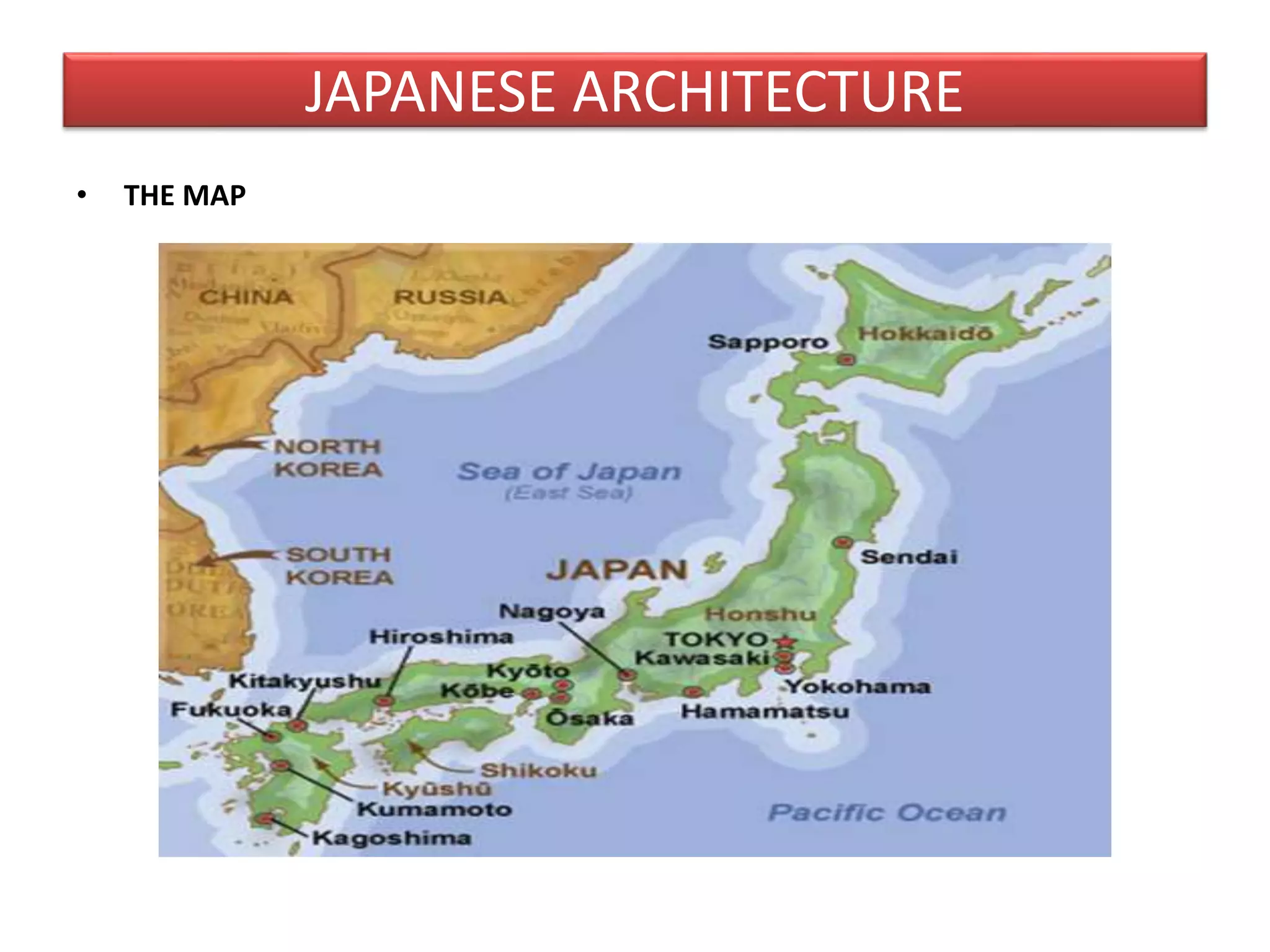
• THE MAP
JAPANESE ARCHITECTURE
GEOGRAPHICAL INFLUENCES
• Composed of chain of islands
• Climatic conditions vary widely
from the subarctic north to the
subtropical south .
• Largest area of the country is
in the temperate zone.
• Eastern shores of Japan bounded
by the Pacific Ocean.
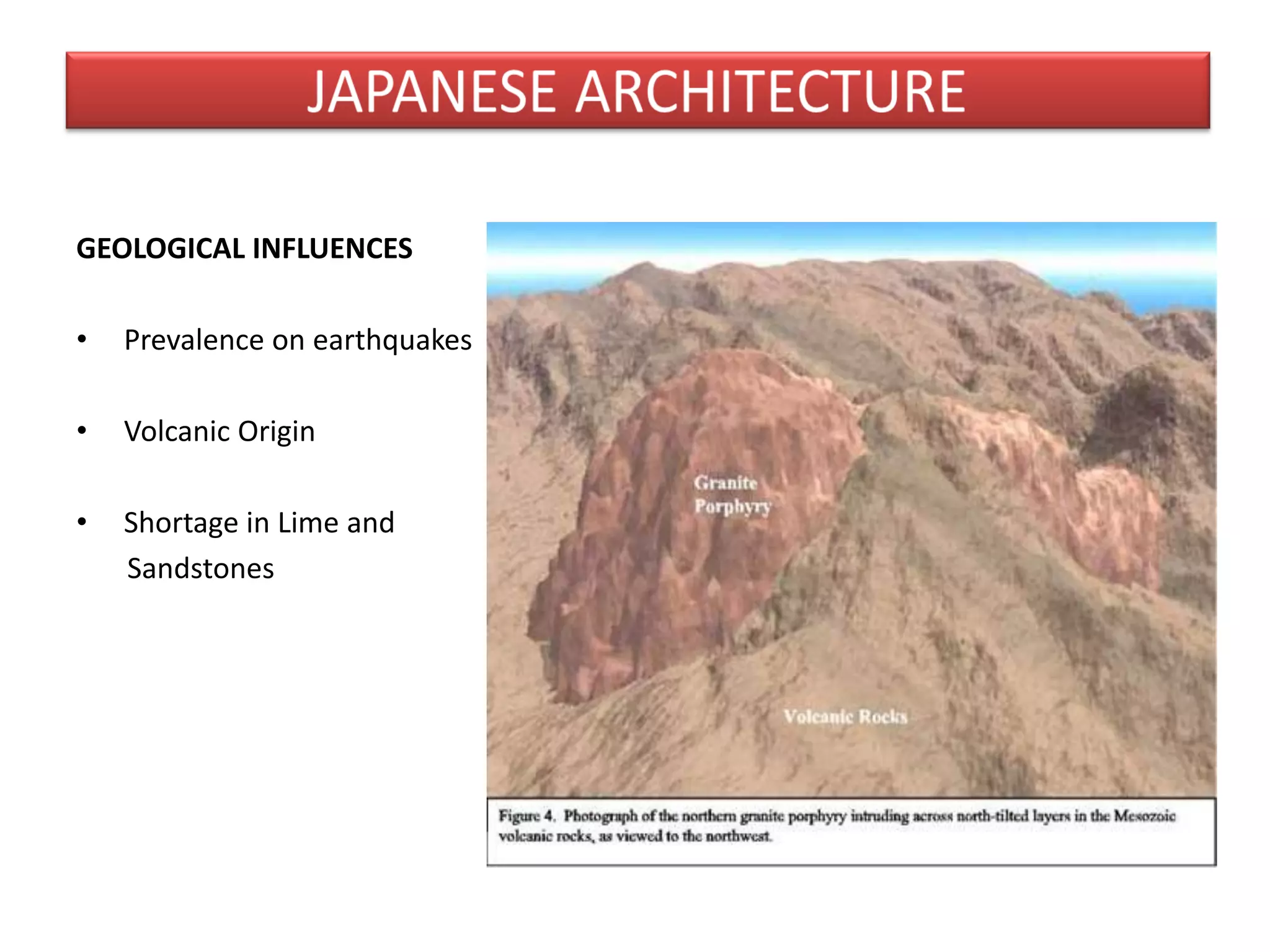
GEOLOGICAL INFLUENCES
• Prevalence on earthquakes
• Volcanic Origin
• Shortage in Lime and
Sandstones
GEOLOGICAL INFLUENCES
• Rugged hill country
• Forest and wild vegetation
• Lime and Sandstones
JAPANESE ARCHITECTURE
CLIMATIC INFLUENCES
• Cold Airstream
• Mountainous Nature and
Airstream
• Houses faces south
JAPANESE ARCHITECTURE
CLIMATIC INFLUENCES
• High Courtyard Wall Screen
JAPANESE ARCHITECTURE
SOCIAL AND POLITICAL INFLUENCES
Bureaucratic state
 Stablishing firmly the buddhism
and the nation to become a
Bureaucratic state with the
chinese laws and ceremonials.
• Japanese painting (complicated rules cause to delay)
.
Feudalism (13th c.)
The Emperor
 The Emperor is called theTennō (天皇)
in Japanese, literally meaning
"heavenly sovereign".
 The Emperor is the head of the
Japanese Imperial Family. He is also the
highest authority of the Shinto religion.
The Nobles
 Social class which possesses more
acknowledged privileges or eminence
than members of most other classes
in a society
The Shoguns
 “A commander of a force" one of the
hereditary military dictators of Japan
from 1192 to 1867.
.
• 1890 Constitution
• Commercial treated
(agreement)
• Polydemonism existed
before the introduction
of Buddhism.
 Earlier bureaucratic form
ofGovernment replaced
by an aristocratic regency
by the fujiwara family wc
supplied the empresses
to the throne.
• The devotion to multitude of a demonic power
SOCIAL AND POLITICAL INFLUENCES
.
 (552-645 A.D) Buddhism
 established.
 1890 constitution
 Self – imposed isolationism
 Introduction of Christianity
(1549) francis xavier
 For 200 years, japan closed to
the outside world.
 Spaniards driven out in 1624
and Portuguese (1638)
 Buddhism encouraged the
erectionof temples and
mystic symbolism. Japanese shoguns (commander of force)
HISTORICAL AND RELIGIOUS INFLUENCES
.
HISTORICAL AND RELIGIOUS INFLUENCES
 (9th C) two new sects of Buddhism,
Shingon and Tendai, the two sects
were brought from china by
japanese priest .
 New two esoteric type of buddhism
required additional buildings for
special rites.
 Zen Buddhism, second wave of
chinese influence.
Japanese Buddhist Monks
.
ARCHITECTURAL INFLUENCES
• Architectural character largely derived from china.
• Carvings and decorations on timber construction.
• Dominant roof w/c form a striking contrast w/ practice in the middle east and India
• Exquisite curvatures supported upon a simple or compound brackets.
• Upper part of the roof is terminated by a gable placed vertically above the end
walls (Irimoya gables).
• Japanese Columns followed the Chinese forms.
• Light is introduced principally through doorways .
• Windows openings are filled with timber trellis provided with wooden shutters
externally and paper usually rice paper-in light sashes.
• Exterior walling is extremely thin.
• Columns receive the main load from the roof and wall panels are entirely non-
structural.
.
ARCHITECTURAL INFLUENCES
• 1. Torii - Shinto gate
• 2. Stone stairs
• 3. Sandō - the approach to the shrine
• 4. Chōzuya or temizuya - purification
font to cleanse one's hands and mouth
• 5. Tōrō - decorative stone lanterns
• 6. Kagura-den - building dedicated
• to Noh or the sacred kagura dance
• 7. Shamusho - the shrine's
• administrative office
• 8. Ema - wooden plaques bearing
• prayers or wishes.
• 9. Sessha/massha - small auxiliary
shrines.
Native Japanese Architecture
.
ARCHITECTUREL INFLUENCES
10. Komainu - the so-called "lion dogs",
guardians of the shrine.
11. Haiden - oratory or hall of worship
12. Tamagaki - fence surrounding the
honden
13. Honden - main hall, enshrining the
kami.
14. On the roof of the haiden and honden
are visible chigi (forked roof finials) and
katsuogi (short horizontal logs),
both common shrine ornamentations.
( Jomon pit house)
.
Yayoi dwelling ,.roof is over a wattle screen wall surrounded by a damp-excluding
ditch
ARCHITECTURAL INFLUENCES
.
TWO METHODS OF ROOF FRAMING
• Corbelled tranverse rainbow beams (koryo)
w/ frog leg truss.
• Single transverse beams supporting central
truss strenghtened by diagonal braces (sasu)
FOUR ROOF TYPES
Gabled (kirizuma-yane)
Hipped (yosemune-yane)
Pyramidal (hogyo-yane)
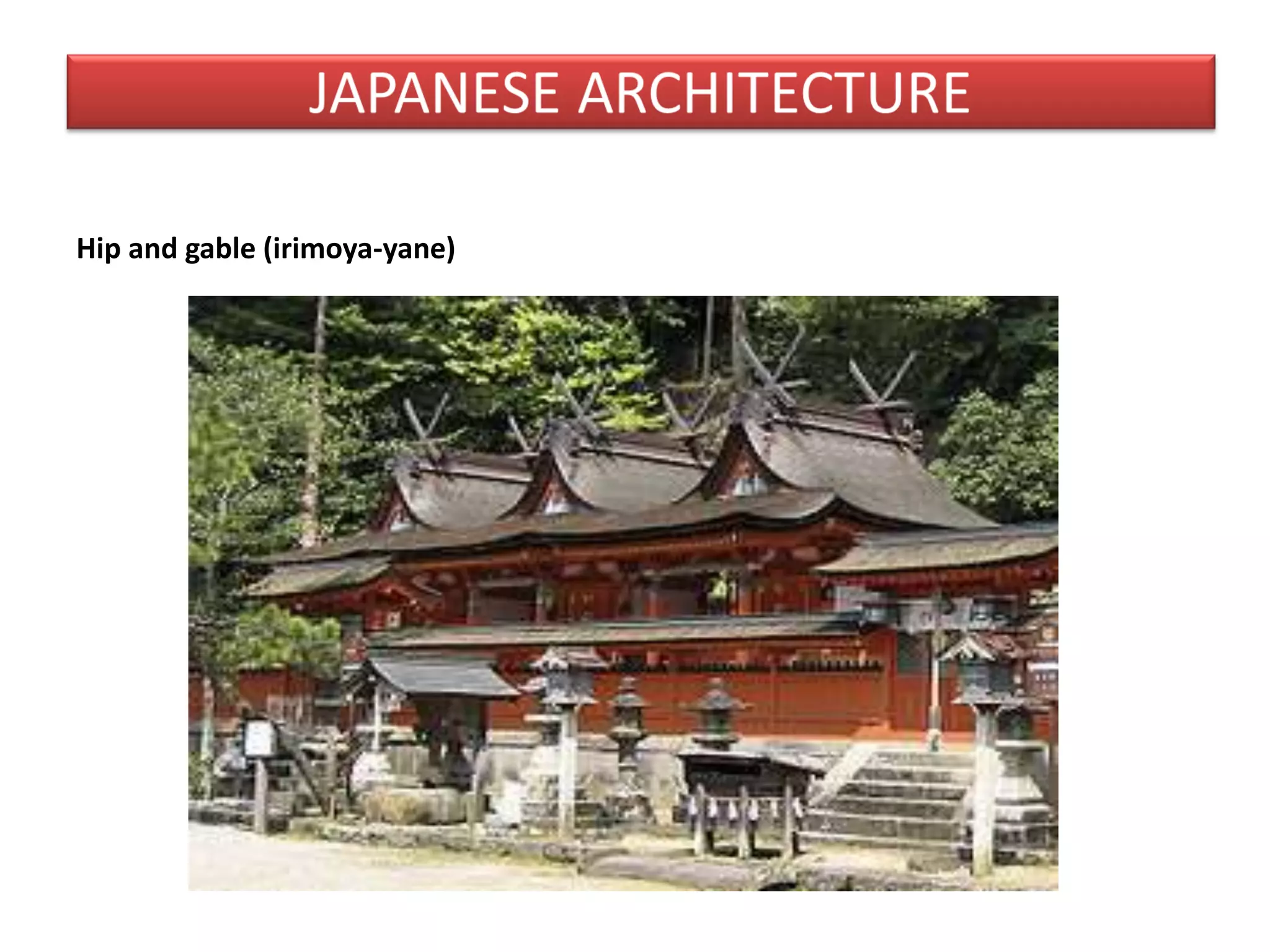
Hip ang gable combined (irimoya-yane)
.
Hipped (yosemune-yane)
.
Hip and gable (irimoya-yane)
.
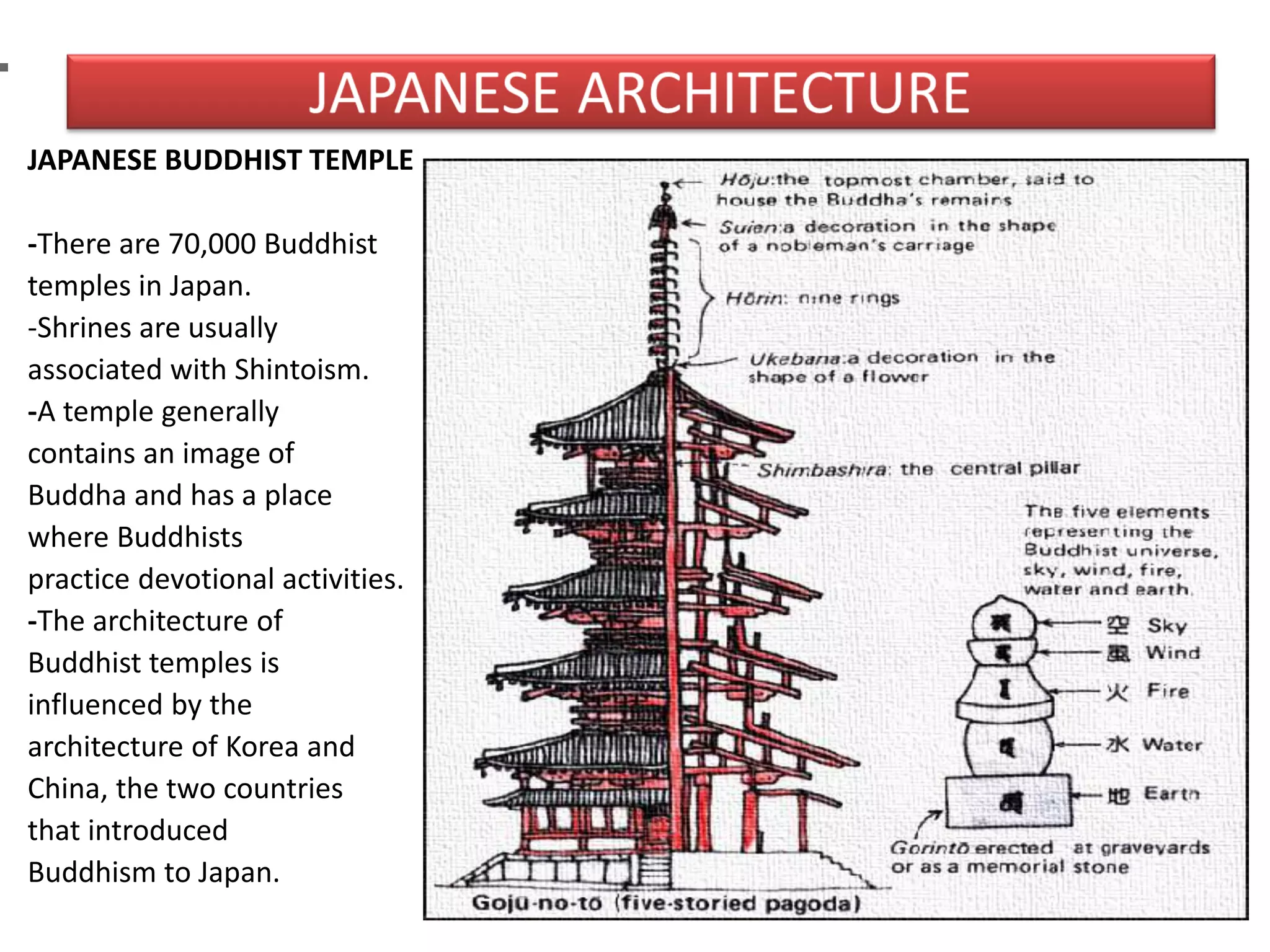
JAPANESE BUDDHIST TEMPLE
-There are 70,000 Buddhist
temples in Japan.
-Shrines are usually
associated with Shintoism.
-A temple generally
contains an image of
Buddha and has a place
where Buddhists
practice devotional activities.
-The architecture of
Buddhist temples is
influenced by the
architecture of Korea and
China, the two countries
that introduced
Buddhism to Japan.
.
Types of Buddhist Temples and Buildings in Japan
There are three main types of Buddhist Temples:
 1) Japanese style (wayo),
 2) Great Buddha style (daibutsuyo), and
 3) Chinese style (karayo). These in turn vary according to the Buddhist school and
the historical period in which they built.
 The main hall (kondo or hondo) is usually found at the center of the temple
grounds. Inside are images of the Buddha, other Buddhist images, an altar or altars
with various objects and space for monks and worshipers. The main hall is
sometimes connected to a lecture hall.
.
.
Features of Buddhist Temples in Japan
 Japanese style pagodas have multiple stories, each with a graceful, tiled Chinese-
style roof, and a top roof capped by a spire.
 The central images in the main hall is often surrounded by burning incense sticks
and offerings of fruit and flowers. Inside the temple there is one set of wooden
plaques with the names of large contributors and another set the afterlife names
of deceased people. In the old days the afterlife names were only given to
Buddhist priests but over time they were given to lay people who paid enough
money and now are almost used as ranking system in the after life.
 Many temples use concrete that has been expertly camouflaged to look like wood.
Near many Buddhist temples are stone Jizo figures with red bibs and a staff in one
hand and a jewel in the other. They honor the souls of children who have died or
been aborted.
.

INTRO: Japanese architecture

  • 1.
  • 2.
    JAPANESE ARCHITECTURE GENERAL TOPICS: Terminologies  The Birth of Japanese Architecture  Major Influences  Japanese Buddhist Temple  Famous structures
  • 3.
    DEFINITION AND DESCRIPTION Hisashi- lower roof sometimes projected below the eaves of the main roof.  Camber- slight rise or upward curve of an other wise horizontal structure .  Entasis- a swelling or curving outwards along the outline of a column shaft designed to counteract the optical illusion whish give a shaft bounded by street lines the appearance of curving inside  Torii- Shinto Gate –O-torii- the first gate to the toshogu shrine, Tochigi prefecture .  Loggia- An arcaded or roof gallery built into or projecting from the side of a building particularly one over looking an open court.  Pagodas-Square plan mostly five storey and about and about 45mts. And 150f. In height  Belvederes- an open roofed gallery in an upper story built for giving a view of scenery.  Bonsai- Plant or dwarf tree is an an almost of Japanese culture. A tree can be easily 100 to 200 year old.  Japanese stone lantern- night by illumination by decorative Japanese lanterns, . produces effects of exquisite beauty. JAPANESE ARCHITECTURE
  • 4.
    THE BIRTH OFJAPANESE ARCHITECTURE • Paleolithic period • Remains of inhabited sites on the Neolithic. • Development of Agriculture 4,000 years later than other Eurasian continents. • Rice cultivation, Gabled Roofed buildings, first raised floor. • The Kofun • Constant Flooding period • The Kingdoms • Agricultural Engineering JAPANESE ARCHITECTURE
  • 5.
    JAPANESE ARCHITECTURE Daisen Kofun,the largest of all kofun, one of many tumuli in the mozuko,fungun,Sakai, OsakaPrefecture, (5th century)
  • 6.
  • 7.
    JAPANESE ARCHITECTURE GEOGRAPHICAL INFLUENCES •Composed of chain of islands • Climatic conditions vary widely from the subarctic north to the subtropical south . • Largest area of the country is in the temperate zone. • Eastern shores of Japan bounded by the Pacific Ocean.
  • 8.
    GEOLOGICAL INFLUENCES • Prevalenceon earthquakes • Volcanic Origin • Shortage in Lime and Sandstones
  • 9.
    GEOLOGICAL INFLUENCES • Ruggedhill country • Forest and wild vegetation • Lime and Sandstones JAPANESE ARCHITECTURE
  • 10.
    CLIMATIC INFLUENCES • ColdAirstream • Mountainous Nature and Airstream • Houses faces south JAPANESE ARCHITECTURE
  • 11.
    CLIMATIC INFLUENCES • HighCourtyard Wall Screen JAPANESE ARCHITECTURE
  • 12.
    SOCIAL AND POLITICALINFLUENCES Bureaucratic state  Stablishing firmly the buddhism and the nation to become a Bureaucratic state with the chinese laws and ceremonials. • Japanese painting (complicated rules cause to delay)
  • 13.
    . Feudalism (13th c.) TheEmperor  The Emperor is called theTennō (天皇) in Japanese, literally meaning "heavenly sovereign".  The Emperor is the head of the Japanese Imperial Family. He is also the highest authority of the Shinto religion. The Nobles  Social class which possesses more acknowledged privileges or eminence than members of most other classes in a society The Shoguns  “A commander of a force" one of the hereditary military dictators of Japan from 1192 to 1867.
  • 14.
    . • 1890 Constitution •Commercial treated (agreement) • Polydemonism existed before the introduction of Buddhism.  Earlier bureaucratic form ofGovernment replaced by an aristocratic regency by the fujiwara family wc supplied the empresses to the throne. • The devotion to multitude of a demonic power SOCIAL AND POLITICAL INFLUENCES
  • 15.
    .  (552-645 A.D)Buddhism  established.  1890 constitution  Self – imposed isolationism  Introduction of Christianity (1549) francis xavier  For 200 years, japan closed to the outside world.  Spaniards driven out in 1624 and Portuguese (1638)  Buddhism encouraged the erectionof temples and mystic symbolism. Japanese shoguns (commander of force) HISTORICAL AND RELIGIOUS INFLUENCES
  • 16.
    . HISTORICAL AND RELIGIOUSINFLUENCES  (9th C) two new sects of Buddhism, Shingon and Tendai, the two sects were brought from china by japanese priest .  New two esoteric type of buddhism required additional buildings for special rites.  Zen Buddhism, second wave of chinese influence. Japanese Buddhist Monks
  • 17.
    . ARCHITECTURAL INFLUENCES • Architecturalcharacter largely derived from china. • Carvings and decorations on timber construction. • Dominant roof w/c form a striking contrast w/ practice in the middle east and India • Exquisite curvatures supported upon a simple or compound brackets. • Upper part of the roof is terminated by a gable placed vertically above the end walls (Irimoya gables). • Japanese Columns followed the Chinese forms. • Light is introduced principally through doorways . • Windows openings are filled with timber trellis provided with wooden shutters externally and paper usually rice paper-in light sashes. • Exterior walling is extremely thin. • Columns receive the main load from the roof and wall panels are entirely non- structural.
  • 18.
    . ARCHITECTURAL INFLUENCES • 1.Torii - Shinto gate • 2. Stone stairs • 3. Sandō - the approach to the shrine • 4. Chōzuya or temizuya - purification font to cleanse one's hands and mouth • 5. Tōrō - decorative stone lanterns • 6. Kagura-den - building dedicated • to Noh or the sacred kagura dance • 7. Shamusho - the shrine's • administrative office • 8. Ema - wooden plaques bearing • prayers or wishes. • 9. Sessha/massha - small auxiliary shrines. Native Japanese Architecture
  • 19.
    . ARCHITECTUREL INFLUENCES 10. Komainu- the so-called "lion dogs", guardians of the shrine. 11. Haiden - oratory or hall of worship 12. Tamagaki - fence surrounding the honden 13. Honden - main hall, enshrining the kami. 14. On the roof of the haiden and honden are visible chigi (forked roof finials) and katsuogi (short horizontal logs), both common shrine ornamentations. ( Jomon pit house)
  • 20.
    . Yayoi dwelling ,.roofis over a wattle screen wall surrounded by a damp-excluding ditch ARCHITECTURAL INFLUENCES
  • 21.
    . TWO METHODS OFROOF FRAMING • Corbelled tranverse rainbow beams (koryo) w/ frog leg truss. • Single transverse beams supporting central truss strenghtened by diagonal braces (sasu) FOUR ROOF TYPES Gabled (kirizuma-yane) Hipped (yosemune-yane) Pyramidal (hogyo-yane) Hip ang gable combined (irimoya-yane)
  • 22.
  • 23.
    . Hip and gable(irimoya-yane)
  • 24.
    . JAPANESE BUDDHIST TEMPLE -Thereare 70,000 Buddhist temples in Japan. -Shrines are usually associated with Shintoism. -A temple generally contains an image of Buddha and has a place where Buddhists practice devotional activities. -The architecture of Buddhist temples is influenced by the architecture of Korea and China, the two countries that introduced Buddhism to Japan.
  • 25.
    . Types of BuddhistTemples and Buildings in Japan There are three main types of Buddhist Temples:  1) Japanese style (wayo),  2) Great Buddha style (daibutsuyo), and  3) Chinese style (karayo). These in turn vary according to the Buddhist school and the historical period in which they built.  The main hall (kondo or hondo) is usually found at the center of the temple grounds. Inside are images of the Buddha, other Buddhist images, an altar or altars with various objects and space for monks and worshipers. The main hall is sometimes connected to a lecture hall.
  • 26.
  • 27.
    . Features of BuddhistTemples in Japan  Japanese style pagodas have multiple stories, each with a graceful, tiled Chinese- style roof, and a top roof capped by a spire.  The central images in the main hall is often surrounded by burning incense sticks and offerings of fruit and flowers. Inside the temple there is one set of wooden plaques with the names of large contributors and another set the afterlife names of deceased people. In the old days the afterlife names were only given to Buddhist priests but over time they were given to lay people who paid enough money and now are almost used as ranking system in the after life.  Many temples use concrete that has been expertly camouflaged to look like wood. Near many Buddhist temples are stone Jizo figures with red bibs and a staff in one hand and a jewel in the other. They honor the souls of children who have died or been aborted.
  • 28.