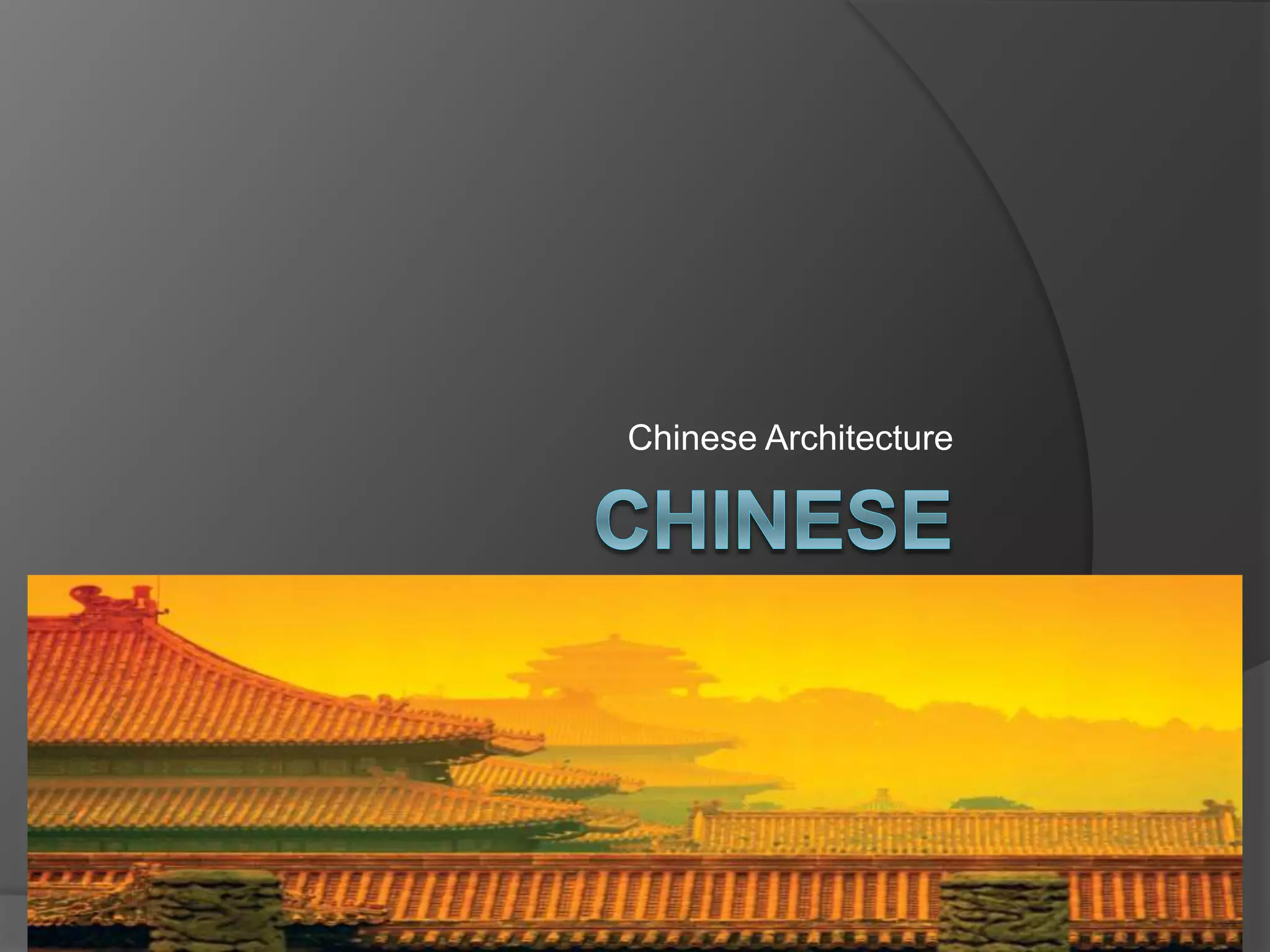
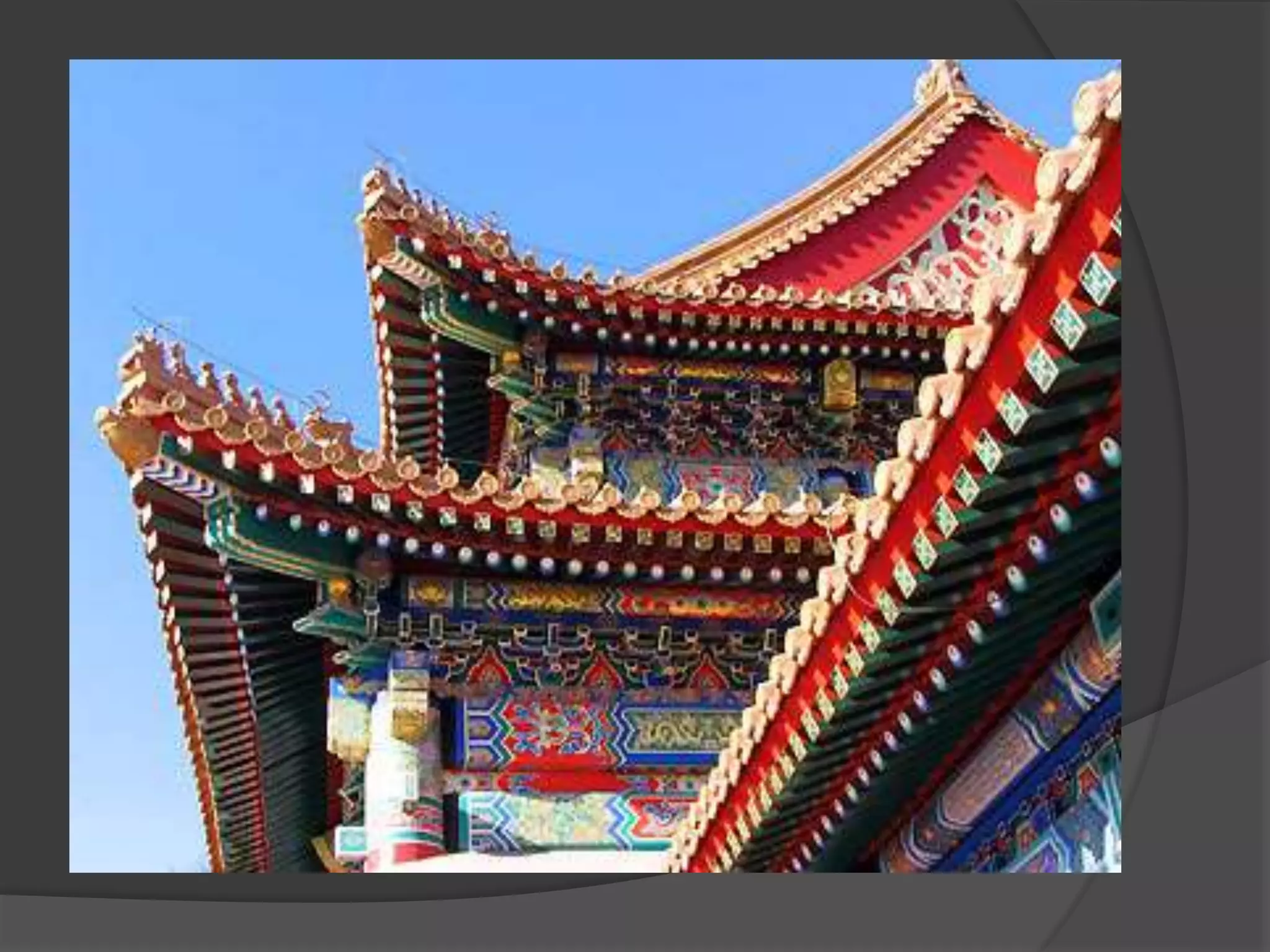
Chinese Architecture
Architecture
 Together with European and Arabian
architecture, ancient Chinese architecture is
an important component of the world
architectural system.
 During its long development, it gradually
formed into a style which featured timberwork
combining stone carving, rammed earth
construction, bucket arch buildings and many
other techniques.
 Industrious Chinese laboring people created
many architectural miracles such as the Great
Wall, Forbidden City and the Mausoleum of
the First Qin Emperor.
Features
 The most significant characteristic is the use of timber
framework.
 Paintings and carvings were added to the architectural
work to make it more beautiful and attractive.
 Ancient Chinese buildings have a long history which can
be traced back to the Shang Dynasty (16th century BC -
771 BC).
 It has its own principles of structure and layout. Through
the long development, many wonders have been created
by industrious and clever laboring people.
 Ancient architectural miracles are innumerable ranging
from Great Wall, White Horse Temple, Mogao Caves to
Summer Palace and Forbidden City.
 Ancient Chinese architecture is mainly timberwork.
Wooden posts, beams, lintels and joists make up the
framework of a house.
 Walls serve as the separation of rooms without
bearing the weight of the whole house, which is
unique to China.
 As a famous saying goes, 'Chinese houses will still
stand when their walls collapse.' The specialty of
wood requires antisepsis methods to be adopted,
thus develops into Chinese own architectural
painting decoration.
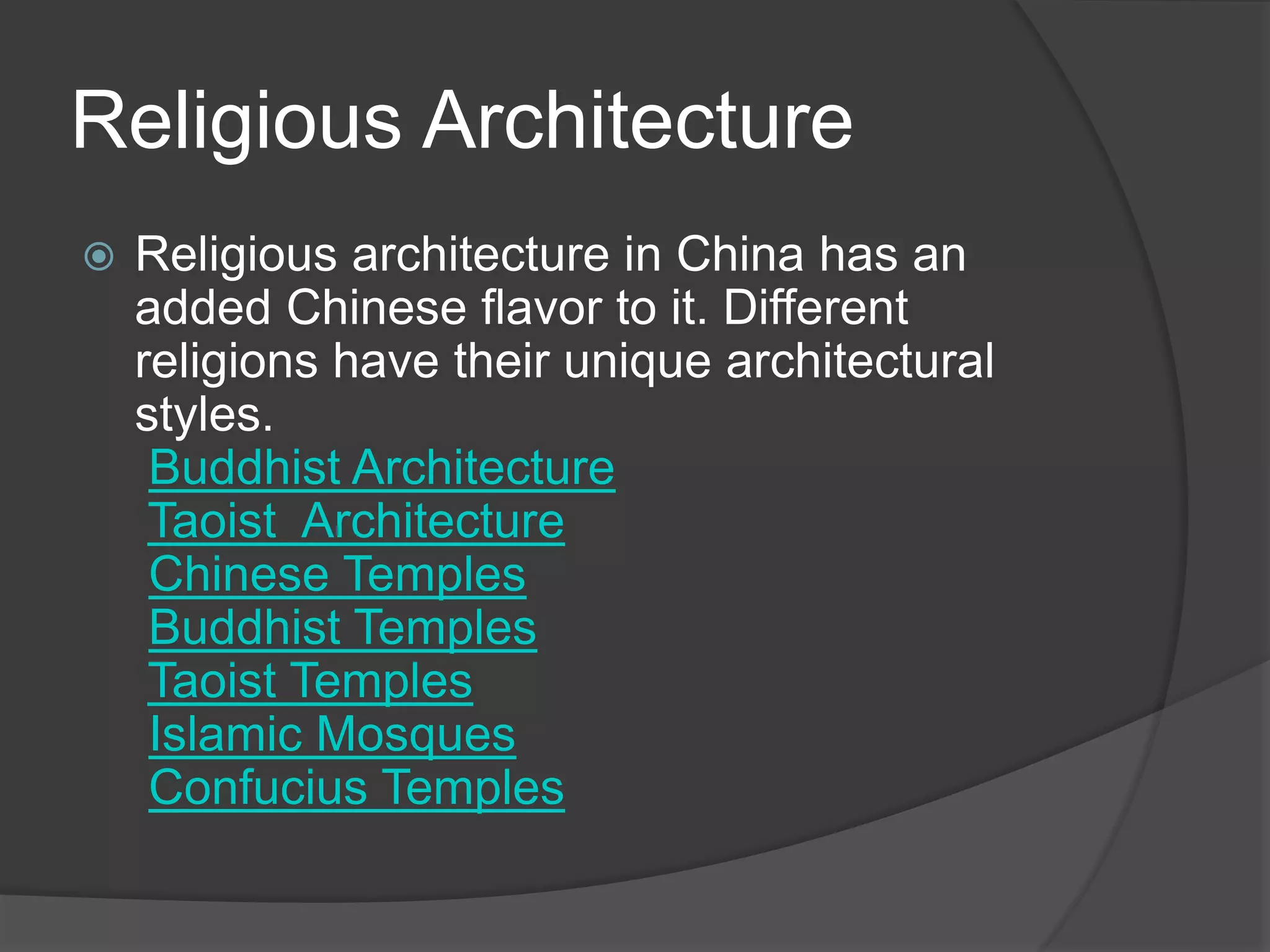
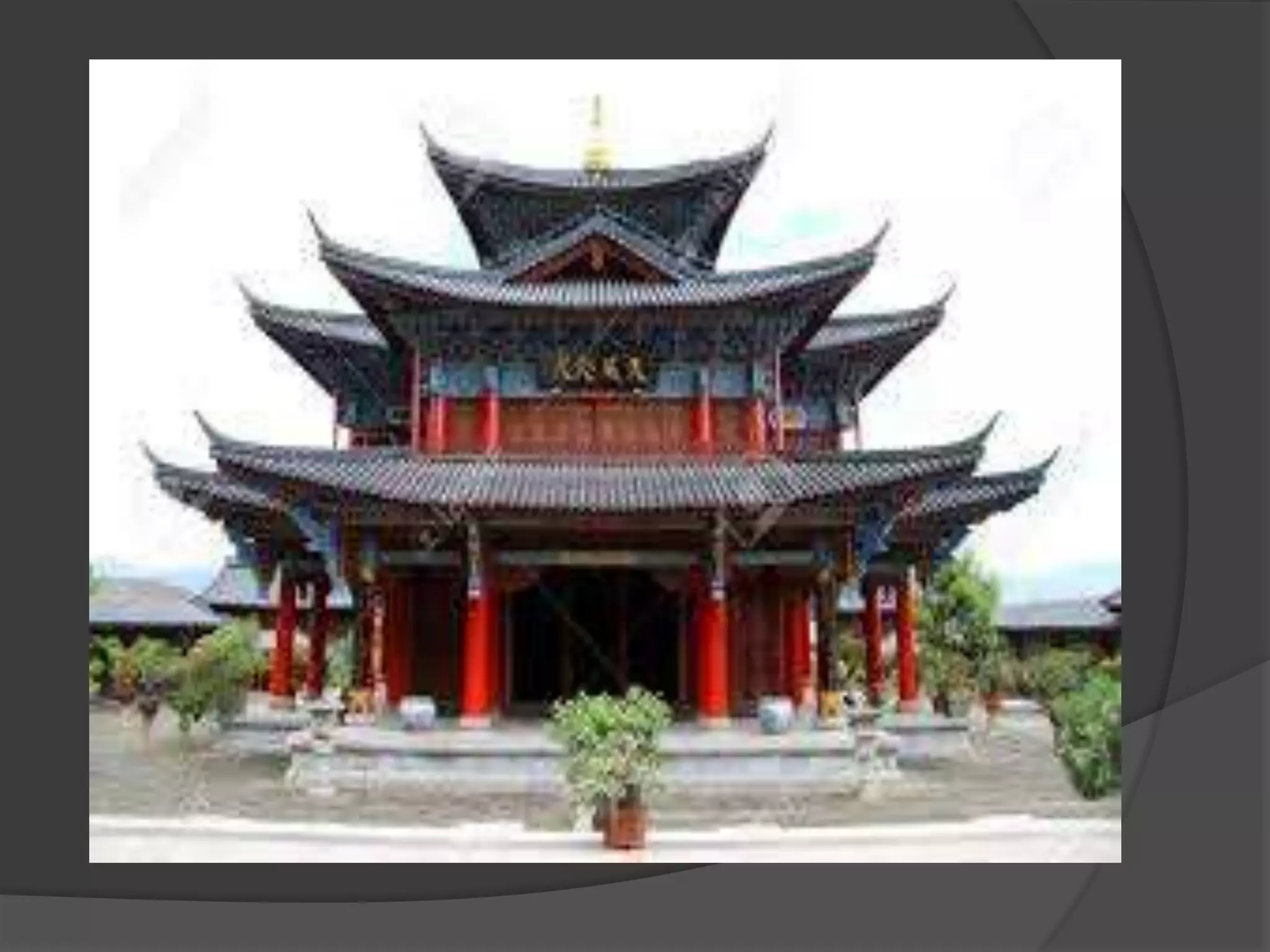
 Colored glaze roofs, windows with exquisite appliqué
design and beautiful flower patterns on wooden
pillars reflect the high-level of the craftsmen's
handicraft and their rich imagination.
 The layout of a courtyard complex is also unique to China.
 The main structure is located on the central axis of a
court while less-important structures are located to the left
and right.
 The whole layout is symmetrical. Compared with
European architectural style which is open and shut, a
courtyard is like a hand scroll of painting which should be
unfolded little by little.
 The scenery is different in each courtyard. Even in moving
several steps within the court yard, you will be surprised
at the changing of prospects.
 Likewise from the interior of the buildings the view from
no two windows is the same.
Architectural Styles
 There were many different styles of
ancient Chinese buildings. All of them
are unique and equally exquisite.
Imperial Architecture
 Chinese imperial architecture, including
imperial palaces, gardens and
mausoleums. In order to incarnate the
supremacy of imperial power, imperial
architecture often adopt the layout of an
axial symmetry, with the buildings on the
central axis tall and splendid while the
rest rather small and simple.
Traditional Residence
 the architecture that common people live in.
The 56 ethnic groups have weaved a colorful
civilian residence picture. Beijing locals has
their own distictive houses in traditional
Courtyards (Siheyuan). In northern part of
Shaanxi Province, people prefer to live in
Farmers' Caves (Yaodong). In Yunnan
Province, local people build Seal-like
Compound (Yikeyin) to dwell in, and in the
west of Fujian Province, Hakkas create the
Earthen Buildings (Tulou)which is considered
to be built with a wondrous architectural style.
Garden Architecture
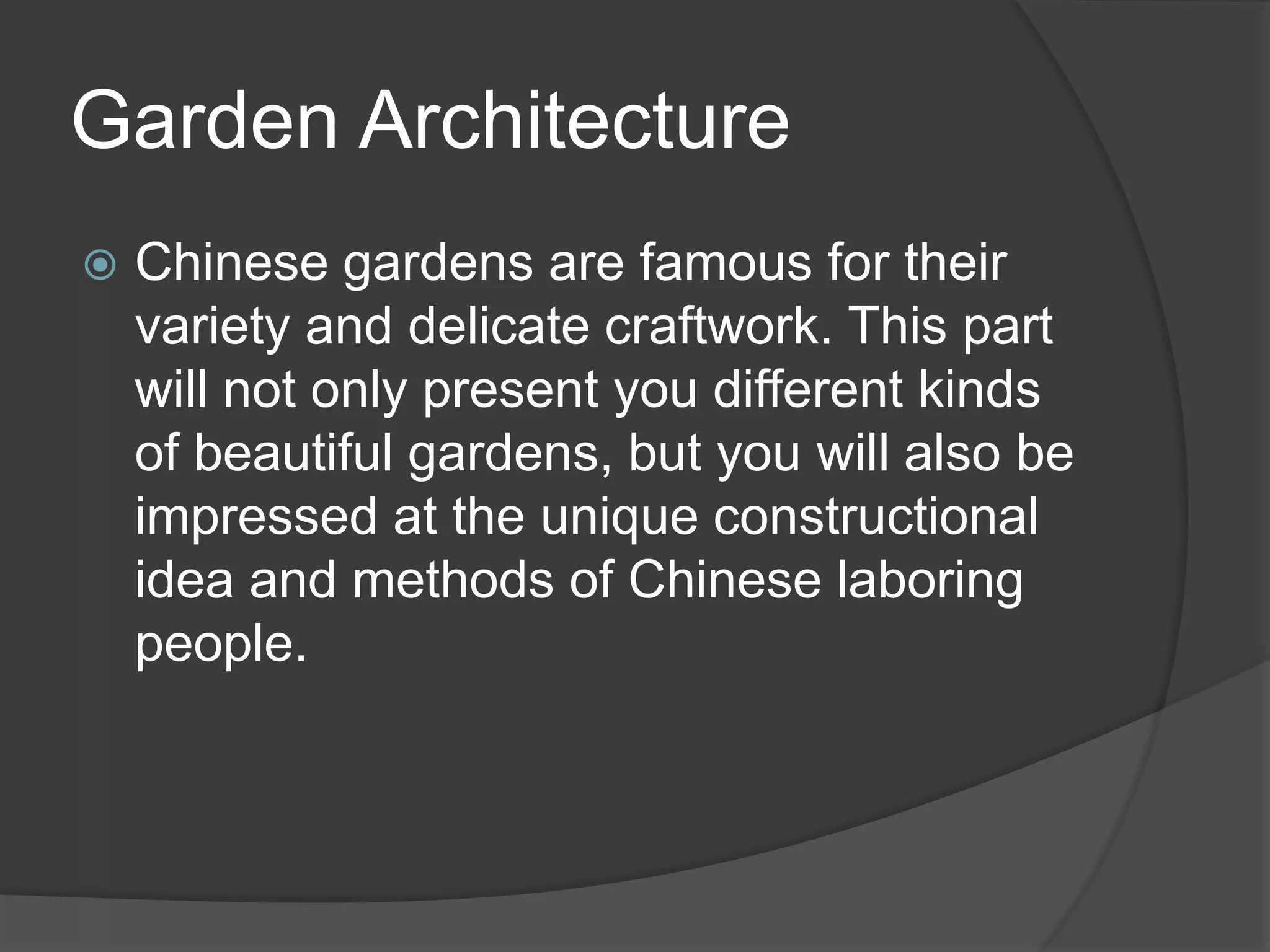
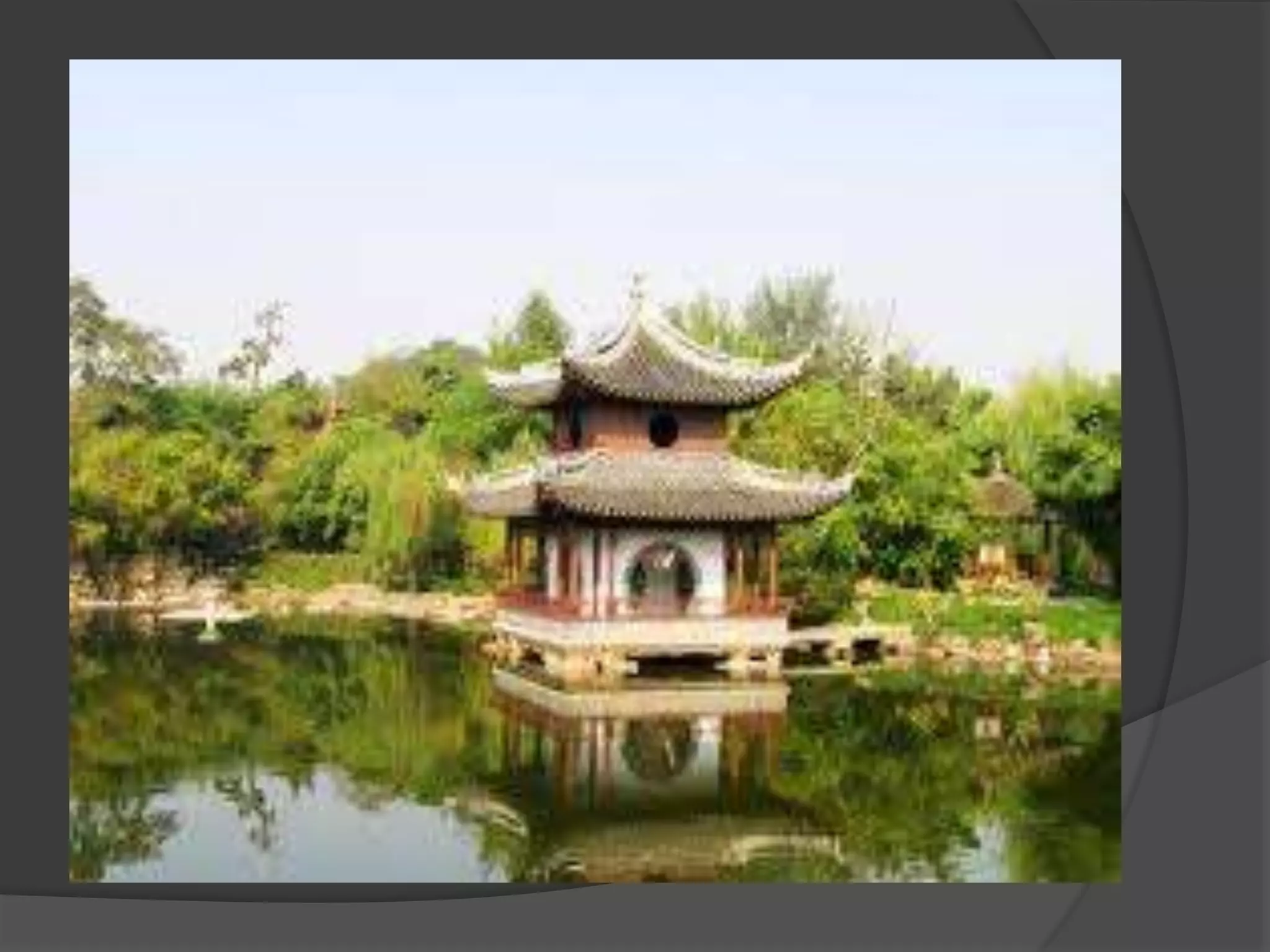
 Chinese gardens are famous for their
variety and delicate craftwork. This part
will not only present you different kinds
of beautiful gardens, but you will also be
impressed at the unique constructional
idea and methods of Chinese laboring
people.
Religious Architecture
 Religious architecture in China has an
added Chinese flavor to it. Different
religions have their unique architectural
styles.
Buddhist Architecture
Taoist Architecture
Chinese Temples
Buddhist Temples
Taoist Temples
Islamic Mosques
Confucius Temples
Chinese architecture

Chinese architecture

  • 1.
  • 2.
    Architecture  Together withEuropean and Arabian architecture, ancient Chinese architecture is an important component of the world architectural system.  During its long development, it gradually formed into a style which featured timberwork combining stone carving, rammed earth construction, bucket arch buildings and many other techniques.  Industrious Chinese laboring people created many architectural miracles such as the Great Wall, Forbidden City and the Mausoleum of the First Qin Emperor.
  • 3.
    Features  The mostsignificant characteristic is the use of timber framework.  Paintings and carvings were added to the architectural work to make it more beautiful and attractive.  Ancient Chinese buildings have a long history which can be traced back to the Shang Dynasty (16th century BC - 771 BC).  It has its own principles of structure and layout. Through the long development, many wonders have been created by industrious and clever laboring people.  Ancient architectural miracles are innumerable ranging from Great Wall, White Horse Temple, Mogao Caves to Summer Palace and Forbidden City.
  • 4.
     Ancient Chinesearchitecture is mainly timberwork. Wooden posts, beams, lintels and joists make up the framework of a house.  Walls serve as the separation of rooms without bearing the weight of the whole house, which is unique to China.  As a famous saying goes, 'Chinese houses will still stand when their walls collapse.' The specialty of wood requires antisepsis methods to be adopted, thus develops into Chinese own architectural painting decoration.  Colored glaze roofs, windows with exquisite appliqué design and beautiful flower patterns on wooden pillars reflect the high-level of the craftsmen's handicraft and their rich imagination.
  • 5.
     The layoutof a courtyard complex is also unique to China.  The main structure is located on the central axis of a court while less-important structures are located to the left and right.  The whole layout is symmetrical. Compared with European architectural style which is open and shut, a courtyard is like a hand scroll of painting which should be unfolded little by little.  The scenery is different in each courtyard. Even in moving several steps within the court yard, you will be surprised at the changing of prospects.  Likewise from the interior of the buildings the view from no two windows is the same.
  • 6.
    Architectural Styles  Therewere many different styles of ancient Chinese buildings. All of them are unique and equally exquisite.
  • 7.
    Imperial Architecture  Chineseimperial architecture, including imperial palaces, gardens and mausoleums. In order to incarnate the supremacy of imperial power, imperial architecture often adopt the layout of an axial symmetry, with the buildings on the central axis tall and splendid while the rest rather small and simple.
  • 8.
    Traditional Residence  thearchitecture that common people live in. The 56 ethnic groups have weaved a colorful civilian residence picture. Beijing locals has their own distictive houses in traditional Courtyards (Siheyuan). In northern part of Shaanxi Province, people prefer to live in Farmers' Caves (Yaodong). In Yunnan Province, local people build Seal-like Compound (Yikeyin) to dwell in, and in the west of Fujian Province, Hakkas create the Earthen Buildings (Tulou)which is considered to be built with a wondrous architectural style.
  • 9.
    Garden Architecture  Chinesegardens are famous for their variety and delicate craftwork. This part will not only present you different kinds of beautiful gardens, but you will also be impressed at the unique constructional idea and methods of Chinese laboring people.
  • 10.
    Religious Architecture  Religiousarchitecture in China has an added Chinese flavor to it. Different religions have their unique architectural styles. Buddhist Architecture Taoist Architecture Chinese Temples Buddhist Temples Taoist Temples Islamic Mosques Confucius Temples