1
Feudal Japan
ART 102 Gardner’s - Chapter 34
Jean Thobaben
Instructor
From 1336-1980:
The Art of Later Japan
Shoguns and Samurai
Pictures of the Floating World
Teahouses and Tea Ceremonies
MODERN
JAPAN
2
Feudal Japan
• In 1336, the Ashikaga clan formed Japan's second shogunate,
and ruled from the Muromachi district of Kyoto.
• Under the Ashikaga shoguns, local lords had considerable power
over local affairs, and ultimately vied for control of the country.
3
Zen Buddhism
• Zen Buddhism flourished alongside other sects, especially Pure
Land Buddhism.
• Because Zen emphasized rigorous discipline and personal
responsibility, it held a special attraction for samurai (warriors).
• Aristocrats and merchants also supported Zen temples, which
were centers for the study of Chinese art, literature, and learning.
4
• The Saihoji temple gardens exemplify the continuities and
transitions that marked religious art in the Muromachi period.
• After this Pure Land temple was transformed into a Zen
institution, the gardens continued to evoke the beauty of
Amida's Pure Land while serving the Zen faith's more
meditative needs.
Green Moss Garden
5
• The gardens echo the complementary roles of the two Buddhist
sects in the Muromachi period.
• The iridescently green mosses of Saihoji's lower gardens, which
seem to belong to another world, contrast with early examples of
dry landscape gardening on the hillsides.
Dry cascade – Upper Gardens
6
• In eastern Asia, gazing at dramatic natural scenery was
considered beneficial to the human spirit.
• Arranging stones to suggest landscapes, as seen in Chinese
paintings, encouraged aesthetic and spiritual engagement with
the scene, which could be fully visualized only in the mind.
Garden, Saihoji, Kyoto, modified in Muromachi period, 14th century.
7
Splashed-Ink Painting:
• Styles and subjects of ink painting in the Muromachi period
usually followed Chinese precedents closely.
• Most of the ink painting masters were at least ostensibly Zen
monks.
• Toya Sesshu (1420–1506) was one of the few artists who
traveled to China, and learned much from Ming painters.
8
• The strength of his brushwork and
brilliance ink handling justify his
high position in Japanese art.
Hanging scroll, ink
on paper, mounted
on brocade. Unigned
but sealed Toyo. An
excellent example of
Haboku
(flung ink)
brushwork.
9
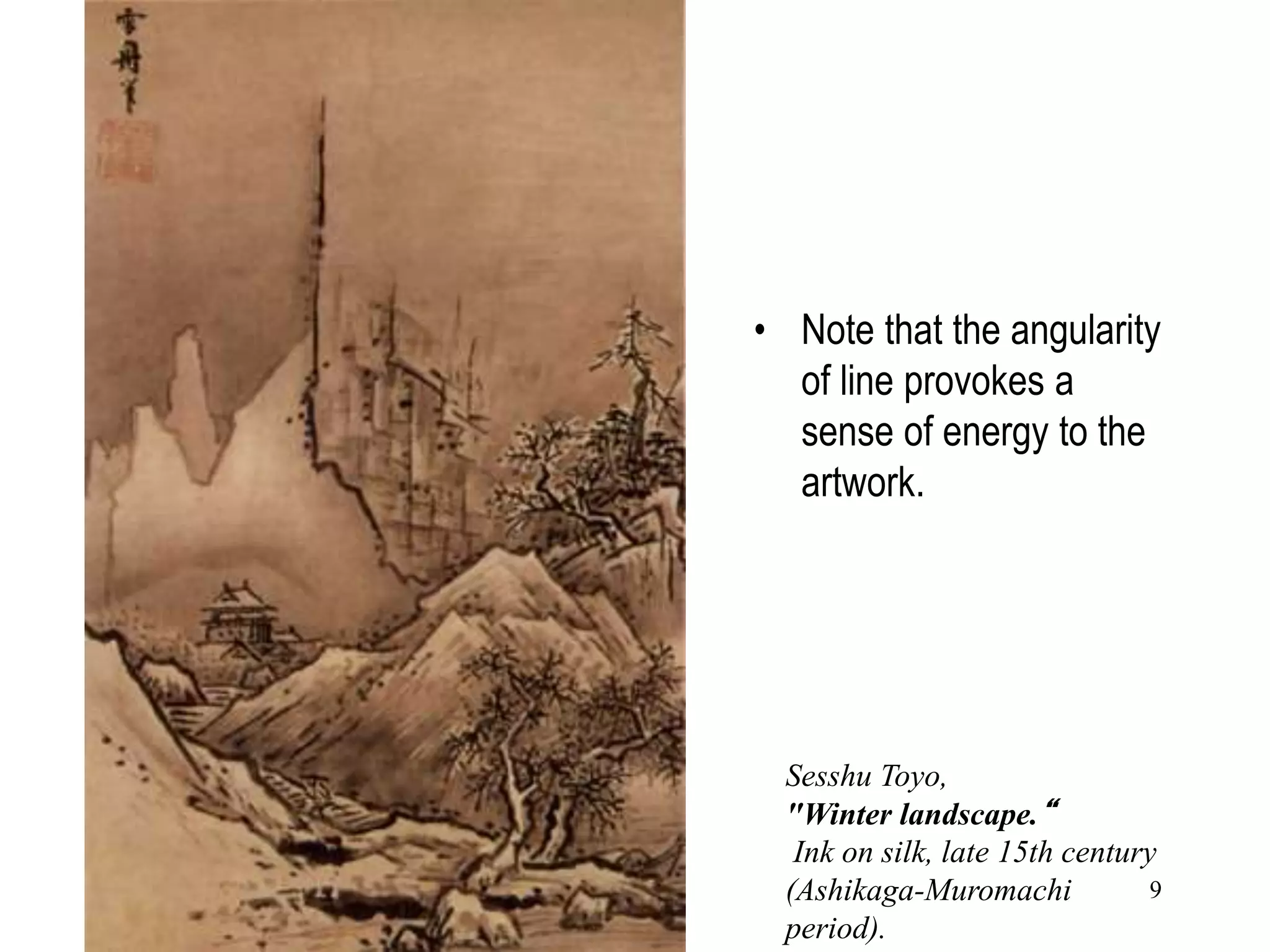
• Note that the angularity
of line provokes a
sense of energy to the
artwork.
Sesshu Toyo,
"Winter landscape.“
Ink on silk, late 15th century
(Ashikaga-Muromachi
period).
10
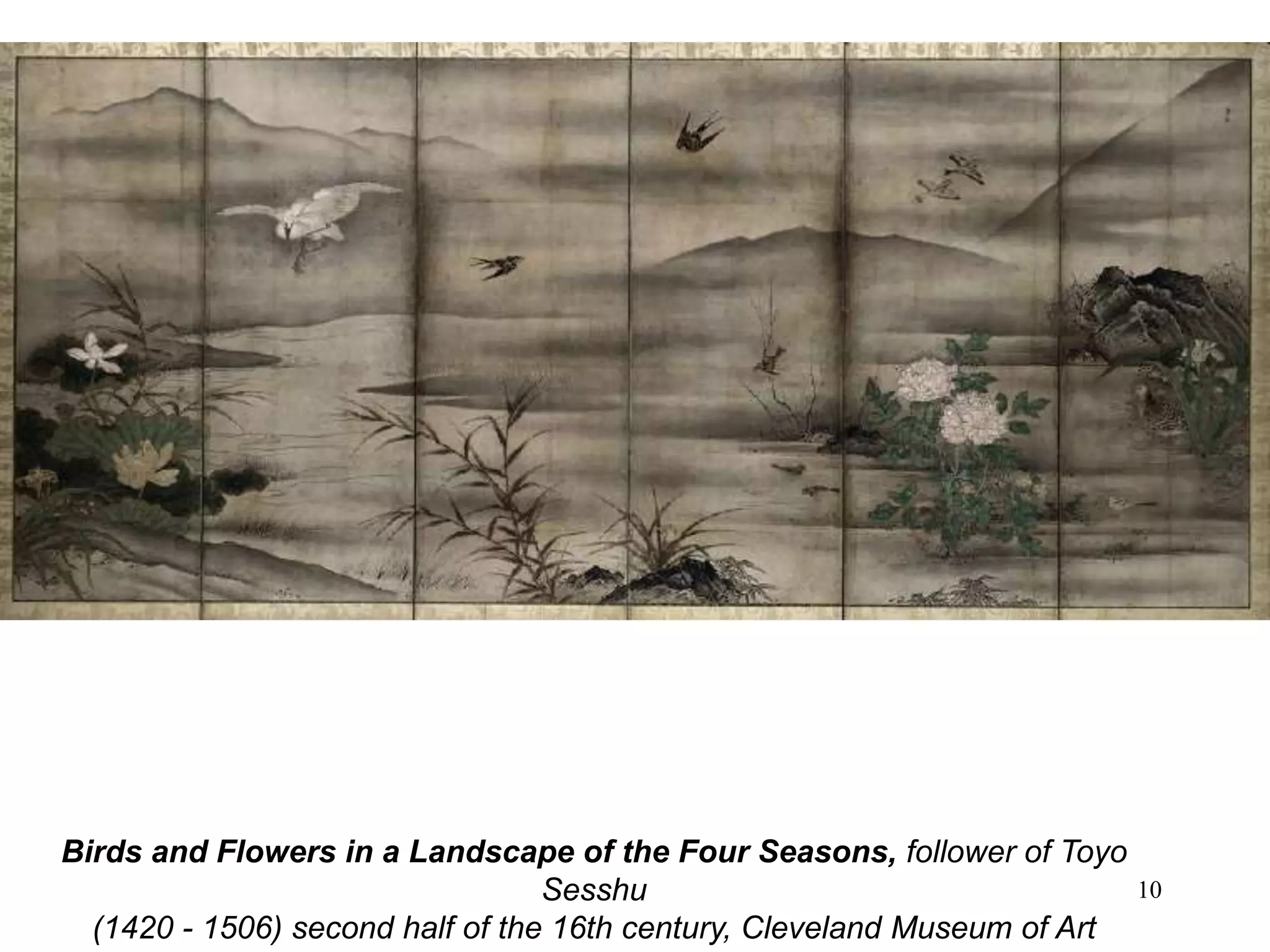
Birds and Flowers in a Landscape of the Four Seasons, follower of Toyo
Sesshu
(1420 - 1506) second half of the 16th century, Cleveland Museum of Art
11
Schools of Art
• The Tosa School and the more influential Kano School
emerged during the fifteenth and sixteenth centuries.
• Tosa Mitsunobu (1434–1525), director of the Painting Bureau
and chief painter at the imperial court, also worked for great
temples allied to the court and the Ashikaga shoguns.
• His Tale of Genji illustrations incorporate more narrative
elements in elegant arrangements, without the intimate moods of
earlier versions.
12
• Lady Murasaki’s epic tale of the life and loves of Genjii made up the
world’s first novel.
Attributed to Tosa Mitsunobu, Tale of Genji ("Yugao," scene 4), early 16th century.
Album, ink and color on paper, approx. 9 1/2" X 7". Harvard University.
13
• Traditional yamato-e painting is characterized by native subject
matter, often taken from literature, and themes associated with
famous places or the four seasons.
• Stylistically it features striking compositions, the frequent use of
flat planes of rich color, and a number of codified pictorial
devices such as fukinuki yatai ("room with roof blown away").
Six-panel screen,Color on paper,152.0 x 357.2,Muromachi period
In addition to scrolls and album leaves, the multi-paneled
folding-screen was a popular surface for decoration.
14
The Kano School
• As an independent painter in
the tumultuous early
sixteenth century, Kano
Moionobu (1476–1559)
formed an efficient workshop
and adapted his own broad
repertoire to its needs.
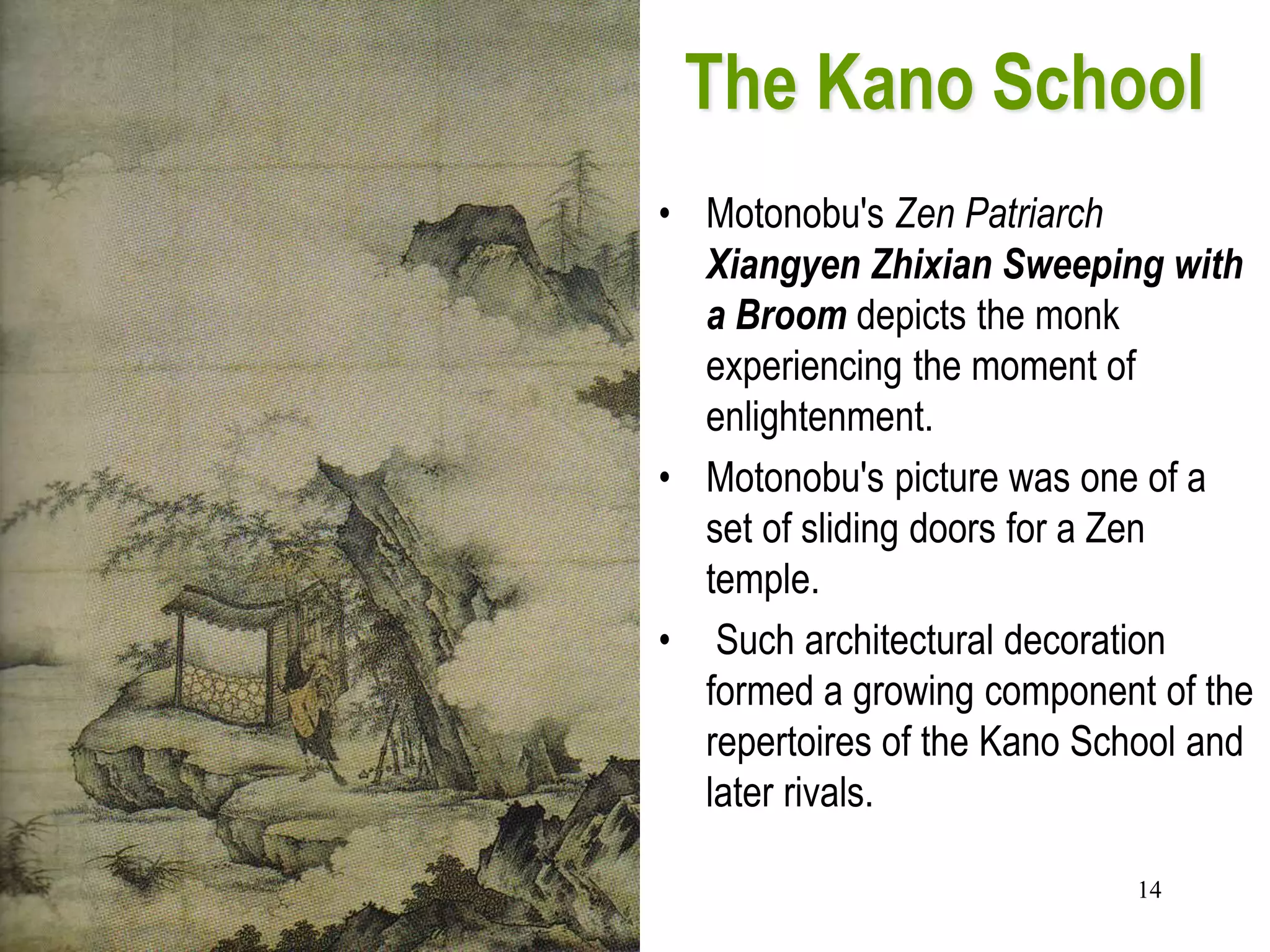
• Motonobu's Zen Patriarch
Xiangyen Zhixian Sweeping with
a Broom depicts the monk
experiencing the moment of
enlightenment.
• Motonobu's picture was one of a
set of sliding doors for a Zen
temple.
• Such architectural decoration
formed a growing component of the
repertoires of the Kano School and
later rivals.
15
Momoyama Period(1573–1615)
• The Role of the Tea Ceremony:
• The favorite exercise of cultivation in the Momoyama period
was the tea ceremony, which eventually carried political and
ideological implications.
• The ceremony also acquired special social significance as it
gained acceptance as a major expression of aesthetic and even
spiritual sophistication.
16
• In the late 15th century, the new
aesthetic of refined rusticity, or
wabi, included appreciation of
rustic Korean and Japanese
wares, as well as the design of
very simple tea rooms and
teahouses.
• Zen concepts also played an
important role in this aesthetic.
• The Shino water jar
named Kogan shows
the wabi aesthetic's
influence in the tea
ceremony.
• The coarse stoneware
body, simple form, and
casual decoration offer
the same aesthetic and
interpretive challenges
and opportunities as the
dry landscape gardens
of Zen temples.
Tea-ceremony water jar, or Kogan (ancient stream bank),
Momoyama period, late sixteenth century. Shino ware with
underglaze design, 7" high. Hatakeyama Memorial
Museum, Tokyo.
17
Shino Ware Tea Bowl, named 'Bridge
Princess' (Hashihime)
• Other examples:
18
Tea Houses
• The ultimate representation of the new wabi aesthetic in the
Momoyama period was the Taian teahouse, designed under the
direction of the most renowned tea master, Sen No Rikyo
(1522–1591).
• The interior displays two standard features of Japanese
residential architecture that developed in the late Muromachi
period-very thick, rigid straw mats - tatami
• and an alcove - tokonoma, a place to hang painting or
calligraphy and to display other prized objects.
19
• The room's dimness and tiny
size produce a cavelike feel
and force intimacy among the
tea host and guests.
• The small entrance
emphasizes a guest's
passage into a ceremonial
space.
Taian teahouse (interior view),
1582, Myokian Temple,
Kyoto, Japan.
20
Momoyama Painting
• In the Momoyama period, a succession of three great warlords
imposed peace on a country civil war had ravaged since the late
fifteenth century.
• The warlords erected huge castles with palatial residences, and
asked the Kano painters and their rivals to decorate them.
• Gold screens had been known since Muromachi times, but
Momoyama painters made them even bolder, reducing in
number and often greatly enlarging the motifs against flat fields
of gold leaf.
21
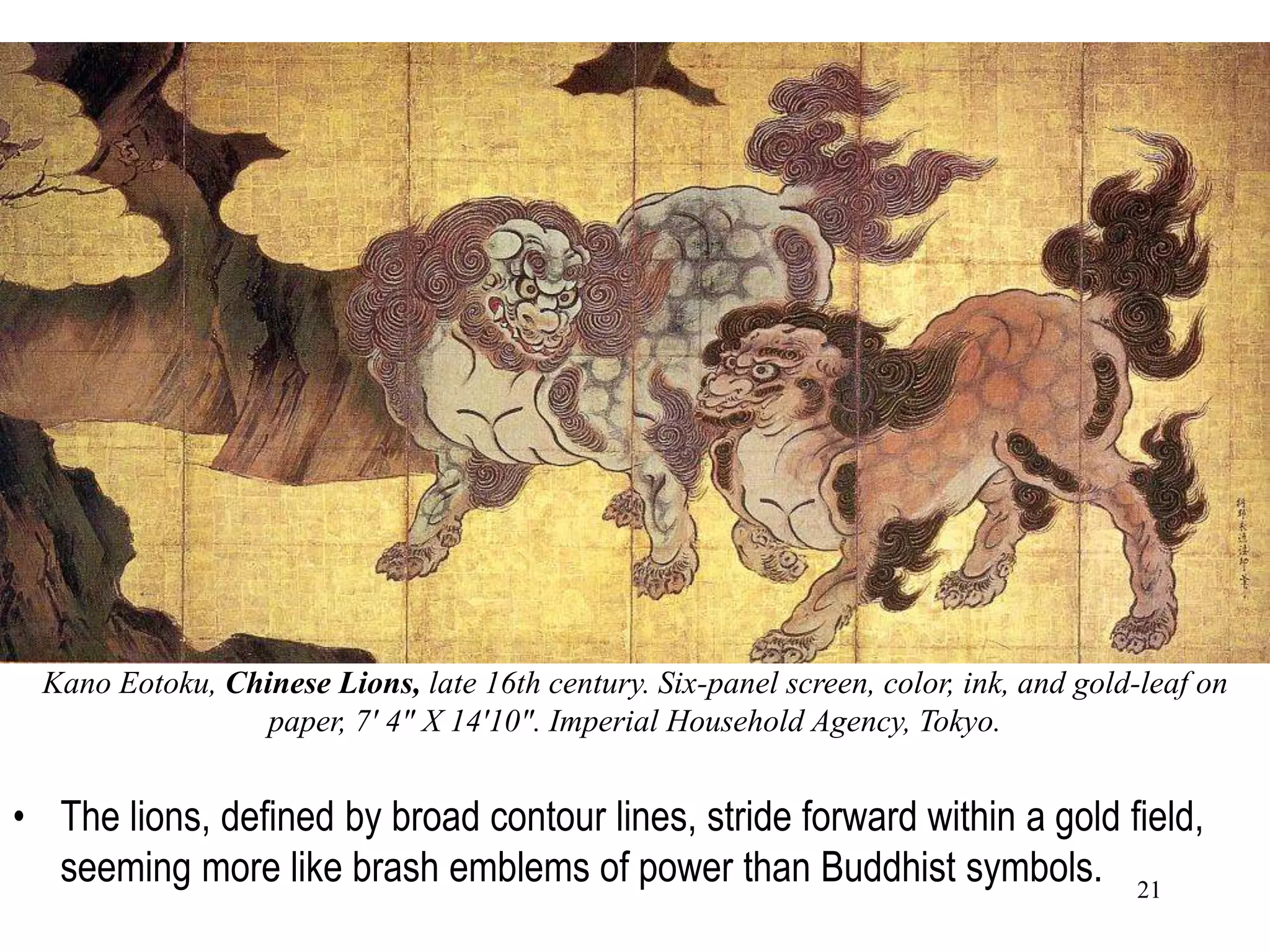
• Motonobu's grandson, Kano Eitoku (1543–1590), was the
dominant painter of such murals and screens.
• Because of the enormous scope of Eitoku's decoration projects,
he often worked in the monumental style typified by Chinese
Lions.
• The lions, defined by broad contour lines, stride forward within a gold field,
seeming more like brash emblems of power than Buddhist symbols.
Kano Eotoku, Chinese Lions, late 16th century. Six-panel screen, color, ink, and gold-leaf on
paper, 7' 4" X 14'10". Imperial Household Agency, Tokyo.
22
• Hasegawa Tohaku (1539–1610), a protegé of Rikyu,
sometimes worked in the loose ink-monochrome manner of the
thirteenth-century Chinese Chan monk Muqi.
• In Pine Forest, trees emerge from and recede into a heavy mist.
• In Zen terms, the picture suggests the illusory nature of
mundane reality while evoking a meditative mood.
Pine Forest, Momoyama period, late 16th c., screens, ink on paper, 5' 1 3/8" X 11' 4".
Tokyo National Museum, Tokyo.
23
Edo Period (1615–1868)
• In 1615, Tokugawa Ieyasu established a new shogunate,
centered in Edo. (Modern Tokyo)
• The new regime instituted many policies designed to limit
Japan's pace of social and cultural change.
• The expansion of urban centers, the spread of literacy, and a
growing thirst for knowledge and diversion, however, made for a
very lively popular culture.
24
• The imperial court continued to influence taste and culture.
• The harmonious integration of building and garden in the Katsura
Imperial Villa became one of the great ideals of Japanese
residential architecture, and has also inspired architects worldwide.
Katsura Imperial Villa, Kyoto, Edo period, 1620–1663.
25
While many of its design features
derive from earlier teahouses, the
Katsura Villa also incorporates
elements of courtly gracefulness.
The architecture's appeal relies on
subtleties of proportion, color, and
texture.
26
Interior view
27
• The Edo period painters produced a dazzling variety of styles.
• Although the Kano School enjoyed official governmental
sponsorship, individualist painters and other schools also emerged
and flourished.
• The earliest major alternative school in the Edo period, Rinpa
School aesthetics and principles attracted a variety of individuals.
• The term Rinpa is derived from the name of its ostensible founder,
Ogata Korin.
• However, two closely linked artists, Honami Koetsu (1558-1637)
and Tawaraya Sotatsu (1576–1643), laid its foundations a few
generations earlier.
28
• Koetsu, heir to a family of sword experts in
Kyoto, was a greatly admired calligrapher, and
made tea ceramics.
• He and Sotatsu, proprietor of a fan-painting
shop, together drew on ancient traditions of
painting and craft decoration to collapse
boundaries between the two arts.
• Most Rinpa works also display knowledge of
court literary and material traditions
• Koetsu's Boat Bridge
writing box
exhibits motifs
drawn from
classical poetry.
• The lid presents
a subtle, gold-on-gold
scene of small boats
supporting a temporary bridge.
• The poem describes the experience of crossing such a bridge as evoking
reflection on life's insecurities.
29
• Hon'ami Kôetsu (1558 - 1637) and Tawaraya Sôtatsu are
generally regarded as among the most important figures in
Japanese art of the early modern period.
• Kôetsu's pottery and calligraphy and Sôtatsu's painting represent
the greatest achievement of the age and a high point in the history
of Japanese culture.
Tawaraya Sôtatsu, Handscroll of Poems from the Anthology of Thirty-six
Immortal Poets, Kyoto National Museun
30
• The son of a textile merchant,
Ogata Korin (1658–1716) took
the principles Koetsu and Sotatsu
developed into the eighteenth
century.
• White Plum Blossoms, Korin
offers a dramatic contrast of forms
and visual textures.
• The mottling of
the trees comes
from a signature
Rinpa technique
called
tarashikomi.
• The contrasting
pattern in the
stream has the
precision and
elegant
stylization of a
textile design
produced by
applying pigment
through a paper
stencil.White Plum Blossoms, ink, color, and gold-and-silver leaf on paper,
each screen 5' 1 5/8" X 5' 7 7/8". Museum of Art, Atami
31
• In the 17th and 18th centuries, Japan's increasingly urban,
educated population spurred a cultural and social restlessness
among commoners and samurai of lesser rank.
• People eagerly sought new ideas and images, directing their
attention primarily to China, but also to the West.
• Several Japanese painters and their followers embraced
elements of the Chinese literati style.
• Illustrations in printed books and actual paintings of lesser quality
brought limited knowledge of the literati style into Japan.
• However, the newly seen Chinese models supported emerging
ideals of self-expression in painting by offering an alternative to
the Kano School's standardized repertoire.
Popular Art and Culture
32
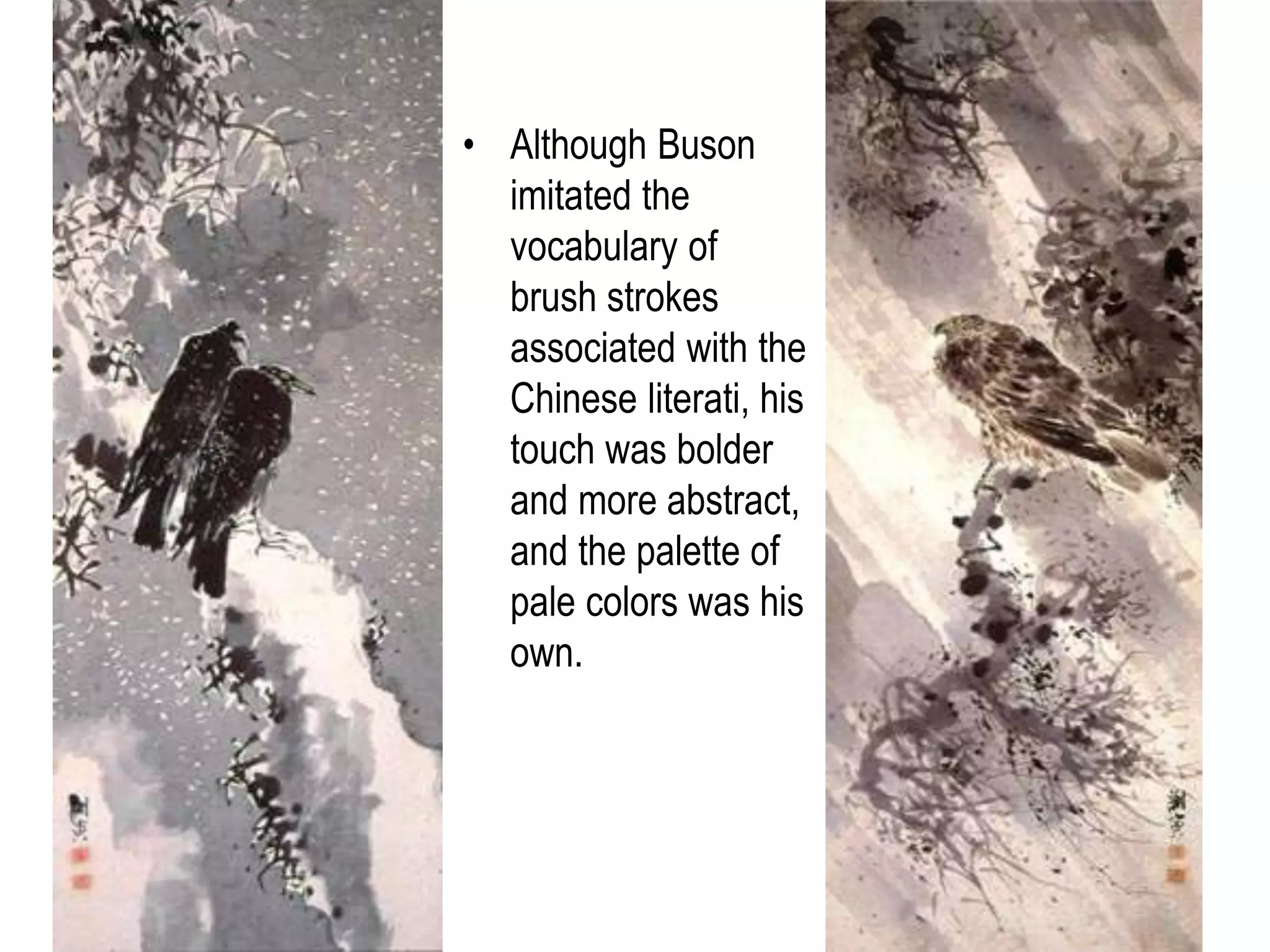
• An outstanding
early example of
Japanese literati
painting was
Yosa Buson
(1716–1783).
• He incorporated basic
elements of Chinese
and Japanese literati
style by rounding the
landscape forms,
rendering their
texture in fine fibrous
brush strokes, and
including dense
foliage patterns.
• Although Buson
imitated the
vocabulary of
brush strokes
associated with the
Chinese literati, his
touch was bolder
and more abstract,
and the palette of
pale colors was his
own.
33
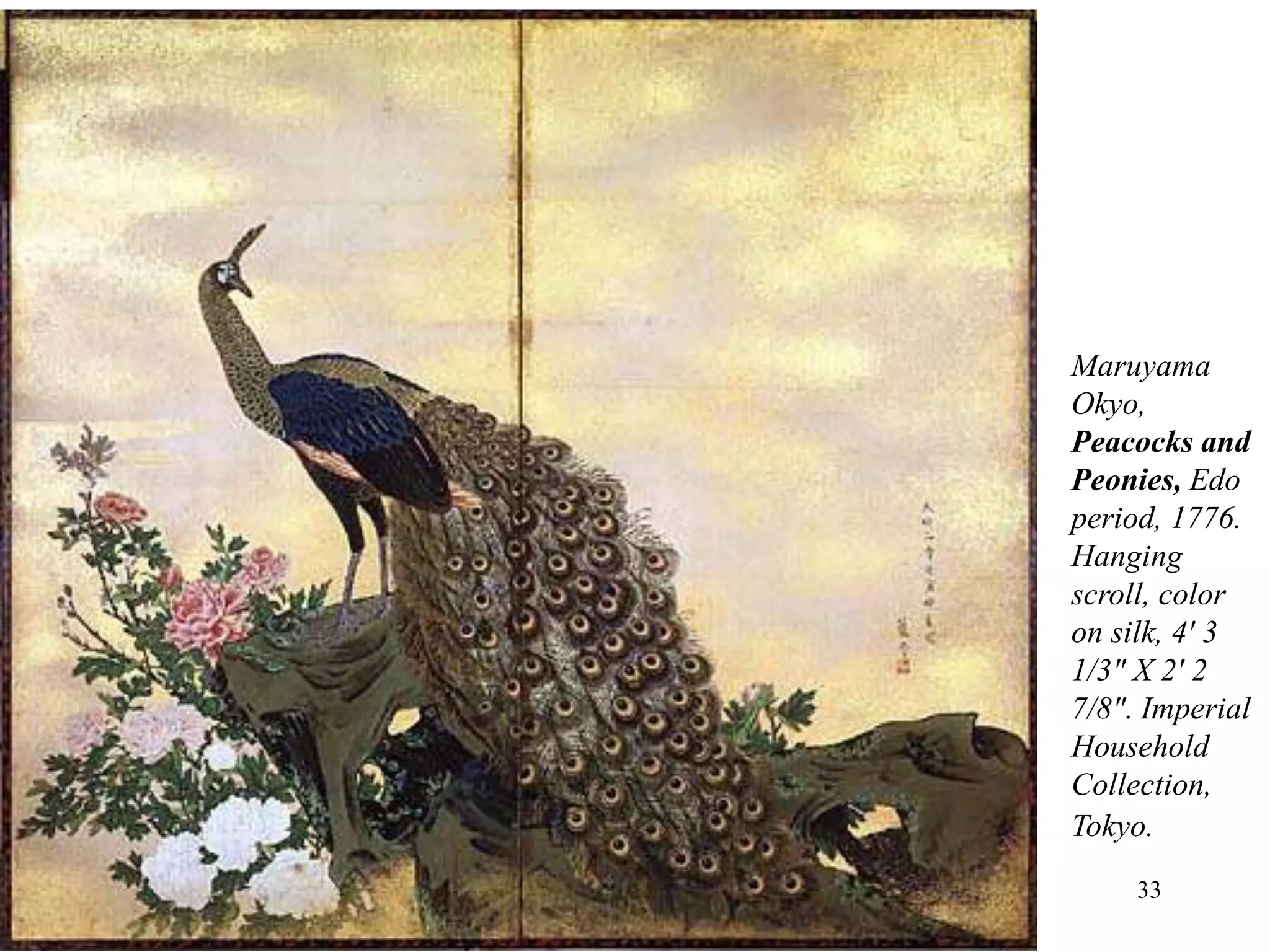
• While the Japanese literati catered to people with an
intellectual bent, the school of Maruyama Okyo
(1733–1795) achieved a wide following among people
attracted to naturalism and sheer painterly skill.
• Okyo looked to a variety of East Asian styles and also
to the West.
• Western approaches to naturalistic depiction had
become fairly widely known in Japan by this time.
Maruyama
Okyo,
Peacocks and
Peonies, Edo
period, 1776.
Hanging
scroll, color
on silk, 4' 3
1/3" X 2' 2
7/8". Imperial
Household
Collection,
Tokyo.
34
• Okyo's Peacocks and Peonies is an outstanding example of
his synthesis of naturalism with elements of Kano painting and
a type of Chinese painting one might call "decorative
naturalism.“
• The combination of rich detail, brilliant colors, and naturalistic
modeling appealed to urban sensibilities.
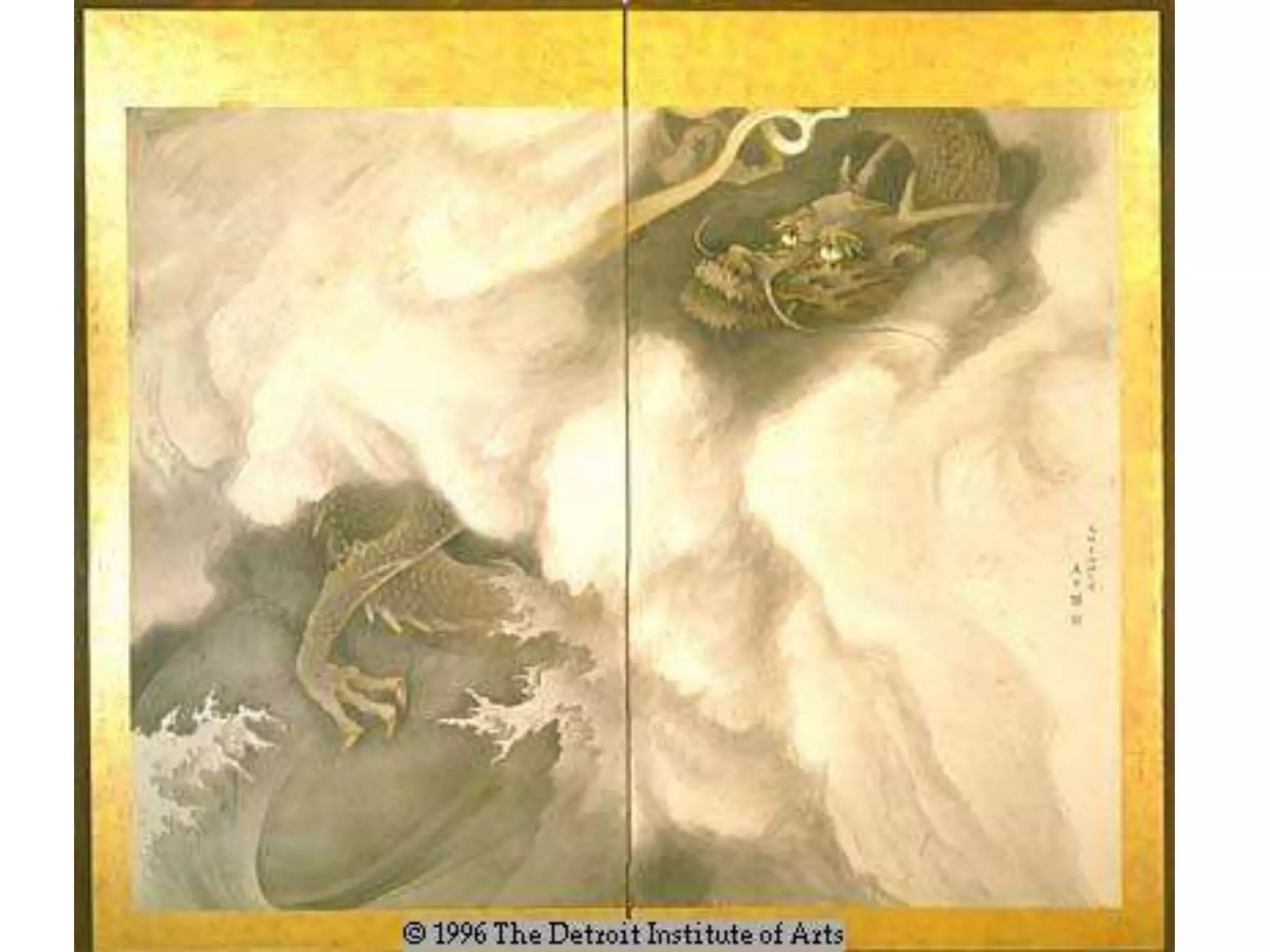
• His The Dragon Screen, although more imaginative, is more
subtle and monochromatic in style.
35
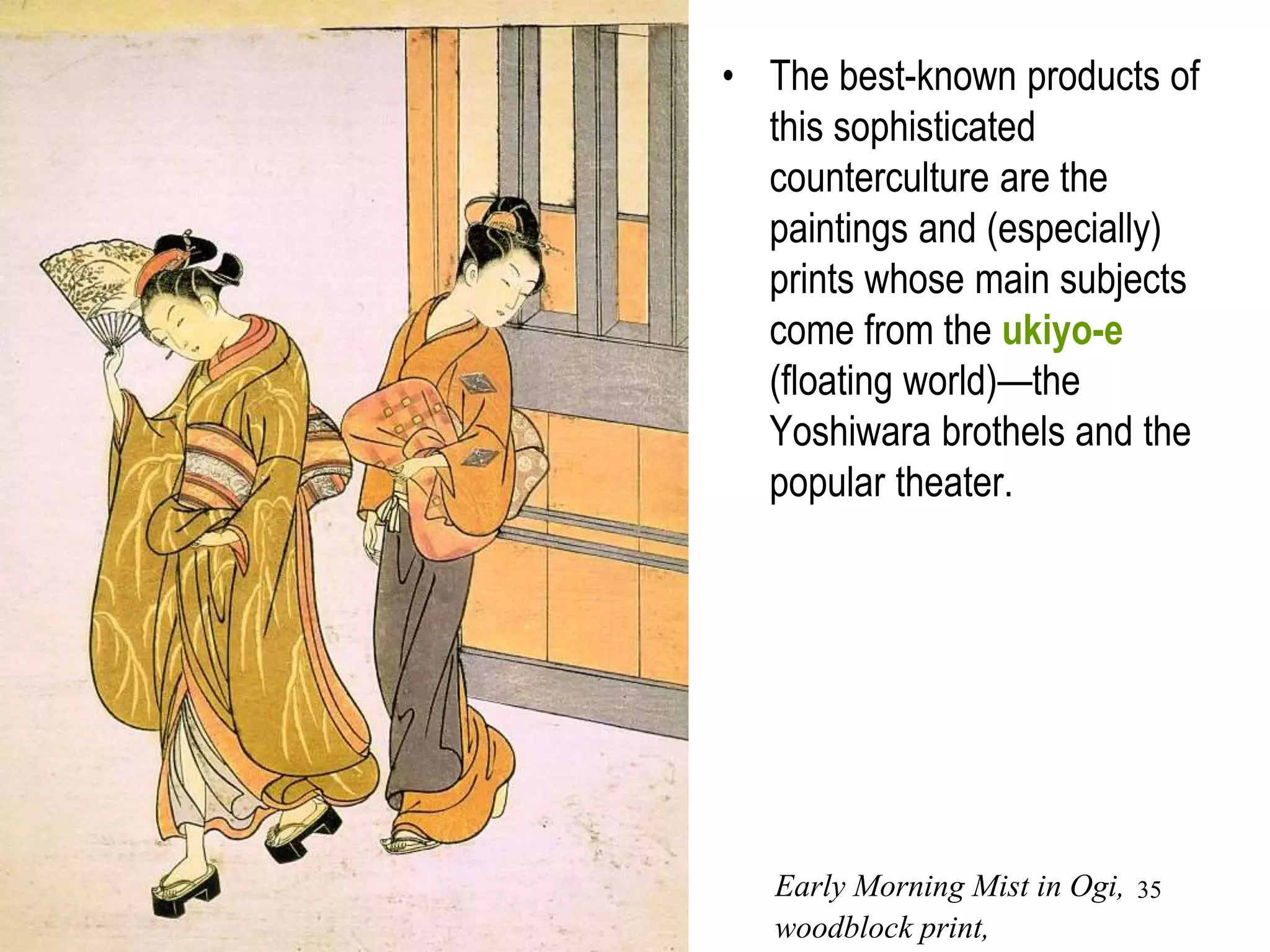
• The urban population's
restlessness also found an outlet
in the popular theaters and
pleasure houses of Edo's
Yoshiwara brothel district, where
prosperous townspeople, as well
as many samurai, sought
entertainment.
• Many who participated in the
urban culture were also highly
educated in literature, music,
and the other arts.
• The best-known products of
this sophisticated
counterculture are the
paintings and (especially)
prints whose main subjects
come from the ukiyo-e
(floating world)—the
Yoshiwara brothels and the
popular theater.
Early Morning Mist in Ogi,
woodblock print,
36
• One of the most admired and emulated eighteenth-century
designers, Suzuki Harunobu (1725–1770), played a key role
in developing some of the earliest brocade prints, pictures
printed in many colors.
• Harunobu applied techniques from his limited-edition
commissions to his more commercial prints, and also issued
some of the private designs for popular consumption.
• A sophisticated example is Evening Bell of the Clock, one of
Harunobu's parlor-series prints that draw playfully on an ancient
Chinese landscape theme, Eight Views of the Parlor series.
37
• Instead of the traditional
temple bell, however,
Harunobu depicted a modern
clock.
• This humorous juxtaposition
of past and present also
displays the cultural
sophistication of the floating
world's inhabitants.
• The flatness and rich color
recall the traditions of court
painting.
Evening Bell of the Clock, from Eight
Views of the Parlor series, Edo period,
ca. 1765. Woodblock print,
11 1/4" X 8 1/2".
Art Institute of Chicago,
38
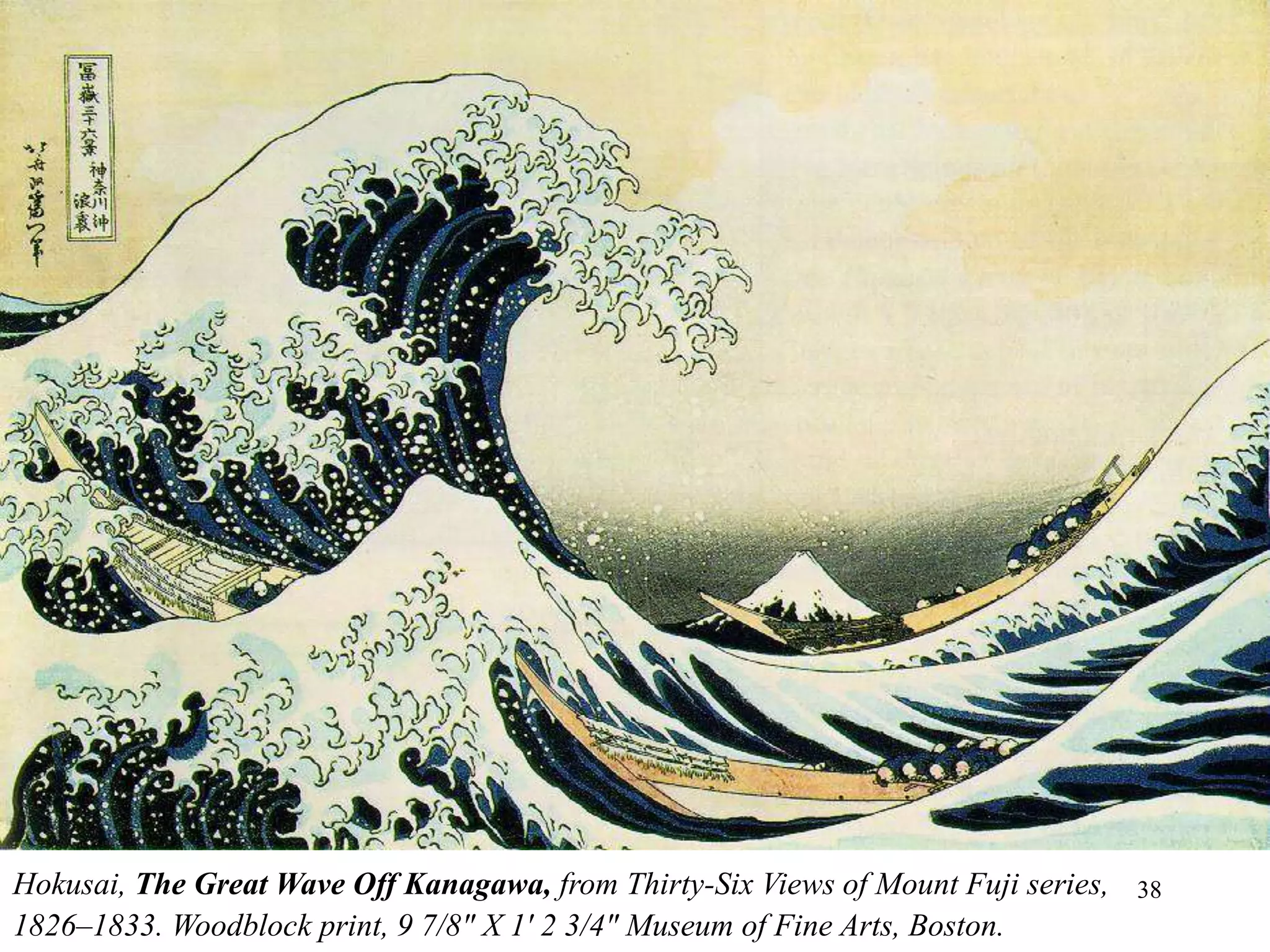
• Another subject, landscapes, often incorporated Western
perspective techniques.
• One of the most famous designers in this style was
Katsushika Hokusai (1760–1849).
• In The Great Wave Off Kanagawa, the huge foreground wave
dwarfs distant Mount Fuji.
• Hokusai places the wave's more traditionally flat and powerfully
graphic forms against the low horizon, typical of Western
perspective painting.
Hokusai, The Great Wave Off Kanagawa, from Thirty-Six Views of Mount Fuji series,
1826–1833. Woodblock print, 9 7/8" X 1' 2 3/4" Museum of Fine Arts, Boston.
39
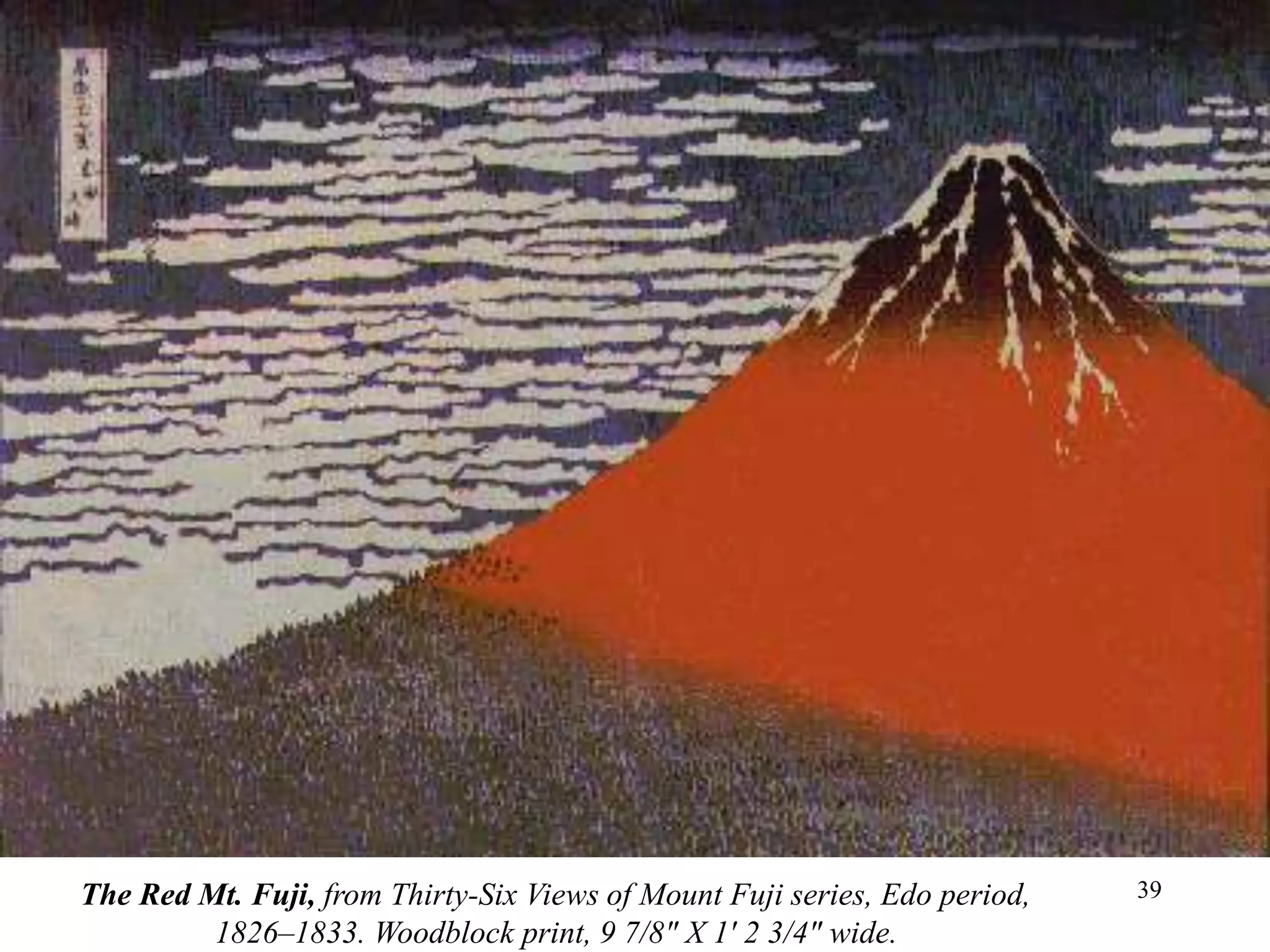
• Another view from the same series.
• Notice how “modern” this print seems by today’s
standards.
• What qualities make it seem so?
The Red Mt. Fuji, from Thirty-Six Views of Mount Fuji series, Edo period,
1826–1833. Woodblock print, 9 7/8" X 1' 2 3/4" wide.
40
• The other great Edo period
artist was Ando Hiroshige
(1797-1858) a Japanese
painter and printmaker, known
especially for his landscape
prints.
• The last great figure of the
Ukiyo-e, or popular, school of
printmaking, he transmuted
everyday landscapes into
intimate, lyrical scenes that
made him even more
successful than his
contemporary, Hokusai.
• His work was not as bold or
innovative as that of the
older master, but he
captured, in a poetic, gentle
way that all could
understand.
Dyers' Quarter, Kanda, 1857 From
"One Hundred Famous Views of Edo";
Woodblock print,
13 1/4 x 8 5/8 in;
The Brooklyn Museum .
41
• Hiroshige won fame as a landscape artist, reaching a peak of
success and achievement in 1833 when his masterpiece, the
print series Fifty-three Stations of the Tokaido (scenes on the
highway connecting Edo and Kyoto), was published.
• In this next slide, a street of houses backing on to the seashore,
and the tail-end of a daimyo's procession passing along it; behind
the houses ships moored in the bay.
• Being the first station on the highway, Shinagawa was thronged
with travellers coming and going.
• The road was lined with many teahouses, restaurants and
entertainment quarters.
42
Towards the Modern Era
• The Meiji and Taisho Periods (1868-1926)
• The Tokugawa shogunate toppled, in part, because of its inability to
handle increasing pressure from Western nations for a more open
Japan.
• Sovereignty was restored to the imperial throne, but real power
rested with the emperor's cabinet.
• Japanese leaders emphasized catching up with the West in military
capacity, science, and technology.
• They also promoted Western cultural elements as signs of Japan's
status as a "civilized" nation, similar to the emulation of China in the
Nara period.
• The government imported Western architects and artists, who
also taught Japanese students.
43
• Oil painting became a major genre in
the late nineteenth century.
• Oiran (Grand Courtesan) by
Takahashi Yuichi (1828–1894),
created for a client nostalgic for
vanishing elements of Japanese
culture, highlights the cultural ferment
of the early Meiji period.
• Takahashi portrayed the courtesan's
features in the analytical manner of
Western portraits, while the more
abstract garments reflect traditional
portraiture.
Takahashi Yuichi, Oiran
(grand courtesan), Meiji
period, 1872. Oil on
canvas, 2' 6 1/2" X 1' 9
5/8". Tokyo National
University of Fine Arts
and Music, Tokyo.
44
• Enthusiasm for Westernization led to resistance and concern over a
loss of distinctive Japanese identity.
• The American professor Ernest Fenollosa (1853–1908), a former
student named Okakura Kakuzo (1862–1913), and others founded
a university dedicated to Japanese arts.
• They encouraged incorporating some Western techniques in
basically Japanese-style paintings.
• The resulting style was called nihonga (Japanese painting), as
opposed to yoga (Western painting).
45
• Kutsugen, by Yokoyama Taikan (1868–1958), provides a good
example of nihonga.
• It combines a low horizon line and subtle shading effects taken from
Western painting with East Asian elements in its composition,
brushwork techniques, and use of traditional media.
• The subject, a Chinese poet who falls out of the emperor's favor, may
have resonated with Taikan and his associates.
• The poet suggests the spirit of the early nihonga painters, who
resisted powerful forces of change.
46
Summary:
• Zen Buddhism flourished alongside other sects and promoted a
uniquely Japanese aesthetic.
• In Muromachi splashed-ink painting spontaneity is balanced with a
thorough knowledge of the painting tradition.
• Painters also continued painting on golden screens
making them even bolder as architectural painting becomes a more
important aspect in Japanese decorative arts.
• Yamato-e or narrative painting continues into the Momoyama period.
• In the late 15th century, the new aesthetic of refined rusticity, or wabi,
included appreciation of rustic Japanese ceramics.
47
• Teahouses and homes included – tatami, and an alcove -
tokonoma-, a place to hang painting or calligraphy and to
display other prized objects.
• In the Edo period, a new middle class comes to power and
popular art includes ukiyo-e woodblock prints to display in the
homes of ordinary people.
• Katsushika Hokusai and Ando Hiroshige are among the most
famous practitioners of this art form.
• By the end of the 19th century, the ever adaptable were utilizing
western techniques and perspective while maintaining a
Japanese style in their artwork.
48
LINKS:
• Cleveland Art Museum
• Metropolitan Special Exhibit (16th Cent Japan)
• Institute for Japanese Art
• Tokyo National Museum
• Japanese Gallery at CGFA
• A Hiroshige Gallery of Prints

09 Asian Art Part 2

  • 1.
    1 Feudal Japan ART 102Gardner’s - Chapter 34 Jean Thobaben Instructor From 1336-1980: The Art of Later Japan Shoguns and Samurai Pictures of the Floating World Teahouses and Tea Ceremonies MODERN JAPAN
  • 2.
    2 Feudal Japan • In1336, the Ashikaga clan formed Japan's second shogunate, and ruled from the Muromachi district of Kyoto. • Under the Ashikaga shoguns, local lords had considerable power over local affairs, and ultimately vied for control of the country.
  • 3.
    3 Zen Buddhism • ZenBuddhism flourished alongside other sects, especially Pure Land Buddhism. • Because Zen emphasized rigorous discipline and personal responsibility, it held a special attraction for samurai (warriors). • Aristocrats and merchants also supported Zen temples, which were centers for the study of Chinese art, literature, and learning.
  • 4.
    4 • The Saihojitemple gardens exemplify the continuities and transitions that marked religious art in the Muromachi period. • After this Pure Land temple was transformed into a Zen institution, the gardens continued to evoke the beauty of Amida's Pure Land while serving the Zen faith's more meditative needs. Green Moss Garden
  • 5.
    5 • The gardensecho the complementary roles of the two Buddhist sects in the Muromachi period. • The iridescently green mosses of Saihoji's lower gardens, which seem to belong to another world, contrast with early examples of dry landscape gardening on the hillsides. Dry cascade – Upper Gardens
  • 6.
    6 • In easternAsia, gazing at dramatic natural scenery was considered beneficial to the human spirit. • Arranging stones to suggest landscapes, as seen in Chinese paintings, encouraged aesthetic and spiritual engagement with the scene, which could be fully visualized only in the mind. Garden, Saihoji, Kyoto, modified in Muromachi period, 14th century.
  • 7.
    7 Splashed-Ink Painting: • Stylesand subjects of ink painting in the Muromachi period usually followed Chinese precedents closely. • Most of the ink painting masters were at least ostensibly Zen monks. • Toya Sesshu (1420–1506) was one of the few artists who traveled to China, and learned much from Ming painters.
  • 8.
    8 • The strengthof his brushwork and brilliance ink handling justify his high position in Japanese art. Hanging scroll, ink on paper, mounted on brocade. Unigned but sealed Toyo. An excellent example of Haboku (flung ink) brushwork.
  • 9.
    9 • Note thatthe angularity of line provokes a sense of energy to the artwork. Sesshu Toyo, "Winter landscape.“ Ink on silk, late 15th century (Ashikaga-Muromachi period).
  • 10.
    10 Birds and Flowersin a Landscape of the Four Seasons, follower of Toyo Sesshu (1420 - 1506) second half of the 16th century, Cleveland Museum of Art
  • 11.
    11 Schools of Art •The Tosa School and the more influential Kano School emerged during the fifteenth and sixteenth centuries. • Tosa Mitsunobu (1434–1525), director of the Painting Bureau and chief painter at the imperial court, also worked for great temples allied to the court and the Ashikaga shoguns. • His Tale of Genji illustrations incorporate more narrative elements in elegant arrangements, without the intimate moods of earlier versions.
  • 12.
    12 • Lady Murasaki’sepic tale of the life and loves of Genjii made up the world’s first novel. Attributed to Tosa Mitsunobu, Tale of Genji ("Yugao," scene 4), early 16th century. Album, ink and color on paper, approx. 9 1/2" X 7". Harvard University.
  • 13.
    13 • Traditional yamato-epainting is characterized by native subject matter, often taken from literature, and themes associated with famous places or the four seasons. • Stylistically it features striking compositions, the frequent use of flat planes of rich color, and a number of codified pictorial devices such as fukinuki yatai ("room with roof blown away"). Six-panel screen,Color on paper,152.0 x 357.2,Muromachi period In addition to scrolls and album leaves, the multi-paneled folding-screen was a popular surface for decoration.
  • 14.
    14 The Kano School •As an independent painter in the tumultuous early sixteenth century, Kano Moionobu (1476–1559) formed an efficient workshop and adapted his own broad repertoire to its needs. • Motonobu's Zen Patriarch Xiangyen Zhixian Sweeping with a Broom depicts the monk experiencing the moment of enlightenment. • Motonobu's picture was one of a set of sliding doors for a Zen temple. • Such architectural decoration formed a growing component of the repertoires of the Kano School and later rivals.
  • 15.
    15 Momoyama Period(1573–1615) • TheRole of the Tea Ceremony: • The favorite exercise of cultivation in the Momoyama period was the tea ceremony, which eventually carried political and ideological implications. • The ceremony also acquired special social significance as it gained acceptance as a major expression of aesthetic and even spiritual sophistication.
  • 16.
    16 • In thelate 15th century, the new aesthetic of refined rusticity, or wabi, included appreciation of rustic Korean and Japanese wares, as well as the design of very simple tea rooms and teahouses. • Zen concepts also played an important role in this aesthetic. • The Shino water jar named Kogan shows the wabi aesthetic's influence in the tea ceremony. • The coarse stoneware body, simple form, and casual decoration offer the same aesthetic and interpretive challenges and opportunities as the dry landscape gardens of Zen temples. Tea-ceremony water jar, or Kogan (ancient stream bank), Momoyama period, late sixteenth century. Shino ware with underglaze design, 7" high. Hatakeyama Memorial Museum, Tokyo.
  • 17.
    17 Shino Ware TeaBowl, named 'Bridge Princess' (Hashihime) • Other examples:
  • 18.
    18 Tea Houses • Theultimate representation of the new wabi aesthetic in the Momoyama period was the Taian teahouse, designed under the direction of the most renowned tea master, Sen No Rikyo (1522–1591). • The interior displays two standard features of Japanese residential architecture that developed in the late Muromachi period-very thick, rigid straw mats - tatami • and an alcove - tokonoma, a place to hang painting or calligraphy and to display other prized objects.
  • 19.
    19 • The room'sdimness and tiny size produce a cavelike feel and force intimacy among the tea host and guests. • The small entrance emphasizes a guest's passage into a ceremonial space. Taian teahouse (interior view), 1582, Myokian Temple, Kyoto, Japan.
  • 20.
    20 Momoyama Painting • Inthe Momoyama period, a succession of three great warlords imposed peace on a country civil war had ravaged since the late fifteenth century. • The warlords erected huge castles with palatial residences, and asked the Kano painters and their rivals to decorate them. • Gold screens had been known since Muromachi times, but Momoyama painters made them even bolder, reducing in number and often greatly enlarging the motifs against flat fields of gold leaf.
  • 21.
    21 • Motonobu's grandson,Kano Eitoku (1543–1590), was the dominant painter of such murals and screens. • Because of the enormous scope of Eitoku's decoration projects, he often worked in the monumental style typified by Chinese Lions. • The lions, defined by broad contour lines, stride forward within a gold field, seeming more like brash emblems of power than Buddhist symbols. Kano Eotoku, Chinese Lions, late 16th century. Six-panel screen, color, ink, and gold-leaf on paper, 7' 4" X 14'10". Imperial Household Agency, Tokyo.
  • 22.
    22 • Hasegawa Tohaku(1539–1610), a protegé of Rikyu, sometimes worked in the loose ink-monochrome manner of the thirteenth-century Chinese Chan monk Muqi. • In Pine Forest, trees emerge from and recede into a heavy mist. • In Zen terms, the picture suggests the illusory nature of mundane reality while evoking a meditative mood. Pine Forest, Momoyama period, late 16th c., screens, ink on paper, 5' 1 3/8" X 11' 4". Tokyo National Museum, Tokyo.
  • 23.
    23 Edo Period (1615–1868) •In 1615, Tokugawa Ieyasu established a new shogunate, centered in Edo. (Modern Tokyo) • The new regime instituted many policies designed to limit Japan's pace of social and cultural change. • The expansion of urban centers, the spread of literacy, and a growing thirst for knowledge and diversion, however, made for a very lively popular culture.
  • 24.
    24 • The imperialcourt continued to influence taste and culture. • The harmonious integration of building and garden in the Katsura Imperial Villa became one of the great ideals of Japanese residential architecture, and has also inspired architects worldwide. Katsura Imperial Villa, Kyoto, Edo period, 1620–1663.
  • 25.
    25 While many ofits design features derive from earlier teahouses, the Katsura Villa also incorporates elements of courtly gracefulness. The architecture's appeal relies on subtleties of proportion, color, and texture.
  • 26.
  • 27.
    27 • The Edoperiod painters produced a dazzling variety of styles. • Although the Kano School enjoyed official governmental sponsorship, individualist painters and other schools also emerged and flourished. • The earliest major alternative school in the Edo period, Rinpa School aesthetics and principles attracted a variety of individuals. • The term Rinpa is derived from the name of its ostensible founder, Ogata Korin. • However, two closely linked artists, Honami Koetsu (1558-1637) and Tawaraya Sotatsu (1576–1643), laid its foundations a few generations earlier.
  • 28.
    28 • Koetsu, heirto a family of sword experts in Kyoto, was a greatly admired calligrapher, and made tea ceramics. • He and Sotatsu, proprietor of a fan-painting shop, together drew on ancient traditions of painting and craft decoration to collapse boundaries between the two arts. • Most Rinpa works also display knowledge of court literary and material traditions • Koetsu's Boat Bridge writing box exhibits motifs drawn from classical poetry. • The lid presents a subtle, gold-on-gold scene of small boats supporting a temporary bridge. • The poem describes the experience of crossing such a bridge as evoking reflection on life's insecurities.
  • 29.
    29 • Hon'ami Kôetsu(1558 - 1637) and Tawaraya Sôtatsu are generally regarded as among the most important figures in Japanese art of the early modern period. • Kôetsu's pottery and calligraphy and Sôtatsu's painting represent the greatest achievement of the age and a high point in the history of Japanese culture. Tawaraya Sôtatsu, Handscroll of Poems from the Anthology of Thirty-six Immortal Poets, Kyoto National Museun
  • 30.
    30 • The sonof a textile merchant, Ogata Korin (1658–1716) took the principles Koetsu and Sotatsu developed into the eighteenth century. • White Plum Blossoms, Korin offers a dramatic contrast of forms and visual textures. • The mottling of the trees comes from a signature Rinpa technique called tarashikomi. • The contrasting pattern in the stream has the precision and elegant stylization of a textile design produced by applying pigment through a paper stencil.White Plum Blossoms, ink, color, and gold-and-silver leaf on paper, each screen 5' 1 5/8" X 5' 7 7/8". Museum of Art, Atami
  • 31.
    31 • In the17th and 18th centuries, Japan's increasingly urban, educated population spurred a cultural and social restlessness among commoners and samurai of lesser rank. • People eagerly sought new ideas and images, directing their attention primarily to China, but also to the West. • Several Japanese painters and their followers embraced elements of the Chinese literati style. • Illustrations in printed books and actual paintings of lesser quality brought limited knowledge of the literati style into Japan. • However, the newly seen Chinese models supported emerging ideals of self-expression in painting by offering an alternative to the Kano School's standardized repertoire. Popular Art and Culture
  • 32.
    32 • An outstanding earlyexample of Japanese literati painting was Yosa Buson (1716–1783). • He incorporated basic elements of Chinese and Japanese literati style by rounding the landscape forms, rendering their texture in fine fibrous brush strokes, and including dense foliage patterns. • Although Buson imitated the vocabulary of brush strokes associated with the Chinese literati, his touch was bolder and more abstract, and the palette of pale colors was his own.
  • 33.
    33 • While theJapanese literati catered to people with an intellectual bent, the school of Maruyama Okyo (1733–1795) achieved a wide following among people attracted to naturalism and sheer painterly skill. • Okyo looked to a variety of East Asian styles and also to the West. • Western approaches to naturalistic depiction had become fairly widely known in Japan by this time. Maruyama Okyo, Peacocks and Peonies, Edo period, 1776. Hanging scroll, color on silk, 4' 3 1/3" X 2' 2 7/8". Imperial Household Collection, Tokyo.
  • 34.
    34 • Okyo's Peacocksand Peonies is an outstanding example of his synthesis of naturalism with elements of Kano painting and a type of Chinese painting one might call "decorative naturalism.“ • The combination of rich detail, brilliant colors, and naturalistic modeling appealed to urban sensibilities. • His The Dragon Screen, although more imaginative, is more subtle and monochromatic in style.
  • 35.
    35 • The urbanpopulation's restlessness also found an outlet in the popular theaters and pleasure houses of Edo's Yoshiwara brothel district, where prosperous townspeople, as well as many samurai, sought entertainment. • Many who participated in the urban culture were also highly educated in literature, music, and the other arts. • The best-known products of this sophisticated counterculture are the paintings and (especially) prints whose main subjects come from the ukiyo-e (floating world)—the Yoshiwara brothels and the popular theater. Early Morning Mist in Ogi, woodblock print,
  • 36.
    36 • One ofthe most admired and emulated eighteenth-century designers, Suzuki Harunobu (1725–1770), played a key role in developing some of the earliest brocade prints, pictures printed in many colors. • Harunobu applied techniques from his limited-edition commissions to his more commercial prints, and also issued some of the private designs for popular consumption. • A sophisticated example is Evening Bell of the Clock, one of Harunobu's parlor-series prints that draw playfully on an ancient Chinese landscape theme, Eight Views of the Parlor series.
  • 37.
    37 • Instead ofthe traditional temple bell, however, Harunobu depicted a modern clock. • This humorous juxtaposition of past and present also displays the cultural sophistication of the floating world's inhabitants. • The flatness and rich color recall the traditions of court painting. Evening Bell of the Clock, from Eight Views of the Parlor series, Edo period, ca. 1765. Woodblock print, 11 1/4" X 8 1/2". Art Institute of Chicago,
  • 38.
    38 • Another subject,landscapes, often incorporated Western perspective techniques. • One of the most famous designers in this style was Katsushika Hokusai (1760–1849). • In The Great Wave Off Kanagawa, the huge foreground wave dwarfs distant Mount Fuji. • Hokusai places the wave's more traditionally flat and powerfully graphic forms against the low horizon, typical of Western perspective painting. Hokusai, The Great Wave Off Kanagawa, from Thirty-Six Views of Mount Fuji series, 1826–1833. Woodblock print, 9 7/8" X 1' 2 3/4" Museum of Fine Arts, Boston.
  • 39.
    39 • Another viewfrom the same series. • Notice how “modern” this print seems by today’s standards. • What qualities make it seem so? The Red Mt. Fuji, from Thirty-Six Views of Mount Fuji series, Edo period, 1826–1833. Woodblock print, 9 7/8" X 1' 2 3/4" wide.
  • 40.
    40 • The othergreat Edo period artist was Ando Hiroshige (1797-1858) a Japanese painter and printmaker, known especially for his landscape prints. • The last great figure of the Ukiyo-e, or popular, school of printmaking, he transmuted everyday landscapes into intimate, lyrical scenes that made him even more successful than his contemporary, Hokusai. • His work was not as bold or innovative as that of the older master, but he captured, in a poetic, gentle way that all could understand. Dyers' Quarter, Kanda, 1857 From "One Hundred Famous Views of Edo"; Woodblock print, 13 1/4 x 8 5/8 in; The Brooklyn Museum .
  • 41.
    41 • Hiroshige wonfame as a landscape artist, reaching a peak of success and achievement in 1833 when his masterpiece, the print series Fifty-three Stations of the Tokaido (scenes on the highway connecting Edo and Kyoto), was published. • In this next slide, a street of houses backing on to the seashore, and the tail-end of a daimyo's procession passing along it; behind the houses ships moored in the bay. • Being the first station on the highway, Shinagawa was thronged with travellers coming and going. • The road was lined with many teahouses, restaurants and entertainment quarters.
  • 42.
    42 Towards the ModernEra • The Meiji and Taisho Periods (1868-1926) • The Tokugawa shogunate toppled, in part, because of its inability to handle increasing pressure from Western nations for a more open Japan. • Sovereignty was restored to the imperial throne, but real power rested with the emperor's cabinet. • Japanese leaders emphasized catching up with the West in military capacity, science, and technology. • They also promoted Western cultural elements as signs of Japan's status as a "civilized" nation, similar to the emulation of China in the Nara period. • The government imported Western architects and artists, who also taught Japanese students.
  • 43.
    43 • Oil paintingbecame a major genre in the late nineteenth century. • Oiran (Grand Courtesan) by Takahashi Yuichi (1828–1894), created for a client nostalgic for vanishing elements of Japanese culture, highlights the cultural ferment of the early Meiji period. • Takahashi portrayed the courtesan's features in the analytical manner of Western portraits, while the more abstract garments reflect traditional portraiture. Takahashi Yuichi, Oiran (grand courtesan), Meiji period, 1872. Oil on canvas, 2' 6 1/2" X 1' 9 5/8". Tokyo National University of Fine Arts and Music, Tokyo.
  • 44.
    44 • Enthusiasm forWesternization led to resistance and concern over a loss of distinctive Japanese identity. • The American professor Ernest Fenollosa (1853–1908), a former student named Okakura Kakuzo (1862–1913), and others founded a university dedicated to Japanese arts. • They encouraged incorporating some Western techniques in basically Japanese-style paintings. • The resulting style was called nihonga (Japanese painting), as opposed to yoga (Western painting).
  • 45.
    45 • Kutsugen, byYokoyama Taikan (1868–1958), provides a good example of nihonga. • It combines a low horizon line and subtle shading effects taken from Western painting with East Asian elements in its composition, brushwork techniques, and use of traditional media. • The subject, a Chinese poet who falls out of the emperor's favor, may have resonated with Taikan and his associates. • The poet suggests the spirit of the early nihonga painters, who resisted powerful forces of change.
  • 46.
    46 Summary: • Zen Buddhismflourished alongside other sects and promoted a uniquely Japanese aesthetic. • In Muromachi splashed-ink painting spontaneity is balanced with a thorough knowledge of the painting tradition. • Painters also continued painting on golden screens making them even bolder as architectural painting becomes a more important aspect in Japanese decorative arts. • Yamato-e or narrative painting continues into the Momoyama period. • In the late 15th century, the new aesthetic of refined rusticity, or wabi, included appreciation of rustic Japanese ceramics.
  • 47.
    47 • Teahouses andhomes included – tatami, and an alcove - tokonoma-, a place to hang painting or calligraphy and to display other prized objects. • In the Edo period, a new middle class comes to power and popular art includes ukiyo-e woodblock prints to display in the homes of ordinary people. • Katsushika Hokusai and Ando Hiroshige are among the most famous practitioners of this art form. • By the end of the 19th century, the ever adaptable were utilizing western techniques and perspective while maintaining a Japanese style in their artwork.
  • 48.
    48 LINKS: • Cleveland ArtMuseum • Metropolitan Special Exhibit (16th Cent Japan) • Institute for Japanese Art • Tokyo National Museum • Japanese Gallery at CGFA • A Hiroshige Gallery of Prints