Japan  Feudalism and Tokugawa
Rise of Feudalism Land became consolidated into  Shoens  - controlled by a few powerful families
Decentralization of government - emperor becomes figurehead Military leaders (Shoguns) hold real power Samurai emerged Bushido code Rise of Feudalism
Power shifted into the hands of those in charge of the  shoens —the  daimyo Daimyo  fight for dominance. independence Control local justice, taxes Rise of Feudalism
 
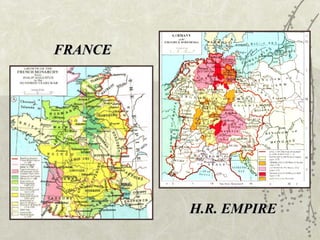
FRANCE H.R. EMPIRE
Economic Development Tax burden on the peasants Trade Economic advancements Merchants considered lowest class
Europeans Reach Japan Portuguese traders arrived in 1543 As the Portuguese began to trade regularly, Jesuit priests also arrived to spread Christianity in 1549
Daimyo  of Edo; proclaimed  shogun  in 1603 Installed his son as  shogun  in order to strengthen Tokugawa control and eliminate problems of succession Political unity Tokugawa Ieyasu
The Tokugawa Shogunate 1603 – 1869 Relied on the feudal system Appointed  daimyo  leaders to help administer governmental duties Emphasized maintaining order and control Maintained both a public and secret police
Social Class During the Tokugawa Shogunate Warrior-administrators Peasants Craftsmen Merchants
The  Samurai  During the Tokugawa Shogunate Samurai  began to follow the  bushido  code In charge of Japan’s military  Gradually shifted to governmental and administrative roles
Christianity and the Tokugawa  Catholic missionaries attempted to convert the elites, but had little success More success in the countryside Shimabara Rebellion Persecution of Japanese Christians, expulsion of missionaries
The Closing of Japan Shimabara Rebellion heightened fear of foreign influences Tokugawa “closed” Japan beginning in 1649 Allowed limited contact with the Dutch, Chinese, Koreans Trade significantly limited and controlled Some  daimyos  ignored the closing
Less need for warriors The  samurai  slowly lost power, status  The warrior ethic seemed to lose its relevance Decline of the  Samurai