Copyright © 2018, 2014, 2011 Pearson Education, Inc. All Rights Reserved
Art History
Sixth Edition
Chapter 26
Japanese Art after 1933
Copyright © 2018, 2014, 2011 Pearson Education, Inc. All Rights Reserved
Learning Objectives (1 of 2)
26.a Identify the visual hallmarks of Japanese art after 1333 for formal,
technical, and expressive qualities.
26.b Interpret the meaning of works of Japanese art after 1333 based on
their themes, subjects, and symbols.
26.c Relate artists and art of Japan after 1333 to their cultural, economic,
and political contexts.
Copyright © 2018, 2014, 2011 Pearson Education, Inc. All Rights Reserved
Learning Objectives (2 of 2)
26.d Apply the vocabulary and concepts relevant to post-1333 Japanese
art, artists, and art history.
26.e Interpret a work of Japanese art after 1333 using the art historical
methods of observation, comparison, and inductive reasoning.
26.f Select visual and textual evidence in various media to support an
argument or an interpretation of a work of Japanese art after 1333.
Suzuki Harunobu THE FLOWERS OF BEAUTY IN THE FLOATING WORLD: MOTOURA
AND YAEZAKURA OF THE MINAMI YAMASAKIYA
Edo period, 1769.Polychrome woodblock print on paper, 11-3/8" × 8-1/2"
(28.9 × 21.8 cm). Honolulu Museum of Art, Gift of James A. Michener, 1957 (14044).
[Fig. 26-01]
Copyright © 2018, 2014, 2011 Pearson Education, Inc. All Rights Reserved
Foundations of Japanese Culture
(1 of 2)
• A hunter-gatherer culture developed during the Jomon period (11,000–
400 BCE) with an agricultural society following during the Yayoi period
(400 BCE–300 CE).
• The Asuka era (552–645) brought Chinese culture into Japan, the
most salient aspect of which being Buddhism.
Copyright © 2018, 2014, 2011 Pearson Education, Inc. All Rights Reserved
Foundations of Japanese Culture
(2 of 2)
• The Nara period (645–794) was the time during which the founding
works of Japanese literature were compiled.
• The Heian period (794–1185) brought a refined court culture and taste
for art.
– Its end, marked by civil warfare, brought samurai clans into
factional conflicts.
– Pure Land Buddhism reigned supreme.
JAPAN
Japan's wholehearted emulation of many aspects of Chinese culture began in the fifth
century. It was challenged by new influences from the West only in the mid nineteenth
century after Western powers forced Japan to open its treaty ports to international trade.
[Map 26-01]
Copyright © 2018, 2014, 2011 Pearson Education, Inc. All Rights Reserved
Muromachi Period
• The Muromachi period is marked by the popularity of Zen Buddhism
among disciplined samurai.
• Japanese aesthetics revolved around asymmetry, abstraction,
boldness, and humor.
Copyright © 2018, 2014, 2011 Pearson Education, Inc. All Rights Reserved
Zen Ink Painting (1 of 2)
• Many Japanese artists adopted monochrome landscape paintings
during this period.
• No undisputed work survives of the monk-artist Shubun, but two by his
pupil Bunsei remain.
• Mimicking Chinese models from the Ming period as well as Korean ink
landscapes, works convey serenity.
Bunsei LANDSCAPE
Muromachi period, mid 15th century.
Hanging scroll with ink and light colors on paper, 28-13/16" × 13" (73.2 × 33 cm).
Museum of Fine Arts, Boston. Special Chinese and Japanese Fund (05.203). Photograph
© 2017 Museum of Fine Arts, Boston. [Fig. 26-02]
Copyright © 2018, 2014, 2011 Pearson Education, Inc. All Rights Reserved
Zen Ink Painting (2 of 2)
• Sesshu
– Sesshu, like other pupils of Shubun, specialized in art rather than
religious ritual or teaching, which allowed him to paint
unencumbered by monastic duties.
– After he returned from a mission to China, he produced paintings
with a bold spirit, unlike those of Shubun.
Sesshu WINTER LANDSCAPE
Muromachi period, c. 1470s.
Hanging scroll with ink on paper, 18-1/4" × 11-1/2" (46.3 × 29.3 cm)
Collection of the Tokyo National Museum. National Treasure. © Burstein
Collection/Corbis. [Fig. 26-03]
Copyright © 2018, 2014, 2011 Pearson Education, Inc. All Rights Reserved
The Zen Dry Garden
• Dry landscape gardens like the temple at Ryoanji present beautiful
stones in asymmetrical arrangements across a flat rectangle of gravel.
• They were inspired by Chinese landscape paintings by the sixteenth
century and became highly intellectualized by the mid-seventeenth
century.
ROCK GARDEN, RYOANJI, KYOTO
Muromachi period, c. 1480. Photographed spring 1993.
UNESCO World Heritage Site, National Treasure. © Michael S. Yamashita/Corbis.
[Fig. 26-04]
Copyright © 2018, 2014, 2011 Pearson Education, Inc. All Rights Reserved
Momoyama Period
• Oda Nobunaga, a ruthless warrior, overthrew the reigning Ashikaga
shogun in 1573.
• Toyotomi Hideyoshi followed in the footsteps of Nobunaga as a patron
of the arts but became overly ambitious in his desire to conquer China
and Korea.
• The period calls to mind tea-ceremony ceramics and luxurious
palaces.
Copyright © 2018, 2014, 2011 Pearson Education, Inc. All Rights Reserved
Architecture
• Himeji castle is one of few surviving examples of architecture from this
period.
– European muskets and cannons changed the nature of Japanese
warfare and castles such as this.
– Visitors must follow angular paths beneath steep walls and
through narrow fortified gates.
HIMEJI CASTLE, HYOGO, NEAR OSAKA
Momoyama period, 1601–1609.
UNESCO World Heritage Site, National Treasure. © Louis W/Shutterstock. [Fig. 26-05]
Copyright © 2018, 2014, 2011 Pearson Education, Inc. All Rights Reserved
Shoin Rooms
• Interior spaces were divide by paper-covered sliding doors (fusuma)
that became canvases for large-scale murals.
• Paintings by Kano Eitoku marked the fusuma of the Jukoin subtemple
in Kyoto.
– Motifs included cranes, pines, and a plum tree, encompassing
both walls.
Copyright © 2018, 2014, 2011 Pearson Education, Inc. All Rights Reserved
Elements of Architecture: Shoin Design
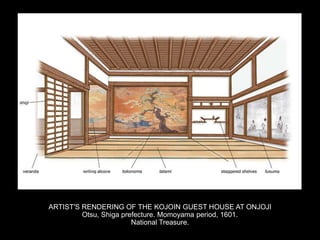
• Shoin combine verandas, walls divided by wooden posts, floors of
tatami mats, and shoji screens.
• They served as a formal room for receiving important guests.
• Architectural harmony is derived from standardized basic units.
– To this day, room size is still expressed in the number of tatami
mats it covers.
ARTIST'S RENDERING OF THE KOJOIN GUEST HOUSE AT ONJOJI
Otsu, Shiga prefecture. Momoyama period, 1601.
National Treasure.
Kano Tokinobu (attributed to) APPRECIATION OF PAINTING
From a set of the "Four Accomplishments". Ryoanji, Kyoto. Momoyama period, c. 1606.
Four panels mounted on sliding doors. Ink, mineral color, and gold on paper; 6 × 24'
(182.9 × 731.5 cm). Metropolitan Museum of Art, New York. Purchase, anonymous gift, in
honor of Ambassador and Mrs. Michael Mansfield, 1989 (1989.139.2a-d).
© 2016. Image copyright The Metropolitan Museum of Art/Art Resource/Scala, Florence
[Fig. 26-6]
Copyright © 2018, 2014, 2011 Pearson Education, Inc. All Rights Reserved
The Tea Ceremony (1 of 3)
• Tea ceremonies contrasted the opulence of other arts of the period.
• Chanoyu is the term encompassing ritual drinking of tea; it is without
counterpart in Western culture.
• The advent of Zen brought a different way of preparing tea, including
monks using tea as a mild stimulant for meditation.
Copyright © 2018, 2014, 2011 Pearson Education, Inc. All Rights Reserved
The Tea Ceremony (2 of 3)
• Sen no Rikyu
– The most famous tea master in Japanese history, Sen no Rikyu
established the aesthetic of modesty, refinement, and rusticity in
tearooms.
– The Taian is a tearoom that preserves his design.
 Guests must crawl to enter the room and no elements of
distraction exist within.
Sen no Rikyu TAIAN TEAROOM
Myokian Temple, Kyoto. Momoyama period, 1582.
National Treasure. Myoki-an/PPS. [Fig. 26-07]
Copyright © 2018, 2014, 2011 Pearson Education, Inc. All Rights Reserved
The Tea Ceremony (3 of 3)
• The Tea Bowl
– Slightly misshapen Korean-style rice bowls became inspiration for
potters.
– One of the finest surviving early tea bowls is Yugure, attributed to
Chojiro, founder of the Raku potters.
 The gritty red clay of raku ware was developed specifically for
the tea ceremony.
Chojiro TEA BOWL, CALLED YUGURE ("TWILIGHT")
Momoyama period, late 16th century. Raku ware, height 3-1/2" (9 cm).
Gotoh Museum, Tokyo. Photo courtesy the Gotoh Museum, Tokyo. [Fig. 26-08]
Copyright © 2018, 2014, 2011 Pearson Education, Inc. All Rights Reserved
Edo Period
• This era was brought about by the reign of Tokugawa Ieyasu.
– He ordered feudal lords to spend time in Edo, where their families
were required to live.
• Society was divided into samurai, farmers, artisans, and merchants.
• Reading, writing, and appreciation for the arts became widespread.
Copyright © 2018, 2014, 2011 Pearson Education, Inc. All Rights Reserved
Rinpa School Painting (1 of 2)
• Kyoto became home to wealthy merchants, artists, and craftsmakers.
• Painter Tawaraya Sotatsu was an honored member of the Rinpa
school, artists who reinterpreted courtly styles.
– One of his famous screen pairs probably depicts the islands of
Matsushima, which was considered one of the "three famous
beautiful views of Japan."
Tawaraya Sotatsu WAVES AT MATSUSHIMA
Edo period, 17th century. Pair of six-panel folding screens with ink, mineral colors, and
gold leaf on paper; each screen 4'9-7/8" × 11'8-1/2" (1.52 × 3.56 m).
Freer Gallery of Art, Smithsonian Institution, Washington, DC. Gift of Charles Lang Freer
(F1906.231 & 232). Bridgeman Images. [Fig. 26-09a]
Tawaraya Sotatsu WAVES AT MATSUSHIMA
Edo period, 17th century. Pair of six-panel folding screens with ink, mineral colors, and
gold leaf on paper; each screen 4'9-7/8" × 11'8-1/2" (1.52 × 3.56 m).
Freer Gallery of Art, Smithsonian Institution, Washington, DC. Gift of Charles Lang Freer
(F1906.231 & 232). Bridgeman Images. [Fig. 26-09b]
Copyright © 2018, 2014, 2011 Pearson Education, Inc. All Rights Reserved
Rinpa School Painting (2 of 2)
• Lacquer Box
– Rinpa painter Ogata Korin oversaw the creation of the Lacquer
Box.
 The subject of this piece was nobleman poet Ise as he pauses
at a place called Eight Bridges, taken from the Tales of Ise.
– Lacquer hardens to a glasslike, protective coating and a piece
could take years to create.
Ogata Korin EXTERIOR OF A LACQUER BOX FOR WRITING IMPLEMENTS
Edo period, late 17th–early 18th century. Lacquer, lead, silver, and mother-of-pearl, 5-
5/8" × 10-3/4" × 7-3/4" (14.2 × 27.4 × 19.7 cm).
Tokyo National Museum, Tokyo. National Treasure. TNM Image Archives. [Fig. 26-10a]
Ogata Korin VIEWS OF INTERIOR AND LID OF A LACQUER BOX FOR WRITING
IMPLEMENTS
Edo period, late 17th–early 18th century. Lacquer, lead, silver, and mother-of-pearl, 5-
5/8" × 10-3/4" × 7-3/4" (14.2 × 27.4 × 19.7 cm).
Tokyo National Museum, Tokyo. National Treasure. TNM Image Archives. [Fig. 26-10b]
Copyright © 2018, 2014, 2011 Pearson Education, Inc. All Rights Reserved
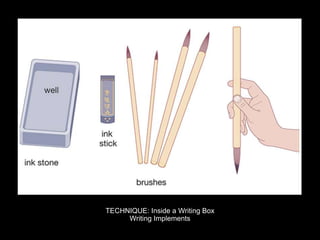
Technique: Inside a Writing Box
• Writing boxes hold an ink stick, ink stone, brushes, and paper.
• Fresh ink is made for each writing session by grinding the ink stick in
water against the ink stone.
• Brushes made from animal hair taper to a fine point that responds to
any shift in pressure.
TECHNIQUE: Inside a Writing Box
Writing Implements
Copyright © 2018, 2014, 2011 Pearson Education, Inc. All Rights Reserved
Naturalistic Painting (1 of 3)
• Nagasawa Rosetsu
– Famous pupil of Maruyama Okyo, Rosetsu delighted in surprising
viewers with unusual compositions.
 An example of this is Bull and Puppy, in which the immense
body of the bull spills over the borders of the screen.
 The puppy's informal pose and contrasting smallness
increases the charm of the painting.
Nagasawa Rosetsu BULL AND PUPPY
Edo period, late 18th century.
Left of a pair of six-panel screens with ink and gold wash on paper,
5'7-1/4" × 12'3" (1.70 × 3.75 m). Los Angeles County Museum of Art, California. Joe and
Etsuko Price Collection (L.83.45.3a). © 2016. Digital Image Museum
Associates/LACMA/Art Resource NY/Scala, Florence. [Fig. 26-11]
Copyright © 2018, 2014, 2011 Pearson Education, Inc. All Rights Reserved
Naturalistic Painting (2 of 3)
• Literati Painting
– Kyoto's distance from Edo allowed for the emergence of new
school of art and philosophy.
– Ideas from Chinese Daoism promoted each person's uniqueness.
 Chinese culture and even tea was imported as political protest.
Copyright © 2018, 2014, 2011 Pearson Education, Inc. All Rights Reserved
Naturalistic Painting (3 of 3)
• Literati Painting
– Successful artists took Chinese literati painting models as starting
points for original interpretations.
 Ike Taiga's View of Kojima Bay blends personal brushwork with
Japanese aesthetics that recall Chinese landscapes.
– It does not represent an imaginary landscape, but a real
place the artist had visited.
Ike Taiga VIEW OF KOJIMA BAY
Edo period, third quarter of 18th century.
Hanging scroll with ink and color on silk, 39-1/4" × 14-5/8" (99.7 × 37.6 cm).
Hosomi Museum, Kyoto. [Fig. 26-12]
Copyright © 2018, 2014, 2011 Pearson Education, Inc. All Rights Reserved
Ukiyo-e: Pictures of the Floating World
(1 of 3)
• Harunobu
– Suzuki Harunobu was the first artist to use the multiple-block
printing method known as nishiki-e.
 This method was favored over printing in black outlines and
adding colors by hand.
– He became famous for images of courtesans.
Copyright © 2018, 2014, 2011 Pearson Education, Inc. All Rights Reserved
Ukiyo-e: Pictures of the Floating World
(2 of 3)
• Sharaku
– Toshusai Sharaku produced 146 prints, mostly of famous kabuki
actors, within the year of 1794–1795.
– Otani Oniji captures a tension-filled moment from an action drama.
 Such half-length portraits captured the essence of characters
portrayed on stage.
Toshusai Sharaku OTANI ONIJI IN THE ROLE OF YAKKO EDOBE
Edo period, 1794. Polychrome woodblock print with ink, colors, and white mica on paper,
15 × 9-7/8" (38.1 × 25.1 cm). Metropolitan Museum of Art, New York. Henry L. Phillips
Collection, Bequest of Henry L. Phillips, 1939 (JP2822). © 2016. Image copyright The
Metropolitan Museum of Art/Art Resource/Scala, Florence [Fig. 26-13]
Copyright © 2018, 2014, 2011 Pearson Education, Inc. All Rights Reserved
Technique: Japanese Woodblock Prints
• Artists, carvers, and printers coordinated to produce prints.
– The artist designed and supplied a master drawing.
– The carver pasted the drawing to the block and cut the key block.
– The printer inked the block and aligned the paper with the block's
registration marks.
Copyright © 2018, 2014, 2011 Pearson Education, Inc. All Rights Reserved
Ukiyo-e: Pictures of the Floating World
(3 of 3)
• Hokusai
– Thirty-Six Views of Mount Fuji, particularly The Great Wave, were
renowned graphic prints by Katsushika Hokusai.
 It inspired the French Japonisme movement.
 At the point of disaster for the figures in the boats, Mount Fuji
becomes clear to the viewer.
Katsushika Hokusai THE GREAT WAVE
From Thirty-Six Views of Mount Fuji. Edo period, c. 1831.
Polychrome woodblock print on paper, 9-7/8" × 14-5/8" (25 × 37.1 cm).
Honolulu Academy of Art. Gift of James A. Michener 1995 (HAA 13, 695). Yale University
Art Gallery, Frances Gaylord Smith Collection(1973.42.39). Image courtesy Yale
University Art Gallery. [Fig. 26-14]
Copyright © 2018, 2014, 2011 Pearson Education, Inc. All Rights Reserved
Zen Painting: Buddhist Art for Rural
Commoners
• Zen master Hakuin Ekaku composed many koan questions and
became a self-taught painter and calligrapher.
– His work featured everyday subjects or Zen themes in simplistic
ways that humble followers could readily understand.
– He often painted Daruma, the Indian monk who founded Zen.
Hakuin Ekaku GIANT DARUMA
Edo period, mid 18th century.
Hanging scroll with ink on paper, 77-3/4" × 25" (197.49 × 63.5 cm).
Los Angeles County Museum of Art, Gift of Murray Smith. (M.911.220). [Fig. 26-15]
Copyright © 2018, 2014, 2011 Pearson Education, Inc. All Rights Reserved
Cloth and Ceramics (1 of 3)
• Japan had a distinguished history of what the Western tradition
considers craft production.
• Artists in Japanese artistic studios followed a hereditary, hierarchical
structure, regardless of medium.
• Teamwork under masterful supervision was the approach to artistic
production.
Copyright © 2018, 2014, 2011 Pearson Education, Inc. All Rights Reserved
Cloth and Ceramics (2 of 3)
• Kosode
– Few kosode prior to the Edo period survive, but examples that
remain reveal tastes of affluent women of the period.
– Stencil dyeing and embroidery associate the example on the next
slide with wives of warriors in the eighteenth century.
A CLOSER LOOK: Woman's Kosode with design of bamboo fence and citrus tree
(tachibana).
Edo period, early 18th century. White figured satin (rinzu), with embroidery (gold and silk
thread) and stencil dyeing. Length 62-1/2" (158.8 cm). Philadelphia Museum of Art. Gift of
Mr. and Mrs. Rodolphe Meyer de Schauensee, 1951. © 2016. Photo The Philadelphia
Museum of Art/Art Resource/Scala, Florence. [Fig. 26-16]
Copyright © 2018, 2014, 2011 Pearson Education, Inc. All Rights Reserved
Cloth and Ceramics (3 of 3)
• Japanese Porcelain
– The town of Arita became the center for porcelain production.
– The plate shown is an example of Nabeshima ware produced in
special kilns meant for noble families.
– Multicolor decorative motifs juxtapose an organic, irregular form
with a more abstracted, stabilizing design.
PLATE WITH WISTERIA AND TRELLIS PATTERN
Edo period, 18th century. Nabeshima ware. Porcelain with underglaze blue decoration
and overglaze enamels, diameter 12-3/16" (31 cm).
Kyushu National Museum, Japan. Important Cultural Property. Photographer: FUJIMORI
Takeshi. [Fig. 26-17]
Copyright © 2018, 2014, 2011 Pearson Education, Inc. All Rights Reserved
The Modern Period
• Commodore Matthew Perry forced the opening of trade ports in Japan
in 1853 and precipitated the downfall of the Tokugawa shogunate.
• Edo was renamed Tokyo.
• Intense industrialization followed in the two decades after Meiji
Restoration, but following that was a flourishing of art.
Copyright © 2018, 2014, 2011 Pearson Education, Inc. All Rights Reserved
Meiji-Period Nationalist Painting (1 of 2)
• The years 1868–1912 marked a period of major change for Japan.
• Japan adopted many aspects of Western education, government,
clothing, medicine, and technology in efforts to modernize the nation.
• Teachers arrived from Italy and a few Japanese artists traveled to
Europe and America to study.
Copyright © 2018, 2014, 2011 Pearson Education, Inc. All Rights Reserved
Meiji-Period Nationalist Painting (2 of 2)
• A Meiji Painter
– Ernest Fenollosa and his student Okakura Kakuzo encouraged a
mix of traditional arts and modern sensibility.
– Yokoyama Taikan developed his style within the Nihonga genre.
 Floating Lights was inspired by a visit to Calcutta, where he
observed women engaging in divination on the banks of the
Ganges.
Yokoyama Taikan FLOATING LIGHTS
Meiji period, 1909. One of a pair of hanging scrolls with ink, colors, and gold on silk, 56-
1/2" × 20-1/2" (143 × 52 cm).
Museum of Modern Art, Ibaraki. Photographer: Kodaira Tadao. [Fig. 26-18]
Copyright © 2018, 2014, 2011 Pearson Education, Inc. All Rights Reserved
Japan After World War II (1 of 4)
• Japanese people immediately began rebuilding their ruined cities,
unified by a sense of national purpose.
• By 1964, Toyko established an extensive commuter rail system.
– Japan became the world leader in high-speed rail transit with the
Shinkansen.
• "Crafts" traditions were a source of national pride and identity.
Copyright © 2018, 2014, 2011 Pearson Education, Inc. All Rights Reserved
Japan After World War II (2 of 4)
• Tange Kenzo
– The Hiroshima Peace Memorial Museum and Park expressed
prayers for world peace.
– The artist became a master of Modernist architecture.
– The wood formwork recalls traditional Japanese architecture, but
concrete brings a modern touch.
Tange Kenzo HIROSHIMA PEACE MEMORIAL MUSEUM
Showa period, 1955. Main building (center) repaired in Heisei period, 1991. East building
(right), the former Peace Memorial Hall, which first opened in 1955, was rebuilt in June
1994 and attached to the main building.
Designated UNESCO World Heritage site in 1996. Courtesy Tange Kenzo and Hiroshima
Peace Memorial Museum. [Fig. 26-19]
Copyright © 2018, 2014, 2011 Pearson Education, Inc. All Rights Reserved
Japan After World War II (3 of 4)
• Fukami Sueharu
– Sueharu is an innovative clay artist who uses slip casting
technique.
– Sky II shows a mastery of pure form and ultramodernism.
 It fuses traditions, media, techniques, and forms with a
mastery of abstraction and thematic meaning to the global
world.
Fukami Sueharu SKY II
Heisei period, c. 1990. Celadon-glazed porcelain with wood base,
3" × 44-1/8" × 9-1/2" (7.7 × 112.1 × 24.2 cm).
Spencer Museum of Art, University of Kansas, Lawrence. Museum purchase: R. Charles
and Mary Margaret Clevenger Fund (1992.0072).
© Fukami Sueharu. Courtesy Erik Thomsen Gallery, New York. [Fig. 26-20]
Copyright © 2018, 2014, 2011 Pearson Education, Inc. All Rights Reserved
Japan After World War II (4 of 4)
• Craftsmakers as Living National Treasures
– In 2002, Eri Sayoko was designated as a Living National Treasure
for her work in the art of cut gold leaf (kirikane).
 She was the first woman to be awarded the title.
 Until the postwar period, women were seldom recognized for
their achievements.
Eri Sayoko ORNAMENTAL BOX: DANCING IN THE COSMOS
Heisei period, 2006. Wood with polychrome and cut gold, height 33-7/8" × 6-1/2" × 6 1/2"
(86 cm × 16.5 cm × 16.5 cm). Collection of Eri Kokei. Courtesy Koukei Eri [Fig. 26-21]
Copyright © 2018, 2014, 2011 Pearson Education, Inc. All Rights Reserved
Think About It (1 of 2)
• Discuss how the Japanese tea ceremony works and observe the role
that art plays within it. Include the unique aesthetics of the tearoom
and the artistic practices associated with the ceremony, making
reference to at least one work from this chapter.
• Chose one woodblock print discussed in this chapter and explain how
its subject matter represents the culture of the "floating world" in Edo.
Copyright © 2018, 2014, 2011 Pearson Education, Inc. All Rights Reserved
Think About It (2 of 2)
• Reflect on the differences between the styles of artists from Kyoto and
artists from Edo. How do they relate to the variations in the social
status and cultural and intellectual interests of residents of these two
cities? How would you fit the lacquer box by a Rinpa-school artist from
Kyoto (Fig. 26–10) and the kosode robe made in Edo ("Closer Look"
on page 846) into your discussion?
• Chose one of the three Japanese works in this chapter from the period
after World War II and evaluate how it draws from both traditional
Japanese and foreign artistic practices. Is the larger debt to tradition or
to innovation?

0134484592 ch26

  • 1.
    Copyright © 2018,2014, 2011 Pearson Education, Inc. All Rights Reserved Art History Sixth Edition Chapter 26 Japanese Art after 1933
  • 2.
    Copyright © 2018,2014, 2011 Pearson Education, Inc. All Rights Reserved Learning Objectives (1 of 2) 26.a Identify the visual hallmarks of Japanese art after 1333 for formal, technical, and expressive qualities. 26.b Interpret the meaning of works of Japanese art after 1333 based on their themes, subjects, and symbols. 26.c Relate artists and art of Japan after 1333 to their cultural, economic, and political contexts.
  • 3.
    Copyright © 2018,2014, 2011 Pearson Education, Inc. All Rights Reserved Learning Objectives (2 of 2) 26.d Apply the vocabulary and concepts relevant to post-1333 Japanese art, artists, and art history. 26.e Interpret a work of Japanese art after 1333 using the art historical methods of observation, comparison, and inductive reasoning. 26.f Select visual and textual evidence in various media to support an argument or an interpretation of a work of Japanese art after 1333.
  • 4.
    Suzuki Harunobu THEFLOWERS OF BEAUTY IN THE FLOATING WORLD: MOTOURA AND YAEZAKURA OF THE MINAMI YAMASAKIYA Edo period, 1769.Polychrome woodblock print on paper, 11-3/8" × 8-1/2" (28.9 × 21.8 cm). Honolulu Museum of Art, Gift of James A. Michener, 1957 (14044). [Fig. 26-01]
  • 5.
    Copyright © 2018,2014, 2011 Pearson Education, Inc. All Rights Reserved Foundations of Japanese Culture (1 of 2) • A hunter-gatherer culture developed during the Jomon period (11,000– 400 BCE) with an agricultural society following during the Yayoi period (400 BCE–300 CE). • The Asuka era (552–645) brought Chinese culture into Japan, the most salient aspect of which being Buddhism.
  • 6.
    Copyright © 2018,2014, 2011 Pearson Education, Inc. All Rights Reserved Foundations of Japanese Culture (2 of 2) • The Nara period (645–794) was the time during which the founding works of Japanese literature were compiled. • The Heian period (794–1185) brought a refined court culture and taste for art. – Its end, marked by civil warfare, brought samurai clans into factional conflicts. – Pure Land Buddhism reigned supreme.
  • 7.
    JAPAN Japan's wholehearted emulationof many aspects of Chinese culture began in the fifth century. It was challenged by new influences from the West only in the mid nineteenth century after Western powers forced Japan to open its treaty ports to international trade. [Map 26-01]
  • 8.
    Copyright © 2018,2014, 2011 Pearson Education, Inc. All Rights Reserved Muromachi Period • The Muromachi period is marked by the popularity of Zen Buddhism among disciplined samurai. • Japanese aesthetics revolved around asymmetry, abstraction, boldness, and humor.
  • 9.
    Copyright © 2018,2014, 2011 Pearson Education, Inc. All Rights Reserved Zen Ink Painting (1 of 2) • Many Japanese artists adopted monochrome landscape paintings during this period. • No undisputed work survives of the monk-artist Shubun, but two by his pupil Bunsei remain. • Mimicking Chinese models from the Ming period as well as Korean ink landscapes, works convey serenity.
  • 10.
    Bunsei LANDSCAPE Muromachi period,mid 15th century. Hanging scroll with ink and light colors on paper, 28-13/16" × 13" (73.2 × 33 cm). Museum of Fine Arts, Boston. Special Chinese and Japanese Fund (05.203). Photograph © 2017 Museum of Fine Arts, Boston. [Fig. 26-02]
  • 11.
    Copyright © 2018,2014, 2011 Pearson Education, Inc. All Rights Reserved Zen Ink Painting (2 of 2) • Sesshu – Sesshu, like other pupils of Shubun, specialized in art rather than religious ritual or teaching, which allowed him to paint unencumbered by monastic duties. – After he returned from a mission to China, he produced paintings with a bold spirit, unlike those of Shubun.
  • 12.
    Sesshu WINTER LANDSCAPE Muromachiperiod, c. 1470s. Hanging scroll with ink on paper, 18-1/4" × 11-1/2" (46.3 × 29.3 cm) Collection of the Tokyo National Museum. National Treasure. © Burstein Collection/Corbis. [Fig. 26-03]
  • 13.
    Copyright © 2018,2014, 2011 Pearson Education, Inc. All Rights Reserved The Zen Dry Garden • Dry landscape gardens like the temple at Ryoanji present beautiful stones in asymmetrical arrangements across a flat rectangle of gravel. • They were inspired by Chinese landscape paintings by the sixteenth century and became highly intellectualized by the mid-seventeenth century.
  • 14.
    ROCK GARDEN, RYOANJI,KYOTO Muromachi period, c. 1480. Photographed spring 1993. UNESCO World Heritage Site, National Treasure. © Michael S. Yamashita/Corbis. [Fig. 26-04]
  • 15.
    Copyright © 2018,2014, 2011 Pearson Education, Inc. All Rights Reserved Momoyama Period • Oda Nobunaga, a ruthless warrior, overthrew the reigning Ashikaga shogun in 1573. • Toyotomi Hideyoshi followed in the footsteps of Nobunaga as a patron of the arts but became overly ambitious in his desire to conquer China and Korea. • The period calls to mind tea-ceremony ceramics and luxurious palaces.
  • 16.
    Copyright © 2018,2014, 2011 Pearson Education, Inc. All Rights Reserved Architecture • Himeji castle is one of few surviving examples of architecture from this period. – European muskets and cannons changed the nature of Japanese warfare and castles such as this. – Visitors must follow angular paths beneath steep walls and through narrow fortified gates.
  • 17.
    HIMEJI CASTLE, HYOGO,NEAR OSAKA Momoyama period, 1601–1609. UNESCO World Heritage Site, National Treasure. © Louis W/Shutterstock. [Fig. 26-05]
  • 18.
    Copyright © 2018,2014, 2011 Pearson Education, Inc. All Rights Reserved Shoin Rooms • Interior spaces were divide by paper-covered sliding doors (fusuma) that became canvases for large-scale murals. • Paintings by Kano Eitoku marked the fusuma of the Jukoin subtemple in Kyoto. – Motifs included cranes, pines, and a plum tree, encompassing both walls.
  • 19.
    Copyright © 2018,2014, 2011 Pearson Education, Inc. All Rights Reserved Elements of Architecture: Shoin Design • Shoin combine verandas, walls divided by wooden posts, floors of tatami mats, and shoji screens. • They served as a formal room for receiving important guests. • Architectural harmony is derived from standardized basic units. – To this day, room size is still expressed in the number of tatami mats it covers.
  • 20.
    ARTIST'S RENDERING OFTHE KOJOIN GUEST HOUSE AT ONJOJI Otsu, Shiga prefecture. Momoyama period, 1601. National Treasure.
  • 21.
    Kano Tokinobu (attributedto) APPRECIATION OF PAINTING From a set of the "Four Accomplishments". Ryoanji, Kyoto. Momoyama period, c. 1606. Four panels mounted on sliding doors. Ink, mineral color, and gold on paper; 6 × 24' (182.9 × 731.5 cm). Metropolitan Museum of Art, New York. Purchase, anonymous gift, in honor of Ambassador and Mrs. Michael Mansfield, 1989 (1989.139.2a-d). © 2016. Image copyright The Metropolitan Museum of Art/Art Resource/Scala, Florence [Fig. 26-6]
  • 22.
    Copyright © 2018,2014, 2011 Pearson Education, Inc. All Rights Reserved The Tea Ceremony (1 of 3) • Tea ceremonies contrasted the opulence of other arts of the period. • Chanoyu is the term encompassing ritual drinking of tea; it is without counterpart in Western culture. • The advent of Zen brought a different way of preparing tea, including monks using tea as a mild stimulant for meditation.
  • 23.
    Copyright © 2018,2014, 2011 Pearson Education, Inc. All Rights Reserved The Tea Ceremony (2 of 3) • Sen no Rikyu – The most famous tea master in Japanese history, Sen no Rikyu established the aesthetic of modesty, refinement, and rusticity in tearooms. – The Taian is a tearoom that preserves his design.  Guests must crawl to enter the room and no elements of distraction exist within.
  • 24.
    Sen no RikyuTAIAN TEAROOM Myokian Temple, Kyoto. Momoyama period, 1582. National Treasure. Myoki-an/PPS. [Fig. 26-07]
  • 25.
    Copyright © 2018,2014, 2011 Pearson Education, Inc. All Rights Reserved The Tea Ceremony (3 of 3) • The Tea Bowl – Slightly misshapen Korean-style rice bowls became inspiration for potters. – One of the finest surviving early tea bowls is Yugure, attributed to Chojiro, founder of the Raku potters.  The gritty red clay of raku ware was developed specifically for the tea ceremony.
  • 26.
    Chojiro TEA BOWL,CALLED YUGURE ("TWILIGHT") Momoyama period, late 16th century. Raku ware, height 3-1/2" (9 cm). Gotoh Museum, Tokyo. Photo courtesy the Gotoh Museum, Tokyo. [Fig. 26-08]
  • 27.
    Copyright © 2018,2014, 2011 Pearson Education, Inc. All Rights Reserved Edo Period • This era was brought about by the reign of Tokugawa Ieyasu. – He ordered feudal lords to spend time in Edo, where their families were required to live. • Society was divided into samurai, farmers, artisans, and merchants. • Reading, writing, and appreciation for the arts became widespread.
  • 28.
    Copyright © 2018,2014, 2011 Pearson Education, Inc. All Rights Reserved Rinpa School Painting (1 of 2) • Kyoto became home to wealthy merchants, artists, and craftsmakers. • Painter Tawaraya Sotatsu was an honored member of the Rinpa school, artists who reinterpreted courtly styles. – One of his famous screen pairs probably depicts the islands of Matsushima, which was considered one of the "three famous beautiful views of Japan."
  • 29.
    Tawaraya Sotatsu WAVESAT MATSUSHIMA Edo period, 17th century. Pair of six-panel folding screens with ink, mineral colors, and gold leaf on paper; each screen 4'9-7/8" × 11'8-1/2" (1.52 × 3.56 m). Freer Gallery of Art, Smithsonian Institution, Washington, DC. Gift of Charles Lang Freer (F1906.231 & 232). Bridgeman Images. [Fig. 26-09a]
  • 30.
    Tawaraya Sotatsu WAVESAT MATSUSHIMA Edo period, 17th century. Pair of six-panel folding screens with ink, mineral colors, and gold leaf on paper; each screen 4'9-7/8" × 11'8-1/2" (1.52 × 3.56 m). Freer Gallery of Art, Smithsonian Institution, Washington, DC. Gift of Charles Lang Freer (F1906.231 & 232). Bridgeman Images. [Fig. 26-09b]
  • 31.
    Copyright © 2018,2014, 2011 Pearson Education, Inc. All Rights Reserved Rinpa School Painting (2 of 2) • Lacquer Box – Rinpa painter Ogata Korin oversaw the creation of the Lacquer Box.  The subject of this piece was nobleman poet Ise as he pauses at a place called Eight Bridges, taken from the Tales of Ise. – Lacquer hardens to a glasslike, protective coating and a piece could take years to create.
  • 32.
    Ogata Korin EXTERIOROF A LACQUER BOX FOR WRITING IMPLEMENTS Edo period, late 17th–early 18th century. Lacquer, lead, silver, and mother-of-pearl, 5- 5/8" × 10-3/4" × 7-3/4" (14.2 × 27.4 × 19.7 cm). Tokyo National Museum, Tokyo. National Treasure. TNM Image Archives. [Fig. 26-10a]
  • 33.
    Ogata Korin VIEWSOF INTERIOR AND LID OF A LACQUER BOX FOR WRITING IMPLEMENTS Edo period, late 17th–early 18th century. Lacquer, lead, silver, and mother-of-pearl, 5- 5/8" × 10-3/4" × 7-3/4" (14.2 × 27.4 × 19.7 cm). Tokyo National Museum, Tokyo. National Treasure. TNM Image Archives. [Fig. 26-10b]
  • 34.
    Copyright © 2018,2014, 2011 Pearson Education, Inc. All Rights Reserved Technique: Inside a Writing Box • Writing boxes hold an ink stick, ink stone, brushes, and paper. • Fresh ink is made for each writing session by grinding the ink stick in water against the ink stone. • Brushes made from animal hair taper to a fine point that responds to any shift in pressure.
  • 35.
    TECHNIQUE: Inside aWriting Box Writing Implements
  • 36.
    Copyright © 2018,2014, 2011 Pearson Education, Inc. All Rights Reserved Naturalistic Painting (1 of 3) • Nagasawa Rosetsu – Famous pupil of Maruyama Okyo, Rosetsu delighted in surprising viewers with unusual compositions.  An example of this is Bull and Puppy, in which the immense body of the bull spills over the borders of the screen.  The puppy's informal pose and contrasting smallness increases the charm of the painting.
  • 37.
    Nagasawa Rosetsu BULLAND PUPPY Edo period, late 18th century. Left of a pair of six-panel screens with ink and gold wash on paper, 5'7-1/4" × 12'3" (1.70 × 3.75 m). Los Angeles County Museum of Art, California. Joe and Etsuko Price Collection (L.83.45.3a). © 2016. Digital Image Museum Associates/LACMA/Art Resource NY/Scala, Florence. [Fig. 26-11]
  • 38.
    Copyright © 2018,2014, 2011 Pearson Education, Inc. All Rights Reserved Naturalistic Painting (2 of 3) • Literati Painting – Kyoto's distance from Edo allowed for the emergence of new school of art and philosophy. – Ideas from Chinese Daoism promoted each person's uniqueness.  Chinese culture and even tea was imported as political protest.
  • 39.
    Copyright © 2018,2014, 2011 Pearson Education, Inc. All Rights Reserved Naturalistic Painting (3 of 3) • Literati Painting – Successful artists took Chinese literati painting models as starting points for original interpretations.  Ike Taiga's View of Kojima Bay blends personal brushwork with Japanese aesthetics that recall Chinese landscapes. – It does not represent an imaginary landscape, but a real place the artist had visited.
  • 40.
    Ike Taiga VIEWOF KOJIMA BAY Edo period, third quarter of 18th century. Hanging scroll with ink and color on silk, 39-1/4" × 14-5/8" (99.7 × 37.6 cm). Hosomi Museum, Kyoto. [Fig. 26-12]
  • 41.
    Copyright © 2018,2014, 2011 Pearson Education, Inc. All Rights Reserved Ukiyo-e: Pictures of the Floating World (1 of 3) • Harunobu – Suzuki Harunobu was the first artist to use the multiple-block printing method known as nishiki-e.  This method was favored over printing in black outlines and adding colors by hand. – He became famous for images of courtesans.
  • 42.
    Copyright © 2018,2014, 2011 Pearson Education, Inc. All Rights Reserved Ukiyo-e: Pictures of the Floating World (2 of 3) • Sharaku – Toshusai Sharaku produced 146 prints, mostly of famous kabuki actors, within the year of 1794–1795. – Otani Oniji captures a tension-filled moment from an action drama.  Such half-length portraits captured the essence of characters portrayed on stage.
  • 43.
    Toshusai Sharaku OTANIONIJI IN THE ROLE OF YAKKO EDOBE Edo period, 1794. Polychrome woodblock print with ink, colors, and white mica on paper, 15 × 9-7/8" (38.1 × 25.1 cm). Metropolitan Museum of Art, New York. Henry L. Phillips Collection, Bequest of Henry L. Phillips, 1939 (JP2822). © 2016. Image copyright The Metropolitan Museum of Art/Art Resource/Scala, Florence [Fig. 26-13]
  • 44.
    Copyright © 2018,2014, 2011 Pearson Education, Inc. All Rights Reserved Technique: Japanese Woodblock Prints • Artists, carvers, and printers coordinated to produce prints. – The artist designed and supplied a master drawing. – The carver pasted the drawing to the block and cut the key block. – The printer inked the block and aligned the paper with the block's registration marks.
  • 45.
    Copyright © 2018,2014, 2011 Pearson Education, Inc. All Rights Reserved Ukiyo-e: Pictures of the Floating World (3 of 3) • Hokusai – Thirty-Six Views of Mount Fuji, particularly The Great Wave, were renowned graphic prints by Katsushika Hokusai.  It inspired the French Japonisme movement.  At the point of disaster for the figures in the boats, Mount Fuji becomes clear to the viewer.
  • 46.
    Katsushika Hokusai THEGREAT WAVE From Thirty-Six Views of Mount Fuji. Edo period, c. 1831. Polychrome woodblock print on paper, 9-7/8" × 14-5/8" (25 × 37.1 cm). Honolulu Academy of Art. Gift of James A. Michener 1995 (HAA 13, 695). Yale University Art Gallery, Frances Gaylord Smith Collection(1973.42.39). Image courtesy Yale University Art Gallery. [Fig. 26-14]
  • 47.
    Copyright © 2018,2014, 2011 Pearson Education, Inc. All Rights Reserved Zen Painting: Buddhist Art for Rural Commoners • Zen master Hakuin Ekaku composed many koan questions and became a self-taught painter and calligrapher. – His work featured everyday subjects or Zen themes in simplistic ways that humble followers could readily understand. – He often painted Daruma, the Indian monk who founded Zen.
  • 48.
    Hakuin Ekaku GIANTDARUMA Edo period, mid 18th century. Hanging scroll with ink on paper, 77-3/4" × 25" (197.49 × 63.5 cm). Los Angeles County Museum of Art, Gift of Murray Smith. (M.911.220). [Fig. 26-15]
  • 49.
    Copyright © 2018,2014, 2011 Pearson Education, Inc. All Rights Reserved Cloth and Ceramics (1 of 3) • Japan had a distinguished history of what the Western tradition considers craft production. • Artists in Japanese artistic studios followed a hereditary, hierarchical structure, regardless of medium. • Teamwork under masterful supervision was the approach to artistic production.
  • 50.
    Copyright © 2018,2014, 2011 Pearson Education, Inc. All Rights Reserved Cloth and Ceramics (2 of 3) • Kosode – Few kosode prior to the Edo period survive, but examples that remain reveal tastes of affluent women of the period. – Stencil dyeing and embroidery associate the example on the next slide with wives of warriors in the eighteenth century.
  • 51.
    A CLOSER LOOK:Woman's Kosode with design of bamboo fence and citrus tree (tachibana). Edo period, early 18th century. White figured satin (rinzu), with embroidery (gold and silk thread) and stencil dyeing. Length 62-1/2" (158.8 cm). Philadelphia Museum of Art. Gift of Mr. and Mrs. Rodolphe Meyer de Schauensee, 1951. © 2016. Photo The Philadelphia Museum of Art/Art Resource/Scala, Florence. [Fig. 26-16]
  • 52.
    Copyright © 2018,2014, 2011 Pearson Education, Inc. All Rights Reserved Cloth and Ceramics (3 of 3) • Japanese Porcelain – The town of Arita became the center for porcelain production. – The plate shown is an example of Nabeshima ware produced in special kilns meant for noble families. – Multicolor decorative motifs juxtapose an organic, irregular form with a more abstracted, stabilizing design.
  • 53.
    PLATE WITH WISTERIAAND TRELLIS PATTERN Edo period, 18th century. Nabeshima ware. Porcelain with underglaze blue decoration and overglaze enamels, diameter 12-3/16" (31 cm). Kyushu National Museum, Japan. Important Cultural Property. Photographer: FUJIMORI Takeshi. [Fig. 26-17]
  • 54.
    Copyright © 2018,2014, 2011 Pearson Education, Inc. All Rights Reserved The Modern Period • Commodore Matthew Perry forced the opening of trade ports in Japan in 1853 and precipitated the downfall of the Tokugawa shogunate. • Edo was renamed Tokyo. • Intense industrialization followed in the two decades after Meiji Restoration, but following that was a flourishing of art.
  • 55.
    Copyright © 2018,2014, 2011 Pearson Education, Inc. All Rights Reserved Meiji-Period Nationalist Painting (1 of 2) • The years 1868–1912 marked a period of major change for Japan. • Japan adopted many aspects of Western education, government, clothing, medicine, and technology in efforts to modernize the nation. • Teachers arrived from Italy and a few Japanese artists traveled to Europe and America to study.
  • 56.
    Copyright © 2018,2014, 2011 Pearson Education, Inc. All Rights Reserved Meiji-Period Nationalist Painting (2 of 2) • A Meiji Painter – Ernest Fenollosa and his student Okakura Kakuzo encouraged a mix of traditional arts and modern sensibility. – Yokoyama Taikan developed his style within the Nihonga genre.  Floating Lights was inspired by a visit to Calcutta, where he observed women engaging in divination on the banks of the Ganges.
  • 57.
    Yokoyama Taikan FLOATINGLIGHTS Meiji period, 1909. One of a pair of hanging scrolls with ink, colors, and gold on silk, 56- 1/2" × 20-1/2" (143 × 52 cm). Museum of Modern Art, Ibaraki. Photographer: Kodaira Tadao. [Fig. 26-18]
  • 58.
    Copyright © 2018,2014, 2011 Pearson Education, Inc. All Rights Reserved Japan After World War II (1 of 4) • Japanese people immediately began rebuilding their ruined cities, unified by a sense of national purpose. • By 1964, Toyko established an extensive commuter rail system. – Japan became the world leader in high-speed rail transit with the Shinkansen. • "Crafts" traditions were a source of national pride and identity.
  • 59.
    Copyright © 2018,2014, 2011 Pearson Education, Inc. All Rights Reserved Japan After World War II (2 of 4) • Tange Kenzo – The Hiroshima Peace Memorial Museum and Park expressed prayers for world peace. – The artist became a master of Modernist architecture. – The wood formwork recalls traditional Japanese architecture, but concrete brings a modern touch.
  • 60.
    Tange Kenzo HIROSHIMAPEACE MEMORIAL MUSEUM Showa period, 1955. Main building (center) repaired in Heisei period, 1991. East building (right), the former Peace Memorial Hall, which first opened in 1955, was rebuilt in June 1994 and attached to the main building. Designated UNESCO World Heritage site in 1996. Courtesy Tange Kenzo and Hiroshima Peace Memorial Museum. [Fig. 26-19]
  • 61.
    Copyright © 2018,2014, 2011 Pearson Education, Inc. All Rights Reserved Japan After World War II (3 of 4) • Fukami Sueharu – Sueharu is an innovative clay artist who uses slip casting technique. – Sky II shows a mastery of pure form and ultramodernism.  It fuses traditions, media, techniques, and forms with a mastery of abstraction and thematic meaning to the global world.
  • 62.
    Fukami Sueharu SKYII Heisei period, c. 1990. Celadon-glazed porcelain with wood base, 3" × 44-1/8" × 9-1/2" (7.7 × 112.1 × 24.2 cm). Spencer Museum of Art, University of Kansas, Lawrence. Museum purchase: R. Charles and Mary Margaret Clevenger Fund (1992.0072). © Fukami Sueharu. Courtesy Erik Thomsen Gallery, New York. [Fig. 26-20]
  • 63.
    Copyright © 2018,2014, 2011 Pearson Education, Inc. All Rights Reserved Japan After World War II (4 of 4) • Craftsmakers as Living National Treasures – In 2002, Eri Sayoko was designated as a Living National Treasure for her work in the art of cut gold leaf (kirikane).  She was the first woman to be awarded the title.  Until the postwar period, women were seldom recognized for their achievements.
  • 64.
    Eri Sayoko ORNAMENTALBOX: DANCING IN THE COSMOS Heisei period, 2006. Wood with polychrome and cut gold, height 33-7/8" × 6-1/2" × 6 1/2" (86 cm × 16.5 cm × 16.5 cm). Collection of Eri Kokei. Courtesy Koukei Eri [Fig. 26-21]
  • 65.
    Copyright © 2018,2014, 2011 Pearson Education, Inc. All Rights Reserved Think About It (1 of 2) • Discuss how the Japanese tea ceremony works and observe the role that art plays within it. Include the unique aesthetics of the tearoom and the artistic practices associated with the ceremony, making reference to at least one work from this chapter. • Chose one woodblock print discussed in this chapter and explain how its subject matter represents the culture of the "floating world" in Edo.
  • 66.
    Copyright © 2018,2014, 2011 Pearson Education, Inc. All Rights Reserved Think About It (2 of 2) • Reflect on the differences between the styles of artists from Kyoto and artists from Edo. How do they relate to the variations in the social status and cultural and intellectual interests of residents of these two cities? How would you fit the lacquer box by a Rinpa-school artist from Kyoto (Fig. 26–10) and the kosode robe made in Edo ("Closer Look" on page 846) into your discussion? • Chose one of the three Japanese works in this chapter from the period after World War II and evaluate how it draws from both traditional Japanese and foreign artistic practices. Is the larger debt to tradition or to innovation?

Editor's Notes

  • #5 Suzuki Harunobu THE FLOWERS OF BEAUTY IN THE FLOATING WORLD: MOTOURA AND YAEZAKURA OF THE MINAMI YAMASAKIYA Edo period, 1769.Polychrome woodblock print on paper, 11-3/8" × 8-1/2" (28.9 × 21.8 cm). Honolulu Museum of Art, Gift of James A. Michener, 1957 (14044). [Fig. 26-01]
  • #8 JAPAN Japan's wholehearted emulation of many aspects of Chinese culture began in the fifth century. It was challenged by new influences from the West only in the mid nineteenth century after Western powers forced Japan to open its treaty ports to international trade. [Map 26-01]
  • #11 Bunsei LANDSCAPE Muromachi period, mid 15th century. Hanging scroll with ink and light colors on paper, 28-13/16" × 13" (73.2 × 33 cm). Museum of Fine Arts, Boston. Special Chinese and Japanese Fund (05.203). Photograph © 2017 Museum of Fine Arts, Boston. [Fig. 26-02]
  • #13 Sesshu WINTER LANDSCAPE Muromachi period, c. 1470s. Hanging scroll with ink on paper, 18-1/4" × 11-1/2" (46.3 × 29.3 cm) Collection of the Tokyo National Museum. National Treasure. © Burstein Collection/Corbis. [Fig. 26-03]
  • #15 ROCK GARDEN, RYOANJI, KYOTO Muromachi period, c. 1480. Photographed spring 1993. UNESCO World Heritage Site, National Treasure. © Michael S. Yamashita/Corbis. [Fig. 26-04]
  • #18 HIMEJI CASTLE, HYOGO, NEAR OSAKA Momoyama period, 1601–1609. UNESCO World Heritage Site, National Treasure. © Louis W/Shutterstock. [Fig. 26-05]
  • #21 ARTIST'S RENDERING OF THE KOJOIN GUEST HOUSE AT ONJOJI Otsu, Shiga prefecture. Momoyama period, 1601. National Treasure.
  • #22 Kano Tokinobu (attributed to) APPRECIATION OF PAINTING From a set of the "Four Accomplishments". Ryoanji, Kyoto. Momoyama period, c. 1606. Four panels mounted on sliding doors. Ink, mineral color, and gold on paper; 6 × 24' (182.9 × 731.5 cm). Metropolitan Museum of Art, New York. Purchase, anonymous gift, in honor of Ambassador and Mrs. Michael Mansfield, 1989 (1989.139.2a-d). © 2016. Image copyright The Metropolitan Museum of Art/Art Resource/Scala, Florence [Fig. 26-6]
  • #25 Sen no Rikyu TAIAN TEAROOM Myokian Temple, Kyoto. Momoyama period, 1582. National Treasure. Myoki-an/PPS. [Fig. 26-07]
  • #27 Chojiro TEA BOWL, CALLED YUGURE ("TWILIGHT") Momoyama period, late 16th century. Raku ware, height 3-1/2" (9 cm). Gotoh Museum, Tokyo. Photo courtesy the Gotoh Museum, Tokyo. [Fig. 26-08]
  • #30 Tawaraya Sotatsu WAVES AT MATSUSHIMA Edo period, 17th century. Pair of six-panel folding screens with ink, mineral colors, and gold leaf on paper; each screen 4'9-7/8" × 11'8-1/2" (1.52 × 3.56 m). Freer Gallery of Art, Smithsonian Institution, Washington, DC. Gift of Charles Lang Freer (F1906.231 & 232). Bridgeman Images. [Fig. 26-09a]
  • #31 Tawaraya Sotatsu WAVES AT MATSUSHIMA Edo period, 17th century. Pair of six-panel folding screens with ink, mineral colors, and gold leaf on paper; each screen 4'9-7/8" × 11'8-1/2" (1.52 × 3.56 m). Freer Gallery of Art, Smithsonian Institution, Washington, DC. Gift of Charles Lang Freer (F1906.231 & 232). Bridgeman Images. [Fig. 26-09b]
  • #33 Ogata Korin EXTERIOR OF A LACQUER BOX FOR WRITING IMPLEMENTS Edo period, late 17th–early 18th century. Lacquer, lead, silver, and mother-of-pearl, 5-5/8" × 10-3/4" × 7-3/4" (14.2 × 27.4 × 19.7 cm). Tokyo National Museum, Tokyo. National Treasure. TNM Image Archives. [Fig. 26-10a]
  • #34 Ogata Korin VIEWS OF INTERIOR AND LID OF A LACQUER BOX FOR WRITING IMPLEMENTS Edo period, late 17th–early 18th century. Lacquer, lead, silver, and mother-of-pearl, 5-5/8" × 10-3/4" × 7-3/4" (14.2 × 27.4 × 19.7 cm). Tokyo National Museum, Tokyo. National Treasure. TNM Image Archives. [Fig. 26-10b]
  • #36 TECHNIQUE: Inside a Writing Box Writing Implements
  • #38 Nagasawa Rosetsu BULL AND PUPPY Edo period, late 18th century. Left of a pair of six-panel screens with ink and gold wash on paper, 5'7-1/4" × 12'3" (1.70 × 3.75 m). Los Angeles County Museum of Art, California. Joe and Etsuko Price Collection (L.83.45.3a). © 2016. Digital Image Museum Associates/LACMA/Art Resource NY/Scala, Florence. [Fig. 26-11]
  • #41 Ike Taiga VIEW OF KOJIMA BAY Edo period, third quarter of 18th century. Hanging scroll with ink and color on silk, 39-1/4" × 14-5/8" (99.7 × 37.6 cm). Hosomi Museum, Kyoto. [Fig. 26-12]
  • #44 Toshusai Sharaku OTANI ONIJI IN THE ROLE OF YAKKO EDOBE Edo period, 1794. Polychrome woodblock print with ink, colors, and white mica on paper, 15 × 9-7/8" (38.1 × 25.1 cm). Metropolitan Museum of Art, New York. Henry L. Phillips Collection, Bequest of Henry L. Phillips, 1939 (JP2822). © 2016. Image copyright The Metropolitan Museum of Art/Art Resource/Scala, Florence [Fig. 26-13]
  • #47 Katsushika Hokusai THE GREAT WAVE From Thirty-Six Views of Mount Fuji. Edo period, c. 1831. Polychrome woodblock print on paper, 9-7/8" × 14-5/8" (25 × 37.1 cm). Honolulu Academy of Art. Gift of James A. Michener 1995 (HAA 13, 695). Yale University Art Gallery, Frances Gaylord Smith Collection(1973.42.39). Image courtesy Yale University Art Gallery. [Fig. 26-14]
  • #49 Hakuin Ekaku GIANT DARUMA Edo period, mid 18th century. Hanging scroll with ink on paper, 77-3/4" × 25" (197.49 × 63.5 cm). Los Angeles County Museum of Art, Gift of Murray Smith. (M.911.220). [Fig. 26-15]
  • #52 A CLOSER LOOK: Woman's Kosode with design of bamboo fence and citrus tree (tachibana). Edo period, early 18th century. White figured satin (rinzu), with embroidery (gold and silk thread) and stencil dyeing. Length 62-1/2" (158.8 cm). Philadelphia Museum of Art. Gift of Mr. and Mrs. Rodolphe Meyer de Schauensee, 1951. © 2016. Photo The Philadelphia Museum of Art/Art Resource/Scala, Florence. [Fig. 26-16]
  • #54 PLATE WITH WISTERIA AND TRELLIS PATTERN Edo period, 18th century. Nabeshima ware. Porcelain with underglaze blue decoration and overglaze enamels, diameter 12-3/16" (31 cm). Kyushu National Museum, Japan. Important Cultural Property. Photographer: FUJIMORI Takeshi. [Fig. 26-17]
  • #58 Yokoyama Taikan FLOATING LIGHTS Meiji period, 1909. One of a pair of hanging scrolls with ink, colors, and gold on silk, 56-1/2" × 20-1/2" (143 × 52 cm). Museum of Modern Art, Ibaraki. Photographer: Kodaira Tadao. [Fig. 26-18]
  • #61 Tange Kenzo HIROSHIMA PEACE MEMORIAL MUSEUM Showa period, 1955. Main building (center) repaired in Heisei period, 1991. East building (right), the former Peace Memorial Hall, which first opened in 1955, was rebuilt in June 1994 and attached to the main building. Designated UNESCO World Heritage site in 1996. Courtesy Tange Kenzo and Hiroshima Peace Memorial Museum. [Fig. 26-19]
  • #63 Fukami Sueharu SKY II Heisei period, c. 1990. Celadon-glazed porcelain with wood base, 3" × 44-1/8" × 9-1/2" (7.7 × 112.1 × 24.2 cm). Spencer Museum of Art, University of Kansas, Lawrence. Museum purchase: R. Charles and Mary Margaret Clevenger Fund (1992.0072). © Fukami Sueharu. Courtesy Erik Thomsen Gallery, New York. [Fig. 26-20]
  • #65 Eri Sayoko ORNAMENTAL BOX: DANCING IN THE COSMOS Heisei period, 2006. Wood with polychrome and cut gold, height 33-7/8" × 6-1/2" × 6 1/2" (86 cm × 16.5 cm × 16.5 cm). Collection of Eri Kokei. Courtesy Koukei Eri [Fig. 26-21]