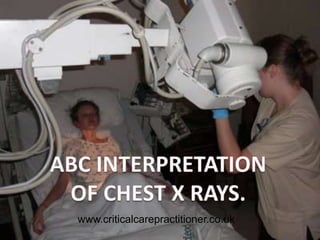
www.criticalcarepractitioner.co.uk
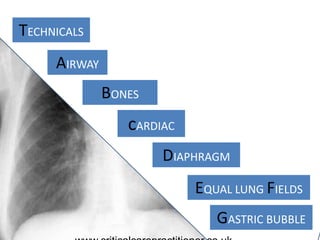
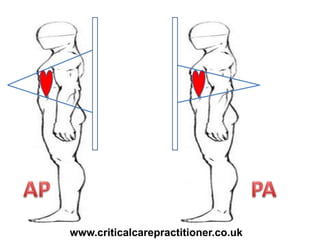
TECHNICALS
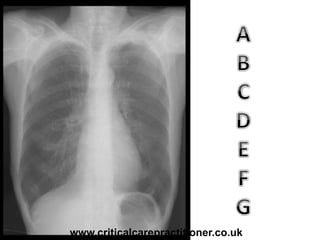
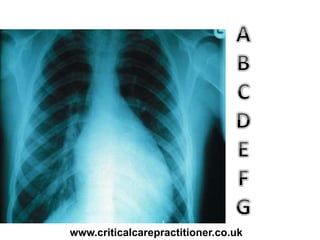
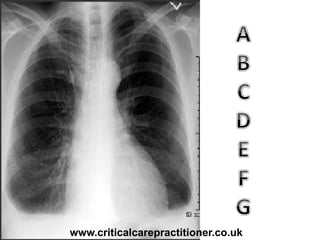
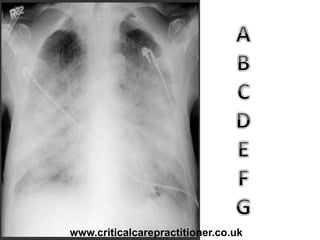
AIRWAY
BONES
cARDIAC
DIAPHRAGM
GASTRIC BUBBLE
EQUAL LUNG FIELDS
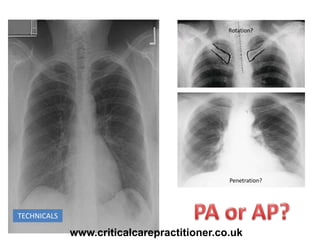
TECHNICALS
Rotation?
Penetration?
www.criticalcarepractitioner.co.uk
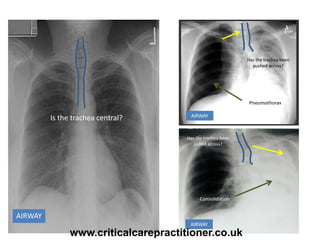
AIRWAY
Is the trachea central? AIRWAY
Has the trachea been
pushed across?
Pneumothorax
Has the trachea been
pulled across?
Consolidation
AIRWAY
www.criticalcarepractitioner.co.uk
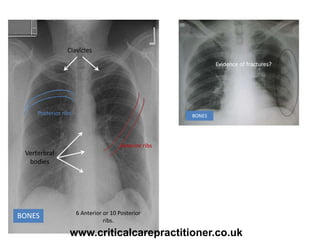
BONES
Posterior ribs
Anterior ribs
Clavicles
Verterbral
bodies
Evidence of fractures?
BONES
6 Anterior or 10 Posterior
ribs.
www.criticalcarepractitioner.co.uk
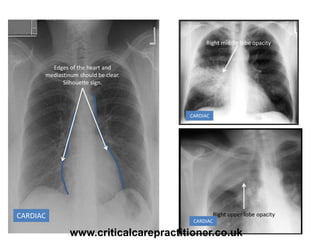
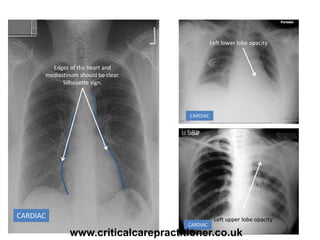
CARDIAC
Edges of the heart and
mediastinum should be clear.
Silhouette sign.
Right middle lobe opacity
Right upper lobe opacity
CARDIAC
CARDIAC
www.criticalcarepractitioner.co.uk
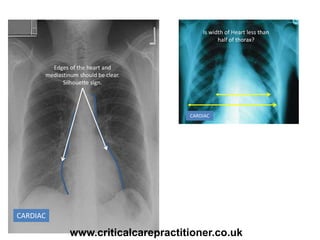
CARDIAC
Edges of the heart and
mediastinum should be clear.
Silhouette sign.
Left lower lobe opacity
Left upper lobe opacity
CARDIAC
CARDIAC
www.criticalcarepractitioner.co.uk
CARDIAC
Edges of the heart and
mediastinum should be clear.
Silhouette sign.
Is width of Heart less than
half of thorax?
CARDIAC
www.criticalcarepractitioner.co.uk
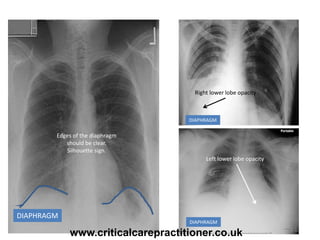
DIAPHRAGM
Edges of the diaphragm
should be clear.
Silhouette sign.
Right lower lobe opacity
Left lower lobe opacity
DIAPHRAGM
DIAPHRAGM
www.criticalcarepractitioner.co.uk
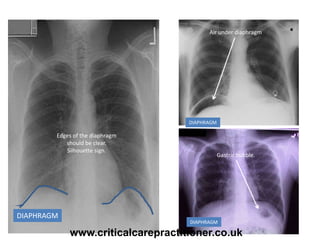
DIAPHRAGM
Edges of the diaphragm
should be clear.
Silhouette sign.
Air under diaphragm
Gastric bubble.
DIAPHRAGM
DIAPHRAGM
www.criticalcarepractitioner.co.uk
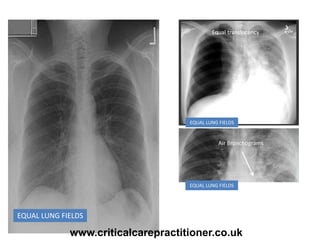
EQUAL LUNG FIELDS
Equal translucency
Air Bronchograms
EQUAL LUNG FIELDS
EQUAL LUNG FIELDS
www.criticalcarepractitioner.co.uk
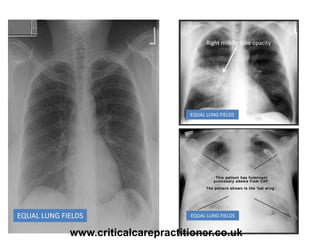
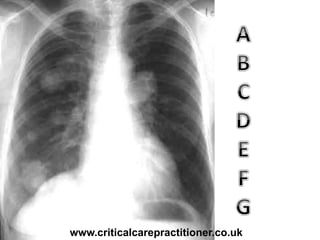
Right middle lobe opacity
EQUAL LUNG FIELDS
EQUAL LUNG FIELDS
EQUAL LUNG FIELDS
www.criticalcarepractitioner.co.uk
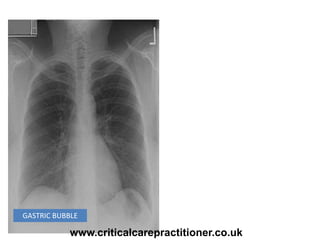
GASTRIC BUBBLE
www.criticalcarepractitioner.co.uk
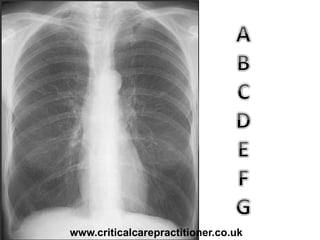
Your Turn!
www.criticalcarepractitioner.co.uk
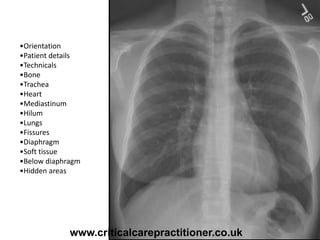
Chest X Rays part II
•Orientation
•Patient details
•Technicals
•Bone
•Trachea
•Heart
•Mediastinum
•Hilum
•Lungs
•Fissures
•Diaphragm
•Soft tissue
•Below diaphragm
•Hidden areas
www.criticalcarepractitioner.co.uk
•Orientation
•Patient details
•Technicals
•Bone
•Trachea
•Heart
•Mediastinum
•Hilum
•Lungs
•Fissures
•Diaphragm
•Soft tissue
•Below diaphragm
•Hidden areas
26
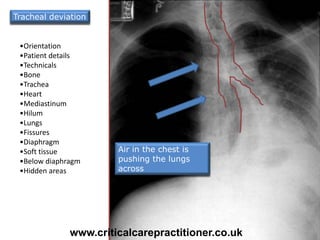
Air in the chest is
pushing the lungs
across
Tracheal deviation
www.criticalcarepractitioner.co.uk
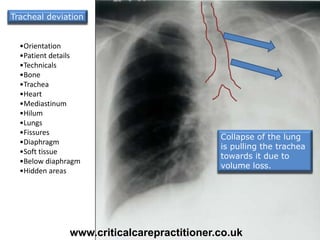
Collapse of the lung
is pulling the trachea
towards it due to
volume loss.
•Orientation
•Patient details
•Technicals
•Bone
•Trachea
•Heart
•Mediastinum
•Hilum
•Lungs
•Fissures
•Diaphragm
•Soft tissue
•Below diaphragm
•Hidden areas
Tracheal deviation
www.criticalcarepractitioner.co.uk
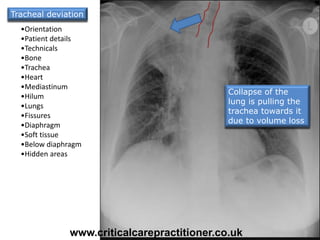
Collapse of the
lung is pulling the
trachea towards it
due to volume loss
•Orientation
•Patient details
•Technicals
•Bone
•Trachea
•Heart
•Mediastinum
•Hilum
•Lungs
•Fissures
•Diaphragm
•Soft tissue
•Below diaphragm
•Hidden areas
Tracheal deviation
www.criticalcarepractitioner.co.uk
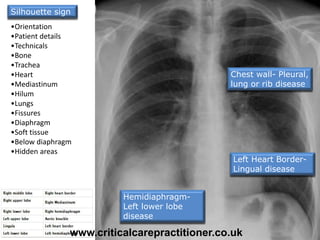
Left Heart Border-
Lingual disease
Hemidiaphragm-
Left lower lobe
disease
Chest wall- Pleural,
lung or rib disease
•Orientation
•Patient details
•Technicals
•Bone
•Trachea
•Heart
•Mediastinum
•Hilum
•Lungs
•Fissures
•Diaphragm
•Soft tissue
•Below diaphragm
•Hidden areas
Silhouette sign
www.criticalcarepractitioner.co.uk
•Orientation
•Patient details
•Technicals
•Bone
•Trachea
•Heart
•Mediastinum
•Hilum
•Lungs
•Fissures
•Diaphragm
•Soft tissue
•Below diaphragm
•Hidden areas
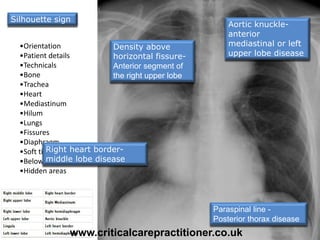
Right heart border-
middle lobe disease
Density above
horizontal fissure-
Anterior segment of
the right upper lobe
Aortic knuckle-
anterior
mediastinal or left
upper lobe disease
Paraspinal line -
Posterior thorax disease
Silhouette sign
www.criticalcarepractitioner.co.uk
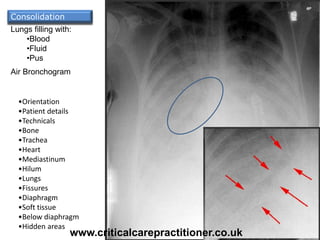
Lungs filling with:
•Blood
•Fluid
•Pus
•Orientation
•Patient details
•Technicals
•Bone
•Trachea
•Heart
•Mediastinum
•Hilum
•Lungs
•Fissures
•Diaphragm
•Soft tissue
•Below diaphragm
•Hidden areas
Air Bronchogram
Consolidation
www.criticalcarepractitioner.co.uk
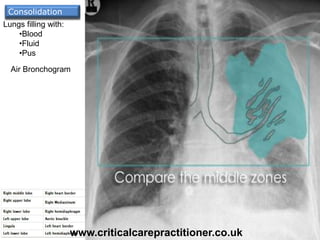
Lungs filling with:
•Blood
•Fluid
•Pus
Air Bronchogram
Consolidation
www.criticalcarepractitioner.co.uk
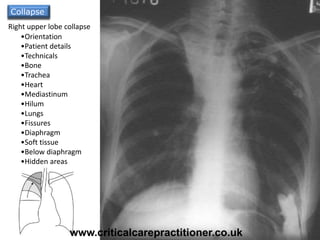
Collapse of the
lung is pulling the
trachea towards it
due to volume loss
•Orientation
•Patient details
•Technicals
•Bone
•Trachea
•Heart
•Mediastinum
•Hilum
•Lungs
•Fissures
•Diaphragm
•Soft tissue
•Below diaphragm
•Hidden areas
Horizontal fissure
pulled upwards
Right upper lobe collapse
Collapse
www.criticalcarepractitioner.co.uk
Collapse
•Orientation
•Patient details
•Technicals
•Bone
•Trachea
•Heart
•Mediastinum
•Hilum
•Lungs
•Fissures
•Diaphragm
•Soft tissue
•Below diaphragm
•Hidden areas
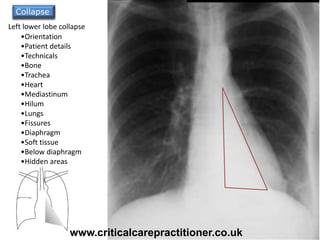
Left lower lobe collapse
www.criticalcarepractitioner.co.uk
Collapse
•Orientation
•Patient details
•Technicals
•Bone
•Trachea
•Heart
•Mediastinum
•Hilum
•Lungs
•Fissures
•Diaphragm
•Soft tissue
•Below diaphragm
•Hidden areas
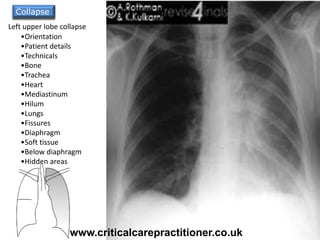
Left upper lobe collapse
www.criticalcarepractitioner.co.uk
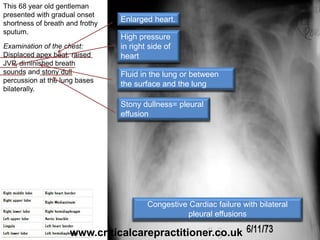
This 68 year old gentleman
presented with gradual onset
shortness of breath and frothy
sputum.
Examination of the chest:
Displaced apex beat, raised
JVP, diminished breath
sounds and stony dull
percussion at the lung bases
bilaterally.
Enlarged heart.
High pressure
in right side of
heart
Fluid in the lung or between
the surface and the lung
Stony dullness= pleural
effusion
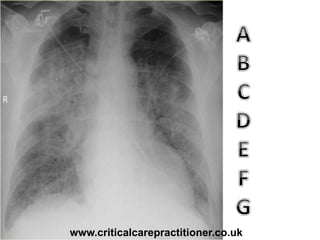
Congestive Cardiac failure with bilateral
pleural effusions
www.criticalcarepractitioner.co.uk
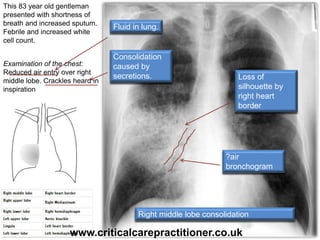
This 83 year old gentleman
presented with shortness of
breath and increased sputum.
Febrile and increased white
cell count.
Examination of the chest:
Reduced air entry over right
middle lobe. Crackles heard in
inspiration
Fluid in lung.
Consolidation
caused by
secretions. Loss of
silhouette by
right heart
border
?air
bronchogram
Right middle lobe consolidation
www.criticalcarepractitioner.co.uk
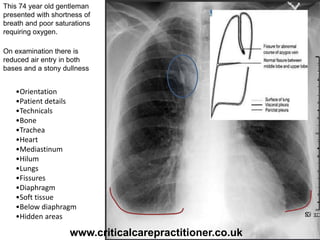
This 74 year old gentleman
presented with shortness of
breath and poor saturations
requiring oxygen.
On examination there is
reduced air entry in both
bases and a stony dullness
•Orientation
•Patient details
•Technicals
•Bone
•Trachea
•Heart
•Mediastinum
•Hilum
•Lungs
•Fissures
•Diaphragm
•Soft tissue
•Below diaphragm
•Hidden areas
www.criticalcarepractitioner.co.uk

The structured interpretation of chest x rays.

Editor's Notes

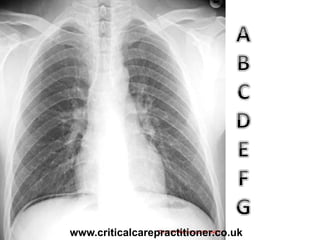
  • #16 How many ribs?
  • #18 Air under diaphragm
  • #19 Left lower lobe collapse
  • #20 Pleural effusion
  • #21 Pulmonary oedema
  • #22 Pulmonary oedema
  • #23 Pulmonary oedema
  • #24 Pulmonary oedema
  • #30 The heart (a soft tissue density structure - near white) lies adjacent to lung tissue (near air density - near black). A crisp contour or 'silhouette' is formed at the interface of these two tissue densities. Loss of clarity of the right heart contour (formed by the right atrium) implies disease of the right middle lobe which lies next to the right atrium. Loss of distinction of the left heart contour indicates an abnormality of the lingula (part of the left upper lobe which wraps over the left ventricle).
  • #39 Azygous fissure An azygous fissure is seen on approximately 1-2% of chest x-rays. In fact autopsy studies suggest they are much more common. The azygous vein, lined by visceral and parietal pleura lies in the base of the fissure, and medially there is a small connection of the 'azygous lobe' with the rest of the upper lobe. An azygous fissure has a tadpole shape, the azygous vein itself forming the head of the tadpole. Because the azygous vein is a right sided structure, this accessory fissure is only ever seen on the right side of the chest.