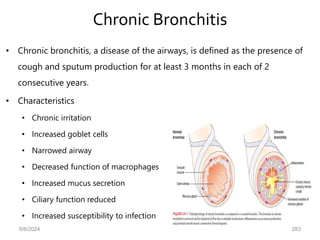
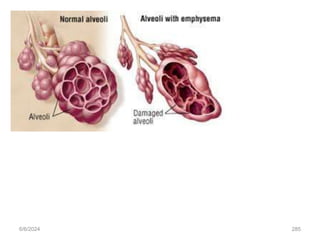
Medical-surgical nursing
Management of patient with
respiratory disorder
6/6/2024 1
Outline
• Anatomy and physiology overview
 Assessment of respiratory system
 Laboratory investigations and Diagnostic procedures
6/6/2024 2
Lesson objectives
After completion of this session the students should be able
to:
 Revise knowledge of anatomy and physiology
 Obtain health history about respiratory system
 Demonstrate physical examination
 Differentiate between normal and abnormal findings
 Identify investigations and diagnostic procedures
6/6/2024 3
Anatomy and physiologic overview
 extends from the nose to the alveoli and includes not
only the air-conducting passages but also the blood
supply
 The primary purpose--Gas exchange
 divided into two parts:
– the upper respiratory tract
– the lower respiratory tract
6/6/2024 4
Anatomy and physiologic overview Cont.…
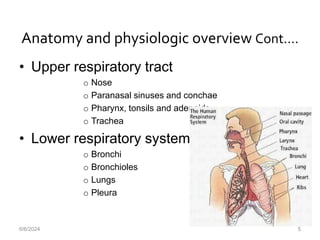
• Upper respiratory tract
o Nose
o Paranasal sinuses and conchae
o Pharynx, tonsils and adenoids
o Trachea
• Lower respiratory system
o Bronchi
o Bronchioles
o Lungs
o Pleura
6/6/2024 5
Anatomy and physiologic overview Cont.…
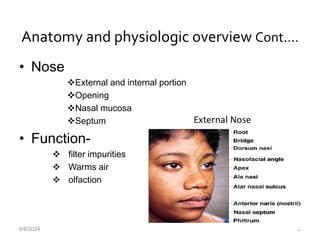
• Nose
External and internal portion
Opening
Nasal mucosa
Septum
• Function-
 filter impurities
 Warms air
 olfaction
6/6/2024 6
Anatomy and physiologic overview Cont.…
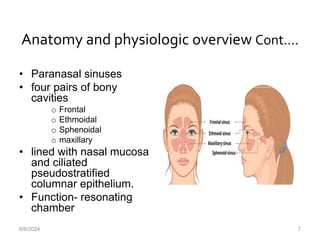
• Paranasal sinuses
• four pairs of bony
cavities
o Frontal
o Ethmoidal
o Sphenoidal
o maxillary
• lined with nasal mucosa
and ciliated
pseudostratified
columnar epithelium.
• Function- resonating
chamber
6/6/2024 7
6/6/2024 8
Anatomy and physiologic overview cont.….
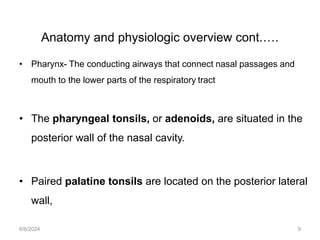
• Pharynx- The conducting airways that connect nasal passages and
mouth to the lower parts of the respiratory tract
• The pharyngeal tonsils, or adenoids, are situated in the
posterior wall of the nasal cavity.
• Paired palatine tonsils are located on the posterior lateral
wall,
6/6/2024 9
Anatomy and physiologic overview Cont.…
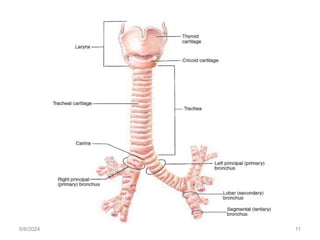
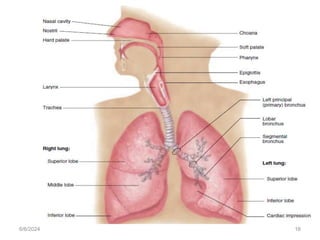
• The larynx, or “voice box,” is a continuation of the conducting division
that connects the laryngopharynx with the trachea.
• Function
 prevent food or fluid from entering the trachea
 produce sound.
• The trachea , the “windpipe,” is a semi rigid, tubular organ,
approximately 12 cm long and 2.5 cm in diameter, connecting the larynx
to the principal (primary) bronchi
• A series of 16 to 20 C-shaped cartilages form the supporting walls of the
trachea
6/6/2024 10
6/6/2024 11
Anatomy and physiologic overview
cont.….
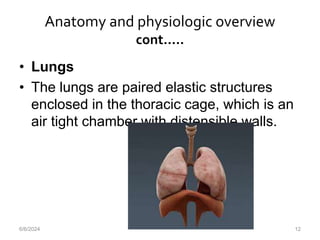
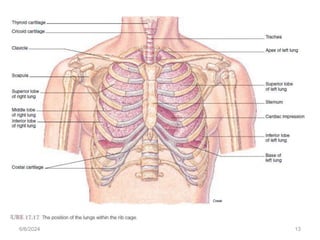
• Lungs
• The lungs are paired elastic structures
enclosed in the thoracic cage, which is an
air tight chamber with distensible walls.
6/6/2024 12
6/6/2024 13
Anatomy and physiologic overview Cont.…
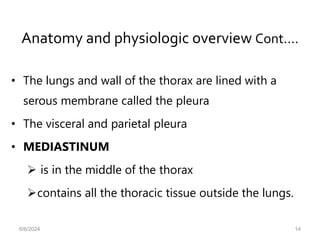
• The lungs and wall of the thorax are lined with a
serous membrane called the pleura
• The visceral and parietal pleura
• MEDIASTINUM
 is in the middle of the thorax
contains all the thoracic tissue outside the lungs.
6/6/2024 14
Anatomy and physiologic overview Cont.…
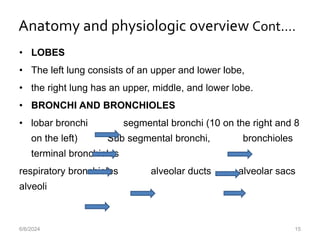
• LOBES
• The left lung consists of an upper and lower lobe,
• the right lung has an upper, middle, and lower lobe.
• BRONCHI AND BRONCHIOLES
• lobar bronchi segmental bronchi (10 on the right and 8
on the left) Sub segmental bronchi, bronchioles
terminal bronchioles
respiratory bronchioles alveolar ducts alveolar sacs
alveoli
6/6/2024 15
6/6/2024 16
Anatomy and physiologic overview Cont.…
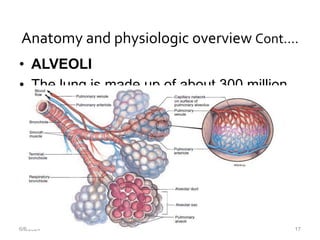
• ALVEOLI
• The lung is made up of about 300 million
alveoli,
6/6/2024 17
FUNCTION OFTHE RESPIRATORY SYSTEM
• The four basic functions of the respiratory system, not all of which are
associated with breathing, are as follows:
• It provides oxygen to the bloodstream and removes carbon dioxide.
• It enables sound production or vocalization as expired air passes over
the vocal folds.
• It assists in abdominal compression during micturition (urination),
defecation (passing of feces), and parturition (childbirth).
• It enables protective and reflexive nonbreathing air movements, as in
coughing and sneezing, to keep the air passageways clean.
6/6/2024 18
EXAMINATION OF
RESPIRATORY
SYSTEM
19
6/6/2024
Locating Findings on the Chest
20
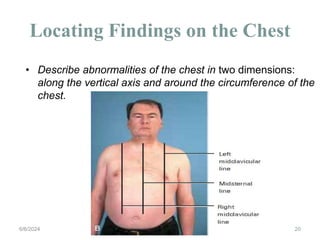
• Describe abnormalities of the chest in two dimensions:
along the vertical axis and around the circumference of the
chest.
6/6/2024
Locating vertically
21
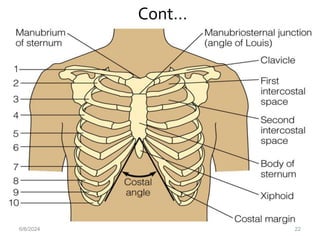
• Number ribs and interspaces accurately.
• Anteriorly, the sternal angle (Angle of Louis),
• Moving laterally from the Angle of Louis, you find the
adjacent second rib and costal cartilage.
• Now you can walk down the inter spaces using your two
fingers. An inter space is named by the rib above it.
6/6/2024
Cont…
22
6/6/2024
Cont…
23
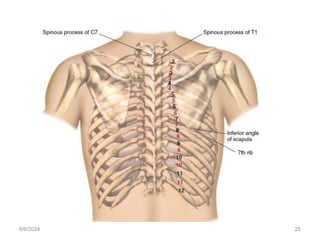
 Posteriorly, the twelfth rib gives an other possible
starting point for counting the ribs and inter spaces.
 This is especially useful in locating findings on the lower
posterior chest and also helps when the anterior
approach is unsatisfactory.
 The inferior angle of the scapula lies at the level of the
seventh rib or interspace
6/6/2024
Cont…
24
 The spinous process of the seventh cervical vertebrae
(When a person flexes his neck for ward, the most
prominent process is usually that of the seventh cervical
vertebrae, and when two processes appear equally
prominent, they are of the seventh cervical and the first
thoracic vertebrae.) helps to locate findings posteriorly.
6/6/2024
6/6/2024 25
Locating Findings AroundThe
Circumference ofThe Chest
26
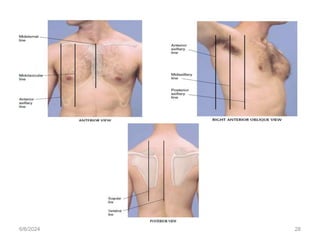
• The mid sternal and vertebral lines precise; others are
estimated.
• These lines drop vertically in the middle of the sternum and
the vertebral column respectively.
• The mid clavicular lines –drop vertically from the mid point
of the clavicle
6/6/2024
Cont…
27
• The anterior and posterior axillary lines- drop vertically
from the anterior and posterior axillary folds (the muscle
masses that border the axilla).
• The mid axillary lines- drop from the apexes of the axilla.
• The scapular lines – drop from the inferior angles of the
scapulas
6/6/2024
6/6/2024 28
Lungs, fissures and lobes
29
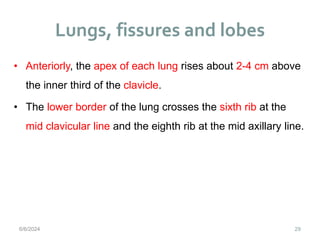
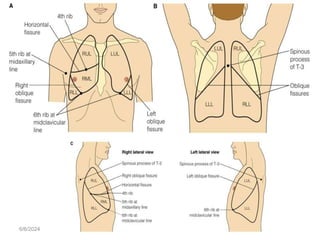
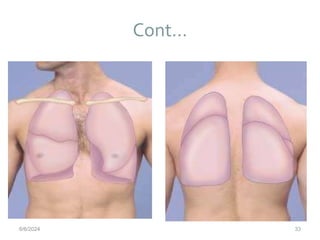
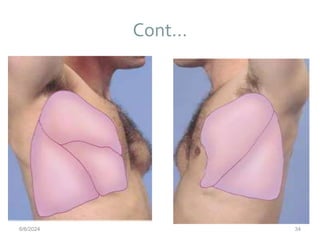
• Anteriorly, the apex of each lung rises about 2-4 cm above
the inner third of the clavicle.
• The lower border of the lung crosses the sixth rib at the
mid clavicular line and the eighth rib at the mid axillary line.
6/6/2024
Cont…
30
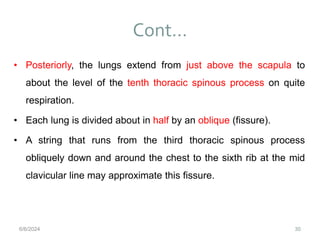
• Posteriorly, the lungs extend from just above the scapula to
about the level of the tenth thoracic spinous process on quite
respiration.
• Each lung is divided about in half by an oblique (fissure).
• A string that runs from the third thoracic spinous process
obliquely down and around the chest to the sixth rib at the mid
clavicular line may approximate this fissure.
6/6/2024
Cont…
31
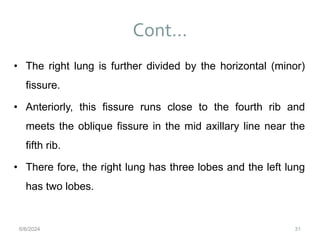
• The right lung is further divided by the horizontal (minor)
fissure.
• Anteriorly, this fissure runs close to the fourth rib and
meets the oblique fissure in the mid axillary line near the
fifth rib.
• There fore, the right lung has three lobes and the left lung
has two lobes.
6/6/2024
32
6/6/2024
Cont…
33
6/6/2024
Cont…
34
6/6/2024
Locations on the Chest
35
 Be familiar with general anatomic terms used to locate
chest findings, such as:
– Supraclavicular—above the clavicles
– Infraclavicular—below the clavicles
– Interscapular—between the scapulae
– Infrascapular—below the scapula
– Bases of the lungs—the lower most portions
– Upper, middle, and lower lung fields
6/6/2024
The trachea and major bronchi
36
 Breath sounds over the trachea and bronchi have a
different quality than breath sounds over the lung
parenchyma.
 Be sure you know the location of these structures.
 The trachea bifurcates into its main stem bronchi at the
levels of the sternal angle anteriorly and the T4 spinous
process posteriorly.
6/6/2024
Cont…
37
6/6/2024
The Pleurae
38
 The pleurae are serous membranes that cover the outer surface
of each lung, the visceral pleura, and also line the inner rib cage
and upper surface of the diaphragm, the parietal pleura.
 Their smooth opposing surfaces, lubricated by pleural fluid,
allow the lungs to move easily within the rib cage during
inspiration and expiration.
• The pleural space is the potential space between visceral and
parietal pleurae.
6/6/2024
Examining the thorax and the lungs
39
 General guidelines
 Expose the chest fully
 Proceed in an orderly fashion: inspection, palpation, percussion, and
finally auscultation
 Compare one side with the other-
 Examine the posterior thorax and lungs while the patient is still in a
sitting position.
 The patient’s arms should be folded across the chest with hands
resting, if possible on the opposite shoulder as this position moves the
scapula apart and increases your access to the lung fields.
6/6/2024
Cont…
40
 Ask the patient to lie supine while examining the anterior chest.
 This position makes examining women easier, and wheezes, if
present, are more likely to be heard.
 Other wise the sitting position is also satisfactory.
 When you must examine the chest by rolling to one side and to the
other, percuss the upper lung and auscultate both lungs in each
position.
 Because ventilation is relatively greater in the dependent lung, the
chances of hearing wheezes or crackles are greater on the dependent
side.
6/6/2024
Cont…
41
 Relate all other findings in the thorax with findings such as
shape of the finger nails and position of the trachea or
cyanosis
6/6/2024
Common or Concerning Symptoms
Of Respiratory System
42
o Chest Pain: Complaints of chest pain or chest discomfort
raise the specter of heart disease, but often arise from
structures in the thorax and lung as well. To assess this
symptom, you must pursue a dual investigation of both
thoracic and cardiac causes.
6/6/2024
Sources of chest pain are listed below
43
• The myocardium-Angina pectoris, myocardial infarction
• The pericardium-Pericarditis
• The aorta-Dissecting aortic aneurysm
• The trachea and large bronchi-Bronchitis
• The parietal pleura-Pericarditis, pneumonia
• The chest wall, including the musculoskeletal system and skin-
Costochondritis, herpes zoster
• The esophagus-Reflux esophagitis, esophageal spasm
• Extrathoracic structures such as the neck, gallbladder, and stomach -
Cervical arthritis, biliary colic, gastritis
6/6/2024
Dyspnea
44
• is a nonpainful but uncomfortable awareness of breathing that is
inappropriate to the level of exertion. This serious symptom warrants a
full explanation and assessment, since dyspnea commonly results
from cardiac or pulmonary disease.
• Ask “Have you had any difficulty breathing?”
• at rest or with exercise?, and how much effort produces onset?.
• Because of variations in age, body weight, and physical fitness, there
is no absolute scale for quantifying dyspnea.
• Anxious patients may have episodic dyspnea during both rest and
exercise, and hyperventilation, or rapid, shallow breathing.
6/6/2024
Wheezes
45
• are musical respiratory sounds that may be audible both to
the patient and to others.
• Wheezing suggests partial airway obstruction from
secretions, tissue inflammation, or a foreign body.
6/6/2024
Cough
46
• is a common symptom that ranges in significance from trivial to
ominous.
• Typically, cough is a reflex response to stimuli that irritate
receptors in the larynx, trachea, or large bronchi.
• These stimuli include
• mucus, pus, and blood
• external agents such as dusts, foreign bodies, or even extremely hot or
cold air.
• inflammation
• pressure or tension in the air passages from a
tumor or enlarged peribronchial lymph nodes.
6/6/2024
Cont…
47
• For complaints of cough, Ask
 whether the cough is dry or produces sputum, or phlegm.
 the volume of any sputum and its color, odor, and consistency.
• Cough is an important symptom of left-sided heart failure.
• Dry hacking cough in Mycoplasmal pneumonia
• productive cough in bronchitis, viral or bacterial pneumonia
• Foul-smelling sputum in anaerobic lung abscess
• tenacious sputum in cystic fibrosis
• Large volumes of purulent sputum in bronchiectasis or lung
abscess
6/6/2024
Hemoptysis
48
• is the coughing up of blood from the lungs; it may vary from blood-
streaked phlegm to frank blood.
• For patients reporting hemoptysis, assess the volume of blood
produced as well as the other sputum attributes; ask about the related
setting and activity and any associated symptoms.
• confirm the source of the bleeding by both history and physical
examination.
• Blood or blood-streaked material may originate in the mouth, pharynx,
or gastrointestinal tract and is easily mislabeled.
6/6/2024
Cont…
49
• When vomited, it probably originates in the gastrointestinal
tract. Occasionally, however, blood from the nasopharynx
or the gastrointestinal tract is aspirated and then coughed
out.
• Blood originating in the stomach is usually darker than
blood from the respiratory tract and may be mixed with
food particles.
6/6/2024
Cont…
50
 Place your thumbs about at the level of and parallel to the tenth
ribs posteriorly and at the level of the lower costal margin in the
mid line anteriorly, your hands grasping the lateral rib cage.
 As you position your hands, slide them medially in order to raise
loose skin folds between your thumbs.
 Ask the patient to breath deeply and watch the divergence of
your thumbs or the return of the folds of skin during inspiration.
6/6/2024
Inspection
51
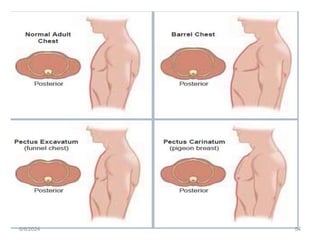
• 1.Inspect the shape of the chest.
In the normal adult the thorax is wider than
it is deep (the anterior-posterior diameter is
about half of the transverse diameter).
6/6/2024
Cont…
52
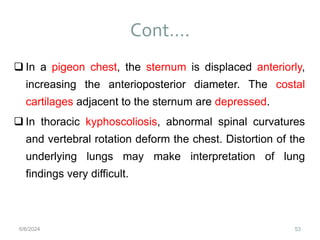
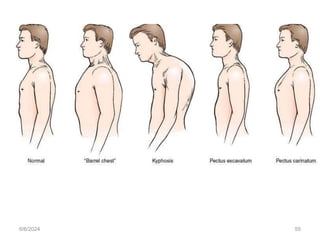
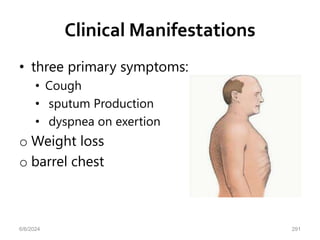
 A barrel chest
 A funnel chest is characterized by a depression in the
lower portion of the sternum. Compression of the heart
and great vessels may cause murmurs.
 A flail chest is unstable chest resulting when multiple ribs
are fractured.
Because descent of the diaphragm decreases intra thoracic
pressure on inspiration, the injured area caves inward; on
expiration, it moves outward (paradoxical respiration).
6/6/2024
Cont….
53
 In a pigeon chest, the sternum is displaced anteriorly,
increasing the anterioposterior diameter. The costal
cartilages adjacent to the sternum are depressed.
 In thoracic kyphoscoliosis, abnormal spinal curvatures
and vertebral rotation deform the chest. Distortion of the
underlying lungs may make interpretation of lung
findings very difficult.
6/6/2024
6/6/2024 54
6/6/2024 55
Cont…
56
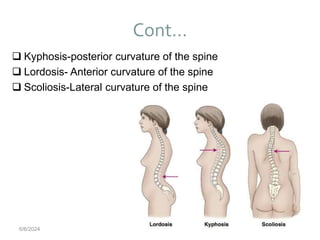
 Kyphosis-posterior curvature of the spine
 Lordosis- Anterior curvature of the spine
 Scoliosis-Lateral curvature of the spine
6/6/2024
2.Inspect respiratory pattern (rate, depth, rhythm, effort)
57
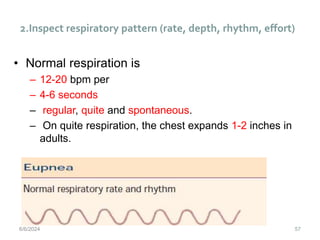
• Normal respiration is
– 12-20 bpm per
– 4-6 seconds
– regular, quite and spontaneous.
– On quite respiration, the chest expands 1-2 inches in
adults.
6/6/2024
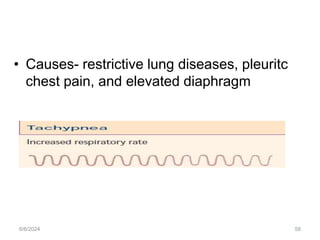
• Causes- restrictive lung diseases, pleuritc
chest pain, and elevated diaphragm
6/6/2024 58
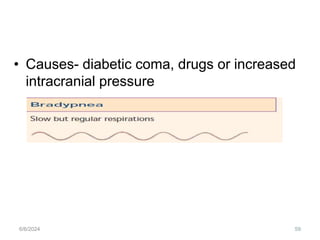
• Causes- diabetic coma, drugs or increased
intracranial pressure
6/6/2024 59
Cont…
60
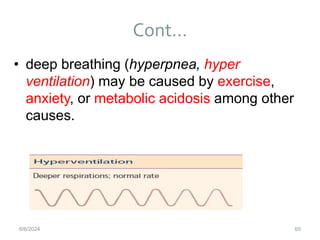
• deep breathing (hyperpnea, hyper
ventilation) may be caused by exercise,
anxiety, or metabolic acidosis among other
causes.
6/6/2024
Cont…
61
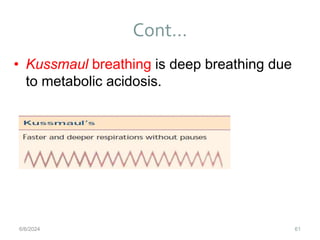
• Kussmaul breathing is deep breathing due
to metabolic acidosis.
6/6/2024
Cont…
62
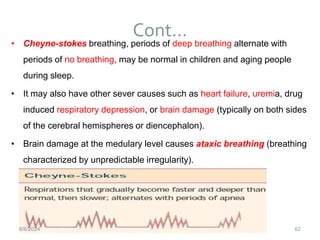
• Cheyne-stokes breathing, periods of deep breathing alternate with
periods of no breathing, may be normal in children and aging people
during sleep.
• It may also have other sever causes such as heart failure, uremia, drug
induced respiratory depression, or brain damage (typically on both sides
of the cerebral hemispheres or diencephalon).
• Brain damage at the medulary level causes ataxic breathing (breathing
characterized by unpredictable irregularity).
6/6/2024
Cont…
63
• In obstructive breathing, expiration is prolonged (longer than 6
seconds) because narrowed airways increase resistance to airflow.
• Causes include asthma, chronic bronchitis and emphysema.
• Contraction of the sternomastoid muscle or supra clavicular retractions
during inspiration at rest signal sever difficulty in breathing.
• Intercostal and sub costal retractions suggest pulmonary stiffness
whereas intercostal bulges during exhalation indicate emphysema.
6/6/2024
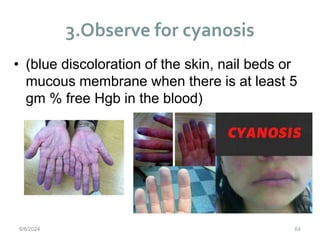
3.Observe for cyanosis
64
• (blue discoloration of the skin, nail beds or
mucous membrane when there is at least 5
gm % free Hgb in the blood)
6/6/2024
4. Movement of the Chest
65
One has to inspect wether both sides of the
chest is moving symetrically or not.Causes
of asymmetrical chest expansion are:
o Pleural effusion
o Pneumothorax
o Extensive consolidation
o Atelectasis
o Pulmonary Fibrosis
6/6/2024
Palpation
66
 Palpation has the following uses:
• 1.Identification of tender areas: palpate any area where
pain has been reported or lesions are evident.
• 2.Assessment of observed abnormalities example
masses
• 3.Assessment of respiratory expansion to determine
range and symmetry of respiratory movements.
6/6/2024
Cont…
67
 Place your thumbs about at the level of and parallel to the tenth
ribs posteriorly and at the level of the lower costal margin in the
mid line anteriorly, your hands grasping the lateral rib cage.
 As you position your hands, slide them medially in order to raise
loose skin folds between your thumbs.
 Ask the patient to breath deeply and watch the divergence of
your thumbs or the return of the folds of skin during inspiration.
6/6/2024
Cont…
68
 Normally divergence should be symmetrical and range of
expansion should be not less than 1-2 inches.
6/6/2024
Cont…
69
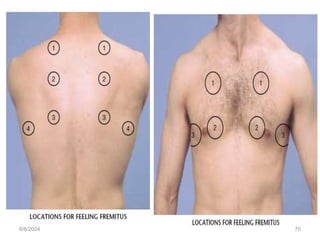
4.Assessment of tactile fremitus (the palpable vibrations
transmitted through the broncho- pulmonary tree to the
chest wall when the patient speaks):
 Ask the patient to repeat words ‘99’ or ‘one-one-one’ and
with the ball of your hand (the bony part of the palm at the
base of the fingers) or the ulnar surface of your hand,
palpate and compare symmetrical areas of the lung.
6/6/2024
6/6/2024 70
Cont…
71
Identify any areas of increased, decreased or
absent fremitus and locate them.
Fremitus is typically more prominent in the
interscapular area than in the lower lung fields,
and is often more prominent on the right side
than on the left.
It disappears below the diaphragm.
6/6/2024
Cont…
72
 Fremitus is decreased or absent when
 the voice is soft,
 the transmissions of the vibrations from the larynx to the surface of the
chest wall is impended as in obstructed bronchus, chronic obstructive
diseases,
 separation of the pleural surfaces by fluid, air, fibrosis (pleural thickening),
infiltrating tumor or when there is very thick chest wall.
• On the contrary, fremitus is increased when transmission is increased
as through the consolidated lung of lobar pneumonia.
6/6/2024
Percussion
73
Percussion of the thorax has three main
purposes:
To determine whether the underlying tissues
are air filled, fluid filled or solid with in 5-7 cm in
to the chest wall.
To estimate diaphragmatic excursion
To identify level of diaphragmatic dullness
6/6/2024
Cont…
74
• Techniques:
• Hyper extend the middle finger of your left hand (pleximeter finger) and
press its distal iterphalangeal joint on the surface to be percussed
(avoid surface contact by any other part of the hand as it dumps the
vibrations).
• Position your right forearm quite close to the surface with the hand
cocked up ward and, with a quick, sharp, but relaxed wrist motion strike
the pleximetre finger with the tip of the partially right middle finger.
6/6/2024
Cont…
75
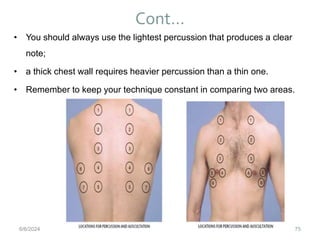
• You should always use the lightest percussion that produces a clear
note;
• a thick chest wall requires heavier percussion than a thin one.
• Remember to keep your technique constant in comparing two areas.
6/6/2024
Cont…
76
 Interpretation of percussion findings is based on the
following five percussion notes:
– Flat- this is a type of note we get by percussing over the
thigh; pathological examples include massive pleural
effusion, tumor, etc.
– Dull: a type of note similar to the one detected over normal
liver. Pathological examples include lobar pneumonia,
pleural effusion, hemothorax, etc.
6/6/2024
Cont…
77
– Resonance: this is the percussion note of normal lung tissue
though it can’t rule out lung abnormalities. Pathological
example, chronic bronchitis.
– Hyper resonance: this note is detected when there is larger
amount of air contained under the surface to be percussed
as in emphysema and bronchial asthma (in which case it is
generalized) or pneumothorax (in which case it is localized).
– Tympani: this note can be learned by percussing over a
puffed out cheek or over most areas of the stomach.
Pathological example, large pneumothorax.
6/6/2024
Identifying The Level Of Diaphragmatic Dullness
78
 Starting above the expected level of dullness, percuss
down ward until resonance replaces dullness during
quiet respiration.
 Check the level of this change near the middle of the hemi
thorax and also more laterally.
 An abnormally high level may suggest pleural effusion, or
high diaphragm as from atelectasis or diaphragmatic
paralysis
6/6/2024
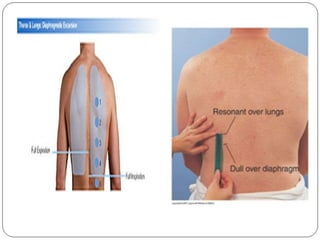
Estimating Diaphragmatic Excursion
79
o Ask the patient to exhale fully and keep.
o Percuss the posterior chest down from area of resonance to
area of dullness and mark.
o Then ask the patient to breath in deep and hold, continue
percussing down until resonance changes to dullness and mark.
o Measure the vertical distance between the two points.
o Do the same for the other side.
o Normally it should be 5-6 cm, with the possibility of the right side
to be 2cm higher than the left side.
6/6/2024
6/6/2024 80
Auscultation
81
 It is the most important examining technique for assessing
airflow through the broncho-tracheal tree.
 Instruct the patient to breath deeply through an open mouth.
 Using the diaphragm of the stethoscope, auscultate areas
suggested by percussion and compare symmetrical areas.
 You should auscultate between the ribs not at the ribs.
 In children, the interspaces are small and there fore you better
use the bell of your stethoscope pressed tightly.
6/6/2024
Cont…
82
 If you hear or suspect abnormality, auscultate adjacent
areas to describe the extent of the abnormality.
 Be alert for patient discomfort due to hyperventilation
(example light headedness, faintness), and allow the
patient to rest as needed.
6/6/2024
Cont…
83
Auscultation has the following three main purposes:
– To identify whether the breath sounds are decreased,
absent or abnormally located
– To identify the presence of added (adventitious) sounds
– To identify extent of transmission of voice sounds
6/6/2024
The Normal Breath Sounds
84
• 1.Vesicular breath sound that is characterized by:
– Inspiratory sounds lasting longer than expiratory ones
– Soft and low pitched
– No pause between expiration and inspiration
– Heard through inspiration and one–third of expiration
– Normally heard over most of both lungs
6/6/2024
2.Bronchial Breath
85
sound that is characterized by:
 Loud and relatively high pitched
 Expiratory sounds lasting longer than inspiratory
ones
 Short silent period between inspiration and
expiration
 The normal location is over the manubrium if heard at
all
6/6/2024
3.Broncho-Vesicular Breath
86
sounds are characterized by:
 Intermediate in intensity and pitch
 Inspiratory and expiratory sounds are about equal in
duration
 A silent gap between inspiration and expiration may or
may not be present
 Normally it can be heard in the first and second
interspaces anteriorly and between the scapulas
posteriorly
6/6/2024
Cont…
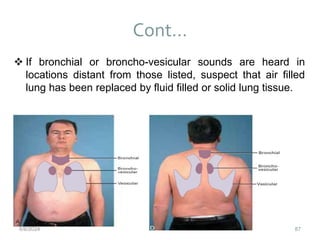
87
 If bronchial or broncho-vesicular sounds are heard in
locations distant from those listed, suspect that air filled
lung has been replaced by fluid filled or solid lung tissue.
6/6/2024
Cont…
88
 Breathed sounds may be decreased when airflow is
decreased (example obstructive lung disease or muscular
weakness) or
 when the transmission of sound is poor (example in
pleural effusion, pneumothorax, or emphysema).
6/6/2024
Added Sounds
89
 These are sounds that are superimposed on the usual breath
sounds. The common ones are described here.
 Crackles/rales/crepitation: discontinuous/intermittent,
nonmusical sounds of brief-like dots in time that may be fine (soft
and brief) or coarse (louder and not quit so brief).
• Crackles are caused by air babbles flowing through
secretions or lightly closed airways during respiration.
6/6/2024
Cont…
90
 They also result from a series of tiny explosions when small
airways, deflated during expiration, pop open during inspiration
(Example interstitial lung disease, early congestive heart failure,
pneumonia).
 If you hear crackles,
 note whether fine or coarse,
 their timing in the respiratory cycle,
 location on the chest wall,
 persistence of their pattern from breath to breath and any change
after coughing or changing position.
6/6/2024
Cont…
91
 Note also that in some normal people, crackles may be heard at the
lung bases anteriorly after maximal expiration, and that crackles in
dependent portions of the lungs may also occur after prolonged
recumbency.
 Wheezes: relatively high-pitched, continuous, musical sounds which
are longer than crackles and like dashes in time. Wheezes are often
audible through mouth or chest wall.
6/6/2024
Cont…
92
 It occurs when air flows through bronchi that are narrowed to
the point of closure.
 Generalized wheezes are commonly caused by asthma,
chronic bronchitis and congestive heart failure.
 A persistent localized wheeze suggests a partial obstruction
of a bronchus, as by a tumor or foreign body.
 It may be inspiratory, expiratory or both.
6/6/2024
Cont…
93
 Stridor is a wheeze that is entirely or predominantly
inspiratory. It indicates a partial obstruction of the larynx or
trachea and is a medical emergency.
 Rhonchi are continuous sounds with snoring quality; it
suggests secretions in the larger airways.
6/6/2024
Cont…
94
 Pleural friction rub: Are discrete granting sounds
that appear continuous because they are
numerous.
 Pleural friction rub are usually confined to a
small area of chest wall and typically heard in
both phases of the respiration.
6/6/2024
Transmitted voice sounds
95
 If you hear abnormally located broncho-vesicular breath sounds
or bronchial breath sounds, continue on to assess transmitted
voice sounds. This can be done in the following ways.
– Ask the patient to say ‘99’,’ arba-arat’ or ‘afurtemi-afur’ as
applicable and auscultate over the auscultatory areas with your
stethoscope.
– Normally the sounds transmitted through the chest wall are muffled
and indistinct.
– Louder clearer voice sounds heard through the stethoscope
(bronchophony) suggest that air-filled lung has become airless.
6/6/2024
Cont…
96
 Ask the patient to say ‘ee’. Normally, you hear a muffled long “e”.
When ‘ee’ is heard as ‘ay’, an e-to-a change, (egohpony), and the
quality sounds nasal, it suggests that the lung has been changed to
airless.
• Ask the patient to whisper ‘99’ or one-two-three’ and auscultate. The
whispered voice is normally heard faintly and indistinctly. Louder
clearer whispered sounds (whispered pectoriloquy) suggest airless
lung.
6/6/2024
Diagnostic evaluation
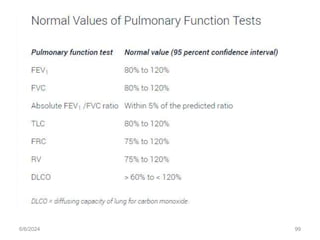
• Pulmonary function tests (PFTs) are routinely used in
patients with chronic respiratory disorders.
• They are performed to assess respiratory function
and to determine the extent of dysfunction.
• measurements of lung volumes, ventilatory function,
and the mechanics of breathing, diffusion, and gas
exchange
6/6/2024 97
6/6/2024 98
6/6/2024 99
Diagnostic evaluation- Cont’d
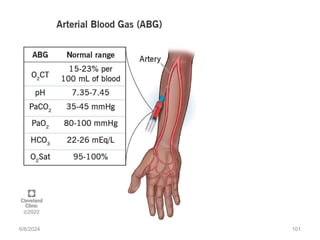
• ARTERIAL BLOOD GAS STUDIES
• Measurements of blood pH and of arterial oxygen and
carbon dioxide tension
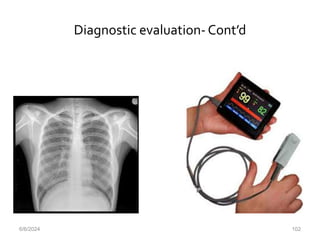
• PULSE OXIMETRY
• noninvasive method of continuously monitoring the oxygen
saturation of hemoglobin
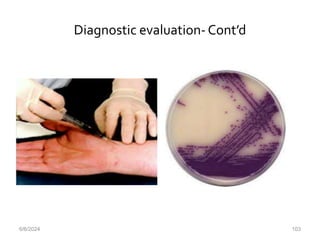
• CULTURES
• Throat cultures may be performed to identify organisms
responsible for pharyngitis
6/6/2024 100
6/6/2024 101
Diagnostic evaluation-Cont’d
6/6/2024 102
Diagnostic evaluation-Cont’d
6/6/2024 103
Diagnostic evaluation-Cont’d
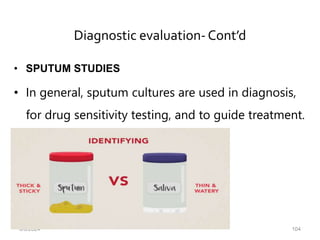
• SPUTUM STUDIES
• In general, sputum cultures are used in diagnosis,
for drug sensitivity testing, and to guide treatment.
6/6/2024 104
Diagnostic evaluation- Cont’d- imaging
studies
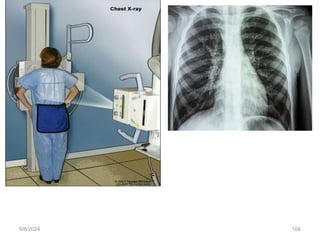
• Chest X-Ray
• Normal pulmonary tissue is radiolucent; therefore, densities produced
by fluid, tumors, foreign bodies, and other pathologic conditions can be
detected by x-ray examination
• The postero-anterior projection and the lateral projection.
• Chest x-rays are usually taken after full inspiration because the lungs are
best visualized when they are well aerated
6/6/2024 105
6/6/2024 106
Diagnostic evaluation-Cont’d
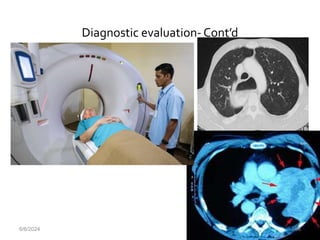
Computed Tomography
• lungs are scanned in successive layers by a narrow-beam x-
ray
• define pulmonary nodules and small tumors
• demonstrate mediastinal abnormalities and hilar adenopathy
• Contrast agents are useful
6/6/2024 107
Diagnostic evaluation- Cont’d
6/6/2024 108
Diagnostic evaluation- Cont’d
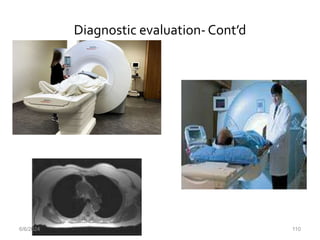
• Magnetic Resonance Imaging
• MRI uses magnetic fields and radiofrequency signals
– characterize pulmonary nodules
– stage bronchogenic carcinoma
– evaluate inflammatory activity in interstitial lung
disease
– acute pulmonary embolism, and chronic
thrombolytic pulmonary hypertension
6/6/2024 109
Diagnostic evaluation-Cont’d
6/6/2024 110
Diagnostic evaluation-Cont’d
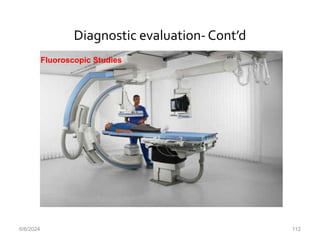
• Fluoroscopic Studies
• Fluoroscopy is used to assist with invasive procedures,
such as a chest needle biopsy or transbronchial biopsy
• Pulmonary Angiography
• used to investigate thromboembolic disease of the
lungs, such as pulmonary emboli and congenital
abnormalities of the pulmonary vascular tree
6/6/2024 111
Diagnostic evaluation-Cont’d
6/6/2024 112
Fluoroscopic Studies
Diagnostic evaluation- Cont’d- ENDOSCOPIC
PROCEDURES
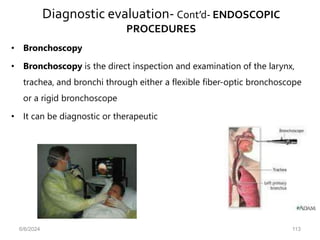
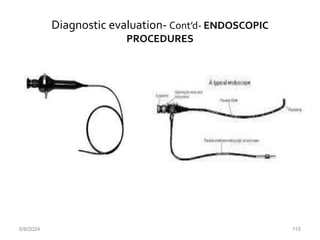
• Bronchoscopy
• Bronchoscopy is the direct inspection and examination of the larynx,
trachea, and bronchi through either a flexible fiber-optic bronchoscope
or a rigid bronchoscope
• It can be diagnostic or therapeutic
6/6/2024 113
Diagnostic evaluation- Cont’d- ENDOSCOPIC
PROCEDURES
DIAGNOSTIC
• to examine tissues or collect secretions
• to determine the location and extent of the pathologic process and to obtain a
tissue sample for diagnosis
• to determine if a tumor can be resected surgically, a
• to diagnose bleeding sites (source of hemoptysis).
Therapeutic
• remove foreign bodies from the tracheobronchial tree,
• remove secretions obstructing the tracheobronchial tree
• treat postoperative atelectasis
• destroy and excise lesions.
6/6/2024 114
Diagnostic evaluation- Cont’d- ENDOSCOPIC
PROCEDURES
6/6/2024 115
Diagnostic evaluation- Cont’d- ENDOSCOPIC
PROCEDURES
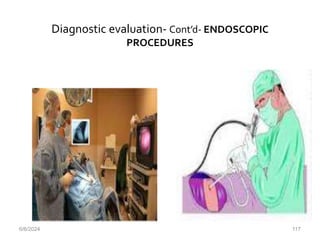
• Thoracoscopy
• Thoracoscopy is a diagnostic procedure in which the pleural cavity is
examined with an endoscope
• THORACENTESIS
• aspiration of pleural fluid for diagnostic or therapeutic purposes
• BIOPSY
• the excision of a small amount of tissue, may be performed to permit
examination of cells from the pharynx, larynx, and nasal passages
6/6/2024 116
Diagnostic evaluation- Cont’d- ENDOSCOPIC
PROCEDURES
6/6/2024 117
Diagnostic evaluation- Cont’d- ENDOSCOPIC
PROCEDURES
• Pleural Biopsy
• Pleural biopsy is accomplished by needle biopsy of the pleura or by
pleuroscopy,
• Performed when there is pleural exudate of undetermined origin and
when there is a need to culture or stain the tissue to identify
tuberculosis or fungi.
• Lung Biopsy Procedures
• transcatheter bronchial brushing
• transbronchial lung biopsy
• percutaneous (through-the-skin) needle biopsy.
6/6/2024 118
Management of Patients With
Upper Respiratory
Tract Disorders
6/6/2024 119
Upper RespiratoryTract Infections/Inflammatory Disorders
• Are the common conditions that affect
most people on occasion,
• some infections are acute and other are
chronic
• Patients with these conditions seldom
require hospitalization.
6/6/2024 120
Case scenario
• A 25 year old student came to the class with running nose,
sneezing and intermittent coughing. When you questioned what
happens to him the condition started a day back with scratchy
throat and currently he feels body warmth, discomfort. You
observed that his nose become red, no eye color change and use
tissue paper very frequently.
• What would be the most likely diagnoses of this student?
• If you are a nurse caring for him how do you manage his
condition?
6/6/2024 121
common cold
• The term “common cold” often is used when referring to an upper respiratory
tract infection that is self-limited and caused by a virus (viral rhinitis).
• Cold referred to afebrile, infectious, acute inflammation, of the mucus membranes
of the nasal cavity
• More broadly, the term refers to an acute upper respiratory tract infection,(non-
specific URI) whereas terms such as “rhinitis,” “pharyngitis,” and “laryngitis”
distinguish the sites of the symptoms.
• Colds are highly contagious because virus is shed for about 2 days before the
symptoms appear and during the first part of the symptomatic phase.
6/6/2024 122
common cold-Etiology
• Rhinovirus
• Para-influenza virus
• coronavirus,
• respiratory syncytial virus (RSV)
• influenza virus
• adenovirus.
6/6/2024 123
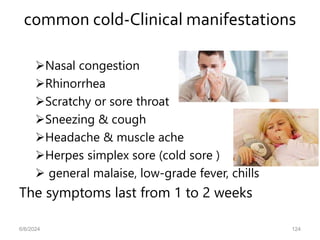
common cold-Clinical manifestations
Nasal congestion
Rhinorrhea
Scratchy or sore throat
Sneezing & cough
Headache & muscle ache
Herpes simplex sore (cold sore )
 general malaise, low-grade fever, chills
The symptoms last from 1 to 2 weeks
6/6/2024 124
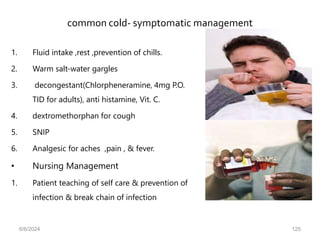
common cold- symptomatic management
1. Fluid intake ,rest ,prevention of chills.
2. Warm salt-water gargles
3. decongestant(Chlorpheneramine, 4mg P.O.
TID for adults), anti histamine, Vit. C.
4. dextromethorphan for cough
5. SNIP
6. Analgesic for aches ,pain , & fever.
• Nursing Management
1. Patient teaching of self care & prevention of
infection & break chain of infection
6/6/2024 125
Pharyngitis (sorethroat)
acute
chronic
6/6/2024 126
Acute Pharyngitis
• It is a febrile inflammation of throat ,caused by virus about
70% , uncomplicated viral infection usually subsided promptly
within 3-10 days
• It is symptom rather than a disease
Caaused by
• Common cold and flu(Viraletiology)
• Strep throat-- group A beta-hemolytic streptococcus
• Mononucleosis(Viral)
• Pseudomembranous pharyngitis
• Vesicular pharyngitis
• Ulcero-necrotic pharyngitis
• Fungal
• Allergy
• Dry indoor air
• chronic mouth breathing
• GERD
6/6/2024 127
Complications of untreated bacterial pharyngitis
Local complication
• Peritonsilar, retropharyngeal or lateral pharyngeal abscess:
General complication
• Complications due to the toxin: diphtheria
• Poststreptococcal complications: ARF, acute
glomerulonephritis.
• Signs of serious illness in children: severe dehydration,
severe difficulty swallowing, upper airway compromise,
deterioration of general condition..
6/6/2024 128
Clinical Manifestations
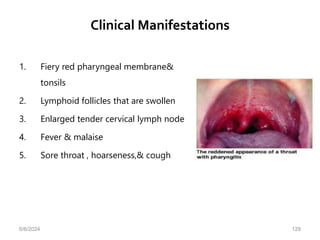
1. Fiery red pharyngeal membrane&
tonsils
2. Lymphoid follicles that are swollen
3. Enlarged tender cervical lymph node
4. Fever & malaise
5. Sore throat , hoarseness,& cough
6/6/2024 129
Assessment and Diagnostic Findings
History and physical examination
Laryngoscope
Rapid screening tests for streptococcal antigens such as the
• Latex agglutination (LA) antigen test
• solid-phase enzyme immunoassays (ELISA),
• optical immunoassay (OIA),
• streptolysin titers,
• throat cultures are used to determine the causative organism,
• Nasal swabs and blood cultures
6/6/2024 130
Medical Management
1. Supportive measures for viral infection
2. analgesic for severe sore
3. antitussive medications: Guaifenesin
4. Nutritional therapy liquid or soft diet
5. “If liquid can’t tolerated IV fluid administered “
6/6/2024 131
Antibiotics
• benzathine benzylpenicillin IM
– adults: 1.2 MIU single dose
• Penicilin V is the oral reference treatment,
– 1 g 2 times daily
• Amoxicilin is an alternative
– 1 g 2 times daily
• azithromycin PO for 3 days
– 500 mg once daily
6/6/2024 132
Nursing Management
• bed rest
• Used tissue should be disposed
• skin assessment
• mouth care
• Ice collar
• normal saline gargle
• self care teaching
6/6/2024 133
Chronic Pharyngitis
• Common in adults who work or live in dusty surrounding ,use
the voice too excess , suffer from chronic cough , & habitually
use alcohol & tobacco
• Types of pharyngitis
1. Hypertrophic :ch.ch.by general thickening& congestion of
pharyngeal mucus membrane
2. Atrophic : probably late stage of first type
3. Chronic Granular : ch.ch.by numerous swollen lymph follicles on
the pharyngeal wall
6/6/2024 134
Clinical Manifestations
1. Constant sense of irritation or fullness in throat
2. Mucus expelled by coughing
3. Difficulty in swallowing
6/6/2024 135
Medical Management
• Relieving symptoms
• Avoiding exposure to irritant
• Correct respiratory & cardiac conditions
• Nasal sprays or medications containing ephedrine sulfate
or phenylephrine hydrochloride
• Aspirin or acetaminophen is recommended for its anti-
inflammatory and analgesic properties.
6/6/2024 136
Tonsillitis and Adenoidits
• The tonsils are composed of lymphatic tissue & situated on
each side of the oropharynx ,they frequently are the site of
acute infection (tonsillitis)
• Tonsillitis occurs when the filtering function becomes
overwhelmed with a virus or bacteria and infection results
• The adenoids, a mass of lymphoid tissue located at the back
of the nasopharynx
• Tonsillitis is more common in children
6/6/2024 137
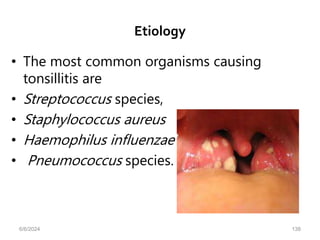
Etiology
• The most common organisms causing
tonsillitis are
• Streptococcus species,
• Staphylococcus aureus
• Haemophilus influenzae
• Pneumococcus species.
6/6/2024 138
Clinical Manifestations
• Tonsillitis :
– Swelling of the tonsils
– Redder than normal tonsils
– A white or yellow coating on the tonsils
– A slight change in the voice due to swelling
– Sore throat sometimes accompanied by ear pain
– Uncomfortable or painful swallowing
– Swollen lymph nodes (glands) in the neck
– Fever
– Bad breath
6/6/2024 139
• Adenoiditis
– Breathing through the mouth instead of the nose most of the time
– Nose sounds “blocked” when the person speaks
– Chronic runny nose
– Noisy breathing during the day
– Recurrent ear infections
– Snoring at night
– Restlessness during sleep, or pauses in breathing for a few seconds
at night
6/6/2024 140
Complications
• Otitis media
• Mastoditis
• Permanent deafness
• Management
• Antimicrobial therapy
“penicillin” for 7 days
6/6/2024 141
• History
• P/E
• RSAT
• Culture from throat
• Audiometric
examination if
complication occurs
Assessment and
Diagnostic Findings
Indications forTonsillectomy
• repeated bouts of tonsillitis;
• hypertrophy of the tonsils and adenoids that could
cause obstruction and obstructive sleep apnea;
• repeated attacks of purulent otitis media;
• suspected hearing loss due to serous otitis media
• Exacerbation of asthma or rheumatic fever.
6/6/2024 142
Nursing Management
1. Provide post op. care :V/S ,hemorrhage ,
position head turned to side,
2. water or ice chips
3. Teaching patient :S&S of hemorrhage
4. Avoid too much talking or coughing
5. Liquid or semi liquid diet for several days
6. mouth washing with warm saline
6/6/2024 143
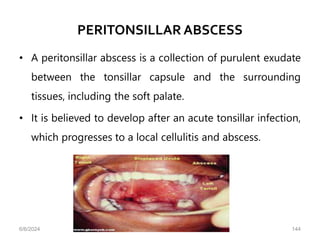
PERITONSILLAR ABSCESS
• A peritonsillar abscess is a collection of purulent exudate
between the tonsillar capsule and the surrounding
tissues, including the soft palate.
• It is believed to develop after an acute tonsillar infection,
which progresses to a local cellulitis and abscess.
6/6/2024 144
Clinical Manifestations
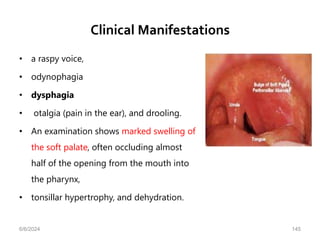
• a raspy voice,
• odynophagia
• dysphagia
• otalgia (pain in the ear), and drooling.
• An examination shows marked swelling of
the soft palate, often occluding almost
half of the opening from the mouth into
the pharynx,
• tonsillar hypertrophy, and dehydration.
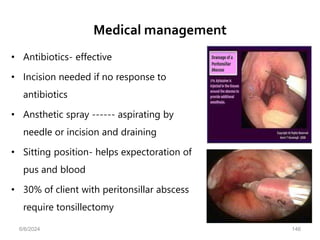
6/6/2024 145
Medical management
• Antibiotics- effective
• Incision needed if no response to
antibiotics
• Ansthetic spray ------ aspirating by
needle or incision and draining
• Sitting position- helps expectoration of
pus and blood
• 30% of client with peritonsillar abscess
require tonsillectomy
6/6/2024 146
Nursing intervention
• Encourage rest. Encourage your child to get plenty of sleep.
• Provide adequate fluids. ...
• Provide comforting foods and beverage. ...
• Prepare a saltwater gargle. ...
• Humidify the air. ...
• Avoid irritants. ...
• Treat pain and fever.
• frequent use of mouthwashes or gargles, using saline or alkaline solutions at a
temperature of 105°F to 110°F (40.6°C to 43.3°C).
• The nurse instructs the patient to gargle at intervals of 1 or 2 hours for 24 to
36 hours.
6/6/2024 147
Laryngitis
• It is an inflammation of larynx ,often occur as a
result of voice abuse or exposure to dust , chemicals
, smoke , & other pollutants
• Common in winter & easily transmitted
• The cause of infection is almost virus
Clinical Manifestations
1. Hoarseness or aphonia
2. Severe cough
6/6/2024 148
Medical Management
1. Resting voice & avoid smoking
2. Inhale cool steam or an aerosol
3. Antibiotics for bacterial organisms
Nursing Management
1. Rest voice
2. Maintain a well humidified environment
3. Daily fluid intake
6/6/2024 149
NURSING PROCESS:THE PATIENT WITH UPPER
AIRWAY INFECTION
Assessment
• Health history
– headache,
– Sore throat
– pain around the eyes and on either side of the nose,
– Difficulty in swallowing,
– cough, hoarseness, fever, stuffiness
– Generalized discomfort and fatigue.
– history of allergy
6/6/2024 150
• P/E
– swelling, lesions, or asymmetry of the nose as well as
bleeding or discharge
– increased redness, swelling, or exudate, and nasal
polyps
– Sinus tenderness
– Throat inspection
– Tracheal palpation
6/6/2024 151
NURSING DIAGNOSES
• Impaired Gas exchange related to retained secretions and
inflammation as evidenced by decrease O2 saturation
• Acute pain related to upper airway irritation secondary to an infection
• Impaired verbal communication related to physiologic changes and
upper airway irritation as evidenced by aphonia
• Deficient fluid volume related to increased fluid loss as evidenced by
tachycardia, decrease BP and poor skin turgor
• Deficient knowledge regarding prevention of upper respiratory
infections, treatment regimen, surgical procedure, or postoperative care
6/6/2024 152
COLLABORATIVE PROBLEMS/POTENTIAL COMPLICATIONS
• Sepsis
• Meningitis
• Peri-tonsillar abscess
• Otitis media
• Sinusitis
6/6/2024 153
Planning and Goals
• maintenance of a patent airway,
• relief of pain
• maintenance of effective means of communication
• normal hydration
• knowledge of how to prevent upper airway
infections
• absence of complications.
6/6/2024 154
Nursing Interventions
MAINTAINING A PATENT AIRWAY
• Increasing fluid intake
• Use of room vaporizers or steam inhalation
• Position- upright position
• Administer prescribed medication
PROMOTING COMFORT
• Analgesics
• topical anesthetic agents
6/6/2024 155
• Hot packs to relieve the congestion of sinusitis and promote
drainage
• warm water gargles or irrigations to relieve the pain of a sore
throat
• encourages rest to relieve the generalized discomfort
• general hygiene techniques to prevent the spread of infection
• ice collar may reduce swelling and decrease bleeding- post-
operative
6/6/2024 156
• PROMOTING COMMUNICATION
• The nurse instructs the patient to refrain from speaking as
much as possible and to communicate in writing instead
• ENCOURAGING FLUID INTAKE
• The nurse encourages the patient to drink 2 to 3 L of fluid
per day during the acute stage of airway infection, unless
contraindicated
6/6/2024 157
• PROMOTING HOME AND COMMUNITY-BASED CARE
• Teaching Patients Self-Care
• how to minimize the spread of infection
• avoid exposure to others at risk for serious illness
• Relieve symptoms of upper respiratory infections
• Complete the treatment regimen
6/6/2024 158
• MONITORING AND MANAGING POTENTIAL
COMPLICATIONS
• The patient and family members are instructed to
seek medical care
• if the patient’s condition fails to improve within several
days of the onset of symptoms,
• if unusual symptoms develop, or
• if the patient’s condition deteriorates.
6/6/2024 159
• Evaluation
• Expected patient outcomes may include:
1. Maintains a patent airway by managing secretions
a. Reports decreased congestion
b. Assumes best position to facilitate drainage of secretions
2. Reports feeling more comfortable
a. Uses comfort measures: analgesics, hot packs, gargles, rest
b. Demonstrates adequate oral hygiene
3. Demonstrates ability to communicate needs, wants, level of comfort
6/6/2024 160
4. Maintains adequate fluid intake
5. Identifies strategies to prevent upper airway infections and allergic reactions
a. Demonstrates hand hygiene technique
b. Identifies the value of the influenza vaccine
6. Demonstrates an adequate level of knowledge and performs self-care adequately
7. Becomes free of signs and symptoms of infection
a. Exhibits normal vital signs (temperature, pulse, respiratory rate)
b. Absence of purulent drainage
c. Free of pain in ears, sinuses, and throat
6/6/2024 161
Management of Patients
With Chest and Lower
Respiratory Tract Disorders
6/6/2024 162
• Conditions affecting the lower respiratory
tract range from acute problems to long-
term chronic disorders.
• Many of these disorders are serious and
often life-threatening.
6/6/2024 163
Atelectasis
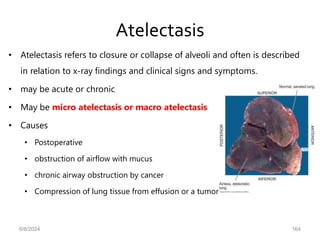
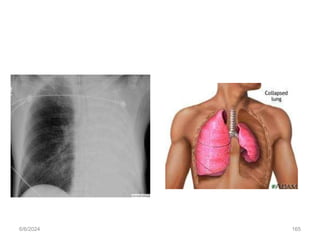
• Atelectasis refers to closure or collapse of alveoli and often is described
in relation to x-ray findings and clinical signs and symptoms.
• may be acute or chronic
• May be micro atelectasis or macro atelectasis
• Causes
• Postoperative
• obstruction of airflow with mucus
• chronic airway obstruction by cancer
• Compression of lung tissue from effusion or a tumor
6/6/2024 164
6/6/2024 165
• Pp
• Airway obstruction the trapped
alveolar air absorbed outside air
cannot replace the absorbed air
isolated portion of the lung becomes airless
alveoli collapse
6/6/2024 166
• Assessment findings
• Clinical effects vary with the causes of lung
collapse, the degree of hypoxia, and the
underlying disease
• Minimal symptoms
• Cough
• sputum production
lobar atelectasis
• marked respiratory distress
• dyspnea, tachypnea , hypoxemia hall mark of
severity
• Tachycardia , pleural pain, and central cyanosis
6/6/2024 167
• Inspection
– decreased chest wall movement, cyanosis,
diaphoresis, substernal or intercostal retractions,
and anxiety.
• Palpation
– may reveal decreased fremitus and mediastinal
shift to the affected side
6/6/2024 168
• Percussion
– may disclose dullness or flatness over lung fields.
• Auscultation
– findings may include crackles during the last part of
inspiration and decreased (or absent) breath
sounds with major lung involvement.
6/6/2024 169
• Diagnostic tests
• chest x-ray findings may reveal patchy infiltrates or
consolidated areas
• pulse oximetry (SpO2) may demonstrate a low
saturation of hemoglobin
• ABG- low partial pressure (paO2) and acidosis
• Bronchoscopy – obstructing tumor
6/6/2024 170
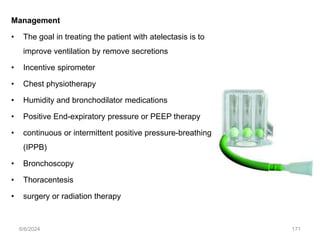
Management
• The goal in treating the patient with atelectasis is to
improve ventilation by remove secretions
• Incentive spirometer
• Chest physiotherapy
• Humidity and bronchodilator medications
• Positive End-expiratory pressure or PEEP therapy
• continuous or intermittent positive pressure-breathing
(IPPB)
• Bronchoscopy
• Thoracentesis
• surgery or radiation therapy
6/6/2024 171
Nursing diagnoses
• Acute pain
• Anxiety
• Deficient knowledge (prevention)
• Fear
• Impaired gas exchange
• Ineffective airway clearance
• Ineffective breathing pattern
• Risk for infection
6/6/2024 172
Nursing interventions
• coughing and deep-breathing exercises every 1 to 2 hours
• Splint the chest to minimize the pain
• help him walk as soon as possible.
• Administer adequate analgesics to control pain.
• Monitor mechanical ventilation. Maintain tidal volume at 10 to 15
ml/kg of the patient's body weight to ensure adequate lung
expansion
6/6/2024 173
• Monitor pulse oximetry for decreases in oxygenation.
• Help the patient use an incentive spirometer to encourage
deep breathing
• Humidify inspired air, and encourage adequate fluid intake
to mobilize secretions.
• Use postural drainage and chest percussion to remove
secretions
• For the intubated or uncooperative patient, provide
suctioning
• Assess breath sounds and respiratory status frequently.
Report changes immediately
6/6/2024 174
• Prevention
• frequent turning,
• early mobilization
• Deep-breathing maneuvers (at least every 2
hours)
• Secretion management techniques may include
directed cough, suctioning, aerosol nebulizer
treatments followed by chest physical therapy
6/6/2024 175
6/6/2024 176
ACUTETRACHEOBRONCHITIS
• an acute inflammation of the mucous membranes of the
trachea and the bronchial tree, often follows infection of
the upper respiratory tract.
• Etiology
• A patient with a viral infection has decreased resistance
and can readily develop a secondary bacterial infection.
• inhalation of physical and chemical irritants, gases, and
other air contaminants
6/6/2024 177
• Mos
• Streptococcus pneumoniae
• Haemophilus influenzae
• Mycoplasma pneumoniae.
• Aspergillus fumigatus
6/6/2024 178
• Pp
• Chemicals, mos irritation of mucosa
mucopurulent sputum
6/6/2024 179
Clinical Manifestations
• Initially, the patient has a dry, irritating cough and expectorates a
scanty amount of mucoid sputum
• The patient complains of sternal soreness from coughing and has
fever or chills and night sweats, headache, and general malaise.
As the infection progresses,
• the patient may be short of breath, have noisy inspiration and
expiration (inspiratory stridor and expiratory wheeze), and produce
purulent sputum
• With severe tracheobronchitis, blood-streaked secretions may be
expectorated
6/6/2024 180
• Medical Management
• Antibiotic treatment
• Expectorants may be prescribed-Guaifenesin, 200- 400 mg
P.O. QID-
• Fluid intake is increased
• Suctioning and bronchoscopy may be needed to remove
secretions.
• Rarely, endotracheal intubation– ARF
• Dextromethorphan hydrobromide, 15 – 30 mg P.O. TID to
QID for adults.
6/6/2024 181
PNEUMONIA
• Pneumonia is an inflammation of the lung parenchyma that
is caused by a microbial agent.
• “Pneumonitis” is a more general term that describes an
inflammatory process in the lung tissue that may predispose
a patient to or place a patient at risk for microbial invasion.
6/6/2024 183
• Pneumonia was described
2,500 years ago by
Hippocrates
• Dr. William Osler described
pneumonia the “captain of the
men of death”
• Before the advent of
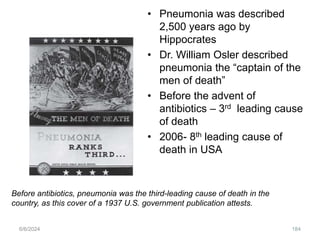
antibiotics – 3rd leading cause
of death
• 2006- 8th leading cause of
death in USA
6/6/2024 184
Before antibiotics, pneumonia was the third-leading cause of death in the
country, as this cover of a 1937 U.S. government publication attests.
• Classification
• Bacterial/Typical
• Atypical
• anaerobic/cavitary
• opportunistic
• A more widely used classification scheme
• community-acquired pneumonia
• Hospital acquired pneumonia
• pneumonia in the immuno-compromised host
• aspiration pneumonia
6/6/2024 185
• Community-acquired pneumonia (CAP) occurs either
in the community setting or within the first 48 hours of
hospitalization or institutionalization.
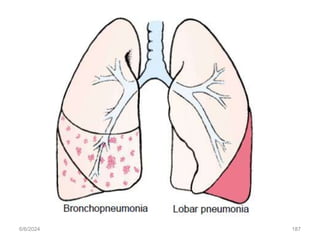
• Pneumonia caused by S. pneumoniae
(pneumococcus)
• most common CAP in people younger than 60 without
comorbidity and in those older than 60 with
comorbidity
• may occur as a lobar or bronchopneumonic form
6/6/2024 186
6/6/2024 187
• Mycoplasma pneumonia, another type of CAP, occurs most
often in older children and young adults
• spread by infected respiratory droplets.
• The inflammatory infiltrate is primarily interstitial rather than
alveolar
• has the characteristics of a bronchopneumonia.
6/6/2024 188
• H. influenzae is another cause of CAP.
• It frequently affects elderly people or those with comorbid
illnesses (eg, chronic obstructive pulmonary disease
[COPD], alcoholism, diabetes mellitus).
• Chest x-rays may reveal multilobar, patchy
bronchopneumonia or areas of consolidation
6/6/2024 189
• Viruses are the most common cause of
pneumonia in infants and children but are
relatively uncommon causes of CAP in adults.
6/6/2024 190
immunocompetent
• influenza viruses types A and
B,
• adenovirus,
• parainfluenza virus,
• coronavirus,
• varicella-zoster virus.
immunocompromised
• cytomegalovirus
• herpes simplex virus,
• adenovirus,
• respiratory syncytial virus.
6/6/2024 191
• Hospital-acquired pneumonia (HAP), also known as
nosocomial pneumonia, is defined as the onset of
pneumonia symptoms more than 48 hours after admission
to the hospital.
• Ventilator-associated pneumonia- endotracheal intubation
and mechanical ventilation.
6/6/2024 192
• The common organisms responsible for
HAP include
• Enterobacter species
• Escherichia coli
• Klebsiella species,
• Serratia marcescens
• P. aeruginosa
• methicillin-sensitive or methicillin-resistant
Staphylococcus aureus
6/6/2024 193
• HAP occurs
• Host defenses are impaired
• an inoculum of organisms reaches the
patient’s lower respiratory tract and
overwhelms the host’s defenses,
• a highly virulent organism is present.
6/6/2024 194
• Pneumonia in the immunocompromised host
• Pneumocystis carinii pneumonia (PCP)
• fungal pneumonias
• Mycobacterium tuberculosis
• Immunocompromization may be due to
• Drugs- corticosteroids, chemotherapy,
• nutritional depletion,
• AIDS, genetic immune disorders
• mechanical ventilation
6/6/2024 195
• Aspiration pneumonia results from the entry of endogenous or exogenous
substances into the lower airway.
• aspiration of bacteria that normally reside in the upper airways.
• Aspiration pneumonia may occur in the community or hospital setting;
• common pathogens
– S. pneumoniae,
– H. influenzae
– S. aureus.
• Other substances may be aspirated into the lung, such as gastric contents,
exogenous chemical contents, or irritating gases.
• This type of aspiration or ingestion may impair the lung defenses, cause
inflammatory changes, and lead to bacterial growth and a resulting pneumonia.
6/6/2024 196
• Pathophysiology
• Lower airway is normally sterile
• Mos access the lung through-
• Inhalation of virulent mos
• Aspiration of upper airway flora
• Hematogeniuos spread
• Extension from nearby structure
6/6/2024 197
• Pneumonia often affects both ventilation and
diffusion.
• Alveoli occupied with
• Inflammatory exudate
• WBC-mostly neutrophils
• Bronchospasm and secretion- reduce entry of air
• This leads to ventilation- perfusion mismatch
6/6/2024 198
Risk factors
• Alcoholism
• Asthma
• Immunosuppresion
• Institutinalization
• Age >=70
6/6/2024 199
• Clinical Manifestations
• Sudden onset of shaking chills
• Cough
• Rapidly increase in body temperature 38.5-40.5 C
• Pleuratic Chest pain increased by deep breathing
• Patient looks severely ill with marked tachypnea
• Shortness of breath
• Orthopnea
• Poor appetite
• Diaphoresis &tires easily
• Purulent sputum
6/6/2024 200
• Assessment and Diagnostic Findings
• history
• physical examination
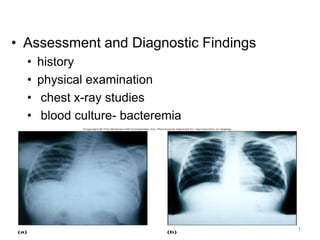
• chest x-ray studies
• blood culture- bacteremia
6/6/2024 201
• Medical Management
• Appropriate antibiotics depend on culture result
• Hydration (increase fluid intake )
• Antipyretic for fever Super infection & Headache
• Warm moist inhalation to relieve irritation
• Oxygen & respiratory supportive measures
• Complications : Shock & respiratory failure ,
• Atelectasis & plural effusion
6/6/2024 202
6/6/2024 203
CURB-65
 C-Confusion=1point
 U-Uremia: BUN >19mg/dL=1point
 R-RR >30/min= 1point
 BP <90/60=1point
 Age >=65=1point
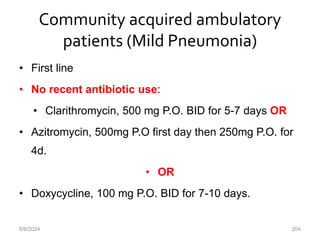
Community acquired ambulatory
patients (Mild Pneumonia)
• First line
• No recent antibiotic use:
• Clarithromycin, 500 mg P.O. BID for 5-7 days OR
• Azitromycin, 500mg P.O first day then 250mg P.O. for
4d.
• OR
• Doxycycline, 100 mg P.O. BID for 7-10 days.
6/6/2024 204
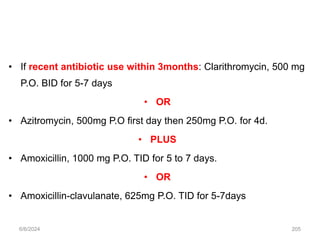
• If recent antibiotic use within 3months: Clarithromycin, 500 mg
P.O. BID for 5-7 days
• OR
• Azitromycin, 500mg P.O first day then 250mg P.O. for 4d.
• PLUS
• Amoxicillin, 1000 mg P.O. TID for 5 to 7 days.
• OR
• Amoxicillin-clavulanate, 625mg P.O. TID for 5-7days
6/6/2024 205
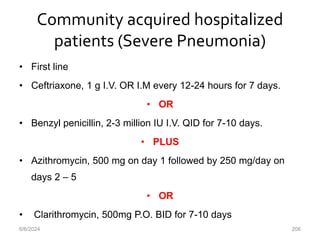
Community acquired hospitalized
patients (Severe Pneumonia)
• First line
• Ceftriaxone, 1 g I.V. OR I.M every 12-24 hours for 7 days.
• OR
• Benzyl penicillin, 2-3 million IU I.V. QID for 7-10 days.
• PLUS
• Azithromycin, 500 mg on day 1 followed by 250 mg/day on
days 2 – 5
• OR
• Clarithromycin, 500mg P.O. BID for 7-10 days
6/6/2024 206
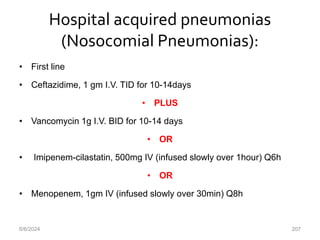
Hospital acquired pneumonias
(Nosocomial Pneumonias):
• First line
• Ceftazidime, 1 gm I.V. TID for 10-14days
• PLUS
• Vancomycin 1g I.V. BID for 10-14 days
• OR
• Imipenem-cilastatin, 500mg IV (infused slowly over 1hour) Q6h
• OR
• Menopenem, 1gm IV (infused slowly over 30min) Q8h
6/6/2024 207
• Alternatives
• Ceftriaxone, 1-2 gI.V. OR I.M. BID for 7 days.
• PLUS
• Gentamicin, 3-5 mg/kg I.V. QDdaily in divided doses for 7 days.
• OR
• Ciprofloxacin, 500 mg P.O./ I.V. BID for 7 days.
• If methicillin-resistant (MRSA) suspected
• Vancomycin, 1 g I.V. BID should be added to the existing emperic regimen
6/6/2024 208
• Nursing diagnoses
• Acute pain
• Anxiety
• Hyperthermia
• Imbalanced nutrition: Less than body requirements
• Impaired gas exchange
• Ineffective airway clearance
• Ineffective coping
• Risk for deficient fluid volume
• Risk for infection
6/6/2024 209
Nursing interventions
• Maintain a patent airway and adequate oxygenation
• Obtain sputum specimens as needed
• Administer antibiotics as ordered and pain medication as
needed
• Provide a high-calorie, high-protein diet
• To prevent aspiration during nasogastric tube feedings, elevate
the patient's head, check the tube position, and administer the
feeding slowly
• Monitor the patient's fluid intake and output
6/6/2024 210
• To control the spread of infection, dispose
of secretions properly
• Provide a quiet, calm environment, with
frequent rest periods
6/6/2024 211
Pleural Conditions
6/6/2024 212
are disorders that involve the visceral pleura, parietal pleura
and pleural space.
PLEURISY
Pathophysiology
Pleurisy (pleuritis) refers to inflammation of both layers of the pleurae
(parietal and visceral).
Pleurisy may develop in conjunction
• Infection(pneumonia or URTI, TB,)or
• collagen disease;
• trauma to the chest,
• pulmonary infarction,
• pulmonary embolism
• primary and metastatic cancer
• after thoracotomy.
6/6/2024 213
Clinical Manifestations
The pleuritic pain – parietal pleura
Pain characterstics
 Taking a deep breath, coughing, or sneezing worsens the pain
 restricted in distribution rather than diffuse; usually occurs only on one
side
 become minimal or absent when the breath is held
 as pleural fluid develops, the pain decreases.
Assessment and Diagnostic Findings
a pleural friction rub can be heard with the stethoscope
friction rub disappear later as more fluid accumulates
Diagnostic tests may include chest x-rays, sputum
examinations, thoracentesis to obtain a specimen of
pleural fluid for examination, and less commonly a pleural
biopsy.
6/6/2024 214
Medical Management
 discover the underlying condition causing the pleurisy and
to relieve the pain.
monitor for signs and symptoms of pleural effusion
 analgesics provide symptomatic relief.
 intercostal nerve block may be required.
Nursing Management
Pain management
Splinting when coughing
.
6/6/2024 215
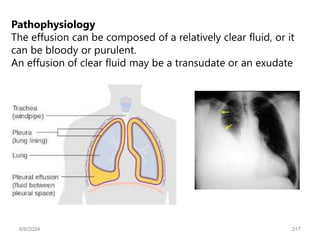
PLEURAL EFFUSION
Pleural effusion, a collection of fluid in the pleural space, is rarely a
primary disease process but is usually secondary to other diseases.
Normally, (5 to 15 mL), which acts as a lubricant
Pleural effusion Cause
• heart failure, TB, pneumonia, pulmonary infections (particularly
viral infections),
• nephrotic syndrome, connective tissue disease, pulmonary
embolism, and neoplastic tumors.
• Bronchogenic carcinoma is the most common malignancy
associated with a pleural effusion.
6/6/2024 216
Pathophysiology
The effusion can be composed of a relatively clear fluid, or it
can be bloody or purulent.
An effusion of clear fluid may be a transudate or an exudate
6/6/2024 217
Clinical Manifestations
 Severity
 The size of the effusion and
 the patient’s underlying lung disease
 the time course of the development
 A large : shortness of breath.
 When a small to moderate :dyspnea may be absent or only
minimal.
6/6/2024 218
Assessment and Diagnostic Findings
 decreased or absent breath sounds, decreased fremitus, and a dull, flat
sound when percussed.
 In an extremely large pleural effusion, acute respiratory distress.
 Tracheal deviation away from the affected side may also be noted.
 chest x-ray, chest CT scan, and thoracentesis confirm the presence of fluid
 Pleural fluid is analyzed by
 bacterial culture, Gram stain, acid fast bacillus stain (for TB), red and
white blood cell counts, chemistry studies (glucose, amylase, lactic
dehydrogenase, protein), cytologic analysis for malignant cells, and pH.
A pleural biopsy also may be performed.
6/6/2024 219
Medical Management
 The objectives
• discover the underlying cause,
• prevent reaccumulation of fluid,
• to relieve discomfort, dyspnea, and respiratory compromise.
 Thoracentesis
 chemical pleurodesis
 Surgical pleurectomy,
 insertion of a small catheter attached to a drainage bottle for outpatient
management, or
 implantation of a pleuroperitoneal shunt
6/6/2024 220
Nursing Management
The nurse’s role in the care of the patient with a pleural effusion includes implementing
the medical regimen.
 The nurse prepares and positions the patient for thoracentesis and offers support
throughout the procedure.
 Pain management is a priority, and the nurse assists the patient to assume
positions that are the least painful.
 However, frequent turning and ambulation are important to facilitate drainage.
 If a chest tube drainage and water-seal system is used, the nurse is responsible for
monitoring the system’s function and recording the amount of drainage at
prescribed intervals.
 If the patient is to be managed as an outpatient with a pleural catheter for drainage,
the nurse is responsible for educating the patient and family regarding
management and care of the catheter and drainage system.
6/6/2024 221
EMPYEMA
An empyema is an accumulation of thick, purulent fluid
within the pleural space, often with fibrin development and a
loculated (walled-off) area where infection is located.
Most empyemas occur as complications of bacterial
pneumonia or lung abscess. Other causes include penetrating
chest trauma, hematogenous infection of the pleural space,
nonbacterial infections, or iatrogenic causes (after thoracic
surgery or thoracentesis).
Pathophysiology
At first the pleural fluid is thin, with a low leukocyte count, but it
frequently progresses to a fibropurulent stage and, finally, to a
stage where it encloses the lung within a thick exudative
membrane (loculated empyema).
6/6/2024 222
Clinical Manifestations
 With an empyema, the patient is acutely ill and has signs and symptoms
similar to those of an acute respiratory infection or pneumonia (fever,
night sweats, pleural pain, cough, dyspnea, anorexia, weight loss).
 If the patient is immuno-compromised, the symptoms may be more
vague.
 If the patient has received antimicrobial therapy, the clinical manifestations
may be less obvious.
Assessment and Diagnostic Findings
decreased or absent breath sounds over the affected area, and there is
dullness on chest percussion as well as decreased fremitus.
The diagnosis is established by a chest x-ray or chest CT scan.
Usually a diagnostic thoracentesis is performed, often under ultrasound
guidance.
6/6/2024 223
Medical Management
The objectives of treatment are to drain the pleural cavity and to achieve full
expansion of the lung. The fluid is drained and appropriate antibiotics, in large doses,
are prescribed based on the causative organism.
Sterilization of the empyema cavity requires 4 to 6 weeks of antibiotics.
Drainage of the pleural fluid depends on the stage of the disease and is accomplished
by one of the following methods:
• Needle aspiration (thoracentesis) with a thin percutaneous catheter, if the
volume is small and the fluid not too purulent or thick
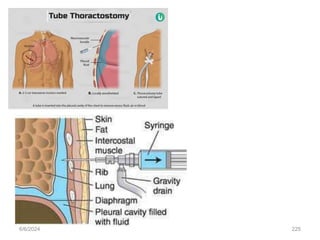
• Tube thoracostomy (chest drainage using a large-diameter intercostal tube
attached to water-seal drainage with fibrinolytic agents instilled through the
chest tube in patients with loculated or complicated pleural effusions
• Open chest drainage via thoracotomy, including potential rib resection, to
remove the thickened pleura, pus, and debris and to remove the underlying
diseased pulmonary tissue
6/6/2024 224
6/6/2024 225
Nursing Management
 The nurse helps the patient cope with the condition and instructs the
patient in lung-expanding breathing exercises to restore normal
respiratory function.
 The nurse also provides care specific to the method of drainage of the
pleural fluid (eg, needle aspiration, closed chest drainage, or rib resection
and drainage).
 When a patient is discharged to home with a drainage tube or system in
place, the nurse instructs the patient and family on care of the drainage
system and drain site, measurement and observation of drainage, signs
and symptoms of infection, and how and when to contact the health care
provider
6/6/2024 226
Pulmonary Edema
Pulmonary edema is defined as abnormal accumulation of fluid in the lung
tissue and/or alveolar space. It is a severe, life threatening condition.
Pathophysiology
 occurs as a result of increased microvascular pressure from abnormal
cardiac function.
 left ventricular dysfunction
 hypervolemia or a sudden increase in the intravascular pressure in the
lung. example pneumonectomy.
 “flash” pulmonary edema.(post op , fluid overload)
 re-expansion pulmonary edema. Sudden expansion of lung
6/6/2024 227
Assessment and Diagnostic Findings
 crackles in the lung bases (especially in the posterior bases) that rapidly
progress toward the apices of the lungs.
 The chest x-ray reveals increased interstitial markings.
 The patient may be tachycardic, the pulse oximetry values begin to fall,
and arterial blood gas analysis demonstrates increasing hypoxemia.
Clinical Manifestations
 The patient has increasing respiratory distress, characterized by dyspnea, air hunger,
and central cyanosis.
 The patient is usually very anxious and often agitated.
 foamy, frothy, and often blood-tinged secretions.
 The patient has acute respiratory distress and may become confused or stuporous.
6/6/2024 228
Nursing Management
 Positioning the patient to promote circulation
 Providing psychological support
 Monitoring medications
Medical Management
 Management focuses on correcting the underlying disorder.
 Vasodilators, inotropic medications, afterload or preload agents
 diuretics
 Oxygen is administered to correct the hypoxemia; in some circumstances,
intubation and mechanical ventilation are necessary.
 The patient is extremely anxious, and morphine is administered to reduce anxiety
and control pain.
6/6/2024 229
Acute Respiratory Failure
Respiratory failure is a sudden and life-threatening deterioration of the gas exchange function of
the lung.
• exchange of oxygen for carbon dioxide in the lungs cannot keep up with the rate of oxygen
consumption and carbon dioxide production by the cells of the body.
• Acute respiratory failure (ARF) is defined as a fall in arterial oxygen tension (PaO2) to less
than 50 mm Hg (hypoxemia) and a rise in arterial carbon dioxide tension (PaCO2) to greater
than 50 mm Hg (hypercapnia), with an arterial pH of less than 7.35.
In ARF, the ventilation or perfusion mechanisms in the lung are impaired. Respiratory system
mechanisms leading to ARF include:
• Alveolar hypoventilation
• Diffusion abnormalities
• Ventilation–perfusion mismatching
6/6/2024 230
6/6/2024 231
Pathophysiology
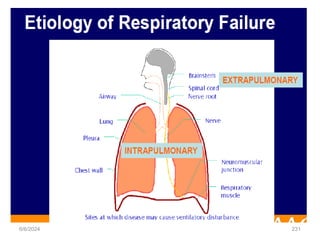
Common causes of ARF can be classified into four categories
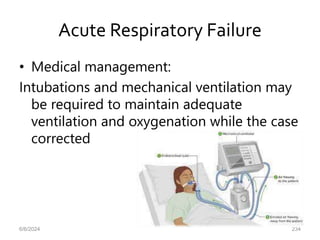
 DECREASED RESPIRATORY DRIVE: severe brain injury, large lesions of the brain
stem use of sedative medications, and metabolic disorders such as
hypothyroidism.
 DYSFUNCTION OF THE CHEST WALL: any disease or disorder
of the nerves, spinal cord, muscles, or neuromuscular junction
 DYSFUNCTION OF LUNG PARENCHYMA: Pleural effusion, hemothorax,
pneumothorax, and upper airway obstruction are conditions that interfere with
ventilation by preventing expansion of the lung.
OTHER CAUSES
postoperative period, especially after major thoracic or abdominal surgery
6/6/2024 232
Acute Respiratory Failure
• Clinical Manifestations
1. Impaired oxygenation & may be include
restlessness
2. Fatigue & headache
3. Dyspnea & air hunger
4. Tachycardia &hypertension
5. Confusion & lethargy
6. Diaphoresis …… Respiratory Arrest
7. Uses of accessory muscles
6/6/2024 233
Acute Respiratory Failure
• Medical management:
Intubations and mechanical ventilation may
be required to maintain adequate
ventilation and oxygenation while the case
corrected
6/6/2024 234
Acute Respiratory Failure
• Nursing management:
1. Monitoring patient responses and arterial
blood gases
2. Monitoring vital sign
3. turning ,mouth care , skin care , and range
of motion .
4. Teaching about the underlying disorders
5. Assists in intubations procedure
6/6/2024 235
Pulmonary Embolism
• Obstruction of a pulmonary artery by a blood borne substance.
• Deep vein thrombosis is a common cause of pulmonary
embolism.
• Other types (Air , Fat , Septic )
• Clinical Manifestations
1. Dyspnea & Tachypnea
2. Sudden & pluretic chest pain
3. Fever & cough & hemoptesis
4. Apprehension Diaphoresis & syncope
6/6/2024 236
6/6/2024 237
Pulmonary Embolism
• Medical Management
1. Emergency Management
i. Nasal O2
ii. IV line for Medication
iii. ABGs &ECG
iv. Small dose of Morphine
v. Intubation & mechanical Ventilation
6/6/2024 238
Pulmonary Embolism
Pharmacologic Management
i. Anticoagulant therapy heparin 5000-10000
bolus then 18u/kg/hrs warfarin for three
months (2-5mg)
ii. Thrombolytic therapy (Streptokinase IV 250,000
units over 30 min, then 100,000 units/hfor 24–72
h)
iii. Surgical Management (Surgical Embolectomy)
6/6/2024 239
Pulmonary Embolism
• Nursing Management
1. Preventing thrombus formation
2. Monitoring thrombolytic therapy
3. Providing post operative nursing care
4. Managing O2 therapy
5. Preventing anxiety
6. Monitor for complications
6/6/2024 240
Pneumothorax/Hemothorax
• Traumatic disorders of the respiratory
tract wherein the underlying lung tissue
is compressed and eventually collapses.
• Types
1. Simple Pnuemothrax
2. Traumatic Pnuemothorax
3. Tension
6/6/2024 241
Pneumothorax/Hemothorax
• Clinical Manifestations
1. Sudden pluretic pain
2. Anxious patient , dyspnea & air hunger
3. Increase use of accessory muscles
4. Central cyanosis
5. Tympanic sound in percussion
6. Absent of breath sound & tactile fremetus
7. Agitation Diaphoresis & hypotension
6/6/2024 242
Pneumothorax/Hemothorax
• Medical Management
1. High concentration supplemental O2
2. Chest tube for drainage
3. In emergency anything may be use to fill the
chest wound
4. Heavy dressing
5. Needle aspiration thoracenthesis
6. Connecting chest tube to water seal drainage
7. An emergency thoractomy may also performed
6/6/2024 243
Pulmonary Heart Disease (Cor Pulmonale)
Cor pulmonale is a condition in which the right ventricle of the heart enlarges (with
or without right-sided heart failure) as a result of diseases that affect the structure or
function of the lung or its vasculature.
causes
 Any disease affecting the lungs and accompanied by hypoxemia may result in cor
pulmonale.
 The most frequent cause is severe COPD
 conditions that restrict or compromise ventilatory function, leading to hypoxemia
or acidosis (deformities of the thoracic cage, massive obesity)
 conditions that reduce the pulmonary vascular bed (primary idiopathic pulmonary
arterial hypertension, pulmonary embolus).
 Certain disorders of the nervous system, respiratory muscles, chest wall, and
pulmonary arterial tree also may be responsible for cor pulmonale.
6/6/2024 244
Clinical Manifestations
With right ventricular failure, the patient may develop increasing
edema of the feet and legs
 distended neck veins
an enlarged palpable liver
pleural effusion, ascites
 a heart murmur.
Headache, confusion, and somnolence (hypercapnia).
Patients often complain of increasing shortness of breath,
wheezing, cough, and fatigue.
6/6/2024 246
Medical Management
The objectives of treatment are
to improve the patient’s ventilation
 to treat both the underlying lung disease and the
manifestations of heart disease.
Supplemental oxygen is administered to improve
gas exchange and to reduce pulmonary arterial
pressure and pulmonary vascular resistance.
6/6/2024 247
6/6/2024 248
• Periodic assessment of pulse oximetry and arterial blood
gases is necessary to determine the adequacy of alveolar
ventilation and to monitor the effectiveness of oxygen
therapy.
• Ventilation is further improved with chest physical therapy
and bronchial hygiene maneuvers
• the administration of bronchodilators.
 If the patient is in respiratory failure, endotracheal intubation and
mechanical ventilation may be necessary.
 Bed rest, sodium restriction, and diuretic therapy
 Digitalis may be prescribed to relieve pulmonary hypertension if the
patient also has left ventricular failure, a supraventricular dysrhythmia, or
right ventricular failure that does not respond to other therapy.
 ECG monitoring may be indicated
 Any pulmonary infection must be treated promptly
 The prognosis depends on whether the pulmonary hypertension is
reversible.
6/6/2024 249
Nursing Management
 If intubation and mechanical ventilation are required to manage ARF, the
nurse assists with the intubation procedure and maintains mechanical
ventilation.
 The nurse assesses the patient’s respiratory and cardiac status and
administers medications as prescribed.
 During the patient’s hospital stay, the nurse instructs the patient about the
importance of close monitoring (fluid retention, weight gain, edema) and
adherence to the therapeutic regimen, especially the 24-hour use of
oxygen.
6/6/2024 250
chronic lung disease
ASTHMA
6/6/2024 251
Objectives
– Identify signs and symptoms consistent with
asthma
– Differentiate the various severities of asthma
– Summarize an appropriate treatment regimen
for asthma of various severities
6/6/2024 252
Bronchial asthma
• It is recurrent air way disease affecting bronchus with
bronchoconstriction
• Asthma is a chronic inflammatory disease of the airways that
causes airway hyperresponsiveness, mucosal edema, and
mucus production.
• It Is due to hyperesponsiviness of airways and also airways flow
limitations, and fundamentally inflammatory disorder.
6/6/2024 253
Definition of Asthma
• Chronic inflammatory disorder of the airways in which many cells and
cellular elements play a role.
• In susceptible individuals, this inflammation causes recurrent episodes of
wheezing, breathlessness, chest tightness, and coughing, particularly
at night or in the early morning.
• These episodes are associated with widespread but variable airflow
obstruction that is reversible either spontaneously, or with treatment.
• Patients with asthma may experience symptom-free periods alternating
with acute exacerbations, which last from minutes to hours or days
6/6/2024 254
Causes of asthma
1. Irritants such as:
– Tobacco smoke
– Exercise*
– Exposure to work-related agents or indoor chemicals; and
– Outdoor pollutants
* Despite its potential to be a trigger, with a proper warm up, people
with exercise-induced asthma should be able to engage in physical
activity
6/6/2024 255
2. Allergens such as
– Pollen
– Moulds
– Dust mites
– Pet dander
– Foods or food additives and
– Cockroach allergen
6/6/2024 256
Other factors that can trigger or worsen asthma severity:
– Upper respiratory infections
– Rhinitis/Sinusitis
– Gastroesophageal reflux
– Sensitivity to aspirin and other NSAIDS and
– Topical and systemic beta-blockers
6/6/2024 257
Risk factors for developing asthma
• Family history of allergy and allergic disorders (including
hay fever, asthma and eczema)
• High exposure of susceptible children to airborne
allergens in the first years of life
6/6/2024 258
• Exposure to tobacco smoke, including
inutero exposure
• Frequent respiratory infections early in life
• Low birth weight and respiratory distress
syndrome
6/6/2024 259
Prevalence of Asthma
6/6/2024 260
6/6/2024 261
Global Asthma Prevalence
• Approximately 262 million people worldwide currently
have asthma
• Asthma death 455000 by the end of 2019
• Studies have shown that asthma is more prevalent in
urban areas than in less polluted areas
6/6/2024 262
• Asthma is the leading chronic disease of children
in industrialized countries
• It is estimated that asthma accounts for about one
in every 250 deaths worldwide
6/6/2024 263
CF and severity of asthma
Mild to moderate severe Respiratory failure
Speaking speaks sentences Words Can't speak
Mental status Conscious Agitated confused
RR <30/min >30/min >30
PR <120/min >120/min,pale PR or BP Low
Accessory
muscles
None Retractions,pale,
sweat
Paradoxic,
cyanoses
Wheezes during exhalation Very strong Absent,no air
movement
6/6/2024 264
6/6/2024 265
6/6/2024 266
6/6/2024 267
6/6/2024 268
6/6/2024 269
6/6/2024 270
6/6/2024 271
6/6/2024 272
6/6/2024 273
6/6/2024 274
ii. Intermittent asthma
First line
• Salbutamol, inhaler 200 microgram/puff, 2 puffs to be taken
as needed but not more than 3-4 times a day, or tablet, 2-
4mg 3-4 times a day
6/6/2024 275
6/6/2024 276
iv. Persistent moderate asthma:
Salbutamol, inhalation 200/puff as needed PRN not more than 3-4 times a day. PLUS
(Inhaled corticosteroid) Beclomethasone, oral inhalation 200 mcg, bid. Decrease the dose
to 100mcg, BID if symptoms are controlled after three months.
OR(Preferred if symptoms are mor severe or if response is not optimal to
Beclomethasone) Fluticasone/Salmeterol, 250/50 mcg oral inahalation, BID
PLUS ( if required) Ephedrine + Theophylline, 11mg + 120mg P.O. BID OR TID
v. Severe persistent asthma:
Prednisolone, 5-10 mg P.O. QOD. Doses of 20-40 mg daily for seven days may be needed
for short-term exacerbations in patients not responding to the above treatment.
6/6/2024 277
Chronic Obstructive Pulmonary
Disease
6/6/2024 278
Chronic Obstructive Pulmonary Disease
• COPD is “a preventable and treatable disease with some
significant extrapulmonary effects that may contribute
to the severity in individual patients.
• Its pulmonary component is characterized by airflow
limitation that is not fully reversible.
• The air flow limitation is usually progressive and
associated with an abnormal inflammatory response of
the lung to noxious particles or gases.” GOLD
6/6/2024 279
Chronic Obstructive Pulmonary Disease cont….
6/6/2024 280
Chronic Obstructive Pulmonary
Disease cont.….
• Pathophysiology
– Noxious particles or gases
– abnormal inflammatory response .
– The inflammatory response occurs throughout the airways, parenchyma,
and pulmonary vasculature .
– narrowing occurs in the small peripheral airways.
– Over time, this injury-and-repair process causes scar tissue formation
and narrowing of the airway lumen.
– Airflow obstruction may also be due to parenchymal destruction as seen
with emphysema, a disease of the alveoli or gas exchange units.
6/6/2024 281
Chronic Obstructive Pulmonary
Disease cont.….
• When activated by chronic inflammation,
proteinases and other substances may be
released, damaging the parenchyma of the
lung.
6/6/2024 282
Chronic Bronchitis
• Chronic bronchitis, a disease of the airways, is defined as the presence of
cough and sputum production for at least 3 months in each of 2
consecutive years.
• Characteristics
• Chronic irritation
• Increased goblet cells
• Narrowed airway
• Decreased function of macrophages
• Increased mucus secretion
• Ciliary function reduced
• Increased susceptibility to infection
6/6/2024 283
Emphysema
• In emphysema, impaired gas exchange (oxygen, carbon
dioxide) results from destruction of the walls of over
distended alveoli.
• “Emphysema” is a pathological term that describes an
abnormal distention of the air spaces beyond the
terminal bronchioles, with destruction of the walls of the
alveoli.
• It is the end stage of a process that has progressed
slowly for many years
6/6/2024 284
6/6/2024 285
• Characteristics of Emphysema
– Destroyed alveolar wall
– Decreased pulmonary capillary contact with alveolar wall
– Increased dead space
– Impaired O2 diffusion(hypoxemia) and CO2
elimination(hypercapnia)
– More blood remain in the pulmonary arteries and the right
ventricle
– Cor-pulmonale
6/6/2024 286
• Two types of emphysema
• Panlobar(panacilar)
– there is destruction of the respiratory bronchiole,
alveolar duct, and alveoli.
– All air spaces within the lobule are essentially enlarged
– barrel chest
– marked dyspnea on exertion, and weight loss
– The chest becomes rigid
6/6/2024 287
• Centrilobular (centriacinar)
– pathologic changes take place mainly in the center of the
secondary lobule
– Preserving the peripheral portions of the acinus
– derangement of ventilation–perfusion ratios
– hypoxemia, hypercapnia
– right-sided heart failure
– central cyanosis, peripheral edema, and respiratory failure
6/6/2024 288
6/6/2024 289
Risk factors
• Exposure to tobacco smoke accounts for an estimated 80% to
90% of COPD cases
• Passive smoking
• Occupational exposure
• Ambient air pollution
• Genetic abnormalities, including a deficiency of alpha1-
antitrypsin, an enzyme inhibitor that normally counteracts the
destruction of lung tissue by certain other enzymes
6/6/2024 290
Clinical Manifestations
• three primary symptoms:
• Cough
• sputum Production
• dyspnea on exertion
o Weight loss
o barrel chest
6/6/2024 291
Assessment and Diagnostic Findings
• Spirometry is used to evaluate airflow
obstruction
• Obstructive lung disease is defined as a
FEV1/FVC ratio of less than 70%.
• Arterial blood gas measurements
• alpha1 antitrypsin deficiency
6/6/2024 292
6/6/2024 293
6/6/2024 294
6/6/2024 295
Step up the treatment based on the severity of COPD
I. Mild COPD Rapid-acting bronchodilator when needed
II. Moderate COPD Add regular treatment with one or more long-acting
bronchodilators Add pulmonary rehabilitation (including exercise training
)
III. Severe COPD Add medium- to high-dose inhaled steroids
IV. Very severe COPD- - Long-term oxygen if chronic respiratory failure
- Consider surgical referral
6/6/2024 296
1. Inhaled ß2 agonist – Salbutamol, MDI, 200 mcg 6 hourly as needed
using a spacer. PLUS
2. Inhaled corticosteroids and long acting inhaled beta -2 agonist
Beclomethasone, oral inhalation 200 mcg, bid. Decrease the dose to
100mcg, BID if symptoms are controlled after three months. OR
(Preferred if symptoms are more severe or if response is not optimal to
Beclomethasone ) Fluticasone/Salmeterol, 250/50 mcg oral inhalation,
BID Dosage forms: PLUS
3. Theophedrine (Ephedrine + Theophylline), P.O, 131 mg 12 hourly.
Doasage forms - Tablet, 11mg + 120mg PLUS
4. Long term home O 2 (>15 hrs per day) - For patients with resting
hypoxemia with signs of pulmonary hypertension or right heart
failure, the use of O2 has been demonstrated to have a significant impact
on mortality rate.
6/6/2024 297
Management of Acute exacerbation
1. Oxygen- via nasal cannula or facemask for hypoxic patients to keep O2
saturation above 90% PLUS
2. Short-acting beta2 agonists Salbutamol, MDI, 200 mcg 6 hourly as needed using
a spacer PLUS
3. Corticosteroids Prednisolone, 30- 40mg/day or its equivalent for7-14 .
PLUS
4. Antibiotic therapy- in patients with a moderate to severe COPD exacerbation
(increased dyspnea, increased sputum volume, or increased sputum purulence or
requiring hospitalization)
First line for moderate exacerbation managed as out patient
Doxycycline 100, mg, p.o. BID for 7 days OR Azithromycin 500mg, p.o. daily for
3days OR Clarithromycin 500mg, p.o, BID for 7 days If there is high risk for
Pseudomonas (frequent use of antibiotics, recent admission and frequent use of
antibiotics) PLUS Ciprofloxacin 500mg , p.o, BID for 7 days
Alternative Cefuroxime 500mg, p.o., BID for 7 days Amxicillin/Clavulanate
500/165 mg, p.o, TID for 7
6/6/2024 298
For severe exacerbations requiring hospitalization
Ceftriaxone, 1gm, IV, BID for 7-10 days or until discharge whichever is shorter.
On discharge change to oral antibiotic mentioned above PLUS Doxycycline
100mg, oral, BID OR Clarithromycin 500mg, oral, BID
SURGICAL MANAGEMENT
• Bullectomy.
• Lung Volume Reduction Surgery
• involves the removal of a portion of the diseased lung
parenchyma.
• This allows the functional tissue to expand, resulting in
improved elastic recoil of the lung and improved chest wall
and diaphragmatic mechanics
• may decrease dyspnea, improve lung function, and improve
the patient’s overall quality of life.
• Lung Transplantation. Lung transplantation is a viable
alternative for definitive surgical treatment of end-stage
emphysema
6/6/2024 299
Nursing Management
• The nurse plays a key role in the management of
COPD
• Breathing Exercises
• Pursed lip breathing helps
• to slow expiration
• prevents collapse of small Airways
• helps the patient to control the rate and depth of
respiration.
6/6/2024 300
• Inspiratory Muscle Training
• the patient breathe against resistance for 10 to 15
minutes every day.
• Activity Pacing.
• planning self-care activities and determining the
best time for bathing, dressing, and daily
activities.
• Self-Care Activities.
• The patient is taught to coordinate diaphragmatic
breathing with activities such as walking, bathing,
bending, or climbing stairs.
6/6/2024 301
• Physical Conditioning.
• Graded exercises and physical conditioning programs
using treadmills, stationary bicycles, and measured
level walks can improve symptoms and increase work
capacity and exercise tolerance.
• There is a close relationship between physical fitness
and respiratory fitness.
• Oxygen Therapy
• Portable oxygen systems allow the patient to exercise,
work, and travel
6/6/2024 302
• Nutritional Therapy.
• Approximately 25% of patients with COPD
are undernourished
• Coping Measures.
6/6/2024 303
Nursing process for the patient with COPD
6/6/2024 304
Nursing Assessment
• Determine smoking history, exposure history, positive family history of
respiratory disease, onset of dyspnea.
• Note amount, color, and consistency of sputum.
• Inspect for use of accessory muscles of respiration and use of abdominal
muscles during expiration; note increase of anteroposterior diameter of chest.
• Auscultate for decreased/absent breath sounds, crackles, decreased heart
sounds.
• Determine level of dyspnea, how it compares to patient's baseline.
• Determine oxygen saturation at rest and with activity.
6/6/2024 305
Nursing Diagnoses
• Ineffective Airway Clearance related to bronchoconstriction, increased mucus production,
ineffective cough, possible bronchopulmonary infection
• Ineffective Breathing Pattern related to chronic airflow limitation
• Risk for Infection related to compromised pulmonary function, retained secretions, and
compromised defense mechanisms
• Impaired Gas Exchange related to chronic pulmonary obstruction, abnormalities due to
destruction of alveolar capillary membrane
• Imbalanced Nutrition: Less Than Body Requirements related to increased work of breathing, air
swallowing, drug effects with resultant wasting of respiratory and skeletal muscles
• Activity Intolerance related to compromised pulmonary function, resulting in shortness of breath
and fatigue
• Disturbed Sleep Pattern related to hypoxemia and hypercapnia
• Ineffective Coping related to the stress of living with chronic disease, loss of independence
6/6/2024 306
Nursing Interventions
• Improving Airway Clearance
• Eliminate pulmonary irritants, particularly cigarette smoking.
– Cessation of smoking usually results in less pulmonary irritation,
sputum production, and cough, and may slow progression of COPD.
– Keep patient's room as dust-free as possible.
– Add moisture (humidifier, vaporizer) to indoor environment, if
appropriate.
6/6/2024 307
• Administer bronchodilators to control bronchospasm and dyspnea and assist with
raising sputum.
– Assess for adverse effects tremulousness, tachycardia, cardiac dysrhythmias, CNS
stimulation, hypertension.
– Auscultate the chest after administration of aerosol bronchodilators to assess for
improvement of aeration and reduction of adventitious breath sounds.
– Observe if patient has reduction in dyspnea.
– Monitor serum theophylline level, as ordered, to ensure therapeutic level and prevent
toxicity.
• Use postural drainage positions to aid in clearance of secretions, if mucopurulent
secretions are responsible for airway obstruction.
6/6/2024 308
• Use controlled coughing .
• Keep secretions liquid.
– Encourage high level of fluid intake (8 to 10 glasses; 2 to 2.5 L] daily)
within level of cardiac reserve.
– Give continuous aerolized sterile water or nebulized normal saline to
humidify bronchial tree and liquefy sputum if appropriate.
– Avoid dairy products if these increase sputum production.
6/6/2024 309
• Improving Breathing Pattern
• Teach and supervise breathing retraining exercises to strengthen
diaphragm and muscles of expiration to decrease work of breathing .
– Teach diaphragmatic, lower costal, and abdominal breathing, using a slow and
relaxed breathing pattern to reduce respiratory rate and decrease energy cost of
breathing.
– Use pursed-lip breathing at intervals and during periods of dyspnea to control
rate and depth of respiration and improve respiratory muscle coordination.
Diaphragmatic and pursed-lip breathing should be practiced for 10 breaths four
times daily before meals and before sleep. Inspiratory to expiratory ratio should
be 1:2.
6/6/2024 310
• Controlling Infection
• Recognize early manifestations of respiratory infection increased
dyspnea, fatigue; change in color, amount, and character of
sputum; nervousness; irritability; low-grade fever.
• Obtain sputum for Gram stain and culture and sensitivity.
• Administer prescribed antimicrobials to control secondary
bacterial infections in the bronchial tree, thus clearing the airways.
6/6/2024 312
• Improving Gas Exchange
• Watch for and report excessive somnolence, restlessness, aggressiveness, anxiety,
or confusion; central cyanosis; and shortness of breath at rest, which is commonly
caused by acute respiratory insufficiency and may signal respiratory failure.
• Review ABG levels; record values on a flow sheet so comparisons can be made
over time.
• Monitor oxygen saturation and give supplemental oxygen as ordered to correct
hypoxemia in a controlled manner. Monitor and minimize CO2 retention. Patients
that experience CO2 retention may need lower oxygen flow rates.
• Be prepared to assist with noninvasive ventilation or intubation and mechanical
ventilation if acute respiratory failure and rapid CO2 retention occur.
6/6/2024 313
• Improving Nutrition
• Take nutritional history, weight, and anthropometric measurements.
• Encourage frequent small meals if patient is dyspneic; even a small increase in abdominal
contents may press on diaphragm and impede breathing. Encourage snacking on high-calorie,
high-protein snacks, such as cheese, nuts.
• Offer liquid nutritional supplements to improve caloric intake and counteract weight loss.
• Avoid foods producing gas and abdominal discomfort.
• Employ good oral hygiene before meals to sharpen taste sensations.
• Encourage pursed-lip breathing between bites if patient is short of breath; rest after meals.
• Give supplemental oxygen while patient is eating to relieve dyspnea as directed.
• Monitor body weight.
6/6/2024 314
• Increasing Activity Tolerance
• Reemphasize the importance of graded exercise and physical conditioning
programs (enhances delivery of oxygen to tissues; allows a higher level of
functioning with greater comfort). This may be part of a formalized pulmonary
rehabilitation program or a referral to physical or occupational therapy.
– Discuss walking, stationary bicycling, swimming.
– Encourage use of portable oxygen system for ambulation for patients with hypoxemia.
• Encourage patient to carry out regular exercise program 3 to 7 days per week to
increase physical endurance.
• Train patient in energy conservation techniques.
6/6/2024 315
• Improving Sleep Patterns
• Maintain a balanced schedule of activity
and rest.
• Use nocturnal oxygen therapy when
appropriate.
• Avoid use of sedatives that may cause
respiratory depression.
6/6/2024 316
Bronchiectasis
• Bronchiectasis is a chronic, irreversible dilation of the bronchi and
bronchioles.
• caused by a variety of conditions, including:
• Airway obstruction
• Diffuse airway injury
• Pulmonary infections and obstruction of the bronchus or complications of long-
term pulmonary infections
• Genetic disorders such as cystic fibrosis
• Abnormal host defense (eg, ciliary dyskinesia or humoral immunodeficiency)
• Idiopathic causes
6/6/2024 318
Pathophysiology
• Infection --- damaged bronchial wall—damaged supportive structure ---
distorted and distended wall—abscess– drainage through bronchus
• Other – impaired muco-ciliary activities and thick mucus accumulation
• Usually localized – segment or lobe
• Alvoelar collapse distance to obstruction
6/6/2024 319
Clinical Manifestations
• Characteristic symptoms of bronchiectasis include
• chronic cough and the production of purulent sputum in copious amounts.
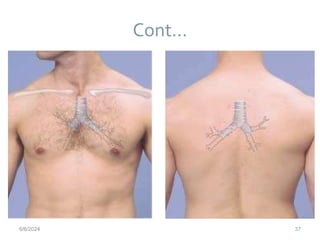
• Many patients with this disease have hemoptysis.
• Clubbing of the fingers also is common because of respiratory insufficiency.
• The patient usually has repeated episodes of pulmonary infection.
• Even with modern treatment approaches, the average age at death is
approximately 55 years.
6/6/2024 320
Assessment and Diagnostic Findings
• Bronchiectasis is not readily diagnosed because the symptoms can be
mistaken for those of simple chronic bronchitis.
• A definite sign is offered by the prolonged history of productive cough,
with sputum consistently negative for tubercle bacilli.
• The diagnosis is established by a computed tomography (CT) scan, which
demonstrates either the presence or absence of bronchial dilation.
6/6/2024 321
Treatment
• Goal
– Clear excess drainage
– Control infection
• Chest physiotherapy
• Smoking cessation
• Antibiotics
• Surgery (segment, lobe or entire lung)
6/6/2024 322

rispiratory disorders for nurses.pptxbb----

  • 1.
    Medical-surgical nursing Management ofpatient with respiratory disorder 6/6/2024 1
  • 2.
    Outline • Anatomy andphysiology overview  Assessment of respiratory system  Laboratory investigations and Diagnostic procedures 6/6/2024 2
  • 3.
    Lesson objectives After completionof this session the students should be able to:  Revise knowledge of anatomy and physiology  Obtain health history about respiratory system  Demonstrate physical examination  Differentiate between normal and abnormal findings  Identify investigations and diagnostic procedures 6/6/2024 3
  • 4.
    Anatomy and physiologicoverview  extends from the nose to the alveoli and includes not only the air-conducting passages but also the blood supply  The primary purpose--Gas exchange  divided into two parts: – the upper respiratory tract – the lower respiratory tract 6/6/2024 4
  • 5.
    Anatomy and physiologicoverview Cont.… • Upper respiratory tract o Nose o Paranasal sinuses and conchae o Pharynx, tonsils and adenoids o Trachea • Lower respiratory system o Bronchi o Bronchioles o Lungs o Pleura 6/6/2024 5
  • 6.
    Anatomy and physiologicoverview Cont.… • Nose External and internal portion Opening Nasal mucosa Septum • Function-  filter impurities  Warms air  olfaction 6/6/2024 6
  • 7.
    Anatomy and physiologicoverview Cont.… • Paranasal sinuses • four pairs of bony cavities o Frontal o Ethmoidal o Sphenoidal o maxillary • lined with nasal mucosa and ciliated pseudostratified columnar epithelium. • Function- resonating chamber 6/6/2024 7
  • 8.
  • 9.
    Anatomy and physiologicoverview cont.…. • Pharynx- The conducting airways that connect nasal passages and mouth to the lower parts of the respiratory tract • The pharyngeal tonsils, or adenoids, are situated in the posterior wall of the nasal cavity. • Paired palatine tonsils are located on the posterior lateral wall, 6/6/2024 9
  • 10.
    Anatomy and physiologicoverview Cont.… • The larynx, or “voice box,” is a continuation of the conducting division that connects the laryngopharynx with the trachea. • Function  prevent food or fluid from entering the trachea  produce sound. • The trachea , the “windpipe,” is a semi rigid, tubular organ, approximately 12 cm long and 2.5 cm in diameter, connecting the larynx to the principal (primary) bronchi • A series of 16 to 20 C-shaped cartilages form the supporting walls of the trachea 6/6/2024 10
  • 11.
  • 12.
    Anatomy and physiologicoverview cont.…. • Lungs • The lungs are paired elastic structures enclosed in the thoracic cage, which is an air tight chamber with distensible walls. 6/6/2024 12
  • 13.
  • 14.
    Anatomy and physiologicoverview Cont.… • The lungs and wall of the thorax are lined with a serous membrane called the pleura • The visceral and parietal pleura • MEDIASTINUM  is in the middle of the thorax contains all the thoracic tissue outside the lungs. 6/6/2024 14
  • 15.
    Anatomy and physiologicoverview Cont.… • LOBES • The left lung consists of an upper and lower lobe, • the right lung has an upper, middle, and lower lobe. • BRONCHI AND BRONCHIOLES • lobar bronchi segmental bronchi (10 on the right and 8 on the left) Sub segmental bronchi, bronchioles terminal bronchioles respiratory bronchioles alveolar ducts alveolar sacs alveoli 6/6/2024 15
  • 16.
  • 17.
    Anatomy and physiologicoverview Cont.… • ALVEOLI • The lung is made up of about 300 million alveoli, 6/6/2024 17
  • 18.
    FUNCTION OFTHE RESPIRATORYSYSTEM • The four basic functions of the respiratory system, not all of which are associated with breathing, are as follows: • It provides oxygen to the bloodstream and removes carbon dioxide. • It enables sound production or vocalization as expired air passes over the vocal folds. • It assists in abdominal compression during micturition (urination), defecation (passing of feces), and parturition (childbirth). • It enables protective and reflexive nonbreathing air movements, as in coughing and sneezing, to keep the air passageways clean. 6/6/2024 18
  • 19.
  • 20.
    Locating Findings onthe Chest 20 • Describe abnormalities of the chest in two dimensions: along the vertical axis and around the circumference of the chest. 6/6/2024
  • 21.
    Locating vertically 21 • Numberribs and interspaces accurately. • Anteriorly, the sternal angle (Angle of Louis), • Moving laterally from the Angle of Louis, you find the adjacent second rib and costal cartilage. • Now you can walk down the inter spaces using your two fingers. An inter space is named by the rib above it. 6/6/2024
  • 22.
  • 23.
    Cont… 23  Posteriorly, thetwelfth rib gives an other possible starting point for counting the ribs and inter spaces.  This is especially useful in locating findings on the lower posterior chest and also helps when the anterior approach is unsatisfactory.  The inferior angle of the scapula lies at the level of the seventh rib or interspace 6/6/2024
  • 24.
    Cont… 24  The spinousprocess of the seventh cervical vertebrae (When a person flexes his neck for ward, the most prominent process is usually that of the seventh cervical vertebrae, and when two processes appear equally prominent, they are of the seventh cervical and the first thoracic vertebrae.) helps to locate findings posteriorly. 6/6/2024
  • 25.
  • 26.
    Locating Findings AroundThe CircumferenceofThe Chest 26 • The mid sternal and vertebral lines precise; others are estimated. • These lines drop vertically in the middle of the sternum and the vertebral column respectively. • The mid clavicular lines –drop vertically from the mid point of the clavicle 6/6/2024
  • 27.
    Cont… 27 • The anteriorand posterior axillary lines- drop vertically from the anterior and posterior axillary folds (the muscle masses that border the axilla). • The mid axillary lines- drop from the apexes of the axilla. • The scapular lines – drop from the inferior angles of the scapulas 6/6/2024
  • 28.
  • 29.
    Lungs, fissures andlobes 29 • Anteriorly, the apex of each lung rises about 2-4 cm above the inner third of the clavicle. • The lower border of the lung crosses the sixth rib at the mid clavicular line and the eighth rib at the mid axillary line. 6/6/2024
  • 30.
    Cont… 30 • Posteriorly, thelungs extend from just above the scapula to about the level of the tenth thoracic spinous process on quite respiration. • Each lung is divided about in half by an oblique (fissure). • A string that runs from the third thoracic spinous process obliquely down and around the chest to the sixth rib at the mid clavicular line may approximate this fissure. 6/6/2024
  • 31.
    Cont… 31 • The rightlung is further divided by the horizontal (minor) fissure. • Anteriorly, this fissure runs close to the fourth rib and meets the oblique fissure in the mid axillary line near the fifth rib. • There fore, the right lung has three lobes and the left lung has two lobes. 6/6/2024
  • 32.
  • 33.
  • 34.
  • 35.
    Locations on theChest 35  Be familiar with general anatomic terms used to locate chest findings, such as: – Supraclavicular—above the clavicles – Infraclavicular—below the clavicles – Interscapular—between the scapulae – Infrascapular—below the scapula – Bases of the lungs—the lower most portions – Upper, middle, and lower lung fields 6/6/2024
  • 36.
    The trachea andmajor bronchi 36  Breath sounds over the trachea and bronchi have a different quality than breath sounds over the lung parenchyma.  Be sure you know the location of these structures.  The trachea bifurcates into its main stem bronchi at the levels of the sternal angle anteriorly and the T4 spinous process posteriorly. 6/6/2024
  • 37.
  • 38.
    The Pleurae 38  Thepleurae are serous membranes that cover the outer surface of each lung, the visceral pleura, and also line the inner rib cage and upper surface of the diaphragm, the parietal pleura.  Their smooth opposing surfaces, lubricated by pleural fluid, allow the lungs to move easily within the rib cage during inspiration and expiration. • The pleural space is the potential space between visceral and parietal pleurae. 6/6/2024
  • 39.
    Examining the thoraxand the lungs 39  General guidelines  Expose the chest fully  Proceed in an orderly fashion: inspection, palpation, percussion, and finally auscultation  Compare one side with the other-  Examine the posterior thorax and lungs while the patient is still in a sitting position.  The patient’s arms should be folded across the chest with hands resting, if possible on the opposite shoulder as this position moves the scapula apart and increases your access to the lung fields. 6/6/2024
  • 40.
    Cont… 40  Ask thepatient to lie supine while examining the anterior chest.  This position makes examining women easier, and wheezes, if present, are more likely to be heard.  Other wise the sitting position is also satisfactory.  When you must examine the chest by rolling to one side and to the other, percuss the upper lung and auscultate both lungs in each position.  Because ventilation is relatively greater in the dependent lung, the chances of hearing wheezes or crackles are greater on the dependent side. 6/6/2024
  • 41.
    Cont… 41  Relate allother findings in the thorax with findings such as shape of the finger nails and position of the trachea or cyanosis 6/6/2024
  • 42.
    Common or ConcerningSymptoms Of Respiratory System 42 o Chest Pain: Complaints of chest pain or chest discomfort raise the specter of heart disease, but often arise from structures in the thorax and lung as well. To assess this symptom, you must pursue a dual investigation of both thoracic and cardiac causes. 6/6/2024
  • 43.
    Sources of chestpain are listed below 43 • The myocardium-Angina pectoris, myocardial infarction • The pericardium-Pericarditis • The aorta-Dissecting aortic aneurysm • The trachea and large bronchi-Bronchitis • The parietal pleura-Pericarditis, pneumonia • The chest wall, including the musculoskeletal system and skin- Costochondritis, herpes zoster • The esophagus-Reflux esophagitis, esophageal spasm • Extrathoracic structures such as the neck, gallbladder, and stomach - Cervical arthritis, biliary colic, gastritis 6/6/2024
  • 44.
    Dyspnea 44 • is anonpainful but uncomfortable awareness of breathing that is inappropriate to the level of exertion. This serious symptom warrants a full explanation and assessment, since dyspnea commonly results from cardiac or pulmonary disease. • Ask “Have you had any difficulty breathing?” • at rest or with exercise?, and how much effort produces onset?. • Because of variations in age, body weight, and physical fitness, there is no absolute scale for quantifying dyspnea. • Anxious patients may have episodic dyspnea during both rest and exercise, and hyperventilation, or rapid, shallow breathing. 6/6/2024
  • 45.
    Wheezes 45 • are musicalrespiratory sounds that may be audible both to the patient and to others. • Wheezing suggests partial airway obstruction from secretions, tissue inflammation, or a foreign body. 6/6/2024
  • 46.
    Cough 46 • is acommon symptom that ranges in significance from trivial to ominous. • Typically, cough is a reflex response to stimuli that irritate receptors in the larynx, trachea, or large bronchi. • These stimuli include • mucus, pus, and blood • external agents such as dusts, foreign bodies, or even extremely hot or cold air. • inflammation • pressure or tension in the air passages from a tumor or enlarged peribronchial lymph nodes. 6/6/2024
  • 47.
    Cont… 47 • For complaintsof cough, Ask  whether the cough is dry or produces sputum, or phlegm.  the volume of any sputum and its color, odor, and consistency. • Cough is an important symptom of left-sided heart failure. • Dry hacking cough in Mycoplasmal pneumonia • productive cough in bronchitis, viral or bacterial pneumonia • Foul-smelling sputum in anaerobic lung abscess • tenacious sputum in cystic fibrosis • Large volumes of purulent sputum in bronchiectasis or lung abscess 6/6/2024
  • 48.
    Hemoptysis 48 • is thecoughing up of blood from the lungs; it may vary from blood- streaked phlegm to frank blood. • For patients reporting hemoptysis, assess the volume of blood produced as well as the other sputum attributes; ask about the related setting and activity and any associated symptoms. • confirm the source of the bleeding by both history and physical examination. • Blood or blood-streaked material may originate in the mouth, pharynx, or gastrointestinal tract and is easily mislabeled. 6/6/2024
  • 49.
    Cont… 49 • When vomited,it probably originates in the gastrointestinal tract. Occasionally, however, blood from the nasopharynx or the gastrointestinal tract is aspirated and then coughed out. • Blood originating in the stomach is usually darker than blood from the respiratory tract and may be mixed with food particles. 6/6/2024
  • 50.
    Cont… 50  Place yourthumbs about at the level of and parallel to the tenth ribs posteriorly and at the level of the lower costal margin in the mid line anteriorly, your hands grasping the lateral rib cage.  As you position your hands, slide them medially in order to raise loose skin folds between your thumbs.  Ask the patient to breath deeply and watch the divergence of your thumbs or the return of the folds of skin during inspiration. 6/6/2024
  • 51.
    Inspection 51 • 1.Inspect theshape of the chest. In the normal adult the thorax is wider than it is deep (the anterior-posterior diameter is about half of the transverse diameter). 6/6/2024
  • 52.
    Cont… 52  A barrelchest  A funnel chest is characterized by a depression in the lower portion of the sternum. Compression of the heart and great vessels may cause murmurs.  A flail chest is unstable chest resulting when multiple ribs are fractured. Because descent of the diaphragm decreases intra thoracic pressure on inspiration, the injured area caves inward; on expiration, it moves outward (paradoxical respiration). 6/6/2024
  • 53.
    Cont…. 53  In apigeon chest, the sternum is displaced anteriorly, increasing the anterioposterior diameter. The costal cartilages adjacent to the sternum are depressed.  In thoracic kyphoscoliosis, abnormal spinal curvatures and vertebral rotation deform the chest. Distortion of the underlying lungs may make interpretation of lung findings very difficult. 6/6/2024
  • 54.
  • 55.
  • 56.
    Cont… 56  Kyphosis-posterior curvatureof the spine  Lordosis- Anterior curvature of the spine  Scoliosis-Lateral curvature of the spine 6/6/2024
  • 57.
    2.Inspect respiratory pattern(rate, depth, rhythm, effort) 57 • Normal respiration is – 12-20 bpm per – 4-6 seconds – regular, quite and spontaneous. – On quite respiration, the chest expands 1-2 inches in adults. 6/6/2024
  • 58.
    • Causes- restrictivelung diseases, pleuritc chest pain, and elevated diaphragm 6/6/2024 58
  • 59.
    • Causes- diabeticcoma, drugs or increased intracranial pressure 6/6/2024 59
  • 60.
    Cont… 60 • deep breathing(hyperpnea, hyper ventilation) may be caused by exercise, anxiety, or metabolic acidosis among other causes. 6/6/2024
  • 61.
    Cont… 61 • Kussmaul breathingis deep breathing due to metabolic acidosis. 6/6/2024
  • 62.
    Cont… 62 • Cheyne-stokes breathing,periods of deep breathing alternate with periods of no breathing, may be normal in children and aging people during sleep. • It may also have other sever causes such as heart failure, uremia, drug induced respiratory depression, or brain damage (typically on both sides of the cerebral hemispheres or diencephalon). • Brain damage at the medulary level causes ataxic breathing (breathing characterized by unpredictable irregularity). 6/6/2024
  • 63.
    Cont… 63 • In obstructivebreathing, expiration is prolonged (longer than 6 seconds) because narrowed airways increase resistance to airflow. • Causes include asthma, chronic bronchitis and emphysema. • Contraction of the sternomastoid muscle or supra clavicular retractions during inspiration at rest signal sever difficulty in breathing. • Intercostal and sub costal retractions suggest pulmonary stiffness whereas intercostal bulges during exhalation indicate emphysema. 6/6/2024
  • 64.
    3.Observe for cyanosis 64 •(blue discoloration of the skin, nail beds or mucous membrane when there is at least 5 gm % free Hgb in the blood) 6/6/2024
  • 65.
    4. Movement ofthe Chest 65 One has to inspect wether both sides of the chest is moving symetrically or not.Causes of asymmetrical chest expansion are: o Pleural effusion o Pneumothorax o Extensive consolidation o Atelectasis o Pulmonary Fibrosis 6/6/2024
  • 66.
    Palpation 66  Palpation hasthe following uses: • 1.Identification of tender areas: palpate any area where pain has been reported or lesions are evident. • 2.Assessment of observed abnormalities example masses • 3.Assessment of respiratory expansion to determine range and symmetry of respiratory movements. 6/6/2024
  • 67.
    Cont… 67  Place yourthumbs about at the level of and parallel to the tenth ribs posteriorly and at the level of the lower costal margin in the mid line anteriorly, your hands grasping the lateral rib cage.  As you position your hands, slide them medially in order to raise loose skin folds between your thumbs.  Ask the patient to breath deeply and watch the divergence of your thumbs or the return of the folds of skin during inspiration. 6/6/2024
  • 68.
    Cont… 68  Normally divergenceshould be symmetrical and range of expansion should be not less than 1-2 inches. 6/6/2024
  • 69.
    Cont… 69 4.Assessment of tactilefremitus (the palpable vibrations transmitted through the broncho- pulmonary tree to the chest wall when the patient speaks):  Ask the patient to repeat words ‘99’ or ‘one-one-one’ and with the ball of your hand (the bony part of the palm at the base of the fingers) or the ulnar surface of your hand, palpate and compare symmetrical areas of the lung. 6/6/2024
  • 70.
  • 71.
    Cont… 71 Identify any areasof increased, decreased or absent fremitus and locate them. Fremitus is typically more prominent in the interscapular area than in the lower lung fields, and is often more prominent on the right side than on the left. It disappears below the diaphragm. 6/6/2024
  • 72.
    Cont… 72  Fremitus isdecreased or absent when  the voice is soft,  the transmissions of the vibrations from the larynx to the surface of the chest wall is impended as in obstructed bronchus, chronic obstructive diseases,  separation of the pleural surfaces by fluid, air, fibrosis (pleural thickening), infiltrating tumor or when there is very thick chest wall. • On the contrary, fremitus is increased when transmission is increased as through the consolidated lung of lobar pneumonia. 6/6/2024
  • 73.
    Percussion 73 Percussion of thethorax has three main purposes: To determine whether the underlying tissues are air filled, fluid filled or solid with in 5-7 cm in to the chest wall. To estimate diaphragmatic excursion To identify level of diaphragmatic dullness 6/6/2024
  • 74.
    Cont… 74 • Techniques: • Hyperextend the middle finger of your left hand (pleximeter finger) and press its distal iterphalangeal joint on the surface to be percussed (avoid surface contact by any other part of the hand as it dumps the vibrations). • Position your right forearm quite close to the surface with the hand cocked up ward and, with a quick, sharp, but relaxed wrist motion strike the pleximetre finger with the tip of the partially right middle finger. 6/6/2024
  • 75.
    Cont… 75 • You shouldalways use the lightest percussion that produces a clear note; • a thick chest wall requires heavier percussion than a thin one. • Remember to keep your technique constant in comparing two areas. 6/6/2024
  • 76.
    Cont… 76  Interpretation ofpercussion findings is based on the following five percussion notes: – Flat- this is a type of note we get by percussing over the thigh; pathological examples include massive pleural effusion, tumor, etc. – Dull: a type of note similar to the one detected over normal liver. Pathological examples include lobar pneumonia, pleural effusion, hemothorax, etc. 6/6/2024
  • 77.
    Cont… 77 – Resonance: thisis the percussion note of normal lung tissue though it can’t rule out lung abnormalities. Pathological example, chronic bronchitis. – Hyper resonance: this note is detected when there is larger amount of air contained under the surface to be percussed as in emphysema and bronchial asthma (in which case it is generalized) or pneumothorax (in which case it is localized). – Tympani: this note can be learned by percussing over a puffed out cheek or over most areas of the stomach. Pathological example, large pneumothorax. 6/6/2024
  • 78.
    Identifying The LevelOf Diaphragmatic Dullness 78  Starting above the expected level of dullness, percuss down ward until resonance replaces dullness during quiet respiration.  Check the level of this change near the middle of the hemi thorax and also more laterally.  An abnormally high level may suggest pleural effusion, or high diaphragm as from atelectasis or diaphragmatic paralysis 6/6/2024
  • 79.
    Estimating Diaphragmatic Excursion 79 oAsk the patient to exhale fully and keep. o Percuss the posterior chest down from area of resonance to area of dullness and mark. o Then ask the patient to breath in deep and hold, continue percussing down until resonance changes to dullness and mark. o Measure the vertical distance between the two points. o Do the same for the other side. o Normally it should be 5-6 cm, with the possibility of the right side to be 2cm higher than the left side. 6/6/2024
  • 80.
  • 81.
    Auscultation 81  It isthe most important examining technique for assessing airflow through the broncho-tracheal tree.  Instruct the patient to breath deeply through an open mouth.  Using the diaphragm of the stethoscope, auscultate areas suggested by percussion and compare symmetrical areas.  You should auscultate between the ribs not at the ribs.  In children, the interspaces are small and there fore you better use the bell of your stethoscope pressed tightly. 6/6/2024
  • 82.
    Cont… 82  If youhear or suspect abnormality, auscultate adjacent areas to describe the extent of the abnormality.  Be alert for patient discomfort due to hyperventilation (example light headedness, faintness), and allow the patient to rest as needed. 6/6/2024
  • 83.
    Cont… 83 Auscultation has thefollowing three main purposes: – To identify whether the breath sounds are decreased, absent or abnormally located – To identify the presence of added (adventitious) sounds – To identify extent of transmission of voice sounds 6/6/2024
  • 84.
    The Normal BreathSounds 84 • 1.Vesicular breath sound that is characterized by: – Inspiratory sounds lasting longer than expiratory ones – Soft and low pitched – No pause between expiration and inspiration – Heard through inspiration and one–third of expiration – Normally heard over most of both lungs 6/6/2024
  • 85.
    2.Bronchial Breath 85 sound thatis characterized by:  Loud and relatively high pitched  Expiratory sounds lasting longer than inspiratory ones  Short silent period between inspiration and expiration  The normal location is over the manubrium if heard at all 6/6/2024
  • 86.
    3.Broncho-Vesicular Breath 86 sounds arecharacterized by:  Intermediate in intensity and pitch  Inspiratory and expiratory sounds are about equal in duration  A silent gap between inspiration and expiration may or may not be present  Normally it can be heard in the first and second interspaces anteriorly and between the scapulas posteriorly 6/6/2024
  • 87.
    Cont… 87  If bronchialor broncho-vesicular sounds are heard in locations distant from those listed, suspect that air filled lung has been replaced by fluid filled or solid lung tissue. 6/6/2024
  • 88.
    Cont… 88  Breathed soundsmay be decreased when airflow is decreased (example obstructive lung disease or muscular weakness) or  when the transmission of sound is poor (example in pleural effusion, pneumothorax, or emphysema). 6/6/2024
  • 89.
    Added Sounds 89  Theseare sounds that are superimposed on the usual breath sounds. The common ones are described here.  Crackles/rales/crepitation: discontinuous/intermittent, nonmusical sounds of brief-like dots in time that may be fine (soft and brief) or coarse (louder and not quit so brief). • Crackles are caused by air babbles flowing through secretions or lightly closed airways during respiration. 6/6/2024
  • 90.
    Cont… 90  They alsoresult from a series of tiny explosions when small airways, deflated during expiration, pop open during inspiration (Example interstitial lung disease, early congestive heart failure, pneumonia).  If you hear crackles,  note whether fine or coarse,  their timing in the respiratory cycle,  location on the chest wall,  persistence of their pattern from breath to breath and any change after coughing or changing position. 6/6/2024
  • 91.
    Cont… 91  Note alsothat in some normal people, crackles may be heard at the lung bases anteriorly after maximal expiration, and that crackles in dependent portions of the lungs may also occur after prolonged recumbency.  Wheezes: relatively high-pitched, continuous, musical sounds which are longer than crackles and like dashes in time. Wheezes are often audible through mouth or chest wall. 6/6/2024
  • 92.
    Cont… 92  It occurswhen air flows through bronchi that are narrowed to the point of closure.  Generalized wheezes are commonly caused by asthma, chronic bronchitis and congestive heart failure.  A persistent localized wheeze suggests a partial obstruction of a bronchus, as by a tumor or foreign body.  It may be inspiratory, expiratory or both. 6/6/2024
  • 93.
    Cont… 93  Stridor isa wheeze that is entirely or predominantly inspiratory. It indicates a partial obstruction of the larynx or trachea and is a medical emergency.  Rhonchi are continuous sounds with snoring quality; it suggests secretions in the larger airways. 6/6/2024
  • 94.
    Cont… 94  Pleural frictionrub: Are discrete granting sounds that appear continuous because they are numerous.  Pleural friction rub are usually confined to a small area of chest wall and typically heard in both phases of the respiration. 6/6/2024
  • 95.
    Transmitted voice sounds 95 If you hear abnormally located broncho-vesicular breath sounds or bronchial breath sounds, continue on to assess transmitted voice sounds. This can be done in the following ways. – Ask the patient to say ‘99’,’ arba-arat’ or ‘afurtemi-afur’ as applicable and auscultate over the auscultatory areas with your stethoscope. – Normally the sounds transmitted through the chest wall are muffled and indistinct. – Louder clearer voice sounds heard through the stethoscope (bronchophony) suggest that air-filled lung has become airless. 6/6/2024
  • 96.
    Cont… 96  Ask thepatient to say ‘ee’. Normally, you hear a muffled long “e”. When ‘ee’ is heard as ‘ay’, an e-to-a change, (egohpony), and the quality sounds nasal, it suggests that the lung has been changed to airless. • Ask the patient to whisper ‘99’ or one-two-three’ and auscultate. The whispered voice is normally heard faintly and indistinctly. Louder clearer whispered sounds (whispered pectoriloquy) suggest airless lung. 6/6/2024
  • 97.
    Diagnostic evaluation • Pulmonaryfunction tests (PFTs) are routinely used in patients with chronic respiratory disorders. • They are performed to assess respiratory function and to determine the extent of dysfunction. • measurements of lung volumes, ventilatory function, and the mechanics of breathing, diffusion, and gas exchange 6/6/2024 97
  • 98.
  • 99.
  • 100.
    Diagnostic evaluation- Cont’d •ARTERIAL BLOOD GAS STUDIES • Measurements of blood pH and of arterial oxygen and carbon dioxide tension • PULSE OXIMETRY • noninvasive method of continuously monitoring the oxygen saturation of hemoglobin • CULTURES • Throat cultures may be performed to identify organisms responsible for pharyngitis 6/6/2024 100
  • 101.
  • 102.
  • 103.
  • 104.
    Diagnostic evaluation-Cont’d • SPUTUMSTUDIES • In general, sputum cultures are used in diagnosis, for drug sensitivity testing, and to guide treatment. 6/6/2024 104
  • 105.
    Diagnostic evaluation- Cont’d-imaging studies • Chest X-Ray • Normal pulmonary tissue is radiolucent; therefore, densities produced by fluid, tumors, foreign bodies, and other pathologic conditions can be detected by x-ray examination • The postero-anterior projection and the lateral projection. • Chest x-rays are usually taken after full inspiration because the lungs are best visualized when they are well aerated 6/6/2024 105
  • 106.
  • 107.
    Diagnostic evaluation-Cont’d Computed Tomography •lungs are scanned in successive layers by a narrow-beam x- ray • define pulmonary nodules and small tumors • demonstrate mediastinal abnormalities and hilar adenopathy • Contrast agents are useful 6/6/2024 107
  • 108.
  • 109.
    Diagnostic evaluation- Cont’d •Magnetic Resonance Imaging • MRI uses magnetic fields and radiofrequency signals – characterize pulmonary nodules – stage bronchogenic carcinoma – evaluate inflammatory activity in interstitial lung disease – acute pulmonary embolism, and chronic thrombolytic pulmonary hypertension 6/6/2024 109
  • 110.
  • 111.
    Diagnostic evaluation-Cont’d • FluoroscopicStudies • Fluoroscopy is used to assist with invasive procedures, such as a chest needle biopsy or transbronchial biopsy • Pulmonary Angiography • used to investigate thromboembolic disease of the lungs, such as pulmonary emboli and congenital abnormalities of the pulmonary vascular tree 6/6/2024 111
  • 112.
  • 113.
    Diagnostic evaluation- Cont’d-ENDOSCOPIC PROCEDURES • Bronchoscopy • Bronchoscopy is the direct inspection and examination of the larynx, trachea, and bronchi through either a flexible fiber-optic bronchoscope or a rigid bronchoscope • It can be diagnostic or therapeutic 6/6/2024 113
  • 114.
    Diagnostic evaluation- Cont’d-ENDOSCOPIC PROCEDURES DIAGNOSTIC • to examine tissues or collect secretions • to determine the location and extent of the pathologic process and to obtain a tissue sample for diagnosis • to determine if a tumor can be resected surgically, a • to diagnose bleeding sites (source of hemoptysis). Therapeutic • remove foreign bodies from the tracheobronchial tree, • remove secretions obstructing the tracheobronchial tree • treat postoperative atelectasis • destroy and excise lesions. 6/6/2024 114
  • 115.
    Diagnostic evaluation- Cont’d-ENDOSCOPIC PROCEDURES 6/6/2024 115
  • 116.
    Diagnostic evaluation- Cont’d-ENDOSCOPIC PROCEDURES • Thoracoscopy • Thoracoscopy is a diagnostic procedure in which the pleural cavity is examined with an endoscope • THORACENTESIS • aspiration of pleural fluid for diagnostic or therapeutic purposes • BIOPSY • the excision of a small amount of tissue, may be performed to permit examination of cells from the pharynx, larynx, and nasal passages 6/6/2024 116
  • 117.
    Diagnostic evaluation- Cont’d-ENDOSCOPIC PROCEDURES 6/6/2024 117
  • 118.
    Diagnostic evaluation- Cont’d-ENDOSCOPIC PROCEDURES • Pleural Biopsy • Pleural biopsy is accomplished by needle biopsy of the pleura or by pleuroscopy, • Performed when there is pleural exudate of undetermined origin and when there is a need to culture or stain the tissue to identify tuberculosis or fungi. • Lung Biopsy Procedures • transcatheter bronchial brushing • transbronchial lung biopsy • percutaneous (through-the-skin) needle biopsy. 6/6/2024 118
  • 119.
    Management of PatientsWith Upper Respiratory Tract Disorders 6/6/2024 119
  • 120.
    Upper RespiratoryTract Infections/InflammatoryDisorders • Are the common conditions that affect most people on occasion, • some infections are acute and other are chronic • Patients with these conditions seldom require hospitalization. 6/6/2024 120
  • 121.
    Case scenario • A25 year old student came to the class with running nose, sneezing and intermittent coughing. When you questioned what happens to him the condition started a day back with scratchy throat and currently he feels body warmth, discomfort. You observed that his nose become red, no eye color change and use tissue paper very frequently. • What would be the most likely diagnoses of this student? • If you are a nurse caring for him how do you manage his condition? 6/6/2024 121
  • 122.
    common cold • Theterm “common cold” often is used when referring to an upper respiratory tract infection that is self-limited and caused by a virus (viral rhinitis). • Cold referred to afebrile, infectious, acute inflammation, of the mucus membranes of the nasal cavity • More broadly, the term refers to an acute upper respiratory tract infection,(non- specific URI) whereas terms such as “rhinitis,” “pharyngitis,” and “laryngitis” distinguish the sites of the symptoms. • Colds are highly contagious because virus is shed for about 2 days before the symptoms appear and during the first part of the symptomatic phase. 6/6/2024 122
  • 123.
    common cold-Etiology • Rhinovirus •Para-influenza virus • coronavirus, • respiratory syncytial virus (RSV) • influenza virus • adenovirus. 6/6/2024 123
  • 124.
    common cold-Clinical manifestations Nasalcongestion Rhinorrhea Scratchy or sore throat Sneezing & cough Headache & muscle ache Herpes simplex sore (cold sore )  general malaise, low-grade fever, chills The symptoms last from 1 to 2 weeks 6/6/2024 124
  • 125.
    common cold- symptomaticmanagement 1. Fluid intake ,rest ,prevention of chills. 2. Warm salt-water gargles 3. decongestant(Chlorpheneramine, 4mg P.O. TID for adults), anti histamine, Vit. C. 4. dextromethorphan for cough 5. SNIP 6. Analgesic for aches ,pain , & fever. • Nursing Management 1. Patient teaching of self care & prevention of infection & break chain of infection 6/6/2024 125
  • 126.
  • 127.
    Acute Pharyngitis • Itis a febrile inflammation of throat ,caused by virus about 70% , uncomplicated viral infection usually subsided promptly within 3-10 days • It is symptom rather than a disease Caaused by • Common cold and flu(Viraletiology) • Strep throat-- group A beta-hemolytic streptococcus • Mononucleosis(Viral) • Pseudomembranous pharyngitis • Vesicular pharyngitis • Ulcero-necrotic pharyngitis • Fungal • Allergy • Dry indoor air • chronic mouth breathing • GERD 6/6/2024 127
  • 128.
    Complications of untreatedbacterial pharyngitis Local complication • Peritonsilar, retropharyngeal or lateral pharyngeal abscess: General complication • Complications due to the toxin: diphtheria • Poststreptococcal complications: ARF, acute glomerulonephritis. • Signs of serious illness in children: severe dehydration, severe difficulty swallowing, upper airway compromise, deterioration of general condition.. 6/6/2024 128
  • 129.
    Clinical Manifestations 1. Fieryred pharyngeal membrane& tonsils 2. Lymphoid follicles that are swollen 3. Enlarged tender cervical lymph node 4. Fever & malaise 5. Sore throat , hoarseness,& cough 6/6/2024 129
  • 130.
    Assessment and DiagnosticFindings History and physical examination Laryngoscope Rapid screening tests for streptococcal antigens such as the • Latex agglutination (LA) antigen test • solid-phase enzyme immunoassays (ELISA), • optical immunoassay (OIA), • streptolysin titers, • throat cultures are used to determine the causative organism, • Nasal swabs and blood cultures 6/6/2024 130
  • 131.
    Medical Management 1. Supportivemeasures for viral infection 2. analgesic for severe sore 3. antitussive medications: Guaifenesin 4. Nutritional therapy liquid or soft diet 5. “If liquid can’t tolerated IV fluid administered “ 6/6/2024 131
  • 132.
    Antibiotics • benzathine benzylpenicillinIM – adults: 1.2 MIU single dose • Penicilin V is the oral reference treatment, – 1 g 2 times daily • Amoxicilin is an alternative – 1 g 2 times daily • azithromycin PO for 3 days – 500 mg once daily 6/6/2024 132
  • 133.
    Nursing Management • bedrest • Used tissue should be disposed • skin assessment • mouth care • Ice collar • normal saline gargle • self care teaching 6/6/2024 133
  • 134.
    Chronic Pharyngitis • Commonin adults who work or live in dusty surrounding ,use the voice too excess , suffer from chronic cough , & habitually use alcohol & tobacco • Types of pharyngitis 1. Hypertrophic :ch.ch.by general thickening& congestion of pharyngeal mucus membrane 2. Atrophic : probably late stage of first type 3. Chronic Granular : ch.ch.by numerous swollen lymph follicles on the pharyngeal wall 6/6/2024 134
  • 135.
    Clinical Manifestations 1. Constantsense of irritation or fullness in throat 2. Mucus expelled by coughing 3. Difficulty in swallowing 6/6/2024 135
  • 136.
    Medical Management • Relievingsymptoms • Avoiding exposure to irritant • Correct respiratory & cardiac conditions • Nasal sprays or medications containing ephedrine sulfate or phenylephrine hydrochloride • Aspirin or acetaminophen is recommended for its anti- inflammatory and analgesic properties. 6/6/2024 136
  • 137.
    Tonsillitis and Adenoidits •The tonsils are composed of lymphatic tissue & situated on each side of the oropharynx ,they frequently are the site of acute infection (tonsillitis) • Tonsillitis occurs when the filtering function becomes overwhelmed with a virus or bacteria and infection results • The adenoids, a mass of lymphoid tissue located at the back of the nasopharynx • Tonsillitis is more common in children 6/6/2024 137
  • 138.
    Etiology • The mostcommon organisms causing tonsillitis are • Streptococcus species, • Staphylococcus aureus • Haemophilus influenzae • Pneumococcus species. 6/6/2024 138
  • 139.
    Clinical Manifestations • Tonsillitis: – Swelling of the tonsils – Redder than normal tonsils – A white or yellow coating on the tonsils – A slight change in the voice due to swelling – Sore throat sometimes accompanied by ear pain – Uncomfortable or painful swallowing – Swollen lymph nodes (glands) in the neck – Fever – Bad breath 6/6/2024 139
  • 140.
    • Adenoiditis – Breathingthrough the mouth instead of the nose most of the time – Nose sounds “blocked” when the person speaks – Chronic runny nose – Noisy breathing during the day – Recurrent ear infections – Snoring at night – Restlessness during sleep, or pauses in breathing for a few seconds at night 6/6/2024 140
  • 141.
    Complications • Otitis media •Mastoditis • Permanent deafness • Management • Antimicrobial therapy “penicillin” for 7 days 6/6/2024 141 • History • P/E • RSAT • Culture from throat • Audiometric examination if complication occurs Assessment and Diagnostic Findings
  • 142.
    Indications forTonsillectomy • repeatedbouts of tonsillitis; • hypertrophy of the tonsils and adenoids that could cause obstruction and obstructive sleep apnea; • repeated attacks of purulent otitis media; • suspected hearing loss due to serous otitis media • Exacerbation of asthma or rheumatic fever. 6/6/2024 142
  • 143.
    Nursing Management 1. Providepost op. care :V/S ,hemorrhage , position head turned to side, 2. water or ice chips 3. Teaching patient :S&S of hemorrhage 4. Avoid too much talking or coughing 5. Liquid or semi liquid diet for several days 6. mouth washing with warm saline 6/6/2024 143
  • 144.
    PERITONSILLAR ABSCESS • Aperitonsillar abscess is a collection of purulent exudate between the tonsillar capsule and the surrounding tissues, including the soft palate. • It is believed to develop after an acute tonsillar infection, which progresses to a local cellulitis and abscess. 6/6/2024 144
  • 145.
    Clinical Manifestations • araspy voice, • odynophagia • dysphagia • otalgia (pain in the ear), and drooling. • An examination shows marked swelling of the soft palate, often occluding almost half of the opening from the mouth into the pharynx, • tonsillar hypertrophy, and dehydration. 6/6/2024 145
  • 146.
    Medical management • Antibiotics-effective • Incision needed if no response to antibiotics • Ansthetic spray ------ aspirating by needle or incision and draining • Sitting position- helps expectoration of pus and blood • 30% of client with peritonsillar abscess require tonsillectomy 6/6/2024 146
  • 147.
    Nursing intervention • Encouragerest. Encourage your child to get plenty of sleep. • Provide adequate fluids. ... • Provide comforting foods and beverage. ... • Prepare a saltwater gargle. ... • Humidify the air. ... • Avoid irritants. ... • Treat pain and fever. • frequent use of mouthwashes or gargles, using saline or alkaline solutions at a temperature of 105°F to 110°F (40.6°C to 43.3°C). • The nurse instructs the patient to gargle at intervals of 1 or 2 hours for 24 to 36 hours. 6/6/2024 147
  • 148.
    Laryngitis • It isan inflammation of larynx ,often occur as a result of voice abuse or exposure to dust , chemicals , smoke , & other pollutants • Common in winter & easily transmitted • The cause of infection is almost virus Clinical Manifestations 1. Hoarseness or aphonia 2. Severe cough 6/6/2024 148
  • 149.
    Medical Management 1. Restingvoice & avoid smoking 2. Inhale cool steam or an aerosol 3. Antibiotics for bacterial organisms Nursing Management 1. Rest voice 2. Maintain a well humidified environment 3. Daily fluid intake 6/6/2024 149
  • 150.
    NURSING PROCESS:THE PATIENTWITH UPPER AIRWAY INFECTION Assessment • Health history – headache, – Sore throat – pain around the eyes and on either side of the nose, – Difficulty in swallowing, – cough, hoarseness, fever, stuffiness – Generalized discomfort and fatigue. – history of allergy 6/6/2024 150
  • 151.
    • P/E – swelling,lesions, or asymmetry of the nose as well as bleeding or discharge – increased redness, swelling, or exudate, and nasal polyps – Sinus tenderness – Throat inspection – Tracheal palpation 6/6/2024 151
  • 152.
    NURSING DIAGNOSES • ImpairedGas exchange related to retained secretions and inflammation as evidenced by decrease O2 saturation • Acute pain related to upper airway irritation secondary to an infection • Impaired verbal communication related to physiologic changes and upper airway irritation as evidenced by aphonia • Deficient fluid volume related to increased fluid loss as evidenced by tachycardia, decrease BP and poor skin turgor • Deficient knowledge regarding prevention of upper respiratory infections, treatment regimen, surgical procedure, or postoperative care 6/6/2024 152
  • 153.
    COLLABORATIVE PROBLEMS/POTENTIAL COMPLICATIONS •Sepsis • Meningitis • Peri-tonsillar abscess • Otitis media • Sinusitis 6/6/2024 153
  • 154.
    Planning and Goals •maintenance of a patent airway, • relief of pain • maintenance of effective means of communication • normal hydration • knowledge of how to prevent upper airway infections • absence of complications. 6/6/2024 154
  • 155.
    Nursing Interventions MAINTAINING APATENT AIRWAY • Increasing fluid intake • Use of room vaporizers or steam inhalation • Position- upright position • Administer prescribed medication PROMOTING COMFORT • Analgesics • topical anesthetic agents 6/6/2024 155
  • 156.
    • Hot packsto relieve the congestion of sinusitis and promote drainage • warm water gargles or irrigations to relieve the pain of a sore throat • encourages rest to relieve the generalized discomfort • general hygiene techniques to prevent the spread of infection • ice collar may reduce swelling and decrease bleeding- post- operative 6/6/2024 156
  • 157.
    • PROMOTING COMMUNICATION •The nurse instructs the patient to refrain from speaking as much as possible and to communicate in writing instead • ENCOURAGING FLUID INTAKE • The nurse encourages the patient to drink 2 to 3 L of fluid per day during the acute stage of airway infection, unless contraindicated 6/6/2024 157
  • 158.
    • PROMOTING HOMEAND COMMUNITY-BASED CARE • Teaching Patients Self-Care • how to minimize the spread of infection • avoid exposure to others at risk for serious illness • Relieve symptoms of upper respiratory infections • Complete the treatment regimen 6/6/2024 158
  • 159.
    • MONITORING ANDMANAGING POTENTIAL COMPLICATIONS • The patient and family members are instructed to seek medical care • if the patient’s condition fails to improve within several days of the onset of symptoms, • if unusual symptoms develop, or • if the patient’s condition deteriorates. 6/6/2024 159
  • 160.
    • Evaluation • Expectedpatient outcomes may include: 1. Maintains a patent airway by managing secretions a. Reports decreased congestion b. Assumes best position to facilitate drainage of secretions 2. Reports feeling more comfortable a. Uses comfort measures: analgesics, hot packs, gargles, rest b. Demonstrates adequate oral hygiene 3. Demonstrates ability to communicate needs, wants, level of comfort 6/6/2024 160
  • 161.
    4. Maintains adequatefluid intake 5. Identifies strategies to prevent upper airway infections and allergic reactions a. Demonstrates hand hygiene technique b. Identifies the value of the influenza vaccine 6. Demonstrates an adequate level of knowledge and performs self-care adequately 7. Becomes free of signs and symptoms of infection a. Exhibits normal vital signs (temperature, pulse, respiratory rate) b. Absence of purulent drainage c. Free of pain in ears, sinuses, and throat 6/6/2024 161
  • 162.
    Management of Patients WithChest and Lower Respiratory Tract Disorders 6/6/2024 162
  • 163.
    • Conditions affectingthe lower respiratory tract range from acute problems to long- term chronic disorders. • Many of these disorders are serious and often life-threatening. 6/6/2024 163
  • 164.
    Atelectasis • Atelectasis refersto closure or collapse of alveoli and often is described in relation to x-ray findings and clinical signs and symptoms. • may be acute or chronic • May be micro atelectasis or macro atelectasis • Causes • Postoperative • obstruction of airflow with mucus • chronic airway obstruction by cancer • Compression of lung tissue from effusion or a tumor 6/6/2024 164
  • 165.
  • 166.
    • Pp • Airwayobstruction the trapped alveolar air absorbed outside air cannot replace the absorbed air isolated portion of the lung becomes airless alveoli collapse 6/6/2024 166
  • 167.
    • Assessment findings •Clinical effects vary with the causes of lung collapse, the degree of hypoxia, and the underlying disease • Minimal symptoms • Cough • sputum production lobar atelectasis • marked respiratory distress • dyspnea, tachypnea , hypoxemia hall mark of severity • Tachycardia , pleural pain, and central cyanosis 6/6/2024 167
  • 168.
    • Inspection – decreasedchest wall movement, cyanosis, diaphoresis, substernal or intercostal retractions, and anxiety. • Palpation – may reveal decreased fremitus and mediastinal shift to the affected side 6/6/2024 168
  • 169.
    • Percussion – maydisclose dullness or flatness over lung fields. • Auscultation – findings may include crackles during the last part of inspiration and decreased (or absent) breath sounds with major lung involvement. 6/6/2024 169
  • 170.
    • Diagnostic tests •chest x-ray findings may reveal patchy infiltrates or consolidated areas • pulse oximetry (SpO2) may demonstrate a low saturation of hemoglobin • ABG- low partial pressure (paO2) and acidosis • Bronchoscopy – obstructing tumor 6/6/2024 170
  • 171.
    Management • The goalin treating the patient with atelectasis is to improve ventilation by remove secretions • Incentive spirometer • Chest physiotherapy • Humidity and bronchodilator medications • Positive End-expiratory pressure or PEEP therapy • continuous or intermittent positive pressure-breathing (IPPB) • Bronchoscopy • Thoracentesis • surgery or radiation therapy 6/6/2024 171
  • 172.
    Nursing diagnoses • Acutepain • Anxiety • Deficient knowledge (prevention) • Fear • Impaired gas exchange • Ineffective airway clearance • Ineffective breathing pattern • Risk for infection 6/6/2024 172
  • 173.
    Nursing interventions • coughingand deep-breathing exercises every 1 to 2 hours • Splint the chest to minimize the pain • help him walk as soon as possible. • Administer adequate analgesics to control pain. • Monitor mechanical ventilation. Maintain tidal volume at 10 to 15 ml/kg of the patient's body weight to ensure adequate lung expansion 6/6/2024 173
  • 174.
    • Monitor pulseoximetry for decreases in oxygenation. • Help the patient use an incentive spirometer to encourage deep breathing • Humidify inspired air, and encourage adequate fluid intake to mobilize secretions. • Use postural drainage and chest percussion to remove secretions • For the intubated or uncooperative patient, provide suctioning • Assess breath sounds and respiratory status frequently. Report changes immediately 6/6/2024 174
  • 175.
    • Prevention • frequentturning, • early mobilization • Deep-breathing maneuvers (at least every 2 hours) • Secretion management techniques may include directed cough, suctioning, aerosol nebulizer treatments followed by chest physical therapy 6/6/2024 175
  • 176.
  • 177.
    ACUTETRACHEOBRONCHITIS • an acuteinflammation of the mucous membranes of the trachea and the bronchial tree, often follows infection of the upper respiratory tract. • Etiology • A patient with a viral infection has decreased resistance and can readily develop a secondary bacterial infection. • inhalation of physical and chemical irritants, gases, and other air contaminants 6/6/2024 177
  • 178.
    • Mos • Streptococcuspneumoniae • Haemophilus influenzae • Mycoplasma pneumoniae. • Aspergillus fumigatus 6/6/2024 178
  • 179.
    • Pp • Chemicals,mos irritation of mucosa mucopurulent sputum 6/6/2024 179
  • 180.
    Clinical Manifestations • Initially,the patient has a dry, irritating cough and expectorates a scanty amount of mucoid sputum • The patient complains of sternal soreness from coughing and has fever or chills and night sweats, headache, and general malaise. As the infection progresses, • the patient may be short of breath, have noisy inspiration and expiration (inspiratory stridor and expiratory wheeze), and produce purulent sputum • With severe tracheobronchitis, blood-streaked secretions may be expectorated 6/6/2024 180
  • 181.
    • Medical Management •Antibiotic treatment • Expectorants may be prescribed-Guaifenesin, 200- 400 mg P.O. QID- • Fluid intake is increased • Suctioning and bronchoscopy may be needed to remove secretions. • Rarely, endotracheal intubation– ARF • Dextromethorphan hydrobromide, 15 – 30 mg P.O. TID to QID for adults. 6/6/2024 181
  • 182.
    PNEUMONIA • Pneumonia isan inflammation of the lung parenchyma that is caused by a microbial agent. • “Pneumonitis” is a more general term that describes an inflammatory process in the lung tissue that may predispose a patient to or place a patient at risk for microbial invasion. 6/6/2024 183
  • 183.
    • Pneumonia wasdescribed 2,500 years ago by Hippocrates • Dr. William Osler described pneumonia the “captain of the men of death” • Before the advent of antibiotics – 3rd leading cause of death • 2006- 8th leading cause of death in USA 6/6/2024 184 Before antibiotics, pneumonia was the third-leading cause of death in the country, as this cover of a 1937 U.S. government publication attests.
  • 184.
    • Classification • Bacterial/Typical •Atypical • anaerobic/cavitary • opportunistic • A more widely used classification scheme • community-acquired pneumonia • Hospital acquired pneumonia • pneumonia in the immuno-compromised host • aspiration pneumonia 6/6/2024 185
  • 185.
    • Community-acquired pneumonia(CAP) occurs either in the community setting or within the first 48 hours of hospitalization or institutionalization. • Pneumonia caused by S. pneumoniae (pneumococcus) • most common CAP in people younger than 60 without comorbidity and in those older than 60 with comorbidity • may occur as a lobar or bronchopneumonic form 6/6/2024 186
  • 186.
  • 187.
    • Mycoplasma pneumonia,another type of CAP, occurs most often in older children and young adults • spread by infected respiratory droplets. • The inflammatory infiltrate is primarily interstitial rather than alveolar • has the characteristics of a bronchopneumonia. 6/6/2024 188
  • 188.
    • H. influenzaeis another cause of CAP. • It frequently affects elderly people or those with comorbid illnesses (eg, chronic obstructive pulmonary disease [COPD], alcoholism, diabetes mellitus). • Chest x-rays may reveal multilobar, patchy bronchopneumonia or areas of consolidation 6/6/2024 189
  • 189.
    • Viruses arethe most common cause of pneumonia in infants and children but are relatively uncommon causes of CAP in adults. 6/6/2024 190
  • 190.
    immunocompetent • influenza virusestypes A and B, • adenovirus, • parainfluenza virus, • coronavirus, • varicella-zoster virus. immunocompromised • cytomegalovirus • herpes simplex virus, • adenovirus, • respiratory syncytial virus. 6/6/2024 191
  • 191.
    • Hospital-acquired pneumonia(HAP), also known as nosocomial pneumonia, is defined as the onset of pneumonia symptoms more than 48 hours after admission to the hospital. • Ventilator-associated pneumonia- endotracheal intubation and mechanical ventilation. 6/6/2024 192
  • 192.
    • The commonorganisms responsible for HAP include • Enterobacter species • Escherichia coli • Klebsiella species, • Serratia marcescens • P. aeruginosa • methicillin-sensitive or methicillin-resistant Staphylococcus aureus 6/6/2024 193
  • 193.
    • HAP occurs •Host defenses are impaired • an inoculum of organisms reaches the patient’s lower respiratory tract and overwhelms the host’s defenses, • a highly virulent organism is present. 6/6/2024 194
  • 194.
    • Pneumonia inthe immunocompromised host • Pneumocystis carinii pneumonia (PCP) • fungal pneumonias • Mycobacterium tuberculosis • Immunocompromization may be due to • Drugs- corticosteroids, chemotherapy, • nutritional depletion, • AIDS, genetic immune disorders • mechanical ventilation 6/6/2024 195
  • 195.
    • Aspiration pneumoniaresults from the entry of endogenous or exogenous substances into the lower airway. • aspiration of bacteria that normally reside in the upper airways. • Aspiration pneumonia may occur in the community or hospital setting; • common pathogens – S. pneumoniae, – H. influenzae – S. aureus. • Other substances may be aspirated into the lung, such as gastric contents, exogenous chemical contents, or irritating gases. • This type of aspiration or ingestion may impair the lung defenses, cause inflammatory changes, and lead to bacterial growth and a resulting pneumonia. 6/6/2024 196
  • 196.
    • Pathophysiology • Lowerairway is normally sterile • Mos access the lung through- • Inhalation of virulent mos • Aspiration of upper airway flora • Hematogeniuos spread • Extension from nearby structure 6/6/2024 197
  • 197.
    • Pneumonia oftenaffects both ventilation and diffusion. • Alveoli occupied with • Inflammatory exudate • WBC-mostly neutrophils • Bronchospasm and secretion- reduce entry of air • This leads to ventilation- perfusion mismatch 6/6/2024 198
  • 198.
    Risk factors • Alcoholism •Asthma • Immunosuppresion • Institutinalization • Age >=70 6/6/2024 199
  • 199.
    • Clinical Manifestations •Sudden onset of shaking chills • Cough • Rapidly increase in body temperature 38.5-40.5 C • Pleuratic Chest pain increased by deep breathing • Patient looks severely ill with marked tachypnea • Shortness of breath • Orthopnea • Poor appetite • Diaphoresis &tires easily • Purulent sputum 6/6/2024 200
  • 200.
    • Assessment andDiagnostic Findings • history • physical examination • chest x-ray studies • blood culture- bacteremia 6/6/2024 201
  • 201.
    • Medical Management •Appropriate antibiotics depend on culture result • Hydration (increase fluid intake ) • Antipyretic for fever Super infection & Headache • Warm moist inhalation to relieve irritation • Oxygen & respiratory supportive measures • Complications : Shock & respiratory failure , • Atelectasis & plural effusion 6/6/2024 202
  • 202.
    6/6/2024 203 CURB-65  C-Confusion=1point U-Uremia: BUN >19mg/dL=1point  R-RR >30/min= 1point  BP <90/60=1point  Age >=65=1point
  • 203.
    Community acquired ambulatory patients(Mild Pneumonia) • First line • No recent antibiotic use: • Clarithromycin, 500 mg P.O. BID for 5-7 days OR • Azitromycin, 500mg P.O first day then 250mg P.O. for 4d. • OR • Doxycycline, 100 mg P.O. BID for 7-10 days. 6/6/2024 204
  • 204.
    • If recentantibiotic use within 3months: Clarithromycin, 500 mg P.O. BID for 5-7 days • OR • Azitromycin, 500mg P.O first day then 250mg P.O. for 4d. • PLUS • Amoxicillin, 1000 mg P.O. TID for 5 to 7 days. • OR • Amoxicillin-clavulanate, 625mg P.O. TID for 5-7days 6/6/2024 205
  • 205.
    Community acquired hospitalized patients(Severe Pneumonia) • First line • Ceftriaxone, 1 g I.V. OR I.M every 12-24 hours for 7 days. • OR • Benzyl penicillin, 2-3 million IU I.V. QID for 7-10 days. • PLUS • Azithromycin, 500 mg on day 1 followed by 250 mg/day on days 2 – 5 • OR • Clarithromycin, 500mg P.O. BID for 7-10 days 6/6/2024 206
  • 206.
    Hospital acquired pneumonias (NosocomialPneumonias): • First line • Ceftazidime, 1 gm I.V. TID for 10-14days • PLUS • Vancomycin 1g I.V. BID for 10-14 days • OR • Imipenem-cilastatin, 500mg IV (infused slowly over 1hour) Q6h • OR • Menopenem, 1gm IV (infused slowly over 30min) Q8h 6/6/2024 207
  • 207.
    • Alternatives • Ceftriaxone,1-2 gI.V. OR I.M. BID for 7 days. • PLUS • Gentamicin, 3-5 mg/kg I.V. QDdaily in divided doses for 7 days. • OR • Ciprofloxacin, 500 mg P.O./ I.V. BID for 7 days. • If methicillin-resistant (MRSA) suspected • Vancomycin, 1 g I.V. BID should be added to the existing emperic regimen 6/6/2024 208
  • 208.
    • Nursing diagnoses •Acute pain • Anxiety • Hyperthermia • Imbalanced nutrition: Less than body requirements • Impaired gas exchange • Ineffective airway clearance • Ineffective coping • Risk for deficient fluid volume • Risk for infection 6/6/2024 209
  • 209.
    Nursing interventions • Maintaina patent airway and adequate oxygenation • Obtain sputum specimens as needed • Administer antibiotics as ordered and pain medication as needed • Provide a high-calorie, high-protein diet • To prevent aspiration during nasogastric tube feedings, elevate the patient's head, check the tube position, and administer the feeding slowly • Monitor the patient's fluid intake and output 6/6/2024 210
  • 210.
    • To controlthe spread of infection, dispose of secretions properly • Provide a quiet, calm environment, with frequent rest periods 6/6/2024 211
  • 211.
  • 212.
    are disorders thatinvolve the visceral pleura, parietal pleura and pleural space. PLEURISY Pathophysiology Pleurisy (pleuritis) refers to inflammation of both layers of the pleurae (parietal and visceral). Pleurisy may develop in conjunction • Infection(pneumonia or URTI, TB,)or • collagen disease; • trauma to the chest, • pulmonary infarction, • pulmonary embolism • primary and metastatic cancer • after thoracotomy. 6/6/2024 213
  • 213.
    Clinical Manifestations The pleuriticpain – parietal pleura Pain characterstics  Taking a deep breath, coughing, or sneezing worsens the pain  restricted in distribution rather than diffuse; usually occurs only on one side  become minimal or absent when the breath is held  as pleural fluid develops, the pain decreases. Assessment and Diagnostic Findings a pleural friction rub can be heard with the stethoscope friction rub disappear later as more fluid accumulates Diagnostic tests may include chest x-rays, sputum examinations, thoracentesis to obtain a specimen of pleural fluid for examination, and less commonly a pleural biopsy. 6/6/2024 214
  • 214.
    Medical Management  discoverthe underlying condition causing the pleurisy and to relieve the pain. monitor for signs and symptoms of pleural effusion  analgesics provide symptomatic relief.  intercostal nerve block may be required. Nursing Management Pain management Splinting when coughing . 6/6/2024 215
  • 215.
    PLEURAL EFFUSION Pleural effusion,a collection of fluid in the pleural space, is rarely a primary disease process but is usually secondary to other diseases. Normally, (5 to 15 mL), which acts as a lubricant Pleural effusion Cause • heart failure, TB, pneumonia, pulmonary infections (particularly viral infections), • nephrotic syndrome, connective tissue disease, pulmonary embolism, and neoplastic tumors. • Bronchogenic carcinoma is the most common malignancy associated with a pleural effusion. 6/6/2024 216
  • 216.
    Pathophysiology The effusion canbe composed of a relatively clear fluid, or it can be bloody or purulent. An effusion of clear fluid may be a transudate or an exudate 6/6/2024 217
  • 217.
    Clinical Manifestations  Severity The size of the effusion and  the patient’s underlying lung disease  the time course of the development  A large : shortness of breath.  When a small to moderate :dyspnea may be absent or only minimal. 6/6/2024 218
  • 218.
    Assessment and DiagnosticFindings  decreased or absent breath sounds, decreased fremitus, and a dull, flat sound when percussed.  In an extremely large pleural effusion, acute respiratory distress.  Tracheal deviation away from the affected side may also be noted.  chest x-ray, chest CT scan, and thoracentesis confirm the presence of fluid  Pleural fluid is analyzed by  bacterial culture, Gram stain, acid fast bacillus stain (for TB), red and white blood cell counts, chemistry studies (glucose, amylase, lactic dehydrogenase, protein), cytologic analysis for malignant cells, and pH. A pleural biopsy also may be performed. 6/6/2024 219
  • 219.
    Medical Management  Theobjectives • discover the underlying cause, • prevent reaccumulation of fluid, • to relieve discomfort, dyspnea, and respiratory compromise.  Thoracentesis  chemical pleurodesis  Surgical pleurectomy,  insertion of a small catheter attached to a drainage bottle for outpatient management, or  implantation of a pleuroperitoneal shunt 6/6/2024 220
  • 220.
    Nursing Management The nurse’srole in the care of the patient with a pleural effusion includes implementing the medical regimen.  The nurse prepares and positions the patient for thoracentesis and offers support throughout the procedure.  Pain management is a priority, and the nurse assists the patient to assume positions that are the least painful.  However, frequent turning and ambulation are important to facilitate drainage.  If a chest tube drainage and water-seal system is used, the nurse is responsible for monitoring the system’s function and recording the amount of drainage at prescribed intervals.  If the patient is to be managed as an outpatient with a pleural catheter for drainage, the nurse is responsible for educating the patient and family regarding management and care of the catheter and drainage system. 6/6/2024 221
  • 221.
    EMPYEMA An empyema isan accumulation of thick, purulent fluid within the pleural space, often with fibrin development and a loculated (walled-off) area where infection is located. Most empyemas occur as complications of bacterial pneumonia or lung abscess. Other causes include penetrating chest trauma, hematogenous infection of the pleural space, nonbacterial infections, or iatrogenic causes (after thoracic surgery or thoracentesis). Pathophysiology At first the pleural fluid is thin, with a low leukocyte count, but it frequently progresses to a fibropurulent stage and, finally, to a stage where it encloses the lung within a thick exudative membrane (loculated empyema). 6/6/2024 222
  • 222.
    Clinical Manifestations  Withan empyema, the patient is acutely ill and has signs and symptoms similar to those of an acute respiratory infection or pneumonia (fever, night sweats, pleural pain, cough, dyspnea, anorexia, weight loss).  If the patient is immuno-compromised, the symptoms may be more vague.  If the patient has received antimicrobial therapy, the clinical manifestations may be less obvious. Assessment and Diagnostic Findings decreased or absent breath sounds over the affected area, and there is dullness on chest percussion as well as decreased fremitus. The diagnosis is established by a chest x-ray or chest CT scan. Usually a diagnostic thoracentesis is performed, often under ultrasound guidance. 6/6/2024 223
  • 223.
    Medical Management The objectivesof treatment are to drain the pleural cavity and to achieve full expansion of the lung. The fluid is drained and appropriate antibiotics, in large doses, are prescribed based on the causative organism. Sterilization of the empyema cavity requires 4 to 6 weeks of antibiotics. Drainage of the pleural fluid depends on the stage of the disease and is accomplished by one of the following methods: • Needle aspiration (thoracentesis) with a thin percutaneous catheter, if the volume is small and the fluid not too purulent or thick • Tube thoracostomy (chest drainage using a large-diameter intercostal tube attached to water-seal drainage with fibrinolytic agents instilled through the chest tube in patients with loculated or complicated pleural effusions • Open chest drainage via thoracotomy, including potential rib resection, to remove the thickened pleura, pus, and debris and to remove the underlying diseased pulmonary tissue 6/6/2024 224
  • 224.
  • 225.
    Nursing Management  Thenurse helps the patient cope with the condition and instructs the patient in lung-expanding breathing exercises to restore normal respiratory function.  The nurse also provides care specific to the method of drainage of the pleural fluid (eg, needle aspiration, closed chest drainage, or rib resection and drainage).  When a patient is discharged to home with a drainage tube or system in place, the nurse instructs the patient and family on care of the drainage system and drain site, measurement and observation of drainage, signs and symptoms of infection, and how and when to contact the health care provider 6/6/2024 226
  • 226.
    Pulmonary Edema Pulmonary edemais defined as abnormal accumulation of fluid in the lung tissue and/or alveolar space. It is a severe, life threatening condition. Pathophysiology  occurs as a result of increased microvascular pressure from abnormal cardiac function.  left ventricular dysfunction  hypervolemia or a sudden increase in the intravascular pressure in the lung. example pneumonectomy.  “flash” pulmonary edema.(post op , fluid overload)  re-expansion pulmonary edema. Sudden expansion of lung 6/6/2024 227
  • 227.
    Assessment and DiagnosticFindings  crackles in the lung bases (especially in the posterior bases) that rapidly progress toward the apices of the lungs.  The chest x-ray reveals increased interstitial markings.  The patient may be tachycardic, the pulse oximetry values begin to fall, and arterial blood gas analysis demonstrates increasing hypoxemia. Clinical Manifestations  The patient has increasing respiratory distress, characterized by dyspnea, air hunger, and central cyanosis.  The patient is usually very anxious and often agitated.  foamy, frothy, and often blood-tinged secretions.  The patient has acute respiratory distress and may become confused or stuporous. 6/6/2024 228
  • 228.
    Nursing Management  Positioningthe patient to promote circulation  Providing psychological support  Monitoring medications Medical Management  Management focuses on correcting the underlying disorder.  Vasodilators, inotropic medications, afterload or preload agents  diuretics  Oxygen is administered to correct the hypoxemia; in some circumstances, intubation and mechanical ventilation are necessary.  The patient is extremely anxious, and morphine is administered to reduce anxiety and control pain. 6/6/2024 229
  • 229.
    Acute Respiratory Failure Respiratoryfailure is a sudden and life-threatening deterioration of the gas exchange function of the lung. • exchange of oxygen for carbon dioxide in the lungs cannot keep up with the rate of oxygen consumption and carbon dioxide production by the cells of the body. • Acute respiratory failure (ARF) is defined as a fall in arterial oxygen tension (PaO2) to less than 50 mm Hg (hypoxemia) and a rise in arterial carbon dioxide tension (PaCO2) to greater than 50 mm Hg (hypercapnia), with an arterial pH of less than 7.35. In ARF, the ventilation or perfusion mechanisms in the lung are impaired. Respiratory system mechanisms leading to ARF include: • Alveolar hypoventilation • Diffusion abnormalities • Ventilation–perfusion mismatching 6/6/2024 230
  • 230.
  • 231.
    Pathophysiology Common causes ofARF can be classified into four categories  DECREASED RESPIRATORY DRIVE: severe brain injury, large lesions of the brain stem use of sedative medications, and metabolic disorders such as hypothyroidism.  DYSFUNCTION OF THE CHEST WALL: any disease or disorder of the nerves, spinal cord, muscles, or neuromuscular junction  DYSFUNCTION OF LUNG PARENCHYMA: Pleural effusion, hemothorax, pneumothorax, and upper airway obstruction are conditions that interfere with ventilation by preventing expansion of the lung. OTHER CAUSES postoperative period, especially after major thoracic or abdominal surgery 6/6/2024 232
  • 232.
    Acute Respiratory Failure •Clinical Manifestations 1. Impaired oxygenation & may be include restlessness 2. Fatigue & headache 3. Dyspnea & air hunger 4. Tachycardia &hypertension 5. Confusion & lethargy 6. Diaphoresis …… Respiratory Arrest 7. Uses of accessory muscles 6/6/2024 233
  • 233.
    Acute Respiratory Failure •Medical management: Intubations and mechanical ventilation may be required to maintain adequate ventilation and oxygenation while the case corrected 6/6/2024 234
  • 234.
    Acute Respiratory Failure •Nursing management: 1. Monitoring patient responses and arterial blood gases 2. Monitoring vital sign 3. turning ,mouth care , skin care , and range of motion . 4. Teaching about the underlying disorders 5. Assists in intubations procedure 6/6/2024 235
  • 235.
    Pulmonary Embolism • Obstructionof a pulmonary artery by a blood borne substance. • Deep vein thrombosis is a common cause of pulmonary embolism. • Other types (Air , Fat , Septic ) • Clinical Manifestations 1. Dyspnea & Tachypnea 2. Sudden & pluretic chest pain 3. Fever & cough & hemoptesis 4. Apprehension Diaphoresis & syncope 6/6/2024 236
  • 236.
  • 237.
    Pulmonary Embolism • MedicalManagement 1. Emergency Management i. Nasal O2 ii. IV line for Medication iii. ABGs &ECG iv. Small dose of Morphine v. Intubation & mechanical Ventilation 6/6/2024 238
  • 238.
    Pulmonary Embolism Pharmacologic Management i.Anticoagulant therapy heparin 5000-10000 bolus then 18u/kg/hrs warfarin for three months (2-5mg) ii. Thrombolytic therapy (Streptokinase IV 250,000 units over 30 min, then 100,000 units/hfor 24–72 h) iii. Surgical Management (Surgical Embolectomy) 6/6/2024 239
  • 239.
    Pulmonary Embolism • NursingManagement 1. Preventing thrombus formation 2. Monitoring thrombolytic therapy 3. Providing post operative nursing care 4. Managing O2 therapy 5. Preventing anxiety 6. Monitor for complications 6/6/2024 240
  • 240.
    Pneumothorax/Hemothorax • Traumatic disordersof the respiratory tract wherein the underlying lung tissue is compressed and eventually collapses. • Types 1. Simple Pnuemothrax 2. Traumatic Pnuemothorax 3. Tension 6/6/2024 241
  • 241.
    Pneumothorax/Hemothorax • Clinical Manifestations 1.Sudden pluretic pain 2. Anxious patient , dyspnea & air hunger 3. Increase use of accessory muscles 4. Central cyanosis 5. Tympanic sound in percussion 6. Absent of breath sound & tactile fremetus 7. Agitation Diaphoresis & hypotension 6/6/2024 242
  • 242.
    Pneumothorax/Hemothorax • Medical Management 1.High concentration supplemental O2 2. Chest tube for drainage 3. In emergency anything may be use to fill the chest wound 4. Heavy dressing 5. Needle aspiration thoracenthesis 6. Connecting chest tube to water seal drainage 7. An emergency thoractomy may also performed 6/6/2024 243
  • 243.
    Pulmonary Heart Disease(Cor Pulmonale) Cor pulmonale is a condition in which the right ventricle of the heart enlarges (with or without right-sided heart failure) as a result of diseases that affect the structure or function of the lung or its vasculature. causes  Any disease affecting the lungs and accompanied by hypoxemia may result in cor pulmonale.  The most frequent cause is severe COPD  conditions that restrict or compromise ventilatory function, leading to hypoxemia or acidosis (deformities of the thoracic cage, massive obesity)  conditions that reduce the pulmonary vascular bed (primary idiopathic pulmonary arterial hypertension, pulmonary embolus).  Certain disorders of the nervous system, respiratory muscles, chest wall, and pulmonary arterial tree also may be responsible for cor pulmonale. 6/6/2024 244
  • 244.
    Clinical Manifestations With rightventricular failure, the patient may develop increasing edema of the feet and legs  distended neck veins an enlarged palpable liver pleural effusion, ascites  a heart murmur. Headache, confusion, and somnolence (hypercapnia). Patients often complain of increasing shortness of breath, wheezing, cough, and fatigue. 6/6/2024 246
  • 245.
    Medical Management The objectivesof treatment are to improve the patient’s ventilation  to treat both the underlying lung disease and the manifestations of heart disease. Supplemental oxygen is administered to improve gas exchange and to reduce pulmonary arterial pressure and pulmonary vascular resistance. 6/6/2024 247
  • 246.
    6/6/2024 248 • Periodicassessment of pulse oximetry and arterial blood gases is necessary to determine the adequacy of alveolar ventilation and to monitor the effectiveness of oxygen therapy. • Ventilation is further improved with chest physical therapy and bronchial hygiene maneuvers • the administration of bronchodilators.
  • 247.
     If thepatient is in respiratory failure, endotracheal intubation and mechanical ventilation may be necessary.  Bed rest, sodium restriction, and diuretic therapy  Digitalis may be prescribed to relieve pulmonary hypertension if the patient also has left ventricular failure, a supraventricular dysrhythmia, or right ventricular failure that does not respond to other therapy.  ECG monitoring may be indicated  Any pulmonary infection must be treated promptly  The prognosis depends on whether the pulmonary hypertension is reversible. 6/6/2024 249
  • 248.
    Nursing Management  Ifintubation and mechanical ventilation are required to manage ARF, the nurse assists with the intubation procedure and maintains mechanical ventilation.  The nurse assesses the patient’s respiratory and cardiac status and administers medications as prescribed.  During the patient’s hospital stay, the nurse instructs the patient about the importance of close monitoring (fluid retention, weight gain, edema) and adherence to the therapeutic regimen, especially the 24-hour use of oxygen. 6/6/2024 250
  • 249.
  • 250.
    Objectives – Identify signsand symptoms consistent with asthma – Differentiate the various severities of asthma – Summarize an appropriate treatment regimen for asthma of various severities 6/6/2024 252
  • 251.
    Bronchial asthma • Itis recurrent air way disease affecting bronchus with bronchoconstriction • Asthma is a chronic inflammatory disease of the airways that causes airway hyperresponsiveness, mucosal edema, and mucus production. • It Is due to hyperesponsiviness of airways and also airways flow limitations, and fundamentally inflammatory disorder. 6/6/2024 253
  • 252.
    Definition of Asthma •Chronic inflammatory disorder of the airways in which many cells and cellular elements play a role. • In susceptible individuals, this inflammation causes recurrent episodes of wheezing, breathlessness, chest tightness, and coughing, particularly at night or in the early morning. • These episodes are associated with widespread but variable airflow obstruction that is reversible either spontaneously, or with treatment. • Patients with asthma may experience symptom-free periods alternating with acute exacerbations, which last from minutes to hours or days 6/6/2024 254
  • 253.
    Causes of asthma 1.Irritants such as: – Tobacco smoke – Exercise* – Exposure to work-related agents or indoor chemicals; and – Outdoor pollutants * Despite its potential to be a trigger, with a proper warm up, people with exercise-induced asthma should be able to engage in physical activity 6/6/2024 255
  • 254.
    2. Allergens suchas – Pollen – Moulds – Dust mites – Pet dander – Foods or food additives and – Cockroach allergen 6/6/2024 256
  • 255.
    Other factors thatcan trigger or worsen asthma severity: – Upper respiratory infections – Rhinitis/Sinusitis – Gastroesophageal reflux – Sensitivity to aspirin and other NSAIDS and – Topical and systemic beta-blockers 6/6/2024 257
  • 256.
    Risk factors fordeveloping asthma • Family history of allergy and allergic disorders (including hay fever, asthma and eczema) • High exposure of susceptible children to airborne allergens in the first years of life 6/6/2024 258
  • 257.
    • Exposure totobacco smoke, including inutero exposure • Frequent respiratory infections early in life • Low birth weight and respiratory distress syndrome 6/6/2024 259
  • 258.
  • 259.
  • 260.
    Global Asthma Prevalence •Approximately 262 million people worldwide currently have asthma • Asthma death 455000 by the end of 2019 • Studies have shown that asthma is more prevalent in urban areas than in less polluted areas 6/6/2024 262
  • 261.
    • Asthma isthe leading chronic disease of children in industrialized countries • It is estimated that asthma accounts for about one in every 250 deaths worldwide 6/6/2024 263
  • 262.
    CF and severityof asthma Mild to moderate severe Respiratory failure Speaking speaks sentences Words Can't speak Mental status Conscious Agitated confused RR <30/min >30/min >30 PR <120/min >120/min,pale PR or BP Low Accessory muscles None Retractions,pale, sweat Paradoxic, cyanoses Wheezes during exhalation Very strong Absent,no air movement 6/6/2024 264
  • 263.
  • 264.
  • 265.
  • 266.
  • 267.
  • 268.
  • 269.
  • 270.
  • 271.
  • 272.
  • 273.
    ii. Intermittent asthma Firstline • Salbutamol, inhaler 200 microgram/puff, 2 puffs to be taken as needed but not more than 3-4 times a day, or tablet, 2- 4mg 3-4 times a day 6/6/2024 275
  • 274.
  • 275.
    iv. Persistent moderateasthma: Salbutamol, inhalation 200/puff as needed PRN not more than 3-4 times a day. PLUS (Inhaled corticosteroid) Beclomethasone, oral inhalation 200 mcg, bid. Decrease the dose to 100mcg, BID if symptoms are controlled after three months. OR(Preferred if symptoms are mor severe or if response is not optimal to Beclomethasone) Fluticasone/Salmeterol, 250/50 mcg oral inahalation, BID PLUS ( if required) Ephedrine + Theophylline, 11mg + 120mg P.O. BID OR TID v. Severe persistent asthma: Prednisolone, 5-10 mg P.O. QOD. Doses of 20-40 mg daily for seven days may be needed for short-term exacerbations in patients not responding to the above treatment. 6/6/2024 277
  • 276.
  • 277.
    Chronic Obstructive PulmonaryDisease • COPD is “a preventable and treatable disease with some significant extrapulmonary effects that may contribute to the severity in individual patients. • Its pulmonary component is characterized by airflow limitation that is not fully reversible. • The air flow limitation is usually progressive and associated with an abnormal inflammatory response of the lung to noxious particles or gases.” GOLD 6/6/2024 279
  • 278.
    Chronic Obstructive PulmonaryDisease cont…. 6/6/2024 280
  • 279.
    Chronic Obstructive Pulmonary Diseasecont.…. • Pathophysiology – Noxious particles or gases – abnormal inflammatory response . – The inflammatory response occurs throughout the airways, parenchyma, and pulmonary vasculature . – narrowing occurs in the small peripheral airways. – Over time, this injury-and-repair process causes scar tissue formation and narrowing of the airway lumen. – Airflow obstruction may also be due to parenchymal destruction as seen with emphysema, a disease of the alveoli or gas exchange units. 6/6/2024 281
  • 280.
    Chronic Obstructive Pulmonary Diseasecont.…. • When activated by chronic inflammation, proteinases and other substances may be released, damaging the parenchyma of the lung. 6/6/2024 282
  • 281.
    Chronic Bronchitis • Chronicbronchitis, a disease of the airways, is defined as the presence of cough and sputum production for at least 3 months in each of 2 consecutive years. • Characteristics • Chronic irritation • Increased goblet cells • Narrowed airway • Decreased function of macrophages • Increased mucus secretion • Ciliary function reduced • Increased susceptibility to infection 6/6/2024 283
  • 282.
    Emphysema • In emphysema,impaired gas exchange (oxygen, carbon dioxide) results from destruction of the walls of over distended alveoli. • “Emphysema” is a pathological term that describes an abnormal distention of the air spaces beyond the terminal bronchioles, with destruction of the walls of the alveoli. • It is the end stage of a process that has progressed slowly for many years 6/6/2024 284
  • 283.
  • 284.
    • Characteristics ofEmphysema – Destroyed alveolar wall – Decreased pulmonary capillary contact with alveolar wall – Increased dead space – Impaired O2 diffusion(hypoxemia) and CO2 elimination(hypercapnia) – More blood remain in the pulmonary arteries and the right ventricle – Cor-pulmonale 6/6/2024 286
  • 285.
    • Two typesof emphysema • Panlobar(panacilar) – there is destruction of the respiratory bronchiole, alveolar duct, and alveoli. – All air spaces within the lobule are essentially enlarged – barrel chest – marked dyspnea on exertion, and weight loss – The chest becomes rigid 6/6/2024 287
  • 286.
    • Centrilobular (centriacinar) –pathologic changes take place mainly in the center of the secondary lobule – Preserving the peripheral portions of the acinus – derangement of ventilation–perfusion ratios – hypoxemia, hypercapnia – right-sided heart failure – central cyanosis, peripheral edema, and respiratory failure 6/6/2024 288
  • 287.
  • 288.
    Risk factors • Exposureto tobacco smoke accounts for an estimated 80% to 90% of COPD cases • Passive smoking • Occupational exposure • Ambient air pollution • Genetic abnormalities, including a deficiency of alpha1- antitrypsin, an enzyme inhibitor that normally counteracts the destruction of lung tissue by certain other enzymes 6/6/2024 290
  • 289.
    Clinical Manifestations • threeprimary symptoms: • Cough • sputum Production • dyspnea on exertion o Weight loss o barrel chest 6/6/2024 291
  • 290.
    Assessment and DiagnosticFindings • Spirometry is used to evaluate airflow obstruction • Obstructive lung disease is defined as a FEV1/FVC ratio of less than 70%. • Arterial blood gas measurements • alpha1 antitrypsin deficiency 6/6/2024 292
  • 291.
  • 292.
  • 293.
    6/6/2024 295 Step upthe treatment based on the severity of COPD I. Mild COPD Rapid-acting bronchodilator when needed II. Moderate COPD Add regular treatment with one or more long-acting bronchodilators Add pulmonary rehabilitation (including exercise training ) III. Severe COPD Add medium- to high-dose inhaled steroids IV. Very severe COPD- - Long-term oxygen if chronic respiratory failure - Consider surgical referral
  • 294.
    6/6/2024 296 1. Inhaledß2 agonist – Salbutamol, MDI, 200 mcg 6 hourly as needed using a spacer. PLUS 2. Inhaled corticosteroids and long acting inhaled beta -2 agonist Beclomethasone, oral inhalation 200 mcg, bid. Decrease the dose to 100mcg, BID if symptoms are controlled after three months. OR (Preferred if symptoms are more severe or if response is not optimal to Beclomethasone ) Fluticasone/Salmeterol, 250/50 mcg oral inhalation, BID Dosage forms: PLUS 3. Theophedrine (Ephedrine + Theophylline), P.O, 131 mg 12 hourly. Doasage forms - Tablet, 11mg + 120mg PLUS 4. Long term home O 2 (>15 hrs per day) - For patients with resting hypoxemia with signs of pulmonary hypertension or right heart failure, the use of O2 has been demonstrated to have a significant impact on mortality rate.
  • 295.
    6/6/2024 297 Management ofAcute exacerbation 1. Oxygen- via nasal cannula or facemask for hypoxic patients to keep O2 saturation above 90% PLUS 2. Short-acting beta2 agonists Salbutamol, MDI, 200 mcg 6 hourly as needed using a spacer PLUS 3. Corticosteroids Prednisolone, 30- 40mg/day or its equivalent for7-14 . PLUS 4. Antibiotic therapy- in patients with a moderate to severe COPD exacerbation (increased dyspnea, increased sputum volume, or increased sputum purulence or requiring hospitalization) First line for moderate exacerbation managed as out patient Doxycycline 100, mg, p.o. BID for 7 days OR Azithromycin 500mg, p.o. daily for 3days OR Clarithromycin 500mg, p.o, BID for 7 days If there is high risk for Pseudomonas (frequent use of antibiotics, recent admission and frequent use of antibiotics) PLUS Ciprofloxacin 500mg , p.o, BID for 7 days Alternative Cefuroxime 500mg, p.o., BID for 7 days Amxicillin/Clavulanate 500/165 mg, p.o, TID for 7
  • 296.
    6/6/2024 298 For severeexacerbations requiring hospitalization Ceftriaxone, 1gm, IV, BID for 7-10 days or until discharge whichever is shorter. On discharge change to oral antibiotic mentioned above PLUS Doxycycline 100mg, oral, BID OR Clarithromycin 500mg, oral, BID
  • 297.
    SURGICAL MANAGEMENT • Bullectomy. •Lung Volume Reduction Surgery • involves the removal of a portion of the diseased lung parenchyma. • This allows the functional tissue to expand, resulting in improved elastic recoil of the lung and improved chest wall and diaphragmatic mechanics • may decrease dyspnea, improve lung function, and improve the patient’s overall quality of life. • Lung Transplantation. Lung transplantation is a viable alternative for definitive surgical treatment of end-stage emphysema 6/6/2024 299
  • 298.
    Nursing Management • Thenurse plays a key role in the management of COPD • Breathing Exercises • Pursed lip breathing helps • to slow expiration • prevents collapse of small Airways • helps the patient to control the rate and depth of respiration. 6/6/2024 300
  • 299.
    • Inspiratory MuscleTraining • the patient breathe against resistance for 10 to 15 minutes every day. • Activity Pacing. • planning self-care activities and determining the best time for bathing, dressing, and daily activities. • Self-Care Activities. • The patient is taught to coordinate diaphragmatic breathing with activities such as walking, bathing, bending, or climbing stairs. 6/6/2024 301
  • 300.
    • Physical Conditioning. •Graded exercises and physical conditioning programs using treadmills, stationary bicycles, and measured level walks can improve symptoms and increase work capacity and exercise tolerance. • There is a close relationship between physical fitness and respiratory fitness. • Oxygen Therapy • Portable oxygen systems allow the patient to exercise, work, and travel 6/6/2024 302
  • 301.
    • Nutritional Therapy. •Approximately 25% of patients with COPD are undernourished • Coping Measures. 6/6/2024 303
  • 302.
    Nursing process forthe patient with COPD 6/6/2024 304
  • 303.
    Nursing Assessment • Determinesmoking history, exposure history, positive family history of respiratory disease, onset of dyspnea. • Note amount, color, and consistency of sputum. • Inspect for use of accessory muscles of respiration and use of abdominal muscles during expiration; note increase of anteroposterior diameter of chest. • Auscultate for decreased/absent breath sounds, crackles, decreased heart sounds. • Determine level of dyspnea, how it compares to patient's baseline. • Determine oxygen saturation at rest and with activity. 6/6/2024 305
  • 304.
    Nursing Diagnoses • IneffectiveAirway Clearance related to bronchoconstriction, increased mucus production, ineffective cough, possible bronchopulmonary infection • Ineffective Breathing Pattern related to chronic airflow limitation • Risk for Infection related to compromised pulmonary function, retained secretions, and compromised defense mechanisms • Impaired Gas Exchange related to chronic pulmonary obstruction, abnormalities due to destruction of alveolar capillary membrane • Imbalanced Nutrition: Less Than Body Requirements related to increased work of breathing, air swallowing, drug effects with resultant wasting of respiratory and skeletal muscles • Activity Intolerance related to compromised pulmonary function, resulting in shortness of breath and fatigue • Disturbed Sleep Pattern related to hypoxemia and hypercapnia • Ineffective Coping related to the stress of living with chronic disease, loss of independence 6/6/2024 306
  • 305.
    Nursing Interventions • ImprovingAirway Clearance • Eliminate pulmonary irritants, particularly cigarette smoking. – Cessation of smoking usually results in less pulmonary irritation, sputum production, and cough, and may slow progression of COPD. – Keep patient's room as dust-free as possible. – Add moisture (humidifier, vaporizer) to indoor environment, if appropriate. 6/6/2024 307
  • 306.
    • Administer bronchodilatorsto control bronchospasm and dyspnea and assist with raising sputum. – Assess for adverse effects tremulousness, tachycardia, cardiac dysrhythmias, CNS stimulation, hypertension. – Auscultate the chest after administration of aerosol bronchodilators to assess for improvement of aeration and reduction of adventitious breath sounds. – Observe if patient has reduction in dyspnea. – Monitor serum theophylline level, as ordered, to ensure therapeutic level and prevent toxicity. • Use postural drainage positions to aid in clearance of secretions, if mucopurulent secretions are responsible for airway obstruction. 6/6/2024 308
  • 307.
    • Use controlledcoughing . • Keep secretions liquid. – Encourage high level of fluid intake (8 to 10 glasses; 2 to 2.5 L] daily) within level of cardiac reserve. – Give continuous aerolized sterile water or nebulized normal saline to humidify bronchial tree and liquefy sputum if appropriate. – Avoid dairy products if these increase sputum production. 6/6/2024 309
  • 308.
    • Improving BreathingPattern • Teach and supervise breathing retraining exercises to strengthen diaphragm and muscles of expiration to decrease work of breathing . – Teach diaphragmatic, lower costal, and abdominal breathing, using a slow and relaxed breathing pattern to reduce respiratory rate and decrease energy cost of breathing. – Use pursed-lip breathing at intervals and during periods of dyspnea to control rate and depth of respiration and improve respiratory muscle coordination. Diaphragmatic and pursed-lip breathing should be practiced for 10 breaths four times daily before meals and before sleep. Inspiratory to expiratory ratio should be 1:2. 6/6/2024 310
  • 309.
    • Controlling Infection •Recognize early manifestations of respiratory infection increased dyspnea, fatigue; change in color, amount, and character of sputum; nervousness; irritability; low-grade fever. • Obtain sputum for Gram stain and culture and sensitivity. • Administer prescribed antimicrobials to control secondary bacterial infections in the bronchial tree, thus clearing the airways. 6/6/2024 312
  • 310.
    • Improving GasExchange • Watch for and report excessive somnolence, restlessness, aggressiveness, anxiety, or confusion; central cyanosis; and shortness of breath at rest, which is commonly caused by acute respiratory insufficiency and may signal respiratory failure. • Review ABG levels; record values on a flow sheet so comparisons can be made over time. • Monitor oxygen saturation and give supplemental oxygen as ordered to correct hypoxemia in a controlled manner. Monitor and minimize CO2 retention. Patients that experience CO2 retention may need lower oxygen flow rates. • Be prepared to assist with noninvasive ventilation or intubation and mechanical ventilation if acute respiratory failure and rapid CO2 retention occur. 6/6/2024 313
  • 311.
    • Improving Nutrition •Take nutritional history, weight, and anthropometric measurements. • Encourage frequent small meals if patient is dyspneic; even a small increase in abdominal contents may press on diaphragm and impede breathing. Encourage snacking on high-calorie, high-protein snacks, such as cheese, nuts. • Offer liquid nutritional supplements to improve caloric intake and counteract weight loss. • Avoid foods producing gas and abdominal discomfort. • Employ good oral hygiene before meals to sharpen taste sensations. • Encourage pursed-lip breathing between bites if patient is short of breath; rest after meals. • Give supplemental oxygen while patient is eating to relieve dyspnea as directed. • Monitor body weight. 6/6/2024 314
  • 312.
    • Increasing ActivityTolerance • Reemphasize the importance of graded exercise and physical conditioning programs (enhances delivery of oxygen to tissues; allows a higher level of functioning with greater comfort). This may be part of a formalized pulmonary rehabilitation program or a referral to physical or occupational therapy. – Discuss walking, stationary bicycling, swimming. – Encourage use of portable oxygen system for ambulation for patients with hypoxemia. • Encourage patient to carry out regular exercise program 3 to 7 days per week to increase physical endurance. • Train patient in energy conservation techniques. 6/6/2024 315
  • 313.
    • Improving SleepPatterns • Maintain a balanced schedule of activity and rest. • Use nocturnal oxygen therapy when appropriate. • Avoid use of sedatives that may cause respiratory depression. 6/6/2024 316
  • 314.
    Bronchiectasis • Bronchiectasis isa chronic, irreversible dilation of the bronchi and bronchioles. • caused by a variety of conditions, including: • Airway obstruction • Diffuse airway injury • Pulmonary infections and obstruction of the bronchus or complications of long- term pulmonary infections • Genetic disorders such as cystic fibrosis • Abnormal host defense (eg, ciliary dyskinesia or humoral immunodeficiency) • Idiopathic causes 6/6/2024 318
  • 315.
    Pathophysiology • Infection ---damaged bronchial wall—damaged supportive structure --- distorted and distended wall—abscess– drainage through bronchus • Other – impaired muco-ciliary activities and thick mucus accumulation • Usually localized – segment or lobe • Alvoelar collapse distance to obstruction 6/6/2024 319
  • 316.
    Clinical Manifestations • Characteristicsymptoms of bronchiectasis include • chronic cough and the production of purulent sputum in copious amounts. • Many patients with this disease have hemoptysis. • Clubbing of the fingers also is common because of respiratory insufficiency. • The patient usually has repeated episodes of pulmonary infection. • Even with modern treatment approaches, the average age at death is approximately 55 years. 6/6/2024 320
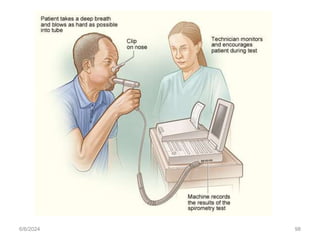
  • 317.
    Assessment and DiagnosticFindings • Bronchiectasis is not readily diagnosed because the symptoms can be mistaken for those of simple chronic bronchitis. • A definite sign is offered by the prolonged history of productive cough, with sputum consistently negative for tubercle bacilli. • The diagnosis is established by a computed tomography (CT) scan, which demonstrates either the presence or absence of bronchial dilation. 6/6/2024 321
  • 318.
    Treatment • Goal – Clearexcess drainage – Control infection • Chest physiotherapy • Smoking cessation • Antibiotics • Surgery (segment, lobe or entire lung) 6/6/2024 322
Editor's Notes