The State of the
Veil Framework
@harmj0y
@ChrisTruncer
Who We Are
●  Will Schroeder (@harmj0y)
o  Former national research lab keyboard monkey
●  Christopher Truncer (@ChrisTruncer)
o  Florida State Graduate - Go Noles!
●  Red Teamers, Pen Testers, and Security
Researchers for the Adaptive Threat Division
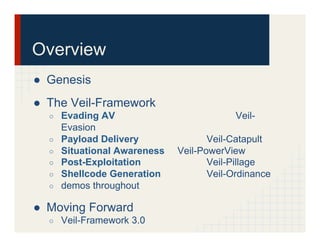
Overview
●  Genesis
●  The Veil-Framework
○  Evading AV Veil-
Evasion
○  Payload Delivery Veil-Catapult
○  Situational Awareness Veil-PowerView
○  Post-Exploitation Veil-Pillage
○  Shellcode Generation Veil-Ordinance
○  demos throughout
●  Moving Forward
○  Veil-Framework 3.0
Genesis
Where it all began
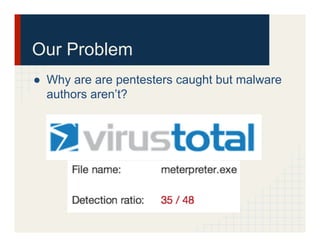
Our Problem
●  Why are are pentesters caught but malware
authors aren’t?
Our Initial Solution
●  Want a way to bypass antivirus “solutions”
as easily as professional malware
●  Minimize repetition
○  Don’t roll custom backdoors each assessment
●  Execute our agents on targets in a way that
bypasses most antivirus detection
The Veil-Framework
●  A toolset aiming to bridge the gap between
pentesting and red teaming capabilities
●  We started with Veil-Evasion, and began to
branch out to payload delivery and
PowerShell exploitation
●  Nothing revolutionary here, but want to bring
together existing techniques and incremental
research try to push things forward
Ethical Considerations
●  Similar parallels to the exploit disclosure
debate
●  The public community is typically 5+ years
behind professional malware developers
●  The blackhat industry has solved this
problem, why shouldn’t the whitehats as
well?
HD’s Take
●  “The strongest case for information
disclosure is when the benefit of
releasing the information outweighs the
possible risks. In this case, like many
others, the bad guys already won.”
●  https://community.rapid7.com/community/
metasploit/blog/2009/02/23/the-best-
defense-is-information
Public Reaction
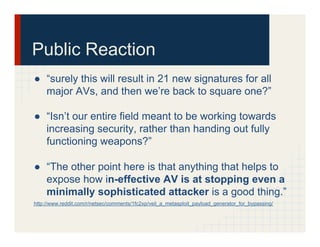
●  “surely this will result in 21 new signatures for all
major AVs, and then we’re back to square one?”
●  “Isn’t our entire field meant to be working towards
increasing security, rather than handing out fully
functioning weapons?”
●  “The other point here is that anything that helps to
expose how in-effective AV is at stopping even a
minimally sophisticated attacker is a good thing.”
http://www.reddit.com/r/netsec/comments/1fc2xp/veil_a_metasploit_payload_generator_for_bypassing/
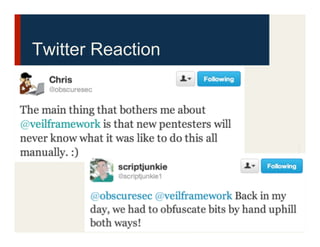
Twitter Reaction
Veil-Evasion
Efficient
Anti-Virus
Evasion
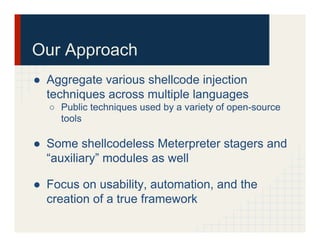
Our Approach
●  Aggregate various shellcode injection
techniques across multiple languages
○  Public techniques used by a variety of open-source
tools
●  Some shellcodeless Meterpreter stagers and
“auxiliary” modules as well
●  Focus on usability, automation, and the
creation of a true framework
Previous Work
●  Mark Baggett’s post
Tips for Evading Anti-Virus During Pen
Testing was the first public resource to talk
about using Python to inject shellcode
●  Dave Kennedy released PyInjector in 2012
●  We ended up mostly drawing from Debasish
Mandal's Execute ShellCode Using Python
o  Uses the VirtualAlloc/CreateThread/
WaitForSingleObject pattern
Features
●  Can use either Metasploit generated or
custom written shellcode
○  Metasploit Framework payloads/options are
dynamically loaded
●  Third-party tools can be easily integrated
○  Hyperion, PE Scrambler, Backdoor Factory, etc.
●  Command line switches add in scriptability
●  Check payload hashes against VirusTotal
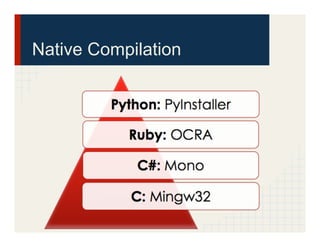
Native Compilation
Shellcode Injection 101
●  Void Pointer Casting
○  Can’t guarantee shellcode is in an executable part of
memory
●  VirtualAlloc
○  Allocate memory as RWX, inject and execute the
shellcode from the allocated section of memory
●  HeapAlloc
○  Creates a heap object, allocates memory, injects
and executes shellcode
Pwnstaller
●  What if some vendors trigger on the
Pyinstaller loader.exe itself?
●  How about a (reasonably) obfuscated
version of the Pyinstaller loader? :)
o  BSides Boston ‘14: Pwnstaller 1.0
o  https://github.com/harmj0y/pwnstaller/
●  Integrated into Veil-Evasion this past May
“Pure” Stagers
●  Stage 1 Meterpreter loaders don’t have to be
implemented in shellcode
●  Meterpreter stagers can be written in higher-
level languages
o  Thanks Raffi!
https://github.com/rsmudge/metasploit-loader
●  Lots of varieties in Python, C, PowerShell,
C# and Ruby
How Stagers Work
●  1) a tcp connection is opened to the handler
●  2) the handler sends back 4 bytes indicating
the .dll size, and then transfers the .dll
●  3) the socket number for this tcp connection
is pushed into the edi register
●  4) execution is passed to the .dll just like
regular shellcode (void * or VirtualAlloc)
●  reverse_http[s] stagers skip steps 2 and 3
V-Day
●  Our release cycle, modeled on Microsoft’s
Patch Tuesday :)
●  New modules are released on the 15th of
every month
●  Currently there are 34+ modules for use
○  We still have 20+ modules in a development or QA
state
●  We plan to keep #avloling for quite some
time
Veil-Evasion Demo
Veil-Catapult
Payload Delivery
Veil-Catapult
●  After payload generation, our focus moved
to payload delivery
●  Features integration with Veil-Evasion to
generate payloads, and can upload or host/
execute binaries on targets
o  additional methods (like PowerShell) as well
●  Obsoleted with the release of Veil-Pillage
Veil-Catapult
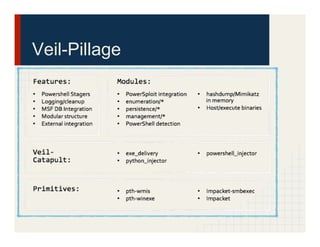
Veil-Pillage
Modular
Post-Exploitation
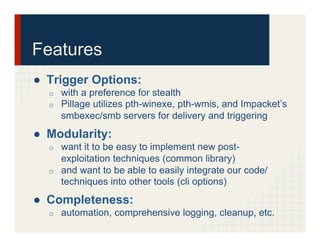
Features
●  Trigger Options:
o  with a preference for stealth
o  Pillage utilizes pth-winexe, pth-wmis, and Impacket’s
smbexec/smb servers for delivery and triggering
●  Modularity:
o  want it to be easy to implement new post-
exploitation techniques (common library)
o  and want to be able to easily integrate our code/
techniques into other tools (cli options)
●  Completeness:
o  automation, comprehensive logging, cleanup, etc.
Veil-Pillage
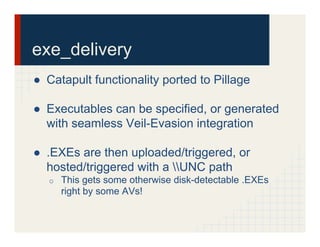
exe_delivery
●  Catapult functionality ported to Pillage
●  Executables can be specified, or generated
with seamless Veil-Evasion integration
●  .EXEs are then uploaded/triggered, or
hosted/triggered with a UNC path
o  This gets some otherwise disk-detectable .EXEs
right by some AVs!
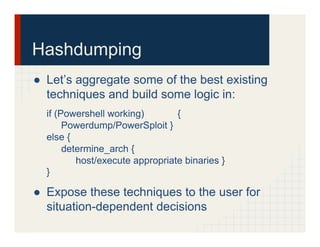
Hashdumping
●  Let’s aggregate some of the best existing
techniques and build some logic in:
if (Powershell working) {
Powerdump/PowerSploit }
else {
determine_arch {
host/execute appropriate binaries }
}
●  Expose these techniques to the user for
situation-dependent decisions
powersploit/*
●  Several PowerSploit modules are included in
Pillage
●  A web server is stood up in the background
o  the ‘IEX (New-Object
Net.WebClient).DownloadString(...)’ cradle is
transparently triggered
●  Makes it easy to run PowerSploit across
multiple machines
Veil-PowerView
Situational
Awareness with
PowerShell
Veil-PowerView
●  Pure PowerShell situational awareness tool
●  Arose partially because a client banned “net”
commands on domain machines
●  Otherwise initially inspired by Rob Fuller’s
netview.exe tool
○  Wanted something a bit more flexible that also didn’t
drop a binary to disk
●  Started to explore and expand functionality
Get-Net*
●  Full-featured replacements for almost all “net
*” commands, utilizing Powershell AD hooks
and various API calls
o  Get-NetUsers, Get-NetGroup, Get-NetServers, Get-
NetSessions, Get-NetLoggedon, etc.
●  Think dsquery on steroids
●  See README.md for complete list, and
function descriptions for usage options
The Fun Stuff
●  Invoke-Netview: netview.exe replacement
●  Invoke-ShareFinder: finds open shares on
the network and checks if you have read
access
●  Invoke-FindLocalAdminAccess: port of
local_admin_search_enum.rb Metaspoit
module
●  Invoke-FindVulnSystems: queries AD for
machines likely vulnerable to MS08-067
User-Hunting
●  Goal: find which machines specific users are
logged into
●  Invoke-UserHunter: finds where target
users or group members are logged into on
the network
●  Invoke-StealthUserHunter: extracts user
HomeDirectories from AD, and runs Get-
NetSessions on file servers to hunt for
targets
o  Significantly less traffic than Invoke-UserHunter
Domain Trusts
●  PowerView can now enumerate and exploit
existing domain trusts:
o  Get-NetDomainTrusts: enumerates all existing
domain trusts, à la nltest
o  Invoke-MapDomainTrusts: recursively maps all
reachable trusts
●  Most PowerView functions now accept a
“-Domain <name>” flag, allowing them to
operate across trusts
o  e.g. Get-NetUsers –Domain sub.test.local will
enumerate all the users from the sub.test.local
domain if an implicit trust exists
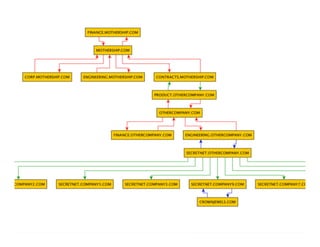
Sidenote:
Mapping Domain Trusts
●  Another ATD member recently released
http://sixdub.net/2014/10/nodal-analysis-of-
domain-trusts-maximizing-the-win/
●  Shows you how to take output from Invoke-
MapDomainTrusts and perform nodal
analysis on it (centrality, etc.)
●  Also, can make neat looking graphs :)
Veil-PowerView Demo
Veil-Ordinance
Fast
Shellcode
Generation
Veil-Evasion and Shellcode
●  Veil-Evasion outsources its shellcode
generation capabilities to msfvenom
●  Reliance on outside tools can sometimes
cause complications:
○  If msfvenom output changes, our parsing can break
■  This has happened twice :(
○  Speed - MSF can be slow to start (even when
instantiating the simplified framework)
What we need
●  We need a tool that generates shellcode
○  Output doesn’t change
■  Allows us to easily control what we
want to parse
○  Still provide bad character avoidance
○  Speed is always nice too
●  Encoders! Send us any/all python POCs!
○  We will slowly work through MSF encoders
●  Feedback!
Veil-Ordnance
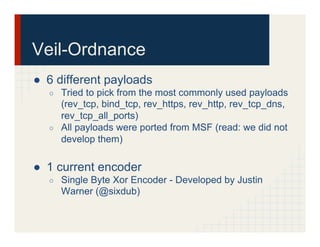
●  6 different payloads
○  Tried to pick from the most commonly used payloads
(rev_tcp, bind_tcp, rev_https, rev_http, rev_tcp_dns,
rev_tcp_all_ports)
○  All payloads were ported from MSF (read: we did not
develop them)
●  1 current encoder
○  Single Byte Xor Encoder - Developed by Justin
Warner (@sixdub)
Veil-Ordinance Demo
Moving
Forward
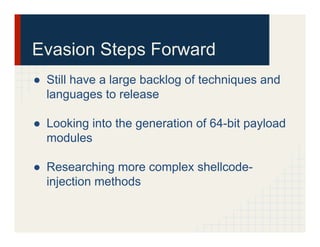
Evasion Steps Forward
●  Still have a large backlog of techniques and
languages to release
●  Looking into the generation of 64-bit payload
modules
●  Researching more complex shellcode-
injection methods
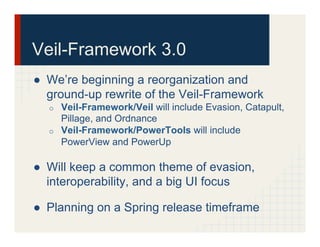
Veil-Framework 3.0
●  We’re beginning a reorganization and
ground-up rewrite of the Veil-Framework
o  Veil-Framework/Veil will include Evasion, Catapult,
Pillage, and Ordnance
o  Veil-Framework/PowerTools will include
PowerView and PowerUp
●  Will keep a common theme of evasion,
interoperability, and a big UI focus
●  Planning on a Spring release timeframe
Questions?
●  harmj0y@veil-framework.com
o  @harmj0y
●  chris@veil-framework.com
o  @ChrisTruncer
●  #veil on freenode
●  https://www.veil-framework.com

The State of the Veil Framework

  • 1.
    The State ofthe Veil Framework @harmj0y @ChrisTruncer
  • 2.
    Who We Are ● Will Schroeder (@harmj0y) o  Former national research lab keyboard monkey ●  Christopher Truncer (@ChrisTruncer) o  Florida State Graduate - Go Noles! ●  Red Teamers, Pen Testers, and Security Researchers for the Adaptive Threat Division
  • 3.
    Overview ●  Genesis ●  TheVeil-Framework ○  Evading AV Veil- Evasion ○  Payload Delivery Veil-Catapult ○  Situational Awareness Veil-PowerView ○  Post-Exploitation Veil-Pillage ○  Shellcode Generation Veil-Ordinance ○  demos throughout ●  Moving Forward ○  Veil-Framework 3.0
  • 4.
  • 5.
    Our Problem ●  Whyare are pentesters caught but malware authors aren’t?
  • 6.
    Our Initial Solution ● Want a way to bypass antivirus “solutions” as easily as professional malware ●  Minimize repetition ○  Don’t roll custom backdoors each assessment ●  Execute our agents on targets in a way that bypasses most antivirus detection
  • 7.
    The Veil-Framework ●  Atoolset aiming to bridge the gap between pentesting and red teaming capabilities ●  We started with Veil-Evasion, and began to branch out to payload delivery and PowerShell exploitation ●  Nothing revolutionary here, but want to bring together existing techniques and incremental research try to push things forward
  • 8.
    Ethical Considerations ●  Similarparallels to the exploit disclosure debate ●  The public community is typically 5+ years behind professional malware developers ●  The blackhat industry has solved this problem, why shouldn’t the whitehats as well?
  • 9.
    HD’s Take ●  “Thestrongest case for information disclosure is when the benefit of releasing the information outweighs the possible risks. In this case, like many others, the bad guys already won.” ●  https://community.rapid7.com/community/ metasploit/blog/2009/02/23/the-best- defense-is-information
  • 10.
    Public Reaction ●  “surelythis will result in 21 new signatures for all major AVs, and then we’re back to square one?” ●  “Isn’t our entire field meant to be working towards increasing security, rather than handing out fully functioning weapons?” ●  “The other point here is that anything that helps to expose how in-effective AV is at stopping even a minimally sophisticated attacker is a good thing.” http://www.reddit.com/r/netsec/comments/1fc2xp/veil_a_metasploit_payload_generator_for_bypassing/
  • 11.
  • 12.
  • 13.
    Our Approach ●  Aggregatevarious shellcode injection techniques across multiple languages ○  Public techniques used by a variety of open-source tools ●  Some shellcodeless Meterpreter stagers and “auxiliary” modules as well ●  Focus on usability, automation, and the creation of a true framework
  • 14.
    Previous Work ●  MarkBaggett’s post Tips for Evading Anti-Virus During Pen Testing was the first public resource to talk about using Python to inject shellcode ●  Dave Kennedy released PyInjector in 2012 ●  We ended up mostly drawing from Debasish Mandal's Execute ShellCode Using Python o  Uses the VirtualAlloc/CreateThread/ WaitForSingleObject pattern
  • 15.
    Features ●  Can useeither Metasploit generated or custom written shellcode ○  Metasploit Framework payloads/options are dynamically loaded ●  Third-party tools can be easily integrated ○  Hyperion, PE Scrambler, Backdoor Factory, etc. ●  Command line switches add in scriptability ●  Check payload hashes against VirusTotal
  • 16.
  • 17.
    Shellcode Injection 101 ● Void Pointer Casting ○  Can’t guarantee shellcode is in an executable part of memory ●  VirtualAlloc ○  Allocate memory as RWX, inject and execute the shellcode from the allocated section of memory ●  HeapAlloc ○  Creates a heap object, allocates memory, injects and executes shellcode
  • 18.
    Pwnstaller ●  What ifsome vendors trigger on the Pyinstaller loader.exe itself? ●  How about a (reasonably) obfuscated version of the Pyinstaller loader? :) o  BSides Boston ‘14: Pwnstaller 1.0 o  https://github.com/harmj0y/pwnstaller/ ●  Integrated into Veil-Evasion this past May
  • 19.
    “Pure” Stagers ●  Stage1 Meterpreter loaders don’t have to be implemented in shellcode ●  Meterpreter stagers can be written in higher- level languages o  Thanks Raffi! https://github.com/rsmudge/metasploit-loader ●  Lots of varieties in Python, C, PowerShell, C# and Ruby
  • 20.
    How Stagers Work ● 1) a tcp connection is opened to the handler ●  2) the handler sends back 4 bytes indicating the .dll size, and then transfers the .dll ●  3) the socket number for this tcp connection is pushed into the edi register ●  4) execution is passed to the .dll just like regular shellcode (void * or VirtualAlloc) ●  reverse_http[s] stagers skip steps 2 and 3
  • 21.
    V-Day ●  Our releasecycle, modeled on Microsoft’s Patch Tuesday :) ●  New modules are released on the 15th of every month ●  Currently there are 34+ modules for use ○  We still have 20+ modules in a development or QA state ●  We plan to keep #avloling for quite some time
  • 22.
  • 23.
  • 24.
  • 25.
    ●  After payloadgeneration, our focus moved to payload delivery ●  Features integration with Veil-Evasion to generate payloads, and can upload or host/ execute binaries on targets o  additional methods (like PowerShell) as well ●  Obsoleted with the release of Veil-Pillage Veil-Catapult
  • 26.
  • 27.
    Features ●  Trigger Options: o with a preference for stealth o  Pillage utilizes pth-winexe, pth-wmis, and Impacket’s smbexec/smb servers for delivery and triggering ●  Modularity: o  want it to be easy to implement new post- exploitation techniques (common library) o  and want to be able to easily integrate our code/ techniques into other tools (cli options) ●  Completeness: o  automation, comprehensive logging, cleanup, etc.
  • 28.
  • 29.
    exe_delivery ●  Catapult functionalityported to Pillage ●  Executables can be specified, or generated with seamless Veil-Evasion integration ●  .EXEs are then uploaded/triggered, or hosted/triggered with a UNC path o  This gets some otherwise disk-detectable .EXEs right by some AVs!
  • 30.
    Hashdumping ●  Let’s aggregatesome of the best existing techniques and build some logic in: if (Powershell working) { Powerdump/PowerSploit } else { determine_arch { host/execute appropriate binaries } } ●  Expose these techniques to the user for situation-dependent decisions
  • 31.
    powersploit/* ●  Several PowerSploitmodules are included in Pillage ●  A web server is stood up in the background o  the ‘IEX (New-Object Net.WebClient).DownloadString(...)’ cradle is transparently triggered ●  Makes it easy to run PowerSploit across multiple machines
  • 32.
  • 33.
    Veil-PowerView ●  Pure PowerShellsituational awareness tool ●  Arose partially because a client banned “net” commands on domain machines ●  Otherwise initially inspired by Rob Fuller’s netview.exe tool ○  Wanted something a bit more flexible that also didn’t drop a binary to disk ●  Started to explore and expand functionality
  • 34.
    Get-Net* ●  Full-featured replacementsfor almost all “net *” commands, utilizing Powershell AD hooks and various API calls o  Get-NetUsers, Get-NetGroup, Get-NetServers, Get- NetSessions, Get-NetLoggedon, etc. ●  Think dsquery on steroids ●  See README.md for complete list, and function descriptions for usage options
  • 35.
    The Fun Stuff ● Invoke-Netview: netview.exe replacement ●  Invoke-ShareFinder: finds open shares on the network and checks if you have read access ●  Invoke-FindLocalAdminAccess: port of local_admin_search_enum.rb Metaspoit module ●  Invoke-FindVulnSystems: queries AD for machines likely vulnerable to MS08-067
  • 36.
    User-Hunting ●  Goal: findwhich machines specific users are logged into ●  Invoke-UserHunter: finds where target users or group members are logged into on the network ●  Invoke-StealthUserHunter: extracts user HomeDirectories from AD, and runs Get- NetSessions on file servers to hunt for targets o  Significantly less traffic than Invoke-UserHunter
  • 37.
    Domain Trusts ●  PowerViewcan now enumerate and exploit existing domain trusts: o  Get-NetDomainTrusts: enumerates all existing domain trusts, à la nltest o  Invoke-MapDomainTrusts: recursively maps all reachable trusts ●  Most PowerView functions now accept a “-Domain <name>” flag, allowing them to operate across trusts o  e.g. Get-NetUsers –Domain sub.test.local will enumerate all the users from the sub.test.local domain if an implicit trust exists
  • 38.
    Sidenote: Mapping Domain Trusts ● Another ATD member recently released http://sixdub.net/2014/10/nodal-analysis-of- domain-trusts-maximizing-the-win/ ●  Shows you how to take output from Invoke- MapDomainTrusts and perform nodal analysis on it (centrality, etc.) ●  Also, can make neat looking graphs :)
  • 40.
  • 41.
  • 42.
    Veil-Evasion and Shellcode ● Veil-Evasion outsources its shellcode generation capabilities to msfvenom ●  Reliance on outside tools can sometimes cause complications: ○  If msfvenom output changes, our parsing can break ■  This has happened twice :( ○  Speed - MSF can be slow to start (even when instantiating the simplified framework)
  • 43.
    What we need ● We need a tool that generates shellcode ○  Output doesn’t change ■  Allows us to easily control what we want to parse ○  Still provide bad character avoidance ○  Speed is always nice too ●  Encoders! Send us any/all python POCs! ○  We will slowly work through MSF encoders ●  Feedback!
  • 44.
    Veil-Ordnance ●  6 differentpayloads ○  Tried to pick from the most commonly used payloads (rev_tcp, bind_tcp, rev_https, rev_http, rev_tcp_dns, rev_tcp_all_ports) ○  All payloads were ported from MSF (read: we did not develop them) ●  1 current encoder ○  Single Byte Xor Encoder - Developed by Justin Warner (@sixdub)
  • 45.
  • 46.
  • 47.
    Evasion Steps Forward ● Still have a large backlog of techniques and languages to release ●  Looking into the generation of 64-bit payload modules ●  Researching more complex shellcode- injection methods
  • 48.
    Veil-Framework 3.0 ●  We’rebeginning a reorganization and ground-up rewrite of the Veil-Framework o  Veil-Framework/Veil will include Evasion, Catapult, Pillage, and Ordnance o  Veil-Framework/PowerTools will include PowerView and PowerUp ●  Will keep a common theme of evasion, interoperability, and a big UI focus ●  Planning on a Spring release timeframe
  • 49.
    Questions? ●  harmj0y@veil-framework.com o  @harmj0y ● chris@veil-framework.com o  @ChrisTruncer ●  #veil on freenode ●  https://www.veil-framework.com