Human Biology
Chemical and the body
Dr. jassim Mohammed Abdo
-2-
2
Human Biology
Chemical and the body
I. Elements:
– Substances that can not be broken down into
simpler substances by chemical reactions.
– There are 92 naturally occurring elements:
Oxygen, carbon, nitrogen, calcium, sodium, etc.
• Life requires about 25 of the 92 elements
• Chemical Symbols:
– Abbreviations for the name of each element.
– Usually one or two letters of the English or Latin
name of the element
– First letter upper case, second letter lower case.
Example: Helium (He), sodium (Na), potassium
(K), gold (Au).
• Main Elements: Over 98% of an organism’s mass is
made up of six elements.
– Oxygen (O): 65% body mass
• Cellular respiration, component of water, and most
organic compounds.
– Carbon (C): 18% of body mass.
• Backbone of all organic compounds.
– Hydrogen (H): 10% of body mass.
• Component of water and most organic compounds.
– Nitrogen (N): 3% of body mass.
• Component of proteins and nucleic acids (DNA/RNA)
– Calcium (Ca): 1.5% of body mass.
• Bones, teeth, clotting, muscle and nerve function.
– Phosphorus (P): 1% of body mass
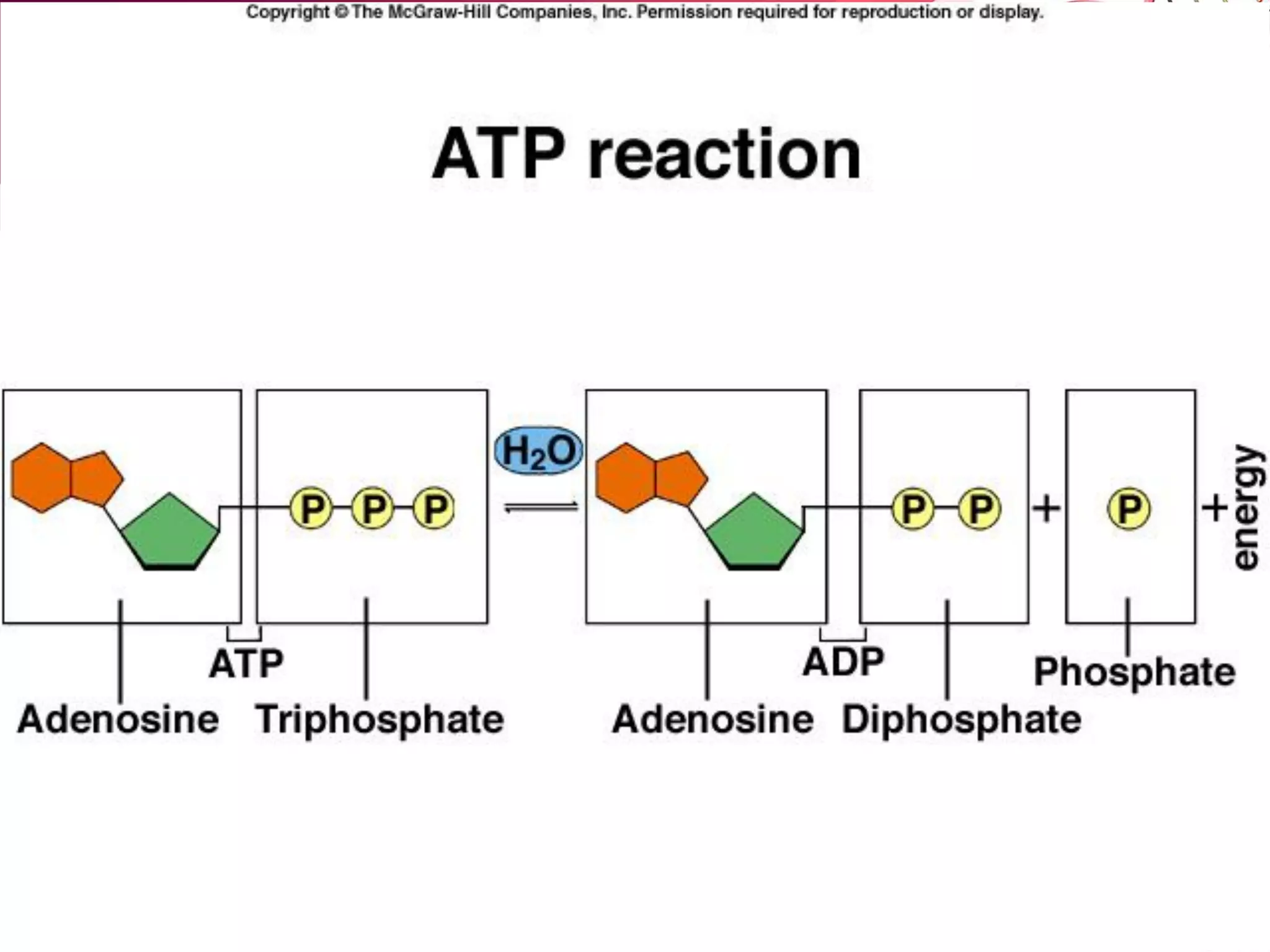
• Bones, nucleic acids, energy transfer (ATP).
• Minor Elements: Found in low amounts. Between
1% and 0.01%.
– Potassium (K): Main positive ion inside cells.
• Nerve and muscle function.
– Sulfur (S): Component of most proteins.
– Sodium (Na): Main positive ion outside cells.
• Fluid balance, nerve function.
– Chlorine (Cl): Main negative ion outside cells.
• Fluid balance.
– Magnesium (Mg): Component of many
enzymes and chlorophyll.
• Trace elements: Less than 0.01% of mass:
– Boron (B)
– Chromium (Cr)
– Cobalt (Co)
– Copper (Cu)
– Iron (Fe)
– Fluorine (F)
– Iodine (I)
– Manganese (Mn)
– Molybdenum (Mo)
– Selenium (Se)
– Silicon (Si)
– Tin (Sn)
– Vanadium (V)
– Zinc (Zn)
II. Structure & Properties of Atoms
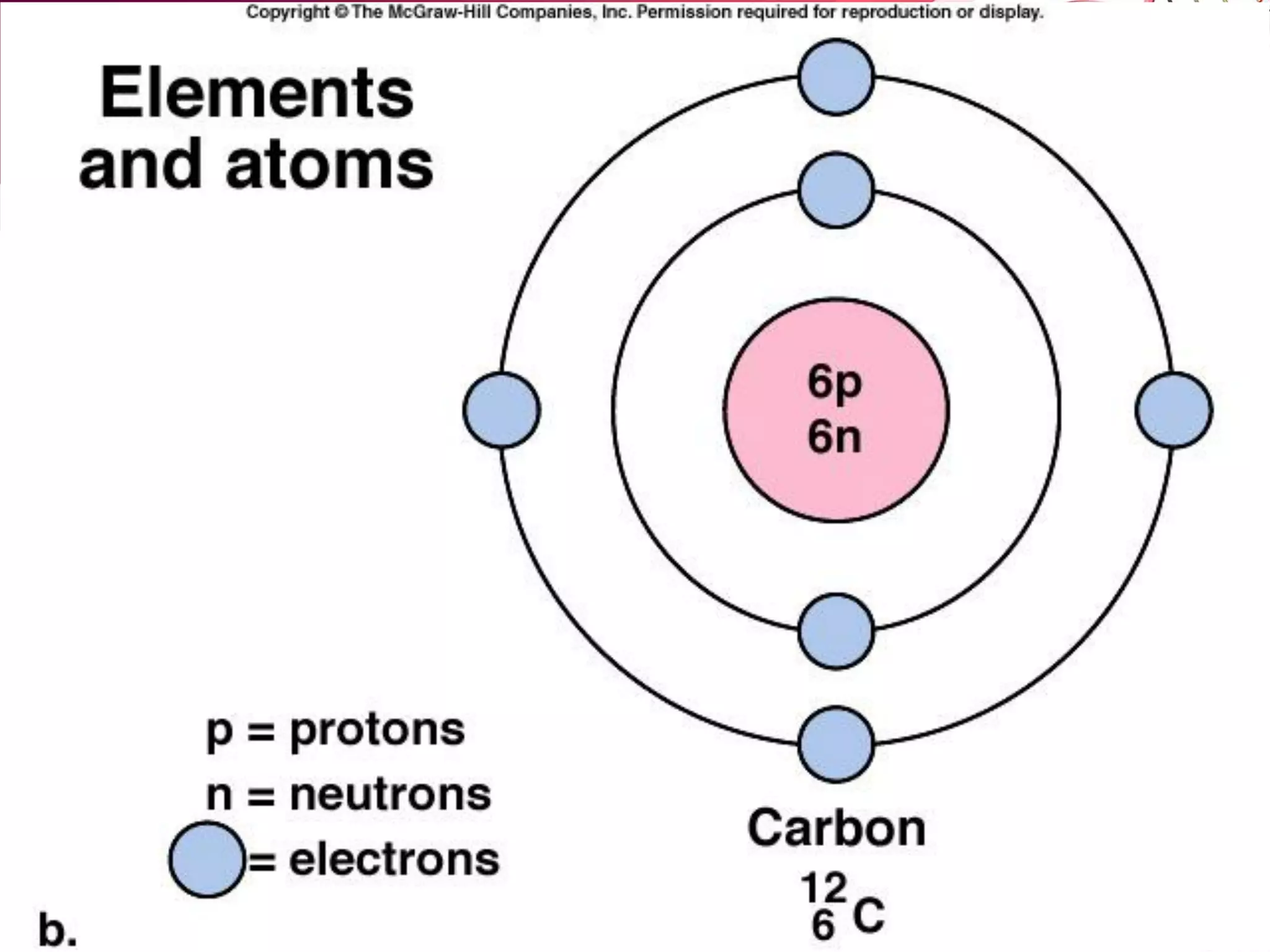
Atoms: Smallest particle of an element that
retains its chemical properties. Made up of three
main subatomic particles.
Particle Location Mass Charge
Proton (p+) In nucleus 1 +1
Neutron (no) In nucleus 1 0
Electron (e-) Outside nucleus 0 -1
Structure and Properties of Atoms
1. Atomic number = # protons
– The number of protons is unique for each element
– Each element has a fixed number of protons in its
nucleus. This number will never change for a given
element.
– Written as a subscript to left of element symbol.
Examples: 6C, 8O, 16S, 20Ca
– Because atoms are electrically neutral (no charge),
the number of electrons and protons are always the
same.
– In the periodic table elements are organized by
increasing atomic number.
Structure and Properties of Atoms:
2. Mass number = # protons + # neutrons
– Gives the mass of a specific atom.
– Written as a superscript to the left of the element
symbol.
Examples: 12C, 16O, 32S, 40Ca.
– The number of protons for an element is always the
same, but the number of neutrons may vary.
– The number of neutrons can be determined by:
# neutrons = Mass number - Atomic number
Structure and Properties of Atoms:
3. Isotopes: Variant forms of the same element.
– Isotopes have different numbers of neutrons
and therefore different masses.
– Isotopes have the same numbers of protons and
electrons.
– Example: In nature there are three forms or
isotopes of carbon (6C):
• 12C: About 99% of atoms. Have 6 p+, 6 no, and 6 e-.
• 13C: About 1% of atoms. Have 6 p+, 7 no, and 6 e-.
• 14C: Found in tiny quantities. Have 6 p+, 8 no, and 6 e-.
Radioactive form (unstable). Used for dating
fossils.
Electron Arrangements of Important Elements of Life
1 Valence electron 4 Valence electrons 5 Valence electrons 6 Valence electrons
III. How Atoms Form Molecules: Chemical
Bonds
Molecule: Two or more atoms combined chemically.
Compound: A substance with two or more elements
combined in a fixed ratio.
• Water (H2O)
• Hydrogen peroxide (H2O2)
• Carbon dioxide (CO2)
• Carbon monoxide (CO)
• Table salt (NaCl)
– Atoms are linked by chemical bonds.
Chemical Formula: Describes the chemical composition of
a molecule of a compound.
– Symbols indicate the type of atoms
– Subscripts indicate the number of atoms
How Atoms Form Molecules:
Chemical Bonds
Atoms can lose, gain, or share electrons to satisfy
octet rule (fill outermost shell).
Two main types of Chemical Bonds
A. Ionic bond: Atoms gain or lose electrons
B. Covalent bond: Atoms share electrons
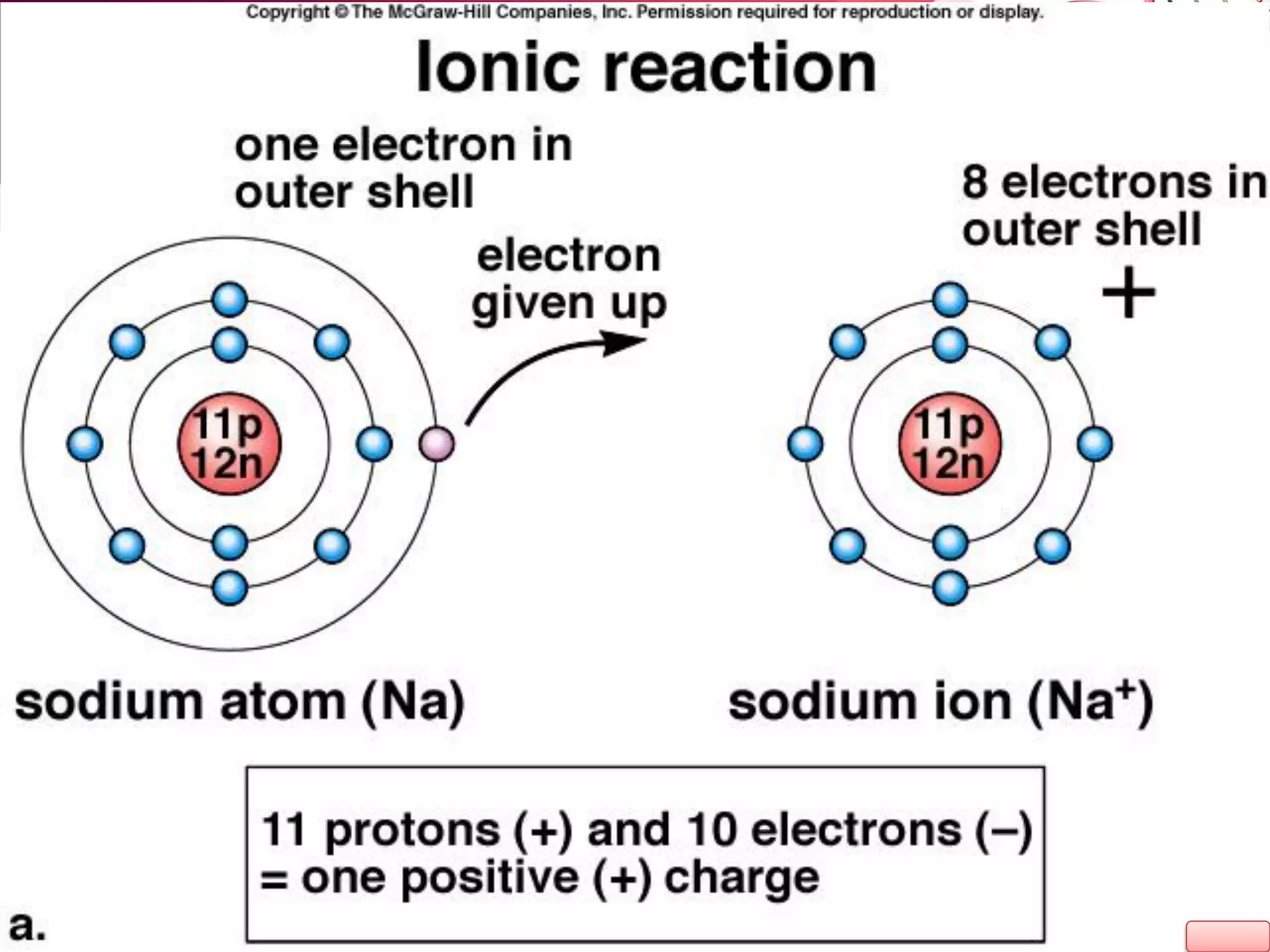
A. Ionic Bond: Atoms gain or lose electrons.
Bonds are attractions between ions of opposite
charge.
Ionic compound: One consisting of ionic bonds.
Na + Cl ----------> Na+ Cl-
sodium chlorine Table salt
(Sodium chloride)
Two Types of Ions:
Anions: Negatively charged particle (Cl-)
Cations: Positively charged particle (Na+)
B. Covalent Bond: Involves the “sharing” of one
or more pairs of electrons between atoms.
Covalent compound: One consisting of
covalent bonds.
Example: Methane (CH4): Main component
of natural gas.
H
|
H---C---H
|
H
Each line represents on shared pair of electrons.
Octet rule is satisfied: Carbon has 8 electrons,
Hydrogen has 2 electrons
Electronegativity: A measure of an atom’s
ability to attract and hold onto a shared
pair of electrons.
Some atoms such as oxygen or nitrogen
have a much higher electronegativity than
others, such as carbon and hydrogen.
Two Types of Covalent Bonds: Polar and Nonpolar
Polar and Nonpolar Covalent Bonds
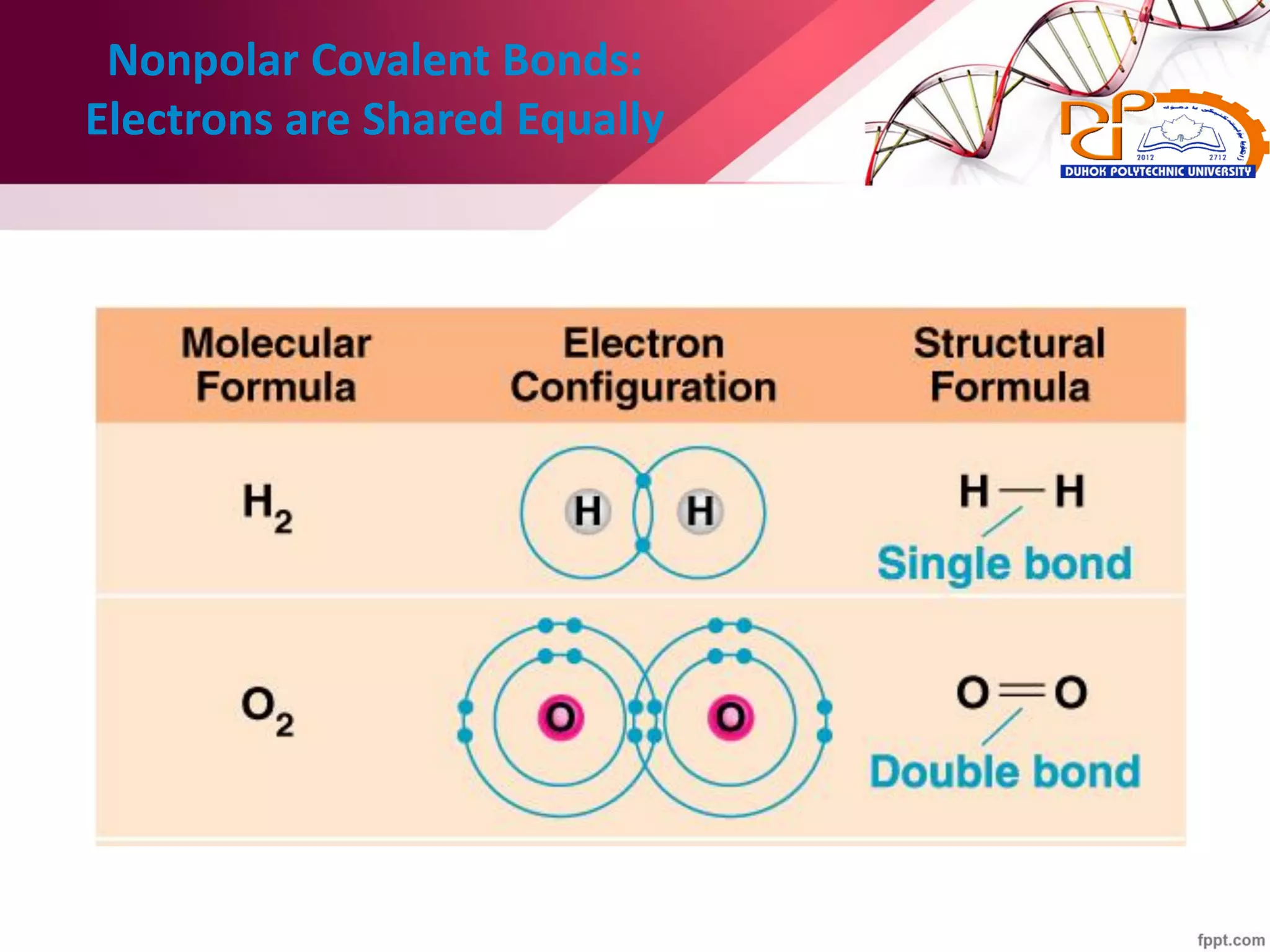
A. Nonpolar Covalent Bond: When the
atoms in a bond have equal or similar
attraction for the electrons
(electronegativity), they are shared equally.
Example: O2, H2, Cl2
Nonpolar Covalent Bonds:
Electrons are Shared Equally
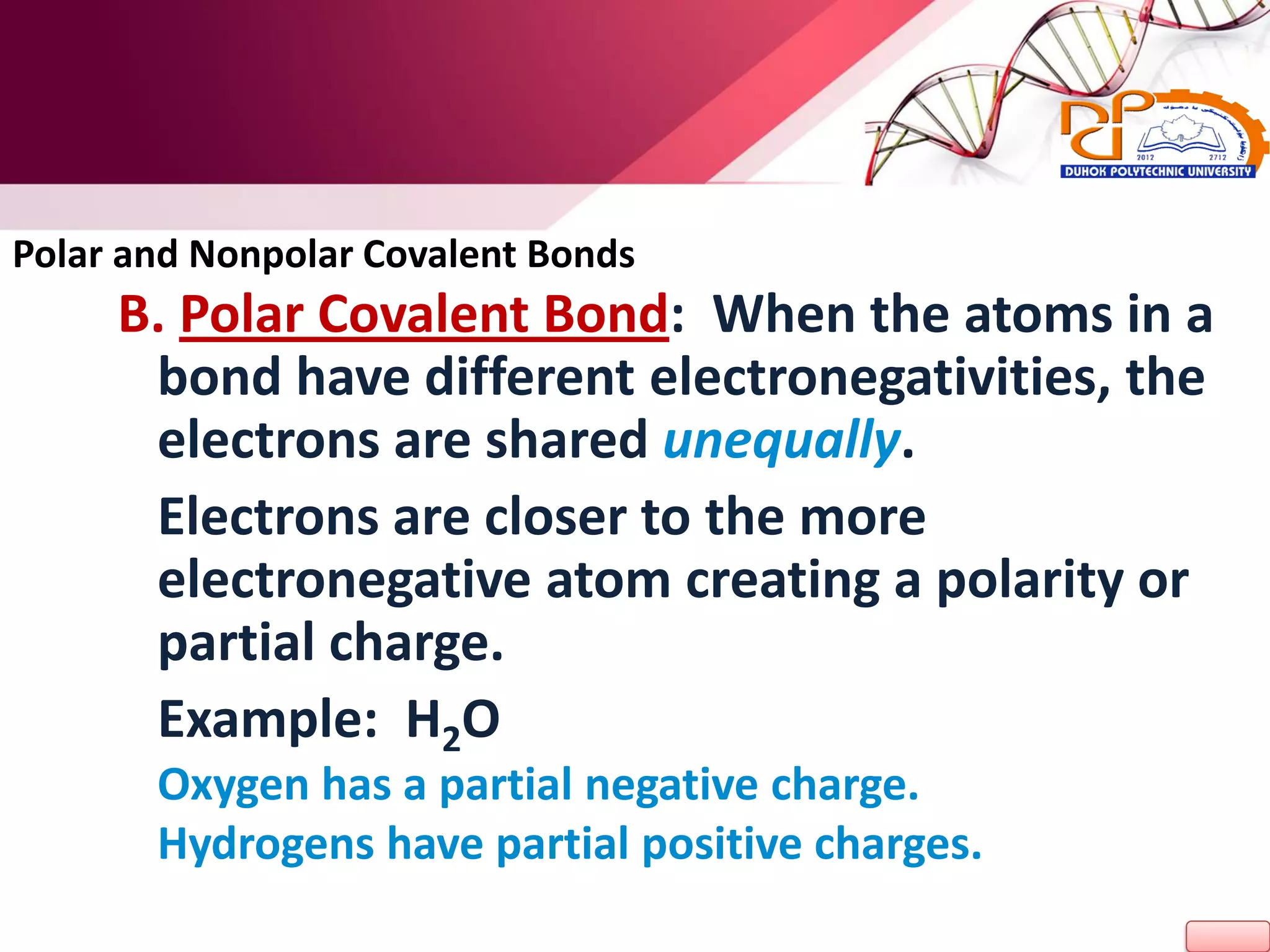
B. Polar Covalent Bond: When the atoms in a
bond have different electronegativities, the
electrons are shared unequally.
Electrons are closer to the more
electronegative atom creating a polarity or
partial charge.
Example: H2O
Oxygen has a partial negative charge.
Hydrogens have partial positive charges.
Polar and Nonpolar Covalent Bonds
Other Bonds: Weak chemical bonds are important in the
chemistry of living things.
• Hydrogen bonds: Attraction between the partially positive H
of one molecule and a partially negative atom of another
– Hydrogen bonds are about 20 X easier to break than a
normal covalent bond.
– Responsible for many properties of water.
– Determine 3 dimensional shape of DNA and proteins.
– Chemical signaling (molecule to receptor).
– Living cells are 70-90% water
– Water covers 3/4 of earth’s surface
– Water is the ideal solvent for chemical
reactions
– On earth, water exists as gas, liquid,
and solid
Water: The Ideal Compound for Life
I. Polarity of water causes hydrogen bonding
– Water molecules are held together by H-
bonding
– Partially positive H attracted to partially
negative O atom.
• Individual H bond are weak, but the cumulative
effect of many H bonds is very strong.
• H bonds only last a fraction of a second, but at any
moment most molecules are hydrogen bonded to
others.
Unique properties of water caused by H-bonds
– Cohesion: Water molecules stick to each other.
This causes surface tension.
– Adhesion: Water sticks to many surfaces.
Capillary Action: Water tends to rise in narrow
tubes.
Unique properties of water caused by H-bonds
– Universal Solvent: Dissolves many (but not all) substances to
form solutions.
Solutions are homogeneous mixtures of two or more
substances (salt water, air, tap water).
All solutions have at least two components:
• Solvent: Dissolving substance (water, alcohol, oil).
– Aqueous solution: If solvent is water.
• Solute: Substance that is dissolved (salt, sugar, CO2).
– Water dissolves polar and ionic solutes well.
– Water does not dissolve nonpolar solvents well.
Solubility of a Solute Depends on its
Chemical Nature
Solubility: Ability of substance to dissolve in a given
solvent.
Two Types of Solutes:
A. Hydrophilic: “Water loving” dissolve easily in
water.
• Ionic compounds (e.g. salts)
• Polar compounds (molecules with polar regions)
• Examples: Compounds with -OH groups (alcohols).
• “Like dissolves in like”
Solubility of a Solute Depends on its
Chemical Nature
Two Types of Solutes:
B. Hydrophobic: “Water fearing” do not
dissolve in water
• Non-polar compounds (lack polar regions)
• Examples: Hydrocarbons with only C-H non-polar
bonds, oils, gasoline, waxes, fats, etc.
ACIDS, BASES, pH AND BUFFERS
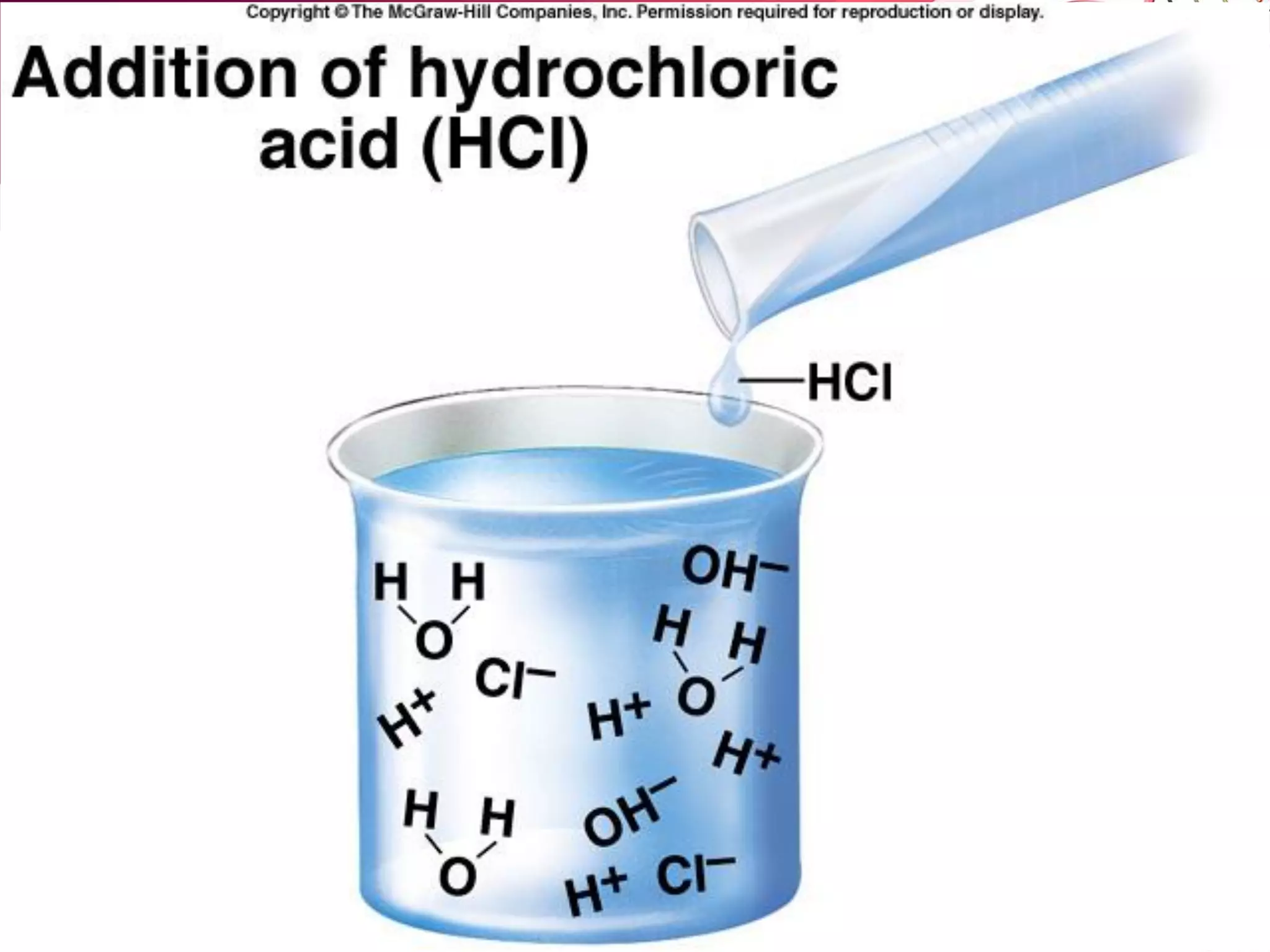
A. Acid: A substance that donates protons (H+).
– Separate into one or more protons and an anion:
HCl (into H2O ) -------> H+ + Cl-
H2SO4 (into H2O ) --------> H+ + HSO4
-
– Acids INCREASE the relative [H+] of a solution.
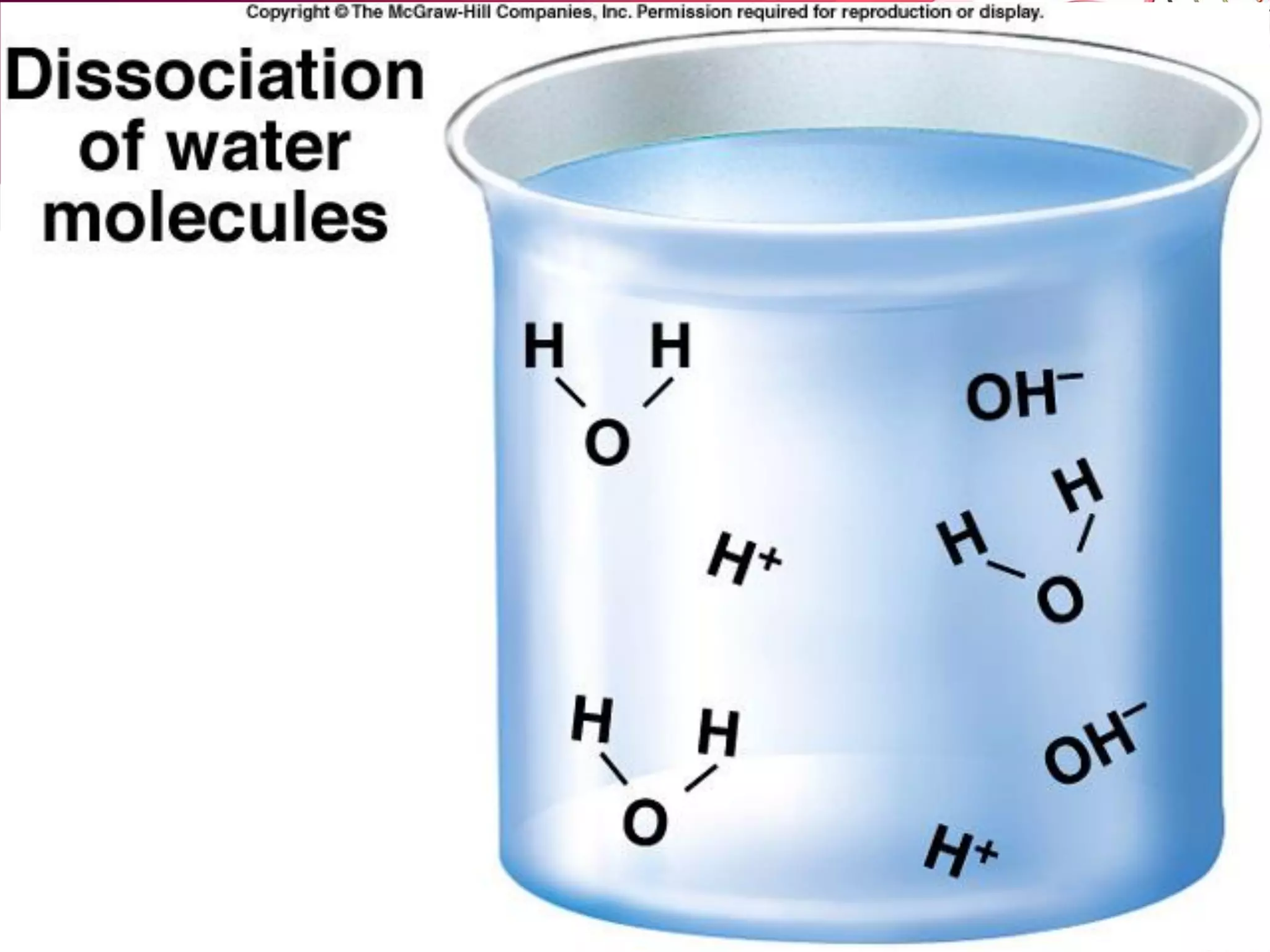
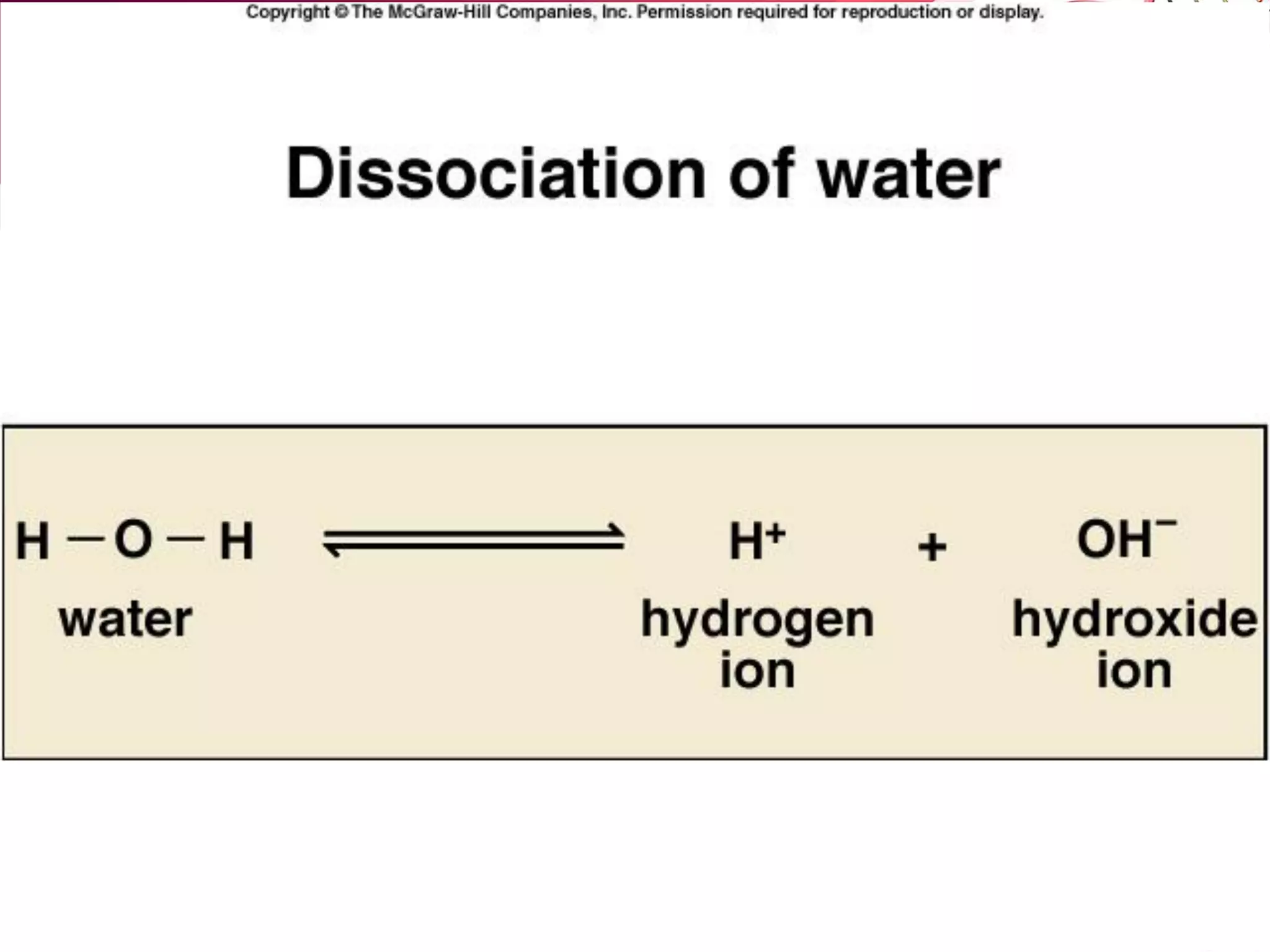
– Water can also dissociate into ions, at low levels:
H2O <======> H+ + OH-
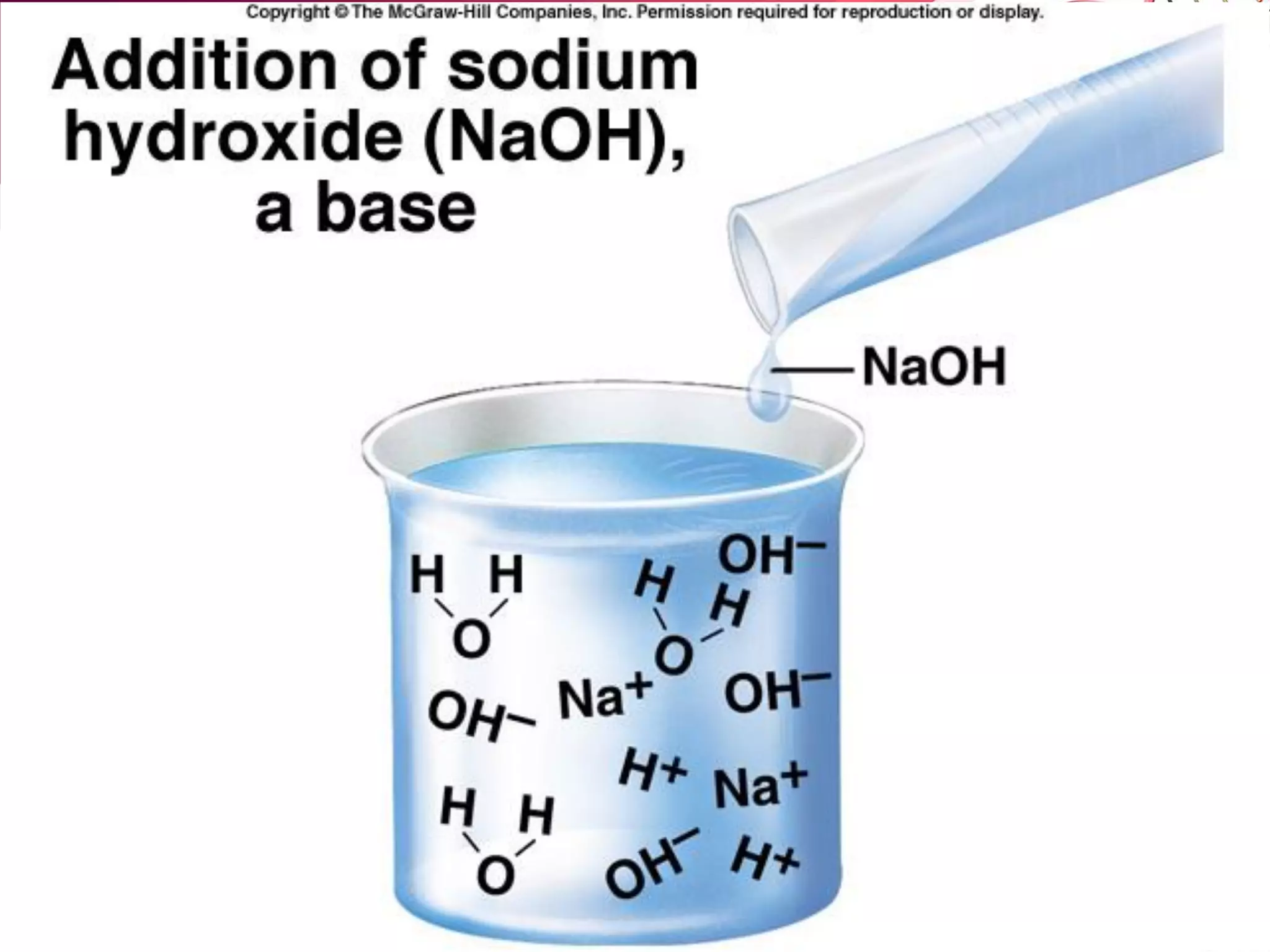
B. Base: A substance that accepts protons (H+).
– Many bases separate into one or more positive ions
(cations) and a hydroxyl group (OH- ).
– Bases DECREASE the relative [H+] of a solution ( and
increases the relative [OH-] ).
H2O <======> H+ + OH-
Directly NH3 + H+ <=------> NH4
+
Indirectly NaOH ---------> Na+ + OH-
( H+ + OH- <=====> H2O )
Strong acids and bases: Dissociation is almost complete
(99% or more of molecules).
HCl (aq) -------------> H+ + Cl-
NaOH (aq) -----------> Na+ + OH-
(L.T. 1% in this form) (G.T. 99% in dissociated form)
• A relatively small amount of a strong acid or base will
drastically affect the pH of solution.
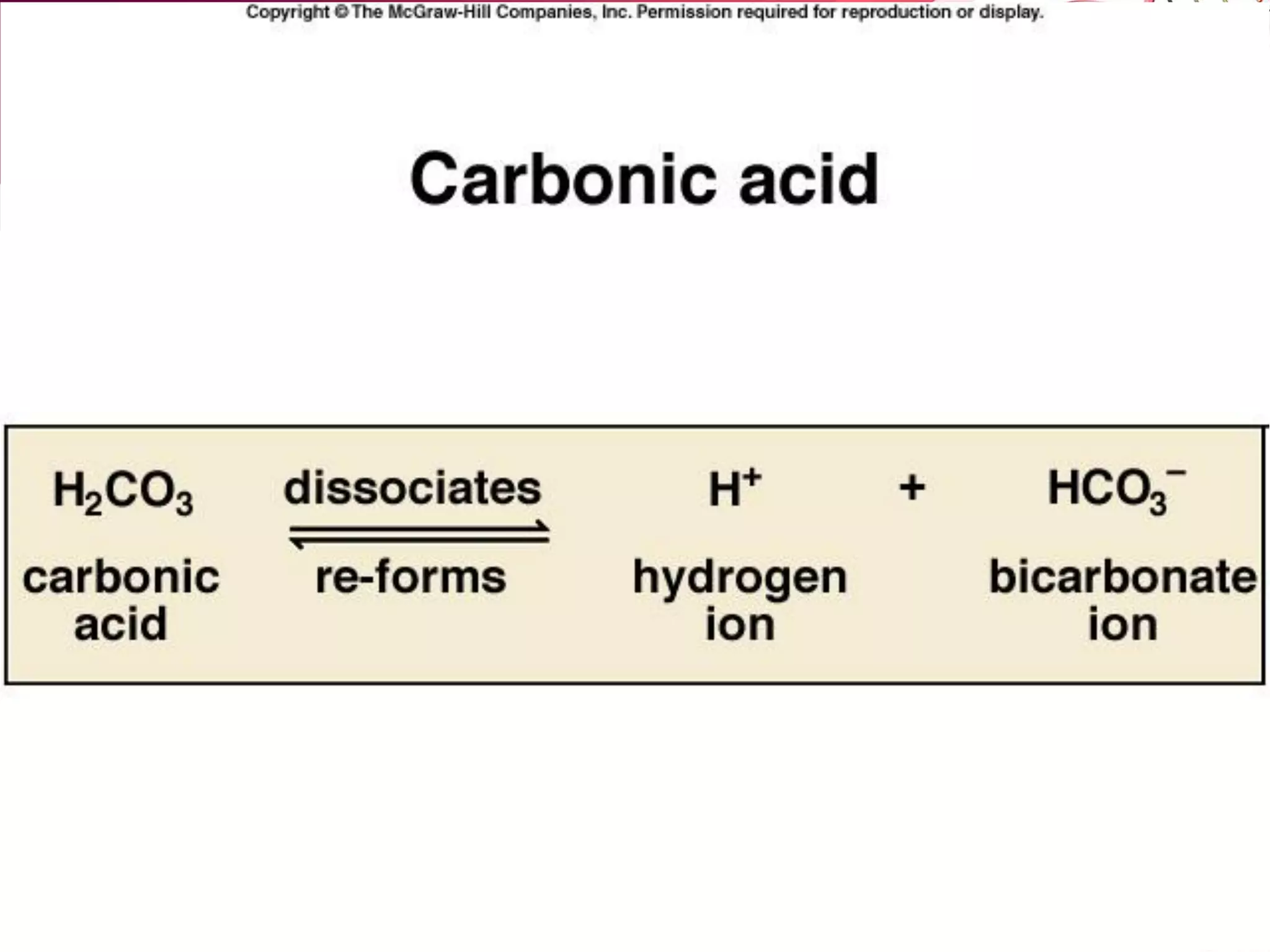
Weak acids and bases: A small percentage of molecules
dissociate at a give time (1% or less)
H2CO3 <=====> H+ + HCO3
-
carbonic acid Bicarbonate ion
(G.T. 99% in this form) (L.T. 1% in dissociated form)
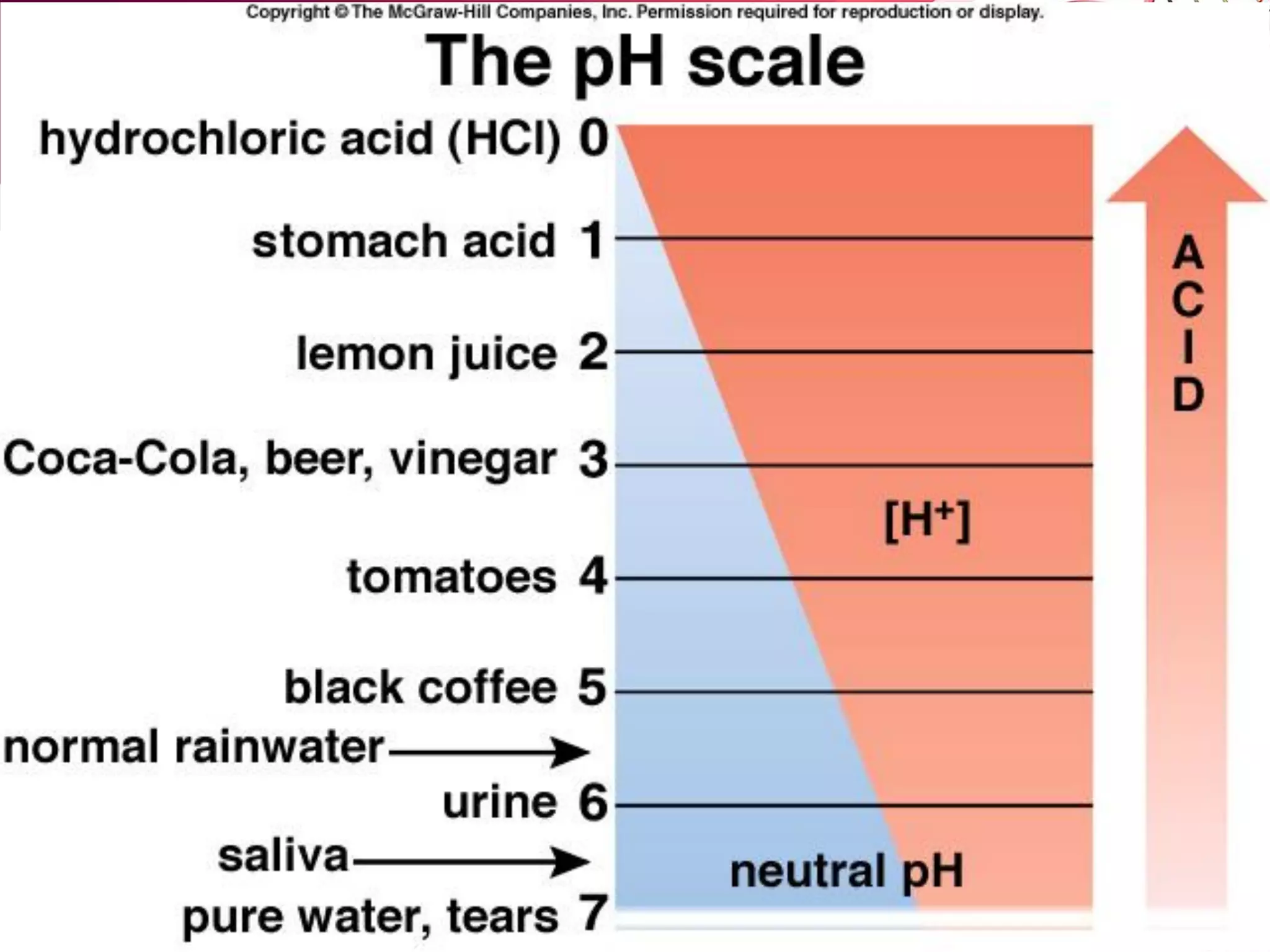
C. pH scale: [H+] and [OH-]
– pH scale is used to measure how basic or acidic a solution
is.
– Range of pH scale: 0 through 14.
• Neutral solution: pH is 7. [H+ ] = [OH-]
• Acidic solution: pH is less than 7. [H+ ] > [OH-]
• Basic solution: pH is greater than 7. [H+ ] < [OH-]
– As [H+] increases pH decreases (inversely proportional).
– Logarithmic scale: Each unit on the pH scale represents a
ten-fold change in [H+].
D. Buffers keep pH of solutions relatively constant
– Buffer: Substance which prevents sudden large changes
in pH when acids or bases are added.
– Buffers are biologically important because most of the
chemical reactions required for life can only take place
within narrow pH ranges.
– Example:
• Normal blood pH 7.35-7.45. Serious health problems will
arise if blood pH is not stable.
CHEMICAL REACTIONS
– A chemical change in which substances (reactants) are
joined, broken down, or rearranged to form new
substances (products).
– Involve the making and/or breaking of chemical bonds.
– Chemical equations are used to represent chemical
reactions.
Example:
2 H2 + O2 -----------> 2H2O
2 Hydrogen Oxygen 2 Water
Molecules Molecule Molecules
Organic Chemistry:
Carbon Based Compounds
A. Inorganic Compounds: Compounds without carbon.
B. Organic Compounds: Compounds synthesized by cells and containing
carbon (except for CO and CO2).
– Diverse group: Several million organic compounds are known
and more are identified every day.
– Common: After water, organic compounds are the most
common substances in cells.
• Over 98% of the dry weight of living cells is made up of organic
compounds.
• Less than 2% of the dry weight of living cells is made up of inorganic
compounds.
Carbon: unique element for basic building
block of molecules of life
• Carbon has 4 valence electrons: Can form
four covalent bonds
– Can form single , double, triple bonds.
– Can form large, complex, branching
molecules and rings.
– Carbon atoms easily bond to C, N, O, H, P,
S.
• Huge variety of molecules can be formed
based on simple bonding rules of basic
chemistry
Diversity of Organic Compounds
• Hydrocarbons:
– Organic molecules that contain C and H only.
– Good fuels, but not biologically important.
– Undergo combustion (burn in presence of oxygen).
– In general they are chemically stable.
– Nonpolar: Do not dissolve in water (Hydrophobic).
Examples:
• (1C) Methane: CH4 (Natural gas).
• (2C) Ethane: CH3CH3
• (3C) Propane: CH3CH2CH3 (Gas grills).
• (4C) Butane: CH3CH2CH2CH3 (Lighters).
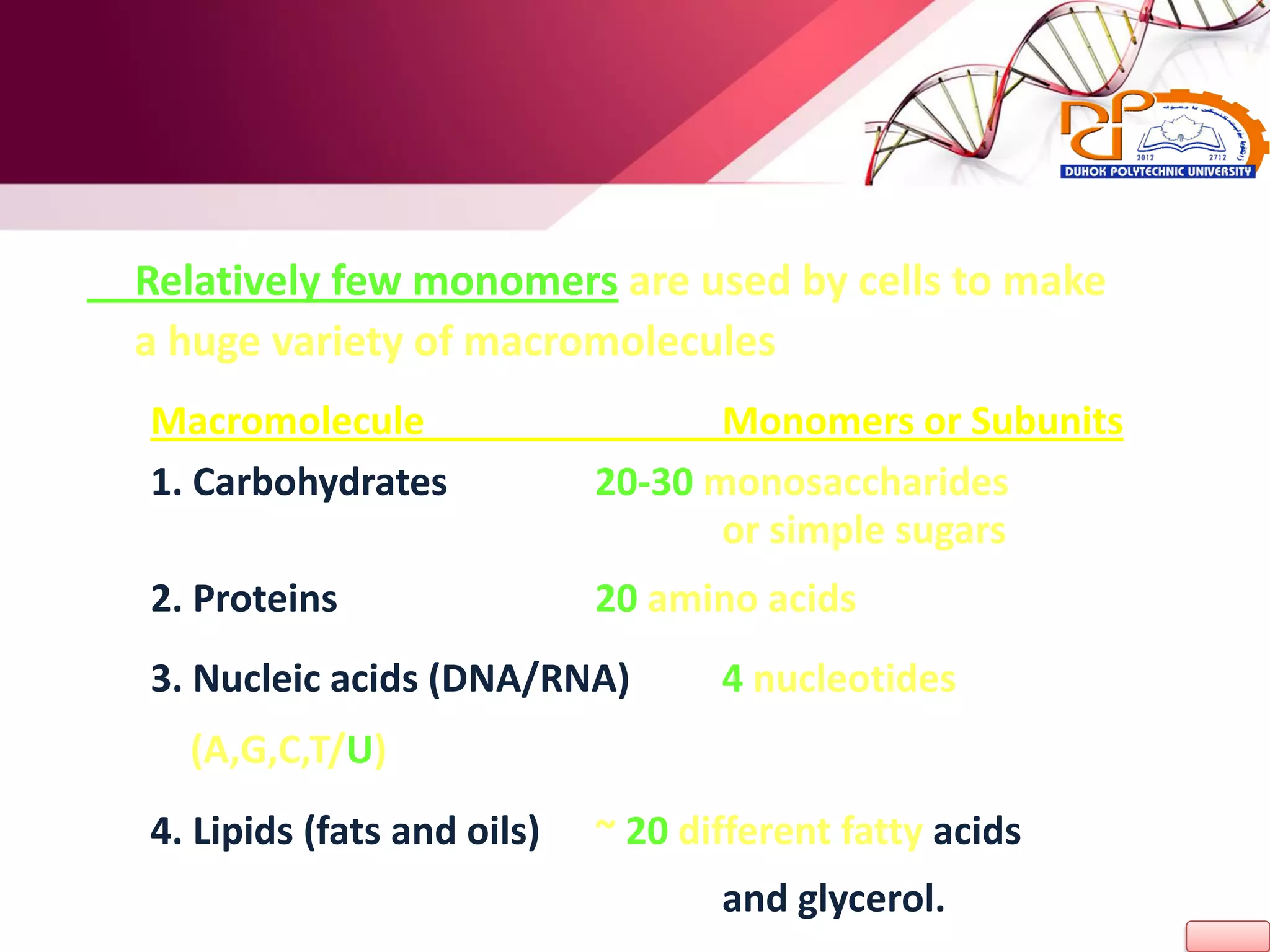
Relatively few monomers are used by cells to make
a huge variety of macromolecules
Macromolecule Monomers or Subunits
1. Carbohydrates 20-30 monosaccharides
or simple sugars
2. Proteins 20 amino acids
3. Nucleic acids (DNA/RNA) 4 nucleotides
(A,G,C,T/U)
4. Lipids (fats and oils) ~ 20 different fatty acids
and glycerol.
III. Carbohydrates: Molecules that store energy and are used
as building materials
– General Formula: (CH2O)n
– Simple sugars and their polymers.
– Diverse group includes sugars, starches, cellulose.
– Biological Functions:
– Fuels, energy storage
– Structural component (cell walls)
– DNA/RNA component
– Three types of carbohydrates:
A. Monosaccharides
B. Disaccharides
C. Polysaccharides
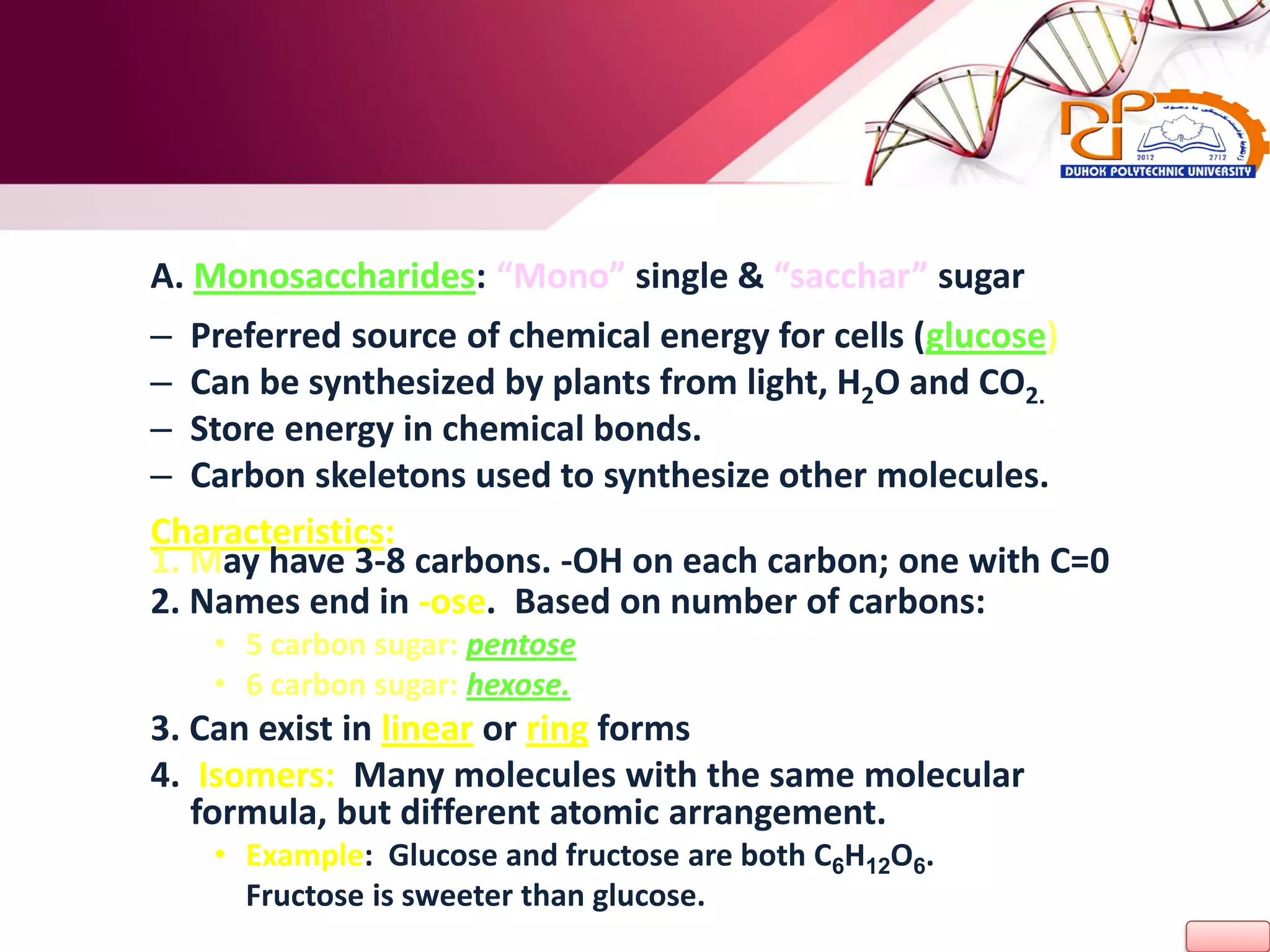
A. Monosaccharides: “Mono” single & “sacchar” sugar
– Preferred source of chemical energy for cells (glucose)
– Can be synthesized by plants from light, H2O and CO2.
– Store energy in chemical bonds.
– Carbon skeletons used to synthesize other molecules.
Characteristics:
1. May have 3-8 carbons. -OH on each carbon; one with C=0
2. Names end in -ose. Based on number of carbons:
• 5 carbon sugar: pentose
• 6 carbon sugar: hexose.
3. Can exist in linear or ring forms
4. Isomers: Many molecules with the same molecular
formula, but different atomic arrangement.
• Example: Glucose and fructose are both C6H12O6.
Fructose is sweeter than glucose.
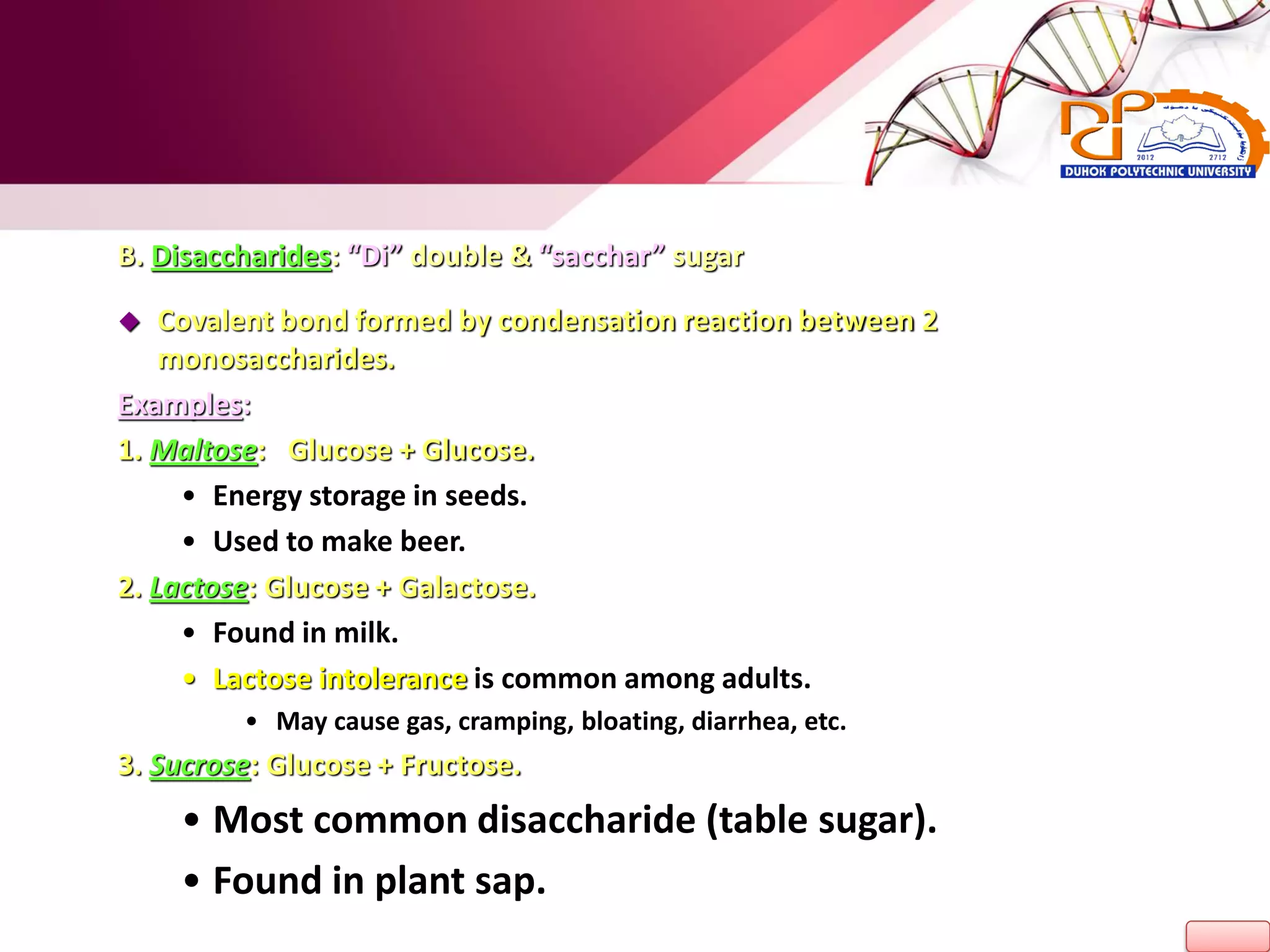
B. Disaccharides: “Di” double & “sacchar” sugar
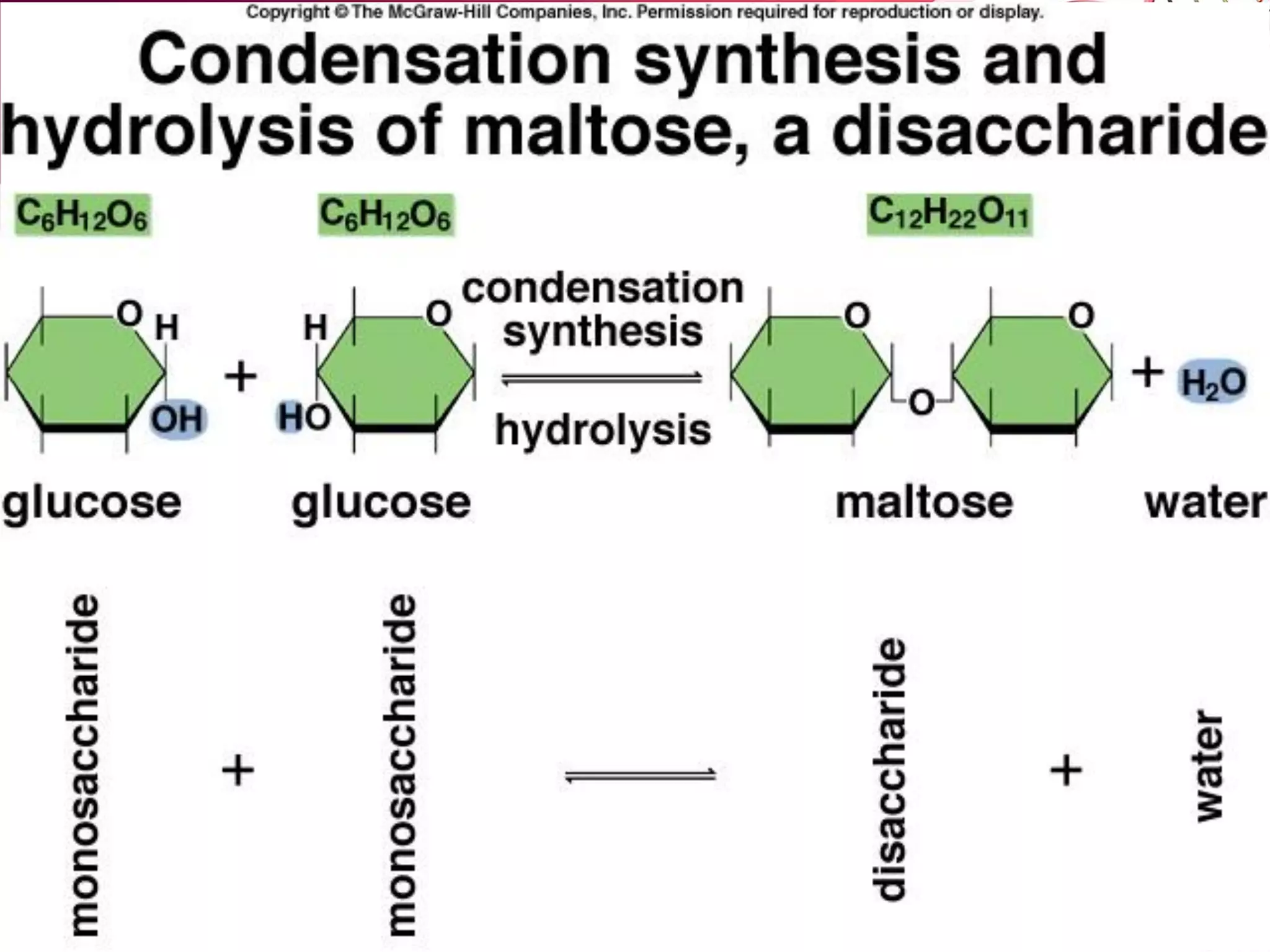
 Covalent bond formed by condensation reaction between 2
monosaccharides.
Examples:
1. Maltose: Glucose + Glucose.
• Energy storage in seeds.
• Used to make beer.
2. Lactose: Glucose + Galactose.
• Found in milk.
• Lactose intolerance is common among adults.
• May cause gas, cramping, bloating, diarrhea, etc.
3. Sucrose: Glucose + Fructose.
• Most common disaccharide (table sugar).
• Found in plant sap.
C. Polysaccharides: “Poly” many (8 to 1000)
Functions: Storage of chemical energy and structure.
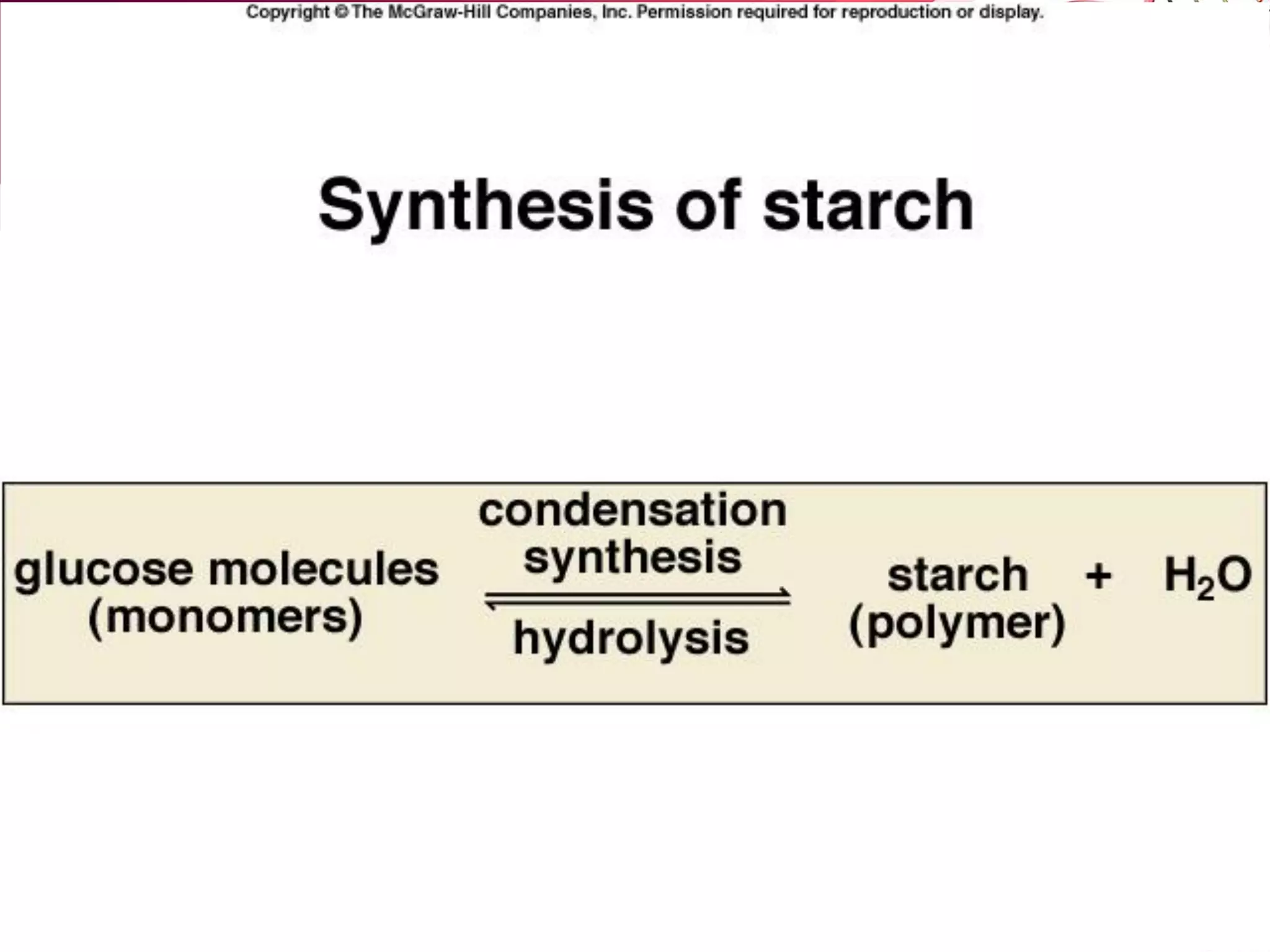
– Storage polysaccharides: Cells can store simple sugars in
polysacharides and hydrolyze them when needed.
1. Starch: Glucose polymer (Helical)
• Form of glucose storage in plants (amylose)
• Stored in plant cell organelles called plastids
2. Glycogen: Glucose polymer (Branched)
• Form of glucose storage in animals (muscle and liver cells)
– Structural Polysaccharides: Used as structural
components of cells and tissues.
1. Cellulose: Glucose polymer.
• The major component of plant cell walls.
• CANNOT be digested by animal enzymes.
• Only microbes have enzymes to hydrolyze.
2. Chitin: Polymer of an amino sugar (with NH2 group)
• Forms exoskeleton of arthropods (insects)
• Found in cell walls of some fungi
Lipids: Fats, phospholipids, and steroids
Diverse groups of compounds.
Composition of Lipids:
– C, H, and small amounts of O.
Functions of Lipids:
– Biological fuels
– Energy storage
– Insulation
– Structural components of cell membranes
– Hormones
Lipids: Fats, phospholipids, and steroids
1. Simple Lipids: Contain C, H, and O only.
A. Fats (Triglycerides).
• Glycerol : Three carbon molecule with three hydroxyls.
• Fatty Acids: Carboxyl group and long hydrocarbon
chains.
– Characteristics of fats:
• Most abundant lipids in living organisms.
• Hydrophobic (insoluble in water) because nonpolar.
• Economical form of energy storage (provide 2X the
energy/weight than carbohydrates).
• Greasy or oily appearance.
Lipids: Fats, phospholipids, and steroids
Types of Fats
– Saturated fats: Hydrocarbons saturated with H. Lack -
C=C- double bonds.
• Solid at room temp (butter, animal fat, lard)
– Unsaturated fats: Contain -C=C- double bonds.
• Usually liquid at room temp (corn, peanut, olive oils)
2. Complex Lipids: In addition to C, H, and O, also contain
other elements, such as phosphorus, nitrogen, and sulfur.
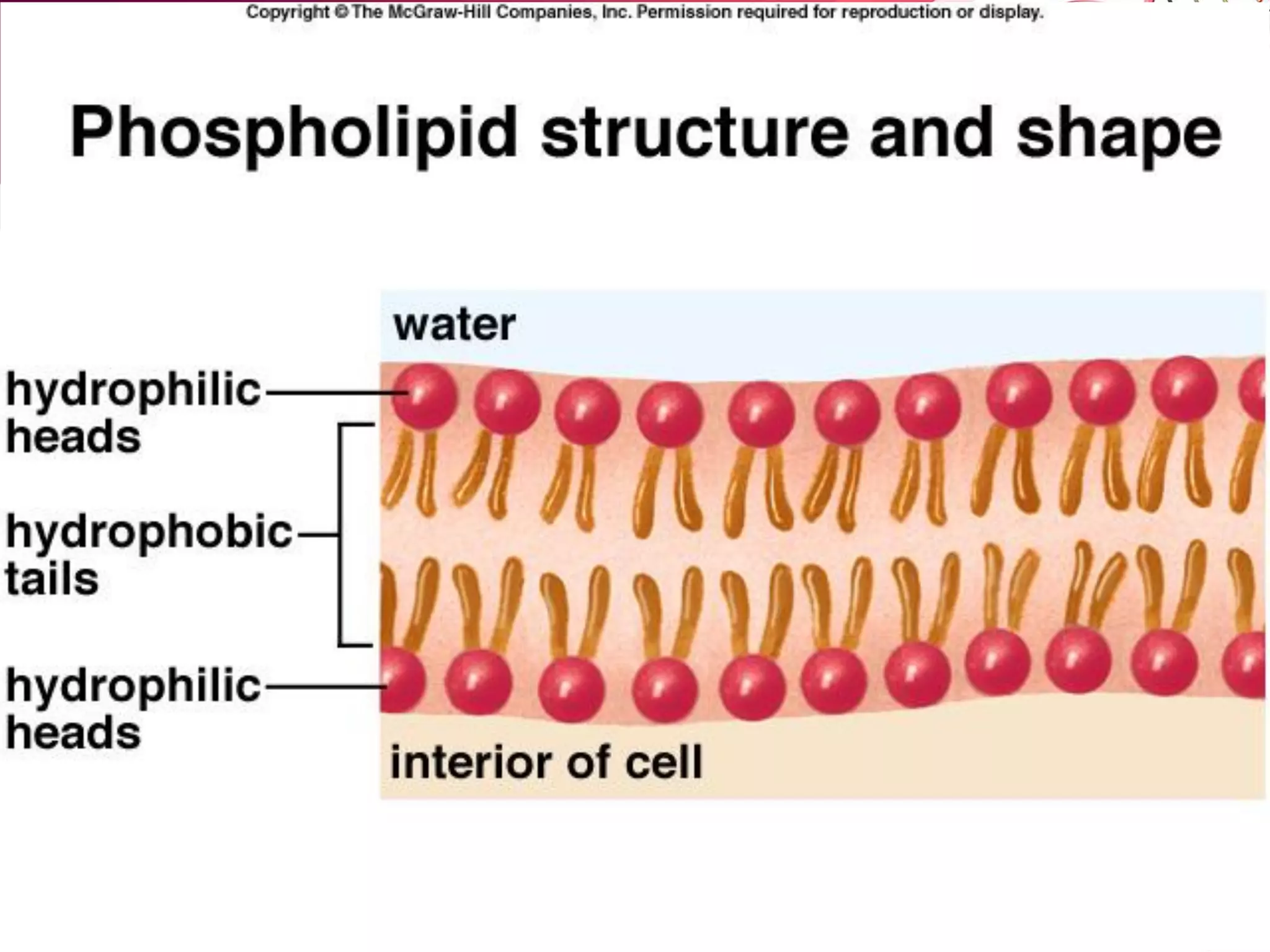
A. Phospholipids: Are composed of:
• Glycerol
• 2 fatty acid
• Phosphate group
– Amphipathic Molecule
• Hydrophobic fatty acid “tails”.
• Hydrophilic phosphate “head”.
Function: Primary component of the plasma membrane
of cells
B. Steroids: Lipids with four fused carbon rings
Includes cholesterol, bile salts, reproductive, and adrenal
hormones.
• Cholesterol: The basic steroid found in animals
– Common component of animal cell membranes.
– Precursor to make sex hormones (estrogen, testosterone)
– Generally only soluble in other fats (not in water)
– Too much increases chance of atherosclerosis.
C. Waxes: One fatty acid linked to an alcohol.
• Very hydrophobic.
• Found in cell walls of certain bacteria, plant and insect
coats. Help prevent water loss.
Proteins: Large three-dimensional
macromolecules responsible for most cellular
functions
– Polypeptide chains: Polymers of amino acids
linked by peptide bonds in a SPECIFIC linear
sequence
– Protein: Macromolecule composed of one or
more polypeptide chains folded into SPECIFIC
3-D conformations
Polypeptide: Polymer of amino acids connected in a
specific sequence
A. Amino acid: The monomer of
polypeptides
• Central carbon
– H atom
– Carboxyl group
– Amino group
– Variable R-group
Protein Function is dependent upon Protein Structure (Conformation)
CONFORMATION: The 3-D shape of a protein is determined by
its amino acid sequence.
Four Levels of Protein Structure
1. Primary structure: Linear amino acid sequence,
determined by gene for that protein.
2. Secondary structure: Regular coiling/folding of
polypeptide.
• Alpha helix or beta sheet.
• Caused by H-bonds between amino acids.
3. Tertiary structure: Overall 3-D shape of a polypeptide
chain.
4. Quaternary structure: Only in proteins with 2 or more
polypeptides. Overall 3-D shape of all chains.
• Example: Hemoglobin (2 alpha and 2 beta
polypeptides)
Nucleic acids store and transmit hereditary information for all living things
There are two types of nucleic acids in living things:
A. Deoxyribonucleic Acid (DNA)
• Contains genetic information of all living organisms.
• Has segments called genes which provide information to make
each and every protein in a cell
• Double-stranded molecule which replicates each time a cell
divides.
B. Ribonucleic Acid (RNA)
• Three main types called mRNA, tRNA, rRNA
• RNA molecules are copied from DNA and used to make gene
products (proteins).
• Usually exists in single-stranded form.
DNA and RNA are polymers of nucleotides that determine the primary
structure of proteins
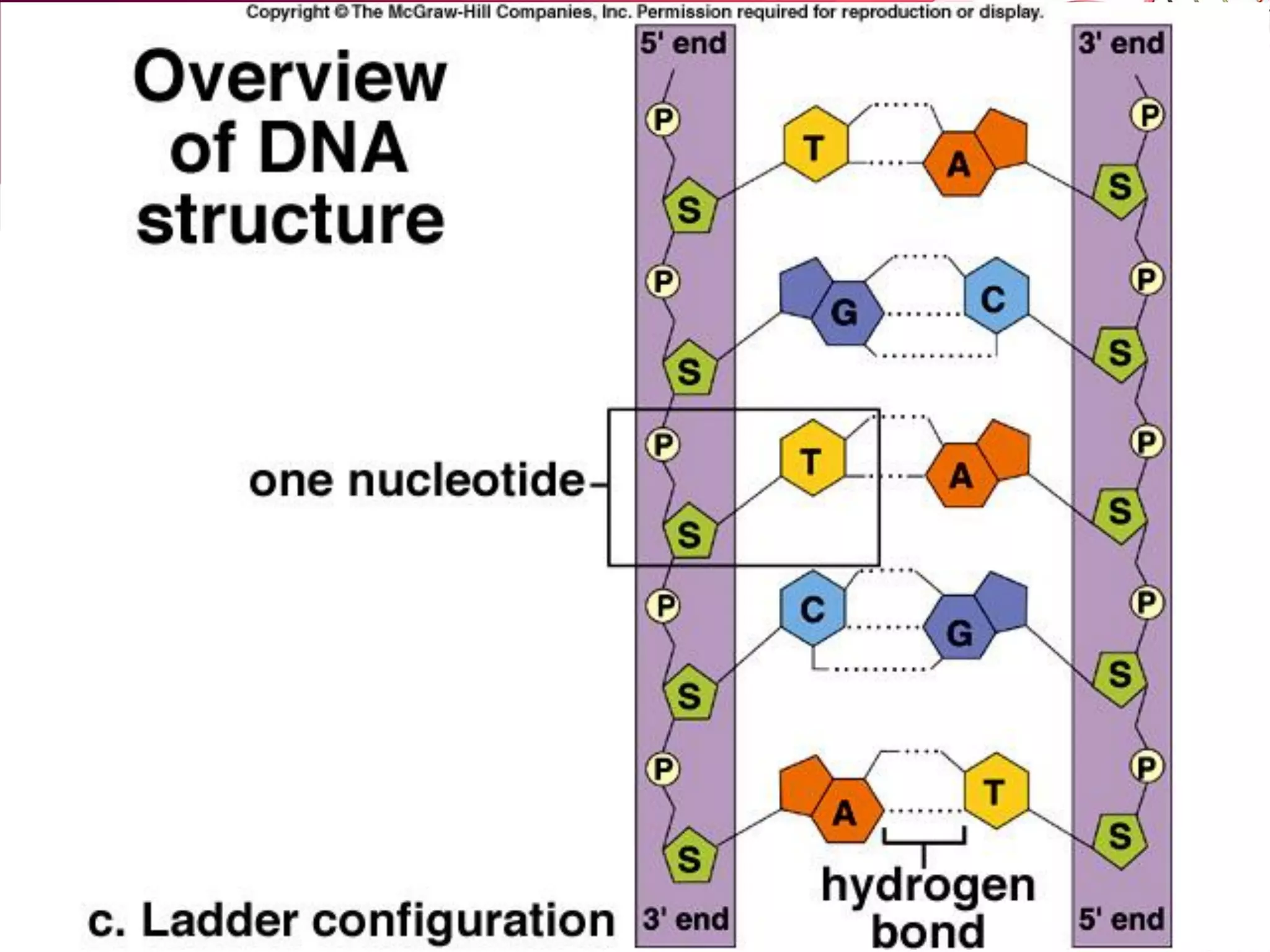
• Nucleotide: Subunits of DNA or RNA.
Nucleotides have three components:
1. Pentose sugar (ribose or deoxyribose)
2. Phosphate group to link nucleotides (-PO4)
3. Nitrogenous base (A,G,C,T or U)
• Purines: Have 2 rings.
Adenine (A) and guanine (G)
• Pyrimidines: Have one ring.
Cytosine (C), thymine (T) in DNA or uracil (U) in RNA.
James Watson and Francis Crick Determined the 3-D Shape of DNA in
1953
– Double helix: The DNA molecule is a double helix.
– Antiparallel: The two DNA strands run in opposite directions.
• Strand 1: 5’ to 3’ direction (------------>)
• Strand 2: 3’ to 5’ direction (<------------)
– Complementary Base Pairing: A & T (U) and G & C.
• A on one strand hydrogen bonds to T (or U in RNA).
• G on one strand hydrogen bonds to C.
– Replication: The double-stranded DNA molecule can easily
replicate based on A=T and G=C pairing.---
– SEQUENCE of nucleotides in a DNA molecule dictate the amino
acid SEQUENCE of polypeptides
L2
L2
L2
L2

L2

  • 1.
    Human Biology Chemical andthe body Dr. jassim Mohammed Abdo -2-
  • 2.
  • 3.
    I. Elements: – Substancesthat can not be broken down into simpler substances by chemical reactions. – There are 92 naturally occurring elements: Oxygen, carbon, nitrogen, calcium, sodium, etc. • Life requires about 25 of the 92 elements • Chemical Symbols: – Abbreviations for the name of each element. – Usually one or two letters of the English or Latin name of the element – First letter upper case, second letter lower case. Example: Helium (He), sodium (Na), potassium (K), gold (Au).
  • 4.
    • Main Elements:Over 98% of an organism’s mass is made up of six elements. – Oxygen (O): 65% body mass • Cellular respiration, component of water, and most organic compounds. – Carbon (C): 18% of body mass. • Backbone of all organic compounds. – Hydrogen (H): 10% of body mass. • Component of water and most organic compounds. – Nitrogen (N): 3% of body mass. • Component of proteins and nucleic acids (DNA/RNA) – Calcium (Ca): 1.5% of body mass. • Bones, teeth, clotting, muscle and nerve function. – Phosphorus (P): 1% of body mass • Bones, nucleic acids, energy transfer (ATP).
  • 5.
    • Minor Elements:Found in low amounts. Between 1% and 0.01%. – Potassium (K): Main positive ion inside cells. • Nerve and muscle function. – Sulfur (S): Component of most proteins. – Sodium (Na): Main positive ion outside cells. • Fluid balance, nerve function. – Chlorine (Cl): Main negative ion outside cells. • Fluid balance. – Magnesium (Mg): Component of many enzymes and chlorophyll.
  • 6.
    • Trace elements:Less than 0.01% of mass: – Boron (B) – Chromium (Cr) – Cobalt (Co) – Copper (Cu) – Iron (Fe) – Fluorine (F) – Iodine (I) – Manganese (Mn) – Molybdenum (Mo) – Selenium (Se) – Silicon (Si) – Tin (Sn) – Vanadium (V) – Zinc (Zn)
  • 7.
    II. Structure &Properties of Atoms Atoms: Smallest particle of an element that retains its chemical properties. Made up of three main subatomic particles. Particle Location Mass Charge Proton (p+) In nucleus 1 +1 Neutron (no) In nucleus 1 0 Electron (e-) Outside nucleus 0 -1
  • 10.
    Structure and Propertiesof Atoms 1. Atomic number = # protons – The number of protons is unique for each element – Each element has a fixed number of protons in its nucleus. This number will never change for a given element. – Written as a subscript to left of element symbol. Examples: 6C, 8O, 16S, 20Ca – Because atoms are electrically neutral (no charge), the number of electrons and protons are always the same. – In the periodic table elements are organized by increasing atomic number.
  • 11.
    Structure and Propertiesof Atoms: 2. Mass number = # protons + # neutrons – Gives the mass of a specific atom. – Written as a superscript to the left of the element symbol. Examples: 12C, 16O, 32S, 40Ca. – The number of protons for an element is always the same, but the number of neutrons may vary. – The number of neutrons can be determined by: # neutrons = Mass number - Atomic number
  • 12.
    Structure and Propertiesof Atoms: 3. Isotopes: Variant forms of the same element. – Isotopes have different numbers of neutrons and therefore different masses. – Isotopes have the same numbers of protons and electrons. – Example: In nature there are three forms or isotopes of carbon (6C): • 12C: About 99% of atoms. Have 6 p+, 6 no, and 6 e-. • 13C: About 1% of atoms. Have 6 p+, 7 no, and 6 e-. • 14C: Found in tiny quantities. Have 6 p+, 8 no, and 6 e-. Radioactive form (unstable). Used for dating fossils.
  • 13.
    Electron Arrangements ofImportant Elements of Life 1 Valence electron 4 Valence electrons 5 Valence electrons 6 Valence electrons
  • 14.
    III. How AtomsForm Molecules: Chemical Bonds Molecule: Two or more atoms combined chemically. Compound: A substance with two or more elements combined in a fixed ratio. • Water (H2O) • Hydrogen peroxide (H2O2) • Carbon dioxide (CO2) • Carbon monoxide (CO) • Table salt (NaCl) – Atoms are linked by chemical bonds. Chemical Formula: Describes the chemical composition of a molecule of a compound. – Symbols indicate the type of atoms – Subscripts indicate the number of atoms
  • 15.
    How Atoms FormMolecules: Chemical Bonds Atoms can lose, gain, or share electrons to satisfy octet rule (fill outermost shell). Two main types of Chemical Bonds A. Ionic bond: Atoms gain or lose electrons B. Covalent bond: Atoms share electrons
  • 16.
    A. Ionic Bond:Atoms gain or lose electrons. Bonds are attractions between ions of opposite charge. Ionic compound: One consisting of ionic bonds. Na + Cl ----------> Na+ Cl- sodium chlorine Table salt (Sodium chloride) Two Types of Ions: Anions: Negatively charged particle (Cl-) Cations: Positively charged particle (Na+)
  • 19.
    B. Covalent Bond:Involves the “sharing” of one or more pairs of electrons between atoms. Covalent compound: One consisting of covalent bonds. Example: Methane (CH4): Main component of natural gas. H | H---C---H | H Each line represents on shared pair of electrons. Octet rule is satisfied: Carbon has 8 electrons, Hydrogen has 2 electrons
  • 21.
    Electronegativity: A measureof an atom’s ability to attract and hold onto a shared pair of electrons. Some atoms such as oxygen or nitrogen have a much higher electronegativity than others, such as carbon and hydrogen. Two Types of Covalent Bonds: Polar and Nonpolar
  • 22.
    Polar and NonpolarCovalent Bonds A. Nonpolar Covalent Bond: When the atoms in a bond have equal or similar attraction for the electrons (electronegativity), they are shared equally. Example: O2, H2, Cl2
  • 23.
  • 24.
    B. Polar CovalentBond: When the atoms in a bond have different electronegativities, the electrons are shared unequally. Electrons are closer to the more electronegative atom creating a polarity or partial charge. Example: H2O Oxygen has a partial negative charge. Hydrogens have partial positive charges. Polar and Nonpolar Covalent Bonds
  • 25.
    Other Bonds: Weakchemical bonds are important in the chemistry of living things. • Hydrogen bonds: Attraction between the partially positive H of one molecule and a partially negative atom of another – Hydrogen bonds are about 20 X easier to break than a normal covalent bond. – Responsible for many properties of water. – Determine 3 dimensional shape of DNA and proteins. – Chemical signaling (molecule to receptor).
  • 26.
    – Living cellsare 70-90% water – Water covers 3/4 of earth’s surface – Water is the ideal solvent for chemical reactions – On earth, water exists as gas, liquid, and solid Water: The Ideal Compound for Life
  • 27.
    I. Polarity ofwater causes hydrogen bonding – Water molecules are held together by H- bonding – Partially positive H attracted to partially negative O atom. • Individual H bond are weak, but the cumulative effect of many H bonds is very strong. • H bonds only last a fraction of a second, but at any moment most molecules are hydrogen bonded to others.
  • 28.
    Unique properties ofwater caused by H-bonds – Cohesion: Water molecules stick to each other. This causes surface tension. – Adhesion: Water sticks to many surfaces. Capillary Action: Water tends to rise in narrow tubes.
  • 29.
    Unique properties ofwater caused by H-bonds – Universal Solvent: Dissolves many (but not all) substances to form solutions. Solutions are homogeneous mixtures of two or more substances (salt water, air, tap water). All solutions have at least two components: • Solvent: Dissolving substance (water, alcohol, oil). – Aqueous solution: If solvent is water. • Solute: Substance that is dissolved (salt, sugar, CO2). – Water dissolves polar and ionic solutes well. – Water does not dissolve nonpolar solvents well.
  • 30.
    Solubility of aSolute Depends on its Chemical Nature Solubility: Ability of substance to dissolve in a given solvent. Two Types of Solutes: A. Hydrophilic: “Water loving” dissolve easily in water. • Ionic compounds (e.g. salts) • Polar compounds (molecules with polar regions) • Examples: Compounds with -OH groups (alcohols). • “Like dissolves in like”
  • 31.
    Solubility of aSolute Depends on its Chemical Nature Two Types of Solutes: B. Hydrophobic: “Water fearing” do not dissolve in water • Non-polar compounds (lack polar regions) • Examples: Hydrocarbons with only C-H non-polar bonds, oils, gasoline, waxes, fats, etc.
  • 32.
    ACIDS, BASES, pHAND BUFFERS A. Acid: A substance that donates protons (H+). – Separate into one or more protons and an anion: HCl (into H2O ) -------> H+ + Cl- H2SO4 (into H2O ) --------> H+ + HSO4 - – Acids INCREASE the relative [H+] of a solution. – Water can also dissociate into ions, at low levels: H2O <======> H+ + OH-
  • 33.
    B. Base: Asubstance that accepts protons (H+). – Many bases separate into one or more positive ions (cations) and a hydroxyl group (OH- ). – Bases DECREASE the relative [H+] of a solution ( and increases the relative [OH-] ). H2O <======> H+ + OH- Directly NH3 + H+ <=------> NH4 + Indirectly NaOH ---------> Na+ + OH- ( H+ + OH- <=====> H2O )
  • 34.
    Strong acids andbases: Dissociation is almost complete (99% or more of molecules). HCl (aq) -------------> H+ + Cl- NaOH (aq) -----------> Na+ + OH- (L.T. 1% in this form) (G.T. 99% in dissociated form) • A relatively small amount of a strong acid or base will drastically affect the pH of solution. Weak acids and bases: A small percentage of molecules dissociate at a give time (1% or less) H2CO3 <=====> H+ + HCO3 - carbonic acid Bicarbonate ion (G.T. 99% in this form) (L.T. 1% in dissociated form)
  • 35.
    C. pH scale:[H+] and [OH-] – pH scale is used to measure how basic or acidic a solution is. – Range of pH scale: 0 through 14. • Neutral solution: pH is 7. [H+ ] = [OH-] • Acidic solution: pH is less than 7. [H+ ] > [OH-] • Basic solution: pH is greater than 7. [H+ ] < [OH-] – As [H+] increases pH decreases (inversely proportional). – Logarithmic scale: Each unit on the pH scale represents a ten-fold change in [H+].
  • 36.
    D. Buffers keeppH of solutions relatively constant – Buffer: Substance which prevents sudden large changes in pH when acids or bases are added. – Buffers are biologically important because most of the chemical reactions required for life can only take place within narrow pH ranges. – Example: • Normal blood pH 7.35-7.45. Serious health problems will arise if blood pH is not stable.
  • 37.
    CHEMICAL REACTIONS – Achemical change in which substances (reactants) are joined, broken down, or rearranged to form new substances (products). – Involve the making and/or breaking of chemical bonds. – Chemical equations are used to represent chemical reactions. Example: 2 H2 + O2 -----------> 2H2O 2 Hydrogen Oxygen 2 Water Molecules Molecule Molecules
  • 46.
    Organic Chemistry: Carbon BasedCompounds A. Inorganic Compounds: Compounds without carbon. B. Organic Compounds: Compounds synthesized by cells and containing carbon (except for CO and CO2). – Diverse group: Several million organic compounds are known and more are identified every day. – Common: After water, organic compounds are the most common substances in cells. • Over 98% of the dry weight of living cells is made up of organic compounds. • Less than 2% of the dry weight of living cells is made up of inorganic compounds.
  • 47.
    Carbon: unique elementfor basic building block of molecules of life • Carbon has 4 valence electrons: Can form four covalent bonds – Can form single , double, triple bonds. – Can form large, complex, branching molecules and rings. – Carbon atoms easily bond to C, N, O, H, P, S. • Huge variety of molecules can be formed based on simple bonding rules of basic chemistry
  • 49.
    Diversity of OrganicCompounds • Hydrocarbons: – Organic molecules that contain C and H only. – Good fuels, but not biologically important. – Undergo combustion (burn in presence of oxygen). – In general they are chemically stable. – Nonpolar: Do not dissolve in water (Hydrophobic). Examples: • (1C) Methane: CH4 (Natural gas). • (2C) Ethane: CH3CH3 • (3C) Propane: CH3CH2CH3 (Gas grills). • (4C) Butane: CH3CH2CH2CH3 (Lighters).
  • 50.
    Relatively few monomersare used by cells to make a huge variety of macromolecules Macromolecule Monomers or Subunits 1. Carbohydrates 20-30 monosaccharides or simple sugars 2. Proteins 20 amino acids 3. Nucleic acids (DNA/RNA) 4 nucleotides (A,G,C,T/U) 4. Lipids (fats and oils) ~ 20 different fatty acids and glycerol.
  • 51.
    III. Carbohydrates: Moleculesthat store energy and are used as building materials – General Formula: (CH2O)n – Simple sugars and their polymers. – Diverse group includes sugars, starches, cellulose. – Biological Functions: – Fuels, energy storage – Structural component (cell walls) – DNA/RNA component – Three types of carbohydrates: A. Monosaccharides B. Disaccharides C. Polysaccharides
  • 52.
    A. Monosaccharides: “Mono”single & “sacchar” sugar – Preferred source of chemical energy for cells (glucose) – Can be synthesized by plants from light, H2O and CO2. – Store energy in chemical bonds. – Carbon skeletons used to synthesize other molecules. Characteristics: 1. May have 3-8 carbons. -OH on each carbon; one with C=0 2. Names end in -ose. Based on number of carbons: • 5 carbon sugar: pentose • 6 carbon sugar: hexose. 3. Can exist in linear or ring forms 4. Isomers: Many molecules with the same molecular formula, but different atomic arrangement. • Example: Glucose and fructose are both C6H12O6. Fructose is sweeter than glucose.
  • 54.
    B. Disaccharides: “Di”double & “sacchar” sugar  Covalent bond formed by condensation reaction between 2 monosaccharides. Examples: 1. Maltose: Glucose + Glucose. • Energy storage in seeds. • Used to make beer. 2. Lactose: Glucose + Galactose. • Found in milk. • Lactose intolerance is common among adults. • May cause gas, cramping, bloating, diarrhea, etc. 3. Sucrose: Glucose + Fructose. • Most common disaccharide (table sugar). • Found in plant sap.
  • 56.
    C. Polysaccharides: “Poly”many (8 to 1000) Functions: Storage of chemical energy and structure. – Storage polysaccharides: Cells can store simple sugars in polysacharides and hydrolyze them when needed. 1. Starch: Glucose polymer (Helical) • Form of glucose storage in plants (amylose) • Stored in plant cell organelles called plastids 2. Glycogen: Glucose polymer (Branched) • Form of glucose storage in animals (muscle and liver cells)
  • 58.
    – Structural Polysaccharides:Used as structural components of cells and tissues. 1. Cellulose: Glucose polymer. • The major component of plant cell walls. • CANNOT be digested by animal enzymes. • Only microbes have enzymes to hydrolyze. 2. Chitin: Polymer of an amino sugar (with NH2 group) • Forms exoskeleton of arthropods (insects) • Found in cell walls of some fungi
  • 59.
    Lipids: Fats, phospholipids,and steroids Diverse groups of compounds. Composition of Lipids: – C, H, and small amounts of O. Functions of Lipids: – Biological fuels – Energy storage – Insulation – Structural components of cell membranes – Hormones
  • 60.
    Lipids: Fats, phospholipids,and steroids 1. Simple Lipids: Contain C, H, and O only. A. Fats (Triglycerides). • Glycerol : Three carbon molecule with three hydroxyls. • Fatty Acids: Carboxyl group and long hydrocarbon chains. – Characteristics of fats: • Most abundant lipids in living organisms. • Hydrophobic (insoluble in water) because nonpolar. • Economical form of energy storage (provide 2X the energy/weight than carbohydrates). • Greasy or oily appearance.
  • 61.
    Lipids: Fats, phospholipids,and steroids Types of Fats – Saturated fats: Hydrocarbons saturated with H. Lack - C=C- double bonds. • Solid at room temp (butter, animal fat, lard) – Unsaturated fats: Contain -C=C- double bonds. • Usually liquid at room temp (corn, peanut, olive oils)
  • 62.
    2. Complex Lipids:In addition to C, H, and O, also contain other elements, such as phosphorus, nitrogen, and sulfur. A. Phospholipids: Are composed of: • Glycerol • 2 fatty acid • Phosphate group – Amphipathic Molecule • Hydrophobic fatty acid “tails”. • Hydrophilic phosphate “head”. Function: Primary component of the plasma membrane of cells
  • 64.
    B. Steroids: Lipidswith four fused carbon rings Includes cholesterol, bile salts, reproductive, and adrenal hormones. • Cholesterol: The basic steroid found in animals – Common component of animal cell membranes. – Precursor to make sex hormones (estrogen, testosterone) – Generally only soluble in other fats (not in water) – Too much increases chance of atherosclerosis. C. Waxes: One fatty acid linked to an alcohol. • Very hydrophobic. • Found in cell walls of certain bacteria, plant and insect coats. Help prevent water loss.
  • 65.
    Proteins: Large three-dimensional macromoleculesresponsible for most cellular functions – Polypeptide chains: Polymers of amino acids linked by peptide bonds in a SPECIFIC linear sequence – Protein: Macromolecule composed of one or more polypeptide chains folded into SPECIFIC 3-D conformations
  • 66.
    Polypeptide: Polymer ofamino acids connected in a specific sequence A. Amino acid: The monomer of polypeptides • Central carbon – H atom – Carboxyl group – Amino group – Variable R-group
  • 67.
    Protein Function isdependent upon Protein Structure (Conformation) CONFORMATION: The 3-D shape of a protein is determined by its amino acid sequence. Four Levels of Protein Structure 1. Primary structure: Linear amino acid sequence, determined by gene for that protein. 2. Secondary structure: Regular coiling/folding of polypeptide. • Alpha helix or beta sheet. • Caused by H-bonds between amino acids.
  • 68.
    3. Tertiary structure:Overall 3-D shape of a polypeptide chain. 4. Quaternary structure: Only in proteins with 2 or more polypeptides. Overall 3-D shape of all chains. • Example: Hemoglobin (2 alpha and 2 beta polypeptides)
  • 71.
    Nucleic acids storeand transmit hereditary information for all living things There are two types of nucleic acids in living things: A. Deoxyribonucleic Acid (DNA) • Contains genetic information of all living organisms. • Has segments called genes which provide information to make each and every protein in a cell • Double-stranded molecule which replicates each time a cell divides. B. Ribonucleic Acid (RNA) • Three main types called mRNA, tRNA, rRNA • RNA molecules are copied from DNA and used to make gene products (proteins). • Usually exists in single-stranded form.
  • 72.
    DNA and RNAare polymers of nucleotides that determine the primary structure of proteins • Nucleotide: Subunits of DNA or RNA. Nucleotides have three components: 1. Pentose sugar (ribose or deoxyribose) 2. Phosphate group to link nucleotides (-PO4) 3. Nitrogenous base (A,G,C,T or U) • Purines: Have 2 rings. Adenine (A) and guanine (G) • Pyrimidines: Have one ring. Cytosine (C), thymine (T) in DNA or uracil (U) in RNA.
  • 73.
    James Watson andFrancis Crick Determined the 3-D Shape of DNA in 1953 – Double helix: The DNA molecule is a double helix. – Antiparallel: The two DNA strands run in opposite directions. • Strand 1: 5’ to 3’ direction (------------>) • Strand 2: 3’ to 5’ direction (<------------) – Complementary Base Pairing: A & T (U) and G & C. • A on one strand hydrogen bonds to T (or U in RNA). • G on one strand hydrogen bonds to C. – Replication: The double-stranded DNA molecule can easily replicate based on A=T and G=C pairing.--- – SEQUENCE of nucleotides in a DNA molecule dictate the amino acid SEQUENCE of polypeptides