Download as PDF, PPTX
![AEG - pwnable.kr
Program
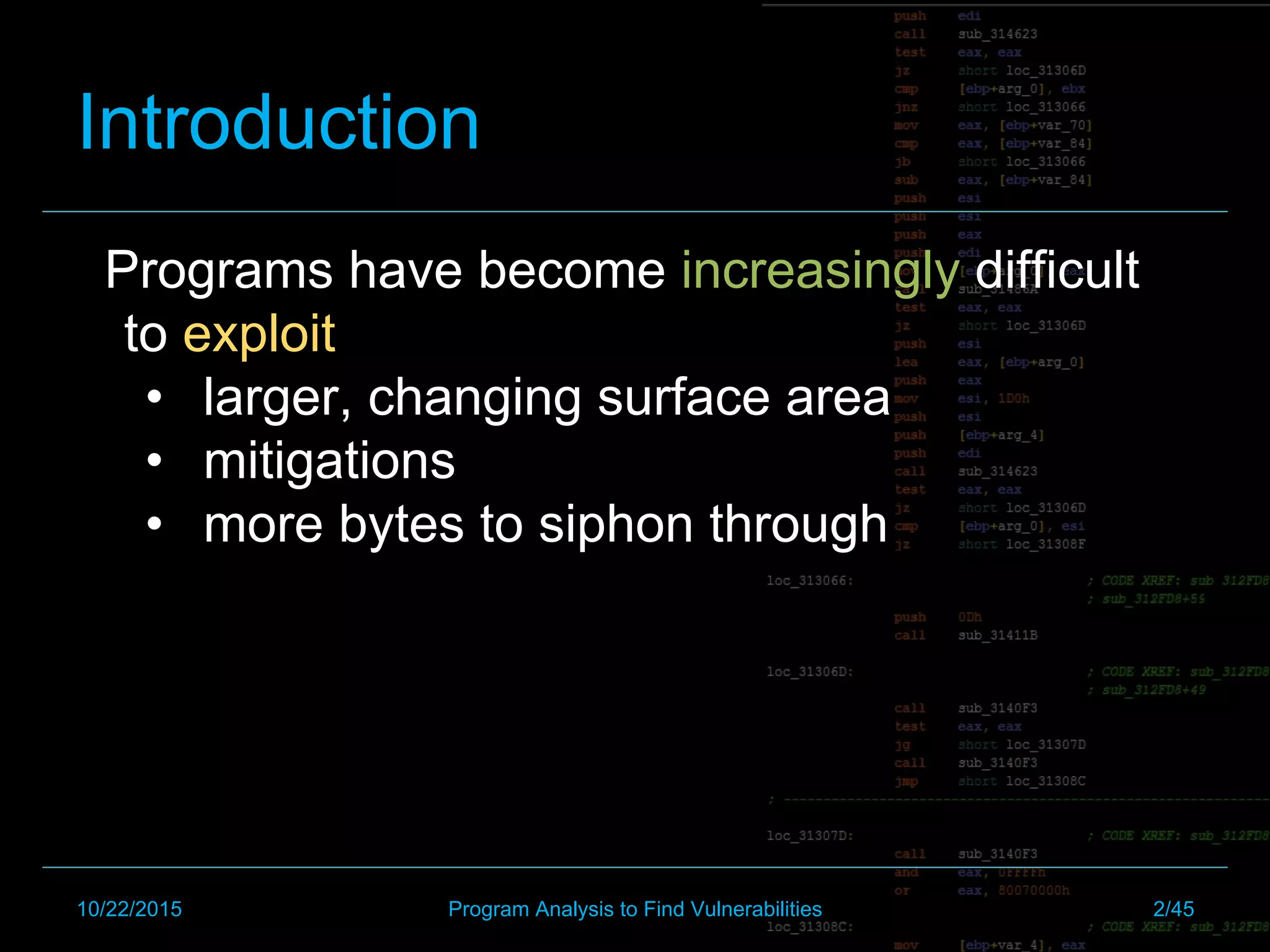
Operations
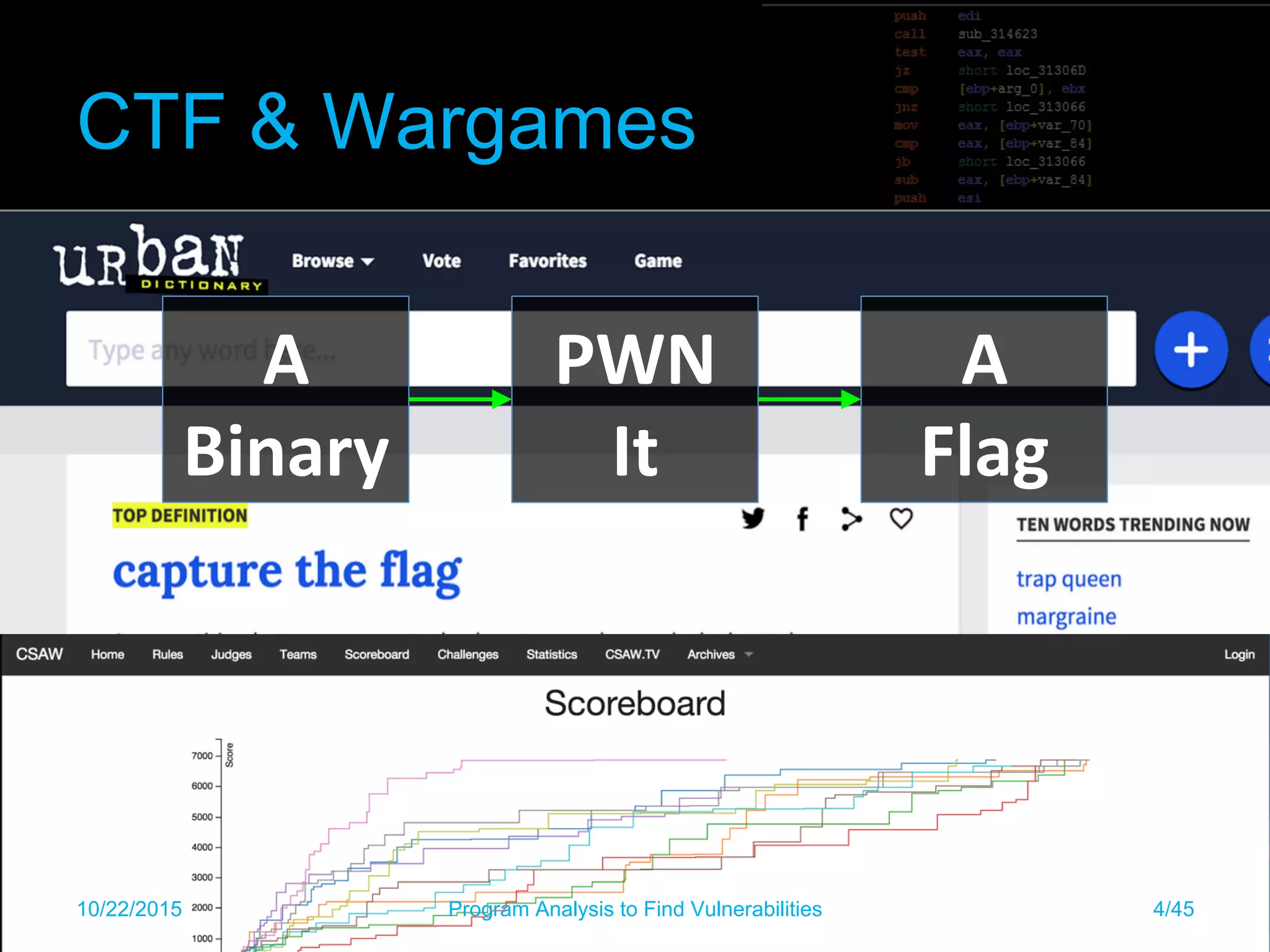
Get random binary, pwn it in 10 seconds.
1) Takes input at argv[1]
2) Does some decode & operations on it
3) Calls sequence of 16 functions
4) Each function checks 3 characters of input
sequentially
5) If you pass them all, you get to the exploitable
memcpy!
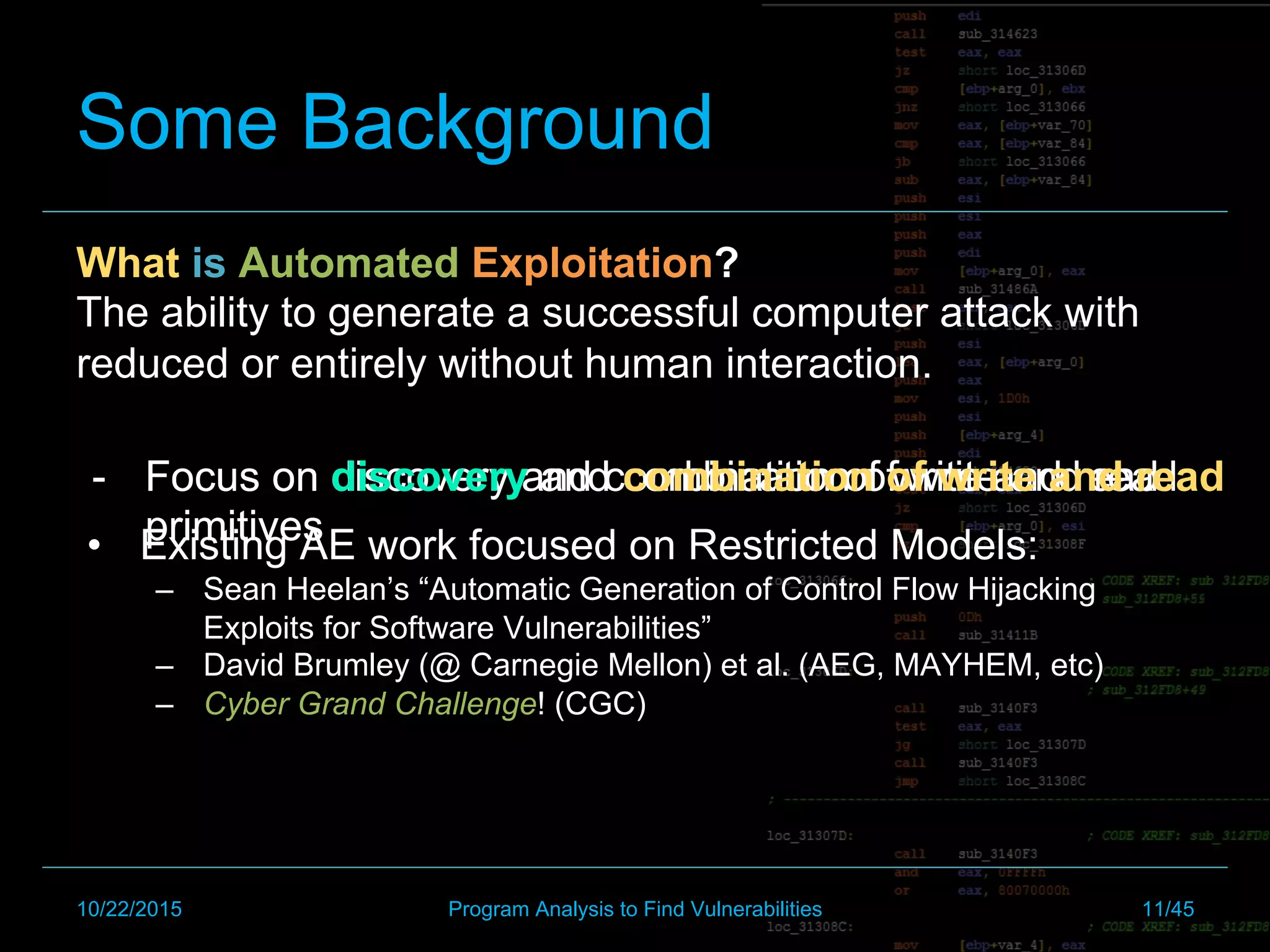
Automated Exploit Generation
1) Generate input to get to vulnerability
2) Generate payload to exploit and get shell
10/22/2015 Program Analysis to Find Vulnerabilities 14/45](https://image.slidesharecdn.com/csw2016dantoineautomaticexploitgeneration-160402161242/75/Csw2016-d-antoine_automatic_exploitgeneration-14-2048.jpg)
![The image cannot be displayed. Your computer may not have enough memory to open the image, or the image may have been corrupted. Restart your computer, and then open the file again. If the red x still appears, you may have to delete the image and then insert it again.
AEG - pwnable.kr
fail ...
input
argv[1]
3
checks
... 15 more
functions ...
memcpy
fail ...
10/22/2015 Program Analysis to Find Vulnerabilities 15/45](https://image.slidesharecdn.com/csw2016dantoineautomaticexploitgeneration-160402161242/75/Csw2016-d-antoine_automatic_exploitgeneration-15-2048.jpg)
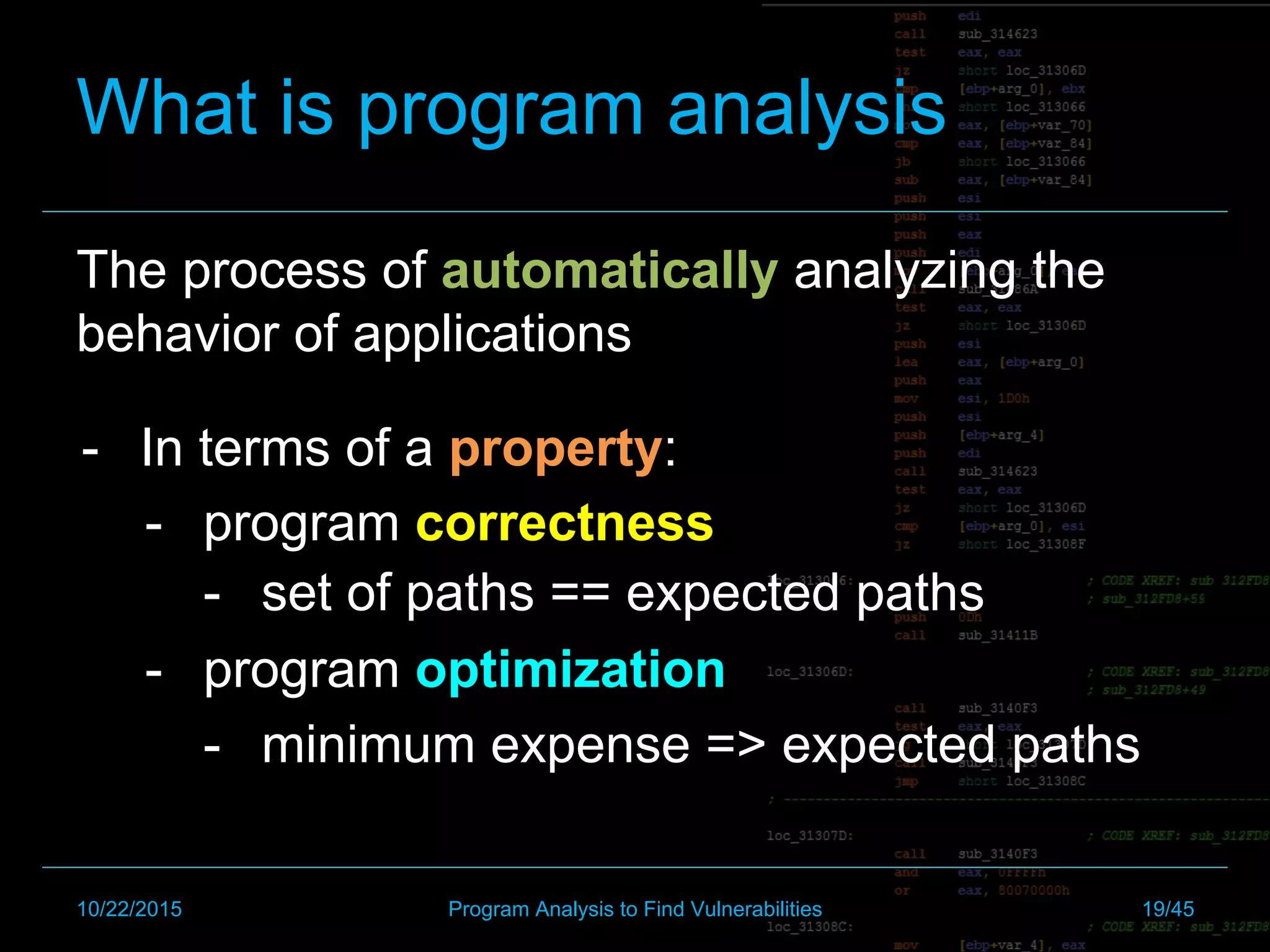
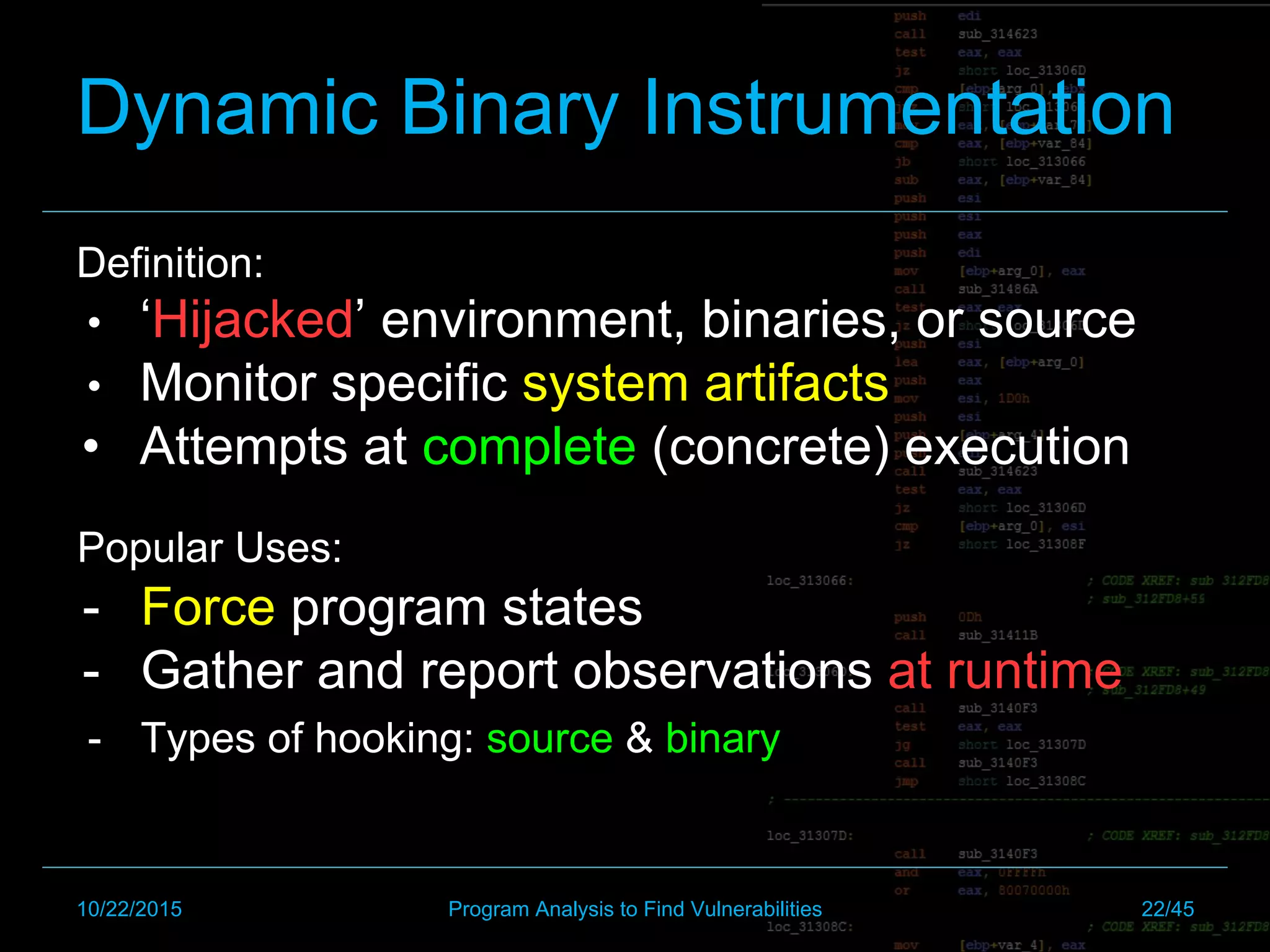
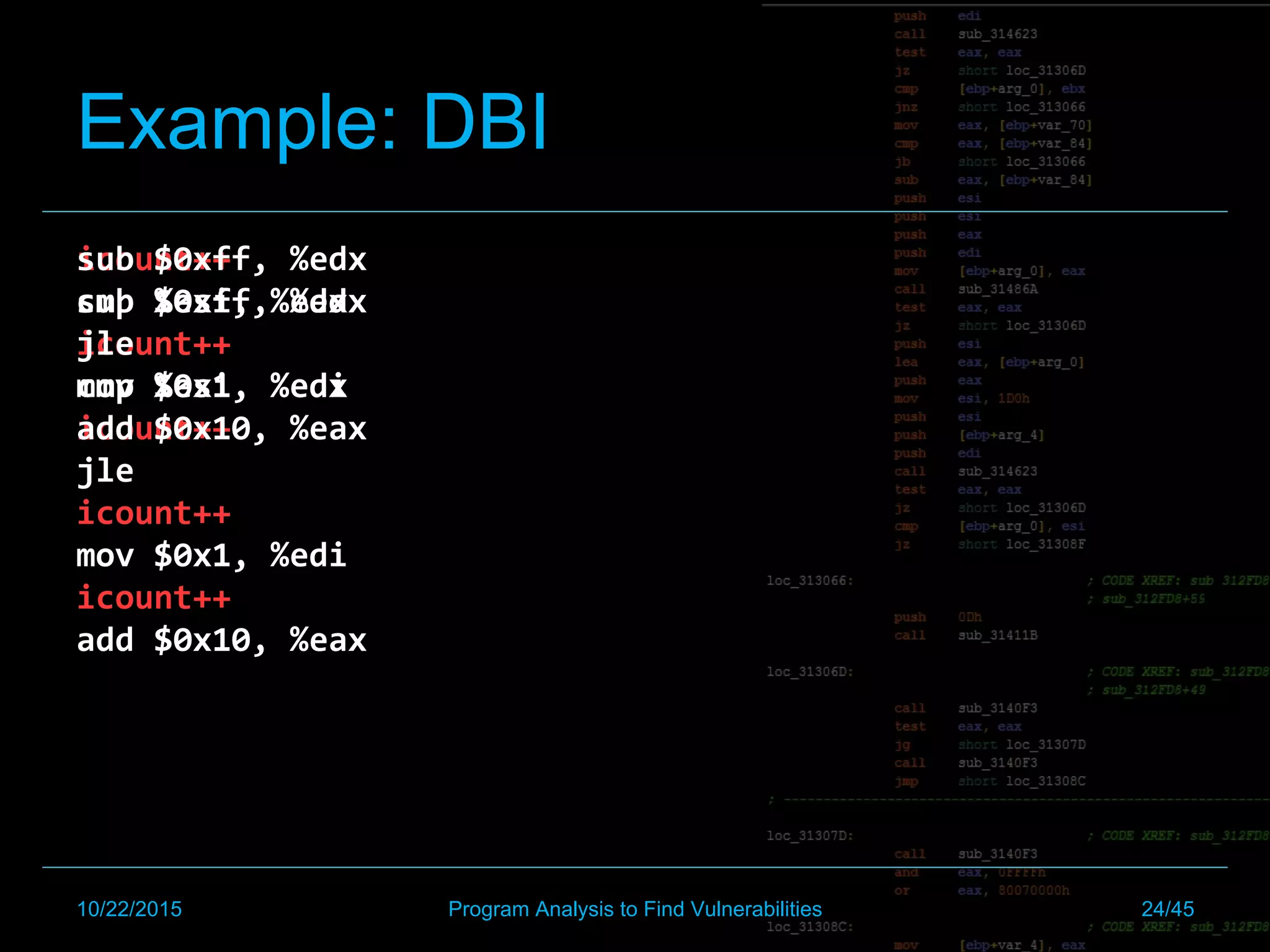
![Example: DBI
$pin -t inscount0.so -- binary
[BINARY LEVEL]
- Inject increment after each instruction
[STILL BRUTE FORCE]
- Return total instructions for fuzzed input
- Only true for that 1 executed path
(the possible CFG space may be
very large)
10/22/2015 Program Analysis to Find Vulnerabilities 23/45](https://image.slidesharecdn.com/csw2016dantoineautomaticexploitgeneration-160402161242/75/Csw2016-d-antoine_automatic_exploitgeneration-23-2048.jpg)
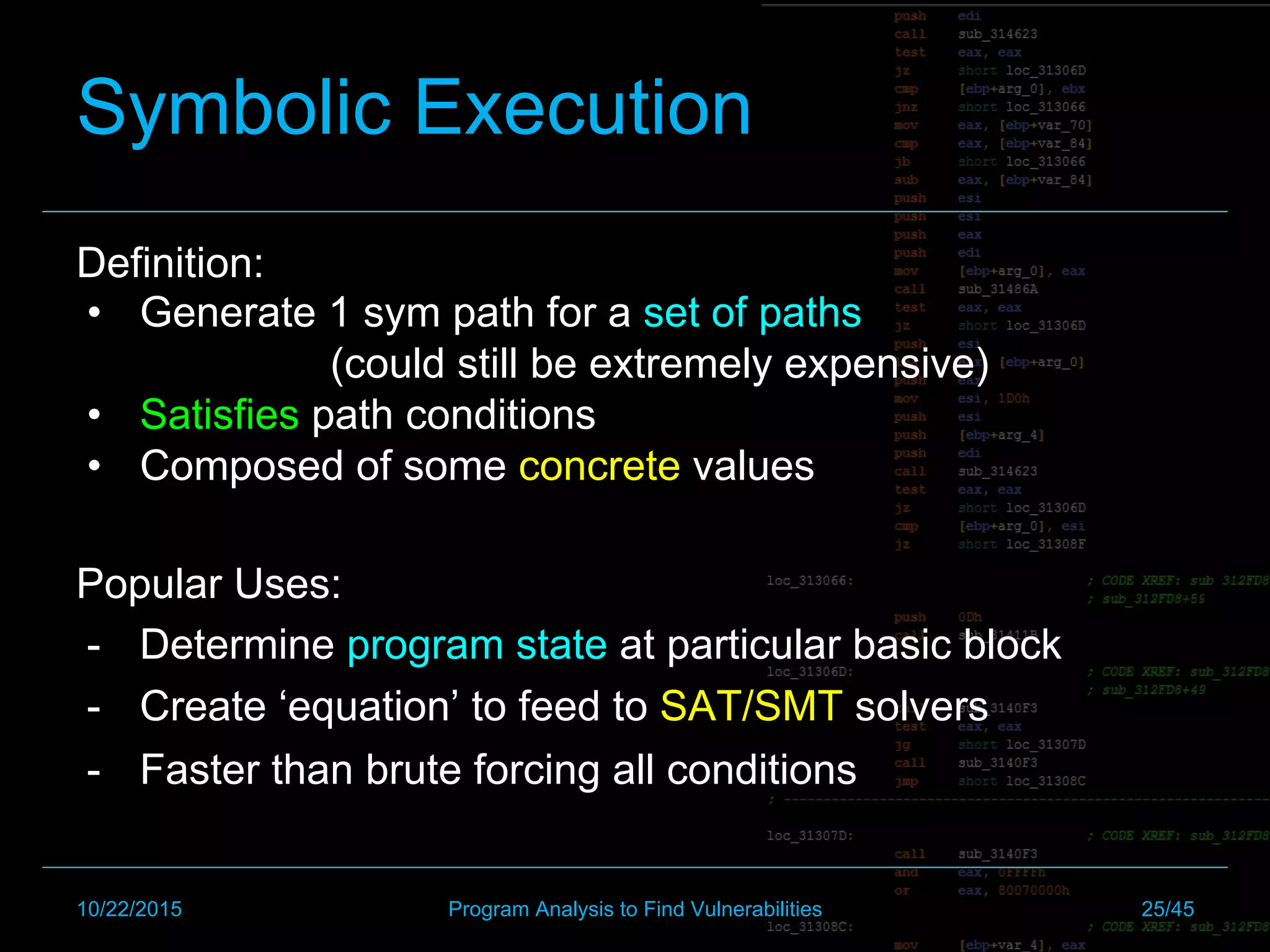
![Example: Symbolic Execution
[INT] a, b, c
[INT] x, y, z = 0;
fun( int a, b, c )
{
if (a) {
x = -2;
}
if (b < 5) {
if (!a && c) {
y = 1;
}
z = 2;
}
assert(x+y+z!=3)
}
. . .
fun( 0, 3, 1 );
. . .
Old Method:
Try all inputs until assert
[WARNING] inputs unbounded!
10/22/2015 Program Analysis to Find Vulnerabilities 26/45](https://image.slidesharecdn.com/csw2016dantoineautomaticexploitgeneration-160402161242/75/Csw2016-d-antoine_automatic_exploitgeneration-26-2048.jpg)
![Example: Symbolic Execution
[SYMBOL] a, b, c
[INT] x, y, z = 0;
if (a) {
x = -2;
}
if (b < 5) {
if (!a && c) {
y = 1;
}
z = 2;
}
assert(x+y+z!=3)
10/22/2015 Program Analysis to Find Vulnerabilities 27/45](https://image.slidesharecdn.com/csw2016dantoineautomaticexploitgeneration-160402161242/75/Csw2016-d-antoine_automatic_exploitgeneration-27-2048.jpg)
![Example: Concolic Execution
[INT] a, b, c
[INT] x, y, z = 0;
fun( int a, b, c )
{
if (a) {
x = -2;
}
if (b < 5) {
if (!a && c) {
y = 1;
}
z = 2;
}
assert(x+y+z!=3)
}
. . .
fun( 0, 3, 1 );
. . .
Old Method:
Try all inputs until assert
[WARNING] inputs unbounded!
10/22/2015 Program Analysis to Find Vulnerabilities 29/45](https://image.slidesharecdn.com/csw2016dantoineautomaticexploitgeneration-160402161242/75/Csw2016-d-antoine_automatic_exploitgeneration-29-2048.jpg)
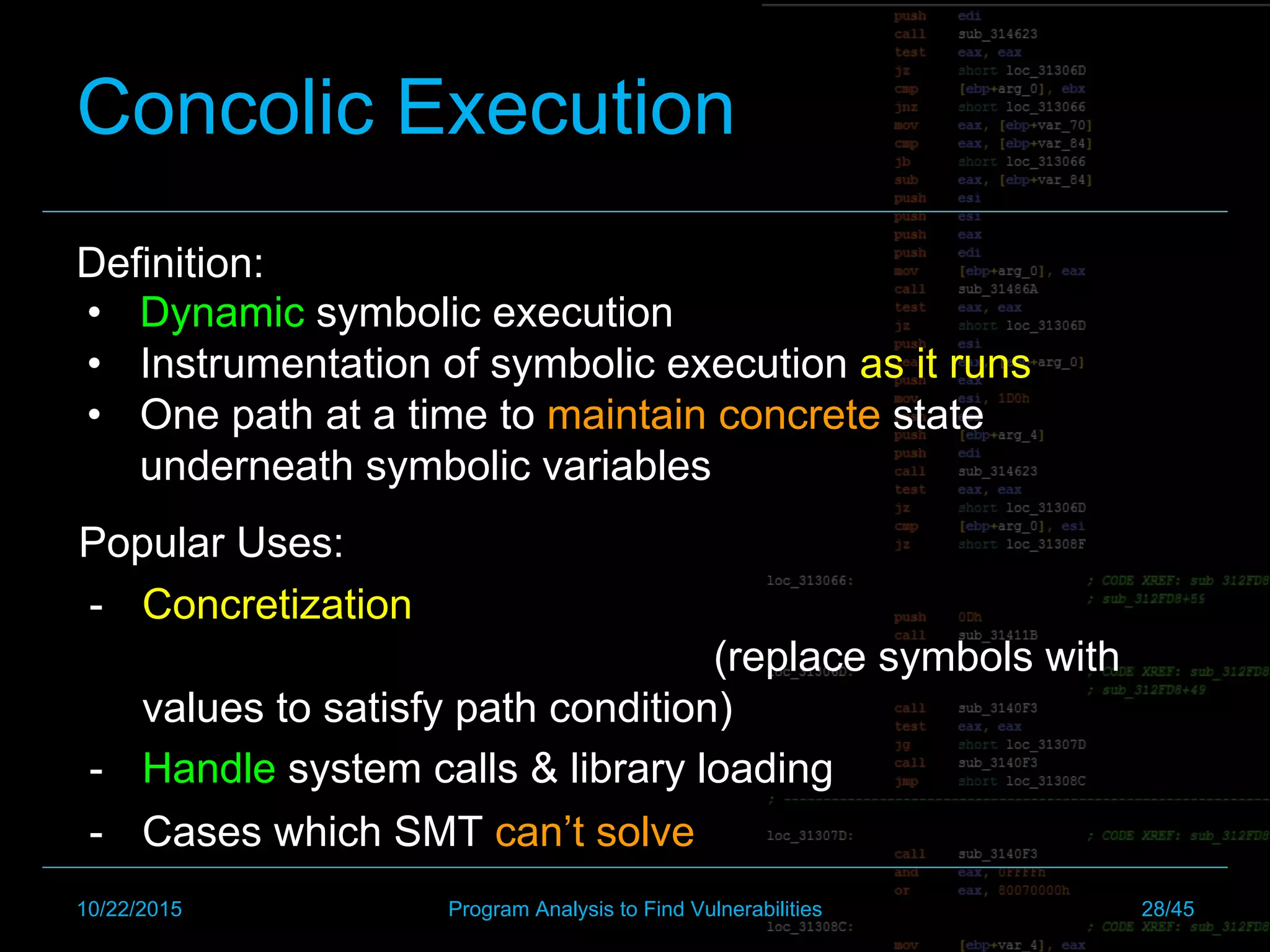
![Example: Concolic Execution
[INT & SYMBOL] a, b, c
[INT] x, y, z = 0;
if (a) {
x = -2;
}
if (b < 5) {
if (!a && c) {
y = 1;
}
z = 2;
}
assert(x+y+z!=3)
STEPS
[ONE]
concrete execution of function
[TWO]
while building symbolic path model
[THREE]
constraints on input are modeled
[FOUR]
models used to generate concrete input
10/22/2015 Program Analysis to Find Vulnerabilities 30/45](https://image.slidesharecdn.com/csw2016dantoineautomaticexploitgeneration-160402161242/75/Csw2016-d-antoine_automatic_exploitgeneration-30-2048.jpg)
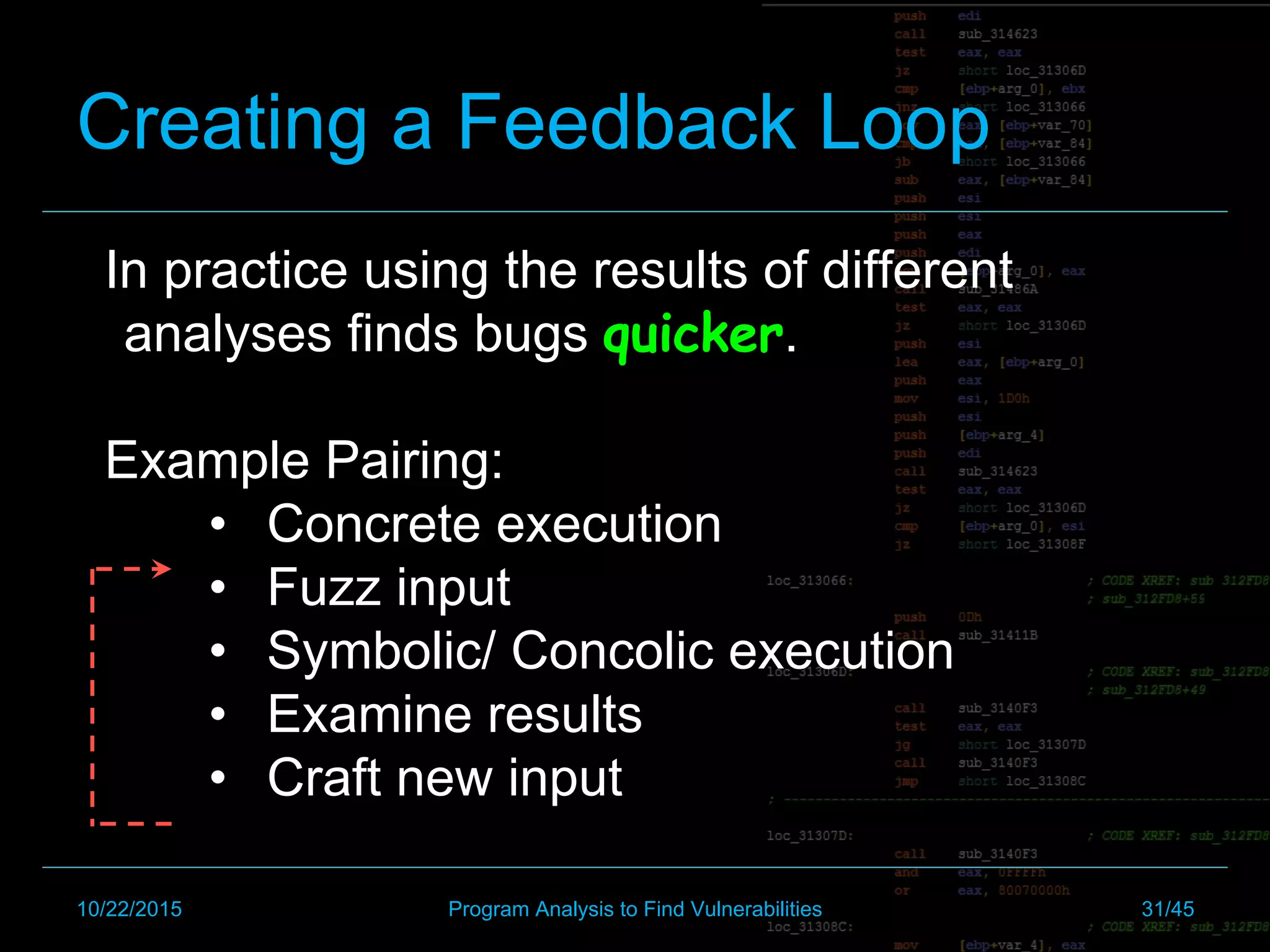
![Example: Flare-on Challenge 9
[ http://blog.trailofbits.com/2015/09/09/flare-on-reversing-
challenges-2015/ ]
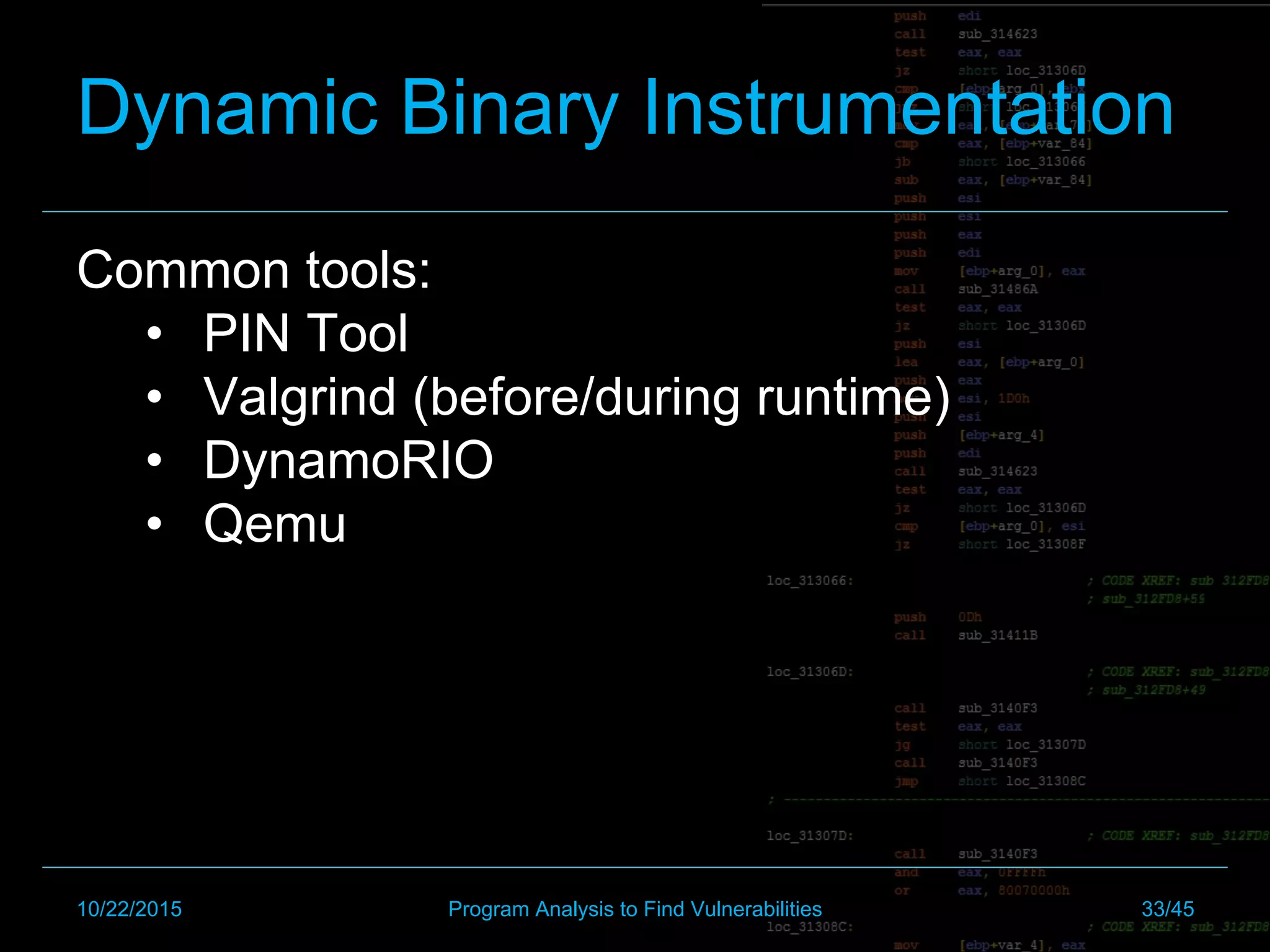
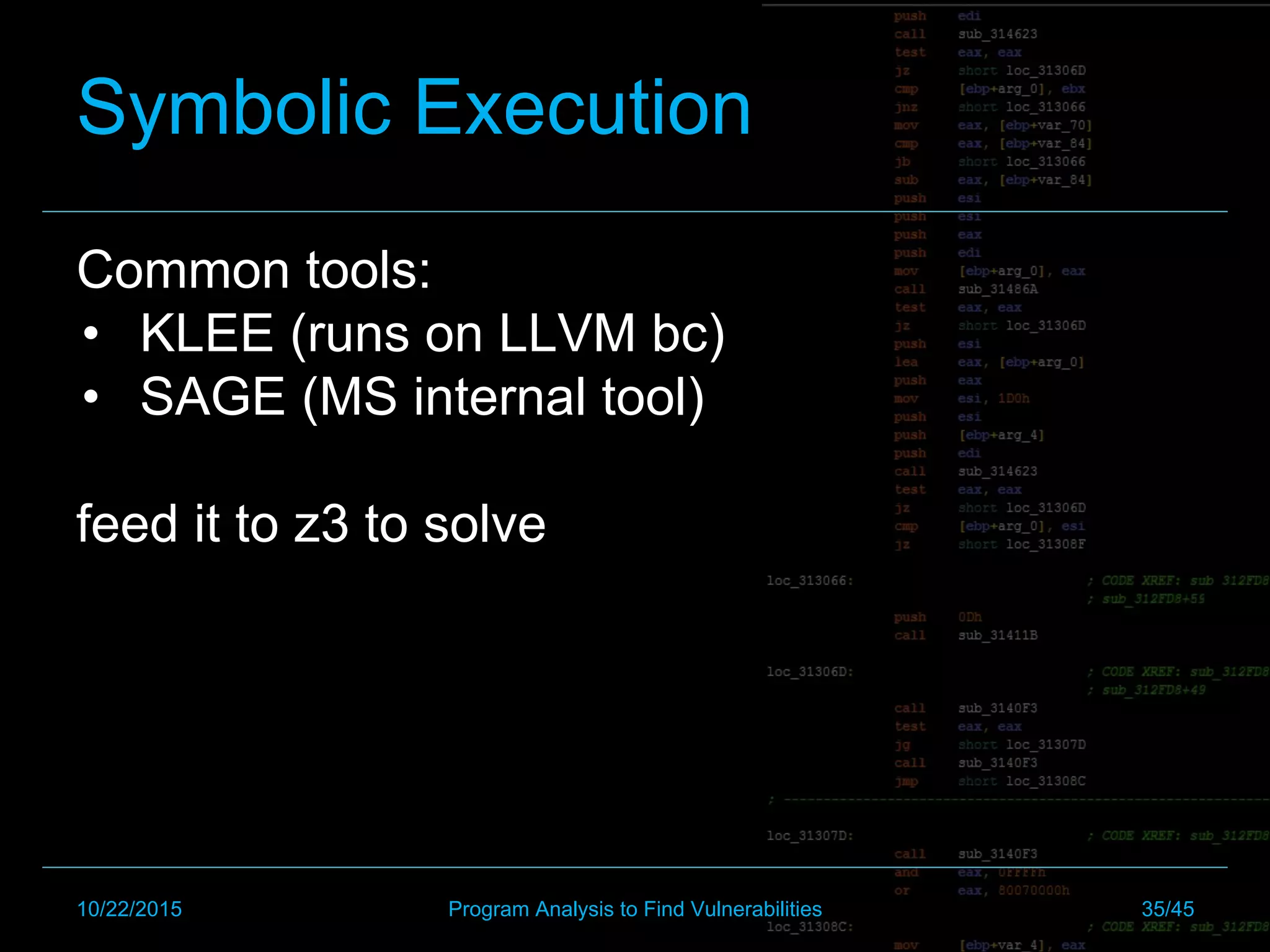
• Pintool instruction count
• More instructions == Closer to correct input
10/22/2015 Program Analysis to Find Vulnerabilities 34/45
Input:
FLAGAAAA...
Input:
AAAAAAAA...](https://image.slidesharecdn.com/csw2016dantoineautomaticexploitgeneration-160402161242/75/Csw2016-d-antoine_automatic_exploitgeneration-34-2048.jpg)
![AEG Demo: Assumptions
[ Assumptions ]
• Space of potential vulnerabilities too large
• Need to write tools to hunt for subset
– Target memory corrupt (memcpy)
• ROP from there…
[ Dynamically Acquire ]
• Path to target
• Solve for constraints
• Addresses of gadgets for ROP
[ Statically (Pre) Acquired ]
• Semantics of target & gadgets
10/22/2015 Program Analysis to Find Vulnerabilities 37/45](https://image.slidesharecdn.com/csw2016dantoineautomaticexploitgeneration-160402161242/75/Csw2016-d-antoine_automatic_exploitgeneration-37-2048.jpg)
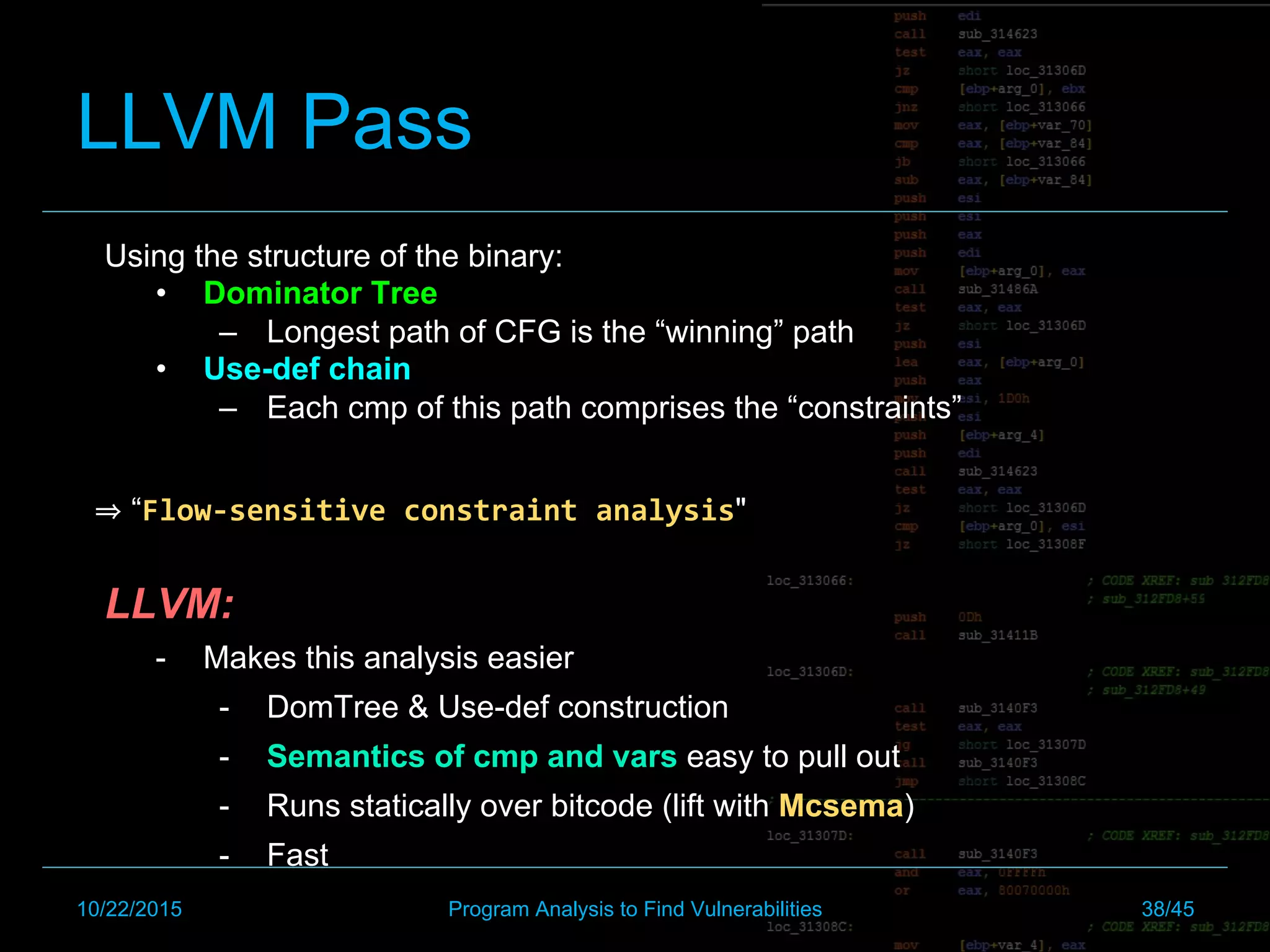
![LLVM Pass
Download tool:
[ https://github.com/trailofbits/domtresat ]
10/22/2015 Program Analysis to Find Vulnerabilities 38/45](https://image.slidesharecdn.com/csw2016dantoineautomaticexploitgeneration-160402161242/75/Csw2016-d-antoine_automatic_exploitgeneration-39-2048.jpg)
![Angr Script
… acquire binary & some conditions ….
b = angr.Project("aeg")
ss = b.factory.blank_state(addr=entry_func)
ss.options.discard("LAZY_SOLVES")
ss.se._solver.timeout=10000
ss.memory.store(argv1_buff, ss.BV("input", 50*8))
pg = b.factory.path_group(ss, immutable=False)
angr.path_group.l.setLevel("DEBUG")
pg.explore(find=vuln_addr[0], avoid=fail_bbs)
argv1_win = pg.found[0].state.se.any_str(pg.found[0].state.memory.load(argv1_buff, 50))
#setup env
#fake input with no value
#target & bad branches, 4 speed
#solved for path to target, dump memory
10/22/2015 Program Analysis to Find Vulnerabilities 39/45](https://image.slidesharecdn.com/csw2016dantoineautomaticexploitgeneration-160402161242/75/Csw2016-d-antoine_automatic_exploitgeneration-40-2048.jpg)
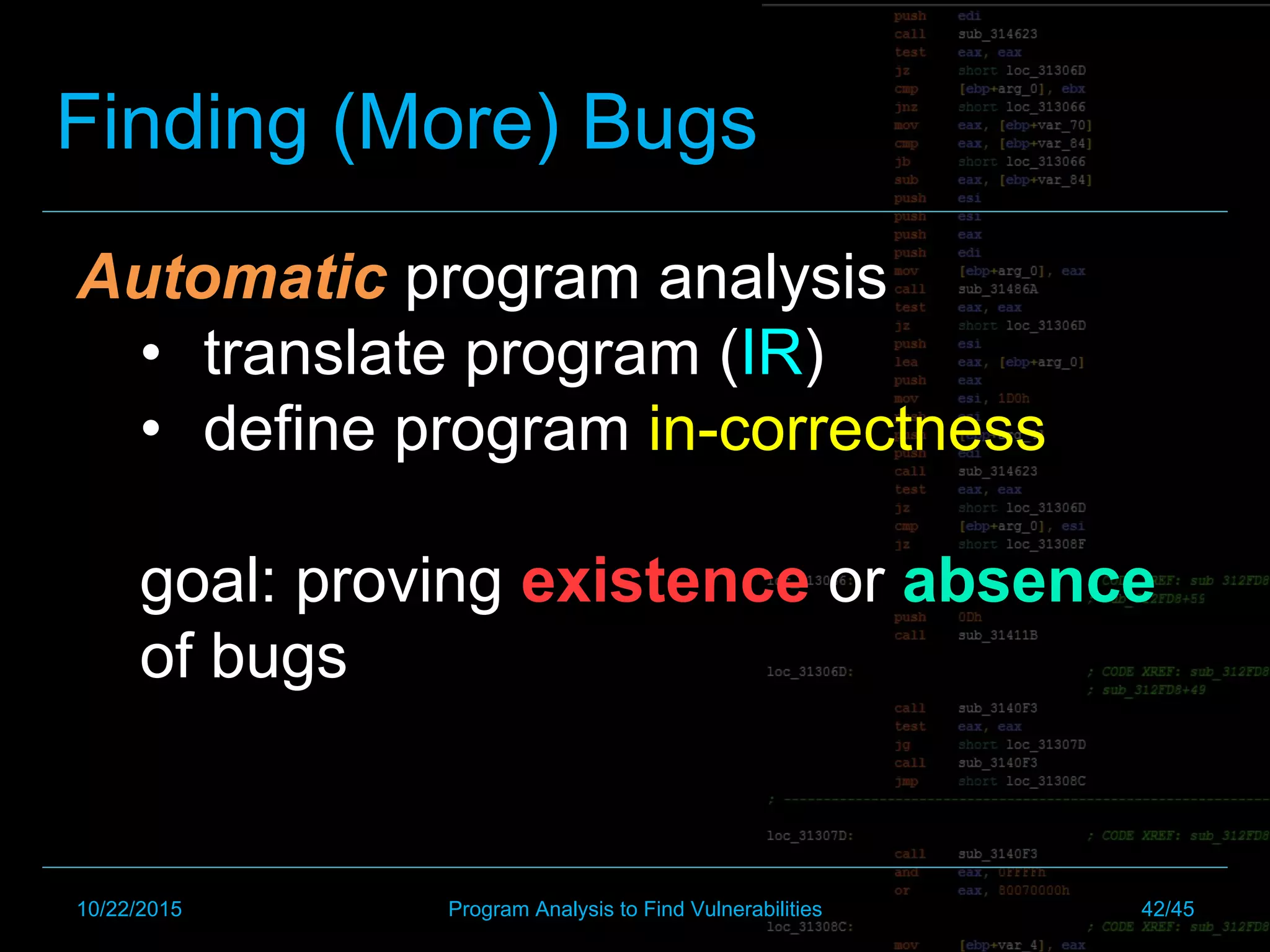
![[ What We are (still) Working With ]
– Binaries
– Source is nice
• Need to lift bins to IR for LLVM
• Most concolic exec. tools would need to compile it
Conclusion: The Future
[ Difficulty ]
- Know how to express our targeted vulnerability
- Semantics for UAF, Memory Corruption, etc....
10/22/2015 Program Analysis to Find Vulnerabilities 41/45](https://image.slidesharecdn.com/csw2016dantoineautomaticexploitgeneration-160402161242/75/Csw2016-d-antoine_automatic_exploitgeneration-42-2048.jpg)
![References
[Good Course Material]
https://www.cs.umd.edu/class/spring2013/cmsc631/lectures/symbolic-exec.pdf
https://www.utdallas.edu/~zxl111930/spring2012/public/lec4.pdf
http://web.mit.edu/16.399/www/lecture_01-intro/Cousot_MIT_2005_Course_01_4-1.pdf
http://homepage.cs.uiowa.edu/~tinelli/classes/seminar/Cousot.pdf
[Site for Tool Documentation]
https://github.com/angr/angr-doc
https://github.com/llvm-mirror/llvm
https://github.com/trailofbits/domtresat [ Tool built on concepts in this talk ]
[Other Good Resources]
http://www.grammatech.com/blog/hybrid-concolic-execution-part-1
http://openwall.info/wiki/_media/people/jvanegue/files/aegc_vanegue.pdf
10/22/2015 Automatic Exploit Generation 44/45](https://image.slidesharecdn.com/csw2016dantoineautomaticexploitgeneration-160402161242/75/Csw2016-d-antoine_automatic_exploitgeneration-45-2048.jpg)

The document discusses automated exploit generation through program analysis techniques. It introduces dynamic binary instrumentation, symbolic execution, and concolic execution as program analysis methods that can help automate finding the path to a vulnerability and generating an exploit. It provides examples of how these techniques work and common tools used like PIN, KLEE, Angr. The document concludes by discussing challenges like defining semantics of vulnerabilities precisely and the potential of program analysis to find more bugs through techniques like automated proving of program correctness.


![Number_Guessing_Game_Dsbsbssbzboc[1].pptx](https://cdn.slidesharecdn.com/ss_thumbnails/numberguessinggamedoc1-251206215042-a076fc05-thumbnail.jpg?width=640&height=640&fit=bounds)


