Overview
 Benefits of the Squat
 Myths about the Squat
 What the Squat
Actually Does
 Safety
 Technique
 Common Errors
 Learning the Squat
 Variations
Benefits of the Squat
 Core strength
 Lower body hypertrophy
 Sport / Real-life specific strength gains
 Bone Mass?
 Mobility
Myths
 Stance width effects muscle recruitment
 Stance width/angle of the feet effect the
knees
 Angle of the feet effects muscle
recruitment
 Squats are bad for the knees
 Bar placement effects muscle
recruitment
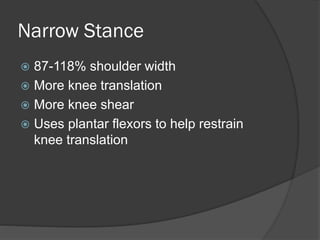
Narrow Stance
 87-118% shoulder width
 More knee translation
 More knee shear
 Uses plantar flexors to help restrain
knee translation
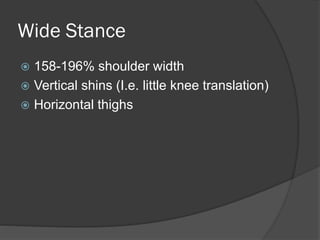
Wide Stance
 158-196% shoulder width
 Vertical shins (I.e. little knee translation)
 Horizontal thighs
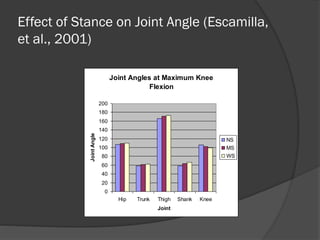
Effect of Stance on Joint Angle (Escamilla,
et al., 2001)
Joint Angles at Maximum Knee
Flexion
0
20
40
60
80
100
120
140
160
180
200
Hip Trunk Thigh Shank Knee
Joint
JointAngle
NS
MS
WS
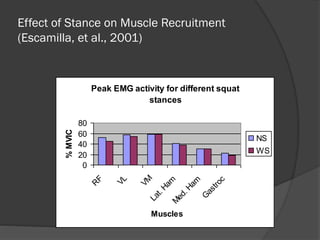
Effect of Stance on Muscle Recruitment
(Escamilla, et al., 2001)
Peak EMG activity for different squat
stances
0
20
40
60
80
R
F
VL
VM
Lat.Ham
M
ed.Ham
G
astroc
Muscles
%MVIC
NS
WS
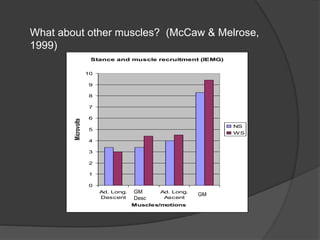
Stance and muscle recruitment (IEMG)
0
1
2
3
4
5
6
7
8
9
10
Ad. Long.
Descent
Ad. Long.
Ascent
Muscles/motions
Microvolts
NS
WS
GM GM
What about other muscles? (McCaw & Melrose,
1999)
GM
Desc.
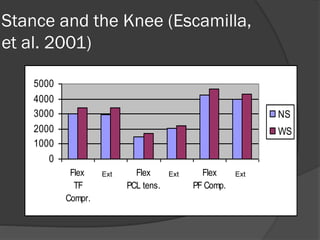
Stance and the Knee (Escamilla,
et al. 2001)
0
1000
2000
3000
4000
5000
Flex
TF
Compr.
Flex
PCL tens.
Flex
PF Comp.
NS
WS
Ext. Ext
.
Ext.
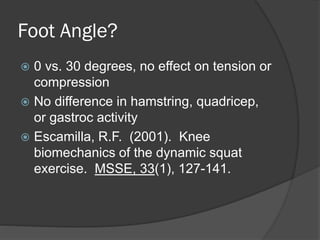
Foot Angle?
 0 vs. 30 degrees, no effect on tension or
compression
 No difference in hamstring, quadricep,
or gastroc activity
 Escamilla, R.F. (2001). Knee
biomechanics of the dynamic squat
exercise. MSSE, 33(1), 127-141.
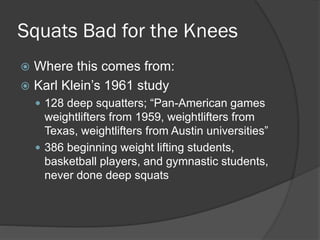
Squats Bad for the Knees
 Where this comes from:
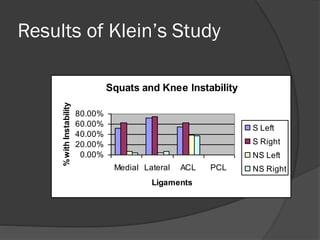
 Karl Klein’s 1961 study
 128 deep squatters; “Pan-American games
weightlifters from 1959, weightlifters from
Texas, weightlifters from Austin universities”
 386 beginning weight lifting students,
basketball players, and gymnastic students,
never done deep squats
Results of Klein’s Study
Squats and Knee Instability
0.00%
20.00%
40.00%
60.00%
80.00%
Medial Lateral ACL PCL
Ligaments
%withInstability
S Left
S Right
NS Left
NS Right
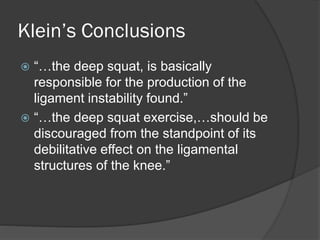
Klein’s Conclusions
 “…the deep squat, is basically
responsible for the production of the
ligament instability found.”
 “…the deep squat exercise,…should be
discouraged from the standpoint of its
debilitative effect on the ligamental
structures of the knee.”
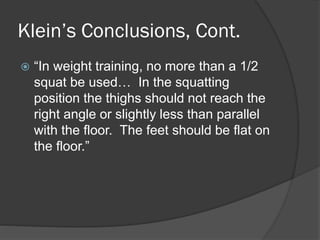
Klein’s Conclusions, Cont.
 “In weight training, no more than a 1/2
squat be used… In the squatting
position the thighs should not reach the
right angle or slightly less than parallel
with the floor. The feet should be flat on
the floor.”
How Well was the Study Done?
 How instability was measured.
 Klein’s comments to potential detractors:
 “…one has to accept the fact that an
experienced tester is capable of
demonstrating the evidence of stability and
instability of ligaments with relative ease.”
Since then...
 No one has been able to duplicate
Klein’s results
What the Squat Actually Does
 Tibiofemoral compression
 ACL/PCL tension
 Patellofemoral compression
 Muscle recruitment
Tibiofemoral Compression
 Too much could damage the menisci
and articular cartilage.
 Serves to resist translation of tibia
relative to femur (I.e. protects cruciate
ligaments).
 WS squats demonstrate greater levels
of TF compression.
 TF compression increases as the knees
flex, decreases as they extend
ACL Tension
 Escamilla has not observed ACL tension
during the squat (Escamilla, et al., 2001)
regardless of stance.
 This is thought to be due to hamstring
activity.
 This is in contrast to leg extensions,
where the ACL is loaded as the knee is
near full extension.
Squat and ACL
 How the squat reduces ACL tension:
 Hamstring activity
 Gastroc activity
 It’s weight bearing (joint compression)
 (Neitzel, J.A. & G.J. Davies, 2000)
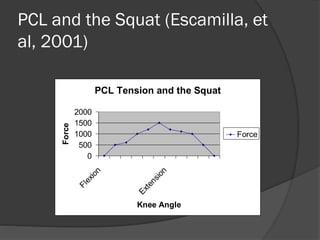
PCL and the Squat (Escamilla, et
al, 2001)
PCL Tension and the Squat
0
500
1000
1500
2000
Flexion
Extension
Knee Angle
Force
Force
Squat and the Cruciate
Ligaments
 Escamilla recommends avoiding squats
greater than 50-60 degrees of knee
flexion with PCL injuries.
 The lack of anterior shear indicates that
the squat may be appropriate for ACL
patients.
Patellofemoral Compression
 Increases as the knees flex and
decreases as the knees extend.
 Escamilla suggests avoiding knee
flexion of greater than 50 degrees when
suffering PF pathologies (stress is
greatest from 50-80 degrees).
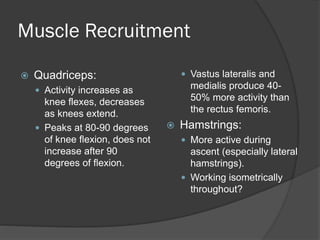
Muscle Recruitment
 Quadriceps:
 Activity increases as
knee flexes, decreases
as knees extend.
 Peaks at 80-90 degrees
of knee flexion, does not
increase after 90
degrees of flexion.
 Vastus lateralis and
medialis produce 40-
50% more activity than
the rectus femoris.
 Hamstrings:
 More active during
ascent (especially lateral
hamstrings).
 Working isometrically
throughout?
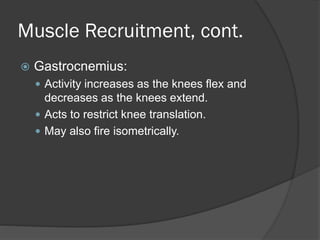
Muscle Recruitment, cont.
 Gastrocnemius:
 Activity increases as the knees flex and
decreases as the knees extend.
 Acts to restrict knee translation.
 May also fire isometrically.
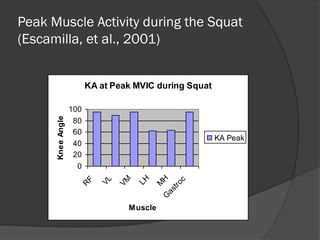
Peak Muscle Activity during the Squat
(Escamilla, et al., 2001)
KA at Peak MVIC during Squat
0
20
40
60
80
100
R
F
VL
VM
LH
M
HG
astroc
Muscle
KneeAngle
KA Peak
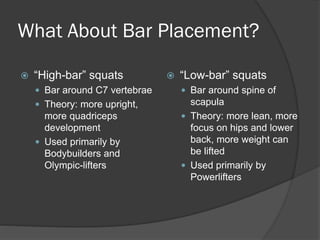
What About Bar Placement?
 “High-bar” squats
 Bar around C7 vertebrae
 Theory: more upright,
more quadriceps
development
 Used primarily by
Bodybuilders and
Olympic-lifters
 “Low-bar” squats
 Bar around spine of
scapula
 Theory: more lean, more
focus on hips and lower
back, more weight can
be lifted
 Used primarily by
Powerlifters
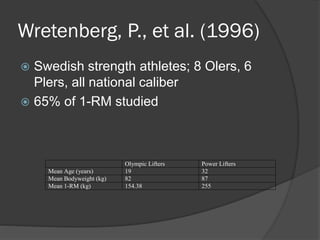
Wretenberg, P., et al. (1996)
 Swedish strength athletes; 8 Olers, 6
Plers, all national caliber
 65% of 1-RM studied
Olympic Lifters Power Lifters
Mean Age (years) 19 32
Mean Bodyweight (kg) 82 87
Mean 1-RM (kg) 154.38 255
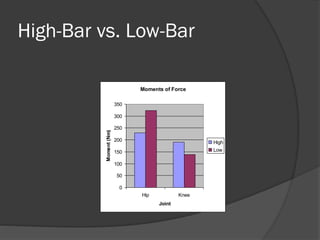
High-Bar vs. Low-Bar
Moments of Force
0
50
100
150
200
250
300
350
Hip Knee
Joint
Moment(Nm)
High
Low
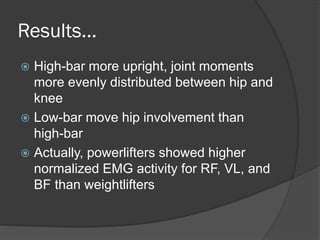
Results...
 High-bar more upright, joint moments
more evenly distributed between hip and
knee
 Low-bar move hip involvement than
high-bar
 Actually, powerlifters showed higher
normalized EMG activity for RF, VL, and
BF than weightlifters

The Squat: An Analysis

  • 2.
    Overview  Benefits ofthe Squat  Myths about the Squat  What the Squat Actually Does  Safety  Technique  Common Errors  Learning the Squat  Variations
  • 3.
    Benefits of theSquat  Core strength  Lower body hypertrophy  Sport / Real-life specific strength gains  Bone Mass?  Mobility
  • 4.
    Myths  Stance widtheffects muscle recruitment  Stance width/angle of the feet effect the knees  Angle of the feet effects muscle recruitment  Squats are bad for the knees  Bar placement effects muscle recruitment
  • 5.
    Narrow Stance  87-118%shoulder width  More knee translation  More knee shear  Uses plantar flexors to help restrain knee translation
  • 6.
    Wide Stance  158-196%shoulder width  Vertical shins (I.e. little knee translation)  Horizontal thighs
  • 7.
    Effect of Stanceon Joint Angle (Escamilla, et al., 2001) Joint Angles at Maximum Knee Flexion 0 20 40 60 80 100 120 140 160 180 200 Hip Trunk Thigh Shank Knee Joint JointAngle NS MS WS
  • 8.
    Effect of Stanceon Muscle Recruitment (Escamilla, et al., 2001) Peak EMG activity for different squat stances 0 20 40 60 80 R F VL VM Lat.Ham M ed.Ham G astroc Muscles %MVIC NS WS
  • 9.
    Stance and musclerecruitment (IEMG) 0 1 2 3 4 5 6 7 8 9 10 Ad. Long. Descent Ad. Long. Ascent Muscles/motions Microvolts NS WS GM GM What about other muscles? (McCaw & Melrose, 1999) GM Desc.
  • 10.
    Stance and theKnee (Escamilla, et al. 2001) 0 1000 2000 3000 4000 5000 Flex TF Compr. Flex PCL tens. Flex PF Comp. NS WS Ext. Ext . Ext.
  • 11.
    Foot Angle?  0vs. 30 degrees, no effect on tension or compression  No difference in hamstring, quadricep, or gastroc activity  Escamilla, R.F. (2001). Knee biomechanics of the dynamic squat exercise. MSSE, 33(1), 127-141.
  • 12.
    Squats Bad forthe Knees  Where this comes from:  Karl Klein’s 1961 study  128 deep squatters; “Pan-American games weightlifters from 1959, weightlifters from Texas, weightlifters from Austin universities”  386 beginning weight lifting students, basketball players, and gymnastic students, never done deep squats
  • 13.
    Results of Klein’sStudy Squats and Knee Instability 0.00% 20.00% 40.00% 60.00% 80.00% Medial Lateral ACL PCL Ligaments %withInstability S Left S Right NS Left NS Right
  • 14.
    Klein’s Conclusions  “…thedeep squat, is basically responsible for the production of the ligament instability found.”  “…the deep squat exercise,…should be discouraged from the standpoint of its debilitative effect on the ligamental structures of the knee.”
  • 15.
    Klein’s Conclusions, Cont. “In weight training, no more than a 1/2 squat be used… In the squatting position the thighs should not reach the right angle or slightly less than parallel with the floor. The feet should be flat on the floor.”
  • 16.
    How Well wasthe Study Done?  How instability was measured.  Klein’s comments to potential detractors:  “…one has to accept the fact that an experienced tester is capable of demonstrating the evidence of stability and instability of ligaments with relative ease.”
  • 17.
    Since then...  Noone has been able to duplicate Klein’s results
  • 18.
    What the SquatActually Does  Tibiofemoral compression  ACL/PCL tension  Patellofemoral compression  Muscle recruitment
  • 19.
    Tibiofemoral Compression  Toomuch could damage the menisci and articular cartilage.  Serves to resist translation of tibia relative to femur (I.e. protects cruciate ligaments).  WS squats demonstrate greater levels of TF compression.  TF compression increases as the knees flex, decreases as they extend
  • 20.
    ACL Tension  Escamillahas not observed ACL tension during the squat (Escamilla, et al., 2001) regardless of stance.  This is thought to be due to hamstring activity.  This is in contrast to leg extensions, where the ACL is loaded as the knee is near full extension.
  • 21.
    Squat and ACL How the squat reduces ACL tension:  Hamstring activity  Gastroc activity  It’s weight bearing (joint compression)  (Neitzel, J.A. & G.J. Davies, 2000)
  • 22.
    PCL and theSquat (Escamilla, et al, 2001) PCL Tension and the Squat 0 500 1000 1500 2000 Flexion Extension Knee Angle Force Force
  • 23.
    Squat and theCruciate Ligaments  Escamilla recommends avoiding squats greater than 50-60 degrees of knee flexion with PCL injuries.  The lack of anterior shear indicates that the squat may be appropriate for ACL patients.
  • 24.
    Patellofemoral Compression  Increasesas the knees flex and decreases as the knees extend.  Escamilla suggests avoiding knee flexion of greater than 50 degrees when suffering PF pathologies (stress is greatest from 50-80 degrees).
  • 25.
    Muscle Recruitment  Quadriceps: Activity increases as knee flexes, decreases as knees extend.  Peaks at 80-90 degrees of knee flexion, does not increase after 90 degrees of flexion.  Vastus lateralis and medialis produce 40- 50% more activity than the rectus femoris.  Hamstrings:  More active during ascent (especially lateral hamstrings).  Working isometrically throughout?
  • 26.
    Muscle Recruitment, cont. Gastrocnemius:  Activity increases as the knees flex and decreases as the knees extend.  Acts to restrict knee translation.  May also fire isometrically.
  • 27.
    Peak Muscle Activityduring the Squat (Escamilla, et al., 2001) KA at Peak MVIC during Squat 0 20 40 60 80 100 R F VL VM LH M HG astroc Muscle KneeAngle KA Peak
  • 28.
    What About BarPlacement?  “High-bar” squats  Bar around C7 vertebrae  Theory: more upright, more quadriceps development  Used primarily by Bodybuilders and Olympic-lifters  “Low-bar” squats  Bar around spine of scapula  Theory: more lean, more focus on hips and lower back, more weight can be lifted  Used primarily by Powerlifters
  • 29.
    Wretenberg, P., etal. (1996)  Swedish strength athletes; 8 Olers, 6 Plers, all national caliber  65% of 1-RM studied Olympic Lifters Power Lifters Mean Age (years) 19 32 Mean Bodyweight (kg) 82 87 Mean 1-RM (kg) 154.38 255
  • 30.
    High-Bar vs. Low-Bar Momentsof Force 0 50 100 150 200 250 300 350 Hip Knee Joint Moment(Nm) High Low
  • 31.
    Results...  High-bar moreupright, joint moments more evenly distributed between hip and knee  Low-bar move hip involvement than high-bar  Actually, powerlifters showed higher normalized EMG activity for RF, VL, and BF than weightlifters