
+
ESS 3092: KINESIOLOGY
Week 12
+
Review
3
+
Name the thigh adductors:
4
5
+
Pectineus
 Origin
 The superior ramus of the
pubis, between the pubic
tubercle and the iliopubic
eminence
 Insertion
 Pectineal line on the posterior
aspect of the femur
 Location
 Deep
 Action
 Hip adduction
 Hip internal rotation (weak)
 Hip flexion (weak)
6
+
Adductor Brevis
 Origin
 The body and the inferior ramus of
the pubis
 Insertion
 Pectineal line and the proximal half
of the linea aspera
 Location
 Deep
 Medial
 Posterior to pectineus
 Action
 Hip adduction
 Hip internal rotation (weak)
 Hip flexion (weak)
7
+
Adductor Longus
 Origin
 The intersection of the pubic
crest and symphysis
 Insertion
 Medial lip of the linea aspera
 Location
 Medial
 Superficial
 Action
 Hip adduction
 Hip flexion
8
+
Adductor Magnus
 Origin
 Inferior ramus of the pubis
 Insertion
 Linea aspera to the adductor
tubercle
 Location
 Medial
 Deepest of the adductors
 Action
 Hip extension
 Hip adduction (role unknown)
9
+
Gracilis
 Origin
 Thin aponeurosis from the
medial surface of the inferior
body of the pubis
 Insertion
 Proximal aspect of the medial
surface of the tibia
 Location
 Medial
 Most superficial of the adductors
 Action
 Hip adduction
 Knee flexion
 Knee internal rotation
10
+
The Knee Joint
11
+ The Knee Joint
Bones & bony landmarks
Joint Structure
 Ligaments & menisci
Movements
Muscles surrounding the joint &
attachments
+
Patella
Patella
The largest sesamoid bone
+
Knee Joint
Vulnerable to injury
Provides stability and mobility
 Extended – joint surfaces congruent
 Flexed – requires capsule, ligaments, muscles
3 articulations
1)Tibiofemoral (knee)
2) Patellofemoral= gliding joint
3) Superior tibiofibular
+
Degrees of Freedom
a) Medial/lateral translation
b) Longitudinal rotation
c) Anterior/posterior translation
16
d) Tibial and femoral rotation
e) Varus/Valgus
f) Flexion/extension
+
Knee Malalignment (Varus ans
Valgus)
 Hip, knee and ankle should remain in line
 Varus moves load medially and increases risk of AO, weight is
a confounder increasing risk of AO 5x
 Valgus moves load laterally. Less risk of AO compared to
varus, but still a factor in AO, minisci, and ligament damage.
17
+
Knee Joint
 Bursae (>10)
 Absorb shock or prevent friction
 Synovial cavity (capsule)
 Lies under patella & between
surfaces of tibia & femur
 Infrapatellar fat pad
 Posterior to patellar tendon
 Osteoarthritis:
 Breakdown of articular
cartilage– decreased blood
supply so does not self-
regenerate
+
Tibiofemoral Joint
 Lateral condyle (c)
 Flatter, larger surface area
 More superior than (b)
 ↑ stability
 Aligned w/ femur
 Medial condyle (b)
 Convex
 Aligned w/ tibia
 Fits snug with tibia (concave)
Posterior Anterior
c b
+
Tibiofemoral Joint
Menisci form cushions
between bones
 Attached to tibia
 Enhance stability
 Thicker outside border &
taper
Medial
 Larger & more open C
Lateral
 Closed C configuration
+
Tears due to:
 Compression & shear
forces during rotation
while flexing or
extending
 Quick directional
changes in running
Menisectomies ↑ friction 50 % (leads to
osteoarthritis)
+ Knee Joint Supporting Ligaments
Cruciate ligaments: (2) ACL & PCL
 Cross w/in knee between tibia & femur
 Maintain anterior & posterior stability & rotatory stability
+
Cruciate Ligaments
Posterior Cruciate Ligament (PCL)
 From posterior middle tibia to anterior medial femoral condyle.
 Limits posterior movement of tibia on femur
 PCL injury = direct contact injury
Anterior Cruciate Ligament (ACL)
 From (anterior) intercondylar eminences of tibia to lateral femoral condyle
 Limits anterior movement of tibia on femur
 Common injury to knee
 Injury mechanism often involves noncontact rotary forces
 Planting & cutting
 Hyperextension
 Violent quadriceps contraction (pulls tibia forward on femur)
+
ACL Injury
Theories why females tear ACLs 2-7x more than
males:
1. ↑ Q-angle in
2. Neurological: when stimulate back of knee, contract
quads, contract hamstrings.
3. Strength differences: is stronger than
4. Hormonal: ↑ Estrogen => ↑ elasticity => ↑ tearing
+
 Lateral (fibular) Collateral Ligament (LCL)
 Supports knee against varus forces (medial bending)
 Laterally directed force
 Medial (tibial) Collateral Ligament (MCL)
 supports knee against valgus forces (lateral bending)
 Injuries (contact) are common: more exposed/vulnerable
Knee Joint Supporting Ligaments
+
LCL and MCL
+ Q Angle
Assessment of
 Lower extremity alignment
 Patella position
Most efficient angle for quadriceps
to function is ~10º
 Males: 10-14º
 Females: 15-17º
Genu valgum (knock kneed)
 > 17º = excessive
Genu varus (bowlegged)
 Negative
↑ Q angle => ↑ stress on MCL
+ Joint Movements
Flexion (145º ROM)
 accompanied by internal rotation
(tibia on femur)
Extension (<180º ROM)
 accompanied by external rotation
(tibia on femur)
+ Joint Movements
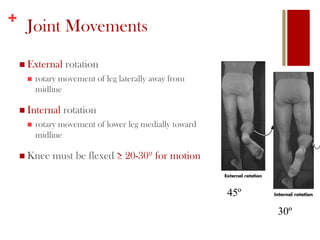
 External rotation
 rotary movement of leg laterally away from
midline
 Internal rotation
 rotary movement of lower leg medially toward
midline
 Knee must be flexed ≥ 20-30º for motion
30º
45º
+
Knee Musculature

4

  • 1.
  • 2.
  • 3.
    + Name the thighadductors: 4
  • 4.
  • 5.
    + Pectineus  Origin  Thesuperior ramus of the pubis, between the pubic tubercle and the iliopubic eminence  Insertion  Pectineal line on the posterior aspect of the femur  Location  Deep  Action  Hip adduction  Hip internal rotation (weak)  Hip flexion (weak) 6
  • 6.
    + Adductor Brevis  Origin The body and the inferior ramus of the pubis  Insertion  Pectineal line and the proximal half of the linea aspera  Location  Deep  Medial  Posterior to pectineus  Action  Hip adduction  Hip internal rotation (weak)  Hip flexion (weak) 7
  • 7.
    + Adductor Longus  Origin The intersection of the pubic crest and symphysis  Insertion  Medial lip of the linea aspera  Location  Medial  Superficial  Action  Hip adduction  Hip flexion 8
  • 8.
    + Adductor Magnus  Origin Inferior ramus of the pubis  Insertion  Linea aspera to the adductor tubercle  Location  Medial  Deepest of the adductors  Action  Hip extension  Hip adduction (role unknown) 9
  • 9.
    + Gracilis  Origin  Thinaponeurosis from the medial surface of the inferior body of the pubis  Insertion  Proximal aspect of the medial surface of the tibia  Location  Medial  Most superficial of the adductors  Action  Hip adduction  Knee flexion  Knee internal rotation 10
  • 10.
  • 11.
    + The KneeJoint Bones & bony landmarks Joint Structure  Ligaments & menisci Movements Muscles surrounding the joint & attachments
  • 12.
  • 13.
  • 14.
    + Knee Joint Vulnerable toinjury Provides stability and mobility  Extended – joint surfaces congruent  Flexed – requires capsule, ligaments, muscles 3 articulations 1)Tibiofemoral (knee) 2) Patellofemoral= gliding joint 3) Superior tibiofibular
  • 15.
    + Degrees of Freedom a)Medial/lateral translation b) Longitudinal rotation c) Anterior/posterior translation 16 d) Tibial and femoral rotation e) Varus/Valgus f) Flexion/extension
  • 16.
    + Knee Malalignment (Varusans Valgus)  Hip, knee and ankle should remain in line  Varus moves load medially and increases risk of AO, weight is a confounder increasing risk of AO 5x  Valgus moves load laterally. Less risk of AO compared to varus, but still a factor in AO, minisci, and ligament damage. 17
  • 17.
    + Knee Joint  Bursae(>10)  Absorb shock or prevent friction  Synovial cavity (capsule)  Lies under patella & between surfaces of tibia & femur  Infrapatellar fat pad  Posterior to patellar tendon  Osteoarthritis:  Breakdown of articular cartilage– decreased blood supply so does not self- regenerate
  • 18.
    + Tibiofemoral Joint  Lateralcondyle (c)  Flatter, larger surface area  More superior than (b)  ↑ stability  Aligned w/ femur  Medial condyle (b)  Convex  Aligned w/ tibia  Fits snug with tibia (concave) Posterior Anterior c b
  • 19.
    + Tibiofemoral Joint Menisci formcushions between bones  Attached to tibia  Enhance stability  Thicker outside border & taper Medial  Larger & more open C Lateral  Closed C configuration
  • 20.
    + Tears due to: Compression & shear forces during rotation while flexing or extending  Quick directional changes in running Menisectomies ↑ friction 50 % (leads to osteoarthritis)
  • 21.
    + Knee JointSupporting Ligaments Cruciate ligaments: (2) ACL & PCL  Cross w/in knee between tibia & femur  Maintain anterior & posterior stability & rotatory stability
  • 22.
    + Cruciate Ligaments Posterior CruciateLigament (PCL)  From posterior middle tibia to anterior medial femoral condyle.  Limits posterior movement of tibia on femur  PCL injury = direct contact injury Anterior Cruciate Ligament (ACL)  From (anterior) intercondylar eminences of tibia to lateral femoral condyle  Limits anterior movement of tibia on femur  Common injury to knee  Injury mechanism often involves noncontact rotary forces  Planting & cutting  Hyperextension  Violent quadriceps contraction (pulls tibia forward on femur)
  • 23.
    + ACL Injury Theories whyfemales tear ACLs 2-7x more than males: 1. ↑ Q-angle in 2. Neurological: when stimulate back of knee, contract quads, contract hamstrings. 3. Strength differences: is stronger than 4. Hormonal: ↑ Estrogen => ↑ elasticity => ↑ tearing
  • 24.
    +  Lateral (fibular)Collateral Ligament (LCL)  Supports knee against varus forces (medial bending)  Laterally directed force  Medial (tibial) Collateral Ligament (MCL)  supports knee against valgus forces (lateral bending)  Injuries (contact) are common: more exposed/vulnerable Knee Joint Supporting Ligaments
  • 25.
  • 26.
    + Q Angle Assessmentof  Lower extremity alignment  Patella position Most efficient angle for quadriceps to function is ~10º  Males: 10-14º  Females: 15-17º Genu valgum (knock kneed)  > 17º = excessive Genu varus (bowlegged)  Negative ↑ Q angle => ↑ stress on MCL
  • 27.
    + Joint Movements Flexion(145º ROM)  accompanied by internal rotation (tibia on femur) Extension (<180º ROM)  accompanied by external rotation (tibia on femur)
  • 28.
    + Joint Movements External rotation  rotary movement of leg laterally away from midline  Internal rotation  rotary movement of lower leg medially toward midline  Knee must be flexed ≥ 20-30º for motion 30º 45º
  • 29.

Editor's Notes

  • #7 I: Between the lesser trochanter and the lineaaspera
  • #9 Important landmark in fitting above the knee prosthetics
  • #10 Often described as performing hamstring functions