John Cissik 
Human Performance Services, LLC
Overview 
 Examine how to train for: 
 Power 
 Speed 
 Agility 
 Examine how to integrate everything for 
program design
Power Training 
 What works “best?” 
 Traditional resistance training 
 Olympic-style weightlifting 
 Plyometrics 
 Complex training 
 Combining tools
Resistance Training 
 Strengthening the muscles could lead to 
an increase in power production 
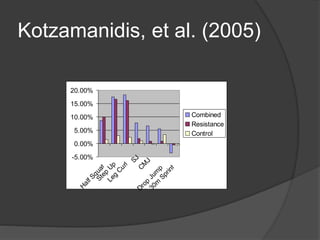
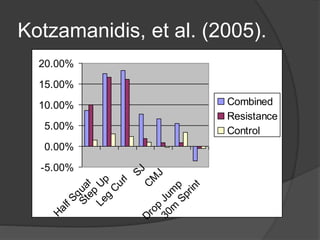
 Kotzamanidis, C., et al. (2005) looked at 
35 teenage soccer players 
 3 groups: control, strength training only, 
combined program (strength + sprints) 
 9 week, periodized program
Kotzamanidis, et al. (2005) 
20.00% 
15.00% 
10.00% 
5.00% 
0.00% 
-5.00% 
Step Up 
Leg Curl SJ 
Half Squat 
CMJ 
Drop Jump 
30m Sprint 
Combined 
Resistance 
Control
Conclusions 
 Resistance training alone does work, but 
may not be as effective as when 
combined with other modes of training. 
 Beginners?
Olympic-Style Weightlifting 
 Rationale 
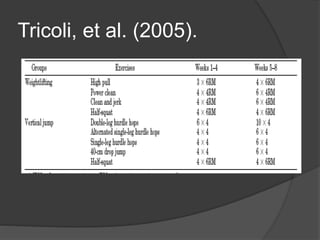
 Tricoli, et al. (2005): 
 Compared OWL and “vertical jump” training 
 32 physical education students, 8 weeks of 
training, 3x/week
Tricoli, et al. (2005).
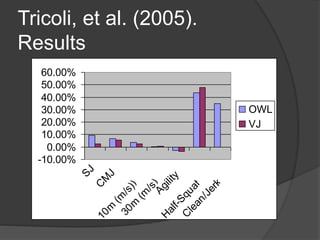
Tricoli, et al. (2005). 
Results 
60.00% 
50.00% 
40.00% 
30.00% 
20.00% 
10.00% 
0.00% 
-10.00% 
SJ 
CMJ 
10m (m/s)) 
Agility 
Half-Squat 
30m (m/s) 
Clean/Jerk 
OWL 
VJ
Does OWL Work? 
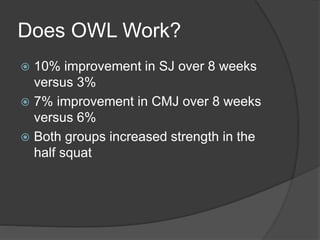
 10% improvement in SJ over 8 weeks 
versus 3% 
 7% improvement in CMJ over 8 weeks 
versus 6% 
 Both groups increased strength in the 
half squat
Plyometrics to Improve 
Power 
 Specificity of training 
 Does it work? Previous results seemed 
mixed… 
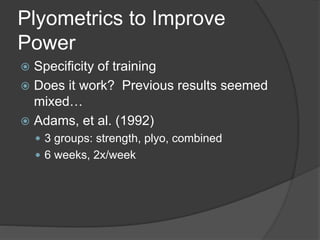
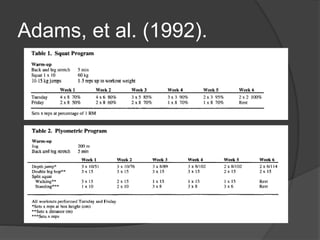
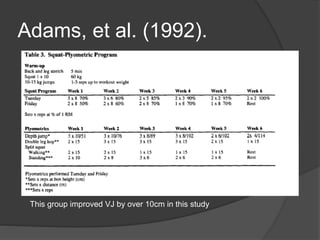
 Adams, et al. (1992) 
 3 groups: strength, plyo, combined 
 6 weeks, 2x/week
Adams, et al. (1992).
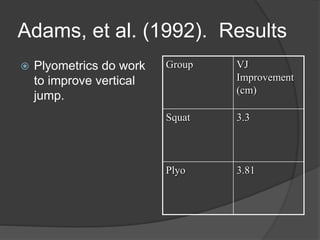
Adams, et al. (1992). Results 
 Plyometrics do work 
to improve vertical 
jump. 
Group VJ 
Improvement 
(cm) 
Squat 3.3 
Plyo 3.81
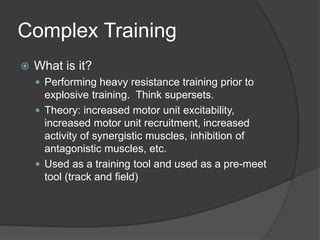
Complex Training 
 What is it? 
 Performing heavy resistance training prior to 
explosive training. Think supersets. 
 Theory: increased motor unit excitability, 
increased motor unit recruitment, increased 
activity of synergistic muscles, inhibition of 
antagonistic muscles, etc. 
 Used as a training tool and used as a pre-meet 
tool (track and field)
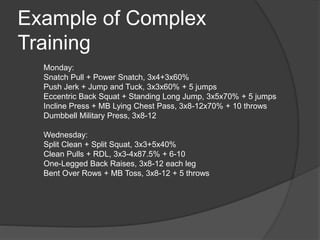
Example of Complex 
Training 
Monday: 
Snatch Pull + Power Snatch, 3x4+3x60% 
Push Jerk + Jump and Tuck, 3x3x60% + 5 jumps 
Eccentric Back Squat + Standing Long Jump, 3x5x70% + 5 jumps 
Incline Press + MB Lying Chest Pass, 3x8-12x70% + 10 throws 
Dumbbell Military Press, 3x8-12 
Wednesday: 
Split Clean + Split Squat, 3x3+5x40% 
Clean Pulls + RDL, 3x3-4x87.5% + 6-10 
One-Legged Back Raises, 3x8-12 each leg 
Bent Over Rows + MB Toss, 3x8-12 + 5 throws
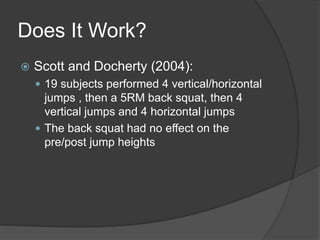
Does It Work? 
 Scott and Docherty (2004): 
 19 subjects performed 4 vertical/horizontal 
jumps , then a 5RM back squat, then 4 
vertical jumps and 4 horizontal jumps 
 The back squat had no effect on the 
pre/post jump heights
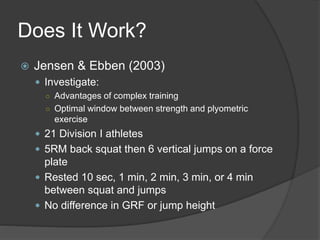
Does It Work? 
 Jensen & Ebben (2003) 
 Investigate: 
○ Advantages of complex training 
○ Optimal window between strength and plyometric 
exercise 
 21 Division I athletes 
 5RM back squat then 6 vertical jumps on a force 
plate 
 Rested 10 sec, 1 min, 2 min, 3 min, or 4 min 
between squat and jumps 
 No difference in GRF or jump height
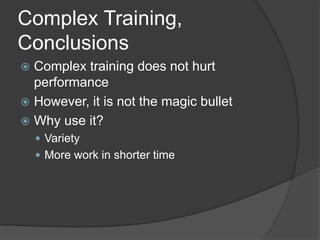
Complex Training, 
Conclusions 
 Complex training does not hurt 
performance 
 However, it is not the magic bullet 
 Why use it? 
 Variety 
 More work in shorter time
Combining Tools May be Most 
Effective 
 Research seems to indicate that 
everything is effective to a greater or 
lesser extent. 
 However, using multiple tools seems to 
be the most effective…
Adams, et al. (1992). 
This group improved VJ by over 10cm in this study
Kotzamanidis, et al. (2005). 
20.00% 
15.00% 
10.00% 
5.00% 
0.00% 
-5.00% 
Step Up 
Leg Curl SJ 
Half Squat 
CMJ 
Drop Jump 
30m Sprint 
Combined 
Resistance 
Control
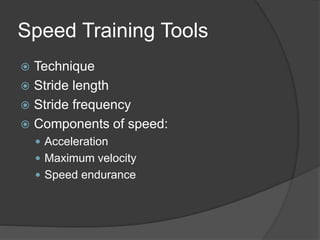
Speed Training Tools 
 Technique 
 Stride length 
 Stride frequency 
 Components of speed: 
 Acceleration 
 Maximum velocity 
 Speed endurance
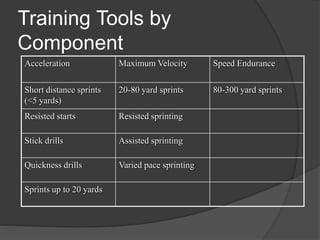
Training Tools by 
Component 
Acceleration Maximum Velocity Speed Endurance 
Short distance sprints 
(<5 yards) 
20-80 yard sprints 80-300 yard sprints 
Resisted starts Resisted sprinting 
Stick drills Assisted sprinting 
Quickness drills Varied pace sprinting 
Sprints up to 20 yards
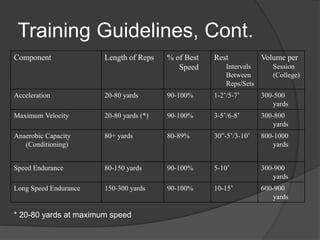
Training Guidelines, Cont. 
Component Length of Reps % of Best 
Speed 
Rest 
Intervals 
Between 
Reps/Sets 
Volume per 
Session 
(College) 
Acceleration 20-80 yards 90-100% 1-2’/5-7’ 300-500 
yards 
Maximum Velocity 20-80 yards (*) 90-100% 3-5’/6-8’ 300-800 
yards 
Anaerobic Capacity 
(Conditioning) 
80+ yards 80-89% 30”-5’/3-10’ 800-1000 
yards 
Speed Endurance 80-150 yards 90-100% 5-10’ 300-900 
yards 
Long Speed Endurance 150-300 yards 90-100% 10-15’ 600-900 
yards 
* 20-80 yards at maximum speed
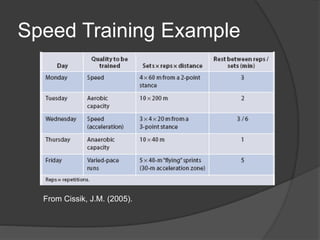
Speed Training Example 
From Cissik, J.M. (2005).
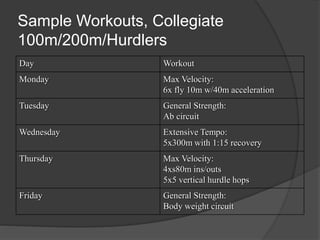
Sample Workouts, Collegiate 
100m/200m/Hurdlers 
Day Workout 
Monday Max Velocity: 
6x fly 10m w/40m acceleration 
Tuesday General Strength: 
Ab circuit 
Wednesday Extensive Tempo: 
5x300m with 1:15 recovery 
Thursday Max Velocity: 
4xs80m ins/outs 
5x5 vertical hurdle hops 
Friday General Strength: 
Body weight circuit
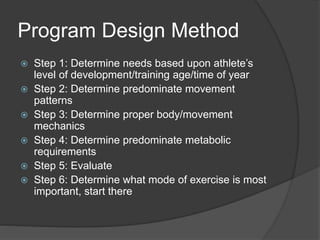
Program Design Method 
 Step 1: Determine needs based upon athlete’s 
level of development/training age/time of year 
 Step 2: Determine predominate movement 
patterns 
 Step 3: Determine proper body/movement 
mechanics 
 Step 4: Determine predominate metabolic 
requirements 
 Step 5: Evaluate 
 Step 6: Determine what mode of exercise is most 
important, start there
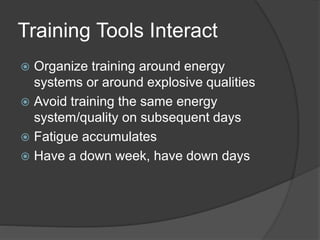
Training Tools Interact 
 Organize training around energy 
systems or around explosive qualities 
 Avoid training the same energy 
system/quality on subsequent days 
 Fatigue accumulates 
 Have a down week, have down days
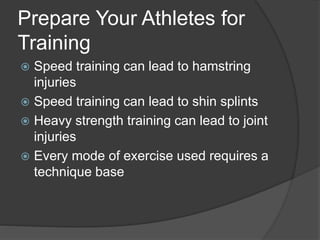
Prepare Your Athletes for 
Training 
 Speed training can lead to hamstring 
injuries 
 Speed training can lead to shin splints 
 Heavy strength training can lead to joint 
injuries 
 Every mode of exercise used requires a 
technique base
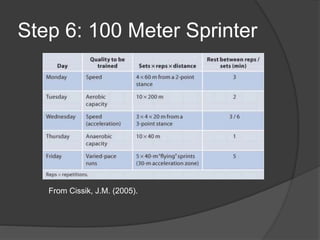
Step 6: 100 Meter Sprinter 
From Cissik, J.M. (2005).
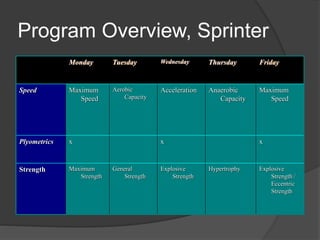
Program Overview, Sprinter 
Monday Tuesday Wednesday Thursday Friday 
Speed Maximum 
Speed 
Aerobic 
Capacity 
Acceleration Anaerobic 
Capacity 
Maximum 
Speed 
Plyometrics x x x 
Strength Maximum 
Strength 
General 
Strength 
Explosive 
Strength 
Hypertrophy Explosive 
Strength / 
Eccentric 
Strength
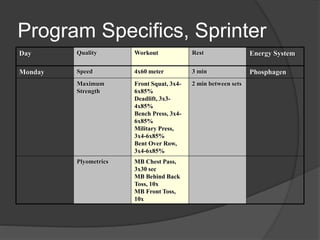
Program Specifics, Sprinter 
Day Quality Workout Rest Energy System 
Monday Speed 4x60 meter 3 min Phosphagen 
Maximum 
Strength 
Front Squat, 3x4- 
6x85% 
Deadlift, 3x3- 
4x85% 
Bench Press, 3x4- 
6x85% 
Military Press, 
3x4-6x85% 
Bent Over Row, 
3x4-6x85% 
2 min between sets 
Plyometrics MB Chest Pass, 
3x30 sec 
MB Behind Back 
Toss, 10x 
MB Front Toss, 
10x
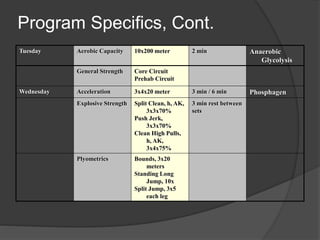
Program Specifics, Cont. 
Tuesday Aerobic Capacity 10x200 meter 2 min Anaerobic 
Glycolysis 
General Strength Core Circuit 
Prehab Circuit 
Wednesday Acceleration 3x4x20 meter 3 min / 6 min Phosphagen 
Explosive Strength Split Clean, h, AK, 
3x3x70% 
Push Jerk, 
3x3x70% 
Clean High Pulls, 
h, AK, 
3x4x75% 
3 min rest between 
sets 
Plyometrics Bounds, 3x20 
meters 
Standing Long 
Jump, 10x 
Split Jump, 3x5 
each leg
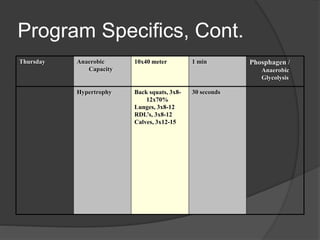
Program Specifics, Cont. 
Thursday Anaerobic 
Capacity 
10x40 meter 1 min Phosphagen / 
Anaerobic 
Glycolysis 
Hypertrophy Back squats, 3x8- 
12x70% 
Lunges, 3x8-12 
RDL’s, 3x8-12 
Calves, 3x12-15 
30 seconds
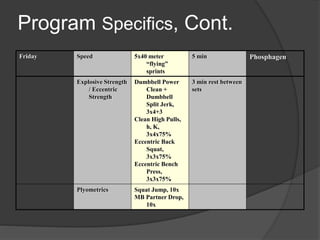
Program Specifics, Cont. 
Friday Speed 5x40 meter 
“flying” 
sprints 
5 min Phosphagen 
Explosive Strength 
/ Eccentric 
Strength 
Dumbbell Power 
Clean + 
Dumbbell 
Split Jerk, 
3x4+3 
Clean High Pulls, 
h, K, 
3x4x75% 
Eccentric Back 
Squat, 
3x3x75% 
Eccentric Bench 
Press, 
3x3x75% 
3 min rest between 
sets 
Plyometrics Squat Jump, 10x 
MB Partner Drop, 
10x
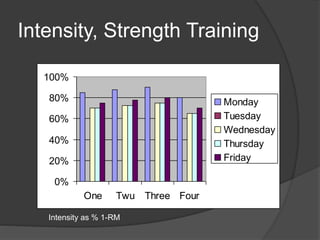
Intensity, Strength Training 
100% 
80% 
60% 
40% 
20% 
0% 
One Twu Three Four 
Monday 
Tuesday 
Wednesday 
Thursday 
Friday 
Intensity as % 1-RM

Program design – how to put everything together

  • 1.
    John Cissik HumanPerformance Services, LLC
  • 2.
    Overview  Examinehow to train for:  Power  Speed  Agility  Examine how to integrate everything for program design
  • 3.
    Power Training What works “best?”  Traditional resistance training  Olympic-style weightlifting  Plyometrics  Complex training  Combining tools
  • 4.
    Resistance Training Strengthening the muscles could lead to an increase in power production  Kotzamanidis, C., et al. (2005) looked at 35 teenage soccer players  3 groups: control, strength training only, combined program (strength + sprints)  9 week, periodized program
  • 5.
    Kotzamanidis, et al.(2005) 20.00% 15.00% 10.00% 5.00% 0.00% -5.00% Step Up Leg Curl SJ Half Squat CMJ Drop Jump 30m Sprint Combined Resistance Control
  • 6.
    Conclusions  Resistancetraining alone does work, but may not be as effective as when combined with other modes of training.  Beginners?
  • 7.
    Olympic-Style Weightlifting Rationale  Tricoli, et al. (2005):  Compared OWL and “vertical jump” training  32 physical education students, 8 weeks of training, 3x/week
  • 8.
  • 9.
    Tricoli, et al.(2005). Results 60.00% 50.00% 40.00% 30.00% 20.00% 10.00% 0.00% -10.00% SJ CMJ 10m (m/s)) Agility Half-Squat 30m (m/s) Clean/Jerk OWL VJ
  • 10.
    Does OWL Work?  10% improvement in SJ over 8 weeks versus 3%  7% improvement in CMJ over 8 weeks versus 6%  Both groups increased strength in the half squat
  • 11.
    Plyometrics to Improve Power  Specificity of training  Does it work? Previous results seemed mixed…  Adams, et al. (1992)  3 groups: strength, plyo, combined  6 weeks, 2x/week
  • 12.
  • 13.
    Adams, et al.(1992). Results  Plyometrics do work to improve vertical jump. Group VJ Improvement (cm) Squat 3.3 Plyo 3.81
  • 14.
    Complex Training What is it?  Performing heavy resistance training prior to explosive training. Think supersets.  Theory: increased motor unit excitability, increased motor unit recruitment, increased activity of synergistic muscles, inhibition of antagonistic muscles, etc.  Used as a training tool and used as a pre-meet tool (track and field)
  • 15.
    Example of Complex Training Monday: Snatch Pull + Power Snatch, 3x4+3x60% Push Jerk + Jump and Tuck, 3x3x60% + 5 jumps Eccentric Back Squat + Standing Long Jump, 3x5x70% + 5 jumps Incline Press + MB Lying Chest Pass, 3x8-12x70% + 10 throws Dumbbell Military Press, 3x8-12 Wednesday: Split Clean + Split Squat, 3x3+5x40% Clean Pulls + RDL, 3x3-4x87.5% + 6-10 One-Legged Back Raises, 3x8-12 each leg Bent Over Rows + MB Toss, 3x8-12 + 5 throws
  • 16.
    Does It Work?  Scott and Docherty (2004):  19 subjects performed 4 vertical/horizontal jumps , then a 5RM back squat, then 4 vertical jumps and 4 horizontal jumps  The back squat had no effect on the pre/post jump heights
  • 17.
    Does It Work?  Jensen & Ebben (2003)  Investigate: ○ Advantages of complex training ○ Optimal window between strength and plyometric exercise  21 Division I athletes  5RM back squat then 6 vertical jumps on a force plate  Rested 10 sec, 1 min, 2 min, 3 min, or 4 min between squat and jumps  No difference in GRF or jump height
  • 18.
    Complex Training, Conclusions  Complex training does not hurt performance  However, it is not the magic bullet  Why use it?  Variety  More work in shorter time
  • 19.
    Combining Tools Maybe Most Effective  Research seems to indicate that everything is effective to a greater or lesser extent.  However, using multiple tools seems to be the most effective…
  • 20.
    Adams, et al.(1992). This group improved VJ by over 10cm in this study
  • 21.
    Kotzamanidis, et al.(2005). 20.00% 15.00% 10.00% 5.00% 0.00% -5.00% Step Up Leg Curl SJ Half Squat CMJ Drop Jump 30m Sprint Combined Resistance Control
  • 23.
    Speed Training Tools  Technique  Stride length  Stride frequency  Components of speed:  Acceleration  Maximum velocity  Speed endurance
  • 24.
    Training Tools by Component Acceleration Maximum Velocity Speed Endurance Short distance sprints (<5 yards) 20-80 yard sprints 80-300 yard sprints Resisted starts Resisted sprinting Stick drills Assisted sprinting Quickness drills Varied pace sprinting Sprints up to 20 yards
  • 25.
    Training Guidelines, Cont. Component Length of Reps % of Best Speed Rest Intervals Between Reps/Sets Volume per Session (College) Acceleration 20-80 yards 90-100% 1-2’/5-7’ 300-500 yards Maximum Velocity 20-80 yards (*) 90-100% 3-5’/6-8’ 300-800 yards Anaerobic Capacity (Conditioning) 80+ yards 80-89% 30”-5’/3-10’ 800-1000 yards Speed Endurance 80-150 yards 90-100% 5-10’ 300-900 yards Long Speed Endurance 150-300 yards 90-100% 10-15’ 600-900 yards * 20-80 yards at maximum speed
  • 26.
    Speed Training Example From Cissik, J.M. (2005).
  • 27.
    Sample Workouts, Collegiate 100m/200m/Hurdlers Day Workout Monday Max Velocity: 6x fly 10m w/40m acceleration Tuesday General Strength: Ab circuit Wednesday Extensive Tempo: 5x300m with 1:15 recovery Thursday Max Velocity: 4xs80m ins/outs 5x5 vertical hurdle hops Friday General Strength: Body weight circuit
  • 29.
    Program Design Method  Step 1: Determine needs based upon athlete’s level of development/training age/time of year  Step 2: Determine predominate movement patterns  Step 3: Determine proper body/movement mechanics  Step 4: Determine predominate metabolic requirements  Step 5: Evaluate  Step 6: Determine what mode of exercise is most important, start there
  • 30.
    Training Tools Interact  Organize training around energy systems or around explosive qualities  Avoid training the same energy system/quality on subsequent days  Fatigue accumulates  Have a down week, have down days
  • 31.
    Prepare Your Athletesfor Training  Speed training can lead to hamstring injuries  Speed training can lead to shin splints  Heavy strength training can lead to joint injuries  Every mode of exercise used requires a technique base
  • 32.
    Step 6: 100Meter Sprinter From Cissik, J.M. (2005).
  • 33.
    Program Overview, Sprinter Monday Tuesday Wednesday Thursday Friday Speed Maximum Speed Aerobic Capacity Acceleration Anaerobic Capacity Maximum Speed Plyometrics x x x Strength Maximum Strength General Strength Explosive Strength Hypertrophy Explosive Strength / Eccentric Strength
  • 34.
    Program Specifics, Sprinter Day Quality Workout Rest Energy System Monday Speed 4x60 meter 3 min Phosphagen Maximum Strength Front Squat, 3x4- 6x85% Deadlift, 3x3- 4x85% Bench Press, 3x4- 6x85% Military Press, 3x4-6x85% Bent Over Row, 3x4-6x85% 2 min between sets Plyometrics MB Chest Pass, 3x30 sec MB Behind Back Toss, 10x MB Front Toss, 10x
  • 35.
    Program Specifics, Cont. Tuesday Aerobic Capacity 10x200 meter 2 min Anaerobic Glycolysis General Strength Core Circuit Prehab Circuit Wednesday Acceleration 3x4x20 meter 3 min / 6 min Phosphagen Explosive Strength Split Clean, h, AK, 3x3x70% Push Jerk, 3x3x70% Clean High Pulls, h, AK, 3x4x75% 3 min rest between sets Plyometrics Bounds, 3x20 meters Standing Long Jump, 10x Split Jump, 3x5 each leg
  • 36.
    Program Specifics, Cont. Thursday Anaerobic Capacity 10x40 meter 1 min Phosphagen / Anaerobic Glycolysis Hypertrophy Back squats, 3x8- 12x70% Lunges, 3x8-12 RDL’s, 3x8-12 Calves, 3x12-15 30 seconds
  • 37.
    Program Specifics, Cont. Friday Speed 5x40 meter “flying” sprints 5 min Phosphagen Explosive Strength / Eccentric Strength Dumbbell Power Clean + Dumbbell Split Jerk, 3x4+3 Clean High Pulls, h, K, 3x4x75% Eccentric Back Squat, 3x3x75% Eccentric Bench Press, 3x3x75% 3 min rest between sets Plyometrics Squat Jump, 10x MB Partner Drop, 10x
  • 38.
    Intensity, Strength Training 100% 80% 60% 40% 20% 0% One Twu Three Four Monday Tuesday Wednesday Thursday Friday Intensity as % 1-RM