What do we know about agility
training?
Not a lot.
Young, et al. (2001). Journal of Strength
and Conditioning Research serves to
represent state of knowledge.
Agility Research, cont.
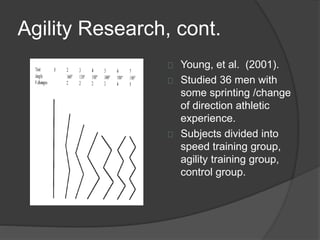
Young, et al. (2001).
Studied 36 men with
some sprinting /change
of direction athletic
experience.
Subjects divided into
speed training group,
agility training group,
control group.
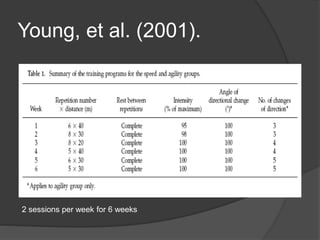
Young, et al. (2001).
2 sessions per week for 6 weeks
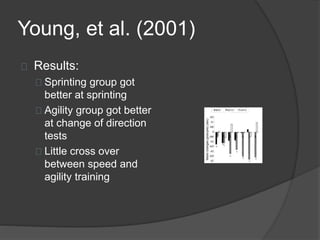
Young, et al. (2001)
Results:
Sprinting group got
better at sprinting
Agility group got better
at change of direction
tests
Little cross over
between speed and
agility training
Improving Agility is Difficult
Factors that influence:
Strength
Acceleration
Mobility
Reaction time
Fundamental Skills
Fundamental Skills
Starting
Stopping
Shuffling
Backpedaling
Running Curves
“Cutting”
Starting
Explosive first step
Emphasized every time a forward step is
taken
Acceleration!
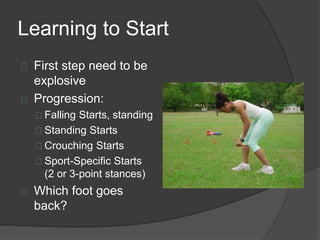
Learning to Start
First step need to be
explosive
Progression:
Falling Starts, standing
Standing Starts
Crouching Starts
Sport-Specific Starts
(2 or 3-point stances)
Which foot goes
back?
Stopping
“Get low”
Chop the steps
Best emphasized through drills that
emphasize starts and stops
Shuffling
Staying low to the ground (I.e. “Ready”
position)
Staying on the balls of the feet
“Push and step”
Avoid crossing feet
Argument: Practice Variability vs.
Practice Specificity
Variability: practicing a number of
different tasks results in greater
retention or transfer of performance than
practicing only one task.
Specificity: maximal retention
performance of a task is facilitated by
practice conditions that mimic retention
conditions (Maslovat, et al., 2004).
No point in talking about practice
specificity...
The Bad News: Transfer of
Skills...
Transfer specificity: the larger the
number of shared elements, the greater
the transfer (Rosenbaum, et al., 2001).
Transfer asymmetry: failure to transfer
despite having similar elements
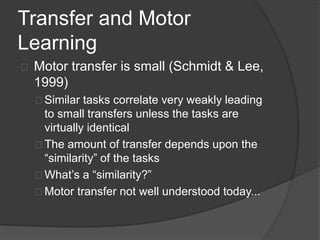
Transfer and Motor
Learning
Motor transfer is small (Schmidt & Lee,
1999)
Similar tasks correlate very weakly leading
to small transfers unless the tasks are
virtually identical
The amount of transfer depends upon the
“similarity” of the tasks
What’s a “similarity?”
Motor transfer not well understood today...
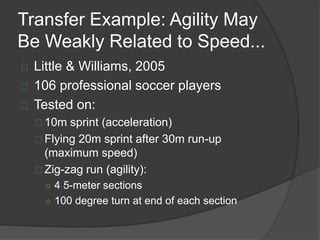
Transfer Example: Agility May
Be Weakly Related to Speed...
Little & Williams, 2005
106 professional soccer players
Tested on:
10m sprint (acceleration)
Flying 20m sprint after 30m run-up
(maximum speed)
Zig-zag run (agility):
○ 4 5-meter sections
○ 100 degree turn at end of each section
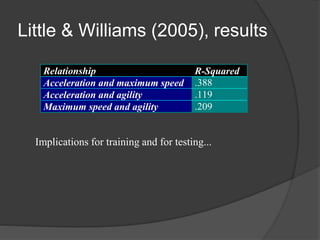
Little & Williams (2005), results
Relationship R-Squared
Acceleration and maximum speed .388
Acceleration and agility .119
Maximum speed and agility .209
Implications for training and for testing...
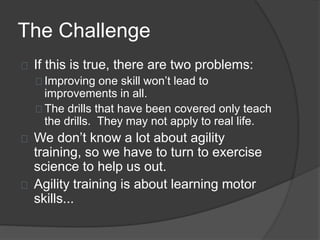
The Challenge
If this is true, there are two problems:
Improving one skill won’t lead to
improvements in all.
The drills that have been covered only teach
the drills. They may not apply to real life.
We don’t know a lot about agility
training, so we have to turn to exercise
science to help us out.
Agility training is about learning motor
skills...
Motor Learning is
Challenging…
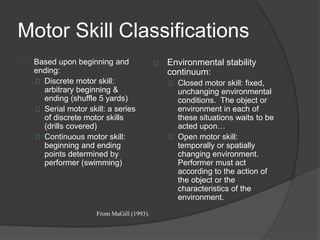
Motor Skill Classifications
Based upon beginning and
ending:
Discrete motor skill:
arbitrary beginning &
ending (shuffle 5 yards)
Serial motor skill: a series
of discrete motor skills
(drills covered)
Continuous motor skill:
beginning and ending
points determined by
performer (swimming)
Environmental stability
continuum:
Closed motor skill: fixed,
unchanging environmental
conditions. The object or
environment in each of
these situations waits to be
acted upon…
Open motor skill:
temporally or spatially
changing environment.
Performer must act
according to the action of
the object or the
characteristics of the
environment.
From MaGill (1993).
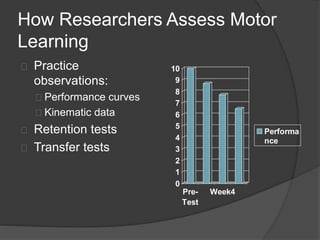
How Researchers Assess Motor
Learning
Practice
observations:
Performance curves
Kinematic data
Retention tests
Transfer tests
0
1
2
3
4
5
6
7
8
9
10
Pre-
Test
Week4
Performa
nce
Fitts & Posner’s Stages of Skill
Acquisition
Declarative (cognitive) stage: basic rules
of task are learned
Associative stage: procedures of task
become more fluent
Autonomous stage: procedures more
rapid, greater immunity from disruption
from outside events (from Rosenbaum,
et al., 2001).
What Happens as we Learn a
Motor Skill?
Changes in knowledge structure of skill
Changes in error detection/correction
Changes in how goal of skill is achieved
Changes in coordination
Changes in movement efficiency
Changes in muscles used
Changes in visual attention
From Magill (1993)
Schmidt’s Schema Theory of
Motor Learning/Control
How learning transfers to performance:
Schema: rule or set of rules that provide the
basis for a decision
Generalized Motor Program (GMP): General
memory representation of the action to be
controlled, controls a class of actions (like
throwing)
Motor Response Schema: Specific rules for
an action in a given situation
Motor Response Schema,
Cont.
Recall schema: adds specific response
instructions to GMP and initiates the
execution of the intended action
Recognition schema: enables athlete to
evaluate and correct
Teaching Skills
Modeling the skill
Providing feedback
Organizing practice
Teaching Agility Skills: Modeling
Modeling works best when:
It is someone similar to the athletes or of
higher-status (I.e. elite or pro athlete)
The skill is modeled correctly
(imitation)unless athletes get to view
feedback as well
Skill is demonstrated frequently:
○ Before practice
○ During practice
Internal vs. External Focus and
Feedback?
Example: focusing on the motion of the
golf club (external) vs. focusing on the
motion of the arms (internal)
External believed to be more effective
for learning motor skills (Wulf, et al.,
2002).
Internal focus may interfere with
automatic processes used in executing
the skill.
More Thoughts on
Feedback
Athletes won’t be perfect initially
Avoid overanalyzing beginners
Avoid overcorrecting beginners:
generally focus on 1-2 things each
session that the athlete can correct
Focus on the most important things
initially
Provide feedback (good and bad) early
and often
Teaching Agility Skills: Whole
vs. Part
Whole vs. part depends upon the
complexity of the skill:
Low complexity skills
High complexity skills
Common sense here...
Part Practice
Fractionization: practicing separate
components of the whole skill (sprint
drills)
Segmentation: practice parts, after first
part has been mastered practice first
part and second part together, etc.
Simplification: reducing the difficulty of
the different parts of the skill
Types of Practice
Variable practice
Blocked practice
Random practice
Serial practice
Variable Practice
Practice that provides a variety of
experiences for performing a skill
In theory, should result in better
retention and better novel performance -
increases generalizability.
Variable Practice and Closed
Skills
Relevant stimuli (I.e. the skill) should be
held constant
Non-relevant stimuli should be varied
For agility, examples include use of a
ball, use of auditory stimuli, etc.
The Next Step
Fundamental skills eventually become
great warm-up drills.
After they have been mastered, combine
skills, for example:
Backpedal + turn + sprint
Shuffle + turn + sprint
Drills which combine skills
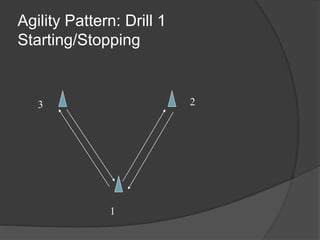
Agility Pattern: Drill 1
Starting/Stopping
1
23
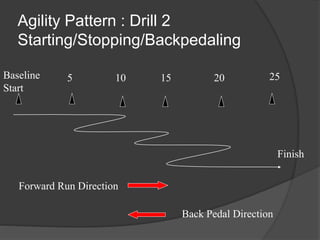
Agility Pattern : Drill 2
Starting/Stopping/Backpedaling
5 10 15 20Baseline
Start
25
Forward Run Direction
Back Pedal Direction
Finish
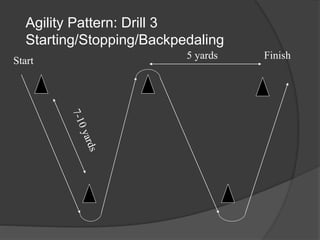
Agility Pattern: Drill 3
Starting/Stopping/Backpedaling
Start
Finish5 yards
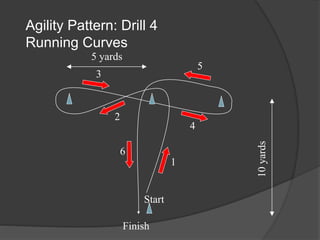
Agility Pattern: Drill 4
Running Curves
Finish
Start
1
2
3
4
5
6
10yards
5 yards
Advanced Agility Drills
React to the coach, ball
React to another athlete
Sport-specific drills
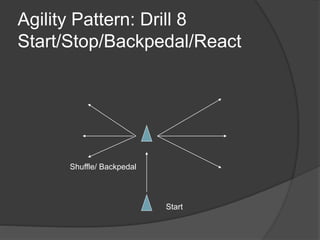
Agility Pattern: Drill 8
Start/Stop/Backpedal/React
Start
Shuffle/ Backpedal
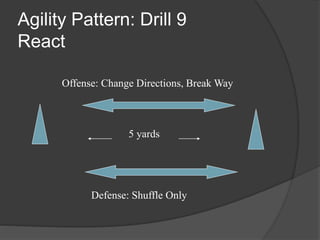
Agility Pattern: Drill 9
React
Defense: Shuffle Only
5 yards
Offense: Change Directions, Break Way
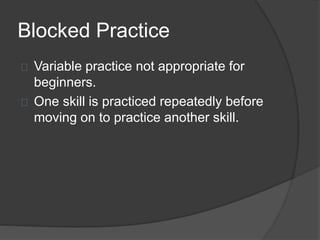
Blocked Practice
Variable practice not appropriate for
beginners.
One skill is practiced repeatedly before
moving on to practice another skill.
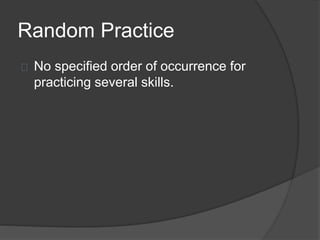
Random Practice
No specified order of occurrence for
practicing several skills.
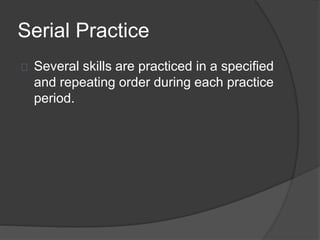
Serial Practice
Several skills are practiced in a specified
and repeating order during each practice
period.
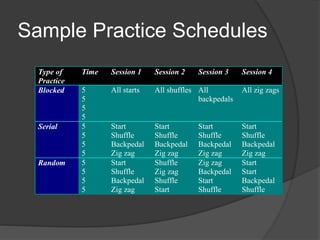
Sample Practice Schedules
Type of
Practice
Time Session 1 Session 2 Session 3 Session 4
Blocked 5
5
5
5
All starts All shuffles All
backpedals
All zig zags
Serial 5
5
5
5
Start
Shuffle
Backpedal
Zig zag
Start
Shuffle
Backpedal
Zig zag
Start
Shuffle
Backpedal
Zig zag
Start
Shuffle
Backpedal
Zig zag
Random 5
5
5
5
Start
Shuffle
Backpedal
Zig zag
Shuffle
Zig zag
Shuffle
Start
Zig zag
Backpedal
Start
Shuffle
Start
Start
Backpedal
Shuffle
Types of Practice, Conclusions
Blocked practice most effective for
short-term gains
Random practice most effective for long-
term retention (Lee & Wishart, 2005)
Problem: Random practice may produce
the impression among athletes that
learning is not proceeding well and may
produce the opposite impression with
blocked practices.
Contextual Interference
A more difficult training/learning
environment, although initially
detrimental to acquisition, results in
more retention and transfer (Maslovat,
et al, 2004).
Contextual Interference,
cont.
Research on CI is good on lab situations
but mixed on real-world sport skills.
Theory is that CI may be more beneficial
for individuals in higher levels of skill
acquisition (Brady, F., 1998).
After extensive practice, individuals may
be bored at which point high CI may be
beneficial to learning
Implications for CI
There may be a progression to follow in
the learning of motor skills...
Types of Practice, Conclusions
cont.
Beginners: Alternating blocked practice
with observation improves both
performance and retention (Lee &
Wishart, 2005).
Massed vs. Distributed Practice
Massed: rest:practice intervals of <1
Distributed: rest:practice intervals of >1
(I.e. more time spent resting)
Distributed seems to result in better
retention (Shea, Shebilske, & Worchel,
1993).
Common sense for agility and speed
training...
After All That: Agility Guidelines
From Twist and
Benicky (1996)
Need a fitness base
Ensure players
understand techniques
Perform drills in ready
position
Keep drills to 2-15
seconds initially
Simple to complex
Gradually add
distance, # foot
contacts, etc.
Add stimuli while
keeping drills constant
Reactive drills
Drills under fatigued
conditions (real life)
Encourage failure to
challenge athletes
Applying the Guidelines
Focus on fundamentals (start, stop, shuffle, etc.).
Combine skills (I.e. patterned drills, blocked
practice with little CI)
Transition into sport-specific movements
Combine skills, sport-specific movements, and ball
handling (I.e. make them process more
information) (I.e. variable practice with CI)
Can be done daily!
When speed and technique suffers, end the drill!
References
Brady, F. (1998). A theoretical and empirical review of the contextual interference
effect and the learning of motor skills. Quest, 50, 266-293.
Lee, T.D. & L.R. Wishart. (2005). Motor learning conundrums (and possible solutions).
Quest, 57, 67-78.
Little, T. & A.G. Williams. (2005). Specificity of acceleration, maximum speed, and
agility in professional soccer players. Journal of Strength and Conditioning Research,
19(1), 76-78.
Magill, R.A. (1993). Motor Learning Concepts and Applications 4th
Edition. Madison,
WI: WCB Brown & Benchmark.
Maslovat, D., R. Chua, T.D. Lee, & I.M. Franks. (2004). Contextual interference: Single
task versus multi-task learning. Motor Control, 8, 213-233.
Rosenbaum, D.A., R.A. Carlson, & R.O. Gilmore. (2001). Acquisition of intellectual
and perceptual-motor skills. Annual Reviews of Psychology, 52, 453-470.
Schmidt, R.A. & T.D. Lee. (1999). Motor Control and Learning A Behavioral Emphasis
3rd
Edition. Champaign, Il: Human Kinetics.
Shea, C.H., W.L. Shebilske, & S. Worchel. (1993). Motor Learning and Control.
Englewood Cliffs, NJ: Prentice Hall.
Wulf, G., N. McConnel, M. Gartner, & A. Schwarz. (2002). Enhancing the learning of
sport skills through external-focus feedback. Journal of Motor Behavior, 34(2), 171-182.

Principles and practices of agility training

  • 2.
    What do weknow about agility training? Not a lot. Young, et al. (2001). Journal of Strength and Conditioning Research serves to represent state of knowledge.
  • 3.
    Agility Research, cont. Young,et al. (2001). Studied 36 men with some sprinting /change of direction athletic experience. Subjects divided into speed training group, agility training group, control group.
  • 4.
    Young, et al.(2001). 2 sessions per week for 6 weeks
  • 5.
    Young, et al.(2001) Results: Sprinting group got better at sprinting Agility group got better at change of direction tests Little cross over between speed and agility training
  • 6.
    Improving Agility isDifficult Factors that influence: Strength Acceleration Mobility Reaction time Fundamental Skills
  • 8.
  • 9.
    Starting Explosive first step Emphasizedevery time a forward step is taken Acceleration!
  • 10.
    Learning to Start Firststep need to be explosive Progression: Falling Starts, standing Standing Starts Crouching Starts Sport-Specific Starts (2 or 3-point stances) Which foot goes back?
  • 11.
    Stopping “Get low” Chop thesteps Best emphasized through drills that emphasize starts and stops
  • 12.
    Shuffling Staying low tothe ground (I.e. “Ready” position) Staying on the balls of the feet “Push and step” Avoid crossing feet
  • 14.
    Argument: Practice Variabilityvs. Practice Specificity Variability: practicing a number of different tasks results in greater retention or transfer of performance than practicing only one task. Specificity: maximal retention performance of a task is facilitated by practice conditions that mimic retention conditions (Maslovat, et al., 2004). No point in talking about practice specificity...
  • 15.
    The Bad News:Transfer of Skills... Transfer specificity: the larger the number of shared elements, the greater the transfer (Rosenbaum, et al., 2001). Transfer asymmetry: failure to transfer despite having similar elements
  • 16.
    Transfer and Motor Learning Motortransfer is small (Schmidt & Lee, 1999) Similar tasks correlate very weakly leading to small transfers unless the tasks are virtually identical The amount of transfer depends upon the “similarity” of the tasks What’s a “similarity?” Motor transfer not well understood today...
  • 17.
    Transfer Example: AgilityMay Be Weakly Related to Speed... Little & Williams, 2005 106 professional soccer players Tested on: 10m sprint (acceleration) Flying 20m sprint after 30m run-up (maximum speed) Zig-zag run (agility): ○ 4 5-meter sections ○ 100 degree turn at end of each section
  • 18.
    Little & Williams(2005), results Relationship R-Squared Acceleration and maximum speed .388 Acceleration and agility .119 Maximum speed and agility .209 Implications for training and for testing...
  • 19.
    The Challenge If thisis true, there are two problems: Improving one skill won’t lead to improvements in all. The drills that have been covered only teach the drills. They may not apply to real life. We don’t know a lot about agility training, so we have to turn to exercise science to help us out. Agility training is about learning motor skills...
  • 20.
  • 21.
    Motor Skill Classifications Basedupon beginning and ending: Discrete motor skill: arbitrary beginning & ending (shuffle 5 yards) Serial motor skill: a series of discrete motor skills (drills covered) Continuous motor skill: beginning and ending points determined by performer (swimming) Environmental stability continuum: Closed motor skill: fixed, unchanging environmental conditions. The object or environment in each of these situations waits to be acted upon… Open motor skill: temporally or spatially changing environment. Performer must act according to the action of the object or the characteristics of the environment. From MaGill (1993).
  • 22.
    How Researchers AssessMotor Learning Practice observations: Performance curves Kinematic data Retention tests Transfer tests 0 1 2 3 4 5 6 7 8 9 10 Pre- Test Week4 Performa nce
  • 23.
    Fitts & Posner’sStages of Skill Acquisition Declarative (cognitive) stage: basic rules of task are learned Associative stage: procedures of task become more fluent Autonomous stage: procedures more rapid, greater immunity from disruption from outside events (from Rosenbaum, et al., 2001).
  • 24.
    What Happens aswe Learn a Motor Skill? Changes in knowledge structure of skill Changes in error detection/correction Changes in how goal of skill is achieved Changes in coordination Changes in movement efficiency Changes in muscles used Changes in visual attention From Magill (1993)
  • 25.
    Schmidt’s Schema Theoryof Motor Learning/Control How learning transfers to performance: Schema: rule or set of rules that provide the basis for a decision Generalized Motor Program (GMP): General memory representation of the action to be controlled, controls a class of actions (like throwing) Motor Response Schema: Specific rules for an action in a given situation
  • 26.
    Motor Response Schema, Cont. Recallschema: adds specific response instructions to GMP and initiates the execution of the intended action Recognition schema: enables athlete to evaluate and correct
  • 28.
    Teaching Skills Modeling theskill Providing feedback Organizing practice
  • 29.
    Teaching Agility Skills:Modeling Modeling works best when: It is someone similar to the athletes or of higher-status (I.e. elite or pro athlete) The skill is modeled correctly (imitation)unless athletes get to view feedback as well Skill is demonstrated frequently: ○ Before practice ○ During practice
  • 30.
    Internal vs. ExternalFocus and Feedback? Example: focusing on the motion of the golf club (external) vs. focusing on the motion of the arms (internal) External believed to be more effective for learning motor skills (Wulf, et al., 2002). Internal focus may interfere with automatic processes used in executing the skill.
  • 31.
    More Thoughts on Feedback Athleteswon’t be perfect initially Avoid overanalyzing beginners Avoid overcorrecting beginners: generally focus on 1-2 things each session that the athlete can correct Focus on the most important things initially Provide feedback (good and bad) early and often
  • 32.
    Teaching Agility Skills:Whole vs. Part Whole vs. part depends upon the complexity of the skill: Low complexity skills High complexity skills Common sense here...
  • 33.
    Part Practice Fractionization: practicingseparate components of the whole skill (sprint drills) Segmentation: practice parts, after first part has been mastered practice first part and second part together, etc. Simplification: reducing the difficulty of the different parts of the skill
  • 34.
    Types of Practice Variablepractice Blocked practice Random practice Serial practice
  • 35.
    Variable Practice Practice thatprovides a variety of experiences for performing a skill In theory, should result in better retention and better novel performance - increases generalizability.
  • 36.
    Variable Practice andClosed Skills Relevant stimuli (I.e. the skill) should be held constant Non-relevant stimuli should be varied For agility, examples include use of a ball, use of auditory stimuli, etc.
  • 37.
    The Next Step Fundamentalskills eventually become great warm-up drills. After they have been mastered, combine skills, for example: Backpedal + turn + sprint Shuffle + turn + sprint Drills which combine skills
  • 39.
    Agility Pattern: Drill1 Starting/Stopping 1 23
  • 40.
    Agility Pattern :Drill 2 Starting/Stopping/Backpedaling 5 10 15 20Baseline Start 25 Forward Run Direction Back Pedal Direction Finish
  • 41.
    Agility Pattern: Drill3 Starting/Stopping/Backpedaling Start Finish5 yards
  • 42.
    Agility Pattern: Drill4 Running Curves Finish Start 1 2 3 4 5 6 10yards 5 yards
  • 44.
    Advanced Agility Drills Reactto the coach, ball React to another athlete Sport-specific drills
  • 45.
    Agility Pattern: Drill8 Start/Stop/Backpedal/React Start Shuffle/ Backpedal
  • 46.
    Agility Pattern: Drill9 React Defense: Shuffle Only 5 yards Offense: Change Directions, Break Way
  • 47.
    Blocked Practice Variable practicenot appropriate for beginners. One skill is practiced repeatedly before moving on to practice another skill.
  • 48.
    Random Practice No specifiedorder of occurrence for practicing several skills.
  • 49.
    Serial Practice Several skillsare practiced in a specified and repeating order during each practice period.
  • 50.
    Sample Practice Schedules Typeof Practice Time Session 1 Session 2 Session 3 Session 4 Blocked 5 5 5 5 All starts All shuffles All backpedals All zig zags Serial 5 5 5 5 Start Shuffle Backpedal Zig zag Start Shuffle Backpedal Zig zag Start Shuffle Backpedal Zig zag Start Shuffle Backpedal Zig zag Random 5 5 5 5 Start Shuffle Backpedal Zig zag Shuffle Zig zag Shuffle Start Zig zag Backpedal Start Shuffle Start Start Backpedal Shuffle
  • 51.
    Types of Practice,Conclusions Blocked practice most effective for short-term gains Random practice most effective for long- term retention (Lee & Wishart, 2005) Problem: Random practice may produce the impression among athletes that learning is not proceeding well and may produce the opposite impression with blocked practices.
  • 52.
    Contextual Interference A moredifficult training/learning environment, although initially detrimental to acquisition, results in more retention and transfer (Maslovat, et al, 2004).
  • 53.
    Contextual Interference, cont. Research onCI is good on lab situations but mixed on real-world sport skills. Theory is that CI may be more beneficial for individuals in higher levels of skill acquisition (Brady, F., 1998). After extensive practice, individuals may be bored at which point high CI may be beneficial to learning
  • 54.
    Implications for CI Theremay be a progression to follow in the learning of motor skills...
  • 55.
    Types of Practice,Conclusions cont. Beginners: Alternating blocked practice with observation improves both performance and retention (Lee & Wishart, 2005).
  • 56.
    Massed vs. DistributedPractice Massed: rest:practice intervals of <1 Distributed: rest:practice intervals of >1 (I.e. more time spent resting) Distributed seems to result in better retention (Shea, Shebilske, & Worchel, 1993). Common sense for agility and speed training...
  • 57.
    After All That:Agility Guidelines From Twist and Benicky (1996) Need a fitness base Ensure players understand techniques Perform drills in ready position Keep drills to 2-15 seconds initially Simple to complex Gradually add distance, # foot contacts, etc. Add stimuli while keeping drills constant Reactive drills Drills under fatigued conditions (real life) Encourage failure to challenge athletes
  • 58.
    Applying the Guidelines Focuson fundamentals (start, stop, shuffle, etc.). Combine skills (I.e. patterned drills, blocked practice with little CI) Transition into sport-specific movements Combine skills, sport-specific movements, and ball handling (I.e. make them process more information) (I.e. variable practice with CI) Can be done daily! When speed and technique suffers, end the drill!
  • 59.
    References Brady, F. (1998).A theoretical and empirical review of the contextual interference effect and the learning of motor skills. Quest, 50, 266-293. Lee, T.D. & L.R. Wishart. (2005). Motor learning conundrums (and possible solutions). Quest, 57, 67-78. Little, T. & A.G. Williams. (2005). Specificity of acceleration, maximum speed, and agility in professional soccer players. Journal of Strength and Conditioning Research, 19(1), 76-78. Magill, R.A. (1993). Motor Learning Concepts and Applications 4th Edition. Madison, WI: WCB Brown & Benchmark. Maslovat, D., R. Chua, T.D. Lee, & I.M. Franks. (2004). Contextual interference: Single task versus multi-task learning. Motor Control, 8, 213-233. Rosenbaum, D.A., R.A. Carlson, & R.O. Gilmore. (2001). Acquisition of intellectual and perceptual-motor skills. Annual Reviews of Psychology, 52, 453-470. Schmidt, R.A. & T.D. Lee. (1999). Motor Control and Learning A Behavioral Emphasis 3rd Edition. Champaign, Il: Human Kinetics. Shea, C.H., W.L. Shebilske, & S. Worchel. (1993). Motor Learning and Control. Englewood Cliffs, NJ: Prentice Hall. Wulf, G., N. McConnel, M. Gartner, & A. Schwarz. (2002). Enhancing the learning of sport skills through external-focus feedback. Journal of Motor Behavior, 34(2), 171-182.