
John M. Cissik 
Human Performance Services, LLC
Overview 
 Analyzing the deadlift 
 Common errors 
 Coaching and Safety 
 Variations of “pulling” exercises
Analyzing the Deadlift 
 Benefits 
 Competition Styles of Deadlifts 
 What does the deadlift work? 
 How does the deadlift affect the lower 
back?
Benefits 
 Lower body hypertrophy 
 Lower back / core strength 
 Bone mass in lumbar spine and lower 
body 
 Total body strength
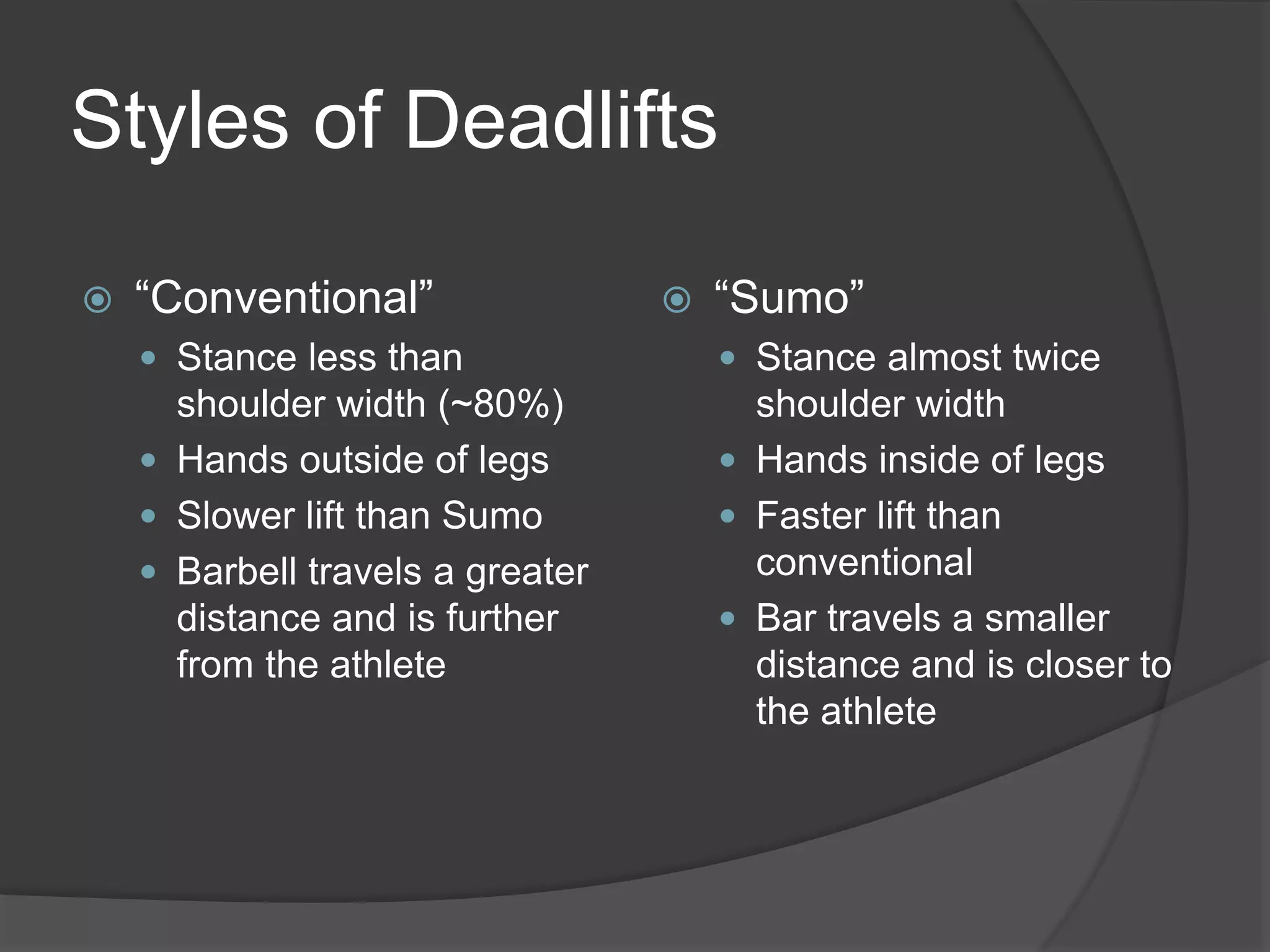
Styles of Deadlifts 
 “Conventional” 
 Stance less than 
shoulder width (~80%) 
 Hands outside of legs 
 Slower lift than Sumo 
 Barbell travels a greater 
distance and is further 
from the athlete 
 “Sumo” 
 Stance almost twice 
shoulder width 
 Hands inside of legs 
 Faster lift than 
conventional 
 Bar travels a smaller 
distance and is closer to 
the athlete
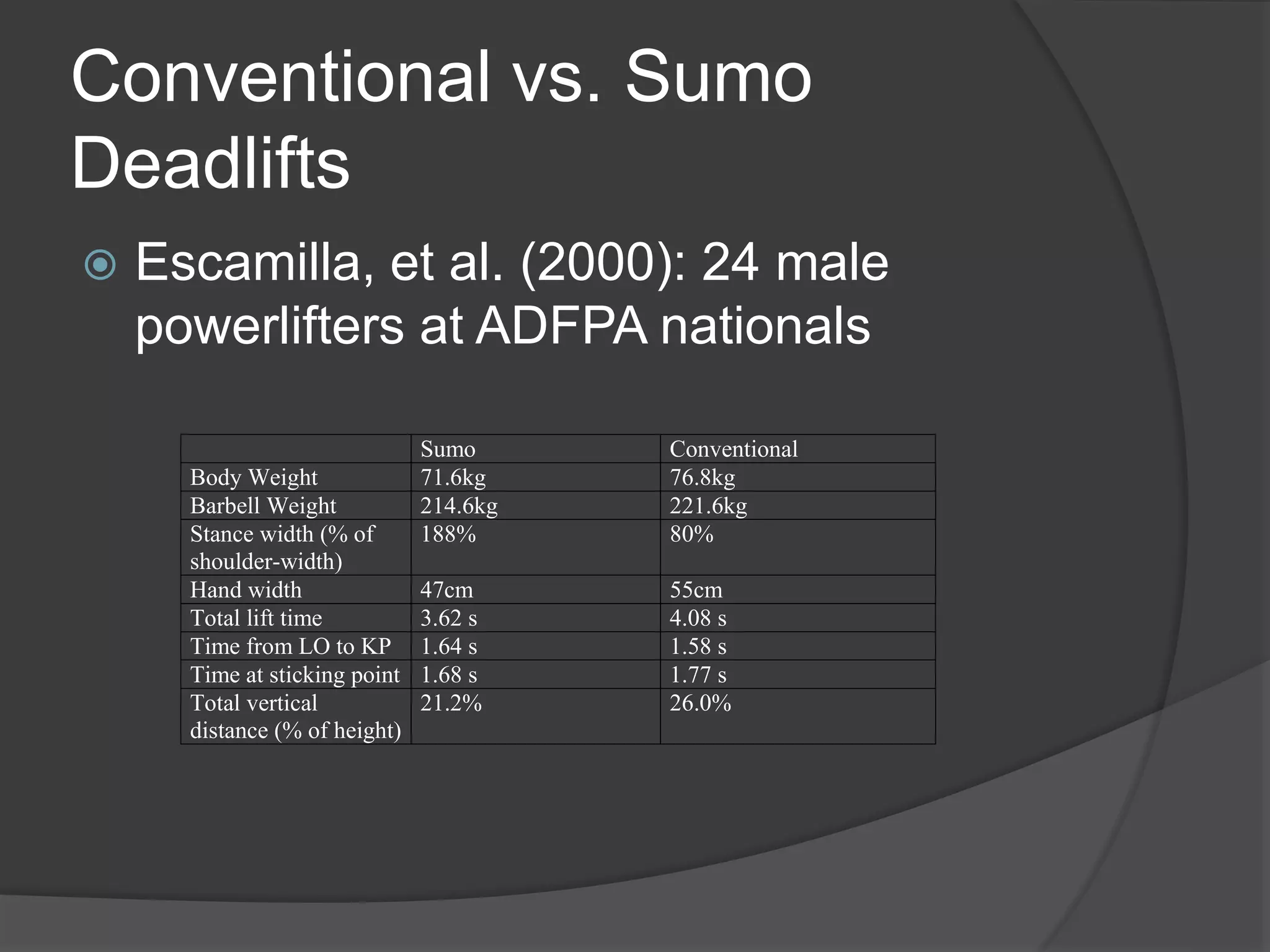
Conventional vs. Sumo 
Deadlifts 
 Escamilla, et al. (2000): 24 male 
powerlifters at ADFPA nationals 
Sumo Conventional 
Body Weight 71.6kg 76.8kg 
Barbell Weight 214.6kg 221.6kg 
Stance width (% of 
188% 80% 
shoulder-width) 
Hand width 47cm 55cm 
Total lift time 3.62 s 4.08 s 
Time from LO to KP 1.64 s 1.58 s 
Time at sticking point 1.68 s 1.77 s 
Total vertical 
distance (% of height) 
21.2% 26.0%
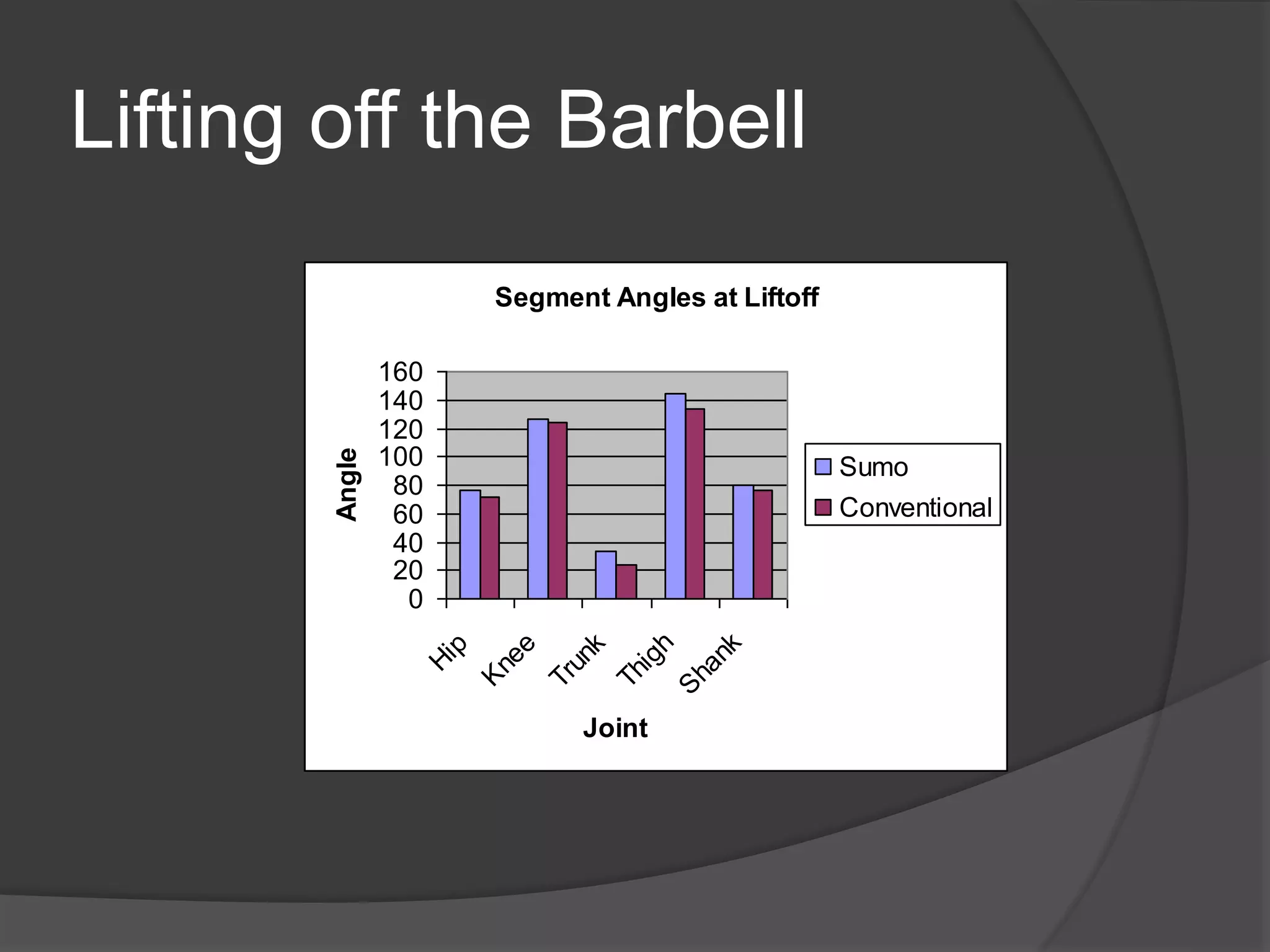
Lifting off the Barbell 
Segment Angles at Liftoff 
160 
140 
120 
100 
80 
60 
40 
20 
0 
Hip 
Knee 
Trunk 
Thigh 
Shank 
Joint 
Angle 
Sumo 
Conventional
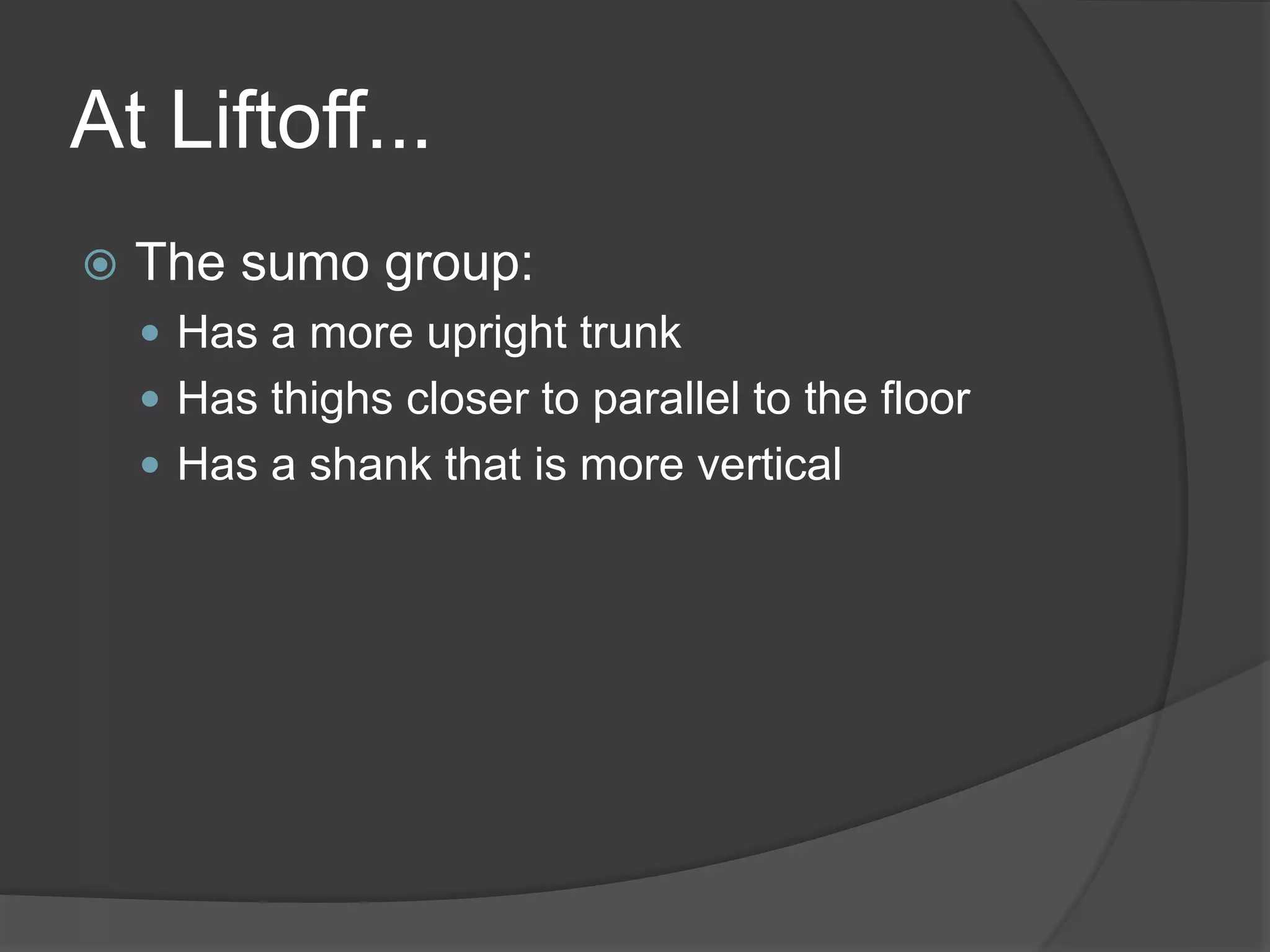
At Liftoff... 
 The sumo group: 
 Has a more upright trunk 
 Has thighs closer to parallel to the floor 
 Has a shank that is more vertical
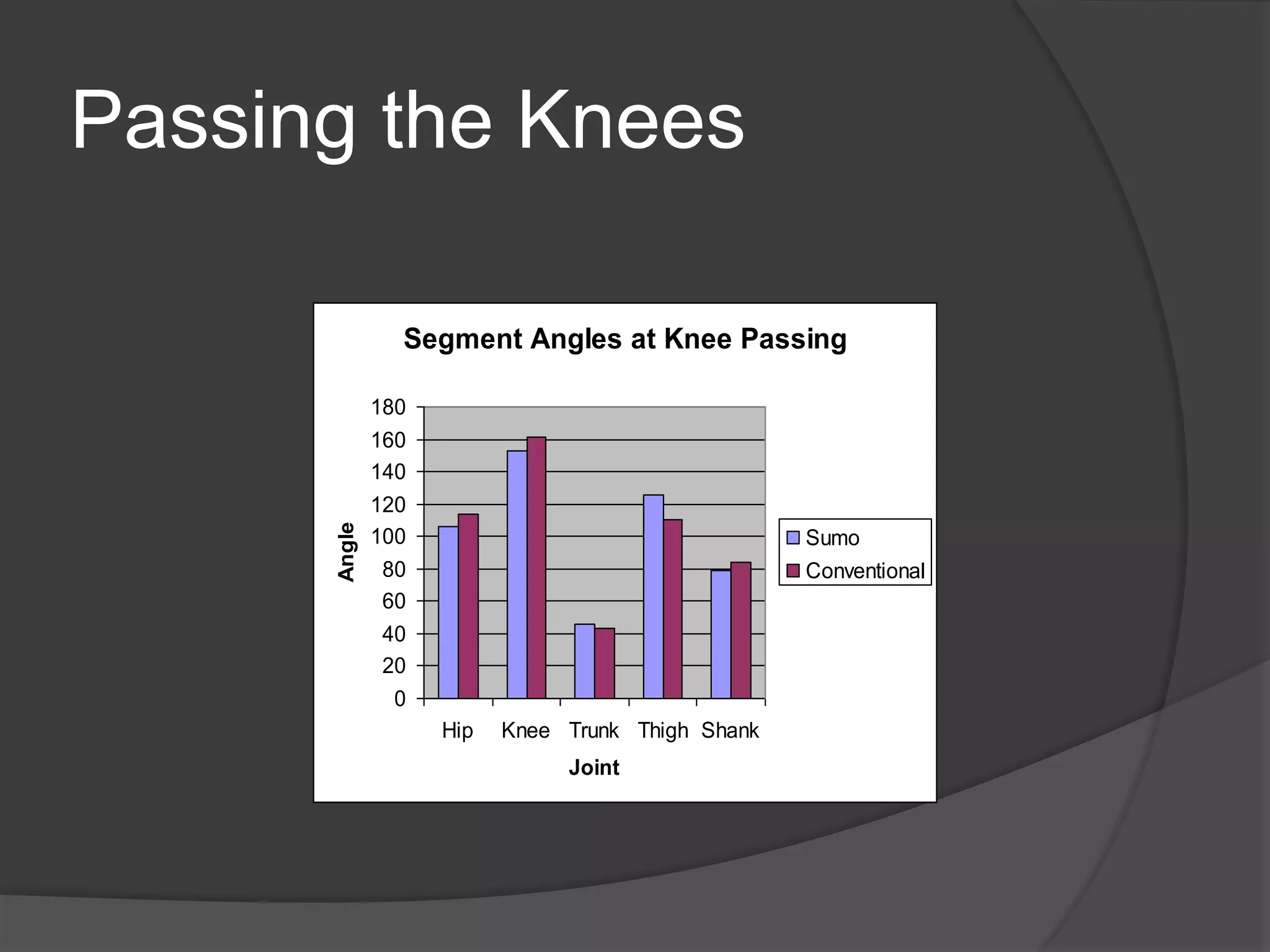
Passing the Knees 
Segment Angles at Knee Passing 
180 
160 
140 
120 
100 
80 
60 
40 
20 
0 
Hip Knee Trunk Thigh Shank 
Joint 
Angle 
Sumo 
Conventional
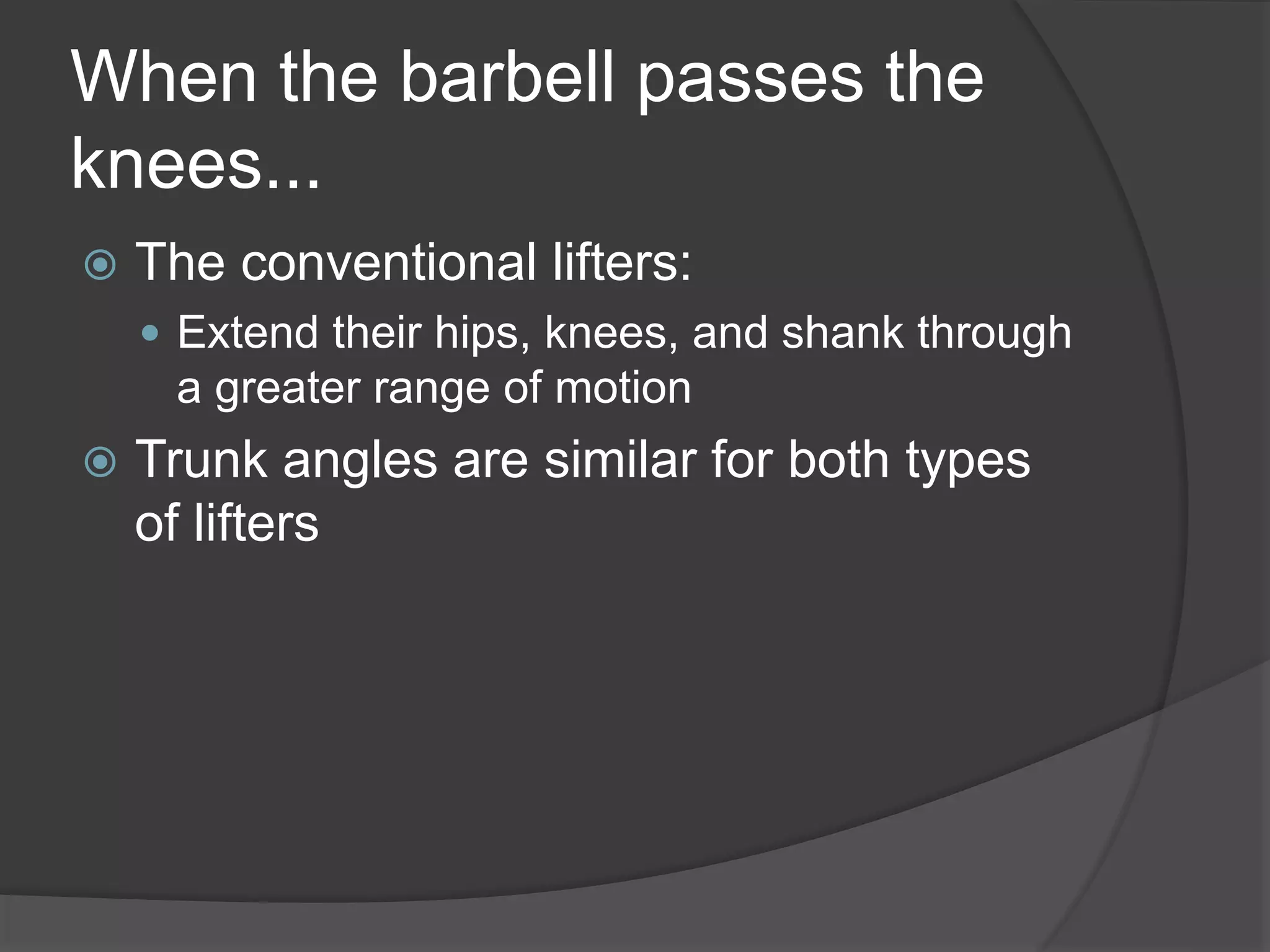
When the barbell passes the 
knees... 
 The conventional lifters: 
 Extend their hips, knees, and shank through 
a greater range of motion 
 Trunk angles are similar for both types 
of lifters
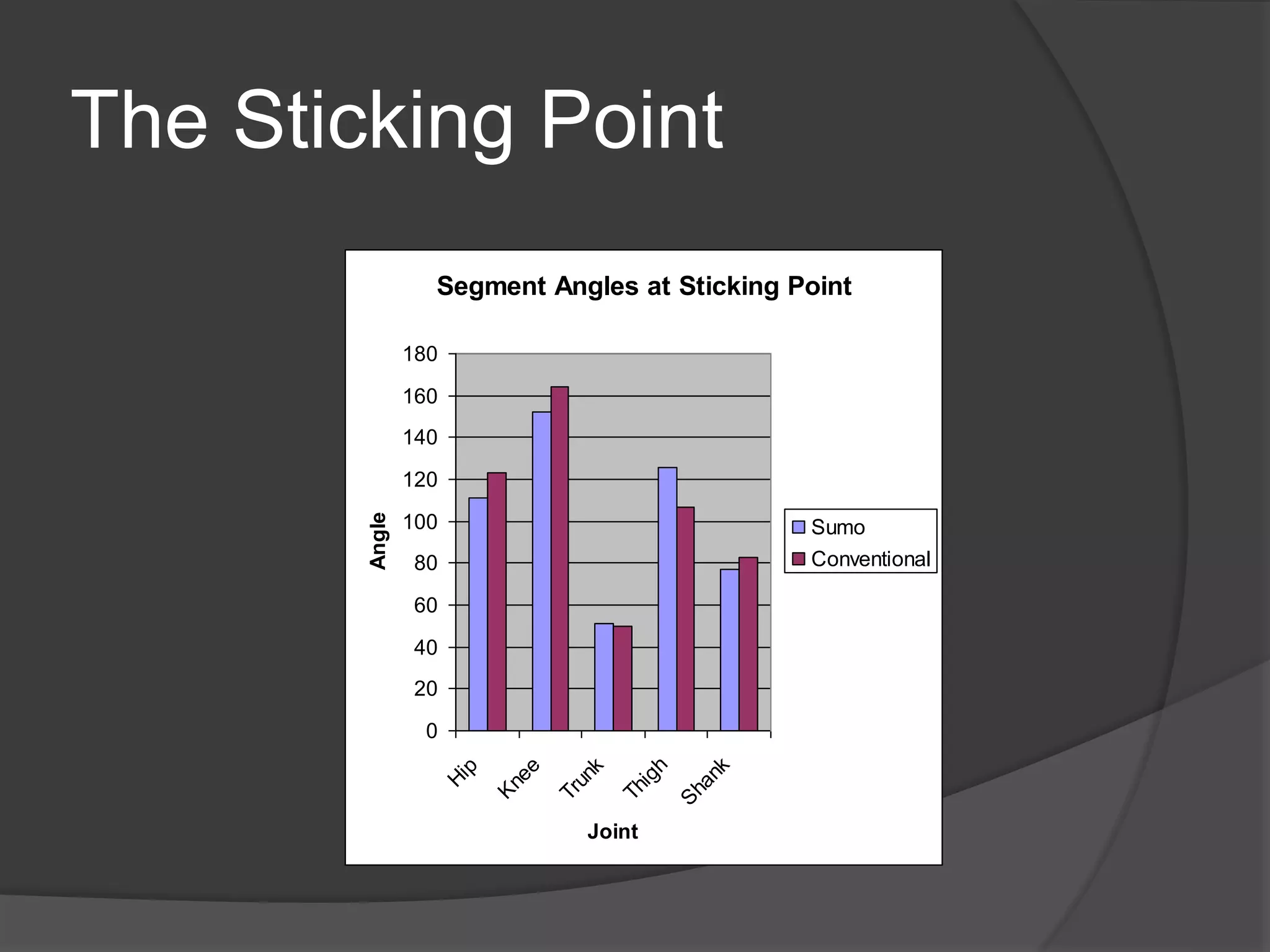
The Sticking Point 
Segment Angles at Sticking Point 
180 
160 
140 
120 
100 
80 
60 
40 
20 
0 
Hip 
Knee 
Trunk 
Thigh 
Shank 
Joint 
Angle 
Sumo 
Conventional
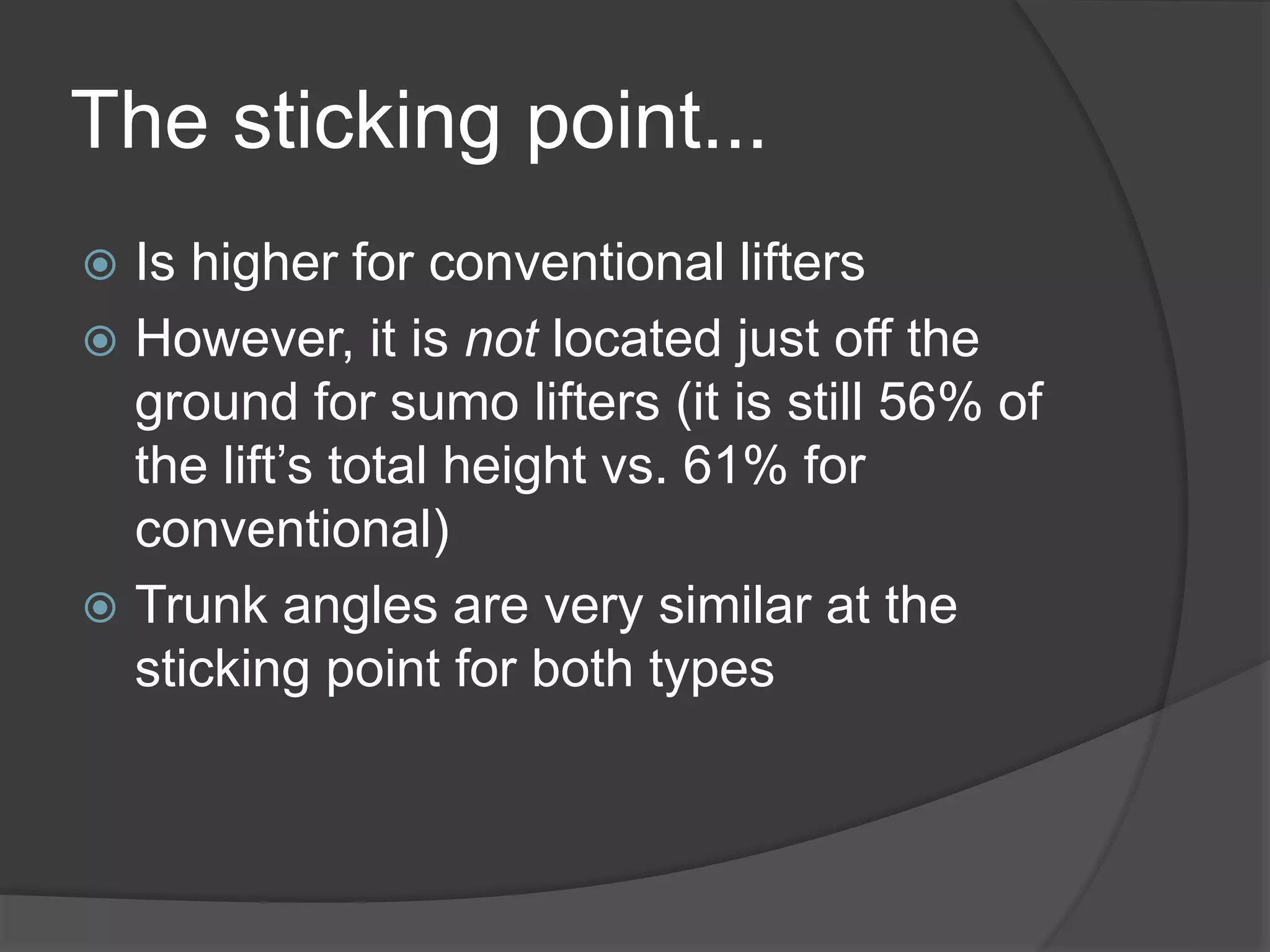
The sticking point... 
 Is higher for conventional lifters 
 However, it is not located just off the 
ground for sumo lifters (it is still 56% of 
the lift’s total height vs. 61% for 
conventional) 
 Trunk angles are very similar at the 
sticking point for both types
Differences Between Sumo and 
Conventional 
 The segment angles and sticking 
regions are not that different between 
the two variations. 
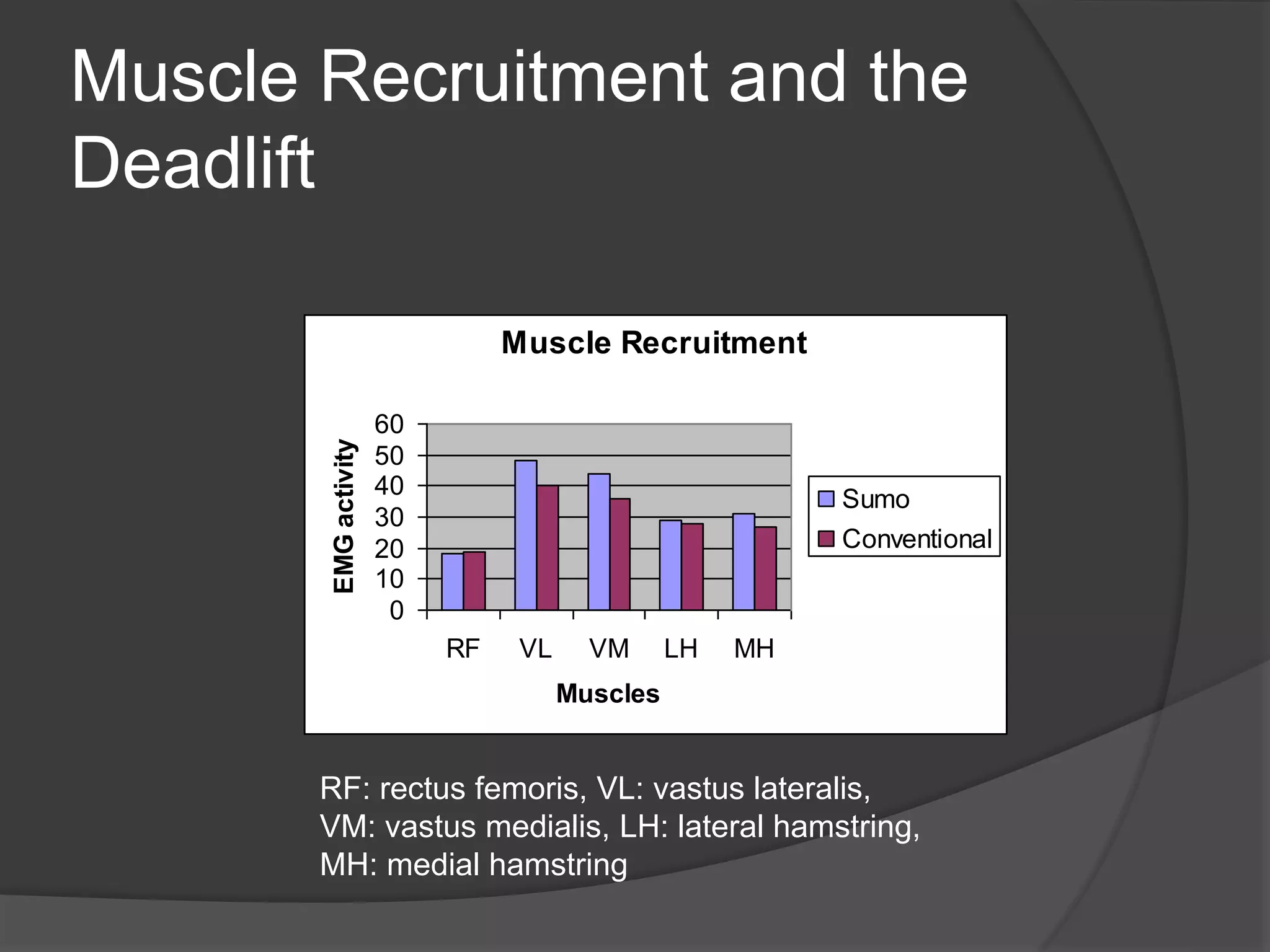
 Surprisingly, muscular involvement is 
very similar as well..
Escamilla, et al. (2002). 
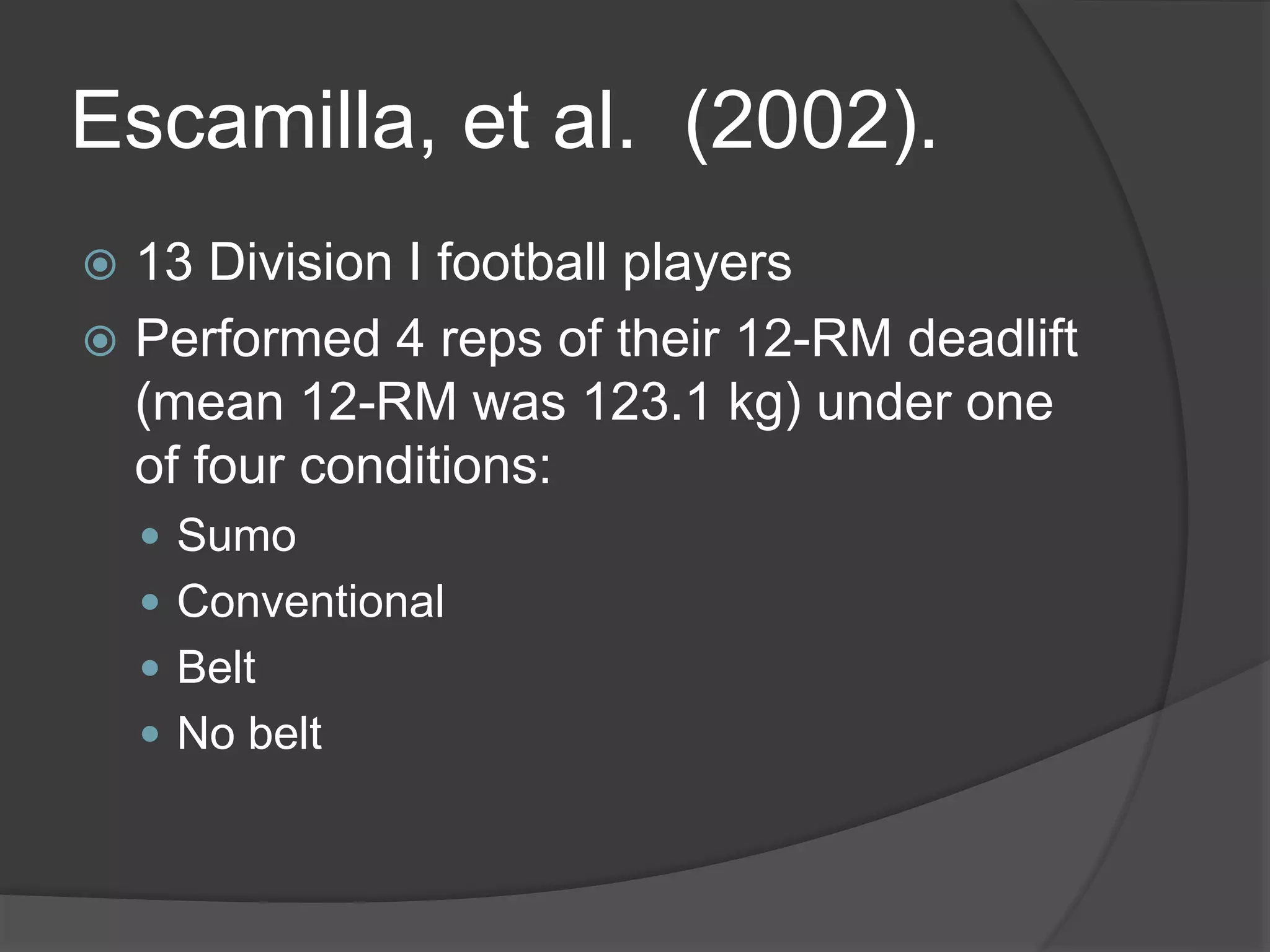
 13 Division I football players 
 Performed 4 reps of their 12-RM deadlift 
(mean 12-RM was 123.1 kg) under one 
of four conditions: 
 Sumo 
 Conventional 
 Belt 
 No belt
Muscle Recruitment and the 
Deadlift 
Muscle Recruitment 
60 
50 
40 
30 
20 
10 
0 
RF VL VM LH MH 
Muscles 
EMG activity 
Sumo 
Conventional 
RF: rectus femoris, VL: vastus lateralis, 
VM: vastus medialis, LH: lateral hamstring, 
MH: medial hamstring
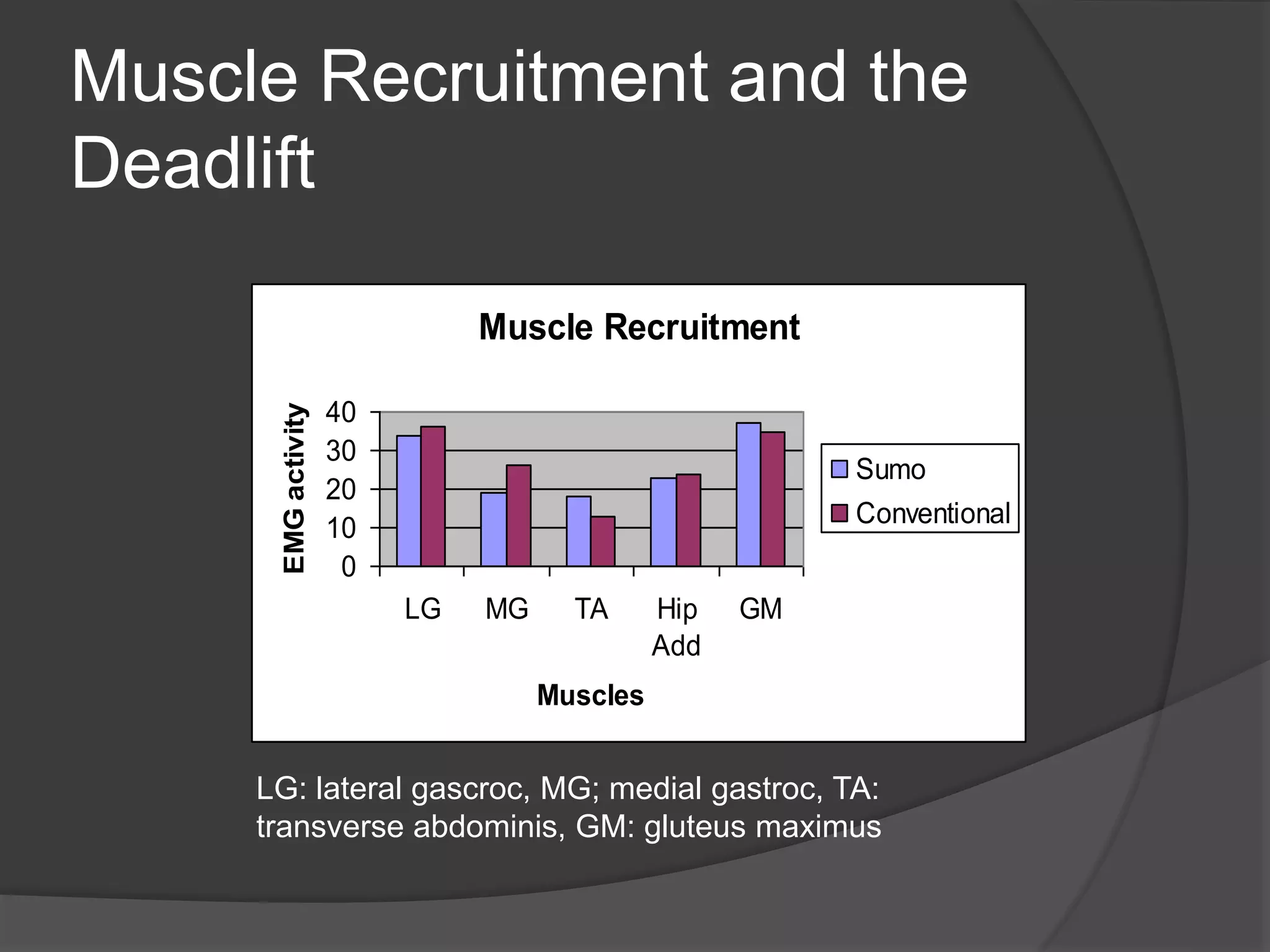
Muscle Recruitment and the 
Deadlift 
Muscle Recruitment 
40 
30 
20 
10 
0 
LG MG TA Hip 
Add 
GM 
Muscles 
EMG activity 
Sumo 
Conventional 
LG: lateral gascroc, MG; medial gastroc, TA: 
transverse abdominis, GM: gluteus maximus
Muscle Recruitment and the 
Deadlift 
Muscle Recruitment 
80 
60 
40 
20 
0 
L3 T12 Mid. 
Trap 
Upp. 
Trap 
RA EO 
Muscles 
EMG activity 
Sumo 
Conventional
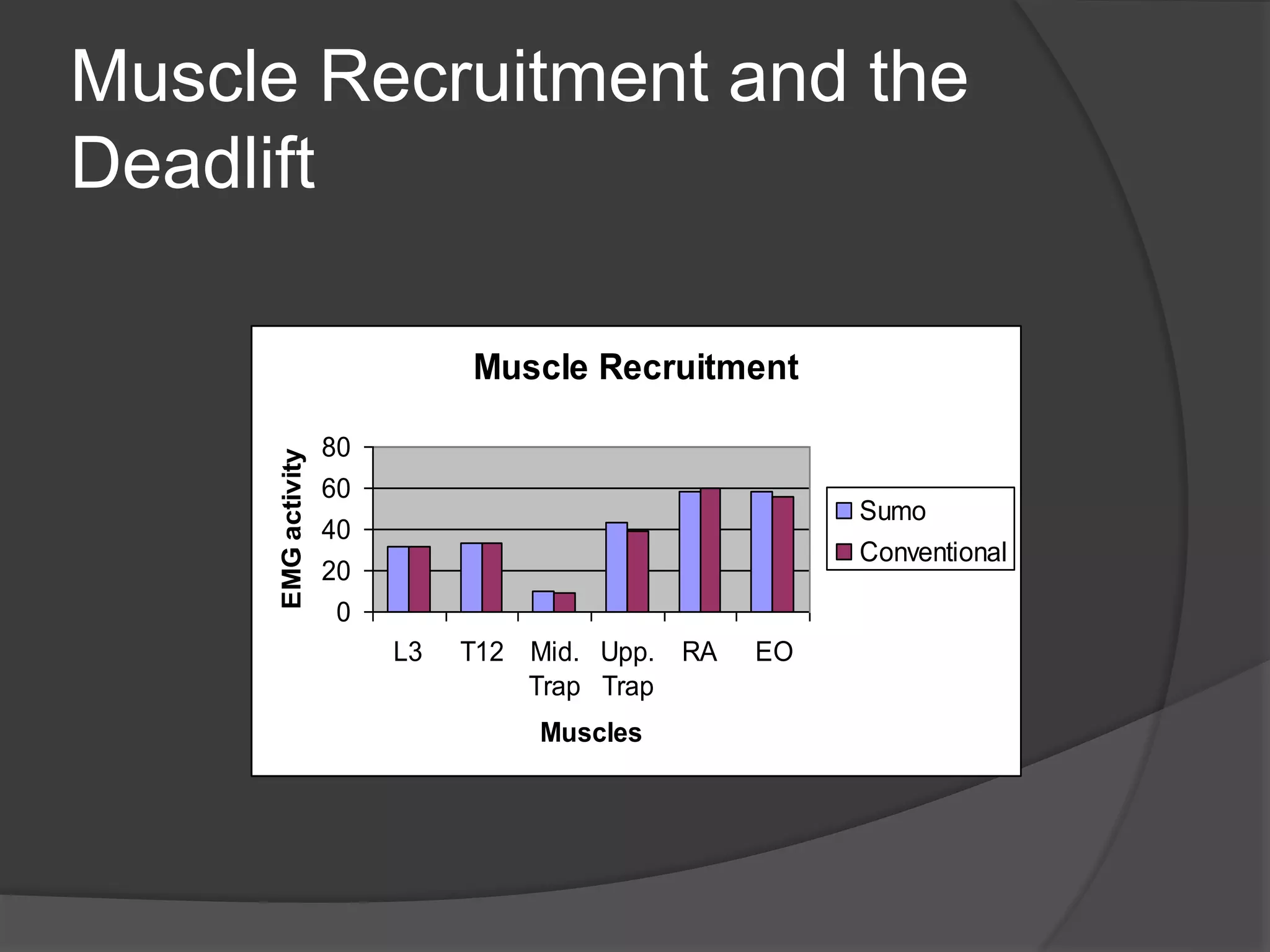
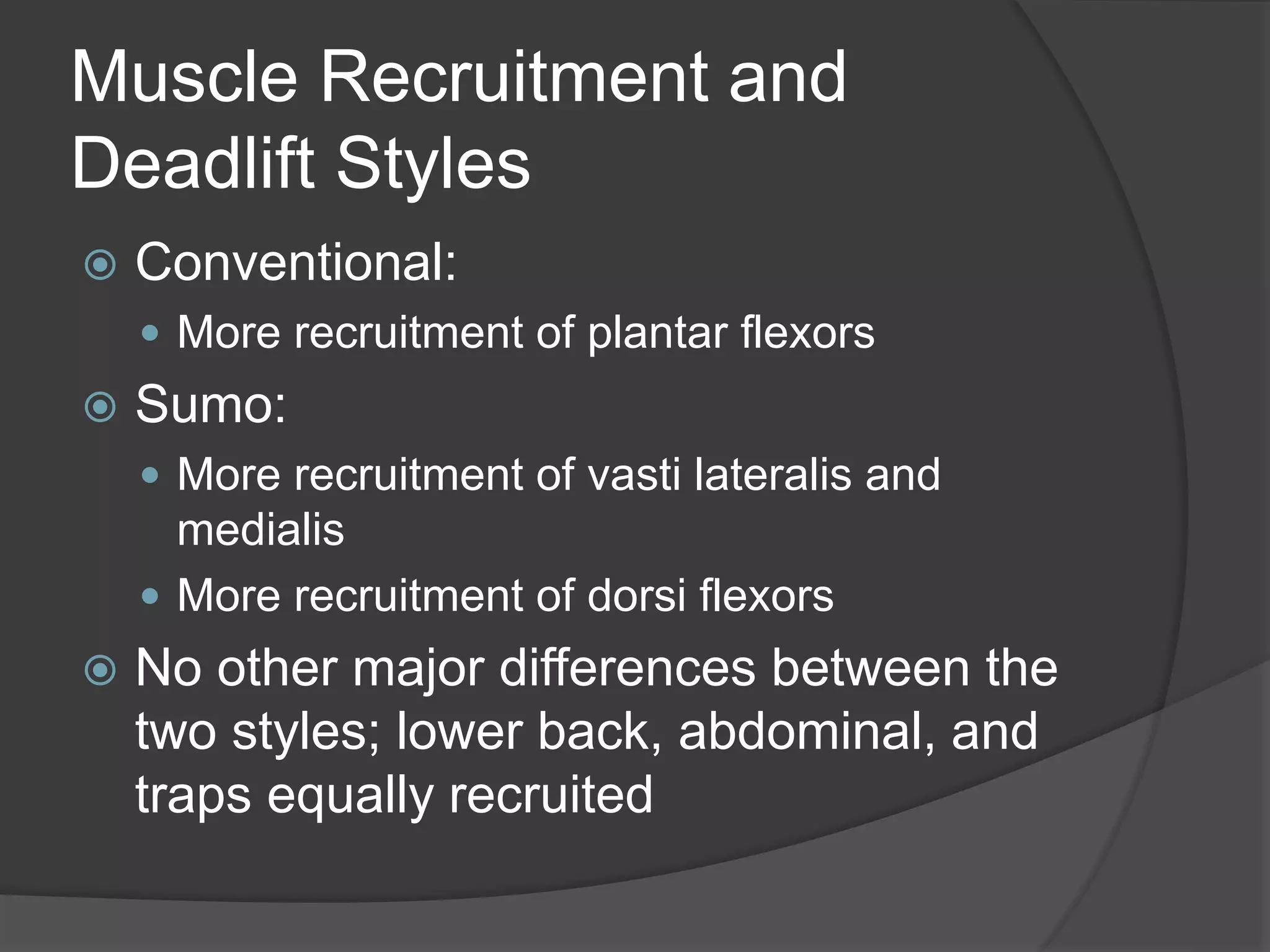
Muscle Recruitment and 
Deadlift Styles 
 Conventional: 
 More recruitment of plantar flexors 
 Sumo: 
 More recruitment of vasti lateralis and 
medialis 
 More recruitment of dorsi flexors 
 No other major differences between the 
two styles; lower back, abdominal, and 
traps equally recruited
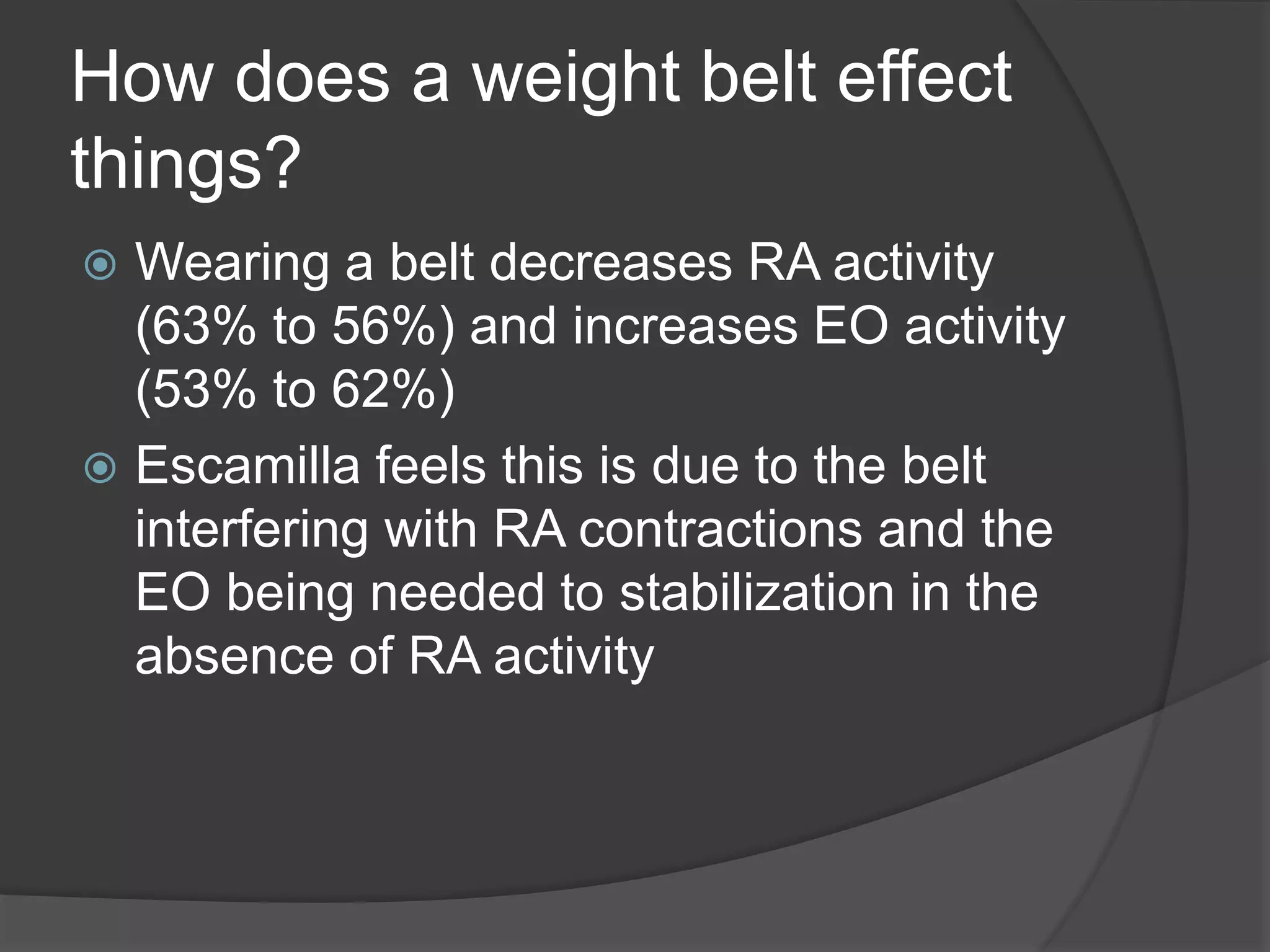
How does a weight belt effect 
things? 
 Wearing a belt decreases RA activity 
(63% to 56%) and increases EO activity 
(53% to 62%) 
 Escamilla feels this is due to the belt 
interfering with RA contractions and the 
EO being needed to stabilization in the 
absence of RA activity
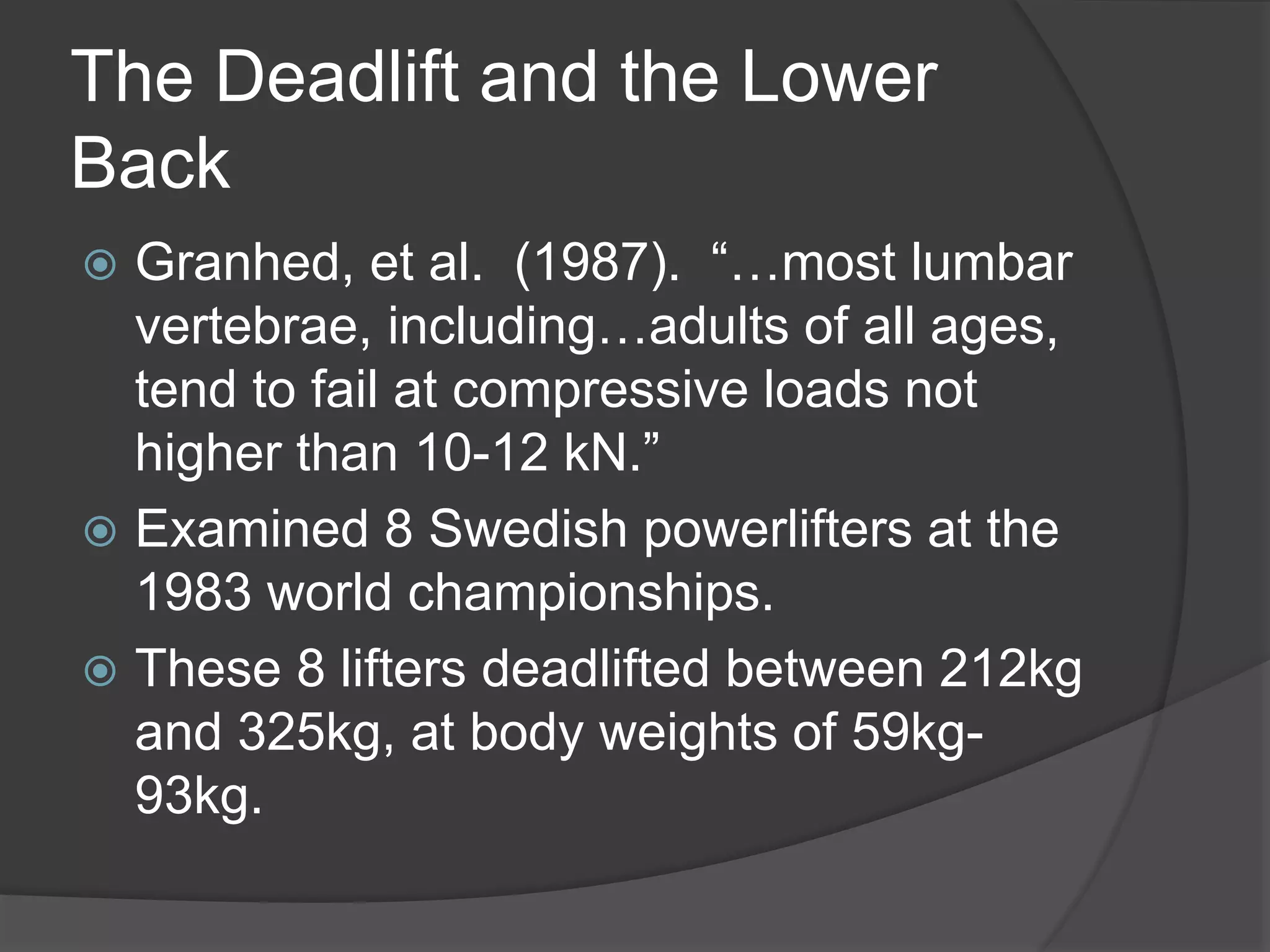
The Deadlift and the Lower 
Back 
 Granhed, et al. (1987). “…most lumbar 
vertebrae, including…adults of all ages, 
tend to fail at compressive loads not 
higher than 10-12 kN.” 
 Examined 8 Swedish powerlifters at the 
1983 world championships. 
 These 8 lifters deadlifted between 212kg 
and 325kg, at body weights of 59kg- 
93kg.
Deadlifting and the Lower Back 
 The 8 Swedish powerlifters were subjecting 
their L3 vertebrae to between 18.8 and 
36.4 kN of compression on those lifts. 
 Researchers found that the Swedish 
powerlifters had a greater BMD in their L3 
vertebrae (greater BMD ~ greater 
resistance to compression). 
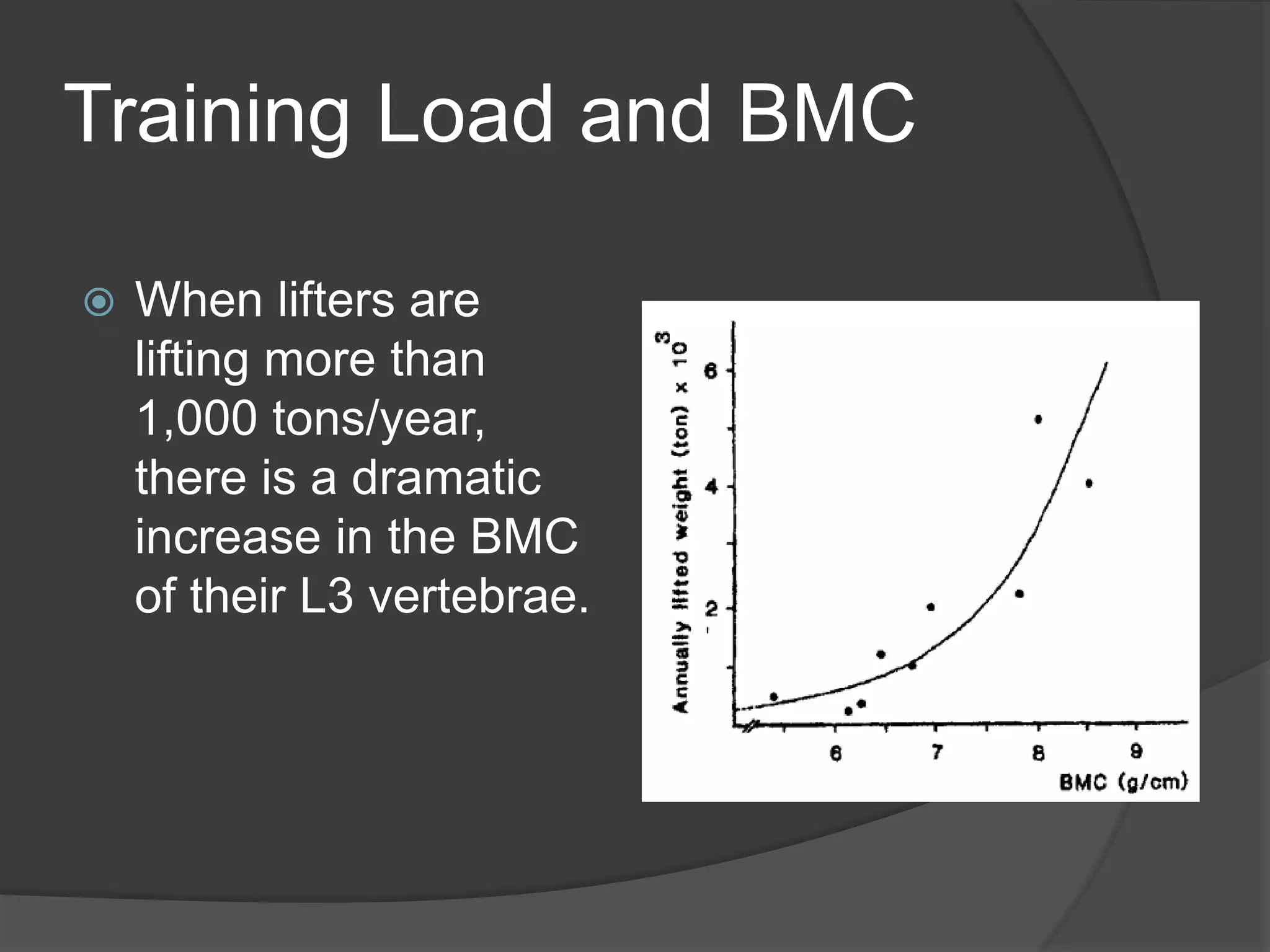
 Relationship between annual training load 
and BMD.
Training Load and BMC 
 When lifters are 
lifting more than 
1,000 tons/year, 
there is a dramatic 
increase in the BMC 
of their L3 vertebrae.
Deadlifts and the Lower 
Back 
 Deadlifts do subject the lower back to a 
great deal of stress. 
 However, this is something that the back 
can adapt to over time...
Variations and Other “Pulling” 
Exercises 
 Snatch-grip Deadlifts 
 Clean-grip Deadlifts 
 Partial Deadlifts 
 Platform Deadlifts 
 Dumbbell Deadlifts 
 Romanian Deadlifts 
 Stiff-Legged Deadlifts 
 Good Mornings 
 Back Raises 
 Reverse 
Hyperextensions 
 Leg Curls

Pulling Exercises: Analyzing the Deadlift

  • 1.
    John M. Cissik Human Performance Services, LLC
  • 2.
    Overview  Analyzingthe deadlift  Common errors  Coaching and Safety  Variations of “pulling” exercises
  • 3.
    Analyzing the Deadlift  Benefits  Competition Styles of Deadlifts  What does the deadlift work?  How does the deadlift affect the lower back?
  • 4.
    Benefits  Lowerbody hypertrophy  Lower back / core strength  Bone mass in lumbar spine and lower body  Total body strength
  • 5.
    Styles of Deadlifts  “Conventional”  Stance less than shoulder width (~80%)  Hands outside of legs  Slower lift than Sumo  Barbell travels a greater distance and is further from the athlete  “Sumo”  Stance almost twice shoulder width  Hands inside of legs  Faster lift than conventional  Bar travels a smaller distance and is closer to the athlete
  • 6.
    Conventional vs. Sumo Deadlifts  Escamilla, et al. (2000): 24 male powerlifters at ADFPA nationals Sumo Conventional Body Weight 71.6kg 76.8kg Barbell Weight 214.6kg 221.6kg Stance width (% of 188% 80% shoulder-width) Hand width 47cm 55cm Total lift time 3.62 s 4.08 s Time from LO to KP 1.64 s 1.58 s Time at sticking point 1.68 s 1.77 s Total vertical distance (% of height) 21.2% 26.0%
  • 7.
    Lifting off theBarbell Segment Angles at Liftoff 160 140 120 100 80 60 40 20 0 Hip Knee Trunk Thigh Shank Joint Angle Sumo Conventional
  • 8.
    At Liftoff... The sumo group:  Has a more upright trunk  Has thighs closer to parallel to the floor  Has a shank that is more vertical
  • 9.
    Passing the Knees Segment Angles at Knee Passing 180 160 140 120 100 80 60 40 20 0 Hip Knee Trunk Thigh Shank Joint Angle Sumo Conventional
  • 10.
    When the barbellpasses the knees...  The conventional lifters:  Extend their hips, knees, and shank through a greater range of motion  Trunk angles are similar for both types of lifters
  • 11.
    The Sticking Point Segment Angles at Sticking Point 180 160 140 120 100 80 60 40 20 0 Hip Knee Trunk Thigh Shank Joint Angle Sumo Conventional
  • 12.
    The sticking point...  Is higher for conventional lifters  However, it is not located just off the ground for sumo lifters (it is still 56% of the lift’s total height vs. 61% for conventional)  Trunk angles are very similar at the sticking point for both types
  • 13.
    Differences Between Sumoand Conventional  The segment angles and sticking regions are not that different between the two variations.  Surprisingly, muscular involvement is very similar as well..
  • 14.
    Escamilla, et al.(2002).  13 Division I football players  Performed 4 reps of their 12-RM deadlift (mean 12-RM was 123.1 kg) under one of four conditions:  Sumo  Conventional  Belt  No belt
  • 15.
    Muscle Recruitment andthe Deadlift Muscle Recruitment 60 50 40 30 20 10 0 RF VL VM LH MH Muscles EMG activity Sumo Conventional RF: rectus femoris, VL: vastus lateralis, VM: vastus medialis, LH: lateral hamstring, MH: medial hamstring
  • 16.
    Muscle Recruitment andthe Deadlift Muscle Recruitment 40 30 20 10 0 LG MG TA Hip Add GM Muscles EMG activity Sumo Conventional LG: lateral gascroc, MG; medial gastroc, TA: transverse abdominis, GM: gluteus maximus
  • 17.
    Muscle Recruitment andthe Deadlift Muscle Recruitment 80 60 40 20 0 L3 T12 Mid. Trap Upp. Trap RA EO Muscles EMG activity Sumo Conventional
  • 18.
    Muscle Recruitment and Deadlift Styles  Conventional:  More recruitment of plantar flexors  Sumo:  More recruitment of vasti lateralis and medialis  More recruitment of dorsi flexors  No other major differences between the two styles; lower back, abdominal, and traps equally recruited
  • 19.
    How does aweight belt effect things?  Wearing a belt decreases RA activity (63% to 56%) and increases EO activity (53% to 62%)  Escamilla feels this is due to the belt interfering with RA contractions and the EO being needed to stabilization in the absence of RA activity
  • 20.
    The Deadlift andthe Lower Back  Granhed, et al. (1987). “…most lumbar vertebrae, including…adults of all ages, tend to fail at compressive loads not higher than 10-12 kN.”  Examined 8 Swedish powerlifters at the 1983 world championships.  These 8 lifters deadlifted between 212kg and 325kg, at body weights of 59kg- 93kg.
  • 21.
    Deadlifting and theLower Back  The 8 Swedish powerlifters were subjecting their L3 vertebrae to between 18.8 and 36.4 kN of compression on those lifts.  Researchers found that the Swedish powerlifters had a greater BMD in their L3 vertebrae (greater BMD ~ greater resistance to compression).  Relationship between annual training load and BMD.
  • 22.
    Training Load andBMC  When lifters are lifting more than 1,000 tons/year, there is a dramatic increase in the BMC of their L3 vertebrae.
  • 23.
    Deadlifts and theLower Back  Deadlifts do subject the lower back to a great deal of stress.  However, this is something that the back can adapt to over time...
  • 25.
    Variations and Other“Pulling” Exercises  Snatch-grip Deadlifts  Clean-grip Deadlifts  Partial Deadlifts  Platform Deadlifts  Dumbbell Deadlifts  Romanian Deadlifts  Stiff-Legged Deadlifts  Good Mornings  Back Raises  Reverse Hyperextensions  Leg Curls