John M. Cissik
Human Performance Services, LLC
Overview
 What they are
 Advantages/Disadvantages
 How they are used
 Training for goals
Tools
 Olympic lifts
 Powerlifts
 Assistance exercises
 Kettlebells
 Heavy ropes
 Suspension training
Olympic Lifts
 Exercises that are variations of the
snatch, clean, and jerk.
 Barbell moves at 2-4 meters/second,
elite lifters are generating 31-50 watts of
power/kg of body weight.
Olympic Lifting: Advantages
 Little eccentric phase in these lifts, can
be done daily.
 Uses most of the muscles in the body.
 Triple extension of hips, knees, and
ankles.
 Done very quickly, develops power.
Olympic Lifting: Cautions
 Very fast, not forgiving of mistakes
 Requires specialized equipment
 Requires specialized instruction
 Very technical, takes a long time to learn
Olympic Lifting: Cautions
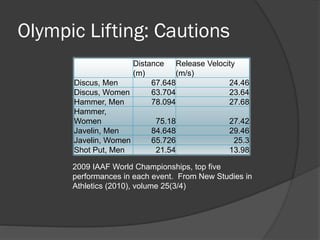
Distance
(m)
Release Velocity
(m/s)
Discus, Men 67.648 24.46
Discus, Women 63.704 23.64
Hammer, Men 78.094 27.68
Hammer,
Women 75.18 27.42
Javelin, Men 84.648 29.46
Javelin, Women 65.726 25.3
Shot Put, Men 21.54 13.98
2009 IAAF World Championships, top five
performances in each event. From New Studies in
Athletics (2010), volume 25(3/4)
Olympic Lifting: Cautions
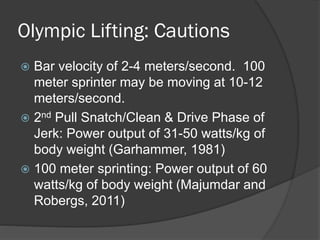
 Bar velocity of 2-4 meters/second. 100
meter sprinter may be moving at 10-12
meters/second.
 2nd Pull Snatch/Clean & Drive Phase of
Jerk: Power output of 31-50 watts/kg of
body weight (Garhammer, 1981)
 100 meter sprinting: Power output of 60
watts/kg of body weight (Majumdar and
Robergs, 2011)
Powerlifts
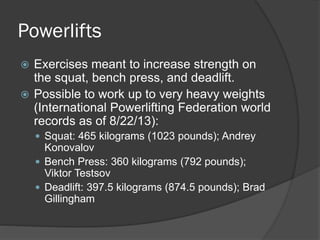
 Exercises meant to increase strength on
the squat, bench press, and deadlift.
 Possible to work up to very heavy weights
(International Powerlifting Federation world
records as of 8/22/13):
 Squat: 465 kilograms (1023 pounds); Andrey
Konovalov
 Bench Press: 360 kilograms (792 pounds);
Viktor Testsov
 Deadlift: 397.5 kilograms (874.5 pounds); Brad
Gillingham
Kettlebells
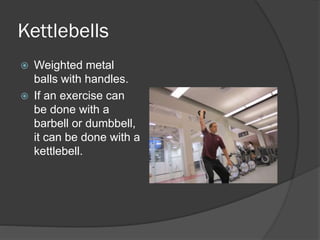
 Weighted metal
balls with handles.
 If an exercise can
be done with a
barbell or dumbbell,
it can be done with a
kettlebell.
Kettlebells
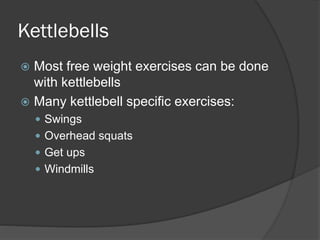
 Most free weight exercises can be done
with kettlebells
 Many kettlebell specific exercises:
 Swings
 Overhead squats
 Get ups
 Windmills
Kettlebells: Programing
Guidelines
 Depends upon goal.
 Strength/power: Mirror programming
guidelines for Olympic lifts or powerlifts
 Endurance/conditioning: Generally done for
time (i.e. swing for 40 seconds, rest for 20)
or circuit-style
Kettlebells: Advantages
 Kettlebell has mass, so it can increase
hypertrophy, strength, and power.
 Requires each side of the body to work
independently.
 Variety, fun.
Kettlebells: Cautions
 Cost between US$1.40 and $3.00/kilogram
 A lot of bad information out there,
marketing/hype vs. substance.
 Requires a lot of equipment to use for track
and field athletes.
 Skill component, takes awhile to learn
many of these exercises.
 Not conducive to some exercises (snatch)
Kettlebells: Cautions
 A lot of anecdotal information, no
research foundation:
 Farrar, et al (2010): Swinging a 16kg
kettlebell for 12 minutes increases heart rate
and oxygen consumption…
 Manocchia et al (2010): A 10 week, 2x/week
program increases 3-RM barbell bench
press (9%), 3-RM barbell clean and jerk
(25%), and low back endurance (20%).
Untrained population…
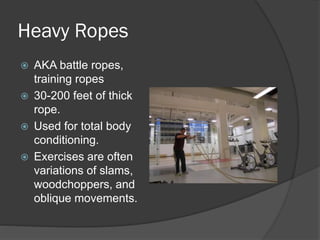
Heavy Ropes
 AKA battle ropes,
training ropes
 30-200 feet of thick
rope.
 Used for total body
conditioning.
 Exercises are often
variations of slams,
woodchoppers, and
oblique movements.
Heavy Ropes: Programming
Guidelines
 Approached as a conditioning or warm-
up tool, so exercises are done for time.
 40 seconds on, 20 seconds off most
common approach.
 Can be done circuit-style.
 Can be tailored to individual needs.
 Can be combined with other exercises
(for example: slam for 60 seconds,
kettlebell swing for 60 seconds)
Heavy Ropes: Advantages
 Fun.
 Great warm-up exercise.
 Good tool for absolute beginners.
Heavy Ropes: Cautions
 Cost US$100-$400 each if you purchase
the premium equipment.
 Home improvement store ropes: $20…
 Very limited overload potential.
 Zero research.
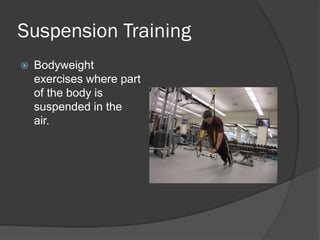
Suspension Training
 Bodyweight
exercises where part
of the body is
suspended in the
air.

Strength Training Tools

  • 1.
    John M. Cissik HumanPerformance Services, LLC
  • 2.
    Overview  What theyare  Advantages/Disadvantages  How they are used  Training for goals
  • 3.
    Tools  Olympic lifts Powerlifts  Assistance exercises  Kettlebells  Heavy ropes  Suspension training
  • 4.
    Olympic Lifts  Exercisesthat are variations of the snatch, clean, and jerk.  Barbell moves at 2-4 meters/second, elite lifters are generating 31-50 watts of power/kg of body weight.
  • 5.
    Olympic Lifting: Advantages Little eccentric phase in these lifts, can be done daily.  Uses most of the muscles in the body.  Triple extension of hips, knees, and ankles.  Done very quickly, develops power.
  • 6.
    Olympic Lifting: Cautions Very fast, not forgiving of mistakes  Requires specialized equipment  Requires specialized instruction  Very technical, takes a long time to learn
  • 7.
    Olympic Lifting: Cautions Distance (m) ReleaseVelocity (m/s) Discus, Men 67.648 24.46 Discus, Women 63.704 23.64 Hammer, Men 78.094 27.68 Hammer, Women 75.18 27.42 Javelin, Men 84.648 29.46 Javelin, Women 65.726 25.3 Shot Put, Men 21.54 13.98 2009 IAAF World Championships, top five performances in each event. From New Studies in Athletics (2010), volume 25(3/4)
  • 8.
    Olympic Lifting: Cautions Bar velocity of 2-4 meters/second. 100 meter sprinter may be moving at 10-12 meters/second.  2nd Pull Snatch/Clean & Drive Phase of Jerk: Power output of 31-50 watts/kg of body weight (Garhammer, 1981)  100 meter sprinting: Power output of 60 watts/kg of body weight (Majumdar and Robergs, 2011)
  • 9.
    Powerlifts  Exercises meantto increase strength on the squat, bench press, and deadlift.  Possible to work up to very heavy weights (International Powerlifting Federation world records as of 8/22/13):  Squat: 465 kilograms (1023 pounds); Andrey Konovalov  Bench Press: 360 kilograms (792 pounds); Viktor Testsov  Deadlift: 397.5 kilograms (874.5 pounds); Brad Gillingham
  • 10.
    Kettlebells  Weighted metal ballswith handles.  If an exercise can be done with a barbell or dumbbell, it can be done with a kettlebell.
  • 11.
    Kettlebells  Most freeweight exercises can be done with kettlebells  Many kettlebell specific exercises:  Swings  Overhead squats  Get ups  Windmills
  • 12.
    Kettlebells: Programing Guidelines  Dependsupon goal.  Strength/power: Mirror programming guidelines for Olympic lifts or powerlifts  Endurance/conditioning: Generally done for time (i.e. swing for 40 seconds, rest for 20) or circuit-style
  • 13.
    Kettlebells: Advantages  Kettlebellhas mass, so it can increase hypertrophy, strength, and power.  Requires each side of the body to work independently.  Variety, fun.
  • 14.
    Kettlebells: Cautions  Costbetween US$1.40 and $3.00/kilogram  A lot of bad information out there, marketing/hype vs. substance.  Requires a lot of equipment to use for track and field athletes.  Skill component, takes awhile to learn many of these exercises.  Not conducive to some exercises (snatch)
  • 15.
    Kettlebells: Cautions  Alot of anecdotal information, no research foundation:  Farrar, et al (2010): Swinging a 16kg kettlebell for 12 minutes increases heart rate and oxygen consumption…  Manocchia et al (2010): A 10 week, 2x/week program increases 3-RM barbell bench press (9%), 3-RM barbell clean and jerk (25%), and low back endurance (20%). Untrained population…
  • 16.
    Heavy Ropes  AKAbattle ropes, training ropes  30-200 feet of thick rope.  Used for total body conditioning.  Exercises are often variations of slams, woodchoppers, and oblique movements.
  • 17.
    Heavy Ropes: Programming Guidelines Approached as a conditioning or warm- up tool, so exercises are done for time.  40 seconds on, 20 seconds off most common approach.  Can be done circuit-style.  Can be tailored to individual needs.  Can be combined with other exercises (for example: slam for 60 seconds, kettlebell swing for 60 seconds)
  • 18.
    Heavy Ropes: Advantages Fun.  Great warm-up exercise.  Good tool for absolute beginners.
  • 19.
    Heavy Ropes: Cautions Cost US$100-$400 each if you purchase the premium equipment.  Home improvement store ropes: $20…  Very limited overload potential.  Zero research.
  • 20.
    Suspension Training  Bodyweight exerciseswhere part of the body is suspended in the air.