This document discusses the classification and principles of movements. It defines movement and classifies them into two main categories: passive movements and active movements. Passive movements involve relaxed movement or manual mobilization while active movements are voluntary or involuntary muscle contractions. Voluntary active movements are further divided into free movements against gravity, assisted movements with external help, assisted-resisted movements combining assistance and resistance, and resisted movements against external force. The document outlines techniques and effects of each type of movement, such as improving joint mobility, muscle tone, and coordination.
Introduction to movement classification and principles, including effects and techniques of both active and passive movements.
Movement as essential to animal life, followed by a classification into passive and active movements.
Details on relaxed passive movements and manual mobilization techniques used in physiotherapy.
In-depth classification of active movements, including various types such as voluntary, assisted, and resisted exercises. Active exercises defined and major classifications discussed, focusing on resistance techniques.
Free exercise categories based on area and techniques to execute free exercises, including positioning and speed.
Outlines the benefits of exercises like relaxation, muscle strength, balance restoration, and coordination. Techniques, effects, and applications of assisted and assisted-resisted exercises to enhance movement control.
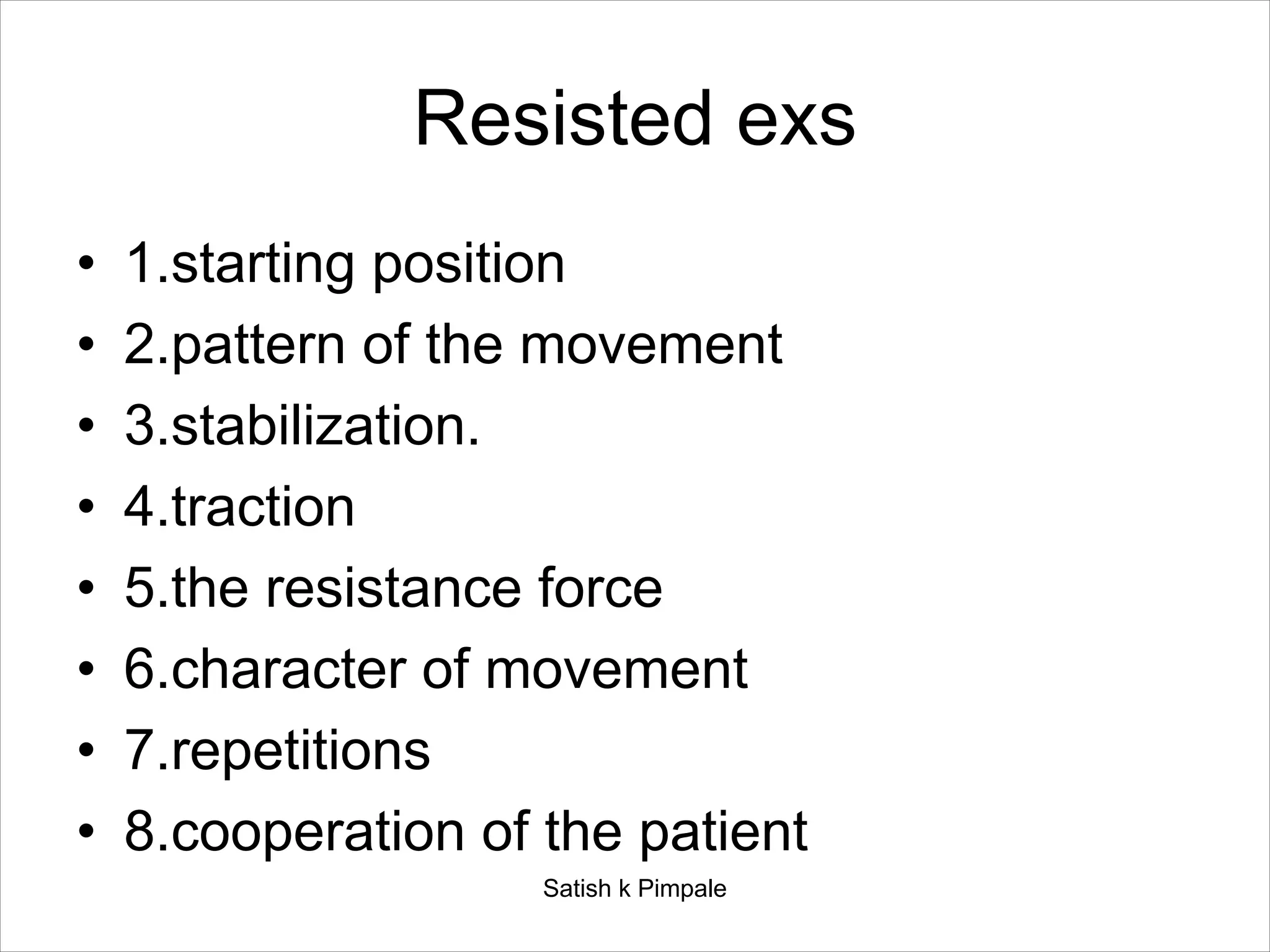
Describes specific techniques and considerations for performing resisted exercises effectively.
• Definition andclassification
• Principles of movements
• Effects, uses and Techniques (active:
assisted, free,assisted- resisted, resisted
& passive)
Satish k Pimpale
3.
Definition
• Movement isa fundamental characteristic
of all animal life and the means by which
the organism adapts itself to the demands
made upon it by the environment in which
it lives.
Satish k Pimpale
Classication
• Free exs: the working muscles are
subject on ly to the forces of gravity acting
upon the part moved or stabillised.
• Assisted exs : whwn muscle strength or
co-ordination is inadequate to perform a
movement an external force is applied to
compensate fo rthe deficiency.
Satish k Pimpale
9.
• Assisted Ressistedexs : muscles may
be strong enough to work against
resistance in part of the range and not in
others.this type of exercise ensures that
the external force applied are adapted in
every part of the range to the abilities of
the muscles.
• Ressisted exs : forces of resitance
offered to the action of the working
muscles. Satish k Pimpale
10.
Classisfication of freeexs
According to the extent of area
• localised and general
According to particular :
• Subjective and Objective
Satish k Pimpale
11.
Technique of Freeexs
• Positioning
• Instruction
• Speed
• Duration
Satish k Pimpale
12.
Effects & Uses
•Relaxation
• joint mobility
• muscle power and tone
• neuromuscular coordination
• confidence
• circulatory and respiratory co-operation
Satish k Pimpale
13.
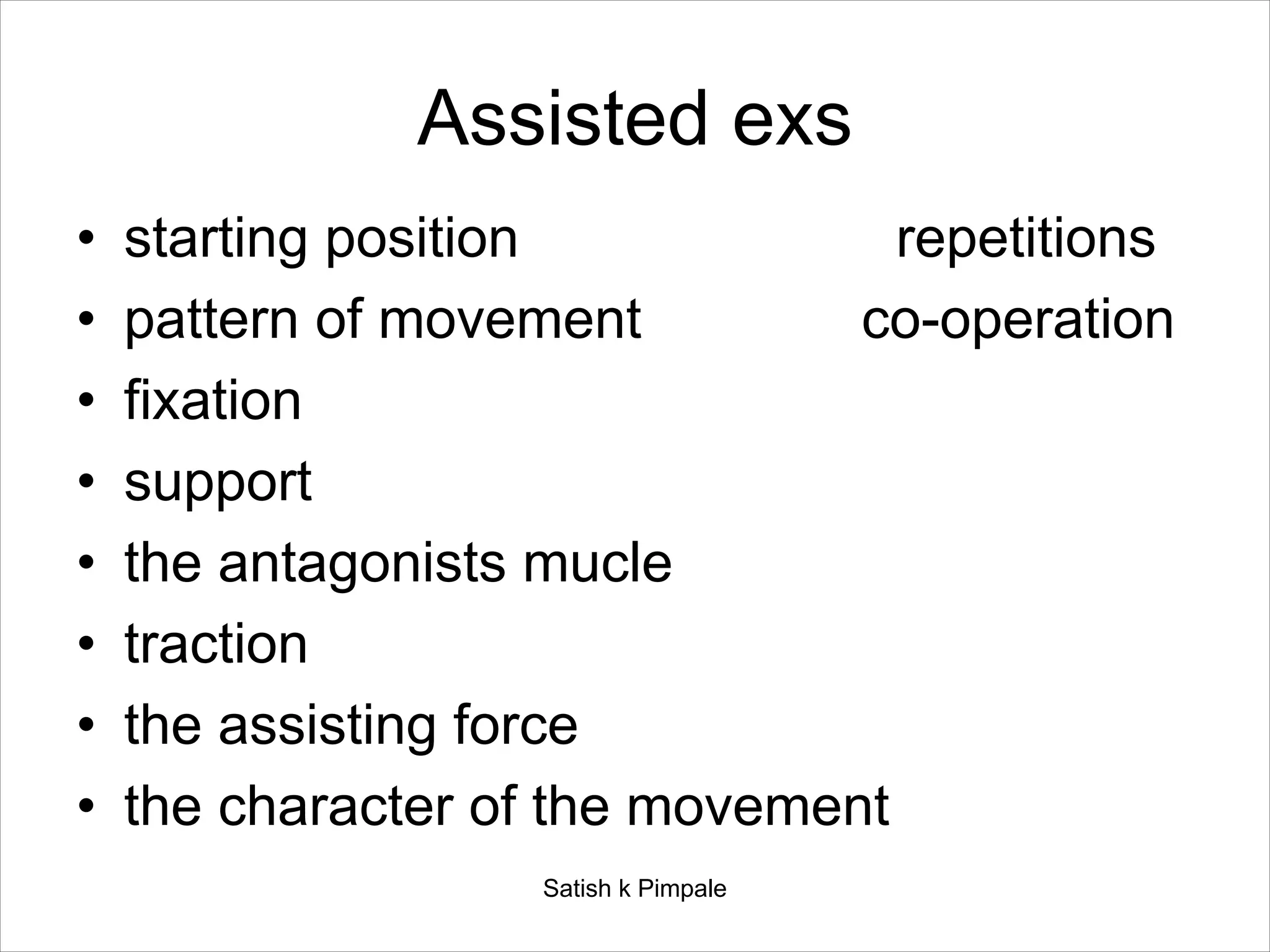
Assisted exs
• startingposition repetitions
• pattern of movement co-operation
• fixation
• support
• the antagonists mucle
• traction
• the assisting force
• the character of the movement
Satish k Pimpale
14.
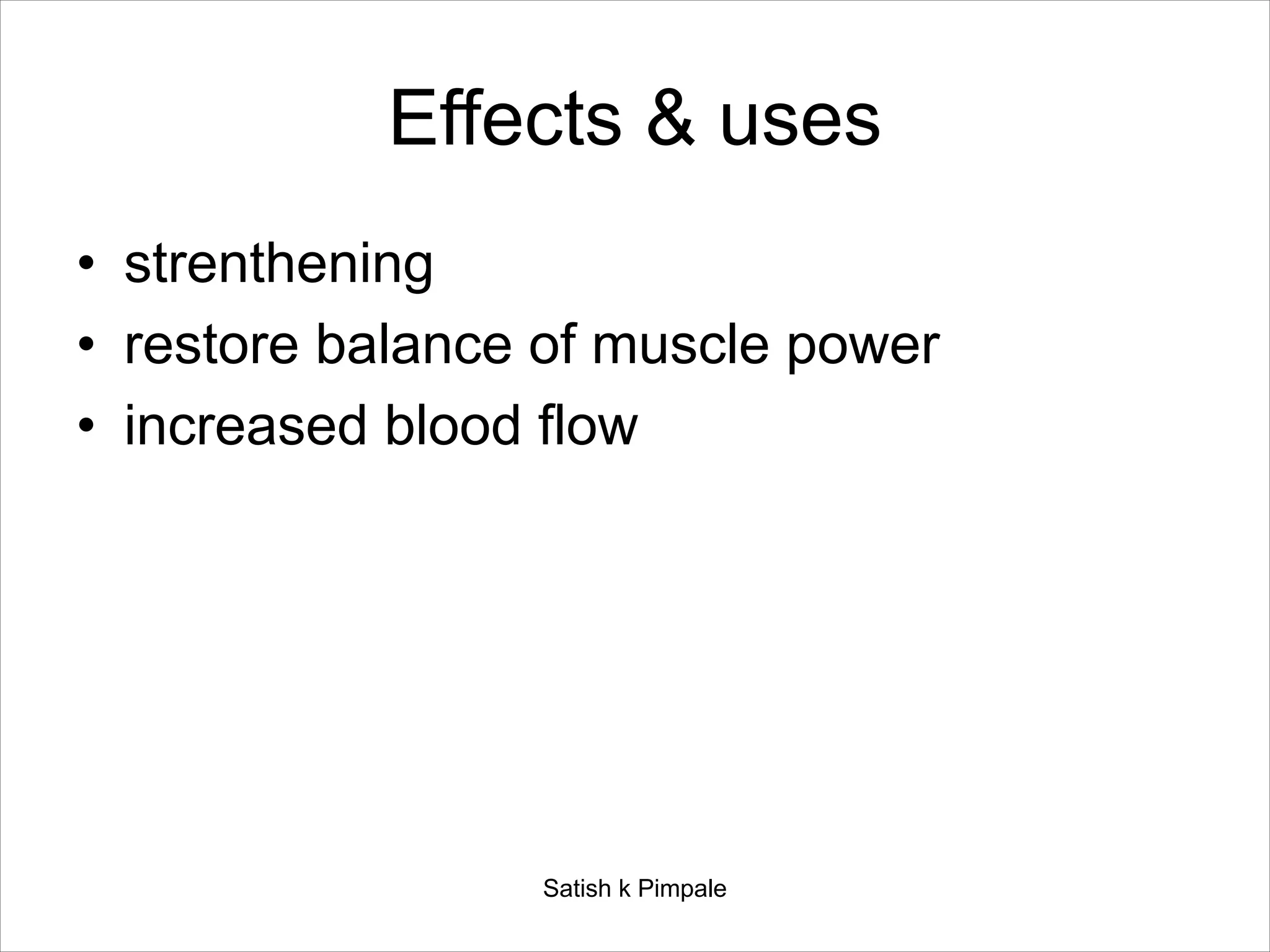
Effects & uses
•strenthening
• restore balance of muscle power
• increased blood flow
Satish k Pimpale
15.
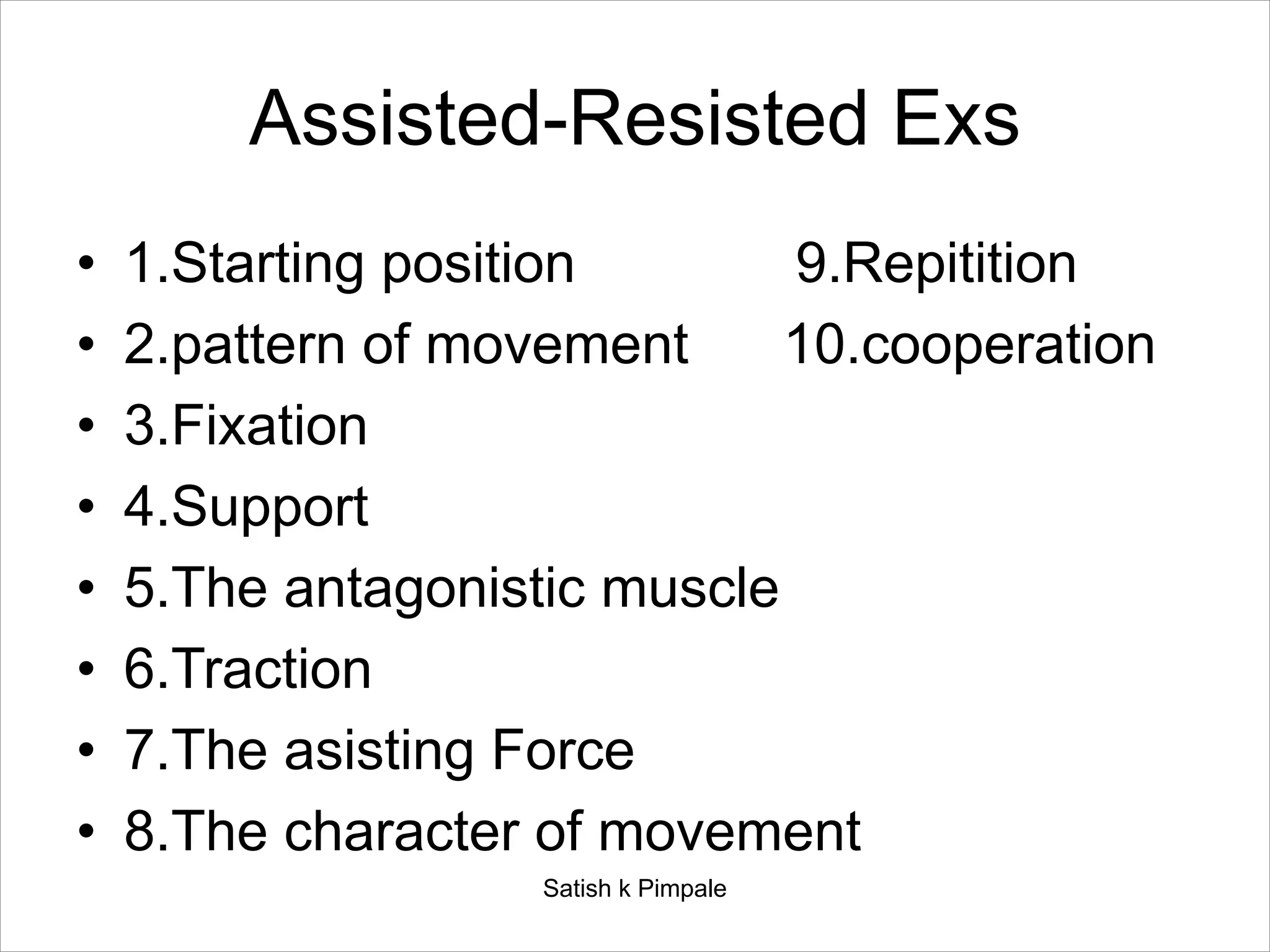
Assisted-Resisted Exs
• 1.Startingposition 9.Repitition
• 2.pattern of movement 10.cooperation
• 3.Fixation
• 4.Support
• 5.The antagonistic muscle
• 6.Traction
• 7.The asisting Force
• 8.The character of movement
Satish k Pimpale
16.
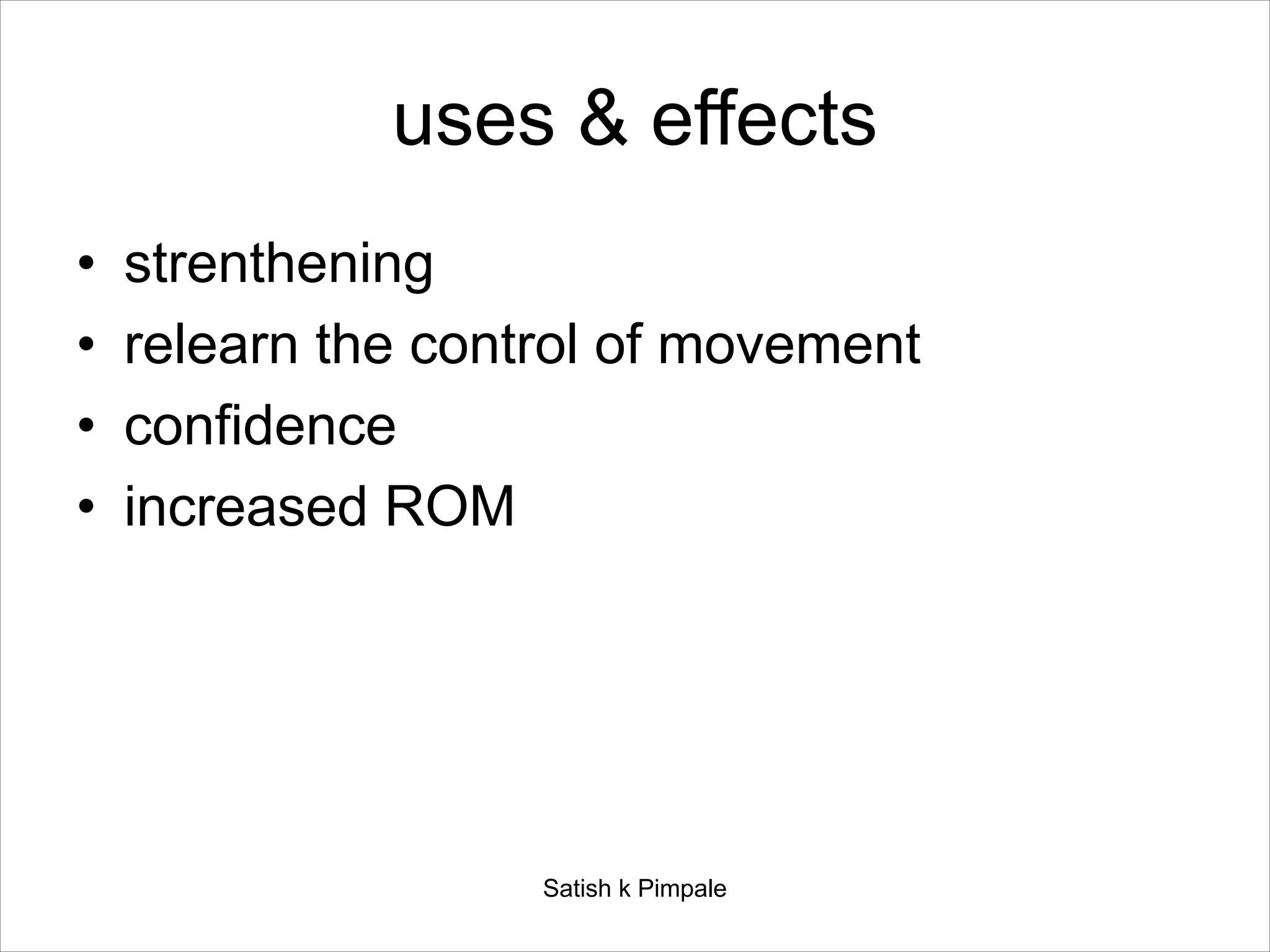
uses & effects
•strenthening
• relearn the control of movement
• confidence
• increased ROM
Satish k Pimpale
17.
Resisted exs
• 1.startingposition
• 2.pattern of the movement
• 3.stabilization.
• 4.traction
• 5.the resistance force
• 6.character of movement
• 7.repetitions
• 8.cooperation of the patient
Satish k Pimpale