A Report in Natural Science I
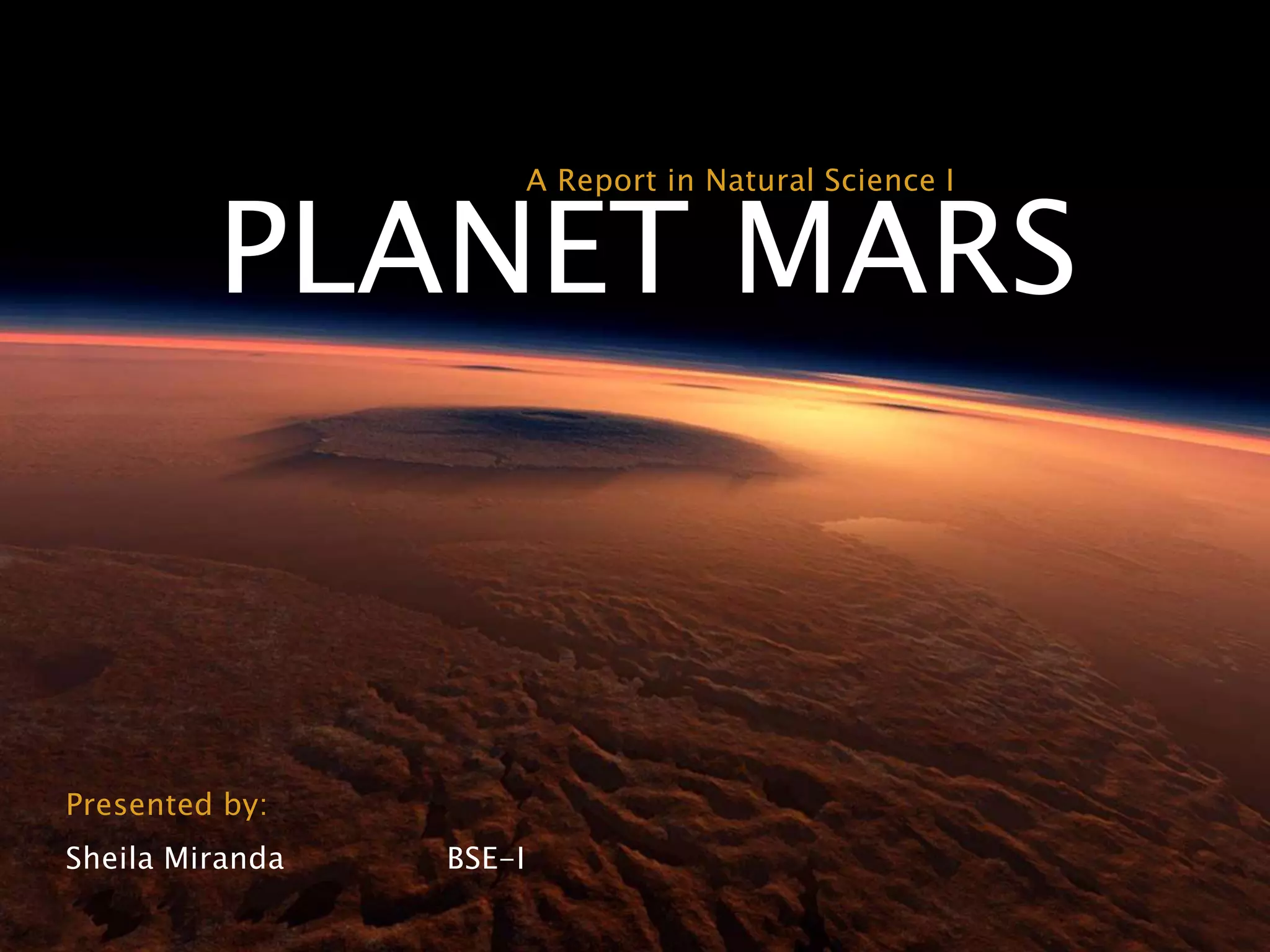
PLANET MARS
Presented by:
Sheila Miranda BSE-I
TOPICS TO BE DISCUSSED
• Basics
• Orbit
• Topography
• Climate
• Water
• Geological Periods
• Atmosphere
• Interior
• The 2 Moons of Mars
• Missions to Mars
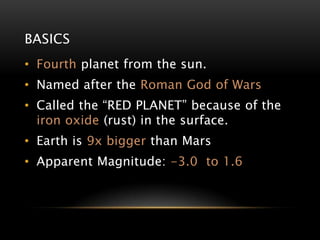
BASICS
• Fourth planet from the sun.
• Named after the Roman God of Wars
• Called the “RED PLANET” because of the
iron oxide (rust) in the surface.
• Earth is 9x bigger than Mars
• Apparent Magnitude: -3.0 to 1.6
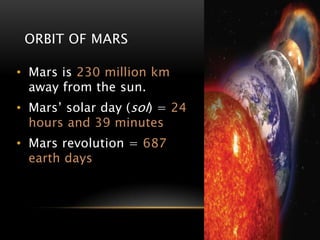
ORBIT OF MARS
• Mars is 230 million km
away from the sun.
• Mars’ solar day (sol) = 24
hours and 39 minutes
• Mars revolution = 687
earth days
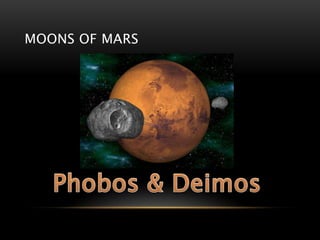
MOONS OF MARS
MOONS OF MARS
• discovered in 1877 by Asaph Hall
• origin is possibly asteroid capture.
• named after Greek mythology characters
Panic and Dread
• no total solar eclipses in Mars ; total
lunar eclipses happen every night
ATMOSPHERE
• Consists of 95% carbon dioxide, 3%
nitrogen, 1.6% argon and traces of
oxygen and water
• No magnetosphere
• Extremely thin atmosphere
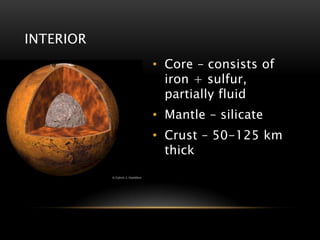
INTERIOR
• Core – consists of
iron + sulfur,
partially fluid
• Mantle – silicate
• Crust – 50-125 km
thick
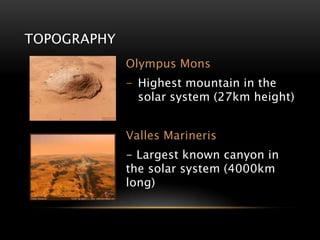
TOPOGRAPHY
Olympus Mons
- Highest mountain in the
solar system (27km height)
Valles Marineris
- Largest known canyon in
the solar system (4000km
long)
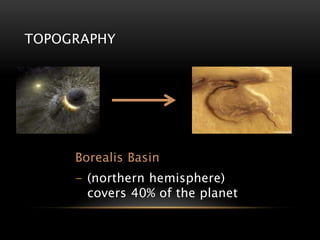
TOPOGRAPHY
Borealis Basin
- (northern hemisphere)
covers 40% of the planet
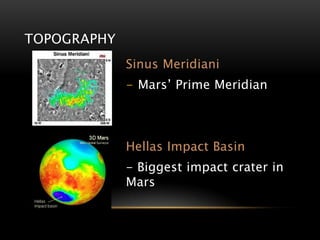
TOPOGRAPHY
Sinus Meridiani
- Mars’ Prime Meridian
Hellas Impact Basin
- Biggest impact crater in
Mars
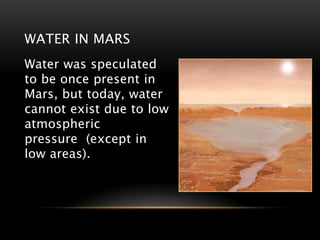
WATER IN MARS
Water was speculated
to be once present in
Mars, but today, water
cannot exist due to low
atmospheric
pressure (except in
low areas).
WATER IN MARS
Signs of water once existing in the planet
include:
• Its two permanent polar ice caps seem
to be made of water.
• Geographical features that show water
run-off or erosion.
• Detection of specific minerals that are
only present in water.
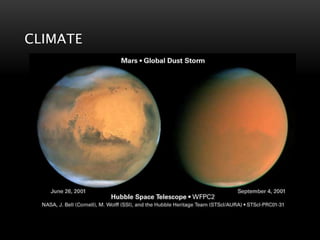
CLIMATE
CLIMATE
• Largest dust storm in the solar system
• Mars seasons are most Earth-like among
all planets in the solar system
• Temperature: -87˚C (winter) to -5˚C
(summer)
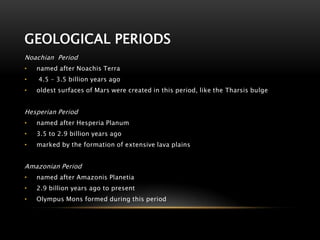
GEOLOGICAL PERIODS
Noachian Period
• named after Noachis Terra
• 4.5 – 3.5 billion years ago
• oldest surfaces of Mars were created in this period, like the Tharsis bulge
Hesperian Period
• named after Hesperia Planum
• 3.5 to 2.9 billion years ago
• marked by the formation of extensive lava plains
Amazonian Period
• named after Amazonis Planetia
• 2.9 billion years ago to present
• Olympus Mons formed during this period
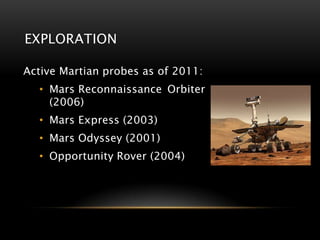
EXPLORATION
Active Martian probes as of 2011:
• Mars Reconnaissance Orbiter
(2006)
• Mars Express (2003)
• Mars Odyssey (2001)
• Opportunity Rover (2004)
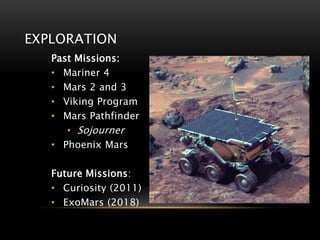
EXPLORATION
Past Missions:
• Mariner 4
• Mars 2 and 3
• Viking Program
• Mars Pathfinder
• Sojourner
• Phoenix Mars
Future Missions:
• Curiosity (2011)
• ExoMars (2018)
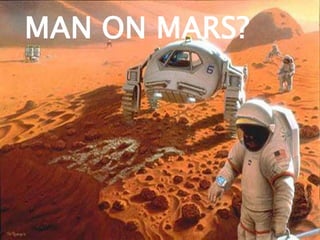
MAN ON MARS?
Q U E S T I O N S ?

Planet Mars

  • 1.
    A Report inNatural Science I PLANET MARS Presented by: Sheila Miranda BSE-I
  • 2.
    TOPICS TO BEDISCUSSED • Basics • Orbit • Topography • Climate • Water • Geological Periods • Atmosphere • Interior • The 2 Moons of Mars • Missions to Mars
  • 3.
    BASICS • Fourth planetfrom the sun. • Named after the Roman God of Wars • Called the “RED PLANET” because of the iron oxide (rust) in the surface. • Earth is 9x bigger than Mars • Apparent Magnitude: -3.0 to 1.6
  • 4.
    ORBIT OF MARS •Mars is 230 million km away from the sun. • Mars’ solar day (sol) = 24 hours and 39 minutes • Mars revolution = 687 earth days
  • 5.
  • 6.
    MOONS OF MARS •discovered in 1877 by Asaph Hall • origin is possibly asteroid capture. • named after Greek mythology characters Panic and Dread • no total solar eclipses in Mars ; total lunar eclipses happen every night
  • 7.
    ATMOSPHERE • Consists of95% carbon dioxide, 3% nitrogen, 1.6% argon and traces of oxygen and water • No magnetosphere • Extremely thin atmosphere
  • 8.
    INTERIOR • Core –consists of iron + sulfur, partially fluid • Mantle – silicate • Crust – 50-125 km thick
  • 9.
    TOPOGRAPHY Olympus Mons - Highestmountain in the solar system (27km height) Valles Marineris - Largest known canyon in the solar system (4000km long)
  • 10.
    TOPOGRAPHY Borealis Basin - (northernhemisphere) covers 40% of the planet
  • 11.
    TOPOGRAPHY Sinus Meridiani - Mars’Prime Meridian Hellas Impact Basin - Biggest impact crater in Mars
  • 12.
    WATER IN MARS Waterwas speculated to be once present in Mars, but today, water cannot exist due to low atmospheric pressure (except in low areas).
  • 13.
    WATER IN MARS Signsof water once existing in the planet include: • Its two permanent polar ice caps seem to be made of water. • Geographical features that show water run-off or erosion. • Detection of specific minerals that are only present in water.
  • 14.
  • 15.
    CLIMATE • Largest duststorm in the solar system • Mars seasons are most Earth-like among all planets in the solar system • Temperature: -87˚C (winter) to -5˚C (summer)
  • 16.
    GEOLOGICAL PERIODS Noachian Period •named after Noachis Terra • 4.5 – 3.5 billion years ago • oldest surfaces of Mars were created in this period, like the Tharsis bulge Hesperian Period • named after Hesperia Planum • 3.5 to 2.9 billion years ago • marked by the formation of extensive lava plains Amazonian Period • named after Amazonis Planetia • 2.9 billion years ago to present • Olympus Mons formed during this period
  • 17.
    EXPLORATION Active Martian probesas of 2011: • Mars Reconnaissance Orbiter (2006) • Mars Express (2003) • Mars Odyssey (2001) • Opportunity Rover (2004)
  • 18.
    EXPLORATION Past Missions: • Mariner4 • Mars 2 and 3 • Viking Program • Mars Pathfinder • Sojourner • Phoenix Mars Future Missions: • Curiosity (2011) • ExoMars (2018)
  • 19.
  • 20.
    Q U ES T I O N S ?