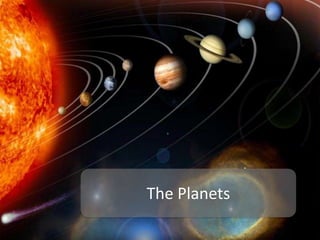
The Planets
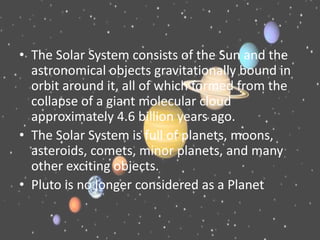
• The Solar System consists of the Sun and the
  astronomical objects gravitationally bound in
  orbit around it, all of which formed from the
  collapse of a giant molecular cloud
  approximately 4.6 billion years ago.
• The Solar System is full of planets, moons,
  asteroids, comets, minor planets, and many
  other exciting objects.
• Pluto is no longer considered as a Planet
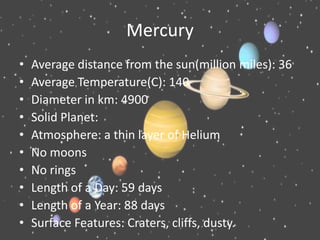
Mercury
•   Average distance from the sun(million miles): 36
•   Average Temperature(C): 140
•   Diameter in km: 4900
•   Solid Planet:
•   Atmosphere: a thin layer of Helium
•   No moons
•   No rings
•   Length of a Day: 59 days
•   Length of a Year: 88 days
•   Surface Features: Craters, cliffs, dusty.
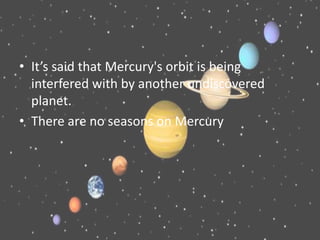
• It’s said that Mercury's orbit is being
  interfered with by another undiscovered
  planet.
• There are no seasons on Mercury
Venus
•   Average distance from the sun(million miles): 67
•   Average Temperature(C): 450
•   Diameter in km: 12,100
•   Solid Planet
•   Atmosphere: Carbon Dioxide
•   No moons
•   No rings
•   Length of a Day: 243 days
•   Length of a Year: 225 days
•   Surface Features: rocky, canyons, dusty.
• Other than the Moon, Venus is the brightest
  natural object in the night sky
• Venus is the only planet named after a female
  figure, the goddess of love.
Earth
•   Average distance from the sun(million miles): 93
•   Average Temperature(C): 10
•   Diameter in km: 12,800
•   Solid Planet
•   Atmosphere: Nitrogen and Oxygen
•   1 moon
•   No rings
•   Length of a Day: 24 hours
•   Length of a Year: 365 days
•   Surface Features: water, mountains, volcanoes.
• Earth is not a perfect sphere, it is an oblate
  spheroid.
• The moon is moving away from the earth at a
  rate of 4 cm a year.
• Around 70% of water on Earth is locked within
  glaciers and polar ice caps
Mars
•   Average distance from the sun(million miles): 142
•   Average Temperature(C): -40
•   Diameter in km: 6,800
•   Solid Planet
•   Atmosphere: Carbon Dioxide
•   2 moons
•   No rings
•   Length of a Day: 25 hours
•   Length of a Year: 687 days
•   Surface Features: Dunes, volcanoes, red dirt canyons.
• Scientists believe that Mars was once a very
  different place. Evidence points to volcanic
  activity, water and a rich atmosphere and
  warm climate.
Jupiter
•   Average distance from the sun(million miles): 484
•   Average Temperature(C): -150
•   Diameter in km: 143,000
•   Gas Planet
•   Atmosphere: Hydrogen, Helium
•   63 moons
•   4 rings
•   Length of a Day: 10 hours
•   Length of a Year: 12 years
•   Surface Features: Red spot, storms.
• One spot that planetary scientists think
  organisms could survive is Europa, Jupiter’s
  moon


• The Great Red Spot is a gigantic storm.
• Jupiter is the largest planet
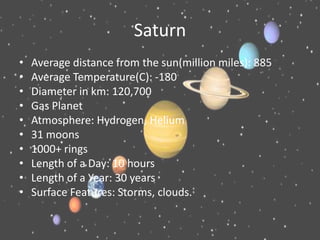
Saturn
•   Average distance from the sun(million miles): 885
•   Average Temperature(C): -180
•   Diameter in km: 120,700
•   Gas Planet
•   Atmosphere: Hydrogen, Helium
•   31 moons
•   1000+ rings
•   Length of a Day: 10 hours
•   Length of a Year: 30 years
•   Surface Features: Storms, clouds.
• Another place where life could exist is Titan,
  Saturn’s largest moon.
• Saturn has an average density less than water,
  that means it would float if there were an ocean
  big enough to hold it.
• Saturn was the name of the Roman god of
  agriculture and harvest
• The particles that make up Saturn’s rings range
  from the size of a grain of salt to the size of a
  mountain.
Uranus
•   Average distance from the sun(million miles): 1,781
•   Average Temperature(C): -200
•   Diameter in km: 51,800
•   Gas Planet
•   Atmosphere: Hydrogen, Helium
•   27 moons
•   11 rings
•   Length of a Day: 17 hours
•   Length of a Year: 84 years
•   Surface Features: Green, blue clouds.
• Uranus was the first planet discovered in
  modern history. It was also the first discovered
  using telescope.
• The moons are named after characters of
  William Shakespeare and Alexander Pope.
Neptune
•   Average distance from the sun(million miles): 2,793
•   Average Temperature(C): -220
•   Diameter in km: 49, 500
•   Gas Planet
•   Atmosphere: Hydrogen, Helium
•   13 moons
•   4 rings
•   Length of a Day: 16 hours
•   Length of a Year: 165 years
•   Surface Features: Storms, blue clouds.
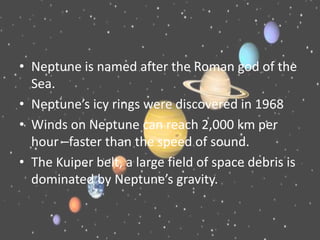
• Neptune is named after the Roman god of the
  Sea.
• Neptune’s icy rings were discovered in 1968
• Winds on Neptune can reach 2,000 km per
  hour –faster than the speed of sound.
• The Kuiper belt, a large field of space debris is
  dominated by Neptune’s gravity.

Planets

  • 1.
  • 2.
    • The SolarSystem consists of the Sun and the astronomical objects gravitationally bound in orbit around it, all of which formed from the collapse of a giant molecular cloud approximately 4.6 billion years ago. • The Solar System is full of planets, moons, asteroids, comets, minor planets, and many other exciting objects. • Pluto is no longer considered as a Planet
  • 3.
    Mercury • Average distance from the sun(million miles): 36 • Average Temperature(C): 140 • Diameter in km: 4900 • Solid Planet: • Atmosphere: a thin layer of Helium • No moons • No rings • Length of a Day: 59 days • Length of a Year: 88 days • Surface Features: Craters, cliffs, dusty.
  • 4.
    • It’s saidthat Mercury's orbit is being interfered with by another undiscovered planet. • There are no seasons on Mercury
  • 5.
    Venus • Average distance from the sun(million miles): 67 • Average Temperature(C): 450 • Diameter in km: 12,100 • Solid Planet • Atmosphere: Carbon Dioxide • No moons • No rings • Length of a Day: 243 days • Length of a Year: 225 days • Surface Features: rocky, canyons, dusty.
  • 6.
    • Other thanthe Moon, Venus is the brightest natural object in the night sky • Venus is the only planet named after a female figure, the goddess of love.
  • 7.
    Earth • Average distance from the sun(million miles): 93 • Average Temperature(C): 10 • Diameter in km: 12,800 • Solid Planet • Atmosphere: Nitrogen and Oxygen • 1 moon • No rings • Length of a Day: 24 hours • Length of a Year: 365 days • Surface Features: water, mountains, volcanoes.
  • 8.
    • Earth isnot a perfect sphere, it is an oblate spheroid. • The moon is moving away from the earth at a rate of 4 cm a year. • Around 70% of water on Earth is locked within glaciers and polar ice caps
  • 9.
    Mars • Average distance from the sun(million miles): 142 • Average Temperature(C): -40 • Diameter in km: 6,800 • Solid Planet • Atmosphere: Carbon Dioxide • 2 moons • No rings • Length of a Day: 25 hours • Length of a Year: 687 days • Surface Features: Dunes, volcanoes, red dirt canyons.
  • 10.
    • Scientists believethat Mars was once a very different place. Evidence points to volcanic activity, water and a rich atmosphere and warm climate.
  • 11.
    Jupiter • Average distance from the sun(million miles): 484 • Average Temperature(C): -150 • Diameter in km: 143,000 • Gas Planet • Atmosphere: Hydrogen, Helium • 63 moons • 4 rings • Length of a Day: 10 hours • Length of a Year: 12 years • Surface Features: Red spot, storms.
  • 12.
    • One spotthat planetary scientists think organisms could survive is Europa, Jupiter’s moon • The Great Red Spot is a gigantic storm. • Jupiter is the largest planet
  • 13.
    Saturn • Average distance from the sun(million miles): 885 • Average Temperature(C): -180 • Diameter in km: 120,700 • Gas Planet • Atmosphere: Hydrogen, Helium • 31 moons • 1000+ rings • Length of a Day: 10 hours • Length of a Year: 30 years • Surface Features: Storms, clouds.
  • 14.
    • Another placewhere life could exist is Titan, Saturn’s largest moon. • Saturn has an average density less than water, that means it would float if there were an ocean big enough to hold it. • Saturn was the name of the Roman god of agriculture and harvest • The particles that make up Saturn’s rings range from the size of a grain of salt to the size of a mountain.
  • 15.
    Uranus • Average distance from the sun(million miles): 1,781 • Average Temperature(C): -200 • Diameter in km: 51,800 • Gas Planet • Atmosphere: Hydrogen, Helium • 27 moons • 11 rings • Length of a Day: 17 hours • Length of a Year: 84 years • Surface Features: Green, blue clouds.
  • 16.
    • Uranus wasthe first planet discovered in modern history. It was also the first discovered using telescope. • The moons are named after characters of William Shakespeare and Alexander Pope.
  • 17.
    Neptune • Average distance from the sun(million miles): 2,793 • Average Temperature(C): -220 • Diameter in km: 49, 500 • Gas Planet • Atmosphere: Hydrogen, Helium • 13 moons • 4 rings • Length of a Day: 16 hours • Length of a Year: 165 years • Surface Features: Storms, blue clouds.
  • 18.
    • Neptune isnamed after the Roman god of the Sea. • Neptune’s icy rings were discovered in 1968 • Winds on Neptune can reach 2,000 km per hour –faster than the speed of sound. • The Kuiper belt, a large field of space debris is dominated by Neptune’s gravity.