The Solar
System
KEY WORDS
Planet, moon,solar
system, constellation
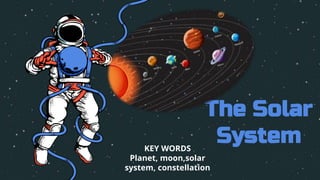
The Solar system
1. The Earth is not the only PLANET to orbit the Sun.
2. There are other planets and there are also MOONS.
3. Which orbit around the planets. The Sun, the planets and their moons are all
part of the SOLAR SYSTEM
4. THE SOLAR SYSTEM is made up of 8 planets, with the Sun at the centre.
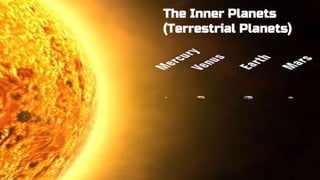
5. There are 4 inner planets, which are the planets closest to the Sun. There are
Mercury, Venus, Earth and Mars.
6. The 4 outer planets, which are furthest from the Sun , are Jupiter, Saturn,
Uranus, and Neptune.
Constellation of star
were indentified by
ancient civilisations
And the seasons were measured and
predicted by farmers who observed the
changing night skies. They knew that certain
constellation or stars could only be seen at
particular times of the year.
Can you name the 8 planets in our
Solar System? This includes Earth…
Mercury, Venus, Earth, Mars, Jupiter,
Saturn, Uranus, Neptune
Do you know any ways to remember all 8?
My Very Excellent Mother Just Sold Us Nuggets!
Galaxies
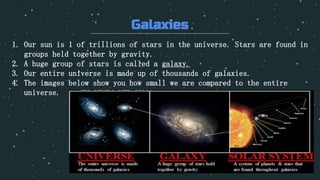
1. Our sun is 1 of trillions of stars in the universe. Stars are found in
groups held together by gravity.
2. A huge group of stars is called a galaxy.
3. Our entire universe is made up of thousands of galaxies.
4. The images below show you how small we are compared to the entire
universe.
The Milky Way
● Our Solar System is part of the “Milky Way” galaxy.
The Inner Planets
(Terrestrial Planets)
Spinning Planets
● Period of Rotation: amount of time that an object takes to
rotate once. (1 Day)
● Period of Revolution: time it takes an object to revolve
around the sun once. (1 year)
Mercury
● On Mercury you weigh only 38% of what
you weigh on Earth.
● Fastest orbiting planet
● Planet nearest to the sun
● One side of the planet can be 800 degrees
Fahrenheit when the other can be -280
degree Fahrenheit at the same time.
Venus
● On Venus you weigh only 91% of what you weigh on
Earth.
● Venus has 90 times the pressure of Earth
● Venus has volcanoes like Earth
● Rotates in the opposite direction of Earth.
● One time there were oceans before they boiled away.
Earth
● 23 hours and 56 min=1 Earth day (rotation)
● 365 days =1 Earth year (revolution)
● Earth is warm enough to keep most of its water from
freezing and cold enough to keep it’s water from boiling
● Temperature is between –13 degrees Celsius and 37
degrees Celsius
Mars
● Air Pressure on Mars is the same as 30 km above the
Earth’s surface
● Mars is in the form of ice.
● Evidence that water was there at one time
● Volcanic history like Earth.
● It has the tallest mount of the planets (Olympus Mons)
3x’s size of Mt. Everest.
Outer Planets
(Gas Planets or Jovial
Planets)
Jupiter
● Largest planet in the Solar System
● Has a Great Red Spot from a storm system that is more
than 400 years old (It is larger than Earth!)
● 9 hours and 54 min=1 Jupiter day (shortest day)
● Pressure is so great it would crush a spaceship.
Saturn
● 2nd Largest planet in the Solar System
● 95 times more massive than earth.
● Saturn has the largest rings of any
planet, the rings are made of icy
particles.
● Most moons of any planet.
Uranus
● Discovered in 1781
● Uranus appears blue-green in color
● It’s axis of rotation is tilted 90 degrees
● Moons are named after Shakespearean plays
and formed from other broken moons.
Neptune
● Discovered in 1846
● Neptune has visual belts of clouds
● Interior releases thermal energy to its outer layers.
● Use to be the 8th planet after Pluto until 1999.
COMETS
ASTEROIDS
METEOROIDS
Other Space Objects
What is a comet?
• A comet is a small body made
out of dust, rock, gas & ice.
• They are kind of like a dirty
snowball
• Comets come from faraway
regions of our solar system
beyond the planets
Comets are made up of different parts.
Comet Brain Pop
http://www.brainpop.com/science/space/comets/
 The nucleus
 The coma
 The ion tail
 The dust tail
What is an asteroid?
• Asteroids are large
pieces of space rock
with irregular shapes.
• They are also known as
planetoids or minor
planets that revolves
around our sun
• Most asteroids orbit the Sun in the asteroid belt
located between Mars and Jupiter. A few asteroids
approach the Sun more closely.
• Asteroids can collide with object such as Earth’s moon,
creating huge craters on the surface.
• Meteoroids are pieces of rock
or dust that are smaller than
asteroids.
• Meteoroids are tiny particles
left by an asteroid or a comet
& most meteoroids are
smaller than the size of a
pebble.
METEOROIDS
METEORS &
METEORITES
• When small meteoroids enters Earth’s atmosphere,
they usually burn up & make a fiery trail as it falls,
it is then called a meteor or a “shooting star”
• Meteors that land on Earth are called meteorites.

The solar system

  • 1.
    The Solar System KEY WORDS Planet,moon,solar system, constellation
  • 3.
    The Solar system 1.The Earth is not the only PLANET to orbit the Sun. 2. There are other planets and there are also MOONS. 3. Which orbit around the planets. The Sun, the planets and their moons are all part of the SOLAR SYSTEM 4. THE SOLAR SYSTEM is made up of 8 planets, with the Sun at the centre. 5. There are 4 inner planets, which are the planets closest to the Sun. There are Mercury, Venus, Earth and Mars. 6. The 4 outer planets, which are furthest from the Sun , are Jupiter, Saturn, Uranus, and Neptune.
  • 4.
    Constellation of star wereindentified by ancient civilisations And the seasons were measured and predicted by farmers who observed the changing night skies. They knew that certain constellation or stars could only be seen at particular times of the year.
  • 5.
    Can you namethe 8 planets in our Solar System? This includes Earth… Mercury, Venus, Earth, Mars, Jupiter, Saturn, Uranus, Neptune Do you know any ways to remember all 8? My Very Excellent Mother Just Sold Us Nuggets!
  • 6.
    Galaxies 1. Our sunis 1 of trillions of stars in the universe. Stars are found in groups held together by gravity. 2. A huge group of stars is called a galaxy. 3. Our entire universe is made up of thousands of galaxies. 4. The images below show you how small we are compared to the entire universe.
  • 7.
    The Milky Way ●Our Solar System is part of the “Milky Way” galaxy.
  • 8.
  • 9.
    Spinning Planets ● Periodof Rotation: amount of time that an object takes to rotate once. (1 Day) ● Period of Revolution: time it takes an object to revolve around the sun once. (1 year)
  • 10.
    Mercury ● On Mercuryyou weigh only 38% of what you weigh on Earth. ● Fastest orbiting planet ● Planet nearest to the sun ● One side of the planet can be 800 degrees Fahrenheit when the other can be -280 degree Fahrenheit at the same time.
  • 11.
    Venus ● On Venusyou weigh only 91% of what you weigh on Earth. ● Venus has 90 times the pressure of Earth ● Venus has volcanoes like Earth ● Rotates in the opposite direction of Earth. ● One time there were oceans before they boiled away.
  • 12.
    Earth ● 23 hoursand 56 min=1 Earth day (rotation) ● 365 days =1 Earth year (revolution) ● Earth is warm enough to keep most of its water from freezing and cold enough to keep it’s water from boiling ● Temperature is between –13 degrees Celsius and 37 degrees Celsius
  • 13.
    Mars ● Air Pressureon Mars is the same as 30 km above the Earth’s surface ● Mars is in the form of ice. ● Evidence that water was there at one time ● Volcanic history like Earth. ● It has the tallest mount of the planets (Olympus Mons) 3x’s size of Mt. Everest.
  • 14.
    Outer Planets (Gas Planetsor Jovial Planets)
  • 15.
    Jupiter ● Largest planetin the Solar System ● Has a Great Red Spot from a storm system that is more than 400 years old (It is larger than Earth!) ● 9 hours and 54 min=1 Jupiter day (shortest day) ● Pressure is so great it would crush a spaceship.
  • 16.
    Saturn ● 2nd Largestplanet in the Solar System ● 95 times more massive than earth. ● Saturn has the largest rings of any planet, the rings are made of icy particles. ● Most moons of any planet.
  • 17.
    Uranus ● Discovered in1781 ● Uranus appears blue-green in color ● It’s axis of rotation is tilted 90 degrees ● Moons are named after Shakespearean plays and formed from other broken moons.
  • 18.
    Neptune ● Discovered in1846 ● Neptune has visual belts of clouds ● Interior releases thermal energy to its outer layers. ● Use to be the 8th planet after Pluto until 1999.
  • 19.
  • 20.
    What is acomet? • A comet is a small body made out of dust, rock, gas & ice. • They are kind of like a dirty snowball • Comets come from faraway regions of our solar system beyond the planets
  • 21.
    Comets are madeup of different parts. Comet Brain Pop http://www.brainpop.com/science/space/comets/  The nucleus  The coma  The ion tail  The dust tail
  • 22.
    What is anasteroid? • Asteroids are large pieces of space rock with irregular shapes. • They are also known as planetoids or minor planets that revolves around our sun
  • 23.
    • Most asteroidsorbit the Sun in the asteroid belt located between Mars and Jupiter. A few asteroids approach the Sun more closely. • Asteroids can collide with object such as Earth’s moon, creating huge craters on the surface.
  • 24.
    • Meteoroids arepieces of rock or dust that are smaller than asteroids. • Meteoroids are tiny particles left by an asteroid or a comet & most meteoroids are smaller than the size of a pebble. METEOROIDS METEORS & METEORITES
  • 25.
    • When smallmeteoroids enters Earth’s atmosphere, they usually burn up & make a fiery trail as it falls, it is then called a meteor or a “shooting star” • Meteors that land on Earth are called meteorites.