Pamela Sanhueza C.
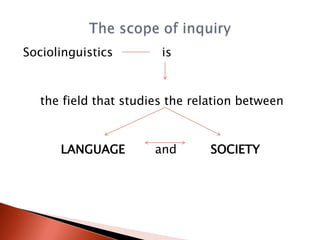
Sociolinguistics        is


   the field that studies the relation between


      LANGUAGE         and       SOCIETY
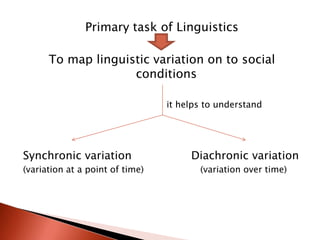
Primary task of Linguistics

      To map linguistic variation on to social
                    conditions

                                 it helps to understand


Synchronic variation                  Diachronic variation
(variation at a point of time)          (variation over time)
Scholars           What they pursue…
Formal Linguist    An autonomous system or
                   significant elements that explain
                   the design and structure of the
                   human brain.
Psycholinguist     How the system works and how it
                   can be learned or lost.
Sociolinguist      How the system is used in a living
                   and complex speech community.
Applied Linguist   How to help people learn language
                   and how to use it effectively to
                   deal with problems of practical
                   daily life.
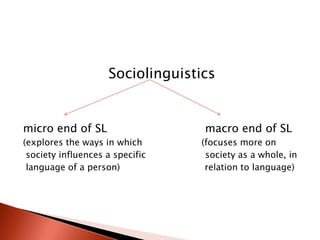
Sociolinguistics


micro end of SL                   macro end of SL
(explores the ways in which      (focuses more on
 society influences a specific    society as a whole, in
 language of a person)            relation to language)
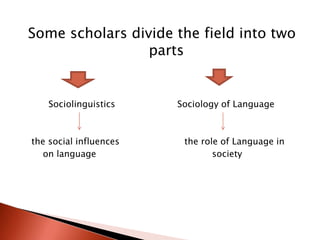
Some scholars divide the field into two
                 parts


    Sociolinguistics    Sociology of Language


the social influences    the role of Language in
   on language                  society
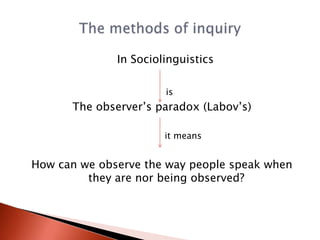
In Sociolinguistics

                       is
      The observer’s paradox (Labov’s)

                       it means


How can we observe the way people speak when
         they are nor being observed?
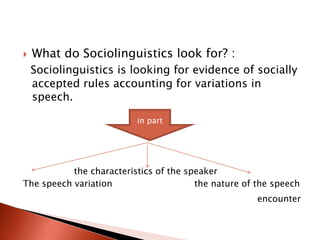
   What do Sociolinguistics look for? :
    Sociolinguistics is looking for evidence of socially
    accepted rules accounting for variations in
    speech.

                          in part


           the characteristics of the speaker
The speech variation                    the nature of the speech
                                                      encounter
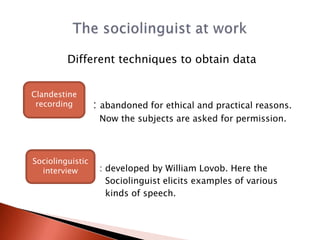
Different techniques to obtain data


Clandestine
 recording        : abandoned for ethical and practical reasons.
                   Now the subjects are asked for permission.


Sociolinguistic
  interview        : developed by William Lovob. Here the
                     Sociolinguist elicits examples of various
                     kinds of speech.
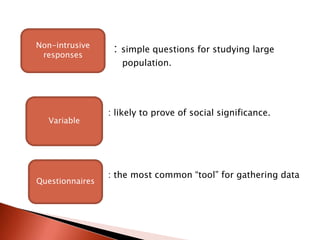
Non-intrusive
 responses
                  :   simple questions for studying large
                      population.


                 : likely to prove of social significance.
   Variable


                 : the most common “tool” for gathering data
Questionnaires

The social study of language

  • 1.
  • 2.
    Sociolinguistics is the field that studies the relation between LANGUAGE and SOCIETY
  • 3.
    Primary task ofLinguistics To map linguistic variation on to social conditions it helps to understand Synchronic variation Diachronic variation (variation at a point of time) (variation over time)
  • 4.
    Scholars What they pursue… Formal Linguist An autonomous system or significant elements that explain the design and structure of the human brain. Psycholinguist How the system works and how it can be learned or lost. Sociolinguist How the system is used in a living and complex speech community. Applied Linguist How to help people learn language and how to use it effectively to deal with problems of practical daily life.
  • 5.
    Sociolinguistics micro end ofSL macro end of SL (explores the ways in which (focuses more on society influences a specific society as a whole, in language of a person) relation to language)
  • 6.
    Some scholars dividethe field into two parts Sociolinguistics Sociology of Language the social influences the role of Language in on language society
  • 7.
    In Sociolinguistics is The observer’s paradox (Labov’s) it means How can we observe the way people speak when they are nor being observed?
  • 8.
    What do Sociolinguistics look for? : Sociolinguistics is looking for evidence of socially accepted rules accounting for variations in speech. in part the characteristics of the speaker The speech variation the nature of the speech encounter
  • 9.
    Different techniques toobtain data Clandestine recording : abandoned for ethical and practical reasons. Now the subjects are asked for permission. Sociolinguistic interview : developed by William Lovob. Here the Sociolinguist elicits examples of various kinds of speech.
  • 10.
    Non-intrusive responses : simple questions for studying large population. : likely to prove of social significance. Variable : the most common “tool” for gathering data Questionnaires