Language, Dialect and Accent
Dr. K. Lakehal-Ayat
Mentouri University Constantine
2011
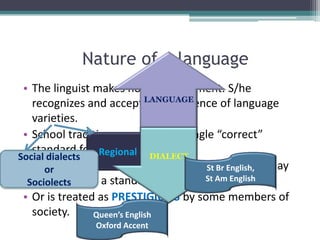
Nature of a language
 • The linguist makes no value judgment. S/he
                             LANGUAGE
   recognizes and accepts the existence of language
   varieties.
 • School traditions emphasize a single “correct”
   standard form.Regional dialects
                               DIALECT
Social dialects
 • Linguistics acknowledges that a certainEnglish, may
      or                               St Br dialect
   be treated as a standard form
  Sociolects                           St Am English

 • Or is treated as PRESTIGIOUS by some members of
   society.     Queen’s English
               Oxford Accent
• Linguists in recent decades have become more
  interested in the language of the people who (by a
  rigid conception of a St. Language) do not talk
  “properly”: language of small children and
  foreigners.
• The language of children has therefore a linguistic
  interest quite apart from its psychological interest as
  the development of speech in infancy.
• The mixed languages of former colonies (Jamaican
  Creole or Haitian Creole) have been studied with the
  same interest as can be studied Fr or Eng.
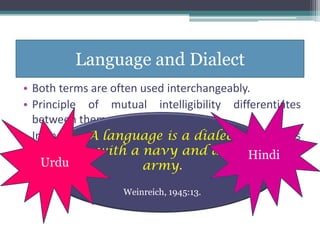
Language and Dialect
• Both terms are often used interchangeably.
• Principle of mutual intelligibility differentiates
  between them.
• In most cases,Any 2 varieties one dialect
            A language is a or another depends
                 the use of which are
  NOT on linguistic bases, but rather an socio-political
            mutually a navy are taken to Hindi
              withthey are mutually on
                  If
                      intelligible and
    Urdu
  factors.               army.
              UNintelligible , then they are
              constitute two dialects of the
                  separate languages.
                    Weinreich, 1945:13.
                     same language.
Solely because they are not (or not
recognized as) literary languages
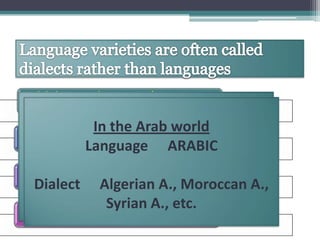
      Dialect the Arab worldterm
                     Subordinate
               In of the given
Because the speakers
             Language ARABIC
language do not have a state of their own

Because they are not used in press or
    Language Super ordinate term
literature, or veryAlgerian A., Moroccan A.,
   Dialect little,
                  Syrian A., etc.
Or because their language lacks prestige.
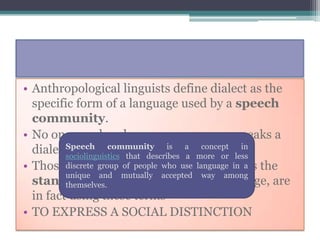
• Anthropological linguists define dialect as the
  specific form of a language used by a speech
  community.
• No one speaks a language ; everyone speaks a
  dialect of a language describes a more or less
         Speech      community
         sociolinguistics that
                               is
                                   a
                                        concept  in

• Those discrete identify a particular dailect a the
          who group of people who use language in as
         unique and mutually accepted way among
  standard or proper version of a language, are
         themselves.
  in fact using these terms
• TO EXPRESS A SOCIAL DISTINCTION
Dialect is also the term used to
  describe differences in speech that
  are associated with different regions
  or different social groups or classes.


• As we move around a speech community, we find
  variation in the speech of its members that is
  associated with their place of living or their social
  grouping.
Accent
• Differences in pronunciation between varieties
• Oxford accent: certain phonological
  characteristics particular to English spoken in
  that town.
• Term is used also to refer to some foreign non
  native features in the speech of a person
  (foreigner)
• You speak English with an accent
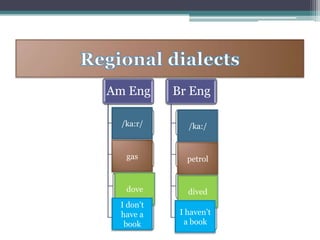
Am Eng           Br Eng

   /ka:r/
 Pronunciation   Pronunciation
                    /ka:/


    Lexis            Lexis
    gas             petrol


 Morphology       Morphology
    dove            dived
  I don’t
  have a          I haven’t
    Syntax           Syntax
   book            a book
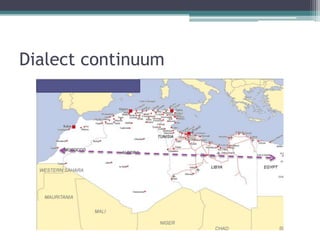
Dialect continuum
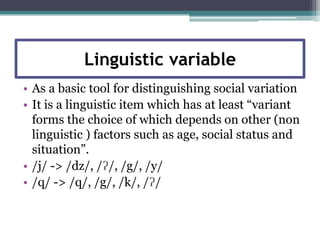
Linguistic variable
• As a basic tool for distinguishing social variation
• It is a linguistic item which has at least “variant
  forms the choice of which depends on other (non
  linguistic ) factors such as age, social status and
  situation”.
• /j/ -> /dz/, /ʔ/, /g/, /y/
• /q/ -> /q/, /g/, /k/, /ʔ/

Language, dialect and accent

  • 1.
    Language, Dialect andAccent Dr. K. Lakehal-Ayat Mentouri University Constantine 2011
  • 2.
    Nature of alanguage • The linguist makes no value judgment. S/he LANGUAGE recognizes and accepts the existence of language varieties. • School traditions emphasize a single “correct” standard form.Regional dialects DIALECT Social dialects • Linguistics acknowledges that a certainEnglish, may or St Br dialect be treated as a standard form Sociolects St Am English • Or is treated as PRESTIGIOUS by some members of society. Queen’s English Oxford Accent
  • 3.
    • Linguists inrecent decades have become more interested in the language of the people who (by a rigid conception of a St. Language) do not talk “properly”: language of small children and foreigners. • The language of children has therefore a linguistic interest quite apart from its psychological interest as the development of speech in infancy. • The mixed languages of former colonies (Jamaican Creole or Haitian Creole) have been studied with the same interest as can be studied Fr or Eng.
  • 4.
    Language and Dialect •Both terms are often used interchangeably. • Principle of mutual intelligibility differentiates between them. • In most cases,Any 2 varieties one dialect A language is a or another depends the use of which are NOT on linguistic bases, but rather an socio-political mutually a navy are taken to Hindi withthey are mutually on If intelligible and Urdu factors. army. UNintelligible , then they are constitute two dialects of the separate languages. Weinreich, 1945:13. same language.
  • 5.
    Solely because theyare not (or not recognized as) literary languages Dialect the Arab worldterm Subordinate In of the given Because the speakers Language ARABIC language do not have a state of their own Because they are not used in press or Language Super ordinate term literature, or veryAlgerian A., Moroccan A., Dialect little, Syrian A., etc. Or because their language lacks prestige.
  • 6.
    • Anthropological linguistsdefine dialect as the specific form of a language used by a speech community. • No one speaks a language ; everyone speaks a dialect of a language describes a more or less Speech community sociolinguistics that is a concept in • Those discrete identify a particular dailect a the who group of people who use language in as unique and mutually accepted way among standard or proper version of a language, are themselves. in fact using these terms • TO EXPRESS A SOCIAL DISTINCTION
  • 7.
    Dialect is alsothe term used to describe differences in speech that are associated with different regions or different social groups or classes. • As we move around a speech community, we find variation in the speech of its members that is associated with their place of living or their social grouping.
  • 8.
    Accent • Differences inpronunciation between varieties • Oxford accent: certain phonological characteristics particular to English spoken in that town. • Term is used also to refer to some foreign non native features in the speech of a person (foreigner) • You speak English with an accent
  • 9.
    Am Eng Br Eng /ka:r/ Pronunciation Pronunciation /ka:/ Lexis Lexis gas petrol Morphology Morphology dove dived I don’t have a I haven’t Syntax Syntax book a book
  • 10.
  • 11.
    Linguistic variable • Asa basic tool for distinguishing social variation • It is a linguistic item which has at least “variant forms the choice of which depends on other (non linguistic ) factors such as age, social status and situation”. • /j/ -> /dz/, /ʔ/, /g/, /y/ • /q/ -> /q/, /g/, /k/, /ʔ/