Nonvascular
Plants
NonvascularPlants
What are Nonvascular Plants?
Nonvascular Plants (bryophytes) are plants
which do not have tissues to transport water
and food. They don’t have real roots, stems
and leaves.
How Dothey Survive?
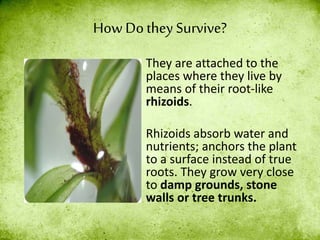
They are attached to the
places where they live by
means of their root-like
rhizoids.
Rhizoids absorb water and
nutrients; anchors the plant
to a surface instead of true
roots. They grow very close
to damp grounds, stone
walls or tree trunks.
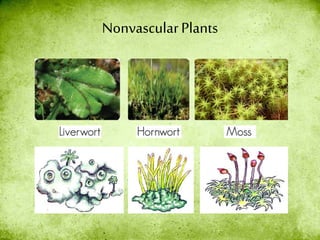
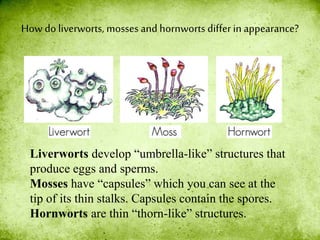
How do liverworts, mosses and hornworts differ in appearance?
Liverworts develop “umbrella-like” structures that
produce eggs and sperms.
Mosses have “capsules” which you can see at the
tip of its thin stalks. Capsules contain the spores.
Hornworts are thin “thorn-like” structures.
Importance of Nonvascular Plants
• They provide oxygen to many
organisms.
• Their “carpetlike” growth covering
large areas in hilly grounds prevent
erosion and increase the capacity of
soil to hold water.
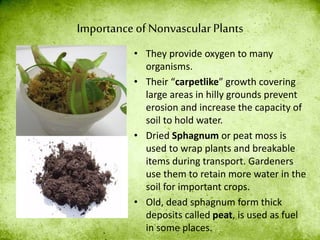
• Dried Sphagnum or peat moss is
used to wrap plants and breakable
items during transport. Gardeners
use them to retain more water in the
soil for important crops.
• Old, dead sphagnum form thick
deposits called peat, is used as fuel
in some places.
Why do you thinknonvascularplantscannotgrow very
large or tall?
Without a vascular system, mosses, and
liverworts cannot grow very large. If you have
seen mosses, you know that they are
actually carpets of individual plants. They are
rarely taller than one inch high. Another
important characteristic of these little guys is that
they require water to reproduce. It's another
characteristic of their low place in plant
evolution. While all plants need water, mosses
and bryophytes need droplets of water to enable
their haploid reproductive cells to combine.
PresentedBy:
• Aprille Joyce Castro
• Wednesday Guillermo
• Marjorie Platin

Non-Vascular Plants

  • 1.
  • 2.
  • 3.
    What are NonvascularPlants? Nonvascular Plants (bryophytes) are plants which do not have tissues to transport water and food. They don’t have real roots, stems and leaves.
  • 4.
    How Dothey Survive? Theyare attached to the places where they live by means of their root-like rhizoids. Rhizoids absorb water and nutrients; anchors the plant to a surface instead of true roots. They grow very close to damp grounds, stone walls or tree trunks.
  • 5.
    How do liverworts,mosses and hornworts differ in appearance? Liverworts develop “umbrella-like” structures that produce eggs and sperms. Mosses have “capsules” which you can see at the tip of its thin stalks. Capsules contain the spores. Hornworts are thin “thorn-like” structures.
  • 6.
    Importance of NonvascularPlants • They provide oxygen to many organisms. • Their “carpetlike” growth covering large areas in hilly grounds prevent erosion and increase the capacity of soil to hold water. • Dried Sphagnum or peat moss is used to wrap plants and breakable items during transport. Gardeners use them to retain more water in the soil for important crops. • Old, dead sphagnum form thick deposits called peat, is used as fuel in some places.
  • 7.
    Why do youthinknonvascularplantscannotgrow very large or tall? Without a vascular system, mosses, and liverworts cannot grow very large. If you have seen mosses, you know that they are actually carpets of individual plants. They are rarely taller than one inch high. Another important characteristic of these little guys is that they require water to reproduce. It's another characteristic of their low place in plant evolution. While all plants need water, mosses and bryophytes need droplets of water to enable their haploid reproductive cells to combine.
  • 8.
    PresentedBy: • Aprille JoyceCastro • Wednesday Guillermo • Marjorie Platin