Kyle Guzik
Honors Engineering Biology
Monday October 10, 2011
LessonTopic: ____ Cellular Reproduction/Genetics ____ Grade level:___9-10___
Length of lesson: ___53 Minutes________
Stage 1 – Desired Results
Content Standard(s):
SI GLEs: will be practiced throughout the year
LS GLEs:
7. Identify the basic structure and function of nucleic acids (e.g., DNA, RNA) (LS-H-
B1)
8. Describe the relationship among DNA, genes, chromosomes, and proteins. (LS-
H-B1)
9. Compare mitosis and meiosis (LS-H-B2)
10. Analyze pedigrees to identify patterns of inheritance for common genetic
disorders (LS-H-B3)
11. Calculate the probability of genotypes and phenotypes of offspring given the
parental genotypes. (LS-H-B3)
12. Describe the processes used in modern biotechnology related to genetic
engineering. (LS-H-B4)(LS-H-B1)
13. Identify possible positive and negative effects of advances in biotechnology. (LS-
H-B4)(LS-H-B1)
Understanding (s)/goals
Students will understand:
1) The Central Dogma of Molecular
Biology
2) How to set up a Punnet Square
3) Mendelian Inheritance Rules
4) Genetic Engineering Methods
5) Intro to Gel Electrophoresis
6) Interpretation of Electrophoresis Data
7) Dominant and Recessive Traits
Essential Question(s):
1. Can students differentiate between the structure
of DNA and RNA?
2. Can students identify and apply the base-pairing
rule?
3. Can students identify the purposes of meiosis
and mitosis and w here and when each takes
place?
4. Can students differentiate between haploid and
diploid (2n)?
5. Can students differentiate between the terms
dominant and recessive?
6. Can students apply dominant and recessive
traits to predict probability?
7. Can students interpret a pedigree chart?
8. Can students identify potential
benefits/consequencesof genetically engineered
products? (ex: crops as related to nitrogen
fixation, bacteria producing human proteins)
9. Can students identify the role of plasmids in
genetic engineering?
10. Can students identify what information can be
obtained fromgel electrophoresis?
Student objectives (outcomes):
Students will be able to:
1) Explain the Central Dogma of Molecular Biology
2) Identify Key Vocabulary Terms
Stage 2 – Assessment Evidence
Performance Task(s):
allele, cell division, cell cycle, chromatin,
clone, codominance, diploid, haploid,
heterozygous, homozygous, homologous,
hybrid, incomplete dominance, gamete,
gel electrophoresis, gene, genetic
engineering, meiosis, messenger RNA,
mitosis, mutation, nitrogen bases,
nucleotide, pedigree, phenotype,
plasmid, probability, recombinant DNA,
replication, ribosomal RNA, selective
breeding, sex chromosome, sex-linked
gene, trait, transfer RNA, transcription,
transformation, translation,
1) Warm Up
2) Vocabulary Acquisition Assignment
3) Return Graded Quizzes
4) Quiz Review
Other Evidence:
1. Homework
Stage 3 – Learning Plan
Learning Activities:
1) Warm Up
2) Vocabulary Acquisition Assignment
3) Return Graded Quizzes
4) Quiz Review
Tuesday
LessonTopic: ____ Cellular Reproduction/Genetics ____ Grade level:___9-10___
Length of lesson: ___53 Minutes________
Stage 1 – Desired Results
Content Standard(s):
SI GLEs: will be practiced throughout the year
LS GLEs:
14. Identify the basic structure and function of nucleic acids (e.g., DNA, RNA) (LS-H-
B1)
15. Describe the relationship among DNA, genes, chromosomes, and proteins. (LS-
H-B1)
16. Compare mitosis and meiosis (LS-H-B2)
17. Analyze pedigrees to identify patterns of inheritance for common genetic
disorders (LS-H-B3)
18. Calculate the probability of genotypes and phenotypes of offspring given the
parental genotypes. (LS-H-B3)
19. Describe the processes used in modern biotechnology related to genetic
engineering. (LS-H-B4)(LS-H-B1)
20. Identify possible positive and negative effects of advances in biotechnology. (LS-
H-B4)(LS-H-B1)
Understanding (s)/goals
Students will understand:
1) The Central Dogma of Molecular
Biology
2) How to set up a Punnet Square
3) Mendelian Inheritance Rules
Essential Question(s):
11. Can students differentiate between the structure
of DNA and RNA?
12. Can students identify and apply the base-pairing
rule?
13. Can students identify the purposes of meiosis
and mitosis and w here and when each takes
place?
14. Can students differentiate between haploid and
diploid (2n)?
15. Can students differentiate between the terms
dominant and recessive?
16. Can students apply dominant and recessive
traits to predict probability?
Student objectives (outcomes):
Students will be able to:
1. Set Up a Punnet Square Cross
2. Explain the Central Dogma of Molecular Biology
Stage 2 – Assessment Evidence
Performance Task(s):
1. Warm Up
2. Continue Vocabulary
3. Collect Quiz Review
4. Molecular Biology Video
5. Science Fair Progress Check
Other Evidence:
1. Homework
Stage 3 – Learning Plan
Learning Activities:
1. Warm Up
2. Continue Vocabulary
3. Collect Quiz Review
4. Molecular Biology Video
Wednesday
LessonTopic: ____ Cellular Reproduction/Genetics ____ Grade level:___9-10___
Length of lesson: ___53 Minutes________
Stage 1 – Desired Results
Content Standard(s):
SI GLEs: will be practiced throughout the year
LS GLEs:
21. Identify the basic structure and function of nucleic acids (e.g., DNA, RNA) (LS-H-
B1)
22. Describe the relationship among DNA, genes, chromosomes, and proteins. (LS-
H-B1)
23. Compare mitosis and meiosis (LS-H-B2)
24. Analyze pedigrees to identify patterns of inheritance for common genetic
disorders (LS-H-B3)
25. Calculate the probability of genotypes and phenotypes of offspring given the
parental genotypes. (LS-H-B3)
26. Describe the processes used in modern biotechnology related to genetic
engineering. (LS-H-B4)(LS-H-B1)
27. Identify possible positive and negative effects of advances in biotechnology. (LS-
H-B4)(LS-H-B1)
Understanding (s)/goals
Students will understand:
2) How to set up a Punnet Square
3) Mendelian Inheritance Rules
4) Genetic Engineering Methods
Essential Question(s):
17. Can students identify the purposes of meiosis
and mitosis and w here and when each takes
place?
18. Can students differentiate between haploid and
diploid (2n)?
19. Can students differentiate between the terms
dominant and recessive?
20. Can students apply dominant and recessive
traits to predict probability?
21. Can students identify the role of plasmids in
genetic engineering?
Student objectives (outcomes):
Students will be able to:
1. Report on the Progress of their Science Fair Project
2. Perform a Punnet Cross Accurately
3. Diagram Mitosis and Meiosis
Stage 2 – Assessment Evidence
Performance Task(s):
1. Warm Up
2. Science Fair Progress Check
3. Genetic Engineering Video
4. Practice Punnet Square
5. Memorizing Mitosis and Meiosis
Other Evidence:
1. Homework
Stage 3 – Learning Plan
Learning Activities:
1. Warm Up
2. Science Fair Progress Check
3. Genetic Engineering Video
4. Practice Punnet Square
5. Memorizing Mitosis and Meiosis
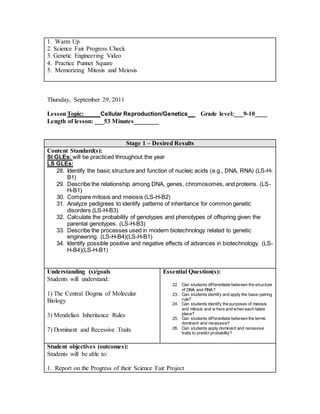
Thursday, September 29, 2011
LessonTopic: ____ Cellular Reproduction/Genetics __ Grade level:___9-10____
Length of lesson: ___53 Minutes________
Stage 1 – Desired Results
Content Standard(s):
SI GLEs: will be practiced throughout the year
LS GLEs:
28. Identify the basic structure and function of nucleic acids (e.g., DNA, RNA) (LS-H-
B1)
29. Describe the relationship among DNA, genes, chromosomes, and proteins. (LS-
H-B1)
30. Compare mitosis and meiosis (LS-H-B2)
31. Analyze pedigrees to identify patterns of inheritance for common genetic
disorders (LS-H-B3)
32. Calculate the probability of genotypes and phenotypes of offspring given the
parental genotypes. (LS-H-B3)
33. Describe the processes used in modern biotechnology related to genetic
engineering. (LS-H-B4)(LS-H-B1)
34. Identify possible positive and negative effects of advances in biotechnology. (LS-
H-B4)(LS-H-B1)
Understanding (s)/goals
Students will understand:
1) The Central Dogma of Molecular
Biology
3) Mendelian Inheritance Rules
7) Dominant and Recessive Traits
Essential Question(s):
22. Can students differentiate between the structure
of DNA and RNA?
23. Can students identify and apply the base-pairing
rule?
24. Can students identify the purposes of meiosis
and mitosis and w here and when each takes
place?
25. Can students differentiate between the terms
dominant and recessive?
26. Can students apply dominant and recessive
traits to predict probability?
Student objectives (outcomes):
Students will be able to:
1. Report on the Progress of their Science Fair Project
2. Perform a Punnet Cross Accurately
3. Diagram Mitosis and Meiosis
Stage 2 – Assessment Evidence
Performance Task(s):
1. Warm Up
2. Turn In Vocabulary
3. Quiz
4. Science Fair Progress Report Assigned
Other Evidence:
1. Homework- Science Fair Progress
Stage 3 – Learning Plan
Learning Activities:
1. Warm Up
2. Turn In Vocabulary
3. Quiz
4. Science Fair Progress Report Assigned
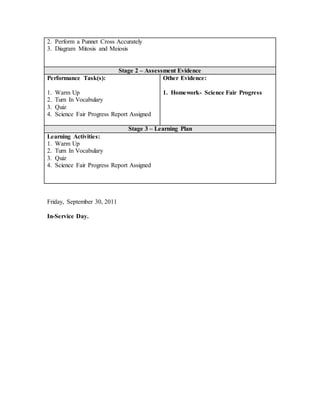
Friday, September 30, 2011
In-Service Day.
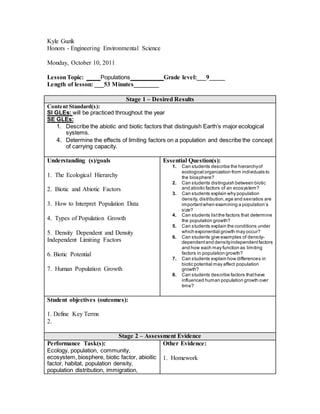
Kyle Guzik
Honors - Engineering Environmental Science
Monday, October 10, 2011
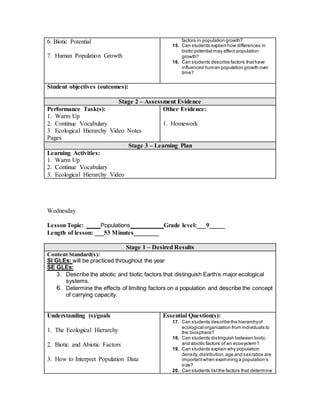
LessonTopic: ____ Populations ________ Grade level:___9_____
Length of lesson: ___53 Minutes________
Stage 1 – Desired Results
Content Standard(s):
SI GLEs: will be practiced throughout the year
SE GLEs:
1. Describe the abiotic and biotic factors that distinguish Earth’s major ecological
systems.
4. Determine the effects of limiting factors on a population and describe the concept
of carrying capacity.
Understanding (s)/goals
1. The Ecological Hierarchy
2. Biotic and Abiotic Factors
3. How to Interpret Population Data
4. Types of Population Growth
5. Density Dependent and Density
Independent Limiting Factors
6. Biotic Potential
7. Human Population Growth
Essential Question(s):
1. Can students describe the hierarchyof
ecological organization from individuals to
the biosphere?
2. Can students distinguish between biotic
and abiotic factors of an ecosystem?
3. Can students explain why population
density, distribution,age and sexratios are
importantwhen examining a population’s
size?
4. Can students listthe factors that determine
the population growth?
5. Can students explain the conditions under
which exponential growth may occur?
6. Can students give examples of density-
dependentand densityindependentfactors
and how each may function as limiting
factors in population growth?
7. Can students explain how differences in
biotic potential may affect population
growth?
8. Can students describe factors thathave
influenced human population growth over
time?
Student objectives (outcomes):
1. Define Key Terms
2.
Stage 2 – Assessment Evidence
Performance Task(s):
Ecology, population, community,
ecosystem, biosphere, biotic factor, abioitic
factor, habitat, population density,
population distribution, immigration,
Other Evidence:
1. Homework
emigration, exponential growth, limiting
factor, carrying capacity, density
dependent factor, density-independent
factor, biotic potential
1) Warm Up
2) Vocabulary Acquisition Assignment
3) Return Graded Quizzes
4) Quiz Review
Stage 3 – Learning Plan
Learning Activities:
1) Warm Up
2) Vocabulary Acquisition Assignment
3) Return Graded Quizes
4) Quiz Review
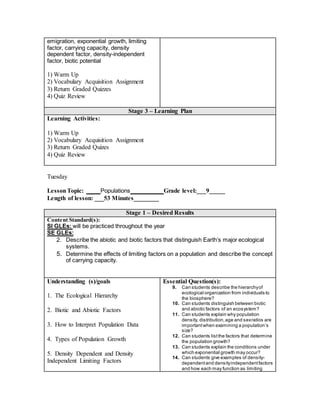
Tuesday
LessonTopic: ____ Populations ________ Grade level:___9_____
Length of lesson: ___53 Minutes________
Stage 1 – Desired Results
Content Standard(s):
SI GLEs: will be practiced throughout the year
SE GLEs:
2. Describe the abiotic and biotic factors that distinguish Earth’s major ecological
systems.
5. Determine the effects of limiting factors on a population and describe the concept
of carrying capacity.
Understanding (s)/goals
1. The Ecological Hierarchy
2. Biotic and Abiotic Factors
3. How to Interpret Population Data
4. Types of Population Growth
5. Density Dependent and Density
Independent Limiting Factors
Essential Question(s):
9. Can students describe the hierarchyof
ecological organization from individuals to
the biosphere?
10. Can students distinguish between biotic
and abiotic factors of an ecosystem?
11. Can students explain why population
density, distribution,age and sexratios are
importantwhen examining a population’s
size?
12. Can students listthe factors that determine
the population growth?
13. Can students explain the conditions under
which exponential growth may occur?
14. Can students give examples of density-
dependentand densityindependentfactors
and how each may function as limiting
6. Biotic Potential
7. Human Population Growth
factors in population growth?
15. Can students explain how differences in
biotic potential may affect population
growth?
16. Can students describe factors thathave
influenced human population growth over
time?
Student objectives (outcomes):
Stage 2 – Assessment Evidence
Performance Task(s):
1. Warm Up
2. Continue Vocabulary
3. Ecological Hierarchy Video Notes
Pages
Other Evidence:
1. Homework
Stage 3 – Learning Plan
Learning Activities:
1. Warm Up
2. Continue Vocabulary
3. Ecological Hierarchy Video
Wednesday
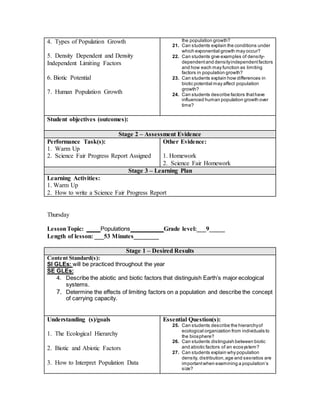
LessonTopic: ____ Populations ________ Grade level:___9_____
Length of lesson: ___53 Minutes________
Stage 1 – Desired Results
Content Standard(s):
SI GLEs: will be practiced throughout the year
SE GLEs:
3. Describe the abiotic and biotic factors that distinguish Earth’s major ecological
systems.
6. Determine the effects of limiting factors on a population and describe the concept
of carrying capacity.
Understanding (s)/goals
1. The Ecological Hierarchy
2. Biotic and Abiotic Factors
3. How to Interpret Population Data
Essential Question(s):
17. Can students describe the hierarchyof
ecological organization from individuals to
the biosphere?
18. Can students distinguish between biotic
and abiotic factors of an ecosystem?
19. Can students explain why population
density, distribution,age and sexratios are
importantwhen examining a population’s
size?
20. Can students listthe factors that determine
4. Types of Population Growth
5. Density Dependent and Density
Independent Limiting Factors
6. Biotic Potential
7. Human Population Growth
the population growth?
21. Can students explain the conditions under
which exponential growth may occur?
22. Can students give examples of density-
dependentand densityindependentfactors
and how each may function as limiting
factors in population growth?
23. Can students explain how differences in
biotic potential may affect population
growth?
24. Can students describe factors thathave
influenced human population growth over
time?
Student objectives (outcomes):
Stage 2 – Assessment Evidence
Performance Task(s):
1. Warm Up
2. Science Fair Progress Report Assigned
Other Evidence:
1. Homework
2. Science Fair Homework
Stage 3 – Learning Plan
Learning Activities:
1. Warm Up
2. How to write a Science Fair Progress Report
Thursday
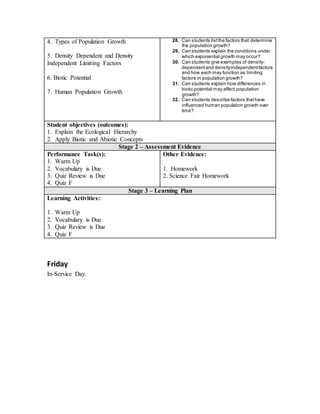
LessonTopic: ____ Populations ________ Grade level:___9_____
Length of lesson: ___53 Minutes________
Stage 1 – Desired Results
Content Standard(s):
SI GLEs: will be practiced throughout the year
SE GLEs:
4. Describe the abiotic and biotic factors that distinguish Earth’s major ecological
systems.
7. Determine the effects of limiting factors on a population and describe the concept
of carrying capacity.
Understanding (s)/goals
1. The Ecological Hierarchy
2. Biotic and Abiotic Factors
3. How to Interpret Population Data
Essential Question(s):
25. Can students describe the hierarchyof
ecological organization from individuals to
the biosphere?
26. Can students distinguish between biotic
and abiotic factors of an ecosystem?
27. Can students explain why population
density, distribution,age and sexratios are
importantwhen examining a population’s
size?
4. Types of Population Growth
5. Density Dependent and Density
Independent Limiting Factors
6. Biotic Potential
7. Human Population Growth
28. Can students listthe factors that determine
the population growth?
29. Can students explain the conditions under
which exponential growth may occur?
30. Can students give examples of density-
dependentand densityindependentfactors
and how each may function as limiting
factors in population growth?
31. Can students explain how differences in
biotic potential may affect population
growth?
32. Can students describe factors thathave
influenced human population growth over
time?
Student objectives (outcomes):
1. Explain the Ecological Hierarchy
2. Apply Biotic and Abiotic Concepts
Stage 2 – Assessment Evidence
Performance Task(s):
1. Warm Up
2. Vocabulary is Due
3. Quiz Review is Due
4. Quiz F
Other Evidence:
1. Homework
2. Science Fair Homework
Stage 3 – Learning Plan
Learning Activities:
1. Warm Up
2. Vocabulary is Due
3. Quiz Review is Due
4. Quiz F
Friday
In-Service Day.

kguzikLPOct10.DOC

  • 1.
    Kyle Guzik Honors EngineeringBiology Monday October 10, 2011 LessonTopic: ____ Cellular Reproduction/Genetics ____ Grade level:___9-10___ Length of lesson: ___53 Minutes________ Stage 1 – Desired Results Content Standard(s): SI GLEs: will be practiced throughout the year LS GLEs: 7. Identify the basic structure and function of nucleic acids (e.g., DNA, RNA) (LS-H- B1) 8. Describe the relationship among DNA, genes, chromosomes, and proteins. (LS- H-B1) 9. Compare mitosis and meiosis (LS-H-B2) 10. Analyze pedigrees to identify patterns of inheritance for common genetic disorders (LS-H-B3) 11. Calculate the probability of genotypes and phenotypes of offspring given the parental genotypes. (LS-H-B3) 12. Describe the processes used in modern biotechnology related to genetic engineering. (LS-H-B4)(LS-H-B1) 13. Identify possible positive and negative effects of advances in biotechnology. (LS- H-B4)(LS-H-B1) Understanding (s)/goals Students will understand: 1) The Central Dogma of Molecular Biology 2) How to set up a Punnet Square 3) Mendelian Inheritance Rules 4) Genetic Engineering Methods 5) Intro to Gel Electrophoresis 6) Interpretation of Electrophoresis Data 7) Dominant and Recessive Traits Essential Question(s): 1. Can students differentiate between the structure of DNA and RNA? 2. Can students identify and apply the base-pairing rule? 3. Can students identify the purposes of meiosis and mitosis and w here and when each takes place? 4. Can students differentiate between haploid and diploid (2n)? 5. Can students differentiate between the terms dominant and recessive? 6. Can students apply dominant and recessive traits to predict probability? 7. Can students interpret a pedigree chart? 8. Can students identify potential benefits/consequencesof genetically engineered products? (ex: crops as related to nitrogen fixation, bacteria producing human proteins) 9. Can students identify the role of plasmids in genetic engineering? 10. Can students identify what information can be obtained fromgel electrophoresis? Student objectives (outcomes): Students will be able to:
  • 2.
    1) Explain theCentral Dogma of Molecular Biology 2) Identify Key Vocabulary Terms Stage 2 – Assessment Evidence Performance Task(s): allele, cell division, cell cycle, chromatin, clone, codominance, diploid, haploid, heterozygous, homozygous, homologous, hybrid, incomplete dominance, gamete, gel electrophoresis, gene, genetic engineering, meiosis, messenger RNA, mitosis, mutation, nitrogen bases, nucleotide, pedigree, phenotype, plasmid, probability, recombinant DNA, replication, ribosomal RNA, selective breeding, sex chromosome, sex-linked gene, trait, transfer RNA, transcription, transformation, translation, 1) Warm Up 2) Vocabulary Acquisition Assignment 3) Return Graded Quizzes 4) Quiz Review Other Evidence: 1. Homework Stage 3 – Learning Plan Learning Activities: 1) Warm Up 2) Vocabulary Acquisition Assignment 3) Return Graded Quizzes 4) Quiz Review Tuesday LessonTopic: ____ Cellular Reproduction/Genetics ____ Grade level:___9-10___ Length of lesson: ___53 Minutes________ Stage 1 – Desired Results Content Standard(s): SI GLEs: will be practiced throughout the year LS GLEs: 14. Identify the basic structure and function of nucleic acids (e.g., DNA, RNA) (LS-H- B1) 15. Describe the relationship among DNA, genes, chromosomes, and proteins. (LS- H-B1) 16. Compare mitosis and meiosis (LS-H-B2) 17. Analyze pedigrees to identify patterns of inheritance for common genetic disorders (LS-H-B3)
  • 3.
    18. Calculate theprobability of genotypes and phenotypes of offspring given the parental genotypes. (LS-H-B3) 19. Describe the processes used in modern biotechnology related to genetic engineering. (LS-H-B4)(LS-H-B1) 20. Identify possible positive and negative effects of advances in biotechnology. (LS- H-B4)(LS-H-B1) Understanding (s)/goals Students will understand: 1) The Central Dogma of Molecular Biology 2) How to set up a Punnet Square 3) Mendelian Inheritance Rules Essential Question(s): 11. Can students differentiate between the structure of DNA and RNA? 12. Can students identify and apply the base-pairing rule? 13. Can students identify the purposes of meiosis and mitosis and w here and when each takes place? 14. Can students differentiate between haploid and diploid (2n)? 15. Can students differentiate between the terms dominant and recessive? 16. Can students apply dominant and recessive traits to predict probability? Student objectives (outcomes): Students will be able to: 1. Set Up a Punnet Square Cross 2. Explain the Central Dogma of Molecular Biology Stage 2 – Assessment Evidence Performance Task(s): 1. Warm Up 2. Continue Vocabulary 3. Collect Quiz Review 4. Molecular Biology Video 5. Science Fair Progress Check Other Evidence: 1. Homework Stage 3 – Learning Plan Learning Activities: 1. Warm Up 2. Continue Vocabulary 3. Collect Quiz Review 4. Molecular Biology Video Wednesday LessonTopic: ____ Cellular Reproduction/Genetics ____ Grade level:___9-10___ Length of lesson: ___53 Minutes________
  • 4.
    Stage 1 –Desired Results Content Standard(s): SI GLEs: will be practiced throughout the year LS GLEs: 21. Identify the basic structure and function of nucleic acids (e.g., DNA, RNA) (LS-H- B1) 22. Describe the relationship among DNA, genes, chromosomes, and proteins. (LS- H-B1) 23. Compare mitosis and meiosis (LS-H-B2) 24. Analyze pedigrees to identify patterns of inheritance for common genetic disorders (LS-H-B3) 25. Calculate the probability of genotypes and phenotypes of offspring given the parental genotypes. (LS-H-B3) 26. Describe the processes used in modern biotechnology related to genetic engineering. (LS-H-B4)(LS-H-B1) 27. Identify possible positive and negative effects of advances in biotechnology. (LS- H-B4)(LS-H-B1) Understanding (s)/goals Students will understand: 2) How to set up a Punnet Square 3) Mendelian Inheritance Rules 4) Genetic Engineering Methods Essential Question(s): 17. Can students identify the purposes of meiosis and mitosis and w here and when each takes place? 18. Can students differentiate between haploid and diploid (2n)? 19. Can students differentiate between the terms dominant and recessive? 20. Can students apply dominant and recessive traits to predict probability? 21. Can students identify the role of plasmids in genetic engineering? Student objectives (outcomes): Students will be able to: 1. Report on the Progress of their Science Fair Project 2. Perform a Punnet Cross Accurately 3. Diagram Mitosis and Meiosis Stage 2 – Assessment Evidence Performance Task(s): 1. Warm Up 2. Science Fair Progress Check 3. Genetic Engineering Video 4. Practice Punnet Square 5. Memorizing Mitosis and Meiosis Other Evidence: 1. Homework Stage 3 – Learning Plan Learning Activities:
  • 5.
    1. Warm Up 2.Science Fair Progress Check 3. Genetic Engineering Video 4. Practice Punnet Square 5. Memorizing Mitosis and Meiosis Thursday, September 29, 2011 LessonTopic: ____ Cellular Reproduction/Genetics __ Grade level:___9-10____ Length of lesson: ___53 Minutes________ Stage 1 – Desired Results Content Standard(s): SI GLEs: will be practiced throughout the year LS GLEs: 28. Identify the basic structure and function of nucleic acids (e.g., DNA, RNA) (LS-H- B1) 29. Describe the relationship among DNA, genes, chromosomes, and proteins. (LS- H-B1) 30. Compare mitosis and meiosis (LS-H-B2) 31. Analyze pedigrees to identify patterns of inheritance for common genetic disorders (LS-H-B3) 32. Calculate the probability of genotypes and phenotypes of offspring given the parental genotypes. (LS-H-B3) 33. Describe the processes used in modern biotechnology related to genetic engineering. (LS-H-B4)(LS-H-B1) 34. Identify possible positive and negative effects of advances in biotechnology. (LS- H-B4)(LS-H-B1) Understanding (s)/goals Students will understand: 1) The Central Dogma of Molecular Biology 3) Mendelian Inheritance Rules 7) Dominant and Recessive Traits Essential Question(s): 22. Can students differentiate between the structure of DNA and RNA? 23. Can students identify and apply the base-pairing rule? 24. Can students identify the purposes of meiosis and mitosis and w here and when each takes place? 25. Can students differentiate between the terms dominant and recessive? 26. Can students apply dominant and recessive traits to predict probability? Student objectives (outcomes): Students will be able to: 1. Report on the Progress of their Science Fair Project
  • 6.
    2. Perform aPunnet Cross Accurately 3. Diagram Mitosis and Meiosis Stage 2 – Assessment Evidence Performance Task(s): 1. Warm Up 2. Turn In Vocabulary 3. Quiz 4. Science Fair Progress Report Assigned Other Evidence: 1. Homework- Science Fair Progress Stage 3 – Learning Plan Learning Activities: 1. Warm Up 2. Turn In Vocabulary 3. Quiz 4. Science Fair Progress Report Assigned Friday, September 30, 2011 In-Service Day.
  • 7.
    Kyle Guzik Honors -Engineering Environmental Science Monday, October 10, 2011 LessonTopic: ____ Populations ________ Grade level:___9_____ Length of lesson: ___53 Minutes________ Stage 1 – Desired Results Content Standard(s): SI GLEs: will be practiced throughout the year SE GLEs: 1. Describe the abiotic and biotic factors that distinguish Earth’s major ecological systems. 4. Determine the effects of limiting factors on a population and describe the concept of carrying capacity. Understanding (s)/goals 1. The Ecological Hierarchy 2. Biotic and Abiotic Factors 3. How to Interpret Population Data 4. Types of Population Growth 5. Density Dependent and Density Independent Limiting Factors 6. Biotic Potential 7. Human Population Growth Essential Question(s): 1. Can students describe the hierarchyof ecological organization from individuals to the biosphere? 2. Can students distinguish between biotic and abiotic factors of an ecosystem? 3. Can students explain why population density, distribution,age and sexratios are importantwhen examining a population’s size? 4. Can students listthe factors that determine the population growth? 5. Can students explain the conditions under which exponential growth may occur? 6. Can students give examples of density- dependentand densityindependentfactors and how each may function as limiting factors in population growth? 7. Can students explain how differences in biotic potential may affect population growth? 8. Can students describe factors thathave influenced human population growth over time? Student objectives (outcomes): 1. Define Key Terms 2. Stage 2 – Assessment Evidence Performance Task(s): Ecology, population, community, ecosystem, biosphere, biotic factor, abioitic factor, habitat, population density, population distribution, immigration, Other Evidence: 1. Homework
  • 8.
    emigration, exponential growth,limiting factor, carrying capacity, density dependent factor, density-independent factor, biotic potential 1) Warm Up 2) Vocabulary Acquisition Assignment 3) Return Graded Quizzes 4) Quiz Review Stage 3 – Learning Plan Learning Activities: 1) Warm Up 2) Vocabulary Acquisition Assignment 3) Return Graded Quizes 4) Quiz Review Tuesday LessonTopic: ____ Populations ________ Grade level:___9_____ Length of lesson: ___53 Minutes________ Stage 1 – Desired Results Content Standard(s): SI GLEs: will be practiced throughout the year SE GLEs: 2. Describe the abiotic and biotic factors that distinguish Earth’s major ecological systems. 5. Determine the effects of limiting factors on a population and describe the concept of carrying capacity. Understanding (s)/goals 1. The Ecological Hierarchy 2. Biotic and Abiotic Factors 3. How to Interpret Population Data 4. Types of Population Growth 5. Density Dependent and Density Independent Limiting Factors Essential Question(s): 9. Can students describe the hierarchyof ecological organization from individuals to the biosphere? 10. Can students distinguish between biotic and abiotic factors of an ecosystem? 11. Can students explain why population density, distribution,age and sexratios are importantwhen examining a population’s size? 12. Can students listthe factors that determine the population growth? 13. Can students explain the conditions under which exponential growth may occur? 14. Can students give examples of density- dependentand densityindependentfactors and how each may function as limiting
  • 9.
    6. Biotic Potential 7.Human Population Growth factors in population growth? 15. Can students explain how differences in biotic potential may affect population growth? 16. Can students describe factors thathave influenced human population growth over time? Student objectives (outcomes): Stage 2 – Assessment Evidence Performance Task(s): 1. Warm Up 2. Continue Vocabulary 3. Ecological Hierarchy Video Notes Pages Other Evidence: 1. Homework Stage 3 – Learning Plan Learning Activities: 1. Warm Up 2. Continue Vocabulary 3. Ecological Hierarchy Video Wednesday LessonTopic: ____ Populations ________ Grade level:___9_____ Length of lesson: ___53 Minutes________ Stage 1 – Desired Results Content Standard(s): SI GLEs: will be practiced throughout the year SE GLEs: 3. Describe the abiotic and biotic factors that distinguish Earth’s major ecological systems. 6. Determine the effects of limiting factors on a population and describe the concept of carrying capacity. Understanding (s)/goals 1. The Ecological Hierarchy 2. Biotic and Abiotic Factors 3. How to Interpret Population Data Essential Question(s): 17. Can students describe the hierarchyof ecological organization from individuals to the biosphere? 18. Can students distinguish between biotic and abiotic factors of an ecosystem? 19. Can students explain why population density, distribution,age and sexratios are importantwhen examining a population’s size? 20. Can students listthe factors that determine
  • 10.
    4. Types ofPopulation Growth 5. Density Dependent and Density Independent Limiting Factors 6. Biotic Potential 7. Human Population Growth the population growth? 21. Can students explain the conditions under which exponential growth may occur? 22. Can students give examples of density- dependentand densityindependentfactors and how each may function as limiting factors in population growth? 23. Can students explain how differences in biotic potential may affect population growth? 24. Can students describe factors thathave influenced human population growth over time? Student objectives (outcomes): Stage 2 – Assessment Evidence Performance Task(s): 1. Warm Up 2. Science Fair Progress Report Assigned Other Evidence: 1. Homework 2. Science Fair Homework Stage 3 – Learning Plan Learning Activities: 1. Warm Up 2. How to write a Science Fair Progress Report Thursday LessonTopic: ____ Populations ________ Grade level:___9_____ Length of lesson: ___53 Minutes________ Stage 1 – Desired Results Content Standard(s): SI GLEs: will be practiced throughout the year SE GLEs: 4. Describe the abiotic and biotic factors that distinguish Earth’s major ecological systems. 7. Determine the effects of limiting factors on a population and describe the concept of carrying capacity. Understanding (s)/goals 1. The Ecological Hierarchy 2. Biotic and Abiotic Factors 3. How to Interpret Population Data Essential Question(s): 25. Can students describe the hierarchyof ecological organization from individuals to the biosphere? 26. Can students distinguish between biotic and abiotic factors of an ecosystem? 27. Can students explain why population density, distribution,age and sexratios are importantwhen examining a population’s size?
  • 11.
    4. Types ofPopulation Growth 5. Density Dependent and Density Independent Limiting Factors 6. Biotic Potential 7. Human Population Growth 28. Can students listthe factors that determine the population growth? 29. Can students explain the conditions under which exponential growth may occur? 30. Can students give examples of density- dependentand densityindependentfactors and how each may function as limiting factors in population growth? 31. Can students explain how differences in biotic potential may affect population growth? 32. Can students describe factors thathave influenced human population growth over time? Student objectives (outcomes): 1. Explain the Ecological Hierarchy 2. Apply Biotic and Abiotic Concepts Stage 2 – Assessment Evidence Performance Task(s): 1. Warm Up 2. Vocabulary is Due 3. Quiz Review is Due 4. Quiz F Other Evidence: 1. Homework 2. Science Fair Homework Stage 3 – Learning Plan Learning Activities: 1. Warm Up 2. Vocabulary is Due 3. Quiz Review is Due 4. Quiz F Friday In-Service Day.