

The Permanent
 Maxillary First
     Molar


    - Aaron Sarwal (BDS 1st Prof.)
INTRODUCTION


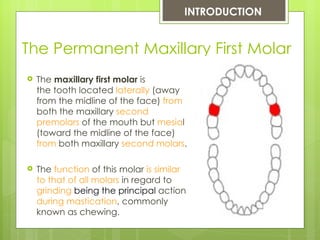
The Permanent Maxillary First Molar
   The maxillary first molar is
    the tooth located laterally (away
    from the midline of the face) from
    both the maxillary second
    premolars of the mouth but mesial
    (toward the midline of the face)
    from both maxillary second molars.

   The function of this molar is similar
    to that of all molars in regard to
    grinding being the principal action
    during mastication, commonly
    known as chewing.
CHRONOLOGY


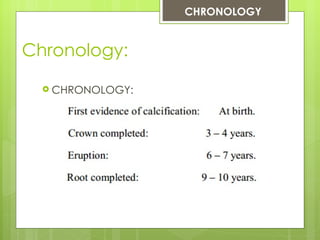
Chronology:

   CHRONOLOGY:
DESCRIPTION


 Detailed
Description
BUCCAL ASPECT


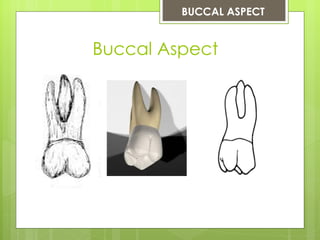
               The Buccal Aspect
   Trapezoidal shape
   Parts of all 4 cusps visible
   Portion of distal surface can be seen
    because of the obtuse distopalatal
    line angle
   Mesiobuccal cusp larger of the
    buccal cusps
   Has a prominent buccal groove that
    continues over from the occlusal
    surface
   Proximal contact areas in middle
    third
   All three roots are visible, palatal root
    centered between buccal roots
BUCCAL ASPECT


Buccal Aspect
PALATAL ASPECT

                 Palatal Aspect
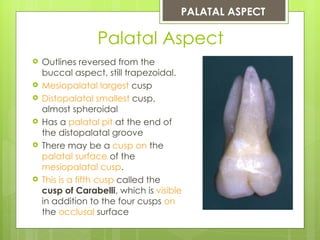
   Outlines reversed from the
    buccal aspect, still trapezoidal.
   Mesiopalatal largest cusp
   Distopalatal smallest cusp,
    almost spheroidal
   Has a palatal pit at the end of
    the distopalatal groove
   There may be a cusp on the
    palatal surface of the
    mesiopalatal cusp.
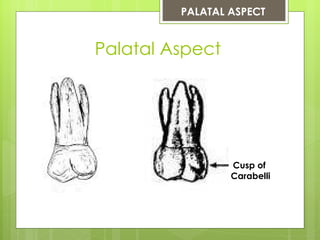
   This is a fifth cusp called the
    cusp of Carabelli, which is visible
    in addition to the four cusps on
    the occlusal surface
PALATAL ASPECT


Palatal Aspect


                 Cusp of
                 Carabelli
MESIAL ASPECT

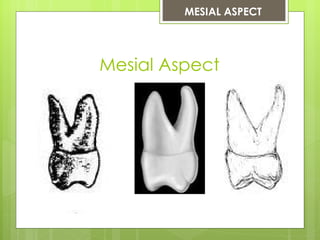
                    Mesial Aspect
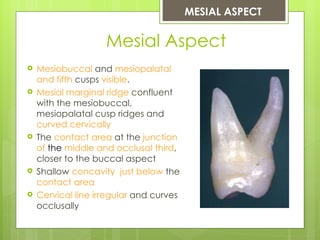
   Mesiobuccal and mesiopalatal
    and fifth cusps visible.
   Mesial marginal ridge confluent
    with the mesiobuccal,
    mesiopalatal cusp ridges and
    curved cervically
   The contact area at the junction
    of the middle and occlusal third,
    closer to the buccal aspect
   Shallow concavity just below the
    contact area
   Cervical line irregular and curves
    occlusally
MESIAL ASPECT


Mesial Aspect
DISTAL ASPECT

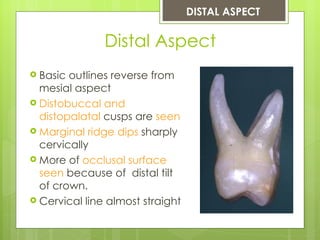
               Distal Aspect
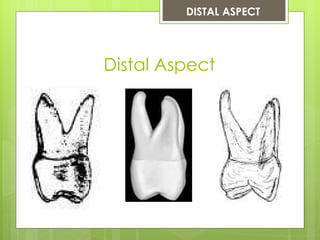
 Basic outlines reverse from
  mesial aspect
 Distobuccal and
  distopalatal cusps are seen
 Marginal ridge dips sharply
  cervically
 More of occlusal surface
  seen because of distal tilt
  of crown.
 Cervical line almost straight
DISTAL ASPECT


Distal Aspect
OCCLUSAL ASPECT


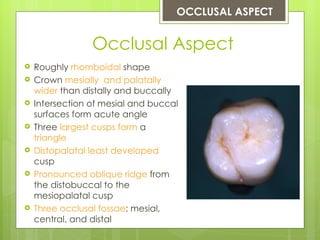
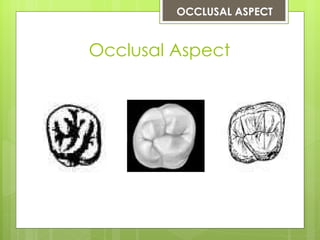
                 Occlusal Aspect
   Roughly rhomboidal shape
   Crown mesially and palatally
    wider than distally and buccally
   Intersection of mesial and buccal
    surfaces form acute angle
   Three largest cusps form a
    triangle
   Distopalatal least developed
    cusp
   Pronounced oblique ridge from
    the distobuccal to the
    mesiopalatal cusp
   Three occlusal fossae: mesial,
    central, and distal
OCCLUSAL ASPECT

                    Occlusal Aspect
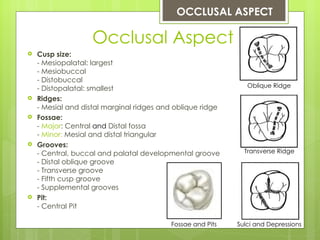
   Cusp size:
    - Mesiopalatal: largest
    - Mesiobuccal
    - Distobuccal
    - Distopalatal: smallest                                   Oblique Ridge
   Ridges:
    - Mesial and distal marginal ridges and oblique ridge
   Fossae:
    - Major: Central and Distal fossa
    - Minor: Mesial and distal triangular
   Grooves:
    - Central, buccal and palatal developmental groove        Transverse Ridge
    - Distal oblique groove
    - Transverse groove
    - Fifth cusp groove
    - Supplemental grooves
   Pit:
    - Central Pit

                                          Fossae and Pits   Sulci and Depressions
OCCLUSAL ASPECT


Occlusal Aspect
THE ROOT


              The Root
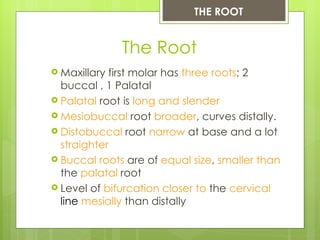
 Maxillary first molar has three roots; 2
  buccal , 1 Palatal
 Palatal root is long and slender
 Mesiobuccal root broader, curves distally.
 Distobuccal root narrow at base and a lot
  straighter
 Buccal roots are of equal size, smaller than
  the palatal root
 Level of bifurcation closer to the cervical
  line mesially than distally
MAXILARY FIRST MOLAR

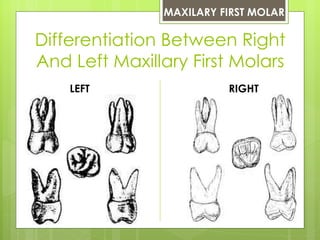
Differentiation Between Right
And Left Maxillary First Molars
    LEFT                 RIGHT
MAXILARY FIRST MOLAR


Thank You!

The Permanent Maxillary First Molar

  • 1.
    The Permanent MaxillaryFirst Molar - Aaron Sarwal (BDS 1st Prof.)
  • 2.
    INTRODUCTION The Permanent MaxillaryFirst Molar  The maxillary first molar is the tooth located laterally (away from the midline of the face) from both the maxillary second premolars of the mouth but mesial (toward the midline of the face) from both maxillary second molars.  The function of this molar is similar to that of all molars in regard to grinding being the principal action during mastication, commonly known as chewing.
  • 3.
  • 4.
  • 5.
    BUCCAL ASPECT The Buccal Aspect  Trapezoidal shape  Parts of all 4 cusps visible  Portion of distal surface can be seen because of the obtuse distopalatal line angle  Mesiobuccal cusp larger of the buccal cusps  Has a prominent buccal groove that continues over from the occlusal surface  Proximal contact areas in middle third  All three roots are visible, palatal root centered between buccal roots
  • 6.
  • 7.
    PALATAL ASPECT Palatal Aspect  Outlines reversed from the buccal aspect, still trapezoidal.  Mesiopalatal largest cusp  Distopalatal smallest cusp, almost spheroidal  Has a palatal pit at the end of the distopalatal groove  There may be a cusp on the palatal surface of the mesiopalatal cusp.  This is a fifth cusp called the cusp of Carabelli, which is visible in addition to the four cusps on the occlusal surface
  • 8.
  • 9.
    MESIAL ASPECT Mesial Aspect  Mesiobuccal and mesiopalatal and fifth cusps visible.  Mesial marginal ridge confluent with the mesiobuccal, mesiopalatal cusp ridges and curved cervically  The contact area at the junction of the middle and occlusal third, closer to the buccal aspect  Shallow concavity just below the contact area  Cervical line irregular and curves occlusally
  • 10.
  • 11.
    DISTAL ASPECT Distal Aspect  Basic outlines reverse from mesial aspect  Distobuccal and distopalatal cusps are seen  Marginal ridge dips sharply cervically  More of occlusal surface seen because of distal tilt of crown.  Cervical line almost straight
  • 12.
  • 13.
    OCCLUSAL ASPECT Occlusal Aspect  Roughly rhomboidal shape  Crown mesially and palatally wider than distally and buccally  Intersection of mesial and buccal surfaces form acute angle  Three largest cusps form a triangle  Distopalatal least developed cusp  Pronounced oblique ridge from the distobuccal to the mesiopalatal cusp  Three occlusal fossae: mesial, central, and distal
  • 14.
    OCCLUSAL ASPECT Occlusal Aspect  Cusp size: - Mesiopalatal: largest - Mesiobuccal - Distobuccal - Distopalatal: smallest Oblique Ridge  Ridges: - Mesial and distal marginal ridges and oblique ridge  Fossae: - Major: Central and Distal fossa - Minor: Mesial and distal triangular  Grooves: - Central, buccal and palatal developmental groove Transverse Ridge - Distal oblique groove - Transverse groove - Fifth cusp groove - Supplemental grooves  Pit: - Central Pit Fossae and Pits Sulci and Depressions
  • 15.
  • 16.
    THE ROOT The Root  Maxillary first molar has three roots; 2 buccal , 1 Palatal  Palatal root is long and slender  Mesiobuccal root broader, curves distally.  Distobuccal root narrow at base and a lot straighter  Buccal roots are of equal size, smaller than the palatal root  Level of bifurcation closer to the cervical line mesially than distally
  • 17.
    MAXILARY FIRST MOLAR DifferentiationBetween Right And Left Maxillary First Molars LEFT RIGHT
  • 18.