Dental Anatomy
Lecture 8
Permanent Premolars
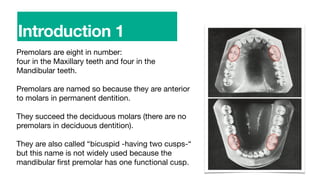
Premolars are eight in number:
four in the Maxillary teeth and four in the
Mandibular teeth.
Premolars are named so because they are anterior
to molars in permanent dentition.
They succeed the deciduous molars (there are no
premolars in deciduous dentition).
They are also called “bicuspid -having two cusps-“
but this name is not widely used because the
mandibular
fi
rst premolar has one functional cusp.
Introduction 1
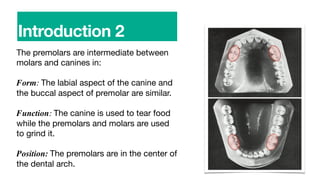
The premolars are intermediate between
molars and canines in:
Form: The labial aspect of the canine and
the buccal aspect of premolar are similar.
Function: The canine is used to tear food
while the premolars and molars are used
to grind it.
Position: The premolars are in the center of
the dental arch.
Introduction 2
Characteristic features of Posterior teeth
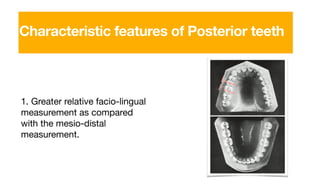
1. Greater relative facio-lingual
measurement as compared
with the mesio-distal
measurement.
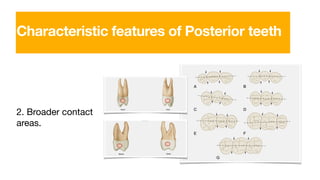
2. Broader contact
areas.
Characteristic features of Posterior teeth
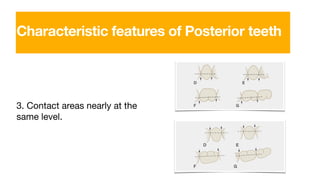
3. Contact areas nearly at the
same level.
Characteristic features of Posterior teeth
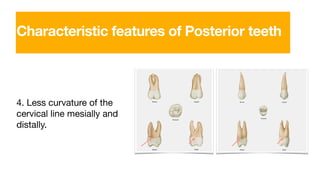
4. Less curvature of the
cervical line mesially and
distally.
Characteristic features of Posterior teeth
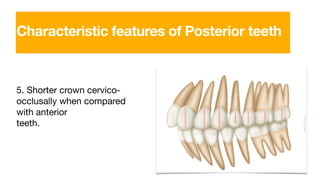
5. Shorter crown cervico-
occlusally when compared
with anterior
teeth.
Characteristic features of Posterior teeth
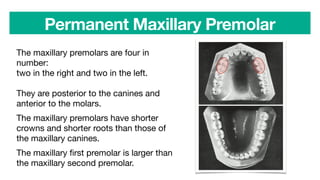
Permanent Maxillary Premolar
The maxillary premolars are four in
number:
two in the right and two in the left.
They are posterior to the canines and
anterior to the molars.
The maxillary premolars have shorter
crowns and shorter roots than those of
the maxillary canines.
The maxillary
fi
rst premolar is larger than
the maxillary second premolar.
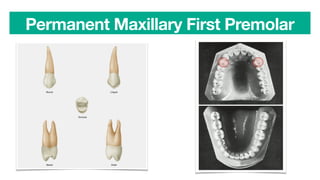
Permanent Maxillary First Premolar
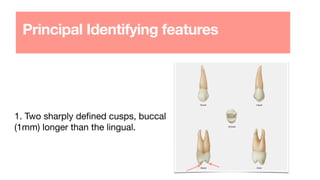
1. Two sharply de
fi
ned cusps, buccal
(1mm) longer than the lingual.
Principal Identifying features
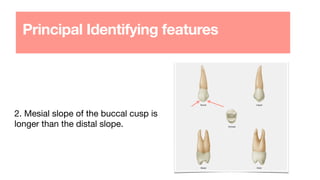
2. Mesial slope of the buccal cusp is
longer than the distal slope.
Principal Identifying features
3. Two roots; buccal and palatal, and
the bifurcation is at the middle third of
the root.
Principal Identifying features
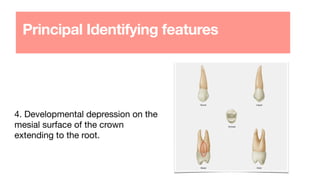
4. Developmental depression on the
mesial surface of the crown
extending to the root.
Principal Identifying features
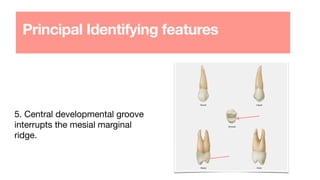
5. Central developmental groove
interrupts the mesial marginal
ridge.
Principal Identifying features
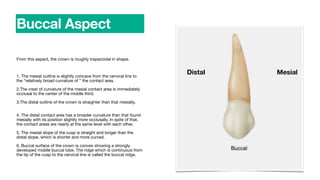
From this aspect, the crown is roughly trapezoidal in shape.
1. The mesial outline is slightly concave from the cervical line to
the “relatively broad curvature of ” the contact area.
2.The crest of curvature of the mesial contact area is immediately
occlusal to the center of the middle third.
3.The distal outline of the crown is straighter than that mesially.
4. The distal contact area has a broader curvature than that found
mesially with its position slightly more occlusally. In spite of that,
the contact areas are nearly at the same level with each other.
5. The mesial slope of the cusp is straight and longer than the
distal slope, which is shorter and more curved.
6. Buccal surface of the crown is convex showing a strongly
developed middle buccal lobe. The ridge which is continuous from
the tip of the cusp to the cervical line is called the buccal ridge.
Buccal Aspect
Distal Mesial
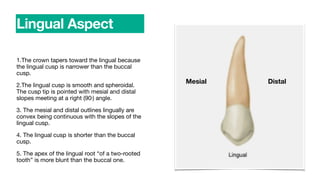
1.The crown tapers toward the lingual because
the lingual cusp is narrower than the buccal
cusp.
2.The lingual cusp is smooth and spheroidal.
The cusp tip is pointed with mesial and distal
slopes meeting at a right (90o
) angle.
3. The mesial and distal outlines lingually are
convex being continuous with the slopes of the
lingual cusp.
4. The lingual cusp is shorter than the buccal
cusp.
5. The apex of the lingual root “of a two-rooted
tooth” is more blunt than the buccal one.
Lingual Aspect
Distal
Mesial
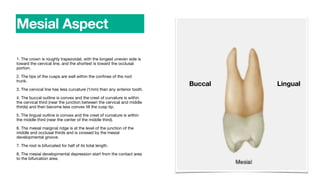
1. The crown is roughly trapezoidal, with the longest uneven side is
toward the cervical line, and the shortest is toward the occlusal
portion.
2. The tips of the cusps are well within the con
fi
nes of the root
trunk.
3. The cervical line has less curvature (1mm) than any anterior tooth.
4. The buccal outline is convex and the crest of curvature is within
the cervical third (near the junction between the cervical and middle
thirds) and then become less convex till the cusp tip.
5. The lingual outline is convex and the crest of curvature is within
the middle third (near the center of the middle third).
6. The mesial marginal ridge is at the level of the junction of the
middle and occlusal thirds and is crossed by the mesial
developmental groove.
7. The root is bifurcated for half of its total length.
8. The mesial developmental depression start from the contact area
to the bifurcation area.
Mesial Aspect
Buccal Lingual
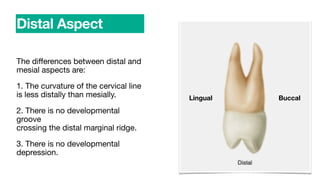
The di
ff
erences between distal and
mesial aspects are:
1. The curvature of the cervical line
is less distally than mesially.
2. There is no developmental
groove
crossing the distal marginal ridge.
3. There is no developmental
depression.
Distal Aspect
Buccal
Lingual
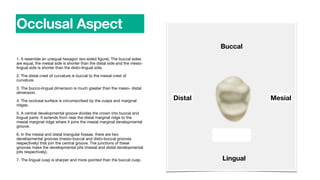
1. It resemble an unequal hexagon (six-sided
fi
gure). The buccal sides
are equal, the mesial side is shorter than the distal side and the mesio-
lingual side is shorter than the disto-lingual side.
2. The distal crest of curvature is buccal to the mesial crest of
curvature.
3. The bucco-lingual dimension is much greater than the mesio- distal
dimension.
4. The occlusal surface is circumscribed by the cusps and marginal
ridges.
5. A central developmental groove divides the crown into buccal and
lingual parts. It extends from near the distal marginal ridge to the
mesial marginal ridge where it joins the mesial marginal developmental
groove.
6. In the mesial and distal triangular fossae, there are two
developmental grooves (mesio-buccal and disto-buccal grooves
respectively) that join the central groove. The junctions of these
grooves make the developmental pits (mesial and distal developmental
pits respectively).
7. The lingual cusp is sharper and more pointed than the buccal cusp.
Occlusal Aspect
Buccal
Lingual
Distal Mesial
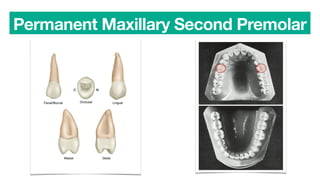
Permanent Maxillary Second Premolar
Principal Identifying features
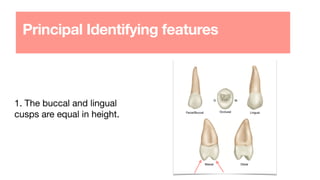
1. The buccal and lingual
cusps are equal in height.
Principal Identifying features
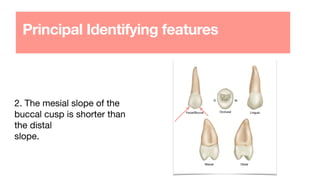
2. The mesial slope of the
buccal cusp is shorter than
the distal
slope.
Principal Identifying features
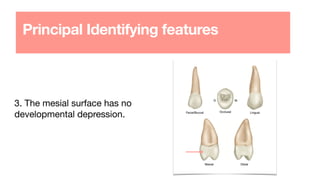
3. The mesial surface has no
developmental depression.
Principal Identifying features
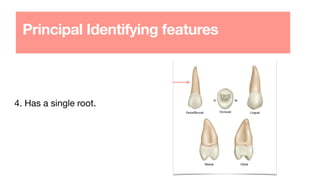
4. Has a single root.
Principal Identifying features
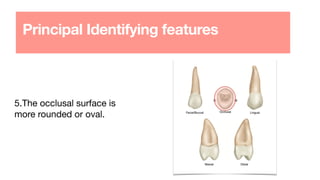
5.The occlusal surface is
more rounded or oval.
Principal Identifying features
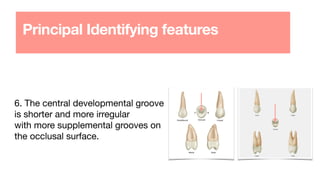
6. The central developmental groove
is shorter and more irregular
with more supplemental grooves on
the occlusal surface.
Principal Identifying features
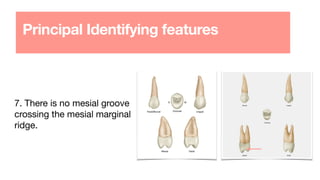
7. There is no mesial groove
crossing the mesial marginal
ridge.
END

Tutorial, Lecture 8.pdf

  • 1.
  • 2.
    Premolars are eightin number: four in the Maxillary teeth and four in the Mandibular teeth. Premolars are named so because they are anterior to molars in permanent dentition. They succeed the deciduous molars (there are no premolars in deciduous dentition). They are also called “bicuspid -having two cusps-“ but this name is not widely used because the mandibular fi rst premolar has one functional cusp. Introduction 1
  • 3.
    The premolars areintermediate between molars and canines in: Form: The labial aspect of the canine and the buccal aspect of premolar are similar. Function: The canine is used to tear food while the premolars and molars are used to grind it. Position: The premolars are in the center of the dental arch. Introduction 2
  • 4.
    Characteristic features ofPosterior teeth 1. Greater relative facio-lingual measurement as compared with the mesio-distal measurement.
  • 5.
    2. Broader contact areas. Characteristicfeatures of Posterior teeth
  • 6.
    3. Contact areasnearly at the same level. Characteristic features of Posterior teeth
  • 7.
    4. Less curvatureof the cervical line mesially and distally. Characteristic features of Posterior teeth
  • 8.
    5. Shorter crowncervico- occlusally when compared with anterior teeth. Characteristic features of Posterior teeth
  • 9.
    Permanent Maxillary Premolar Themaxillary premolars are four in number: two in the right and two in the left. They are posterior to the canines and anterior to the molars. The maxillary premolars have shorter crowns and shorter roots than those of the maxillary canines. The maxillary fi rst premolar is larger than the maxillary second premolar.
  • 10.
  • 11.
    1. Two sharplyde fi ned cusps, buccal (1mm) longer than the lingual. Principal Identifying features
  • 12.
    2. Mesial slopeof the buccal cusp is longer than the distal slope. Principal Identifying features
  • 13.
    3. Two roots;buccal and palatal, and the bifurcation is at the middle third of the root. Principal Identifying features
  • 14.
    4. Developmental depressionon the mesial surface of the crown extending to the root. Principal Identifying features
  • 15.
    5. Central developmentalgroove interrupts the mesial marginal ridge. Principal Identifying features
  • 16.
    From this aspect,the crown is roughly trapezoidal in shape. 1. The mesial outline is slightly concave from the cervical line to the “relatively broad curvature of ” the contact area. 2.The crest of curvature of the mesial contact area is immediately occlusal to the center of the middle third. 3.The distal outline of the crown is straighter than that mesially. 4. The distal contact area has a broader curvature than that found mesially with its position slightly more occlusally. In spite of that, the contact areas are nearly at the same level with each other. 5. The mesial slope of the cusp is straight and longer than the distal slope, which is shorter and more curved. 6. Buccal surface of the crown is convex showing a strongly developed middle buccal lobe. The ridge which is continuous from the tip of the cusp to the cervical line is called the buccal ridge. Buccal Aspect Distal Mesial
  • 17.
    1.The crown taperstoward the lingual because the lingual cusp is narrower than the buccal cusp. 2.The lingual cusp is smooth and spheroidal. The cusp tip is pointed with mesial and distal slopes meeting at a right (90o ) angle. 3. The mesial and distal outlines lingually are convex being continuous with the slopes of the lingual cusp. 4. The lingual cusp is shorter than the buccal cusp. 5. The apex of the lingual root “of a two-rooted tooth” is more blunt than the buccal one. Lingual Aspect Distal Mesial
  • 18.
    1. The crownis roughly trapezoidal, with the longest uneven side is toward the cervical line, and the shortest is toward the occlusal portion. 2. The tips of the cusps are well within the con fi nes of the root trunk. 3. The cervical line has less curvature (1mm) than any anterior tooth. 4. The buccal outline is convex and the crest of curvature is within the cervical third (near the junction between the cervical and middle thirds) and then become less convex till the cusp tip. 5. The lingual outline is convex and the crest of curvature is within the middle third (near the center of the middle third). 6. The mesial marginal ridge is at the level of the junction of the middle and occlusal thirds and is crossed by the mesial developmental groove. 7. The root is bifurcated for half of its total length. 8. The mesial developmental depression start from the contact area to the bifurcation area. Mesial Aspect Buccal Lingual
  • 19.
    The di ff erences betweendistal and mesial aspects are: 1. The curvature of the cervical line is less distally than mesially. 2. There is no developmental groove crossing the distal marginal ridge. 3. There is no developmental depression. Distal Aspect Buccal Lingual
  • 20.
    1. It resemblean unequal hexagon (six-sided fi gure). The buccal sides are equal, the mesial side is shorter than the distal side and the mesio- lingual side is shorter than the disto-lingual side. 2. The distal crest of curvature is buccal to the mesial crest of curvature. 3. The bucco-lingual dimension is much greater than the mesio- distal dimension. 4. The occlusal surface is circumscribed by the cusps and marginal ridges. 5. A central developmental groove divides the crown into buccal and lingual parts. It extends from near the distal marginal ridge to the mesial marginal ridge where it joins the mesial marginal developmental groove. 6. In the mesial and distal triangular fossae, there are two developmental grooves (mesio-buccal and disto-buccal grooves respectively) that join the central groove. The junctions of these grooves make the developmental pits (mesial and distal developmental pits respectively). 7. The lingual cusp is sharper and more pointed than the buccal cusp. Occlusal Aspect Buccal Lingual Distal Mesial
  • 21.
  • 22.
    Principal Identifying features 1.The buccal and lingual cusps are equal in height.
  • 23.
    Principal Identifying features 2.The mesial slope of the buccal cusp is shorter than the distal slope.
  • 24.
    Principal Identifying features 3.The mesial surface has no developmental depression.
  • 25.
  • 26.
    Principal Identifying features 5.Theocclusal surface is more rounded or oval.
  • 27.
    Principal Identifying features 6.The central developmental groove is shorter and more irregular with more supplemental grooves on the occlusal surface.
  • 28.
    Principal Identifying features 7.There is no mesial groove crossing the mesial marginal ridge.
  • 29.