



Sterilization and
Disinfection
Aaron Sarwal
MDS Batch 2017
Department of conservative Dentistry and
Endodontics
INDEX
– INTRODUCTION
– Definitions
– EXPOSURE RISK
– PERSONAL BARRIER PROTECTION
– CLEANING
– STERILIZATION
– Methods
– Agents
– MONITORS OF STERILIZATION
– DISINFECTANTS
– Agents
– ANSTISEPTICS
– Agents
– REFERENCES
Introduction
– The increase in serious transmittable diseases over the last few decades have
created global concern and have affected the treatment approach of all
healthcare professionals.
– The concepts of asepsis and prevention of infection is the single most important
consideration for the success of surgery.
– Diseases like anemia, metabolic disorders, diabetes, TB, liver/kidney disorders
affect wound healing.
– Modern antibiotics are a great support to the surgeon, but they are not, in the
least, a substitute for good surgical principles of aseptic technique and
atraumatic surgery.
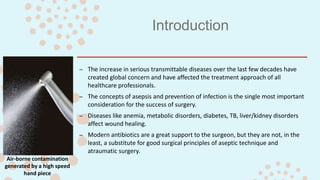
Air-borne contamination
generated by a high speed
hand piece
EXPOSURE RISK
Exposure Risk
– Obvious risks -- contaminated instruments -- patient 
professional and professional  patient
– High-speed hand pieces create air-borne contamination.
– With respect to size, there may be 3 types of airborne
contaminants generated by the high speed hand piece:
– Aerosols
– Mists
– Spatter
– Thus, need for sterilization.
Exposure Risk
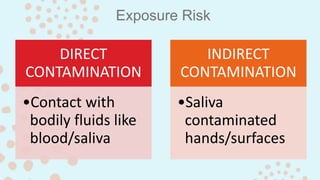
DIRECT
CONTAMINATION
•Contact with
bodily fluids like
blood/saliva
INDIRECT
CONTAMINATION
•Saliva
contaminated
hands/surfaces
Personal Barrier
Protection
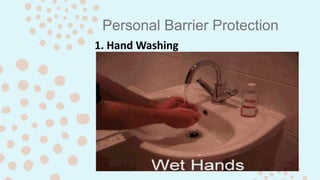
Personal Barrier Protection
1. Hand Washing
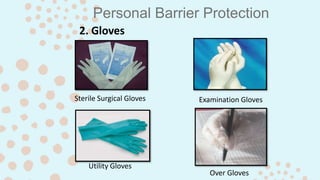
Personal Barrier Protection
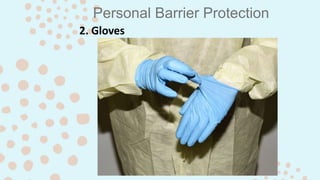
2. Gloves
Sterile Surgical Gloves Examination Gloves
Utility Gloves
Over Gloves
Personal Barrier Protection
2. Gloves
Personal Barrier Protection
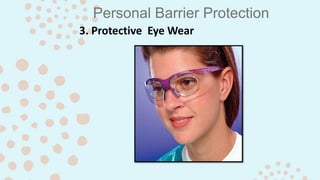
3. Protective Eye Wear
Personal Barrier Protection
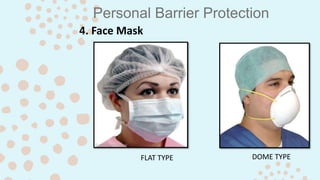
4. Face Mask
FLAT TYPE DOME TYPE
Personal Barrier Protection
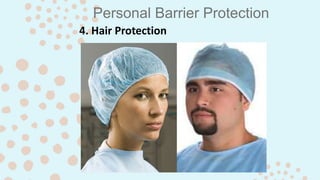
4. Hair Protection
Personal Barrier Protection
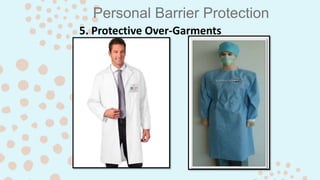
5. Protective Over-Garments
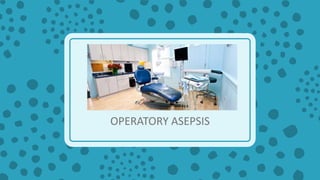
OPERATORY ASEPSIS
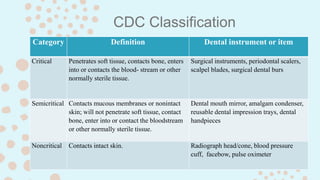
CDC Classification
Category Definition Dental instrument or item
Critical Penetrates soft tissue, contacts bone, enters
into or contacts the blood- stream or other
normally sterile tissue.
Surgical instruments, periodontal scalers,
scalpel blades, surgical dental burs
Semicritical Contacts mucous membranes or nonintact
skin; will not penetrate soft tissue, contact
bone, enter into or contact the bloodstream
or other normally sterile tissue.
Dental mouth mirror, amalgam condenser,
reusable dental impression trays, dental
handpieces
Noncritical Contacts intact skin. Radiograph head/cone, blood pressure
cuff, facebow, pulse oximeter
STERILIZATION
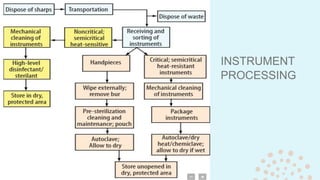
INSTRUMENT PROCESSING
INSTRUMENT
PROCESSING
Sterilization
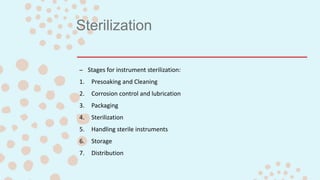
– Stages for instrument sterilization:
1. Presoaking and Cleaning
2. Corrosion control and lubrication
3. Packaging
4. Sterilization
5. Handling sterile instruments
6. Storage
7. Distribution
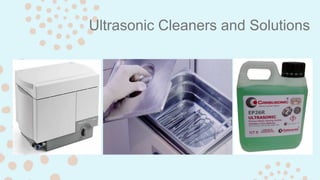
Ultrasonic Cleaners and Solutions
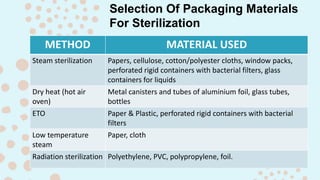
METHOD MATERIAL USED
Steam sterilization Papers, cellulose, cotton/polyester cloths, window packs,
perforated rigid containers with bacterial filters, glass
containers for liquids
Dry heat (hot air
oven)
Metal canisters and tubes of aluminium foil, glass tubes,
bottles
ETO Paper & Plastic, perforated rigid containers with bacterial
filters
Low temperature
steam
Paper, cloth
Radiation sterilization Polyethylene, PVC, polypropylene, foil.
Selection Of Packaging Materials
For Sterilization
Agents Used In Sterilization
PHYSICAL
AGENTS
CHEMICAL
AGENTS
Agents Used In Sterilization
METHODS OF STERILIZATION
1. Steam pressure sterilization
(autoclave)
2. Chemical vapor pressure sterilization-
(chemiclave)
3. Dry heat sterilization (dryclave)
4. Ethylene oxide sterilization
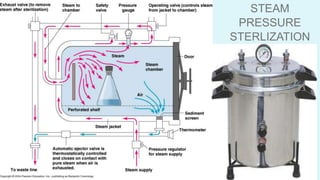
STEAM
PRESSURE
STERLIZATION
Advantages Of Autoclave
1. Autoclaving is the most rapid and effective method for sterilizing cloth surgical
packs and towel packs.
2. Is dependable and economical
3. Sterilization is verifiable.
Disadvantages of Autoclave
1. Items sensitive to the elevated temperature cannot be autoclaved.
2. Autoclaving tends to rust carbon steel instruments and burs.
3. Instruments must be air dried at completion of cycle
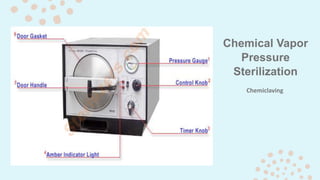
Chemical Vapor
Pressure
Sterilization
Chemiclaving
ADVANTAGES Carbon steel and other
corrosion-sensitive
instruments are said to be
sterilized without rust.
Relatively quick turnaround
time for instruments.
Load comes out dry.
Sterilization is verifiable.
CHEMICLAVING
CHEMICLAVING
DISADVANTAGES Items sensitive to the
elevated temperature will
be damaged. Vapor odor
is offensive, requires
aeration.
Heavy cloth wrappings of
surgical instruments may
not be penetrated to
provide sterilization.
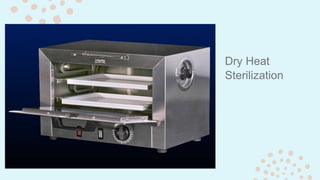
Dry Heat
Sterilization
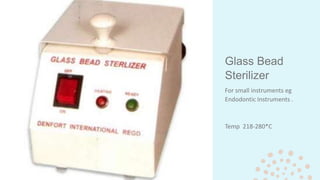
Glass Bead
Sterilizer
For small instruments eg
Endodontic Instruments .
Temp 218-280*C
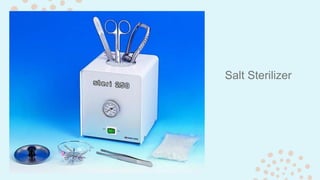
Salt Sterilizer
Dry Heat
Sterilization
ADVANTAGES Carbon steel instruments and burs
do not rust, corrode, if they are
well dried before processing.
Industrial forced-draft hot air
ovens usually provide a larger
capacity at a reasonable price.
Rapid cycles are possible at high
temperatures.
Low initial cost and sterilization is
verifiable.
Dry Heat
Sterilization
DISADVANTAGES High temperatures may
damage more heat-
sensitive items, such as-
rubber or plastic goods.
Sterilization cycles are
prolonged at the lower
temperatures.
Must be calibrated and
monitored
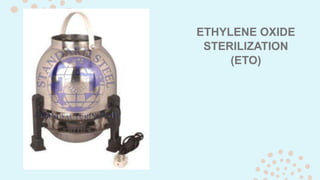
ETHYLENE OXIDE
STERILIZATION
(ETO)
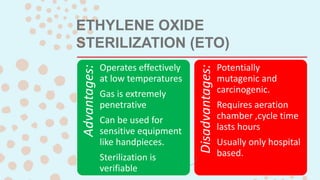
ETHYLENE OXIDE
STERILIZATION (ETO)
Advantages:
Operates effectively
at low temperatures
Gas is extremely
penetrative
Can be used for
sensitive equipment
like handpieces.
Sterilization is
verifiable
Disadvantages:
Potentially
mutagenic and
carcinogenic.
Requires aeration
chamber ,cycle time
lasts hours
Usually only hospital
based.
Irradiation Sterilization
–UV radiation
Irradiation Sterilization
– Gamma radiation
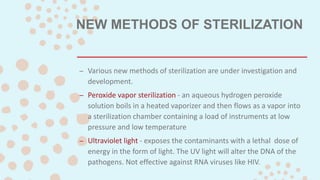
NEW METHODS OF STERILIZATION
– Various new methods of sterilization are under investigation and
development.
– Peroxide vapor sterilization - an aqueous hydrogen peroxide
solution boils in a heated vaporizer and then flows as a vapor into
a sterilization chamber containing a load of instruments at low
pressure and low temperature
– Ultraviolet light - exposes the contaminants with a lethal dose of
energy in the form of light. The UV light will alter the DNA of the
pathogens. Not effective against RNA viruses like HIV.
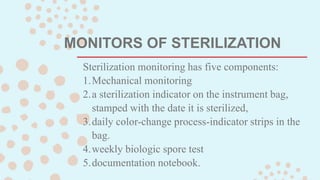
MONITORS OF STERILIZATION
Sterilization monitoring has five components:
1.Mechanical monitoring
2.a sterilization indicator on the instrument bag,
stamped with the date it is sterilized,
3.daily color-change process-indicator strips in the
bag.
4.weekly biologic spore test
5.documentation notebook.
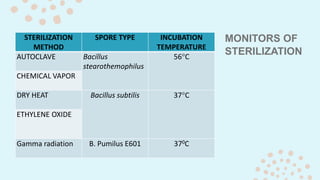
MONITORS OF
STERILIZATION
STERILIZATION
METHOD
SPORE TYPE INCUBATION
TEMPERATURE
AUTOCLAVE Bacillus
stearothemophilus
56°C
CHEMICAL VAPOR
DRY HEAT Bacillus subtilis 37°C
ETHYLENE OXIDE
Gamma radiation B. Pumilus E601 370C
DISINFECTANTS
DISINFECTANTS
– Sodium Hypochloride
– Phenols
– Aldehyde Compunds
– Chlorhexidine
– Cetrimide
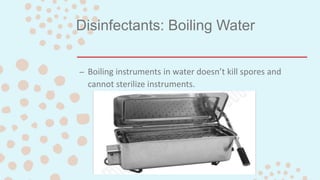
Disinfectants: Boiling Water
– Boiling instruments in water doesn’t kill spores and
cannot sterilize instruments.
ANTISEPTICS
Antiseptics
– Alcohol
– Hexachloropene
– Iodine and Iodine Compunds
– Aqueous Qaternary Ammonium Compunds
– H202A
CLINICAL WASTE
DISPOSAL
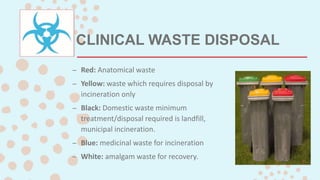
CLINICAL WASTE DISPOSAL
– Red: Anatomical waste
– Yellow: waste which requires disposal by
incineration only
– Black: Domestic waste minimum
treatment/disposal required is landfill,
municipal incineration.
– Blue: medicinal waste for incineration
– White: amalgam waste for recovery.
REFERENCES:
– CONTENT:
– Text book of Oral and Maxillofacial Surgery, Vinod Kapoor
– Sturdevant’s the Art and Science of Operative Dentistry
– Essentials of Endodontics, Vimal K Sikri
– CDC Website
– IMAGES AND GIF
– Google Image Search
Sterlization and disinfection

Sterlization and disinfection

  • 1.
    Sterilization and Disinfection Aaron Sarwal MDSBatch 2017 Department of conservative Dentistry and Endodontics
  • 2.
    INDEX – INTRODUCTION – Definitions –EXPOSURE RISK – PERSONAL BARRIER PROTECTION – CLEANING – STERILIZATION – Methods – Agents – MONITORS OF STERILIZATION – DISINFECTANTS – Agents – ANSTISEPTICS – Agents – REFERENCES
  • 3.
    Introduction – The increasein serious transmittable diseases over the last few decades have created global concern and have affected the treatment approach of all healthcare professionals. – The concepts of asepsis and prevention of infection is the single most important consideration for the success of surgery. – Diseases like anemia, metabolic disorders, diabetes, TB, liver/kidney disorders affect wound healing. – Modern antibiotics are a great support to the surgeon, but they are not, in the least, a substitute for good surgical principles of aseptic technique and atraumatic surgery. Air-borne contamination generated by a high speed hand piece
  • 4.
  • 5.
    Exposure Risk – Obviousrisks -- contaminated instruments -- patient  professional and professional  patient – High-speed hand pieces create air-borne contamination. – With respect to size, there may be 3 types of airborne contaminants generated by the high speed hand piece: – Aerosols – Mists – Spatter – Thus, need for sterilization.
  • 6.
    Exposure Risk DIRECT CONTAMINATION •Contact with bodilyfluids like blood/saliva INDIRECT CONTAMINATION •Saliva contaminated hands/surfaces
  • 7.
  • 8.
  • 9.
    Personal Barrier Protection 2.Gloves Sterile Surgical Gloves Examination Gloves Utility Gloves Over Gloves
  • 10.
  • 11.
    Personal Barrier Protection 3.Protective Eye Wear
  • 12.
    Personal Barrier Protection 4.Face Mask FLAT TYPE DOME TYPE
  • 13.
  • 14.
    Personal Barrier Protection 5.Protective Over-Garments
  • 15.
  • 16.
    CDC Classification Category DefinitionDental instrument or item Critical Penetrates soft tissue, contacts bone, enters into or contacts the blood- stream or other normally sterile tissue. Surgical instruments, periodontal scalers, scalpel blades, surgical dental burs Semicritical Contacts mucous membranes or nonintact skin; will not penetrate soft tissue, contact bone, enter into or contact the bloodstream or other normally sterile tissue. Dental mouth mirror, amalgam condenser, reusable dental impression trays, dental handpieces Noncritical Contacts intact skin. Radiograph head/cone, blood pressure cuff, facebow, pulse oximeter
  • 17.
  • 18.
  • 19.
    Sterilization – Stages forinstrument sterilization: 1. Presoaking and Cleaning 2. Corrosion control and lubrication 3. Packaging 4. Sterilization 5. Handling sterile instruments 6. Storage 7. Distribution
  • 20.
  • 21.
    METHOD MATERIAL USED Steamsterilization Papers, cellulose, cotton/polyester cloths, window packs, perforated rigid containers with bacterial filters, glass containers for liquids Dry heat (hot air oven) Metal canisters and tubes of aluminium foil, glass tubes, bottles ETO Paper & Plastic, perforated rigid containers with bacterial filters Low temperature steam Paper, cloth Radiation sterilization Polyethylene, PVC, polypropylene, foil. Selection Of Packaging Materials For Sterilization
  • 22.
    Agents Used InSterilization PHYSICAL AGENTS
  • 23.
  • 24.
    METHODS OF STERILIZATION 1.Steam pressure sterilization (autoclave) 2. Chemical vapor pressure sterilization- (chemiclave) 3. Dry heat sterilization (dryclave) 4. Ethylene oxide sterilization
  • 25.
  • 26.
    Advantages Of Autoclave 1.Autoclaving is the most rapid and effective method for sterilizing cloth surgical packs and towel packs. 2. Is dependable and economical 3. Sterilization is verifiable.
  • 27.
    Disadvantages of Autoclave 1.Items sensitive to the elevated temperature cannot be autoclaved. 2. Autoclaving tends to rust carbon steel instruments and burs. 3. Instruments must be air dried at completion of cycle
  • 28.
  • 29.
    ADVANTAGES Carbon steeland other corrosion-sensitive instruments are said to be sterilized without rust. Relatively quick turnaround time for instruments. Load comes out dry. Sterilization is verifiable. CHEMICLAVING
  • 30.
    CHEMICLAVING DISADVANTAGES Items sensitiveto the elevated temperature will be damaged. Vapor odor is offensive, requires aeration. Heavy cloth wrappings of surgical instruments may not be penetrated to provide sterilization.
  • 31.
  • 32.
    Glass Bead Sterilizer For smallinstruments eg Endodontic Instruments . Temp 218-280*C
  • 33.
  • 34.
    Dry Heat Sterilization ADVANTAGES Carbonsteel instruments and burs do not rust, corrode, if they are well dried before processing. Industrial forced-draft hot air ovens usually provide a larger capacity at a reasonable price. Rapid cycles are possible at high temperatures. Low initial cost and sterilization is verifiable.
  • 35.
    Dry Heat Sterilization DISADVANTAGES Hightemperatures may damage more heat- sensitive items, such as- rubber or plastic goods. Sterilization cycles are prolonged at the lower temperatures. Must be calibrated and monitored
  • 36.
  • 37.
    ETHYLENE OXIDE STERILIZATION (ETO) Advantages: Operateseffectively at low temperatures Gas is extremely penetrative Can be used for sensitive equipment like handpieces. Sterilization is verifiable Disadvantages: Potentially mutagenic and carcinogenic. Requires aeration chamber ,cycle time lasts hours Usually only hospital based.
  • 38.
  • 39.
  • 40.
    NEW METHODS OFSTERILIZATION – Various new methods of sterilization are under investigation and development. – Peroxide vapor sterilization - an aqueous hydrogen peroxide solution boils in a heated vaporizer and then flows as a vapor into a sterilization chamber containing a load of instruments at low pressure and low temperature – Ultraviolet light - exposes the contaminants with a lethal dose of energy in the form of light. The UV light will alter the DNA of the pathogens. Not effective against RNA viruses like HIV.
  • 41.
    MONITORS OF STERILIZATION Sterilizationmonitoring has five components: 1.Mechanical monitoring 2.a sterilization indicator on the instrument bag, stamped with the date it is sterilized, 3.daily color-change process-indicator strips in the bag. 4.weekly biologic spore test 5.documentation notebook.
  • 42.
    MONITORS OF STERILIZATION STERILIZATION METHOD SPORE TYPEINCUBATION TEMPERATURE AUTOCLAVE Bacillus stearothemophilus 56°C CHEMICAL VAPOR DRY HEAT Bacillus subtilis 37°C ETHYLENE OXIDE Gamma radiation B. Pumilus E601 370C
  • 43.
  • 44.
    DISINFECTANTS – Sodium Hypochloride –Phenols – Aldehyde Compunds – Chlorhexidine – Cetrimide
  • 45.
    Disinfectants: Boiling Water –Boiling instruments in water doesn’t kill spores and cannot sterilize instruments.
  • 46.
  • 47.
    Antiseptics – Alcohol – Hexachloropene –Iodine and Iodine Compunds – Aqueous Qaternary Ammonium Compunds – H202A
  • 48.
  • 49.
    CLINICAL WASTE DISPOSAL –Red: Anatomical waste – Yellow: waste which requires disposal by incineration only – Black: Domestic waste minimum treatment/disposal required is landfill, municipal incineration. – Blue: medicinal waste for incineration – White: amalgam waste for recovery.
  • 50.
    REFERENCES: – CONTENT: – Textbook of Oral and Maxillofacial Surgery, Vinod Kapoor – Sturdevant’s the Art and Science of Operative Dentistry – Essentials of Endodontics, Vimal K Sikri – CDC Website – IMAGES AND GIF – Google Image Search

Editor's Notes

  • #4 The goal is to ensure compliance with standard precautions and other methods to minimize the risk of infection. Infection is the greatest deterrent to normal wound healing. Surgeons encounter 2* infection which can give them sleepless nights. General physical condition of patient is a predisposing factor to infection, nutritional state of patient Chain of asepsis must be maintained. Holds true for OPD as well.
  • #5 Contamination from: water system, blood, saliva, tissues, microbes of oral cavity, fine debris from cutting teeth.
  • #6 AEROSOLS: 5nm- 50nm. Invisible particles. Remain suspended in air and can be breathed for hours. Carry agents of respiratory infection MISTS: Visible under a beam of light. Droplets of around 50nm in size. Heavy mists settle after 5 to 15 mins. Mists from undiagnosed TB patients can potentially transmit the infection SPATTER: >50nm and includes visible splashes. Falls within 3ft of the operating area (mouth). Spatter can coat the face and outer garments of a dental personnel. Transmits blood borne pathogens
  • #7 Major exposure concern
  • #9 Lather for 15 secs, rub all surfaces, rinse, dry Handclensers with 3%Parachlorometaxylenol (PCMX)/ Chlorhexidine should be used. 4% for special cleansing like surgry/injury/glove leaks
  • #10 Steile gloves: best fit, right and left sides, for surgical procedure Examination: ambidextrerous, XS, S, M and L sizes Utility: puncture resistant, reuseable, washable, autoclaveable, cleaning sharps and surfaces Overgloves: used to prevent cross contamination of materials made of thin inexpensive plastic/copolymer * heat resistant gloves worn while handling hot items like unloading sterilizers * Dermal gloves used in cases of irritation and allergies.
  • #11 Process of removal of gloves: Pinch from palm of one side near the wrist with the gloved fingers of other hand and pull off. Both gloves can be removed simultaneously like this. Never use one glove for more than one patient. Never wash. Use overgloves to open drawer/ handle material.
  • #12 Include goggles/ glasses with eye shield. To save time, clean replacemnts should be avaialble Antifog sol is recommended.
  • #14 Hair can trap heavy contamination that can be rubbed back into the face from pillow at night if not washed away. Use a cap. For both men and women.
  • #15 Lab coat Surg gown
  • #17 -In the dental operatory, environmental surfaces (i.e., a surface or equipment that does not contact patients directly) can become contaminated during patient care. -Certain surfaces, especially ones touched frequently (e.g., light handles, unit switches, and drawer knobs) can serve as reservoirs of microbial contamination, although they have not been associated directly with transmission of infection to either personnel or patients. -Transfer of microorganisms from contaminated environmental surfaces to patients occurs primarily through personnel hand contact
  • #18 It is the complete destruction of all micro-organisms including spores. A process cant be called sterilization unless it is shown to kill all the spores.
  • #21 Hand and ultrasolic leaning. Hand with nylon brush + disinfectant mild detergent. Safest and most efficient way to clean sharp instruments. 9x more effective than hand cleaning if the device functions properly. Observe operating precautions Operate tank at ½ to ¾ full. Use recommened solutions. Change solutions as directed. Antimicrobial solution is preferable. Operate atleast 5 mins/ 1 min per instument Remove packaging/was/coating of cement/ impression material and then place in cleaner.
  • #22 Intrument smust be dried and divided into functional packs for sterilization.
  • #23 Physical agents: Sunlight, Drying, Dryheat: flaming, incineration, hot air, Moist heat: pasteurization, boiling, steam under pressure, steamunder normal pressure. Filtration: candles asbestos pads, membranes, Radiation Ultrasonic and sonic vibrations
  • #24 Chemical agents: Alcohols: ethyl, isopropyl, trichlorobutanol, Aldehydes: formaldehyde, glutaraldehyde, Dyes, Halogens, Phenols, Surface-active agents, Metallic salts, Gases: ethylene oxide, formaldehyde, beta propiolactone.
  • #26 Unwrapped Instuments 121 °C (249 °F) for 20 minutes @15 PSI 134 °C for 3 minutes @ 30 PSI lightly wrapped items132 C (270 F)30psi 8min heavily wrapped items132 C (270 F)30psi 10min
  • #29 The 1938 patent of dr. George hollenback and the work of hollenback and harvey in 1940s culminated in the development of an unsaturated chemical vapor system , also called harvey chemiclave.
  • #32 160*c for 2 hrs 120*c for 6 hrs
  • #33 Time for each instrument: 5secs for RC instruments Absorbent points and cotton pellets: 10 secs Long handled inst. : 5 secs Disadvantage: - small beads <1mm may be carried into the RC with the instrument and can be difficult to remove. -costlier than salt sterilizer
  • #37 Sterlization for temp and water sensitive items EtO Gas at 10.73*C. destroyes microorganism by alkalysation ie distrupting DNA and preventing reproduction. Temp, humidity and pressure contriolled for 6-12 hrs
  • #39 The wavelength of UV radiation ranges from 328 nm to 210 nm (3280 A to 2100 A). Its maximum bactericidal effect occurs at 240–280 nm Inactivation of microorganisms results from destruction of nucleic acid through induction of thymine dimers. UV radiation has been employed in the disinfection of drinking water , air, titanium implants, and contact lenses. The application of UV radiation in the health-care environment (i.e., operating rooms, isolation rooms, and biologic safety cabinets) is limited to destruction of airborne organisms or inactivation of microorganisms on surfaces
  • #40 The Nature of Gamma Radiation A form of pure energy that is generally characterized by its deep penetration and low dose rates, Gamma Radiation effectively kills microorganisms throughout. Benefits of Gamma Radiation include: precise dosing rapid processing uniform dose distribution system flexibility dosimetric release–the immediate availability of product after processing. Penetrating Sterilization: Even with High-Density Products Gamma Radiation is a penetrating sterilant. Substantial Decrease in Organism Survival: Gamma Radiation kills microorganisms by attacking the DNA molecule.
  • #42 Sterlization monitoring is now a standard of health care. MECHANICAL : Each load monitored for time, temp, pressure. Manual obsewrvation and record in a log. Chemical: inexpensive qualitative monitoring. Strip is coated with chemicals which cvhange color slowly, relative to record the temp reached in the pack. However not accurate. Chemical ext: to mark packs used and those that havent. The tape easily changes color based on exposure. Biological monitoring: spore test strip. Weekly monitor. Spores coated on an absorbent paper. Sterlization carried out then spores sent to a lab for INDEPENDENT VERIFICATION. Notebook: single, dates, initialed indicvator strip attached plus a spre strip report. Of that week.
  • #44 Used on nonvital objects to kill pathogenic microorganisms but not all spores of bacteria
  • #45 Sodium Hypochloride Disinfection of surfaces, inst, linen for HIV +ve pt Phenols Carbolic Acid – Walls, floor, furniture. Irritant to skin and mucosa Aldehyde Compunds – Formaldehyde, Gultraldehyde 2% = Cidex. Foul Smell. Operatory disinfection, metal, rubber plastic Chlorhexidine- 20% for hand disinfection and 0.2% as an antiplaque agent Cetrimide- 0.5% in isopropyl alchohol and water skin woyunds and preoperation prior to syurgery.
  • #46 Boiling water is a high level disinfectant and doesn’t kill spores. It is only used when there is a sterilizer failure Great care must be taken to ensure that the instruments remain submerges under water for the duration of boiling.
  • #47 Used on living tissue for inhibiting the growth and dev of micro organisms
  • #48 Alcohol 70% by wt. prior to needle puncture Hexachloropene 3% as surgical scrub Iodine and Iodine Compunds Tincture idodine 2% for oral wounds and 5% for antimicrobial Aqueous Qaternary Ammonium Compunds- Benzalkonium Chloride H202 – 3% oxidizing agent, against anaerobes for contaminated open wounds