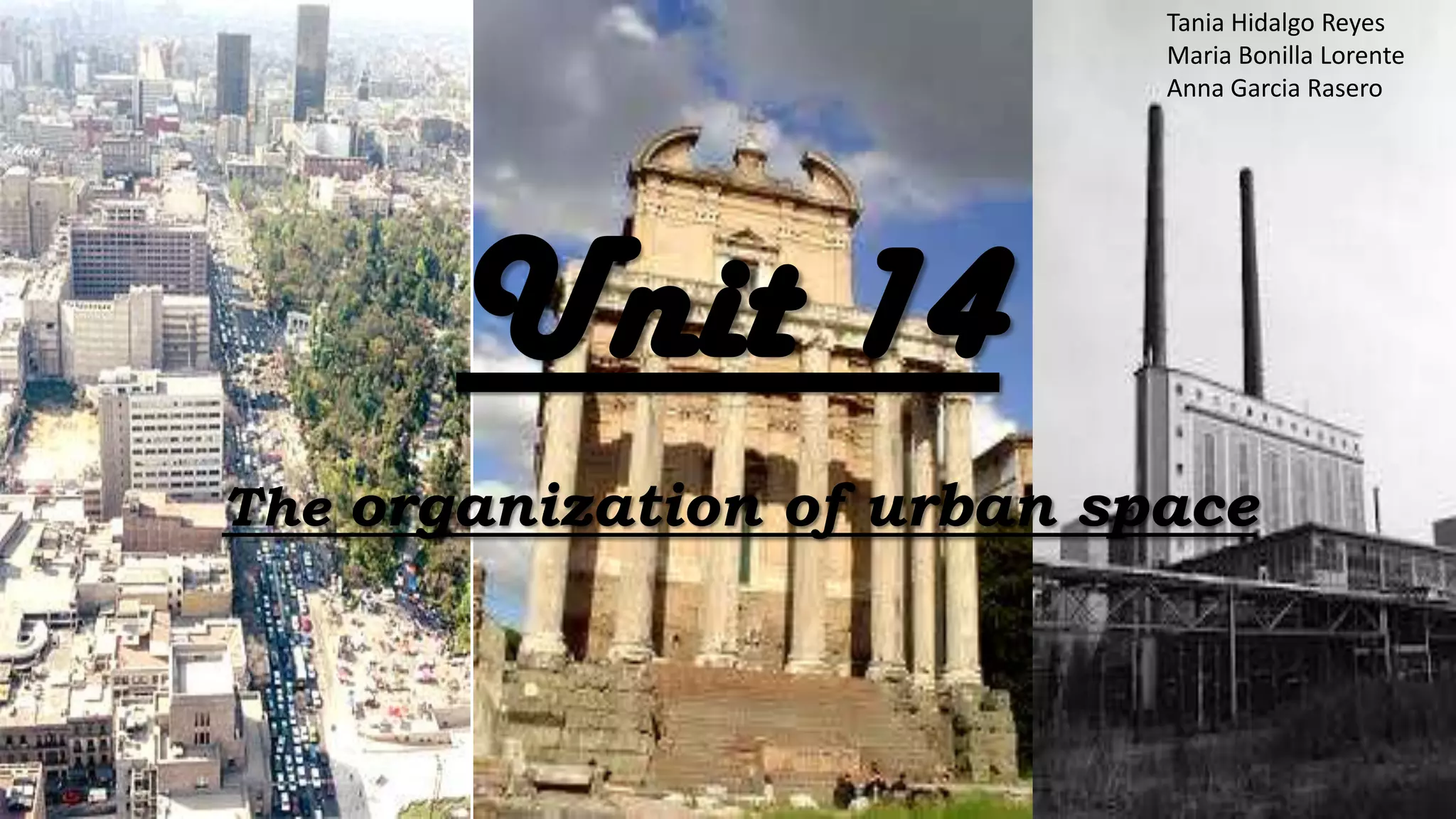
Unit 14
The organization of urban space
Tania Hidalgo Reyes
Maria Bonilla Lorente
Anna Garcia Rasero
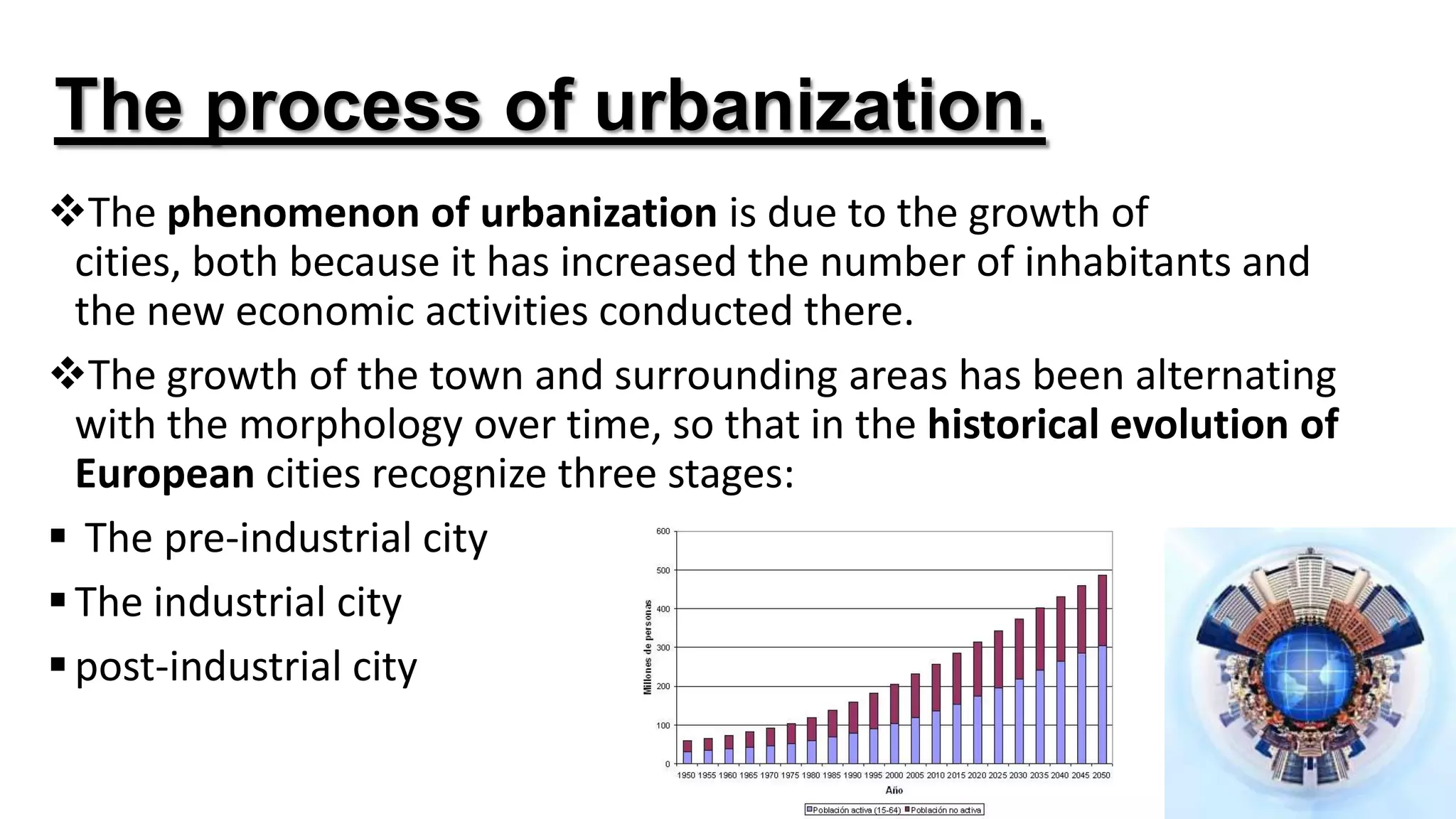
The process of urbanization.
The phenomenon of urbanization is due to the growth of
cities, both because it has increased the number of inhabitants and
the new economic activities conducted there.
The growth of the town and surrounding areas has been alternating
with the morphology over time, so that in the historical evolution of
European cities recognize three stages:
 The pre-industrial city
The industrial city
post-industrial city
THE OLD CITY: GREECE AND ROME
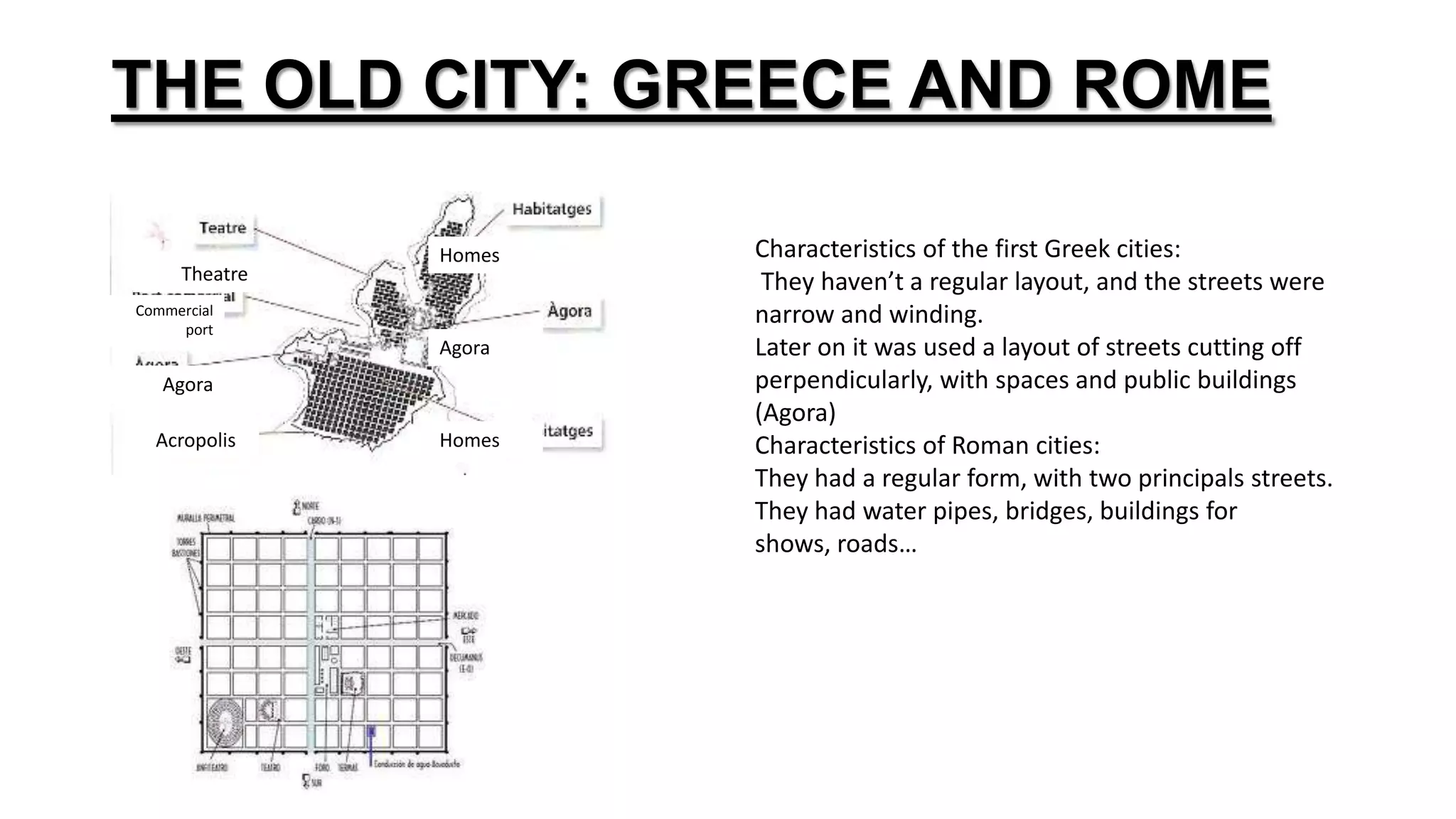
Characteristics of the first Greek cities:
They haven’t a regular layout, and the streets were
narrow and winding.
Later on it was used a layout of streets cutting off
perpendicularly, with spaces and public buildings
(Agora)
Characteristics of Roman cities:
They had a regular form, with two principals streets.
They had water pipes, bridges, buildings for
shows, roads…
Theatre
Commercial
port
Acropolis
Agora
Homes
Agora
Homes
THE CITY IN THE MIDDLE AGES
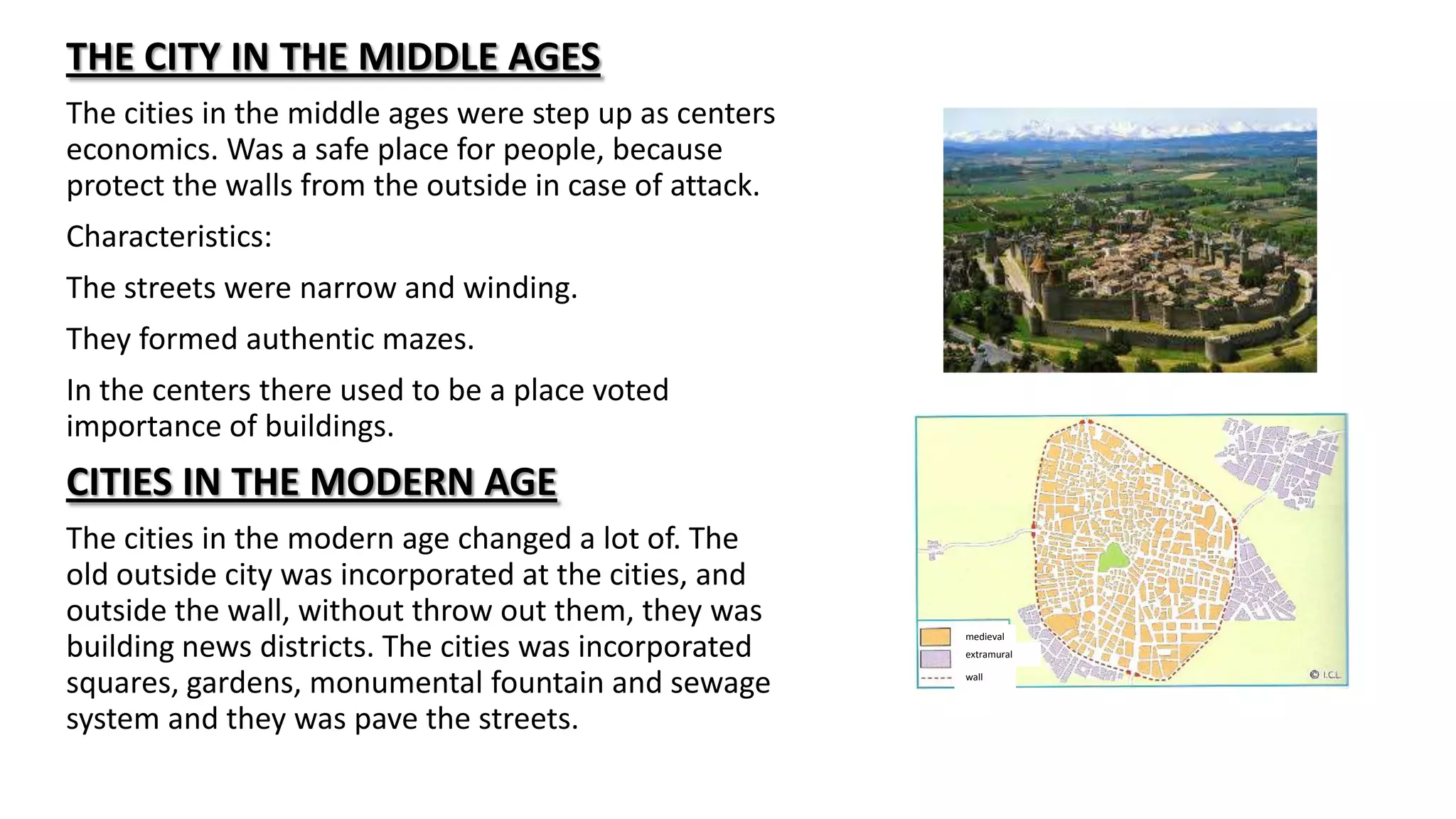
The cities in the middle ages were step up as centers
economics. Was a safe place for people, because
protect the walls from the outside in case of attack.
Characteristics:
The streets were narrow and winding.
They formed authentic mazes.
In the centers there used to be a place voted
importance of buildings.
CITIES IN THE MODERN AGE
The cities in the modern age changed a lot of. The
old outside city was incorporated at the cities, and
outside the wall, without throw out them, they was
building news districts. The cities was incorporated
squares, gardens, monumental fountain and sewage
system and they was pave the streets.
medieval
wall
extramural
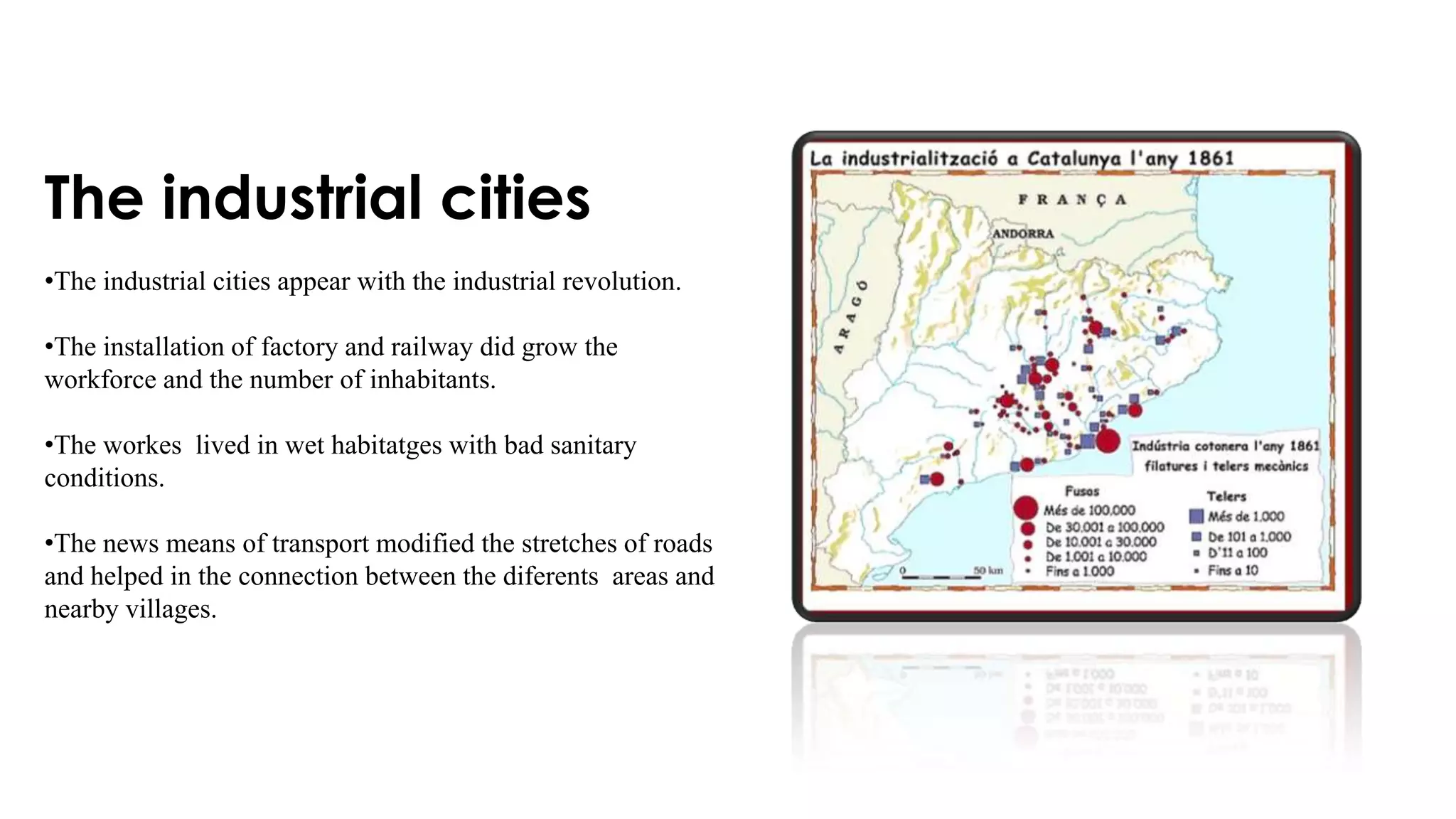
The industrial cities
•The industrial cities appear with the industrial revolution.
•The installation of factory and railway did grow the
workforce and the number of inhabitants.
•The workes lived in wet habitatges with bad sanitary
conditions.
•The news means of transport modified the stretches of roads
and helped in the connection between the diferents areas and
nearby villages.
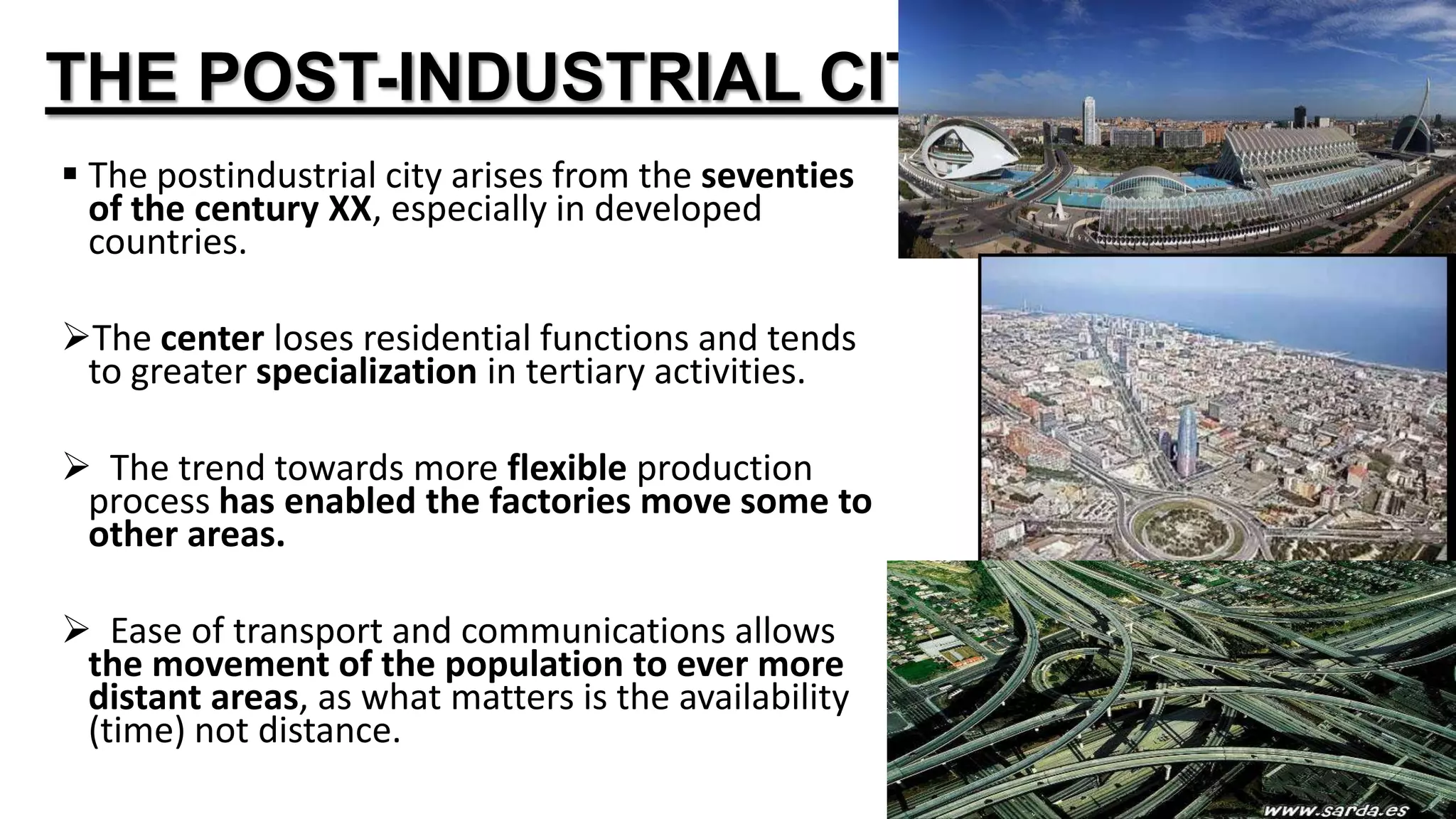
THE POST-INDUSTRIAL CITY
 The postindustrial city arises from the seventies
of the century XX, especially in developed
countries.
The center loses residential functions and tends
to greater specialization in tertiary activities.
 The trend towards more flexible production
process has enabled the factories move some to
other areas.
 Ease of transport and communications allows
the movement of the population to ever more
distant areas, as what matters is the availability
(time) not distance.
Program 1
1.1-Globalization and urban space.
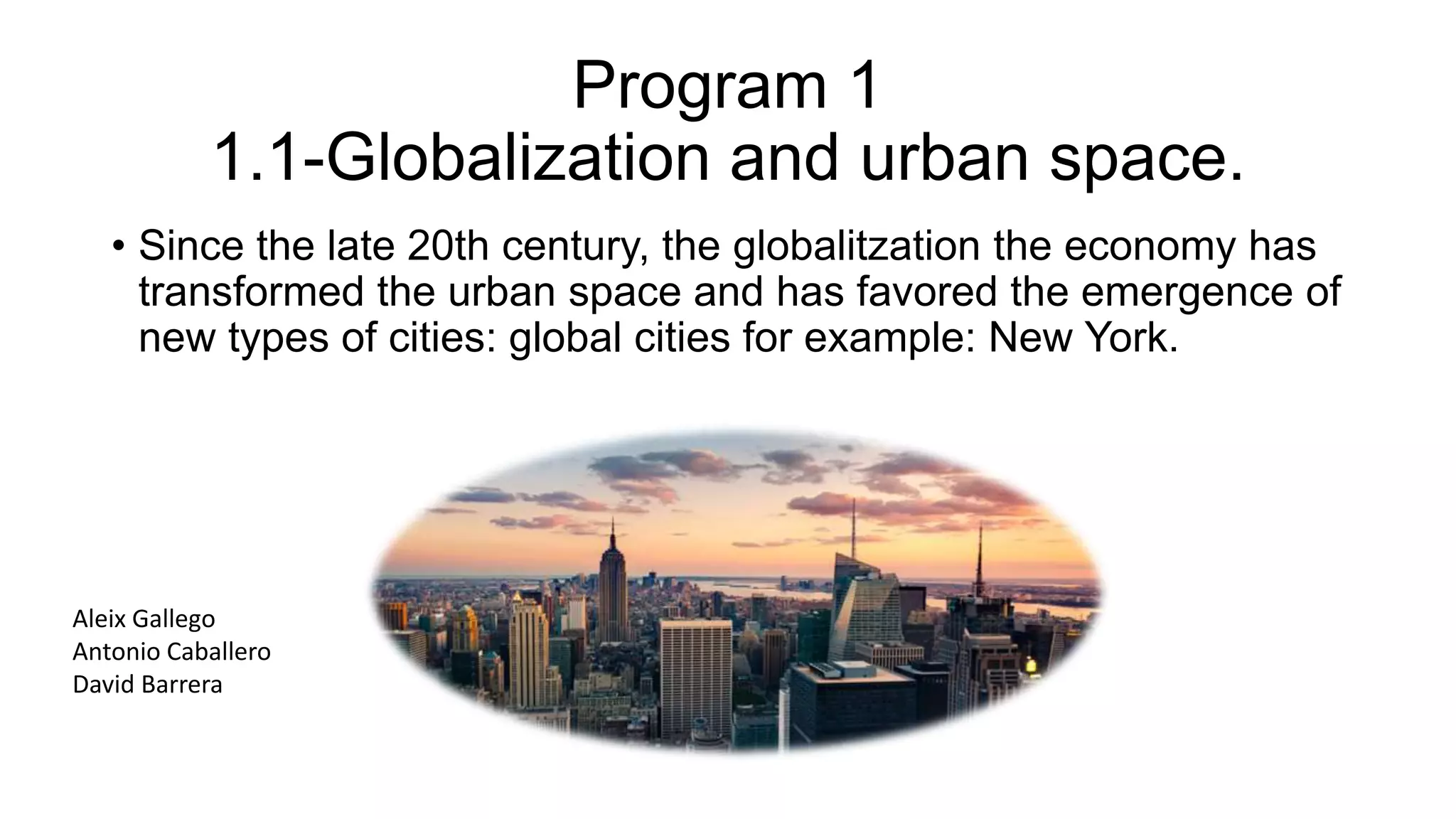
• Since the late 20th century, the globalitzation the economy has
transformed the urban space and has favored the emergence of
new types of cities: global cities for example: New York.
Aleix Gallego
Antonio Caballero
David Barrera
1.2 Transformations in large cities.
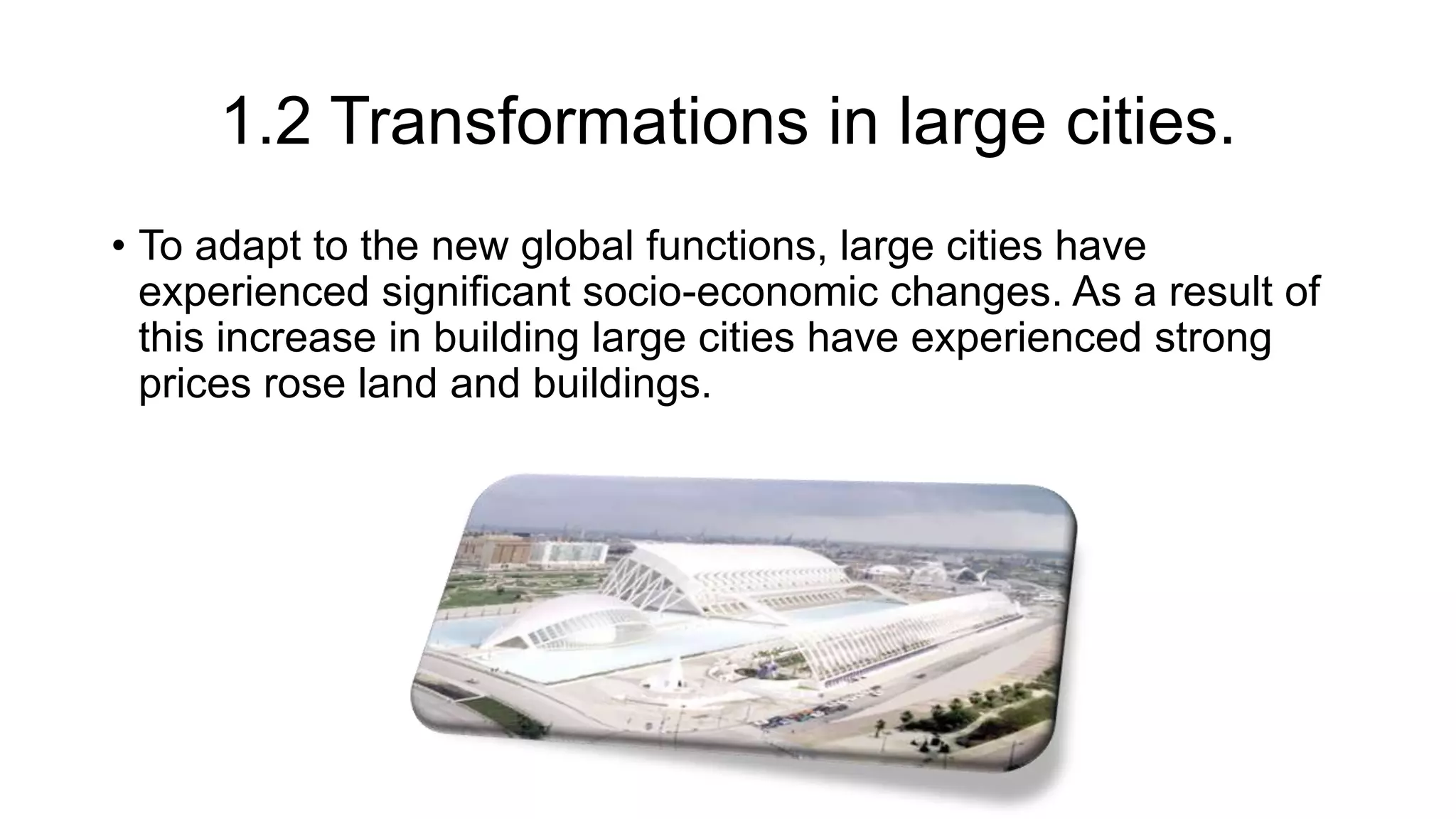
• To adapt to the new global functions, large cities have
experienced significant socio-economic changes. As a result of
this increase in building large cities have experienced strong
prices rose land and buildings.
1.3 Urban networks
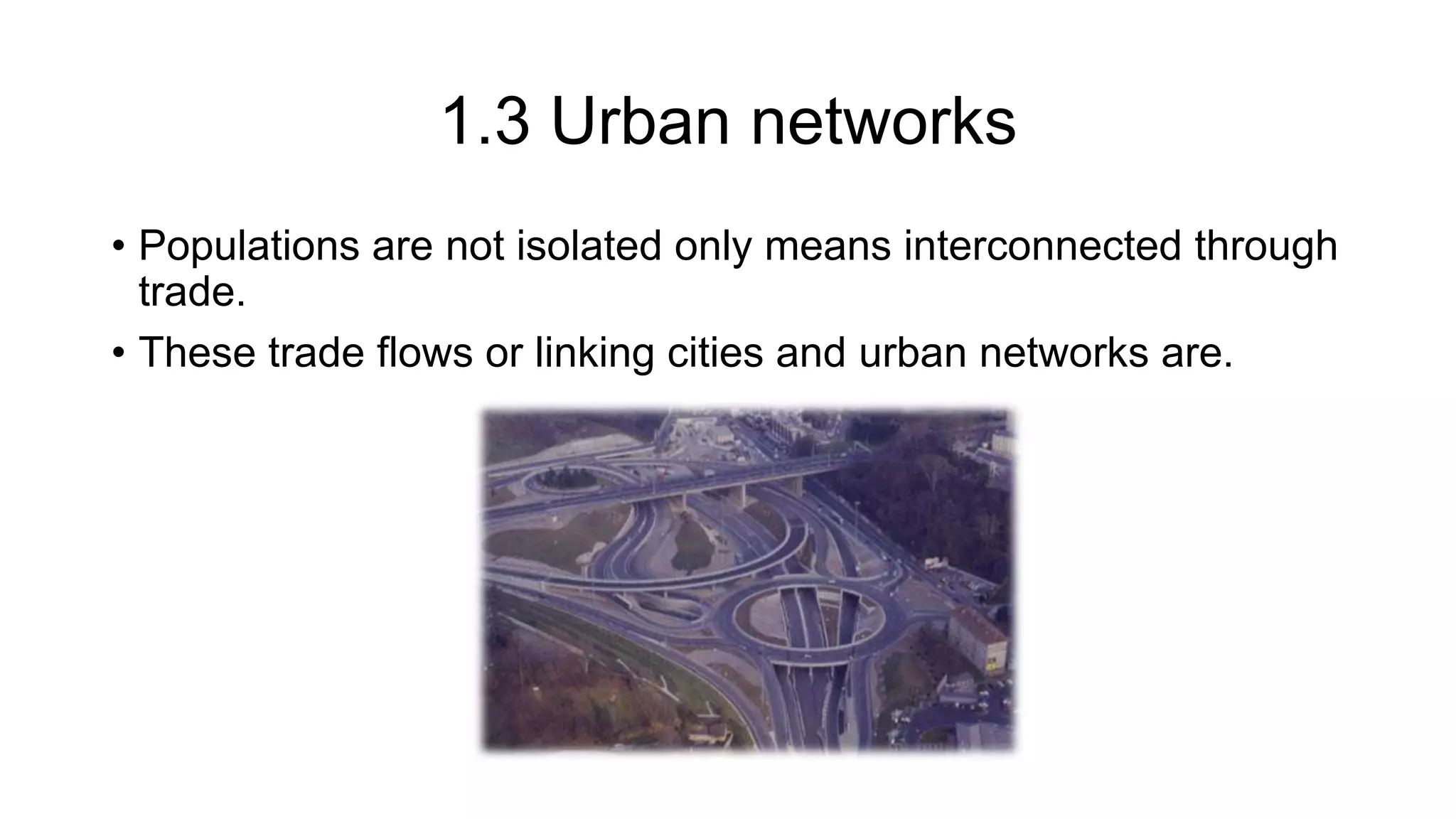
• Populations are not isolated only means interconnected through
trade.
• These trade flows or linking cities and urban networks are.
Program 2:
Territorial and social inequalities
Daniel Lopez
Judith Blanch
Amanda Medina
Paula Vizcarra
2.1 Social and territorial differences
• The Globalization is not just economic or financial, is a
process that also includes social, cultural, occupational, and
environmental. Number of advantages, accentuating poverty
and social inequalities.
• The phenomen on of globalization favors a few other cities
on favors industrial zones.
• The urban housings are distributed in the territory according
to the purchasing power of the population who lives every
place.
2.2 New areas for a rich people
• People with a lot of money, want privileged areas of the city
with comfortably and luxuriously homes.
• This emerging private estates, gardens, green
areas, restricted access to residents, golf courses, etc ...
2.3 Marginal areas
• In the prefer of the cities form the developing countries, and
a many cities in developed countries, there are areas of
settlement precarious.
• In these areas, there is a part of the population who lives
badly with a minimal conditions and, illegally.
2.3 The central city
• Recover parts of the historic center through the transformation of some
buildings in luxury hotels and restaurants or design shops. This process is
known as gentrification.
• New exclusive services influence a rise of land prices, and attract residents
with a high standard of living.
• The usual residents tend to leave these areas of the city and seek
economically affordable neighborhoods.
• There are neighborhoods that are deteriorating from the center to the lack
of investment in infrastructure and the part of the public or the private
sector.
• The town has few resources remains in these degraded areas of the city
center.
Program 3
The urban landscape in the world today
Yasmina Vazquez
Aida Ibañez
3.1 A world of cities
• During the last decades the urban population now exceeds the
population rural. The characteristics of this improvement are:
* Big cities the millions of people.
* Cities have a high technology but with environmental problems.
* Cities compete worldwide
* Multicultural cities.
3.2 Cities in developed countries
• Cities in developed countries have experienced a loss of density,
because the population moved to live outside the city or medium-
sized cities. So there has been a remarkable growth of metropolitan
areas.
• Compact city has spent a continuous urban area where it is very
difficult to determine where it begins and ends in the city.
3.3 Cities in developing countries
• Largest cities are called the third world megacities and megalopolises.
• What are large urban concentrations exceding ten million inhabitants.
• The urban conurbations play a dominant role
• Examples of the megacity have in Rio de Janeiro and developed
countries there are in Tokyo or Yokohama-Boston-Washington.
4
THE DIFFUSE CITY
Oscar osá Edjang
Erich Gárate
• The boundaries between the rural and the urban:
• In metropolitan areas , the boundary between
the city and countryside is not a line defined. City moves on the
countryside and this created an area were mixed it has activities mixed
urban and rural. It’s a very dynamic and changind, we can call in severals
ways:
Diffuse city
Peri-urban area
Strip rururbano
Uses and functions to urban sprawl:
• The activities in the territory of the urban sprawl organized
according to the needs of the metropolis could hardly be placed into
the strict city:
Urbanization, industrial parks, sports facilities and urban farmland
recipients market etc ...
• It’s a kind of diffusions of the functions and
activities of the tradicional city, but developed a more extensive and
variebles limits, which for this reason is called urban sprawl.
Causes of diffuse city
• Causes of diffuse city:
The growth of diffuse city is mainly due to higher pre-ground from the
big city and it is possible, in large part thanks to the development of
private transport (cars, trucks, etc.) and the increase in road
infrastructure (roads, etc.) to facilitate bringing some rural areas in
the city.
Impact of urban sprawl
If not carried out a proper planning, the repercussion of the growth model
of urban sprawl can be very negative for these reasons:
• Very high consumptions of the sun
• Services increased
• Constant mobility
• Development of a more individualistic social model
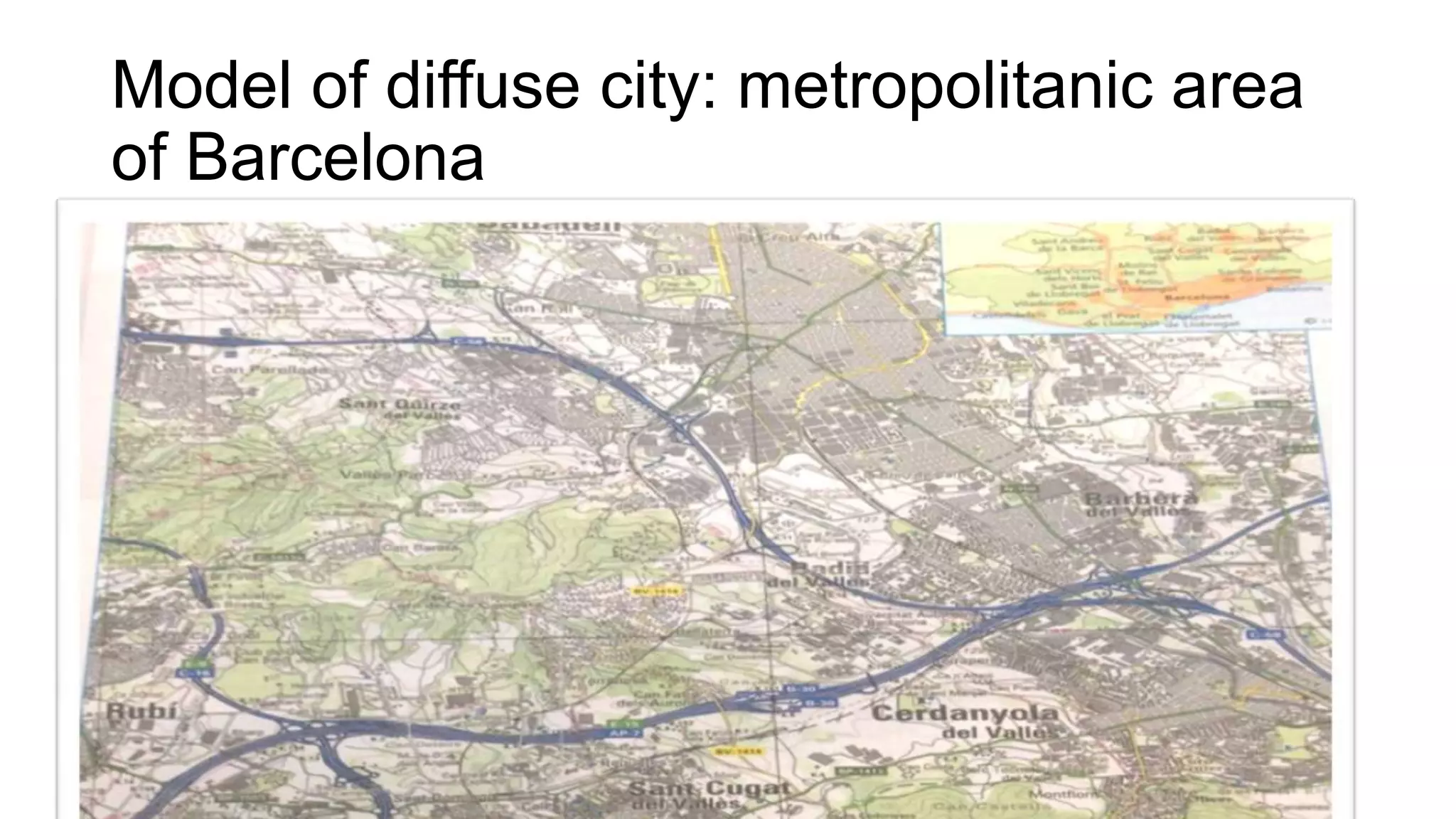
Model of diffuse city: metropolitanic area
of Barcelona
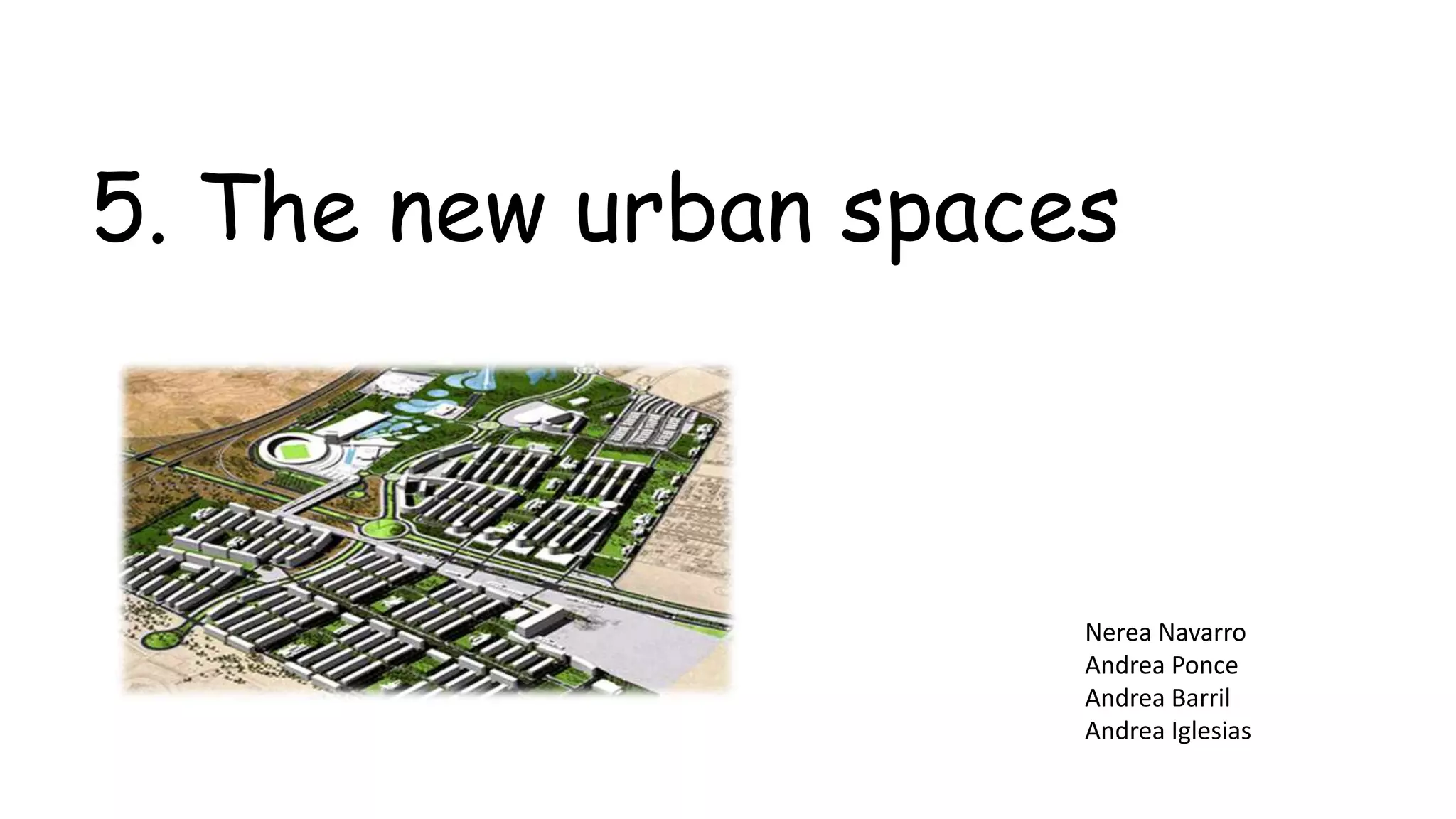
5. The new urban spaces
Andrea Barril
Andrea Iglesias
Nerea Navarro
Andrea Ponce
Nerea Navarro
Andrea Ponce
Andrea Barril
Andrea Iglesias
5.1 The new spaces
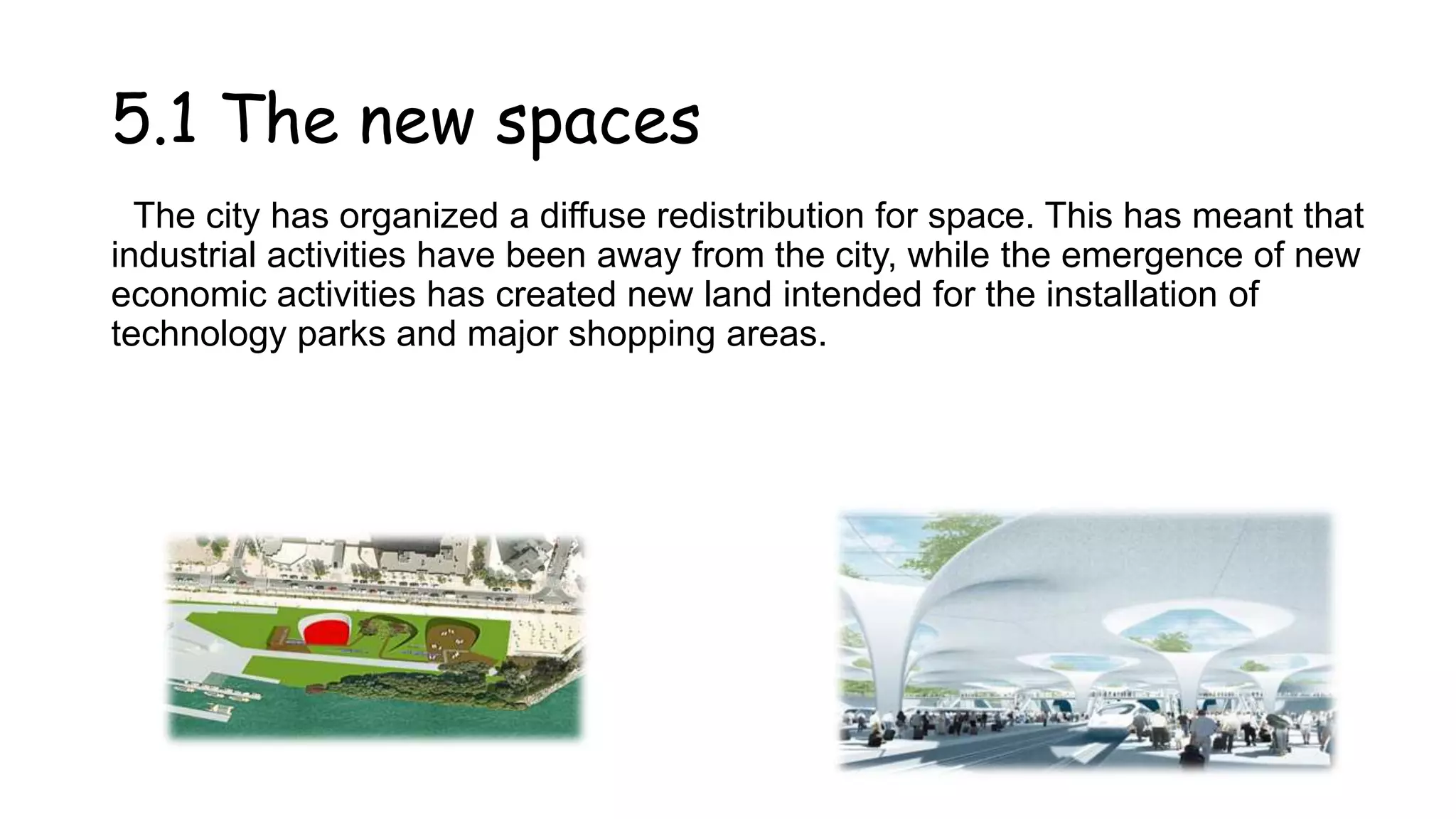
The city has organized a diffuse redistribution for space. This has meant that
industrial activities have been away from the city, while the emergence of new
economic activities has created new land intended for the installation of
technology parks and major shopping areas.
5.3 The functions of the central town
or big city
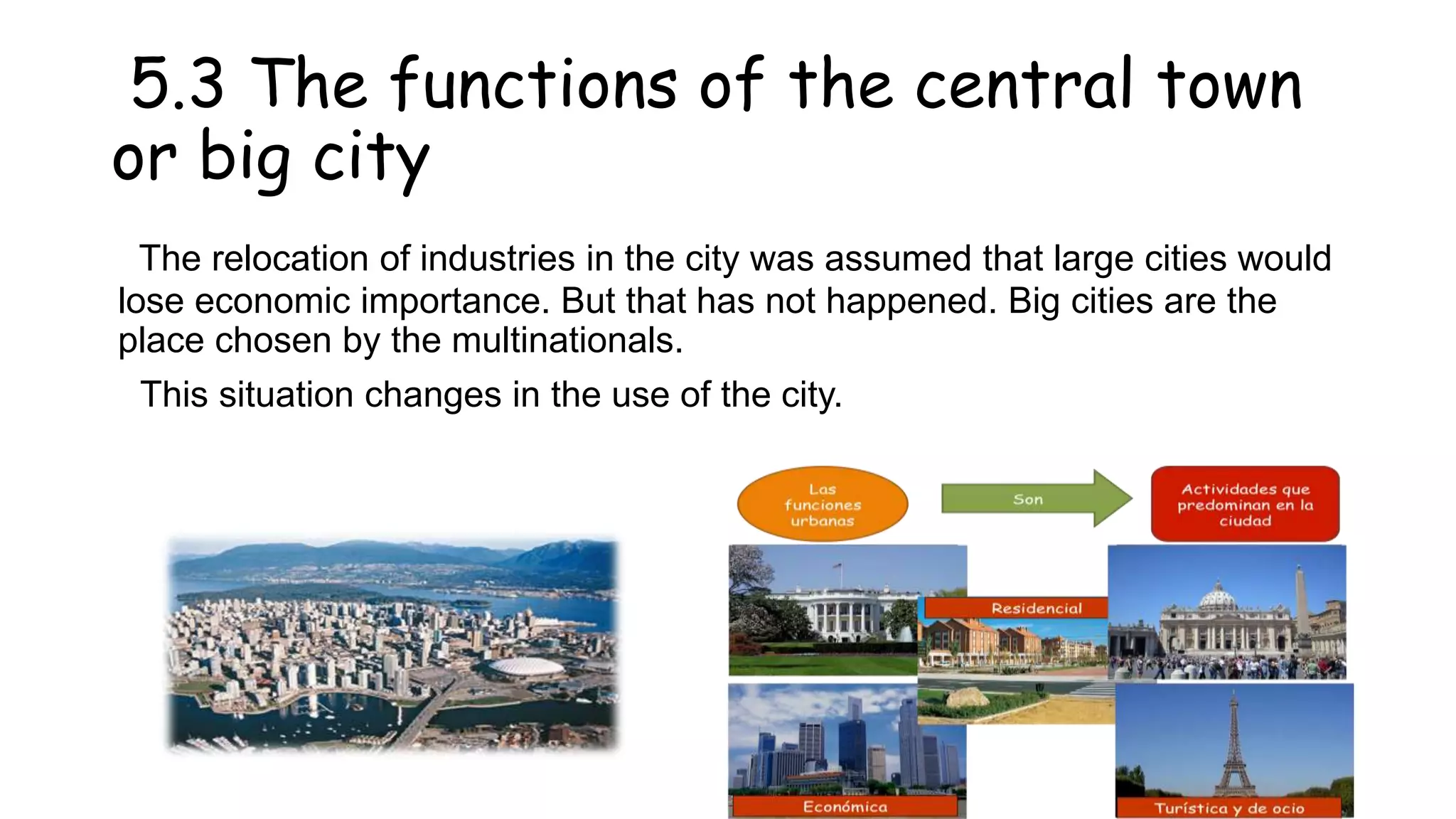
The relocation of industries in the city was assumed that large cities would
lose economic importance. But that has not happened. Big cities are the
place chosen by the multinationals.
This situation changes in the use of the city.
5.4 Technology parks
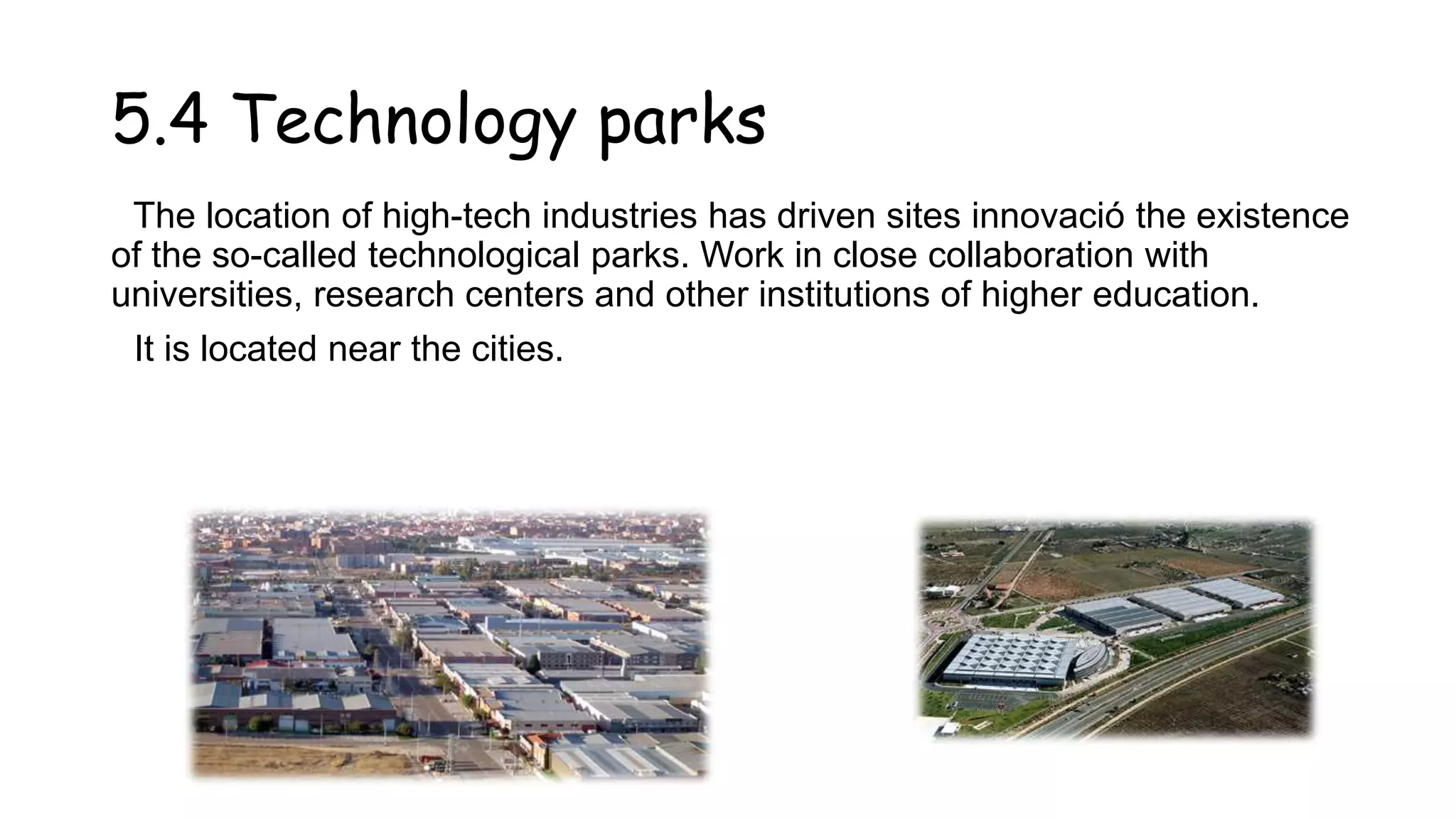
The location of high-tech industries has driven sites innovació the existence
of the so-called technological parks. Work in close collaboration with
universities, research centers and other institutions of higher education.
It is located near the cities.
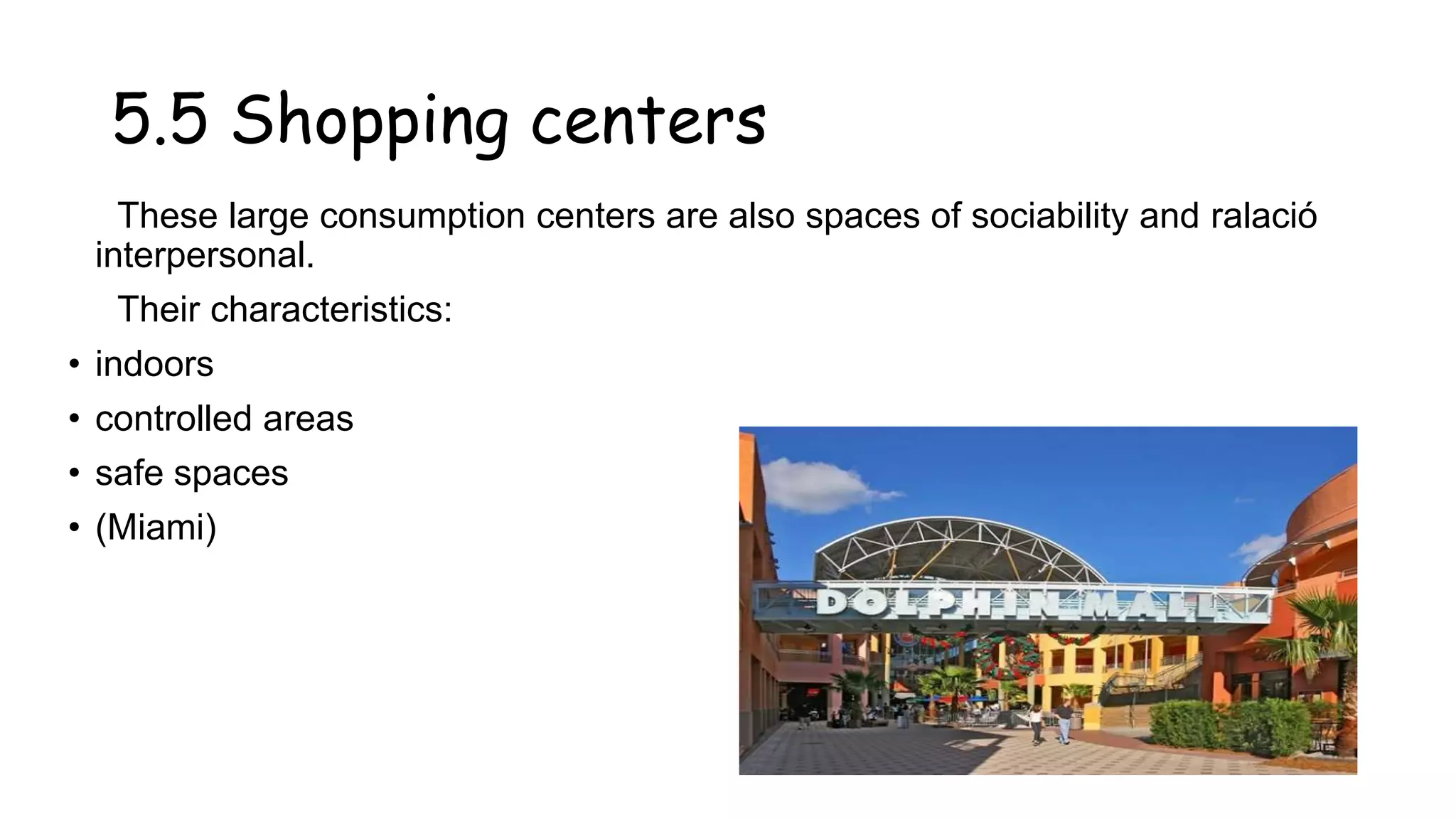
5.5 Shopping centers
These large consumption centers are also spaces of sociability and ralació
interpersonal.
Their characteristics:
• indoors
• controlled areas
• safe spaces
• (Miami)
THE ENVIRONMENTAL
PROBLEMS IN CITIES
JORDI RUBIO SALVADOR
3r I
URBAN AREA
- Alters the natural
- Constructs a humanized landscape
- Operation and modification of resources
LACK OF VEGETATION
• Lack of vegetation:
- deforestation
- Lack of grenery.
• EFECTS
- Reduction of water from rivers and wells
- Climate change
SCARCITY AND WATER POLLUTION
• Scarcity and water pollution:
- ¼ people affected by the shortage
- Developed countries consume too much water
- Contamination of groundwater due to lack of separation between
the potable water networks and sewage pipes
• Efects: infectious diseases (hepatitis)
6- THE ENVIRONMENTAL PROBLEMS
OF CITIES
• Fiorella Villanueva Gárate
• Mireia Florejachs Costa
• Laia Agudo Utrero
HIGH CONTAMINATION
• In the cities there are other sources of contamination very difficult
to control and cause a considerable air pollution, such as sulfur
dioxide and carbon monoxide, smoke from vehicles and factories.
• The urban population also has to bear the noise pollution, noise
from vehicles, industries of public works and neighbors and citizens
who behave antisocial.
A CONSUMER SOCIETY
• The big consumption that exist in cities cause a great accumulation
of solid waste which are difficult to collect, classify, recycle or
eliminate.
• The hygienic and health problems more serious happen in cities less
developed by budget or by infrastructure, are frequent landfills
outdoors
A CONSUMER SOCIETY (part 2)
• The consequences of that there are dumps:
odors, the danger of contamination of groundwater and the
proliferation of rodents, animals that have many diseases which are
transmitted to the population.
Currently the "modern city" does a great consumption of non-
renewable energy (oil, natural gas ..).
http://www.youtube.com/watch?v=kEyjWTJX4UA

The organization of urban space

  • 1.
    Unit 14 The organizationof urban space Tania Hidalgo Reyes Maria Bonilla Lorente Anna Garcia Rasero
  • 2.
    The process ofurbanization. The phenomenon of urbanization is due to the growth of cities, both because it has increased the number of inhabitants and the new economic activities conducted there. The growth of the town and surrounding areas has been alternating with the morphology over time, so that in the historical evolution of European cities recognize three stages:  The pre-industrial city The industrial city post-industrial city
  • 3.
    THE OLD CITY:GREECE AND ROME Characteristics of the first Greek cities: They haven’t a regular layout, and the streets were narrow and winding. Later on it was used a layout of streets cutting off perpendicularly, with spaces and public buildings (Agora) Characteristics of Roman cities: They had a regular form, with two principals streets. They had water pipes, bridges, buildings for shows, roads… Theatre Commercial port Acropolis Agora Homes Agora Homes
  • 4.
    THE CITY INTHE MIDDLE AGES The cities in the middle ages were step up as centers economics. Was a safe place for people, because protect the walls from the outside in case of attack. Characteristics: The streets were narrow and winding. They formed authentic mazes. In the centers there used to be a place voted importance of buildings. CITIES IN THE MODERN AGE The cities in the modern age changed a lot of. The old outside city was incorporated at the cities, and outside the wall, without throw out them, they was building news districts. The cities was incorporated squares, gardens, monumental fountain and sewage system and they was pave the streets. medieval wall extramural
  • 5.
    The industrial cities •Theindustrial cities appear with the industrial revolution. •The installation of factory and railway did grow the workforce and the number of inhabitants. •The workes lived in wet habitatges with bad sanitary conditions. •The news means of transport modified the stretches of roads and helped in the connection between the diferents areas and nearby villages.
  • 6.
    THE POST-INDUSTRIAL CITY The postindustrial city arises from the seventies of the century XX, especially in developed countries. The center loses residential functions and tends to greater specialization in tertiary activities.  The trend towards more flexible production process has enabled the factories move some to other areas.  Ease of transport and communications allows the movement of the population to ever more distant areas, as what matters is the availability (time) not distance.
  • 7.
    Program 1 1.1-Globalization andurban space. • Since the late 20th century, the globalitzation the economy has transformed the urban space and has favored the emergence of new types of cities: global cities for example: New York. Aleix Gallego Antonio Caballero David Barrera
  • 8.
    1.2 Transformations inlarge cities. • To adapt to the new global functions, large cities have experienced significant socio-economic changes. As a result of this increase in building large cities have experienced strong prices rose land and buildings.
  • 9.
    1.3 Urban networks •Populations are not isolated only means interconnected through trade. • These trade flows or linking cities and urban networks are.
  • 10.
    Program 2: Territorial andsocial inequalities Daniel Lopez Judith Blanch Amanda Medina Paula Vizcarra
  • 11.
    2.1 Social andterritorial differences • The Globalization is not just economic or financial, is a process that also includes social, cultural, occupational, and environmental. Number of advantages, accentuating poverty and social inequalities. • The phenomen on of globalization favors a few other cities on favors industrial zones. • The urban housings are distributed in the territory according to the purchasing power of the population who lives every place.
  • 12.
    2.2 New areasfor a rich people • People with a lot of money, want privileged areas of the city with comfortably and luxuriously homes. • This emerging private estates, gardens, green areas, restricted access to residents, golf courses, etc ...
  • 13.
    2.3 Marginal areas •In the prefer of the cities form the developing countries, and a many cities in developed countries, there are areas of settlement precarious. • In these areas, there is a part of the population who lives badly with a minimal conditions and, illegally.
  • 14.
    2.3 The centralcity • Recover parts of the historic center through the transformation of some buildings in luxury hotels and restaurants or design shops. This process is known as gentrification. • New exclusive services influence a rise of land prices, and attract residents with a high standard of living. • The usual residents tend to leave these areas of the city and seek economically affordable neighborhoods. • There are neighborhoods that are deteriorating from the center to the lack of investment in infrastructure and the part of the public or the private sector. • The town has few resources remains in these degraded areas of the city center.
  • 15.
    Program 3 The urbanlandscape in the world today Yasmina Vazquez Aida Ibañez
  • 16.
    3.1 A worldof cities • During the last decades the urban population now exceeds the population rural. The characteristics of this improvement are: * Big cities the millions of people. * Cities have a high technology but with environmental problems. * Cities compete worldwide * Multicultural cities.
  • 17.
    3.2 Cities indeveloped countries • Cities in developed countries have experienced a loss of density, because the population moved to live outside the city or medium- sized cities. So there has been a remarkable growth of metropolitan areas. • Compact city has spent a continuous urban area where it is very difficult to determine where it begins and ends in the city.
  • 18.
    3.3 Cities indeveloping countries • Largest cities are called the third world megacities and megalopolises. • What are large urban concentrations exceding ten million inhabitants. • The urban conurbations play a dominant role • Examples of the megacity have in Rio de Janeiro and developed countries there are in Tokyo or Yokohama-Boston-Washington.
  • 19.
    4 THE DIFFUSE CITY Oscarosá Edjang Erich Gárate
  • 20.
    • The boundariesbetween the rural and the urban: • In metropolitan areas , the boundary between the city and countryside is not a line defined. City moves on the countryside and this created an area were mixed it has activities mixed urban and rural. It’s a very dynamic and changind, we can call in severals ways: Diffuse city Peri-urban area Strip rururbano
  • 21.
    Uses and functionsto urban sprawl: • The activities in the territory of the urban sprawl organized according to the needs of the metropolis could hardly be placed into the strict city: Urbanization, industrial parks, sports facilities and urban farmland recipients market etc ... • It’s a kind of diffusions of the functions and activities of the tradicional city, but developed a more extensive and variebles limits, which for this reason is called urban sprawl.
  • 22.
    Causes of diffusecity • Causes of diffuse city: The growth of diffuse city is mainly due to higher pre-ground from the big city and it is possible, in large part thanks to the development of private transport (cars, trucks, etc.) and the increase in road infrastructure (roads, etc.) to facilitate bringing some rural areas in the city.
  • 23.
    Impact of urbansprawl If not carried out a proper planning, the repercussion of the growth model of urban sprawl can be very negative for these reasons: • Very high consumptions of the sun • Services increased • Constant mobility • Development of a more individualistic social model
  • 24.
    Model of diffusecity: metropolitanic area of Barcelona
  • 25.
    5. The newurban spaces Andrea Barril Andrea Iglesias Nerea Navarro Andrea Ponce Nerea Navarro Andrea Ponce Andrea Barril Andrea Iglesias
  • 26.
    5.1 The newspaces The city has organized a diffuse redistribution for space. This has meant that industrial activities have been away from the city, while the emergence of new economic activities has created new land intended for the installation of technology parks and major shopping areas.
  • 27.
    5.3 The functionsof the central town or big city The relocation of industries in the city was assumed that large cities would lose economic importance. But that has not happened. Big cities are the place chosen by the multinationals. This situation changes in the use of the city.
  • 28.
    5.4 Technology parks Thelocation of high-tech industries has driven sites innovació the existence of the so-called technological parks. Work in close collaboration with universities, research centers and other institutions of higher education. It is located near the cities.
  • 29.
    5.5 Shopping centers Theselarge consumption centers are also spaces of sociability and ralació interpersonal. Their characteristics: • indoors • controlled areas • safe spaces • (Miami)
  • 30.
    THE ENVIRONMENTAL PROBLEMS INCITIES JORDI RUBIO SALVADOR 3r I
  • 31.
    URBAN AREA - Altersthe natural - Constructs a humanized landscape - Operation and modification of resources
  • 32.
    LACK OF VEGETATION •Lack of vegetation: - deforestation - Lack of grenery. • EFECTS - Reduction of water from rivers and wells - Climate change
  • 33.
    SCARCITY AND WATERPOLLUTION • Scarcity and water pollution: - ¼ people affected by the shortage - Developed countries consume too much water - Contamination of groundwater due to lack of separation between the potable water networks and sewage pipes • Efects: infectious diseases (hepatitis)
  • 34.
    6- THE ENVIRONMENTALPROBLEMS OF CITIES • Fiorella Villanueva Gárate • Mireia Florejachs Costa • Laia Agudo Utrero
  • 35.
    HIGH CONTAMINATION • Inthe cities there are other sources of contamination very difficult to control and cause a considerable air pollution, such as sulfur dioxide and carbon monoxide, smoke from vehicles and factories. • The urban population also has to bear the noise pollution, noise from vehicles, industries of public works and neighbors and citizens who behave antisocial.
  • 36.
    A CONSUMER SOCIETY •The big consumption that exist in cities cause a great accumulation of solid waste which are difficult to collect, classify, recycle or eliminate. • The hygienic and health problems more serious happen in cities less developed by budget or by infrastructure, are frequent landfills outdoors
  • 37.
    A CONSUMER SOCIETY(part 2) • The consequences of that there are dumps: odors, the danger of contamination of groundwater and the proliferation of rodents, animals that have many diseases which are transmitted to the population. Currently the "modern city" does a great consumption of non- renewable energy (oil, natural gas ..). http://www.youtube.com/watch?v=kEyjWTJX4UA