Space Planning in Records
Management: Storing More
Records in Less Space
THE GREAT SPACE CRUNCH
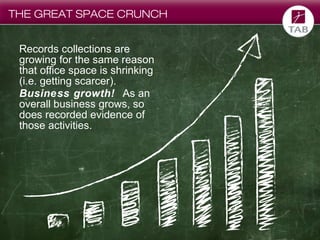
Records collections are
growing for the same reason
that office space is shrinking
(i.e. getting scarcer).
Business growth! As an
overall business grows, so
does recorded evidence of
those activities.
THE GREAT SPACE CRUNCH

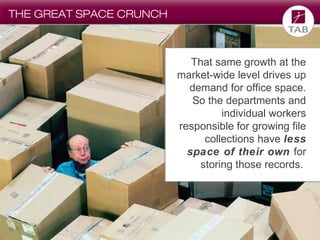
That same growth at the
market-wide level drives up
demand for office space.
So the departments and
individual workers
responsible for growing file
collections have less
space of their own for
storing those records.
SPACE MANAGEMENT: A TOTAL SOLUTION APPROACH

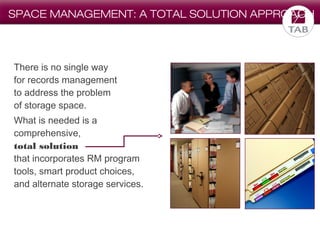
There is no single way
for records management
to address the problem
of storage space.
What is needed is a
comprehensive,
total solution
that incorporates RM program
tools, smart product choices,
and alternate storage services.
SPACE MANAGEMENT: A TOTAL SOLUTION APPROACH

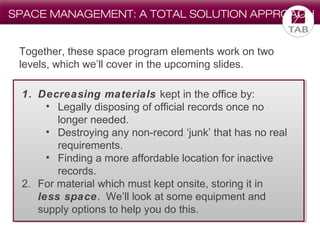
Together, these space program elements work on two
levels, which we’ll cover in the upcoming slides.
1. Decreasing materials kept in the office by:
• Legally disposing of official records once no
longer needed.
• Destroying any non-record ‘junk’ that has no real
requirements.
• Finding a more affordable location for inactive
records.
2. For material which must kept onsite, storing it in
less space. We’ll look at some equipment and
supply options to help you do this.
SPACE MANAGEMENT: A TOTAL SOLUTION APPROACH

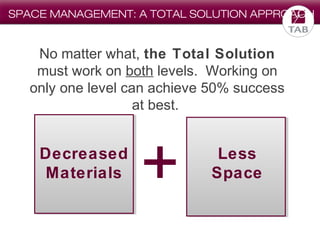
No matter what, the Total Solution
must work on both levels. Working on
only one level can achieve 50% success
at best.

Decreased
Materials

+

Less
Space
LEVEL 1: REDUCE VOLUME
RETAINED

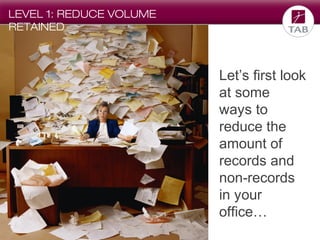
Let’s first look
at some
ways to
reduce the
amount of
records and
non-records
in your
office…
LEVEL 1: REDUCE VOLUME
RETAINED
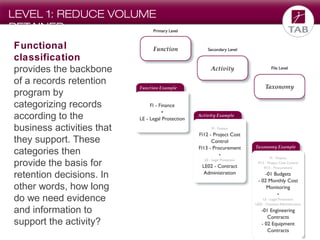
Functional
classification
provides the backbone
of a records retention
program by
categorizing records
according to the
business activities that
they support. These
categories then
provide the basis for
retention decisions. In
other words, how long
do we need evidence
and information to
support the activity?
LEVEL 1: REDUCE VOLUME
RETAINED
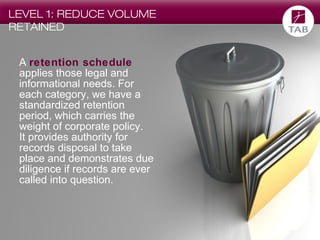
A retention schedule
applies those legal and
informational needs. For
each category, we have a
standardized retention
period, which carries the
weight of corporate policy.
It provides authority for
records disposal to take
place and demonstrates due
diligence if records are ever
called into question.
LEVEL 1: REDUCE VOLUME
RETAINED
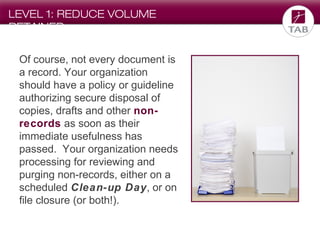
Of course, not every document is
a record. Your organization
should have a policy or guideline
authorizing secure disposal of
copies, drafts and other nonrecords as soon as their
immediate usefulness has
passed. Your organization needs
processing for reviewing and
purging non-records, either on a
scheduled Clean-up Day, or on
file closure (or both!).
LEVEL 1: REDUCE VOLUME
RETAINED

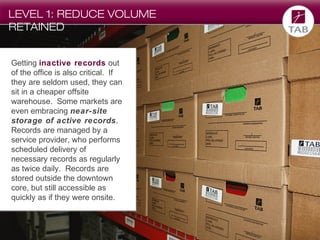
Getting inactive records out
of the office is also critical. If
they are seldom used, they can
sit in a cheaper offsite
warehouse. Some markets are
even embracing near-site
storage of active records.
Records are managed by a
service provider, who performs
scheduled delivery of
necessary records as regularly
as twice daily. Records are
stored outside the downtown
core, but still accessible as
quickly as if they were onsite.
LEVEL 1: REDUCE VOLUME
RETAINED

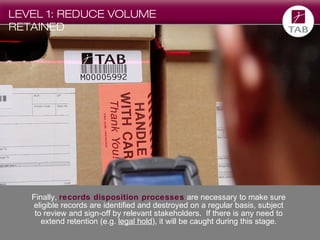
Finally, records disposition processes are necessary to make sure
eligible records are identified and destroyed on a regular basis, subject
to review and sign-off by relevant stakeholders. If there is any need to
extend retention (e.g. legal hold), it will be caught during this stage.
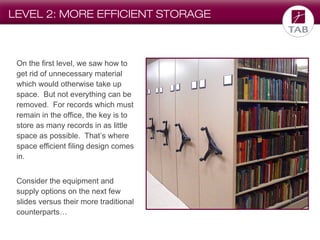
LEVEL 2: MORE EFFICIENT STORAGE

On the first level, we saw how to
get rid of unnecessary material
which would otherwise take up
space. But not everything can be
removed. For records which must
remain in the office, the key is to
store as many records in as little
space as possible. That’s where
space efficient filing design comes
in.
Consider the equipment and
supply options on the next few
slides versus their more traditional
counterparts…
LEVEL 2: MORE EFFICIENT STORAGE

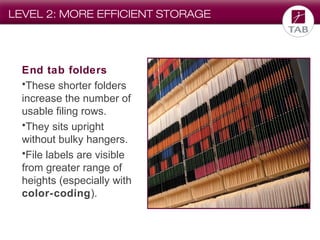
End tab folders
•These shorter folders
increase the number of
usable filing rows.
•They sits upright
without bulky hangers.
•File labels are visible
from greater range of
heights (especially with
color-coding).
LEVEL 2: MORE EFFICIENT STORAGE

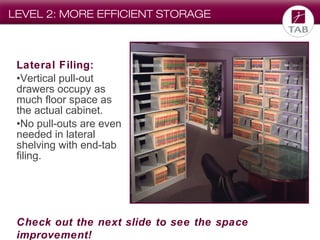
Lateral Filing:
•Vertical pull-out
drawers occupy as
much floor space as
the actual cabinet.
•No pull-outs are even
needed in lateral
shelving with end-tab
filing.

Check out the next slide to see the space
improvement!
LEVEL 2: MORE EFFICIENT STORAGE

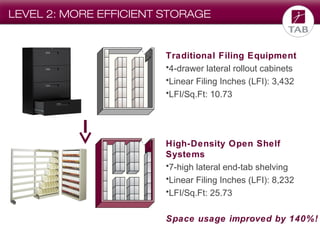
Traditional Filing Equipment
•4-drawer lateral rollout cabinets
•Linear Filing Inches (LFI): 3,432
•LFI/Sq.Ft: 10.73

High-Density Open Shelf
Systems
•7-high lateral end-tab shelving
•Linear Filing Inches (LFI): 8,232
•LFI/Sq.Ft: 25.73
Space usage improved by 140%!
LEVEL 2: MORE EFFICIENT STORAGE
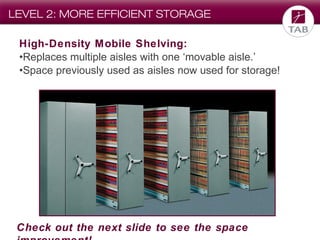
High-Density Mobile Shelving:
•Replaces multiple aisles with one ‘movable aisle.’
•Space previously used as aisles now used for storage!

Check out the next slide to see the space
LEVEL 2: MORE EFFICIENT STORAGE

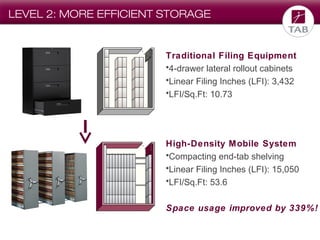
Traditional Filing Equipment
•4-drawer lateral rollout cabinets
•Linear Filing Inches (LFI): 3,432
•LFI/Sq.Ft: 10.73

High-Density Mobile System
•Compacting end-tab shelving
•Linear Filing Inches (LFI): 15,050
•LFI/Sq.Ft: 53.6
Space usage improved by 339%!
SAMPLE SPACE MANAGEMENT
PLAN
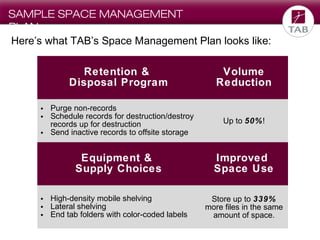
Here’s what TAB’s Space Management Plan looks like:
Retention &
Disposal Program

Volume
Reduction

• Purge non-records
• Schedule records for destruction/destroy
records up for destruction
• Send inactive records to offsite storage

Up to 50%!

Equipment &
Supply Choices

Improved
Space Use

• High-density mobile shelving
• Lateral shelving
• End tab folders with color-coded labels

Store up to 339%
more files in the same
amount of space.
DOING MORE WITH LESS?

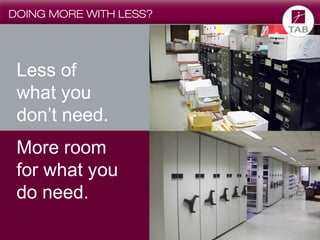
Less of
what you
don’t need.
More room
for what you
do need.
DOING MORE WITH LESS?

Need more space?
Contact TAB to learn
more about our high-density
storage solutions:
www.tab.com/contact

Space Planning in Records Management

  • 1.
    Space Planning inRecords Management: Storing More Records in Less Space
  • 2.
    THE GREAT SPACECRUNCH Records collections are growing for the same reason that office space is shrinking (i.e. getting scarcer). Business growth! As an overall business grows, so does recorded evidence of those activities.
  • 3.
    THE GREAT SPACECRUNCH That same growth at the market-wide level drives up demand for office space. So the departments and individual workers responsible for growing file collections have less space of their own for storing those records.
  • 4.
    SPACE MANAGEMENT: ATOTAL SOLUTION APPROACH There is no single way for records management to address the problem of storage space. What is needed is a comprehensive, total solution that incorporates RM program tools, smart product choices, and alternate storage services.
  • 5.
    SPACE MANAGEMENT: ATOTAL SOLUTION APPROACH Together, these space program elements work on two levels, which we’ll cover in the upcoming slides. 1. Decreasing materials kept in the office by: • Legally disposing of official records once no longer needed. • Destroying any non-record ‘junk’ that has no real requirements. • Finding a more affordable location for inactive records. 2. For material which must kept onsite, storing it in less space. We’ll look at some equipment and supply options to help you do this.
  • 6.
    SPACE MANAGEMENT: ATOTAL SOLUTION APPROACH No matter what, the Total Solution must work on both levels. Working on only one level can achieve 50% success at best. Decreased Materials + Less Space
  • 7.
    LEVEL 1: REDUCEVOLUME RETAINED Let’s first look at some ways to reduce the amount of records and non-records in your office…
  • 8.
    LEVEL 1: REDUCEVOLUME RETAINED Functional classification provides the backbone of a records retention program by categorizing records according to the business activities that they support. These categories then provide the basis for retention decisions. In other words, how long do we need evidence and information to support the activity?
  • 9.
    LEVEL 1: REDUCEVOLUME RETAINED A retention schedule applies those legal and informational needs. For each category, we have a standardized retention period, which carries the weight of corporate policy. It provides authority for records disposal to take place and demonstrates due diligence if records are ever called into question.
  • 10.
    LEVEL 1: REDUCEVOLUME RETAINED Of course, not every document is a record. Your organization should have a policy or guideline authorizing secure disposal of copies, drafts and other nonrecords as soon as their immediate usefulness has passed. Your organization needs processing for reviewing and purging non-records, either on a scheduled Clean-up Day, or on file closure (or both!).
  • 11.
    LEVEL 1: REDUCEVOLUME RETAINED Getting inactive records out of the office is also critical. If they are seldom used, they can sit in a cheaper offsite warehouse. Some markets are even embracing near-site storage of active records. Records are managed by a service provider, who performs scheduled delivery of necessary records as regularly as twice daily. Records are stored outside the downtown core, but still accessible as quickly as if they were onsite.
  • 12.
    LEVEL 1: REDUCEVOLUME RETAINED Finally, records disposition processes are necessary to make sure eligible records are identified and destroyed on a regular basis, subject to review and sign-off by relevant stakeholders. If there is any need to extend retention (e.g. legal hold), it will be caught during this stage.
  • 13.
    LEVEL 2: MOREEFFICIENT STORAGE On the first level, we saw how to get rid of unnecessary material which would otherwise take up space. But not everything can be removed. For records which must remain in the office, the key is to store as many records in as little space as possible. That’s where space efficient filing design comes in. Consider the equipment and supply options on the next few slides versus their more traditional counterparts…
  • 14.
    LEVEL 2: MOREEFFICIENT STORAGE End tab folders •These shorter folders increase the number of usable filing rows. •They sits upright without bulky hangers. •File labels are visible from greater range of heights (especially with color-coding).
  • 15.
    LEVEL 2: MOREEFFICIENT STORAGE Lateral Filing: •Vertical pull-out drawers occupy as much floor space as the actual cabinet. •No pull-outs are even needed in lateral shelving with end-tab filing. Check out the next slide to see the space improvement!
  • 16.
    LEVEL 2: MOREEFFICIENT STORAGE Traditional Filing Equipment •4-drawer lateral rollout cabinets •Linear Filing Inches (LFI): 3,432 •LFI/Sq.Ft: 10.73 High-Density Open Shelf Systems •7-high lateral end-tab shelving •Linear Filing Inches (LFI): 8,232 •LFI/Sq.Ft: 25.73 Space usage improved by 140%!
  • 17.
    LEVEL 2: MOREEFFICIENT STORAGE High-Density Mobile Shelving: •Replaces multiple aisles with one ‘movable aisle.’ •Space previously used as aisles now used for storage! Check out the next slide to see the space
  • 18.
    LEVEL 2: MOREEFFICIENT STORAGE Traditional Filing Equipment •4-drawer lateral rollout cabinets •Linear Filing Inches (LFI): 3,432 •LFI/Sq.Ft: 10.73 High-Density Mobile System •Compacting end-tab shelving •Linear Filing Inches (LFI): 15,050 •LFI/Sq.Ft: 53.6 Space usage improved by 339%!
  • 19.
    SAMPLE SPACE MANAGEMENT PLAN Here’swhat TAB’s Space Management Plan looks like: Retention & Disposal Program Volume Reduction • Purge non-records • Schedule records for destruction/destroy records up for destruction • Send inactive records to offsite storage Up to 50%! Equipment & Supply Choices Improved Space Use • High-density mobile shelving • Lateral shelving • End tab folders with color-coded labels Store up to 339% more files in the same amount of space.
  • 20.
    DOING MORE WITHLESS? Less of what you don’t need. More room for what you do need.
  • 21.
    DOING MORE WITHLESS? Need more space? Contact TAB to learn more about our high-density storage solutions: www.tab.com/contact