Human Geography: Places and
Regions in Global Context, 5e
      Chapter 10: Urbanization
  Paul L. Knox & Sallie A. Marston
  PowerPoint Author: Keith M. Bell
Overview
The world is becoming increasingly urbanized, and cities have come to
dominate even more aspects of modern life than they did in previous times.
Whether we live in one or not, cities have a strong influence on our lives—
especially, perhaps, for Americans. Most of the products people buy, the
services they use, and the fashions and cultural tastes they follow originate in
cities.
This chapter examines the impact and influence of cities and the factors leading
to their growth. Urban systems are ancient in origin, but became especially
important in Medieval Europe, where they were associated with the rise of
capitalism. The rise of merchant capitalism helped prompt colonialism, further
helping to spread the urban model to many other places around the world. After
considering the growth of urbanization, this chapter turns to the contemporary
urban process, looking at central place theory as well as the economic base of
cities and the problems of increasing urbanization.
Chapter Objectives
• The objectives of this chapter are to:
  – Examine the roots of European urban
    expansion
  – Explore today’s urbanization, looking at
    regional trends and projections, and their
    urban systems
  – Investigate urban growth processes
Chapter Outline
•   Urban Geography and Urbanization (p. 390)
     – Functions of urban settlement
•   Urban Origins (p. 392)
     – European urban expansion
     – Industrialization
     – Imperialism and colonial cities
•   Urban Systems (p. 401)
     – City-size distributions
     – Primacy and centrality
•   World cities
     – Rapid growth of the world’s cities
     – Overurbanization and megacities
     – Mature cities and deindustrialization
•   Globalization and Splintering Urbanism (p. 417)
     – Differences between core and peripheral cities
•   Conclusion (p. 419)
Geography Matters
• 10.1 Visualizing Geography—Shock City:
  Manchester (p. 402)
  – Manchester, England, was an early industrial city
• 10.2 Window on the World—Urban Terrorism
   (p. 408)
  – Cities have become the sites of terrorism
• 10.3 Window on the World—Pearl River
  Delta: An Extended Metropolis (p. 412)
  – How the greater Hong Kong area has become a
    megacity
Urbanization
     The urban areas of the world are the
   linchpins of human geographies at the
        local, regional, and global scales.

  The earliest towns and cities developed
independently in the various hearth areas
       of the first agricultural revolution.

The expansion of trade around the world
   established numerous gateway cities.

The Industrial Revolution generated new
                          kinds of cities.

   Today, there is a striking difference in
 trends and projections between core and
peripheral regions in global urbanization.

A small number of “world cities” occupy
   key roles in the organization of global
                   economies and culture.

    Many megacities of the periphery are
         primate and highly centralized.
Urban Geography and Urbanization
• The study of urban geography is concerned with
  the development of towns and cities around the
  world, with particular reference to the similarities
  and differences both among and within urban
  places.
• Experts on urbanization point to four fundamental
  aspects of the role of towns and cities in human
  economic and social organization:
   –   The mobilizing function of urban settlement
   –   The decision-making capacity of urban settlement
   –   The generative functions of urban settlement
   –   The transformative capacity of urban settlement
Urban Population/Urban
     Settlements
           •   Towns and cities must be
               viewed as part of the economies
               and societies that maintain
               them.
           •   Geographers analyze and
               conceptualize urban systems to
               understand the patterns and
               regularities they find. (e.g.,
               French urban system, African
               urban system, Islamic urban
               system, etc.).
           •   Urban form refers to the
               physical structure and
               organization of cities in their
               land use, layout, and built
               environment.
Urbanization Growth Rates, 2000–
               2005
• Urban form refers to the
  physical structure and
  organization of cities.
• Urban ecology is the
  social and demographic
  composition of city
  districts and
  neighborhoods.
• Urbanism concerns
  people’s attitudes and
  behaviors about the city in
  which they live.
The Roots of European Urban Expansion

• Greek and Roman influenced
• Feudalism gave rise to a fragmented landscape of
  inflexible, introverted world-empires
• Economic and social organization based on the communal
  chiefdoms of Germanic tribes
• An elaborate urban system developed, the largest of which
  became nodal centers in a global world-system
• Self-sufficient regarding food and resources
• Existence of towns depended on their role:
   – Ecclesiastical or university centers
   – Defensive strongholds
   – Administrative centers (for the upper tiers of the feudal hierarchy)
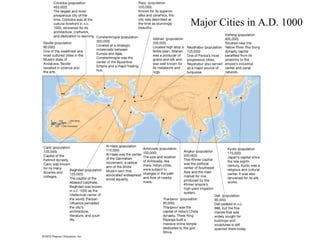
Major Cities in A.D. 1000
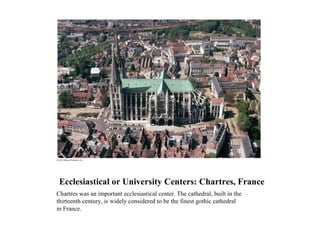
Ecclesiastical or University Centers: Chartres, France
Chartres was an important ecclesiastical center. The cathedral, built in the
thirteenth century, is widely considered to be the finest gothic cathedral
in France.
Defensive Strongholds: Aigues-Mortes, France
This walled medieval town in southern France is one of the best-
preserved examples of thirteenth-century military architecture. The town
of rectilinear streets is surrounded by a wall with five towers and ten
fortified gates.
Defensive Strongholds: Urbino, Italy
An important strategic center in the thirteenth century with a classic
hilltop defensive site, Urbino became a principal artistic center during the
Renaissance.
Administrative Centers: Cologne, Germany
In the late 1400s, Cologne had a population of less than 25,000 but was
already a critical commercial and manufacturing center, with an
important cathedral and a university that was more than 100 years of age.
The Towns and Cities of Europe, ca.
             1350
                  • Cities with more than
                    10,000 residents were
                    uncommon in medieval
                    Europe except in northern
                    Italy and Flanders, such as
                    the cities of Florence and
                    Delft (Netherlands), where
                    the spread of cloth
                    production and the growth
                    of trade permitted
                    relatively intense
                    urbanization.
Towns and Cities of Europe, ca.
             1350
Ghent, Belgium                         Venice, Italy


 The regional specializations and trading patterns that emerged provided
 the foundations for a new phase of urbanization based on merchant
 capitalism.
Towns and Cities of Europe, ca.
              1350
Florence, Italy                        Prague, Czech Republic


 Merchant capitalism (e.g., the Hanseatic League in the North and Baltic
 Seas) increased in scale and sophistication; economic and social
 reorganization was stimulated by the Protestant Reformation and the
 scientific revolution.
Gateway Cities
Growth of Chicago


Chicago’s growth in the nineteenth century followed the arrival of
railroads, which made the city a major transportation hub.
Urbanization Process: Core
         Regions
Imperialism and Peripheral Urbanization
Colonial cities are those that were deliberately established or developed as
administrative or commercial centers by colonial or imperial powers. This
painting of the Indian Peninsular Terminus in Mumbai (Bombay) shows
the influence of Victorian British architecture.
Shock City: Manchester


   A shock city is one that embodies surprising and
   disturbing changes in economic, social, and cultural life.
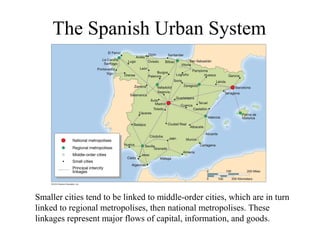
The Spanish Urban System


Smaller cities tend to be linked to middle-order cities, which are in turn
linked to regional metropolises, then national metropolises. These
linkages represent major flows of capital, information, and goods.
Functional Specialization Within an Urban System
Slum Housing in Peripheral
               Cities


Throughout much of the world, the scale and speed of urbanization,
combined with the scarcity of formal employment, have resulted in very
high proportions of slum housing, much of it erected by the squatters
themselves.
The Pearl River Delta: An Extended
            Metropolis
World Cities and the Global Urban
                    System
• World cities provide an interface between the global
  and the local. They are also sites of:
   – Most of the leading global markets
   – Clusters of specialized, advanced business services
   – Concentrations of corporate headquarters
   – Concentrations of national and international headquarters
     of trade and professional organizations
   – Most of the leading NGOs and IGOs that are international
     in scope
   – The most powerful and internationally influential media
     organizations
Urban Terrorism
The wreckage of a public train near Atocha train station in Madrid, Spain,
March 11, 2004. Thirteen bombs on four packed commuter trains killed
191 people and wounded more than 1500. The attack was attributed to
the Islamic militant group al-Qaeda.
World Cities in the Global Urban
             System


The sphere of influence of world cities, based on an analysis of the regional
headquarter functions of the world’s largest advanced business services firms.
Megacities
Mexico City, Mexico                      Shanghai, China


    Megacities’ most important common attribute is their sheer size—most of which
    have ten million or more in population. Other examples include Bangkok,
    Lagos, Manila, Dhaka, New Delhi, Jakarta, São Paulo, and Teheran.
Globalization and Splintering Urbanism
• Enclaves of Internet and digital multimedia technology
  development, mostly in core-country world cities.
• Technopoles and clusters of high-tech industrial innovation.
• Places configured for foreign direct investment in
  manufacturing, with customized infrastructure, expedited
  development approval processes, tax concessions, and in some
  cases exceptions to labor and environmental regulations.
• Enclaves of international banking, finance, and business
  services in world cities and major regional centers.
• Enclaves of modernization in the megacities and major regional
  centers of peripheral countries.
• Enclaves of back-office spaces, data-processing, e-commerce,
  and call centers.
• Spaces customized as “logistics zones.”
End Chapter 10
Discussion Topics and Lecture
             Themes
• What were some of the factors that led to the formation
  of the earliest urban-based world-empires? What factors
  might have contributed to the periodic collapse of these
  early empires?
   – Experts differ in their explanations of the first transitions from
     subsistence minisystems to city-based world-empires. The
     classic archeological interpretation emphasizes the availability of
     an agricultural surplus large enough to allow the emergence of
     specialized, nonagricultural workers. Some urbanization,
     however, seems to have been the result of the pressure of
     population growth. This growth caused some people to move to
     marginal areas, where they set up an urban economy based on
     trade, religion, or defense. Wars and epidemics contributed to
     the periodic collapse of these empires.
Discussion Topics and Lecture
               Themes
•    Compare and contrast lifestyles in rural and
     urban areas. What are the advantages and
     disadvantages of each? Ask the students
     which environment they prefer, and why. Might
     their response explain the rapid growth of
     urban areas in the late twentieth century, as
     well as the corresponding back-to-the-land
     movement?
    –   Many students may not have experienced life in
        rural areas, and they may have romantic notions
        about rural life. Population trends in the United
        States indicate a greater move from rural to urban
        environments, rather than the other way around.
Discussion Topics and Lecture
               Themes
•    Give some examples of Medieval European
     cities (especially those still flourishing today).
     What factors contributed to the growth of these
     cities?
    –   Examples of Medieval European cities include
        Cambridge (England), Bruges (Belgium), and Mainz
        (Germany) among many others. Medieval towns
        were established for a variety of reasons, including
        as ecclesiastical or university centers, as defensive
        strongholds, and as administrative centers.
Discussion Topics and Lecture
               Themes
•       What is meant by a shock city? Can you think of some
        examples of cities that might be considered shock
        cities today? What makes them shocking?
    –     A shock city is a city that is seen as the embodiment of
          surprising and disturbing changes in economic, social, and
          cultural life. Examples might include Lagos (Nigeria) and Port
          Moresby (Papua New Guinea). These cities have had to face
          rapid growth and overurbanization, leading to squatter
          settlements and the inability of the city government to provide
          even basic services. Tensions also result from a constant
          stream of in-migrants from many different ethnic groups who
          seek better economic conditions in the city.
Discussion Topics and Lecture
               Themes
•    Why were Manchester and Chicago
     considered shock cities at one time? Are they
     still shock cities today? Why not?
    –   Manchester and Chicago were both industrial cities
        —a new purpose for a city and one that led to rapid
        growth. They are no longer considered shock cities
        today because they no longer embody surprising
        and disturbing changes in economic, social, and
        cultural life. See also the Geography Matters 10.1
        boxed text for information about Manchester.
Discussion Topics and Lecture
               Themes
•       What are some of the distinctive features of colonial
        cities? If the local community is a former colonial city,
        what evidence of its colonial past is visible today?
    –      Colonial cities typically contain areas established by the
           colonial power to fulfill colonial functions, with ceremonial
           spaces, office, and depots for colonial traders, plantation
           representatives, and government officials; barracks for a
           garrison of soldiers; and housing for colonists. Structures
           included churches, city halls, railway stations, palaces of
           governors and archbishops, and houses of wealthy colonists.
           Colonial cities also contained areas for housing and
           commercial uses for the indigenous population. See pages
           400–401 in the textbook for further information.
Discussion Topics and Lecture
               Themes
•    How has the growth of cities in the periphery
     been different from the experience of core
     cities? What particular problems do peripheral
     cities face? Why are most of these cities
     growing so rapidly?
    –   Cities in the periphery have grown much more
        rapidly than cities in the core. Rural migrants to
        cities in the periphery have poured into these cities
        out of desperation and hope, rather than being
        drawn in by jobs and opportunities, leading to
        problems of overurbanization. See pages 409–417
        in the textbook for further information.
Discussion Topics and Lecture
               Themes
•    What is the nearest world city to where
     you live? What impacts does this city
     have on life in the local community?
    – The nearest world city may be fairly distant.
      See pages 407–409 for a description of the
      characteristics of world cities.
Discussion Topics and Lecture
               Themes
•    Can you think of some examples of large cities
     that are not world cities? What factors, other
     than or despite their size, deny them status as
     world cities?
    –   Some large cities, or megacities, that are not world
        cities include Cairo, Jakarta, Lagos, and Shanghai.
        These cities are not control centers of the world
        economy; they are not places where critical
        decision-making and interaction take place with
        regard to global economic, cultural, and political
        issues.

Human geography10

  • 1.
    Human Geography: Placesand Regions in Global Context, 5e Chapter 10: Urbanization Paul L. Knox & Sallie A. Marston PowerPoint Author: Keith M. Bell
  • 2.
    Overview The world isbecoming increasingly urbanized, and cities have come to dominate even more aspects of modern life than they did in previous times. Whether we live in one or not, cities have a strong influence on our lives— especially, perhaps, for Americans. Most of the products people buy, the services they use, and the fashions and cultural tastes they follow originate in cities. This chapter examines the impact and influence of cities and the factors leading to their growth. Urban systems are ancient in origin, but became especially important in Medieval Europe, where they were associated with the rise of capitalism. The rise of merchant capitalism helped prompt colonialism, further helping to spread the urban model to many other places around the world. After considering the growth of urbanization, this chapter turns to the contemporary urban process, looking at central place theory as well as the economic base of cities and the problems of increasing urbanization.
  • 3.
    Chapter Objectives • Theobjectives of this chapter are to: – Examine the roots of European urban expansion – Explore today’s urbanization, looking at regional trends and projections, and their urban systems – Investigate urban growth processes
  • 4.
    Chapter Outline • Urban Geography and Urbanization (p. 390) – Functions of urban settlement • Urban Origins (p. 392) – European urban expansion – Industrialization – Imperialism and colonial cities • Urban Systems (p. 401) – City-size distributions – Primacy and centrality • World cities – Rapid growth of the world’s cities – Overurbanization and megacities – Mature cities and deindustrialization • Globalization and Splintering Urbanism (p. 417) – Differences between core and peripheral cities • Conclusion (p. 419)
  • 5.
    Geography Matters • 10.1Visualizing Geography—Shock City: Manchester (p. 402) – Manchester, England, was an early industrial city • 10.2 Window on the World—Urban Terrorism (p. 408) – Cities have become the sites of terrorism • 10.3 Window on the World—Pearl River Delta: An Extended Metropolis (p. 412) – How the greater Hong Kong area has become a megacity
  • 6.
    Urbanization The urban areas of the world are the linchpins of human geographies at the local, regional, and global scales. The earliest towns and cities developed independently in the various hearth areas of the first agricultural revolution. The expansion of trade around the world established numerous gateway cities. The Industrial Revolution generated new kinds of cities. Today, there is a striking difference in trends and projections between core and peripheral regions in global urbanization. A small number of “world cities” occupy key roles in the organization of global economies and culture. Many megacities of the periphery are primate and highly centralized.
  • 7.
    Urban Geography andUrbanization • The study of urban geography is concerned with the development of towns and cities around the world, with particular reference to the similarities and differences both among and within urban places. • Experts on urbanization point to four fundamental aspects of the role of towns and cities in human economic and social organization: – The mobilizing function of urban settlement – The decision-making capacity of urban settlement – The generative functions of urban settlement – The transformative capacity of urban settlement
  • 8.
    Urban Population/Urban Settlements • Towns and cities must be viewed as part of the economies and societies that maintain them. • Geographers analyze and conceptualize urban systems to understand the patterns and regularities they find. (e.g., French urban system, African urban system, Islamic urban system, etc.). • Urban form refers to the physical structure and organization of cities in their land use, layout, and built environment.
  • 9.
    Urbanization Growth Rates,2000– 2005 • Urban form refers to the physical structure and organization of cities. • Urban ecology is the social and demographic composition of city districts and neighborhoods. • Urbanism concerns people’s attitudes and behaviors about the city in which they live.
  • 10.
    The Roots ofEuropean Urban Expansion • Greek and Roman influenced • Feudalism gave rise to a fragmented landscape of inflexible, introverted world-empires • Economic and social organization based on the communal chiefdoms of Germanic tribes • An elaborate urban system developed, the largest of which became nodal centers in a global world-system • Self-sufficient regarding food and resources • Existence of towns depended on their role: – Ecclesiastical or university centers – Defensive strongholds – Administrative centers (for the upper tiers of the feudal hierarchy)
  • 11.
    Major Cities inA.D. 1000
  • 12.
    Ecclesiastical or UniversityCenters: Chartres, France Chartres was an important ecclesiastical center. The cathedral, built in the thirteenth century, is widely considered to be the finest gothic cathedral in France.
  • 13.
    Defensive Strongholds: Aigues-Mortes,France This walled medieval town in southern France is one of the best- preserved examples of thirteenth-century military architecture. The town of rectilinear streets is surrounded by a wall with five towers and ten fortified gates.
  • 14.
    Defensive Strongholds: Urbino,Italy An important strategic center in the thirteenth century with a classic hilltop defensive site, Urbino became a principal artistic center during the Renaissance.
  • 15.
    Administrative Centers: Cologne,Germany In the late 1400s, Cologne had a population of less than 25,000 but was already a critical commercial and manufacturing center, with an important cathedral and a university that was more than 100 years of age.
  • 16.
    The Towns andCities of Europe, ca. 1350 • Cities with more than 10,000 residents were uncommon in medieval Europe except in northern Italy and Flanders, such as the cities of Florence and Delft (Netherlands), where the spread of cloth production and the growth of trade permitted relatively intense urbanization.
  • 17.
    Towns and Citiesof Europe, ca. 1350 Ghent, Belgium Venice, Italy The regional specializations and trading patterns that emerged provided the foundations for a new phase of urbanization based on merchant capitalism.
  • 18.
    Towns and Citiesof Europe, ca. 1350 Florence, Italy Prague, Czech Republic Merchant capitalism (e.g., the Hanseatic League in the North and Baltic Seas) increased in scale and sophistication; economic and social reorganization was stimulated by the Protestant Reformation and the scientific revolution.
  • 19.
  • 20.
    Growth of Chicago Chicago’sgrowth in the nineteenth century followed the arrival of railroads, which made the city a major transportation hub.
  • 21.
  • 22.
    Imperialism and PeripheralUrbanization Colonial cities are those that were deliberately established or developed as administrative or commercial centers by colonial or imperial powers. This painting of the Indian Peninsular Terminus in Mumbai (Bombay) shows the influence of Victorian British architecture.
  • 23.
    Shock City: Manchester A shock city is one that embodies surprising and disturbing changes in economic, social, and cultural life.
  • 24.
    The Spanish UrbanSystem Smaller cities tend to be linked to middle-order cities, which are in turn linked to regional metropolises, then national metropolises. These linkages represent major flows of capital, information, and goods.
  • 25.
  • 26.
    Slum Housing inPeripheral Cities Throughout much of the world, the scale and speed of urbanization, combined with the scarcity of formal employment, have resulted in very high proportions of slum housing, much of it erected by the squatters themselves.
  • 27.
    The Pearl RiverDelta: An Extended Metropolis
  • 28.
    World Cities andthe Global Urban System • World cities provide an interface between the global and the local. They are also sites of: – Most of the leading global markets – Clusters of specialized, advanced business services – Concentrations of corporate headquarters – Concentrations of national and international headquarters of trade and professional organizations – Most of the leading NGOs and IGOs that are international in scope – The most powerful and internationally influential media organizations
  • 29.
    Urban Terrorism The wreckageof a public train near Atocha train station in Madrid, Spain, March 11, 2004. Thirteen bombs on four packed commuter trains killed 191 people and wounded more than 1500. The attack was attributed to the Islamic militant group al-Qaeda.
  • 30.
    World Cities inthe Global Urban System The sphere of influence of world cities, based on an analysis of the regional headquarter functions of the world’s largest advanced business services firms.
  • 31.
    Megacities Mexico City, Mexico Shanghai, China Megacities’ most important common attribute is their sheer size—most of which have ten million or more in population. Other examples include Bangkok, Lagos, Manila, Dhaka, New Delhi, Jakarta, São Paulo, and Teheran.
  • 32.
    Globalization and SplinteringUrbanism • Enclaves of Internet and digital multimedia technology development, mostly in core-country world cities. • Technopoles and clusters of high-tech industrial innovation. • Places configured for foreign direct investment in manufacturing, with customized infrastructure, expedited development approval processes, tax concessions, and in some cases exceptions to labor and environmental regulations. • Enclaves of international banking, finance, and business services in world cities and major regional centers. • Enclaves of modernization in the megacities and major regional centers of peripheral countries. • Enclaves of back-office spaces, data-processing, e-commerce, and call centers. • Spaces customized as “logistics zones.”
  • 33.
  • 34.
    Discussion Topics andLecture Themes • What were some of the factors that led to the formation of the earliest urban-based world-empires? What factors might have contributed to the periodic collapse of these early empires? – Experts differ in their explanations of the first transitions from subsistence minisystems to city-based world-empires. The classic archeological interpretation emphasizes the availability of an agricultural surplus large enough to allow the emergence of specialized, nonagricultural workers. Some urbanization, however, seems to have been the result of the pressure of population growth. This growth caused some people to move to marginal areas, where they set up an urban economy based on trade, religion, or defense. Wars and epidemics contributed to the periodic collapse of these empires.
  • 35.
    Discussion Topics andLecture Themes • Compare and contrast lifestyles in rural and urban areas. What are the advantages and disadvantages of each? Ask the students which environment they prefer, and why. Might their response explain the rapid growth of urban areas in the late twentieth century, as well as the corresponding back-to-the-land movement? – Many students may not have experienced life in rural areas, and they may have romantic notions about rural life. Population trends in the United States indicate a greater move from rural to urban environments, rather than the other way around.
  • 36.
    Discussion Topics andLecture Themes • Give some examples of Medieval European cities (especially those still flourishing today). What factors contributed to the growth of these cities? – Examples of Medieval European cities include Cambridge (England), Bruges (Belgium), and Mainz (Germany) among many others. Medieval towns were established for a variety of reasons, including as ecclesiastical or university centers, as defensive strongholds, and as administrative centers.
  • 37.
    Discussion Topics andLecture Themes • What is meant by a shock city? Can you think of some examples of cities that might be considered shock cities today? What makes them shocking? – A shock city is a city that is seen as the embodiment of surprising and disturbing changes in economic, social, and cultural life. Examples might include Lagos (Nigeria) and Port Moresby (Papua New Guinea). These cities have had to face rapid growth and overurbanization, leading to squatter settlements and the inability of the city government to provide even basic services. Tensions also result from a constant stream of in-migrants from many different ethnic groups who seek better economic conditions in the city.
  • 38.
    Discussion Topics andLecture Themes • Why were Manchester and Chicago considered shock cities at one time? Are they still shock cities today? Why not? – Manchester and Chicago were both industrial cities —a new purpose for a city and one that led to rapid growth. They are no longer considered shock cities today because they no longer embody surprising and disturbing changes in economic, social, and cultural life. See also the Geography Matters 10.1 boxed text for information about Manchester.
  • 39.
    Discussion Topics andLecture Themes • What are some of the distinctive features of colonial cities? If the local community is a former colonial city, what evidence of its colonial past is visible today? – Colonial cities typically contain areas established by the colonial power to fulfill colonial functions, with ceremonial spaces, office, and depots for colonial traders, plantation representatives, and government officials; barracks for a garrison of soldiers; and housing for colonists. Structures included churches, city halls, railway stations, palaces of governors and archbishops, and houses of wealthy colonists. Colonial cities also contained areas for housing and commercial uses for the indigenous population. See pages 400–401 in the textbook for further information.
  • 40.
    Discussion Topics andLecture Themes • How has the growth of cities in the periphery been different from the experience of core cities? What particular problems do peripheral cities face? Why are most of these cities growing so rapidly? – Cities in the periphery have grown much more rapidly than cities in the core. Rural migrants to cities in the periphery have poured into these cities out of desperation and hope, rather than being drawn in by jobs and opportunities, leading to problems of overurbanization. See pages 409–417 in the textbook for further information.
  • 41.
    Discussion Topics andLecture Themes • What is the nearest world city to where you live? What impacts does this city have on life in the local community? – The nearest world city may be fairly distant. See pages 407–409 for a description of the characteristics of world cities.
  • 42.
    Discussion Topics andLecture Themes • Can you think of some examples of large cities that are not world cities? What factors, other than or despite their size, deny them status as world cities? – Some large cities, or megacities, that are not world cities include Cairo, Jakarta, Lagos, and Shanghai. These cities are not control centers of the world economy; they are not places where critical decision-making and interaction take place with regard to global economic, cultural, and political issues.

Editor's Notes

  • #9 Figure 10.1
  • #10 Figure 10.2
  • #12 Figure 10.4
  • #16 Figure 10.7
  • #17 Figure 10.8 (map)
  • #20 Figure 10.9
  • #30 The purpose of the bombing may have been rooted in Spain’s involvement in the US-led Iraq War, or a long-held grievance from Muslims being expelled from Spain in 1492.