Planning Techniques
Complied by
Front Desk Architects and Planners Forum
http://www.frontdesk.co.in/forum
Survey for the Town Planning
The surveys establish ultimately the present state of the town and indicate the
measures for its improvements.
Objective of survey for the town planning are:
• The people, their interests and occupations and how they follow them,
• The land and buildings and how they serve their interests.
The data collected in surveys are properly analysed in relation to the area
under consideration and they are recorded on maps, charts, schedules and
models. The planning survey does not start just of its own, it has to be
organized with meticulous care from beginning to end and various processes
concerned with such survey are suitably collected, processed, arranged and
interpreted. Thus, the essential ingredient of a purposeful town planning
survey is to arrange the facts of investigation in the best possible scientific
manner.
http://www.frontdesk.co.in/forum
Advantage & Role of Survey
Advantage
1. The survey draws attention to the inter-relation between various
complicated activities of a town life.
2. The survey stresses the local requirements and appropriate treatment to
be given socially, conveniently and artistically.
3. ‘Survey before Plan’ the principle advocated by Sir Patrick Geddes
4. It is the ‘Diagnosis before treatment’ or ‘Diagnostic approach’ without
which no adequate planning scheme can be prepared for a town.
The survey data so collected can be analysed and will be represented in the
form of maps, charts, tables and models. Such a fully illustrated and clearly
documented survey is helpful and advantageous.
Role
1. To evaluate the effects of development,
2. To present detailed reasoned reports,
3. To provide the necessary understanding before decisions for development
are made,
4. To study the situation with respect to objective effectually.http://www.frontdesk.co.in/forum
TYPES OF SURVEYS
1. Civic or Socio- Economic Survey
survey conducted at local level for re-development scheme, slum improvement
scheme and Master plan.
house to house survey is the socio-economic survey which is the foundation
stone of the planning structure.
from this survey the town planner/ urban planner can make a correct diagnosis
of various ills from which the town is suffering and prescribe the correct
remedies for their cure.
2. Town Survey : They are done at town level and apart from data collected
from the regional surveys it also includes,
i. Physical Survey
ii. Social Survey
iii. Economic Survey
http://www.frontdesk.co.in/forum
TYPES OF SURVEYS
3. Regional survey
They are those surveys which are done over a region dealing with,
I. Physical factors
II. Physical economic factors
III. Social economic factors
• consist of number of townships and villages.
• Surveys for regional highways, regional transport, regional water supply
come under regional survey.
• It helps to develop the whole region in a co-ordinated manner.
4. National Survey :
Collect information of natural resources and potentialities and to locate the
industries in different regions .
Survey for fixing railway alignments, Irrigation, Hydroelectric works, Heavy
industries come under national survey.
http://www.frontdesk.co.in/forum
TOWN SURVEY
1. PHYSICAL SURVEY
2. SOCIAL SURVEY
3. ECONOMIC SURVEY
PHYSICAL SURVEY
The data can be collected either by Land Survey or Aerial Survey.
A. Natural features:
• Location in relation to other major towns in the region.
• Topography
• Climatology
B. Conditions of the Buildings:
Based on the perception of the respondent, condition of the Census houses,
was classified as ‘good’, ‘livable’ or ‘dilapidated’ and code ‘1’, ‘2’ or 3 assigned
respectively in census of India.
http://www.frontdesk.co.in/forum
PHYSICAL SURVEY
C. Land use:
• Residential
• Commercial
• Public and Semi-public
• Open Spaces
• Transportation
• Agriculture
• Water-sheets
• Vacant
• Other uses: Refuse disposal areas, cemeteries, grave-yards, area under
defence, etc.
D. Communication:
• Highways connecting the town.
• Traffic on roads and railways and at junctions.
• Parking survey.
• Origin and Destination surveys (O&D surveys).http://www.frontdesk.co.in/forum
SOCIAL SURVEY
A. Population:
• Trends in population growth for
last 40 to 50 years
• Characteristics of present
population
• Future growth of population
considering rural migration,
development of new industries
• Demographic survey
• Distribution and density of
population in the town.
B. Housing:
• Housing condition.
• Density of accommodation.
• Height of the buildings.
• Materials used for construction.
• Tenancy status; Rented and owned.
C. Community facilities:
• Education
• Health
• Recreational
• Others: Museums, historical and
religious buildings.
http://www.frontdesk.co.in/forum
ECONOMIC SURVEY
A. Occupational condition:
Workers classified according to the nature
of employment. Workers employed in,
• Household industry
• Cultivation
• Agriculture
• Trade and commerce
• Construction work
• Manufacturing industry
• Transport and communication
• Quarrying
• Other services
B. Financial position of local authority:
• Income and expenditure
• Taxation
C. Survey of Industries:
• Classification of industries
• Location of industries
• Availability of raw material
• Workers employed
• Quantity of goods produced
• Type of nuisance created
http://www.frontdesk.co.in/forum
ECONOMIC SURVEY
D. Survey of commerce:
• Types of commodities handled
• Wholesale or retail
• Quantity of commodities , its import and export
• Its transportation by road, railway, airway, waterway, etc.
• Employment facilities.
E. Utility Services:
• Water supply: Industrial purpose, domestic purpose, source of
supply, capacity per capita consumption.
• Drainage and Sewerage System: Disposal system.
• Electricity: Source, supply.
• Telephone
• Fire protection
• Street-lighting.
http://www.frontdesk.co.in/forum
CIVIC OR SOCIO-ECONOMIC SURVEY
PHYSICAL FEATURES:
• Geological structure: showing the
arrangement of the underlying rocks and their
formation.
• Contours showing variations of ground
surface.
• Rainfall and wind charts.
• Rivers, flood ranges, tides.
COMMUNICATIONS:
• Roads with traffic details, widths and tree
planting.
• Railways.
• Waterways, canals, rivers.
• Airways, indicating aerodrome sites.
• Accessibility by different ways and time and
distances.
TRAFFIC PROBLEMS:
• Type of road
• Traffic congestion, its causes
• Remedies for traffic
congestion
• Traffic control
OPEN SPACES:
• Parks, gardens
• Playgrounds, playfields
• Common and other special
types of areas
It covers a vast field hence a mere list would be sufficient to know its wide scope.
http://www.frontdesk.co.in/forum
CIVIC OR SOCIO-ECONOMIC SURVEY
INDUSTRIAL SURVEY:
• Local industries, classification; their
position and labour employed
• Commerce: Including shops, business
areas, docks
HOUSING:
• Types of buildings
• Insanitary areas- conditions of
building
POPULATION:
• Population: Existing, increase and
decrease
• Occupations and diurnal movements
• Density
HEALTH CONDITIONS:
• Birth rates
• Death rates
• Disease diagrams
LANDSCAPE SURVEY:
• Types of country
• Landscape features
• Soils and vegetation
• Disfigurement
LAND CULTIVATION:
• Agriculture
• Afforestation
PUBLIC SERVICES:
• Water supply
• Electricity
• Gas
• Drainage
http://www.frontdesk.co.in/forum
METHODOLOGY/ TECHNIQUES OF
SURVEYS:
Of the various techniques of surveys that are followed, some are listed,
A. Self surveys:
Mailing questionnaires to the persons to be surveyed or collection through
postal communications with Govt. department, public institutions and
interested bodies.
B. Interviews:
By asking questions to the people to be surveyed, i.e. personal interviews
with individuals or organisations interested in the field of planning.
C. Direct inspection:
When the surveyor himself inspects the situation concerned, i.e.
Reconnaissance and spot inspection by the town planner/ urban planner
himself and his staff.
D. Observer’s participation:
When the observer himself participate in acquiring the data required, i.e.
direct collection from office records, reports from Govt. municipal offices and
other bodies.
E. Field work http://www.frontdesk.co.in/forum
SCOPE OF PLANNING SURVEYS
Planning Surveys will vary in content and scope from the surveys needed to
be carried out for a Comprehensive Development Plan (COP), Outline
Development Plan (ODP), Master Plan/ Development Plan etc.
Basic data is collected generally by a sample survey and this data will broadly
cover housing, transport, physical services, social services, amenities etc.
Aspects like family income, means of livelihood, and nature of employment
are also covered. In addition depending in the nature of the exercise, a
detailed surveys and projections are also required over the plan period /
horizon year so that future requirements are adequately catered to.
http://www.frontdesk.co.in/forum
Census Data
The Census provides valuable information, which could be used as the basis
for a planning survey.
It consists of three primary documents
(i) House list,
(ii) Household schedule
(iii) Individual slip.
The house list contains information about the use to which a census house
was put, on the material of its walls and roof, whether, it was owned or
rented and the number of rooms, if it was used for dwelling, together with
essential data concerning houses that were used as establishments,
workshops or factories like name of establishment or proprietor, name of
products produced, repaired or serviced, number of persons working and
kind of fuel or power, if machinery was used, etc.
http://www.frontdesk.co.in/forum
Census Data
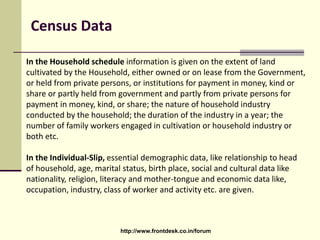
In the Household schedule information is given on the extent of land
cultivated by the Household, either owned or on lease from the Government,
or held from private persons, or institutions for payment in money, kind or
share or partly held from government and partly from private persons for
payment in money, kind, or share; the nature of household industry
conducted by the household; the duration of the industry in a year; the
number of family workers engaged in cultivation or household industry or
both etc.
In the Individual-Slip, essential demographic data, like relationship to head
of household, age, marital status, birth place, social and cultural data like
nationality, religion, literacy and mother-tongue and economic data like,
occupation, industry, class of worker and activity etc. are given.
http://www.frontdesk.co.in/forum
Components of Planning Survey
The preliminary planning survey may be considered to consist of the
following components :
1. Preparation of Base Map of the urban area.
2. Existing Land Use Survey.
3. Utilities and Services Surveys.
4. Survey of Community facilities like Schools, Hospitals, Clinic, Parks and
Playgrounds, etc.
5. Sample household survey for colleting essential data on housing,
transport services and amenities.
http://www.frontdesk.co.in/forum
Techniques of preparing Base Maps
In the absence of an accurate base map, no planning exercise can be
undertaken. The base map should show all the streets, lanes and open
spaces and division of area by plots with survey numbers. The base map
should show all physical features including contours.
- For Urban Planning, Base Map (Town Map) is basic pre-requisite:
(i) Reliable (ii) Accurate (iii) Up to date
(iv) Uniformity (v) Purpose
- Information required on base map for Urban Development Planning:
- For urban development plans the base maps are to be drawn on large scale
and should show all or part of the physical, topography and cultural
features and administrative and planning boundaries as per the details
given below:
a. Physical
(i) Hills (ii) Water bodies
(iii) Agricultural lands (iv) Forest Areas
http://www.frontdesk.co.in/forum
Techniques of preparing Base Maps
b. Topographical
(i) Transport Network
- Airport - Railways - Roads streets, lanes
(ii) Utility and service lines – HT lines
(iii) Built up areas
(iv) Contours at appropriate intervals
c. Important city features
(i) Parks and Gardens
(ii) Important Landmarks (Important public buildings)
(iii) Important Archeological & Historical Monuments
d. Planning and Administrative boundaries
(i) municipal boundary
(ii) census ward
(iii) administrative sub-division limits (if any)
(iv) planning area boundary (if identified)
(v) Gaothan area/abadi/settlement area (urban village or rural
settlement within the municipal limits or on the fringe of the
municipal town)
(vi) cantonment area boundary (if any)
(vii) grids (artificial or latitudes and longitudes)http://www.frontdesk.co.in/forum
Techniques of preparing Base Maps
- Base Maps generally have standard layouts and standard sizes.
- Generally all base maps have North pointing upwards.
- North direction and scale (Graphic and Spatial) should invariably be shown
on every base map.
Scale
Graphic Scale Graphic scale is also an essential requirement of map and
preferably it should be given in metric system for the convenience of
reproduction. The graphic scale could be drawn above the title block of the
map.
Area Scale In addition to graphic scale the area scale should also be given on
all plans. The area scale should consist of a square with metric sides and
the area covered by the square should be given inside the square. Such
area scale could be located above the graphic scale in the drawing.
Numeric Scale A numeric scale giving representation fraction (R.F.) e.g.
1:1,00,000 should be given below the graphic scale.
http://www.frontdesk.co.in/forum
Scale of Maps
S.
No.
Type of Map / Planning
Exercise
Size of Planning Area
Metropolitan Level Small and
Medium Town
Level
1. Map of Regional Setting 1 : 250,000 -
1 : 1,000,000
1 : 100,000 -
1 : 250,000
2. Perspective Plan 1 : 100,000 -
1 : 250,000
1 : 50,000 -
1 : 100,000
3. Development Plan 1 : 25,000 -
1 : 50,000
1 : 10,000 -
1 : 25,000
4. Plans of Projects /
Scheme
1 : 1,000 -
1 : 5,000
1 : 500 -
1 : 2,500
http://www.frontdesk.co.in/forum
Sources of Maps
• Conventional Sources
(a) Topographical maps of Survey of India.
(b) City survey sheets from settlement survey and land
records departments
(c) Old maps published in gazettes and other publications
(d) Maps included in Census of India publication
(e) Old municipal / property maps
(f) Maps prepared by other local development department
like PWD, public health, power, etc.
(g) City guide and tourist maps
(h) Specific field survey
• New Techniques
(a) Conventional aerial photography and photogrammetry
(b) Digital photogrammetry
(c) Satellite imagery
(d) GPS, GIS, etc.
http://www.frontdesk.co.in/forum
Land Use
Grouping of Land Uses Urban land may be put to a large number of uses. It
may be residential, industrial, commercial or recreational. Likewise rural
land in the vicinity, may be used for gardens like vegetable and fruit, cash
crops like tobacco, chillies or staple crops like wheat, rice or millets. The
different uses of urban and rural land follow established patterns around
urban areas.
Urban land uses are innumerable and in carrying out a survey of urban land
use. It has become necessary to group these uses under certain well-defined
heads. Such grouping has been based upon similarity of functions as well as
similarity of performance characteristics. For instance, residential uses go
together so also, retail commercial uses: and wholesale commercial area
and storage godowns get grouped together. Similarly, industrial uses can
also be grouped together but an industry, which emits a large amount of
smoke, and noxious fumes cannot be put alongside an industry which
produces no smoke and is able to maintain clean premises such as an
electronics industry, etc. The emission of smoke wastes and such other
criterion form "the performance characteristics" of the industry.http://www.frontdesk.co.in/forum
Land Use Depiction on Base Map
Land Use is USE OF Land and not USE of STRUCTURE Therefore:
- Entire property to be marked under that use.
- In case of vertical mixing of Land uses in a building, predominant
Land use to be marked.
- In case of Horizontal Mixing, main use to be marked treating
remaining uses as ancillary uses.
- Those lands which do not have any structure on it, but which are
used for a specific purpose, the Land use should be marked e.g. Parks,
Play grounds, open stack yards etc.
http://www.frontdesk.co.in/forum
Land Use Classification
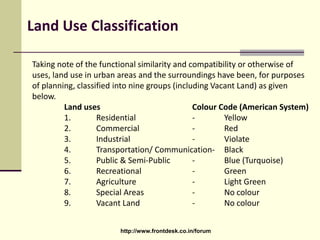
Taking note of the functional similarity and compatibility or otherwise of
uses, land use in urban areas and the surroundings have been, for purposes
of planning, classified into nine groups (including Vacant Land) as given
below.
Land uses Colour Code (American System)
1. Residential - Yellow
2. Commercial - Red
3. Industrial - Violate
4. Transportation/ Communication- Black
5. Public & Semi-Public - Blue (Turquoise)
6. Recreational - Green
7. Agriculture - Light Green
8. Special Areas - No colour
9. Vacant Land - No colour
http://www.frontdesk.co.in/forum
Land Use Classification
Sub Classification of Land uses : The classification of the uses into groups
can be further extended into subgroups, where necessary and the sub-
groups can be further broken up into sub-subgroups for a general land
use survey. It is adequate if the above nine uses with certain sub-
categories are identified and land use surveys carried out.
1.Residential
- Single family dwellings (Plotted development)
- Group Housing
- Slum Areas (Katchi Basties)
- Population densities (Ranges) are generally shown as
R-1, R-2, R-3, R-4 (From Low to High densities)
2.Commercial
- Retail business & General commercial
- Wholesale business
- Warehousing & godowns
3.Industrial
- Light Industries
- Heavy Industries
- Extractive Industrieshttp://www.frontdesk.co.in/forum
Land Use Classification
4.Transportation / communication
- Airports
- Bus Terminals / Truck Terminals
- Railway Line / Railway Station
- Road Network (Hierarchical)
5.Public & Semi-Public
- University / College / Professional College
- Secondary, Senior Secondary School
- Hospital / Other Health Centre
- Veterinary Hospital
- Social, Cultural / Religious Place
- Historical Monument
- Other Community Facilities
- Public Utilities
- Cremation / Burial Ground
http://www.frontdesk.co.in/forum
Land Use Classification
6.Recreational
- Parks, Open Spaces & Playground / Stadium
- Fair Ground / Tourist Facility
7.Agriculture
Agriculture
Forests
Poultry and Dairy Farm
Rural Settlements
Brick kiln & Extractive Areas
Water Bodies
8. Special Areas
Old Built up (Core) Areas
Heritage & Conservation Areas
Scenic Value Areas
Other Uses
9. Vacant
Built but un-occupied
Vacant under construction
Vacant developed but
unbuilt
http://www.frontdesk.co.in/forum
Land Use Survey through Remote Sensing
Techniques
A land use survey produces basic information for a variety of planning
purposes. When a land use survey of an urban area is carried out using
aerial photographs as the data source, various techniques such as
• Building relief displacement,
• Oblique aerial photography
• Stereo photography
Building relief displacement helps to identify the building and its height
in terms of storeys.
Oblique aerial photography helps to interpret the facade on either side of
the street.
Similarly, stereo photography consists of a series of photographs taken
along a parallel flight path and is required in order to obtain complete
photographic coverage of a particular survey area.
http://www.frontdesk.co.in/forum
Land Use Survey through Remote Sensing
Techniques
For preparation of land use survey map, the various sources of
information have been described in the Table
Map Details to be depicted Sources of Information
Land Use Survey
Maps
Perspective Plan Level
Urban Land Use
Classification
Satellite imageries photo
mosaic toposheet,
limited field survey.
Development Plan Level
Urban Land Use
Classification.
Topo map aerial
photograph (stereo pair),
limited field survey.
Action Plan Level Urban
Land Use Classification-
Use Premises
Aerial photograph (stereo
pair), city survey sheet,
limited field survey
http://www.frontdesk.co.in/forum
UTILITIES AND SERVICES SURVEY
The utilities and services survey is to be carried out in a general way and
has to indicate to the Town Planner the areas which are covered by existing
water supply, drainage, electricity and gas system.
This survey which is carried out with the help of the base map when
combined with land use survey will help determine the general directions in
which future development may take place.
http://www.frontdesk.co.in/forum
SURVEY OF COMMUNITY FACILITES
This survey, like the utilities survey is to be carried out in a general way with
the help of the base map. As the land-use survey proceeds, the location of
the various facilities will become known and these locations are separately
mapped to facilitate a study of their inter-relationships, as well as their
service areas.
A rapid reconnaissance will also reveal the capacity of the facilities such as
total strength of primary schools, extent of open spaces, accessibility to
play grounds, distance to local shops etc. and will help in assessing the
planning problems especially at the local level.
http://www.frontdesk.co.in/forum
HOUSEHOLD SAMPLE SURVEY FOR GATHERING
ESSENTIAL DATA ON HOUSING, TRANSPORT SERVICES AND AMENITIES
The information that is to be collected under this survey may be classified
broadly into the following groups:
Housing
i) Existing number of houses,
ii) Condition of house, type of structure, age,
iii) Number of people living in each household,
iv) Number of habitable rooms,
v) Occupancy (tenant or owner),
vi) Services (drainage, drinking, water, electricity),
vii) Rent in relation to the income of the family, etc,
Transport
i. Place of employment,
ii. Type of employment,
iii. Mode of transport,
iv. Time taken to travel to place of employment, etc,
http://www.frontdesk.co.in/forum
HOUSEHOLD SAMPLE SURVEY FOR GATHERING
ESSENTIAL DATA ON HOUSING, TRANSPORT SERVICES AND AMENITIES
Education
i) Distance from primary or middle school to home,
ii) Mode and cost of travel from home to school, etc, Recreational
Recreation
i) Place of recreation,
ii) Type of recreation for adults and children, etc,
Shopping
I. Distance of nearest shopping centre
http://www.frontdesk.co.in/forum
HOUSEHOLD SAMPLE SURVEY Coverage
One hundred per cent coverage of the area for the survey is time
consuming and will cost a great deal of money. The purpose of the survey
may be defeated if the survey itself takes too long time.
A sample survey, provided the sample is chosen scientifically, can be
considered in most cases adequate and satisfactory.
The method of sampling and the size of sample will vary from case to case
and should be determined on the basis of a careful study of the survey
material, the survey personnel and the funds available for collection and
analysis of data.
The basic rules for selection of sample size are as follows:
1. More disastrous the results of poor information, larger sample size is
required
2. The more varied the expected responses, larger sample size is required.
3. Larger the total population, smaller the percentage of the population
are required to be surveyed
http://www.frontdesk.co.in/forum
Types of selection of samples
The samples could be selected in various ways depending on the type of
information required and the importance of the accuracy of the particular
information in the survey process.
The various types of selection of samples are
1. SIMPLE RANDOM SAMPLING ( selecting samples at random without any
criteria to select the samples whatsoever )
2. SYSTEMATIC SAMPLING (selection of the Kth element along a particular
street, where k can be any number )
3. STRATIFIED SAMPLING ( making of a homogenous listing of the different
sects of the population and collecting a certain percentage at random from
each sect)
4. CLUSTERED SAMPLING (when samples are selected from clusters and not
from a homogeneous listing )
http://www.frontdesk.co.in/forum
Sampling
The success with which the results of a sample survey can be applied depends
largely on the homogeneity of the universe. Most urban areas are
heterogeneous. The density of population, density of housing, character of
housing, etc., all vary from one part of the area to another. In order to ensure
that the results of the sample survey can be applied with a fair degree of
accuracy to the universe, it is necessary to divide the survey area initially into
units, which are homogeneous in character to as great an extent as possible.
This homogeneity is normally based upon the physical characteristics of the
neighborhood, and where, possible social characteristics may also be taken into
consideration. Some of the characteristics that can be used to determine
homogeneity are:
i) Density of Housing.
ii) Character of Housing
iii) Economic Level of the Resident Population.
iv) Socially cohesive Groups.
v) Influence ,Zone of congregating Centres such as Temples, Mosques.
Churches, Markets etc.http://www.frontdesk.co.in/forum
Questionnaire
For purposes of the survey, a questionnaire has to be devised and used. It
has to be coherent and easy to fill in. Elaborate notes may not be taken while
conducting the survey and such notes cannot also be used conveniently in
the analysis.
It should be designed with a view to ensure ease and rapidity in the
collection of the data, mechanical tabulation and ready evaluation of the
collected data.
MEASUREMENT SCALES FOR STRUCTURING QUESTIONNAIRES
The questions that are asked in the questionnaires can be of general things,
some asks for some order of preferences or some give stress to the time
interval between two incidents. Thus the scales of the questionnaires are
fixed, which can be described as follows
1. NOMINAL
2. ORDINAL
3. INTERVAL
4. RATIO
http://www.frontdesk.co.in/forum
MEASUREMENT SCALES FOR STRUCTURING
QUESTIONNAIRES
NOMINAL where there is no ordering, like asking of sex, age, employment in
any particular service etc. These are sets of names. Some examples of nominal
scales are:
Sex : male, Female
Colour : black, red, white
Profession : Doctor, Architect, Lawyer
Nominal scale have no inherent order among the alternative responses.
ORDINAL where there is a specific order of choices like asking of priorities,
housing conditions, climate etc. Some examples of ordinal scale are :
Social class : Upper, Medium, Lower
Housing Conditions : Good, Needs Minor Repair, Needs Major Repair
Climate : Cold, warm, hot
http://www.frontdesk.co.in/forum
MEASUREMENT SCALES FOR STRUCTURING
QUESTIONNAIRES
INTERVAL where an interval of time is given importance like time taken to shift
from LIG housing to MIG housing, time interval to change from two wheelers
to four wheelers etc. this provides an yardstick of measurements. Interval data
is like ordinal except we can say the intervals between each value are equally
split. The most common example is temperature in degrees Fahrenheit. The
difference between 29 and 30 degrees is the same magnitude as the
difference between 78 and 79 .
RATIO : Ratio Scale is defined as a variable measurement scale that not only
produces the order of variables but also makes the difference between
variables known along with information on the value of true zero. It is
calculated by assuming that the variables have an option for zero, the
difference between the two variables is the same and there is a specific order
between the options.
http://www.frontdesk.co.in/forum
MEASUREMENT SCALES FOR STRUCTURING
QUESTIONNAIRES
The following questions fall under the Ratio Scale category:
What is your Monthly Income?
Less than 20000/=.
20000 – 25000/=
25000 – 30000/=
More than 30000/=
http://www.frontdesk.co.in/forum
QUESTIONNAIRES SECTIONS
The first section covers the family size, composition, occupation and
transport facilities to places of employment. It also provides for information
on income and number of wage-earners in the family.
The second section gives information on number of school children,
proximity to recreation facilities and proximity to shopping centres.
The third section of the questionnaire covers the information about houses.
Age and type of structure will aid in determining its future life and condition
of the houses. The services, such as drinking water, electricity and sanitation
together with the above data will aid in determining whether the house is
standard or substandard. The number of habitable rooms and the
information whether the house has been occupied by one family or by a
number of families will aid in determining the extent of overcrowding.
Information about tenancy and ownership has also been included.
http://www.frontdesk.co.in/forum
National , Regional, City, Zone, Local area
plans
The need and roles for the specific plan category, namely, Perspective Plan, Regional Pla
n, Development plan , master plan, local area plan
Perspective Plan or National level plan
Developing a vision for region is essential for policy framework. The vision stipulates dire
ction of growth and identification of resource potential and innovations to be adopted fo
r the thrust areas of development. It integrates broad level plan with the regional or city
development plan
Regional Plan
Regional Plan For planned and sustainable development of the human settlements, the
regional planning approach needs to be promoted. The planning regions could be
classified under three heads:
(a) Administrative Regions, which can be District Regions or Metropolitan Regions as per
the recommendations of the 73rd & 74th Constitutional Amendment Act,
(b) Investment Regions, which can be new investment manufacturing zones, industrial
and freight corridors, special investment regions etc. They could be identified under
Nat National Acts/ policies,
(c) Special regions, which are sensitive in terms of environment/ socio economic or
political aspects. http://www.frontdesk.co.in/forum
Contents of regional plan
Regional Plan is to be prepared for the area identified as formal or functional re
gion, which could be state/ inter‐state/ district/ inter‐district, investment regio
n or special area. If region so identified is inter‐state, all such states will need t
o prepare subregional plans for their respective areas. For a regional plan for a
normal region, the following key contents to be included:
1. Introduction of the Region
2. Analysis of regional resources
3. Projected requirements
4. Major proposals and projects
5. Implementation Plan
For Regional Planning for an Investment Region or Special Region, ‘delineation
of the region’ to be included in the above given contents .
http://www.frontdesk.co.in/forum
City Development Plan
City Development Plan / Master plan
Development plan is a statutory plan prepared (under relevant Act) within the
framework of an approved perspective plan. The objective of a development
plan is to provide further necessary details and intended actions in the form of
strategies and physical proposals for various policies given in the perspective
plan and regional plan depending upon the economic and social needs and
aspiration of the people, available resources and priorities .
Eastern (NE) States, where land title is based on community ownership. The
approach to land aspects of the Development Plan may be different in such
cases. Therefore, a Structure Plan approach to land management may be
appropriate in order to allocate land for different land uses in urban
infrastructure etc. In such cases or otherwise, Structure Plan is to serve as a
planning tool which directs the growth and zones of planning, but is not as
precise as the development plan (such as the Structure Plan for Bangalore
Metropolitan Region). Structure Plans may be considered as an overarching
Development http://www.frontdesk.co.in/forum
Contents of City Development Plan
This part recommends the contents of Development Plan document, which wo
uld include the written document as well as the map showing the spatial plan
and other supporting charts and diagrams.
Contents of Development Plan should be formulated in accordance with statut
ory provisions of the relevant Act. With the view of saving time and also devel
oping a participatory system of planning, necessary information from secondar
y sources should be utilised, as far as practicable and primary surveys should b
e conducted only when it is unavoidable. Conceived within the framework of t
he perspective plan and adjusted as per the Regional District Plan, a Developm
ental Plan is to be prepared for a period of 20‐30 years. While preparing Devel
opment Plan, special attention must be paid on safety, security and participati
on of women, the elderly, and other segments of society requiring special nee
ds. The Development plan should contain the following major heads:
1. Existing Conditions and Development Issues
2. Assessment of Deficiencies and Projected Requirements
3. Vision and Mission
4. Development Proposalshttp://www.frontdesk.co.in/forum
Zonal Development Plan
The master plan divides the city into sub-divisions or zones
Criteria’s followed are :
physical & historical growth , character of land
intensity of land – use, circulation pattern ( railways , major arteries etc. )
municipal boundaries , election & census wards
Content of Zonal development plan are :
1. Introduction ƒ
2. Site Background & Analysis ƒ
3. Conceptual Framework ƒ
4. Proposals and development strategy
5. Conservation and Improvement of Environment ƒ
6. Compliance of Government Policies ƒ
7. Zoning Regulations ƒ
8. Development Regulations ƒ
9. Resource Mobilization and Implementation ƒ
10.Implementation framework ƒ
11.Annexures: ƒ http://www.frontdesk.co.in/forum
Local Area Plan
A local area plan sets out a strategy for the proper planning and sustainable
development of a specific area within a local authority and for a timescale as
specified by the authority.
Contents of a local area plan
1. Land use zoning & density
2. Public open space
3. Private open space
4. Car parking
5. Provision of infrastructure
6. Conservation of built heritage
7. Conservation of natural environment
8. Provision of traveller accommodation
9. Community facilities
10. Design & development standards.http://www.frontdesk.co.in/forum
Data & Database
A database is an organized collection of data a collection of information that is
organized so that it can easily be accessed, managed, and updated.
The data are organized to model relevant aspects of reality (for example- water
supply), in a way that supports processes requiring this information (for
example, setting a benchmark).
Types of Data are :
Primary Data : Info collected 'first hand‘ using survey etc.
Secondary data : info collected from other sources like census , gov. databank
etc.
Quantitative Data : Data is the one that focuses on numbers and mathematical
calculations and can be calculated and computed.
Qualitative Data : data concerned with descriptions, which can be observed but
cannot be computed.
http://www.frontdesk.co.in/forum
Vector & Raster Data
Vector data: Vector data consists of individual points, which (for 2D data) are
stored as pairs of (x, y) co-ordinates. The points may be joined in a particular
order to create lines, or joined into closed rings to create polygons, but all vector
data fundamentally consists of lists of co-ordinates that define vertices, together
with rules to determine whether and how those vertices are joined.
A representation of the world using points, lines, and polygons. Vector models
are useful for storing data that has discrete boundaries, such as country borders,
land parcels, and streets.
Raster data:
Raster data is made up of pixels (or cells), and each pixel has an associated
value.
A representation of the world as a surface divided into a regular grid of cells.
Raster models are useful for storing data that varies continuously, as in an aerial
photograph, a satellite image, a surface of chemical concentrations, or an
elevation surface.
http://www.frontdesk.co.in/forum
Different Types of Data sources
Urban planning requires data such as those about land use, about where people live
and congregate and when, about their mobility, their economic conditions, where they
spend their money, and about their social networks .
In planning the data sources for data acquisition should be carefully selected
considering the application and scale. The following data sources are widely used:
Census Data Reports and publications
Attributes, statistics , data.gov.in
Analog maps
Elevation, soil, landuse, climate, etc.
Aerial photographs
DEM(digital elevation model ), landuse (Urban)
Satellite image
Landuse (regional), vegetation, temperature, DEM
Ground survey with GPS / AGPS
Detailed information using total station survey or AGPS survey
Mobile network big data (MNBD)
CDRs (Call Detail Records) , VLR (visitor-location registry), BTS (base transceiver
Stations) http://www.frontdesk.co.in/forum
Urban Database in India
Database Name Authority
Information and Services Need Assessment (ISNA) JnNURM
National Urban Information System (NUIS) TCPO
Basic Statistics for Local Level Development (BSLLD) Central Statistics
Office (CSO)
National Urban Database System (NUDS) NIUA
Objective of database
ISNA (Primary Data) : Developing a National Architecture for E-governance in
Municipalities
NUIS (Primary Data) : Establish a comprehensive information system at ULB level for
planning, management and de-centralized governance in the context of
implementation of the 74th CAA
BSLLD (Secondary Data) : Provide information for local planning, effective
implementation and monitoring of various social and economic development
programmes at Panchayat and Nagar Palika level
NUDS (Secondary Data) : Proposal to establish a centralized urban database system
where standardized data would be made available in a user friendly formathttp://www.frontdesk.co.in/forum
MNBD
Mobile network big data
MNBD are generated by all phones, smart and otherwise. MNBD include CDRs
generated when calls and texts are sent/received, the internet is used,
and prepaid value is loaded, and visitor-location registry (VLR)
data are generated when handsets “tell” base transceiver
stations (BTS) that they are in coverage areas . CDRs, which include data elements
such as calling-party number, called-party number, the BTS where the call originated,
time of call, duration, and information about the device, are used for billing
purposes.
MNBD can reveal some aspects about large cities in a near real-time manner,
especially about dynamic aspects like transportation, that was not possible with the
traditional survey and census techniques
http://www.frontdesk.co.in/forum
Software for Data Analysis
useful in Planning
Urban planners use following software's in data analysis
1. R : open-source programming languages to perform data analysis &
Graphics (https://www.r-project.org/)
2. Python : open-source & general purpose programming language for
Deployment and production (https://www.python.org/) Pandas is an
open source, BSD-licensed library providing high-performance, easy-to-
use data structures and data analysis tools for the Python programming
language.(https://pandas.pydata.org/)
3. SQL (Structured Query Language) : SQL is designed to query and extract
data from tables within a database . It is designed for managing data in a
relational database management system (RDBMS)
https://www.mysql.com/
4. Excel : Microsoft Excel is the spreadsheet program, a powerful data
visualization and analysis tool.
http://www.frontdesk.co.in/forum
Software for Data Analysis
useful in Planning
5. AutoCAD : AutoCAD® is computer-aided design (CAD) software that
architects, planners professionals use to create precise 2D and 3D
drawings. Customization of AutoCAD with AutoLISP (dialect of the
programming language LISP) can help in Graphical Data Analysis. AutoLISP
programs can be created to maintain data accuracy and integrity.
6. ArcGIS : ArcGIS is an architecture geographic information system for
working with maps and geographic information developed by ESRI .
Written C++ & Python. ArcGIS provides contextual tools for mapping and
spatial reasoning so you can explore data and share location-based
insights.
http://www.frontdesk.co.in/forum
Excel Data Analysis functions
COUNTA
=COUNTA identifies whether a cell is empty or not. In the life of a data analyst,
you’re going to run into incomplete data sets daily. COUNTA will allow you to
evaluate any gaps the dataset might have without having to reorganize the data.
CONCATENATE
=CONCATENATE is one of the easiest to learn but most powerful formulas when
conducting data analysis. Combine text, numbers, dates and more from multiple
cells into one.
LEN
=LEN quickly provides the number of characters in a given cell. As in the example
above, you can identify two different kinds of product Stock Keeping Units (SKUs)
using the =LEN formula to see how many characters the cell contains.
http://www.frontdesk.co.in/forum
Excel Data Analysis functions
DAYS/NETWORKDAYS
=DAYS is exactly what it implies. This function determines the number of calendar
days between two dates. This is a useful tool for determining lifecycle of products,
contracts, and run rating revenue depending on service length – a data analysis
essential.
SUMIFS
=SUMIFS is one of the “must know” formulas for a data analyst. The common
formula used is =SUM, but what if you need to sum values based on multiple
criteria? SUMIFS is it. In the example below, SUMIFS is used to determine how much
each product is contributing to top-line revenue.
AVERAGEIFS
Much like SUMIFS, AVERAGEIFS allows you to take an average based on one or more
criteria.
http://www.frontdesk.co.in/forum
Excel Data Analysis functions
INDEX MATCH
Formula: =INDEX(range, MATCH(cell,range,0),MATCH(cell,range,0))
This is an advanced alternative to the VLOOKUP or HLOOKUP formulas (which have
several drawbacks and limitations). INDEX MATCH is a powerful combination of
Excel formulas that will take your financial analysis and financial modeling to the
next level.
INDEX returns the value of a cell in a table based on the column and row number.
MATCH returns the position of a cell in a row or column.
IFERROR
=IFERROR is something that any analyst who actively presents data should take
advantage of. Using the previous example, looking for specific text/values in a
dataset won’t return a match. This causes a #VALUE error, and while harmless, it is
distracting and an eyesore.
Use =IFERROR to replace the #VALUE errors with any text/value. In the example
above the cell is blank so that data consumers can easily pick out which rows
returned a matching value.
http://www.frontdesk.co.in/forum
Excel Data Analysis functions
MINIFS
=MINIFS is very similar to the min function except it allows you to take the minimum
of a set of values, and match on criteria as well. In the example, =MINIFS is used to
find the lowest price each product sold for.
MAXIFS
=MAXIFS like its counterpart minifs, allows you to match on criteria, but this time it
looks for the maximum number.
http://www.frontdesk.co.in/forum
Excel pivot tables
Excel pivot tables are so very versatile because they enable you to easily analyze
summaries of large amounts of data by using a variety of summary functions. When
setting up the original Excel pivot table, you make several decisions: what summary
function to use, which columns (fields) the summary function is applied to, and
which columns (fields) these computations are tabulated with.
Requirements for Pivot Tables
The data for your Pivot Tables must meet the following requirements:
1. The most important criteria: Each column must have a title.The title is always
the top row of your data. Blanks/ empty cells as column headings are not
allowed.
2. In earlier versions of Excel, each column heading could only appear once.
Therefore, each column heading had to be unique. Newer version add a number
in the end if a title is used several times. In order to avoid confusion, we
recommend using unique column titles for each column.
3. Your data should have a ‘database’ structure: Each column should have one
criteria or value. you should use the ‘table format’ in Excel
http://www.frontdesk.co.in/forum
AutoCAD Application for base map
preparation
ArcGIS for AutoCAD is a free plug-in that simplifies the way you share
and synchronize GIS content between AutoCAD and ArcGIS. Enrich your CAD
drawings with ArcGIS hosted maps, imagery, and geographic features. Edit
geographic features within AutoCAD and use them for navigating the
drawing through location.
https://www.esri.com/en-us/arcgis/products/arcgis-for-autocad
Commands in AutoCAD
1. Drawing
2. Editing
3. Modifying
4. Layer management
5. Scaling Drawings and Images
6. Plotting and Printing
http://www.frontdesk.co.in/forum
AutoCAD for Planners
Match Only Selected AutoCAD Properties :
On the standard toolbar, click Match Properties, or type Matchprop at the
Command line. Select the object whose properties you want to copy. If you
want to control which properties are transferred, type S at the Command
line (for Settings).
Link Cells Between AutoCAD Tables :
In your table, select the cells to link. On the Table ribbon contextual tab,
click Data, Link Cell. In the Data Link Manager tree view, select Create a New
Excel Data Link. In the Enter Data Link Name dialog box, enter a name for
the data link
Maintain the Attributes Value when Exploding
If you'd like to explode a block with attributes and have them retain the
assigned attribute value, then you'll need to use
the BURST command. Burst will explode the block back into individual
objects and keep the attribute values.http://www.frontdesk.co.in/forum
AutoCAD for Planners
Import XY Coordinates from Excel into AutoCAD
In Excel, highlight and Copy the column of X,Y coordinates to be
used to generate the drawing. Open Windows Notepad. Before
pasting the coordinates, type LINE as the first word in the file (this
will launch the Line command when the script is run), then press
[Enter].
Convert Spline to Polyline
Click Home tab Modify panel Edit Spline. Select the spline to
convert. Enter p to convert to Polyline. Specify a precision value or
press Enter to end the command.
Or Use FLATTEN to quickly convert them
Non-uniform scale
Select the block w/grips, open the properties dialogue box, change
the value of X, Y or Z scale factor as needed.
http://www.frontdesk.co.in/forum
Regional Planning
Physical planning relates to areas physical structure like landuse,
communications, utilities and such things which relates to control on town
development
Economic planning is concerned with economic structure and overall
prosperity. It works through market mechanism.
The Regional planning thus is concerned in physical terms (identified region)
and is more concerned with overall economic development (also upliftment of
back ward areas through effective steps ) However there is some debate
whether regions are natural phenomena or mental construction.
http://www.frontdesk.co.in/forum
Regional Planning
Social region & Analysis of social and structureCultural factors & Humanistic approach
Economic region & Regional SciencePhysical region & Chorological Approach
http://www.frontdesk.co.in/forum
Classification of regions
The concept of region as method of classification has evolved through two
distinct phase reflecting the economic advance from a simple agrarian
economy to complex industrial economy. The First phase saw the ‘Formal
region’- concerned with uniformity, and defined according to homogeneity.
The second Phase saw the development of the ‘Functional Region’-concerned
with inter-dependence, the inter-relationship of the parts and defined on the
basis of functional coherence
A formal region is geographical area which is uniform or homogeneous terms
of selected criteria. A formal region type
1. Natural formal region
2. Economic formal region
http://www.frontdesk.co.in/forum
Classification of regions
Natural formal region
A natural region is a formal region based on the criteria of topography,
climate or vegetation . Criteria used are, predominantly physical. linked
with the concept of geographical determinism.
Darwin’s concept of environmental determinism : Environmental
determinism is the doctrine that human growth, development and
activities are controlled by the physical environment
Economic formal region
Economic formal region are generally based on type of industry , natural
resource ( coal mining region , tea plantation region ) , income level, ratio
of unemployment and rate of economic growth .
In India region have been defined based on social factor or social and
economic backwardness such as tribal region and backward regions
It is sometime referred to as nodal or polarised region and is composed of
heterogeneous units such as cities town and villages. Which are
functionally inter-related http://www.frontdesk.co.in/forum
Functional region
Polarized / Nodal / Heterogeneous Regions
Drobneand Botagaj (2012) says :
Functional regions(FRs) are internally social and economic heterogeneous
that causes mutual complementarity and independence. In the quantitative
literature, the functional region has often been defined as that aggregation
of elementary spatial units(ESU) at lower level which maximizes the ratio of
intra-regional (within-region) to inter-regional (between-region)
interaction. The third structural class, the nodal region, is defined by cores
and regional dominance in networks.
Functional/ polarized or nodal regions look to a centre-a large town usually-
for service. Its influence extends beyond the
area of the city. The villages are dependent upon it for services and
marketing. There is little concern for uniformity when a polarized or
nodal region is taken. Cohesiveness is due to internal flows, contacts and
interdependencies. The city
region need not correspond to the administrative region because
hinterland of several clear-cut regions may be served by a city. A capital city
may attract customers form several districts around the capital city.http://www.frontdesk.co.in/forum
Classification of regions :
Planning region
Planning region : Third type of regional classification is mix of formal and
functional regions
It must be a viable economic entity i.e. major criteria of production and
employment (region must assure nearly full employment and production of
agricultural and non agricultural commodities.
Two physically separate tracts but inter related economies for eg. Plain
areas of Kerala with mountainous plantation areas mutually compliment
and supplement.
Thus the three regions may be
1) Nodal region, consisting of large town
2) Primarily rural area with large no. of nodes (small towns)
3) Micro regions essentially problem areas such as famine prone area
,mining belt, ravines area,
http://www.frontdesk.co.in/forum
Planning regions Definition
Boudville defines planning region ( or programming region ) as areas
displaying some coherence or unity of economic decisions
Keeble says planning region as an area which is large enough to enable
sustainable changes in distribution of population and employment to take
place within its boundaries, yet which is small enough for its planning
problems to be seen as a whole.
Klassen sees that Planning region must be large enough to take investment
decisions of an econmic size, must be able to supply its own industry with
labour, a homogeneous economic structure, contain at least one growth
point and have common approach to and awareness of its problems
In Practice the formal and functional region always overlap and very with
market . The identification of satisfactory planning region involve some
compromise and can actually delineated with administrative viability, which
introduce the problem of regionalization and regionalism.
http://www.frontdesk.co.in/forum
Classification of regions
Formal Regions based on
dominant crop types
Functional Regions tied
to a central node. These
could be bank serving
their branches, dairy
farms providing milk to
suppliers etc.
Planning Regions of
a city or urban area
defined by subjective
criteria .
http://www.frontdesk.co.in/forum
Classification of regions in India
In India the hierarchy of planning region would be(i) macro level/region
(ii) meso /district level (ii) and micro/local level.
A planning region is (or should be)
large enough to enable substantial changes in the
distribution of population and employment to take place within its
boundaries, yet small enough for its planning problems to be tackled
effectively. It should have a viable source base, a manpower base, and
internal homogeneity/cohesiveness. It should be such that satisfactory levels
of mutually satisfying levels
of production, exchange, and consumption levels obtained.
In 1968, the Town and Country Planning Organisation suggested a scheme of
planning regions delineated on the principle of economic viability, self-
sufficiency and ecological balance at the macro and meso levels.
The emphasis of the scheme was to introduce regional factor in economic
development. This approach would complement the macro planning at the
national level, with a component of regional policies, aimed at reducing
regional disparities in the development.http://www.frontdesk.co.in/forum
Classification of regions in India
The macro- regionalization sought to link a set of areas, rich in one type of
resources with areas having complementary resources or even resource
poor areas, so that the benefits of economic activity in the former may flow
into the latter. These planning regions cut across the State boundaries, but
do not completely ignore the basic administrative units.
A macro region
A macro region usually has a common
resource base and specialization in that
resource base, so that production activities can develop on the principle of
comparative advantage based on territorial division of labour
Meso Regions
Meso region can be identified with a ‘division’
of a state. Meso region is usually a subdivision of a state (Administrative Regi
on),comprising of several districts. There should be some identifiable affinity
in the area which may even facilitate planning. It can be cultural or
administrative region and it will be even better if it is a homogeneous
physical region http://www.frontdesk.co.in/forum
Classification of regions in India
A meso region can also become a nodal region provided the combined
micro regions or parts thereof can be developed in a complementary
manner. A metropolitan area can be one micro
region and the area of influence can be another micro region
Micro regions
Various nodal points within a meso region could be micro region, though in
many cases micro regions are
basically rural areas, which may have a number of minor nodes without any
organizational hierarchy influencing the entire area. The basic characteristic
of a micro region is its smallness. There can be some specific micro regions
such as belts of extraction of mineral or a reclaimed area, or a not-so-big
command area of an irrigational projects, administrative districts etc.
http://www.frontdesk.co.in/forum
Delineation techniques
Delineation techniques of various types of regions
Regionalization is process of delineating regions. In absence of adequate
data, qualitative infinitive approaches have been used to delineate regions
lead to very misty regional boundaries.
Delineation of formal regions
1. The weighted index number method by Boudeville
In this technique, for policy reasons, there is need to isolate the main
problem region, the area of economic malaise (refers to an economy that is
stagnant or in recession)
Example 1 : The study area contains nine localities varying according to
unemployment rates and per capita income levels. Taking the criteria
individually, it is difficulty to isolate the problem region but taken together
and weighted, a region can be isolated.
http://www.frontdesk.co.in/forum
Delineation techniques
The weighted index number method
• The study area is divided into several localities varying according to
unemployment rates and per capita income levels.
• The aim is to isolate the main problem region; i.e. the area of economic
malaise.
• Weights are assigned to each criteria and when taken together and
weighted, one of the region can be isolated.
Example -1
Challenges encountered while
using this method
• The choice of the original
criteria
• The choice of weights
• The determination of
acceptable homogeneity
limits
Nevertheless, because of its
simplicity, it is a well-used
methodLocation with
individual criteria
Location with
weighted criteriahttp://www.frontdesk.co.in/forum
Delineation techniques
The weighted index number method
Example -2
Location with
individual criteria
Location with weighted criteria
2 per % unemployed < 10%
3 per % unemployed ≥ 10%
1 per population <2000
2 per population ≥ 2000 <4000
3 per population >4000
Applying a statistical variation test to weights
Region A = mean X =5.11 & Standard deviation SD=0.48
Region B = mean X =4 & Standard deviation SD=0.5
Therefore both region are within homogenous limits ±1
(SD)
http://www.frontdesk.co.in/forum
Standard deviation (SD)
The formula for standard deviation (SD) is
where ∑ means "sum of", x is a value in the data set, μ is the mean of the
data set, and N is the number of data points in the population.
Step 1: Find the mean μ.
(5+5+5+5+5+4+6+6+5)/9 = 5.11
Step 2: For each data point, find the square of its distance to the mean.
(5-5.11)2= (-0.11)2 = 0.0121
(5-5.11)2= (-0.11)2 = 0.0121
(4-5.11)2= (1.11)2 = 1.2321
(6-5.11)2= (-0.89)2 = 0.7921
Step 3: Sum the values from Step 2.
0.0121+0.0121+0.0121+0.0121+0.0121+1.2321+0.7921+0.7921+0.0121 = 2.0968
Step 4: Divide by the number of data points. = 2.0969/9 = 0.2329
Step 5: Take the square root.= √0.2329 = 0.48http://www.frontdesk.co.in/forum
Delineation techniques
2. The Variable Index Method
Under the variable index method, variable weights are assigned to highlight
the different regions. The weight given to each activity, in each region is
different, in accordance with the value or the volume regionally produced
3. The Cluster Method:
Cluster means grouping together. This concept is used in the planning as a
strategy to strengthen lateral links and to dissipate growing vertical links in
the settlement system. Such a cluster while providing greater viability and
threshold for development efforts will also create for themselves
a greater bargaining power in bringing about
reciprocity in exchange of goods and services (Rengasamy, 2002)
http://www.frontdesk.co.in/forum
Delineation techniques
4. The factor analysis method by Berry in U.S.A.
Used for delineating economic health regions.
• identified 14 industrial criteria on a local employment exchange area
base and 14 socio-economic criteria on a local authority base.
• Many of these criteria are interdependent. The factor analysis method
can be used to isolate these factors and to group areas on the basis of
factor loadings.
• identified ‘industrial change’ and industrial structure’ as major industrial
factors, and ‘population change’ and ‘social structure’ as major socio-
economic factors.
• These factors help in delineating economic health regions.
http://www.frontdesk.co.in/forum
Delineation techniques
Delineation Of Functional Regions
1. Flow analysis based on actual observation of what people do
2. Gravitational analysis based on theoretical observations,
1. Flow Analysis Method
• Builds up flows on the basis of the direction and intensity flows between
the dominant center and surrounding satellites.
• Flows may be of several types:
• economic (road, rail, shopping or commuting);
• social (such as flow of students or patients);
• political (flow of govt. expenditure);
• information (newspapers, telephone calls), etc.
• Graph theory : The flows are plotted in matrix form, from which primary
and secondary flows into and out of each center can be identified.
http://www.frontdesk.co.in/forum
Delineation techniques
Graph Theory
Graph theory: Graph theory employed by Nystuen and Decey measures
telephone calls between towns. Graph theory measures the relationship
(economic, social, etc) between selected group of centers on the basis of flows
between the centers. The no. of telephone calls is the usual flow criteria. In
the following figure D is a major town and BGE are subsidiary centers.
A B C D E F G H I
A 40 20
B 10 60
C 30 10
D 60 40
E 30 10
F 20 10
G 50 20
H 20 30
I 10 40
Telephone calls (000”s per day) to center
Flow matrix primary and secondary flows
only
http://www.frontdesk.co.in/forum
Delineation techniques
2. Gravitational Analysis Method
Gravitational analysis studies the theoretical forces of attraction between
two centres. The gravitational force between two centres i and j can be
expressed as:
Gij = K [Mi Mj/dij]
Where Gij = Gravitational force between centres i and j.
Mi and Mj = the masses of the centres i and j.
Dij = distance between i and j. K = constant.
• It is concerned with the theoretical forces of attraction between centers
rather than the actual flows.
• This model assumes that the interaction between two centers is directly
proportional to the ‘mass’ of centers and inversely proportional to the
‘distance’ between them.
• ‘Mass’ is represented by variables like population, employment, income,
expenditure and retail turnover.
http://www.frontdesk.co.in/forum
Delineation techniques
• ‘Distance’ is represented in physical terms (miles), time, price and
intervening opportunities.
• Mathematically By calculating the potential for the centers, lines
illustrating relative attractiveness, spheres of influence of various centers
can be plotted on a map.
• From such lines, functional regions can be identified.
Green and Carruthers have attempted to delimit sphere of influence of
center and functional region. It was thought that bus service is a indicator of
economic linkage and it is run on most economic routes. No. of passengers
in different segments and the length of route and the third factor frequency.
However the buses may be run on social basis. In India we may use Pvt.
Jeeps etc. to some extent
http://www.frontdesk.co.in/forum
Delineation of National Capital Region (NCR)
In case of large cities if planned in isolation and the surrounding nodes are
neglected then it may result in imbalance in development
In the early stages the study of Delhi’s influence was studied and it was
found to influence Gaziabad and Loni , Faridabad, Ballabhgarh, Gurgaon, and
Bahadurgarh. The area bounded by these towns is known as Metropolitan
area in the master plan of Delhi. It was proposed to develop these towns so
that each of them has sound economic base and adequate utilities , services
and amenities.
Outside this are there was second zone of influence within a distance of 50
miles of Delhi and this area was termed as National capital Region.
Later on it was observed that certain tehsils having important milk collection
centers and areas which supply vegetables to Delhi lie outside this boundary.
For eg. Ferozpur – Jhirka, Panipat and Nahan , Migration data of 1961 census
showed that there is considerable migration from Alwar, Karnal,
http://www.frontdesk.co.in/forum
Considerations and factors in
Delineating the NCR
• The basic area has been considered as 70 miles radius. This area covers
42 tehsils of 3 states.
• Tehsil has been taken as a unit, being small and data for such unit is
available . Smaller than this data would not be available.
• Demographic Characteristics: a) Population growth rate, b) Urbanism ( %
age of Urban population), c)Economic activity: %age of non-agricultural
workers to total workers, d) Migration, e) Density of population per
sq.km.
• Interaction between Delhi and surrounding areas in various ways, a)
Volume of railway goods traffic, b) Good traffic by road, c) Passenger
train traffic, d) Passenger bus traffic, e) Wholesale trade, f) supply of raw
materials to industry, g) labour supply, h) sale of finished goods, i)
Banking facilities, j) supply of perishable goods, k) Cultural affinity: News
paper circulation, shopping, recreation, telephone calls,
• Service: Major water sources, drainage channels, flood control works,
irrigation channels, Power houses.
http://www.frontdesk.co.in/forum
Delineation: After studies following points
have emerged
• Tehsil of Meerut and Bulandshahar and Aligarh had fairly high density
compared to tehsils of Haryana and Rajasthan.
• The proportion of Urban population was high in Meerut(50%), Koil(41%)
and Ballabhgarh.
• Non agricultural working force was highest in Meerut(73%) . Hapur
(58%),
• The proportion of decennial population change was very in Haryana
compared to Uttar pradesh or Rajasthan.
• Data indicated that 3.28 lakh persons have migrated from 13 districts of
study area.
• The total migration from all over India was 16.38 lakhs in 1961 census .
Thus the migration was about 20 % from NCR area. The max. from
meerut followed by Rohtak, then Bulandshahar. Etc.
• ON the study of interaction and services mentioned above the study of
perishable goods ( Milk, vegetable) have shown that the supply is from
area surrounding 6o miles from Delhi.
http://www.frontdesk.co.in/forum
Regional Planning Interface
The functionality of regions has led into two different interfaces called
(i)intra-regional and (ii) inter-regional planning.
(i)Intra-regional Planning:
Intra-regional planning is the type of regional planning which is directed
towards resource allocation
Within regions or between sub regions, and between various policy fields
economic development, social, environmental, transport, and so forth.
(ii)Inter-regional Planning :
Inter-regional planning, on the other hand, is concerned with the allocation
of resources between regions (Glasson,1978:27).
http://www.frontdesk.co.in/forum
Regional growth theory
In regional analysis, growth of a region can result either from endogenous
(within) factors or from exogenous (outside) factors or both. Sometimes
growth may result from a right location of industries/services. Consequently
there are theories of regional growth which attempt to explain the growth of
a region in terms of
1. Endogenously induced process.
1. Sector theory,
2. stage theory
2. Exogenously induced process
1. Export base model
3. Spatially induced process
1. Growth pole,
2. Central place theory
http://www.frontdesk.co.in/forum
Sector Theory
The sector theory has its origin in the empirical observations made by Colin
Clark, Simon Kuznets and others.
It is based on the contribution of different sectors of economy at different levels
of development. The sector theory places attention on structural changes
taking place within an economy .
Primary sector: Involves the extraction and production of raw materials, such as
corn, coal, wood and iron. (A coal miner and a fisherman would be workers in
the primary sector.) Secondary sector: Involves the transformation of raw or
intermediate materials into goods e.g. manufacturing steel into cars, or textiles
into clothing. (A builder and a dressmaker would be workers in the secondary
sector.) Tertiary sector: Involves the provision of services to consumers and
businesses, such as babysitting, cinema and banking. (A shopkeeper and an
accountant would be workers in the tertiary sector.)
According to sector theory, the process of economic development is
accompanied by a shift in the employment pattern first from primary to
secondary sector and later on to the tertiary sector.
http://www.frontdesk.co.in/forum
Stage Theory
The stage theory visualizes economic development as a process of
transformation through successive stages. Most famous of the stage theory is
that of Rostow, who has distinguished five stages of growth on the basis of
development experience of a number of countries :
1. Traditional Society : Pre-Newtonian science & technology Political power
– landed aristocracy
2. Pre conditions for take off : New learning or Renaissance New Monarchy
New Religion or Reformation Building up to social over head capital
Technological revolution in agriculture Reactive nationalism (against foreign
domination)
3. Take off stage : Rise in the rate of productive investment Development of
one or two manufacturing sector Emergence of institutional frame work
4. Drive to maturity : Change in the working force-skilled urbanization
Change in the qualities of entrepreneurs
5. Age of High Mass consumption : Movement to suburbs Use of automobiles
Use of household goods & gadgets
http://www.frontdesk.co.in/forum
Christaller’s Central Place Theory (CPT)
Christaller’s Central Place Theory (CPT) – a location theory
Central place theory was given by Walter Christaller in 1933, CPT in urban geography
is one of the most appreciated theories which tries to explain the spatial
arrangements and distribution of human settlements and their number based on
population and distance from another human settlement. This theory was first given
by German geographer Walter Christaller in 1933, on the basis of his study of
settlement patterns in southern Germany. This study included the analyzing the
relationships between settlements of different sizes and related their economic
activities (market) with the population.
Walter Christaller explained why the highest order settlement has very peculiar
activities which can only be supported by them and the reason behind those
activities taking place only in those particular highest order settlements, he also
explained the nature of activities in different order of settlements. Central place
theory is of great importance even after decades and forms the basis of various
present-day theories used in urban planning.
http://www.frontdesk.co.in/forum
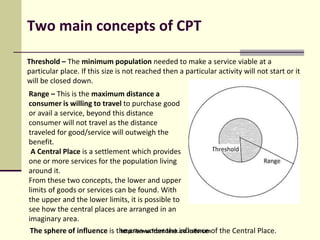
Two main concepts of CPT
Threshold – The minimum population needed to make a service viable at a
particular place. If this size is not reached then a particular activity will not start or it
will be closed down.
Range – This is the maximum distance a
consumer is willing to travel to purchase good
or avail a service, beyond this distance
consumer will not travel as the distance
traveled for good/service will outweigh the
benefit.
A Central Place is a settlement which provides
one or more services for the population living
around it.
From these two concepts, the lower and upper
limits of goods or services can be found. With
the upper and the lower limits, it is possible to
see how the central places are arranged in an
imaginary area.
The sphere of influence is the area under the influence of the Central Place.http://www.frontdesk.co.in/forum
Sizes of settlements/communities as per
CPT
Walter Christaller gave a system with 5 sizes of settlements based on
population. The smallest unit is Hamlet which is considered a rural
community and the largest unit is Regional Capital. The rank order of central
places in ascending order include:
1. Hamlet
2. Village
3. Town
4. City
5. Regional Capital/ Metropolis
Markets and Services tend to be nested hierarchies with smaller towns serving
smaller markets. However, transportation and border effects can shift the distribution of
towns away from theoretical uniformity.http://www.frontdesk.co.in/forum
The arrangement of the Central places/
settlements: CPT
As transport is equally easy in all direction, each
central place will have a circular market area as
shown in C in the following diagram: However,
the circular shape of the market areas results in
either un-served areas or over-served areas. To
solve this problem, Christaller suggested the
hexagonal shape of the markets as shown in D in
the above diagram. Within a given area there will
be fewer high order cities and towns in relation to
the lower order villages and hamlets. For any
given order, theoretically, the settlements will be
equidistant from each other. The higher order
settlements will be further apart than the lower
order ones.
http://www.frontdesk.co.in/forum
Principles in the arrangement of the
central places:
Central place theory gives 3 principles which are the
marketing principle,
transport principle and
administrative principle for orderly arrangements and the formation of hierarchy.
Settlements are regularly spaced – equidistant spacing between same order centers,
with larger centers farther apart as compared to smaller centers. The market area is
hexagonal shaped as it is free from overlapping, most efficient in both number and
function.
The different layouts predicted by Christaller have K- values which show how much
the Sphere of Influence of the central places takes in — the central place itself counts
as 1 and each portion of a satellite counts as its portion:
Marketing Principle (K=3)
Transport Principle/ Traffic Principle (K=4)
Administrative Principle (K=7)
http://www.frontdesk.co.in/forum
Marketing Principle in CPT
Marketing Principle (K=3): As per this the
market area of a higher order occupies one-
third (1/3 part) of the market area of each of
the consecutive lower size place(node) which
lies on its neighbor. The lower size nodes (6 in
numbers and 2nd larger circles) are located at
the corner of the largest hexagon around the
high-order settlement. Each high-order
settlement gets 1/3rd of each satellite
settlement (which are 6 in total), thus K =
1 + 6×1/3 = 3.
With K=3 the transport network is not efficient
even when the distance traveled is reduced.
This is because of the absence of transport links
(network) between the larger places (nodes).
http://www.frontdesk.co.in/forum
Transport Principle in CPT
Transport Principle (K=4): This provides for
most efficient transport network. High order
place half of the market area of 6 neighboring
lower order places located on the edge of the
hexagon formed by high order settlement.
There are maximum central places possible.
These are located on the main transport routes
connecting the higher order center. The
transportation principle involves the
minimization of the length of roads connecting
central places at all hierarchy levels. In this
system of nesting, the lower order centers are
all located along the roads linking the higher
order centers. This alignment of places along a
road leads to minimization of road length.
However, for each higher order center, there
are now four centers of immediate lower order,
as opposed to three centers under the
marketing principle.
http://www.frontdesk.co.in/forum
Administrative Principle in CPT
Administrative Principle (K=7): According to K =
7 administrative principle (or political-social
principle), settlements are nested according to
sevens. The market areas of the smaller
settlements are completely enclosed within the
market area of the larger settlement. Since
tributary areas cannot be split administratively,
they must be allocated exclusively to a single
higher-order place. Efficient administration is
the control principle in this hierarchy.
http://www.frontdesk.co.in/forum
Hierarchical spatial arrangement in CPT
Marketing Principle : A hierarchical spatial arrangement of central place
according to christaller’s k=3 principle
http://www.frontdesk.co.in/forum
Hierarchical spatial arrangement in CPT
Transportation Principle K=4 Transport routes
are straight, passing through second order
centers
Administrative Principle k=7 and all the
six lower-order places in the hexagon are
served by the central placehttp://www.frontdesk.co.in/forum
Hierarchy of Central Places
Christaller suggested that the central places, providing goods and services to the
surrounding areas would form a hierarchy. A large number of widely distributed small
places would provide lower order goods and services to service regular widespread
demand. There would be a smaller number of larger centers providing both lower-
order and higher-order goods and services. Successive steps of the hierarchy would
consist of larger central places providing even higher-order goods and services.
http://www.frontdesk.co.in/forum
Scalogram or Guttman Scaling
In 1944, sociologist Lous Guttman introduced the Scalogram. Scalogram is also
called cumulative scaling.
The Scalogram or Gultman Scaling ranks cities and municipalities in a region
by their functional complexity based on the number and types of functions
that are located within them.
The uses of the Scalogram are to:
1. Categorise settlements into levels of functional complexity,
2. •Determine the types and diversity of services and facilities,
3. Indicate the sequence in which settlements tend to accumulate functions,
4. Show the degree of access that people have to services and facilities, and
5. Assist in deciding appropriate investment for settlements on a hierarchical
basis.
http://www.frontdesk.co.in/forum
Scalogram or Guttman Scaling
The starting point in the computation of centrality is the listing of the
presence of social and economic functions (productive activities, services,
facilities and infrastructure) of highest and lowest orders in a settlement.
The next step is to list in hierarchical manner all functions by order of
importance. The function of the highest order present in a settlement will
imply the level of development of that settlement.
Settlements (Lowest) -------------------------Functions----------------
------------(Highest)
1 2 3 4 5 6 7 8 9 10
A X X X X X X X X X X
B X X X X X X X
C X X X X X
D X X X X
E X X
An example of a Scalogram is given, where
the vertical columns indicate
the functions present in Settlements A to E
and the horizontal columns reflect
their hierarchical levels (lowest to highest).
Functions might include urban facilities
such as Banks, Markets, Airports, Hospitals
and Industrial centres. Non-urban
functions, e.g. tourist resorts, should not be
used.
http://www.frontdesk.co.in/forum
Sociogram
Sociograms were developed by Jacob L. Moreno to analyze choices or
preferences within a group
The following sociogram represents a group of
twelve students in a youth group,with each
circle representing a student. The students had
to nominate three people they would prefer to
work with to organise a function. They also
had to identify three people they would prefer
not to work with. From this sociogram the
following information is revealed. Adapted from: Teasedale, T.C. (1976) Social Psychology.
• The person who is the most popular: No. 5
• Reciprocating friendships e.g. Nos. 7 and 8
• Chains of friendships e.g. Nos. 8, 7, 6, 3 and 2
• Closed friendship groups or cliques e.g. Nos. 3, 4,
and 6
• People not chosen by anyone (rejected) e.g. No.
12
• Some people are neither rejected nor
chosen (ignored) e.g. No. 11
• The person who neither makes a choice
nor receives a choice (isolated) e.g.
No. 10.
• The person with considerable influence
e.g. No. 9, as he is chosen by the
most popular person.
http://www.frontdesk.co.in/forum
Methods of Population Forecast And
Projections
Population Projection forms an integral part of any study or activity dealing
with providing services to people. Planning for existing population can be done
by obtaining population data from various sources.
1. Arithmetical Increase Method
2. Geometrical Increase Method
3. Incremental Increase Method
4. Method of Least Square
5. Component Method
Arithmetic Increase method
Arithmetic mean: Linear Interpolation or Extrapolation ,
Pe= Pi+ (P2-P1) n/N
Pe=Estimate population at some inter-census data
P1=population first Year , P2=population Second Year ,
N = number of year/ month between Two censuses P1 & P2
n = number of year / month between the date Pe , & Pi
http://www.frontdesk.co.in/forum
Arithmetic Increase method
Pe= P0+ (P0+rt)/100
r= growth rate = average of all last five decades
t = time period
Example : P1966 = P61 + (P71-P61) 5/10
P71= 30 LACS , P61=20 LACS
0
10
20
30
40
1961 1966 1971 1976
Interpolation ( Inside Interval)
POPULATION
(Lacs)
Extrapolation ( outside interval)
P1966 = 25
http://www.frontdesk.co.in/forum
Arithmetic Increase method
Step:1 To find out the increment from the population data
Step2 : To find the average increment/rate of change of population wrt time from the
population increment
Step3 : to estimate the
population at the
respective year from
the formula of
arithmetic increase
method
http://www.frontdesk.co.in/forum
Geometrical Increase method
Instead of assuming that the population is growing by a constant amount, the
exponential model assumes that the population is growing at a constant rate.
This may be appropriate for expanding communities unaffected by any
constraints
Pe= P0(1+r)n
Pe=Estimated year population
P0=Origin year population
r = Geometric Mean of Growth rate
n = Time period
0
20
40
60
80
100
120
1961 1966 1971 1976 1981
POPULATION
(Lacs)
P1966 = 30
http://www.frontdesk.co.in/forum
Geometrical Progression method
Step:1 To find out the increment
from the population data
Step 2 : to estimate the Geometrical increase
rate of growth
Step 3: To find out geometric mean (IG or r) Step 4: Population forecasting
http://www.frontdesk.co.in/forum
Incremental Increase Method
While adopting this method the increase in increment is considered for
calculating future population. The incremental increase is determined for each
decade from the past population and the average value is added to the
present population along with the average rate of increase.
Pn= P+ n.X + (n.(n+1)/2).Y
Pe=Estimated year population
P0=Origin year population
r = Growth rate
n = Time period
http://www.frontdesk.co.in/forum
Incremental Increase Method
Step:1 To find out the increment from
the population data
Step: 2 Find the incremental increase (Y)
Step: 3 Find total and average
of increase and incremental
increase
http://www.frontdesk.co.in/forum
Incremental Increase Method
Step:4 - Population forecasting
http://www.frontdesk.co.in/forum
Method of Least Square
This method is applicable when time-series data is available. It is a simple
method commonly used to make future projections on the basis of the past
trend. It is common to fit a straight line to the past observations.
Y= a+bX
Y= required trend value
X= unit of time
a, b= constant
By solving two equation to get a & b
ΣY = Na + b. Σ X
ΣXY = a. Σ X + b. ΣX2
where:
ΣX = the sum of all observations of X
ΣY = the corresponding sum of all the Y observations
ΣXY = the sum of all the products of X and Y
ΣX2 = the sum of all the squares of X
N = total number of observations
http://www.frontdesk.co.in/forum
Method of Least Square
Example of Population Projections Based on Method of Least Squares
Year population S. No. of Square of
(in million) Col. 1 ‘X’
(Y) (X) X.Y
1997 51.99 1 1 51.99
1998 52.46 2 4 104.92
1999 55.12 3 9 165.36
2000 54.07 4 16 216.23
2001 57.56 5 25 287.80
Total (ΣY) 271.20 (ΣX) 15 (ΣX2) 55 (ΣXY) 826.35
By using the following two equations, the value of Y = a + b . X can be
calculated:
ΣY = Na + bΣ X = 271.20 = 5a + 15b ……………………………1
ΣXY = a Σ X + b ΣX2 = 826.33 = 15a + 55b ……………………………….2
Multiply equation (1) by 3 and subtract it from Equation (2) to get the value of
‘b’. By putting the value of ‘b’ in Equation (2), the value of ‘a’ can also be
worked out: http://www.frontdesk.co.in/forum
Method of Least Square
Thus, by interpolation we get the following equation:
Y = 50.43 + 1.27 X (with 1997 as X=1)
In the above example, by putting the values of ‘X’ we can get values for
various years to draw the best-fitting lines and then project it in the
future. Accordingly, the population projections for 2002 can be
worked out as under:
population in 2002 (Y) = 50.43 + 1.27 x 6 = 58.05, X = 6 in year 2002-03
Similarly, Population can be projected in the future by increasing the
value of ‘X as under:
Year Value of ‘X’ population (in million) (Y)
2002-03 6 58.05
2003-04 7 59.32
2004-05 8 60.59
2005-06 9 61.86
2006-07 10 63.13
2007-08 11 64.40
http://www.frontdesk.co.in/forum
Component Method
Projection by component method involves an analysis of various age- sex
groups of current population assumed as the base.
Cohort : denote a group of person who experience a certain event in specific
period of time .
Cohort Component Equation
To project the total population size, and the number of males and females by 5-
year age groups, find the number of people who survive or are expected to be alive
in the future. Add to the survived population number, the number of births that
take place and the number of net migrants.
The fertility and mortality of a group ( cohort) follow a definite schedule. the
assume pattern of death rate can be taken “Life Table” also know as mortality
table. The birth each year can be calculated by general fertility rate and estimated
female population of child bearing age (15 to 44 age group)
http://www.frontdesk.co.in/forum
Life table
The various columns given in the abridged life table are :
nqx It represents the probability of dying between exact age x and x+n
lx It is the expected number of persons surviving at exact age x out of the
original cohort l0 of say 1,00,000 persons
nLx This denotes the expected number of person-years lived between ages x and x+n
years
Ex It denotes the expectation of life at age x viz. the average number of additional
years a person would live if the current mortality trends were to continue.
The Sample Registration System (SRS) is a large scale demographic sample survey based
on the mechanism of a dual record system with the objective of providing reliable
estimates of fertility and mortality indicators at State and National levels for rural and
urban areas separately.
There are two types of life tables:
Unabridged, for single years of life
Abridged, for 5-year cohorts of life : To adjust for the sampling fluctuation and for
augmenting the sample size, five-year average is compiled for estimating age-specific
death rates separately for rural and urban areas, both for male and female
http://www.frontdesk.co.in/forum
Life table
SRS based abridged life table of RAJASTHAN
http://www.frontdesk.co.in/forum
Survival Rates
Life tables are used to calculate survival rates. For population projections, 5-year survival
rates are computed.
To calculate a rate to survive women ages 25–29 into the next 5-year age cohort (30–34),
use the following numbers from the Lx column
Surviving One Age Group into the Next Year Age Cohort
S30-35 = L30-35 / L25-30 = 458690/ 462504 = 0.9917
This process is repeated for most age groups; the first and last age groups are exceptions.
Slight modifications are required to survive these two groups into the next age group.
Surviving the youngest age cohort
Surviving the oldest age cohort : The value of Tx represents the number of survivors in a
particular age group and all older age groups.
= (95892+ 378232) / 100000X5 = 474124 /500000 = 0.9482
= (105740+139710)/ (105740+139710+211755) = 245450/457205 = 0.5368
http://www.frontdesk.co.in/forum
Cohort Component Method
Step 1: Collecting Information
The cohort component method requires information from both the most recent and the
prior census of the locale. Collect information on the number of births during the past
10 years. Ideally information on births should be compiled by the age of the mother so
that age-specific fertility rates can be calculated. These rates are used to project the
number of births that occur during the projection period. Use the general fertility rate
when births by age of mother are not available. A life table or calculated survival rates
are also needed.
Step 2: Aging a Population into the Future
The cohort component method takes each age group of the population and ages it over
time using survival rates. Obtain census information distributed by sex and age (usually
5-year age groups) Multiply the base census population of a given age group by survival
rates to obtain the population still alive 5 years later
What is the number of women aged 25-29 who will be alive in 5 years?
Women aged 25-29 alive in 5 years = (population women aged 20-24) (survival rate)
http://www.frontdesk.co.in/forum
Cohort Component Method
Step 3: Adding Births
Next, calculate the number of births taking place during the projection interval. Age-
specific fertility rates are used to estimate the number of births that take place. The
rates are multiplied by the number of women in their reproductive years. The results
give an annual number of expected births. They are then multiplied by the projection
period, usually 5 years, to obtain the total number of births that take place in the
future.
An age-specific fertility rate indicates the probability that a woman in her reproductive
years will give birth in a given year. Use the Sex Ratio equation as shown in equation to
find the number of male and female babies born.
Sex Ratio Equation :
Once the number of male and female births has been determined, the results are
multiplied by a survival rate to determine how many babies survive into the future as
shown in equation
http://www.frontdesk.co.in/forum
Step 4 : Adding Net Migrants
Next add the number of net migrants. This can be a positive or negative number.
Obtaining the number of net migrants is a 2-stage process. First, calculate net
migration rates. Then multiply these rates by the survived population to obtain the
number of net migrants.
Migrations are movements across political boundaries that are semi-permanent or
permanent in nature. Net migration can be defined as the number of in-migrants
minus the number of out-migrants divided by the population exposed to the possibility
(or risk) of migration, as shown in Equation
K is a constant, usually 100.
The residual method of
calculating migration
Cohort Component Method
http://www.frontdesk.co.in/forum
Forward Method
The survival rate is multiplied by the prior
census population, P °
x. The result provides an
expected population for the present census
period. Subtract the expected population from
the present census period, Pt
x+t. The difference
is assumed to be due to migration. The forward
method estimates the number of net migrants
at the end of the period and assumes that:
• All migration takes place at the end of the
period
• All deaths occur in the community for which
the estimates are being prepared, or all
deaths are to non-migrants. One problem is
that residents and migrants are moving and
dying throughout
In most cases, planners use survival rate methods to estimate net migration rates.
The forward methods estimate net migration by age and sex.
Cohort Component Method
http://www.frontdesk.co.in/forum
Example of component method
Example : The goal is to project the number
of women for the district from years 2000-
2005.
Step 1: Collecting Information
Step 2: Aging a Population into the Future
Table-1
Projecting the Population of Females for Year 2005
Column 1 Column 2 Column 3 Column 4
Column 5
Survived
Population
Age in 2000
Birth 00-05
Age in
2005
Census
2000
Survival
Rate
(Column 3*4)
0-4 0-4 --- 0.9809 ---
5 to 9 5 to 9 3837 0.9904 3763.71
10 to 14 10 to 14 3006 0.9934 2986.16
15-19 15-19 2632 0.9976 2625.68
20-24 20-24 2648 0.996 2637.41
25-29 25-29 3478 0.9938 3456.44
30-34 30-34 4022 0.9916 3988.22
35-39 35-39 4091 0.987 4037.82
40-44 40-44 3823 0.9795 3744.63
45-49 45-49 3474 0.9673 3360.4
50-54 50-54 2648 0.9512 2518.78
55-59 55-59 1706 0.9322 1590.33
60-64 60-64 1341 0.9036 1211.73
65-69 65-69 1155 0.8653 999.42
70-74 70-74 1180 0.8165 963.47
75-79 75-79 1139 0.7505 854.82
80+ 80-84 951 0.6634 630.89
85+ 827 0.5426 448.73
http://www.frontdesk.co.in/forum
Example of component method
Step 3: Adding Births
Estimating the number of births taking place during the projection period is a two-
stage process. First, calculate age-specific fertility rates. To do this, obtain information
on the number of births by age of mother for a three year period around the date of
the last census taking.
Column 1 Column 2 Column 3 Column 4 Column 5 Column 6 Column7 Column 8 Column 9
Ages
Births
1999
Births
2000
Births
2001
Births Average Women C5/C6 C7 * C8
((C2+C3+C4)/3)
Census
2000
ASFR
Survived
Women
Annual
Births
15-19 324 273 302 299.67 2648 0.1132 2637.4 298.47
20-24 472 442 457 457 3478 0.1314 3456.4 454.16
25-29 427 411 416 418 4022 0.1039 3988.2 414.49
30-34 258 250 274 260.67 4091 0.0637 4037.8 257.28
35-39 102 93 74 89.67 3823 0.0235 3744.6 87.83
40-44 10 9 14 11 3474 0.0032 3360 10.64
Table-2
http://www.frontdesk.co.in/forum
Example of component method
Column 1 indicates the ages of women in their reproductive years or child bearing age
(15 to 44 age group)
Columns 2-4 present the number of births for the 3 years surrounding the last census
period. An average was taken of the births prior to calculating the age-specific fertility
rate ASFR ((Column 2 + Column 3 + Column 4)/3)).
Column 9 Once the age-specific fertility rates are calculated, they are multiplied by the
number of survived women in each age group.
The sum of Column 9 provides the number of expected annual births that is annual
births total = 1522.8599
To find the number of expected births for the projection period, the number of annual
births were multiplied by the projection interval of 5 years.
births during the projection period = annual births X projection period
(1,522.86) (5) = 7,614
To find the number of female births, the number of expected births was multiplied
by .49 (.49 is based on the use of Sex Ratio Equations ).
female births = expected births X .49 = (7,614)(.49) = 3,731
The final step is to multiply the expected births by a survival rate, which is provided in
Table -1
Number of projected births = 3,731 X survival rate = 3,731 X .9809 = 3659.7379http://www.frontdesk.co.in/forum
Example of component method
Step 4 : Adding Net Migrants
Using the forward method to
estimate net migration.
This method was selected
because its process of
estimating migration is easier
to understand. Census data
were collected for 1990–2000,
as well as information on the
number of births that occurred
in 1990–2000. 10-year survival
rates are used to calculate
estimates of net migration.
The first two rows in Column 4
show the births that took place
from 1990 to 1995 and from
1995 to 2000. In Column 3, the
first survival rate is S0-5 for
children under the age of 5,
Table 3
Column1 Column 2: Column 3: Column 4: Column 5 Column 6: Column 7 Column 8
1990 ages
Births
2000 Ages
10-year
Survival
Rates
Census
1990
Expected
Population
Census
2000
Net
Migrants
Net
Migration
Rate
Births
1995-2000
0-4 0.9892 3226 3191.1592 3006 -185.159 -0.058
Births
1990-1995
5 to 9 0.9962 2468 2458.6216 2632 173.3784 0.0705
0-4 10 to 14 0.998 2346 2341.308 2648 306.692 0.131
5 to 9 15-19 0.9966 2387 2378.8842 3478 1099.116 0.462
15-19 20-24 0.9948 2535 2521.818 4022 1500.182 0.5949
20-24 25-29 0.9942 3332 3312.6744 4091 778.3256 0.235
25-29 30-34 0.9932 3949 3922.1468 3823 -99.1468 -0.0253
30-34 35-39 0.991 3144 3115.704 3474 358.296 0.115
35-39 40-44 0.9864 2515 2480.796 2648 167.204 0.0674
40-44 45-49 0.9785 1674 1638.009 1706 67.991 0.0415
45-49 50-54 0.9661 1337 1291.6757 1341 49.3243 0.0382
50-54 55-59 0.9463 1218 1152.5934 1155 2.4066 0.0021
55-59 60-64 0.9208 1326 1220.9808 1180 -40.9808 -0.0336
60-64 65-69 0.8855 1236 1094.478 1139 44.522 0.0407
65-69 70-74 0.8265 1127 931.4655 951 19.5345 0.02
70-74 75-79 0.7281 1129 822.0249 827 4.9751 0.0061
75+ 80-84 0.5782 895 517.489 545 27.511 0.0532
85+ 0.5524 1089 601.5636 409 -192.564 -0.3201
and the second rate is S5-10 for children ages 5–9. The
remaining survival rates are for a 10-year period.
http://www.frontdesk.co.in/forum
Example of component method
Result :
The projection for females for the
Year 2005 is provided in Table 4.
Births were added to Column 3.
Net migration rates in Column 6 were
used to calculate the number of net
migrants (see Column 7).
Column 8 consists of the projected
population for each age group.
It represents the number of net
migrants plus the number of
population that survived into the
future plus the number of births that
occurred.
Table 4
Projecting the Population of Females Year 2005
Column Column Column Column Column Column Column Column
1 2 3 4 5 6 7 8
Age 2000 Age 2005
Census
2000
Survival
Rate
Survived
Population
Net
Migration
Rate
Number Net
Migrants
Projected
Population
Birth 00-05 0-4 3731 0.9809 3659.74 -0.058 -212.3473 3447.39
0-4 5 to 9 3837 0.9904 3763.71 0.0705 265.4116 4029.12
5 to 9 10 to 14 3006 0.9934 2986.16 0.131 391.1623 3377.32
10 to 14 15-19 2632 0.9976 2625.68 0.462 1213.1443 3838.83
15-19 20-24 2648 0.996 2637.41 0.5949 1568.9443 4206.35
20-24 25-29 3478 0.9938 3456.44 0.235 812.103 4268.54
25-29 30-34 4022 0.9916 3988.22 -0.0253 -100.8169 3887.4
30-34 35-39 4091 0.987 4037.82 0.115 464.3361 4502.15
35-39 40-44 3823 0.9795 3744.63 0.0674 252.3855 3997.01
40-44 45-49 3474 0.9673 3360.4 0.0415 139.4846 3499.89
45-49 50-54 2648 0.9512 2518.78 0.0382 96.1828 2614.96
50-54 55-59 1706 0.9322 1590.33 0.0021 3.3206 1593.65
55-59 60-64 1341 0.9036 1211.73 -0.0336 -40.6702 1171.06
60-64 65-69 1155 0.8653 999.42 0.0407 40.6552 1040.08
65-69 70-74 1180 0.8165 963.47 0.021 20.2057 983.68
70-74 75-79 1139 0.7505 854.82 0.0061 5.1736 859.99
75-79 80-84 951 0.6634 630.9 0.0532 33.5399 664.43
80+ 85+ 827 0.5426 448.73 -0.3201 -143.6408 305.09
Total: 44839.557
http://www.frontdesk.co.in/forum
Threshold analysis
The application of threshold analysis gained significance due to failure of
physical planning in Poland. It was used to determine policies for spatial
development in post war reconstruction.
It attempts to rationalize and control the process of growth. Another aspect
was close association of economics and urban planning.
It is a technique that is applied to process of formulation and comparing
alternative strategies for development of towns.
Therefore this has been made integral part of structure plan in UK.
Threshold theory is based on the observation that towns encounter limitations
to their expansion due to physical features, existing land use , and technology
of infrastructure.
There is observation that physical growth of towns is not smoothly continuous
but proceeds in stages marked by successive limitations which have been called
as thresholds. These thresolds are not insurmountable but can be overcome
only at additional( some times very High) development investments known as
threshold costs From: Urban threshold theory by B. Malisz 1967
http://www.frontdesk.co.in/forum
Threshold analysis
Thus it can be inferred that capital investment cost for the expansion of a town
will change over time disproportionately to increasing number of inhabitants
and will reflect periods when additional lump sum must be spent to open
successive areas for further development.
In general the costs necessary to locate new inhabitant in a town (C1=total
cost) are at least two fold.
1) Normal cost (Cn): These costs are connected with
given locations of construction necessary to
accommodate new inhabitants and would have to
be spent in any case. These costs are dependent on
type and density of dwellings, site servicing and
development and the cost of material, labour, etc.
2) Additional cost (Ca): These cost result from existing
conditions and characteristics of given The diagram
1 illustrates these type of costs. It is clear that the
need to over come a given threshold may result in
a violent rise in additional costs Ca.
http://www.frontdesk.co.in/forum
Threshold analysis
The overstepping of the threshold limitation i.e. completion of all investments
necessary to open new land for town expansion, results in a decline in these
costs. The peak points on the cost curve are in fact one of the ways in which
thresholds can be presented.
Threshold costs may be categorised into those which must be spent before the
land is made suitable for development( e.g. a bridge , or access road)
Second type which are spread over the whole period of development ( such as
cost connected with building on land with low bearing capacity )
Classification of thresholds:
Physical threshold: Limitations due to physiography and topography and get
physically identified in the form of natural features such as rivers hilly areas,
Technological thresholds: These are constraints due to expansion of
infrastructure system. Some of them can be identified spatially and others
numerically.
http://www.frontdesk.co.in/forum
Classification of thresholds:
For example water shed line is generally limit of extension of sewerage
system(spatially identified as threshold), capacity of sewerage treatment plant
can be expressed in terms of number of inhabitants that can be served(
numerically identified threshold) beyond which substantial costs have to
incurred. The yield of existing water sources is also example of numerical
threshold.
As the demand exceeds then substantial costs are required to develop new
source and bring it to the town.
In relation to transport network as the town expands where it need mass
transportation to be introduced or rapid transit system to be introduced.
Structural limitations : These are constraints imposed on the further growth of
a town by its internal urban structure. For eg. A large commercial complex in
center of town may require large Development investments in order to serve
increased population.
http://www.frontdesk.co.in/forum
Classification of thresholds:
The threshold may be applied to local ,regional or national
In a transitional economy like India the threshold may be classified as Tangible
or intangible
Tangible : physical, technological or structural
Intangible : socio-ecomomic, May be linguistic or religious factors.
Thresholds are classified as , 1) Grade threshold, 2) Stepped threshold
A grade threshold is overcome by additional investment during development
and generally caused by site conditions
A stepped threshold is overcome by lump sum investment before new
inhabitants can be accommodated.
In grade threshold investment average const of each additional unit keeps on
increasing after threshold is experienced at x
In case of stepped threshold lump sum investments have to be made at stages
A and B of towns growth
http://www.frontdesk.co.in/forum
Method of Threshold analysis
Stage 1. Delineation of area to be surveyed (should be as far as possible
homogeneous)
Stage 2: Analysis of factors affecting town development
A) Physiographic suitability of land for urban development, such as Natural
features are slopes, woodlands, swamps etc. whether land is suitable for
development.
B) The possible extension of public utility and transportation systems. Main
relevant infrastructure may be water supply, power etc.
The hindrances may be forest lands, heritage areas,
Land available for development without extra cost, Existing urban structure
where there is blighted areas, undeveloped areas in built up areas, such areas
are available for immediate development. C) lines of various networks which
could create limitations for further town growth. In particular rail route, HT
lines,
D) ownership of land or property may be of considerable importance which
may place constraints.
http://www.frontdesk.co.in/forum
Method of Threshold analysis
Stage 3: Tracing the threshold lines. For the majority of towns simple graphical
methods can be used to show the results of stage 2 on the map. The survey
group could be divided in land needing essential improvements and or capital
investments before becoming suitable and land unsuitable for urban
development.
Stage 4. Synthesis. The information can now be correlated to form a sysnthesis
of all factors.
There are many threshold lines superimposed resulting from different factors.
Stage 5 : the subdivision of land for main functions within successive physical
threshold areas . This may be done by division into suitability of 2 main
functions only, areas suitable for industry and areas suitable for other Urban
functions. Where land is suitable for both industrial function may be given
priority as employment generator and the requirements are more inflexible.
Stage 6 : The calculation of capacity of residential areas within first and
successive threshold lines can be transformed into quantitative figures how
many people can be accommodated
http://www.frontdesk.co.in/forum
Method of Threshold analysis
Stage 7 Calculation of industrial areas within first and successive threshold lines
to define potential .
Stage 8: Rough Calculation of costs necessary to overstep each threshold within
examined area.
Stage 9: Calculation of efficiency indices for successive threshold areas
Implications from threshold analysis
When a town meets a threshold or there is a prospect of one occurring in near
future, the time has come for a reappraisal of the pattern of development to
ensure that more efficient one does not exist.
The nature of thresholds give wide opportunities to analyze and evaluate all
reasonable planning alternatives from the point of natural features, public utility
networks , and communication systems and land use patterns and arrive at most
suitable option.
Scope for application: It is quantitative tool to arrive at decision. It helps to identify
thresholds and additional costs involved in overcoming them However it may be seen
that costlier option need not necessarily be less acceptable because it may more social
benefits which are beyond the scope of threshold analysis.
http://www.frontdesk.co.in/forum
Input-Output Analysis
I N P U T- O U T P U T approach has been developed by Prof Leontief to provide
a framework for " an empirical l study of interrelations among the different
parts of a national economy “
Input
- Something which is brought for the enterprise
- Input-that which is procured
- Represents the expenditure of the firm
- Sum of the money values of inputs is the total cost
Output
- Something which is sold by it.
- Output-that which is produced
- Receipt part of the firm
- Sum of the money values of the output is the total revenue
http://www.frontdesk.co.in/forum
Input-Output Analysis
The investment demand for the product of each industry cannot be
explained unless together with the input coefficients, the capital coefficients are
also included in the model.
A set of capital coefficients for a given industry describes the stocks of various
commodities required per unit of its output. With the introduction of these capital
coefficients or the stock-flow relation ships, the model assumes a dynamic
character.
This dynamic model can be utilised for the purposes of planning in quantitative
terms, if the; input and capital coefficients are given. In that case, if the time-shape
of the final demand is to be taken as given, we can determine wit h the help of this
model, the feasible rate of growth of output of the various sectors of the economy.
With the help of the same model, we can also determine the way in which the.
final demand should be controlled.
http://www.frontdesk.co.in/forum
SWOT Analysis
SWOT Analysis is a structured analysis method
used to evaluate the Strengths, Weaknesses,
Opportunities and Threats involved in a planning
. The Planning constraints and opportunities are
examined relative to future development and/or
redevelopment of the Study Area carriageways
and public realm. The SWOT acronym is defined
as follows:
Strengths: characteristics of the planning that
provide advantages and assist in the planning
success;
Weaknesses: characteristics that place the
planning at a disadvantage and may hinder
planning success;
Opportunities: elements of the planning that
could lead to planning success;
Threats: elements in the planning region that
could cause setbacks for the planning.http://www.frontdesk.co.in/forum
Lorenz Curve
The Lorenz Curve is a graphical method used
to display the concentration of activities within
an area (e.g. the degree of industrial
specialization within an urban area). Fieldwork
data may be used but it is more common to
use secondary sources (e.g. census data, etc).
This technique is particularly useful as it
provides a good visual comparison of any
observed differences and from it a precise
index (Gini Coefficient) can be calculated.
The further away the Lorenz Curve is from the "line of perfect equality" (diagonal),
the more diverse is the sample and the more unevenly the values are spread out .
This is very useful to estimate how wealth is distributed among a population: if a
country's Lorenz Curve is distant from the line of perfect equality, it means a small
% of the population controls most of the wealth and that the country's income
distribution is uneven.
http://www.frontdesk.co.in/forum
Gini Coefficient
The Gini Coefficient is used to quantify the
diversity which you have shown after you have
built a Lorenz curve.
The formula to calculate the Gini Coefficient is
given by the diagram below.
Gini = 0 means perfect equality
Gini = 1 means total inequality
Note: you can calculate the area by counting
approximately the squares and half squares on
the graph paper
http://www.frontdesk.co.in/forum
Occupation
Number
employe
d
Rank
Frequenc
y
(= % of
total)
Cumul
ative
Freque
ncy %
Office workers 195 1 60% 60%
Retail workers 34 2 10.5% 70.5%
Waiters 25 3 7.6% 78.1%
Teachers 23 4 7.1% 85.2%
Public Employees 28 5 5.5% 90.7%
Managers 16 6 4.8% 95.5%
Doctors 7 7 2.1% 97.6%
Unemployed 6 8 1.8% 99.4%
CEOs 1 9 0.6% 100%
Employment survey in city block #1:
Occupation
Number
employed
Rank
Frequency
(= % of
total)
Cumulati
ve
Frequenc
y %
Waiters 19 1 26.3 26.3
Managers 18 2 25% 51.3%
Office
workers
14 3 19.4% 70.7%
CEOs 6 4 8.3% 79.0%
Doctors 5 5 6.9% 85.9%
Retail
workers
5 6 5.5% 91.4%
Public
employees
3 7 4.2% 95.6%
Unemployed 2 8 2.9% 98.5%
Teachers 1 9 1.5% 100%
Example: comparison of employment between city block #1 and city block #2
Employment survey in city block #2:
Lorenz Curve Example
http://www.frontdesk.co.in/forum
Graphic interpretation: The Lorenz Curve for
the city block #2 is closer to the Even
Distribution Line than for city block #1 : this
means that various types of jobs are more
evenly distributed in city block #2, while more
people tend to do the same kind of work in
city block #1 (e.g. 60% of them hold the type
of work found at rank #1, ie office workers).
Lorenz Curve Example
0
0.1
0.2
0.3
0.4
0.5
0.6
0.7
0.8
0.9
1
0 0.1 0.2 0.3 0.4 0.5 0.6 0.7 0.8 0.9 1
CumulativeShareofemployment
0
0.1
0.2
0.3
0.4
0.5
0.6
0.7
0.8
0.9
1
0 0.1 0.2 0.3 0.4 0.5 0.6 0.7 0.8 0.9 1
CumulativeShareofemployment
However, in both cases, we find that there
appears to be a significant deviation from the
"ideal" line of even distribution, which means
that in both cases, there isn't much diversity in
the types of jobs found in both blocks: just two
types of jobs employ 50% (city block #2) to
70% (city block #1) of all people, while other
types of jobs are much less represented.
city block -1 : GINI 0.604
city block -2 : GINI 0.435
http://www.frontdesk.co.in/forum
i =
j = 1 2 3 4 5 6 7 8 9
1 0 161 170 172 167 179 188 189 194
2 161 0 9 11 6 18 27 28 33
3 170 9 0 2 3 9 18 19 24
4 172 11 2 0 5 7 16 17 22
5 167 6 3 5 0 12 21 22 27
6 179 18 9 7 12 0 9 10 15
7 188 27 18 16 21 9 0 1 6
8 189 28 19 17 22 10 1 0 5
9 194 33 24 22 27 15 6 5 0
Vertical Sum 1420 293 254 252 263 259 286 291 326
Horizontal
Sum 3644
Gini
Coefficient 0.604
Gini Coefficient Example
# of rank 9
rank
Number
employed
1 195
2 34
3 25
4 23
5 28
6 16
7 7
8 6
9 1
Mean 37.22
city block -1
Step1: calculate arithmetic mean
Step2 : Matrix showing difference of employed with other rank
Step 3 : Take vertical and total horizontal sum
Step 4 : Gini coefficient = total sum /(2*(no of rank^2)*mean)
http://www.frontdesk.co.in/forum
Theil’s Inequality Index : Theil’s index derives from the notion of entropy in information
theory. It is a measure that assesses the value of different events with respect to their
likelihood of occurrence. The Theil index is a statistic primarily used to measure economic
inequality and other economic phenomena
The values of the GE (General Entropy) class of measures vary between zero (perfect
equality) and infinity (or one, if normalized). A key feature of these measures is that they
are fully decomposable, i.e. inequality may be broken down by population groups or
income sources or using other dimensions, which can prove useful to policy makers.
Another key feature is that researchers can choose a parameter α that assigns a weight to
distances between incomes in different parts of the income distribution. For lower values
of α, the measure is more sensitive to changes in the lower tail of the distribution and, for
higher values, it is more sensitive to changes that affect the upper tail. The most common
values for α are 0, 1, and 2. When α=0, the index is called “Theil’s L” or the “mean log
deviation” measure. When α=1, the index is called “Theil’s T” index or, more commonly,
“Theil index”. When α=2, the index is called “coefficient of variation”. Similarly to the
Gini coefficient, when income redistribution happens, change in the indices depends on
the level of individual incomes involved in the redistribution and the population size
Theil’s index
http://www.frontdesk.co.in/forum
Ratios constitute the most basic inequality measures available. They are simple, direct,
easy to understand, and they offer few data and computation challenges. Accordingly,
they do not provide as much information as the complex measures described above.
Decile dispersion ratio (or inter-decile ratio)
It is the ratio of the average income of the richest x per cent of the population to the
average income of the poorest x per cent. It expresses the income (or income share) of
the rich as a multiple of that of the poor. However, it is vulnerable to extreme values
and outliers. Common decile ratios include: D9/D1: ratio of the income of the 10 per
cent richest to that of the 10 per cent poorest; D9/D5: ratio of the income of the 10 per
cent richest to the income of those at the median of the earnings distribution; D5/ D1:
ratio of the income of those at the median of the earnings distribution to the 10 per
cent poorest. The Palma ratio and the 20/20 ratio are other examples of decile
dispersion ratios.
Ratios
http://www.frontdesk.co.in/forum
Palma ratio
It is the ratio of national income shares of the top 10 per cent of households to the
bottom 40 per cent. It is based on economist José Gabriel Palma’s empirical observation
that difference in the income distribution of different countries (or over time) is largely
the result of changes in the ‘tails’ of the distribution (the poorest and the richest) as there
tends to be relative stability in the share of income that goes to the ‘middle’.
20/20 ratio
It compares the ratio of the average income of the richest 20 per cent of the population
to the average income of the poorest 20 per cent of the population. Used by the United
Nations Development Programme Human Development Report (called “income quintile
ratio”).
Ratios
http://www.frontdesk.co.in/forum
Number of Urban Units – India
Towns:
• Census 2001 5,161
• Census 2011 7,935 Increase: 2,774
Statutory Towns:
• Census 2001 3,799
• Census 2011 4,041 Increase: 242
Census Towns:
• Census 2001 1,362
• Census 2011 3,894 Increase: 2,532
Number of Rural Units (or Villages) in India:
All areas which are not categorized as Urban area are considered as Rural Area
Villages:
• Census 2001 6,38,588
• Census 2011 6,40,867
Increase: 2,279
Rural – Urban Units in India
http://www.frontdesk.co.in/forum
Urban population in India - 2011
Parameter
Statutory Towns
(based on state
government
definition)
Census Towns
(based on census
office definition)
Total Towns
(based on state
government and
census office
definition)
Number of towns 4,041 3,894 7,935
Population (in million) 323 54 377
Share of urban
population (%)
26.69 4.46 31.15
http://www.frontdesk.co.in/forum
Urban concentration
Uchida and Nelson: The authors proposed an alternative measure of urban
concentration called an agglomeration index in 2008.10 The index is calculated
using three criteria:
(i) population density;
(ii) population of a large urban centre,
(iii) travel time to that large urban centre.
The World Bank11 observes that by using the measure of agglomeration index,
the “share of India’s population living in areas with urban-like features was
55.3% in 2010…suggesting the existence of considerable hidden
urbanisation…particularly on the peripheries of major cities, which is not
captured by official statistics”.
http://www.frontdesk.co.in/forum
Urban concentration
Joint Research Centre (JRC) of the European Commission: A global database,
namely the Global Human Settlement Layer (GHSL), developed by the JRC with
the support of the Directorate-General for Regional and Urban Policy, is available
for assessing human presence on earth. These data are based on satellite images
that “make it possible to analyse the development of built-up areas, population
and settlements of the whole planet over the past 40 years”.12
The database helps in understanding the degree of urbanisation by using
population grid cells in four periods – 2015, 2000, 1990, and 1975. The data
show that about 63% of India’s population lived in cities or large urban areas in
2015.
To arrive at this figure, the following definition is used: “contiguous grid cells of 1
sq. km. with a density of at least 1,500 inhabitants per sq. km. or a density of
built-up greater than 50%, and a minimum of 50,000 inhabitants”.13
http://www.frontdesk.co.in/forum
Urbanization rate in India according to
various definitions
Various urban studies scholars have often expressed reservations over classifying areas
or settlements into “urban” and “rural”, saying it is inappropriate as it creates divisions
among societies and leads to social and economic inequalities. These scholars suggest
that such urban-rural classification be avoided, and instead a holistic approach (e.g.,
regional planning) should be used for planning and governance, as the two units are
intrinsically linked.
Taken from Measuring Urbanisation in India by RUMI AIJAZ
http://www.frontdesk.co.in/forum
Metropolitan concentration
Over the last 50 years, the world has faced
dramatic growth of its urban population. The
number of so-called mega cities increased in
the period from 1975 until today from 4 to 22
The number of Indian mega cities will double
from the current three (Mumbai, Delhi and
Kolkata) to six by the year 2021 (new additions
will be Bangalore, Chennai and Hyderabad),
Rank Metropolitan area Population Area (in km2)
1 National Capital Region (NCR) 46,049,032 55,083
2 Mumbai Metropolitan Region 20,800,000 4,354.5
3 Kolkata Metropolitan Area 14,720,000 1,851.41
4 Bangalore Metropolitan Region 10,576,167 8,005
5 Pune Metropolitan Area 10,100,000 6,616.79
6 Hyderabad Metropolitan Region 9,700,000 7,257http://www.frontdesk.co.in/forum
Metropolitan concentration : NCR , MMR
National Capital Region (NCR) is a unique example
of inter-state regional planning and development for
a region with NCT-Delhi as its core. The NCR as
notified covers the whole of NCT-Delhi and certain
districts of Haryana, Uttar Pradesh and Rajasthan,
covering an area of about 55,083 sq. kms. The sub-
region wise area details are as under:
The Mumbai Metropolitan Region (MMR) spread
over 4,355 sq. km. consists of 8 Municipal
Corporations viz. Greater Mumbai, Thane, Kalyan-
Dombivali, NaviMumbai, Ulhasnagar, Bhiwandi-
Nizamapur, Vasai-Virar and Mira-Bhayandar; and 9
Municipal Councils viz. http://www.frontdesk.co.in/forum
Spatial distribution & Density
Spatial distribution describes how
spread out a population is (what area
it occurs in), while population density
describes how many individuals are
found in a given area.
Spatial distribution of population
means the pattern of where people
live. Indian population distribution is
uneven.
Sparsely populated places tend to be
difficult places to live. These are
usually places with hostile
environments e.g. Arunachal Pradesh
(13 per/Km) .
Places which are densely populated
are habitable environments e.g. Delhi
(9,340 per/Km)
http://www.frontdesk.co.in/forum
Social Area Analysis
Social areas were derived by computing the scores given on the basis of three
Status measured in census variables such as income, marital status, caste :
1. Economic Status
2. Family Status
3. Ethnic Status
Attempt to give the social structure of the city an underlying empirical basis.
Grew out of the sociological discussion of the process of urbanisation,
especially Wirth's (1938) ideas on urbanism as a way of life.
Wirth suggested that the old ideas about neighborhoods as homogenous
“villages” had to give way to the different societies of the city.
Social Area Analysis proposed that a city could not be understood without
consideration of the society that created it.
Urbanisation changed everything – economics, demographics, culture,
society.
http://www.frontdesk.co.in/forum
These aspects of
urbanisation…
… lead to these changes in
society…
… whose effects on
space are …
… and can be measured
thus …
… and are
called:
Change in the
range and
intensity of socio-
economic
relationships
• Changing structure of
productive activity.
• Decreasing importance of
manual production.
• Increasing importance of
services sector
employment.
• Changes in the
spatial
arrangement of
occupations based
on function.
Education, income,
occupation, own or
rent, persons per room,
employment status,
ownership of items, tax
category.
ECONOMIC
STATUS
Differentiation of
economic
functions and
family roles.
• Decreasing importance of
primary production.
• Movement of women into
the labour force.
• Development of alternate
family patterns based on
lifestyle..
• Changes in
housing stock,
choice and
lifestyles.
• Filtering,
downtown
infilling, suburbs
become urbs.
Age and gender ratios,
number of children,
type of dwelling, own
or rent, number f
persons per household,
type of vehicle.
FAMILY
STATUS
Variety of origins
and
differentiation of
people
• Changing composition of
population.
• Increasing migration and
movement.
• Changes to age and gender
distributions.
• Increasing ethnic diversity.
• Redistribution of
space into core
and periphery.
• Isolation and
segregation of
groups.
• Increase in
international
Ethnicity, mother
tongue, country of
origin, length of
residency, movement
patterns over time,
children’s movement
patterns.
ETHNIC
STATUS
Process of
Urbanization
Increasing Social Scale Variables
SocialAreaConstructs
http://www.frontdesk.co.in/forum
Urbanisation
Processes:
Increased societal
scale and
complexity and
functional
differentiation
creating…
Social
status
Change in the range
and intensity of
socio-economic
relationships
Differentiation of
economic functions
and family roles.
Variety of origins
and differentiation
of people
Family
status
Ethnic
status
Process of Urbanisation and the Development of
Social Area Analysis Dimensions
http://www.frontdesk.co.in/forum
Giving rise to
different spatial
patterns based on
conditions of
status such as
ability to afford
best land, need
for family lifestyle
space, conditions
of assimilation
model.
Social
status
Measured by census
variables such as
income, occupation,
education.
Measured by census
variables such as
marital status, number
of children.
Measured by census
variables such as caste
mother tongue.
Family
status
Ethnic
status
Social Area Analysis Dimensions, How They Are
Measured, and Their Effects on Space
http://www.frontdesk.co.in/forum
Strategic Choice Approach (SCA)
The strategic choice approach is based on the principle that planning is a continuous
process involving the evaluation of possibilities against desirability: any process of choice
will become a process of planning (or: strategic choice) if the selection of current action is
made after a formulation and comparison of possible solutions over a wider field of
decision relating to certain anticipated as well as current situations
Strategic Choice Approach (SCA) is a problem structuring method centered on the
management of uncertainty and commitment in strategic situations, where strategic
refers to the advisability of considering particular decisions in the context of others.
Decision making occupies a central position in the strategic choice approach. Planning is
seen as the equivalent of decision making. Starting from this principle strategic choice
tries, as far as possible. To systematize and making explicit the decisions that must be
taken for the benefit of those groups affected by the planning problems
http://www.frontdesk.co.in/forum
Analysis of Interconnected Decision Areas
(AIDA)
The Analysis of Interconnected Decision
Areas (AIDA) technique can be used to
make these interrelationships clear. AIDA is
to a large extent a graphic technique which
generates solutions in situations where a
great number of possible combinations of
separated choices have to be taken into
accounts
One of the most important characteristic of
AIDA is the fact that users are free to
formulate the problem without constraint
as to the consistency and coherence of the
set of issue in their decision graph. It does
not matter whether the decision areas
representing the choices are defined
broadly or narrowly, generally or
specifically
The general process for finding solutions (Pahl &
Beitz, 1996)
http://www.frontdesk.co.in/forum
Analysis of Interconnected Decision Areas
(AIDA)
The steps of the planning and design process (Pahl & Beitz, 1996)
In the early stages of design, designers
can use AIDA to examine their decision
environment. Although there are
techniques for determining the range
of valid decisions, AIDA is the only
technique that we are aware of that
can be used to specifically show the
interdependencies and relations
between these decisions. In other
words, AIDA allows decision makers to
define the specific relationships that
couple design decisions. Although this
issue of exploring the
interdependencies within the design
process coupled with the overall look of
the AIDA matrices may remind
researchers of design structure
matrices (DSM)
http://www.frontdesk.co.in/forum
Spatial standards
• The Norms and standards - suggestive
• To be suitably modified as per local conditions.
•Variables affecting planning standards
- Population
- Function of City
- Geographic Location
- New town / Existing town
•URDPFI (Urban and Regional Development Plans Formulation and
Implementation) Guidelines-2014 New Delhi: Ministry of Urban
Development, Government of India.
•Accepted by Govt. of India.
•Being followed in Town Planning Departments.
http://www.frontdesk.co.in/forum
Settlement type Persons per hectare (pph) in
Plain Areas Hill Areas
Small Towns 75-125 45-75
Medium Towns 100-150 60-90
Large Cities 100-150 60-90
Metro Cities 125-175 --
Average densities of Developed Areas
http://www.frontdesk.co.in/forum
• Work Force participation – 33 % of total Population.
- This is increasing because of rising trend of female
participation.
•Percentage of industrial workers to total workers.
- Normal Town / City – 20 to 25%
- Industrial City – Up to 40%
• Industrial workers density – 100 PPh
Work Force
http://www.frontdesk.co.in/forum
Land use Category Percentage of Developed Area
Small Medium Large
Cities
Metro
Cities
Residential 45-50 40-45 35-40 35-40
Commercial 2-3 3-4 4-5 4-5
Industrial 8-10 8-10 10-12 12-14
Pub. & Semi Public 6-8 10-12 12-14 14-16
Recreational 12-14 18-20 18-20 20-25
Transport &
Communication
10-12 12-14 12-14 15-18
Agriculture & Water
Bodies
Balance Balance Balance Balance
Total Developed Area 100 100 100 100
Proposed Land use Structure of Urban
Centres in Plain areas
http://www.frontdesk.co.in/forum
Land use Percentage of Developed Area
Small
Towns
Medium
Towns
Large
Cities
Residential 50-55 48-52 45-50
Commercial 2-3 2-3 4-5
Industrial 3-4 4-5 5-7
Pub. & Semi Public 8-10 8-10 12-15
Recreational 15-18 15-18 16-20
Transport &
Communication
5-6 5-6 6-8
Ecological 8-10 8-10 8-10
Proposed Land use Structure in Hill
Towns
http://www.frontdesk.co.in/forum
Physical Infrastructure
• Adequacy
• Accessibility
Social Infrastructure
• Social welfare objectives
• Equitable distribution
• Vulnerable sections of society to be covered
• Hierarchy, locational and spatial attributes must be kept in mind while
proposing these facilities.
Planning Standards - Infrastructure
http://www.frontdesk.co.in/forum
Water Supply
• Domestic – 150 lpcd
• Industrial – Depends on nature industry. Huge
variation.
• Institutional
- Hospitals – 400 lpcd (Per bed)
- Hotels – 180 lpcd (Per bed)
- Colleges / Boarding schools – 135 lpcd
- Restaurants – 70 lpcd (Per seat)
- Offices, day schools, factories – 40 to 45 lpcd
- Theatres, cinemas etc. – 15 lpcd (Per seat)
• Source – CPHEEO, Govt. of India.
Physical Infrastructure
http://www.frontdesk.co.in/forum
Sewerage
• Estimated at the rate of 80% of the water supply in
the area.
• For squatters, one toilet for 4 to 5 families.
• Small STP’s for campus / small community level
STP’s encouraged.
• Emphasis on Zero discharge of treated water.
Drainage
• Mainly governed by natural drainage course and
topography.
• Water Harvesting encouraged.
Physical Infrastructure
http://www.frontdesk.co.in/forum
Electricity
• Power consumption (City level) – 2 Kw per household.
• One Electric Sub Station of 11 Kv – 15000 Population.
• Prescribed distances from H.T. Lines to be maintained and areas to
be kept open.
Non Conventional Energy
• Solar power to be used where ever possible.
• Street lighting, Garden lighting and external lighting in campuses to be
solar power.
• Harnessing of wind energy to be explored.
• Reduce dependence on conventional sources of Energy
Physical Infrastructure
http://www.frontdesk.co.in/forum
• Social infrastructure of higher level caters to regional demand in addition
to city demand.
• High level amenities to be provided for 25% additional population.
• Apex facilities to be excluded from projections.
• Adequate number of sites for lower level Educational and Medical
facilities must be provided at all levels to avoid tendency of operating
in private residential buildings.
Social Infrastructure
http://www.frontdesk.co.in/forum
S.
No.
Level of School Area Strength
of
Students
Population
to be
served
Comments
1. Nursery School 0.08
Hec.
- 2500 Location on
Residential street,
near park.
2. Primary (Class I to V) 0.4
Hec.
500 4000 – 5000 ”
3. Senior Secondary
School (Class VI–XII)
1.60
Hec.
1000 7500 Location on sector
road.
4. Integrated school (Class
I to XII)
3.5
Hec.
1500 90000 to 1
lac
Parking facility
required
5. School for Handicapped 0.50
Hec.
400 45000 All Handicap
provisions necessary.
Social Infrastructure:
Primary / Secondary Education
http://www.frontdesk.co.in/forum
S.
No.
Level Area Strengt
h
Populatio
n served
Comments
1. College 4 Hec. 1000 -
1500
1.25 Lac Min. 60’ Road
2. University campus 10 Hec. -- -- Min 80’ Road
3. New University
area
Up to 60
Hec.
-- -- --
4. Tech. Edu. Centre
One ITI and
One Polytechnic
1.60 Hec.
2.40 Hec.
500
400
10 Lac Near
Industrial
Zone
5. Engg. College Min. 6
Hec.
1500 -- Min 80’ Road.
6. Medical College
(with attached
Hospital)
15 Hec. -- -- Min 80’ Road
Social Infrastructure:
Higher Education
http://www.frontdesk.co.in/forum
S.
No.
Level Area Strength Population
served
Comments
1. Dispensary 0.10 Hec. -- 15000 Sector Level
2. Nursing Home,
Child welfare &
Maternity centre
0.25 Hec. 25-30
Beds
0.5 to 1 Lac 12 m. Road
3. Poly clinic 0.25 Hec. ” 1 Lac 18 m. Road
4. Satellite Hospital 2.7 Hec –
Hospital 1.0
Hec. – Res.
Facility
200 Beds 1 Lac 24 m. Road
5. General Hospital 4.0 Hec. –
Hospital
2.0 Hec. – Res.
Facility
500 Beds 2.5 Lac >24 m. Road
Social Infrastructure:
Health Care Facilities
http://www.frontdesk.co.in/forum
a) Community room
One for 5,000 Population 660 sq.m.
b) Community hall and library
One for 15,000 Population 2,000 sq.m.
c) Recreational club
One for 1 lakh population 10,000 sq.m.
d) Music, Dance and drama centre
One for 1 lakh population 1,000 sq.m.
e) Mediation and spiritual centre
One for 1 lakh population 5,000 sq.m
f) Socio – cultural centre
One for 10 lakh population 15 ha.
g) Religious sites
2 for 15000 Population.
Social Infrastructure:
Socio Cultural Facilities
Area
http://www.frontdesk.co.in/forum
a) Petrol Pump
- One for 150 ha. of gross residential areas.
- One for 40 ha. of gross industrial area.
- Two petrol pumps in each Freight Complex.
- Two petrol pumps in each District Centre
- One petrol pump in each Community Centre
b) Milk distribution
One milk booth for 5,000 population.
c) LPG godowns
One gas godown for 40 -50 thousand population. To be located away from
residential areas.
Distribution Services
http://www.frontdesk.co.in/forum
1) Police Station (Including essential Residential)
Population - 90,000 Area - 1.5 Hect.
2) Police Post (Including essential Residential)
Population - 40,000 – 50,000 Area - 0.16 Hect.
3) District Jail
Population - 10 Lac Area – 1.0 Hect.
4) Civil Defence/Home Guards
Population - 10 Lac Area - 2 Hect.
5) Fire station – Range 2 Km.
Population - 2 Lac Area - 1 Hect.
Police and Fire services
http://www.frontdesk.co.in/forum
Planning Unit Hierarchy of
Commercial
Centre
Pop.
Served
Area Per
1000 Persons
(Sq.m.)
No. of
Shops
1. Housing Cluster Neighborhood
centre
4000 220 Sq.m. 1 for 110
Persons
2. Sector Sector centre 5000-
20,000
300 Sq.m. 1 for 200
persons
3. Community Community
centre
25,000 –
1 Lac
500 Sq.m. 1 for 200
persons
4. District District Centre 1 Lac –
5 Lac
880 Sq.m. 1 for 300
person
5. Sub-city Sub City Centre 5 Lac –
25 Lac
-- --
6. City City Centre 25 Lac –
50 Lac
-- --
Commercial
http://www.frontdesk.co.in/forum
- Area requirement for commercial activities in medium size town is 0.25
hect/ 1000 persons and for large cities it is 0.3 Hect. / 1000 persons.
- Space for informal sector activities must be provided at the rate of 2%
of scheme area near all important uses.
- Informal sector activities are required near:
i) Government and Commercial Offices
ii) Hospitals
iii) Bus Terminal / Railway Stations
iv) Industrial Use
Commercial
http://www.frontdesk.co.in/forum
- For medium sized towns the norm for recreational facility 10 – 12 sq.m.
per persons.
- For large & Metro cities – 12 to 14 sq. m. per persons.
Planning Unit Area in Sq. m. per persons
Housing cluster
Sector
Community
District
Sub-city centre
1-2 local parks and playgrounds
3-4 local park and playgrounds
2-3 community level park and open space
1 district level park and sports centre, maidan
1 city level park, sports complex, botanical /
zoological garden, maidan
Overall town /
city level
10 sq. m. – 12.00 sq. m. per person
Recreational Facilities
http://www.frontdesk.co.in/forum
1) Cremation / Burial Ground
- Location not to be in the proximity of Residential area
- At least 2 sites for 5 lac population.
2) Taxi stands / Bus stops / Rickshaw stands
- Should not be located near road intersections.
- Maximum distance of this facility should not
exceed 0.5 km. from farthest point in any Residential area.
Miscellaneous Facilities
http://www.frontdesk.co.in/forum
Zoning regulations and development
controls
Zoning is a planning and development control tool for regulating the built
environment and guide urban growth and development. It does so by dividing land
that comprises the statutory area of a local authority into sections, permitting
particular land uses on specific sites to shape the layout of towns and cities and
enable various types of development.
Zoning determines
1. Location of buildings
2. Size of buildings
3. Use of buildings
4. Density of city blocks
Types of zoning :
1. EUCLIDEAN ZONING ( Single Use Zoning like residential , commercial etc. )
2. PERFORMANCE ZONING ( based on Performance Standards)
3. FORM BASED CODES (FBC) (regulating development using physical form as the
organizing principle)
http://www.frontdesk.co.in/forum
Euclidean zoning typically relies on a list of specific uses to define what activities may be
permitted in the various zones. Generally, commercial, industrial, and residential uses
are clearly separated, with further breakdowns within these categories for differing
density and quality of development. Performance zoning approaches the problem of
separating potentially incompatible land uses from a different angle. As the expression
implies, with performance standards, the planner looks at effect rather than use.
A performance-based bylaw might retain zones but they would be based, at least in
part, on performance levels dictated by neighborhood or environmental characteristics
rather than on use categories. The teeth of the performance approach are the
standards which define impact and levels of performance which are required in the
various zones
Dennis O'Harrow definition of performance standards : The ideal zoning
performance standard will substitute a quantitative measurement of an effect
for a qualitative description of that effect that we have used in the past. It will
not use the terms "limited," "substantial,“ "objectionable," "offensive." Instead,
it will establish definite measurements with standardized instruments to
determine whether the effects of a particular use are within predetermined
limits, and therefore permissible in a particular zone.
EUCLIDEAN ZONING VS. PERFORMANCE
ZONING
http://www.frontdesk.co.in/forum
One of the advantages of performance zoning is that the types and intensities of impact
regulated by the performance standards can reflect a particular community's character
better than standard use restrictions and design specifications.
PERFORMANCE Standards14
1. Environmental Pollution : The regulation of the location and intensity of pollution
generating industries is the form of performance zoning with which planners are
most familiar.
2. Traffic Generation : Nuisances associated with traffic in Performance based
regulation. In most residential neighborhoods traffic is the single most significant
determinant of community character and is therefore the most important
performance attribute to control.
3. Floor Area Ratio : The standard measurement of building intensity is floor-area-
ratio (FAR). The greater the floor area in relation to lot size the higher the building
intensity
4. Ground Coverage : Relationship of man-made surfaces to natural surfaces , ratio of
base floor area with total area of plot.
5. Aesthetics : Controls which are aimed at either eliminating, moderating, or
stipulating conditions on one element of the visual impression
PERFORMANCE Standards
http://www.frontdesk.co.in/forum
6. Social and Economic Impact : Impact on schools, utility needs, road usage, and
requirements for police and fire protection, parks, and hospitals. The tax revenues
which the community expects to gain from a proposed project are also part of the
total fiscal impact
7. Land Capacity : standards based on environmental impact in relation to land
capability . Land capability standards relate to such factors as erosion potential, soil
limitations in regard to subsurface sewage disposal, protection of groundwater
supplies, and flood hazards.
PERFORMANCE Standards
http://www.frontdesk.co.in/forum
Guiding principles in FBC codes
• Coordinated built form
• Building form
• Building placement
• Setbacks
• Building frontage & projections
• FAR & density caps
• Landuse and building use
• Building placement & setbacks
• Block standards
• Complete streets
• Street networks and Linkages
• Street typologies/hierarchy
• Street elements & infrastructure
• Livability on streets
Form based codes (FBC)
http://www.frontdesk.co.in/forum
• Accessible Public spaces
• Hierarchy of public spaces
• Function of public spaces
• Accessibility to public spaces
• Public space elements
• Streets as public spaces
• Vending
• Effective Mobility Management
• On street and offstreet parking
• Access to public transport
• NMT safety and access
• Contextual landscapes
• Vegetation
• Landscape elements
Form based codes (FBC)
http://www.frontdesk.co.in/forum
• Environmental and cultural inclusivity
• Built heritage
• Natural heritage
• Intangible components
• Inclusivity
Form based codes (FBC)
http://www.frontdesk.co.in/forum
Structure of the URDPFI Guidelines
Volume I : Urban & Regional Planning Guidelines
http://www.frontdesk.co.in/forum
Structure of the URDPFI Guidelines
Volume II A & B : National Legal Provisions in Urban & Regional Planning
http://www.frontdesk.co.in/forum
Reference
1. Survey in town planning by JS Chapman
2. GUIDE TO PRELIMINARY PLANNING SURVEYS OF URBAN AREAS
3. Cullingworth J.B, 1985. Town and Country Planning, British Library, U.K.
4. URBAN AND REGIONAL DEVELOPMENT PLANS FORMULATION AND
IMPLEMENTATION (URDPFI) GUIDELINES 2014
5. Population Projections: Sub-national Dimensions, Commonwealth
Publishers, Delhi, 1996. by Arun C Mehta
6. http://mohua.gov.in/cms/urban-data-resource.php
7. An introduction to regional Planning Concepts Theory and Practice by John
Glosson
8. Urban threshold theory by B. Malisz 1967
9. https://www.measureevaluation.org/resources/training/online-courses-
and-resources
10. Uchida, Hirotsugu and Andrew Nelson, “Agglomeration Index: Towards a
New Measure of Urban Concentration,” Background Paper for the World
Development Report (15 February 2008).
11. The World Bank, “Leveraging Urbanization in India,” 24 September 2015.http://www.frontdesk.co.in/forum
Reference
12. “New Satellite Image Database Maps the Dynamics of Human Presence on
Earth,” European Commission, October 18, 2016.
13. Measuring Urbanisation in India by RUMI AIJAZ
14. Performance Standards - a technique for controlling land use by Oregon
State University report no 424
15. https://smartnet.niua.org/sites/default/files/resources/fbc_guidebook_.p
df
16. Robert, M. (1974). An introduction to town planning techniques.
University of California: Hutchinson Educational.
17. Keeble, L. (1976). Principles and practice of town and country planning.
London: Estates Gazette.
18. Bracken, I. (2014). Urban Planning Methods. Routledge
http://www.frontdesk.co.in/forum

Planning techniques

  • 1.
    Planning Techniques Complied by FrontDesk Architects and Planners Forum http://www.frontdesk.co.in/forum http://www.frontdesk.co.in/forum
  • 2.
    Survey for theTown Planning The surveys establish ultimately the present state of the town and indicate the measures for its improvements. Objective of survey for the town planning are: • The people, their interests and occupations and how they follow them, • The land and buildings and how they serve their interests. The data collected in surveys are properly analysed in relation to the area under consideration and they are recorded on maps, charts, schedules and models. The planning survey does not start just of its own, it has to be organized with meticulous care from beginning to end and various processes concerned with such survey are suitably collected, processed, arranged and interpreted. Thus, the essential ingredient of a purposeful town planning survey is to arrange the facts of investigation in the best possible scientific manner. http://www.frontdesk.co.in/forum
  • 3.
    Advantage & Roleof Survey Advantage 1. The survey draws attention to the inter-relation between various complicated activities of a town life. 2. The survey stresses the local requirements and appropriate treatment to be given socially, conveniently and artistically. 3. ‘Survey before Plan’ the principle advocated by Sir Patrick Geddes 4. It is the ‘Diagnosis before treatment’ or ‘Diagnostic approach’ without which no adequate planning scheme can be prepared for a town. The survey data so collected can be analysed and will be represented in the form of maps, charts, tables and models. Such a fully illustrated and clearly documented survey is helpful and advantageous. Role 1. To evaluate the effects of development, 2. To present detailed reasoned reports, 3. To provide the necessary understanding before decisions for development are made, 4. To study the situation with respect to objective effectually.http://www.frontdesk.co.in/forum
  • 4.
    TYPES OF SURVEYS 1.Civic or Socio- Economic Survey survey conducted at local level for re-development scheme, slum improvement scheme and Master plan. house to house survey is the socio-economic survey which is the foundation stone of the planning structure. from this survey the town planner/ urban planner can make a correct diagnosis of various ills from which the town is suffering and prescribe the correct remedies for their cure. 2. Town Survey : They are done at town level and apart from data collected from the regional surveys it also includes, i. Physical Survey ii. Social Survey iii. Economic Survey http://www.frontdesk.co.in/forum
  • 5.
    TYPES OF SURVEYS 3.Regional survey They are those surveys which are done over a region dealing with, I. Physical factors II. Physical economic factors III. Social economic factors • consist of number of townships and villages. • Surveys for regional highways, regional transport, regional water supply come under regional survey. • It helps to develop the whole region in a co-ordinated manner. 4. National Survey : Collect information of natural resources and potentialities and to locate the industries in different regions . Survey for fixing railway alignments, Irrigation, Hydroelectric works, Heavy industries come under national survey. http://www.frontdesk.co.in/forum
  • 6.
    TOWN SURVEY 1. PHYSICALSURVEY 2. SOCIAL SURVEY 3. ECONOMIC SURVEY PHYSICAL SURVEY The data can be collected either by Land Survey or Aerial Survey. A. Natural features: • Location in relation to other major towns in the region. • Topography • Climatology B. Conditions of the Buildings: Based on the perception of the respondent, condition of the Census houses, was classified as ‘good’, ‘livable’ or ‘dilapidated’ and code ‘1’, ‘2’ or 3 assigned respectively in census of India. http://www.frontdesk.co.in/forum
  • 7.
    PHYSICAL SURVEY C. Landuse: • Residential • Commercial • Public and Semi-public • Open Spaces • Transportation • Agriculture • Water-sheets • Vacant • Other uses: Refuse disposal areas, cemeteries, grave-yards, area under defence, etc. D. Communication: • Highways connecting the town. • Traffic on roads and railways and at junctions. • Parking survey. • Origin and Destination surveys (O&D surveys).http://www.frontdesk.co.in/forum
  • 8.
    SOCIAL SURVEY A. Population: •Trends in population growth for last 40 to 50 years • Characteristics of present population • Future growth of population considering rural migration, development of new industries • Demographic survey • Distribution and density of population in the town. B. Housing: • Housing condition. • Density of accommodation. • Height of the buildings. • Materials used for construction. • Tenancy status; Rented and owned. C. Community facilities: • Education • Health • Recreational • Others: Museums, historical and religious buildings. http://www.frontdesk.co.in/forum
  • 9.
    ECONOMIC SURVEY A. Occupationalcondition: Workers classified according to the nature of employment. Workers employed in, • Household industry • Cultivation • Agriculture • Trade and commerce • Construction work • Manufacturing industry • Transport and communication • Quarrying • Other services B. Financial position of local authority: • Income and expenditure • Taxation C. Survey of Industries: • Classification of industries • Location of industries • Availability of raw material • Workers employed • Quantity of goods produced • Type of nuisance created http://www.frontdesk.co.in/forum
  • 10.
    ECONOMIC SURVEY D. Surveyof commerce: • Types of commodities handled • Wholesale or retail • Quantity of commodities , its import and export • Its transportation by road, railway, airway, waterway, etc. • Employment facilities. E. Utility Services: • Water supply: Industrial purpose, domestic purpose, source of supply, capacity per capita consumption. • Drainage and Sewerage System: Disposal system. • Electricity: Source, supply. • Telephone • Fire protection • Street-lighting. http://www.frontdesk.co.in/forum
  • 11.
    CIVIC OR SOCIO-ECONOMICSURVEY PHYSICAL FEATURES: • Geological structure: showing the arrangement of the underlying rocks and their formation. • Contours showing variations of ground surface. • Rainfall and wind charts. • Rivers, flood ranges, tides. COMMUNICATIONS: • Roads with traffic details, widths and tree planting. • Railways. • Waterways, canals, rivers. • Airways, indicating aerodrome sites. • Accessibility by different ways and time and distances. TRAFFIC PROBLEMS: • Type of road • Traffic congestion, its causes • Remedies for traffic congestion • Traffic control OPEN SPACES: • Parks, gardens • Playgrounds, playfields • Common and other special types of areas It covers a vast field hence a mere list would be sufficient to know its wide scope. http://www.frontdesk.co.in/forum
  • 12.
    CIVIC OR SOCIO-ECONOMICSURVEY INDUSTRIAL SURVEY: • Local industries, classification; their position and labour employed • Commerce: Including shops, business areas, docks HOUSING: • Types of buildings • Insanitary areas- conditions of building POPULATION: • Population: Existing, increase and decrease • Occupations and diurnal movements • Density HEALTH CONDITIONS: • Birth rates • Death rates • Disease diagrams LANDSCAPE SURVEY: • Types of country • Landscape features • Soils and vegetation • Disfigurement LAND CULTIVATION: • Agriculture • Afforestation PUBLIC SERVICES: • Water supply • Electricity • Gas • Drainage http://www.frontdesk.co.in/forum
  • 13.
    METHODOLOGY/ TECHNIQUES OF SURVEYS: Ofthe various techniques of surveys that are followed, some are listed, A. Self surveys: Mailing questionnaires to the persons to be surveyed or collection through postal communications with Govt. department, public institutions and interested bodies. B. Interviews: By asking questions to the people to be surveyed, i.e. personal interviews with individuals or organisations interested in the field of planning. C. Direct inspection: When the surveyor himself inspects the situation concerned, i.e. Reconnaissance and spot inspection by the town planner/ urban planner himself and his staff. D. Observer’s participation: When the observer himself participate in acquiring the data required, i.e. direct collection from office records, reports from Govt. municipal offices and other bodies. E. Field work http://www.frontdesk.co.in/forum
  • 14.
    SCOPE OF PLANNINGSURVEYS Planning Surveys will vary in content and scope from the surveys needed to be carried out for a Comprehensive Development Plan (COP), Outline Development Plan (ODP), Master Plan/ Development Plan etc. Basic data is collected generally by a sample survey and this data will broadly cover housing, transport, physical services, social services, amenities etc. Aspects like family income, means of livelihood, and nature of employment are also covered. In addition depending in the nature of the exercise, a detailed surveys and projections are also required over the plan period / horizon year so that future requirements are adequately catered to. http://www.frontdesk.co.in/forum
  • 15.
    Census Data The Censusprovides valuable information, which could be used as the basis for a planning survey. It consists of three primary documents (i) House list, (ii) Household schedule (iii) Individual slip. The house list contains information about the use to which a census house was put, on the material of its walls and roof, whether, it was owned or rented and the number of rooms, if it was used for dwelling, together with essential data concerning houses that were used as establishments, workshops or factories like name of establishment or proprietor, name of products produced, repaired or serviced, number of persons working and kind of fuel or power, if machinery was used, etc. http://www.frontdesk.co.in/forum
  • 16.
    Census Data In theHousehold schedule information is given on the extent of land cultivated by the Household, either owned or on lease from the Government, or held from private persons, or institutions for payment in money, kind or share or partly held from government and partly from private persons for payment in money, kind, or share; the nature of household industry conducted by the household; the duration of the industry in a year; the number of family workers engaged in cultivation or household industry or both etc. In the Individual-Slip, essential demographic data, like relationship to head of household, age, marital status, birth place, social and cultural data like nationality, religion, literacy and mother-tongue and economic data like, occupation, industry, class of worker and activity etc. are given. http://www.frontdesk.co.in/forum
  • 17.
    Components of PlanningSurvey The preliminary planning survey may be considered to consist of the following components : 1. Preparation of Base Map of the urban area. 2. Existing Land Use Survey. 3. Utilities and Services Surveys. 4. Survey of Community facilities like Schools, Hospitals, Clinic, Parks and Playgrounds, etc. 5. Sample household survey for colleting essential data on housing, transport services and amenities. http://www.frontdesk.co.in/forum
  • 18.
    Techniques of preparingBase Maps In the absence of an accurate base map, no planning exercise can be undertaken. The base map should show all the streets, lanes and open spaces and division of area by plots with survey numbers. The base map should show all physical features including contours. - For Urban Planning, Base Map (Town Map) is basic pre-requisite: (i) Reliable (ii) Accurate (iii) Up to date (iv) Uniformity (v) Purpose - Information required on base map for Urban Development Planning: - For urban development plans the base maps are to be drawn on large scale and should show all or part of the physical, topography and cultural features and administrative and planning boundaries as per the details given below: a. Physical (i) Hills (ii) Water bodies (iii) Agricultural lands (iv) Forest Areas http://www.frontdesk.co.in/forum
  • 19.
    Techniques of preparingBase Maps b. Topographical (i) Transport Network - Airport - Railways - Roads streets, lanes (ii) Utility and service lines – HT lines (iii) Built up areas (iv) Contours at appropriate intervals c. Important city features (i) Parks and Gardens (ii) Important Landmarks (Important public buildings) (iii) Important Archeological & Historical Monuments d. Planning and Administrative boundaries (i) municipal boundary (ii) census ward (iii) administrative sub-division limits (if any) (iv) planning area boundary (if identified) (v) Gaothan area/abadi/settlement area (urban village or rural settlement within the municipal limits or on the fringe of the municipal town) (vi) cantonment area boundary (if any) (vii) grids (artificial or latitudes and longitudes)http://www.frontdesk.co.in/forum
  • 20.
    Techniques of preparingBase Maps - Base Maps generally have standard layouts and standard sizes. - Generally all base maps have North pointing upwards. - North direction and scale (Graphic and Spatial) should invariably be shown on every base map. Scale Graphic Scale Graphic scale is also an essential requirement of map and preferably it should be given in metric system for the convenience of reproduction. The graphic scale could be drawn above the title block of the map. Area Scale In addition to graphic scale the area scale should also be given on all plans. The area scale should consist of a square with metric sides and the area covered by the square should be given inside the square. Such area scale could be located above the graphic scale in the drawing. Numeric Scale A numeric scale giving representation fraction (R.F.) e.g. 1:1,00,000 should be given below the graphic scale. http://www.frontdesk.co.in/forum
  • 21.
    Scale of Maps S. No. Typeof Map / Planning Exercise Size of Planning Area Metropolitan Level Small and Medium Town Level 1. Map of Regional Setting 1 : 250,000 - 1 : 1,000,000 1 : 100,000 - 1 : 250,000 2. Perspective Plan 1 : 100,000 - 1 : 250,000 1 : 50,000 - 1 : 100,000 3. Development Plan 1 : 25,000 - 1 : 50,000 1 : 10,000 - 1 : 25,000 4. Plans of Projects / Scheme 1 : 1,000 - 1 : 5,000 1 : 500 - 1 : 2,500 http://www.frontdesk.co.in/forum
  • 22.
    Sources of Maps •Conventional Sources (a) Topographical maps of Survey of India. (b) City survey sheets from settlement survey and land records departments (c) Old maps published in gazettes and other publications (d) Maps included in Census of India publication (e) Old municipal / property maps (f) Maps prepared by other local development department like PWD, public health, power, etc. (g) City guide and tourist maps (h) Specific field survey • New Techniques (a) Conventional aerial photography and photogrammetry (b) Digital photogrammetry (c) Satellite imagery (d) GPS, GIS, etc. http://www.frontdesk.co.in/forum
  • 23.
    Land Use Grouping ofLand Uses Urban land may be put to a large number of uses. It may be residential, industrial, commercial or recreational. Likewise rural land in the vicinity, may be used for gardens like vegetable and fruit, cash crops like tobacco, chillies or staple crops like wheat, rice or millets. The different uses of urban and rural land follow established patterns around urban areas. Urban land uses are innumerable and in carrying out a survey of urban land use. It has become necessary to group these uses under certain well-defined heads. Such grouping has been based upon similarity of functions as well as similarity of performance characteristics. For instance, residential uses go together so also, retail commercial uses: and wholesale commercial area and storage godowns get grouped together. Similarly, industrial uses can also be grouped together but an industry, which emits a large amount of smoke, and noxious fumes cannot be put alongside an industry which produces no smoke and is able to maintain clean premises such as an electronics industry, etc. The emission of smoke wastes and such other criterion form "the performance characteristics" of the industry.http://www.frontdesk.co.in/forum
  • 24.
    Land Use Depictionon Base Map Land Use is USE OF Land and not USE of STRUCTURE Therefore: - Entire property to be marked under that use. - In case of vertical mixing of Land uses in a building, predominant Land use to be marked. - In case of Horizontal Mixing, main use to be marked treating remaining uses as ancillary uses. - Those lands which do not have any structure on it, but which are used for a specific purpose, the Land use should be marked e.g. Parks, Play grounds, open stack yards etc. http://www.frontdesk.co.in/forum
  • 25.
    Land Use Classification Takingnote of the functional similarity and compatibility or otherwise of uses, land use in urban areas and the surroundings have been, for purposes of planning, classified into nine groups (including Vacant Land) as given below. Land uses Colour Code (American System) 1. Residential - Yellow 2. Commercial - Red 3. Industrial - Violate 4. Transportation/ Communication- Black 5. Public & Semi-Public - Blue (Turquoise) 6. Recreational - Green 7. Agriculture - Light Green 8. Special Areas - No colour 9. Vacant Land - No colour http://www.frontdesk.co.in/forum
  • 26.
    Land Use Classification SubClassification of Land uses : The classification of the uses into groups can be further extended into subgroups, where necessary and the sub- groups can be further broken up into sub-subgroups for a general land use survey. It is adequate if the above nine uses with certain sub- categories are identified and land use surveys carried out. 1.Residential - Single family dwellings (Plotted development) - Group Housing - Slum Areas (Katchi Basties) - Population densities (Ranges) are generally shown as R-1, R-2, R-3, R-4 (From Low to High densities) 2.Commercial - Retail business & General commercial - Wholesale business - Warehousing & godowns 3.Industrial - Light Industries - Heavy Industries - Extractive Industrieshttp://www.frontdesk.co.in/forum
  • 27.
    Land Use Classification 4.Transportation/ communication - Airports - Bus Terminals / Truck Terminals - Railway Line / Railway Station - Road Network (Hierarchical) 5.Public & Semi-Public - University / College / Professional College - Secondary, Senior Secondary School - Hospital / Other Health Centre - Veterinary Hospital - Social, Cultural / Religious Place - Historical Monument - Other Community Facilities - Public Utilities - Cremation / Burial Ground http://www.frontdesk.co.in/forum
  • 28.
    Land Use Classification 6.Recreational -Parks, Open Spaces & Playground / Stadium - Fair Ground / Tourist Facility 7.Agriculture Agriculture Forests Poultry and Dairy Farm Rural Settlements Brick kiln & Extractive Areas Water Bodies 8. Special Areas Old Built up (Core) Areas Heritage & Conservation Areas Scenic Value Areas Other Uses 9. Vacant Built but un-occupied Vacant under construction Vacant developed but unbuilt http://www.frontdesk.co.in/forum
  • 29.
    Land Use Surveythrough Remote Sensing Techniques A land use survey produces basic information for a variety of planning purposes. When a land use survey of an urban area is carried out using aerial photographs as the data source, various techniques such as • Building relief displacement, • Oblique aerial photography • Stereo photography Building relief displacement helps to identify the building and its height in terms of storeys. Oblique aerial photography helps to interpret the facade on either side of the street. Similarly, stereo photography consists of a series of photographs taken along a parallel flight path and is required in order to obtain complete photographic coverage of a particular survey area. http://www.frontdesk.co.in/forum
  • 30.
    Land Use Surveythrough Remote Sensing Techniques For preparation of land use survey map, the various sources of information have been described in the Table Map Details to be depicted Sources of Information Land Use Survey Maps Perspective Plan Level Urban Land Use Classification Satellite imageries photo mosaic toposheet, limited field survey. Development Plan Level Urban Land Use Classification. Topo map aerial photograph (stereo pair), limited field survey. Action Plan Level Urban Land Use Classification- Use Premises Aerial photograph (stereo pair), city survey sheet, limited field survey http://www.frontdesk.co.in/forum
  • 31.
    UTILITIES AND SERVICESSURVEY The utilities and services survey is to be carried out in a general way and has to indicate to the Town Planner the areas which are covered by existing water supply, drainage, electricity and gas system. This survey which is carried out with the help of the base map when combined with land use survey will help determine the general directions in which future development may take place. http://www.frontdesk.co.in/forum
  • 32.
    SURVEY OF COMMUNITYFACILITES This survey, like the utilities survey is to be carried out in a general way with the help of the base map. As the land-use survey proceeds, the location of the various facilities will become known and these locations are separately mapped to facilitate a study of their inter-relationships, as well as their service areas. A rapid reconnaissance will also reveal the capacity of the facilities such as total strength of primary schools, extent of open spaces, accessibility to play grounds, distance to local shops etc. and will help in assessing the planning problems especially at the local level. http://www.frontdesk.co.in/forum
  • 33.
    HOUSEHOLD SAMPLE SURVEYFOR GATHERING ESSENTIAL DATA ON HOUSING, TRANSPORT SERVICES AND AMENITIES The information that is to be collected under this survey may be classified broadly into the following groups: Housing i) Existing number of houses, ii) Condition of house, type of structure, age, iii) Number of people living in each household, iv) Number of habitable rooms, v) Occupancy (tenant or owner), vi) Services (drainage, drinking, water, electricity), vii) Rent in relation to the income of the family, etc, Transport i. Place of employment, ii. Type of employment, iii. Mode of transport, iv. Time taken to travel to place of employment, etc, http://www.frontdesk.co.in/forum
  • 34.
    HOUSEHOLD SAMPLE SURVEYFOR GATHERING ESSENTIAL DATA ON HOUSING, TRANSPORT SERVICES AND AMENITIES Education i) Distance from primary or middle school to home, ii) Mode and cost of travel from home to school, etc, Recreational Recreation i) Place of recreation, ii) Type of recreation for adults and children, etc, Shopping I. Distance of nearest shopping centre http://www.frontdesk.co.in/forum
  • 35.
    HOUSEHOLD SAMPLE SURVEYCoverage One hundred per cent coverage of the area for the survey is time consuming and will cost a great deal of money. The purpose of the survey may be defeated if the survey itself takes too long time. A sample survey, provided the sample is chosen scientifically, can be considered in most cases adequate and satisfactory. The method of sampling and the size of sample will vary from case to case and should be determined on the basis of a careful study of the survey material, the survey personnel and the funds available for collection and analysis of data. The basic rules for selection of sample size are as follows: 1. More disastrous the results of poor information, larger sample size is required 2. The more varied the expected responses, larger sample size is required. 3. Larger the total population, smaller the percentage of the population are required to be surveyed http://www.frontdesk.co.in/forum
  • 36.
    Types of selectionof samples The samples could be selected in various ways depending on the type of information required and the importance of the accuracy of the particular information in the survey process. The various types of selection of samples are 1. SIMPLE RANDOM SAMPLING ( selecting samples at random without any criteria to select the samples whatsoever ) 2. SYSTEMATIC SAMPLING (selection of the Kth element along a particular street, where k can be any number ) 3. STRATIFIED SAMPLING ( making of a homogenous listing of the different sects of the population and collecting a certain percentage at random from each sect) 4. CLUSTERED SAMPLING (when samples are selected from clusters and not from a homogeneous listing ) http://www.frontdesk.co.in/forum
  • 37.
    Sampling The success withwhich the results of a sample survey can be applied depends largely on the homogeneity of the universe. Most urban areas are heterogeneous. The density of population, density of housing, character of housing, etc., all vary from one part of the area to another. In order to ensure that the results of the sample survey can be applied with a fair degree of accuracy to the universe, it is necessary to divide the survey area initially into units, which are homogeneous in character to as great an extent as possible. This homogeneity is normally based upon the physical characteristics of the neighborhood, and where, possible social characteristics may also be taken into consideration. Some of the characteristics that can be used to determine homogeneity are: i) Density of Housing. ii) Character of Housing iii) Economic Level of the Resident Population. iv) Socially cohesive Groups. v) Influence ,Zone of congregating Centres such as Temples, Mosques. Churches, Markets etc.http://www.frontdesk.co.in/forum
  • 38.
    Questionnaire For purposes ofthe survey, a questionnaire has to be devised and used. It has to be coherent and easy to fill in. Elaborate notes may not be taken while conducting the survey and such notes cannot also be used conveniently in the analysis. It should be designed with a view to ensure ease and rapidity in the collection of the data, mechanical tabulation and ready evaluation of the collected data. MEASUREMENT SCALES FOR STRUCTURING QUESTIONNAIRES The questions that are asked in the questionnaires can be of general things, some asks for some order of preferences or some give stress to the time interval between two incidents. Thus the scales of the questionnaires are fixed, which can be described as follows 1. NOMINAL 2. ORDINAL 3. INTERVAL 4. RATIO http://www.frontdesk.co.in/forum
  • 39.
    MEASUREMENT SCALES FORSTRUCTURING QUESTIONNAIRES NOMINAL where there is no ordering, like asking of sex, age, employment in any particular service etc. These are sets of names. Some examples of nominal scales are: Sex : male, Female Colour : black, red, white Profession : Doctor, Architect, Lawyer Nominal scale have no inherent order among the alternative responses. ORDINAL where there is a specific order of choices like asking of priorities, housing conditions, climate etc. Some examples of ordinal scale are : Social class : Upper, Medium, Lower Housing Conditions : Good, Needs Minor Repair, Needs Major Repair Climate : Cold, warm, hot http://www.frontdesk.co.in/forum
  • 40.
    MEASUREMENT SCALES FORSTRUCTURING QUESTIONNAIRES INTERVAL where an interval of time is given importance like time taken to shift from LIG housing to MIG housing, time interval to change from two wheelers to four wheelers etc. this provides an yardstick of measurements. Interval data is like ordinal except we can say the intervals between each value are equally split. The most common example is temperature in degrees Fahrenheit. The difference between 29 and 30 degrees is the same magnitude as the difference between 78 and 79 . RATIO : Ratio Scale is defined as a variable measurement scale that not only produces the order of variables but also makes the difference between variables known along with information on the value of true zero. It is calculated by assuming that the variables have an option for zero, the difference between the two variables is the same and there is a specific order between the options. http://www.frontdesk.co.in/forum
  • 41.
    MEASUREMENT SCALES FORSTRUCTURING QUESTIONNAIRES The following questions fall under the Ratio Scale category: What is your Monthly Income? Less than 20000/=. 20000 – 25000/= 25000 – 30000/= More than 30000/= http://www.frontdesk.co.in/forum
  • 42.
    QUESTIONNAIRES SECTIONS The firstsection covers the family size, composition, occupation and transport facilities to places of employment. It also provides for information on income and number of wage-earners in the family. The second section gives information on number of school children, proximity to recreation facilities and proximity to shopping centres. The third section of the questionnaire covers the information about houses. Age and type of structure will aid in determining its future life and condition of the houses. The services, such as drinking water, electricity and sanitation together with the above data will aid in determining whether the house is standard or substandard. The number of habitable rooms and the information whether the house has been occupied by one family or by a number of families will aid in determining the extent of overcrowding. Information about tenancy and ownership has also been included. http://www.frontdesk.co.in/forum
  • 43.
    National , Regional,City, Zone, Local area plans The need and roles for the specific plan category, namely, Perspective Plan, Regional Pla n, Development plan , master plan, local area plan Perspective Plan or National level plan Developing a vision for region is essential for policy framework. The vision stipulates dire ction of growth and identification of resource potential and innovations to be adopted fo r the thrust areas of development. It integrates broad level plan with the regional or city development plan Regional Plan Regional Plan For planned and sustainable development of the human settlements, the regional planning approach needs to be promoted. The planning regions could be classified under three heads: (a) Administrative Regions, which can be District Regions or Metropolitan Regions as per the recommendations of the 73rd & 74th Constitutional Amendment Act, (b) Investment Regions, which can be new investment manufacturing zones, industrial and freight corridors, special investment regions etc. They could be identified under Nat National Acts/ policies, (c) Special regions, which are sensitive in terms of environment/ socio economic or political aspects. http://www.frontdesk.co.in/forum
  • 44.
    Contents of regionalplan Regional Plan is to be prepared for the area identified as formal or functional re gion, which could be state/ inter‐state/ district/ inter‐district, investment regio n or special area. If region so identified is inter‐state, all such states will need t o prepare subregional plans for their respective areas. For a regional plan for a normal region, the following key contents to be included: 1. Introduction of the Region 2. Analysis of regional resources 3. Projected requirements 4. Major proposals and projects 5. Implementation Plan For Regional Planning for an Investment Region or Special Region, ‘delineation of the region’ to be included in the above given contents . http://www.frontdesk.co.in/forum
  • 45.
    City Development Plan CityDevelopment Plan / Master plan Development plan is a statutory plan prepared (under relevant Act) within the framework of an approved perspective plan. The objective of a development plan is to provide further necessary details and intended actions in the form of strategies and physical proposals for various policies given in the perspective plan and regional plan depending upon the economic and social needs and aspiration of the people, available resources and priorities . Eastern (NE) States, where land title is based on community ownership. The approach to land aspects of the Development Plan may be different in such cases. Therefore, a Structure Plan approach to land management may be appropriate in order to allocate land for different land uses in urban infrastructure etc. In such cases or otherwise, Structure Plan is to serve as a planning tool which directs the growth and zones of planning, but is not as precise as the development plan (such as the Structure Plan for Bangalore Metropolitan Region). Structure Plans may be considered as an overarching Development http://www.frontdesk.co.in/forum
  • 46.
    Contents of CityDevelopment Plan This part recommends the contents of Development Plan document, which wo uld include the written document as well as the map showing the spatial plan and other supporting charts and diagrams. Contents of Development Plan should be formulated in accordance with statut ory provisions of the relevant Act. With the view of saving time and also devel oping a participatory system of planning, necessary information from secondar y sources should be utilised, as far as practicable and primary surveys should b e conducted only when it is unavoidable. Conceived within the framework of t he perspective plan and adjusted as per the Regional District Plan, a Developm ental Plan is to be prepared for a period of 20‐30 years. While preparing Devel opment Plan, special attention must be paid on safety, security and participati on of women, the elderly, and other segments of society requiring special nee ds. The Development plan should contain the following major heads: 1. Existing Conditions and Development Issues 2. Assessment of Deficiencies and Projected Requirements 3. Vision and Mission 4. Development Proposalshttp://www.frontdesk.co.in/forum
  • 47.
    Zonal Development Plan Themaster plan divides the city into sub-divisions or zones Criteria’s followed are : physical & historical growth , character of land intensity of land – use, circulation pattern ( railways , major arteries etc. ) municipal boundaries , election & census wards Content of Zonal development plan are : 1. Introduction ƒ 2. Site Background & Analysis ƒ 3. Conceptual Framework ƒ 4. Proposals and development strategy 5. Conservation and Improvement of Environment ƒ 6. Compliance of Government Policies ƒ 7. Zoning Regulations ƒ 8. Development Regulations ƒ 9. Resource Mobilization and Implementation ƒ 10.Implementation framework ƒ 11.Annexures: ƒ http://www.frontdesk.co.in/forum
  • 48.
    Local Area Plan Alocal area plan sets out a strategy for the proper planning and sustainable development of a specific area within a local authority and for a timescale as specified by the authority. Contents of a local area plan 1. Land use zoning & density 2. Public open space 3. Private open space 4. Car parking 5. Provision of infrastructure 6. Conservation of built heritage 7. Conservation of natural environment 8. Provision of traveller accommodation 9. Community facilities 10. Design & development standards.http://www.frontdesk.co.in/forum
  • 49.
    Data & Database Adatabase is an organized collection of data a collection of information that is organized so that it can easily be accessed, managed, and updated. The data are organized to model relevant aspects of reality (for example- water supply), in a way that supports processes requiring this information (for example, setting a benchmark). Types of Data are : Primary Data : Info collected 'first hand‘ using survey etc. Secondary data : info collected from other sources like census , gov. databank etc. Quantitative Data : Data is the one that focuses on numbers and mathematical calculations and can be calculated and computed. Qualitative Data : data concerned with descriptions, which can be observed but cannot be computed. http://www.frontdesk.co.in/forum
  • 50.
    Vector & RasterData Vector data: Vector data consists of individual points, which (for 2D data) are stored as pairs of (x, y) co-ordinates. The points may be joined in a particular order to create lines, or joined into closed rings to create polygons, but all vector data fundamentally consists of lists of co-ordinates that define vertices, together with rules to determine whether and how those vertices are joined. A representation of the world using points, lines, and polygons. Vector models are useful for storing data that has discrete boundaries, such as country borders, land parcels, and streets. Raster data: Raster data is made up of pixels (or cells), and each pixel has an associated value. A representation of the world as a surface divided into a regular grid of cells. Raster models are useful for storing data that varies continuously, as in an aerial photograph, a satellite image, a surface of chemical concentrations, or an elevation surface. http://www.frontdesk.co.in/forum
  • 51.
    Different Types ofData sources Urban planning requires data such as those about land use, about where people live and congregate and when, about their mobility, their economic conditions, where they spend their money, and about their social networks . In planning the data sources for data acquisition should be carefully selected considering the application and scale. The following data sources are widely used: Census Data Reports and publications Attributes, statistics , data.gov.in Analog maps Elevation, soil, landuse, climate, etc. Aerial photographs DEM(digital elevation model ), landuse (Urban) Satellite image Landuse (regional), vegetation, temperature, DEM Ground survey with GPS / AGPS Detailed information using total station survey or AGPS survey Mobile network big data (MNBD) CDRs (Call Detail Records) , VLR (visitor-location registry), BTS (base transceiver Stations) http://www.frontdesk.co.in/forum
  • 52.
    Urban Database inIndia Database Name Authority Information and Services Need Assessment (ISNA) JnNURM National Urban Information System (NUIS) TCPO Basic Statistics for Local Level Development (BSLLD) Central Statistics Office (CSO) National Urban Database System (NUDS) NIUA Objective of database ISNA (Primary Data) : Developing a National Architecture for E-governance in Municipalities NUIS (Primary Data) : Establish a comprehensive information system at ULB level for planning, management and de-centralized governance in the context of implementation of the 74th CAA BSLLD (Secondary Data) : Provide information for local planning, effective implementation and monitoring of various social and economic development programmes at Panchayat and Nagar Palika level NUDS (Secondary Data) : Proposal to establish a centralized urban database system where standardized data would be made available in a user friendly formathttp://www.frontdesk.co.in/forum
  • 53.
    MNBD Mobile network bigdata MNBD are generated by all phones, smart and otherwise. MNBD include CDRs generated when calls and texts are sent/received, the internet is used, and prepaid value is loaded, and visitor-location registry (VLR) data are generated when handsets “tell” base transceiver stations (BTS) that they are in coverage areas . CDRs, which include data elements such as calling-party number, called-party number, the BTS where the call originated, time of call, duration, and information about the device, are used for billing purposes. MNBD can reveal some aspects about large cities in a near real-time manner, especially about dynamic aspects like transportation, that was not possible with the traditional survey and census techniques http://www.frontdesk.co.in/forum
  • 54.
    Software for DataAnalysis useful in Planning Urban planners use following software's in data analysis 1. R : open-source programming languages to perform data analysis & Graphics (https://www.r-project.org/) 2. Python : open-source & general purpose programming language for Deployment and production (https://www.python.org/) Pandas is an open source, BSD-licensed library providing high-performance, easy-to- use data structures and data analysis tools for the Python programming language.(https://pandas.pydata.org/) 3. SQL (Structured Query Language) : SQL is designed to query and extract data from tables within a database . It is designed for managing data in a relational database management system (RDBMS) https://www.mysql.com/ 4. Excel : Microsoft Excel is the spreadsheet program, a powerful data visualization and analysis tool. http://www.frontdesk.co.in/forum
  • 55.
    Software for DataAnalysis useful in Planning 5. AutoCAD : AutoCAD® is computer-aided design (CAD) software that architects, planners professionals use to create precise 2D and 3D drawings. Customization of AutoCAD with AutoLISP (dialect of the programming language LISP) can help in Graphical Data Analysis. AutoLISP programs can be created to maintain data accuracy and integrity. 6. ArcGIS : ArcGIS is an architecture geographic information system for working with maps and geographic information developed by ESRI . Written C++ & Python. ArcGIS provides contextual tools for mapping and spatial reasoning so you can explore data and share location-based insights. http://www.frontdesk.co.in/forum
  • 56.
    Excel Data Analysisfunctions COUNTA =COUNTA identifies whether a cell is empty or not. In the life of a data analyst, you’re going to run into incomplete data sets daily. COUNTA will allow you to evaluate any gaps the dataset might have without having to reorganize the data. CONCATENATE =CONCATENATE is one of the easiest to learn but most powerful formulas when conducting data analysis. Combine text, numbers, dates and more from multiple cells into one. LEN =LEN quickly provides the number of characters in a given cell. As in the example above, you can identify two different kinds of product Stock Keeping Units (SKUs) using the =LEN formula to see how many characters the cell contains. http://www.frontdesk.co.in/forum
  • 57.
    Excel Data Analysisfunctions DAYS/NETWORKDAYS =DAYS is exactly what it implies. This function determines the number of calendar days between two dates. This is a useful tool for determining lifecycle of products, contracts, and run rating revenue depending on service length – a data analysis essential. SUMIFS =SUMIFS is one of the “must know” formulas for a data analyst. The common formula used is =SUM, but what if you need to sum values based on multiple criteria? SUMIFS is it. In the example below, SUMIFS is used to determine how much each product is contributing to top-line revenue. AVERAGEIFS Much like SUMIFS, AVERAGEIFS allows you to take an average based on one or more criteria. http://www.frontdesk.co.in/forum
  • 58.
    Excel Data Analysisfunctions INDEX MATCH Formula: =INDEX(range, MATCH(cell,range,0),MATCH(cell,range,0)) This is an advanced alternative to the VLOOKUP or HLOOKUP formulas (which have several drawbacks and limitations). INDEX MATCH is a powerful combination of Excel formulas that will take your financial analysis and financial modeling to the next level. INDEX returns the value of a cell in a table based on the column and row number. MATCH returns the position of a cell in a row or column. IFERROR =IFERROR is something that any analyst who actively presents data should take advantage of. Using the previous example, looking for specific text/values in a dataset won’t return a match. This causes a #VALUE error, and while harmless, it is distracting and an eyesore. Use =IFERROR to replace the #VALUE errors with any text/value. In the example above the cell is blank so that data consumers can easily pick out which rows returned a matching value. http://www.frontdesk.co.in/forum
  • 59.
    Excel Data Analysisfunctions MINIFS =MINIFS is very similar to the min function except it allows you to take the minimum of a set of values, and match on criteria as well. In the example, =MINIFS is used to find the lowest price each product sold for. MAXIFS =MAXIFS like its counterpart minifs, allows you to match on criteria, but this time it looks for the maximum number. http://www.frontdesk.co.in/forum
  • 60.
    Excel pivot tables Excelpivot tables are so very versatile because they enable you to easily analyze summaries of large amounts of data by using a variety of summary functions. When setting up the original Excel pivot table, you make several decisions: what summary function to use, which columns (fields) the summary function is applied to, and which columns (fields) these computations are tabulated with. Requirements for Pivot Tables The data for your Pivot Tables must meet the following requirements: 1. The most important criteria: Each column must have a title.The title is always the top row of your data. Blanks/ empty cells as column headings are not allowed. 2. In earlier versions of Excel, each column heading could only appear once. Therefore, each column heading had to be unique. Newer version add a number in the end if a title is used several times. In order to avoid confusion, we recommend using unique column titles for each column. 3. Your data should have a ‘database’ structure: Each column should have one criteria or value. you should use the ‘table format’ in Excel http://www.frontdesk.co.in/forum
  • 61.
    AutoCAD Application forbase map preparation ArcGIS for AutoCAD is a free plug-in that simplifies the way you share and synchronize GIS content between AutoCAD and ArcGIS. Enrich your CAD drawings with ArcGIS hosted maps, imagery, and geographic features. Edit geographic features within AutoCAD and use them for navigating the drawing through location. https://www.esri.com/en-us/arcgis/products/arcgis-for-autocad Commands in AutoCAD 1. Drawing 2. Editing 3. Modifying 4. Layer management 5. Scaling Drawings and Images 6. Plotting and Printing http://www.frontdesk.co.in/forum
  • 62.
    AutoCAD for Planners MatchOnly Selected AutoCAD Properties : On the standard toolbar, click Match Properties, or type Matchprop at the Command line. Select the object whose properties you want to copy. If you want to control which properties are transferred, type S at the Command line (for Settings). Link Cells Between AutoCAD Tables : In your table, select the cells to link. On the Table ribbon contextual tab, click Data, Link Cell. In the Data Link Manager tree view, select Create a New Excel Data Link. In the Enter Data Link Name dialog box, enter a name for the data link Maintain the Attributes Value when Exploding If you'd like to explode a block with attributes and have them retain the assigned attribute value, then you'll need to use the BURST command. Burst will explode the block back into individual objects and keep the attribute values.http://www.frontdesk.co.in/forum
  • 63.
    AutoCAD for Planners ImportXY Coordinates from Excel into AutoCAD In Excel, highlight and Copy the column of X,Y coordinates to be used to generate the drawing. Open Windows Notepad. Before pasting the coordinates, type LINE as the first word in the file (this will launch the Line command when the script is run), then press [Enter]. Convert Spline to Polyline Click Home tab Modify panel Edit Spline. Select the spline to convert. Enter p to convert to Polyline. Specify a precision value or press Enter to end the command. Or Use FLATTEN to quickly convert them Non-uniform scale Select the block w/grips, open the properties dialogue box, change the value of X, Y or Z scale factor as needed. http://www.frontdesk.co.in/forum
  • 64.
    Regional Planning Physical planningrelates to areas physical structure like landuse, communications, utilities and such things which relates to control on town development Economic planning is concerned with economic structure and overall prosperity. It works through market mechanism. The Regional planning thus is concerned in physical terms (identified region) and is more concerned with overall economic development (also upliftment of back ward areas through effective steps ) However there is some debate whether regions are natural phenomena or mental construction. http://www.frontdesk.co.in/forum
  • 65.
    Regional Planning Social region& Analysis of social and structureCultural factors & Humanistic approach Economic region & Regional SciencePhysical region & Chorological Approach http://www.frontdesk.co.in/forum
  • 66.
    Classification of regions Theconcept of region as method of classification has evolved through two distinct phase reflecting the economic advance from a simple agrarian economy to complex industrial economy. The First phase saw the ‘Formal region’- concerned with uniformity, and defined according to homogeneity. The second Phase saw the development of the ‘Functional Region’-concerned with inter-dependence, the inter-relationship of the parts and defined on the basis of functional coherence A formal region is geographical area which is uniform or homogeneous terms of selected criteria. A formal region type 1. Natural formal region 2. Economic formal region http://www.frontdesk.co.in/forum
  • 67.
    Classification of regions Naturalformal region A natural region is a formal region based on the criteria of topography, climate or vegetation . Criteria used are, predominantly physical. linked with the concept of geographical determinism. Darwin’s concept of environmental determinism : Environmental determinism is the doctrine that human growth, development and activities are controlled by the physical environment Economic formal region Economic formal region are generally based on type of industry , natural resource ( coal mining region , tea plantation region ) , income level, ratio of unemployment and rate of economic growth . In India region have been defined based on social factor or social and economic backwardness such as tribal region and backward regions It is sometime referred to as nodal or polarised region and is composed of heterogeneous units such as cities town and villages. Which are functionally inter-related http://www.frontdesk.co.in/forum
  • 68.
    Functional region Polarized /Nodal / Heterogeneous Regions Drobneand Botagaj (2012) says : Functional regions(FRs) are internally social and economic heterogeneous that causes mutual complementarity and independence. In the quantitative literature, the functional region has often been defined as that aggregation of elementary spatial units(ESU) at lower level which maximizes the ratio of intra-regional (within-region) to inter-regional (between-region) interaction. The third structural class, the nodal region, is defined by cores and regional dominance in networks. Functional/ polarized or nodal regions look to a centre-a large town usually- for service. Its influence extends beyond the area of the city. The villages are dependent upon it for services and marketing. There is little concern for uniformity when a polarized or nodal region is taken. Cohesiveness is due to internal flows, contacts and interdependencies. The city region need not correspond to the administrative region because hinterland of several clear-cut regions may be served by a city. A capital city may attract customers form several districts around the capital city.http://www.frontdesk.co.in/forum
  • 69.
    Classification of regions: Planning region Planning region : Third type of regional classification is mix of formal and functional regions It must be a viable economic entity i.e. major criteria of production and employment (region must assure nearly full employment and production of agricultural and non agricultural commodities. Two physically separate tracts but inter related economies for eg. Plain areas of Kerala with mountainous plantation areas mutually compliment and supplement. Thus the three regions may be 1) Nodal region, consisting of large town 2) Primarily rural area with large no. of nodes (small towns) 3) Micro regions essentially problem areas such as famine prone area ,mining belt, ravines area, http://www.frontdesk.co.in/forum
  • 70.
    Planning regions Definition Boudvilledefines planning region ( or programming region ) as areas displaying some coherence or unity of economic decisions Keeble says planning region as an area which is large enough to enable sustainable changes in distribution of population and employment to take place within its boundaries, yet which is small enough for its planning problems to be seen as a whole. Klassen sees that Planning region must be large enough to take investment decisions of an econmic size, must be able to supply its own industry with labour, a homogeneous economic structure, contain at least one growth point and have common approach to and awareness of its problems In Practice the formal and functional region always overlap and very with market . The identification of satisfactory planning region involve some compromise and can actually delineated with administrative viability, which introduce the problem of regionalization and regionalism. http://www.frontdesk.co.in/forum
  • 71.
    Classification of regions FormalRegions based on dominant crop types Functional Regions tied to a central node. These could be bank serving their branches, dairy farms providing milk to suppliers etc. Planning Regions of a city or urban area defined by subjective criteria . http://www.frontdesk.co.in/forum
  • 72.
    Classification of regionsin India In India the hierarchy of planning region would be(i) macro level/region (ii) meso /district level (ii) and micro/local level. A planning region is (or should be) large enough to enable substantial changes in the distribution of population and employment to take place within its boundaries, yet small enough for its planning problems to be tackled effectively. It should have a viable source base, a manpower base, and internal homogeneity/cohesiveness. It should be such that satisfactory levels of mutually satisfying levels of production, exchange, and consumption levels obtained. In 1968, the Town and Country Planning Organisation suggested a scheme of planning regions delineated on the principle of economic viability, self- sufficiency and ecological balance at the macro and meso levels. The emphasis of the scheme was to introduce regional factor in economic development. This approach would complement the macro planning at the national level, with a component of regional policies, aimed at reducing regional disparities in the development.http://www.frontdesk.co.in/forum
  • 73.
    Classification of regionsin India The macro- regionalization sought to link a set of areas, rich in one type of resources with areas having complementary resources or even resource poor areas, so that the benefits of economic activity in the former may flow into the latter. These planning regions cut across the State boundaries, but do not completely ignore the basic administrative units. A macro region A macro region usually has a common resource base and specialization in that resource base, so that production activities can develop on the principle of comparative advantage based on territorial division of labour Meso Regions Meso region can be identified with a ‘division’ of a state. Meso region is usually a subdivision of a state (Administrative Regi on),comprising of several districts. There should be some identifiable affinity in the area which may even facilitate planning. It can be cultural or administrative region and it will be even better if it is a homogeneous physical region http://www.frontdesk.co.in/forum
  • 74.
    Classification of regionsin India A meso region can also become a nodal region provided the combined micro regions or parts thereof can be developed in a complementary manner. A metropolitan area can be one micro region and the area of influence can be another micro region Micro regions Various nodal points within a meso region could be micro region, though in many cases micro regions are basically rural areas, which may have a number of minor nodes without any organizational hierarchy influencing the entire area. The basic characteristic of a micro region is its smallness. There can be some specific micro regions such as belts of extraction of mineral or a reclaimed area, or a not-so-big command area of an irrigational projects, administrative districts etc. http://www.frontdesk.co.in/forum
  • 75.
    Delineation techniques Delineation techniquesof various types of regions Regionalization is process of delineating regions. In absence of adequate data, qualitative infinitive approaches have been used to delineate regions lead to very misty regional boundaries. Delineation of formal regions 1. The weighted index number method by Boudeville In this technique, for policy reasons, there is need to isolate the main problem region, the area of economic malaise (refers to an economy that is stagnant or in recession) Example 1 : The study area contains nine localities varying according to unemployment rates and per capita income levels. Taking the criteria individually, it is difficulty to isolate the problem region but taken together and weighted, a region can be isolated. http://www.frontdesk.co.in/forum
  • 76.
    Delineation techniques The weightedindex number method • The study area is divided into several localities varying according to unemployment rates and per capita income levels. • The aim is to isolate the main problem region; i.e. the area of economic malaise. • Weights are assigned to each criteria and when taken together and weighted, one of the region can be isolated. Example -1 Challenges encountered while using this method • The choice of the original criteria • The choice of weights • The determination of acceptable homogeneity limits Nevertheless, because of its simplicity, it is a well-used methodLocation with individual criteria Location with weighted criteriahttp://www.frontdesk.co.in/forum
  • 77.
    Delineation techniques The weightedindex number method Example -2 Location with individual criteria Location with weighted criteria 2 per % unemployed < 10% 3 per % unemployed ≥ 10% 1 per population <2000 2 per population ≥ 2000 <4000 3 per population >4000 Applying a statistical variation test to weights Region A = mean X =5.11 & Standard deviation SD=0.48 Region B = mean X =4 & Standard deviation SD=0.5 Therefore both region are within homogenous limits ±1 (SD) http://www.frontdesk.co.in/forum
  • 78.
    Standard deviation (SD) Theformula for standard deviation (SD) is where ∑ means "sum of", x is a value in the data set, μ is the mean of the data set, and N is the number of data points in the population. Step 1: Find the mean μ. (5+5+5+5+5+4+6+6+5)/9 = 5.11 Step 2: For each data point, find the square of its distance to the mean. (5-5.11)2= (-0.11)2 = 0.0121 (5-5.11)2= (-0.11)2 = 0.0121 (4-5.11)2= (1.11)2 = 1.2321 (6-5.11)2= (-0.89)2 = 0.7921 Step 3: Sum the values from Step 2. 0.0121+0.0121+0.0121+0.0121+0.0121+1.2321+0.7921+0.7921+0.0121 = 2.0968 Step 4: Divide by the number of data points. = 2.0969/9 = 0.2329 Step 5: Take the square root.= √0.2329 = 0.48http://www.frontdesk.co.in/forum
  • 79.
    Delineation techniques 2. TheVariable Index Method Under the variable index method, variable weights are assigned to highlight the different regions. The weight given to each activity, in each region is different, in accordance with the value or the volume regionally produced 3. The Cluster Method: Cluster means grouping together. This concept is used in the planning as a strategy to strengthen lateral links and to dissipate growing vertical links in the settlement system. Such a cluster while providing greater viability and threshold for development efforts will also create for themselves a greater bargaining power in bringing about reciprocity in exchange of goods and services (Rengasamy, 2002) http://www.frontdesk.co.in/forum
  • 80.
    Delineation techniques 4. Thefactor analysis method by Berry in U.S.A. Used for delineating economic health regions. • identified 14 industrial criteria on a local employment exchange area base and 14 socio-economic criteria on a local authority base. • Many of these criteria are interdependent. The factor analysis method can be used to isolate these factors and to group areas on the basis of factor loadings. • identified ‘industrial change’ and industrial structure’ as major industrial factors, and ‘population change’ and ‘social structure’ as major socio- economic factors. • These factors help in delineating economic health regions. http://www.frontdesk.co.in/forum
  • 81.
    Delineation techniques Delineation OfFunctional Regions 1. Flow analysis based on actual observation of what people do 2. Gravitational analysis based on theoretical observations, 1. Flow Analysis Method • Builds up flows on the basis of the direction and intensity flows between the dominant center and surrounding satellites. • Flows may be of several types: • economic (road, rail, shopping or commuting); • social (such as flow of students or patients); • political (flow of govt. expenditure); • information (newspapers, telephone calls), etc. • Graph theory : The flows are plotted in matrix form, from which primary and secondary flows into and out of each center can be identified. http://www.frontdesk.co.in/forum
  • 82.
    Delineation techniques Graph Theory Graphtheory: Graph theory employed by Nystuen and Decey measures telephone calls between towns. Graph theory measures the relationship (economic, social, etc) between selected group of centers on the basis of flows between the centers. The no. of telephone calls is the usual flow criteria. In the following figure D is a major town and BGE are subsidiary centers. A B C D E F G H I A 40 20 B 10 60 C 30 10 D 60 40 E 30 10 F 20 10 G 50 20 H 20 30 I 10 40 Telephone calls (000”s per day) to center Flow matrix primary and secondary flows only http://www.frontdesk.co.in/forum
  • 83.
    Delineation techniques 2. GravitationalAnalysis Method Gravitational analysis studies the theoretical forces of attraction between two centres. The gravitational force between two centres i and j can be expressed as: Gij = K [Mi Mj/dij] Where Gij = Gravitational force between centres i and j. Mi and Mj = the masses of the centres i and j. Dij = distance between i and j. K = constant. • It is concerned with the theoretical forces of attraction between centers rather than the actual flows. • This model assumes that the interaction between two centers is directly proportional to the ‘mass’ of centers and inversely proportional to the ‘distance’ between them. • ‘Mass’ is represented by variables like population, employment, income, expenditure and retail turnover. http://www.frontdesk.co.in/forum
  • 84.
    Delineation techniques • ‘Distance’is represented in physical terms (miles), time, price and intervening opportunities. • Mathematically By calculating the potential for the centers, lines illustrating relative attractiveness, spheres of influence of various centers can be plotted on a map. • From such lines, functional regions can be identified. Green and Carruthers have attempted to delimit sphere of influence of center and functional region. It was thought that bus service is a indicator of economic linkage and it is run on most economic routes. No. of passengers in different segments and the length of route and the third factor frequency. However the buses may be run on social basis. In India we may use Pvt. Jeeps etc. to some extent http://www.frontdesk.co.in/forum
  • 85.
    Delineation of NationalCapital Region (NCR) In case of large cities if planned in isolation and the surrounding nodes are neglected then it may result in imbalance in development In the early stages the study of Delhi’s influence was studied and it was found to influence Gaziabad and Loni , Faridabad, Ballabhgarh, Gurgaon, and Bahadurgarh. The area bounded by these towns is known as Metropolitan area in the master plan of Delhi. It was proposed to develop these towns so that each of them has sound economic base and adequate utilities , services and amenities. Outside this are there was second zone of influence within a distance of 50 miles of Delhi and this area was termed as National capital Region. Later on it was observed that certain tehsils having important milk collection centers and areas which supply vegetables to Delhi lie outside this boundary. For eg. Ferozpur – Jhirka, Panipat and Nahan , Migration data of 1961 census showed that there is considerable migration from Alwar, Karnal, http://www.frontdesk.co.in/forum
  • 86.
    Considerations and factorsin Delineating the NCR • The basic area has been considered as 70 miles radius. This area covers 42 tehsils of 3 states. • Tehsil has been taken as a unit, being small and data for such unit is available . Smaller than this data would not be available. • Demographic Characteristics: a) Population growth rate, b) Urbanism ( % age of Urban population), c)Economic activity: %age of non-agricultural workers to total workers, d) Migration, e) Density of population per sq.km. • Interaction between Delhi and surrounding areas in various ways, a) Volume of railway goods traffic, b) Good traffic by road, c) Passenger train traffic, d) Passenger bus traffic, e) Wholesale trade, f) supply of raw materials to industry, g) labour supply, h) sale of finished goods, i) Banking facilities, j) supply of perishable goods, k) Cultural affinity: News paper circulation, shopping, recreation, telephone calls, • Service: Major water sources, drainage channels, flood control works, irrigation channels, Power houses. http://www.frontdesk.co.in/forum
  • 87.
    Delineation: After studiesfollowing points have emerged • Tehsil of Meerut and Bulandshahar and Aligarh had fairly high density compared to tehsils of Haryana and Rajasthan. • The proportion of Urban population was high in Meerut(50%), Koil(41%) and Ballabhgarh. • Non agricultural working force was highest in Meerut(73%) . Hapur (58%), • The proportion of decennial population change was very in Haryana compared to Uttar pradesh or Rajasthan. • Data indicated that 3.28 lakh persons have migrated from 13 districts of study area. • The total migration from all over India was 16.38 lakhs in 1961 census . Thus the migration was about 20 % from NCR area. The max. from meerut followed by Rohtak, then Bulandshahar. Etc. • ON the study of interaction and services mentioned above the study of perishable goods ( Milk, vegetable) have shown that the supply is from area surrounding 6o miles from Delhi. http://www.frontdesk.co.in/forum
  • 88.
    Regional Planning Interface Thefunctionality of regions has led into two different interfaces called (i)intra-regional and (ii) inter-regional planning. (i)Intra-regional Planning: Intra-regional planning is the type of regional planning which is directed towards resource allocation Within regions or between sub regions, and between various policy fields economic development, social, environmental, transport, and so forth. (ii)Inter-regional Planning : Inter-regional planning, on the other hand, is concerned with the allocation of resources between regions (Glasson,1978:27). http://www.frontdesk.co.in/forum
  • 89.
    Regional growth theory Inregional analysis, growth of a region can result either from endogenous (within) factors or from exogenous (outside) factors or both. Sometimes growth may result from a right location of industries/services. Consequently there are theories of regional growth which attempt to explain the growth of a region in terms of 1. Endogenously induced process. 1. Sector theory, 2. stage theory 2. Exogenously induced process 1. Export base model 3. Spatially induced process 1. Growth pole, 2. Central place theory http://www.frontdesk.co.in/forum
  • 90.
    Sector Theory The sectortheory has its origin in the empirical observations made by Colin Clark, Simon Kuznets and others. It is based on the contribution of different sectors of economy at different levels of development. The sector theory places attention on structural changes taking place within an economy . Primary sector: Involves the extraction and production of raw materials, such as corn, coal, wood and iron. (A coal miner and a fisherman would be workers in the primary sector.) Secondary sector: Involves the transformation of raw or intermediate materials into goods e.g. manufacturing steel into cars, or textiles into clothing. (A builder and a dressmaker would be workers in the secondary sector.) Tertiary sector: Involves the provision of services to consumers and businesses, such as babysitting, cinema and banking. (A shopkeeper and an accountant would be workers in the tertiary sector.) According to sector theory, the process of economic development is accompanied by a shift in the employment pattern first from primary to secondary sector and later on to the tertiary sector. http://www.frontdesk.co.in/forum
  • 91.
    Stage Theory The stagetheory visualizes economic development as a process of transformation through successive stages. Most famous of the stage theory is that of Rostow, who has distinguished five stages of growth on the basis of development experience of a number of countries : 1. Traditional Society : Pre-Newtonian science & technology Political power – landed aristocracy 2. Pre conditions for take off : New learning or Renaissance New Monarchy New Religion or Reformation Building up to social over head capital Technological revolution in agriculture Reactive nationalism (against foreign domination) 3. Take off stage : Rise in the rate of productive investment Development of one or two manufacturing sector Emergence of institutional frame work 4. Drive to maturity : Change in the working force-skilled urbanization Change in the qualities of entrepreneurs 5. Age of High Mass consumption : Movement to suburbs Use of automobiles Use of household goods & gadgets http://www.frontdesk.co.in/forum
  • 92.
    Christaller’s Central PlaceTheory (CPT) Christaller’s Central Place Theory (CPT) – a location theory Central place theory was given by Walter Christaller in 1933, CPT in urban geography is one of the most appreciated theories which tries to explain the spatial arrangements and distribution of human settlements and their number based on population and distance from another human settlement. This theory was first given by German geographer Walter Christaller in 1933, on the basis of his study of settlement patterns in southern Germany. This study included the analyzing the relationships between settlements of different sizes and related their economic activities (market) with the population. Walter Christaller explained why the highest order settlement has very peculiar activities which can only be supported by them and the reason behind those activities taking place only in those particular highest order settlements, he also explained the nature of activities in different order of settlements. Central place theory is of great importance even after decades and forms the basis of various present-day theories used in urban planning. http://www.frontdesk.co.in/forum
  • 93.
    Two main conceptsof CPT Threshold – The minimum population needed to make a service viable at a particular place. If this size is not reached then a particular activity will not start or it will be closed down. Range – This is the maximum distance a consumer is willing to travel to purchase good or avail a service, beyond this distance consumer will not travel as the distance traveled for good/service will outweigh the benefit. A Central Place is a settlement which provides one or more services for the population living around it. From these two concepts, the lower and upper limits of goods or services can be found. With the upper and the lower limits, it is possible to see how the central places are arranged in an imaginary area. The sphere of influence is the area under the influence of the Central Place.http://www.frontdesk.co.in/forum
  • 94.
    Sizes of settlements/communitiesas per CPT Walter Christaller gave a system with 5 sizes of settlements based on population. The smallest unit is Hamlet which is considered a rural community and the largest unit is Regional Capital. The rank order of central places in ascending order include: 1. Hamlet 2. Village 3. Town 4. City 5. Regional Capital/ Metropolis Markets and Services tend to be nested hierarchies with smaller towns serving smaller markets. However, transportation and border effects can shift the distribution of towns away from theoretical uniformity.http://www.frontdesk.co.in/forum
  • 95.
    The arrangement ofthe Central places/ settlements: CPT As transport is equally easy in all direction, each central place will have a circular market area as shown in C in the following diagram: However, the circular shape of the market areas results in either un-served areas or over-served areas. To solve this problem, Christaller suggested the hexagonal shape of the markets as shown in D in the above diagram. Within a given area there will be fewer high order cities and towns in relation to the lower order villages and hamlets. For any given order, theoretically, the settlements will be equidistant from each other. The higher order settlements will be further apart than the lower order ones. http://www.frontdesk.co.in/forum
  • 96.
    Principles in thearrangement of the central places: Central place theory gives 3 principles which are the marketing principle, transport principle and administrative principle for orderly arrangements and the formation of hierarchy. Settlements are regularly spaced – equidistant spacing between same order centers, with larger centers farther apart as compared to smaller centers. The market area is hexagonal shaped as it is free from overlapping, most efficient in both number and function. The different layouts predicted by Christaller have K- values which show how much the Sphere of Influence of the central places takes in — the central place itself counts as 1 and each portion of a satellite counts as its portion: Marketing Principle (K=3) Transport Principle/ Traffic Principle (K=4) Administrative Principle (K=7) http://www.frontdesk.co.in/forum
  • 97.
    Marketing Principle inCPT Marketing Principle (K=3): As per this the market area of a higher order occupies one- third (1/3 part) of the market area of each of the consecutive lower size place(node) which lies on its neighbor. The lower size nodes (6 in numbers and 2nd larger circles) are located at the corner of the largest hexagon around the high-order settlement. Each high-order settlement gets 1/3rd of each satellite settlement (which are 6 in total), thus K = 1 + 6×1/3 = 3. With K=3 the transport network is not efficient even when the distance traveled is reduced. This is because of the absence of transport links (network) between the larger places (nodes). http://www.frontdesk.co.in/forum
  • 98.
    Transport Principle inCPT Transport Principle (K=4): This provides for most efficient transport network. High order place half of the market area of 6 neighboring lower order places located on the edge of the hexagon formed by high order settlement. There are maximum central places possible. These are located on the main transport routes connecting the higher order center. The transportation principle involves the minimization of the length of roads connecting central places at all hierarchy levels. In this system of nesting, the lower order centers are all located along the roads linking the higher order centers. This alignment of places along a road leads to minimization of road length. However, for each higher order center, there are now four centers of immediate lower order, as opposed to three centers under the marketing principle. http://www.frontdesk.co.in/forum
  • 99.
    Administrative Principle inCPT Administrative Principle (K=7): According to K = 7 administrative principle (or political-social principle), settlements are nested according to sevens. The market areas of the smaller settlements are completely enclosed within the market area of the larger settlement. Since tributary areas cannot be split administratively, they must be allocated exclusively to a single higher-order place. Efficient administration is the control principle in this hierarchy. http://www.frontdesk.co.in/forum
  • 100.
    Hierarchical spatial arrangementin CPT Marketing Principle : A hierarchical spatial arrangement of central place according to christaller’s k=3 principle http://www.frontdesk.co.in/forum
  • 101.
    Hierarchical spatial arrangementin CPT Transportation Principle K=4 Transport routes are straight, passing through second order centers Administrative Principle k=7 and all the six lower-order places in the hexagon are served by the central placehttp://www.frontdesk.co.in/forum
  • 102.
    Hierarchy of CentralPlaces Hierarchy of Central Places Christaller suggested that the central places, providing goods and services to the surrounding areas would form a hierarchy. A large number of widely distributed small places would provide lower order goods and services to service regular widespread demand. There would be a smaller number of larger centers providing both lower- order and higher-order goods and services. Successive steps of the hierarchy would consist of larger central places providing even higher-order goods and services. http://www.frontdesk.co.in/forum
  • 103.
    Scalogram or GuttmanScaling In 1944, sociologist Lous Guttman introduced the Scalogram. Scalogram is also called cumulative scaling. The Scalogram or Gultman Scaling ranks cities and municipalities in a region by their functional complexity based on the number and types of functions that are located within them. The uses of the Scalogram are to: 1. Categorise settlements into levels of functional complexity, 2. •Determine the types and diversity of services and facilities, 3. Indicate the sequence in which settlements tend to accumulate functions, 4. Show the degree of access that people have to services and facilities, and 5. Assist in deciding appropriate investment for settlements on a hierarchical basis. http://www.frontdesk.co.in/forum
  • 104.
    Scalogram or GuttmanScaling The starting point in the computation of centrality is the listing of the presence of social and economic functions (productive activities, services, facilities and infrastructure) of highest and lowest orders in a settlement. The next step is to list in hierarchical manner all functions by order of importance. The function of the highest order present in a settlement will imply the level of development of that settlement. Settlements (Lowest) -------------------------Functions---------------- ------------(Highest) 1 2 3 4 5 6 7 8 9 10 A X X X X X X X X X X B X X X X X X X C X X X X X D X X X X E X X An example of a Scalogram is given, where the vertical columns indicate the functions present in Settlements A to E and the horizontal columns reflect their hierarchical levels (lowest to highest). Functions might include urban facilities such as Banks, Markets, Airports, Hospitals and Industrial centres. Non-urban functions, e.g. tourist resorts, should not be used. http://www.frontdesk.co.in/forum
  • 105.
    Sociogram Sociograms were developedby Jacob L. Moreno to analyze choices or preferences within a group The following sociogram represents a group of twelve students in a youth group,with each circle representing a student. The students had to nominate three people they would prefer to work with to organise a function. They also had to identify three people they would prefer not to work with. From this sociogram the following information is revealed. Adapted from: Teasedale, T.C. (1976) Social Psychology. • The person who is the most popular: No. 5 • Reciprocating friendships e.g. Nos. 7 and 8 • Chains of friendships e.g. Nos. 8, 7, 6, 3 and 2 • Closed friendship groups or cliques e.g. Nos. 3, 4, and 6 • People not chosen by anyone (rejected) e.g. No. 12 • Some people are neither rejected nor chosen (ignored) e.g. No. 11 • The person who neither makes a choice nor receives a choice (isolated) e.g. No. 10. • The person with considerable influence e.g. No. 9, as he is chosen by the most popular person. http://www.frontdesk.co.in/forum
  • 106.
    Methods of PopulationForecast And Projections Population Projection forms an integral part of any study or activity dealing with providing services to people. Planning for existing population can be done by obtaining population data from various sources. 1. Arithmetical Increase Method 2. Geometrical Increase Method 3. Incremental Increase Method 4. Method of Least Square 5. Component Method Arithmetic Increase method Arithmetic mean: Linear Interpolation or Extrapolation , Pe= Pi+ (P2-P1) n/N Pe=Estimate population at some inter-census data P1=population first Year , P2=population Second Year , N = number of year/ month between Two censuses P1 & P2 n = number of year / month between the date Pe , & Pi http://www.frontdesk.co.in/forum
  • 107.
    Arithmetic Increase method Pe=P0+ (P0+rt)/100 r= growth rate = average of all last five decades t = time period Example : P1966 = P61 + (P71-P61) 5/10 P71= 30 LACS , P61=20 LACS 0 10 20 30 40 1961 1966 1971 1976 Interpolation ( Inside Interval) POPULATION (Lacs) Extrapolation ( outside interval) P1966 = 25 http://www.frontdesk.co.in/forum
  • 108.
    Arithmetic Increase method Step:1To find out the increment from the population data Step2 : To find the average increment/rate of change of population wrt time from the population increment Step3 : to estimate the population at the respective year from the formula of arithmetic increase method http://www.frontdesk.co.in/forum
  • 109.
    Geometrical Increase method Insteadof assuming that the population is growing by a constant amount, the exponential model assumes that the population is growing at a constant rate. This may be appropriate for expanding communities unaffected by any constraints Pe= P0(1+r)n Pe=Estimated year population P0=Origin year population r = Geometric Mean of Growth rate n = Time period 0 20 40 60 80 100 120 1961 1966 1971 1976 1981 POPULATION (Lacs) P1966 = 30 http://www.frontdesk.co.in/forum
  • 110.
    Geometrical Progression method Step:1To find out the increment from the population data Step 2 : to estimate the Geometrical increase rate of growth Step 3: To find out geometric mean (IG or r) Step 4: Population forecasting http://www.frontdesk.co.in/forum
  • 111.
    Incremental Increase Method Whileadopting this method the increase in increment is considered for calculating future population. The incremental increase is determined for each decade from the past population and the average value is added to the present population along with the average rate of increase. Pn= P+ n.X + (n.(n+1)/2).Y Pe=Estimated year population P0=Origin year population r = Growth rate n = Time period http://www.frontdesk.co.in/forum
  • 112.
    Incremental Increase Method Step:1To find out the increment from the population data Step: 2 Find the incremental increase (Y) Step: 3 Find total and average of increase and incremental increase http://www.frontdesk.co.in/forum
  • 113.
    Incremental Increase Method Step:4- Population forecasting http://www.frontdesk.co.in/forum
  • 114.
    Method of LeastSquare This method is applicable when time-series data is available. It is a simple method commonly used to make future projections on the basis of the past trend. It is common to fit a straight line to the past observations. Y= a+bX Y= required trend value X= unit of time a, b= constant By solving two equation to get a & b ΣY = Na + b. Σ X ΣXY = a. Σ X + b. ΣX2 where: ΣX = the sum of all observations of X ΣY = the corresponding sum of all the Y observations ΣXY = the sum of all the products of X and Y ΣX2 = the sum of all the squares of X N = total number of observations http://www.frontdesk.co.in/forum
  • 115.
    Method of LeastSquare Example of Population Projections Based on Method of Least Squares Year population S. No. of Square of (in million) Col. 1 ‘X’ (Y) (X) X.Y 1997 51.99 1 1 51.99 1998 52.46 2 4 104.92 1999 55.12 3 9 165.36 2000 54.07 4 16 216.23 2001 57.56 5 25 287.80 Total (ΣY) 271.20 (ΣX) 15 (ΣX2) 55 (ΣXY) 826.35 By using the following two equations, the value of Y = a + b . X can be calculated: ΣY = Na + bΣ X = 271.20 = 5a + 15b ……………………………1 ΣXY = a Σ X + b ΣX2 = 826.33 = 15a + 55b ……………………………….2 Multiply equation (1) by 3 and subtract it from Equation (2) to get the value of ‘b’. By putting the value of ‘b’ in Equation (2), the value of ‘a’ can also be worked out: http://www.frontdesk.co.in/forum
  • 116.
    Method of LeastSquare Thus, by interpolation we get the following equation: Y = 50.43 + 1.27 X (with 1997 as X=1) In the above example, by putting the values of ‘X’ we can get values for various years to draw the best-fitting lines and then project it in the future. Accordingly, the population projections for 2002 can be worked out as under: population in 2002 (Y) = 50.43 + 1.27 x 6 = 58.05, X = 6 in year 2002-03 Similarly, Population can be projected in the future by increasing the value of ‘X as under: Year Value of ‘X’ population (in million) (Y) 2002-03 6 58.05 2003-04 7 59.32 2004-05 8 60.59 2005-06 9 61.86 2006-07 10 63.13 2007-08 11 64.40 http://www.frontdesk.co.in/forum
  • 117.
    Component Method Projection bycomponent method involves an analysis of various age- sex groups of current population assumed as the base. Cohort : denote a group of person who experience a certain event in specific period of time . Cohort Component Equation To project the total population size, and the number of males and females by 5- year age groups, find the number of people who survive or are expected to be alive in the future. Add to the survived population number, the number of births that take place and the number of net migrants. The fertility and mortality of a group ( cohort) follow a definite schedule. the assume pattern of death rate can be taken “Life Table” also know as mortality table. The birth each year can be calculated by general fertility rate and estimated female population of child bearing age (15 to 44 age group) http://www.frontdesk.co.in/forum
  • 118.
    Life table The variouscolumns given in the abridged life table are : nqx It represents the probability of dying between exact age x and x+n lx It is the expected number of persons surviving at exact age x out of the original cohort l0 of say 1,00,000 persons nLx This denotes the expected number of person-years lived between ages x and x+n years Ex It denotes the expectation of life at age x viz. the average number of additional years a person would live if the current mortality trends were to continue. The Sample Registration System (SRS) is a large scale demographic sample survey based on the mechanism of a dual record system with the objective of providing reliable estimates of fertility and mortality indicators at State and National levels for rural and urban areas separately. There are two types of life tables: Unabridged, for single years of life Abridged, for 5-year cohorts of life : To adjust for the sampling fluctuation and for augmenting the sample size, five-year average is compiled for estimating age-specific death rates separately for rural and urban areas, both for male and female http://www.frontdesk.co.in/forum
  • 119.
    Life table SRS basedabridged life table of RAJASTHAN http://www.frontdesk.co.in/forum
  • 120.
    Survival Rates Life tablesare used to calculate survival rates. For population projections, 5-year survival rates are computed. To calculate a rate to survive women ages 25–29 into the next 5-year age cohort (30–34), use the following numbers from the Lx column Surviving One Age Group into the Next Year Age Cohort S30-35 = L30-35 / L25-30 = 458690/ 462504 = 0.9917 This process is repeated for most age groups; the first and last age groups are exceptions. Slight modifications are required to survive these two groups into the next age group. Surviving the youngest age cohort Surviving the oldest age cohort : The value of Tx represents the number of survivors in a particular age group and all older age groups. = (95892+ 378232) / 100000X5 = 474124 /500000 = 0.9482 = (105740+139710)/ (105740+139710+211755) = 245450/457205 = 0.5368 http://www.frontdesk.co.in/forum
  • 121.
    Cohort Component Method Step1: Collecting Information The cohort component method requires information from both the most recent and the prior census of the locale. Collect information on the number of births during the past 10 years. Ideally information on births should be compiled by the age of the mother so that age-specific fertility rates can be calculated. These rates are used to project the number of births that occur during the projection period. Use the general fertility rate when births by age of mother are not available. A life table or calculated survival rates are also needed. Step 2: Aging a Population into the Future The cohort component method takes each age group of the population and ages it over time using survival rates. Obtain census information distributed by sex and age (usually 5-year age groups) Multiply the base census population of a given age group by survival rates to obtain the population still alive 5 years later What is the number of women aged 25-29 who will be alive in 5 years? Women aged 25-29 alive in 5 years = (population women aged 20-24) (survival rate) http://www.frontdesk.co.in/forum
  • 122.
    Cohort Component Method Step3: Adding Births Next, calculate the number of births taking place during the projection interval. Age- specific fertility rates are used to estimate the number of births that take place. The rates are multiplied by the number of women in their reproductive years. The results give an annual number of expected births. They are then multiplied by the projection period, usually 5 years, to obtain the total number of births that take place in the future. An age-specific fertility rate indicates the probability that a woman in her reproductive years will give birth in a given year. Use the Sex Ratio equation as shown in equation to find the number of male and female babies born. Sex Ratio Equation : Once the number of male and female births has been determined, the results are multiplied by a survival rate to determine how many babies survive into the future as shown in equation http://www.frontdesk.co.in/forum
  • 123.
    Step 4 :Adding Net Migrants Next add the number of net migrants. This can be a positive or negative number. Obtaining the number of net migrants is a 2-stage process. First, calculate net migration rates. Then multiply these rates by the survived population to obtain the number of net migrants. Migrations are movements across political boundaries that are semi-permanent or permanent in nature. Net migration can be defined as the number of in-migrants minus the number of out-migrants divided by the population exposed to the possibility (or risk) of migration, as shown in Equation K is a constant, usually 100. The residual method of calculating migration Cohort Component Method http://www.frontdesk.co.in/forum
  • 124.
    Forward Method The survivalrate is multiplied by the prior census population, P ° x. The result provides an expected population for the present census period. Subtract the expected population from the present census period, Pt x+t. The difference is assumed to be due to migration. The forward method estimates the number of net migrants at the end of the period and assumes that: • All migration takes place at the end of the period • All deaths occur in the community for which the estimates are being prepared, or all deaths are to non-migrants. One problem is that residents and migrants are moving and dying throughout In most cases, planners use survival rate methods to estimate net migration rates. The forward methods estimate net migration by age and sex. Cohort Component Method http://www.frontdesk.co.in/forum
  • 125.
    Example of componentmethod Example : The goal is to project the number of women for the district from years 2000- 2005. Step 1: Collecting Information Step 2: Aging a Population into the Future Table-1 Projecting the Population of Females for Year 2005 Column 1 Column 2 Column 3 Column 4 Column 5 Survived Population Age in 2000 Birth 00-05 Age in 2005 Census 2000 Survival Rate (Column 3*4) 0-4 0-4 --- 0.9809 --- 5 to 9 5 to 9 3837 0.9904 3763.71 10 to 14 10 to 14 3006 0.9934 2986.16 15-19 15-19 2632 0.9976 2625.68 20-24 20-24 2648 0.996 2637.41 25-29 25-29 3478 0.9938 3456.44 30-34 30-34 4022 0.9916 3988.22 35-39 35-39 4091 0.987 4037.82 40-44 40-44 3823 0.9795 3744.63 45-49 45-49 3474 0.9673 3360.4 50-54 50-54 2648 0.9512 2518.78 55-59 55-59 1706 0.9322 1590.33 60-64 60-64 1341 0.9036 1211.73 65-69 65-69 1155 0.8653 999.42 70-74 70-74 1180 0.8165 963.47 75-79 75-79 1139 0.7505 854.82 80+ 80-84 951 0.6634 630.89 85+ 827 0.5426 448.73 http://www.frontdesk.co.in/forum
  • 126.
    Example of componentmethod Step 3: Adding Births Estimating the number of births taking place during the projection period is a two- stage process. First, calculate age-specific fertility rates. To do this, obtain information on the number of births by age of mother for a three year period around the date of the last census taking. Column 1 Column 2 Column 3 Column 4 Column 5 Column 6 Column7 Column 8 Column 9 Ages Births 1999 Births 2000 Births 2001 Births Average Women C5/C6 C7 * C8 ((C2+C3+C4)/3) Census 2000 ASFR Survived Women Annual Births 15-19 324 273 302 299.67 2648 0.1132 2637.4 298.47 20-24 472 442 457 457 3478 0.1314 3456.4 454.16 25-29 427 411 416 418 4022 0.1039 3988.2 414.49 30-34 258 250 274 260.67 4091 0.0637 4037.8 257.28 35-39 102 93 74 89.67 3823 0.0235 3744.6 87.83 40-44 10 9 14 11 3474 0.0032 3360 10.64 Table-2 http://www.frontdesk.co.in/forum
  • 127.
    Example of componentmethod Column 1 indicates the ages of women in their reproductive years or child bearing age (15 to 44 age group) Columns 2-4 present the number of births for the 3 years surrounding the last census period. An average was taken of the births prior to calculating the age-specific fertility rate ASFR ((Column 2 + Column 3 + Column 4)/3)). Column 9 Once the age-specific fertility rates are calculated, they are multiplied by the number of survived women in each age group. The sum of Column 9 provides the number of expected annual births that is annual births total = 1522.8599 To find the number of expected births for the projection period, the number of annual births were multiplied by the projection interval of 5 years. births during the projection period = annual births X projection period (1,522.86) (5) = 7,614 To find the number of female births, the number of expected births was multiplied by .49 (.49 is based on the use of Sex Ratio Equations ). female births = expected births X .49 = (7,614)(.49) = 3,731 The final step is to multiply the expected births by a survival rate, which is provided in Table -1 Number of projected births = 3,731 X survival rate = 3,731 X .9809 = 3659.7379http://www.frontdesk.co.in/forum
  • 128.
    Example of componentmethod Step 4 : Adding Net Migrants Using the forward method to estimate net migration. This method was selected because its process of estimating migration is easier to understand. Census data were collected for 1990–2000, as well as information on the number of births that occurred in 1990–2000. 10-year survival rates are used to calculate estimates of net migration. The first two rows in Column 4 show the births that took place from 1990 to 1995 and from 1995 to 2000. In Column 3, the first survival rate is S0-5 for children under the age of 5, Table 3 Column1 Column 2: Column 3: Column 4: Column 5 Column 6: Column 7 Column 8 1990 ages Births 2000 Ages 10-year Survival Rates Census 1990 Expected Population Census 2000 Net Migrants Net Migration Rate Births 1995-2000 0-4 0.9892 3226 3191.1592 3006 -185.159 -0.058 Births 1990-1995 5 to 9 0.9962 2468 2458.6216 2632 173.3784 0.0705 0-4 10 to 14 0.998 2346 2341.308 2648 306.692 0.131 5 to 9 15-19 0.9966 2387 2378.8842 3478 1099.116 0.462 15-19 20-24 0.9948 2535 2521.818 4022 1500.182 0.5949 20-24 25-29 0.9942 3332 3312.6744 4091 778.3256 0.235 25-29 30-34 0.9932 3949 3922.1468 3823 -99.1468 -0.0253 30-34 35-39 0.991 3144 3115.704 3474 358.296 0.115 35-39 40-44 0.9864 2515 2480.796 2648 167.204 0.0674 40-44 45-49 0.9785 1674 1638.009 1706 67.991 0.0415 45-49 50-54 0.9661 1337 1291.6757 1341 49.3243 0.0382 50-54 55-59 0.9463 1218 1152.5934 1155 2.4066 0.0021 55-59 60-64 0.9208 1326 1220.9808 1180 -40.9808 -0.0336 60-64 65-69 0.8855 1236 1094.478 1139 44.522 0.0407 65-69 70-74 0.8265 1127 931.4655 951 19.5345 0.02 70-74 75-79 0.7281 1129 822.0249 827 4.9751 0.0061 75+ 80-84 0.5782 895 517.489 545 27.511 0.0532 85+ 0.5524 1089 601.5636 409 -192.564 -0.3201 and the second rate is S5-10 for children ages 5–9. The remaining survival rates are for a 10-year period. http://www.frontdesk.co.in/forum
  • 129.
    Example of componentmethod Result : The projection for females for the Year 2005 is provided in Table 4. Births were added to Column 3. Net migration rates in Column 6 were used to calculate the number of net migrants (see Column 7). Column 8 consists of the projected population for each age group. It represents the number of net migrants plus the number of population that survived into the future plus the number of births that occurred. Table 4 Projecting the Population of Females Year 2005 Column Column Column Column Column Column Column Column 1 2 3 4 5 6 7 8 Age 2000 Age 2005 Census 2000 Survival Rate Survived Population Net Migration Rate Number Net Migrants Projected Population Birth 00-05 0-4 3731 0.9809 3659.74 -0.058 -212.3473 3447.39 0-4 5 to 9 3837 0.9904 3763.71 0.0705 265.4116 4029.12 5 to 9 10 to 14 3006 0.9934 2986.16 0.131 391.1623 3377.32 10 to 14 15-19 2632 0.9976 2625.68 0.462 1213.1443 3838.83 15-19 20-24 2648 0.996 2637.41 0.5949 1568.9443 4206.35 20-24 25-29 3478 0.9938 3456.44 0.235 812.103 4268.54 25-29 30-34 4022 0.9916 3988.22 -0.0253 -100.8169 3887.4 30-34 35-39 4091 0.987 4037.82 0.115 464.3361 4502.15 35-39 40-44 3823 0.9795 3744.63 0.0674 252.3855 3997.01 40-44 45-49 3474 0.9673 3360.4 0.0415 139.4846 3499.89 45-49 50-54 2648 0.9512 2518.78 0.0382 96.1828 2614.96 50-54 55-59 1706 0.9322 1590.33 0.0021 3.3206 1593.65 55-59 60-64 1341 0.9036 1211.73 -0.0336 -40.6702 1171.06 60-64 65-69 1155 0.8653 999.42 0.0407 40.6552 1040.08 65-69 70-74 1180 0.8165 963.47 0.021 20.2057 983.68 70-74 75-79 1139 0.7505 854.82 0.0061 5.1736 859.99 75-79 80-84 951 0.6634 630.9 0.0532 33.5399 664.43 80+ 85+ 827 0.5426 448.73 -0.3201 -143.6408 305.09 Total: 44839.557 http://www.frontdesk.co.in/forum
  • 130.
    Threshold analysis The applicationof threshold analysis gained significance due to failure of physical planning in Poland. It was used to determine policies for spatial development in post war reconstruction. It attempts to rationalize and control the process of growth. Another aspect was close association of economics and urban planning. It is a technique that is applied to process of formulation and comparing alternative strategies for development of towns. Therefore this has been made integral part of structure plan in UK. Threshold theory is based on the observation that towns encounter limitations to their expansion due to physical features, existing land use , and technology of infrastructure. There is observation that physical growth of towns is not smoothly continuous but proceeds in stages marked by successive limitations which have been called as thresholds. These thresolds are not insurmountable but can be overcome only at additional( some times very High) development investments known as threshold costs From: Urban threshold theory by B. Malisz 1967 http://www.frontdesk.co.in/forum
  • 131.
    Threshold analysis Thus itcan be inferred that capital investment cost for the expansion of a town will change over time disproportionately to increasing number of inhabitants and will reflect periods when additional lump sum must be spent to open successive areas for further development. In general the costs necessary to locate new inhabitant in a town (C1=total cost) are at least two fold. 1) Normal cost (Cn): These costs are connected with given locations of construction necessary to accommodate new inhabitants and would have to be spent in any case. These costs are dependent on type and density of dwellings, site servicing and development and the cost of material, labour, etc. 2) Additional cost (Ca): These cost result from existing conditions and characteristics of given The diagram 1 illustrates these type of costs. It is clear that the need to over come a given threshold may result in a violent rise in additional costs Ca. http://www.frontdesk.co.in/forum
  • 132.
    Threshold analysis The oversteppingof the threshold limitation i.e. completion of all investments necessary to open new land for town expansion, results in a decline in these costs. The peak points on the cost curve are in fact one of the ways in which thresholds can be presented. Threshold costs may be categorised into those which must be spent before the land is made suitable for development( e.g. a bridge , or access road) Second type which are spread over the whole period of development ( such as cost connected with building on land with low bearing capacity ) Classification of thresholds: Physical threshold: Limitations due to physiography and topography and get physically identified in the form of natural features such as rivers hilly areas, Technological thresholds: These are constraints due to expansion of infrastructure system. Some of them can be identified spatially and others numerically. http://www.frontdesk.co.in/forum
  • 133.
    Classification of thresholds: Forexample water shed line is generally limit of extension of sewerage system(spatially identified as threshold), capacity of sewerage treatment plant can be expressed in terms of number of inhabitants that can be served( numerically identified threshold) beyond which substantial costs have to incurred. The yield of existing water sources is also example of numerical threshold. As the demand exceeds then substantial costs are required to develop new source and bring it to the town. In relation to transport network as the town expands where it need mass transportation to be introduced or rapid transit system to be introduced. Structural limitations : These are constraints imposed on the further growth of a town by its internal urban structure. For eg. A large commercial complex in center of town may require large Development investments in order to serve increased population. http://www.frontdesk.co.in/forum
  • 134.
    Classification of thresholds: Thethreshold may be applied to local ,regional or national In a transitional economy like India the threshold may be classified as Tangible or intangible Tangible : physical, technological or structural Intangible : socio-ecomomic, May be linguistic or religious factors. Thresholds are classified as , 1) Grade threshold, 2) Stepped threshold A grade threshold is overcome by additional investment during development and generally caused by site conditions A stepped threshold is overcome by lump sum investment before new inhabitants can be accommodated. In grade threshold investment average const of each additional unit keeps on increasing after threshold is experienced at x In case of stepped threshold lump sum investments have to be made at stages A and B of towns growth http://www.frontdesk.co.in/forum
  • 135.
    Method of Thresholdanalysis Stage 1. Delineation of area to be surveyed (should be as far as possible homogeneous) Stage 2: Analysis of factors affecting town development A) Physiographic suitability of land for urban development, such as Natural features are slopes, woodlands, swamps etc. whether land is suitable for development. B) The possible extension of public utility and transportation systems. Main relevant infrastructure may be water supply, power etc. The hindrances may be forest lands, heritage areas, Land available for development without extra cost, Existing urban structure where there is blighted areas, undeveloped areas in built up areas, such areas are available for immediate development. C) lines of various networks which could create limitations for further town growth. In particular rail route, HT lines, D) ownership of land or property may be of considerable importance which may place constraints. http://www.frontdesk.co.in/forum
  • 136.
    Method of Thresholdanalysis Stage 3: Tracing the threshold lines. For the majority of towns simple graphical methods can be used to show the results of stage 2 on the map. The survey group could be divided in land needing essential improvements and or capital investments before becoming suitable and land unsuitable for urban development. Stage 4. Synthesis. The information can now be correlated to form a sysnthesis of all factors. There are many threshold lines superimposed resulting from different factors. Stage 5 : the subdivision of land for main functions within successive physical threshold areas . This may be done by division into suitability of 2 main functions only, areas suitable for industry and areas suitable for other Urban functions. Where land is suitable for both industrial function may be given priority as employment generator and the requirements are more inflexible. Stage 6 : The calculation of capacity of residential areas within first and successive threshold lines can be transformed into quantitative figures how many people can be accommodated http://www.frontdesk.co.in/forum
  • 137.
    Method of Thresholdanalysis Stage 7 Calculation of industrial areas within first and successive threshold lines to define potential . Stage 8: Rough Calculation of costs necessary to overstep each threshold within examined area. Stage 9: Calculation of efficiency indices for successive threshold areas Implications from threshold analysis When a town meets a threshold or there is a prospect of one occurring in near future, the time has come for a reappraisal of the pattern of development to ensure that more efficient one does not exist. The nature of thresholds give wide opportunities to analyze and evaluate all reasonable planning alternatives from the point of natural features, public utility networks , and communication systems and land use patterns and arrive at most suitable option. Scope for application: It is quantitative tool to arrive at decision. It helps to identify thresholds and additional costs involved in overcoming them However it may be seen that costlier option need not necessarily be less acceptable because it may more social benefits which are beyond the scope of threshold analysis. http://www.frontdesk.co.in/forum
  • 138.
    Input-Output Analysis I NP U T- O U T P U T approach has been developed by Prof Leontief to provide a framework for " an empirical l study of interrelations among the different parts of a national economy “ Input - Something which is brought for the enterprise - Input-that which is procured - Represents the expenditure of the firm - Sum of the money values of inputs is the total cost Output - Something which is sold by it. - Output-that which is produced - Receipt part of the firm - Sum of the money values of the output is the total revenue http://www.frontdesk.co.in/forum
  • 139.
    Input-Output Analysis The investmentdemand for the product of each industry cannot be explained unless together with the input coefficients, the capital coefficients are also included in the model. A set of capital coefficients for a given industry describes the stocks of various commodities required per unit of its output. With the introduction of these capital coefficients or the stock-flow relation ships, the model assumes a dynamic character. This dynamic model can be utilised for the purposes of planning in quantitative terms, if the; input and capital coefficients are given. In that case, if the time-shape of the final demand is to be taken as given, we can determine wit h the help of this model, the feasible rate of growth of output of the various sectors of the economy. With the help of the same model, we can also determine the way in which the. final demand should be controlled. http://www.frontdesk.co.in/forum
  • 140.
    SWOT Analysis SWOT Analysisis a structured analysis method used to evaluate the Strengths, Weaknesses, Opportunities and Threats involved in a planning . The Planning constraints and opportunities are examined relative to future development and/or redevelopment of the Study Area carriageways and public realm. The SWOT acronym is defined as follows: Strengths: characteristics of the planning that provide advantages and assist in the planning success; Weaknesses: characteristics that place the planning at a disadvantage and may hinder planning success; Opportunities: elements of the planning that could lead to planning success; Threats: elements in the planning region that could cause setbacks for the planning.http://www.frontdesk.co.in/forum
  • 141.
    Lorenz Curve The LorenzCurve is a graphical method used to display the concentration of activities within an area (e.g. the degree of industrial specialization within an urban area). Fieldwork data may be used but it is more common to use secondary sources (e.g. census data, etc). This technique is particularly useful as it provides a good visual comparison of any observed differences and from it a precise index (Gini Coefficient) can be calculated. The further away the Lorenz Curve is from the "line of perfect equality" (diagonal), the more diverse is the sample and the more unevenly the values are spread out . This is very useful to estimate how wealth is distributed among a population: if a country's Lorenz Curve is distant from the line of perfect equality, it means a small % of the population controls most of the wealth and that the country's income distribution is uneven. http://www.frontdesk.co.in/forum
  • 142.
    Gini Coefficient The GiniCoefficient is used to quantify the diversity which you have shown after you have built a Lorenz curve. The formula to calculate the Gini Coefficient is given by the diagram below. Gini = 0 means perfect equality Gini = 1 means total inequality Note: you can calculate the area by counting approximately the squares and half squares on the graph paper http://www.frontdesk.co.in/forum
  • 143.
    Occupation Number employe d Rank Frequenc y (= % of total) Cumul ative Freque ncy% Office workers 195 1 60% 60% Retail workers 34 2 10.5% 70.5% Waiters 25 3 7.6% 78.1% Teachers 23 4 7.1% 85.2% Public Employees 28 5 5.5% 90.7% Managers 16 6 4.8% 95.5% Doctors 7 7 2.1% 97.6% Unemployed 6 8 1.8% 99.4% CEOs 1 9 0.6% 100% Employment survey in city block #1: Occupation Number employed Rank Frequency (= % of total) Cumulati ve Frequenc y % Waiters 19 1 26.3 26.3 Managers 18 2 25% 51.3% Office workers 14 3 19.4% 70.7% CEOs 6 4 8.3% 79.0% Doctors 5 5 6.9% 85.9% Retail workers 5 6 5.5% 91.4% Public employees 3 7 4.2% 95.6% Unemployed 2 8 2.9% 98.5% Teachers 1 9 1.5% 100% Example: comparison of employment between city block #1 and city block #2 Employment survey in city block #2: Lorenz Curve Example http://www.frontdesk.co.in/forum
  • 144.
    Graphic interpretation: TheLorenz Curve for the city block #2 is closer to the Even Distribution Line than for city block #1 : this means that various types of jobs are more evenly distributed in city block #2, while more people tend to do the same kind of work in city block #1 (e.g. 60% of them hold the type of work found at rank #1, ie office workers). Lorenz Curve Example 0 0.1 0.2 0.3 0.4 0.5 0.6 0.7 0.8 0.9 1 0 0.1 0.2 0.3 0.4 0.5 0.6 0.7 0.8 0.9 1 CumulativeShareofemployment 0 0.1 0.2 0.3 0.4 0.5 0.6 0.7 0.8 0.9 1 0 0.1 0.2 0.3 0.4 0.5 0.6 0.7 0.8 0.9 1 CumulativeShareofemployment However, in both cases, we find that there appears to be a significant deviation from the "ideal" line of even distribution, which means that in both cases, there isn't much diversity in the types of jobs found in both blocks: just two types of jobs employ 50% (city block #2) to 70% (city block #1) of all people, while other types of jobs are much less represented. city block -1 : GINI 0.604 city block -2 : GINI 0.435 http://www.frontdesk.co.in/forum
  • 145.
    i = j =1 2 3 4 5 6 7 8 9 1 0 161 170 172 167 179 188 189 194 2 161 0 9 11 6 18 27 28 33 3 170 9 0 2 3 9 18 19 24 4 172 11 2 0 5 7 16 17 22 5 167 6 3 5 0 12 21 22 27 6 179 18 9 7 12 0 9 10 15 7 188 27 18 16 21 9 0 1 6 8 189 28 19 17 22 10 1 0 5 9 194 33 24 22 27 15 6 5 0 Vertical Sum 1420 293 254 252 263 259 286 291 326 Horizontal Sum 3644 Gini Coefficient 0.604 Gini Coefficient Example # of rank 9 rank Number employed 1 195 2 34 3 25 4 23 5 28 6 16 7 7 8 6 9 1 Mean 37.22 city block -1 Step1: calculate arithmetic mean Step2 : Matrix showing difference of employed with other rank Step 3 : Take vertical and total horizontal sum Step 4 : Gini coefficient = total sum /(2*(no of rank^2)*mean) http://www.frontdesk.co.in/forum
  • 146.
    Theil’s Inequality Index: Theil’s index derives from the notion of entropy in information theory. It is a measure that assesses the value of different events with respect to their likelihood of occurrence. The Theil index is a statistic primarily used to measure economic inequality and other economic phenomena The values of the GE (General Entropy) class of measures vary between zero (perfect equality) and infinity (or one, if normalized). A key feature of these measures is that they are fully decomposable, i.e. inequality may be broken down by population groups or income sources or using other dimensions, which can prove useful to policy makers. Another key feature is that researchers can choose a parameter α that assigns a weight to distances between incomes in different parts of the income distribution. For lower values of α, the measure is more sensitive to changes in the lower tail of the distribution and, for higher values, it is more sensitive to changes that affect the upper tail. The most common values for α are 0, 1, and 2. When α=0, the index is called “Theil’s L” or the “mean log deviation” measure. When α=1, the index is called “Theil’s T” index or, more commonly, “Theil index”. When α=2, the index is called “coefficient of variation”. Similarly to the Gini coefficient, when income redistribution happens, change in the indices depends on the level of individual incomes involved in the redistribution and the population size Theil’s index http://www.frontdesk.co.in/forum
  • 147.
    Ratios constitute themost basic inequality measures available. They are simple, direct, easy to understand, and they offer few data and computation challenges. Accordingly, they do not provide as much information as the complex measures described above. Decile dispersion ratio (or inter-decile ratio) It is the ratio of the average income of the richest x per cent of the population to the average income of the poorest x per cent. It expresses the income (or income share) of the rich as a multiple of that of the poor. However, it is vulnerable to extreme values and outliers. Common decile ratios include: D9/D1: ratio of the income of the 10 per cent richest to that of the 10 per cent poorest; D9/D5: ratio of the income of the 10 per cent richest to the income of those at the median of the earnings distribution; D5/ D1: ratio of the income of those at the median of the earnings distribution to the 10 per cent poorest. The Palma ratio and the 20/20 ratio are other examples of decile dispersion ratios. Ratios http://www.frontdesk.co.in/forum
  • 148.
    Palma ratio It isthe ratio of national income shares of the top 10 per cent of households to the bottom 40 per cent. It is based on economist José Gabriel Palma’s empirical observation that difference in the income distribution of different countries (or over time) is largely the result of changes in the ‘tails’ of the distribution (the poorest and the richest) as there tends to be relative stability in the share of income that goes to the ‘middle’. 20/20 ratio It compares the ratio of the average income of the richest 20 per cent of the population to the average income of the poorest 20 per cent of the population. Used by the United Nations Development Programme Human Development Report (called “income quintile ratio”). Ratios http://www.frontdesk.co.in/forum
  • 149.
    Number of UrbanUnits – India Towns: • Census 2001 5,161 • Census 2011 7,935 Increase: 2,774 Statutory Towns: • Census 2001 3,799 • Census 2011 4,041 Increase: 242 Census Towns: • Census 2001 1,362 • Census 2011 3,894 Increase: 2,532 Number of Rural Units (or Villages) in India: All areas which are not categorized as Urban area are considered as Rural Area Villages: • Census 2001 6,38,588 • Census 2011 6,40,867 Increase: 2,279 Rural – Urban Units in India http://www.frontdesk.co.in/forum
  • 150.
    Urban population inIndia - 2011 Parameter Statutory Towns (based on state government definition) Census Towns (based on census office definition) Total Towns (based on state government and census office definition) Number of towns 4,041 3,894 7,935 Population (in million) 323 54 377 Share of urban population (%) 26.69 4.46 31.15 http://www.frontdesk.co.in/forum
  • 151.
    Urban concentration Uchida andNelson: The authors proposed an alternative measure of urban concentration called an agglomeration index in 2008.10 The index is calculated using three criteria: (i) population density; (ii) population of a large urban centre, (iii) travel time to that large urban centre. The World Bank11 observes that by using the measure of agglomeration index, the “share of India’s population living in areas with urban-like features was 55.3% in 2010…suggesting the existence of considerable hidden urbanisation…particularly on the peripheries of major cities, which is not captured by official statistics”. http://www.frontdesk.co.in/forum
  • 152.
    Urban concentration Joint ResearchCentre (JRC) of the European Commission: A global database, namely the Global Human Settlement Layer (GHSL), developed by the JRC with the support of the Directorate-General for Regional and Urban Policy, is available for assessing human presence on earth. These data are based on satellite images that “make it possible to analyse the development of built-up areas, population and settlements of the whole planet over the past 40 years”.12 The database helps in understanding the degree of urbanisation by using population grid cells in four periods – 2015, 2000, 1990, and 1975. The data show that about 63% of India’s population lived in cities or large urban areas in 2015. To arrive at this figure, the following definition is used: “contiguous grid cells of 1 sq. km. with a density of at least 1,500 inhabitants per sq. km. or a density of built-up greater than 50%, and a minimum of 50,000 inhabitants”.13 http://www.frontdesk.co.in/forum
  • 153.
    Urbanization rate inIndia according to various definitions Various urban studies scholars have often expressed reservations over classifying areas or settlements into “urban” and “rural”, saying it is inappropriate as it creates divisions among societies and leads to social and economic inequalities. These scholars suggest that such urban-rural classification be avoided, and instead a holistic approach (e.g., regional planning) should be used for planning and governance, as the two units are intrinsically linked. Taken from Measuring Urbanisation in India by RUMI AIJAZ http://www.frontdesk.co.in/forum
  • 154.
    Metropolitan concentration Over thelast 50 years, the world has faced dramatic growth of its urban population. The number of so-called mega cities increased in the period from 1975 until today from 4 to 22 The number of Indian mega cities will double from the current three (Mumbai, Delhi and Kolkata) to six by the year 2021 (new additions will be Bangalore, Chennai and Hyderabad), Rank Metropolitan area Population Area (in km2) 1 National Capital Region (NCR) 46,049,032 55,083 2 Mumbai Metropolitan Region 20,800,000 4,354.5 3 Kolkata Metropolitan Area 14,720,000 1,851.41 4 Bangalore Metropolitan Region 10,576,167 8,005 5 Pune Metropolitan Area 10,100,000 6,616.79 6 Hyderabad Metropolitan Region 9,700,000 7,257http://www.frontdesk.co.in/forum
  • 155.
    Metropolitan concentration :NCR , MMR National Capital Region (NCR) is a unique example of inter-state regional planning and development for a region with NCT-Delhi as its core. The NCR as notified covers the whole of NCT-Delhi and certain districts of Haryana, Uttar Pradesh and Rajasthan, covering an area of about 55,083 sq. kms. The sub- region wise area details are as under: The Mumbai Metropolitan Region (MMR) spread over 4,355 sq. km. consists of 8 Municipal Corporations viz. Greater Mumbai, Thane, Kalyan- Dombivali, NaviMumbai, Ulhasnagar, Bhiwandi- Nizamapur, Vasai-Virar and Mira-Bhayandar; and 9 Municipal Councils viz. http://www.frontdesk.co.in/forum
  • 156.
    Spatial distribution &Density Spatial distribution describes how spread out a population is (what area it occurs in), while population density describes how many individuals are found in a given area. Spatial distribution of population means the pattern of where people live. Indian population distribution is uneven. Sparsely populated places tend to be difficult places to live. These are usually places with hostile environments e.g. Arunachal Pradesh (13 per/Km) . Places which are densely populated are habitable environments e.g. Delhi (9,340 per/Km) http://www.frontdesk.co.in/forum
  • 157.
    Social Area Analysis Socialareas were derived by computing the scores given on the basis of three Status measured in census variables such as income, marital status, caste : 1. Economic Status 2. Family Status 3. Ethnic Status Attempt to give the social structure of the city an underlying empirical basis. Grew out of the sociological discussion of the process of urbanisation, especially Wirth's (1938) ideas on urbanism as a way of life. Wirth suggested that the old ideas about neighborhoods as homogenous “villages” had to give way to the different societies of the city. Social Area Analysis proposed that a city could not be understood without consideration of the society that created it. Urbanisation changed everything – economics, demographics, culture, society. http://www.frontdesk.co.in/forum
  • 158.
  • 159.
    These aspects of urbanisation… …lead to these changes in society… … whose effects on space are … … and can be measured thus … … and are called: Change in the range and intensity of socio- economic relationships • Changing structure of productive activity. • Decreasing importance of manual production. • Increasing importance of services sector employment. • Changes in the spatial arrangement of occupations based on function. Education, income, occupation, own or rent, persons per room, employment status, ownership of items, tax category. ECONOMIC STATUS Differentiation of economic functions and family roles. • Decreasing importance of primary production. • Movement of women into the labour force. • Development of alternate family patterns based on lifestyle.. • Changes in housing stock, choice and lifestyles. • Filtering, downtown infilling, suburbs become urbs. Age and gender ratios, number of children, type of dwelling, own or rent, number f persons per household, type of vehicle. FAMILY STATUS Variety of origins and differentiation of people • Changing composition of population. • Increasing migration and movement. • Changes to age and gender distributions. • Increasing ethnic diversity. • Redistribution of space into core and periphery. • Isolation and segregation of groups. • Increase in international Ethnicity, mother tongue, country of origin, length of residency, movement patterns over time, children’s movement patterns. ETHNIC STATUS Process of Urbanization Increasing Social Scale Variables SocialAreaConstructs http://www.frontdesk.co.in/forum
  • 160.
    Urbanisation Processes: Increased societal scale and complexityand functional differentiation creating… Social status Change in the range and intensity of socio-economic relationships Differentiation of economic functions and family roles. Variety of origins and differentiation of people Family status Ethnic status Process of Urbanisation and the Development of Social Area Analysis Dimensions http://www.frontdesk.co.in/forum
  • 161.
    Giving rise to differentspatial patterns based on conditions of status such as ability to afford best land, need for family lifestyle space, conditions of assimilation model. Social status Measured by census variables such as income, occupation, education. Measured by census variables such as marital status, number of children. Measured by census variables such as caste mother tongue. Family status Ethnic status Social Area Analysis Dimensions, How They Are Measured, and Their Effects on Space http://www.frontdesk.co.in/forum
  • 162.
    Strategic Choice Approach(SCA) The strategic choice approach is based on the principle that planning is a continuous process involving the evaluation of possibilities against desirability: any process of choice will become a process of planning (or: strategic choice) if the selection of current action is made after a formulation and comparison of possible solutions over a wider field of decision relating to certain anticipated as well as current situations Strategic Choice Approach (SCA) is a problem structuring method centered on the management of uncertainty and commitment in strategic situations, where strategic refers to the advisability of considering particular decisions in the context of others. Decision making occupies a central position in the strategic choice approach. Planning is seen as the equivalent of decision making. Starting from this principle strategic choice tries, as far as possible. To systematize and making explicit the decisions that must be taken for the benefit of those groups affected by the planning problems http://www.frontdesk.co.in/forum
  • 163.
    Analysis of InterconnectedDecision Areas (AIDA) The Analysis of Interconnected Decision Areas (AIDA) technique can be used to make these interrelationships clear. AIDA is to a large extent a graphic technique which generates solutions in situations where a great number of possible combinations of separated choices have to be taken into accounts One of the most important characteristic of AIDA is the fact that users are free to formulate the problem without constraint as to the consistency and coherence of the set of issue in their decision graph. It does not matter whether the decision areas representing the choices are defined broadly or narrowly, generally or specifically The general process for finding solutions (Pahl & Beitz, 1996) http://www.frontdesk.co.in/forum
  • 164.
    Analysis of InterconnectedDecision Areas (AIDA) The steps of the planning and design process (Pahl & Beitz, 1996) In the early stages of design, designers can use AIDA to examine their decision environment. Although there are techniques for determining the range of valid decisions, AIDA is the only technique that we are aware of that can be used to specifically show the interdependencies and relations between these decisions. In other words, AIDA allows decision makers to define the specific relationships that couple design decisions. Although this issue of exploring the interdependencies within the design process coupled with the overall look of the AIDA matrices may remind researchers of design structure matrices (DSM) http://www.frontdesk.co.in/forum
  • 165.
    Spatial standards • TheNorms and standards - suggestive • To be suitably modified as per local conditions. •Variables affecting planning standards - Population - Function of City - Geographic Location - New town / Existing town •URDPFI (Urban and Regional Development Plans Formulation and Implementation) Guidelines-2014 New Delhi: Ministry of Urban Development, Government of India. •Accepted by Govt. of India. •Being followed in Town Planning Departments. http://www.frontdesk.co.in/forum
  • 166.
    Settlement type Personsper hectare (pph) in Plain Areas Hill Areas Small Towns 75-125 45-75 Medium Towns 100-150 60-90 Large Cities 100-150 60-90 Metro Cities 125-175 -- Average densities of Developed Areas http://www.frontdesk.co.in/forum
  • 167.
    • Work Forceparticipation – 33 % of total Population. - This is increasing because of rising trend of female participation. •Percentage of industrial workers to total workers. - Normal Town / City – 20 to 25% - Industrial City – Up to 40% • Industrial workers density – 100 PPh Work Force http://www.frontdesk.co.in/forum
  • 168.
    Land use CategoryPercentage of Developed Area Small Medium Large Cities Metro Cities Residential 45-50 40-45 35-40 35-40 Commercial 2-3 3-4 4-5 4-5 Industrial 8-10 8-10 10-12 12-14 Pub. & Semi Public 6-8 10-12 12-14 14-16 Recreational 12-14 18-20 18-20 20-25 Transport & Communication 10-12 12-14 12-14 15-18 Agriculture & Water Bodies Balance Balance Balance Balance Total Developed Area 100 100 100 100 Proposed Land use Structure of Urban Centres in Plain areas http://www.frontdesk.co.in/forum
  • 169.
    Land use Percentageof Developed Area Small Towns Medium Towns Large Cities Residential 50-55 48-52 45-50 Commercial 2-3 2-3 4-5 Industrial 3-4 4-5 5-7 Pub. & Semi Public 8-10 8-10 12-15 Recreational 15-18 15-18 16-20 Transport & Communication 5-6 5-6 6-8 Ecological 8-10 8-10 8-10 Proposed Land use Structure in Hill Towns http://www.frontdesk.co.in/forum
  • 170.
    Physical Infrastructure • Adequacy •Accessibility Social Infrastructure • Social welfare objectives • Equitable distribution • Vulnerable sections of society to be covered • Hierarchy, locational and spatial attributes must be kept in mind while proposing these facilities. Planning Standards - Infrastructure http://www.frontdesk.co.in/forum
  • 171.
    Water Supply • Domestic– 150 lpcd • Industrial – Depends on nature industry. Huge variation. • Institutional - Hospitals – 400 lpcd (Per bed) - Hotels – 180 lpcd (Per bed) - Colleges / Boarding schools – 135 lpcd - Restaurants – 70 lpcd (Per seat) - Offices, day schools, factories – 40 to 45 lpcd - Theatres, cinemas etc. – 15 lpcd (Per seat) • Source – CPHEEO, Govt. of India. Physical Infrastructure http://www.frontdesk.co.in/forum
  • 172.
    Sewerage • Estimated atthe rate of 80% of the water supply in the area. • For squatters, one toilet for 4 to 5 families. • Small STP’s for campus / small community level STP’s encouraged. • Emphasis on Zero discharge of treated water. Drainage • Mainly governed by natural drainage course and topography. • Water Harvesting encouraged. Physical Infrastructure http://www.frontdesk.co.in/forum
  • 173.
    Electricity • Power consumption(City level) – 2 Kw per household. • One Electric Sub Station of 11 Kv – 15000 Population. • Prescribed distances from H.T. Lines to be maintained and areas to be kept open. Non Conventional Energy • Solar power to be used where ever possible. • Street lighting, Garden lighting and external lighting in campuses to be solar power. • Harnessing of wind energy to be explored. • Reduce dependence on conventional sources of Energy Physical Infrastructure http://www.frontdesk.co.in/forum
  • 174.
    • Social infrastructureof higher level caters to regional demand in addition to city demand. • High level amenities to be provided for 25% additional population. • Apex facilities to be excluded from projections. • Adequate number of sites for lower level Educational and Medical facilities must be provided at all levels to avoid tendency of operating in private residential buildings. Social Infrastructure http://www.frontdesk.co.in/forum
  • 175.
    S. No. Level of SchoolArea Strength of Students Population to be served Comments 1. Nursery School 0.08 Hec. - 2500 Location on Residential street, near park. 2. Primary (Class I to V) 0.4 Hec. 500 4000 – 5000 ” 3. Senior Secondary School (Class VI–XII) 1.60 Hec. 1000 7500 Location on sector road. 4. Integrated school (Class I to XII) 3.5 Hec. 1500 90000 to 1 lac Parking facility required 5. School for Handicapped 0.50 Hec. 400 45000 All Handicap provisions necessary. Social Infrastructure: Primary / Secondary Education http://www.frontdesk.co.in/forum
  • 176.
    S. No. Level Area Strengt h Populatio nserved Comments 1. College 4 Hec. 1000 - 1500 1.25 Lac Min. 60’ Road 2. University campus 10 Hec. -- -- Min 80’ Road 3. New University area Up to 60 Hec. -- -- -- 4. Tech. Edu. Centre One ITI and One Polytechnic 1.60 Hec. 2.40 Hec. 500 400 10 Lac Near Industrial Zone 5. Engg. College Min. 6 Hec. 1500 -- Min 80’ Road. 6. Medical College (with attached Hospital) 15 Hec. -- -- Min 80’ Road Social Infrastructure: Higher Education http://www.frontdesk.co.in/forum
  • 177.
    S. No. Level Area StrengthPopulation served Comments 1. Dispensary 0.10 Hec. -- 15000 Sector Level 2. Nursing Home, Child welfare & Maternity centre 0.25 Hec. 25-30 Beds 0.5 to 1 Lac 12 m. Road 3. Poly clinic 0.25 Hec. ” 1 Lac 18 m. Road 4. Satellite Hospital 2.7 Hec – Hospital 1.0 Hec. – Res. Facility 200 Beds 1 Lac 24 m. Road 5. General Hospital 4.0 Hec. – Hospital 2.0 Hec. – Res. Facility 500 Beds 2.5 Lac >24 m. Road Social Infrastructure: Health Care Facilities http://www.frontdesk.co.in/forum
  • 178.
    a) Community room Onefor 5,000 Population 660 sq.m. b) Community hall and library One for 15,000 Population 2,000 sq.m. c) Recreational club One for 1 lakh population 10,000 sq.m. d) Music, Dance and drama centre One for 1 lakh population 1,000 sq.m. e) Mediation and spiritual centre One for 1 lakh population 5,000 sq.m f) Socio – cultural centre One for 10 lakh population 15 ha. g) Religious sites 2 for 15000 Population. Social Infrastructure: Socio Cultural Facilities Area http://www.frontdesk.co.in/forum
  • 179.
    a) Petrol Pump -One for 150 ha. of gross residential areas. - One for 40 ha. of gross industrial area. - Two petrol pumps in each Freight Complex. - Two petrol pumps in each District Centre - One petrol pump in each Community Centre b) Milk distribution One milk booth for 5,000 population. c) LPG godowns One gas godown for 40 -50 thousand population. To be located away from residential areas. Distribution Services http://www.frontdesk.co.in/forum
  • 180.
    1) Police Station(Including essential Residential) Population - 90,000 Area - 1.5 Hect. 2) Police Post (Including essential Residential) Population - 40,000 – 50,000 Area - 0.16 Hect. 3) District Jail Population - 10 Lac Area – 1.0 Hect. 4) Civil Defence/Home Guards Population - 10 Lac Area - 2 Hect. 5) Fire station – Range 2 Km. Population - 2 Lac Area - 1 Hect. Police and Fire services http://www.frontdesk.co.in/forum
  • 181.
    Planning Unit Hierarchyof Commercial Centre Pop. Served Area Per 1000 Persons (Sq.m.) No. of Shops 1. Housing Cluster Neighborhood centre 4000 220 Sq.m. 1 for 110 Persons 2. Sector Sector centre 5000- 20,000 300 Sq.m. 1 for 200 persons 3. Community Community centre 25,000 – 1 Lac 500 Sq.m. 1 for 200 persons 4. District District Centre 1 Lac – 5 Lac 880 Sq.m. 1 for 300 person 5. Sub-city Sub City Centre 5 Lac – 25 Lac -- -- 6. City City Centre 25 Lac – 50 Lac -- -- Commercial http://www.frontdesk.co.in/forum
  • 182.
    - Area requirementfor commercial activities in medium size town is 0.25 hect/ 1000 persons and for large cities it is 0.3 Hect. / 1000 persons. - Space for informal sector activities must be provided at the rate of 2% of scheme area near all important uses. - Informal sector activities are required near: i) Government and Commercial Offices ii) Hospitals iii) Bus Terminal / Railway Stations iv) Industrial Use Commercial http://www.frontdesk.co.in/forum
  • 183.
    - For mediumsized towns the norm for recreational facility 10 – 12 sq.m. per persons. - For large & Metro cities – 12 to 14 sq. m. per persons. Planning Unit Area in Sq. m. per persons Housing cluster Sector Community District Sub-city centre 1-2 local parks and playgrounds 3-4 local park and playgrounds 2-3 community level park and open space 1 district level park and sports centre, maidan 1 city level park, sports complex, botanical / zoological garden, maidan Overall town / city level 10 sq. m. – 12.00 sq. m. per person Recreational Facilities http://www.frontdesk.co.in/forum
  • 184.
    1) Cremation /Burial Ground - Location not to be in the proximity of Residential area - At least 2 sites for 5 lac population. 2) Taxi stands / Bus stops / Rickshaw stands - Should not be located near road intersections. - Maximum distance of this facility should not exceed 0.5 km. from farthest point in any Residential area. Miscellaneous Facilities http://www.frontdesk.co.in/forum
  • 185.
    Zoning regulations anddevelopment controls Zoning is a planning and development control tool for regulating the built environment and guide urban growth and development. It does so by dividing land that comprises the statutory area of a local authority into sections, permitting particular land uses on specific sites to shape the layout of towns and cities and enable various types of development. Zoning determines 1. Location of buildings 2. Size of buildings 3. Use of buildings 4. Density of city blocks Types of zoning : 1. EUCLIDEAN ZONING ( Single Use Zoning like residential , commercial etc. ) 2. PERFORMANCE ZONING ( based on Performance Standards) 3. FORM BASED CODES (FBC) (regulating development using physical form as the organizing principle) http://www.frontdesk.co.in/forum
  • 186.
    Euclidean zoning typicallyrelies on a list of specific uses to define what activities may be permitted in the various zones. Generally, commercial, industrial, and residential uses are clearly separated, with further breakdowns within these categories for differing density and quality of development. Performance zoning approaches the problem of separating potentially incompatible land uses from a different angle. As the expression implies, with performance standards, the planner looks at effect rather than use. A performance-based bylaw might retain zones but they would be based, at least in part, on performance levels dictated by neighborhood or environmental characteristics rather than on use categories. The teeth of the performance approach are the standards which define impact and levels of performance which are required in the various zones Dennis O'Harrow definition of performance standards : The ideal zoning performance standard will substitute a quantitative measurement of an effect for a qualitative description of that effect that we have used in the past. It will not use the terms "limited," "substantial,“ "objectionable," "offensive." Instead, it will establish definite measurements with standardized instruments to determine whether the effects of a particular use are within predetermined limits, and therefore permissible in a particular zone. EUCLIDEAN ZONING VS. PERFORMANCE ZONING http://www.frontdesk.co.in/forum
  • 187.
    One of theadvantages of performance zoning is that the types and intensities of impact regulated by the performance standards can reflect a particular community's character better than standard use restrictions and design specifications. PERFORMANCE Standards14 1. Environmental Pollution : The regulation of the location and intensity of pollution generating industries is the form of performance zoning with which planners are most familiar. 2. Traffic Generation : Nuisances associated with traffic in Performance based regulation. In most residential neighborhoods traffic is the single most significant determinant of community character and is therefore the most important performance attribute to control. 3. Floor Area Ratio : The standard measurement of building intensity is floor-area- ratio (FAR). The greater the floor area in relation to lot size the higher the building intensity 4. Ground Coverage : Relationship of man-made surfaces to natural surfaces , ratio of base floor area with total area of plot. 5. Aesthetics : Controls which are aimed at either eliminating, moderating, or stipulating conditions on one element of the visual impression PERFORMANCE Standards http://www.frontdesk.co.in/forum
  • 188.
    6. Social andEconomic Impact : Impact on schools, utility needs, road usage, and requirements for police and fire protection, parks, and hospitals. The tax revenues which the community expects to gain from a proposed project are also part of the total fiscal impact 7. Land Capacity : standards based on environmental impact in relation to land capability . Land capability standards relate to such factors as erosion potential, soil limitations in regard to subsurface sewage disposal, protection of groundwater supplies, and flood hazards. PERFORMANCE Standards http://www.frontdesk.co.in/forum
  • 189.
    Guiding principles inFBC codes • Coordinated built form • Building form • Building placement • Setbacks • Building frontage & projections • FAR & density caps • Landuse and building use • Building placement & setbacks • Block standards • Complete streets • Street networks and Linkages • Street typologies/hierarchy • Street elements & infrastructure • Livability on streets Form based codes (FBC) http://www.frontdesk.co.in/forum
  • 190.
    • Accessible Publicspaces • Hierarchy of public spaces • Function of public spaces • Accessibility to public spaces • Public space elements • Streets as public spaces • Vending • Effective Mobility Management • On street and offstreet parking • Access to public transport • NMT safety and access • Contextual landscapes • Vegetation • Landscape elements Form based codes (FBC) http://www.frontdesk.co.in/forum
  • 191.
    • Environmental andcultural inclusivity • Built heritage • Natural heritage • Intangible components • Inclusivity Form based codes (FBC) http://www.frontdesk.co.in/forum
  • 192.
    Structure of theURDPFI Guidelines Volume I : Urban & Regional Planning Guidelines http://www.frontdesk.co.in/forum
  • 193.
    Structure of theURDPFI Guidelines Volume II A & B : National Legal Provisions in Urban & Regional Planning http://www.frontdesk.co.in/forum
  • 194.
    Reference 1. Survey intown planning by JS Chapman 2. GUIDE TO PRELIMINARY PLANNING SURVEYS OF URBAN AREAS 3. Cullingworth J.B, 1985. Town and Country Planning, British Library, U.K. 4. URBAN AND REGIONAL DEVELOPMENT PLANS FORMULATION AND IMPLEMENTATION (URDPFI) GUIDELINES 2014 5. Population Projections: Sub-national Dimensions, Commonwealth Publishers, Delhi, 1996. by Arun C Mehta 6. http://mohua.gov.in/cms/urban-data-resource.php 7. An introduction to regional Planning Concepts Theory and Practice by John Glosson 8. Urban threshold theory by B. Malisz 1967 9. https://www.measureevaluation.org/resources/training/online-courses- and-resources 10. Uchida, Hirotsugu and Andrew Nelson, “Agglomeration Index: Towards a New Measure of Urban Concentration,” Background Paper for the World Development Report (15 February 2008). 11. The World Bank, “Leveraging Urbanization in India,” 24 September 2015.http://www.frontdesk.co.in/forum
  • 195.
    Reference 12. “New SatelliteImage Database Maps the Dynamics of Human Presence on Earth,” European Commission, October 18, 2016. 13. Measuring Urbanisation in India by RUMI AIJAZ 14. Performance Standards - a technique for controlling land use by Oregon State University report no 424 15. https://smartnet.niua.org/sites/default/files/resources/fbc_guidebook_.p df 16. Robert, M. (1974). An introduction to town planning techniques. University of California: Hutchinson Educational. 17. Keeble, L. (1976). Principles and practice of town and country planning. London: Estates Gazette. 18. Bracken, I. (2014). Urban Planning Methods. Routledge http://www.frontdesk.co.in/forum